




–
T
Glass
The newsletter of the
Glass Association
Registered as a Charity No. 326602
Chairman:
Anthony Waugh
Hon. Secretary:
Roger Dodsworth
Editor:
Charles Hajdamach
Address for correspondence:
Broadfield House Glass Museum,
Barnett Lane, Kingswinford,
West Midlands DY6 9QA.
Tel: 0384 273011
ISSN
0265 9654
Printed by Jones & Palmer Ltd., Birmingham
Alan E. Comyns
Chester
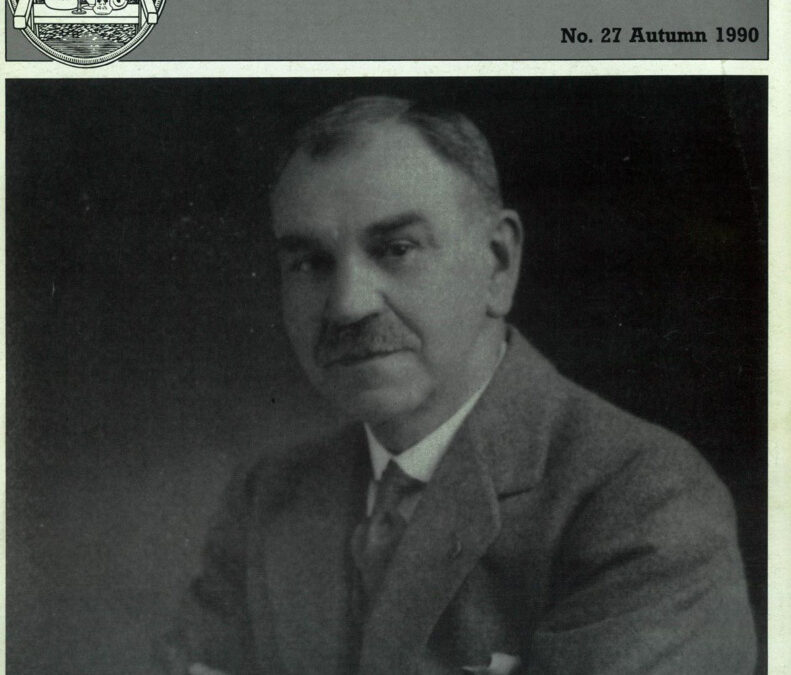
Cover Illustration
Photgraph of Mr Al Allen by
Warrington photographer Thos.
Birtles. (See Showcase article.)
Two Mystery Glasses
I have a weakness for glass
objects of obscure use or method
of construction. Recently, in an
Oxford antiques market, I
acquired an unmatched pair of
heavy champagne glasses,
decorated in a most unusual way.
They bear vertical stripes of a red
surface stain, in which a florid
pattern has apparently been
scribed by hand. Under a lens the
red areas appear quite rough; the
clear areas have not been etched
away, they still bear the sharp
striations of their original
polishing. Does anyone know
when, where and how these
glasses were made? It has been
suggested that they were for
ceremonial use, the bases being
almost of the thickness of firing
glasses.
New Publications
Our member Michael T. Vaughan
has published two monographs on
glass which members can buy
directly from him at 13 The Croft,
Larkhall, Lanarkshire, Scotland,
ML9 lAX. The Origins of Hebrew
Glass”, running to 2,500 words,
costs £4.00 including postage to
UK members and £5 for overseas
members. “Jacobite Glass — The
Risings of 1715 and 1745 in
Scotland”, numbering 2,600 words,
costs the same amount.
Reminiscences
Wheeler’s Manchester Chronicle
Saturday December 15 1827
Valuable Crown Glass Works –
By order of the assignees of a
bankrupt — To be sold by
Auction at the Clarendon Buildings
in Liverpool on Tuesday the 15th
day of January 1828 at one o’clock
in the afternoon, subject to such
conditions of sale as will be then
and there produced.
All those newly erected CROWN
GLASSWORKS, situate at the top
of Falge Lane, within West Derby,
in the road leading from
Wavertree to the Old Swan, and
distant only about three miles from
the town of Liverpool aforesaid,
containing in the whole an area of
about 6,000 square yards of land.
— The buildings, which are all in
good repair, consist of a cone 120
feet high and 60 feet diameter,
containing a furnace for four pots,
four annealing arches, two pot
arches, and other furnaces
complete; a spacious yard,
surrounded by the requisite
buildings, clay house, cutting,
sorting and packing rooms, a pot
room, capable of containing sixty
pots, with flues for heating the
same, proper store rooms, mixing
room, kelp, sandhouse, and
smithy, & c, sixteen cottages for
workmen, a manager’s house,
counting-house, porter’s lodge,
stables, gig-house, and other
requisite convenience. The
premises possess peculiar local
advantages; being about 200 yards
from the Liverpool and
Manchester Railway, goods may
be forwarded to the interior parts
of the country, and coals received
at the works on very easy terms;
and the contiguity to Liverpool
affords great facilities for making
shipments to all parts of Ireland,
as well as for participating in the
extensive trade carried on in that
town.
Also will be offered for Sale by
Auction, on a day that will be
shortly fixed, the MANSION
HOUSE, called Elm House.
COPY DATES
Winter 1990
South East issue — Friday 7th December
Spring 1991
Midlands issue — Friday 22nd February
111
wca se
A Newly Discovered Collection at Flixton
Warrington Museum was very
interested to hear (via a Glass
Association member) about a
collection of glass which belonged
to the last owner of Robinson, Son &
Co, Glassmakers of Warrington, Mr
A. J. Allen (Cover Illustration).
The collection was passed down to
the present owner, Mr. Allen’s
granddaughter, in 1971, by her aunt
(Mr. Allen’s daughter) who inherited
the family home at Stockton Heath,
Warrington. Mr Allen also
presented his granddaughter with a
selection of glassware on her
wedding in 1938.
Part of the collection, consisting of
50-60 pieces, has since been given
to the owner’s daughter. Both
owners live in Flixton and kindly
permitted the Museum to
photograph the collection.
Born in 1855, Mr. Allen was
promoted to the Board of Directors
at Robinsons’ in 1905, after the death
of William Robinson, the last male in
the family to be connected with the
business. As early as 1918 the
factory was under threat, the land
and buildings being sold to
Crosfields, the adjoining soap
factory, for £41,000. Later
withdrawals of assets, and eventual
expiry of leases forced the factory to
close in 1933. The remainder of the
business was taken over by John
Walsh Walsh of Birmingham and
was removed there. Robinsons’
continued to operate under its own
name, in premises adjoining the
Vesta Glassworks. It was not
embodied in the firm of John Walsh
Walsh, although owned by them. Mr
Allen, the sole manager at this time,
moved to Birmingham with a hard
core of workmen. He commuted
daily from Warrington to
Birmingham until his death in 1939 at
the age of 74.
Robinsons’ factory, the ‘Mersey Flint
glassworks’ at Bank Quay, was
founded by Peter Robinson in 1869.
He was previously in partnership
with Edward Bolton at Orford Lane
but availability of rail and water
transport at Bank Quay undoubtedly
made it an ideal and preferable site.
The business gained a reputation for
high quality tableware and they
supplied bulk orders to worldwide
shipping companies, clubs and
hotels. They provided the entire
stock of glassware for refreshments
at one of the late 19th c International
Exhibitions, and during the First
World War made a successful attack
on the German and Austrian
monopoly for electric bulb and
heavy chemical glass.
With the exception of one or two
press moulded items, the Flixton
collection is of finely blown and cut
glass comprising all types of
drinking glass, biscuit barrels,
custard cups, tazza, decanters,
flower vases, dessert dishes, and
marmalade, tobacco, cigar and
pickle jars. It is very typical of
1. Three water jugs Flixton Collection.
Examples of ‘step’ cutting can be
seen on a documented service
made by Perrin & Geddes for
Ralph Wright of Flixton in 1809,
pieces of which are on loan to
Warrington Museum. The striking,
asymmetrical motifs are very
similar to those on decanters made
by the same firm for Liverpool
Town Hall and the Prince of Wales
c.1810
1
. It is interesting to find this
creamer among the collection of
one of the descendants of the much
later Bank Quay Factory of Peter
Robinson and it tempts speculation.
With the inherent problems of
dating and identifying glass, it is
extremely satisfying to be able to
link a collection directly with a
manufacturer. The Museum is,
therefore, particularly grateful to
the present owners of the collection
for providing information and
access to the glass and for their
time and hospitality.
2. Creamer, reminiscent of Perrin
Geddes, glass c.1910. Flixton
Collection.
3. & 4. Press moulded creamer and
corresponding illustration from the
Robinson, Son & Skinner pattern
book (1871-97). Recently purchased
by Warrington Museum.
Robinsons’ production and reflects
their reputation for good quality
tableware. The Museum at
Warrington has identical examples
of the popular straight sided
lemonade/water jugs with cusped
rim (pl 1.). What makes these
pieces significant is that, according
to the owner, the majority (the wine
glasses in particular) were actual
samples from the Robinsons’
showroom. Most of the glass
appears to be of 20th c date, from
the time Mr Allen was promoted to
the Board of Directors. However,
there is a scent bottle engraved
with initials and the world ‘Xmas’
which is dated 1892.
The most intriguing piece in the
collection is a small, heavily cut
creamer (pl 2.). Quite unlike any
known Robinson piece, this jug is
reminiscent of glass made much
earlier by Perrin, Geddes & Co.
Perrin, Geddes & Co managed the
Bank Quay Factory, Warrington’s
earliest glasshouse, from 1805-1824.
The firm was originally established
in 1757 by Peter Seaman and Co.
The creamer is decorated with two
distinct forms of cutting; prismatic
‘step’ cutting around the upper half
and deeply cut, asymmetrical
curves around the lower half.
Recent Acquisitions
Warrington was never renowned
for its press moulded glass nor was
it mass-producing on the scale of
Manchester or the North East. This
accounts for the scarcity of
Warrington pressed glass. With
access to Pattern books and the
invaluable help of two notable
pressed glass collectors from the
Association, the Museum has
recently made considerable strides
in displaying examples of press
moulding in Warrington, acquiring
wares by Robinson, Son & Skinner
of the Mersey Flint Glassworks and
Edward Bolton of Orford Lane.
Purchases over the last few years
include goblets, salts, celeries,
flower troughs, desserts, sugars and
creamers. The most unusual piece
is an opaque white sardine box by
Edward Bolton made in the style of
the china ones usually sold by the
trade’.
2
The play of light passing
through the translucent fin of the
fish enhances the subtle modelling
of the scales making this piece
stand out as an example of press
moulding at its best.
More recently, the Museum has
acquired further Robinson, Son &
Skinner pieces (sucrier, water jug
and creamer) illustrated in their
pattern book for 1871-97 (pls 3., 4.).
More unusual is a flower trough by
Edward Bolton, made in the form of
a boat, complete with stand,
illustrated in an advert in the
supplement to the Pottery Gazette
1877 (pls 5., 6.). From 1850, Edward
Bolton was in partnership with
Peter Robinson at the Orford Lane
Glassworks. The factory was
originally founded in 1798 by
Thomas Kirkland Glazebrook — the
leading figure in the Lancashire
Association of Flint Glass
manufacturers — and, next to Bank
Quay, was the second major
glasshouse in Warrington.
After Peter Robinson moved to
Bank Quay to start up his new
business in 1869, Bolton continued
at Orford Lane. He acquired a new
partner in the 1870s as in 1877 he
registered a design under the name
Bolton, Son and Wood. The
business continued until the 1890s.
Temporary Closure of
Glass Displays at
Warrington Musuem
Owing to a major refurbishment
programme of the temporary
exhibition galleries currently under
way, the glass displays are
unfortunately not accessible at
present. Work should be
completed by December and the
glass display, albeit in an abridged
form (due to provision of a new
doorway), should be re-opened to
visitors early next year.
Notes
1.
‘The Prince’s Glasses, Some
Warrington Cut Glass 1806-
1811’ Vol 2 1987 pp (The Journal
of The Glass Association). The
article includes photographs of
decanters and examples of the
Ralph Wrigt Service.
2.
Advert in the Supplement to the
Pottery Gazette, July 1, 1880,
p.421.
Cherry Gray
Boat Rower trowit and
Stand
5.
&
6. Press moulded boat by
Edward Bolton and corresponding
illustration in advert in supplement to
Pottery Gazette, 1877
ALEXIS SOYER Lot 705 A RARE
It is not surprising that Alexis Soyer
COMMEMORATIVE GOBLET
patented glassware designs in the
1840s (as mentioned in the review of
Jenny Thompson’s book on pressed
glass in The Glass Cone No. 26) for
as a cook, inventor, and organiser of
magnificently elaborate banquets,
his reputation exceeded that of Mrs
Isabella Beeton who devoted close
attention to glass tableware and
table decorations in her “Book of
Household Management”, first
published in book form in 1861.
Alexis Benoit Soyer (1809-1858),
born in France, earned entry into
the “Dictionary of National
Biography”, as did his wife Elizabeth
Emma (née Jones), a prolific painter
of portraits who in 1848 exhibited
140 of her works at the Prince of
Wales bazaar held on behalf of the
Spitalfields Soup Kitchen. Already
famous as cook to members of the
English aristocracy, in 1837 Alexis
Soyer was appointed chef to the
Reform Club which at that time was
temporarily established at 104 Pall
Mall. At the Club he created
probably the most magnificent and
efficient working kitchen in the
country. He resigned from this
position in May 1850 and in the
following year opened a restaurant
which was well patronised but lost
money.
Probably his main claim to fame lay
in his invention of cooking stoves
and the economical preparation of
food, especially in hospitals and for
the troops during the Crimean War
when he co-operated with Florence
Nightingale.
His publications included “Soyer’s
Charitable Cookery or The Poor
Man’s Regenerator”, “Gastronomic
Regenerator, a simplified and new
system of Cookery” (1846), “A
Shilling Cookery Book for the
People” (1855) and “Soyer’s Culinary
Campaign, Being historical
reminiscences of the late war, with
the plain Art of Cookery for military
and civil Institutions, the Army,
Navy, public, etc. etc.” (1857).
“Memoirs of Alexis Soyer: with
unpublished Recipes and odds and
ends of Gastronomy”, compiled and
edited by F. Volant and J. R. Warren,
his late secretaries, was published
in 1859.
H. Jack Haden
The sales reported by John Brooks
are on a somewhat higher plane
than those which take place in
Manchester, where most of the glass
sold in auction is anonymous,
commercial, and boring, However,
at the Capes, Dunn sale of
4th September 1990, there were four
blown goblets either etched,
engraved, or cut, and all from the
same undisclosed estate. One of
them was of great interest to
Manchester members, being
catalogued as by the Ancoats
(Manchester) firm of Percival,
Vickers & Co Ltd. This attribution
was probably arrived at after
consultation with staff at the City Art
Gallery, who would be aware that
the engraver was at one time an
employee of Percival’s, though not
necessarily at the time of
manufacture of the goblet.
The goblet was described as “a fine
‘rare’ commemorative glass goblet
manufactured by Percival Vickers &
Co Manchester, having a round
bowl around which are acid
etchings by J Caffrey, Salford
celebrating the Manchester Royal
Jubilee Exhibition of 1887, showing a
portrait of Daniel Adamson Esq and
titled Manchester Ship Canal, with
faceted stem and a star cut foot 11″
high”.
Although the Capes, Dunn
catalogues do not suggest probable
sale prices, £300 was thought to be
not unreasonable, bearing in mind
its interest to students of Manchester
glass. However, at £280 the bidding
was continuing upwards with no
signs of hesitation until, at £580
(+ buyer’s premium of 111/2%, inc.
VAT), our member who was
attempting to bring it into the glass
collectors’ fold, called it a day, and
the Lot was knocked down to a
collector of commemoratives, who
had no interest either in the factory
or the glass itself, and who
obviously, by his subsequent
behaviour, felt that he had got a
bargain.
Sadly, such purchase funds as are
available to the City Council are not
orientated in this direction, nor –
due to severe financial constraints
— is display space available for
such examples of Manchester glass
as are held by the Gallery, although
it has been suggested that the fund-
raising Friends (of the Manchester
City Art Galleries & Museums)
might be influenced to divert a very
minor element of their resources to
the purchase of significant pieces as
they appear on the market.
Another institution which— from its
title — might be interested is the
(Greater Manchester) Museum of
Science and Industry, but its interest
is mainly in the machinery of
manufacture and its history, rather
than in the artefacts themselves –
with the notable exception of
railway engines and motor cars!
Peter Helm
It is with great sadness that we
have to report the death of Lt. Col.
Reg Williams Thomas on Sunday,
4th November. Many of us will
always remember his enthusiasm
for glassmaking, his eagerness to
help glass scholars, his inspired
efforts to build up the museum
collections at Stevens and
Williams and not least his
constant good humour. We plan
to publish a full obituary about
Reggie in the next issue.
AN ATTRIBUTION EXERCISE
I
became interested in these odd
looking half pint goblets having
acquired several different versions,
and am attempting to deduce their
sources, albeit with only limited
success (pl 1).
The circular deep bowls are plain
taper changing abruptly to a
hexagonal section. The stem is also
hexagonal but offset to that from the
bowl. The plain feet are usually
reworked after moulding.
No. 1 is plain, of a very clear glass,
with the hexagon portions from a two
section mould. No. 2, with an
applied handle, is engraved in a
square
script “A present from
Blackpool”. Is this a clue to their
origins, the North West? The
proportions of this one are different
and the hexagon section is from a
three
section mould.
A 19th c Robinson and Skinner
catalogue shows three of these
designs of “Ale Glass” without
handles. If we can assume catalogue
drawings to be reasonably to scale,
then this second one has very
similar proportions to their “14D”;
also, with this company being at
Warrington, it was one of the closest
glass factories to Blackpool.
No. 3,
also with an applied handle, is
engraved “A Present From
Rochdale”
and has the anchor mark
of
John Derbyshire and No. 249, C
1870s
(p12). This stem and foot are
from
a three part mould but
proportions are different again.
Manchester’s Pressed Glass Mine
produced two more, both with two
applied handles, “Loving Cups”?
One (No. 4) has the same
Derbyshire marks and is obviously
from
the same mould as my No.
3,
but
the other (No. 5) is different yet
again. The foot and stem are from a
two
part mould but not of the same
form as No. 1. This foot is not fire
polished but ground flat
underneath. The bowl is engraved
“Forget Me Not”, plus floral
decoration.
The Percival Vickers catalogue of
1881 has two similar 1/2 pint designs.
No.
1 has very similar proportions to
their
design No. 66 and No. 5 follows
their
No. 58. These two samples also
both have the two section moulded
stems and feet, but No. 5 is 20%
By Peter Beebe
heavier and not the clarity of No.
1,
so may not be from the same source.
I
thought determining weights, glass
densities and reaction to ultra violet
light would provide useful
comparisons especially against
other known pieces of similar
vintage, but no, four have very
similar densities indeed, with one of
the Derbyshire samples being 10%
greater (No. 3). Under UV light the
same Derbyshire one is the odd one
out, giving a much lower yellow/
green hue, typical of flint glass, so
Derbyshire obviously changed their
composition (or the moulds changed
hands). So we could have four or five
manufacturers.
As handled drinking vessels, they
are definitely not “user friendly” as
the
height produces a
very
Detail showing the JD anchor mark
inside a handled half-pint goblet with
an engraved inscription ‘Remember
Me’ John Derbyshire, Manchester,
c 1870s. Private Collection.
unbalanced feel.
I
suspect with their
deep plain bowls, they were
intended for engraved souvenirs.
Are there any more out there?
I would be interested in hearing
from anyone with evidence as to
their origins, otherwise watch this
space, the saga may continue.
Finally, I am grateful to Eva Frumin
and Jim Edgeley for the loan of two
samples.
SALEROOM REPORT SEPTEMBER
1990
The summer months are a generally
quiet period in the world of antiques
fairs and the salerooms. As a
consequence there are fewer sales
with glass interest to report on but
among them have been one or two
interesting and unusual items which
seldom turn up in the salerooms
these days.
There have been no major sales of
English glass but small amounts
have turned up in provincial sales. If
price per lb. was a criterion the most
valuable piece would certainly be
the scent bottle which was sold in
Lincoln in May. This was a small,
blue, diamond facet cut scent bottle
with flat sides and a gold screw cap,
only 21/2″ high. It sold for £2,650 and
this price must be due, in large
measure, to the delicate,
polychrome enamelling of birds,
flowers and insects on each side, its
fine condition undoubtedly the
result of being in its original
shagreen case. Scent bottles of this
type and with this style of decoration
are usually attributed to the
workshop of James Giles, a London
decorator of the later 18th century.
More coloured glass was sold in
Exeter in June when 25 lots of so-
called ‘Bristol’ glass were offered.
The highlight of this collection was
the £2,800 paid for eight amethyst
wine glass rinsers, all with matching
gilt decoration which included a
family crest. The one item that could
fairly have been considered to have
been made in Bristol was the blue
spirit decanter signed on the base
“I.
Jacobs Bristol No. 8″ The Jacobs
family worked in Bristol as cutters,
decorators and finally
manufacturers at the Non-such
Glassworks from about 1760 until
1820. This decanter beat its estimate
of £60-£100 to realize £1,200.
Another group of English drinking
glasses from the collection of the
late Frances Dickson was sold at
Leominster in July.
The most interesting of these was a
sweetmeat glass with a double ogee
bowl and an opaque twist stem. This
is a well known type but what set it
apart from any other I have seen was
the fact that the opaque threads in
the stem extended up through the
bowl. At £420 it looked like a very
good buy for someone.
During the latter part of the 19th
century there was a vogue, on the
Continent, for objects with a Middle
Eastern flavour. Gallo produced
many decorative enamelled vases
in this style and Brocard of Paris
showed
–
copies of 15th century
mosque lamps at the Paris
exhibition of 1871. Lobmeyr of
Austria showed a group of Islam
inspired vases at the Paris
exhibition of 1878, and originating
from about this period was the small,
elaborately enamelled vase, based
on a mosque lamp, that appeared in
a London sale in June. Only 61/2”
high, it fetched £4,200.
Turning to another type of French
glass; up to 15 years ago there used
to be regular sales of paperweights
in London but they now appear
irregularly. The emphasis of
collecting seems to centre on
France and America and it was in
New York in July where some high
prices were made for rare weights.
A Clichy magnum basket weight
made a record $235,000 (almost
£137,000). A Baccarat weight with
ducks on a pond came back to
England at a price of £24,500 and a
signed and dated St. Louis millefiori
weight made just over £15,000.
There was some glass at a house
sale in Norfolk in June and a long
way from home were a pair of blue
Peking glass bowls carved with
figures in a landscape. I find it very
difficult to decide whether single
colour Chinese glass is 19th or 20th
century but someone was happy
with these as they went well over
estimate to make £1,200.
Later decorative glass remains
popular and none more so than that
coming from France. High prices
were reported for Daum and Calle
glass but the work of one glassworks
has turned up very regularly during
the last three months. I refer to
examples from the Lalique factory.
His early experimental studio work
commands understandably high
prices but most of what appears in
the salerooms is the commercial,
moulded glass dating from after the
first world war. Some of these
patterns turn up regularly and
always seem expensive to me for
what they are. Here are some
examples.
In June an ‘Ondine’ bowl moulded
with nude female figures made £750
while a bowl titled Coquilles’ made
£300. This must be Lalique’s best
known pattern since so many
lampshades were made in this
pattern during the 1930s.
In July two bowls moulded with a
band of parakeets on a background
of foliage made £2,300 and £2,400.
Although the latter was twice the
size of the former, the similarity of
the prices was due to the smaller
example having its background
stained blue.
At the same sale a ‘Calypso’ bowl
(another one with nude figures) in
opalescent blue made £3,800.
In August two more ‘Ondine’ bowls
turned up at different sales and
made £1,000 and £1,200. A free-
standing plaque called ‘Suzanne’
(yet another nude figure) made
£12,500. A small vase titled
‘Rampillion’ sold for £1,500. This is
interesting because its pattern of
diamond shaped bosses on a floral
ground must take its inspiration from
the ‘Claw’ beakers made in northern
Europe from the 5th-7th centuries.
J.A. Brooks
THOMAS WEBB CLOSES
On Tuesday, 13th November the
news was announced that glass
making at Thomas Webb’s was to
stop after one hundred and fifty
years of production. The closure
of this famous works was
expected after the bankruptcy of
the Coloroll group but it was
hoped that a buyer would come
forth and rescue the firm.
Eventually the Edinburgh Crystal
and Thomas Webb factory were
acquired by a management
buyout with the result that all
glass production will be centred
at the Penicuik factory with the
Stourbridge site used for
warehousing, distribution and
administration. As a result of this
decision 69 employees will be
made redundant. It remains to be
seen how long the warehousing
and distribution posts, employing
131 staff, will remain in
Stourbridge.