




The newsletter of the
Glass Association
Registered as a Charity No 326602
Chairman:
Anthony Waugh
Hon. Secretary:
Roger Dodsworth
Editor:
Charles Hajdarnach
Address for correspondence:
Broadheld House Glass Museum,
Barnett Lane. Kingswinford,
West Midlands DY6 9QA.
Tel. 0384 273011
ISSN 0265 9654
Printed by Tones & Palmer Ltd., Birmingham
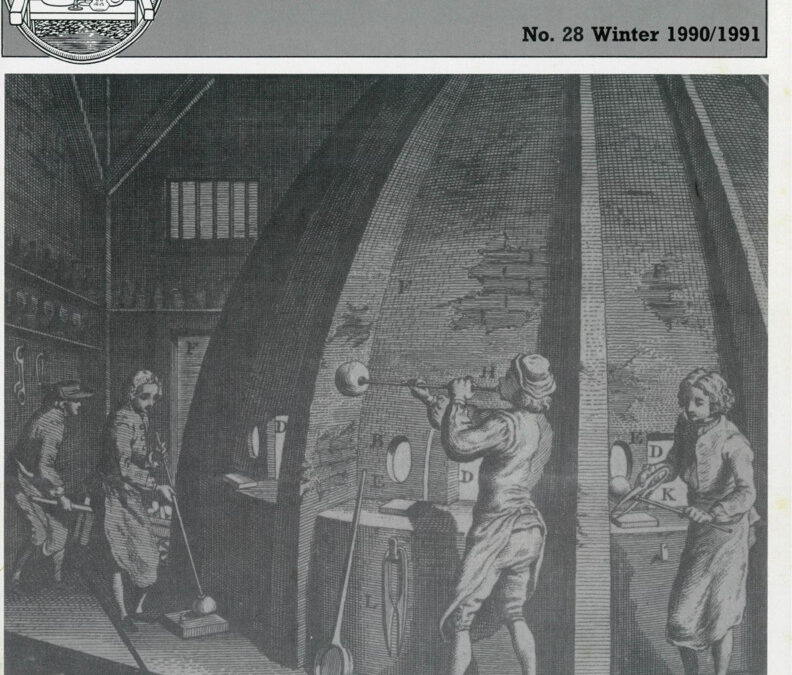
Cover Illustration
The Glass-Makers at Work.
Printed for J. Hinton at the Kings
Alms, St. Paul’s Churchyard. 1747.
Photo courtesy of The British
Library.
Glass Mortar and Pestle
Do members know of any other
examples of this piece? It is about
8 inches high, and made from
opaque green glass. Please
contact Richard Gray, the
Director, Manchester City Art
Gallery, Mosley Street,
Manchester M2 3JL.
Third Glass Collectors
Fair
19th May 1991
The third Glass Collectors Fair
will take place at The National
Motor Cycle Museum near to the
N.E.C. Birmingham on Sunday 19th
May 1991 between 11 am and
5 pm (trade admitted 9.30 am). It
has been chosen as the venue for
the next Glass Collectors Fair
because of its geographical
location with easy access by road,
rail and air, and the purpose built
large ground floor rooms and
more than ample car parking
facilities. It is expected that at
least 45 dealers specialising in
collectable British and Continental
glass will participate in this quality
event exhibiting glass from the
18th Century to the present day.
For further information please
contact the organiser Pat Hier (Tel
0260 271975).
Exhibitions
LLANGOLLEN
ECTARC
Castle Street
Clwyd LL20 8RB
0978 861514
Contemporary Glass Collection.
The current exhibition focuses on
the collection of European studio
glass built up over the last five
years by the Ulster Museum. The
mastermind behind the collection
is Michael Robinson who must be
congratulated for assembling a
stunning group of glasses by
internationally acclaimed artists.
Although British, Swedish,
German, Italian, French and Dutch
artists are represented, the
emphasis of the collection is on
Czechoslovakian glass designers.
In an erudite and witty lecture at
the opening of the exhibition on
14th December Michael Robinson
explained his preferences for
Czech glassmakers, most of whom
featured in his top ten list of all
glass artists. Notable by their
absence from that list were some
of the current fashionable
American glass artists.
The Ectarc gallery, whose name
stands for European Centre for
Traditional and Regional Cultures,
plays host to the collection until
20th June 1991. The show then
travels to other centres in Wales.
The shame is that there is no
English venue for this superb
collection.
Open Mon-Fri 10-5, closed 12-1.
Sat 10-5, closed 1-2. Sun 1-5.
Admission free.
LONDON
JEANETTE HAYHURST GALLERY
32A Kensington Church Street
W8 4HA
071-938 1539
Once Upon a Time…
Eight new cameo works by
Stephen Andrew Bradley and his
interpretation of the Portland
Vase.
23 March-27 April
and at
Broadfield House Glass Museum
6 May-16 June
The Association for the
History of Glass
August 1991 will see the next in the
series of tri-annual international
congresses, organised by the
Association for the History of Glass.
After the successful eleventh
congress in Basle in 1988, next
year’s venue is Vienna at the
Kunstgewerbermuseum. The dates
of the congress are 26th to 31st
August with registration taking
place on Sunday 25th August. There
will be some seven to nine working
sessions of papers covering, as
usual, a wide range of the history
and technology of glass, along with
a full day devoted to contemporary
glass, and an excursion, it is hoped,
to Jack Ink’s (formerly Lobmeyr)
shop in Baden. As is the custom,
there will be special glass
exhibitions organised in
conjunction with the congress.
Participants will also be most
welcome to take advantage of a
post-congress tour to Budapest via
Graz which will also include visits to
the porcelain factory at Herend,
Esterhazy Castle in Northern
Hungary, the Roman city of
Carnuntum and neighbouring
Petronell House.
A more detailed programme of
events and conference information
will be available in the Spring, and
anyone interested in attending
should contact Dr. Patricia Baker,
the Honorary Secretary of the
British branch of the Association for
the History of Glass, at 3 Winton
Road, Farnham, Surrey GU9 9QW.
The Annales containing the
proceedings of the Basle congress
have just been printed and are
available for purchase; for further
details, again contact Dr. Patricia
Baker.
COPY DATES
Summer 1991
North East issue —
Friday 7th June
Autumn 1991
North West issue
— Friday 6th September
18th & 19th Century Canal Commemoratives
commemoratives. The opening of
key sections was always an event of
some importance and local
celebrations were often extensive.
The canal era started in South
Lancashire and North Cheshire.
P1.1.
Bearing in mind the importance of
transport in the development of
Britain in the eighteenth and
nineteenth century, I always find it
rather surprising how little roads,
canals and railways feature in
Manchester was the magnet with a
growing industrial base and a need
to move coal there cheaply.
Turnpikes were expensive and the
rivers unnavigable. At first the rivers
were improved by locks, cuttings
and a towpath. The Mersey and
Irwell was enhanced in this way and
was commemorated by a plain stem
Goblet dating from around 1780,
now in Warrington Museum. This
shows an engraving of a horsedrawn
barge and the inscription “Success
to the Old Quay Packer”. This
presumably refers to the Old Quay
in Warrington which, until the
middle of the eighteenth century,
marked the limit of navigation
where the Mersey ceases to be an
estuary. Starting in 1721 the river
had been erratically improved from
that point to form the “Mersey and
Irwell Navigation”. The Packer glass
cannot be linked with a specific
event but the date of circa 1780
places it near the beginning of
competition between the true canals
and the improved rivers. The first
true canal is always taken as the St.
Helens Canal opened in 1754 but I
would be surprised if any
commemorative was produced.
Work on the Bridgewater Canal,
which started the canal boom,
commenced in 1758, on a line
parallel to the Mersey and Irwell
Navigation. The construction of the
Barton Aquaduct carrying the canal
over the Mersey was one of the
great engineering feats of the era. It
was demolished in 1892 to be
replaced by the Barton Swing
Aquaduct over the Mersey and the
Ship Canal. Neither appear to have
produced a commemorative.
However, as the first engraved glass
commemorating the famous bridge
at Ironbridge, a mid 19th century
Cylindrical Ale, only surfaced at
Christies in June 1988 (Lot 88),
perhaps there is still hope. The
application for Parliamentary
approval for the extension of the
Bridgewater in 1760 starts by stating
that the Duke of Bridgewater “bath
already begun a Sough or Level”.
This shows that the word canal was
not the only word in common use
and one wonders if many canal
glasses are unrecognised.
P1.2.
P1.3.
Alternative names for soughs or
canals were levels, navigations or
cuts. I would dearly like to trace the
rummer referred to as a mystery
engraving in Lloyd Ward’s book
“Investing in Georgian Glass”
inscribed “Success to Nent Force
Level” as this was a canal near
Alston in Cumberland on which
construction started in 1776.
As the canal network extended it
became increasingly a question not
only of linking raw materials to
industrial production but of creating
a network linking the various river
systems and thereby the ports.
Although the “canal mania” of the
1790s led to canal projects all over
the country, it is not surprising that
the first such successful link was
again in the North West despite the
problem of crossing the Pennines.
On 27th December 1804 The Times
reported “On Friday the Rochdale
Canal, which completes the line of
inland navigation from the Irish
Channel, Liverpool, and the
German Ocean, at Hull was opened
in great style”. This report, and
earlier reports in local papers talk
of multitudes on the banks as two
ceremonial yachts progressed
down the canal, followed by a
procession through the streets of
Manchester by “workman and
gentlemen” wearing “in their hats a
Blue Ribbon with the inscription in
gold letters ‘Success to the
Rochdale Canal’. The article goes
on to report that “eighty gentlemen
partook of an elegant dinner
provided for the occasion, many
appropriate toasts were given”.
One wonders if the rummer in Plate
2. was produced for this dinner.
Certainly it is a good quality glass
suitable for such an occasion and
everything about it fits with the 1804
opening and the Press descriptions
of the event.
The “golden age” for canals, in
profit terms, was the 1830s and
1840s before railway competition
drove down prices. By then the
Midlands had become the hub of
the system with certain strategic
links able to make very high
charges. The decanter in P1.1.,
which is one of a pair, together with
a set of engraved glasses marked
CCC for Coventry Canal Company,
belong to this era and could well
have been from the Company
Board Room which was enjoying a
very prosperous period, rather than
being for a specific
commemorative event. From 1850
canals had little to celebrate, and
began to lose an unequal struggle
with the railways who frequently
purchased key sections to restrict
competition.
The final fling of the canal era was
back where it all started. The
Manchester Ship Canal, opened in
1894, followed the same line as the
Bridgewater Canal, and the Mersey
and Irwell before, but with yet
larger vessels. This event probably
generated more glassware in total
than the rest of the canal era put
together. Almost all are pressed
glassware, of which dishes marked
“Success to the Ship Canal” round
the edge and a centre showing a
ship marked “Opened 1894” are the
most attractive P1.3. I feel sure that
there must be in existence some
higher quality glassware
celebrating the event or perhaps
something more picturesque
similar to the ceramic beakers
which do exist with attractive views
of the various locks and vantage
points.
John Delafaille
Uncertain Future For Hutton Paintings
In
mid-October 1990, local papers
in
the Farnham area, some 38 miles
south-west from London and close
to
the army town of Aldershot,
carried the news that the town’s
largest employer for more than fifty
years, Crosby Doors, is to move out
in
March 1991 and the ten acre site
which the works now occupy is to
be
redeveloped, probably as a
shopping centre. The closure of a
small factory resulting in the loss of
200
jobs is unfortunately now a
familiar story over much of the
United Kingdom, but the demolition
of
these works does have a special
interest for those keen on 20th
century British glass, for the Crosby
Doors factory canteen has been
decorated for many years with four
large
paintings by John Hutton
(1906
–
1978),
the New Zealand-born
glass artist-engraver, famous for his
huge West Screen windows in the
new
Coventry Cathedral
consecrated in 1962.
In
the closing months of the Second
World War, Hutton was posted from
the
Middle East to Farnham as the
head of the Army School of
Camouflage. His second-in-
command was a young architect
Basil Spence, later responsible for
the rebuilding of Coventry
Cathedral. Hutton got to know Basil
Crosby, then in charge of the local
bomb disposal squad and as a
result of a conversation, presented
the works with these four 6′ long
panels depicting Crosby staff
making, among other things,
ammunition boxes and torpedo
frames as part of the war-effort. Two
colour illustrations showing details
of two of the panels have been
included in the recently published
book on Hutton by Margaret
Brentnall (John Hutton: artist and
glass-engraver, Art Alliance Press,
1986) and the Glass Cone here
reproduces part of another,
previously unpublished. As
reported in the local newspaper
Surrey & Hants News (30 October
90), Gordon Hyam, formerly
Crosby’s personnel manager, can
remember Hutton coming into the
works to make preliminary
sketches, and also the paintings
being handed over by the artist in
1946. He is sure he can identify two
of the factory workers, and another
local paper, the Farnham Herald,
following up the story, has asked
readers to contact the paper if other
people in the paintings can be
named.
John Hutton had another connection
with the area for in 1955 he was
commissioned to produce
engraved plate-glass lunettes
depicting angel musicians for
Guildford Cathedral, some six miles
from Farnham. Five years later, just
before its consecration in 1961, he
designed the Sentinel figures for
the doors at the West end which
utilised the techniques of sand-
blasting, brilliant- and wheel-
cutting which were to be exploited
so well at Coventry. More of his
work can be seen at Stratford-on-
Avon’s Shakespeare’s Centre,
Runnymede (the Memorial, 1953),
Plymouth
Civic Centre
(1962) and
New Zealand House, London
(1963).
With the planned demolition of the
Crosby Doors factory, the future of
the four paintings remains
somewhat uncertain at present but
Bob Clements, the site-manager, is
determined they should survive.
Happily with the current publicity
and awakening of local interest, it
seems these panels will find a safe
home, probably in the local Arts
centre, the Mailings.
Patricia Baker
The Glass Cone would like to thank
the Editor, and the photographer of
the Surrey & Hants News for their
permission to use the photograph,
and the information carried in
recent
issues
of the paper.
One of four
painted panels
by John Hutton,
c.1946, 6′ long,
Crosby Doors
factory,
Farnham,
Surrey. Photo
courtesy
Surrey and
Hants News.
1879 11th August
1888 19th October
1889 21st January
1889 9th February
1889 22nd June
1980 11th February
1890 28th February
1891 9th April
1893 1st March
1893 10th June
1893 4th October
1894 30th May
1894 10th December
1895 2nd March
338093
(Glass Side of Top Light)
111661
(Owl)
117815
(Sitting Chicken)
119318
(Bull’s head Indistinct)
127515-6
143884
(Jug)
145008
169410
(Dish)
208367
213374
(Jug)
219638
(Goblet with thumb print
pattern round the middle and
vertical raised lines to top half
— Classical shape)
233062
(Sugar)
245720
(Sweetmeat dish — leaf
shape)
250515
(Sugar semi-imit. cut raised
pattern in blocks)
117815
39415
Further comments on Matthew Turnbull
and Edward Bolton
By Jenny Thompson
It gave me great pleasure to read
the article in The Glass Cone No. 26
on the minor Sunderland Flint glass
makers and concerning Matthew
Turnbull.
I am enclosing from my notes the
Turnbull registrations and the
Design Registration drawing of his
“Sitting Chicken”. I have often
wondered whether it was the
prototype for all the world wide
sitting chickens, including those in
‘carnival’ glass! The owl is similarly
alert looking and ‘feathered’.
The domestic items of the 4th
October 1893 registration are good
quality pieces of classical shape.
The cream jug is average size, but
the sugar bowl is even larger than
most of the Sowerby or Davidson
ones.
It was equally fascinating to read in
The Glass Cone No. 27, about the
Edward Bolton boat flower trough
and stand as illustrated in the 1877
supplement to the Pottery Gazette. I
have what I believe is an Edward
Bolton boat but the glass rod stand
is much sturdier and more
elaborate. Possibly this is because
the boat’s size is 15 inches in length
and the glass rods extend an inch or
so beyond the boat — The 39415
4
111111111
n
VIIIINCAj
w”
Matthew Turnbull
Cornhill Glassworks, Sunderland
.. O .0 • OA • • • • 111.11,,••
……. …..
registration of 11th December 1885
has a similar pattern to the boat with
vertical lines and bobbles — so it is
reasonable to suppose that the
flower boats and troughs were
made for many years between the
late 1870s through to the late 1880s,
in varying shapes, with the same
pattern as a concurrent theme. It
would be interesting to know
whether the 39414 registered glass
boat had a similar stand, or a
Sowerby type one?
The Design Registration
representations are acknowledged
as being in the custody of the Public
Record Office.
SALEROOM REPORT
I
am occasionally asked for my
opinion on the investment
possibilities of collecting glass and
while I view this as incidental to the
pleasure of collecting it is always
comforting to know that the money
invested in one’s hobby is generally
holding its value against inflation.
Although the antiques trade
generally is feeling the effects of the
current depression collectors are
still active and some Continental
glass offered at a recent sale
provided a good opportunity to
make some precise comparisons in
the way prices have increased over
ten years.
One of the most important
collections of European glass to be
sold in recent years was the Krug
collection which was sold by
Sotheby’s in four parts between
1981/1983. Twenty four items from
the first two parts of those sales
appeared in a sale at Christie’s on
the 16th October and only one lot
failed to sell. Including the 10%
buyer’s premium the earlier total
selling price for the 24 lots was
£26,939. The total price realised in
this latest sale was £67,925 or 21/2
times the cost in 1981. If the former
sum
had been invested, it would
have required a compound interest
rate of about 101/2% to produce the
latter amount today. Although
interest rates are currently running
at that sort of figure one should
remember that inflation and interest
rates fell sharply during the mid ’80s.
Inflation since 1981 has resulted in
prices being generally about 55%
higher today.
In spite of the success of the Krug
glasses nearly 25% of the 100 lots of
European glass failed to find a buyer
and I believe one may draw some
conclusions from these facts. If you
must buy for investment be
prepared to pay good prices for the
rarer items, particularly those with a
good provenance. Be patient and do
not expect to resell them too
quickly. Saleroom buyers are
suspicious of goods which reappear
too
soon or too frequently.
What of English glass in the same
sale? It is difficult to compare them
on the same basis as the Krug glass
since none of the lots offered gave
references to previous sales but of
the 165 lots of English glass only
about 10% failed to sell. Plain stem,
facet stem and standard patterns of
opaque twist glasses made prices in
the £60-£120 range which are far
higher than 10 years ago but seem to
have advanced very little in the last
12 months. Prices for baluster stem
glasses, at £600-£1, 000, were a little
lower than at the Sotheby’s, West
Green House sale in May but that
was probably to be expected since
there is often an atmosphere at
country house sales that prompts
bidders to be over enthusiastic.
Looking back to the catalogues of
1981 one can get an idea of price
levels at that time. Heavy baluster
wines at about £200-£250; light
baluster wines at £150-£200; opaque
twist wines at £45-£60; cordials and
ales on tall stems about £60-£80;
facet stem wines about £25-£30. On
this evidence prices for English
glass today are 2-3 times higher than
in 1981 and compare favourably
with the appreciation in European
glass noted above.
Prices remain high, however, for
unusual styles of glass, anything with
commemorative or interesting
decoration and, of course, good
provenance. One glass, in the
Christie sale, which met all these
criteria was a Jacobite ‘Amen’ glass
which once belonged to the Earls of
Breadalbane. It sold for £26,400 but
might still be considered a ‘good
buy’ when it is recalled that, four
years ago, another ‘Amen’ glass
owned by the same family sold for
£28,600. Other, less important,
Jacobite glasses made from £528 to
£1,430.
Interestingly engraved tumblers,
once hard to sell, made good prices.
Two with sailing ships on them
fetched £418 and £352. An Absolon
of Yarmouth barrel shaped tumbler
engraved with a view of Yarmouth
church and an inscription made
£880 (about four times the price it
would have made 10 years ago).
Five Williamite’ glasses made
prices ranging from £880 to £1, 760
and, generally speaking, the
decorated
glass exceeded
estimates while more ordinary
glasses sold within or a little below
estimate. Sales at Sotheby’s or
Christie’s are always good pointers
to the general health of the market in
antique glass and the one discussed
above gave cause for reasonable
optimism.
Elsewhere, Neales of Nottingham
held a sale in November with a
section devoted to a collection of
Masonic memorabilia which
contained some interesting glass.
This is a rather narrow field but
three or four dealers competed with
as many private collectors to
produce some good prices. Two
dram glasses on firing feet with
enamelled decoration made £1,540
and £1,100 while the engraved
glass, consisting mostly of tumblers
and rummers, went for between
£100 and £350.
Prices for good Art Nouveau glass
by the famous makers, Galle Daum,
Lalique and Tiffany remain very
high, supported no doubt by a
continuing strong interest from
Japan. As I have remarked before,
these high prices for the rarities
inevitably drag up the prices of the
more mundane and commercial
examples in their wake.
John Brooks
December 1990
Continued from page 8.
available from: The Honorary
Secretary, Society of Glass
Technology, 20 Hallam Gate Road,
Sheffield S10 5BT or The Honorary
Secretary, Worshipful Company of
Glass Sellers, 43 Aragon Avenue,
Thames Ditton, Surrey KT7 OPY and
entries must be submitted by 30th
June 1991.
OBITUARY
Lt. Col. R. S. Williams-Thomas DSO.,
It was with great sadness that the
glass industry learnt of the death
of Lt. Col. Reginald Williams-
Thomas on the 4th of November
1990.
Better known to his workforce as
Mister Reg and to his close
friends as Reggie, he will always
be remembered for his great
enthusiasm and joie de vivre
which he brought to his many
activities. Born on 1 1 th February
1914 and educated at
Shrewsbury and the University of
Birmingham, Reg had a
distinguished war record during
which he was awarded the Croix
de Guerre for gallantry by the
French Government, and the
Belgian Order of the Crown in
TD., DL.
recognition of the part he played
in the post-war stabilisation of
that country. After the war he
returned to Royal Brierley
Crystal where he was to become
Managing Director, Chairman
and President before he retired
in 1985. In the immediate post-
war years the Stourbridge glass
industry faced many problems
but Reg, with his managerial
skills and warm regard for his
staff, was able to re-establish the
trade and steer it in new
directions. In later years he was
the inspiration behind efforts to
increase the works glass
museum, buying not only the
firm’s 19th century products but
also acquiring splendid
examples of the glass-cutter’s art
from the 18th century. His
dedication to his own glass
history is apparent in his book
The Crystal Years.
Among his many hobbies,
archery, shooting and fishing
were most prominent but he also
enjoyed gardening, philately
and cooking. His last activity was
a shooting trip with friends in
Wiltshire.
Reggie was a warm-hearted,
generous and helpful person
with a mischievous sense of
humour who we shall miss
dearly. He will always have a
warn place in our affections.
C. R. H.
th Regional Reports
National Meeting: Liverpool,
15th September, 1990
The 1990 autumn meeting of the
Association took place at the
Liverpool Museum, part of the
complex of museums which make
up the National Museums and
Galleries on Merseyside. The day
offered an opportunity to see
something of the rich collections of
glass in Liverpool, which are mostly
held in store.
We were welcomed to the museum
by Lionel Burman, Keeper of
Decorative Arts. Very helpful
introductions to the collections of
ancient glass and European glass
were given by Fiona Philpott,
Curator of British Antiquities, and
Alyson Pollard, Curator of
Metalwork. Members were then
provided with maps to seek out the
glass on display in the maze of
galleries which form the Liverpool
Museum—most seem to have had
little trouble in resisting the
attractions of early locomotives,
swordfish and masks from Oceania
to track down the quarry! Lunch was
a smorgasbord buffet in the
Maritime Museum, and then it was
back to the glass — this time pieces
brought out from store for us to
handle. Museum staff had selected a
range of glasses of interest from the
ancient world, the English
eighteenth and nineteenth century
collections and the continental
collection. The Roscoe collection of
English eighteenth century glass
provided a particular highlight –
envious eyes were cast over some of
the early balusters, which are
perhaps the stars of this collection,
formed in the 1910s and 1920s.
We also heard during the day of the
massive programme of
documentation under way in
Liverpool and of the plans to
relocate the glass in open storage so
that it becomes more accessible to
the public. Members were thus
perhaps more able to appreciate
the problems museums have in
looking after their collections and to
realize that moves are afoot, through
the use of computer databases for
example, to provide better
information on collections which
have largely to be kept in store.
At the end of the day Greville Watts
thanked the museum staff for the
work they had put in to organize the
event. It was a delight to be able to
handle superb pieces and to sense
the care and enthusiasm which goes
into the job of curating them.
The Worshipful Company of Glass
Sellers of London Award 1991 –
Art and Craft
In 1674 George Ravenscroft, under
the patronage of the Glass Sellers
Company, and in a workshop
situated where the Savoy Hotel now
stands, effected a process for the
manufacture of lead crystal glass.
The Glass Sellers Company has
continuously patronised the art,
craft, science and technology of
glass and has recently consolidated
its patronage in the form of the
Worshipful Company of Glass
Sellers of London Award.
Entries are now invited for the
above Award which is available to
persons resident in the United
Kingdom, who will be judged by the
Adjudicating Committee to have
made an outstanding contribution to
the art and craft of glass during, say,
the past two years.
Entries may, for example, take the
form of relevant publications in the
areas outlined above or works of art
or design. The Award consists of a
suitably inscribed scroll and trophy
and a cash sum, it is hoped that some
of the pieces submitted may be
exhibited. Application forms are
Continued on page 7