




“har
n
ered
Surveyors
land &
Estate
Agents
.
s{
Valuers
The newsletter of the
Glass Association
Registered as a Charity No. 326602
Chairman:
Anthony Waugh
Hon. Secretary:
Roger Dodsworth
Editor:
Charles Hajdamach
Address for correspondence:
Broadfield House Glass Museum,
Barnett Lane, Kingswinford,
West Midlands DY6 9QA.
Tel: 0384 273011
ISSN 0265 9654
Printed by Jones & Palmer Ltd., Birmingham
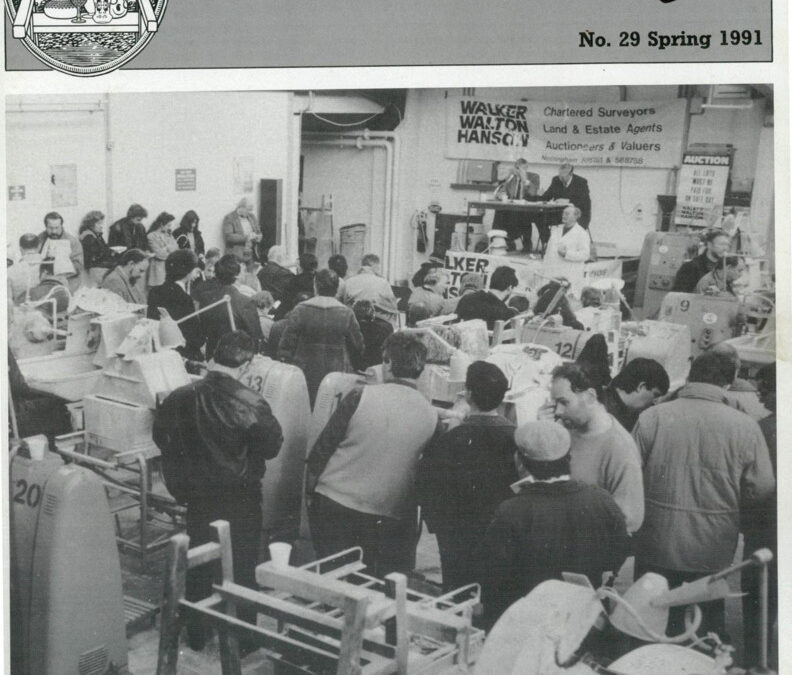
Cover Illustration
The end of 150 years of
glassmaking at an Amblecote
glassworks. The Nottingham
auctioneers Walker, Walton and
Hanson conducting the sale of
equipment in the cutting shop at the
Thomas Webb factory on Thursday
24th January 1991. See Showcase
article.
Exhibitions
LONDON
OPUS# 1
25a Maddox Street
W1R 9LE
071-495 2570
Festival of Contemporary Glass ’91
U.S.A. and is in various public
collections worldwide.
Monty is the name of the Jack
Russell owned by Ronald Pennell,
another exhibitor in the Festival.
Ron Pennell is a highly imaginative
glass engraver who is always
looking for new challenges His
exhibit at the Festival may be one
of the last glass pieces produced
by this master craftsman, since he
is being drawn into the new
direction of wood-carving. Like all
of the accomplished artists in the
Festival of glass he manages to use
his medium to enhance the
spiralling pciture he etches around
the vessel. And the significance of
Monty? — in nearly every picture,
space is found for Ron’s faithful
friend.
With blown, cast, kiln-worked,
fused and engraved glass, any
visitor to the show will not fail to
see that glass is moving into a new
chapter in its history. OPUS#1 feels
that the 90s will prove to be a new
golden age for British glass
following the international interest
that the medium is presently facing.
Open 10 July — 17 August
Mon-Fri 10-5.30; Thurs until 7.30
Sat 11-5.30. Closed Sunday.
MIDDLESEX
Syon House
Brentford
081-560 0881
“Light forms”
Contemporary British Kiln-Worked
Glass
Organised by the Angel Row
Gallery in Nottingham, the touring
exhibition is the first major showing
devoted solely to glass worked in
the kiln. The artists taking part are
Tessa Clegg, David Reekie, Maria
Amidu, Gayle Matthias, Karen
Vincent, Ann Martin, Keith
Cummings and Colin Reid
27 June — 24 July.
Conference News
BRITISH ARTISTS IN GLASS
The annual British Artists in Glass
conference will be held this year at
Lancashire Polytechnic from
September 19th to 21st. Guest
speakers include Jan Erik Ritzman,
glassmaker from Sweden, Sien van
Meurs, glass artist working in
Holland, Alexander Belashenko,
Morag Gordon, Christina Kirk, John
Cook and stained glass artist Mike
Davis. Lancashire Polytechnic is
situated in Preston and during the
conference tours will be arranged
to places of interest in the area
including the Pillcington Glass
Museum and the Tiffany Museum in
Accrington. More details from
aAG.,
c/o Broadfield House Glass
Museum.
SYMPOSIUM —
The
King’s Table
Victoria and Albert Museum
14/15 September, 1991
OPUS# 1 will be holding The
Festival of Contemporary Glass ’91
from July 10 until August 17,
following upon the success of last
years Festival. It is envisaged that
this event will become the major
yearly showcase for the British
studio glass movement.
As part of the whole event there
will be video film presentations,
lectures and artists’ presentations.
Exhibiting as part of the Festival are
the Sunderland Polytechnic Glass
and Ceramics Degree students.
With the showing of their final year
work, the visitor will be able to
view exhibits from a new
generation of artists.
This year’s Festival has among its
participants several artists of
international renown and offers a
rare chance to see a selection of
work usually destined for overseas
collectors.
One such artist is Amanda
Brisbane, who has sold in numerous
countries from Malaysia to the
Fifteenth National Selected
Exhibition of Engraved Glass by the
Fellows, Associate Fellows and
Craft Members of the Guild of Glass
Engravers
Sponsored by the Royal Bank of
Scotland, the exhibition this year
will include work by Laurence and
Simon Whistler, Peter Dreiser,
David Prytherch, Alison Kinnaird,
James Denison-Pender, Hilary
Virgo, Madeleine Dinkel, David
Peace, Peter David, Jennifer
Conway, Gillian Cox, Jane Webster,
Tracey Sheppard, Jacques
Ruijterman, Pat Chaloner, Sally Scott
and many more. Most of the items
will be for sale and the majority of
engravers accept commissions.
30 June — 25 July
12 noon-5 p.m. Sunday to
Thursdays.
ST HELENS
Pillcington Glass Museum
Prescot Road WA 10 3’11
0744 69 2499
This is the second meeting of an
international group of Art Historians
and Curators who are studying
every aspect of Royal Dining; the
silver, porcelain and glass, how
tables were laid and decorated,
how wine was served, the role of
servants and etiquette, etc.
This session is held to coincide with
the London showing of the Danish
Queen’s 18th century French silver
dinner service at Kensington
Palace. There are Essays in the
Exhibition catalogue on the
evolution of the dinner service, the
English visit of Christian VII of
Denmark in 1768 and a comparison
of Danish and French tableware.
Members of the Glass Association
are invited to attend this symposium
for which a small fee will be
charged. Application forms are
available from the Metalwork
Department, Victoria and Albert
Museum, South Kensington, London
SW7 2RL.
Pl. 1. Interior of the Webb blowing shop with the two pot furnaces and a row of
cullett trolleys.
P1. 2. Two pot changing ‘kettles’ used to contain the hot glass which is ladled out of
the pots prior to pot changing Lot 147, on the right, is now in the Broadfield House
collections.
t
wca se
The Auction at Thomas Webb’s Glassworks
The history of glassmaking in the
Stourbridge district has seen many
closures of glassworks but no
previous occasion matched the sad
atmosphere on Thursday 24th
January 1991 when glass people
gathered together at the Thomas
Webb and Sons factory, situated
between King William Street and
Collis Street in Amblecote, to
witness the auction of glassmaking
equipment from one of the greatest
British glass firms (Cover
Illustration). The demise of the
Webb factory resulted from the
bankruptcy of the Coloroll group
and for months prior to the sale the
receivers of Coloroll Tableware Ltd.
had attempted, without success, to
find a buyer for the works. Ironically,
among the uncatalogued debris in
the cellars, noticeboards bearing in
large letters the Coloroll name and
extolling the workforce to greater
levels of production lay unwanted
and reviled. Discarded on the floor
in a corner of an empty office a
chipped pottery mug bore the
image of John Ashcroft, the founder
of Coloroll.
Pl. 3. Another view of the blowing shop with rows of glassmaker’s chairs and
marvers, and in the foreground two pot changing trolleys purchased by Broadfield
House.
Pl. 4. Rows of
new glasshouse
clay pots in the
cellars. The
pots which sold
fetched an
average price
of £60.
The auction catalogue listed 549 lots
consisting of furnaces (P1.1),
glasshouse pots, acid polishing
equipment, annealing lehrs,
glassmaker’s tools, pot changing
equipment, glass cutting lathes and
roughing and smoothing wheels.
Much of the better equipment
together with moulds had been
removed to Edinburgh Crystal.
Broadfield House Glass Museum
bought a number of lots including a
pot changing kettle and trolleys (P1.2
& 3), a glass marking machine,
wooden moulds, gadgets and a
furnace pot (P1.4). The final amount
made at the sale came to £103,000.
Some of the equipment was bought
by other glassworks in England and
Ireland. A group of ex-cutters from
Webbs bought cutting lathes and
have now banded into a consortium
which may retain the Thomas Webb
name for its products. Perhaps this
fact alone is typical of the
Stourbridge glass industry; that out
of decline a regeneration often takes
place to continue the great tradition
of glassmaking in the district.
The works now stand empty, the
unsold furnaces have been
dismantled and a For Sale notice
advertises the five acre site with
Dennis Hall at its centre. Whatever
the future of the site maybe, Webb
glass will continue to be part of the
local heritage. Due to the
commitment by the Managing
Director of Edinburgh Crystal Bill
Soutar and the designer Rob
Arrowsmith, the Webb museum
collections formerly housed at
Dennis Hall are guaranteed a safe
home at Broadfield House Glass
Museum. A formal announcement
will be made to this effect in the
summer. The Webb pattern books
have already found a safe resting
place in the archives of Dudley
Library. In the words of an
advertisement of 1884 Thomas
Webb and Sons will be
remembered as “Manufacturers of
Every Description of Table and
Decorative Glass, In Crystal,
Carved, Coloured, Gilt, Enamelled,
Etched and Engraved, In all of
which it has ever been their chief
aim and study to combine the
following characteristics, namely: –
NOVELTY with ORIGINALITY,
FORM with REFINEMENT,
BEAUTY of DESIGN, PURITY of
MATERIAL, PERFECTION of
WORKMANSHIP, and
PUNCTUALITY in the EXECUTION
of ORDERS.”
C. R. Hajdamach
Dudley Memorials
Parish Registers and gravestones
are recognised as valuable sources
of
information about the lives of
glassmakers, but sometimes the
monuments and wall plaques inside
a
church can provide useful
information as well. St. Edmund’s
Church in Dudley, for instance, an
early 18th century red brick
building at the foot of the Castle,
contains memorials of two of
Dudley’s leading glassmaking
families.
At the west end of the north aisle
there is a memorial to Edward
Badger, youngest son of Isaac and
Sarah Badger, who “Having
embarked in communal life by
joining his brothers in the Phoenix
Glass Works and displaying habits
of business which justified his
relatives and friends in high
expectation of his future success …
was prematurely cut off in the 21st
year of his age 1821”. The Phoenix
Glass Works were owned by one
Edward Roughton in 1818, and
Badger Brothers are known to have
been in occupation in 1829. This
memorial to Edward Badger
effectively ties down the year when
the
Badgers purchased the glass
works to about 1819 or 1820.
The brothers referred to in the
inscription were Isaac and Sarah
Badger’s two oldest sons, Thomas
Badger (1781/2 — 1856) and Isaac
(1784 — 1860). A third brother,
Septimus, joined them in the
business but probably not until after
Edward’s death. Thomas and Isaac
Badger were prominent figures in
public life in Dudley in the early
19th century. They were
Magistrates and were closely
involved in the nail making trade as
well as glass. Dudley Art Gallery
possesses a painting entitled
“Smoke Room Dudley Arms Hotel
1825” in which both men are
featured, and the Gallery also has a
full length portrait of Thomas
Badger by John Calcott Horsley.
Thomas Badger’s own memorial is
next door to Edward’s in St.
Edmund’s Church.
The second memorial of glass
interest can be found on the south
wall of the chancel and
commemorates Abiather Hawkes
(1750 —1800) and his wife Mary
(1750 — 1821). Abiather Hawkes is
said to have founded the Dudley
Flint Glass Works on the corner of
Priory Street and Stone Street
opposite the Saracen’s Head Hotel.
The date is given as 1766 but as he
would have been only sixteen at the
time this may be incorrect. The
factory became particularly famous
during the time of Abiather’s sons,
Abiather the second and Thomas,
who was M.P. for Dudley between
1834 and 1844. Bentley’s “History
and Directory of Worcestershire”
1841 states that “their articles in
opal, turquoy, and gold enamel
stand unrivalled” and mentions a
splendid gold enamel dessert
service that was supplied by the
Hawkes Company to the
Corporation of London in 1837 on
the occasion of Queen Victoria’s
first visit to Guildhall.
According to an article in the
Daily
News
dated 1st December, 1849,
Thomas Hawkes was obliged by
“the pressure of pecuniary
embarrassments” to go abroad in
1844 “with a view to repair his
fortunes” and he accordingly
relinquished his seat in parliament.
Confirmation of this can be found in
the parish church of Himley, a small
village just outside Dudley where
the Earls of Dudley had their seat
and Hawkes lived for many years.
On the south wall of the nave is a
memorial “In Fond Rembrance of
Alice Anna, The Wife of Thomas
Hawkes Esqr., Who Departed this
Life at Trouville sur Mer, France
7th October 1853 Aged 60 Years”.
Whether Thomas Hawkes returned
to England at this point is not
known, but he died in Brighton in
1858, and is buried at Himley. The
memorial simply states “Also of the
Above Thomas Hawkes who died
Decr. 3rd 1858 Aged 80 years”. The
Hawkes glassworks had closed
during the 1840s although the
buildings remained standing until
1886.
Roger Dodsworth
Dudley Crystal Festival
The third Dudley Crystal Festival
will take place from Saturday 31st
August until Saturday 7th
September. The main events will
take place at Himley Hall near
Dudley on Saturday 31st August and
Sunday 1st September and will
include an Antiques Glass Fair, the
Antique Glass Roadshow and
displays by local companies. The
Celebrity Lecture, on Tuesday 3rd
September at the Bonded
Warehouse, will be presented by
Eric Knowles of Bonhams and
B.B.C. Antiques Roadshow fame, on
the subject of the glass of Rene
Lalique. On Wednesday 4th
September the popular
Connoisseur’s Evening at
Broadfield House will take the form
of a paperweight extravaganza
hosted by David Nagli of Artistic
Treasures. A glass auction by Giles
Haywood will include a special
section of studio glass donated by
British glass artists with proceeds
going to the Kurdish refugee fund.
During the Festival two major
exhibitions will be held at
Broadfield House, the first
consisting of a selection of final year
students’ work from colleges
throughout the country. The historic
exhibition will look at the cameo
glass
of George Woodall through
his photographs printed from his
own glass negative plates held by
the museum. Further details about
the Festival can be obtained from
Brett Westwood, Economic
Development Dept., St. James’s
Road, Dudley, West Midlands.
Tel 0384 456000 ext 5776.
Simon Cottle is a member of the
Glass Association and many of you
already know him personally. He
will be remembered by many more
for the splendid exhibition,
illustrating the history of the
Sowerby factory, which he
organised at the Shipley Art Gallery
in Gateshead in 1986 and for the
sterling work he put in to the Glass
Association seminar in Glasgow in
1989. What, you may ask, has this to
do with the saleroom report? Well,
Simon has moved from the
academic ambience of the museum
service to the more commercial
world of the auction room and is
now responsible for the glass sales
at Sotheby’s in London. His first
sale, on March 25th, was interesting
for several reasons and I intend to
devote most of this report to a
review of it.
The sale was interesting both for its
size and scope. It was the first all
day sale exclusively of glass which
Sotheby’s have held for more than
four years. Christie’s seem to have
been in the ascendancy as far as
glass is concerned during that
period but this sale went some way
to redressing the balance. The
morning session of 254 lots covered
English glass and 18th century
European glass while the afternoon
session, of a further 265 lots,
included 19th century European
glass, paperweights and, unusually,
a section devoted to 20th century
Venetian glass.
The results bore out the comments
I made in my last saleroom report.
Rare things sold well but buyers
are suspicious of goods which
reappear to soon or too often in the
saleroom. Most Jacobite ‘Amen’
glasses are known by the name of
the family to whom they belonged
and the star of the British section
was the
Spottiswoode Amen glass’.
This is apparently the first time it
has appeared in public; it is a little
over 8″ high and has an air twist
stem. These factors combined to
produce a hammer price of £60,000.
Compare this with the last two
‘Amen’ glasses which have
appeared in the salerooms. Both
were of the more predictable plain
Saleroom Report
stem type and both had been seen
in the salerooms previously. They
made £24,000 and £26,000. An
interesting sidelight on the
Spottiswoode’
glass is a note in an
article in the transactions of the
Glass Circle.
Vol. 5 contains a review, by R. J.
Charleston and Dr. G. Seddon, of all
known ‘Amen’ glasses. On page 14
there is the following entry:
35 SPOTTISWOODE
The late Capt. W Horridge
had notes of an Amen’ glass
belonging to a Mr. J. Herbert
Spottiswoode, but the only
details surviving in the
correspondence (1946) with
E. Barrington Haynes are that
the glass had a folded foot and
that the word “Bliss” occurred
twice in the first line of the
anthem.
This description is at odds in both
respects with the glass which has
just been sold and which has a
good provenance going back at
least to the middle of the last
century. I think that this should be
an encouragement to anyone
involved in research as it shows that
second hand information is not
always reliable.
A somewhat similar glass but with a
plain stem was a
`VVilliamite’
goblet
engraved with portraits of William
III and Queen Mary. This is a rarer
subject that the ‘Amen’ glass but
suffered from its third appearance
in the saleroom in 13 years: the last
one only three years ago. On that
occasion it fetched £35,000; this
time it went for £33,000. Beilby
enamelled wine glasses usually
make good prices but another glass
which suffered even more from the
results of over exposure and the
current economic climate was a
goblet with bucket bowl on an
opaque twist stem. This had a
continuous band of classical ruins
by Beilby but only made £6,000
compared with the £9,000 it fetched
in 1989. By contrast a tumbler, only
33/4″ high, enamelled in white with a
shooting scene and inscribed
SUCCESS to R * Brown 1768
made
£3,800. (I wonder if our first
Treasurer was bidding for it?)
In more general terms, baluster
stem glasses tended to exceed the
estimates, air twist glasses
performed well (one having an
applied ‘vermicular’ collar round
the stem went for £300) but
‘Newcastle’ balusters fell below
expectations. Ten per cent of the
lots in this section failed to find a
buyer.
Early Venetian and German glass
sold well, although the competition
was not as brisk as it has been in
the past and prices were generally
easier than they were three to four
years ago. I suspect that the current
economic climate is general
throughout Europe, and several
regular Continental buyers were
not in evidence.
The big disappointment must have
been the section covering 19th
century Bohemian glass and the
florid, gilded and enamelled
overlay glass of Northern Europe.
Prices for these wares were pushed
to very high levels by Middle and
Far Eastern buyers but with the
Middle East in turmoil and Japan in
the grip of a recession the market,
which had been falling, has now all
but collapsed. Forty-five per cent of
the lots in this section failed to sell.
An exception was the £10,000 paid
for a beaker decorated with two
silhouette portraits and transparent
enamel. This had the advantage of
being signed and dated
“Mohn
1810”
for Samuel Mohn.
I can claim no great familiarity with
paperweights but when only two
lots from 33 failed to sell I must
assume that the market for these is
still active. They ranged in price
from £210 for a miniature Baccarat
pansy weight to a brisk £3,200 for a
Baccarat magnum weight with
millefiori canes set in a muslin
ground and dated 1848.
Much of the modern glass making
on offer to visitors to Murano is
likely to come under the heading of
‘Tourist Tat’ but glass making skills
are alive and well in Murano if you
know where to find them. This was
amply illustrated by the final
section of 20th century Venetian art
and studio glass. It was instructive
to the observer, although not too
successful from the auctioneer’s
point of view. Only 41% of 151 lots
sold. It covered glass from about
1910 to the present day with the
higher prices being paid for more
recent pieces carried out in what
are obviously elaborate and difficult
techniques. The largest group of
works, which sold reasonably well
and for the best prices, was by the
firm of
Venini.
Is there a pointer to
the future in this? Their
‘Handkerchief vases have been
much copied and the large
examples are quite spectacular.
I have no doubt that, once the
collecting public becomes
generally aware of the merit of this
glass, prices will start to rise.
All this is very heady stuff One area
of collecting that now seems to be
entirely outside the scope and
endeavour of the major salerooms is
the market for pressed glass which,
I know, is of ever increasing
interest to many collectors. Do any
salerooms offer identifiable 19th
century pressed glass? If any
member, having read this far, has
any knowledge of interesting
pressed glass which has appeared
in local salerooms I would be very
pleased to have details so that I may
include them in a future report.
John Brooks
Dated Wine Bottles 1650-1700
The excavation of King Henry VIII’s
palace of Nonsuch in 1959 recovered
large quantities of pottery and glass
dating from the last years of the
palace which was demolished in
1682. These finds will be published
later this year in the English Heritage
series of Archaeological Reports
under the title
The Palace of
Nonsuch, ii, The Domestic
Occupation.
The book will include
chapters on the pottery by Michael
Archer, Robin Hildyard, and myself,
and on the fine white (Venetian,
facon de Venise,
and English) glass
and the fine green glass by Robert
Charleston. I have, in addition,
written chapters on the thick-walled
green glass bottles and their seals,
and would very much welcome help
from readers of the
Glass Cone.
The bottles and other finds should all
be earlier than the demolition of
1682. To test this proposition, I am
trying to arrange for as many as
possible of the complete (or almost
complete) bottles bearing seals with
dates in years between 1650 and
1700 surviving anywhere in the
country to be drawn. If the book can
include scale drawings of such dated
bottles at intervals of no more than
four or five years, the series will
provide an invaluable guide to the
dating of other bottles, and in the
present case for dating the bottles
found at Nonsuch. Being based only
on dated specimens, this series
should be less subject to doubt than
those published by Leeds or Noel
Hume which both depend to some
extent on typology. The question I
am asking is this: if we rely on dated
bottles alone, what does this tell us of
the evolution in shape of the wine
bottles?
From the books of Sheelagh Ruggles-
Brise and Roger Dumbrell, one can
work out that there are about 55
recorded surviving complete or
almost complete bottles with seals
dated between 1657 and 1700. About
twenty-two of these are (or were) in
public or institutional collections. I
already have new drawings of many
of these. But there are some long
gaps in years and I would be most
grateful for readers’ help in (a)
locating some of the recorded bottles
and (b) discovering bottles
previously unrecorded or likely to be
unknown to me.
First, can anyone tell me the present
whereabouts of the following
recorded bottles?
1.
1661, sealed with a kings bust
full face under a crown.
Formerly in the Francis Berry,
A.S. Marsden-Smedley, and
P.M. Turner collections.
2.
1661, sealed with a king’s bust
full face, with the letters
CR
on
the left and
RAB
on the right.
Said by Ruggles-Brise,
Sealed
Bottles
(1949), pp.54, 90, to be in
the Hereford Museum and Art
Gallery, but now now
recognised by the Museum as
having ever been in their
collection.
3.
1674, sealed with
Bydder, Thistle
Boon.
Dumbrell collection. Sold
at auction, London, 1978.
4.
1681, sealed with Whin a
cipher. Sold at auction 1976-8.
5.
1683, sealed with
R How at
Chedworth.
6.
1685 changed to 1686, sealed
with
Anthony Hall in Oxford
Formerly C. K Mason collection.
7.
1686, sealed
TL.
Formerly
C. Staal collection
8.
1686, sealed
CP.
Exhibited
Vinters’ Hall, 1933.
9.
1686, sealed
Christor Gill
Formerly M. W. Ashby
collection. Sold at Sotheby’s,
3 November 1943.
10.
1687, sealed
TL.
Formerly Luis
G. Gordon collection
11.
1687, sealed
RW.
12.
1691, sealed RNwith a
merchant’s mark Formerly
Francis Berry collection. Sold at
auction, provinces, 1978.
13.
1695, sealed RWwith a king’s
head. Formerly Mrs Rugg
collection
14.
1696, sealed RWwith a king’s
bust full face crowned. Formerly
C. K. Mason collection.
15.
1698, sealed
S
with merchant’s
mark. Formerly C. Staal
collection.
I have only included here bottles
once (and perhaps still) in private
possession, for years for which we
have no other specimen. If owners or
others were kind enough to let me
know in confidence the present
location of any of these bottles, I
would seek permission to have them
drawn at the place they are normally
kept, or elsewhere according to the
owner’s wishes, and to publish the
drawings. Anonymity could be
preserved, if the owner so wished.
Second, I would be more than
grateful if readers would let me know
of unrecorded, or probably
unrecorded, bottles with seals dated
before 1700, and especially before
1685. I would also be very glad to
hear of detached seals with dates
before 1670 to add to my list of seals
up to 1660 already published in
Oxoniensia
53 (1988), 342-6.
Correspondents can reach me at
Hertford College, Oxford OX1 3BW,
or on Oxford (0865) 279422 (most
days) or (0865) 513056 (evenings and
weekends).
Martin Biddle
Facets
Regional Reports
Midlands Regional Group
Around forty members squeezed
into the Hulbert Room at Broadfield
House on 21st March to hear about
two significant but often overlooked
areas of glassmaking — the glass
button and bead.
Tine Gam, our first speaker, is that
rare combination of trained
archaeologist and practising
glassmaker. When, several years
ago, the Danish settlement of Ribe
(c700 — 900 AD) began to throw up
evidence of bead manufacture, she
was able to show, by carrying out
practical experiments, that the
beads from this site had been made
by the core-winding process, in
which a trail of molten glass was
wound around a mandrel.
Decoration was then added by
applying trails of a contrasting
colour. It is an article of faith among
archaeologists that all ancient glass
was melted in crucibles. Again,
through practical experiments,
Tine was able to show that the glass
could equally well have been
melted in metal pans set on the fire,
and that the use of crucibles would
in fact have been extremely
wasteful because of the small
amount of glass invovled. Tine, who
is at present studying at the
International Glass Centre in
Brierley Hill, showed some
excellent slides of her bead-
making trials, and the interest her
talk aroused was demonstrated by
the large number of questions that
followed.
After our coffee break, Dawn
Clarke, a third year glass student
from Wolverhampton Polytechnic,
talked about the British Studio Glass
Button with particular reference to
the firm of Bimini.The company was
founded by Fritz Lampl in Vienna in
1912, but the rise of Fascism in
Central Europe in the 1930s forced
him to move to London in 1938.
Bimini specialised in hand-made
buttons for the luxury fashion trade.
The coloured glass rods were
bought from firms such as Plowden
and Thompson, and the buttons
were made individually over the
flame, afterwards being decorated
by gilding and platinum lustre.
Production was able to continue
throughout the War because the
firm was also making scientific
glassware. Bimini prospered after
the War but after exhibiting at the
Festival of Britain in 1951, the firm
went bankrupt the following year.
Dawn Clarke suggested that the
demise of the glass button
generally was not unconnected
with the advent of the tumble dryer.
Dawn Clarke’s detective work in
uncovering this forgotten studio
made for a fascinating lecture, and
no doubt there was much turning
out of button drawers for
unsuspected Biminis when
members got home!
The Glass Association Club Tie and Scarf
As agreed at the 1989 A.G.M. we
are now able to supply Association
scarves and ties. The tie is available
in a ribbed polyester or silk cloth,
in navy blue or maroon, with a
woven version of the Association
logo which normally appears in the
top left hand corner of
The Glass
Cone
newsletter. In addition, a
single diagonal stripe is woven
across the point. The design of the
stripe is based on the pull up
threads on the Osiris range of glass
developed by John Northwood I
at Stevens and Williams in the late
1880s.
The headscarf is available in silk
only and here again the design was
inspired by pulled up threads
which spiral around an offset pontil.
The base colour is white with either
peach and grey or turquoise and
grey ‘threads’. One corner of the
scarf has The Glass Association
written in script.
The Association wishes to thank our
committee member Dill Hier for
seeing the production of the ties
and scarves from the initial concept
of the pull up design through to final
completion.
PRICES
Polyester Tie Navy Blue or Maroon
£7.50 each
.
Silk Tie Navy Blue or Maroon
£14.50 each.
Silk Scarf Peach or Turquoise
£15 each
Prices include p&p and V.A.T.
Members should send their orders,
with cheques made out to “The
Glass Association”, to the Hon.
Secretary, The Glass Association,
Broadfield House Glass Museum,
Barnett Lane, Kingswinford, West
Midlands DY6 9QA.