




No. 31 Autumn 1991
1,
The newsletter of the
Glass Association
Registered as a Charity No 326602
Chairman:
Anthony Waugh
Hon. Secretary:
Roger Dodsworth
Editor.
Charles Haldamach
Address for correspondence:
Broacifield House Glass Museum,
Barnett Lane, Kingswinford,
West Midlands DY6 9QA
.
Tel. 0384 273011
ISSN
0265 9654
Printed by
Jones & Palmer LtcL, Birmingham
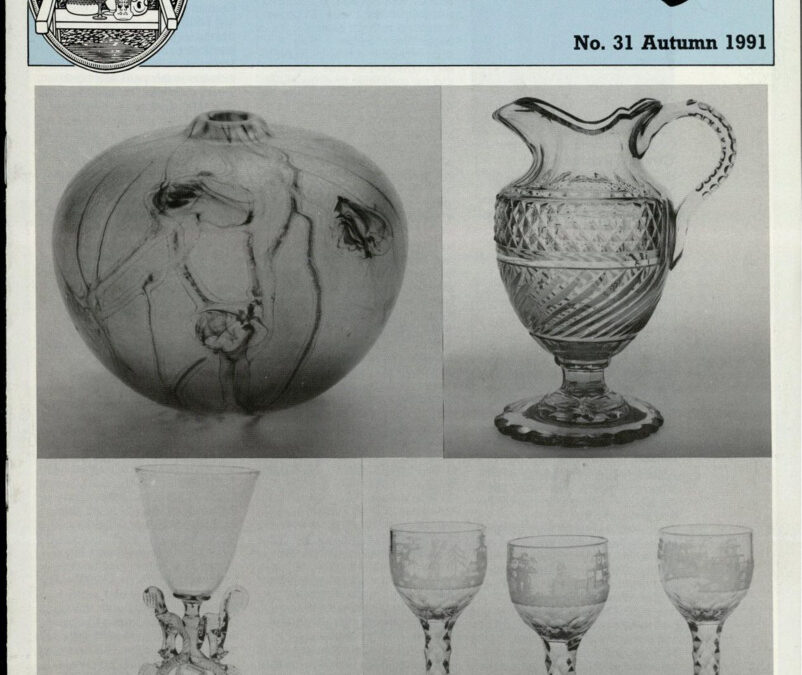
Cover Illustration
Glass from the Liverpool Museum:
Vase by Siddy Langley 1985; Jug
Irish about 1800, Walter Harding
Bequest 1936; Goblet Netherlands
or Germany, 17th century,
purchased 1876; Wine glasses,
about 1760-70, Roscoe Bequest 1949.
See Showcase article.
COPY DATES
Spring 1992
Midlands issue –
Friday 13th March
Summer 1992
North East issue –
Friday 29th May
Five Thousand Years of
Glass
Edited by Hugh Tait British
Museum Press, London, 1991. 256
pp, 266 ills, almost all in colour, 214
figures Price £25.
As one would expect from British
Museum Publications this is a
splendidly produced book,
illustrated with high quality colour
photographs, many specially taken
of glasses in the Museum’s
collection. The text draws
particularly on the expertise of past
and present staff of the British
Museum, and a notable feature is
the series of black and white
photographs taken of Bill Gudenrath
at the New York Experimental
Glass Workshop, demonstrating a
wide range of glassmaking
techniques. Aimed at a general
readership, the book contains much
to interest those with a developed
interest in glass.
The emphasis of the book lies in
the chapters on glass history prior
to the industrial revolution, written
by Veronica Tatton-Brown, Carol
Andrews, Ralph Pinder Wilson and
Hugh Tait. All these contributors
work or have worked on the
Museum’s collections, which are of
course strong in glass of the
archaeological and the Renaissance
and immediately succeeding
periods. The period from 1800 to
1940 in Europe and America, dealt
with by Paul Hollister, is accorded
relatively little space — 23 pages
compared with, for example, the 28
pages covering Islamic glass. Any
comprehensive survey is bound to
be imbalanced in some respect,
and the somewhat brief treatment
of the nineteenth and especially the
twentieth centuries is forgivable in
a book based largely on the British
Museum collections, which have
only recently taken in the modern
period.
The strengths of the text of this
book are that it makes recondite
historical and technical information
accessible to a general readership
and that it incoporates recent
scholarly findings throughout. The
reader is guided expertly through
the maelstrom of attributions to the
workshops of the ancient and
Islamic worlds, and the problematic
nature of many of these is never
hidden. Allusion is made, for
example, to the problems for our
understanding of the origins of
glassblowing raised by the 1st
century B.C. Italian wall paintings
showing apparently blown glass
bowls — an issue discussed at a
conference held in conjunction with
the
Glass of the Caesars
exhibition
in the British Museum. The various
possible attributions for the famous
Hedwig cut glasses of the 12th
century and the difficulties
associated with each are
interestingly discussed within a
chapter which admirably surveys
the three periods of Islamic glass
history. The transformation of our
knowledge of medieval glassware
in Northern Europe, thoroughly
assessed in the Basel exhibition
catalogue
Phoenix from Sand and
Ashes
in 1988 is outlined in a
chapter which also presents current
knowledge of the Venetian industry
from the medieval period through
the Renaissance in some detail.
Further, there is discussion and
illustration of pieces recently
brought to light but published to
date only in journals or continental
exhibition catalogues. Thus a
French blue glass knife handle of
the 13th century with moulded relief
decoration, found at St. Denis near
Paris in 1981, and an extraordinary
Louis XIV glass table top with
millefiore decoration recognised in
a private collection in 1988 will be
new to most people, each important
for suggesting connections between
France and Italy in the periods
concerned.
Inevitably, there are certain aspects
of glass history which are not here
given the emphasis they might be.
German glass of the 18th century
and British glass are very briefly
treated — they are perhaps
insufficiently represented in the
Museum’s collections for significant
inclusion in this particular book.
There is a section on pressed glass
of the 19th century but otherwise
space for that remarkable period of
glass history has had to be devoted
chiefly to art glass. The concluding
section, however, is tremendously
useful — the series of photographs
of manufacturing techniques. Apart
from lost wax casting all the major
methods are beautifully illustrated,
and aspects of technique such as
clamping and cracking off (which
explains how the Romans could
finish glasses without a pontil) are
demonstrated. Altogether, the book
is very good value for money — as
a guide to the British Museum
collections and as a thoroughly
interesting and up-to-date survey of
the history of glass.
Ian Wolfenden
Rare Jacobite Glasses at
Sotheby’s
Several important Jacobite glasses
will be included in a sale at
Sotheby’s, London on Tuesday 14th
April 1992. An Amen goblet, known
as the Gregson of Tilliefour Old
Pretender goblet (so-called after
the Major Gregson of Tilliefour
Collection where it first appeared),
is one of only three known Amen
glasses with bell-shaped bowls.
Estimate is £30,000 — £40,000. Also
in the sale is one of only eight
known enamelled glasses with a
portrait of Bonnie Prince Charlie;
this one is thought to have been
made in Edinburgh c.1765 and used
at the Prince’s birthday dinner
celebrations. Estimate is £15,000 —
£20,000.
Other Jacobite rarities include a
disguised Jacobite glass with the
inscription “God bless Prince
Charlie and down with the Rump”
carefully hidden under the rim (Est.
£3,000 — £5,000), and a glass on a
colour twist stem engraved with a
rose and two buds and a moth (Fst.
about £1,500).
The Glass Collection in the Liverpool Museum
The Decorative Art Department of
the National Museums and Galleries
on Merseyside is a relatively new
member of the Glass Association.
During its short membership, the
Department has hosted two visits of
the Association and looks forward to
future visits. All the staff in the
Department see it as vital that the
vessel glass collection should be
seen and studied. It is all too easy for
a collection that is stored away from
the public’s view to be under used. I
always welcome visits by students of
glass, in particular Glass Association
members, and take the opportunity
to ‘pick their brains’ over the more
unusual pieces in the collection!
The collection is housed in the
Liverpool Museum which is part of
the National Museums and Galleries
on Merseyside. It numbers
approximately 2,000 pieces and is
stored in 10 wooden cabinets in the
Decorative Arts storage area.
Unfortunately, most of the time the
glass remains in store; however,
twenty-five of the collection’s most
important pieces are on permanent
display in the ‘Art of the Potter
Gallery’. Selections from the stored
glass are occasionally exhibited in
small temporary displays.
In the near future a refurbished
room at the Walker Art Gallery will
provide an opportunity to display
some examples from the collection.
This new gallery will be devoted to
the art of the 18th century. Here, a
small number of drinking glasses
will be displayed along with
ceramics, silver, paintings and
sculpture. The new gallery is due to
open in early 1992.
The vessel glass collection is also
used for talks and is available to
students by appointment. Ideally, a
storage-on-display gallery, similar
to the museum’s ceramic study
centre, is required. In the ceramic
study centre, students have access
to books and supervised access to
the collection. The study centre is
situated on one side of the display
cases containing the ceramic
reserve collection. The general
public can view the ceramics from
the other side of the cases, in the
public gallery. Until such a study
centre for the glass becomes a
reality, access to the collection will,
unfortunately, be limited.
The collection has a long history
dating back to the formative years of
the Liverpool Museum. Its growth
and importance is largely due to a
few individuals who gave or
bequeathed their collections. This
fortunate but unplanned growth is
mostly responsible for the uneven
coverage of the collection. Certain
areas, such as 18th century drinking
glasses, are well represented
whereas other areas, such as 19th
century press-moulded glass, are
sparsely represented. The
Department’s aim is to build on
these strengths and to strengthen
the weaker areas by acquiring good
quality pieces. In recent years, the
collection has also been extended to
cover modern craft glass.
The first individual who made a
significant contribution to the
collection was Joseph Mayer (1803-
86), Liverpool goldsmith and
antiquarian, whose collection was
given to the museum in 1867.
Although Mayer’s collection
consisted of mostly archaeological
and ethnographic material, it also
included a number of post-medieval
glass pieces which are now held in
the Decorative Art Department.
Towards the end of the 19th century
several important pieces were
purchased, mostly 16th and 17th
century Venetian and facon de
Venise glass. However, it was not
until the middle of the 20th century
that the glass collection really
expanded due to a number of gifts
and bequests. The first of these was
the addition, in 1936, of a number of
Irish cut glass pieces of the late 18th
and early 19th century, from the
collection of Walter Harding, of
Birkenhead. After his death, his
collection was distributed between
the Williamson Art Gallery in
Birkenhead, the Victoria and Albert
Museum and the Liverpool
Museum. Fortunately, Walter
Harding produced an illustrated
book of his glass, so although the
collection is divided we can see
how it would have been in its
entirety.
During the war the museum building
suffered a direct hit and the resultant
upheaval and displacement of the
collections no doubt accounts for the
disappearance of a number of
pieces. Perhaps it was because of
this wartime destruction that after
the war various collectors were
keen to rebuild Liverpool’s public
collections by gifts and bequests.
Between 1949 and 1954 four major
additions to the collection were
made. The first of these added
approximately 400 drinking glasses
of the 18th century to the collection.
This was the collection of William
Malin Roscoe, bequeathed by his
wife in 1949.
The Roscoe family had strong
connections with the City of
Liverpool and it was during the
1930s that the Director of the
Museum approached Mr Roscoe’s
son with a view to the collection
being given to the museum. During
the 1930s and 1940s, links were built
between the museum and the
Roscoe family. Some of the
correspondence from this period
survives and provides an interesting
insight, not only into the acquisition
of the collection but also into
museum practice of the day. The
whole collection was brought from
the Roscoe home in Co-op tea,
Ryvita and porridge oat boxes,
especially ordered by the Director.
Not one piece was damaged during
transit.
In 1950 the wife of Francis Buckley,
glass historian and collector, gave
many of his note and cutting books to
the museum along with excavated
vessel glass and various other
decorative art items such as buckles
and ceramics. The majority of his
collection had already been
deposited at the Victoria and Albert
Museum in London. His note books
are a compilation of extracts from
newspapers of the 18th and 19th
centuries. These extracts relate to
glass-houses all over Britain and
mostly recount business details but
also incidents in the lives of the
glass-house owners and workers.
Including the following from the
Bristol Journal
26 Nov. 1796:
‘Committed to Newgate 7 women for
receiving glass stolen from the
Phoenix glass house, the property of
Richard Ricketts, David Evans and
Co.’ There are no further details of
what happened to the women or the
stolen glass.
The final major gift of this period was
that of Walter Shore, who in 1954
gave the museum a large collection
of ceramics, furniture and glass. The
glass consisted of approximately
200 pieces, most of which are 18th
century drinking glasses.
Unfortunately, at present the vessel
glass collection is not fully
documented and it is estimated that
it will be several years before a
complete handlist is available. Work
has started on the documentation
and at present 500 basic entries
have been made on the computer
database. These first entries will
form the basis of a full handlist and
eventual catalogue. Several of the
collection’s finest pieces are
described and illustrated in the
catalogue ‘Historic Glass’ which was
produced in 1979 to accompany an
exhibition of the same name. This
catalogue is still available. However,
it is this general lack of published
information which makes it so
important for the Department to
inform the public of what is in store
and to make sure that every
opportunity is taken to encourage
the study of the collection.
Alyson Pollard
Alyson Pollard is Curator of Metalwork
and Glass in the Decorative Art
Department at Liverpool Museum.
The First Glass Visit to Liege
In 1991, members of the Glass
Association Trip thought we were
pioneers in our visit to the
Glassworks of Liege. However, 345
years before, a Scots polymath and
entrepreneur, Sir James Hope of
Hopetoun (1614-1661), preceded us
and devoted ten pages of his diary to
the industry of Liege, including
“three glasse fornaces”.
Hope was of a wealthy Scots legal
family, his father having been Lord
Advocate, he himself a judge from
1649 until 1654 when Cromwell
deposed him, and three of his four
sons were judges. He acquired
through his wife the Scottish
leadmines at Leadhills and
Wanlockhead, thus securing the
foundations of the fortune that later
enabled Hopetoun House to be
built. Leadhills remains today a star
of the Hopetoun Estates, but its
wealth no longer derives from
mining, but from its renowned
grouse moors.
In 1646 Hope made a journey to the
Low Countries, principally to re-
affirm the contracts for his lead ore
exports to Zeeland, but also visiting
(and crossing the firing line, since
the Dutch Estates were actively at
war with the Spaniards who
controlled most of today’s Belgium)
Liege and Namur to see the
metallurgical activity there. His
diary’ gives considerable detail of
Iron smelting and Iron Rolling Mills;
coal, pyrites and alum mining; alum,
sulphur and vitriol manufacture; shot
and gun making. He says all too little
of the glass industry, only: “I went
and did see … three glasse fornaces
for the making of all sorts of glasses.”
Later he visits ‘alme earth mines’ at
‘Jonky’ (Chokier, 16 km down the
Meuse from Liege) and says after
describing the alum mine: “They did
shew to me above ground two
cropes of cristall vaines which they
alleged to be the mater whereof
cristall is made. … I went into the
drift and found … a thick ore of
grayish yallow color with a cleire
blacke sparre about two inches
thicke in the middle of it…” Was this
perhaps sand for the glass industry,
clay for the pots, or merely a
crystalline form of alum?
None the less, his interest in glass
was more than transitory, for in the
following year, 1647, in another
volume of his diary
2
, he records
discussions in Edinburgh by a Scots
consortium, which included himself,
“with Christopher Visitella,
Glassemaker, anent ye setting up
againe by us foure of the Glasse
workes at the pannes”
[Prestonpans?]. The initial capital
costs were put at £200 Sterling, with
a projected weekly output of 1,800
wyne or beare glasses, to sell for £17
per week and having direct costs of
£11. Whilst the project was
considered in detail and the gross
profit looked attractive, the times
were unpropitious and Sir James put
his finger on the main problem — a
tiny market: “they would make more
in one weeke then could possiblie
be vented in a mounth …” The
project did not proceed, although
by 1661, the year of Sir James, early
death from ‘Flanders disease’,
caught on another visit to Holland,
John Ray in his “Itinerary” reported
glass being made at Prestonpans
from a mixture of kelp, salt and local
sand.
Thus, although we of the Glass
Association much enjoyed
ourselves, we were not the first
British visitors, nor did we have to
bribe the rude soldiery and
convince various military governors
that our journey from Liege to
Brussels was not a spying mission.
F. Peter Lole
Notes:
1.
‘Miscellany of the Scottish
History Society. Vol: IX’ (1958)
“The Diary of Sir James Hope
1646.”
2.
‘Miscellany of the Scottish
History Society. Vol: III (1919)
“The Diary of Sir James Hope
1646-1654.”
Also referred to in Glass Circle
No. 151 R. Oddy “Scottish Glass
Houses” (n. d. — circa 1967).
Fig 1.
Pot Hole’
Sculptures by
Timo
Sarpaneva
for littala, C.
1950-51 Coll.
littala Glass
Museum.
Fig 2.
Serpentine’
Bowl by Nils
Landberg for
orrefors, c.
1944.
Glass in the Fifties
Many will recall with distaste some
of the commoner household
furnishings of the 1950s — spindly-
legged, wiry furniture, bizarre
assymetrical tableware and
wallpaper designs based on
molecular structures and micro-
organisms. However, such a poor
opinion of post-war design usually
springs from the bastardized forms
and the plagiarism which
eventually corrupt any radical new
movement in the decorative arts.
The exhibition assembled by
Machester City Art Galleries gave
us a refreshing and illuminating
insight into what was really
happening in the visual arts in that
era. The exhibition was curated by
Lesley Jackson, who is also the
author of an excellent new book,
The New Look— Design in the
Fifties
(Thames and Hudson).
North West Region members of the
Glass Association gathered in
Manchester on 19th October for an
introduction by our member
Richard Gray, Director of the City
Art galleries, and a conducted tour
by Lesley Jackson of the glass
exhibits. This was an international
exhibition, and in glass it is the
pieces from Finland, Sweden,
Denmark, Holland, Italy and
Czechoslovakia which
predominated.
For the beginnings of what was
happening in the Fifties we should
look back to such designers as
Alvar Aalto whose organic
curvilinear glass vessels were
already in the 1930s helping to
establish the break with the jazzy
and geometric style of Art Deco.
Sculptors and painters were also
influential. Lesley Jackson’s book is
perceptive in tracing the
connecting lines between the
sculptural work of Constantin
Brancusi, Jean Arp, Henry Moore
and Barbara Hepworth, and the
paintings of Jackson Pollock, Joan
Miro and Paul Klee, with
developments in the applied arts.
The seeds sown pre-war began to
germinate vigorously in the late
1940s, thanks principally to the
pent-up energy and talent of
Scandinavian and Italian designers.
Few glass lovers will be unfamiliar
with Tapio Wirkala’s beautiful
‘Kantarelli vases, created for Iittala
in 1946. Also in Finland Gunnel
Nyman helped the glass industry to
find a strong new voice: her
Serpentine’ vase for Nuvtajarvi and
‘Rose Petal’ bowl for Iittala, both
good examples of the ‘organic’
feeling, are illustrated in Lesley
Jackson’s book. In the exhibition
there was an ‘Egg Shell’ bowl
produced by Iittala from 1947. Timo
Sarpaneva was another of littala’s
superstar designers who was
responsible for both brilliantly
sculptural pieces (see fig. 1) and
much acclaimed utility wares.
Swedish glass was equally strong;
Nils Landberg (see fig. 2), Sven
Palmqvist, Ingeborg Lundin, Edvin
Ohrstrom, Vicke Lindstrand and
Gunnar Nylund (see fig. 3) were all
represented in this exhibition.
In contrast with the cool
Scandinavian glass with its
restrained use of colour, the Italians
were exuberant. The dominant
figure was Paolo Venini whose
handkerchief vases and brilliantly
coloured vase and bottle forms are
especially well known. Venini
employed other freelance
designers, for example Tobia
Scarpa, whose ‘Occhi’ vase is
shown in fig. 4.
But what, you may ask, was
happening in Britain? Speaking to
Glass Association members, Lesley
Jackson described our
manufacturers at that time as
conservative and nervous about
new design. There was a sharp
division between what were seen
as “contemporary” and “traditional”
styles. In textiles we were more
adventurous, and Robin Day, David
Mellor and Robert Welch were
beginning to change the scene for
furniture and tableware.
There were only three pieces of
British Glass on show, of which two
had been selected for their
engraving. New Zealand born artist
John Hutton’s large Angel Vase,
with its sharply attenuated figures
reminiscent of his glass screen in
Coventry Cathedral, was incised
with a hand-held wheel. A pair of
bookends was engraved with
alchemical symbols and molecular
structures by Helen Munro-Turner,
who established the Juniper
Workshop in Scotland in 1956.
Richard Gray described some
fascinating detective work to locate
and reunite the two bookends
which were in separate ownership!
The third piece is a rather sad
contribution from the manufacturing
industry, a handkerchief vase
attributed to Chance Brothers,
which is a horribly debased version
of Venini’s brilliant originals.
However, it would be wrong to be
totally dismissive of British glass in
this period. It may not have been
trend-setting in the international
scene but considerable progress
was made, for example, with the
introduction of clean modem
pressed glass designs which
competed successfully with
ceramic kitchen and tableware.
Urged on by the Government in the
years of austerity (rationing and
other restrictions lasted until 1954)
there was much new investment in
the British glass industry with a
view to boosting exports.
Alexander Williamson of the Royal
College of Art was commissioned to
design glassware for mass-
production, and this he did
successfully for the Sherdley
products of Limited Glass. Chance
Brothers also entered the market
for pressed tableware with the
latest automatic plant which
produced lightweight articles of
excellent finish. While their popular
‘Fiesta’ range may not have reached
great aesthetic heights, a pressed
vase (showing a sandblasted
‘Celery’ label) is on show in the
Britain 1900-1960 Gallery at the V. &
A., and is certainly an attractive and
novel modern design. Further
details of these products may be
found in British Table and
Ornamental Glass by
L. M.
Angust-
Butterworth published in 1956, and
in Glass (Twentieth Design series)
by Frederick Cooke published in
1986.
Members’ thanks must go to
Richard Gray, Lesley Jackson and
Ian Wolfenden for an excellent
afternoon in Manchester. The
Musuem café is recommended too!
Greville Watts
Fig 3.
Group of vases
by Gunnar
Nylund for
StrOmbergshyttan,
1955-56. Coll.
Smaland Museum.
Fig 4.
Occhi’ vase by
Tobia Searpa
for Venini,
Murano, c. 1961
Coll. City of
Bristol Museum
and Art Gallery
Czechoslovakia Explored
Fig 1.
Interior view
of the
entrance hall
at the Glass
Museum at
lablonec nad
Nisou
showing
lighting
columns.
A camping holiday last summer in
Czechoslovakia centred around a
five day orienteering event in
Northern Bohemia provided the
ideal excuse to learn something
about Bohemian glass at first hand.
The outward journey was made
more interesting by taking a route
through former East Germany (and
indulging my other interest –
music) visiting Halle (Handel’s
birthplace), Leipzig (where Bach
was Cantor for 25 years) and
Dresden. Some glass had already
been seen in museums on the way
but the treat came in Dresden
where we visited the exhibition of
the Treasures of the Green Vault’,
currently in the Albertinum
Museum. The collection was set up
in the early 18th century and is
absolutely breathtaking — glass as
such is almost non-existent but rock
crystal items abound: a few
descriptions to wet the appetite.
“Gothic rock-crystal vessels in
settings of gilded silver, partly
enamelled … small goblet,
presumably French 14th century;
cup of Queen Hedwig of Poland,
French, presumably 14th century,
the setting Cracow Court workshop
before 1399″. ”Vessels in rock
crystal, Milan, around 1580, gold,
emeralds, rubies, enamel, the
bottle from the Sarachi workshop,
both heavily engraved”. “Rock
crystal goblets in settings from
Freiburg im Breisgau, Nuremberg,
Augsburg, from 1560 to early 17th
century” … and so on. We didn’t get
time to see the glass collection in
the main museum but a lavishly
illustrated catalogue bought at the
Albertinum showed there was
much to see there.
First stop in Czechoslovakia was
Karlovy Vary (formerly Carlsbad), a
lovely spa town nestling in a narrow
wooded valley in western Bohemia
and full of elegant 19th century
buildings. The museum contained a
lot of glass, well displayed as in all
the museums we visited, but most
importantly the lady at the ticket
office told us how to find the Moser
factory. Incidentally, all the
museums we visited had a small
entry charge which I’m sure
deterred no-one but obviously
brought in useful revenue; another
nice touch in some cases was to
give a postcard of an exhibit as a
ticket.
In my ignorance I hadn’t realised
what a prestigious glass firm Moser
was. It was a Saturday so the factory
was closed, though as we
discovered later we couldn’t visit
any factories as they were
considered to be too dangerous for
the public to be admitted. The
showroom, however, was open.
The display of glass, much of it
currently in production, was superb
and mouthwatering making it all the
more frustrating finding little was
for sale. In fact little Moser glass is
available anywhere in
Czechoslovakia as 85-90% is only
for export. From the small part of
the display which was for sale,
however, I was able to purchase a
pair of tumblers from their
‘Copenhagen’ set, lovely clean lines
with the traditional engraved gold
band just below the rim with an 18ct
gold band around the rim! The
gentleman in charge of the
showroom spoke perfect English
and besides telling me the glasses
were from the same set presented
to President Havel also gave the
names of various glass towns to visit
in Northern Bohemia. The most
intriguing piece of information,
however, was that Moser glass
contains no lead. They have their
own secret mix which still gives a
lovely clear and brilliant metal.
Prague is a wonderful city with so
much to see but in the four days we
spent there we missed out on glass
other than in the National Museum
Exhibition on view in Lobkovic
Exhibition on view in Lobkovic
Palace at Prague Castle. The
museum which I understood
contained the main glass collection
was closed for renovation but I think
now that I probably went to the
wrong one!
Touring south and west of Prague we
diverted to take in the glass centre at
Lenora but this was the one
disappointment we had as the
museum was very small, not very
interesting and they seemed more
interested in making sure you wore
overshoes to protect the flooring.
After a few more days in which we
saw some wonderful old towns and
castles, we finished up in Liberic in
Northern Bohemia, a focal point for
exports in this glass making area. On
the way we had tried, again
unsuccessfully, to visit the glass
factory at Podebrady, due east of
Prague, but again entry was not
allowed and the adjoining factory
shop was shut for two weeks’ holiday!
From Liberic we visited the main
glass centres in eastern Northern
Bohemia at Jablonec nad Nisou,
Zelezny Brod and Harrachov. I
should say at this stage that as I
couldn’t speak, read or understand
Czech I had to fall back on my
limited ability with German and
undoubtedly missed out on a lot
through not having a better
understanding of German which at
the moment is very much the second
language.
Harrachov is now a popular, though
small, ski resort in the mountains
bordering Poland but its history as a
glass making town goes back to the
late 16th century. The factory here is
part of ‘Crystalex’ which appears to
be the major firm, presumably at the
moment still state owned, which has
satellite factories throughout
Northern Bohemia with the main
factory at Novy Bor. The museum is
quite small but housed in a modern
purpose-built single storey building
which contains in chronological
order an excellent display of
coloured and cut glass which has
always been the main output in
Harrachov.
The museum at Jablonec nad Nisou
was a revelation. Jablonec, long a
glass making centre, was the home of
the Turnov paste’ which was
invented around 1711: this was a pot
metal of a special composition which
allowed the imitation of different
kinds of precious stones which, in
combination with cheap metal
mountings, laid the foundation for the
production of Jablonec costume
jewellery. The existing tradition and
local skills in glass making enabled
this to expand as a cottage industry
which was the basis for the
subsequent worldwide reputation of
the so-called ‘Jablonec Wares’. The
museum has parallel exhibitions of
the historical development of glass
with exhibits arranged
chronologically from specimens of
the earliest artefacts found in regions
around the Mediterranean through
the history of Bohemian glass to the
present day alongside the
development of the Jablonec
Jewellery all entwined with maps
showing the locations of factories
over the centuries, photographic
reproductions of period portraits,
period furniture, tools used in the
industry, etc. The floor to ceiling
glass lighting ‘columns’ in the
entrance hall set the scene for
something special and that is what
we found (fig. 1). In addition, there
was an exhibition with a superb
illustrated catalogue (in English as
well as Czech and German reflecting
that it was a post-1989 revolution
exhibition) of 10 generations of glass
making by the Reidel family
stretching over 200 years and
including some magnificent exhibits
especially in coloured enamelled
pieces from the late 19th century.
The museum shop incidentally had a
small number of glassworkers
producing museum replicas, passed
by and marked by the museum
authorities as copies but of a
comparable quality; I now own an
18th century (replica) milk glass
tumbler with an enamelled design of
‘Europe’, part of a ‘continents’ set, and
an enamel decorated spirit flask from
the same period.
The museums at Kamenicky and
Novy Bor are filial museums to
Jablonec but first a mention of
Zelezny Brod. The museum
collection here is quite small but full
of interest and the bonus was
receiving directions to the local glass
making school. This was founded in
1920 and as luck would have it had a
large exhibition of current students’
work. Again there was an excellent
well illustrated catalogue but only in
Czech and the attendant appeared to
have even less German than me. It is
obviously a large school and the
exhibits ranged from futuristic and
comic figures in lamp work to
modern concepts in tableware both
through shape and engraving, to
pure studio pieces with colour and
shape skilfully used.
Our next base was Cesky Lipa, a
predominantly modern sprawling
town dominated by typical Eastern
Bloc’ apartment blocks in serried
ranks. Just north of there, however, is
Novy Bor, not only the home base of
Crystalex but also containing the
largest Crystalex retail outlet we saw
anywhere which drew us back
repeatedly, trying not to make more
purchases! The museum was in a
lovely house built in 1804 by J.K.
Sochr, an active exporter of glass at
the time. The exhibits illustrated the
very extensive range of glass making
techniques used both in the past and
now in the Novy Bor district, as
always beautifully displayed.
Only a few miles further on, but up in
the hills, was Kamenicky Senov, the
home of ‘Lusty chandeliers, also
part of the Crystalex group. There is
also another school of glass making
here dating from 1839 and said to be
the oldest in Europe. The museum is
in an old Patrician building originally
belonging to Stefan Rath, owner of
the Viennese Lobmeyr firm. The
superb collection has mainly come
from private collections donated to
the museum over the years and
again is displayed in chronological
order from the 17th to 19th century
and consists mainly of cut and
engraved glass. There was a small
shop selling chandeliers but nothing
of particular interest and the one I
brought home came from a general
store in Cesky Lipa where I made
quick but detailed notes of how it
went together as it was being
dismantled and packed for
travelling.
Czechoslovakia is a fascinating
country and for those interested in
glass has a tremendous amount to
offer. I think that if I had obtained
some sort of written introduction in
advance I could have seen inside the
factories but the many specialist
museums were ample compensation.
At the moment hotel accommodation
is far from plentiful and can be quite
basic (though very cheap) but free
enterprise is leading to many B&B
(equivalent) signs going up and you
don’t have to be camping, therefore,
like us if you want to wander freely
and explore. Roads are good, the
people very friendly and as I said
earlier, if you have some German you
can get by. English is now being
taught in the schools and certainly
some of the younger generation are
keen to practise it.
Michael Savage