




lower the wick. For lack of a
better term they may be called
open flame glass lamps. They may
be grouped into basic categories:
1.
A particularly interesting type
has one or more spouts around
the bowl or reservoir to take
the wicks and a central
aperture for filling it with oil.
As many as six such spouts
may be found in some
examples. The bowl is usually
supported on a stem, but there
are a few squat examples
without a stem. In this type
there is usually a saucer or
drip-tray to catch any spilled
oil.
2.
The most commonly seen type
is known as a lacemaker’s
lamp which has a bowl with
only one aperture for both the
wick and for the filling with oil.
Supported by a hollow or solid
stem it sometimes has a handle
(usually with a thumb rest) and
a saucered foot. Later versions
without a handle usually have a
small tray under the bowl to
catch the drips, so that the foot,
which is often not folded (as
the earlier ones may be), no
longer needs to be saucered.
3.
There is then a whole range of
smaller lamps, usually less than
four inches in height,
consisting of an often ovoid
bowl with a single aperture for
the wick and for filling,
supported on a short
(sometimes incised twist) stem
on a flat foot.
4.
Many glass objects unsuitable
for drinking from tend to be
described as lamps in default
of any other use to which they
seem likely to have been put.
Such cases have to be
examined individually.
5.
Although not totally a glass
object, the use of a glass
calibrated reservoir on some
open flame pewter lamps
served the purpose of time
measurement. No such use has
been seen by us on a totally
glass lamp, however.
The vast majority of lamps that
have survived are single objects;
however, in a small number of
cases an accompanying fitment
has been found with them. This
may either be a glass lid to cover
the filling aperture or a loose
metal fitment through which the
wick passes to hold it in place.
Finally, we should be grateful if
any Glass Association member
who happens to have an open
flame lamp with some unusual
feature would please get in touch,
so that a photograph, etc. may be
included in a forthcoming study.
Keith Kelsall
John Phillips
Glass Lithographs
Members of the Glass Association
are offered six lithographs of glass
subjects from the stock of Trevor
Rostron of Craven Arms. Four
illustrations show exhibits at the
Great Exhibition of 1851,
published by Day and Son,
measuring 48 x 33 cms and
include:
Bacchus, Birmingham; Green and
Apsley Pellatt, London —
group of
objects in glass, consisting of an
engraved claret and cream jug
(green), a Venetian champagne
and an engraved ale glass
(Bacchus), and an engraved claret
glass and cut salt cellar (Pellatt);
F & C Osler, London and
Birmingham —
The Crystal
Fountain;
Apsley Pellatt, Naylor
and Green, London —
group of
objects in glass;
Count Harrach,
Bohemia —
group of glass. Two
other lithographs show stained
glass. Interested buyers should
contact Trevor Rostron, Wigmore
Abbey, via Craven Arms,
Shropshire SY7 ONB,
Tel: 0568 86445.
Puzzle Piece
Can anyone help to identify the
country of origin or even the
factory which produced the range
of items of which this vase is a
typical example? All the objects
whether vase, candlestick or
inkwell have as their support
three glass spheres, often with an
extra sphere acting as a knop for
the hollow vessel on top. The
pieces are given a slight
iridescence.
Answers please to the Editor.
The newsletter of the
Glass Association
Registered as a Charity No. 326602
Chairman:
Anthony Waugh
Hon. Secretary:
Roger Dodsworth
Editor:
Charles Hajdamach
Address for correspondence:
Broadfield House Glass Museum,
Barnett Lane, Kingswinford,
West Midlands DY6 9QA.
Tel: 0384 273011
ISSN 0265 9654
Printed by Jones & Palmer Ltd., Birmingham
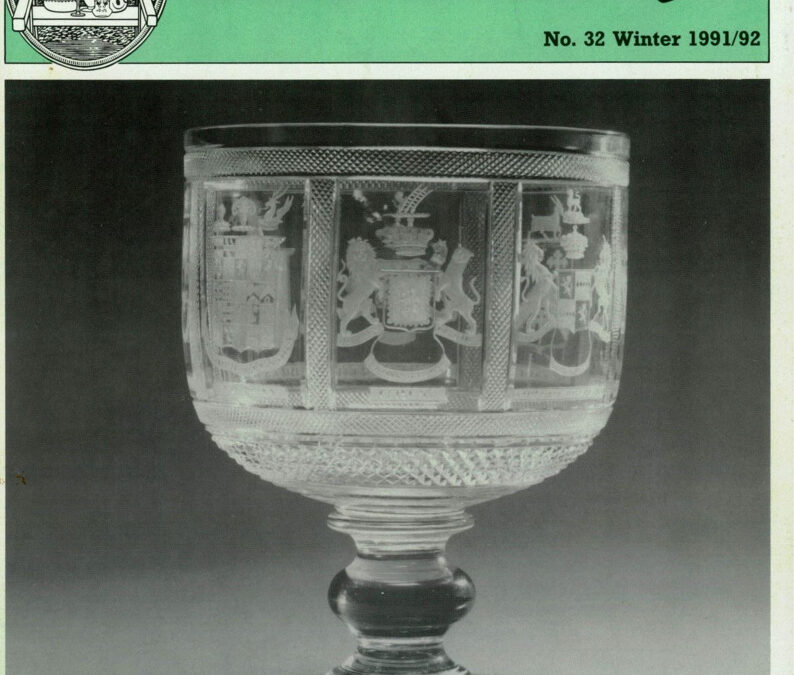
Cover Illustration
HELP SOLVE THE GOBLET
MYSTERY.
A magnificent but mysterious
goblet has gone on show at
Sunderland Museum and Art
Gallery.
The goblet is eleven inches high
and is believed to have been
made in Sunderland in about 1825.
It is beautifully engraved with the
arms of eight northern families:
Londonderry, Lambton, Grey,
Northumberland, Darlington,
Russell, Ravensworth and
Bradling.
London dealers Mallett’s recently
bought the goblet at auction and
have kindly lent it to Sunderland
Museum for special display.
Museum staff are anxious to
discover when and for whom the
goblet was made. Was it for the
opening of the railway, the new
harbour, or a new invention
connected with mining?
The first person to solve the
mystery will be presented with a
copy of the new hardback book
Sotheby’s Concise Encyclopedia
of Glass:
Answers to Sue Newell or Nick
Dolan at Sunderland Museum,
091-514 1235.
Photo courtesy Mallett’s.
COPY DATE
Summer 1992
North East issue –
Friday 29th May
Open Flame Lamps
The distinguishing features of the
18th and early 19th century glass
lamps are the absence of a glass
chimney and a wheel to raise or
Gin Palaces
8c
Pubs
This article is not intended as an
erudite and scholarly treatise. It was
conceived in a pub in pleasant
company and with an awareness
that in the urge to adapt to change,
much unrecorded, but often worthy
and occasionally outstanding glass
was being swept away without
record. The Gin Palaces themselves
had their origins in a similar time of
change. Camera in hand I therefore
made tours in Central London and
Brighton. The nearness of the
London pubs to major museums may
give some idea on sources of
information. In the case of Brighton,
I asked a dealer in architectural
artefacts for guidance.
In
the eighteenth and early
nineteenth century, gin was a social
menace, in some ways comparable
to
the present day drug problems.
The governmental reaction in 1830
was to actively encourage the
drinking of beer rather than gin, and
did this by an Act permitting the free
sale of beer without a licence if
brewed on the premises. As a result
Beer houses mushroomed.
Inevitably the larger breweries and
distillers fought back. They started
the
process, the legacy of which is
still with us, of buying up those
premises licensed to sell both beer
and spirits and making them
attractive. The formula was to
convert what had been drear and
dingy drinking houses into places
where for a short time there was an
illusion of luxury. As in the 1930s
depression escapism was via
Hollywood and the opulent Art Deco
theatre, the escapism from the slums
and squalor of Victorian England
was the Gin Palaces.
The Gin Palace design as it evolved
during the second half of the
nineteenth century was a solution to
a
number of conflicting problems.
There was a desire for light and
brightness, yet it must be isolated
from
the squalor outside. It had to fit
into the stratification of Victorian
society in which, whatever the
venue, there were always those one
cut above the rest who wanted to get
away from
hoi polloi.
The perfect
materials to achieve these
objectives proved to
be frosted
glass for windows and partitions,
mirrors for brightness and
enhanced space, and bright
decorative lighting. In time the glass
partitions were decorated firstly
with cutting and engraving and later
acid etching, the mirrors cut or
painted, the light fittings made more
elaborate.
“The Quadrant” in Queen Street,
Brighton dates from 1846 and is an
early example. It provides good
examples of engraved glass, though
unfortunately only three of the
original glass panels remain
in situ.
At the main entrance (Plate 1) is a
large concave window with a good
quality engraving of a bird standing
in full song on a leafy branch. Inside
are two windows above an alcove
set into a stair well. One is an
original, again of a leaf design, the
other a good modern reproduction
after a recent breakage with a cost,
I was told, of over £1,500 for
replacement. With these costs one
can well see why this style is
perhaps not so popular with modern
pub architects. The landlord
believes that all the fittings,
including the glass, date from the
1846 building. My own inclination
would have been to have dated the
glass 20 or 30 years later, but it
would be interesting to obtain other
views on
this.
P1 1.
The main
entrance
window, “The
Quadrant” pub,
Queen Street
Brighton.
P1.2.
Cut glass
Snob-screens
in “The Lamb”,
Conduit Street
London.
A feature of almost all Gin Palaces is
the large curving bar with the
separation of lounge and public bar
by glass partitions; often there is no
connecting door and the move from
one to the other can only be done by
going outside and back in. But this
did not stop the coarse populace in
the Public Bar being able to look
across into the lounge, and who
knows after imbibing perhaps even
making comment. In order to stop
this undesirable practice, some bars
put in “Snob-screens”. These are
glass panels on a vertical axis at
head height through which a
customer can order and similar
panels at counter level for serving
the drink with the area between of
frosted plate glass or wooden
panelling. After serving, both could
be closed thereby sealing off the
lounge area from the public at large.
The top and centre of this structure
still survives at “The Lamb” in
Conduit Street, London as shown in
Plate 2, with a rather complex cut
star pattern giving sparkle without
transparency.
This pub has a fine array of glass in
various forms. The partitioning is
acid etched but only one (Plate 3)
was readily photographable. The
dark square on the photograph is
because, like the Association, “The
Lamb” is trying to sell ties, though
unlike the Association they are in a
case and screwed down. Even the
lighting in “The Lamb” continues the
Pl. 3.
Etched
Urn Window,
“The Lamb’:
Conduit Street.
PI. 5.
“The Salisbury”
St. Martin’s
Lane, London.
glass theme (Plate 4) and I am
uncertain whether these were
specially made as lights or
converted from serving casks.
Certainly the cutting is extremely
decorative for a serving cask.
Of pubs visited, pride of place
though must go to The Salisbury” in
St. Martin’s Lane, London (Plate 5).
The work here is all of the highest
quality, and I refer not only to the
glass but the carving of the frames,
the lighting both hanging and
standing. There is a claim that brass
lampstands were the first custom-
built lampstands in England. The
doors show off the good features of
what by this time is a standard
design formula (Plate 6). Solid brass
bars and plates protecting the
working parts, but the glass work of
unexpected delicacy and
refinement in various etched flower
designs. The front doors let into a
screened vestibule with a door left
and right continuing the flower
design motif. Though now all one
large room with a peninsular bar,
what was the lounge has a mirrored
alcove, but the mirrors with a cut
design are replacements, the
original being broken in the poll tax
riots.
By way of contrast we have the more
typical survivor “The Great Eastern”
in Trafalgar Street, Brighton (Plate
7). Small, off the main traffic areas,
the separate doors marked “Jug
Pl. 4.
A Table Lamp
in “The Lamb”
49\.:
:&S11 RE
`
7
)‘
–
1-1CIAL SCOTCH
kt„,,&MUSSELECURCH
N
THE
G
P1 7
Etched
windows at
“The Great
E,astern” pub in
Trafalgar
Street Brighton.
The large
window
advertises
“Tamplin’s
Brewery
Company
Limited”.
EAT EASTERN”
P1 6
Side door at
“The Salisbury’:
P1.8.
Glass Spirit
Cask, late 19th
century.
Percival
Vickers of
Manchester are
one of the glass
companies
known to have
made these
casks Photo
courtesy
Capes Dunn
Salerooms,
Manchester.
Department” and “Public Bar”
indicative of the trade it was built to
serve. Inevitably with progress, it is
the pubs on prime sites which had
the best quality fittings, and these
are always the first to feel the
pressure for improvement. “The
Salisbury”, named after the then
Prime Minister, is the exception that
proves the rule, and shows the
opulence and the best of its era. I am
looking out for “The Thatcher” as the
quintessential example of this era.
The one feature of all pubs which
has been changed to suit modern
taste and working practice is the
bar. A few preserve the mirrored
backing with the old advertising
slogans, but they were designed to
back spirit casks such as the “Far &
Sure Special Scotch”, illustrated in
Plate 8. These have had to go, to
make way for the rows of spirit
dispensers and measures with
which we are all so familiar. Even a
fine mirrored bar such as at the
“Queens Head” outside Brighton
Station loses much of its impact
because of the clutter of modern bar
fittings and bottles. The combination
of working practice and health
regulations have resulted as far as I
am aware of there being no
remaining bars which are not
substantially modified. If anybody is
aware of any we should make a
pilgrimage.
This brief survey has not
commented at all on stained glass
which again can be found, but as
part of a slightly different and older
tradition, itself worthy of some study.
John Delafaille
P. S.
The day this article was finished saw
the loss of what I am assured was the
best remaining Gin Palace in the
United Kingdom, when an IRA
explosion in Central Belfast
destroyed virtually all the glass in
“The Crown Liquor Saloon”. Even if
restored, and the Crown is a
scheduled building, most of the
glass
is now gone for ever, and I for
one will never see it.
Glassmakers’ Cricket Match
The Game of Cricket,
being part of a
report on a match between the
British Union Flint Glass Makers and
the Kirby Street Flint Glass Makers
on 22nd June 1861, by Thomas Saxon
(Kirby Street). From the Flint Glass
Makers’ Magazine, No. 4, Vol IV
(1861).
”
It was my pleasure to be present
on 22nd June 1861, as a marker for a
match, or contest, at cricket,
between the British Union Flint
Glass Makers, Hulme — employer,
Mr James Darbyshire — and the
Kirby Street Flint Glass Makers,
Manchester — employers, Messrs
S G Webb & Co [i.e. Molyneaux,
Webb & Co]. At the close of the
game we partook of a plain but
excellent repast, and the
proceedings after were of a very
rare kind. I will say a few words
about it after I have given you a
report of the game [which Kirby
Street won]
I would just say that
the game of cricket is an uncertain
game, that is, the best players do not
always win; still, the best players
stand the best chance, and our firm
— I must say — is too much for the
British Union, yet I firmly believe
that they are quite equal and able to
contest with any firm from
Manchester, of whatever trade, that
has only the same number of hands
to choose from. I trust to see that
Firm as large as our own, hoping it is
only in its infancy
It had been
showering all night before, and I
began to think that there would be
no play at all as the British Union
Flint Glass Makers had a long way to
come to meet us. I made sure they
would not be on the field at the
appointed time — 10 o’clock;
however, I thought /would be there
at the time, so I went along, going
quite easy, and when within about
200 yards of the ground I happened
to look round, when to my surprise, I
saw a spring cart load of jolly good-
looking fellows close behind me. I
though they must be our opponents,
so I hastened on to the field for fear
they should get there first, which
they were very near doing; it really
did me good to see them come in
that way. They looked like men of
business coming in their master’s
conveyance, which, to me, was
ample proof of the good feeling that
must exist between them; and
another proof was his presence
during half the game. May nothing
ever happen to sever that good
feeling. Well, after greeting each
other, and each one, hoping the
clouds would disappear and that we
should have a fine day, the Umpires
— who were chosen out of the
cutting-shop for each place –
called “play”, the game commenced
by the British Union Flint Glass
Makers going in to bat. The result
was 45 the first innings and 56 the
second, making a total of 101; the
Kirby Street scored in one innings
102, thus coming off victors.
Thus ended a very nice quiet game,
which lasted nearly five hours, so
you may think we were in good
order for the repast prepared for the
occasion. There was a goodly
number of spectators present from
all the other houses, and all
went on very well to the concluding
of the game
Dinner being over, our worthy D S
Bamford at once proposed Mr James
Darbyshire, master of the British
Union Flint Glass Makers, should
occupy the chair for the evening.
After being seconded and carried
unanimously, he rose, saying he felt
very proud to be in such a position,
on such an occasion as the present.
It afforded him an opportunity, as he
had a little time to spare, of spending
a few hours to advantage with some
of his work-people, and some of
those who could claim his earliest
recollection as friends, at the same
time trusting they were all friends.
He then said he rose from our ranks
by sobriety, industry, and
perseverance, to the more exalted
position of employer; yet he had met
with many difficulties in attaining
that stand. It was not as easy a road
as some might imagine; still it was
attainable by many in his presence
whom he hoped would keep a
steady eye and look after number
one, by leading a sober life. He was
pleased to see his workmen spend
their leisure hours in the way they
were doing. He was very sorry they
had been defeated, though all along
he knew they were over-matched.
Still, he urged them to press on, and
said it would be a pleasure to him, at
any time, if he could render them
any assistance in any way whatever
He then called on Mr S G Webb,
manager of Kirby Street, who was
also present. Mr Webb making an
apology, and it being accepted, he
called on Mr W Bamford, who, in his
HULME
First innings
2nd innings
KIRBY STREET
3
0
7
3
5
0
0
0
5
0
1
Bye balls 2
29
2nd innings
b Cook
2
b Edwards 3
b Rudge
2
b Rudge
3
not out
20
c Edwards 21
b Rudge
10
b Rudge
0
b Rudge
0
s. out
0
legged out
3
Bye balls 3
67
J Wardle b Calvert
3
W Rudge b Calvert
1
B Derbyshire b Calvert
0
W Edwards c Bland
0
W Cook run out
0
C Higgison b Calvert
9
J Rudge c Calvert
0
G Derbyshire run out
1
S Walker not out
0
J Butterworth run out
4
J Stanleystreet b Ogden
0
Bye balls 3
21
c Scarratts
4
b Ogden
5
b Ogden
1
c Bland
8
b Calvert
1
b Ogden
0
b Calvert
10
b Calvert
0
b Calvert
0
b Calvert
0
not out
0
Bye balls 6
35
First innings
Wm Calvert b Cook
J Rogers b Rudge
Jn Scarratts b Rudge
Wm Bamford run out
T Bland c Higg
J Ogden b Rudge
G Phillips b Rudge
W Houltram stumped out
J Brown c Higg
J Badon c Derbyshire
J Scarratts not out
Peter Helm
the glaziers (James Powell of
Whitefriars) and, especially, the
developing talent of the young artist,
Edward Burne-Jones (1833-98), who
was invited to prepare the cartoons.
Pevsner observes:
“In its vigorously stylized
composition and figure design and
its glow of colours amongst the best
glass done in the 19th century, much
bolder than most Morris & Co. glass
and much richer in the scale of
colours used.”
The rose or wheel window depicts
the Creation as described in the
Book of Genesis. In the central light,
we see God in Majesty, seated on a
rainbow and holding the Orb of
Power. The seven smaller “lobes”
portray:
(i) the firmament; (ii) the waters;
(iii) tree, grass and herb; (iv) sun,
moon and stars; (v) fowls of the air
and fishes; (vi) Adam and Eve in the
Garden of Eden; (vii) the rejoicing of
the angels on the seventh day.
The three lancet windows below are
Jesse windows and depict
characters from the Old and New
Testaments, with Christ crucified at
the top of the central light.
In 1991 the rose window was found
to be in need of complete
restoration. An appeal fund for
£12,000 has been setup. Anyone
wishing to support the appeal
should send cheques payable to
“Waltham Abbey Church Window
Repair Fund” and addressed to
Mr Brian Snell, the Parish Office,
5a Greenyard, Waltham Abbey,
Essex, EN9 1RD.
Mrs P. M. Gray
Continued from page 7…
usual workman-like style, spoke a
considerable time on the
advantages of the game which had
brought them together; he also
pointed out one or two evils in
connection with the same,
entreating them to shun all that tends
to evil, and to cleave to that which is
good. He felt very happy to meet his
old friend — the chairman on this
occasion — and was happy to be
able to say that he (the chairman)
was one of the instigators of the
British Union Cricket Club; and
wishing him every success, he sat
down
Another friend rose to his
feet, not waiting for the voice of the
Chairman, and said he felt very
proud to belong to a cricket club,
but was very sorry they had been
defeated, and hoped that next time
they played they would win. He
said, very touchingly, that
he
had
failings which he might have been
freed from had there been a cricket
club formed when he was in his
apprenticeship
After votes of
thanks being passed to umpires and
markers, for their impartial
judgment and attendance, and
several songs being sung, the party
broke up after spending a most
pleasant day.”
The score card was not printed, but
a return match was played at the
end of September — Kirby Street
winning again — and this shows the
names of the players of each firm’s
team (see page
7) .
The Burne-Jones
Windows, Waltham
Abbey Church
In the early part of 1991 the South
East Region visited Waltham
Abbey, primarily to see the Burne-
Jones East Windows. At that time
serious bowing had been
discovered and it was believed
major restoration and reconstruction
would be necessary. This has
proved to be the case and there is
now an appeal printed elsewhere.
In 1859/60, a great programme of
restoration was put in hand at
Waltham Abbey under the direction
of the architect, William Burges,
whose own artistic preferences are
clearly to be seen, particularly in his
treatment of the ceiling and the east
wall of the church. In the latter, the
fine stained glass windows combine
the vision of the architect, the skill of