




No. 33 Spring 1992
The newsletter of the
Glass Association
Registered as a Charity No. 326602
Chairman:
Anthony Waugh
Hon. Secretary:
Roger Dodsworth
Editor:
Charles Hajdamach
Address for correspondence:
Broadfield House, Glass Museum,
Barnett Lane, Kingswinford,
West Midlands DY6 9QA.
Tel: 0384 273011
ISSN 0265 9654
Printed by Jones & Palmer Ltd., Birmingham
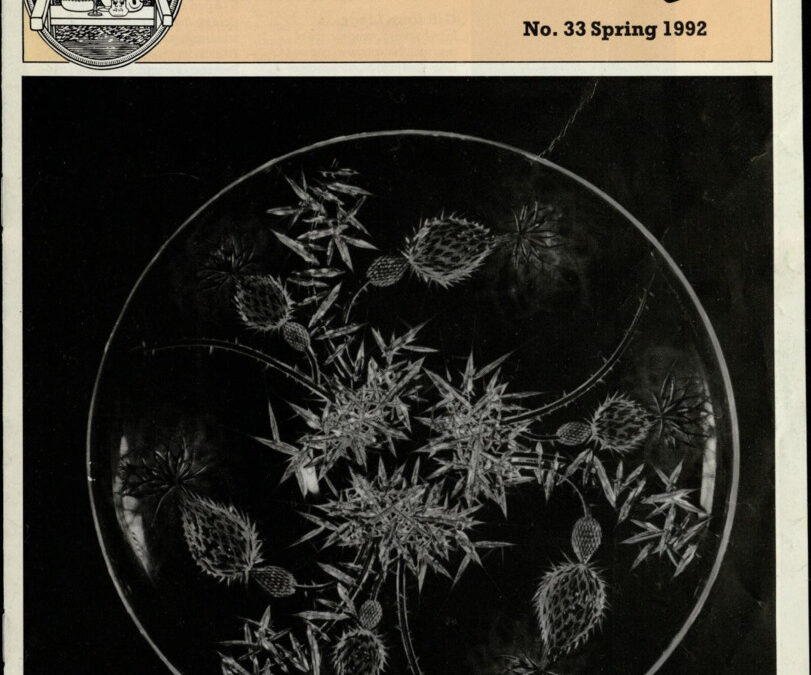
Cover Illustration:
Cut glass Bowl by Josef Svarc,
diameter 15
1
/3 inches.
Collection ofDerek and Betty Parsons.
See article The Hunting of the Svarc’
on page 8.
Photo: Frank Power, Dudley.
Dudley Crystal Festival
The Crystal Festival will run from
Saturday 5th to Sunday 13th
September 1992. Held at Himley
Hall on the outskirts of Dudley, the
Festival contains a number of
favourite attractions plus some
exciting new events. The star
attraction, from America, will be
Vera Meyer, who is renowned as a
performer of the glass harmonica
which was invented by Benjamin
Franklin. This year, the British Artists
in Glass Conference will be held in
Dudley from llth to 13th
September and visitors to the
Festival will be able to attend many
of the B.A.G. activities. A selling
exhibition of paperweights made
by Paul Ysart during his last years of
production will be held at
Broadfield House Glass Museum.
Puzzle Piece Identified
Following the request in
Glass Cone
No. 32
for help with identifying a
range of objects with the common
feature of three glass spheres as
support, our member Richard Giles
has identified the source of these
glasses. The items were sold by
Eduard Dressler in Berlin and were
advertised by him in 1886. The
glasses were made predominantly
in the Gablonz area of Bohemia
during the late 19th century. Further
information on these and other
paperweights is available in an
important new book called
“Paperweights” by Sibylle Jargstorf
and published in Pennsylvania.
Thanks to Richard for supplying all
this information.
Gift from Liege
In the general atmosphere of
goodwill that followed our visit to
Liege last July, an exchange of
publications took place between the
Association and Ann Chevalier,
Curator of the Liege
Glass
Museum.
We sent her a complete set of
Glass
Cones
and the three Journals so far
produced, in return for which she
sent us various issues of the
Bulletins and Annals published by
the International Association for the
History of Glass, which had its
origins in Belgium in 1958.
As the Glass Association does not
have its own library, your
committee decided that the Liege
publications should be donated to
Broadfield House on condition that
the gift was acknowledged inside
each volume and that members
would be able to consult or borrow
the books at any time.
The publications in question are
Bulletins 2, 3, 4, 5, 6, 7 and 9 of the
International Association written in
French and dealing with glass in
Poland, Syria, Czechoslovakia,
Belgium, Tunisia, East Germany
and Italy respectively, and the
Annals of the 5th, 6th, 7th and 8th
Congresses, which contain papers
on miscellaneous glass topics in
several languages. Members
interested in seeing these
publications or in using the Glass
Library generally are asked to
contact Roger Dodsworth or
Charlet Hajdamach at Broadfield
House (0384 273011).
International Ceramics Fair
Venue: Park Lane Hotel
Dates: 12th – 15th June 1992
Opening Times: Friday, Saturday
and Sunday, 11.00 a.m. – 8.00 p.m.
Monday 11.00 a.m. – 7.00 p.m.
The Ceramics Fair is not solely
devoted to that topic and glass
enthusiasts are recommended to
visit the stand of Delomosne and
Son, Leo Kaplan, Frides Lameris,
Mallett and Son, and Sheppard and
Cooper for a fascinating and
important selection of glass of all
ages. As part of the seminar Hugh
Tait of the British Museum will be
lecturing on the glass collections of
Felix Slade. The lecture is timed for
5 – 6 p.m. on Sunday 14th June.
Cost for the lecture plus Fair
admission is £14; admission only is
£8 including hardback handbook.
Payment or enquiries to ICFS Ltd.,
Booking Office, 3B Burlington
Gardens, Old Bond Street, London
W1X 1LE.
Glass Symposium
A symposium on Science and Art in
Glass will be held at the Royal
Institution in London from 19th to
21st October 1992. Organised by
the Daresbury Laboratory in
Warrington and supported by the
Society of Glass Technology, the
Symposium will cover the topics of
transparency, colour, structure,
utilisation and novel glasses.
Speakers will include Roger Aravjio
from the Corning Glass Works,
Peter Dreiser (glass engraver), Sir
Alistair Pilkington, Patrick
Reyntiens, Jim Roddis (Royal
College of Art), Simon Cottle
(Sotheby’s) and Oliver Watson
(Victoria and Albert Museum).
Further details are available from
Professor G.N. Greaves, Daresbury
Laboratory, Warrington WA4 4AD.
Glass Cone Index
For some time now thought has
been given by the Glass Association
committee to providing an index to
the growing number of
Glass Cone
newsletters. Glass Association
member Ann Smith-Hajdamach has
volunteered her services to work on
an index and work should begin in
the very near future. The index will
be published and sent to all
members with a forthcoming
Glass
Cone
newsletter.
COPY DATES
Autumn 1992
North West issue—
Friday 4th September
Winter 1992
South East issue –
Friday 27th November
How Dense is Your Glass?
Wouldn’t it be wonderful if glass had
fingerprints? To identify those
mysterious pieces which so
competently hide their ancestry we
would only have to work our way
through the rogues gallery.
Unfortunately life isn’t that simple
and even if it were, glass collecting
would lose some of its challenge.
But in a way glass manufacturers
must have interred their own
unique identity into their product.
Each would have their own sources
of sand and chemicals, their own
compositions to create different
colours or basic metal. Each batch
would be marginally different from
its sibling and from its closest
mimic. It is possible that a
sophisticated analytical laboratory
would now be able to match
fragments from the same batch and
if the basic reference data was
available, identify the original
source of the glass. But alas such an
approach is way beyond the reach
of us collectors. However, there is
one physical character which is
easy to measure and does not
damage the glass. It is not unique to
any particular metal but it does help
to categorize and thereby provide
another clue in the “whodunit”
conundrum of glass identification.
The density of glass, that is its mass
per unit volume, is not a
“fingerprint” of its make, and
glasses of differing composition
may have similar densities.
Nevertheless, it does provide useful
corroborative data. For example, it
will distinguish between soda and
lead glass and although this can also
be achieved by other tests, such as
the use of ultra-violet light, feeling
the smooth surface, or listening to
the “ring”, the former is quite
useless on coloured glass and only
density can give any indication of
the amount of lead in the glass.
Perhaps the simplest method of
measuring density is based on
weighing the sample in air and in
water, then, provided two conditions
are met, the density is evaluated as
the weight in air divided by the
difference. However, the density of
the water itself must be unity, i.e. one
gram per millilitre (or a correction
made in the calculation), and the
glass must not have any included
air. Ordinary tap water at 60
degrees F will usually suffice
although it is as well to check this by
the simple process of weighing an
exactly measured volume of water,
such as in a 500m1measuring
cylinder. While most glass is
significantly free from included air
P1. 1
Equipment used
to measure the
density of glass.
Pl. 2
Small pale
yellow Greener
glass—or is it?
some is not and unless an allowance
can be made for the volume of
trapped air this method cannot be
applied. The equipment we have
used is shown in Pl. 1. The balance is
a laboratory scales and weighs to
0.05 grams. As most specimens are
in excess of 50 grams, the results
are reproducible to within two
decimal places, and for heavier
ones greater accuracy may be
achieved.
To date we have determined the
density of nearly 500 items but the
majority of these do not have origins
which we can identify with such
confidence that we would regard
them as “bench-marks”.
. Generally,
most glass has a density of around
2.46 but boro-silicate (Pyrex, etc.) is
much less at 2.25 and lead or
barium glass a good deal higher,
reaching 3.3. This does not mean
that all glass must fall into one of
these categories. Our results
indicate a continuum throughout the
range. Establishing the “bench-
marks” has been difficult, especially
in the case of pressed glass. Design
Registration Nos. and pattern
identification cannot be accepted as
absolute indication of origin for
moulds change hands and designs
are copied. Notwithstanding, there
is reasonable confidence in the
figures quoted in table 1 and we do
use them as a base for
comparisons. It should be noted that
some of this data comes from
earlier measurements which were
less accurate and this may account
for the larger spread of results in
some groups.
Slack (1) tells us that Flint glass was
used exclusively for pressed work
until 1864 when an American
discovered a much cheaper lime
soda mix. It seems that only a
modified version was adopted in
England and this is known as a
“semi-lead” glass. Indeed the
densities of Molineaux, Webb and
Percival, Vickers metal which we
have examined would be quite
consistent with this, and at 2.79 we
would expect it to contain about
10% lead. However, Davidsons,
over the period 1880 to 1930,
appear to have produced clear
glass with a density of around 2.47
which, if it has any lead at all, must
be quite small. Only six Sowerby
“bench-marks” have been
measured; these suggest that the
earlier
glass
(c1870-79) was a little
more dense than in the later (1880-90)
bracket (2.55 decreasing to 2.48).
Seven examples of Ed. Moore show
a consistent 2.44 while six of
Greener’s, over the period 1860-
90, come out at about 2.6. Apiece of
1886 Webbs had a density of 3.2
and a 1930s Stuart of 3.12; on the
other hand, an imported 24% lead
crystal had a density of only 2.91.
Colouring glass can alter its density
and it has been observed that
Davidson’s yellow Pearline, which
contains about 0.5-1% uranium is
0.1 higher than clear glass from the
same period and this order of
increase has been observed with
other makes. The “Anther” glass
produced by Webbs and Steven &
Williams in the 1930s have average
densities of 3.28 and 3.31
respectively although within each
group there can be a 0.2 range.
This, we understand, may be
explained by the nature of the metal
which tended to froth during
preparation and possibly lose some
of its lead by sublimation.
P1. 3
Three similar
vases, 1 to r —
green, pale
lemon, deeper
lemon. The
centre one has
the lowest
uranium
content but the
highest
density. It is
clearly a very
different basic
metal to that of
the other two.
P1.4
An old yellow
candlestick
with a density
of 3.296.
Definitely not
Sowerby or
Davidson but
did it come
from the
Midlands?
Density measurement will not only
help slot unidentified items, it may
also spot anomalies which would
otherwise have gone unnoticed. Pl.
2 shows a small glass which carries
the Registration No. 182002, and is
attributed to Greener in 1891, but its
density is only 2.45 whereas,
allowing for the uranium content, we
might have expected it to be more
like 2.65. This inevitably raises the
question whether the glass was
made much later, perhaps the
1920s when Joblings were
producing glass of this density?
The three vases in Pl. 3 are identical
in pattern but unmarked. The centre
one is marginally smaller than the
other two so clearly came from a
similar, but not the same, mould. It is
a slightly paler yellow than its
counterparts and has only half the
uranium content but its density is
2.82 compared with 2.55 and 2.58, a
difference which is significant and,
as yet, unexplained.
Pl. 4 shows a poor old battered
candlestick which, apart from being
skewed, has two other curious
features. The top of the candle cup
has been cut and ground, not
finished in a mould or on a pontil,
and it has a density of 3.296, a figure
more likely associated with a heavy
leaded glass or one made using
barium such as Sowerby did in their
Queens Ivory. On balance, we
favour the theory that it is an
example of early pressed glass
possibly from the Midlands, but any
other suggestions would be
gratefully received!
The density of a piece of glass is
definitely not its hallmark or proof of
manufacture but it can be an
important piece of evidence in
trying to trace the origin of the item.
However, to exploit this it is
necessary to have a library of
reliable bench-marks but, as far as
we are aware, such information has
not been published. While we have
a high degree of confidence in
those we have measured and
adopted, they are only a small
proportion of what is needed. If any
other Glass Association member
has complementary data or wishes
to pursue this line of investigation
we would very much like to hear
from them.
Barrie Skelcher
References:
(1) “English Pressed Glass, 1830-
1900” (page 47), Raymond Slack,
Barrie & Jenkins, 1987.
Table 1. Average densities of samples of identified glass.
Manufacturer
Date
Colour
% LI No. Tested Density
Range
Comments
Bagley
1930s
Green
0.05
6
2.489
0.04
1923
Clear
1
2.452
Bailey
1909
Clear
3
2.463
0.02
Jelly Moulds
Bolton Ed.
1880-90
Clear
2
2.450
0.07
Davidson
1880-89
Clear
5
2.455
0.04
1890-1900 Clear
–
17
2.465
0.04
1890-1905 Yellow
0.25
4
2.506
0.03
Pale
Primrose
0.70
1.10
11
12
2.534
2.537
0.08
0.02
Medium
r
–
•
earline
Deep
1900-09
Clear
–
7
2.460
0.05
1910-20
Clear
–
3
2.482
0.02
1920 -4
Clear
–
5
2.475
0.07
Edinburgh
1930s
Green
0.19
1
2.750
Crystal
Amber
0.80
1
3.279
Fenton
1970s
Burmese
0.60
1
2.510
Lime
0.40
1
2.558
Gray Thos
1875
Clear
–
2
2.472
0.004
Greener
1860-69
Clear
–
3
2.592
0.08
1870-79
Clear
–
1
2.600
1880-89
Clear
–
2
2.614
0.002
Jobling
1920 ->
Clear
6
2.469
0.07
1930s
Green
0.10
7
2.482
0.06
Malin & Webb
1860-80
Clear
2
2.791
0.01
Moore Ed.
1860-80
Clear
7
2.436
0.02
Perc. Vickers
1860-80
Clear
6
2.784
0.10
Sowerby
1870-79
Clear
3
2.550
0.03
1880-89
Clear
3
2.478
0.05
Stev. & Williams
1930s
Green
0.65
2
3.115
0.01
Amber
3.00
4
3.313
0.20
Stuart
1930 -4
Clear
1
3.118
Webb Thos.
1886
Clear
–
1
3.204
1887
Q Burmese 0.50
3
2.752
0.04
1930s
Amber
1.30
10
3.281
0.20
Green
0.20
1
3.167
PAUL YSART
Paul Ysart, the world famous
paperweight maker, passed
peacefully in his sleep at 11.30 a.m.
on Wednesday 18th December
1991 at a nursing home in Wick,
Scotland. He was 87 years old.
NIGEL WILLIAMS 1944-1992
Nigel Williams, who died of a heart
attack on 21st April 1992 while
working on a British Museum
excavation in Jordan, will be
remembered by glass enthusiasts
for his re-restoration of the Portland
Vase, probably the most important
surviving piece of Roman glass. The
B.B. C. Chronicle programme about
the restoration made Nigel Williams
a household name. During a 30 year
career he rose from museum
assistant to become the British
Museum’s expert on the restoration
of glass and ceramics. In recent
years he was in great demand as a
lecturer and would hold audiences
spellbound with his inimitable blend,
of knowledge and humour.
HANDS WOLF
Droitwich antiques dealer, Mr
OBITUARIES
Hanus “Henry” Wolf, died on
10th December 1991, aged 72.
Mr Wolf came to Britain from his
native Czechoslovakia in 1940 and
started his business, in partnership
with his wife, in Droitwich in 1948.
He was noted for his fairness in
dealing, detestation of inflated
prices and his knowledge of early
English and Continental porcelain
and 18th and 19th century glass.
Richard Edmonds, writer of the
Antiques Column in
The
Birmingham Post,
said: “Hanus was
unfailingly courteous and was
compassionate towards
impecunious collectors and
understood the collecting zeal.”
LLOYD EDWARD McDOWELL
1916-1991
The reality of a man is his spirit! The
loss of a man with an intensely
strong spirit is felt deeply.
Lloyd E. McDowell (Mac) died
suddenly at his home in Fremont,
Ohio, U.S.A. on 22nd November
1991. Mac was a member of The
Glass Association of England and a
Director of The Glass Collectors
Club of Toledo, Ohio. He had
worked in the glass industry for 60
years and was an astute historian
and collector of glass. His personal
collection consists of glass from the
2nd century to contemporary work.
Mac’s visit to the Stourbridge area
in 1989 was the realization of a
dream. He reverently visited the
graves of England’s great glass
men; the Webbs, the Woodalls, the
Northwoods, William Fritsche,
Edwin Grice, and others. He pored
over the pattern books at the
Broadfield House Museum. He was
visibly delighted to view the
collections at the Stevens &
Williams Museum and at the
Broadfield House Museum and to
caress a Northwood cameo. He had
set a goal to return to the area and to
visit other areas in England steeped
in the history of great glass.
Charles Hajdamach once said of Mac,
His enthusiasm for glass just never
ends!” And so it doesn’t, Charles. It
lives on through those of us who knew
Mac best and loved him!
Ruth E. Might
(Mac McDowell and his collection
were featured in an article in
The
Glass Cone
No. 25 Spring 1990)
RICHARDSON LETTERS
In December 1991 Broadfield
House Glass Museum purchased an
important collection of some two
hundred and eighty letters written
by Benjamin Richardson of the
Wordsley Flint Glass Works in
Stourbridge to his older brother
and business partner, William
Haden Richardson, who was based
in London. The letters, which date
between about 1838 and 1851,
complement the large collection of
Richardson glass and pattern books
already at Broadfield House, and
their purchase was made possible
by a generous grant from the PRISM
Fund administered by the Science
Museum.
A cursory glance through some of
the letters from the year 1842
gives an indication of the
fascinating information they have
in store. During the 1840s
Richardson’s were experimenting
with various new coloured
glasses, and the letters, when
properly researched, may help to
pin down when certain colours
were introduced. For example,
3rd March 1842: “I have made a
pot of canary colour this week and
next week I intend to have a pot of
white cornelian and hope it will be
good… I have had more ruby put
on the ruby colours so as to make
them more richer in appearance. I
have got the 2oz of cobalt. It is
quite different to what I ever had
before. I hope it will be genuine.
Do you know the strength of it?”
6th June 1842: “Dear Brother, I
have duly received the box of
patterns, and the goods in will be
made all tomorrow except for the
green hocks for Jones and Co. I
have none of that colour this week.
I have got opal of chrysolite in for
making into balls for flowers etc.
and a pot of turquoise, and shall try
to make a very few tall flowers and
send up.” 10th August 1842: “You
send me down some uranium say
101bs of the fine, common no good,
no certainty in it and takes
double.”
The sorry state of the glass trade is a
constant refrain at the start of 1842.
7th January: “Dear Brother, I have
duly received Westwood’s letter by
which it appears people are turning
mad and almost thanking people to
take their goods off them. I wish all
such people as Jackson (1) were at
the devil. They are the curse of the
trade, and for their own interest it
becomes Shop Keepers as well as
Manufacturers to discourage them
for were all the people to do the like
there would be soon no profit for
one or the other.” 12th February
1842: “I am sadly put about through
the cursed foolishness of
manufacturers giving their goods
away and shall not be sorry to hear
of some closing up. I heard that
Robinson (2) of Warrington… is not
expected to hold out long and
Webb I should think, if selling at
those prices, will sinken the new
bank. It appears that any trade is
better to be in than the Glass
Trade.”
In 1842 the Glass Excise still had
three years to run, and the letters
testify to the very real
inconvenience that manufacturers
were put to by this cumbersome
legislation. 13th June 1842: “I am
again put about with those cursed
officers in the Weight and the
Weighing Room. They have been
adjusting them. In the first place
they found them, they say, 120oz.
too heavy, and afterward I was
present they appeared 59oz.
heavy… They have taken 8 of the
561b. weights to Stourbridge to be
adjusted. This puts me most
dreadfully about as I am perfectly at
a loss to know the cause of this over
weight — they are the same
weights that have been here ever
since we have had the place, and I
am fearful that some cursed trick
has been played onus.” (3) By
2nd August the problem seems to
have been ironed out: “Today we
have had two gentlemen here from
the Board of Excise to make enquiry
about the weights etc. They went
over the Glasshouse and into the
weighing and re-weighing rooms
and seemed pleased at the state
they found the rooms in and said
our Weighing Room was the finest
they ever saw except for the one at
Harrises at Birmingham which was
very large… After I asked them into
the warehouse and showed them
the different articles we made. They
were pleased in seeing the different
coloured glass and said they never
saw so much variety at any other
works.”
One of the most interesting letters
so far deciphered shows us that
factory tours are nothing new.
22nd December 1842: “We have
had Lady Dudley, Lady Atherton,
Lady Morgan, and lots of others
here today to look over the works in
3 carriages. People all up though
Queen was come or someone else.
They were here 2 hours and better,
highly pleased, made them pay for
what they had… Lady Atherton and
Lady Morgan was highly pleased at
what they saw here. Very like we
shall have other people of the same
kind call as they come to visit
Himley.” (4)
Midlands members of The Glass
Association will have an opportunity
to share in the exciting task of
deciphering these letters when a
Study Evening is held at Broadfield
House on 8th October.
NOTES:
1.
Probably a BiLston manufacturer.
2.
Benjamin Richardson was
evidently misinformed. Robinson’s
did not close until 1933!
3.
According to the Excise
Regulations all goods had to be
weighed after they came out of the
lehr so that the duty payable could
be calculated. Clearly, if the
Richardson weights were
inaccurate and in fact weighed
more than the figure stated on
them, the company would not have
been paying as much duty as they
should, hence Benjamin’s
consternation.
4.
Himley Hall, the seat of Lord and
Lady Dudley about 4 miles north of
Wordsley.
The Hunting of the Svarc
(apologies to L.C.)
The hunt started at the Crystal Week
Glass Collectors Fair at Himley Hall
in 1991. A beautifully cut and
engraved large, shallow bowl (15’/2″
diam., 12
1
/2
lbs. wt.) was on sale and
the temptation to buy was too great
to resist.
On the rim there was an indistinct
signature (S?a??) which could have
been Swann or similar. None of our
‘glass friends’ could suggest a
name.
A chance observation that a Carl
Svahn had worked for Orrefors in
the 1930s prompted a letter to
Orrefors. Within a week a reply was
received from Diana Hansen of
Kosta Boda (incidentally, Kosta have
letter headings in English for letters
to U.K. — do any British firms have
heading in French or German for
Continental use?). This was the start
of a series of friendly and helpful
letters (in perfect English — at least
on her part) culminating in an
invitation to visit Kosta when we
came to Sweden. It seems that
several of the Svahn family still work
for Kosta but none could identify our
piece — the advice was “try
Czechoslovakia”.
Soon after, we found a picture of a
bowl of similar style attributed to
Josef Svarc of Czechoslovakia
(‘Modem Glass’ by G. Beard). It
seemed that Podebrady specialised
in cut glass so a photograph was
sent to “The Manager, The
Glassworks, Podebrady, Nr.
Prague”. Although the address was
vague a reply was received only
just over a week later from Mr
Milfait of SKLO Bohemia at Svetla n.
S. (between Prague and Brno) as
the letter had been sent to him from
Podebrady. Mr Milfait confirmed
that our bowl was by Josef Svarc
and gave us Mr Svarc’s address in
Svetla. Mr Svarc has invited us to his
studio to see his work and give us
details of our piece so we are
hoping to visit Svetla later this year.
By a strange coincidence, only days
after getting Mr Milfait’s letter, and
while we were researching our
main interest (Bagley of Knottingley)
in
Pottery Gazette
at Harley Library,
we found an advertisement by
Glassexport Co. Ltd. of Liberec in
which our bowl was illustrated
together with design references,
etc. so its provenance is now
established.
Two things have emerged from our
hunt. It seems that the wonderfully
friendly and helpful attitude of
“glass people” that we have
encountered in Britain is also
prevalent on the Continent (are
people and companies in other
fields as helpful?). Secondly, the
Continental postal services seem to
be very good at sorting out vague
addresses. We wonder if a similarly
vaguely addressed letter in a
foreign language would have led to
such a quick reply from Britain.
Betty and Derek Parsons
Glass Association National Meeting Bass Museum
An impressive total of seventy-five
members assembled for our first
national meeting of the year at the
Bass Museum, Burton upon Trent,
on Saturday 11th April. The first
item on the agenda was the Special
Meeting, which had been called to
approve certain changes to the
rules of the Association. The chief of
these involved increasing the
number of posts on the committee
from eleven to sixteen to take into
account the dramatic growth of the
society since it was founded in 1983.
The rule changes were passed
unanimously and so we now have a
committee structure as follows:
Chairman, Vice-Chairman, Hon.
Secretary, Treasurer, Membership
Secretary and Events Secretary, the
Editors of the
Glass Cone
and
Journal, three ordinary committee
members, and five posts of
Regional Representative covering
the South-East, North-East, North-
West, Midlands and South-West.
The Regional Representatives are to
be nominated by the regions
themselves, and their main tasks
will be to represent the region on
the committee and co-ordinate a
programme of regional events.
Volunteers have been found to fill all
the committee posts, with the
exception of South-West Regional
Representative, on an acting basis
until the 1992 AGM in October
when formal elections will take
place.
With this important business out of
the way, we settled back to an
introductory talk by Sarah Elsom,
Curator of the Bass Museum, who
described the history of brewing in
Burton and informed us that the
brewers were attracted to Burton
because of the particular quality of
the local water supply, which was
filtered through layers of gypsum.
Sarah was followed by our
member, Dominic King, who had
come to the rescue at short notice
when we were unable to find a
speaker on beer bottles and who
gave an entertaining talk on the
history of wine and wine bottles.
Dominic brought along some
splendid examples of 18th and 19th
century bottles form his own
collection, which members were
able to handle at the end of his talk.
After an excellent buffet lunch
during which members were able
to examine the collection of glass
salts put out on show by Museum
guide, Mary Innes, we dispersed in
glorious spring sunshine to look
around the extensive Bass Museum
site, which includes both indoor and
outdoor displays. The highlight of
the afternoon was the shire-horse
drawn tours of Burton which twenty
intrepid members had elected to go
on and which departed from the
museum courtyard amid much
merriment and clicking of cameras!
This was a most enjoyable day, and
special thanks must go to Sarah
Elsom of the Bass Museum for all
her help with the organisation.