




This issue –
The story of
Voneche
as told by
Ann Chevalier
The newsletter of the
Glass Association
Registered as a Charity No. 326602
Chairman:
Anthony Waugh
Hon. Secretary:
Roger Dodsworth
Editor:
Dr. Patricia Baker
Address for Glass Cone correspondence:
3 Winton Road, Farnham,
Surrey, GU9 9QW, England
Address for membership enquiries, etc.:
Broadfields House Glass Museum,
Barnett Lane, Kingswinford,
West Midlands DY6 9QA
Tel: 0384 273011
ISSN 0265 9654
Printed by Jones
&
Palmer Ltd, Birmingham
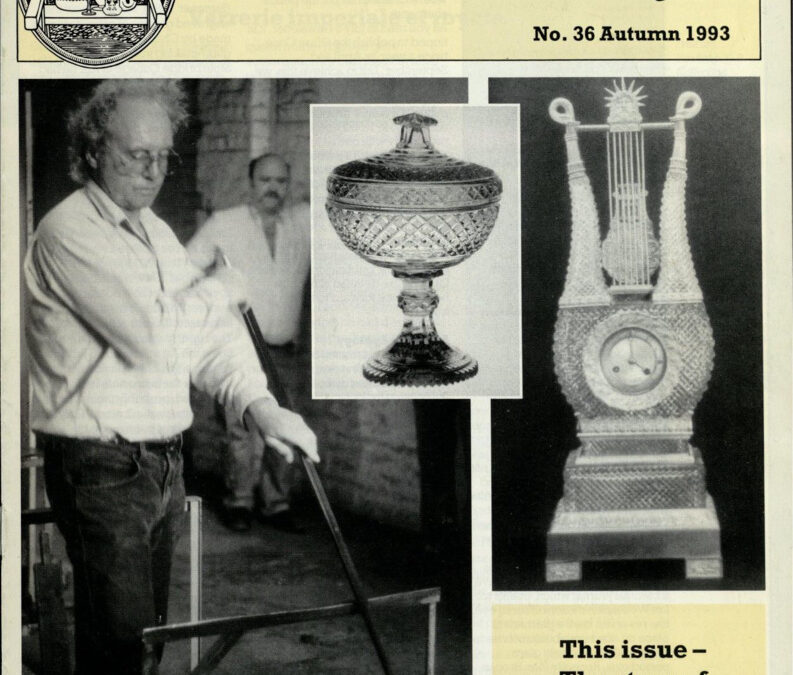
Cover Illustration:
Louis Leloup, one of Belgium’s
foremost contemporary studio glass-
makers in action for members of the
Glass Association during their Liege
visit in July 1991 (see article on
Voneche glass, opposite). Photo:
Alex Werner.
Farewell and many thanks…
In the last issue of the Glass Cone,
sent out May this year, Charles
Hajdamach announced his
resignation from the editorship of
the Glass Cone. All of us have
reason to thank Charles for he is
one of the eleven founder members
of the Glass Association and without
their energy and enthusiasm to ‘get
the show on the road’ over the past
ten years, the association would not
be in its present healthy state, and
certainly it would not have benefited
from the generous support of
Dudley Council, both now and then.
Over five hundred members now
enjoy the various and varied
meetings, talks, visits and outings
up and down the country. We have
a biennial Journal which, thanks to
Ian Wolfenden’s keen editorial eye,
has reserved itself a permanent
place on academic bookshelves
among other scholarly glass
periodicals. Recently John Brooks
has created a regular quarterly
newsletter full of interest; it is
proving so successful in eliciting
contributions from Glass
Association members that the
Committee is advising John to keep
down each issue to 8 pages.
So as Charles takes off the green
eye-shade, puts away the blue
pencil, empties the desk-drawers
and pushes back the editorial chair,
our grateful thanks… and when can
we all expect an article from him for
the Cone?
…and Hello
It will take me some time to adjust to
this new responsibility — to begin
with, the height of the editorial chair
needs changing, and I must find
where Charles has put the pencil-
sharpener.
As you read in July’s Newsletter, it is
hoped to publish the Glass Cone
twice a year, in April and
September, but to achieve this, we
are looking to members of the
Association to provide us with
material. Feature articles and
notices up to 1,000 words in length,
preferably with one or more black
and white prints or colour
transparencies will be welcomed.
All contributions over 750 words
and accompanying photographs
will be acknowledged by post, as
soon as possible after receipt;
illustrations will of course be
returned when received from the
printers after publication. Deadlines
for copy are detailed in the box
below. I look forward to hearing
from you.
A Special Apology
As the cover illustration of this issue
reminds us, the first overseas
seminar weekend of the Glass
Association took place in mid-July
1991 (Ian Turner’s report in the
Cone no. 30). Those of us lucky
enough to take part in that
memorable Liege trip realised very
quickly on our arrival that Mme Ann
Chevalier of the Musee du Verre
was totally committed to make our
visit a great success. Nothing was
too much trouble for her.
After some pressure, she kindly
agreed to send a summary of her
talk for publication in the Cone, but
for various reasons at our end, there
has been a long delay in printing.
We can only hope she will accept
our deepest apologies for this.
Caveat Emptor
Given the surprising frequency that
allegedly antique commemorative
glasses appear on the market,
collectors have good reason to
suspect the genuineness of them all.
When discussing the history of
glass-making at his home
Wordsley Hall, I can recall Benjamin
Richardson, then head of Henry G.
Richardson & Sons, telling me that
his firm once received a goblet with
an engraved motif and legend
indicating a Nelson commemorative
from a dealer. With it was his order
for a hundred or so copies to be
made. A note added the engraving
on the copies did not have to be
perfect, nor cleaned and polished
before dispatch.
Avid readers of the Glass Cone will
remember that in issue no. 18
(Summer 1988), I wrote about the
engraved glasses of antique design
made by Charles D. Stanier, the
glass-making instructor at
Stourbridge College of Art; he had
been one of Stuart & Sons’ most
skilful makers, whose photograph appears extensively in the firm’s
publicity material. Also at the School
was William Barnett Webb, the
engraving instructor from 1935,
who had previously worked for
Webb & Corbett, Amblecote and
L. and S. Hingley of Albert
Glassworks, Wordsley.
I mention this because recently I
came across a piece in the
County
Express
(Stourbridge) of
15 October 1949, regarding the
appointment of an ex-Stourbridge
student, William Frank Siviter, as
assistant to Stanier at the School.
The report added that in the serious
fire at the Art school on 26 July that
year, the fine collection of glasses
made by the instructors had been
destroyed, probably the result of
over-enthusiastic firemen. Only one
piece had not been made by
Charles Stanier, but by Siviter
decorated with an engraving
copied from a Battle of the Boyne
commemorative, by Webb.
That was one ‘antique’ that got
away. So, collectors, you have been
warned. Still any engraving by
W. G. Webb is well worth
treasuring in its own right.
H. Jack Haden
The opinions expressed in the
Glass Cone are those of the
writers. The editor’s aim is to
provide a range of interests and
ideas, not necessarily ones
which mirror her own. Her
decision is final.
COPY DATES
Spring 1994
February 19
Autumn 1994
July 16
1/’
Voneche
Verrerie imperiale et royale
Fruit urn,
Voneche. U. B.
Collection,
Voneche).
On 12 July 1991, Mme Ann Chevalier
of Liege gave a paper to members of
the Glass Association, and has since
kindly given us permission to publish
an English translation. However,
nothing can convey the wit and
humour of Mme Chevalier’s delivery
on that occasion. In translation and
editing, there is always a possibility
of an emphasis misplaced, a
meaning misconstrued; we
apologise if this has occurred here
but we wished to delay its
publication no longer.
In 1819 Mme Desamaud, manager
of L’Escalier de Crystal (The Crystal
Staircase) factory in Paris exhibited
a wonderful crystal and bronze
‘coiffeuse’ during the Exhibition of
the Products of Industry in the
capital.
It is thought this beautiful ensemble
of dressing-table and chair was
purchased by the Empress Marie-
Louise, or Marie-Louise Queen of
Spain, or more probably the
Duchess of Berry. Whoever the
buyer was, it was recorded by
Nicholas-Henri Jacob (1782-1871),
one of David’s pupils, and these
drawings are now held in the
Louvre collection classified as
“Cristallerie de Voneche”.
Until recently, hardly anything was
known about this Voneche glass
factory but the attention of the
Belgian public was awoken in 1985
with two exhibitions: “Verreries et
cristalleries Namouroises du XVIIIe
siècle a nos jours” and “L’Art verrier
en Wallonie de 1802 a nos jours”.
Voneche is a small village in the
province of Namur near the French
border. And this was where at the
end of the eighteenth century,
attracted by the good roads, sand
deposits and abundant forests in the
locale (so necessary for feeding the
furnaces), that Pierre-Nicolas
Mathys decided to build a glass-
works. On 14 August 1778 the
queen Marie-Therese gave
authorisation for the glass furnaces
to be built, and granted the title
‘errerie imperiale et royale” to the
works, although later it came to be
more generally known as “Verrerie
Sainte-Anne”. At first the factory
flourished but a series of bad
managers meant it quickly ran to
seed. It became known for the
coarseness of its glass, a result of
using too much potash in the batch.
A reputation saved
A young Parisian chemist, Rime-
Gabriel d’Artigues, came to the
rescue. In 1790, When in charge of
the Royal St. Louis-les-Bitche glass-
works in Alsace, he had discovered
the process of producing red lead
and so revolutionised French glass
production; before this, red lead
had had to be imported from
England. In 1802 A-G. d’Artigues
bought the Voneche glass-works
and transformed it into a crystal
glass-making factory, and
eventually into the most important
establishment of its kind during the
period of the French Empire. He
progressively cut back the
production of window glass and
tableware at Voneche, and
concentrated on glass crystal work,
personally overseeing the
preparation of batch from the raw
materials. Assisted by glass-makers
from the region of Alsace-Lorraine,
he was soon the largest
manufacturer of crystal glass in
France because his costs were
more than fifty per cent lower than
his competitors’.
Declining Years
Public recognition came quickly but
success was to last barely thirty
years. D’Artigues chose two
talented men to work alongside
him: Francois Kemlin and Auguste
Lelievre. Their collaboration bore
fruit; Vol
–
Ache was awarded a silver
medal at the 1806 Paris Exhibition of
Products of French Industry. By
1815, the Voneche glass-works was
employing five hundred workers,
with Kemlin as its Deputy Director.
The range was expanded to include
mould-blown pieces alongside the
cut crystal, and around 1818,
ceramic ‘sulphide’ portrait
incrustations, often representing the
French imperial family, were
incorporated on certain items.
Enamel painting was also
produced.
However, the political upheaval
caused by the fall of the First Empire
resulted in more than a fall in
production. To accommodate the
new kingdom of the Netherlands,
territorial frontiers were redrawn
Lyre Clock with
ormolu fittings,
in the First
Empire style,
c.1815. (ATIC
Collection,
Musee de
Groesbeeck-de
Croix, Namur).
Sweetmeat dish
with cover, first
quarter of the
19th century.
Voneche cut
decoration
resembled
contemporary
work across the
Channel, due in
part to english
cutters
employed in the
Cappelmans
workshop,
Brussels.
(Musee du
Verre, Liege).
with the result that Voneche was no
longer French. An agreement with
Louis XVIII allowed Voneche to
trade in France, on the
understanding that d’Artigues
would produce crystal on French
soil. To this end d’Artigues bought
the Sainte-Anne factory, renaming it
“Voneche factory in Baccarat”; at
this stage Baccarat was merely a
subsidary company of Voneche.
The working arrangement between
himself, Kemlin and Lelievre did not
survive. Kemlin and Lelievre
established a glass-works called
Val Saint-Lambert on the site of an
old Cistercian monastery in 1826.
The Revolution of 1830 marked the
end of the Voneche factory itself
The workers and equipment went
over to Louis Zoude’s glass factory
in Namur, to the new Val Saint-
Lambert works or to the French
company.
As for d’Artigues, he retired to his
mansion built in beautiful landscape
near the glass-works until 1844
when he sold up to Count Felix
Cornet Ways-Ruart. A year earlier,
the name Voneche had been
dropped by the Baccarat works. He
left for Paris where he died seven
years later, the author of several
works on a wide variety of subjects
(storage of corn; fresh-water pearls;
flint-glass for optics, etc.) as well the
founder of the crystal-glass industry
in France and Belgium.
Unanswered Questions
Given that we owe the production of
crystal glass to Ravenscroft’s work
in 1673, and that Franco-Belgian
production was the brain child of
A-G. d’Artigues, there are several
unanswered points.
Is it possible to identify Voneche
glass of the early period? Are there
special features which enable us to
distinguish between d’Artigues’s
products from the St. Louis glass-
works, his early Voneche designs,
and the first work made at the
Baccarat, Zoude and Val Saint-
Lambert? Are there any archival
sources to help us?
First, there is no doubt that glass-
cutting was undertaken nearby at
the Tanton cutting -shop and thanks
to a Voneche factory note-book, we
have information regarding the
patterns. Apart from the Louvre
illustrations by Jacob, these
drawings made by H. Ponthiere,
together with a price-list, were until
recently the only listed archival
sources. Both are now in the
Corning Museum of Glass
collection. We also know that some
cutting was done at Jean-Baptiste
Capplemans’s factory in Brussels,
which employed English cutters,
and in Paris at the Dersarnaud-
Charpentier works (L’Escalier de
Cristal). Desarnaud was the first
factory to produce crystal pieces in
association with bronze and ormolu,
as exhibited in 1819.
However, it has been my good
fortune to obtain correspondence
between M. Lelievre’s grandson
and Baron de Dorlodot. I have yet to
publish these but have the pleasure
in revealing just three new pieces of
information to you.
From these letters, it is now clear
that Kemlin and Lelievre left
Voneche because d’Artigues had
foolishly fallen in love with a
barmaid and appointed her as the
factory director, causing many
employees to resign.
Secondly, they reveal that
d’Artigues entered a contract with
Regout of Maastricht regarding
glass-cutting.
And lastly, that Voneche glass was
exported to Germany and Russia,
so there is a possibility of previously
unidentified pieces coming to light
in these countries.
As for distinguishing the early glass
of the various factories concerned,
in 1939 Lelievre’s grandson wrote
“to my knowledge, Voneche,
Baccarat, St. Louis and Val Saint-
Lambert in the beginning did not
put a factory-mark on their crystal”
and commented that it was “actually
very difficult” to identify the
individual factory production
ranges.
I find Lelievre’s attitude
disappointing and hope with your
help to modify this assessment. Do
you possess any genuine marked
Voneche glass in your collection, or
do you know of any pieces as yet
unrecorded? Such items could hold
important clues in the Voneche
story.
Ann Chevalier
Conservateur,
Musees d’Archeologie
et d’Arts decoratifs, Liege
Is the Engraving Familiar?
In the summer of 1992 I acquired
the single-handled jelly glass
illustrated opposite. Although it has
two minor chips on the foot rim, I
was attracted to it not only because
it was a handled glass, but also the
stylised engraving rang a bell the
minute I picked it up.
Sure enough, after a quick look
through my library, I found
illustrated in Thorpe’s
English Glass
(1935, plate XIX (b) facing p.192), a
sweetmeat and jelly suite now in the
Laing Art Gallery, Newcastle upon
Tyne, and realised that the
distinctive trellis border (a sort of
embellished Vesica pattern), the
flowers and foliage engraved on the
bowl,
and
it would seem, the
engraving on the underside of the
foot of my handled jelly, are
remarkably similar to those on the
Laing glasses; one piece is shown
here opposite. However, at 11.5 cm
my glass is somewhat taller than the
Laing jelly glasses.
The Laing set, consisting of a
stemmed tazza, a master
sweetmeat glass and eight jellies,
came into the collection in 1927 in a
bequest from John Crawford
Hodgson FSA, having formerly
been in the Hauxley collection.
Unfortunately, all but three of the
jellies were accidentally broken by
scaffolding constructors in the
course of work on the gallery in
1950. It dates from about 1745 to
1755; the engraving, possibly the
work of Jerome Johnson or a
London-Bohemian craftsman,
appears contemporary although it
has been suggested it is slightly later
in date. Over the past months I have
been in correspondence with
experts about my glass, notably Mr.
Nick Dolan, Mr. Tim Udall and Mr.
Simon Cottle. While they have
expressed great interest in the glass
and confirm the close resemblance
to the Laing set, they have some
doubts as to whether it originally
belonged to this suite.
Does any other Glass Association
member know of any more glasses
(sweetmeats, jellies or even perhaps
wines or goblets) with this particular
design engraved upon them? If so,
were perhaps such glasses part of a
large suite of glasses made to order?
Any answers or comments through
the Editor, please.
Roy Kingsbury
A piece from the
Laing
sweetmeat and
jelly suite (by
kind permission
of the Laing Art
gallery,
Newcastle upon
Tyne).
The single-
handled jelly
glass (Roy
Kingsbury;
photo. by Mike
McEnnemey,
Wimbome
Minster).
Five pens from
the Mike
Hughes
collection. The
two shown here
with anchor
finials have the
characteristic
turquoise glass
associated with
the Wordsley
firm of
Richardsons.
Wanted
Information
on Glass Dip
Pens
Glass Association member Mike
Hughes would welcome information
about glass dip pens. They come in
many different guises, some made
in three parts: glass spiral nib, stem
holder and finial. Other examples
have glass nibs with hollow tube
holders with advertisements inside.
The ornamental finial may take the
form of a bird but Mike Hughes, in
his collection of over 45 items, also
has pens with anchors, serpents,
various animals and crowns in all
different shapes, sizes and colours.
He wonders if he is correct in
assuming the glass nib allowed the
writer to exert more pressure than
possible with a regular steel; was it
then used for carbon copying?
Any answers or comments through
theEditor, please.
Cottage glass
with furnace
decoration
(John Franks).
In the absence of a trademark or
signature, classifying and dating of
glass to a glass-works or maker are
problematic, especially when
dealing with the decorative
coloured glass of the ‘Victorian’
period, when British glass-houses,
set free from the restraints of Excise
Duty, flourished and diversified
production. However, it is often
possible to recognise a style, the
use of a particular mould and type
of decoration, so the collector has
the opportunity to try to assemble a
representative collection of an
individual glass-house, or of a
decorative type — for example,
slag glass, cloud glass and carnival
glass.
Some cased glass forms a
distinctive grouping but it has never
been the subject of serious study,
left as it were, at the back of shelves
and displays at antique fairs. It does
not seem to have been the subject
Cottage Glass
of any specialist exhibition other
than in 1986 at Church Farm House
Museum, London, when the writer’s
collection was on show for six
months. Bought and sold under a
variety of names which sum up its
curious appearance — ‘Splatter’,
‘Spatter’, ‘End of Day’, ‘Splashed’,
even ‘Friggers’, — this type of late
19th century glassware was
produced by a number of
companies for many years.
It takes the form of cased or overlay
glass, blown in the English tradition,
so identifiably different from the
American ‘Splatter’ glass made by
Northwood (cf. William Heacock
Harry Northwood: the Early Years
1881-1900).
Typically this group has
an inner case of opal, then a pattern
layer of coloured glass, and a final
colourless, transparent crystal
casing. Most pieces have faults,
which suggests that it was
experimental, practice or
apprentice work. It seems to have
been made, not for the great
mansions or middle-class houses,
but for workers’ cottages, be they
‘tunnel backs’, ‘bothys’ or whatever
local variation, and sold at wakes,
fairs or in public houses.
‘Cottage’ glass, if we may call it that,
often fulfilled a useful purpose as
baskets, vases, tobacco jars,
candlesticks, or jugs sometimes
with basins, oil lamps and carafes
with matching glass. Or they may
be purely whimsical, decorative
ornaments.
By comparing shapes, handle
forms, colour combinations and
decoration, a picture builds up
which suggests Stourbridge
manufacture, but no one glass-
works. The patterning of the pink
and white basket shown here
corresponds to that on a rib mould
jug attributed to Stevens & Williams
(no. 103 Cyril Manley
Decorative
Victorian Glass);
other items came
from that mould, sometimes
incorporating the claw handle.
Some pieces have silver flecks in
the spatter decoration, and their
shape suggests the use of Webb
moulds. Again, others have furnace-
wrought decorative details, as
illustrated below.
The colour pattern over the inner
opal layer may be a candy stripe,
‘peacock eyes’, or ‘spatter’. Over
time, the number of colours used
increased and the ‘spatter’ has a
finer distribution. Some moulded
‘spatter’ pieces have no additional
decoration, and this may well
indicate later commercial mass-
production. Occasionally pairs of
large vases can be found with gold
or enamel applied decoration.
Except for some mould-blown
items, there is usually a good pontil
mark, which in a number of
examples has been ground down.
These black and white photographs
cannot convey the exuberant
colouring of these glasses, nor the
rich variety of forms one can find.
Some imitate Classical shapes,
while others reflect the impact of Art
Nouveau, or show the Victorian
Gothic taste for over-working. They
may lack the simplicity preferred
by the modern eye but for a
collector, they can be fun.
John Franks
Pink and white
glass basket,
(John Franks)
.
A Walk in the Forest
During a recent holiday in Central
Europe, by chance Jill Turnbull came
across two German glass museums,
which will be of interest to others
considering travelling in the area.
While visiting Weimar, in former
East Germany, we were shown a
magazine article describing a glass
museum in the village of Lauscha in
the Thuringia Wald. Close to
another centre of glassmaking,
Neuhaus, and not far from Coburg,
Lauscha is an important area of
traditional forest glass-making,
relatively little changed by
‘westernisation’.
Glass has been made in Lauscha
since 1597. The local factory is still
in production, and lampworking
continues to give employment in the
village. The museum collection
dates back to an exhibition mounted
by the community in 1897 to
celebrate 300 years of glassmaking,
but it has since been expanded to
cover Thuringian glass in general.
Most of the exhibits were made in
the 19th and 20th centuries, but
there are examples of 17th century
glasses, 18th century Hampen,
rummers, engraved presentation
pieces and enamelled work. The
process of lampworking was
introduced in the second half of the
18th century, and the museum
display includes a range of work,
beads and artificial pearls,
Christmas decorations and other
ornaments, animals and vessels.
Photographs show whole families
working at home on different
aspects of glassworlcing, and
women setting off to market
carrying huge packs of glass
baubles on their backs. There is
also a small diarama displaying the
process of blowing and pulling
glass rods for use in lampwork.
Rods are still pulled by hand in the
Lauscha factory and visitors may
see this being done any working-
day morning.
Many of the museum objects are
unsophisticated in design and
sometimes in execution, but this
small museum reflects very nearly
four hundred years of continuous
glass-making in the village
community. And the current
illustrated catalogue (in English) is
in itself a historical record of former
political times with its references to
the exploitation of the workers by
“the capitalist sales agent system”!
Much more sophisticated glass was
dazzingly displayed at the Passauer
Glasmuseum, situated in the Wilden
Mann building, in the, old quarter of
Passau, near the Austrian border.
Case after case of decorative glass
is on display, covering the period
1730 to 1930. While there are
examples of 18th century
enamelled wares and 19th century
revivals, engraved and cased glass,
the main emphasis is on Art
Nouveau work. There is an
enormous, comprehensive range of
glass from the Bohemian factory of
Johann Loetz Witwe of
Klostermuhle. Many are Jugenstil
wares from 1898 onwards,
including irridescent ‘Phanomen’
and ‘Papillon’ effects and imitation of
semi-precious stones. Also on show
are designs for the firm by Maria
Kirschner from 1900 to 1915, and
work of the designer Michael
Powolny for J & L Lobmeyr, and of
Koloman Moser, Josef Hoffman and
Hans Bolek.
Both Lauscha and Passau are well
worth a visit; Passau is certainly a
‘must’ for the any Art Nouveau
enthusiast. And good news,
photography is permitted in both
museums.
Jill Turnbull
Jobs for the Boys (and Girls)
The Birmingham Glass Trade in 1913
An interesting insight into the
working conditions of the
Birmingham glass-making factories
in 1913 is contained in a pamphlet
published by the Central Care
Committee of the Birmingham
Education Authority that year, for
the Juvenile Employment Exchange.
At that time, the young person was
informed, it was customary to work
in a team of four, although this was
increased to six or seven in the
production of fancy coloured glass.
The ‘foot-maker’ (also known as the
‘foot-blower’ or ‘gatherer’)
gathered the glass, shaped it on the
marver and then handed it to the
‘servitor’ for blowing. The finishing
touches, adding the stem, foot and
any furnace decoration, were the
task of the ‘workman’ or ‘maker’,
and the last man on the team, the
‘taker-in’ carried the finished work
on a forked stick to the trays of the
annealing chamber, hand-cranking
the line of trays along.
This was at this level the young boy
entered the glass-house. He
worked as a ‘taker-in’ for two or
three years during which time he
also had opportunities to practise
‘gathering’ and to learn blowing. If
he showed any skill, he graduated
to helping the ‘workman’ by
gathering glass on the punty iron for
the stem or foot and was eventually
set `to make foot’.
As a rule boys advanced to become
`foot-makers’ between the ages of
16 and 18, but the National Flint
Glass Makers Society (the trade
union) had a say in both the
engagement of boys, and their
promotion. It allowed one boy to
each chair and no boy could be
advanced to ‘foot-maker’ as long as
there was a suitable ‘foot-maker’ on
the trade list of unemployed; this
also applied to progress into the
other grades so advancement was a
slow business.
Hours and Wages
The pamphlet stated that usually
glassworks worked alternate six-
hour shifts, the first starting at 6 am
on Monday. They normally did eight
‘turns’ in a week; the maximum
agreed by the union was nine and
the minimum, five ‘turns’ and a
‘move’ (half a shift), that is 33 hours.
However, at this time (1913) one
firm had introduced 12-hour shift
working
“in order to make the hours
more convenient for boys”
[emphasis added].
The wages of the boys on first
entering a glass-house varied.
Some firms paid one shilling (5p) a
‘turn’ and a weekly shilling bonus,
making a maximum of 10/- for nine
‘turns’ with a further 3d per ‘turn’
paid after the first month. Other
companies paid by the week, the
boys starting at 6/- to
7/-
(30 or 35p)
rising to 11/3d (56p) after which
they were paid accordingly to
ability by the ‘turn’.
The weekly (of 8 ‘turns’) rates were
as follows:
Foot-makers: £1.5.4d to £1.17.4d
(£1.26p to £1.66p); Servitors: £2 to
£2.8.0 (£2.40p); Workmen: £2.8.0.
to £3.2.0 (£3.10p); Mixers were paid
by the day up to 28/- to 33/- (£1.40
to £1.65p). Girls who worked in the
warehouses were ordinarily paid a
starting wage of 4/6 to 5/- for a 52-
hour week, rising to 8/6d to 11/6d
maximum. Apart from Bank
Holidays there were no recognised
holidays.
Adverse criticism
The leaflet states that the glass-
making trade was scheduled as
being dangerous, with workers
being liable to chronic bronchitis,
consumption, rheumatism and gout
caused by the high temperatures
they were exposed to at work. They
were also liable to cataracts,
especially of the left eye, owing to
the heat and glare of the furnaces.
However, a later paragraph in the
pamphlet reads: “The trade is very
free from all forms of serious
accidents”. Indeed the Flint Glass
Makers Society published statistics
to prove its members were
remarkably long-lived; their
average age at death was 71
1
/2. It
also reported a number of men over
60 years of age still working who
had started in the glass-house at the
age of nine. It was one of the few
trades where men of 50 were in
greater demand than men of 30.
Entry requirements
No formal qualifications were
required, just “a robust constitution,
good eyesight and an eye for
proportion or he will never become
a good glassblower”. The
prospects were good. There was
little or no short time and several
firms were contemplating creating
new ‘chairs’; skilled labour was in
short supply. However, it was
recognised the heat, and the
monotonous nature of the job
during the early years meant many
Birmingham boys preferred other
unskilled work especially during
the summer months. The six hour
‘turns’ were also unpopular with
parents as boys got home after
midnight, then had to leave again
for work by 5 am. The pamphlet
admits this, making a last telling
comment: “A certain number of
boys are obtained from the
Stourbridge district, which is the
chief centre of the trade”.
John Brooks