




\UAL:3Z;
The newsletter of the
Glass Association
Registered as a Charity No. 326602
Chairman:
Anthony Waugh
Hon. Secretary:
Roger Dodsworth
Editor:
Dr. Patricia Bake:
Address for Glass Cone correspondence:
3 Winton Road, Farnham,
Si rey, GLT9 9QW, England
Address for membership enquiries, etc.:
Bt oadfields House Glass Museum.
Barnett Lane, Kingswinforcl,
West Midlands DY6 9QA
Tel: 0384 273011
ISSN 0265 9654
Printed by Jones & Palmer Ltd, Birmingham
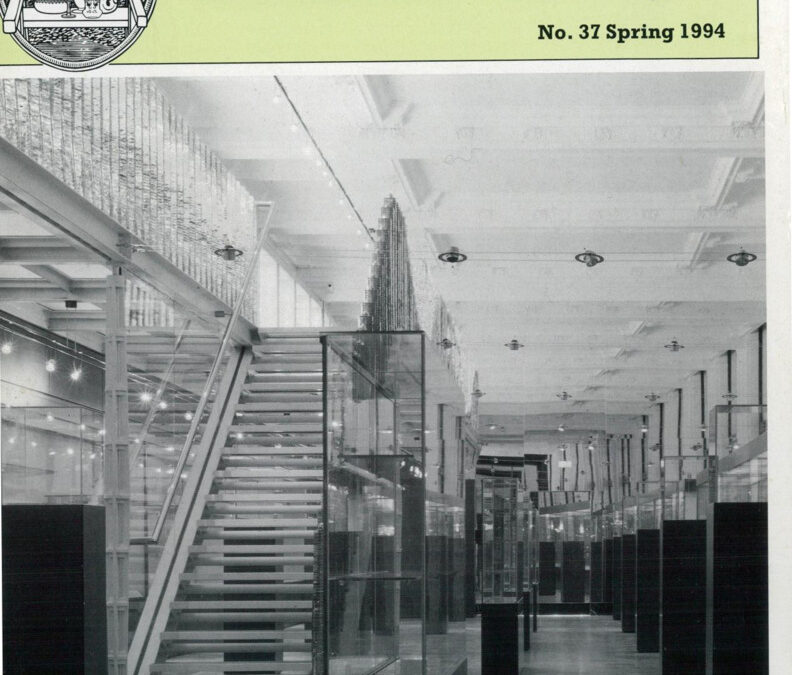
Cover Illustration:
The installation of the new Glass
Gallery at the Victoria & Albert
Museum. Designer Penny Richards of
Pringle & Richards, Architects. Glass
balustrade and handrail by Danny
Lane, in collaboration with Pringle &
Richards, and Whitby & Bird, (By
kind permission of the V&A Museum,
London.)
A Spring to be Remembered
The grime and traffic of London are
often more than enough to
discourage one from making a
special journey into London, but this
spring, put a sparkle into your day
in the south by visiting the Glass
Gallery at the Victoria & Albert
Museum (reopening to the public
on 20 April). The new display not
only reveals the dimensions of the
gallery, previously swamped by the
large and cumbersome Victorian
display cases, but allows more
pieces to be shown than before.
Even on a dark, dismal January day,
with the displays still waiting the
finishing touches, it seemed as if the
glass itself has taken on new life
revelling in this opportunity to show
off its rich variety of colour, shapes
and proportion, and technique used
by glass-makers, past and present.
The trustees, and staff of the
Ceramics & Glass department of
the V&A have kindly invited Glass
Association members to attend a
Private View on 4 May; full details
and application on the flyer
enclosed with the Newsletter or
with this issue. The V&A education
department is marking the opening
with a two-day conference,
exploring various topics of glass,
ancient and modern, in mid-May.
Information and application form
will be sent with the Newsletter or
with this Cone.
Both events should be entered into
your diary now. Cancel all other
engagements; after all, this
opportunity of celebrating the
gallery’s reopening won’t happen
again in our lifetime.
And why not go along to the new
premises of the Glasshouse in
Islington (p.
7)
the same day, to see
the results of the new leadless batch
they plan to use? Both venues are
linked by the Underground. Only a
few minutes away from South
Kensington will be an exhibition of
Gayle Matthias’s work at the
Jeanette Hayhurst Gallery,
Kensington Church Street.
Glass Dip Pens
Following Mike Hughes’s request
for information on Glass Dip Pens,
Ken Cannell of London has noted
three recent articles published in
American periodicals by Lon
Knickerbocker, as detailed in the
Publications listing in the
Journal of
Glass Studies
(Corning Museum of
Glass, NJ, USA), vol. 35 (1993).
These are “What about Glass
Pens?”
Glass Collector’s Digest,
vol.
5(vi), April/May 1992, pp. 55-63,
illustrated; “Glass Pens: Are they
more than just a whimsey?”
Antique
Weekly
(Eastern ed.) vol. 25 (no.
28), 5 Oct. 1992, p. 1 and plate; and
“What about Glass Pens?”
Whimsical Notions
vol. 4(i), Jan. 1992
pp. 3-6. Back issues of the JGS may
well contain other references in the
listings.
As the new V&A Glass display will
include a few examples of glass
pens, and the Village Glass
(Stirlingshire) stand at the
Birmingham International Spring
Fair (see p. 7) drew a constant
stream of visitors with its glass pen
demonstration, Mike Hughes may
also have a crystal ball in his
collection.
Plans for Future Issues
The Glass Association has a well-
deserved reputation for being a
friendly society, with its member
enjoying the diversity of interests
represented. With that in mind, it is
hoped to carry as regular features in
the Cone, interviews with people
(not necessarily members) involved
in collecting, in dealing, in
researching and in making glass;
and also a series to be called “My
Choice”, in which the writer would
introduce a glass-work which has
special personal significance,
perhaps because it is associated
with an event in his/her life, because
it was a fluke ‘find’, or because, for
the writer, it embodies the essence
of glass-making. Such glass does not
necessarily have to be in the writer’s
collection.
So, get writing or if that prospect is
too daunting, let me have your
suggestions of interviewees and
possible interviewers.
Feature articles and notices
up to
1,000 words in length (a typed line
on an A4 page usually contains just
under 10 words), preferably with
one or more black and white prints
or colour transparencies will be
welcomed. The text should be typed
or written
clearly.
All contributions
over 750 words and accompanying
photographs will be acknowledged
by post, as soon as possible after
receipt; illustrations will of course
be returned when received from the
printers after publication. Deadlines
for copy are detailed in the box
below. I look forward to hearing
from you.
Righting the Wrong
Clive Bartlett of Manchester with
Jenny Thompson’s
The Identification
of English Pressed Glass,
1989 close
at hand has compiled a list of
corrections to errors in various
standard reference works. As he
says, her publication is of immense
service to all enthusiasts of this glass.
Insert these corrections in your
copies before you forget.
Slack
English Pressed Glass 1830-
1900,
1987; the List of Design
Registrations should read as follows:
28865 Parcel 5
67781 Rees, Penry Napolean
Price, London
continued on back page
The opinions expressed in the
Glass Cone are those of the
writers. The editor’s aim is to
provide a range of interests and
ideas, not necessarily ones
which mirror her own. Her
decision is final.
COPY DATES
Autumn 1994
16 July
Spring 1995
16 February
Opal and clear
glass water-lily
flower holders
with metal
mounts. Design
registered in
1903, made by
John Walsh of the
Soho and Vesta
Glassworks. V&A
Circ. 380 & 599-
1966 (By kind
permission of the
Victoria & Albert
Museum.)
More than a Spring Clean
Let’s face it.
We have all been grumbling over the
closure of the V&A’s glass gallery.
What has been going on upstairs on
the second floor since August 1991?
Surely, it was just a matter of
redecorating, re-lining and re-
varnishing the display cases,
washing the glass and writing new
labels. So why has the reorganisation
taken almost three years?
Oliver Watson, in charge of the
Ceramics & Glass department of
the Victoria & Albert Museum,
London stood in the new gallery and
asked if it really did look as before.
That was in late January. Come
20 April and you will be able to see
for yourself that it is substantially
more than a mere wash-and-brush-
up.
After the gallery closed to the public
in the autumn of 1991, work began
removing the glass displayed in the
wall cases. To store not only the
glass — over 400 pieces — but also
the Victorian display cases, the
French porcelain gallery was also
closed off.
It had been decided to take the
opportunity offered by the
reorganisation to undertake much
needed building and repair work in
the departmental offices behind the
scenes; when the museum was
constructed, the original site plan of
the South Kensington Museum
included gallery layout but no office
space, so these sections have
always had a certain makeweight
character about them. While this
work was done, the staff camped for
a few months in the gallery now
empty of all its glass.
After moving all the office
equipment back, it was time for the
building team to tackle the long-
overdue repair work in the gallery
itself. As the Museum no longer
comes under PSA, a sizeable chunk
of money and time had to be spent
on the updating of the security
systems. Such work had to be done
within the constraints of Grade 1
Listed building regulations. Only
then could work begin on the
installation of the new mezzanine,
floor sanding, and general
redecoration.
In January 1993, Penny Richards the
designer could at last begin to see
the display area take shape with the
arrival and installation of the new
free-standing cases, and the
construction of the wall cabinets.
These airtight cabinets have
swallowed up over two-thirds of the
budget which totalled about
El million but they will provide
stable humidity conditions
necessary to control “crizzling”
(devitrification), which affects about
10% of the collection. It was known
that early Italian and Fagan de
Venise glass were liable to the
“glass disease” which occurs when
insufficient stabilizer has been put in
the original batch, but it had not
been realised that this problem
could arise with all glass excepting
Classical and Islamic work. One
consequence of this has been that
the V&A and Imperial College,
London are working together on
this problem.
Meanwhile, the department was
hard at work entering and updating
details of each of the 7,000 objects
which made up the total collection
(discounting shards) onto the
computer database, and compiling
a separate glass register with
identification photographs.
Everything was washed carefully
and sent for conservation if
necessary.
Every member of the section took
responsibility for a historical and/or
regional category: Oliver Watson
for Islamic glass and then, following
Curatorial
assistant
Andrew Bolton
working on one
of the 19th
century display
cases.
Sandblasted
sculpture, made
in Scotland by
Ray Fla veil,
1991. V&A
C.204-1991. (By
kind permission
of the Victoria &
Albert
Museum.)
Paul Greenhaugh’s departure,
19th century British work;
Hilary Young for Spanish, and
Continental 17th and 18th
century glass, while
newcomer Reino Liefkes was
assisted by Fiona Callaghan
on the Italian collection. Robin
Hildyard dealt with British
glass up to the Victorian
period, and Jennifer Opie
worked on Continental 19th
century and all the 20th
century items; in all, those two
curators handled over half the
collection in number of
pieces.
The plan of the display was
then finalised. The
mezzanine was to house the
study collection (bound to
be a draw for Glass
Association members; each
of the 18th century drinking
glasses on show is different), and
the wall cabinets and display units
on the main floor to be kept for the
prize items, arranged according to
their date and place of origin, with
occasional separate cases to
explore particular themes.
Altogether, 1,000 more pieces
would be out on view than with the
previous arrangement.
It was decided to keep information
notices and labelling to a minimum,
but before you write to your MP to
complain, read on. At some three
assured all the database functions
will be operational by mid-April. It
is planned to make all this
information available
to
the public,
by putting it and the images on CD
in the longer term.
After deciding on the plan, the
various pieces had to be located, no
easy task when dealing with
5,000 objects, and arranged
in
the
display area concerned. The
British 18th century cabinet looks
particularly attractive, with the glass
set out like a trade-card of the
period, while the bewildering
variety of 19th century styles is
deliberately exploited to the full
nearby. The displays of 20th
century and contemporary glass
have to meet the visual challenge
presented by each of the pieces
reflecting their maker’s
determination to create a highly
individual object, and seemingly to
make it larger than anyone else’s.
The gallery shows what a museum
display can be, involving the
spectator in an enthusiastic
demonstration of the ingenuity and
creativity of the glass-maker, past
and present. You will want to go
back, again and again.
Patricia Baker
As from last year, V&A opening hours
are now: Monday 12.00 – 17.50;
Tuesday to Sunday 10.00- 17.50
places in the gallery, there are
computer pods (guaranteed idiot-
proof) which are mines of
information. Interested in a certain
piece of glass on display? Then,
take a note of its number, and enter
it into the computer. Hey presto, all
the relevant details will appear. Also
in the database will be info’
illation
on techniques, and production
centres (factories, etc.),
personalities, maps, a history of
glass and so on. News of the
£100,000 grant from Corning
Museum of Glass, NY and the
Friends of the V&A, that made this
wizardry possible, came through
only at the end of last year, but I am
An Important Acquisition
The two stalwart
supporters of
the oval shield,
carrying the
WD monogram,
and dated 1789
(by kind
permission of
Broadfield
House Glass
Museum).
A rare documentary tumbler has
recently been purchased by
Broadfield House Glass Museum
from Delomosne’s with the help of
50% grant from the Victoria and
Albert Museum/Museums and
Galleries Commission Purchase
Grant Fund.
At first glance the 4’/2″ tumbler looks
like a conventional Napoleonic Wars
patriotic commemorative with a
figure of Britannia on one side and
on the other, two supporters holding
an oval shield with the monogram “WD” and the date 1798. Tum the
piece over and look at the base and
you find the fascinating inscription
“May Britannia Ever Gain the Day
W. Dudley Dudley Worcestershire
Glass Engraver Finished May 4th
1799”.
Although Dudley had a considerable
glass industry in the late 18th and first
half of the 19th century, few records
survive and even fewer pieces have
been identified. So the tumbler is
particularly important for the light it
throws on glassmalcing activity in the
town about 1800. Until the
appearance of this piece, the earliest
recorded engravers in Dudley were
William Herbert and John Bourne
working in the 1820s. Now Dudley
will have to be considered alongside
the more recognised centres such as
London and Newcastle as a possible
source for some of the large number
of engraved commemorative
rummers and tumblers that were
being produced around 1800.
Assuming that the glass was made as
well as decorated in Dudley, this
would make it not only the earliest
known piece of Dudley glass in
existence, but it would also pre-date
any piece of vessel glass that we can
positively identify as having come
from nearby Stourbridge.
In some ways the tumbler raises
more questions than it answers.
Engraved glass of this period is
hardly ever signed and so why the
engraver chose to inscribe the base
in this way is not entirely clear, nor
is the significance of the strange-
looking supporters with the oval
shield, unless they are meant simply
to be a humourous variant on the
military trophies one might expect
to find there. Whatever the precise
meaning of the tumbler’s
decoration, the piece certainly
forms a valuable addition to our
knowledge of Dudley glass.
Roger Dodsworth
The base of the
Dudley tumbler,
dearly showing
the inscription
and date (by
kind permission
of Broadfield
House Glass
Museum).
Our
Choice
Betty and Derek Parsons in the West
Midlands have kindly agreed to be
the first to share with us their favourite
land of glass. They started collecting
Bagley glass because “it was one of
the few types of glass which was still
available at a price which would suit
someone on a small pension”. Before
long, the charms of the glass itself
became addictive, and frustrated by
the lack of published information, the
Parsons themselves began delving
into the history of the firm. Some of
their research is revealed here.
Bagley’s began operations in 1871
with the construction of a single pot
furnace, as just one of the many
bottle making companies situated in
what is now West Yorkshire. Until
1913, bottles were its sole
manufacture but in that year it
launched the Crystal Glass
Company, for the production of
containers for preserves and
confectionery.
Ten years later, the company
registered its design 1122 which
later in 1949 came to be known as
‘Queen’s Choice’, because of the
admiration Queen Mary expressed
for it (actually it remained in
production until 1975). Together
with a few other classical designs,
1122 formed the bulk of production
in the 1920s, as can be seen from
the 1927 catalogue.
The period of the 30s was the high
point for Bagley’s. Delicate shades
of coloured glass, both clear and
frosted, were marketed under the
name ‘Crystaltynt’. Lamps, vases
and boudoir sets in Art Deco style
were introduced. Of particular
merit was the series 1333 (later
called ‘Wyndham’) and 2231
(‘David’). An amusing set of press-
moulded jelly moulds in the form of
rabbits were
also
produced.
Alexander Williamson who joined
Bagley’s in 1934 as a designer was
responsible for six beautiful designs,
among them the ‘Marine bowl’ and
‘Leaf vase’. Several striking Boudoir
sets were made, including the
‘Bedford’, unusual for its twin
candlesticks. Several lamps and
three clock mounts were designed,
as may be seen from the colour
catalogue of 1936, and the lavish
advertisements in contemporary
trade journals. At this time, the
company compared very favourably
with other — now better known –
pressed glass manufacturers.
In 1936 a series of items were
produced to mark the coronation of
Edward VIII but, with the
abdication, the company ruled that
all should be destroyed. It is
reported that a few pieces escaped
but we have never seen any. A
commemorative plate of fairly
conventional design was produced
in a hurry for the coronation of
George VI, and this is fairly
common. Much rarer is the
modification carried out on this
design, to mark the visit of the King
and Queen to the factory in late
1937. In addition to the plate a
souvenir booklet was produced,
and in this may be seen the ‘Koala
Bear Vase’ and the ‘Pelican’
figurine, perhaps some of the rarest
Bagley designs to be found now.
The outbreak of war brought an end
Bagley’s of Knottingley
to this innovative period as Bagley’s
concentrated on making articles for
the war effort, as stipulated by
government regulations.
After the war, production of the
decorative and domestic glassware
was resumed but although some
new designs were introduced, the
pre-war designs remained
prominent, judging from a
catalogue issued in the mid-50s.
Perhaps the most significant
development was the introduction
of an attractive black glass called
‘Jetique’ in 1957, often decorated
with polka dots.
Both before and after the war, many
of the smaller items were hand-
painted with flowers but it is rare to
find a perfect example of this style,
as it wears badly. After the war,
transfers were used and the patterns
fired on, making a much more
permanent decoration. An unusual
style sometimes found involved the
attachment of leather flowers in
addition to painted leaves but most
surviving examples are in very poor
condition.
Bagley’s was acquired by Jackson,
another Knottingley glass firm, in
1962. The change of ownership
brought about a new company
name, White Rose Glass, and with it
some new designs which were
based on traditional forms. As the
1964 catalogue shows, the patterns
were now given names, rather than
simple numbers, a practice which
Bagley had started in 1947 with
‘Queen’s Choice’.
1975 saw the company taken over
by Rockware and a series of original
designs called ‘Wild Oak’ appeared
.
Soon, however, the production of
decorative glass ceased and the
Weeland Road factory reverted to
making high quality containers,
mainly for the cosmetic trade. The
factory is still in production.
Identification of Bagley glass is not
easy and catalogues are almost
impossible to find, but
advertisements carried in trade
journals can be very informative.
Some Bagley glass is marked ‘Made
in England’ (occasionally ‘British
Made’) and some patterns carry a
registered design number, but it is
most important to get a ‘feel’ of the
glass. Easily identified is the series
made for the holiday souvenir trade,
which usually have hand-painted
flowers together with the name of
the resort in red script. Many Bagley
pieces were put into metal mounts
by other manufacturers, and
typically these mounts are of the
‘leaf and cord’ variety (but this is not
an infallible guide as Bagley was not
exclusively used).
For those of you wanting to see
examples of Bagley ware, there is
a
small number of items usually on
public display at Broadfield House.
Pontefract Museum also have a
collection as do the authors, but
viewing is by appointment only in
both cases.
Betty and Derek Parsoris
Boudoir set
3002, a classic
Art Deco style,
designed in
1934 probably
by Alexander
Williamson
(Betty & Derek
Parsons).
Tea Caddy Bowls: Mixers or Sugars?
Victorian tea
caddy, press-
moulded,
c.1860 (John
Brooks,
Leicester). In his book on British Glass, Charles
Hajdamach includes a Webb
Richardson design sheet
circa
1803
for ‘Caddies’ (p 1 . 38) and in
discussing this plate, writes: “The
designs in a tea caddy would seem to
be final proof that this shape of bowl
was used in a tea caddy for blending
teas and not as a sugar bowl which
some evidence has suggested.” Peter
Lole of Manchester reopens the
debate, strongly supported by
Jeanette Hayhurst.
Peter Lole
writes: In the Vawdrey
personal accounts now in the
Cheshire Record Office, Peter
Vawdrey recorded a large number
of glass items purchased from his
company Perrin, Geddes of
Warrington (cf. Glass Association
Journal
no. 2) one of which was “1
Mahogany Tea Caddie with a blue
cut sugar bowl and two squares –
£0.16s. 0”, bought in 1803. This
describes the classic caddy, and
indicates clearly that Vawdrey
regarded the
central bowl as
used for sugar.
The price
incidentally
can hardly be
for the whole
ensemble; he
bought 17
“sugar
basons”
between 1802 and 1806, paying
anything from 6d for “a blue Sugar
Bason” to a princely £2.15.6 for “1
Rich Cu
–
Et Globe Sugar Bason”; the
lowest price noted in the accounts
for such cut bowls was 4s.6d, the
average price being 10s. 6d.
But, in the light of this evidence, asks
Peter Lole, what are we then to
make of the fine free-standing
Teapoy at Arlington Court, Devon,
which contains both three
“squares” and
three bowls?
Jeanette Hayhurst
in London notes
that sugar as well as tea was an
expensive commodity in Britain in
the early 19th century, and coloured
bowls as late as the 1840s were
sometimes decorated with the
slogan “Be canny with the sugar”.
She points out that in those caddies
with only one compartment for tea,
the bowl could hardly have been
used for blending, and that tea was
available already blended from at
least one major supplier. For her,
the proof lies in the
Book of Prices &
Designs of Cabinet Work,
published
by The Cabinet-makers, London
(second ed. 1793, p.235) which in
setting prices for the making and
veneering of a tea chest, including
the following details: “A cover with
hole cut to receive the sugar basin
£0.0.5d. Blocking ditto to the circle,
and lining ditto with cloth £0.0.5d.
Making a case for the sugar basin to
lift out, the inside of ditto shaped to
the circle, top part veneer’d and
mitr’d, inside lin’d with cloth
£0.1.0d.” Could we have anything
more specific, she asks?
The Glasshouse in Islington, London
No one could easily forget Chris
William’s directions to the new
home for The Glasshouse. “Angel
tube station on the Northern Line,
turn right and walk up to Islington
Green, and St. Albans Place is
opposite the Slug and Lettuce.”
This is the second move for the
workshop which started life as a co-
operative in Neal Street in the first
years of the British studio glass
movement, and then transferred to
nearby Long Acre in 1976. Covent
Garden itself has undergone marked
changes over the last sixteen years,
as the area became firmly
established on the tourist map, but it
was failure to obtain a new lease on
“sensible teiiiis” that prompted the
search for new premises. The four
glass-makers who make up The
Glasshouse (Annette Meech, David
Taylor, Fleur Tookey and Chris
Williams) looked at places in
Portobello, Butler’s Wharf, anywhere
in London that had a ‘community feel’
about it, finally coming across this
unit in Islington. Its proximity to the
Crafts Council, the Business Design
Centre and Camden Passage was an
added bonus.
The mad rush of Christmas also
brought the lease-expiry date and
everything had to be moved out of
Long Acre by Christmas Eve. As the
furnace and glory-holes were
dismantled, stock and equipment
boxed up at Long Acre for
transportation, so wooden partitions
of the former camera repair shop in
Islington were ripped out and
mezzanines constructed. January
was spent in the sort of “organised
chaos” that would have won critical
acclaim as a sculptural installation if
displayed at the Tate Gallery, but
then it did entail installing new
lighting, redecorating, unpacking
and setting up the workshop — as
well as exhibiting at the Trade Fair
in New York.
Foot for foot, there may not be much
difference between the two
workshops, but the Islington site
gives the impression of more
space, especially noticeably in the
ground-floor showroom. Upstairs is
the working area with a newly built
tank-furnace
designed by
David Taylor,
the three
glory-holes
and two
benches, the
lehrs, etc. with
side units
housing the
cold-working
processes.
Contemporary
glass
enthusiasts won’t need further details
to persuade them to visit the new
premises, but Glass Association
members with a technical bent will
find the new glass pieces interesting
as the Glasshouse team will be using
for the first time, the new lead-free
glass of Plowden and Thompson,
which promises the colour and
brilliance of lead. And before
checking out the antique shops in
Camden Passage three minutes
walk away, or experiencing the
nearby Chapel Street market, you
should try one of the many cafés and
restaurants in the area; this “Slug and
Lettuce” pub sounds intriguing…
The Glasshouse is open Tues-Fri
10-6, Sat 10-5, at 21 St. Albans Place,
London Ni ONX; Tel: 071-359 8162;
Fax: 071-359 9485
The new
ground-floor
gallery
Through a Glass Darkly
During last
year, the
Crafts
Council
travelling
exhibition
displayed
current work
of British
Studio glass-
makers, and
this year’s
International
Spring Gift Trade Fair at
Birmingham NEC allowed
manufacturers to show off their new
design ranges. With a few
exceptions, it was depressing stuff.
Most of the British cut crystal work
exhibited remains entrenched in
the 19th century. Observing the
pastiches of feet, stems, cups and
decoration, one visitor wondered
wryly how long the old pattern
books could be so misused for
ideas. For the few non-“traditional”
pieces, Brierley showed some
overlay coloured glass angle-cut in
the manner of 1980s Minimalist
perspex, and free-blown work
which compares very unfavourably
with Simon Moore’s well-designed
studio ‘snail’ stemmed ware.
On the other hand, the Edinburgh
Crystal display included a new
stylish Veneto range, with just two
elliptical cuts curving over the
elegant form.
Dema of Chesterfield’s machine-
made Metropolitan range caught
the eye with its primary colours
(sprayed on), and forms
reminiscent of Philip Webb/Powell
designs. A touch of colour featured
on one of the new Darlington ranges
with shapes akin to late 1970s
Rosenthal ceramic work. Most of the
UK coloured glass production relied
heavily on Art Nouveau glass for
inspiration but lacked finesse and
sense of proportion. Enough said.
For real enjoyment of form and
glass-working, one had to turn to
the stands of the East European,
German and Austrian manu-
facturers. Bohemian Art Glass lifted
the spirits with its
joie de vivre,
the
stemmed ware of Riedel, Austria
was breathtakingly reckless and
Nachtmann’s Allegro series eye-
catching.
Is it any wonder that British glass
firms are turning to foreign
factories, which offer good quality at
low prices? SuCh work is safe in
concept but markedly less
ponderous in appearance. At least
one firm looks set to break out; the
stand of Kikko of London attracted
visitors with its planters, designed
by Peter Cromack and made in
Russia. Clearly, UK manufacturers
have to reconsider seriously their
design policy if they are to survive.
Peter
Cromack’s glass
and steel
planters,
displayed at
NEC, February
1994 (Kikko of
London).
Glass at Sheffield
With the kind permission of the
Editor of the
Sheffield Telegraph,
we
reprint this article by Ian Soutar
(26 Oct. 93) on the recently opened
Turner Museum of Glass. The
Hadfield Building is off Portobello
Road, with the museum open to the
public Mondays to Fridays, 10 am to
5 pm.
‘The Turner Museum of Glass,
housed within the Sir Robert
Hadfield Building at Sheffield
University, contains pieces
collected by Prof WES Turner,
founder of its Department of Glass
Manufacture in 1916.
A pioneer of glass technology — a
tai
in he is credited with inventing –
since coming to Sheffield in 1904,
Prof Turner was also keenly
interested in art and craft of glass.
Having acquired a collection on his
travels and through gifts, he was
keen that it should be displayed so
students were aware of its beauty,
“bringing pleasure to the eye and
mind and serving as a counter-
balance to the technical activities of
the department”…
Originally on display rather
haphazardly at the Department’s
Elmfield building in
Northumberland Road, it was
maintained after his death in 1963.
But when glass technology was
absorbed into the School of
Materials in the Hadfield building, it
was decided to co-ordinate it into a
museum that could be more
accessible to the public.
The Keeper of the Ruskin Gallery,
Janet Barnes, who has been
honorary curator of the collection
since 1979, reorganised the display
with refurbished glass cabinets and
its first catalogue.
Sited in a coffee bar on E floor, it still
fulfils Prof Turner’s ethos in being
accessible to students.
The collection is wide-ranging, from
Roman and Syrian ware and 18th
century drinking glasses to
Victorian bottles and contemporary
studio glass.
But the core is of pieces made
during the Twenties, Thirties and
Forties by leading designers from
Europe and the USA, reflecting Prof
Turner’s personal contacts with
designers and makers of the period.
“This is what makes it unique,” says
Janet Barnes, “especially since no
other museum — except the V & A
— was collecting this type of glass
[then].”
Leading designers such as
Frederick Carder, Edward Hald,
Simon Gate and Keith Murray are
represented and individual pieces
come from Finland, Norway,
Greece, Czechoslovakia,
Germany, France, Italy and the
United States.
It is hoped that more exhibits will be
added to the museum in future.
(It is
reported that there is a small
purchasing fund. — Cone Ed.]
Once of the most striking exhibits is
a mosaic map showing the historical
glass-making centres of the world,
commissioned by Prof Turner and
his children in memory of his first
wife who died in 1939.’
continued from front page
95237 Thomas Jackson,
Manchester
110293 Powell & Wootten,
Birmingham
181208 Richard Gent (not Dent as
in register), London
183295 read 186295
185462 read 186462
187182 Parcel 8
187183 Parcel 8
249890-3 Gregoir Antoin Hunanian,
Manchester
260802 Parcel5
289145 read 290145
305227 Isaac Barnes & Co.,
Birmingham
308957-8 read 307957-8 and
Feb. 23
312701 Jehoiada A Rhodes,
Sheffield
314938 Samuel H Martin & Co,
London
318467 Parcel 4
321308 Samuel Jones, Tranmere,
County of Chester
327641 Jane Webb, Joseph
Hammond & Henry
Fitzroy Webb trading as
executors of the late
Joseph Webb,
Stourbridge
352408 William Mackinlay Percy,
Glasgow
Missing entry:
Feb. 11 Parcel 8, design no.
227274, manufacturer or
registrar: Thomas Welsey,
Birmingham
Corrections to text:
p.32 pl. 15
Sowerby catalogue no. 1672; the
year should be 1881. Comparing
the lozenges for the date given
by Cottle (1986) and Slack
(1987), the confusion probably
arose in misreading the year
letter E as a P. (Peter Beebe
notes a Sowerby registration for
1881; Dec. 15, parcel 10.)
p.63 pl. 48
read Davidson for Sowerby
p.121 pl. 93
read August, not September
Cottle
Sowerby Gateshead Glass,
1986
p.100
318789 to 318795, read
February, not January
Lattimore
English 19th Century
Press Moulded Glass,
1979
p.160
1849 July 18 4, read David
Wilkinson, Manchester
1854 Jan. 14 3, read February
1859 July 8 2, read Thomas
Dawkins, London
P. 165
1873 Jan. 3 4, read Ker, Webb &
Co, Manchester
P. 169
1877 Oct. 29 2, read parcel 6
1878 Jan. 20 3, read February
P. 170
1878 Dec. 13 6, read parcel 16
P. 172
1880 July 26 10, read Sowerby &
Co, Ellison Glass Works,
Gateshead (correct designation
up to 1882)
P. 173
1882 April 28 12, read parcel 13
P. 174
1883 Feb. 12 9, read Henry
Greener, Sunderland
Clive Bartlett notes the actual
Register of Designs is not free from
errors (e.g. entry 13 Dec. 1878,
parcel 16), and care is needed in
interpreting the entries; if possible,
compare the various entries for a
particular proprietor.