




Ibt
a
–
–
The Magazine of the
Glass Association
Registered as a Charity No. 326602
Chairman:
Anthony Waugh
lion. Secretary:
Roger Dodsworth
Editor:
Dr. Patricia Baker
Address for Glass Cone correspondence:
146 Cheyneys Avenue, Edgware,
Middlesex 1-1A8 6SE
Address for membership enquiries, etc.:
Broadfields House Glass Museum,
Barnett Lane, Kingswinford,
West Midlands DY6 9QA
Tel: 0384 273011
ISSN 0265 9654
Printed by Jones & Pa mer Ltd. Birmingham
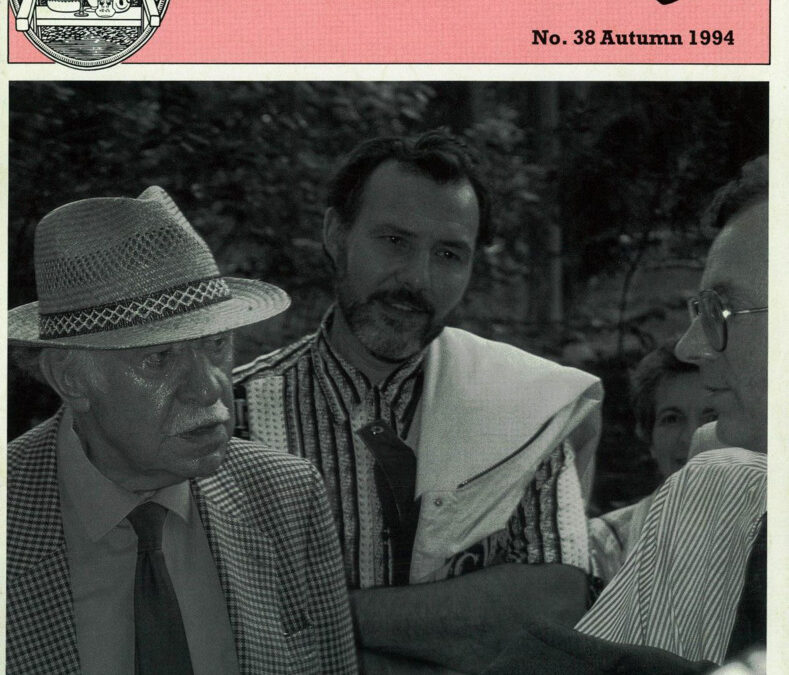
Cover Illustration:
Eric Wood proved adept in
persuading Glass Association
members to search for remains of
Wealden glass furnaces in the wilds
of Surrey, June 1994. Many thanks to
Jason Ellis of Staffordshire for
recording the event.
What’s in a name?
The keen-eyed among you will spot
a subtle change or two in the top
left-hand box on this page; the usual
legend “The Glass Cone, the
Newsletter of the Glass Association”
has been amended to read “The
Glass Cone, the Magazine…” This,
the committee hopes, will clarify
and help in distinguishing the
difference between John Brooks’s
quarterly Newsletter and this twice-
yearly publication. The Newsletter,
as its title suggests, will tend to carry
news of members and information
about forthcoming events, while
longer articles and features
requiring illustration will find a
place among these pages. If you
remain confused whom to contact
with any material, no problem: both
editors confer extensively, so
whatever you send in will find a
ready home.
Also, please note the new — but
temporary — address of the
Glass
Cone
editor, who has moved from
Farnham but is following a rather
nomadic existence before pitching
her tent in a friendly oasis. Not that
all of us would think of London’s East
End as an oasis. Inshallah, come the
Spring issue, there will be a new
permanent address, but whatever,
correspondence sent to Edgware
will be redirected as a matter of
course.
The Spring Clean moves North
Not only do we now have a sparkling
new glass gallery in London’s
Victoria & Albert Museum, but this
autumn sees the new addition to
Broadfields House Glass Museum at
Kingswinford. Unfortunately, the
timing of the grand opening was
such that it has proved impossible to
cover the event in any detail in this
magazine. However, it is to be
hoped that either Charles
Hajdamach or Roger Dodsworth can
be persuaded to write a piece in the
near future.
Which reminds me…
In haste to return the page proofs of
the last issue before taking to the
China Seas (as one of the two Guest
Lecturers on a cruise ship), the
editor did not catch a missing zero
in the Showcase article on the V&A
gallery: referring to the gallery
closure in 1991 and storage of glass
in the first column of text, the
number of items should have read
4000, and not 400.
Also, the date in the caption of the
Broadfields House tumbler
illustration (page 5) should have
read 1798, and not 1789.
Apologies on both counts.
Mr Robert Charleston writes from
Whittington:
“I read with interest Roger
Dodsworth’s short piece [issue 37]
on the tumbler engraved by W.
Dudley and recently acquired by
Broadfields House, an acquisition
on which the Museum is certainly to
be congratulated. He clearly did not
have much space in which to go
more deeply into the origins and
ramifications of glass-engraving in
the Stourbridge area, but it is
perhaps worth mentioning that its
history goes back well before the
date of the W. Dudley tumbler
which the printer has recorded
variously as 1789 [Ed: see above
apology], 1798 and 1799. There
was a Samuel Benedict in 1767,
“glass engraver … now or late of
Stourbridge”; Samuel Richards in
1769 “apprentice to Pidcock, Ensell
and Bradley, to the glass-engraving
business”; and Henry Levy
recorded in 1772 as “fugitive
debtor … formerly of Stourbridge
glass-flowerer”. Francis Buckley
indeed notes
Thomas
Dudley as an
engraver in Dudley in 1790,
presumably the father (or other
relation) of W. Dudley. These
sources are gathered together in
‘Some English Glass-Eng
–
avers… ‘
The Glass Circle,
no. 4 (1982).”
Shrinking Violets?
Despite the plea for articles and
ideas in the last issue of the
Glass
Cone,
the editor has been distinctly
underwhelmed by the response. Is
it that although the Glass
Association has a well-deserved
reputation for being a friendly
society, all the members are
shrinking violets? Surely not.
As it happened, without Maurice
McLain of Northampton taking pity
and coming to the rescue, this issue
would have had to be postponed
until the spring, in the hope that
more material would come in.
As a reminder, the following would
be most welcome: interviews with
people (not necessarily Glass
Association members) involved in
collecting, in dealing, in researching
and in making glass; and features
under the heading “My Choice”, in
which the writer introduces a glass-
work which has special personal
significance, perhaps because it is
linked with an event in his/her life,
because it was a fluke ‘find’, or
because, for the writer, it embodies
the essence of glass-making. Such
glass does not necessarily have to
be in the writer’s collection.
So get writing or if that prospect is
too daunting, let the editor have
your suggestion of interviewees
and possible interviewers.
Feature articles and notices
up to
1,000
words in length (a typed line
on an A4 page usually contains just
under 10 words), preferably with
one or more black and white prints
or colour transparencies will be
welcomed. The text should be
typed or written
clearly.
All
contributions over 750 words and
accompanying photographs will be
acknowledged by post, as soon as
possible after receipt; illustrations
will of course be returned when
received from the printers after
publication. Deadlines for copy are
detailed in the box below.
The opinions expressed in the
Glass Cone
are those of the
writers. The editor’s aim is to
provide a range of interests and
ideas, not necessarily ones
which mirror her own. Her
decision is final.
COPY DATES
Spring 1995
18 February
Autumn 1995
16 July
A Bohemian Blue cased Engraved Goblet
The Bohemian
goblet
(Pat &Dil Hier)
It has often been said that the master
Bohemian engravers took their
inspiration from contemporary artists
and engravers but rarely can this be
precisely illustrated; an exception is
this example from the collection of Pat
and Dil Hier. It was purchased in June
1986 at Christie’s in London for the
quality of the engraving; the
catalogue description gave no clue as
to the subject or the engraver. In
December of the same year the
Antiques Trade Gazette
came
crashing through the letter box of the
Hiers’ residence and on the front
page was an illustration of a painting
by Sir Edwin Landseer sold at
Christie’s, London on 21 November
1986; the picture and the engraving
on the goblet looked the same.
The catalogue of the art sale was sent
for and close examination of the
illustrated painting revealed that the
engraving was identical to the
painting in every respect except for
the omission of a falconer’s gauntlet
that lies on the bottom step in front of
the spaniel. This omission appeared
strange since smaller items such as a
cluster of feathers on the courtyard
floor were included in the engraving.
The painting is entitled “Prince
George’s Favourites” and was
painted in 1835. Prince George was
the second Duke of Cambridge; his
father was Governor-General of
Hanover where the Prince spent
much of his early life, returning to
England in 1837 at the age of 18. In the
picture the Prince’s favourite pony
Selim, Newfoundland dog Nelson,
and spaniel Flora, together with his
falcons, are seen in a courtyard with
Windsor Castle visible through an
open door, in the background.
The painting remained the property
of H.R.H. The Duke of Cambridge
until his death in 1904 when it was first
sold by Christie’s. The goblet
normally would be attributed much
earlier than 1904, indeed Christie’s
dated it
circa
1860, so how did a
humble glass engraver have access
to the painting? The answer could be
from engravings or lithographs and
perhaps this would also explain the
missing gauntlet. We know two
engravings were produced, one
engraved in 1841 by W. Giller, and a
second by Charles Thompkins in
1883. In addition, a lithograph by
Lafosse is also recorded. It is know
that many lithographs of the day were
published in Germany and were not
always such faithful reproductions as
the engravings. Dil Hier, in his
research, has obtained a copy of the
W. Giller engraving, complete with
description and library reference
labels both in German, and seen the
one by Thompkins. Both, as one
would expect, include the gauntlet,
but he has not tracked down the
lithograph. It would be interesting to
establish if this omitted the gauntlet;
this would also give a clue to the
earliest date of production for the
goblet but would not help to identify
the glass engraver who was, from the
quality of the work, obviously one of
the best.
The cased blue over crystal goblet is
29.5cm (11
1
/2″) high. The bowl is
engraved within a cartouche, and has
seven diminishing lenses cut on the
reverse side; it is supported on a
hollow blown blue ball knop above a
clear fluted stem enclosing blue and
white striped and air twist canes, on a
blue foot, A similar ruby cased goblet
engraved with a Persian warrior and
horse was recently sold from the
collection of the late Fred Wood who
is remembered by Pat and Dil with
great affection and fond memories of
his encouragement at the start of their
collecting days. This warrior has a
distinctive head dress which is
identical to those depicted in the
battle scene on the magnificent
August Bohm covered chalice on
display at Broadfields House. The
similarity of this subject also to signed
decanters recently auctioned at
Sotheby’s would make Bohm a clear
contender as the engraver of the
‘Favourites’ goblet. But not all items of
glass need to be ‘christened’; what is
clear is that whoever was responsible
for the engraving was in the ‘Meister’
class.
Far Left: “Prince
George’s
Favourites” by
Sir Edward
Landseer (by
kind permission
of Christie’s,
London)
Left: The Giller
engraving, 1841
The inscription
on the rim
Maurice McLain
Down With the Rump
The Rum Glass
(Maurice
McLain)
At a sale in Sotheby’s some time
ago, after being outbid for a very
important and very expensive glass,
by way of compensation, I
purchased a second piece which
had caught my eye. The glass itself
is a rather ordinary mid-eighteenth
century glass with bell bowl on a
drawn plain stem, but it has an
unusual engraving, in diamond point
just under the rim — “God bless
Prince Charles and Down with the
Rump”.
The amateurish engraving is only
apparent on close examination.
The phrase “God bless Prince
Charles” is obviously Jacobite in its
sentiment, but what did “Down with
the Rump” mean?
I knew that there was a Rump
Parliament in the mid-seventeenth
century (1648-53) but why should
that be commemorated on a glass
produced about a hundred years
later? Had there been another Rump
Parliament or was this a reference to
some other Rump? My questions
were answered when my son a little
later gave me as a present a book on
Jacobitism in England.
Despite the Royalists losing the Civil
War, had Charles acceded to some
of the demands of Cromwell, the
victorious Roundhead army and
Parliament, he might have kept his
head by perhaps abdicating in
favour of his son, later Charles II.
Instead, he refused to make any
concessions.
Parliament was not united in its
determination to be rid of Charles.
In December 1648, some of the MPs
were excluded from the House –
thus the Rump was formed. In
January 1649, to try the King, the
Rump set up a special high court of
justice, because no judge nor
official court would undertake the
task. In this way, the charge was
brought in Westminster Hall by the
Commons, excluding the Upper
House. The ‘high court’ of 135
members, the Rump, found Charles
guilty of treason and voted to
execute him. In fact only 59 could
be induced to sign the King’s death
warrant, for which many of those
‘Regicides’ were later executed
after the restoration of the Stuart line
in 1660, with Charles II.
The Rump thus came to epitomise the
Anti-Stuart cause and the cry “‘Down
with the Rump” became a rallying
call for those seeking a second Stuart
Restoration. In street demonstrations
and riots up and down the country
“Down with the Rump” could be
often heard for almost a century after
James ll’s replacement by William III
and Mary. But with the death of
Bonnie Prince Charles in 1772, the
Jacobite movement also died and this
and other cries of “No King George”,
“King James for ever”, “Jemmy’s the
lad”, “White Cockades” and “Prince
Charles” disappeared.
A popular date for such street
demonstrations and riots was on
10th June, Oak Apple Day, when the
throne was restored to Charles II.
Only a few years ago I remember
Oak Apple Day being celebrated in
a local inn called the ‘Cromwell
Cottage’ , which seemed a
singularly inappropriate setting for
such an occasion.
If anyone knows of another glass
with this motto “Down with the
Rump”, please let me know (via the
Editor).
Friendly Society Pole-head
or just another mystery?
It is common knowledge that formal
processions were part of many 19th
century British celebrations, and
that tradesmen took part, often
carrying articles of their trade held
aloft on poles. Glassmakers and
cutters were no exception, and
there are several illustrations
showing glassware as pole-heads in
these processions. What is perhaps
less well-know is that, in some parts
of the country at least, Friendly
Societies also held processions in
which the members held aloft
symbols identifying their particular
Society. The
Guardian
newspaper
recently published a picture of an
example which was part of a
collection to be sold at Sotheby’s,
Billinghurst. The pole-head shown
was made of brass and was in the
form on an open hand, but with a
heart-shaped cut-out in the centre of
the palm. Sotheby’s catalogue gave
a short introduction to the subject of
pole-heads, referring readers to
Margaret Fuller’s book
West
Country Friendly Societies
for
further information, and illustrated
other brass pole-heads of the West
Country Friendly Societies, while
Fuller’s book includes drawings of
many more. Most of the symbols
were said to derive from spears,
others from inn signs, but the one of
the hand-with-heart-in-palm was in
a small group of miscellaneous
symbols for which sources were not
identified.
Fuller has little information about the
Friendly Societies of other areas,
except to say that there was
evidence of brass pole-heads in the
brass-manufacturing areas of the
Midlands. But of all the designs
illustrated, only one could be
related to Manchester glass. Both
Derbyshire and Burtles, Tate & Co.
made pressed glass
representations of an open hand
with four fingers close together and
a thumb at an angle, and a heart-
shaped outline on the palm. Some of
these have survived; each has an
integral cylindrical base with an
inside diameter of about 3 inches,
so that, although it could be pole-
mounted, it sits just as easily on a flat
surface. The Burtles, Tate hand was
registered as a Chimney Piece
ornament, but interestingly the
Design Representation omitted the
heart-shaped outline (see Jenny
Thompson
Supplement to the
Identification of English Pressed
Glass,
page 4).
Did the Friendly Societies of the
North West have annual
processions? The National Museum
of Labour History is located in
Manchester, but a search of its
catalogue disclosed nothing
significant. However, the collection
is fragmentary, so the subject
catalogue of the Central (Public)
Library was consulted, which
revealed copies of the Rules of two
local Friendly Societies: the Ancient
Order of Foresters Friendly Society,
and Charles Hardwick’s
Manual for
Patrons and Members of Friendly
Societies.
But in complete contrast to
theRules of West Country Friendly
Societies, these Northern Societies
do not even mention processions
nor pole-heads. Hardwick
(published in 1869) contains only an
oblique reference (page 145):
“…These anniversaries and
processions are generally attended
by the clergy, or some of the
neighbouring gentry, and are
really, in country districts
especially, the means by which
such Societies and their objects are
Chris Meechan of the National
Museum of Wales (Department of
Zoology), Cardiff is keen to trace
more examples of glass models of
invertebrate animals, made by
Leopold and Rudolf Blaschka
between 1863 and 1890. So far he
has discovered some twenty-three
institutions in Great Britain and
Ireland have such pieces in their
collections. The largest (a group of
Plumose
Anemones) is
60 x 30 cm at
the base and about 25cm in height,
but the smallest can be under 2cm in
length. Made at a time when there
was no other suitable means of
displaying soft bodied invertebrates
in Natural History museums, curators
prominently brought before the
notice of working men…”
Perhaps, then, the pressed glass
hands had no connection with the
Friendly Societies, but, if not, were
they only of sentimental interest, or
are they just another Mystery?
Peter Helm
eagerly used them to educate the
public. But when the Blaschkas
signed an exclusive contract with
Harvard University in 1890 to
provide glass models of plants and
flowers (now housed in the Botanical
Museum of Harvard University),
production of the invertebrate
models ceased. Chris Meechan has
managed to find four catalogues of
Blaschka glass models for the years
1871, 1874, 1878 and 1888; the first
two are in German, the other two in
English. The 1871 catalogue lists a
range of almost 300 pieces and by
1888, this had increased to 700
different items.
The Blaschka
Project
Pressed glass
hand (ht. 22cm)
Burtles, Tate &
Co. production.
Manchester
My Choice A Poor Man’s Privateer
The glass with
its scalloped
foot and cut
stem (Maurice
McLain)
Captain Sands’s
ship
My interest in glass is very
traditional, mainly eighteenth
century drinking glasses, with a
leaning towards commemorative
engraved glasses. As time has
passed and my collection grown, I
have become more interested in
the social history behind the glass,
such as the drinking habits of the
period, the political and economic
reasons behind the changes in
style, and the events recorded on
such glasses.
One type of commemorative
engraved glass, that must be one of
the “Holy Grails” of the period for
an ordinary collector, is the
Privateer Glass. So few were
produced, and so many are already
in special collections. The classical
Privateer glass seemed beyond my
reach.
In a Sotheby’s sale a few years ago,
a glass attracted me. As a glass it
was not particularly elegant — a
round funnel bowl on a facet cut
stem. The foot was also cut with a
scalloped rim and ground out pontil
mark. The bowl was engraved with
a sailing ship with the motto “Capt.
Sands of the Prince of Wales”. Just
above the `e’ of Prince was `fs’. I
naively thought that this old `ss’
might stand for “success”.
I looked upon the glass as a Poor
Man’s Privateer glass, bid for it and
was successful within the suggested
price range.
It sat on my shelf for several years
until I decided to carry out research
on it. A letter to the National
Maritime Museum enquiring about
ships of the late eighteenth century
by the name
Prince of Wales
with a
Capt. Sands, brought the reply
“Many ships of that name but none
with a Capt. Sands”.
Had I been duped? Was this a fake?
I did not think so. If a forger was at
work, he probably would have
done a better job than the rather
crude representation of a sailing
ship on this glass.
It was that fount of knowledge, John
Brooks, who provided the next clue.
He said “That mistake in the
engraving is interesting”.
“What mistake?”
“The misspelling of the word
‘Princess’ with the correction” came
the reply.
On re-examination I saw that the ‘fs’
was not short for success but rather
a crude correction, just as we might
insert an extra correcting word
above the written line today.
The next step was a trip to the
National Maritime Museum, where
in the library, a helpful assistant
showed me the shelves with the
Lloyd’s Registers of ships. These
books were produced annually
towards the end of the eighteenth
century and later, but earlier
registers were less regular in
appearance.
The date of the glass was not
immediately apparent. Most glass
books suggest that facet cut stems
date from the last quarter of that
century, and the cut foot with
scalloped rim and ground out pontil
mark also indicated a later date
rather than earlier. Therefore I
started with the Lloyd’s Register of
1785, and found many ships called
the
Princess of Wales
but no Capt.
Sands. 1786, 1787 and so on
produced a similar negative result.
In each register I also checked the
ships called
Princess of Wales
in
case the earlier letter from the
museum was incorrect.
Remembering that George, Prince
of Wales became Prince Regent in
1811 and King George
IV
in 1820, I
continued going through the
registers to that date — nothing.
I almost gave up, not knowing
where to go from there. But by then
the development of the Lloyd’s
Register during that time intrigued
me and I decided, more out of
curiosity than anything else, to look
at the earliest register available –
1764. A tiny volume in comparison
with the later tomes.
Success! There it was!
“Princess of Wales
Capt. J. Sands.”
It was built on the River Thames in
1749, a Brig of 140 tons and draught
12′, owned by Twyman. It initially
traded between London and Cadiz.
Later entries showed it to have a
tonnage reduced to 120, with a new
skipper Capt. W. Pike in 1768, then
on the London–Rotterdam route. In
1780 and ’81, Capt. J. Dixon was in
charge but it was no longer
registered in 1782, presumably
scrapped or lost.
The ship was not (as I had originally
thought) named after Princess
Caroline, wife of George, Prince of
Wales, later George III. It was
named after his grandmother,
Princess Augusta of Saxe Gotha,
who died in 1772. She was the wife
of Prince Frederick Louis, eldest
son of George II, who died in 1751
before his father.
The glass obviously has an earlier
date than its type suggests,
confirming Jeanette Hayhurst’s
contention that the dating of many of
these facet cut glasses should be
revised. Similarly, the cut foot with
scalloped foot and ground out pontil
mark must have been used earlier
than many believe.
This piece of research, easily
carried out, has increased my
fascination for this glass. Since then
I have in fact acquired a “proper
privateer” glass but I believe I care
more for my “Poor Man’s
Privateer”!
Maurice McLain, Northampton
A Glass in History
At the recent National Meeting of the
Association at Guildford, Surrey,
Graham Cowlin brought along a
drinking glass which aroused great
interest. An account of his adventures
that afternoon appear in the
Newsletter ..
Twenty-five years ago I acquired a
glass which is proving more
interesting now than it seemed at
the time. Amongst a showcase full of
the usual types of eighteenth and
early nineteenth century glasses
then on offer, I saw one unusual
specimen. Of plain design and in
thin glass, it was clearly not the
eighteenth century ale glass as
labelled. I suspected an earlier
date, paid the modest price and
carried it off.
Plain but well-proportioned, it has a
large round funnel bowl, blown in
clear glass, heavily striated and with
several silica seeds. The stem is
short and hollow, tapering sharply
to a thin flat foot, which contains
numerous air bubbles. Lead
content is assumed, for although
U.V. lamp tests have not been
conclusive, a clear note is emitted
when the glass is struck.
Finding nothing similar illustrated, I
took the glass in due course to the
Victoria & Albert Museum, to show
it to Mr. Robert Charleston, who was
in those happy days Keeper of
Ceramics & Glass.
He suggested it was made in
London
circa
1685. The type was
known but few had survived intact.
How few I did not then realise.
Searching for reference to similar
stems, I duly found Fergus
Graham’s article in
Apollo (1),
and
Ivor Noel Hume’s work on
Williamsburg collections (2). More
recently, research by Colin and Sue
Brain (3), along with recent
archaeological finds in Surrey have
combined to give a wider
perspective.
At Ewell near Epsom, Surrey, only
half-a-mile from the site of Henry
VIII’s Nonesuch Palace, the 1990
excavations at Bourne Hall revealed
household waste in the dry lake-
bed. Among it was a number of
wineglass stems ranging in period
from mid-seventeenth century to a
Silesian type; several were
tapering, some crudely quadrefoil
and one was a plain stem — like my
own.
Then six months later in May 1991,
came the important find at
Tunsgate, Guildford. Glasses with
similar tapering stems were found
among the sealed glasses,
Greene’s pattern tumblers, now all
carefully conserved by Kevin Fryer
at Guildford Museum.
Glass making has a long history in
Surrey. Saxon glass has been found,
and the current excavations at the
Norman castle keep, behind
Guildford High Street, promise
more finds. As some of the town’s
finest buildings were built in the
seventeenth century, and I bought
my glass in a nearby village, I
sometimes wonder if it was once
used by a prosperous Guildford
citizen when such houses were all in
the latest fashion.
This glass is in a transitional style,
produced during that brief period
between the days of Glass Sellers’
imports from Venice and the full
lead glass production of
Ravenscroft. To me it was a curiosity
when I first bought it. Now in the
light of recent finds it has, in my
view, begun to assume a clearer
position in the history of English
glass-making.
Graham Cowlin
(1)
Fergus Graham “Twenty years:
some aspects of English glass…”
Apollo
Magazine July 1937.
(2)
Ivor Noel Hume “Glass in Colonial
Williamsburg’s Archaeological
Collections”
Colonial Williamsburg
Archaeological Series
No. 1, Virginia
1969.
(3)
Colin & Sue Brain
English
17th Century Drinking Glasses –
Tapering Stems,
Salisbury 1993.
The glass is
132= tall, with
a foot diameter
of 77.8 and a rim
diameter of 79.4
(Graham
Cowlin)
The bubbles in
the flat foot
Another Mystery
Solved?
In the Glass Association’s Newsletter
of July 1993, John Greaves of
Leicester asked for help in identifying
a butterfly mark on several glass
ashtrays, thought to date from the
1930s. A suggestion made by some
members that it was a Baccharat
mark was rejected by the Baccharat
Museum in France. Then in April this
year Pauline Wells of Alton, realising
there was a common interest, put
John Greaves in contact with
Christine Ricketts, who was able to
provide an answer. The butterfly
mark was used by Heinrich Hoffman
of Gatlonz, Bohemia as recorded in
the book
Czechoslovakian Perfume
Bottles and BoudoirAccessories
by
Jacquelyne Jones-North, published
by Antique Publications, Marietta,
Ohio. As luck would have it, the
book-seller John Ives had a copy so
John
Greaves was able to buy it and
see for himself. John Greaves
considers this publication is “a must”
for anyone wishing to collect
perfume bottles, and is delighted,
thanks to both ladies, to find out about
Hoffman and his work which closely
parallels that of his contemporary,
Lalique. He wonders if any members
are due to visit the Public Records
Office in Kew, London; if so, could
they check the registration
no. 756470 Foreign?
From Across the Water, but When?
Victoria commemoratives by Jim Edgeley
The development of press-moulded
glass in England came too late for the
English factories to utilise the process to
celebrate the accession and coronation
of Queen Victoria in 1834. I have been
unable to fmd any such glass items
actually dated or referring to the
coronation, although there is a number
of small plates and dishes with the
‘young’ head of Victoria as shown on
British coins minted from 1837 to 1886.
One example is illustrated in the
Corning Museum Catalogue (no. 422),
and listed as made by the Boston &
Sandwich Glass Co. This company
produced a wide range of
commemoratives in the 1830s and
1840s, and used a pattern identical to
that featured on this ‘Victoria’ plate, so it
would appear that it is an American
export. (Admittedly some of the
commemorative series were
reproduced in the 1930s, but it seems
unlikely that the Queen Victoria pieces
would have been included in this
range.)
Probably also American in origin are
two other small plates marked Victoria
and showing the Queen’s head and a
crown as these too have similarities with
the New England glass companies’
products. There is another marked
‘V.R.’ with her head but without the
crown. In this case the border is a
simple criss-cross pattern, with the
letter ‘D’ near the rim. Although there
are several examples of this design, I
have not been able to identify the glass-
works. Another very well-moulded 5″
plate features a crown and the letters VR
in the centre. As the border is in the
style of many items in the Coming
catalogue, it surely is also American.
Several examples show a portrait of
Victoria and Albert together. I had
always assumed that these were
produced for the Royal Wedding of
1840, and this may be true of some.
However, the Royal Mint struck a medal
featuring both their heads at the time of
the Great Exhibition of 1851. This
design was used by the New England
Glass Company of Cambridge, Mass.
for a paperweight, which is very similar
to several of the ‘Victoria & Albert’
plates. It would seem therefore that
these pieces date from 1851 rather than
1840. Some could well be of English
manufacture, but others look to be
almost certainly French.
No pressed-glass commemoratives
were issued for the Silver Jubilee of
1862, presumably because the Queen
was still in mourning after the death of
Prince Albert the previous December.
There was, however, a small plate
produced to mark his death, the
inscription reading “In memory of
Albert the good. Righteousness exaleth
[sic]
a nation”. Obviously quality control
was not good on that one.
A large variety of small plates show the
Prince of Wales’s feathers and the
legend “Ich Dien”. In one case this
inscription is reversed, so it reads
correctly only when turned, Perhaps it
came from the same factory as the
Albert memorial plate! Unfortunately
none of these designs gives details of a
date or the occasion, so while they may
have been produced to commemorate
the Prince’s birth, this is by no means
certain. Edward was known as the
Prince of Wales from birth and I have not
found any references to a later
ceremony of investiture as now occurs,
There is, however, a small plate with the
outer section identical to one of the
‘feather’ plates, but with the centre
plumes replaced by a portrait of the
Prince and Princess. Surely this must
have been issued to mark their wedding
in 1863.
Glass in a Cheshire Country House Inventory of 1840
On 9th January in 1840, 47 year-old
Peter Langford-Brooke, of Mere Hall,
fell through the ice of the mere on which
he was skating, and died. With him died
the period of building and acquisition
by the Brooke family, and the slow
decline in fortune culminated on
23rd May 1994 with the dispersal sale
by Christie’s of the contents of Mere
Hall. One of the lots sold was the 1840
Probate Inventory of chattels, made “the
3 of February and seven following
days”; a quarto foolscap lined exercise
book, quarter bound in maroon
morocco with marbled boards.
The inventory records the Glass, China,
Silver and wine which a substantial
gentry family had in 1840. None of the
glass,
unfortunately, appeared in the
recent sale.
We often think that by 1840 the well-to-
do were appointing their tables with
enormous matching sets of china, glass
and cutlery. That is not the picture which
this inventory gives, despite a dining
room with a set of 24 mahogany dining
chairs by Gillow, and a wine cellar of
more than 3,000 bottles.
As far as the china-ware was
concerned, there were three separate
dessert services, a breakfast set, and a
tea and coffee set; but
as
for a dinner
service as we understand it today, there
was only ‘Small part of Blue Chantilly
Dinner Set’ plus ‘6 dozen of plates
various patterns in Cupboard’, together
with only 8 serving dishes. But, of silver,
there were 6 dozen matching plates, 8
tureens and 9 sauce boats, and 33
various dishes (both of silver and
plated), many with covers. The flatware
and cutlery, too, was a very mixed bag,
with apparently none of the great
matching canteens we associate with
the Victorians.
When we turn to the glass, a similar
picture emerges. Nearly all the glass is
given as a separate section in the
inventory; the Housekeeper’s Room
contained a little extra, including: ’10 old
wines’ and a ‘plain double spouted jug
(cracked)’. Otherwise, apart from
lighting Glass in the Butler’s Pantry, and
two tumblers in the Still Room, it is all
together.
There were in total 221 various drinking
Glasses, of which the biggest group
was ’42 taper cut Wines’ and probably
en suite
with these were ’17 Globe Do’
and ’17 Champagnes Do’. To fill the
glasses there were 55 Jugs, Decanters,
Caraffes and Croffs, and a solitary
Claret Ewer; whilst to cool and rinse
one’s glass there were 66 Wine
Coolers, plus 67 Finger Glasses in
which to cleanse one’s fingers. For
dessert there were two dozen Ice Plates
and four ‘Cut circular dessert dishes’
(plus, in the Plate section, a plated
‘Epergne with a Glass Platue
[sic]
and
Cut Glass Dishes). There were none of
the sweetmeats or custard cups which I
had expected to find.
Of drinking Glass types (and quantities)
we find: Wine (122), Goblets (9),
Liquiers (9), Clarets (15), Hocks (16),
Water Glasses (13), Ale Glasses (8),
Champagnes (17), Tumblers (1
1 ) ,
and a
solitary Tumbler with Handle later
annotated as Broken.
From such evidence as the Prince
Regent’s Warrington Glass service of
1808, the 1824 Londonderry service, or
the vast service prepared by Davenport
for the Guildhall banquet for Victoria’s
accession in 1837, we tend to believe
that by the time of Queen Victoria, all
those who could afford it had
succumbed to the insistence that all the
table accoutrements be matched. This
inventory suggests otherwise.
F. Peter Lole, Manchester