




The Magazine of the
Glass Association
Registered as a Charity No. 326602
Chairman:
John Delafaille
Hon. Secretary:
Di’ I Her
Editor:
Dr Patricia Bake:
Address for Glass Cone correspondence:
2 t Jsbourrio Mews, Carroun Road.
London SW 1LR
Address for membership enquiries, etc.:
Broadfields House Glass Museum,
Compton Drive, Kineswinforcl,
Vest Midlands D’08
1
1
1
11ir
,
Tel: 0384 273011
ISSN 0265 9654
Printed by Jones & Palmer Ltd, Birm
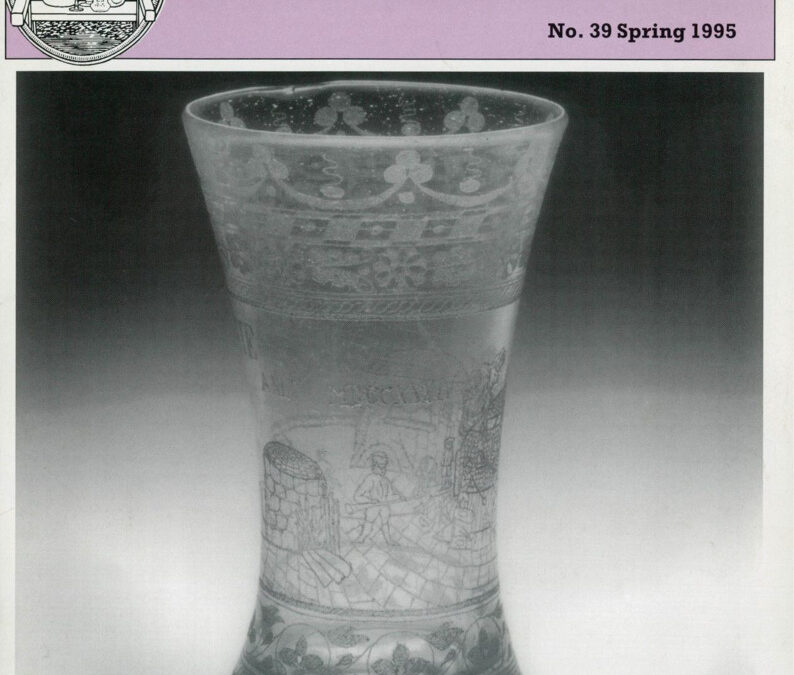
Cover Illustration:
A rare diamond point engraved
beaker, of Gelman manufacture
circa
1734 (height 18 cm); see page
6 for further details. (By kind
permission of Mallet & Son
(Antiques) Ltd., London WI YOBS.)
A Few More Changes . . .
Some amendments in the top left-
hand box on this page reflect the
changes on the committee as
approved at the October Annual
General Meeting of the Glass
Association.
Also, do note the new address of the
Glass Cone editor, who has finally
moved — not to London’s East End
as planned — but to the Oval. From
now on, please send all
correspondence to this London
SW8 1 LR address.
The unhappy toll of winter
This winter saw the glass world
robbed of some of its foremost
historians and enthusiasts and a
notable designer, all of whom had
done much to bring their love of
glass to the attention of a wider
public. It seemed at one point as if
one could not open a newspaper
without learning of yet another sad
loss. After much discussion
between the editors of the
Association’s Newsletter and Cone,
it was decided their passing should
be noted in the Newsletter, regretting it was impossible to give
each adequate coverage in the
Cone. All of us will have special
memories of these men which
cannot be conveyed easily in a few
words, but we know that they have
left us and the glass world the richer
for their lives and work.
Glorious Glass
A small but exciting exhibition
Glorious Glass
showing new work in
architectural glass will be mounted
at the Pilldngton Glass Museum,
St Helens, WA10 3TT from 1 May to
2 June 1995. As well as displaying
recent work of Sue Woolhouse,
Mick Davies, Bridget Jones, Stephen
Kinsella, Sarah Richardson and Cate
Wilkinson, there will be
explanations about the actual
process of designing to
commission, and making.
Compliments to the owners
Howard Phillips of Aylesbury was
struck by the interesting range of
glasses in the last issue (no. 38) and
especially by the beautiful quality of
Graham Cowlin’s glass but cannot
help thinking that the pressed glass
hand was a ring stand for a lady’s
dressing table. He remembers an
amusing rhyme about Prince
Frederick:
“Here lies poor Fred who was alive
and is dead,
Had it been his father I had much
rather.
Had it been his sister nobody would
have missed her.
Had it been his brother, still better
than any other.
Had it been the whole generation
So much better for the nation.
But since it is Fred who was alive
and is dead
There is no more to be said.”
The Butterfly flutters on
Dil Hier of Cheshire was intrigued
by the Butterfly mark of John
Greaves (issue 38) as he had
recently seen a table lamp base
with a moulded seagull, lit from the
base in the manner of Lalique car
mascots; it too was signed with the
Butterfly. Glass car mascots in
similar style are known to be
registered under number 511338,
know as “Red-Ashay” and
produced by HG Ascher Ltd. The
company also took out registration
number 756446 on 15 July 1930 and
while admitting it is probably
unlikely, Dil wonders whether the
imprint is unambiguously 756470.
George Sturrock of Exeter asks if
the following legends on pressed
glass objects are any help in trying
to date the pieces: Foreign; Made in
England; British made.
In other words, is it known whether
any of these three inscriptions were
used on pressed glass only
between certain dates? (Any
thoughts, through the Editor
please.)
A Weekend in the Country
There may still be places available
on the 44th Attringham Summer
School on The Country House in
Britain. The venue for the July 7-13
meeting is at West Dean in Sussex
(visiting Arundel Castle, Petworth
etc.); that of July 14-21 is
Nottingham (for Haddan Hall,
Hardwick Hall, Bolsover Castle and
Kedleston) while the York venue,
July 19-25, will allow visits to
particularly Fairfax House,
Fountains Abbey, Temple Newsam
and Castle Howard. A nine-day
summer school in Wales will
explore Cardiff Castle, Powis and
Chirk along with a number of
private houses. More details from
Nick Dolan at the Laing Art Gallery,
Higham Place, Newcastle upon
Tyne, NE1 8AG.
While in New York . . .
If you’re planning a short stay in
New York, NY, do check out the
programme of exhibitions, lectures,
walking tours and other events
offered by the Bard Graduate
Center for Studies in the Decorative
Arts, 18 West 86th Street, NY 10024.
A Reminder for the autumn
issue
Feature articles and notices
up to
1,000 words in length (a typed line
on an A4 page usually contains just
under 10 words), preferably with
one or more black and white prints
or colour transparencies, are
welcome. The text should be typed
or written clearly. All contributions
over 750 words and accompanying
photographs will be acknowledged
by post, as soon as possible after
receipt; illustrations will of course
be returned when received from
the printers after publication.
Deadlines for copy are detailed in
the box below.
The opinions expressed in the
Glass Cone
are those of the
writers. The editor’s aim is to
provide a range of interests and
ideas, not necessarily ones
which mirror her own. Her
decision is final.
COPY DATES
Autumn 1995
16 July
Spring 1996
18 February
WC
The New Look Broadfield House Glass Museum
The Glass Pavilion
atBroadfield
House Glass
Museum at night
The structure is
currently the
largest glass-only
construction in the
world.
(Peter Moss,
photography)
Glass, in all its many forms, is
currently undergoing a major revival
in the United Kingdom. The new Glass
Gallery at the Victoria and Albert
Museum, the Hotties project at St
Helens and the proposed National
Glass Centre at Sunderland promise
a national resurgence of glass.
Another major player is Broadfield
House Glass Museum.
Situated at Kingswinford in the West
Midlands, Broadfield House has
undergone a major refurbishment as
the first stage in the creation of a
national centre for the British glass
industry, past, present and future.
Designs and contracts were finalised
by the end of 1993 in order to qualify
for European funding. By March 1994
work began on revitalising the entire
ground floor area. On Friday 26
August the achievements were
unveiled when Sir Charles Wolsley
opened the “American Splendour”
exhibition of American Brilliant Cut
Glass sponsored by Texas A & M
University. On 17 November 1994 the
refurbished galleries were officially
opened by H.R.H. The Duke of
Gloucester. The new scheme has
received major critical acclaim since
then and has transformed Broadfield
House from a “fine art” museum to a
centre for the enjoyment of glass from
every viewpoint.
The most exciting single element of
the refurbishment is the Glass
Pavilion, the new entrance to the
museum. The triple glazed roof units
and the double glazed wall sections
are fixed to beams and columns of
triple laminated float glass, the whole
structure being literally stuck
together with silicone. This
architectural
tour de force
captures
transient moods of light and shade
depending on the prevailing weather
conditions. At night the reflections on
the different surfaces from concealed
lighting in the floor wells and at ceiling
height combine with the movement of
visitors to create a kinetic glass
sculpture. Etched on the wall light
panels, the quote “GLASS IS ONE OF
THE TRUE FRUITS OF THE ART OF
FIRE” sums up the versatility of this
magic material. The idea of using
glass references is continued on the
glass counter which is etched with the
word “glass” in 16 languages.
The addition of the Pavilion on the
rear elevation of the building called
for a solution to the treatment of the
Venetian-style windows which had to
be retained as a part of the Grade II*
listed building category. David
Prytherch was asked to devise two
new windows, on the themes of Glass
blowing and cold glass-working.
From the Pavilion the visitor has a
choice of two directions. One
doorway leads to the Tyzack Gallery,
named after Paul Tyzack, the earliest
recorded glassmaker in
Kingswinford. The Gallery will offer a
programme of six major exhibitions a
year, with the emphasis on
international quality. Glass-block
walls link the Tyzack Gallery to the
Tea Room and the Glassblowing
Studio with its motto above the door:
“If you are a blower of glass, fashion
the cup as if it were to be touched by
the lips of your beloved”. The studio
with furnaces and equipment will be
made available each year to a
graduating glass blower from any of
the colleges and universities in
Britain.
Or the visitor may enter The Magic of
Glass Gallery, which explores the
technology and mythology of glass.
Panels display the diversity of glass,
mass production and neon lighting in
the city at night as well as the
association of glass in fairy-tales and
legends, superstition and belief in the
afterlife, alchemy, and glass in
science fiction.
The two remaining rooms on the
ground floor complete the physical
transformation. In the Cameo Glass
gallery every piece of cameo work in
the museum’s collection has been
drawn together for the first time in a
blatant show of astonishing skills by
the Stourbridge cameo carvers of the
last century. The Characters of Glass
room features a multi-screen
presentation about six contemporary
personalities in British
glass. Rosemary Gorton,
RachaelWoodman,
Ray Flavell, Peter
Dreiser, Malcolm
Andrews and Reg
Everton talk about
their involvement
with glass and refer to
some of the historic
characters who
established the
reputation of British
glass since
Ravenscroft and the
invention of lead glass. Fifty
masterpieces from that 300 year
period are displayed opposite in a
case dramatically lit with fibre optics.
The first and second floor galleries
were not ignored in the renovations.
“A Few Nice Pieces of Glass” from the
collection of the late Michael
Parkington have been reorganised
and extended on the first floor while
the second floor displays feature The
Encyclopaedia of Glass, a wide mix of
styles, techniques and dates offering
the glass collector easily accessible
reference material.
Funding for the scheme came from
the European Regional Development
Fund, Dudley Metropolitan Borough
and West Midlands Arts. Over the
next two years the work of the
museum will be consolidated to
establish solid foundations for future
developments. Whatever that future
may hold, there is no doubt that the
innovations at Broadfield House have
helped set new standards which will
benefit and inspire a new generation
of glass makers, architects and
museum curators.
Charles R Hajdamach,
Dudley Museum
David Prytherch
in front of his
“Glass Dance”
windows. The
rings behind the
glass-makers
represent the
interior of a
glass cone
looking up to
the opening and
the sky above.
(Peter Moss,
photography)
Large group of
Plumose
Anemones
Actinoloba
dianthus
(NMW
27.407.24)
Portuguese
man-of-war’
Jellyfish
Physalia
physalis
(NMVV
27.407.07)
Not long after I began working at the
National Museum of Wales in the early
1980s, I came across a wonderful
collection of glass animals tucked away
in a dusty cabinet in the basement.
They were extremely lifelike models of
invertebrates, i.e. those animals that
lack a vertebral column; most
represented soft bodied marine
creatures. Some years later the
opportunity to exhibit some of these
models prompted me to research their
history. Our registers showed that the
models had been acquired in two lots:
in 1890 138 models had been
purchased by the old Cardiff City
Museum at a cost of £70 and a further
62 items came from the Science
Museum in South Kensington in 1927.
The only information on the model-
makers was the name ‘Blaschka’.
Further research revealed that
Leopold and Rudolph Blaschka, a
father and son partnership working in
Germany, had made glass models of
animals during the latter half of the
nineteenth century before working on
a large collection of glass flowers for
the Botanical Museum of Harvard
University. A letter to Harvard
eventually found its way to the desk of
Susan Rossi-Wilcox, the administrator
of the collection, and a most interesting
correspondence has ensued ever
since. Published works based on
documents kept in the archives of
Harvard University revealed the
following biographical details.
‘
2
Leopold Blaschka was born in 1822 at
Aicha in Northern Bohemia, now the
Czech Republic. The Blaschka family,
originally from Venice, were skilled
workers in decorative glass. Lepold
worked as a goldsmith and gem cutter
for some years at Turnau before
returning to Aicha to work with glass
and metal in the family business. In
1853 during a voyage to America he
made detailed drawings of jellyfish and
other marine animals and it was
perhaps these that inspired him to
experiment with glass models of
animals and plants. In 1860 his work
was seen by the botanist Prince
Camille de Rohan who commissioned
a series of orchid models. These, in
turn, were seen by Ludwig
Reichenbach, the Director of the Royal
Natural History Museum and Botanical
Garden in Dresden, who
commissioned Leopold in 1863 to
make models of marine invertebrates
for the Dresden Museum. Displayed in
artificial aquariums, these pieces
attracted much attention from curators
of newly established museums
worldwide. Leopold’s son Rudolph,
born in 1857, became his father’s only
assistant in 1870 in what was to
become a thriving business.
Some of Blaschkas’ models came to be
displayed at the Museum of
Comparative Zoology at Harvard in the
United States. Here they were seen by
Professor George Lincoln Goodale
who was planning the new galleries in
the adjacent Botanical Museum.
Convinced that glass would be the
ideal medium in which to fashion plant
models, he visited the Blaschkas in
1886, who by then were working in a
studio near Dresden. He persuaded
them to make some
samples and
subsequently awarded
a half-time contract. By
1890 the Blaschkas
decided that they no
longer wished to
divide their time
between the plant and
animal models and
were offered an
exclusive contract with
Harvard for the next
ten years. After
Leopold died in 1895,
aged 73, Rudolph continued single-
handedly, until 1936, dying three years
later at the age of 82. The entire
collection of plant models, some 847
life-sized and over 3,000 enlarged
flowers and anatomical sections, was
privately financed as a memorial to the
late Dr Charles Eliot Ware, a former
Harvard graduate, by his widow and
daughter and presented to the
Botanical Museum in 1893.
Many thousands of the invertebrate
models must have been made and
distributed between 1863 and 1890
and I was interested to know how many
of these beautiful yet fragile objects
had survived. Initially, my search
began with a request in the
Museums
Journal,
December 1992, for
information about any such glass
models held in the UK and I contacted
some institutions directly and followed
up likely leads. At the time of writing
I have traced around 1,400 surviving
models held in 19 institutions whilst a
further 600 models are listed as lost or
destroyed.
Information on surviving models
elsewhere in Europe is being gathered
by Dr Henri Reiling, based in the
Netherlands. Dr Reiling was inspired
by the collection of Blaschka models
held at the University Museum in
Utrecht and began, quite by
coincidence, to research their history
at about the same time as my own
project started. We have established
that there are many collections abroad
with some very comprehensive ones
in the United States, but most seem to
have been acquired during the later
years of production, in the 1880s. Apart
from some sea anemones in Lund,
Sweden, collections of early (i.e. pre-
1870) models have only so far been
identified in the UK.
Many of the early collections consist
only of models sea anemones and for a
time we were puzzled by the glass
numerals, attached to each model,
which bore no relation to any
catalogues we had seen. During a visit
to Oxford Dr Reiling noticed the
striking similarity between their
anemone models and the figures in the
coloured plates in the book
‘Actinologia Britannica’ A History of the
British Sea Anemones and Corals
by
P H Gosse. It soon became clear that
Leopold had made numbered sets,
each of 68 models, based almost
entirely on the coloured plates in
Gosse’s book, which was published in
1860. It is likely that this source of
A Glass Menagerie:
The work of Leopold and Rudolph Blaschka.
Acknowledgements to PPG Industries,
Owens Corning, Vetrotex & John Kerr of the
Glascord Co. Ltd, and KL Lowenstein
The Manufacturing Technology of Continuous
Glass Fibres.
reference was suggested by Ludwig
Reichenbach when he commissioned
Leopold in 1863.
As an early catalogue from 1871, which
lists nearly 300 models, clearly shows,
the Blaschkas soon expanded their
range, keen to accommodate
customer demand. By 1888 the
catalogue published by Henry Ward,
their American agent, listed 700
different models, including a series of
anatomical preparations almost
certainly based on their own
dissections of specimens. Comparison
between early and later models shows
a distinct tendency towards increased
scientific accuracy away from the
more showy early style. Here the
emphasis had been on “decoration for
elegant rooms” and the models were
described as such in the early
catalogues.
The work varies greatly in complexity
and in construction. Component parts
were formed from both clear and
coloured glass using a combination of
glass-blowing and lamp-working
techniques. These were then either
directly fused together or assembled
with adhesives, probably animal glues.
Where necessary, other materials
were used in the construction. Fine
copper wires were often added to
reinforce or attach delicate tentacles
and gills. Elsewhere, painted paper
was cleverly used to represent internal
structures. Great attention was paid to
achieving the correct appearance of
the living animals. For example a fine
speckled layer of pigment, often
applied to the inner surface of the
glass, conveyed a jellylike
translucence. Where much thicker skin
or a textured appearance was
required the paint or enamel was
applied in thicker coats, often with
gritty particles mixed in. The simplest
models that I have seen represent
marine flatworms and consist of
nothing more than thin glass shapes
with details of colours painted onto
paper loosely attached to the
undersurface. The most complex is
probably the splendid group of
Plumose Anemones which, at $35, was
the most expensive model in Ward’s
1888 catalogue.
The info
i
notion presented here gives
only a brief idea of the extent of the
Blaschkas’ work. I am optimistic that in
the not too distant future a major
exhibition of the glass models
celebrating their unique talent and
supreme craftsmanship will be staged
in the UK.
Chris Meechan
National Museum of Wales, Cardiff
References
1.
The Ware Collection of Blaschke glass
models of plants
by Oakes Ames, 1951
2.
The Glass Flowers at Harvard
by Richard
Evans Schultes and William A Davis, 1992
Glass in the
Shuttle
To many people, the term
‘glass
fibres’
conjures up car-body repair kits or loft
insulation. However, glass as a multi-
filament yarn has a wide range of
industrial applications today. In the
electronics industry, for example,
glass fabrics provide the best material
for use in high pressure laminates –
the base for printed circuit boards.
Civilisation as we know it is built on
PCB! Other important product areas
are reinforced plastics, filtration,
coating and laminating, thermal
insulations and aerospace/
aeronautical applications where the
special properties of glass ensure
optimum performance and economy
unmatched by any other material.
Of course, glass fibres and glass have
many identical physical and chemical
properties, but the mechanical
properties are quite different. When
drawn into fine filaments, glass is
remarkably resilient and flexible, the
tensile strength in fibre form being ten
times stronger weight for weight, and
twice as strong as steel wire of the
same diameter. Continuous filaments
may be drawn as fine as 0.00015″ and
as yarn, glass fibre fabric can weigh a
mere 1/2 ounce a square yard.
It could be said that the manufacture of
glass fibre pre-dates glass-blowing
because the simple technique of
drawing of glass canes used to
decorate the core-vessels of Antiquity
lies at the basis of today’s controlled
manufacturing process.
The first recorded reference to the
possibility of weaving with glass fibres
occurred in 1713 when the French
physicist Rene Antoine Ferchault de
Reaumer proposed that if
glass
could
be ‘spun’ as fine a silk then it could be
woven. His own experiments were
unsuccessful as his fine drawn
filaments were too short and brittle to
be of commercial interest.
Nevertheless, the idea still continued to
fascinate. In 1842 Louis Schwabe, a
prominent Manchester silk-weaver,
displayed composite fabrics of silk and
glass along with the ‘spinning’ machine
he had used to produce the glass
filaments at a British Association
meeting in Manchester. The method
he used then — drawing molten glass
through a small orifice — is basically
the same used today.
As a 1897 Krefeld publication shows,
work in the field continued; glass
drawing and weaving in a French shop
in the Passage Joilffray in Paris are
described in detail. Glass rods were
reheated to 1,000-1,200 C and
attenuated on to a 12′ diameter
cylinder revolving at 400 rpm. From
there the filament was transferred on to
small spools for shuttles. A composite
cloth was then woven, with the weft of
glass and the warp being silk or cotton.
It sold for a (then) costly 100 francs a
metre. Filament diameters were
typically 34-51 microns (against
today’s 3-25 micron range; 1 micron =
Vi,000mm) so the fabric was very heavy
and stiff, but suitable for furnishing
fabrics, etc. However, dresses of
glass-fibre and silk were displayed by
Edward Drummond Libby of Toledo,
Ohio, at the Columbian Exhibition in
Chicago 1893 and one of these is said
to be on show at the Toledo Museum in
Spain.
As the electrical industry, and later
plastics, became aware of the potential
of this ‘new’ material so a viable
production process was developed.
In 1938 the Owens Illinois Glass Co.,
Ohio joined forces with Corning
Glassworks, New York to perfect the
production of ‘Glass Silk’ under the
trademark Owens Corning Fiberglas.
The breakthrough came with the idea
of a multifilament yarn that was both
flexible and strong. The Schwaube
process of drawing a filament through
a plate with a single small hole was
replaced by a plate with typically 204
holes of much smaller diameter; a
slight twist was added as was a
lubricant. Weavers now had a unique
textile filament suitable for the
twentieth century.
Today weaving alone takes over 1/4
million tons of glass fibre yarn a year,
which represents approximately 15%
of total filament production, the
balance being used extensively in
reinforced plastics and associated
industries.
Rob Johnson, Somerset
An example of
glass-fibre
fabric
An 18th Century Glashiitte
The glass beaker illustrated on the
front cover of this issue is diamond
point engraved with a contemporary
drawing of a large glasshouse. The
actual furnace itself appears to have
eight glory holes and the artist has
shown five chairs. The worker in the
middle is holding a blowing iron. The
four figures to his right are all sitting at
conventional gaffer’s chairs complete
with marver to their right, surrounded
by pincers and other tools of their
trade. Behind the furnace someone is
swinging in the air a particularly large
gather. The young lad on the right with
a fork in his hand is attending the
annealing kiln. On the left is a seated
women with what is probably straw in
her hand preparing to pack one of the
six wine glasses to her left and, in an
open cupboard next to her, can just be
seen a jug, more wine glasses and a
beaker identical in form to the one
engraved here. To the left of the
central figure is a small furnace which
is connected by a flue to the annealing
kiln.
Contemporary descriptions of glass-
making practice at this time are
extraordinarily rare and this on-the-
spot record is a fascinating and
important addition to glass-making
history.
Germany,
circa
1734
An unusual
commemorative rummer
One of the three
rummers,
height 13.8 cm.
(Betty and Derek
Wyndham
Parsons)
The details
become clear
when the
tumbler is filled
with milk. The
genius of the
Wyndham
Parsons!
Some years ago we purchased a set of
three commemorative rummers at an
antique centre in Winchester. We
were informed at the time that they
were from a house clearance carried
out in Stoke-on-Trent and that there
were originally four in the set but that
one had been broken.
The items are bucket bowl rummers
with a plain stem, in clear glass and
with a black line decoration. Around
the top are the words ‘TI
IE
WORSHIPFUL COMPANY OF GLASS
SET
T
FRS’ together with the arms of the
Company and the date 1664. Below
this heading and spreading all round
the glass is a picture of Old London
Bridge as it would have been at that
date. Finally around the lower part of
the bowl, the words ‘ROGER
PILKINGTON . MASTER * SIR GILBERT
INGLEFIELD LORD MAYOR *’.
Despite the date, the rummers were
obviously modern and their history,
obtained as a result of a little research,
proved intriguing.
The Worshipful Company of Glass
Sellers was founded in 1664, during the
reign of King Charles II. Although
Charles is mainly remembered for his
various amours, a number of important
societies were founded under his
auspices, the most notable being The
Royal Society. It is interesting to note
that the Company of Glass Sellers was
founded one year prior to the Plague
(which probably reduced its
membership considerably) and two
years before the Great Fire (which
could well have had a similar effect on
the wealth of its surviving members).
Much of the following information was
obtained from Dr Roger Pilkington
from his retirement home and we are
greatly indebted to him for his trouble
in writing to us.
Dr Pilkington, of the renowned
glassmaking family, was the Master of
the Company at the time of its
tercentenary, and he felt that the
occasion should be marked
appropriately. He commissioned
between 125 and 150 sets of four
rummers which were presented to the
Members at the Company’s Mansion
House Banquet in October 1968. He
recollects that the cost in 1968 was 25/-
(£1.25) for a set of four!
The drawing by David Knight was
based on an engraving of Old London
Bridge in the Museum of London.
David Knight was an old associate of
Dr Pilkington and had illustrated many
of his books on various subjects. The
name of the artist is cunningly included
in the drawing, placed vertically in
such a way that it looks like a course of
bricks at the edge of a building.
Dr Pilkington told us that the rummers
were made by Chance Brothers of
Smethwick, a subsidiary of the
Pilkington Group. Chance Brothers
closed down in the early 1980s but Dr
Pilkington suggested that we should
contact Fiesta Glass, which was formed
by some ex-employees of Chance’s in
the hope that somebody there would
remember the rummers and give us
further information.
He was right! As soon as we walked into
the Fiesta shop and produced the
rummers there was immediate
recognition. It appears that the glass
was, in fact, hand blown at the Nazeing
factory in Broxboume and was sent to
Chance for decoration. The design was
screen printed on the glasses and then
fixed by firing. This, apparently, was
can
–
led out with difficulty, firstly due to
screen printing on a curved surface and
because secondly slight variations in
the size of the bowls led to variations in
the gap between the end of the
drawing, something which can be seen
on close examination of our three
specimens. (In extreme cases, we were
told, there was an overlap of the two
ends of the drawing.) It is not surprising
that the rummers were immediately
recognised more than 25 years later,
when the difficulty of manufacture is
appreciated. To quote one former
Chance employee, “It was a nightmare
making them”!
Betty and Derek Wyndham Parsons
West Midlands
Honest Damage
or Dubious Perfection?
Left to Right:
Engraved
opaque twist aic
glass.
Large plain-
stemmed drawn
trumpet goblet
(height: 7.6′).
Composite-
stemmed
airtwist wine
glass.
(photo by Mike
McEnnemey,
Wimborne)
For some glass collectors, however
enthusiastic they may be, there
comes a time when they can simply
no longer afford to fill the gaps in
their collection with perfect
specimens. There are also, of
course, times when they come
across an item 200+ years old,
damaged and therefore very
cheap, which they simply cannot
refuse.
A
small number of items in my
collection of wine glasses,
sweetmeats and jelly glasses have
minor damage. While no one seems
to
be too concerned if there is a
small, barely noticeable chip on a
cut sweetmeat, for example, when
it’s a question of a rim chip on a fine
wine glass, then eyebrows are
raised! Three particular glasses in
my own collection, however, have
more than the normally acceptable
amount of damage — but they are
fit
in
favourites: they are illustrated
here and all bear witness to the
ravages of time.
How did I acquire them? The
opaque twist ale glass came from a
general antique shop which had
been broken into. The owner was
holding a sale of his remaining
stock, damaged and undamaged,
prior to closing down. The glass had
been standing in the front window
when it was smashed and half the
foot was broken off. There was
other bruising around the foot, too,
but the stem and bowl were
untouched. I bought it.
The other two glasses came from a
general auction sale of household
goods. Delving into an old
cardboard box crammed with
cheap dust-laden glassware, I
happened to spot, even through
grime, the unmistakable glint of an
airtwist stem. When I dug into the
box, I came up with the composite-
stem glass with two-thirds of a foot
and, right at the bottom, the large
drawn trumpet with two rim chips.
I
bought the boxfuli
So why do I like these glasses so
much?
•
First of all, I personally think all
three are genuine 18th-century
glasses. They all exhibit the
‘correct’ features for the type
and period of glass and
certainly all ‘feel’ right. And for
this reason I can happily hand
them round as examples when I
am lecturing.
•
Secondly, even though each is
damaged each in its own way is
(or certainly
was)
an excellent
example of its type. The opaque
twist in the stem of the ale glass
is a good example of a central
gauze surrounded by spiral
threads, and the hops and
barley engraving on the bowl is
as good as most! The tear in the
stem of the well-proportioned
drawn-trumpet goblet is such
that it almost becomes a hollow
stem. And the airtwist in the
drawn section of the composite-
stemmed glass is as fine and
even as one could hope for,
combined with the fact that the
beaded inverted baluster
section is also finely blown.
•
Commercially, of course, each
of these three glasses is worth a
fraction of what it would be if it
were in perfect condition. One
cost about £20, as I recall; the
other two together cost about
£40 together (in the boxful!). But
I have here examples of three
designs of antique wine glass
which would now be quite
expensive to buy.
Of course, with the Lovejoy touch,
any one of these three glasses
could
be made to look perfect. But what
do you want: honest damage — or
dubious perfection? Personally I’d
rather have good old honest
damage any day. Anyway, I’m not
sure I can afford ‘perfection’ any
more!
Roy Kingsbury
Hampshire
A Learner’s Lament
(a true story)
Tudor Mary’s heart was cut
With Calais’ horrid game.
As mine still bears its living scars
From this collecting game.
The glass I found and did not buy,
The finds that got away,
Glass I saw and would not buy
Still haunts me to this day.
Two glasses long ago I saw,
Kings’ heads engraved fair,
The dealer said: They must be fakes,
A copper wheel is all it takes.
He asked two pounds the pair.
I doubted too (the expert he)
I wonder now, regrets still gnaw.
Two decanters, tapered, cut, a matching Adam pair.
Lurking in a dingy shop; I blinked and gasped for air.
The shop was shut that afternoon, an early closing day,
Shut on Thursday, Friday too, still shut on Saturday.
On Monday it was open wide, a minder in the gloom
Two decanters at the back? he recalled them well
An ugly pair of bottles them, difficult to sell.
On Saturday the boss came back, in the
afternoon
He sold them and far too cheap, he only got a pound,
Two pounds at least is what they’re worth!
My grief could voice no sound.
Another shop, another year,
The little vase that seemed too dear,
A pretty thing of subtle hue,
A name that neither of us knew
Engraved obscurely on the side.
Our knowledge was not deep or wide
Not mine nor his (the dealer’s) then.
He only wanted three pounds ten –
I did not buy nor did I daily,
Neither of us knew of Galle.
When Antique Markets first were seen
One I searched each week, so keen
But never had a single soul
A piece of glass intact and whole
Until the week I couldn’t go.
Next time they said: Old so-
And-so did well last week.
He had a sort of red glass bowl
With fishes on. There was a name –
G
Woodall was it? All the same
A dealer showed —he lived nearby—
They said he really seemed to fly
With jolly carpet slippers neat
Still on his hurried little feet.
He bought the bowl, it wasn’t dear
And now it lives in Lancashire.
The glass I saw and could not buy,
Those things that got away,
The glass I found and did not buy;
I never cease to wonder why
Never, to this day.
Graham Cowlin,
Spring 1995
The Unbreakable Glass of Ancient Rome
This article is reproduced from the
October issue of Chemistry
in Britain
by
kind permission of its editor, and of the
author, Dr John Emsley, the Science
Writer in Residence at Imperial College,
London.
Tiberius was Emperor of Rome from 14
AD
to 37
AD,
a time of great prosperity, as
the glassware of the period shows.
Indeed, some of the vessels that have
survived are among the most beautiful
works of art ever wrought in glass. One
example is the blue and white Portland
Vase in the British Museum, which was
deliberately smashed in 1845, but has
twice been painstakingly reassembled.
Like all glass, aside from some modem
varieties, Roman glass was easily
shattered. The only exception was in the
reign of Tiberius, when a craftsman
brought one of his creations, a beautiful
transparent vase, to the Imperial Court
and showed it to the Emperor. He then
dropped it on the floor, and to everyone’s
amazement it did not break. Magic!
The Emperor asked the glassmaker
about his wonderful new glass. What
was it made from? Who else knew the
secret of how to make it? The
glassmaker proudly boasted that he
alone knew the recipe. Upon hearing
this, the Emperor ordered his
immediate execution, and the
glassmaker’s secret died with him. Just
to be on the safe side, Tiberius
ordered the destruction of the man’s
workshop as well. The reason he gave
for his executive decisiveness was the
understandable one of protecting the
value of the palace’s existing
investments in glass artefacts.
The ancient writers, Pliny and Petronius,
who reported the incident, called the
glass
vitrium flexible
(flexible glass) and
also said that it was made from
martiolum,
a material that we cannot now identify. Or
can we? I believe it must have been a
form of sodium borate, the key ingredient
of borosilicate (Pyrex) glass, which can
withstand hard knocks, sudden
temperature changes and chemical
attack.
Ordinary glass, and the kind that the
Romans manufactured, is made from
sand (Si0
2
), limestone (CaCO
3
) and
soda ash (Na
2
CO
3
) and has a typical
composition of 70 per cent SiO
2
, 15
per cent Na
2
O, and 10 per cent CaO,
with 5 per cent of other oxides.
Relatively little sodium borate is needed
to convert this to borosilicate glass,
which contains
circa 10
per cent B
2
O
3
.
Could our unknown glassmaker have
stumbled on a type of Pyrex glass? If
the reports are correct, and he really
had made a shatterproof vase, then he
must have added some borate to make
his glass. He probably used borax, the
common form of sodium borate, but
where did he get it from? The only
source of borax known to the ancient
world was Tibet, where it crystallises
from Lake Yamdok Cho, south of
Lhasa. From these it was exported to
the Near East and Europe right up to
the end of the eighteenth century.
Borax was used as a flux by
goldsmiths: perhaps our noble Roman
bought a small amount, hoping it would
improve the flow of ordinary glass, and
discovered the wonderful effect it had.
Unknown to the Romans, there were
large deposits of borax within the
borders of their empire, for example in
Asia Minor (Turkey), which is today a
major exporter of the mineral. Much
nearer to Rome was another source,
at
Maremma in Tuscany. This deposit
was mined in the nineteenth century,
and for 30 years, until 1850, Italy was
the world’s largest producer. Perhaps
our budding chemist/glassmaker
experimented with material collected
from around the borax-rich steam
vents of the Maremma region, and
maybe the name
martiolum
hints at the
locale from which his secret ingredient
came.