




SLs
flags
C013€
The Magazine of the
Glass Association
Registered as a Charity No. 326602
Chairman:
John Delafaille
Hon. Secretary:
Dil Hier
Editor:
Dr Patricia Baker
Address for Glass Cone correspondence:
2 Usbourne Mews, Carroun Road,
London SW8 1LR
Address for membership enquiries, etc.:
Broadfields House Glass Museum,
Compton Drive, Kingswinford,
West Midlands DY6 9NS
Tel: 01384 273011
ISSN 0265 9654
Printed by Jones & Palmer Ltd, Birmingham
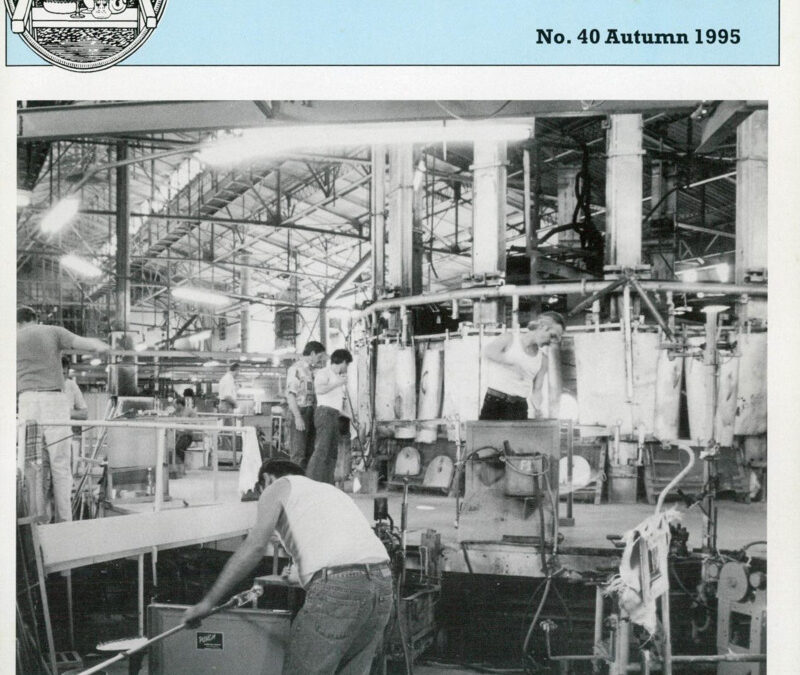
Cover Illustration:
Glassmaking at Cristal de Sevres &
Daum works, visited during the Glass
Association’s tour of Nancy. (John
Brooks, Leicester.)
Remember . . .
Do note the new address of the
Glass Cone editor. Mail is no longer
being redirected from the former
Farnham address so, unless you
wish your comments and articles to
disappear into the black hole of
unclaimed post in Royal Mail sorting
offices, do make sure to use the
current address
as
shown above.
An Invitation to view . . .
Mallet & Son (Antiques) Ltd of New
Bond Street, London WlY OBS will
be kindly inviting members of the
Glass Association, and of the Glass
Circle, to an evening private view of
Tassie glass medallions on Tuesday
12 December 1995. Tassie who was
born in Glasgow in 1735 and died
1799, produced a number of
portraits of the ‘worthy and good’ of
his time, Classical in form. A book
on his work will be produced to
accompany the exhibition. More
details to follow in the Newsletter.
Don’t forget the AGM
The Committee of the Association
hopes that as many people as
possible will attend the Annual
General Meeting this October. It is a
great opportunity for you to put
forward your views about the
national and regional programmes,
and the Committee is keen to hear
them. An enormous amount of hard
work, totally unpaid, goes on behind
the scenes just to plan events,
produce publications, etc. and the
Committee would like to know if you
consider such energy is being
usefully spent. But perhaps you think
it should be considering changes in
direction. Come along and speak
your mind.
An ignominious end but not
forgotten
In the Association’s Newsletter no. 9,
February 1995, Clive Bartlett asked
what happened to the original
Davidson moulds for flower-domes.
Nick Dolan, the Keeper of Applied
Art at the Laing Art Gallery,
Newcastle upon Tyne, writes:
“I believe that, like many of the
original moulds owned, made and
used by Davidson, they were
disposed of in a skip in the late
1960s, following the takeover of the
firm in 1966 by Abrahams, the
Birmingham plating company. Few
moulds remained, these eventually
going to Waterstone Glass
(Grenadier Giftware); some of these
are currently in the permanent
‘Made in Gateshead’ display at the
Shipley Art Gallery, Gateshead.
“The dome-shaped flower block
was the invention of Thomas
Davidson (1860-1937), son of the
founder of the firm. A patent for
manufacture was applied for on
31 March 1910, and accepted on
1 December 1910 (no. 7830). The
technique of manufacturing the
blocks was updated in 1931, and
production continued into the 1970s
when the block was superceded by
the crumbly sponge-like ‘Oasis’ for
successful floral display.
“The flower-blocks, incredibly
familiar as they are, are triumphs of
moulding manufacture: in particular,
the delicate thin walls of glass between
the holes are worthy of admiration.
“I understand that between the
wars other firms, French included,
purchased the rights to produce the
blocks, though it was also widely
pirated by glass manufacturers (such
as the Australia Glass company,
though in their case unsuccessfully)
who strove to profit from this
extraordinarily popular product.”
Nick Dolan promises that more
information on Davidson moulds
and the firm itself will feature in the
forthcoming major publication
Davidson’s Glass — From Gateshead
to the World.
No publication date as
yet; he tantalisingly ends his letter
“but watch this space”.
A Wedding Dress
Apropos of the article on Fibre Glass
in the last issue of the Cone, Peter Lole
of Manchester reminds us that the
Turner Museum of Glass at Sheffield
University has in its collection the full-
length blue wedding dress worn by
Helen Monro on her marriage to
Professor Turner in 1943. Glass
Fibres Ltd of Firhill, Glasgow supplied
the fabric which, given its structure,
had coupon exemption from wartime
clothers rationing, and it was made up
by Pettigrew & Stephens, Glasgow
who also designed the garment.
Is there a doctor in the house?
Jem Stedman of East Sussex asks
whether any further research is being
carried out on the potential hazards or
otherwise of collecting and displaying
glassware coloured with uranium
salts. The article by Sheilagh Murray &
John Haggith published in 1970
concerned Burmese glass (which
involved a percentage of uranium and
copper) did much to dispel anxiety.
However, a quarter of a century later,
it now seems that current opinion
holds that any level of ionising
radiation poses a risk of some sort. Is
there any recommendation based on
current scientific opinion as to what
constitutes a ‘safe’ dosage of ionising
radiation? As the ‘gold topaz’ colour,
as used by Webb 1935 49, was
derived from uranium alone, is there
additional reason for concern? Should
the glass be kept away from the main
living/sleeping areas in the house?
Info’
‘nation too would be
welcome on the history of uranium as
a colouring agent in both lead and
non-lead glass. Is the greenish
chameleon-effect of uranium
reproducable using other colouring
agents? And have any other
radioactive elements ever been used
in the colouring/decoration of glass?
Any comments from readers will be
forwarded on to Jem Stedman.
A Reminder for the Spring Issue
Feature articles and notice
up to
1,000
words in length (a typed line on an A4
page usually contains just under 10
words), preferably with one or more
black and white prints or colour
transparencies, are welcome. The
text should be typed or written
clearly.
All contributions over 750
words and accompanying
photographs will be acknowledged
by post, as soon as possible after
receipt; illustrations will of course
be
returned when received from the
printers after publication. Deadlines
for copy are detailed in the box
below.
The opinions expressed in the
Glass Cone
are those of the
writers. The editor’s aim is to
provide a range of interests and
ideas, not necessarily ones
which mirror her own. Her
decision is final.
COPY DATES
Spring 1996
18 February
Autumn 1996
6
Jtilv
WC
se
A Glass Consolation Prize
One of the fascinating aspects of the
study of British glass is its frequent use
to record public or personal events. A
notable instance of this is the pair of
Scottish rummers illustrated here
which have recently been purchased
for Edinburgh’s Huntly House
Museum. The glasses themselves are
well made; the bases of the bowls
have been formed in a dip-mould and
the sides cut with alternate flutes and
splits. They would, however, be
unexceptional but for their engraved
decoration which in each case
consists of a naively rendered boating
scene amid ferns, and the enigmatic
inscription:
“Barbara” of Cockenzie
Consolidation Prize Regatta
28 Aug 1875 from Wm Ford
Commodore — Prestonpans
The first point to note from the
inscription is that the glasses,
assuming that they are contemporary
with the engraving, do look rather old-
fashioned. That these two rummers
are racing prizes is also plain enough.
However, in view of the geographical
references (Prestonpans and
Cockenzie are situated on the
southern shore of the Firth of Forth, a
few miles east of Edinburgh), an
obvious question arises, namely,
whether the “Wm Ford” referred to in
the inscription was the same William
Ford who owned the Holyrood Glass
Works. This company is known to
have produced examples of engraved
glass of very superior quality during
the period in question and so it seems
improbable that these rummers,
which are engraved in a rather
amateurish hand, were likely to have
been the personal gift of the senior
partner of this prestigious glass house.
In an attempt to resolve this
question and also establish what
prompted the presentation of this
consolation prize, reference was
made to the local newspaper of the
time, the
Haddingtonshire Courier.
The extensive coverage given to not
only the regatta itself but the build-up
in the weeks preceding indicates that
it was a major annual event in
Prestonpans life. On 30 July 1875, it
was reported that the date for the
regatta had been fixed and that Mr
William Ford had not only agreed to
act as commodore and offer a
handsome subscription to the funds,
but had placed his yacht
Foam
at the
disposal of the regatta committee.
Sailing was obviously a favourite
pastime of Ford’s and his wealth
enabled him to indulge his interest in
considerable style. The yacht
Foam
was an elegantly appointed vessel,
forty-nine feet in length and furnished
with a mahogany panelled cabin in
which hung fifteen oil paintings of sea
views. It also featured a patent water
closet and a brass spittoon. Further
testament to Ford’s enthusiasm for
sailing is provided by the fact that, in
addition to the
Foam,
at this time he
also owned the
Mayflower,
an iron
sailing yacht which he used for
cruising around the Scottish coast. At
forty-six feet, three inches in length, it
was only slightly smaller than the
Foam.’
On 27 August, the day before the
event, the Counerproudly
announced that:
With a view to giving eclat to the proceedings,
the Tranent brass band has been engaged for
the day to play on the beach during the various
competitions.
The report of the regatta itself
appeared on 3 September and
included detailed accounts of the
sailing, rowing and swimming
matches, including an account of the
misfortune that befell the
Barbara:
In the first competition viz., that for dredge boats
— an unfortunate mistake was made by the
Barbara of Cockenzie. This boat had the race in
hand but mistook the MonrSon’s Haven harbour
buoy for the flag buoy specially laid for the sailing
races, and was in this way outrun by the Isabella
and the Warrior. The latter of the two, although
second in coming in, was entitled to the first prize
by the time allowed for keel measurement.
As well as establishing that the
scene depicted on each of the glasses
is the actual event, the account of the
day’s proceedings also mentions that
William Ford was resident at Beach
House, Prestonpans. The Prestonpans
Valuation Roll for 1875/6 establishes
his true identity for he is there listed
as “Glass Manufacturer, 17 St.John
Street Edinburgh”, this address being
the Ford family home adjoining the
Holyrood Glass Works. The Valuation
Roll indicates that not only did Ford
keep a house in Prestonpans High
Street for his own use but that he
owned and rented another six in the
same street.
2
William Ford was born on 13 May
1829 and was the third of four
children born to John Ford, under
Pairof
commemorative
rummers
inscribed..
“‘Barbara” of
Cockenzie,
Consolation prize
Regatta 28 August
1875, from
Wm Ford
Commodore —
Prestonpans’.
Height: 6″ (Huntly
House Museum,
Edinburgh)
Close-up of the
anchor mark, with
initials JD and
number of the
handled goblet
above.
William Ford
1829-1890
whose name the Holyrood Glass
Works traded from 1835 until its
closure in 1904. Both he and his two
brothers, Ernest and John Humphrey,
were actively involved in the family
business. A substantial quantity of
documentary material survives to
detail William’s work for the company
and this includes accounts of journeys undertaken on the firm’s behalf to
such far-flung places as Moscow,
St Petersburg, Berlin, Warsaw, and
the USA. He certainly possessed a
generous spirit, his gesture to award
the unfortunate owner of the
Barbara
a
consolation prize is proof of that. He
again demonstrated this attribute six
years later when he granted the
executors of his will the power to pay
pensions to those of this workmen
who had given him long service but
now found themselves incapacitated.
3
Returning to the glasses
themselves, although it is rewarding
to have such a full account of the
events which prompted their
presentation, there remains the
puzzling matter of the quality, or
rather the lack of quality, of the
engraving. Although it is equal in
standard to much of that employed on
popular commemorative glass of the
late nineteenth century, it makes a
poor comparison with the best work
produced in Edinburgh at this time;
this was executed in the main it would
seem by the Bohemian immigrant
engravers who were resident in the
city in some numbers.
It was only after examination of
letters and other documents written in
William Ford’s own hand that a
relationship between the script on the
glasses became apparent. It is
obvious that Ford had simply
engraved the glasses himself.
What then is the significance of
these glasses? Whilst there is no
denying that they do not add anything
in any artistic sense to the achievement
of the Edinburgh glassmakers, it is
rewarding to be able to add another
name, albeit in a purely amateur
capacity, to the list of known Scottish
engravers. Above all, they do offer a
fascinating insight into the interests and
character of one of the most successful
glassmakers of his day.
Gordon McFarlan
Asst. Course Director
Decorative Arts Programme
University of Glasgow
Footnotes:
1 Account of Cruise from Oban in the
Mayflower,
July/August 1875; 1991 Loan, Ford Ranken
Archive.
2 Prestonpans Valuation Roll; Local History Centre,
Lodge Street, Haddington.
3 Trust Disposition and Settlement of William Ford,
1881; Bundle 1/25, Ford Ranken Archive, Huntly
House Museum, Edinburgh.
John Derbyshire of Salford
Three examples of
John Derbyshire’s
glass. The tumbler
bears the number
96, the handled
goblet 249, and the
miniature comport
308. (private
collection)
John Derbyshire of Salford was in
business as a glassmaker in Regent
Road, Salford, either on his own or
with partners, from 1873 to 1876
approximately.
In that time he registered 15
designs, and — more importantly
— identified many products as his
by the use of a mark consisting of
an anchor with a monogram of
the letter JD on the shaft of the
anchor.
This mark was in use before the
1876 Trade Marks Act came into
effect, and was, apparently, not
subsequently registered as a trade
mark. It is only because of its
occurrence in association with
registration ‘lozenges’ on designs
registered by him or the company,
that the mark can be attributed to the
factory.
When the factory mark appears
together with a registration ‘lozenge’,
or when the factory mark appears
alone on decorative pieces, no
other mark is known to appear. But
on unregistered, factory-marked,
table wares, a 2 or 3 figure number
can sometimes be found below
the mark.
Examination of such pieces in a
small group of local collections has
resulted in the following list of
mould/model numbers being
compiled:
62 Tumbler
96 Tumbler
115 Tumbler
218 Goblet
246 Goblet
249 Handled goblet
253 Goblet
256 Goblet
308 Miniature comport
First indications are that there
are at least three series of numbers;
members are invited to examine
factory-marked pieces in their
collections in order to expand
the list.
Peter Helm
Manchester
C
–
My Choice — a True Baluster
The following lot description
appeared in the Sotheby’s specialist
English, Continental Glass and
Paperweights
auction catalogue for
18 July 1983.
28
A BALUSTER WINE GLASS,
the flared bowl with solid
teared base set on a collar over
annulations, bead knop and
teared true baluster, basal
knop, conical foot, 18.4 cm.,
c.1720.
£100-140
The glass was also illustrated.
I had only been interested in glass
for a short time, a couple of years at
most, and had until then only bought
from reputable dealers. But I had
begun to read widely about
eighteenth century English glass,
had handled a few balusters, had
viewed some collections and felt,
like many with ‘a little knowledge’,
that I knew enough to buy at
auction,
When I first read through the
catalogue, this particular glass
attracted my attention for a number of
reasons: I did not have a baluster in
my collection, I personally felt that it
had a pleasing shape, it had an
interesting knopped stem
and
it
contained a true baluster knop (while
so many baluster glasses contain an
inverted baluster knop). Further, and
this was no small consideration at the
time, the estimate was just within my
means.
Most of all, however, the glass
had, if not a true ‘provenance’, at least
a record’. No, its ‘record’ was not
mentioned in the catalogue
description, but this particular
glass is illustrated in
Old English
Drinking Glasses
by Grant R. Francis
(1926), P1. VI (opposite p.16), glass
number 30.
Why this fact was not mentioned
I do not know, but the moment I saw
the illustration of Lot 28, I know that
I had seen it in the reference
literature, and later with the aid of a
magnifying glass proved it, at least to
my own satisfaction.
Not only did Lot 28
look
exactly the
same as glass number 30 in Plate VI
—
a wide deep bell bowl, the same
tear in the solid base of the bowl, the
same rather ornate knopped stem
with exactly the same tear in the
baluster knop, and a plain conical foot
—
it also exhibited exactly the same
tool marks on the cushion knop
(beneath the bowl). I put in a bid
and was successful in purchasing
the glass.
This is a fine glass, and one that
exhibits very clearly most of the
features that collectors are always
advised to look for when handling a
glass to judge its age and authenticity
—
a rich grey colour, good weight
and good proportions — and all these
features combined with the individual
fingerprints of the glassblower –
clear striations and other toolmarks
together with a most effective use of
air tears.
If I have to dispose of any of my
collection in the future, this will almost
certainly be the last drinking glass
I shall ever sell.
Roy Kingsbury
Hampshire
Baluster wine
glass (photo by
Mike McEnneme;
Wimbome)
Architectural Coloured Glass
at Chertsey Museum
Chertsey Museum, Surrey, has the
good fortune to occupy a Regency
townhouse on lease from the Olive
Matthews Trust for a peppercorn rent.
The site of the house has been
occupied from the sixteenth century,
but the present building can be dated
to around 1815. Records indicate that
William Clark, the principal Chertsey
solicitor of that time, purchased the
land and demolished the existing
house to build anew. The main facade
faces the street, but the opposite side
facing south-west looked onto a
walled pleasure garden. In keeping
with Regency ideas, Clark took
advantage of the garden exposure
with windows, French doors and a
balcony. Originally the garden front
held no less than four groups of
windows and doors incorporated
coloured glass panels. In the evening,
the sun coming through the glass
would have
dappled the
staircase and
dining room walls
with a spectacular
display of colour
and pattern.
Coloured
window glazing,
especially amber
glass, was much
used by John
Soane in the late
eighteenth
century, and
Thomas Hope also used coloured
glass for his redecoration of
Deepdene in Surrey. However, few
houses retain examples of the
patterned and decorated glass that
once was an important architectural
consideration. Chertsey Museum
may be one of the few places still to
retain this type of glass
in situ,
albeit
fragmentary. The house was
redecorated in the “Queen Anne”
taste in the 1880s at which time the
dining room windows were replaced
with diamond shaped leaded panes.
In the twentieth century, the balcony
was enclosed to create an additional
room, and the French windows
removed to the basement. Inevitably
the years have also taken their toll
with breakages and crude
replacements. However, panes of
glass remain in overdoor panels, and
the French doors as well as the top
half of a divided door have been
“rescued” from the basement.
Sufficient glass remains to show
the intended effect. Rich ruby and
amber painted quatrefoils and
cartouches form the surrounds for
larger central panels of windows, and
similar roundels relieve the pointed
arches of overdoors. The largest and
most elaborate surviving panel is
decorated in a sgraffito style with a
central rosette against a background
of swirls. If any note can be taken of a
later source,
Cassell’s Household
Guide
states that deep bottle green
glass, such as that present in the
window border, is 2d. dearer than
ruby glass.
A single, unmounted rectangular
pane of glass different in proportion to
extant frame sizes, may derive from
the original dining room window. It is
decorated with an etched design of a
cherub and vine within an amber
border. The pane has been marked
“No.10 W”.
The Museum hopes eventually to
restore and replace the windows
in situ.
Meanwhile we would welcome
any comments members may have
concerning the style, technique or
provenance of the glass, or the
location of similar examples.
Philip Sykas
Assistant Curator
Chertsey Museum, Surrey
Large framed
door panel
which forms the
upper half of a
divided door to
one side of the
garden
entrance. This
has the most
elaborate
design of the
surviving glass.
The Visit to Nancy
6-10 July 1995
This summer saw the second ‘foreign’
trip organised by the Association. As
with the previous Liege tour, it proved
to be highly successful although sadly
fewer members took part. David Watts
describes the full exhausting schedule.
Precisely 6.30 a.m. and our coach,
accompanied by a faint hint of bacon
sandwiches, left Victoria for Dover
where our complement of 45 Glass
Association participants was
completed. Joining
The Pride of Dover
for Calais, we soon learnt the
significance of European Monetary
Union: the unfavourable exchange rate
meant a bottle of beer or choc-ice was
£2. Then it was the El5 toll road to
Nancy where, 5221.an later and Ff. 268
lighter (toll for coaches) and with the
town clocks striking seven, we arrived
at Monbois University Hall of
Residence — our home for the next
three days.
Friday, and after a stop for some
members to buy soap and towels
(drawing the line at toilet seats!) we set
out for Vannes-le-Chatel and the
Cristal de Sevres factory (Compagnie
Frangaise du Cristal). Drinking glass
production by a tight team of five
glassmakers using open/shut moulds
and footboards followed traditional
lines but the use of a Victorian-looking
hydraulic press for making large vases
was a revelation. A thick cylinder of hot
glass was introduced into the base of
the press and the hinged moulds,
outer and inner, separately assembled
above it. A long lever then forced the
hot glass up into the mould. The inner
mould was then withdrawn, the outer
Vannes le Chatel
(Sevres and Daum)
ak
illk
CERFAV
Vallerysthal
,/
•
lac•
Pierre
Percee
o.
0
1995
Strasbourg
NANCY
Baccarat
Darney
•
Clairey
La Rochere
to Mulhouse
to Dijon
LUXEMBOURG
Metz
BELGIUM
to
.
to Calais
Brussels
Reims
to Paris
The Glass lissociation
Visit to Nancy, 190
released to withdraw the blank some
12″
tall. It was then manually drawn,
twisted and flared into several designs.
The production rate for this team of
three men was about 13 an hour.
Resisting the temptations of the
factory shop, we relaxed over a
picnic lunch in the nearby Foret de
Meine before heading in soaring
temperatures for Darnley, cradle of
the
Verriers Gentilhommes
and glass-
making in England.
En route
we visited the Centre
Europeen de Formation aux Arts
Verriers (CERFAV), a studio glass
teaching centre with ambitions to
become the ‘Pilchuck’ of Europe. The
size and space of the enterprise were
more impressive then the traditional
equipment. The work was original,
and execution excellent but with
prices to match.
Looking at the flowing streams, the
eroded sandstone, the thickly
wooded slopes
around Darnley, it
was easy to
understand why this
area had become a
glass-makers’
paradise in the
fifteenth to early
seventeenth
centuries. Local
village names,
Hennezel la Hatrey
and Thietry, are a
permanent reminder.
It was from here that
Balthasar and
Thomas de Hennezel
(Henzey) were
brought by Cane in
an unsuccessful
attempt to make
broad glass in
England. And from
here that later the
wife of George
Henzey escaped with
her son Ananias who
eventually joined
forces with Paul Tyzack in
Stourbridge to initiate a world force in
glassmaking.
The Darnley glass-houses have
long since disappeared, but La
Rochere, founded in 1475 by Simon
de Thysac, some 14 km south is still
operational. We caught a few minutes
of glass-making before the teams
packed up for the day, leaving only
one lady to complete cracking off the
moil and polish the rim of a drinking
glass in uncanny silence.
On to the Musee de la Residence at
Clairey, another old glassmaking
centre in the Vosges where tea,
cake and a genial welcome from
M. Michel, President of the Association
de la Haute-Saone, revived our
energy. This little gem of a museum
has a diverse collection relating to
the Saint-Denis Glassworks and
the Art Nouveau work of Francois-
Theodore Legras (1839-1916).
Like Galle he drew much inspiration
from nature as seen in the pieces
illustrated in a booklet
Legras:
Maitre Verner des Vosges
by H.
Poirier and S. Lorraine with
contributions by Colonel George, who
had joined us in Darnley.
The last visit of the day was the
sixteenth century Chateau of
Lichecourt in idyllic surroundings,
where its present owner M. Labat
spoke of its historical links with glass-
making, and Colonel George
presented the Association with a thick
folder containing much valuable
information of the craft in the region.
M. Colonel
George whose
knowledge of
the region
added much to
the tour.
(Ray Notley,
London)
John Brooks
studying the
obsolete
furnace at
Vallerysthal
Glass factory.
David Watts
swears John was
saying “1 said
you’d get stuck
if you went in
there, Roger”.
(David Watts,
Herts.)
After dinner in Darnley, it was back to
Nancy with the clock touching
midnight.
Saturday began with the Musee des
Beaux Arts in Nancy to see the
magnificent Daum collection of 150
items, introduced to us by Genevieve
Courmontage. They ranged from a
small flask depicting in enamels the
house of Joan of Arc to a Majorelle
‘Eglatine’ table lamp, three foot high,
made as a wedding present for Antonin
Daum in 1898. The impact of the display
may be measured by the brisk sale of
illustrated catalogues at £20 each.
After a substantial lunch, we set off
for the Musee de 1’Ecole de Nancy.
Here, glass by Galle and also Daum
was displayed in a total Art Nouveau
environment of furniture, decor and
stained glass (mainly by Jacques
Gruber). Few of us could have lived
with the dining room with its powerful
chandelier with its writhing tentacles
of wood. Ray Notley taught us how to
distinguish the work of Galle,
Majorelle and Vallin and then from the
delightful museum garden, complete
with the giant umbellifer so
successfully exploited by Galle, we
were taken on a guided tour of
Nancy’s Art Nouveau buildings.
During the day Roger Dodsworth
had been unusually introspective. Not
caused by over-indulgence wining and
dining but the daunting prospect of
giving an eloquent response in French
that evening at the
Mayoral reception in
the Town Hall. The
welcome and
champagne from
Nancy’s Councillor in
charge of International
Affairs didn’t stop us
examining the glass of
the Salon’s entrance
doors which had
clearly been made by
the muff process with
characteristic marks of
the flattening iron.
The last day was
devoted to the
Baccarat and
Vallerysthal factories.
Baccarat began as the
Saint Anne glassworks
in 1764 but its museum
displays some 1,100
pieces dating back to
1816-17 and the use of
lead-crystal; one
design is still in production. A
spectacularly large cut vase, some
1,470 cm high, bore the coat of arms
of our Queen; how the elaborate
cutting was achieved beggars the
imagination. One of the group had a
lottery-winning experience finding
that an identical set of gilded goblets
to his (for which he had paid £240)
was on display carrying a sales tag,
ten times the price.
The Baccarat quality approached
perfection in every aspect. A church
across the square housed the
chandelier created for Baccarat’s
230th anniversary last year. Five
metres high and three wide, it
boasted 8,086 prices of crystal,
weighted 1.5 tons and required 10.6
kw of light bulbs. Clearly destined for
the Guinness Book of Records.
Lunch with delicious Gris wine
and salmon was taken high above
the Lac de Pierre-Percee, but various
delays meant that the following
sail in the appropriately named
Cristal
boat had to be drastically
curtailed. Even then, the busy minds
of some in the group were working
on limericks to record the event.
Who knows what one hour’s sailing
might have produced?
Vallerysthal is best known in this
country for pressed glass. Founded in
1707 under the name Plaine de
Walsch, the factory had seen better
days. At one end, the huge
glassmaking hall was dominated by
a
derelict 8-pot furnace in which tub-
shaped open pots could be seen. It
was raised on a low working platform
while the roof above had only simple
ventilation, not the cone structure
seen in Britain. Nearby stood chariots
for manipulating the pots into the
furnace, and three pressing machines
In another corner were shelves
of iron moulds. Two new leers
were partly filled with wine
glasses
and bottles.
The glass for sale, plain, coloured
and cut, was aimed at the popular
market, and included mould-blown
animals, traditional pressed single and
double salts in clear and plain amber,
and the well-known wicker-pattern
honey jar with conical lid and bees on
the outside . . . all of which find their
way into British antique shops.
We celebrated our last night
with
dinner at the capacious and
elaborately decorated Taverne de
Maitre Kanter in Nancy. John
Delafaille closed the evening with
presentations to Roger and to Agnes
Lyons who had organised much of the
outing and acted as interpreter cum
trouble-shooter. Our thanks also went
to Susan Newell and Aileen Dawson
who made light of the demanding task
of translation. And of course to our
driver whose good humour, endless
patience and safe driving should not
pass unrecorded. To misquote Keats
“A memorable experience is a joy
forever”; this trip will surely
rank on
the short list of those who
participated.
David Watts
Hertfordshire
Visiting La
Rochere
glassworks,
in operation
since 1475.
(Ray Notley,
London)