




its\U2114hTl
11667
ittU
4t
The Magazine of the
Glass Association
Registered as a Charity No. 326602
Chairman
John Delafaille.
Hon. Secretary
Dil Hier
Editorial Board
Patricia Baker, John Brooks, Ken Cannell.
Address for Glass Cone correspondence
2 Knight’s Crescent, Rothley. Leics. LE7 7PN.
College,
I
Address for membership enquiries
Membership Secretary, 50 Worcester Road,
Middleton, Manchester. M24 1WZ
4
ISSN No. 0265 9654
PRINTED BY
Jones & Palmer Ltd., Birmingham.
DESK TOP PUBLISHING
by Adrian Smith, Rawlins Community
Quorn. Leicestershire. LE12 8DY.
OM”
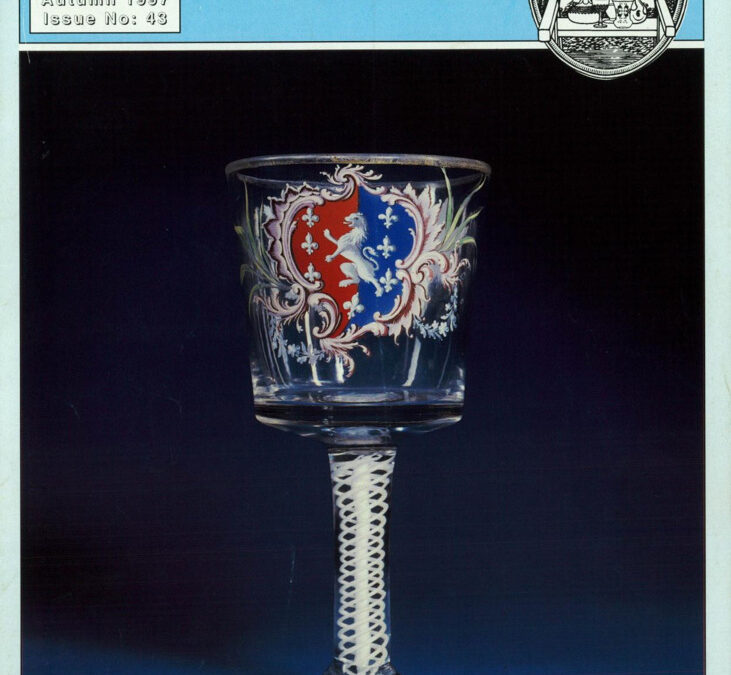
COVER ILLUSTRATION:
The Buckmaster goblet by William Beilby, c.1765
(ht. 18.5cm), with opaque twist stem and white,
red and blue enamel decoration on the bucket bowl
showing the arms of Lord Buckmaster of Lincoln,
Northampton and Devonshire. One of a pain (the
other in the Cecil Higgins Museum, Bedford) it is to
feature in the 18 December 1997 sale at Sotheby’s,
London. (By kind permission of Sotheby’s, London.)
BIGGER, BETTER AND EVEN MORE
The Glass Association Committee has decided, as a
result of your comments in the questionnaire, to
combine the Newsletter and the Glass Cone and to
publish four issues a year in this A4 format. We hope
you approve.There are certain advantages in doing this:
problem pieces and marks can be illustrated clearly
(provided we receive photographs with clear definition),
and there is the opportunity for full colour reproduction.
The A4 format means that the Cone will now fit into
files of that size, but the slightly narrower width and
increased length have persuaded us to experiment with
a new two column layout; we welcome your comments
on it.
It was unfortunate that we did not have enough
material to produce a Spring issue of the Cone this year
but we feel confident that this new approach will ensure
that this is not a problem in the future. The editors
hope that you will be fired by this new beginning to
contribute news and information since the more we
receive the thicker and more informative your Cone will
be.
One simple and useful way in which members can
help is to look out for any items printed in national or
regional newspapers relating to glass and glass-makers,
whether studio, domestic or industrial, then photocopy
it or cut it out, note the name and date of issue and send
it to us.
For instance, a decision is pending regarding the
proposed extension to the Fitzwilliam Museum in
Cambridge. If the plans are accepted and a Lottery
grant application is successful, it could well mean that
the famous Beves collection of glass will lose its display
area and be consigned to storage for the foreseeable
future. We would want to know about this.
You will have noticed thatAnnette Dunn is the name
that now appears on most GlassAssociation forms which
are to be returned to Broadfield House. During last
year’s A.G.M. John Delafaille, in his Chairman’s address,
said that we were approaching the point when the
Association would need professional secretarial help.
That time has now arrived and with the assistance of
Charles Hadjamach we have enlisted the help, on
a part time basis, of Annette who works for Dudley
Planning and Leisure Department. She will prepare
notices for circulation, act as a collection point for your
booking forms and organise most of our bulk mailing.
The benefits of her services are already being felt by
the committee.
Informal courses on the history of glass, as opposed
to degree courses at higher institutions of learning, are
unusual. For anyone living within easy access of New
Malden in Surrey the W.E.A. has planned such a course.
It is called FROM PHARAOH TO PHARMACIST: A
HISTORY OF GLASS and runs for 20 weeks on Tuesday
afternoons from 1.30pm to 3.30pm, starting on 7
October. It will include visits to the British Museum
and the V &A and the tutor is Caroline Macdonald-Haig.
The fee is £72 or £68 for senior citizens. For further
information telephone Margaret Mathieson, 0181 942
1833 or Anne Knott, 0181 942 0554.
The opinions expressed in the Glass COne are those
of the contributors. The editors’ aim is to provide a
range of interests and ideas, not necessarily those
which mirror their own. However, the decision of
the editorial board is final.
COPY DATES
Winter 1997:
20 October 1997
Spring 1998:
20 January 1998
The Glass Cone’ – Issue No 43: Autumn 1997
moo
JACOB VERSELINI’S WILL
Glass-making in 16th century England was dominated
by Jacob Verselini (also spelt Verzelini), a Venetian by
birth. After living inAntwerp where he married in 1556,
at the age of 34, he came to London in 1571. Three
years later he was granted a royal patent for 21 years,
making him the only person in England permitted to
produce glass in Venetian style. Glass Association
member, Don Tyzack, has been examining the last will
of Verselini which is lodged in a Guildford vault and he
has supplied the following account of his researches.
“While looking for something else I recently came
across the will of Jacob Verselini in an archive in
Guildford (Muniment Room), Surrey. Quite a bulky
document it turned out to be when it finally came up
from the vault. Seven vellum skins and, after I had
painstakingly transcribed it into my wordprocessor it
amounted to ten thousand words. Quite clearly the
scribe of 1604, one William (frith, was paid by the word;
he never included a word unless he could repeat it.
GOBLET
English, London, glass-house of Jacob
Verselini, dated 1578. Dark soda-glass;
diamond-point engraved, probably by
Anthony de Lysle.
(by permission of Fitzwilliam Museum, Cambridge)
By the time of his death in 1606 Jacob Verselini was
a wealthy man, most of it from property around the
Manor of Downe in Kent. In fact his principal house
was, or was near the Down House later to be lived in by
Charles Darwin. In the book “Down:The Home of the
Darwins”, it is said that Verselini bought Down from
Henry Manning, Knight Marshal of the Household under
Henry VIII, after Manning left for Greenwich in 1560,
but the will says it was purchased from John and Simon
Smythe. One of Manning’s sons, also a Henry, and a
Doctor of Law, advised Verselini, about the drafting of
his will.
Although Verselini owned several properties in and
around Downe, he apparently preferred to live in
London. We find him there when he dictated most of
the will, for example:-
And he saieth that on the last daie of Maye One
thousand sixe hundred and Power and in the
fforenoone of the same daye this deponent was sent
for to the same testator to his howse within the
Crutched ffreers London to be a Wittnes to his will
and the testator was then in his Stone parlour next
to his Garden.
The will starts off with £20 for a marble gravestone
to be engraved with pictures of himself and his wife.
Does this tablet still exist? His tenants were to receive
eight to ten shillings a yard for material for funeral coats.
Other details
of
interest are £25 to the children of his
brother Jasper in Venice, and bequests for the poor of
Downe, St. Olave’s in Hart Street, Christ’s Hospital
Orphanage, St Bartholomew’s Hospital, and St.Thomas’s
Hospital.
His wife Elizabeth was the executrix and was left
the residue including all property in Kent except Randall
Woods, land near Mark Lane, London, and other property
in the City of London.
His eldest son Francis must have blotted his
copybook; his problems with the law are not mentioned
but he gets only a couple of annuities worth about £60
per year.
Provided nevertheles and my Will and mynde is that
of my sayde Sonnes or either of them after my
deceasse shall vex sewe or molest or cawse or assent
to the sewinge vexinge or molestinge of the said
Elizabeth my lovinge wief and their naturall Mother
other than for Non payment of the saide Annuities
above bequeathed or either of them or shal by any
open or overt acte practize or goe abowte to
frustrate this my present Testament and last will or
any Legacye Guyffe or Devise by me herein given
or bequeathed or yf my sayde Sonnes or either of
them at any tyme duringe the.naturag lief of their
said Mother shall enter uppon any the Mannors
Messuages Landes Tenements and Hereditaments
whatsoever Where I am nowe seized and molest or
trouble any of the holdinge and occupienge of the
same or any parte or parcell thereof (except it be
only uppon inste cawse btWaie of distresse for Non
payment of the Annuyties and Yearlie Rent by his
will willed and bequeathed) That then and from
thencefwothe the Legacie and Devise above given
and made of ffourtie poundes per annu- unto him
‘The Glass Cone’ – Issue No 43: Autumn 1997
or them which shall soe offend transgresse or doe
contrarie to the true meaninge this my present
Testament and last will shall ceasse and determine
and be utterlie void and of nowe effect to all intents
and puposes.
On Elizabeth’s death, Jacob, their second son
inherited various properties,Vallence, Shenfield Meade,
and the Manor of Downe, all in Kent. His sister Elizabeth,
who had married Peter, the nephew of the older Henry
Manning mentioned above, was left Randall Woods,
Leaves Green in Cudham Down, Sowthcote Woods,
Fallowe Fields, Shawe Grove, and various woods all in
Kent. Maybe here, in the ownership of all these
woodlands one fmds the only sign of Verselini’s earlier
glass interests.
Verselini was at pains to work out the subsequent
inheritance of his various bequests after the death of
each original beneficiary. He always sought to nominate
an alternative beneficiary if the first issue failed to
materialise. So we find him making many bequests
which steered the endowment through his first
beneficiary and then defined, in any event that he could
envisage, who subsequently inherited it. Many items
were traced down to his various grandchildren and even
to potential grandchildren to be.
Whether this attempt to second guess the future
succeeded is difficult to say. The affairs of Downe Manor
were the subject of much litigation for the next fifty
years or more after Verselini’s death. After his wife’s
death the Downe property went to his second son Jacob
as provided in the will but, in 1614, son Jacob leased it
to Jacob Manning the grandson of Verselini, (Elizabeth
and Peter Mannynge’s son). Now under the will, because
son Jacob died childless, the property should have gone
to Marie, Verselini’s daughter and her husband, the
grocer Michael Palmer, who were already living in Down
Court. By 1646 Thomas, the son of Jacob Manning, went
to court claiming that his father was in possession of
the property when he died in 1621. Litigation continued
until 1652 when the manor seems to have come back
into the Palmer’s hands.
So ten thousand words, in Elizabethan secretary’s
hand, later, after interminable legal jargon, I found no
word at all about glass. If it had not been for the mention
of the “Crutched Freers” I might have begun to wonder
whether I had found the right will.”
Don Tyzack. Buckinghamshire
CLOSURE OF THE NORTH
BRITISH GLASSWORKS
Glassmaking has ended at the St. Catherine’s Road
Glassworks of John Moncrieff Ltd. in Perth.
The company has always been primarily a
manufacturer of laboratory and industrial glassware,
mostly under the Monax brand name, but from 1924
through to the early 1960s it also employed the Ysart
family to make Monart glass as a sideline.This probably
made very little commercial sense but it brought prestige
to the company and latterly, since the “British Glass
Between the Wars” exhibition in 1987, great pleasure to
collectors of 20th century British art glass.
It was also the place in which, in his own time, Paul
Ysart developed his skill as a paperweight maker. Later,
as Training Officer at Caithness Glass and in his own
studio at Harland, he was to train the craftsmen who
have made the making of glass paperweights such an
important craft industry in Scotland today.
The Moncrieff furnaces have now been closed for
over six months and the factory still stands empty,
awaiting demolition, whilst a planning dispute rages over
schemes for a large block of land adjacent to the Perth
inner ring road. Rumour has it that the site is likely to
be redeveloped for a Leisure Centre but, meanwhile,
Monart collectors can take a nostalgic look at the empty
factory. Whilst stocks last, the company – which is still
trading from the separate office building next door – is
selling the remnants of the Monax stock as spaghetti
storage jars! An opportunity definitely to be missed.
Thanks to Peter Beebe and Hildegarde Berwick for
supporting information.
Ian Turner, July 1997. Melbourne.
EXHIBITION AT NOVEMBER
OLYMPIA ANTIQUES FAIR
We have recieved the following notice from George
Neilson, curator of the Drambuie Collection, in
Edinburgh.
Jacobites Reach London
“Let the public beware that a large group ofJacks
are threatening to freely display themselves in the
city of London. They are to be seen variously
showing their favours either secretly or openly in
the area of Earls Court called Olympia, with other
items of a North British connection. These Jacks
should be observed for their ingenuity and cunning
as they are the largest gathering ever to be assembled
so farsouth. They have to be admired for their skilful
representations of hidden symbolic and open brazen
seditious representations of the Pr…. which they are
determined to flaunt within the Olympia precincts
from the 17th until the 23rd November”
A collection of Jacobite glass will be on display at
the Fine Art and Antiques Fair at Olympia as part of the
loan exhibition – ‘A Scots Trinity’ – a collection of family
portraits from the House of Dun (National Trust for
Scotland), Burgesses Trade chairs fromAberdeen (Trinity
Hall, Aberdeen) and Jacobite relics (the Drambuie
Collection) from 17 to 23 November 1997.
The Glass Cone’ – Issue No 43: Autumn 1997
GREEN BOTTLE GLASS DUMPS
The left hand one containing a plaster effigy of Gladstone.
The rest with flowers
DOWN IN THE DUMPS
Mr. P. Collings has provided the accompanying
photograph and would like to know more about the
history and origins of these decorative lumps of glass.
Although commonly called door
stops or door dumps there are
some which are too small to secure
a door and might sooner be
considered as paperweights. I have
heard of them being attributed to
bottle glasshouses as far apart as
Bristol and Newcastle upon Tyne
but the best evidence appears to
identify them with the Wakefield
area. Because, I suspect, most
authors on glass have confined
their interest to vessel glass or
decorative glass comparatively little
has been written about them and I
can only offer the following
references.
`Paperweights and Other Glass
Curiosities’ by E.M. Elville, 1954
refers to them (pp41-42) and much
the same information appears in his
`Collector’s Dictionary of Glass’,
1961 (pp73-74). The text has a
brief description of how they were
made and, apart from a brief
reference to J. Kilner of Wakefield, makes no reference
to their possible origins.
‘Glass Making on Wearside. Part I’, Tyne & Wear
County Council, 1979 illustrates several (pp19-21) but
devotes only one paragraph to them, accepting that they
were made in Sunderland but dismissing them as “..not
strictly Triggers’ as a great deal of skill was not required
in their making.”
Paul Hollister in ‘The Encyclopedia of Glass
Paperweights’ 1969, (pp176-180) provides much more
detail. He quotes a letter from Sir Hugh Chance, a
descendant of the original owners of the Nailsea glass
works, which asserts that ”
Nailsea can never have
produced paperweights.” He then goes on to the history
of the Kilner Glass Co. of Wakefield, referring to a weight
marked ‘J. Kilner, Maker’ which could have been made
as early as 1829. The record of the firm’s changing title
over the years provides evidence for dating on marked
examples. Hollister, referring to the use of the word
`dump’, quotes a member of the family as saying that it
was a local word referring to molten glass left at the end
of the day which would otherwise have been ‘dumped
out’.
The marked Kilner examples I have seen were all of
a distinctive clear, pale bluish green glass. Most others
are of typical pale green bottle glass that were probably
widely made in the bottle glasshouses of the North of
England.
As a final comment, one of our late members, Laura
Seddon, had a fine collection of these dumps which was
sold at auction by Giles Haywood in Stourbridge on 26th
July 1996. The collection included examples of most
types; flowerpots, floral, bubbles, plaster model
inclusions and some rare examples containing colour.
There were also some made as inkwells and a good
selection of them was illustrated on page 43 of the
catalogue. Prices varied from around £100 to £450 for
the rarest examples containing colour.
John Brooks.
THE ORIGIN OF
MERESE
Does anyone know when and where the
glassmaking term
merese
was first used in the English
language?
Professor Michael Cable of Sheffield University is
currently advising on the vocabulary of glass technology
for a revised edition of the Oxford English Dictionary.
He reports that one word, which at present has to admit
`etymology unknown’ is
merese.
The earliest reference
to this as, ‘a sharp edged button’ on the stem of a wine
glass, is found in H.J. Powell’s Glass
Making in England
(1923). Are there any earlier authoritative books in
English or, perhaps French, which may use or explain
the term? Any suggestions to the editor please.
‘The Glass Cone’ – Issue No 43: Autumn 1997
JEAN-CLAUDE NOVARO: A MODERN MASTER OF GLASS
AN EXAMPLE OF JEAN-CLAUDE NOVARO’S WORK
produced in 1989. Clear glass over opaque white with
oxides and enamel inclusions. Ht. 25cm. Photo: C.
Germain
studio glassmaking. Following the example of Maurice
Marinot, this exceptional craftsman transformed the
magical world of artistic glassmaking in Europe.
Jean-Claude Novaro was born in 1943 in Biot in the
south of France where he still lives. From 1957 to 1977
he worked at the `Verrerie de Biot’ in the studio of Eloi
Monod. His first approach to glass was limited to blown
objects on a small scale but, inspired by the colours of
Maurice Marinot and Emil Gallee, he has developed his
own way of glassmaking.
Nowadays, Novaro has his own `Galerie’ of glass art
in Biot. Since 1992 he has been working with Serge
Lechaczynski and both have been actively involved in
bringing well known glass artists to the town –
international masters like Chihuly, Dailey, Reid and
Stankard. Every summer, during the `Verriales’ [Glass
Festival.] in Biot, thousands of people may see high
quality American, British and French studio glass. The
town provides a valuable exchange for ideas and
information and Novaro is a fine example of glassmakers
who love exploiting the visual possibilities of colour and
light in glass.
During the twentieth century the art nouveau and
the art deco have been important styles in the art of
glassmaking. France was technically very ahead in this
domain and contained a large number of creators and
masters of both styles. Moreover, young contemporary
glassmakers have been widely inspired by them.
Among the glass artists of the 1990s Jean-Claude
Novaro may be regarded as one of the leaders of French
His work may be seen in: Galerie Internationale duVerre.
Biot, France.
Musee des Arts Decoratifs, Paris, France.
M.M.A. New York, U.S.A.
V. & A. London, England.
Musee de Liege, Liege, Belgium.
Joaquim San Bernardino, Besancon, France
“CRUSHED” GLASS
Jenny Thompson writes of a visit to New Zealand,”I
was recently in South Island, New Zealand and we went
to Arrowtown, one of the Victorian gold rush towns, 14
miles northeast of Queenstown which has become a
tourist attraction since, like a fly trapped in amber, it
has scarcely changed architecturally.
We went into the local museum which was full of
furniture and period things given by descendants of the
original settlers. In one cabinet were two pieces of shiny,
jet pressed glass: a banded cauldron shaped sugar bowl
and a matching cream jug. I asked if I could see them
and the most helpful attendant offered to let me handle
them. Underneath there were no trade marks, but there
were whorls or concentric circles. I asked what was
known of them, their provenance etc. I have always
been somewhat suspicious of these pieces as to their
date and have thought they were Scottish but without
certainty.
On the museum card it said that it was ‘crushed glass
from the North East of England or near the border’. The
word ‘crushed’ intrigued – was it a word the early settlers
used I wonder, or merely another interpretation of the
word ‘pressed’? I said that I thought they were Scottish
pressed glass and she said that the family who had given
them was very Scottish.”
[This cauldron shape and matching jug is well
known to collectors; always black and the quality of
moulding often inferior to that of Sowerby or Davidson.
I have seen one example with what looked like a thistle
mark inside but the concentric rings under the base are
usually associated with Davidson. Have our readers any
thoughts to offer on this subject? JB]
The Glass Cone’ – Issue No 43: Autumn 1997
ADVERTISEMENTS OCTOBER 1997
WANTED
Any articles, publications, books relating to English or European ROEMERS. Also
wishes to purchase interesting or unusual examples of Roemers.
Brian Balman. 01264 361476.
Wanted to purchase WHITEFRIARS/POWELL glass. Particularly of the Baxter era.
Genuine collector/fanatic.
Alex Bishop. 01905 775749
Can anyone help identify the marking VG 1721 stamped on the metal caps on several
coloured Victorian WITCHBALLS in my possession.
Hartley Cook, Grafton Galleries, 389 New South Head road, Double Bay, NSW. 2028,
Australia.
I am beginning research on factors which influenced the development of pressed
glass production during the 19th century. Any information concerning publications
or collections would be much appreciated. Mike Taylor, 21b Salisbury Road, Bulford
Village, Salisbury. SP4 9DF. Tel: 01980 638872
P.T.O.
N.B. The Glass Association offers this as a service to members but reserves the
right to refuse advertisements and accepts no liahility for contracts made between
participants to this service. It must be understood that any contract arising from
these advertisements will be the responsibility of the members concerned who are
recommended to take their own precautions before entering into any contract.
PLEASE PRINT.
NAME
ADDRESS (for record only)
Tel
Please insert the following advertisement in the next available issue of the Glass
Association Newsletter.
FOR SALE/WANTED (Delete as necessary)
PLEASE PRINT.
Price
Are these items being offered in the way of trade?
YES/NO.
N.B. 40 words max. including Tel. No. and Name.
Signed
Do you prefer to use box numbers? YES/NO.
If items not in perfect condition faults must be detailed.
If you only want to receive responses between certain hours please specify.
Return to John Brooks, 2 Knights Crescent, Rothley, Leics LE7 7PN.
1
FOR SALE
Large collection (about 70 pieces) of PRESSED GLASS. Includes Davidson, Greener,
Sowerby. Majority marked – perfect. Will split. Also two pairs glass lustres.
R.A. Hibbert. Tel: 01253 866887.
John Ford, Edinburgh. Frosted pressed glass hands. Registered 25 Feb. 1876.
Illustrated ‘Victorian Table Glass and Ornaments’, Barbara Morris. Pl. 133 (but no
stand). £100. Brian Maguire. Tel: 0114 2301146.
STOP PRESS.
Phillips North East
in Gateshead, Tyne and Wear (Tel: 0191 477 6688) will be
offering for sale, during the third week in October, more than 50 lots of pressed
glass from the collection of our member Jenny Thompson. Included will be Carnival
and Joblings glass as well as the products of the other well known glasshouses of
the North East.
2
EPERGNES AND FLOWER STANDS
My footnote on table centres in the May issue of the
Newsletter this year (No.18) had been discovered quite
casually and was included because it seemed to add
something to the review of ‘THE ELEGANT EPERGNE’
in issue 17. When I have tried to provoke a debate by
being contentious, or invited comment on specific
subjects, the reaction has generally been a deafening
silence. This afterthought, included without ulterior
motive, has apparently touched a nerve and the
correspondence on the subject has been most
interesting and illuminating. Peter Lole in Manchester
starts us off.
“In our very last Newsletter our Editor asks for
nineteenth century references to EPERGNES. Surely, as
the observation from Jane Shadel Spillman half implies,
we are mixing up two almost separate devices?
Epergnes held desserts and sweetmeats, whilst Flower
Stands held … flowers! The Oxford English Dictionary
gives the earliest record for Epergnes as 1761: “Grand
Epergnes filled with fine pickles”, and the sumptuous
eighteenth century silver centrepieces with arms
holding dishes, intially also of silver but later more often
of Glass, seem frequently to have been called Epergnes.
An 1840 inventory for Mere Hall, Cheshire (see the
Glass Cone No.38 for a discussion of this inventory and
the glass which figures in it) lists amongst the silver:
“Epergne supported by three figurs Glass Platue
plated frame & cut Glass Dishs” (sic)
But what really clarifies the nomenclature is Silber
& Fleming’s “Glass and China Book”, a fully illustrated
283 page catalogue of about 1881, which was reprinted
in 1990. This has eight pages of FLOWER STANDS,
scattered through various sections, comprising either
single trumpets rising from a bowl, or clusters of
trumpets, or in a few cases hanging baskets (but these
baskets are illustrated as flower containers, not dessert
vessels). There is only one page of EPERGNES, given in
‘Electro-Plated Goods’ section, and these all have plated
stands with arms, supporting a number of Glass dishes
or hanging baskets for dessert. In the same vein, the
catalogue also offers FRUIT STANDS and CENTRE &
STAND both of which have a single large Glass dish atop
an elaborate stand of Glass or silver-plate.
Presumably, as is so often the case, the owner did
not always use the device as the manufacturer intended.
It would be easier to use an Epergne as a Flower Stand
than vice-versa, for the Flower Stand vessels were not
suited to dessert or sweetmeats, whilst the Epergne
vessels were more accommodating. Perhaps this
promiscuous use muddled up the descriptive terms, for
the OED now gives its support to an EPERGNE for both
dishes and flowers.”
Frank Chiarenza, who writes elsewhere in this issue,
gives us some further thoughts and a literary reference.
“Words seem to take on increasing layers of meaning
over time, and glass terminology, of course, is no
exception. I am referring in particular to the question
of whether the term”epergne” was used to mean flower
stand in the 19th century. According to the Oxford
English Dictionary, the earliest recorded use of the term
“epergne” is 1761 (see Peter Lole above), said to derive
from the French meaning “saving or economy”, but
“there is no evidence to show how the word acquired
its present meaning”. Another quotation, dated 1779,
speaks of “sumptuous epergnes filled with sweetmeats.”
There are no references to suggest the term was used to
describe flower holders during the 18th century. For
whatever interest it may be, I am enclosing a “novel”
(Dickens, that is) reference to epergne which you may
or may not wish to share with your readers.”
A DICKENS REFERENCE TO “EPERGNE”
Among several 19th century quotations, a
particularly evocative one is from Dickens’ novel,
“Great
Expectations”.
In describing Miss Havisham’s dreary
room, where mice are rampant and everything is buried
under layers of dust and mould, he mentions a long table
with a table cloth spread on it, adding “An epergne or
centre-piece of some kind was in the middle of the
cloth”. The epergne itself he described as so overhung
with spider webs that its form was “quite
indistinguishable”, and spiders had commandeered it for
themselves so that it seemed to Pip as if” to grow, like a
black fungus” on the table top. At that moment, Miss
Havisham enters the room, points with her stick and
asks “what do you think that is?…that where the
cobwebs are?” Unable to guess, he is told “It’s a great
cake. A bride cake. Mine!”
So, were flower stands called epergnes in the 19th
century? It would appear that Dickens at least did not
have a flower stand in mind when he used the term
“epergne”, but rather a cake salver (the cake itself, we
might assume, having long since been devoured by the
mice, spiders and beetles that invade the room). Even
more interesting is the 1861 date of Dickens’ novel,
suggesting perhaps that epergnes were much in vogue
at the time, as it agrees with both the Dobson & Pearce
1861 design patent date and the Exhibition in the
following year where, as Mrs. Spillman noted, James
Powell & Sons showed a similar design.
For what it may be worth, here are some additional
observations from the book
“Collecting Brides’ Baskets
and Other Glass Fancies”
by John Mehane (Wallace-
Homestead Book Co., 1976):
“Basically the early epergne was a silver stand whose
height varied up to a maximum of about two feet and
which held, in one manner or another, glass dishes or
baskets intended for sweetmeats, desserts and
confections.
‘The
Glass Cone’ – Issue No 43:
Autumn 1997
NMI
n
Ultimately the simpler glass epergnes of the late
nineteenth century evolved into what were basically
decorative flower holders with horn-shaped glass vases
supplanting the bowl and dishes… Many collectors today
include pieces
originally termed flower stands
(my
emphasis) in the epergne category. Some of these were
intended to hold fruit as well as flowers and were made
with a glass bowl supported on a standard, with a glass
flower horn rising from the center of the bowl. A
number of dessert stands also so closely resembled
epergnes that they are often assigned to that category”
(pp 31, 36).
All, apparently, inconclusive, but it seems most likely
that Mrs. Spillman is correct in her view, that the use of
the term epergne to mean a flower stand, did not
become current until about the turn of the century?’
Jenny Thompson, writing from Cumbria, has this to
mo
p
add. “I would like to add a P.S. to the epergne query. As
can be seen from the Design Registrations and catalogues
the description ‘Flower Stand’ is used often. According
III
to the Concise English Dictionary epergne means
“Centre ornament (especially in branched form) for
dinner table holding flowers or fruit (18th C. origin
unknown)”. Flower stand is a descriptive trade word.
Epergne, along with Entree, Souffle, Mousse, was more
of a social, household word and certainly used in the
19th century.
I think I have seen the word in connection with
Richardson’s and Webb’s designs and, on page 154 of
‘Victorian Table Glass and Ornament’
by Barbara Morris,
there is a description of a John Walsh Walsh piece
described in the
Pottery Gazette,
February 1885 as “an
epergne with opaque scallop shells of a pinkish tint to
hold fruit or sweets”
Dr. Denis Ashurst in South Yorkshire throws more
light on the subject. “I am sorry to disillusion Jane
Spillman (Newsletter August 1977) but ‘epergne’,
derived from French ‘epargne’ – saving, was most
certainly in use as a generic term describing a glass
centrepiece for the table in the 19th Century. The O.E.D.
offers a 1761 date for an’epergne filled with fine pickles’.
In 1834 the three Wood brothers (John, James &
William) together with Richard Perkes, all from
Stourbridge, took over a glassworks established in 1828
at the village of Worsbrough, near Barnsley in South
n
Yorkshire. William and his son Eugene had worked at
Baccarat and introduced French techniques of etching
and gilding to Worsbrough. The firm specialised in fine
tableware, particularly epergnes and pieces involving
the Sheffield silversmiths. The firm moved to Barnsley
in 1871, specialising in chemical glassware, but closed
in the 1980’s recession.
The Barnsley historian Joseph Wilkinson, writing in
1872,records that
“From these works, in 1851 and 1862,
were sent to the National Exhibitions some fine
specimens of workmanship, including a magnificent cut
glass epergne, and other elegant articles of glass
manufacture”.
They were awarded a gold medal for their display at
the 1851 Crystal Palace Exhibition and the epergne is
further described by Wilfred Barker (Works Manager
early this century) as consisting of
“a large central dish
surrounded by four smaller dishes and a supporting base.
All these were made of flintglass cased with gold ruby
glass, the latter partly cut away in neat designs”.
It is
currently preserved at the Barnsley Museum, Cannon
Hall, Cawthorne.
The photograph shows that, in this form, it could
not have held flowers and has been generally considered
to have stood centre table with the dishes holding
varieties of sweets for after dinner.
Or do I only muddy the waters further”!
(The photograph is not suitable for reproduction as
received. We will try and get a better copy: Ed.)
These interesting contributions to the debate make
a number of points which I feel may be summarised as
follows.
During the 18th and early 19th centuries table
centrepieces (epergnes) were well known but for fruit,
sweetmeats, etc. since flowers were not normally
displayed on the dining table. They were usually too
full of food at meal times. By the second half of the
19th century the style of dining had changed to what
was known as
‘service a la Russe’.
This left more space
for decoration and ‘flower stands’ became popular.
Given that silver or plated epergnes with cut glass dishes
would mostly have appeared on the tables of the well-
to-do the appearance of glass flower stands, which were
presumably cheaper, would have allowed households
lower down the social scale also to have table centres
and keep abreast of fashion. It is only a step from here
before the distinction between the terms become
blurred and, to take up Jenny Thompson’s point, how
much nicer to refer to one’s ‘Epergne’ rather than
`Flower holder’. I think we may see this as a social
change occurring around the turn of the 20th century
which is kept alive today by antiques dealers wishing to
present their ‘flower stands’ in the best light!
John Brooks.
A WEBB QUERY
11111
With the Webb Corbett exhibition soon to open at
Broadfield House Barrie Skelcher in Suffolk has sent in a
topical query about a Webb design. “I have just found a
wine glass with a fine cut pattern which is clearly
illustrated in Design Registry submissions as 214597.,
registered by Edward Webb of Wordsley in 1867. I can
find little in print about this gentleman. I gather he was
at (owned?) White House Glass Works and was brother
of Joseph Webb. Does any member have any further
information? Where were these works and what
happened to them? Was Edward in any way related to
Thomas Webb? Any information gratefully received.”
‘The Glass Cone’ – Issue No 43: Autumn 1997
AN UPSIDE-DOWN PLATE
I have, in my collection, one of Sowerby’s basket-
weave plates 9″ in diameter, the design for which was
first registered on 18August 1876. Instead of the pattern
decorating the inner surface, as is normal, it appears on
what is, in effect, the underside while the footrim and
Sowerby mark now form part of the upper concave
surface. It is quite even with no irregularity or other
comfortably on top of another dish of either 9″ or 10″
diameter and so could hardly have been intended as a
plate cover. The basket-weave pattern shows slight wear
suggesting that it has spent, at least part of its life, with
the normal underside uppermost. In this position it
would make a good plantpot holder but there is no wear
to support the idea. I have been unable to come up
THE CONVEX FORM OF THE
BASKET-WEAVE PLATE.
imperfection. I find it hard to believe that it was
produced by accident and, even
if
it was, why was it
not rejected and not offered for sale? Could it have been
appropriated by an employee as a novelty? If so, to what
use was it put? If, on the other hand, it was made
deliberately then what was its purpose? It does not fit
THE ‘UNDERSIDE’ WITH THE SOWERBY MARK
SHOWS NO SIGN OF WEAR.
with a plausible explanation for the intended purpose
of this plate – if indeed there is one. I have never seen
another and I wonder if anyone else has come across
anything comparable and whether they have any
suggestions as to its original use.
Dr. Deryk Snow, Manchester.
oik
THE NATIONAL MILK GLASS
COLLECTORS SOCIETY IN AMERICA
Like many organizations such as ours, the National
Milk Glass Collectors Society began, in 1985, as an
informal group of a few dozen people who shared a
common interest in opaque milk white glass. With no
more nexus than that, they held casual meetings annually
and produced a modest newsletter,
Opaque News,
issued bimonthly, to share information and to advertise
items they wished to sell or buy.
With these modest beginnings, a formal organization
was founded two years later, as a charitable non-profit
association, and the Newsletter was adopted as its official
publication to be issued quarterly. From its initial single
fold-over page,
Opaque News
has expanded greatly, each
issue now averaging about 16 pages with some running
to over 20 pages. To date,we have published 12 volumes,
comprising over 600 pages of text and illustrations,
mainly black and white but colour photographs were
introduced last year and are now a regular feature.
Each issue, prepared by a Publications Committee
of which I serve as Chairman, contains information about
our members and articles and reports relating to milk
glass and collecting. Brief notices, not extensive enough
to serve as full-fledged research articles, are encompassed
in a column designated “The Members Forum.” Reports
of recent auction sales, as well as “For Sale” and “Wanted”
ads are welcomed and published at no charge. Members
are invited to write briefly about themselves and their
collecting interests in a regular “Meet the Members”
column. To amend, amplify, and supplement the existing
published literature, we devote space to a feature called
IP
“Reference Book Update” so members can annotate and
correct their reference books. For the past three years,
one of your members, Geoff Bateman, has been our
British Correspondent, contributing views from abroad,
often witty and lighthearted observations on the “glass
scene” in England, and indeed introduced me to the Glass
Association for which I thank him. Finally, mindful of
the needs of new members, we also have introduced an
on-going series, “Tips for the Beginning Milk Glass
Collector.”
From its inception, the society’s mission has been,
in the words of its Charter, “to promote knowledge,
•
The Glass Cone’ – Issue No 43: Autumn 1997
1MI
„,
1
0
interest, and enjoyment in a type of opaque glass
generally called milk glass, and to educate people in its
aesthetic values and beauty” To that end, its members,
who now number more than 500, also assemble annually
at various locations for lectures and discussions, as well
as the social gathering. Major dealers from throughout
the country are invited to show and sell their wares,
and the society sponsors an auction of pieces consigned
by its own members, generally highlighted by the
offering of the rarest and most prized items.
The term “Milk Glass” used to mean opague press-
moulded glass of a milky white colour but over the years,
it has come to refer to opaque glass of whatever colour,
including marblised or glass of the type common to many
English products of Sowerby, Davidson, Heppell and
others. Such extended application of the term results
in such curious expressions as “blue milk glass” and
“black milk glass” to describe opaque blue and jet glass.
There is also an infinite variety of shades or tints even in
“milk white” glass, as one may know if familiar with the
grayish tint to most French products made in opaque
white. Some milk glass pieces, generally the older ones,
are highly opalescent showing brilliant “fire” when held
to the light, while others are chalk white characteristic
of many Sowerby pieces.
The types of items collected by our members are
virtually limitless, including bottles, inkwells, lamps,
vases, candlesticks, ornamentals, and of course
patterned tableware, toothpick holders, matchsafes, etc..
But the most sought-after are the animal covered dishes,
one of which, a two-part full figured large rabbit, serves
as the logo of our society. This is a prized item, made in
the late 1880s by Atterbury & Company of Pittsburgh,
Pennsylvania. A standard reference for many years, E.
McCamely Belknap’s
Milk Glass,
is perhaps the best
source of information for those who wish a basic
introduction to the whole field. The chapter devoted to
Covered Dishes should be an eye popper for those who
have not encountered them.
While most Americans who collect milk glass are
somewhat familiar with the British manufacturers
(although if a piece is determined to be English, it is
almost automatically assumed to be Sowerby!), I sense
that many collectors in England are not familiar with
the American counterparts. Our Atterbury company in
some respects corresponds to your Sowerby, and I am
currently investigating, although as yet with little
success, if there was a close tie between Atterbury and
Matthew Turnbull, for I have found several covered
dishes (a hen, an owl, and a bull’s head) made by both
companies and almost identical. One of the most notable
features distinguishing many American animal covered
dishes from European counterparts is the form of
moulded eye sockets in which glass stones were affixed.
Often they are red, but quite realistic glass eyes, brown
with black pupil, were also used.
Having allowed my own research interests to
intrude, I apologize for straying from my topic. The
results of a recent questionnaire sent out to our society’s
membership may be of interest. About three quarters
of our members are 60 years old or over and have
collected milk glass for more than ten years. Some, like
our youngest member who is 13, have joined only within
the past year or so, while many are Charter Members.
The size of individual collections ranges from as few as
25 pieces to well in excess of 3,000. Most members
collect merely as a hobby, some for investment, while a
small number are dealers. While we have some “purists”
who collect only opaque white glass (the true meaning
of “milk glass”), most collect any and all colours, as well
as “slag.”, and more than half also collect other types of
glass, very few limiting themselves to one particular
manufacturer, period, or category. Our members collect
mainly American milk glass, some by choice and others
by sheer necessity owing to availability. There is a great
demand for all of the pressed glass products of the French
factories Vallerysthal and Portieux. A somewhat smaller,
but intensely dedicated number, myself included will
buy any English milk glass they can find. A particular
prize is the Greener Cow covered dish which I have in
white and in marbled purple, and a Hen covered dish in
clear crystal made by Matthew Turnbull.
A few colleagues and I are at work on a book which
the society hopes to publish within the next year or so.
It will consist of some 500-600 items illustrating
previously unlisted milk glass pieces drawing upon the
major collections of some of our members. As with all
else relating to the society and the newsletter, this is
wholly a volunteer effort spurred by a love for milk glass
and a desire to promote and preserve its long history
and infinite forms.
If any of the Glass Association members care to have
additional information about the society, or communicate
with me about their interest in opaque press-moulded
glass, I shall be most pleased to hear from them.
Frank Chiarenza, Vice President, NMGCS
80 Crestview, Newington, Connecticut 06111-2405.
A FIGURE BOTTLE
Mrs. Vivien Ferneyhough is the glass
specialist with the Guernsey Museum
Archaeology Group and she has sent this
drawing of the neck of a bottle which has
turned up during some excavations. She
writes, “I am hoping that someone out there
may be able to shed some light on the enclosed
drawing of an anthropomorphic bottle neck
excavated recently from a footings trench
which was originally dug circa 1873. Any suggestions as to
what it may have contained or its provenance would be helpful.
The metal is pale green and the drawing is life size.”
[The American glass makers produced a variety of figure
bottles at that period but I have been unable to identify it
from my sources. If the expression on the face is anything to
go by the contents may have been intended to produce a
feeling of euphoria! and if it did originate in the U.S. perhaps
one of our American members can identify it? Any other
suggestions to the editors please.]
7
7
‘The Glass Cone’ –
Issue No 43: Autumn 1997
Left to Right. Geoffrey Bond, Kate Adie, Mark Moore (holding the jar),
Pamela Calvert and Esther Gibbon.
(By kind permission of the Eastern Echo newspaper)
lib
11
PROGRESS AT THE NATIONAL GLASS CENTRE
The presence of Kate Adie, the
intrepid TV news reporter, in front of
the cameras usually means political
upheaval, battle stations or at least
urban riots in the neighbourhood, but
in May this year she was in more
peaceful surroundings, in Sunderland,
to mark the official start of building
work on the £16 million National Glass
Centre.
As part of the ceremony a time
capsule was buried on the site. Into
the glass jar went the plans of the
complex along with memories of the
past represented by reminiscences of
the ‘Barbary Coast’ (the local name for
the area of Monkwearmouth on which
the development stands) by Esther
Gibbon. Hopes for the future were
expressed in visions of 21st century
Sunderland; the work of the two
children in the picture. Affectionately
referred to by one commentator as a
`large sweetie-jar’, the jar and lid were
made by Sunderland glassmakers Corning.
Also taking part in the ceremony was Geoffrey Bond,
head of the London based Worshipful Company of
Glaziers and, incidentally, Kate Adie’s brother-in-law.
Mrs. Gibbon worked at Jobling, on flint glass production,
during the Second World War and we hope she may be
persuaded to talk about her experiences in an issue of
the Glass cone. Thanks are due to our member Roy
Elwen for his assistance in helping to compile this report.
Rita Pearce, Gosforth.
THE BRILLIANCE OF SWEDISH GLASS 1918-39
“THE BRILLIANCE OF SWEDISH GLASS 1918-39: An
Alliance of Art and Industry”. Editors Derek Ostergard
and Nina Stritzler-Levine. Yale University Press, ISBN 0-
300-07005-5. £45.
Opening with ten essays, intended by the editors to
examine “The emergence of Swedish glass against a
historical, socio-economic and art-historical background”,
this book is a mixture. Given the sub-title -AnAlliance of
Art and Industry I was hoping to find an examination of
the relationship between the Glass Industry and the world
of Art and Design. When Johan Ekman, interested
primarily in its lumber, purchased Orrefors in 1913
nobody could have guessed that five years later it would
have a uniquely integrated team of Artist-Designers and
Craftsmen or that it would have a management team that
not only kept that team intact for the next twenty years
but recruited and retained artists of the calibre of
Lindstrand and Ohrstrom. Compared with the record of,
say, Kosta in the same period, this must be the crux but
is not examined. The dynamics of the relationships
between the Glass Industry and the Swedish Craft Society
are nowhere mentioned, neither is Johan Ekman – rather
like writing about the Russian Revolution and omitting
all reference to Lenin. We get instead essays on the design
movements in Sweden and economic/industrial
development but no serious attempt is made to explore
the Alliance of the sub-title. However, there are a number
of very good well focussed essays, particularly those on
Lighting Design and Glass in Public Places.
That is half the book. The second half, the catalogue
of the Exhibition at the Bard Graduate Centre, is excellent.
The photographs are stunning and the supporting text
matches this standard. It is in chronological sequence
and does benefit from being read in sequence rather than
being dipped into. The Appendix on Swedish Designers
and Factories compiled by Gunnel Holmer (author of two
of the best essays) will, I am sure, become a standard
point of reference.
My overall view is of a good book but a missed
opportunity. An outstanding exhibition and catalogue,
but at the same time it does not effectively probe the
Alliance it alludes to.
John
Delafaille, Bristol.
The Glass Cone’ – Issue
No
43: Autumn 1997
MEMBERS
A warm welcome is extended to the following
members who have joined the Association during the
last five months.
Mr. R. Bramah
Miss J. Brookes
Messrs. A. & R. Bishop
Mrs. F Brunt
Mr. B. Clark
Mr. & Mrs. R. Clarke
Mr. G.D. Davies
Mr. G. Dickinson
Mr. J.M. Dick
Ms. J.L. Green
Mr. C. Garvey
Brierley Hill.
London.
Droitwich.
Swansea.
Brierley Hill.
Bury.
South Shields.
Victoria, Australia.
Surrey.
Surrey.
Wirral.
Mr. & Mrs. G. Keeling
Mrs. J. Ladbury
Miss G.M. Lyn-Caryl
Mr. & Mrs. B.Macfarlane
Mrs. J. Mavropoulos
Mrs. N. Mayes
Mr. D. Riley-Smith
Mr. & Mrs. K. Scholes
Mr. & Mrs. T Thompson
Mr. S. Rymell
Ms. L. Valdez
Mrs. D. Walmsley
Concept Design
National Glass Centre
Dursley.
Ware.
London.
Wimborne.
London.
Leeds.
London.
Gwynedd.
Wolverhampton.
London.
Glos.
Lancs.
Knottingley.
Sunderland.
EXHIBITIONS AND FAIRS
12
Manchester City Art Gallery, Mosley Street,
Manchester. M2 3JL has an exhibition titled GLASS
LANDSCAPE GARDEN from 8 November to 8 February
1998. It shows the work ofTokyo born, Edinburgh based
Keiko Mukaide, “one of the most exciting glass artists
working today. A brilliant technician, she uses her
intuitive understanding of the material to create stunning
glass sculptures that explore the mutability of glass; its
flow from one state to another. Although her work is
influenced by her cultural and artistic background, she
avoids being overtly ‘Japanese’. In a move away from
traditional methods of exhibiting objects, she has
developed a glass ‘environment’ especially for this
exhibition”.
Don’t forget the GLASS COLLECTORS’ FAIR on
Sunday 2nd November at the Motor Cycle Museum,
Junction 6 of the M42. Early entry at 9.30am,13. After
11.00am, £2.
A reminder of the 100 YEARS OF WEBB CORBETT
exhibition which runs at Broadfield House Glass Museum
from 25 October to 11 January 1998.
This should reach you in time for you to catch the
end of the annual exhibition of THE GUILD OF GLASS
ENGRAVERS which this year is at Shakespeare’s Globe,
New Globe Walk, Bankside, Southwark, London. This
is situated south of the Thames between Waterloo and
Southwark bridges. It runs until 17 October and is open
from 10.00am to 5.00pm.
Informal courses on the history of glass, as opposed
to degree courses at higher institutions of learning, are
unusual. For anyone living within easy access of New
Malden in Surrey the W.E.A. has planned such a course.
It is called FROM PHARAOH TO PHARMACIST: A
HISTORY OF GLASS and runs for 20 weeks on Tuesday
afternoons from 1.30pm to 3.30pm, starting on 7
October. It will include visits to the British Museum
and the V &A and the tutor is Caroline Macdonald-Haig.
The fee is £72 or £68 for senior citizens. For further
information telephone Margaret Mathieson, 0181 942
1833 or Anne Knott, 0181 942 0554.
The third Fine Art & Antiques Fair of the year at
Olympia, London will run from 17 to 23 November. See
the note about the Jacobite Exhibition on page 4.
Dates for sales in London which will include glass
are, 3 November at Christie’s, King St., 25 November at
Sotheby’s, Bond St., and 18 December also at Sotheby’s,
Bond St. to include the Buckmaster goblet shown on
the cover of this issue.
The Glass Cone’ – Issue No 43: Autumn 1997