


••
,
t
rui4.14
•
2
The Magazine of the
Glass Association
Registered as a Charity No. 326602
Chairman
John Delafaille.
Hon. Secretary
Dil Hier
Editorial Board
Patricia Baker, John Brooks, Ken Cannell.
Address for Glass Cone correspondence
2 Knight’s Crescent, Rothley. Leics. LE7 7PN.
Address for membership enquiries
Membership Secretary,50 Worcester Road,
Middleton, Manchester. M24 1WZ
ISSN No. 0265
9654
PRINTED BY
Jones & Palmer Ltd., Birmingham.
DESK TOP PUBLISHING
by Adrian Smith, Rawlins Community College,
Quorn. Leicestershire. LE12 8DY.
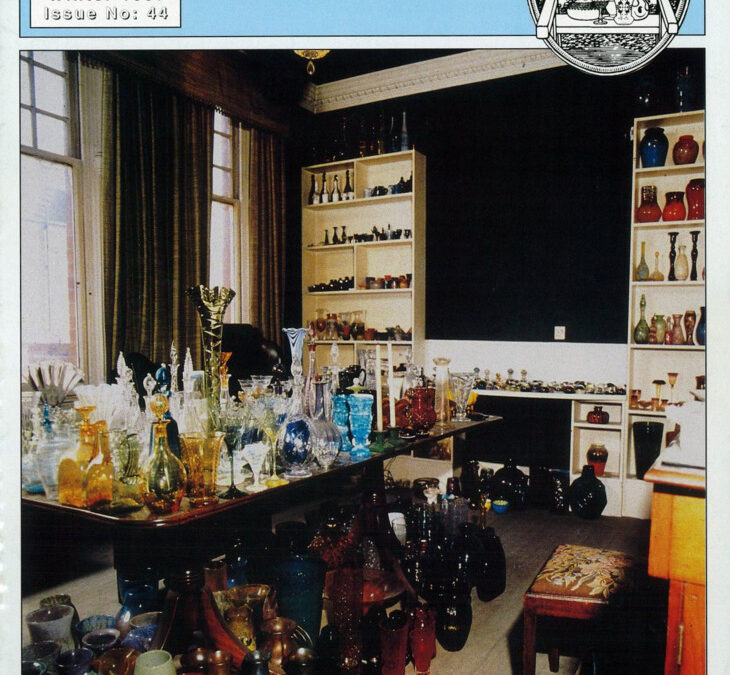
COVER ILLUSTRATION:
THE DINING ROOM, WYNSTAY GARDENS,
KENSINGTON. 1995
Michael Parkington began to collect British glass
when he and his wife, Peggy, returned from South
Africa to London in the late 1960s. When he died
on 30 March 1994 his collection was the finest
accumulation of British glass ever to have been
formed or ever likely to be in the future. The
collection dated from the early 18th century to the
1970s. Every item had to be rare or unique and all
had to be perfect. The colour orange was a particular
favourite. Housing such a large and quickly
expanding collection posed no problems. Quite
simply, every available surface was there to act as a
resting place for new acquisitions, whether they be
small Ysart paperweights or large Monart vases.
Bookcases, hall cupboards and bedroom wardrobes
were crammed with the results of his buying which
was guided by unerring eye and judgement. This
view of the dining room greeted those privileged to
be welcomed into the hallowed shrine. Not only
was the top of the dining table fill] but the carpet
underneath was also filled with vases and bowls.
Even the fire grate was utilised to house a collection
of Nazeing vases. Consequently the room had only
a very narrow path which the visitor had to negotiate
with some skill and concentration. Michael’s study
presented a similar picture.
Peggy Parkington died in February 1997 and, in
her will, left
533
pieces of glass to Broadfield House
Glass Museum as a public memorial to Michael. The
remainder of the collection was consigned to sale by
the Executors. The first half, consisting of
approximately 1100 objects was auctioned at
Christie’s South Kensington on 16 & 17 October (see
report) and made almost £250,000. The remainder
will be sold in the same rooms on Wednesday 8 April
1998. C.J. Hajdamach. (Photograph courtesy of
Broadfield House Glass Museum.)
EDITORIAL
For the first time since the Glass Association was
founded it has been decided to increase subscriptions.
The details will be found in the report of the AGM. The
membership forms are being revised and reprinted and
as soon as they are available and circulated new members
will pay the increased subscription forthwith. To this
end we would ask any member who is in possession of
any of the old forms to destroy them immediately.
You may or may not be aware that the Glass
Association is registered as a charity (No. 326602). For
those members who subscribe to charities via the
Charities Aid Foundation there is an obvious advantage
in paying your subscription through this means.
One of the chores connected with our publications
is the labelling and stuffing of envelopes prior to
despatch. It is unreasonable to expect that the staff of
the Museum will continue to do this service for us and
we are asking for volunteers, to work on a rota basis,
who can spare some time once a quarter to undertake
this task. We know from experience that it takes two
people about two hours for the present mailing list. The
filled envelopes then have to be sorted into their postal
group – inland, EC and overseas – and the total cost
calculated. If you live within easy reach of Broadfield
House and would be prepared to help please inform
Annette Dunn (Tel: 01384 812745) and give her your
name so that we may contact you in due course.
The opinions expressed in the Glass Cone are those
of the contributors. The editors’ aim is to provide a
range of interests and ideas, not necessarily those
which mirror their own. However, the decision of
the editorial board is fmal.
COPY DATES
Spring 1998:
20 January 1998
Summer 1998:
30 April 1998
The Glass Cone’ – Issue No 44: Winter 1997
At the recent AGM the proposed bursary scheme
was ratified. A number of travel awards (up to £750
each) to further research into glass studies (archaeology,
history, art and design, technical and material sciences,
etc.) will be available to British or EC post-graduates
registered at Higher Education establishments in the UK.
Successful candidates, will undertake to write an original
paper, incorporating research resulting from the travel
undertaken, suitable for inclusion in one of the
Association’s publications. Notification of the bursary
scheme, inviting applications from students, were sent
out last month to over 50 institutions throughout the
country, and results will be announced in the Summer
of 1998.
THETIMES, 30 October 1997 reported that over 6000
jobs will be shed by Pilkington, the sheet glass
manufacturer, over the next
18
months in order to
produce £200 million savings. The cuts will be mostly
felt in Britain from redundancies and the sale of many of
its 170 businesses involved in double glazing, glass
cutting and merchanting; 31 of its 55 branches will be
closed or change hands.
With the advent of shorter days and dark evenings
the activities in most of the regions will be curtailed
until the spring and there are no impending meetings
to report. Expect notice of meetings in the next issue.
The comment and letters we have received since
the publication of the last issue of the Glass Cone has
been complimentary and is therefore very acceptable
to the Editors. Although you will receive this issue a
little later than planned it is the biggest we have ever
published, thanks entirely to the enthusiasm with which
you have sent us interesting material. We already have a
number of articles for the next issue, but keep them
coming in. We hope to build on this success but nothing
is perfect and constructive criticism is as welcome as
your approbation.
•
AGM 1997
The meeting was held on 11 October and, as is usual,
a full programme was arranged to complement theAGM
itself. In the morning Christie’s South Kensington
opened their doors to a combined meeting of the Glass
Association and the Glass Circle for a private view of
the Michael Parkington collection prior to its sale the
following week. About 120 members of both bodies
stretched the available lecture space to its limit to listen
to excellent talks by Jeanette Hayhurst, on a personal
view of a dealer’s relationship with Michael, and, a
discussion of the contents of the collection bequeathed
to Broadfield House, by Charles Hajdamach.
Michael Parkington emerged as a forthright character,
not always easy to deal with, but always fair and with a
sense of humour as demonstrated by personal anecdotes
from both speakers. His attitude to collecting is well
conveyed by Charles Hajdamach in his comments
beneath the caption to the cover picture.
After time to view the collection Glass Association
members adjourned to the Rembrandt Hotel for lunch
followed by the AGM which is reported below.The final
event of the day was an invitation to view the exhibition
of glass, at The Studio Glass Gallery in Connaught Street,
by Czech artist Bohumil Elias whose work was being
exhibited in the UK for the first time. John Delafaille,
who visited the exhibition, reports that “Parkington was
a traditional, though exceptional, collector but I doubt
if the works of the Czech Bohumil Elias, viewed at the
Studio Glass Gallery, would have played any part in his
collection, even if Elias had been English. The works
were primarily architectural, a mixture of sculpture,
painting and glassworking. They explored and extended
the boundaries not only of glass, but of Art.”
Then on to the principal business of the day – the
Annual General Meeting.
John Brooks
The fourteenth AGM of the Glass Association took
place on 11 October 1997 at the Rembrandt Hotel,
London, following the morning’s activities.
The Chairman, John Delafaille, reported that the past
year had been one of intense activity for theAssociation,
largely resulting from the questionnaire responses. He
thanked John Brooks, Dil Hier and Ian Turner for their
time and effort analysing and identifying the members’
concerns.
Acting upon members’ suggestions concerning
sponsorship, the Association this year had sponsored the
Michael Parkington Memorial Lecture at Himley Hall.
After hearing details of the proposed student travel
bursary plan, the meeting approved the scheme whereby
applications would be invited from students for
individual awards, maximum of £750 each (a total of up
to £2000). Thanks were expressed to Patricia Baker for
her work on the project.
It was clear from the questionnaire returns that a
very significant number of members were in the
Association for the publications. As many had supported
the merger of the Newsletter and Cone into one
publication, and technology available to us enabled a
reduced publication time with Desk Top Publishing at
the editorial stage, the committee had proceeded with
the new Cone format. In order to spread the workload
and ensure continuity an Editorial Committee has been
formed comprising: Patricia Baker, John Brooks, and Ken
Cannell.The sales/wanted ads, overwhelmingly endorsed
by the membership, will be included on a separate
photocopied sheet together with any Stop Press.
The long awaited JOURNAL vol. 5 (then awaiting
despatch), is the largest and most expensive issue yet,
but has retained its high standard of scholarship. Ian
Wolfenden, editor since its inception assisted since vol.
3
by Richard Gray of Manchester Museum andArt Gallery
were congratulated for all they have done over the years
continued overleaf
3
The Glass Cone’ – Issue No 44: Winter 1997
A
Stevens & Williams cameo
glass vase by William
Northwood. c.1886
4
to establish the JOURNAL as an important scholarly
publication . Both Ian Wolfenden and Richard Gray now
wish for others to take their place; it will be difficult to
replace them.
A further publication concerning registration
numbers, compiled by Clive Bartlett which supplements
existing publications, will be published within the next
few months and offered for sale to members and non-
members at appropriate prices. A further initiative is the
offer to put an informative plaque on the site of the
Catcliffe Cone near Sheffield, acknowledging the
Association; the Chairman has yet to hear from the
relevant Council Department.
John Delafaille then outlined the administrative role
of Annette Dunn (as carried in The Cone issue no. 43).
He warned members that as Local Government, museums,
and businesses tightened their belts, many of the hidden
subsidies from which we have benefited in the past have
disappeared.The postage bill this year would for the first
time reflect reality, as would our printing and photo
copying costs. In view of this and the other initiatives
outlined above there was a need to increase our
subscriptions next year; these would still compare very
favourably with other societies.
The Chairman gave a review of regional activities
drawing attention to the problem of representation for
the South East; serious consideration was being given to
splitting the area into two, the North and South of the
Thames each with a representative. He paid tribute to
the work and dedication of all the members of the
committee and in particular our Vice-Chairman and Editor
of The Newsletter – John Brooks for his enormous
contribution. His help and advice were invaluable.
Although he had come to the end of his five year office,
John Brooks had agreed to continue on the Editorial Board
but had said that he wished to step down as Vice
Chairman.
The Treasurer Sheila Leonard presented the meeting
with the audited annual income and expenditure account
for the year ending 31st July 1997, which was adopted
unanimously. Following this report it was agreed to
increase membership subscriptions as follows:
Individual
£15
Joint
£22
Student
£8
Institutional
£30
Overseas Individual
£22
Life
£300
as from 1 August 1998 for existing members and with
immediate effect for new applications.
Peter Beebe, the Membership Secretary, announced
the continued upward trend of membership in 1996/97
with a net increase of 50, giving the Association a current
membership of 710.
The election of officers and committee members
followed :John Delafaille was re-elected as Chairman and
Ian Turner was elected as Vice Chairman. The other
officers, namely Dil Hier (Secretary), Sheila Leonard
(Treasurer), Peter Beebe (Membership Secretary), and
Aileen Dawson (Events Secretary) were re-elected. The
appointment of Regional Representatives was also
approved as follows: IanTurner (Midlands),Alan Comyns
(North West), Rita Pearce (North East), and Richard Giles
(South West). There was no nomination for the South
East region. The vacancy among the three ordinary
committee members was filled by John Greenham, from
Surrey and it is hoped that his election will help the
committee develop the South East region as indicated in
the Chairman’s report. Peter Helm was re-elected as
Auditor. The meeting ended with a brief review of the
proposals for the 1998 programme of events, details of
which will be published in future issues of the Cone.
Dil Hier
GLASS AT SOTHEBY’S
The British Rail Pension Fund’s collection of
Hellenistic and Roman glass was sold at Sotheby’s Bond
Street, London, on November 24. The famous ‘cage-
cup’ , circa 300 AD (Lot 10) went for12,311,500, while
the small, exquisite, cast and cut Skyphos, 3rd-2nd
century BC (Lot 14) commanded a price of £265,500.
The `millefiori’ mosaic bowl of the same period (Lot
12) was sold for £276,500. The bank account of the
buyer for the 5th centuryADAnglo-Saxon ‘bucket’ , found
in Bury St. Edmunds, Suffolk, was £205,000 lighter by
the end of the sale;
an export licence
will be required for
this object (Lot 33).
As expected, the
small mould-blown
Aristeas
cup
carrying
the
maker’s name and
his place of origin
(Lot 18), early 1st
century
AD,
reached £227,000.
On 3 March
1998 Sotheby’s
will sell the Royal
Brierley Crystal Ltd.
(formerly Stevens
Williams)
collection of glass
from
the
Honeybourne
Museum. It will be
on display at
Brierley Hill before
going to the Bond
Street salerooms.
The collection falls into two groups; a smaller collection
of earlier glass of the 18th and 19th centuries which
provided some of the inspiration for their own innovative
ideas while the remainder represents the various
products of the company including rock crystal, cameo,
threaded glass, coloured overlay, moss agate, silveria and
dolce relievo.
The Glass Cone’ – Issue No 44: Winter 1997
THE 37TH CORNING SEMINAR ON GLASS 1997
Every year, around the third weekend in October,
the Corning Museum of Glass holds a seminar. A real
glasfest
but with the Brits conspicuous by their absence.
Admittedly, Corning is notoriously difficult to get to,
being in up-state New York, nearer Buffalo than New
York City and accessible only by a five hour drive from
New York or a commuter flight in a small aircraft from
NewYork’s LaGuardia airport.There is no railroad service
and the coach service from NewYork takes seven hours.
However, on arrival, the hotels are commodious and
cheap by European standards, the friendliness of the
natives is no legend, and, this year at least, every
morning, the mist in the valley cleared to reveal clear
blue skies and the russet tints of the fall in the
surrounding woodlands. Corning is near the Finger Lakes
and surrounded by woodlands and wineries, all well
worth a visit. In fairness, I should add that I have been
to a seminar when it snowed.
The seminar starts with registration on Wednesday
evening, the handing out of name badges and the
opportunity to drink the first cup of continuously
available (weak) coffee, and to talk glass. Around 150
attend, museum curators, practising glassmakers and
collectors of every shape, size and depth of purse.
Thursday, Friday and Saturday were given over to
lectures, demonstrations and visits. Bill Gudenrath of
Corning, known to many of us following his lectures
and demonstrations in London and Edinburgh, discussed
the technical problems the Venetians overcame in the
14th – 16th century, using slides and out-takes from his
video. Susanne Frantz, also of Corning, discussed mid
20th century Venetian glass with particular reference to
their current exhibition entitled ITALIAN GLASS 1930-
1970 MASTERPIECES OF DESIGN FROM MURANOAND
MILAN.
There were three good lectures on American glass
with particular reference to cut glass, the first
concerning the Union Glass works, Philadelphia; the
second concerning the Pairpoint corporation 1900-1937
both of these firms were influenced by Englishmen
working for them. The third lecture on Steuben’s Cut
and Engraved Glass 1903-1933 again showed the
influence of Stourbridge, as the company was highly
dependant on Frederick Carder, formerly of Stevens &
Williams.
Dr Jack Martin, a past deputy director, gave a
fascinating lecture on the great flood in Corning of 1972
which completely devastated the museum and
particularly the library.
The German glass artist, Professor Ann Wolff, who
now lives in Sweden, winner of 1997 Rakow commission
for a glass Work of Art, gave a long illustrated talk on the
progress of her philosophy and consequently the
development of her art. Her earlier easily accessible art
progressed to more complex ideas and she eventually
confided to a stunned audience that her meaning of life,
derived from one together with a half, is two!
Alice Cooney Frelinghuysen, a.k.a. Nonnie, talked
about the interiors designed by Louis Comfort Tiffany,
who, using the full resources of the Tiffany workshops,
offered a complete service to his clients. This was
followed by a coach trip to nearby Bath, to see a church
interior refurbished by LCT with stained glass, hanging
lamps, furnishings and other decorations.
A session entitled Curator’s Choice allowed the
museum staff, including the director, to discuss items in
the museum which particularly appealed to them, the
objects of British interest included a Beilby watercolour
which passed through Sotheby’s London, and a signed
Apsley Pellatt claret jug, one of only three or four signed
pieces known, which turned up recently in Germany.
The new studios were open for attendees to watch
Bill Gudenrath blow glass, and to have hands-on
experience of glass cutting, sand-blasting and lamp-work
(I now know how difficult glasscutting is). There was
also a dinner following which the director, David
Whitehouse, told of the firm plans to expand the
museum for the Millennium, with a new library,
extended galleries and hope for doubling of visitors to
600,000 per annum.
As well as the Americans there were visitors from
Canada, Austria, Sweden and Romania and one other
Englishman besides myself. The next seminar is on
October 14th-17th 1998 and any British visitors will be
very welcome. For information contact The Corning
Museum of Glass, One Museum Way, Corning, NewYork
14830-2253.
Visitors are also welcome at the National American
Glass Club seminars in Pittsburgh, May 7th-9th 1998 and
in San Francisco, April lst-4th 1998. For information
contact Carmen Freeman, 1744 Island Way, Osprey,
Florida 34229 USA.Tel: 001 941 966 4406 Fax: 001 941
966 6857.
John Smith
AN OLD CUSTOM
In his article “A Series of old
English Decanters”
(APOLLO magazine,August 1935) J.G. Noppen illustrated
a small decanter, about 5″ high, which he identified as a
`To-go’ decanter and added ” ‘One-go’ and ‘Two-go’
decanters are still used in some London clubs, a pleasant
survival of an old custom”. Presumably this means more
than just a decanter holding enough liquid for one or
two glasses. Can anyone throw light on what the ‘custom’
referred to might have been ?
5
The Glass Cone’ – Issue No 44: Winter 1997
The furnace being lifted on to the flat-bed loader on 16th April 1996 By
this time the quarry workings had encroached to within a few metres of
the furnace. The woods of Cannock Chase can be seen in the distance.
A GLASS FURNACE SAVED
6
A UNIQUE RESCUE OPERATION OF A 16TH
CENTURY GLASS FURNACE.
Would you be interested in the opportunity to save
a sixteenth century glass furnace?. That simple question
led to a unique operation which resulted in only the
third medieval furnace in Great Britain to
be rescued. The rest, as they say, is history.
In the Spring of 1993 Broadfield
House Glass Museum in Kingswinford,
received a phone call from Chris Welch,
the head of the Archaeology and
Conservation Section of Staffordshire
County Council. He quickly explained that
he had been instrumental in discovering
the remains of a glass furnace near the
town of Rugeley in Staffordshire and that
he and his team had excavated and
recorded the site. However, the remains
of the furnace were in danger of
destruction as the site was on a sand and
gravel quarry operated by Western
Aggregates who were keen to develop that
particular section. Because of the
considerable survival of its remains and the
large amount of associated material found
during the archaeological investigations
the structure was an excellent example for
preservation and eventual display to the
public. After further discussion Broadfield
House was able to give Chris a very
definite and positive reply.
The glassmaking site, known as Little
Birches on the Wolseley estate near
Rugeley (SMR no. 4300. NGR
SK0080918909), was excavated between
August 1991 and May 1992. During the
work a considerable amount of evidence
for glassmaking was discovered together
with the remains of two furnaces. The
larger of the two furnaces known as the
Upper Furnace was the one to be saved.
Brickwork from the adjacent smaller kiln
dated the site to the period 1533-1557 A.D.
(68% probability) by the archaeomagnetic
method which compares present day
magnetic north with the position of magnetic north fixed
within the furnace brickwork. The measured difference
allows a dating with an accuracy of plus or minus 12
years.
The main furnace consisted of two 1.5m long
platforms flanking a central 0.5m wide trench. The
trench extended approximately 1.2m beyond each end
of the platforms and was walled by stone or brick. The
impressions of the bases of six crucibles, circles some
380mm across, were seen on the platforms. The central
part of the furnace was covered in fused glassy waste,
and the central trench was partially blocked by glass
that appeared to have spilled from the crucibles on the
platforms or sieges, as they are also known. Large
amounts of broken stone and clay were found strewn
over the site, presumably part of the furnace
superstructure.
At either end of the furnace two pairs of deep
postholes would have supported some form of tiled roof.
To the south of the main furnace a shallow depression,
lined with brick and stone was interpreted as a
secondary furnace. To the north, north-west and west
there were three large tips which contained broken
crucible, glass waste, glass, ash and charcoal, as well as
sandstone and clay from the furnace structure. The raw
silica for the glass was derived from crushed white
pebbles; the flux was potash, probably derived from the
ashes of ferns which still grow in abundance in the area.
7
The Glass Cone’
–
Issue No 44: Winter 1997
The fuel was wood, primarily birch. The main furnace
would have been used as the main melting furnace. The
secondary furnace could have been used to anneal the
glass to remove stresses and strains; it may also have been
used to create the frit from which the glass was melted.
A large amount of glass was recovered from around the
furnace; two fragments were painted and had clearly
been brought to the site to be remelted as cullet. The
main output of the furnace seems to have been white
‘Crown’ window glass with a much smaller amount of
vessel glass. The excavated glass fragments and sections
of crucible are deposited at Stoke City Museum and Art
Gallery.
The Little Birches furnace was one of many in the
area which established Staffordshire as one of the major
British glassmaking areas during the medieval period,
the other being the Weald of Sussex. Although much of
the available documentation that relates to this site has
yet to be examined, it is thought that there were
glassmakers atAbbots Bromley, about 10 km to the north-
east of Wolseley, in 1290. Ruth Hurst Vose in her book
‘Glass’ cites a ‘John Glasewryth of Rugeley’ who was
invited to the Weald about 1379. Vose also refers to a
‘John Glasman of Rugeley’ in about 1420, who bought
white glass for York Minster which had been made in
Staffordshire. A number of rentals confirm that glass
was being made in Wolseley in the fifteenth century, and
a number of references from the 1530s suggest that there
were then members of the Harvey family living in
Rugeley and Wolseley. The Harveys were a well known
glassmaking family in the area throughout the early
sixteenth century.
From this superficial search through glass
publications, it became clear that this glass furnace was
a vital link in the development of glass technology at a
crucial period in English history, when the French
Lorraine families were spreading throughout the country.
Less certain was the method by which to attempt the
rescue. Two other similar furnaces have been rescued,
one at Rosedale in Yorkshire and now reconstructed at
the Hutton-Le-Hole Museum, and one at Denton in
Manchester which still remains in crates. Both furnaces
were dismantled like large jigsaw puzzles and in the case
of the Rosedale example re-built and completed with a
modern version of the upper structure. In the case of
the Rugeley furnace the very delicate and loose nature
of the surviving fragments seemed to preclude this
course of action. At this stage we invited the services
of John Price of Conservation Services in Farnham. John
had many years experience as Chief Conservator with
the Ancient Monuments Laboratory but within the last
ten years had developed effective techniques to retrieve
larger, fragile structures including a 7th century pottery
kiln. After inspecting the furnace site his advice was to
lift the furnace as a complete unit. The basic plan was
to fix the loose, top fragments by carefully pressing
kitchen foil over the entire surface and then spraying it
with polyurethane foam which would set hard and
prevent movement. Under the furnace a steel raft would
be made using separate, square section, metal tubes
which would be welded to three RSJs running in the
opposite direction. This raft would also hold the steel
and wooden wall and roof to complete the protective
cocoon around the furnace. A series of tensioned metal
straps provided the fmal security. Lifting points would
be welded onto the RSJs allowing the whole unit to be
lifted by two cranes onto a flat bed loader and
transported to the museum.
Although the method had not been tried on a glass
furnace it was agreed by all parties that the technique
provided a unique chance to maintain all the important
details of the furnace such as the pot marks which would
be disturbed in a more traditional form of rescue. After
obtaining approvals and processing grant applications
the work started in the summer of 1994. John Price
worked single-handedly on the site in conditions ranging
from sub-tropical to Siberian winter. A caravan parked
close to the furnace acted as home from home.
Eventually, on 16th April 1996, the momentous day
arrived for the lift. Amid the jangling of nerves, the
clicking of cameras and the whirring of camcorders, the
furnace, in its cocoon and weighing a massive 15 tons,
was successfully lifted from the site where it had rested
for 450 years. The significance of that lift was matched
only by the smile on John Price’s face.
The success of the entire operation was due to the
cooperation of many people and institutions. The initial
excavation work was funded jointly by English Heritage
and Western Aggregates, the company who lease the land
from Sir Charles Wolseley. As the owner of the site
Sir
Charles gave his permission for the Glass Museum to
remove the furnace from the site. Brian Atkin and his
staff at the quarry site provided essential support with
advice and equipment and without their patience the
rescue operation could not have taken place. The PRISM
fund at the Science Museum, London offered a grant
towards the rescue costs. The final part of the rescue
operation i.e. the lifting and transport to Kingswinford
was expertly handled by Malcolm Woolley and his team
from Hulbert Contract Services of Dudley. As major
sponsors of Broadfield House Glass Museum the Hulbert
Group of Companies extended their support by meeting
the costs of the lifting operation.
Today, the furnace lies within its protective ‘egg’ at
Broadfield House Glass Museum. Plans to exhibit the
remains temporarily have been shelved due to the
proposals by the museum to move to Himley Hall, near
Dudley, where it will establish a glass museum of national
significance. The Little Birches furnace will take its
rightful place there at the beginning of the story of the
great achievements of glassmakers in Britain over the
last five centuries.
Charles R. Hajdamach
Broadfield House Glass Museum
(This article first appeared in the Newsletter, Number
14 March 1997, of the Glass Society of Ireland who have
kindly given permission for it to be reprinted inThe Glass
Cone.)
7
The Glass Cone’ – Issue No 44: Winter 1997
ihe Micromelt 75 stands almost 1.45m high,
width 1.04m and 1.23m depth.
MICROMELT – THE WAY FORWARD
Enter a glass-making studio and there
is the furnace dominating the space,
looking and sounding like a caged animal,
roaring away. Its construction means
appeasing Health & Safety officers and
negotiating with gas and electrical
engineers. Even the routine task of
changing pots entails weeks of planning.
New studio glass-blowers agonise over
the initial expense, the operating costs
and the paper-work relating to
installation. Once operating it eats
money; quarterly gas-bills can easily top
£1000 plus VAT
David Taylor of the Glasshouse
(London) is confident he has the answer.
Working in collaboration with Micromelt
Ltd, he has come up with a user-friendly
tank furnace, self-contained (except for
a small 220 watt combustion air fan).
Looking like a large pudding steamer, the
well-designed Micromelt requires only
connection to the gas supply (natural or
propane) and a 13 amp socket and within
24 hours the batch is at temperature for
gathering. The unit can easily be moved
around the workshop provided access
points for gas and electricity are available.
The flue required is akin to that for a
domestic central-heating boiler.
After glass-working any residue glass
can easily be drained off, which means
the furnace can be switched off when
not in use without damage; not so with
most furnaces. And of course for casting
the mould can be placed immediately
under the drain. Not only does draining save fuel and
money, but it means the maker can switch glasses or
colours in a matter of hours, simply by draining changing
the tank if necessary. With the prospect of cutting the
cost of say, Kugler colour by 75% and the ability to gather
it hot, the benefits to colour-working are evident.
The Micromelt 75 illustrated here has a capacity of
75 kg, though there are larger furnaces with capacities
up to 1500 kg/day. The gathering door can be operated
by a footpedal. A fully automatic and programmable
combustion and temperature control system simplifies
operation. It can be delivered to your door by lorry,
unpacked, wheeled into position, and installed in less
than a day… providing you have that 13 amp socket. A
typical 24 hour cycle of 6 hours working, 12 hours
melting and 4 hours idling would consume a total gas
energy consumption of 460,000 kcals.
Glass enthusiasts are often reminded by historians
how the 1960s American workshops of Littleton and
Labino publicly demonstrated that makers could do
without the huge glass furnaces of industry and in so
doing they are rightly considered the fathers of
Contemporary Studio Glass. And in the 1970s the
innovation of electric kilns opened up new horizons
for studio ceramic makers world-wide.
DavidTaylor and Micromelt Ltd richly deserve similar
recognition for this technical and innovative
breakthrough. Furnaces like these, whether purchased
outright or leased, will surely enable many studio glass-
makers of the future to establish hot-glass workshops
with the minimum of fuss, while established makers will
save on costs knowing that efficiency and adaptability
have been key considerations. Already the potential of
the Micromelt system has been recognised abroad with
lively export sales to Denmark, France, Italy, and Korea.
Details obtainable from Micromelt Ltd, Unit 2
Kingfishers, Hodgson Way, Wickford, Essex SS11 8YN,
(Fax: 01268 562975).
10
The Glass Cone’ – Issue No 44: Winter 1997
WHO WAS FREDERICK
SHUKER?
On show at Broadfield House Glass Museum are
some examples of Stuart’s Medallion Cameo Glass. Their
caption notes that they were the creation of “a Bohemian
engraver named Shuker about whom little is known at
the moment”.
Jack Haden
of Stourbridge has more
information.
Frederick Walter Shuker was an Englishman, born
12 July 1872, son ofThomas and Min Shuker ofWordsley.
On 19 December 1882, aged ten, he was admitted as a
pupil into Oldswinford Hospital. It was a charity school
founded and endowed by a wealthy ironmaster,Thomas
Foley, and, because the boys wore a dark blue uniform,
it was known as the Blue-coat School. Evidently he was
no scholar for when he left, at the age of fourteen, to be
apprenticed on 6 October 1886 to Stuart & Sons, glass
manufacturers ofWordsley, his headmaster entered into
the register, “A boy of poor ability”.
Fred Shuker certainly gained and developed the skills
of a craftsman otherwise the enterprising and
prosperous Stuart’s works would not have employed him
for forty years. He probably attended Stourbridge Art
School classes like other designers and decorators in
the region for it is recorded that, as a young man, he
passed with honour as a designer and cameo artist from
the Government’s Art Department, South Kensington in
London. With the qualification he was appointed to
the staff of Wordsley Art & Technical School. He, along
with Thomas Woodall the famous cameo glass designer,
W.H. Stuart, Benjamin Richardson, W.H.P. Richardson,
A.J.H. Richardson, J.T. Hambrey and George J. Carder
signed the illuminated address presented in July 1903
to Frederick Carder, the Master of the school’s Art
Department and teacher of the glassmaking classes, on
his departure for America.
The (Stourbridge) COUNTY EXPRESS referred to
Shuker as a master glass etcher, glass designer and cameo
artist and, at the time of his death in 1927, he was in
charge of Stuart’s cutting shop. For years he lived at 43
New Street, Wordsley, a few yards away from Thomas
Woodall who was then giving his occupation as music
teacher. His first wife, Ann Elizabeth, died tragically
young at the age of 36 in 1906. He later married another
Ann Elizabeth, the daughter of William Simpkiss of Platts
Crescent,Amblecote and they lived at Holly Mount,
39
Bridle Road,Woollaston.
Fred Shuker died on 8 May 1927, aged 54, at the
works premises of The Decorative Glass Co. off Platts
Road, which he was visiting that Sunday morning on
business. For some time he had suffered from chest
pains and indigestion and the inquest was informed that
death was due to dilation of the heart muscles: a verdict
of natural causes was recorded. The County Express of
14 May reported that his funeral service was conducted
by the Vicar otWoollaston at Stourbridge cemetery with
employees of Stuart’s acting as bearers; Wilfred Waker
(cutting shop assistant),A. Corfield, C. Quarry,W. Hingley,
Charles Wood and J. Benson (a stopperer).
Jack Haden
Jack Haden adds a personal note,
“They were the
kind of men who were in large measure responsible for
the fine glassware produced by Stuart’s. They should
not be forgotten. I knew some of them.”
A KNY CLARET JUG
This magnificent claret jug, wheel engraved and
signed by Frederick Engelbert Kny, was acquired by
Dudley Metropolitan Borough Council for Broadfield
House Glass Museum in 1996
The cost of £25000 was met with contributions from
the Victoria andAlbert Museum/Museums and Galleries
Commission Purchase Grant Fund (£11000), the National
Art Collections Fund (£7000), the National Association
of Decorative and Fine Art Societies (£3500) and the
Friends of Broadfield House (£1000).
Dating from about 1870 this hitherto unrecorded
jug is elaborately wheel engraved with a scene depicting
Queen Boadicea exhorting her troops before battle.
Although a celebrated engraver in his own day very few
works signed by Kny survive.
11
The Glass Cone’ – Issue No 44: Winter 1997
THOUGHTS ON SOWER13Y’S
IVORY QUEENSWARE
FOR B.A.G READ C.G.S.
September 12-14 saw the first annual conference of
the Contemporary Glass Society (CGS) at
Wolverhampton University. The CGS has newly risen
from the cold ashes of the British Artists in Glass
organisation, active in the 1980s.
MaxJaquard
attended
and sent us this report.
One wondered if the fire and passion of those first small
gatherings at Peter Layton’s London Leathermarket workshop
earlier in the year would be sustained at a larger scale event.
However, the line-up of speakers looked impressive and with
the back-up of Wolverhampton University’s glass department
a stimulating weekend looked a distinct possibility.
The first morning saw a healthy turnout. Peter Layton
made an emotional introduction and Mike Press gave the
opening lecture, analysing why we make glass and how we
can compete in the world of mass consumption. Using a
combination of statistics, cultural analysis, humour and
business strategy, he left the audience feeling that it could
and should take on the world.
The global imagery was taken up by Jane MacDonald who
illustrated the rich cross-fertilization between art and
architecture, ranging from Islamic mosaics to Lalique’s work
in Jersey. Keith Cummings followed talking about the
relationship between technique and expression from the
Graeco-Roman world to the contemporary work of Toots
Zinsky, while Diana Hobson discussed her personal
exploration of the creative process. Alison Kinnaird, the
renowned Scottish engraver, carried on the theme.
The afternoon was spent visiting Himley Hall’s Glass of
97 exhibition and watching demonstrations by Bob Crooks,
Jill Cox and others. Much heat was generated at the evening
AGM, unfortunately somewhat of a messy affair, about the
minutiae of membership, budget allocation and conference
participation. Questions impossible to resolve in the short
time allotted.
The next day began with Chris Bird Jones outlining the
activities of the Women’s International Stained Glass Workshop
(whose work was recently shown at the Glass Art Gallery,
London), but this was followed by Peter Wren Howard’s
salutory note of warning regarding new legislation concerning
lead oxide furnace emissions. As many studio blowers still
use 24% lead crystal, this was highly relevant to many in the
audience.
Spirits revived with Barry Clarke reporting on the progress
of the new National Glass Centre in Sunderland, and after
Marianne Buns’s review of the Young Glass Exhibition at
Ebeltoft Glass Museum in Denmark, Charles Hajdamach gave
the last talk on the state of the art in the UK, stressing the
importance of promotion, presentation and networking.
Citing projects like Sunderland’s NGC, the Hotties and Himley
Hall, this is a time of a resurgence of interest in studio glass. It
was an upbeat note on which to end.
The next CGS conference is planned for September 5-7,
12
1998.
As a collector of pressed glass I am particularly fond
of Sowerby’s Ivory Queensware. Though not as
common as other Sowerby colours, Queensware still
turns up sufficiently frequently today to suggest that it
must have been produced in considerable quantity in
its heyday. Why then, I wonder, did no other
manufacturer try to copy Queensware?
Most of the usual colours found in pressed glass are
common to all glasshouses; there are not many colours
peculiar to only one manufacturer and most of these
seem to have been in very limited production, possibly
because of technical difficulties or expense. I am
thinking of such examples as Sowerby’s own Giallo
(yellow) and aesthetic green, their opalescent pink
similar to if not identical to that of Burtles and Tate,
Greener’s opaque brick red and Edward Moore’s
caramel.
As far as I am aware, the only popular colour in large
scale production which remains unique to the one
manufacturer is Sowerby’s Ivory Queensware.
Introduced in 1878 and patented the same year it was
reputedly still being made in 1896 (1) and certainly
seems to have been successful enough for a competitor
to wish to copy it. It was admittedly rather more
expensive than most other wares and it is said that in
1886 its price had to be reduced because of falling sales,
but it hardly seems likely that expense alone dissuaded
other glasshouses from attempting to copy it. The fact
that it was patented also seems unlikely to have deterred
a determined competitor. After all, Davidson had
patented their pearline glass but this did not stop
Greener from producing a virtually exact copy without
apparent redress. Could it be that Sowerby were more
litigious than Davidson? Despite the patenting of
Queensware, Cottle (2) states that Sowerby were not
averse to supplying batches of glassmix, including
Queensware, to other glasshouses. It is uncertain how
widespread this practice was but I have never seen
anything approximating to Queensware from any other
factory.
So, to return to my original question, why did not
other glasshouse attempt to copy Queensware? It would
be interesting to know if anyone has any views on the
subject.
(1)
Sheilagh Murray. THE PEACOCK AND THE
LIONS: THE STORY OF PRESSED GLASS INTHE NORTH
EAST OF ENGLAND. Oriel Press, Stocksfield, 1982.
(2)
Simon Cottle. SOWERBY: GATESHEAD GLASS.
Tyne & Wear Museum Service, 1986.
Deryk Snow
The Glass Cone’ – Issue No 44: Winter 1997
BOOKS
It is over fifty years since the publication of WB.
Honey’s ‘GLASS, Handbook of the glass at the Victoria &
Albert Museum, London’; now long out of print but still
useful, its somewhat pedantic style is unlikely to have
appealed to the ordinary visitor to the museum. That
certainly cannot be said about the new ‘GLASS’ (Ed. Reino
Leifkes, V. & A. Publications, London 1997. ISBN
1851771972. Hardback £25) which reads well and is
beautifully illustrated.
It is difficult to avoid comparison with the British
Museum’s ‘FIVETHOUSANDYEARS OF GLASS’ (Ed. Hugh
Tate, BMP, 1991, Rep. 1995). However, whereas the
B.M., reflecting its own collections, emphasised the
archaeological, historical and technical aspects and was
probably aimed at the glass enthusiast and student, the
V. & A. emphasises the social and decorative qualities
and targets a more general audience. The illustrations
are, of course, completely different.
Few books are perfect and I do have some criticisms.
I would have preferred to have the dimensions with the
illustrations rather than have to refer to the notes at the
back and the index appears to be more a check-list for
the editor than an aid to the reader – too many entries
are contained under general headings, such as ‘glass
types’, rather than alphabetically in their own right and
several items are noticeably absent, particularly irritating
if you are using the book as a guide.
I like the two-page sections outlining topics such as
‘Venice and chandeliers’; perhaps this idea could be
extended as a more portable guide to the collections or
as separate pamphlets.
The inclusion of some of the more obscure
references in the bibliography presumably arises from
the lack of anything more accessible. There are a number
of readable articles, for example on Chinese glass, which
are not listed and the book ‘Scientific Research in Early
Chinese Glass’ is, to say the least, not for the beginner.
The section on studio glass gives the names of a
number of artists; perhaps too many since they are largely
unsupported by illustrations, so essential when dealing
with unusual forms. This possibly arises from gaps in
the V & A collection; a similar gap occurs regarding
Roman cameo glass mentioned only in passing under
late 19th century English cameo glass. Perhaps in this
important instance an example from outside the V & A
could have been used?
Few errors escaped the proof-reader, but I was
somewhat disturbed by the transposition of ‘A
mechanical Bottle-Blowing Machine in operation: from
Arnold Fleming, Scottish and Jacobite Glass’ into ‘A
mechanically Bottle-Blowing Machine in operation: from
Arnolf Flemming, Scottish and Jacobite Glass’ (note 107).
Nevertheless this is probably the best general
introduction to decorative glass to date, but then it has
to be to compete with the longevity of Honey’s book.
A CHORUS OF COLOUR: Chinese Glass from Three
American Collections. Asian Art Museum of California.
Washington Press. £17.95 (ISBN No. unavailable)
This work goes some way towards filling the gap
mentioned in the review of GLASS, the V&A publication.
Essentially a catalogue, over 100 items from the 18th
and 19th centuries are described and illustrated in
colour, together with introductory essays.
Anyone with a good ‘remainder’ bookshop should
look out for ROYAL GLASS: FOUR CENTURIES OF TABLE
GLASS, GLASS SERVICES & GOBLETS. This is the
catalogue for an exhibition held in Copenhagen in 1995,
based on the collections of the Danish and Norwegian
royal families. 400 pages of which two-thirds are devoted
to 13 essays on topics such as the Nostetangen
glassworks, a previous unknown collection of Galle glass,
masonic glass and the purchase and consumption of
wine, beer and spirits. Parallel texts in English and
Danish, hardback, about £18.
JOURNAL OF GLASS STUDIES vol.39 (1997).
Corning Museum of Glass, NY. $43 inc p&p.
Once again there is nothing of major, direct interest
to collectors of British glass except a short article arising
from the Corning Museum’s purchase of two drawings
by Harry Clarke, the 20th century Irish glass artist, and
an article on 18th century Chinese glass (see review
opposite).
It is sad to see that only two (out of 68) of the recent
important acquisitions reported were by British
museums, significant though they are: the Kny Boadicae
claret jug (Broadfield House) andThe Falcon Glassworks
painting (Museum of London).
Less than 10 in the ‘Published Articles’ listing for
1997 are credited to the Association. No doubt our
‘ranking’ will improve in next year’s listing with the new
issue of our own JOURNAL and the revitalised CONE.
K H Cannel!
GLASS LIGHT & SPACE. Eds. Louise Taylor &Andrew
Lockhart. Crafts Council, London. 1997. Paperback ISBN
1 870 145 712.£8.
This is the catalogue printed to accompany the
touring exhibition of the same name. As well as four
essays discussing the importance of glass in architecture
and to the maker, it includes statements from the
exhibiting glass artists with colour photographs showing
their work in situ. These reproductions revealing the
context and scale of their work are far more informative
than the display erected at the London gallery of the Crafts
Council. It also includes a useful bibliography for anyone
beginning to look at this aspect of contemporary glass.
Patricia Baker
13
‘The Glass Cone’ – Issue No 44: Winter 1997
Enamelled water jug by WI{, B. &J. Richardson.
The registration diamond painted on the base for 6June 1848,
has an error. The parcel No. shown is L but should be 4.
Caroline and £977 for one with Jacobite engraving.
Decanters seem to be out of favour at the moment and
prices were hardly remarkable. The only exceptions
were two ‘Lynn’ decanters at £1610 and £1840. Six
toddy lifters, offered in two lots, averaged 1250 each –
a very good price.
A wide variety of coloured glass made only slightly
above average prices; the exceptions being jugs and
bowls in green glass which have always been rare. A
covered sugar bowl making £1955 and a diamond
moulded cream jug at £437.
PRESSED GLASS.
One of the strong points of the collection was the
pressed glass of the North East. Multiple lots of 8 or 9
fairly standard Sowerby items averaged around £60 per
item but a pair of candlesticks in Queen’s Ivory with
triple curved stems (Pattern 1305) together with a
turquoise vase moulded with rams heads fetched £862
and nursery rhyme pieces made prices up to 1575 each.
GLASS CHEROOT HOLDERS.
Nine lots of cheroot holders, sold in pairs, mostly
overlaid in one or more colours and cut or acid etched,
averaged around £350 a pair – two to three times what
one might normally expect but one pair soared to /1035.
I am still at a loss to know why. A small group of pipe
tampers, on the other hand, made quite modest prices
at around £100 each.
7
THE PARKINGTON SALE• PART 1
The sale comprised 525 lots spread over two
sessions at Christie’s South Kensington on Thursday
October 16 and Friday October 17. One might, at first,
wonder why a collection of this magnitude and
belonging to such a well known figure in the world of
glass collecting was not sold at King Street but the
location of sales is now dictated, not by aesthetic
standards or the importance of the owner but by
considerations of lot value and commission structure.
The average values of glass in sales cannot compete with
those achieved by Old Masters and fine furniture so King
Street’s loss was Old Brompton Road’s gain and Jane
Hay and her team at South Kensington were able to put
on a display of glass that could have graced any museum
and was guaranteed to whet the appetite of both dealers
and collectors.
Many of the objects in the collection only appear
occasionally on the market and, to my knowledge, there
have never been so many examples of particular styles
or the product of some factories offered for sale at the
same time. This meant that it became possible to discern
patterns in the prices realised which can be considered
as establishing ‘benchmarks’ for the future. Another
factor which encouraged the buyers was that the quality
of what was on offer was consistently high.
What then of the glass itself? It covered a period
from about 1720 to the 1960s with the emphasis being
on the later 19th century and the 20th century. I will
list the main groups as they were offered and indicate
some of the prices which include the buyer’s premium.
18TH
CENTURY GLASSES.
Facet stems were the largest group in this section
with the few standard examples making prices
predictably in the 1100/150 range, but anything with
unusual decoration – coats of arms, inscriptions – or with
unusual styles of cutting to the stem made very high
prices. A glass engraved for cider fetched £3450, a glass
finely engraved with Venus and Cupid made £1955 while
other engraved examples went for £690 to £920. Two,
with unusual styles of cutting, each made £920. Even
allowing that they were unusual the prices seemed to
be about 100% higher than I have seen similar examples
realise in the past.
There were few other glasses in this category and
few surprises in the prices. Cordials ranged from £345
for a plain stemmed example to £2070 for an inscribed
example dated 1765 while £1955 was the price for a
tall example with opaque twist stem and central knop.
Fairly normal prices for such things. However, the only
light baluster wine glass made £2175 which I thought
was high. Other 18th century glasses made average
prices and engraved tumblers went for prices between
£184 and £460. The only ones to improve on this were
14
two commemorative examples at £690 for Queen
The Glass Cone’ – Issue No 44: Winter 1997
SILVERED GLASS.
One telephone bidder bought all fifteen lots of Hale
Thomson/Varnish & Co. silvered glass (patented in 1849)
against any opposition in the saleroom. The buyer was
so determined that it eventually became a matter of some
amusement to the audience. Prices ranged from £230
for small coloured but uncut pieces to £3680 for a green
overlaid vase elaborately cut with the Prince of Wales
feathers.
STOURBRIDGE GLASS.
Coloured and cut cameo glass made good prices. A
`Burmese’ nightlight and stand sold for £483 as did a
Webb’s ‘bronze’ two handled vase. Examples of cameo
cutting sold for around £1600 although one with white
orchids over a pink ground climbed to £5520. My own
favourite in this section was the Richardson water jug
enamelled with water lilies (illustrated) which, sold with
a ‘Richardson’s Patent’ specimen bottle, reached £2990.
WHITEFRIARS.
The first session ended with a selection of Powell’s
glass of the early years of this century. Predictably the
prices realised would have been unthinkable a few years
ago. Most were multiple lots but two vases loosely
based on the German 17th century ‘Humpen’ shape
reached £690 and £805.
The second session of the sale, on Friday morning,
started with a selection of later Powell’s glass, mostly
Geoffrey Baxter designs. Most of the multiple lots
averaged £50-60 per piece but ‘studio’ products reached
£200-250. One Baxter pattern which I would like to
own is the large ‘Banjo’ vase and the example in the
sale made £402.
MONART.
Seventy five lots represented only part of Michael
Parkington’s collection from this Scottish glasshouse.
While the very few ‘standard’ items sold for no more
than the current market value most of it was exceptional
and one or two lots passed the £1000 mark while many
more sold in the £500-1000 range. This represented a
significant advance in the level of prices for Monart
which, according to Ian Turner – a keen collector, was
quickly reflected in the asking prices for Monart at the
recent Glass Collectors’ Fair.
STUART.
The second session ended with a small group of
Stuart enamelled wares of the 1930s. Most small items
made the sort of prices one has come to expect, i.e.
£25-50 range, but several decanters and cocktail shakers
reached £125-185.
The presence of so many collectors and dealers in
search of unusual examples in excellent condition
produced a brisker atmosphere in the room than I have
seen for a long time. It bodes well for the remainder of
the collection on 8 April next year.
DEATH OF ANOTHER
GLASSWORKS
After 210 years the Dema glassworks in the small
village of Lemington, ten miles up the River Tyne, has
closed and has disappeared under the bulldozers. The
cone, originally 310′ high remains to dominate the view
of the river. Rescued and restored by English Heritage
and one of three remaining in Britain, it was working
when George Stephenson (of steam-engine fame) was
born in the little cottage two miles along the wagonway.
The business thrived, founded on cheap small coal and
the sand and alkali brought in as ballast by the colliers
returning from London. The poor navigability of theTyne
encouraged growth. Because large ships had difficulty
getting up the river, only the best coal could fetch a price
which made shipment worthwhile, so glass was made
with small coal. The chemical industry followed the glass
industry and the Industrial Revolution saw a great increase
in the demand for industrial glass.
The original land lease from the Duke of
Northumberland stipulated that the land could only be
used for glass manufacture, hence the delay when Dema
wanted to sell. The razed site now belongs to Landrovers
North-East, whose intention it is to use the land for storage
and the cone – a listed building – as a reception and display
area. “Gleaming Landrovers will fill the furnace arches
which for decades produced delicate gleaming glass” as
one of the workers said to me. The Managing Director of
Landrovers North-East is sensitive to the history and
tradition of the place and is consulting with an ex-manager
about the future display area, so it will be interesting to
see what is done.
Like most glass companies, the Lemington works had
a chequered history. In 1974, the owners. Glass Tube &
Components Ltd., a subsidiary of GEC did some
restoration on the cone. Five years ago the firm was
struggling and a forward-looking manager, concerned
about the future of the men and the craft prepared a
feasibility study for Newcastle City Council but because
of repeated rate-capping, there was no money. In recent
years the firm made industrial glass, e.g. the covers for
airport landing lights and for seaports. Think of them
next time you come into land. Blanks for Edinburgh
Crystal were also made here and shipped across the
border.
During the delay over the land lease, we managed
to rescue some of the archives including basic recipes,
account books and other records (even the notes of the
sherry and whisky bought for Christmas by former MDs!).
Next time you are in the V&A Museum Glass gallery,
look at one of the central displays. At the right hand end,
there is an unusual set of coloured sherry glasses around
1930, inverted pyramid shape, identified as Newcastle
glass but with the original black & gold label saying
“Lemington Glassworks”.
John Brooks
Rita Pearce.
15
The Glass Cone’ – Issue No 44: Winter 1997
MEMBERS
We welcome the following members who have
joined the Association during the last few months:
Mr. & Mrs. M.J. Armstrong Darlington
Mr. A Bainbridge
Tyne & Wear
Mr. J. Bell
Newcastle upon Tyne
Ms. H.H. Bennett
Newcastle upon Tyne
Mr. K. Corbett
Worthing
Mr. W.D. Corbett
Somerset
Mr. R. Elser
Ashford
Ms. C. Heyer
Stuttgart, Germany
Mr. M. Hughes
Dudley
Mrs. L. Jenkinson
Barnsley
Mr. T.J. Lawson
Leicester
Mr. K. Saunders
Wirral
Mr. Wade
West Sussex
Mrs. A.M. Williams
Solihull
TheTreasurer thanks all those who have renewed their
subscriptions for 1997/8, but asks those who have not done
so, to send in their forms as this will cut down the number
of reminders to be despatched, saving both time and money.
EXHIBITIONS AND FAIRS
100 YEARS OF WEBB CORBETT’
A reminder that this exhibition runs at Broadfield
House Glass Museum until 11 January 1998. One is
probably more familiar with the mass produced products
of the company, and these form part of the exhibition,
but the show also provides a very good lesson in how
versatile and imaginative commercial glass making was
in Stourbridge between the two World Wars.
ELIZABETH SWINBURNE
Broadfield House Glass Museum is launching its 1998
programme with an exhibition titled
‘HAND WORK’
by
acclaimed glass artist Elizabeth Swinburne which will
be her first solo show in the U.K. She is currently Senior
Tutor in Glass at the Royal College of Art in London and
the central motif of the collection is hands. The title of
the exhibition is thus intended as a bridge linking the
emotive content of the work with continued exploration
into the craft of glassmaking.
The exhibition runs from 17 January to 29 March 1998.
Admission is free and many of the exhibits will be for sale.
GLASS, LIGHT AND SPACE
The Crafts Council’s long-waited exhibition
displaying contemporary glass in an architectural context
finally opened in London this autumn. Some of you
may remember that the major C.C. studio glass
exhibition a few years back, with its emphasis on vessel
forms, prompted cries from various quarters for a show
celebrating the current work by glass makers in
architecture. This is the result, and I for one do not
believe that it is an accurate record. If it is, then I am
very disappointed.
Such established names in architectural glass as
Diane Radford (Unilever House, London; Lime Street
Station, Liverpool, etc.) are not included but a free
standing head in laminated window glass by Harry Seager
and a kiln formed bowl by Jeff Bell are. So there is an
underlying question, never directly addressed, about
what constitutes glass in architecture. I was hoping to
see strong relevant work complementing, exploiting and
exploring various architectural contexts, but the very
display denies adequate light and space to the more
interesting exhibits, confining them between and behind
pretend walls and windows.
Those few pieces accorded more generous space
were not visually strong enought to exploit it. The
whimsical glass ‘wind chimes’ of Deborah Thomas, and
her laminated ‘broken’ glass platform with its invitation
to the visitor to stand on it and record his/her response
“by making comments on the sheets [of paper]
provided” provoked barely contained irritation in this
jaded and cynical observer.
Visitors’ comments hit the spot: “Beautiful subject –
appalling exhibition” and “Display methods far too heavy
and kill the beauty and ‘light’ the glass holds.” A quick
look at the catalogue (see page 13) and it seems to be
far more interesting than the exhibition itself; but make
up your own mind. The exhibition will open at the
Architecture Centre, Narrow Quay, Bristol om 6
December to 1 February 1998; thereafter at the Northern
Gallery for ContemporaryArt, Fawcett Street, Sunderland
(1 May-6 June); Glynn Vivien Art Gallery, Swansea (8
August-27 September) and Tullie House City Museum,
Carlisle (21 November-1 February
1999).
Patricia Baker
EVA FISEROVA
The Slovak glass artist Eva Fiserova will be exhibiting
some of her recent work at the Studio Glass Gallery, 63
Connaught Street, London W2, from
3
December
1997
to 28 February 1998.