


of pages may vary from issue to issue, while keeping
within this limit, and we shall not always use colour on
the front cover. The impending increase in subscriptions
will ensure that, among other things, the Glass Cone can
continue to serve the members of the Glass Association
in an appropriate manner.
The Magazine of the
Glass Association
Registered as a Charity No. 326602
Chairman
John Delafaille.
Hon. Secretary
Dil Hier
Editorial Board
Patricia Baker, John Brooks, Ken Cannell.
Address for Glass Cone correspondence
2 Knight’s Crescent, Rothley. Leics. LE7 7PN.
Address for membership enquiries
Membership Secretary,50 Worcester Road,
Middleton, Manchester. M24 1WZ
ISSN No. 0265 9654
PRINTED BY
Jones & Palmer Ltd., Birmingham.
DESK TOP PUBLISHING
by Adrian Smith, Rawlins Community College,
Quorn. Leicestershire. LE12 8DY.
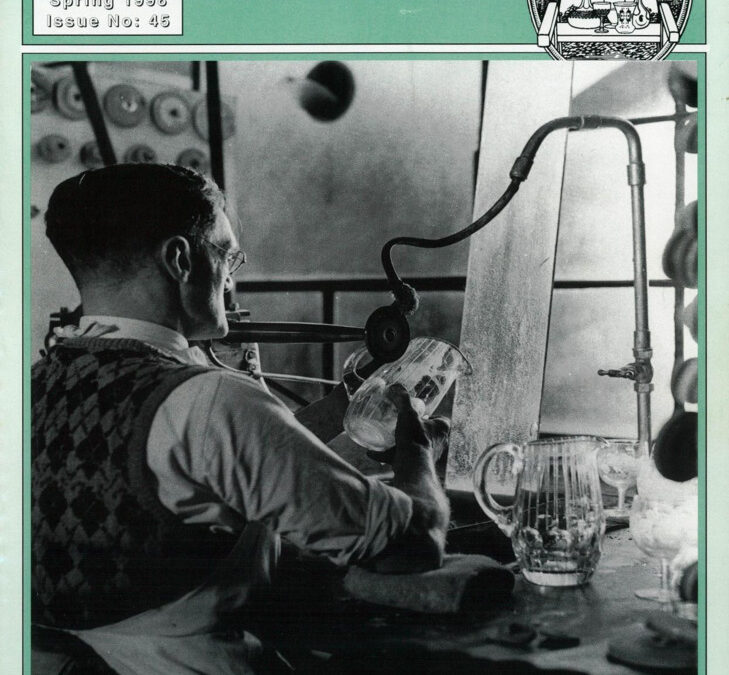
FRONT COVER
Billy Weaver; a glass cutter at Webb Corbett during
the 1950s, seen executing Intaglio work. Intaglio is a
finer form of cutting using smaller wheels ranging from
6″ down to 3/8″ in diameter and therefore employed on
more detailed designs. (Courtesy Royal Doulton).
Reaction to the last two Glass Cones has been
complimentary and these comments provide a source
of encouragement to the editors. We know that the Cone
provides the main source of contact with the Glass
Association for many of our members, particularly those
overseas. We believe this response is, in part, due to the
changed layout and the use of colour on the front page.
Unfortunately, these improvements come at a price.
Printing costs increase and we are in danger of spending
too much of the resources of the Association on this
one publication.
This matter was discussed at the last Committee
meeting and, in an effort to give the editorial board as
much flexibility as possible, it was decided that we
should continue with four issues of the Glass Cone per
year but work within an overall limit of 48 pages per
annum – (an improvement on the 32 pages p.a. which
2
was previously the norm). This means that the number
We regularly receive notices from museums
regarding their forthcoming exhibitions and activities
but it was particularly gratifying to receive a press release
from Broadfield House Glass Museum with the news that
glass has not been forgotten in the distribution of funds
from the Heritage Lottery Fund. The sum of £13173
from this source, backed up by £7147 from the Dudley
MBC Glass Heritage Fund, enabled the museum to buy
65 items from the first part of the Michael Parkington
sale at Christie’s South Kensington last October. These
were acquired to complement the large number of
pieces already bequeathed to the museum by Peggy
Parkinson in her will.
The purchases, a selection of which are now on
display, include glass byWhitefriars,Monart, an important
engraved vase by Thomas Webb and paperweights by
Paul Ysart.
Incidentally the opening hours at Broadfield House
Glass Museum have been changed. They are now 2pm
– 5pm Tuesday to Sunday. The museum remains closed
on Mondays.
It was proposed, at the last AGM, to institute a travel
bursary to help students, who are pursuing glass related
courses at higher education establishments, to further
their studies. Applications were invited from about 50
suitable institutions and 6 proposals were received by
the closing date. They are now being reviewed and we
shall report on successful candidate(s) in the next issue
of the Glass Cone.
ARTICLES ON DISK
We
are very happy to receive articles or information
on 3.5″ disks in Microsoft Word to run on Dos or
Macintosh, but will contributors please ensure that
the disk is clearly marked with owner’s name and
a list of the files. Disks should be accompanied by
a hard copy which is cross referenced to the disk
and don’t forget to save a copy.
The opinions expressed in the Glass Cone are those
of the contributors. The editors’ aim is to provide a
range of interests and ideas, not necessarily those
which mirror their own. However, the decision of
the editorial board is final.
COPY DATES
Summer 1998:
20 June 1998
Winter 1998:
20 October 1998
The Glass Cone’ – Issue No 45: Spring 1998
THE HOLT SPA
It seems not uncommon that an object that one has
long taken for granted is suddenly seen in a different,
more interesting light. Such is a carafe, inscribed “Pure
Holt Spa Water”, which I bought some years ago in the
London area to add to my collection of decanters. There
it remained, an oddity not arousing much speculation,
until I recently became aware of the considerable interest
existing in certain circles in the history of spas.
This carafe is of late eighteenth to early nineteenth
century design, straight sided, thin walled and with an
unground pontil mark. It is undecorated apart from the
inscription and fitted with a loose stopper moulded with
the letters JJL. Many contemporary prints show such
bottles, a particularly appropriate one being Gilray’s
“Hero’s recruiting at Kelsey’s or Guard Day at St. James”,
which depicts guardees gorging themselves at the
counter of a shop replete with sweetmeats of all kinds
served in a variety of appropriate glassware. How then
did a bottle of common enough design become
dedicated to serving water from one particular spa?
Holt is a small town in Wiltshire not far from Bath.
The spa was established as a result of a rather comical
occurrence and operated subsequently throughout the
eighteenth century In 1688 an inhabitant of Holt found
a spring on his property which he began to use to supply
the house with water. Expecting visitors, he brewed a
barrel of ale and boiled a leg of mutton, which became
strangely discoloured but was nevertheless consumed.
Before long the entire company was incapacitated with
extended attacks of “the flux”. Investigations into the
chemical content of the water revealed a mixture of
mineral salts and the spring fell into disuse for many
years. Then in 1713 a new owner,Widow Harding, had
care of a child sick of the King’s Evil. As no other cure
had been effective, the mineral water was administered,
with immediate beneficial results. The patient recovered
to live on in Holt to adulthood.
Realising the commercial possibilities, Grace Harding
began dispensing the water and by 1723 was publishing
a leaflet showing the benefits of taking these waters.
She had the backing of a Lady Lisle, a local landowner,
and of the curate of Holt, a Rev.John Lewis, both of whom
promoted the establishment of a spa, assisted by Henry
Eyre, a professional publicist. Thus Holt Spa was begun
andThe Great House built to accommodate visitors. The
waters were also bottled for sale, first locally
and
gradually extending to other towns. In an early
anticipation of the National Health Service some Poor
Law authorities bought supplies for poor patients or paid
for them to lodge in Holt and take the waters at the spa.
Although Holt aspired to compete with Bath in attracting
the gentry, it appears that only those of lesser status
became its patrons, during it’s Summer Season. By the
end of the century the Spa had changed hands several
times until The Great House was turned into a girls’
school in 1790.
It is therefore all the more intriguing to find a bottle
which is much of that date and dedicated to a spa that
was on the verge of closure. The girls’ school was short-
lived, to be succeeded by one for boys run by a Dr.Arnot.
He also owned Holt Waters which he advertised in 1800
for sale in quart bottles, marked with the seal of the spa
and proprietor’s name, at four shillings a dozen, corks,
wax etc. included. By the next year he was offering
bottles packed for exportation at
£6
per gross but the
venture did not survive much longer.
Plain Decanter; c.1820, engraved for Holt Spa Water
Was my bottle then one of those sent to London for
four shillings a dozen? Evidently not, for it holds only
one and a half pints and was clearly not designed for
transport along eighteenth century roads. More likely
it was used to serve Holt Water at table in such
establishments as the Green Lamp in Swallow Street,
earlier recorded as receiving weekly supplies. Perhaps
it was used in one of the places drawn by Gilray in
St. James’s in
1797
or even used by the Prince Regent at
Carlton House, for there is a well known cartoon of him
in the throes of indigestion, illustrating similar bottles.
So the mystery remains. There cannot have been
many bottles of this pattern inscribed thus, shortly before
the closing of the Spa. The Well House survived to
present times (inside a bedding factory) but The Great
House was finally demolished in 1957. This bottle
therefore must be one of the few tangible relics of an
enterprise that flourished for most of the eighteenth
century.
•
Finally, to whom did JJL impressed so boldly on the
stopper refer: was it to Lady Lisle or to the Rev. J. Lewis?
Any reader with further knowledge could provide an
interesting conclusion to this tale.
My thanks are due to Dr. Bruce Osborne of Sussex
University, Cora Weaver, local historian and author, to
Katherine Jordan of Bath University for their help in
providing historical information.
G.G. Cowlin
3
The Glass Cone’ – Issue No 45: Spring 1998
•
4
GLASS BUTTONS
•
• • .
••
• •
•
• ..00
I
•
• • • ‘
•
. I :••••1100..
••
•
we
.
• •
lb
0.
.0
•
•..,etd
.
fff
f
f
•••• •
o• •
.to
‘
•
.1
‘”
n
.
..•
n
••
n
• e
‘
.
‘
e •
•
• ‘ n •” n.
,
,
• 0
i
• • •
I I
•
C
. ,,•.,,1,,I, .0 I ,
, • . 0
I
,
I
. ,
I
n
.0
•• • • • *. • ••• •• • • •
IN • 00 IA •
n
I . ‘ ‘ ..
, I • 1
n
,
‘
I
I ••
. •••••. -. … …–
•
.
00 le
•
0
•
…
•
•
ft
•
On
•••
•• • .* •
GO • •
•
• •
,…
)
,.;’••••
(.10,41
1
k
,
16
,
•
011,46)(trIlill
Vitiiir•IC__
•
•
– —7)
•
• •• 00
•
I . .
I ‘ • • I 4 •
. …..
i
• 1
•
………
•
….•
• •
… …
• I= • • ••• •
• •••• • • • • • …… •
•
•
, .
r t
.
,
4 40
,
•
• • “. …. • •
• ,4 • . • •• • ••• •
.., .. .. ..• • ..
1
•
•
• r •
• •
• •
‘ •
• • • • ‘
•
6
• ‘ • lulai
Examples of the button ranges produced
by The English Glass Co.
Glass buttons were an important fashion accessory
in the 1940s and 1950s. Tom J. Lawson, who worked
at the English Glass Co. Ltd., Leicester from 1958 until
1993, explains the firm’s involvement in their
production.
The English Glass Co. Ltd. was one of the foremost
producers of glass buttons in the 1940s and early 1950s.
It all started after the First World War with Leicester-
born and based entrepreneur, Hubert Burton, joint
founder of the John Bull Rubber Company of Leicester.
Latching onto the growing market for motor vehicles,
this firm produced a variety of rubber mouldings
incorporating warning glass reflectors for cars and
cycles. These glass reflectors were initially imported
from Jablonec (also known as Geblonz, its Sudeten
Deutschland name), a town in former Czechoslovakia
well known for its industrial glass manufacturing, and in
particular from the company Fischmann & Sohne,
suppliers of a wide range of glass products both for trade
and retail markets. By the late 1920s Burton decided to
manufacture the reflectors himself so,with the assistance
of Josef Oplatek, the export director of Fischmann &
Sohne, he set up the English Glass Co. Ltd. of Empire
Road, Leicester, incorporated in September 1934. The
coloured glass rods, the ‘raw material’ for the reflectors,
were still supplied from Czechoslovakia, as was a skilled
Czech glass presser to start production.
With the Nazi invasion of Czechoslovakia in 1939,
Josef Oplatek and his family emigrated and eventually
settled in Leicester where he and his wife, Norma, were
engaged to manage the English Glass Co. Ltd., then
suffering from a serious fall in demand and difficulties
in obtaining supplies.
Both Josef and Norma Oplatek turned the company
round by expanding the original product range from
basic automobile and road sign reflectors to products
for the Ministry of Defence including optical lenses,
filters, safety glasses and ampoules for detonators. From
two or so employees the firm grew rapidly to a full
complement of eventually over 60 people crammed into
a two-storied ex-hosiery factory just off the Roman Fosse
Road in north-east Leicester.
Norma Oplatek used her former 1930s design
training at Jablonec’s Technical School and introduced
the production of glass fancy jewellery (e.g. brooches,
earrings, hatpins and buttons) utilising Pilkington’s
Vitrolite glass sheets, more commonly used in bathroom
decoration. Even though Defence Ministry contracts
and registration with the Limbless Association (by
employing disabled workers) allowed easier access to
restricted materials and fuels, the company conformed
to the wartime Utility standards, keeping button sizes
small. However, when restrictions were lifted in the
late 1940s, Norma Oplatek’s button designs became
more flamboyant and innovative. Besides the use of
various coloured glasses, gilding and other decorative
techniques were introduced, and tens of thousands of
English Glass buttons were sold in the UK, until Czech
and German imports damaged home sales.
Inspecting small shank buttons, probably made from
Vitrolite glass in 1942.
The production of glass buttons was based on the
rod-moulding process, with glass supplied from Wood
4
0.
•••
•
0
.,
I
• •• •• •
•
•
•
•
• •
•
•••• • •
•
•
•
•
•
i
I
•
00 • • • • ND
I
/
Ile
•
NB •
— 7.
10
00
• • •
•
•
ilv
•
.1
1
‘1
•
•• at es • •
•
e.
•••
P6.11,
40
•
• • •
n
• ••
• • •
•
The Glass Cone’ – Issue No 45: Spring 1998
Dr. Deryk
Snow
is intrigued,
as are many other
people, to know the
origin of a number
of unmarked pieces
of pressed glass. The
photographs he has
sent illustrate a
number of the well
known patterns
which have yet to
be given a specific
attribution but we
illustrate two, of the
Pearline
type,
which do not
appear in the
Davidson catalogues
in Deryk’s possession. The
first, in blue Pearline, has
three handles and is
moulded with what
looks like trailing
ivy. The second is
yellow and they are
both 12cm
(41/2”)
high. If anyone can
shed any light on
these two, please
drop a line to the
editors.
Two ‘Perline’ vases
of unknown origin,
the upper blue, the
lower yellow
BUTTONS
CONT’D
MORE MYSTERIES
Brothers of Barnsley, Moncrieff of Perth, or occasionally
Plowden &Thomas (for tiny buttons). A rod or cut-strip
of Vitrolite would be softened in the mouth of a glory-
hole (coal-fired until conversion to town gas in the late
1940s), and then pressed in special metal tongs which
produced the button shape and decorated face on one
side and holes with or without a shank on the other.
After annealing and inspection, the button was trimmed
of any excess glass by staff using hardened steel circular
cutters, and its edge ground smooth on carborundum
wheels. After washing, drying, gilding with liquid gold,
silver or platinum chemicals, and perhaps iridising the
surface, the button was again inspected before packaging
and despatch. Rejection rates were almost 50% so with
the cost of labour, raw materials and fuel, the final
purchase price was high.
In the war years the supply of coloured glass was
limited: black, opal, green and pink in opaque glass and
red, green, blue and yellow in clear glass, as used for
signals. After the war the company was again able to
purchase more colours from Czechoslovakia, France and
Bavaria (Neu Kaufbeurem), but the easing of import
restrictions meant cheaper continental buttons were also
allowed in. The English Glass Co. halted button work
around 1955 but the company continued introducing
new product ranges, merging its glass interests with a
Birmingham optical company in 1996. The original
company now manufactures plastic packaging
accessories in Leicester. But that is another story.
T. Lawson
TRADE MARKS
wim
Of the two marks left unidentified from the seven
illustrated in Newsletter No. 17 (Feb. ’97)
George
Sturrock
has provided ‘Societe Industrielle deVerreries’
for SW This leaves the elephant (STWER) from that
issue and three from issue No. 18, the M in a triangle,
`Made in PV Czechoslovakia’ and C.V.M., which we hope
may yet be identified.
THE NATIONAL GLASS
CENTRE, SUNDERLAND
Smith Cole Wright, Milburn House, Dean Street,
Newcastle upon Tyne NE1 1LF (Tel: 0191 221 1616)
have been appointed as letting agents for the industrial
unit and workshop space at the centre. The workshop
areas vary from 56.9 sq. m. (720 sq.ft.) to 163.7 sq. m.
(1762 sq. ft.). The Centre is intended as a major tourist
attraction and the activities in the industrial and
workshop areas will provide much interest to visitors.
JOURNAL NO.
5
Dil Hier offers the following comment on Journal
no.5
I have a correction to an attribution in the Lesley
Jackson article in the Journal. She reproduced old
photographs, Figs 3 & 4, identifying them as Richardson.
They are in fact Thomas Webb. In Fig 3 the posy vase
numbered as 15740, is the number and shape of the first
piece of Queen’s Burmese Ware recorded by Thomas
Webb, dated October 1886.
I
have an identical piece to
that illustrated in my collection. During the course of
my research on Burmese Ware
I
have also found a Price
Book with similar ‘A’ numbers, but I have not found the
corresponding Pattern Book which would show the
representations.
D. Hier
5
The Glass Cone’ – Issue No 45: Spring 1998
cope with his possessions as best she could. What she
did, in fact, was to marry another glassmaker, one Francois
de Massey. Thus the Masseys became the Seigneurs of
Lichecourt. The story moves a big jump now to modern
times when a descendant of the Masseys was attracted
to buy the Château.
In the 8 November, 1997 issue of the French
newspaper C’EST REPUBLICAN, appears an account of
a series of court cases concerning the property. At the
beginning of 1996 Credit Agricole attempted to sell the
property by auction. They asked only for one stake price
of 810,000FF (roughly £80,000). This was equivalent to
the unpaid debt owed to them on the property.
The Massey descendants had bought the property
for considerably more than that with the aid of a small
loan from Credit Agricole. But perhaps they did not
reckon with the enormous amount of renovation
required. This was to require a supplementary
investment of more than twice the buying price. In
August 1995, Credit Agricole proceeded to seize the
property by way of a bailiff and put it into public auction
at 810,000FE The details of the legal process are outlined
in the article and are full of theatrical interventions by
judgements in higher courts stopping the sale at the very
last minute.
At the time of the article there was to be one final appeal.
The lawyers are quoted as saying, “If the court confirms the
judicial liquidation, the sale of the chateau will be resumed
at the initiative of the liquidator. That is to say all over again
by one sale at the auctions, or by a sale on offer”.
D.
Tyzack
Two books of interest are LICHECOURT, LES FEUX DE
LA VOSGE by Raymond George (Pub. Dominique Gueniot,
1993. ISBN 2-87825) and DonTyzack’s GLASS,TOOLS AND
TYZACKS (3rd ed 1997, ISBN 0 9526390 5 x).
GLASSMAKERS’ RESIDENCE GOING FOR A SNIP
Members of the Association who joined the Nancy
trip in 1995 will remember that sunny July afternoon
when we visited Lichecourt and where M George gave
us a fascinating talk (em plein ais, from the top of the
garden wall, ably translated by Sue Newell) on the history
of the site and its association with the Thysac glass-
making family. We were welcomed by the charming
and, so we thought, fortunate owners. Don Tyzack,
himself a descendant of the family, reports on more
recent events.
In 1473 Jehan de Thysac was a person in the right
place at the right time. Duke Rene of Lorraine needed
reliable pioneering subjects to repopulate his waste
border areas. He judged it a good time to grant such
lands to knights of his duchy. On the 5th March, 1473
the Duke wrote Jehan a letter.
“To Jehan de Thysac, esquire, and Alix de Barisey,
his wife, the remains of the
big
glasshouse of Darney
for building a glasshouse called Li gecourt which place
was a ruin and is in much decay. Access agreed for the
sum of ten small guilders per year”
So Jehan and Alix took on their borderland site and
there they built, in 1473, a fine “strong house” which
included a tower and a glassworks.
Jehan de Thysac built his house near the glassworks
for protection in this lawless area. It was a place of refuge
should trouble come. Life in this remote border territory
was full of risk. Wars that affected Lorraine and its
neighbours in the fifteenth century and earlier, created
a permanent state of insecurity and the borders of
Lorraine were badly defined. Why live in such a place if,
then, it was so harsh? A principal reason for the choice
was access to woodlands. Being glassmakers theThysacs
had to suffer risks and hardships for their craft, for the
fuel they needed.
Today, four kilometres north-west of Darney and
one kilometre south-west of Relanges, is the boundary
between a beech forest and rolling cultivated lands.
Turning left, from the D164 at Relanges, the traveller
soon sees a magnificent vista. A few metres away is the
flowing stream of Belmont and there ahead, is the fairy
tale Château of Lichecourt. Even today it is an imposing
building with its two high towers topped with small
diamond tiles. The battlements frame a façade of finely
carved white stone, which possesses enormous
windows. Château Lichecourt as we see it today was
mostly the work of the generations who came after Jehan.
As the family prospered with its glass, it could afford a
better house. So from 1545 Nicolas de Thysac, ehan’s
grandson, constructed the present house.
By 1600 Nicolas’s grandson Christophe Tyzack had
murdered his cousin and run away to England to escape
6
justice. Back in Lorraine he had left Gerarde, his heir, to
The Glass Cone’ – Issue No 45: Spring 1998
DAVID STUART
THE REGIONS
It is with sadness that we have to report the death
of Dr. David Stuart whose book on Norfolk glass is
reviewed below. He died on Sunday 18 January, two
days after the talk he had planned to launch his book
had to be given on his behalf as he was too ill himself.
He was inspired to collect glass, some thirty years
ago, after a visit to the Beves Collection at the Fitzwilliam
Museum, Cambridge. Very much a discriminating
collector of 18th century glass he developed a particular
interest in the place of Norfolk in the history of
glassmaking. Blessed with a photographic memory, he
could remember details of any item or illustration he
had seen, enabling him to recognise glasses of
significance missed by others.
He had been ill for some time but was determined
to publish his knowledge for the benefit of others. In
achieving this end he has also left a memorial to himself.
BOOKS
GLASS IN NORFOLK,A History of Glassmaking and
Decoration in Norfolk. (1997, Published by Dr. David
R.M. Stuart, ISBN 0 9532358 0 7).
This little book by the late Dr. David Stuart is in two
parts. Part 1 is a short history of glassmaking in Norfolk
and includes a cogently argued case for dropping the
misleading ‘Lynn’ for those familiar, 18th century
drinking glasses, decanters, etc. with horizontal ribbing;
although arguing a case for GreatYarmouth as the source,
he suggests the more general (and safer) term “Norfolk”.
Part 2 is a detailed study of the glass decorated by
the Great Yarmouth retailer William Absolon and his
assistants from the end of the 18th century to the middle
of the 19th century. Using his own collection he
discusses tumblers, rummers and mugs, plus a jug and a
decanter. Techniques included engraving, with and
without gilding, surface gilding and enamelling, with
subjects, charmingly, if sometimes crudely executed,
mainly souvenirs of the ‘Success to …’ type. An analysis
of detailed features is given to help in identification.
The illustrations are small but, in the main, quite
adequate for the purposes of the text.
This book is likely to remain, until further evidence
appears, the definitive publication on William Absolon’s
connection with glass.
GLASS IN NORFOLK is obtainable direct from Dr. P
Stuart, 4 Marine Crescent, Great Yarmouth, NR30 4ER.
Price 18 inc. p&p. Cheques should be made out to Great
Yarmouth Parish Church to which Dr. Stuart donated
the proceeds.
K. Cannel!
MIDLANDS
The Oxford meeting which had to be abandoned
last year because of the funeral of Princess Diana has
been re-arranged for Saturday 18 April. It will include
conducted visits to the glass collections in the Ashmolean
Museum and Christ Church Picture Gallery as well as
visits to see stained glass windows in some of the
colleges.
On Thursday 11 June there will be a private, evening
preview of the summer exhibition of contemporary glass
at the Ferrers Gallery at Staunton Harold near Melbourne,
Derbyshire. This will be followed by a visit, for those
who wish, to Ian Turner’s home to see his collection of
Monart glass. Attendance at this meeting must be pre-
booked.
There will be a collectors’ evening at the Midland
Arts Centre in Birmingham on Thursday 10 September
on the theme of ‘My first piece of glass’.
If any member learns of any glass related events in
the region which would provide the basis for additional
meetings please contact Ian Turner on 01332 862629.
NORTH WEST
Nothing has been arranged for the early part of the
year since Alan Comyns has had to have surgery and
will need to recuperate. We wish him a speedy and full
recovery.
The first meetings in the other regions will have been
held by the time this is published and other meetings
are planned for later in the year which will be reported
in the next issue.
HELP!
We have received the following request from
Professor Peter Plesch.
He writes, “I am interested
in finding others who share my interest in the following
two categories of glass; 19th century and earlier Asian
glass from China, Japan, India, etc. and pre-mediaeval,
say before the 6th century C.E., circum-mediterranean
glass.” If enough members respond he would like to
form an Interest Group. Please write to the Glass Cone
and we will put you in touch with him.
A further request comes from
Godfrey Evans,
Curator of European Art at the National Museums of
Scotland, who is interested in Bohemian engraved glass
commemorating spas, exhibitions and British cities. He
is going to mount an exhibition on souvenir wares, to
coincide with the Edinburgh Festival in 1999, and would
like to hear from members who collect them. Contact
him through the National Museums of Scotland,
Chambers Street, Edinburgh. EH1 1JF.
7
‘The Glass Cone’ – Issue
No
45: Spring 1998
EXHIBITIONS, SEMINARS & FAIRS
From 4 April- 14 June 1998 Broadfield House Glass
Museum, Kingswinford, West Midlands (tel: 01384
812745) will hold an exhibition titled
THE
FORGOTTEN FACTORY – BAGLEY’S OF
KNOTTINGLEY.
The factory, started in the 1870s,
initially made bottles but during the 1930s turned to
decorative pressed glass which was sold under the trade
name of `Crystaltynt’. About 150 items, from a private
collection, will be on display. Admission is free and the
museum is open from 2pm – 5pm,Tuesday to Sunday.
This will be followed, from 20 June – 2 August, by
EVERGLASSTING,
an exhibition of the work of Alister
Malcolm and Susan Nixon who were this year’s joint
holders of the Studio Scholarship. Alister Malcolm’s
work is influenced by marine life while Susan Nixon
explores the optical and reflective qualities of glass.
Himley Hall, Dudley, West Midlands (tel: 01902
326665) will present two overlapping and very different
exhibitions.
GLASSWORKS
from 16 May – 5 July consists of a
series of drawings and paintings, illustrating glassmaking
and its surroundings, by Lev Vykopal resulting from his
residence at three glass factories in the West Midlands;
Plowden &Thompson,Royal Doulton and Stuart Crystal.
FIRST GATHER, the 11
th annual exhibition of work
by students at the International Glass Making Centre,
Brierley Hill will be on display from 23 May – 21 June.
Most exhibits will be for sale.
In New York the Bard Graduate Centre for Studies
in the Decorative Arts, in association with Helsinki’s
Museum of Art & Design, is currently exhibiting until
14 June,
FINNISH MODERN DESIGN: UTOPIAN
IDEALS AND EVERYDAY REALITIES, 1930-77.
Focussing on the central and decisive role played by
modernism in the development of Finnish design over
the last six years, the display includes the glass of Tapio
Wirkkala and Saara Hopea, as well as work from the glass
factories of iitala (sic), Karhula and Nuutajarvi, alongside
ceramics, furniture and textiles. A fully illustrated
catalogue including 12 essays, published in collaboration
with Yale University, is available. Details from B.G.C.
Tel: +212 501 3072 or Fax: +212 501 3079.
The Association for the History of Glass is planning
a residential conference at Edinburgh College ofArt from
22-24 July 1998 inclusive. As with its highly successful
conference, also held at the E.C.A. in 1992, there will
be a mixture of illustrated talks closely linked to studio
demonstrations, the latter organised by the
internationally renowned glass artist and teacher, Ray
Flavell. Among the hot working techniques to be
discussed, we understand, will be Roman ‘multi-
compartment’ ewers, folded feet and rims, claw beakers,
cameo work, cane drawing and `graal’. Details and
booking form may be had from Dr. Justine Bayley,Ancient
Monuments Laboratory, English Heritage, 23 Savile Row,
London W1X lAB.
Maryland College, Leighton Street, Woburn, Beds
MK17 9JD (Tel: 01525 292901) will be the venue for a
weekend course, from 8-10 May, dealing with the history
of GLASS FROM THE RENAISSANCE TO THE PRESENT
DAY. Starting with Venice at the height of its power, it
will survey glass making in Northern Europe. The tutor
will be John Brooks and the cost £99 residential
(including full board) or £76 non-residential.
Some of the Antiques fairs at which glass dealer
members of the Association will be exhibiting during
the next three months are the N.E.C., 16-19 April;
Buxton, 9-16 May; Harrogate, 30 April – 3 May; Glass
Collectors’ Fair, 17 May; Barkham Manor, Sussex 23-26
July; N.E.C., 6-9 August.
Sotheby’s have a sale of British and Continental glass
and paperweights planned for 12 May and on 21 May
their annual Irish sale will have a glass section.
Christie’s South Kensington will follow their 8 April
sale of the second half of the Parkington Collection with
further glass sales on 7 May and 24 September.
MEMBERS
A warm welcome is extended to the following
members who have joined the Association during the
last few months.
Mr. S. Bentley
Buxton
Dr. & Mrs. J Bonham
Sheffield
Mr. & Mrs. G. Cohen
London
Miss A. Cooper
Plymouth
Ms. A. Fletcher
Durham
Miss J. Hardy
Sunderland
Mr. C.W. Hart
Cleveland
Mr. P Herbert
Nottingham
Mr. R. Hetherington
Leeds
Mr. & Mrs. K. Leggett
Cockermouth
Ms. G. Moreland
Nantwich
Dr. L.R. Mytton
Powys
Mr. & Mrs. P Petrides
London
Ms. M. Spinks
Leeds
Ms. A.C. Stephens
Southampton
Mr. R. Tindal
Lichfield
May we issue a final reminder to members who have
not renewed their subscriptions for the current year. It
would be of great assistance to the Membership
Secretary if anyone who does not intend to renew would
let him know so that they can be taken off the mailing
list.