




‘be
Glass C
Autumn 1998
Issue No: 47
The Magazine of the
Glass Association
Registered as a Charity No. 326602
Chairman
Ian Turner
Hon. Secretary
Dil Hier
Editorial Board
Patricia Baker, John Brooks, Ken Cannell, Roy Kingsbury
Address for Glass Cone correspondence
2 Knight’s Crescent, Rothley, Leicestershire. LE7 7PN
Address for membership enquiries
Membership Secretary, 50 Worcester Road, Middleton,
Manchester. M24 1W
ISSN No. 0265 9654
PRINTED BY
Jones & Palmer Ltd., Birmingham
DESK TOP PUBLISHING
by Adrian Smith, Rawlins Community College, Quorn,
Leicestershire. LE12 8DY
One of our members, who remains anonymous for security
reasons, provides us with a first hand account of the consequences
of being burgled in the hope that it will provide some comfort to
anyone who suffers similarly.
In October 1990 we returned from our holiday
to
find the house had been burgled. Among the
many missing items were some 200 scent bottles
from my daughter’s collection and 69 glass cigarette/
cheroot holders from my wife’s collection. Needless
to say, they were the best ones. The police came and
asked questions and were given photographs for the
County Antiques Theft section, which then comprised
2
one
sergeant with an office in Wakefield. Our insurance
company duly paid the claim and we expected that to be
the end of the matter.
A few weeks later we were at the Newark
Antiques Fair and saw some of the scent bottles on
one of the stalls. After we had explained our loss
to the stallholder she took us to the dealer from
whom she had bought the bottles that morning.
He admitted the sale and told us that he had
bought “100 scent bottles and various other things”
for £5,000 from a little old lady whom he didn’t
know who had come into his shop which was in a
small out-of-the-way village somewhere in Yorkshire.
When we asked about cheroot holders, we were told
that there were some but the last 16 had been sold
to a Japanese dealer that morning. This information
was passed to the police but without any effect.
In April 1998, as part of the sale of a collection
of glass in London, some cheroot holders were
illustrated in the catalogue. Among them were two
which we could definitely identify as being from the
stolen group. An article by my wife about cheroot
holders had been published in a magazine earlier.
It was accompanied by a colour illustration which
included the two in question; one identified by
colour and initials and the other by colour and
pattern. We also had our own photographs of the
collection.
Our insurance company was notified and the
matter was passed to their firm of loss adjusters
who contacted the auctioneer and the cheroot holders
were withdrawn from sale. Here I might add that
the police were also informed, but since both ‘new’
owners of the glass had died there was no way in
which the police could follow up the case.
The loss adjuster made frequent requests to the
auctioneers for the return of the holders but met
with delays “because of a hold-up by the Executors”.
On 3 August a solicitor’s letter was sent to the
auctioneer and on 17 August the loss adjuster was
informed that the cheroot holders were being returned
to us and, even though the sale estimates had been
more than three times our original claim, I was only
required to refund to the insurance company the
amount which we had received for them in 1991.
It had taken six months to reclaim our property but
we felt that the effort was worthwhile.
The opinions expressed in the Glass Cone are those of
the contributors. The editors’ aim is to provide a range
of
interests and
ideas, not necessarily
those
which
mirror
their own. However, the decision of the editorial board
is final
COPY DATES
Winter 1998/9:
18 December 1998
Spring 1999:
20 February 1999
COVER ILLUSTRATION
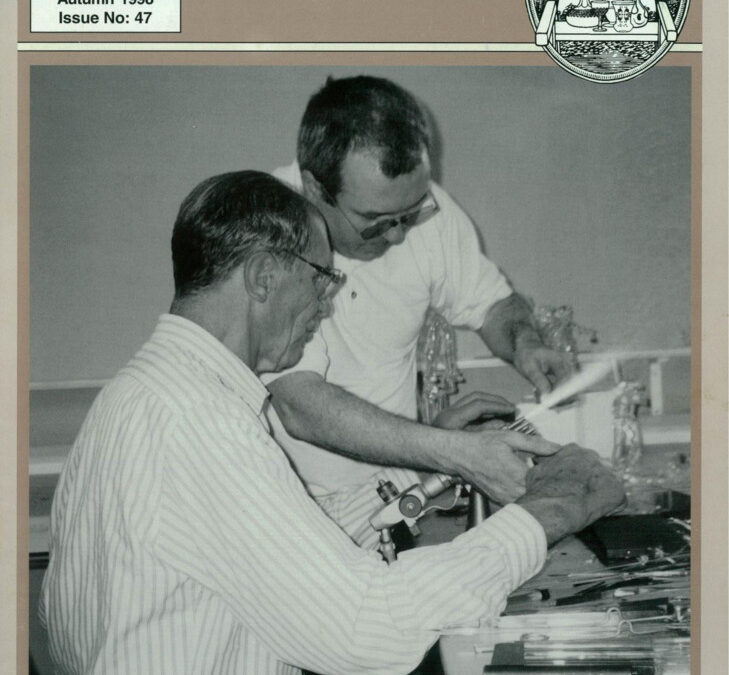
Roger Burgess (seen seated), at the National Glass Centre during
the Sunderland weekend, taking instruction from Norman Veitch on
the art of lamp work. (photograph courtesy of Rita Pearce.)
THE TRIALS OF A
COLLECTOR
The Glass Cone’ – Issue No 47: Autumn 1998
The “Volcano Furnace”
A BEAD FURNACE
In our last issue we reported on a bead making
course to be run by Winston Doull at DAEDALIAN
GLASS in Lancashire. We have since received further
information on the small furnace which Winston Doull
has developed to carry out operations requiring small
quantities of glass. Called the ‘VOLCANO’ it is simple
to set up and can be used at home. At 36cm(14in.) x
12cm(5in.) it must be one of the smallest furnaces ever.
It runs on propane gas and reaches 1200°C in the
working zone. The detailed description of the furnace is
too long to print here (two sides A4) but if any member
would like a photocopy, please send a S.A.E. to John
Brooks, 2 Knights Crescent, Rothley, Leics. LE7 7PN, or
approach Mr. Doull direct at Kaiserstr. 74, D-42781 Haan,
Germany, Tel: 0049-2129-8213.
THE TRIALS OF A RESEARCHER
Research, as I have discovered, is an excellent training
ground for the virtue of patience. For many years I have
been collecting the glass manufactured by John Walsh Walsh
of Birmingham and my experience has been that research
cannot be undertaken without some disappointment and
frustration. As time progresses, however, a sense of
achievement develops, frequently supplemented by light-
hearted, amusing or unexpected revelations. My
recommendation to any member considering research is that
they take the plunge and make a start.
Family business development in the nineteenth century
frequently centred round close family relationships and the
history of Walsh Walsh was no exception. The story of the
company was confusing until I discovered that John Walsh
Walsh married twice, with a child from the second marriage
born less than nine months after the birth of the last child
from the first marriage. This caused a re-think of previously
held views and produced a new approach relating to the
ownership of the business following the death of John Walsh
Walsh.
I incorrectly assumed, in the early stages of my research,
that William G. Riley, the Managing Director from 1928 to
1951, was William George Riley and over a number of years
I undertook several searches against this name. A later review
of records at the Institute of Mechanical Engineers produced
his original membership proposal form giving his correct name
as William Grimshaw Riley (Grimshaw being the maiden name
of his mother). Much to my amazement and delight this form
also gave an abridged version of the Walsh company history
from 1923 to 1942.
And it is not always wise to believe everything that has
previously been published.
Pottery GcTite and Glass Trades
Review
October 1936 states that William G. Riley was the great-
grandson of John Walsh Walsh, a statement I attempted to
prove for many years. In conversation with a former employee
I was told the
Pottery Gaette
was inaccurate and the truth
was that it was
Mrs.
Riley who was the great-granddaughter
of John Walsh Walsh, a statement I was able to prove within
a few weeks, enabling me to complete the family tree.
Technical issues can become an education, and I learned
from experience that illustrations submitted by manufacturers
for Registered Design purposes are frequently schematic and
require interpretation when searching for examples.
Terminology changes with time, and shapes are not always
what they appear to be – vases become bowls and bowls
become vases. I also recognised at an early stage that
manufacturing processes were as imperfect in the nineteenth
century as they are in the twentieth. I possess two pieces of
Victorian Walsh, totally different in shape and size but both
marked with the same registered design number. Examination
of records reveal both items to be Walsh, but different
registrations. Some unfortunate employee, probably at the end
of a shift, had no doubt been marking 42716 for most of the
day and did not realise production had changed to 333714.
Research has taught me several basic principles I intend
following in any future projects. These will be published
in
another issue of the Cone.
Eric Reynolds
As reported in the
Daily Telegraph
for 10
September, the Waterford Wedgwood Group reported
an overall fall in profits of 12% for the last financial
year but Waterford Crystal itself raised profits by
36% to IL9m. This improvement was helped by new
product lines which included Millennium flute glasses
which are selling at the rate of two a minute! (This
seems an odd statistic but I suppose it equates to
a
production of at least 1,000 per day. JB).
3
‘The Glass Cone’ – Issue No 47: Autumn 1998
PRINCE ALBERT AND HARTLEY’S OF
SUNDERLAND: PAST AND PRESENT
On 16 October, 1851,
The Times
reported that Hartley
and Co. of Sunderland had been awarded the Prize Medal for
Rolled Plate for Roofs at the Great Exhibition. The engraved
certificate signed by Prince Albert and the medal which
accompanied it are both to be found in the collections of
Sunderland Museum and Art Gallery today.
The firm had worked hard to create a magnificent
impression at the Crystal Palace exhibition. As well as
displaying examples of their products, their stand included
glass models of a greenhouse and a room created to scale to
show off the potential of their newly perfected Patent Rolled
Plate, or PRP as it quickly became known. The most
eyecatching model, however, must have been the 8-pot furnace
with all its inner workings, itself made of glass. The cone was
12′(3.65m) high and 7′(2.10m) in diameter.
Contrary to later popular belief in Sunderland, Hartley’s
did not, of course, supply the glass for the Palace itself.
Some of the replacement Jewels made by Hartlg Wood and Co. for the
Albert Memorial (photograph courtesy of Eura Conservation Lid)
Chance’s won this order by quoting a slightly lower price than
Hartley’s, even though the latter could have provided larger
sheets of glass, thus greatly reducing the amount of framing
required. The local and national press were more enthusiastic
4
however, and Hartley’s proudly included the following passage
from the
Illustrated London News
of 17 May, 1851, at the head
of their
Glass Tariff Newspaper
for 1853: “The glass through
which the light permeates in this building (the Crystal Palace),
is considered by some persons competent to judge, as too
thin, and it is a subject of regret that the Rough Plate Glass
of Hartley, which is only one-fourth dearer, but twice as thick,
has not been substituted for it.”
The Prize Medal served to publicise James Hartley’s
achievements and his company’s prominence in the industry
which was to last for several decades. Complete windows were
designed and made by them in PRP and these can still be seen
in many buildings in the North-East today. They also made
more mundane items such as cream pots, fern shades, railway
signal lenses, roof lamp glasses, lamp chimney glasses, glass
shades, tube gauge glasses, ship’s deck lights, rolling pins, milk
pans, beer glasses, preserve jars, fruit protectors, grape glasses,
pastry pans, flower pots, cucumber glasses and glass tiles.
One department in the works was dedicated to making a
more specialised product. This was mouth-blown window
glass, produced by the crown and cylinder methods. Trained
at Chance’s in Birmingham, Hartley had been sent by them to
France and Belgium to study these age-old skills. He was
subsequently responsible for re-introducing them to
Sunderland, almost 12 centuries after glass had first been made
there. As is well-known (thanks to the Venerable Bede)
Sunderland’s main claim to glassmaking fame lies in the arrival
in 675 AD of craftsmen, summoned from Gaul by the Abbot
of Monkwearmouth, to make windows for his new church.
Victorian architects again found this glass perfect for the
stained glass windows of their gothic revival buildings.
Decades of successful production were followed by
decline and ruin and Hartley’s massive glassworks were finally
demolished in 1896. The name of Hartley lived on, however,
thanks to a new small glass company formed in 1892 by
Hartley’s grandson in partnership with the skilled craftsman
Alfred Wood. The history of Hartley’s and Hartley Wood &
Co. must be left for another day. Suffice to say the latter small
business continued the tradition of creating mouth-blown
window glass right up to its own sad closure in November
1997.
Up until that day Hartley Wood’s craftsmen could be seen
any day of the week making ‘antique’ window glass. The
furnaces may have been gas-powered and the glassmen dressed
in tee-shirts and jeans, but nonetheless a visit to the factory
was like stepping into an engraved illustration in Diderot’s
Engclopedie.
They produced sheet glass in 72 colours as well
as vases, paperweights and trinkets. They also undertook
special orders and it is perhaps appropriate that one of Hartley
Wood’s last commissions in 1995-97, linking them back firmly
to the mother firm Hartley’s, takes us back not only to Prince
Albert but to that great tradition of ancient techniques
combined with the innovation on which the original firm’s
fortune was founded.
Restoration of the Albert Memorial began in 1994 and it
The Glass Cone’ – Issue No 47: Autumn 1998
is not generally known that Sir George Gilbert Scott’s Gothic
masterpiece, completed in 1876, has opaque glass “jewels” of
turquoise, red and white, thought to have been supplied by
Hartley’s, decorating the elaborate canopied structure under
which the Prince sits. Over a century’s exposure to pollutants
meant that many jewels were damaged beyond repair and
needed to be replaced. With hindsight, it is clear that the
conservation firm in charge of the work were lucky to find
the descendant of the original manufacturers still in business.
Moulds created from surviving undamaged examples were
delivered to Hartley Wood’s. A colour specialist was appointed
in order to fulfill the order. Ernie Rice, formerly of
Leamington Glassworks on the Tyne and Dema Glass of
Harworth near Doncaster, was also the last Works Manager.
His expertise was crucial in recreating the jewels as the
selenium red in particular presented technical problems. After
painstaking trials to match the shade, thickness and opacity
of the originals, good reproductions were obtained. The trial
pieces are now on long-term loan to Sunderland Museum and
Art Gallery. The order for 600 jewels was completed two
months before Hartley Wood’s closure. Within a week of the
closure the glassworks buildings, a familiar if ramshackle
Sunderland landmark, were demolished to make way for a
retail park.
Now that Prince Albert is unveiled in all his golden
splendour, it is hoped that members will not be too dazzled
to notice the jewels, beautifully made in Sunderland.
PS. The Sunderland tradition of ‘antique’ glassmaking
has only been temporarily interrupted. In March 1998 a new
company, Sunderland Glassworks, was formed. It employs
five of the former Hartley Wood’s men including
Manufacturing Manager, Nigel Alder, employed since 1967
by the old firm under his father, the Managing Partner Allen
Alder. Based in Sunderland’s new National Glass Centre,
production has now begun.
Sue Newell
MORE ON BUTTONS
The article on the English Glass Co. by Tom
Lawson in
Glass Cone No. 45 has prompted Raymond Berger to write with
more information about button manufacture.
The piece by Tom Lawson about glass buttons adds
another intriguing chapter to a period of glass-making
activity in which I have, via family connections, more than a
little interest.
I wrote an article which appeared in the Spring 1996
Glass Cone
(No. 41) about a firm called Bimini, which
later became Orplid, which was active in London between
1940 and 1955. The founder was a Viennese glass blower
called Fritz Lampl. He was one of the many artistic
refugees from Hitler’s Europe who found a new home in
this country. His company produced a variety of work in
England, but buttons formed a large proportion of his
output, especially during the war years. Compared to the
English Glass Co. , however, the scale of his production
was miniscule.
Orplid was always an atelier and workshop rather than
a factory-sized operation. Examples of its work can be
seen at the Victoria & Albert Museum, as well as the
button museum at Ross-on-Wye. (Original Orplid buttons
can be bought from the Button Lady shop in Perrins Lane,
Hampstead, London.) As Lampl’s nephew by marriage, I
often wonder if there is anybody still alive who worked for
Orplid as Mr. Lawson worked for the English Glass Co.
R.
Berger
By coincidence the Button Collector’s Society, in the latest
issue of their magaine Button Lines, has a long article by Kay
Jenkins titled
Lampl and Orplid Glass’. Ed.
HOLLOWAY END
Holloway End
(Glass Cone
No. 46) is not a glassworks
that comes readily to mind. Apart from a brief mention,
dated 1717, in Guttery’s
From Broad-Glass to Cut Crystal
there seems to be no mention of it in any of the usual
books and dictionaries. However, it is referred to in Takao
Matsumura’s little known but fascinating study of the
social background to mid-19th century glassmaking,
The
Labour Aristocracy Revisited, The Victorian Flint Glass Makers
1850-80
(pub. 1983). Unfortunately it seems that when
Holloway End is mentioned, it is for all the wrong
reasons. In addition to the subject of price-fixing etc.
referred to by Mr. Ellis the only mention by Matsumura is
the following contained in a section dealing with the
treatment of boys.
The Brierley Hill Advertiser of 22 February 1862 reported
that a glass maker named George Ridger, of the Holloway End
Glass Works in Stourbridge, was sued by the father of a taker-
in named George Green: Ridger had accused the taker-in of
neglecting to clean his blow-pipe, and then struck him on the head
with it. He was knocked down. The assault was judged in the
Public Office and Ridger was fined 1 s (5p) and costs. Yet this
was an exception. In most cases, glass makers who committed the
assaults were not prosecuted and their misconduct was concealed.
The [Flint Glass Makers Friendly] society never tried to explore
the matter seriously. The ill treatment of boys was the dark side
of the respectability the flint glass makers claimed”.
Ken Cannel
From early August, visitors to the Blackpool Tower in
NW England could experience that walking-on-air
feeling, that is if they had the nerve to try out the
newest tourist attraction, the ‘Walk of Faith’. Removing
the normal heavy-duty flooring, Pilkingtons has installed
a 2″(5cm) thick laminated glass panel about 6ft(1.85m).
square, costing £50,000. The new floor which allows
those brave enough to stand on it to view everything
happening at ground level, a mere 385ft(117m). below.
5
‘The Glass Cone’ – Issue No 47: Autumn 1998
BOOKS
GILDED & ENA1VIETLED GLASS FROM THE
MIDDLE EAST,
ed. Rachel Ward, British Museum Press,
London, 1998. ISBN 0 7141 1478 2. 31 colour illus., 180 b/w
£48.
To most people the term ‘Islamic Glass’ is
synonymous with enamelled glass of 13-15th century Egypt
and Syria. More than any other type of Islamic glass, this
highly decorated ware has attracted’ the attention of
Western scholars, collectors and designers, especially in
the late 19th and early 20th centuries. Yet, unlike the
many publications available on Islamic carpets, there are
only a handful of books on the subject of Islamic glass, the
most recent on enamelled glass being published over fifty
years ago, so this new publication is overdue.
The fact that this is a collection of conference papers
from a British Museum 1995 international symposium will
possibly put some people off; but even for those with only
a transient interest in the field, such conference papers
frequently offer rich pickings because of the variety of
methodologies and approaches they reveal. For those
interested in archaeology, there are reports of recent
discoveries in Europe, the Crimea and China (but nothing
on Israeli excavations, which reportedly shed new light on
dating). Stephano Carboni’s “Gregorio’s Tale”, a fictional
story based on fact, explores the links with Venetian
enamelled glass, while other contributors assess relationships
in form and decoration with Islamic ceramics, wood and
metalwork, or concentrate on specific vessels. The chemical
composition of the glass and enamels might seem daunting
but Freestone & Stapleton’s findings on the similarities and
differences between Islamic and Venetian work were
comprehensible even to this reader. And for
aficionados
of
Victorian glass, Stephen Vernoit’s paper on Islamic glass in
19th century collections and that shown at the great international
exhibitions of the period will fascinate.
It has to be said that this volume is not an easy read.
Islamic glass is a subject which interests me deeply but
more than once I felt lost in the mass of detail. The
overall approach presumes readers will be aware at all times
of every subtle implication of dating and provenance. Ward’s
introduction expertly summarises the main points made by
the contributors but more clear sign-posting would have
been useful, perhaps in the form of a concluding essay
setting out the main issues, and questions arising from this
current research. Few of the papers give such a full and
rounded cultural and historical context for the glass as in
Venetia Porter’s paper (vessels made for the Yemeni Rasulid
sultanate), and arguably the major questions concerning
dating, provenance, design evolution and purpose (such
colourful decoration would have been lost on the observer
when the vessels were filled with coloured liquid or used as
lamps) are not adequately addressed.
The purchase price will undoubtedly deter some but
we might well have to wait for another half-century for
a further monograph on this subject; in the meantime
6
this is
a valuable contribution
to the study, bringing
together a selection of recent research and revealing the
current concerns and methodology of academics in the field.
Patricia Baker
THE PARIS SALONS 1895-1914:
Volume IV
CERAMICS AND GLASS
Alistair Duncan. Antique
Collectors Club. ISBN
1 85149 229 1 £49.50.
The Paris Salons have long played an important role
in French cultural life; smaller and more specialised than
the major industrial exhibitions, the Salons were probably
at their most significant for the decorative arts during the
fin de siecle
which seemed to last from the mid-90s to
the outbreak of the First World War. Held throughout
each year and controlled by committees ensuring that
nothing too radical was exhibited, it was the Salons
which set the fashion.
This latest volume in the series is unashamedly a
picture book, but it is certainly not of the coffee table
variety. Using photographs culled from contemporary
catalogues, magazines and even scrap books it
comprehensively illustrates the transition of art glass, mainly
French, from arguably the height of its artistic achievement
to its early industrialisation. It was the period when art glass
became established as a medium in its own right.
There are over 300 photographs of glass alone illustrating
about 500 items covering some 30 different designers and
makers. The original photographs were, of course, in black
and white, but a few modern colour photographs are included
as well as pictures of the exhibition stands. Inevitably the
quality of the older photographs is not of the standard taken
for granted today, but this is more than made up for by a
range of items rarely, if ever, seen today. There is a scene-
setting introduction and the descriptions with the photographs
are minimal (would it not have been possible to quote, where
available from the original sources, at least colour and
dimensions?) It must be assumed that Muller Freres are
omitted because they did not exhibit in the Salons and
Schneider because they were too late, but the book includes
several names not generally encountered.
Few books in English, with the exception of monographs
on better known makers (Duncan has given us books on Galle„
and Tiffany), cover the period adequately and the more general
ones tend to concentrate on the standard masterpieces. It has
to be said that the present volume does not fill this gap; it was
not intended to. Nevertheless it serves two major purposes:
firstly as a source book for designers and historians, and
secondly as a companion to books like
Gkus Art Nouveau to
Art Deco’
by V Arwas, where space has necessarily restricted
the number of illustrations.
On the face of it an expensive book, but had it
been a glass-only volume I doubt if it would have been
much cheaper and, in any case, it is interesting and
useful to be able to compare glass and ceramics of the
same period.
Ken Cannell
The Glass Cone’ – Issue No 47: Autumn 1998
FOR SALE
WHITEFRIARS boxed set of six ‘Eiger’ sherry glasses. Pattern No. M170. All with Whitefriars
label and most with pattern number label. Best offer over £60 secures. G. Timberlake 01582
423120
RARE ITEM. Greener 1888, Silver Wedding sugar bowl, design registration 91449,
commemorating the Silver Wedding of the Prince and Princess of Wales. Slight annealing fault
where one mould line terminates at rim. Best offer over £25 secures. G. Timberlake 01582
423120.
A cylindrical, footed vase (14″ high x 2″ dia.) engraved by DAVID PEACE with “Let me not to
the marriage of true minds admit impediments” (Shakespeare sonnet number 116) in flowing
script. Signed under base. £130. J. Brooks, Tel:0116 230 2625.
STOP
PRESS
The Studio Glass Gallery,
63 Connaught Street, London W2.
Tel: 0171 706 3013 will have an exhibition of work by Justin
Knowles from 3 – 27 November.
The Guild of Glass Engravers
will hold an exhibition of work
by Fellows of the Guild from 3-18 November in the MILTON
GALLERY, ST. PAUL’S SCHOOL, Lonsdale Road, Barnes, London
SW13 9JT.
ADINP.TISMNTS AUTUMN 1998
WANTED
WHITEFRIARS GLASS of the Baxter era. Large tangerine pieces such as textured
rectangular vases, waisted vase, hooped vase, shouldered vase. Also want ‘Drunken
Bricklayer vases of various colours. D. Fewings. Tel: 01695 423853 (evenings).
1 would like to purchase glass and copper lustre ‘master’ salts made in England and France
prior to 1910. R. Elser, 1470 Morewood Drive, Powhatan, VA. 23139-7127. USA.
Tel: 001 804 598 8771. e-mail, rcelser @ aol for t? This is not clear) corn
THOMAS WEBB’S 1930s ‘Bulls Eye’ pattern drinking glasses wanted by private collector. Any
colour. Also ‘Wave’ pattern. Mrs. E. Lavarello, Tel:01932 840781
CANALS. Any canal related glassware. Engraved, press moulded or etched.
J. Delafaille. Tel: 01275 843790
P.T.O.
N.B. The
Glass
Association offers this as a service to
members but reserves the right to refuse advertisements and accepts no liability for contracts made between participants
to this service. It must be understood that any contract
arising from these advertisements will be the responsibility
of the members concerned who are recommended to take their
own precautions before entering into any contract.
PLEASE PRINT.
NAME
ADDRESS(for record only)
Tel
Please insert the following advertisement in the next available issue of the Glass Association
Newsletter.
FOR SALE/WANTED (Delete as necessary) PLEASE PRINT.
Price
Are these items being offered in the way of trade?
YES/NO.
N.B. 40 words max. including Tel. No. and Name.
Signed
Do you prefer to use box numbers? YES/NO.
If items not in perfect condition faults must be detailed.
If you only want to receive responses between certain hours please specify.
Return to John Brooks, 2 Knights Crescent, Rothley, Leics. LE7 7PN.
Members who were present at the National Meeting
in Guildford in 1994 will remember the Venetian nesting
tumblers and sealed fragments, on display in the museum,
that were recovered from the Tunsgate site. The research
into this find has continued and the latest results are
contained in
Part-Medetu/ Afrthaeohgy
vol 31 (1997). Copies of the
reportmay be had from the Guildford Museum Excavation
Unit, Guildford Museum, Castle Arch, Guildford, GU1
3SX for £5 plus £1.50 p&p. Cheques to Guildford Museum.
We have received the latest catalogue (No. 10) from the
GLASS BOOKSHOP which now includes books on ceramics
as well as glass. It may be obtained from Paul Brown, 68 St.
James Street, Brighton. East Sussex BN2 I PJ. Tel: 01273
691253 during shop hours, 10-6.
REGIONS
MIDLANDS
The last meeting of the year was held at the Midlands
Art Centre in Birmingham when a dozen members assembled
to discuss their first piece of glass or a problem piece. During
the evening several mysteries were resolved.
For the benefit of the members who attended, the candle
miser which I showed, and whose name I could not remember,
was given the fanciful name of `LYCHNOPHYLAX by its
makers J.C. & J. Field of OZOKERIT WORKS, Lambeth,
London; rather belying its mundane appearance and perhaps
intended to make it seem more important than it was. The
word appears to come from the Greek roots Lychnos = a
light and Phylax = a guard. It was exhibited at the 1872
International Exhibition and received an Honourable Mention
at the 1878 Vienna Exhibition.
John Brooks
SOUTH WEST
The joint meeting at Torre Abbey, in Torquay, with the
Friends of Torre Abbey on 19 September attracted
approximately sixty people split evenly between the two
organisations. The success of the meeting owed much to Peter
Wright who, having a foot in both camps, was responsible for
much of the organisation. The meeting focussed on the Meres
collection of 18th and 19th century glass belonging to Torre
Abbey, about which not much seems to be known. In an effort
to rectify this our member John Brooks gave a talk on
glassmaking in England in the 18th century and commented
on several items in the collection.
One piece which particularly invited further investigation
was a cylindrical beaker, cut and inscribed in panels with the
following “JAMES JAGGER BOUND JULY 2nd 1776
AGED 16 YEARS” “MISS POLLY PRITTEMAN MADE
THIS IN THE YEAR 1776” and “JOINED BY
FRIENDSHIP, CROWNED BY LOVE”. ‘Bound’ presumably
refers to Jagger being bound as an apprentice. Was Polly
Pritteman a glass cutter or engraver? (Are there any records
of female glass decorators other than Mary Beilby?) Does
`crowned by love’ refer to them both? It would be fascinating
to know more about these people.
After lunch members of the Association returned to the
home of Peter Wright and John Morris for a session to discuss
pieces of glass they had brought with them. Rarely could so
many puzzling objects have appeared at one meeting; obviously
made for specific purposes but for which no reasonable
explanations were forthcoming. A successful day was brought
to an even better conclusion with tea and home-made cakes.
Richard Giles
NATIONAL MEETING
The National meeting (July 10-12) was held in Sunderland
to coincide with the opening of the National Glass Centre.
This is a landmark in the history of the glass industry of
Britain, the first purpose-designed building to show off the
qualities and variety of a flexible, intriguing raw material. We
have decided to let members offer their personal views of the
weekend since it is apparent that many factors go to make up
the success of a weekend like this.
The mixture of talks, exhibitions and hands-on experience
was almost without exception regarded favourably. Written
comment was from ‘generally suitable’ to `excellent’; others
said ‘I don’t need to write this down, Rita. It’s been a damned
good weekend’. The workshops in stained glass, wheel
engraving and blowing were universally enjoyed, the big moan
being ‘Couldn’t we have had more time to do this? It’s been
such fun. My son thought I had bought my piece of ‘antique
glass’ and was astounded when I said I had made it.’ Some
members made their own glass Christmas decorations; Mr.
Willey made his own paperweight to add to his already
considerable collection and Tom Percival made a piece which
he passed off as a piece of Hartley Wood in the Sunday
morning display, to tease Nick Dolan, who had a good laugh
about it. The lectures were summed up by one member as
`Very good, informative and of the right length’. Nick Dolan’s
talk on ‘The production of Wearside and Tyneside Glass’ was
praised as ‘literally up to the minute in research; good value
for money’ (from somebody who came for the Sunday only!)
`Very entertaining; a lot of exercise’ (Tom Percival again, who
seated at the back of the not well-equipped Education Room
was bobbing up and down all the time in order to see the
slides). Considering Nick was competing with a folk band
performing on the roof and a new cleaner who got locked in,
we think he deserved all the plaudits he got.
The exhibitions were generally praised, particularly the
Kaleidoscope Gallery: ‘Just the thing for us wrinklies, it brings
us up to date without patronising us’. There were complaints
about the labelling of the ‘Glass UK’ exhibition and the lack
of any information other than the expensive catalogue,
although it was recognised that it would make a useful
reference book.
Coned over
7
The Glass Cone’ – Issue No 47: Autumn 1998
But it was the restaurant and the Nouvelle Cuisine which
provoked the strongest reaction which varied from Too trendy
for an establishment seeking popular approval’; ‘trying to be a
bit too daring’; ‘not my cup of tea (sic) but well cooked and
beautifully presented’ to ‘first class English cooking at its best’.
It was universally agreed that the service, however, left a lot to
be desired!
Other cameos include watching feet walking along the lines
on the glass roof and turning through right angles to change
direction; Arctic terns and cormorants seen, through the glass
walls, flying up river; groups of members wandering along the
riverside in the afternoon sun, back to their accommodation
across the river; waves of laughter from different tables as the
Association dinner progressed; Ian Turner’s eyebrows doing the
can-can as he signalled that Nick Dolan was running seriously
overtime; the clumsiness of inexperienced hands when engraving
and an appreciation of the skill and deftness of the working
man/woman in the glass industry.
A long letter to the Director of the Centre, listing all your
comments has produced an equally detailed response, welcoming
constructive criticism. The cloakroom is now in place. The
restaurant management has changed and other points raised are
being acted upon.
In spite of minor hitches, the weekend was enjoyed by all,
as summed up by a new member, who wrote: This was my first
national conference. It was a long way to go, 61/2 hours by train,
but all worth while.’ That the weekend was such a success was
largely due to the administrative and computer skills of Mike
Pearce.
Rita Pearce
NEW MEMBERS I
EXHIBITIONS, FAIRS
AND SEMINARSIIIIIM
A warm welcome is extended to the following new
members.
8
Mr. & Mrs. M. Bamber, Carlisle.
Dr. G. Cooley, Oxon.
Ms. K. Cumming, Oxon.
Mrs. S.A. Currah, Haywards Heath.
Ms. K. Foulkes, West Yorks.
Mr. P. Housden, Beds.
Mr. & Mrs. J. Laws, Tyne & Wear.
Mr. S.D. Paine, Southport.
Mr. C. Prata, Hong Kong.
Mr. I.P. Price, Wakefield.
Mr. D.G. Roberts, Tyne & Wear.
Mr. M. Sadler, Stockport.
Mr. & Mrs. J. Shackleton, Herefordshire.
Mrs. J.M. Shorrock, Southport.
Mr. E. Smith, Stockport.
Mr. F. Smith, Rugby.
Mrs. M. Whitley, Co. Wicklow, Eire.
Mr. L.J. Wild, Kent.
The Association continues to grow and membership
now stands at 780. I would like to thank all those who
renewed their subscriptions before I have to send out
renewal notices. It saves so much time, trouble and expense.
Peter Beebe
Due to an oversight two of the illustrations in
the last
Glass Cone
(No.46) were not given
acknowledgements. We have to thank Broadfield
House Glass Museum for the front cover picture and
Antique Collecting
magazine for the photograph of
the ‘Clanny’ miner’s lamp. We apologise for this
omission.
The second
biennial exhibition VENEZIA APERTO
VETRO 1998 is taking place at several sites in Venice
from 16 October 1998
to 8 January 1999. As previously
it
will be curated by
Dr. Attilia Dorrigato and Prof. Dan
Klein, joined
this
year
by Rosa Barovier Mentasti, an art
historian and specialist
in Venetian glass. The theme this
year is
Homage to Venice
(Omaggio a Venetia)
as a
tribute to the rich range
of Venetian glass techniques
which have had such an influence
on contemporary glass
all over the world. A number
of international glass artists
have been invited to exhibit works
on the theme of The
Four Seasons’ and Italian artists
will, of course, be
exhibiting. Venetian galleries which
specialise in
contemporary glass will also mount their
own exhibitions.
There will be a full colour illustrated catalogue
and
further information can be had from Alan J. Poole,
Dan
Klein Associates, 43 Hugh Street, London, SW1V 1OJ.
Tel:
0171 821 6040.
GLASS UK – BRITISH CONTEMPORARY
GLASS.
This exhibition, which was at the new glass centre in
Sunderland (see report on the AGM) has now moved to the
City Arts Centre, Market Street. Edinburgh until 4 January
1999. Opening hours 10am – 5pm Tuesday to Saturday.
The Association for the History of Glass is running
a study day on Monday 29 March 1999 surveying
‘Current
work on the history of glass through scientific analysis’,
at 23 Savile Row, London W1. It is organised by Dr. Ian
Freestone, who may be contacted for further details, at
The Dept. of Scientific Research, British Museum, Great
Russell Street, London, WC1B 3DG.
The next
LONDON GLASS & CERAMICS FAIR
will
be held at the Commonwealth Institute, Kensington High St,
London on 28 February 1999.