




Ib
t
Winter 1998/9
Issue No: 48
The Magazine of the
Glass Association
Registered as a Charity No. 326602
Chairman
Ian Turner.
Hon. Secretary
Dil Hier
Editorial Board
Patricia Baker, John Brooks, Ken Cannell,
Roy Kingsbury.
Address for Glass Cone correspondence
2 Knight’s Crescent, Rothley. Leics. LE7 7PN.
Address for membership enquiries
Membership Secretary,50 Worcester Road,
Middleton, Manchester. M24 1WZ
ISSN No. 0265 9654
PRINTED BY
Jones & Palmer Ltd., Birmingham.
DESK TOP PUBLISHING
by Adrian Smith, Rawlins Community College,
Quorn. Leicestershire. LE12 8DY.
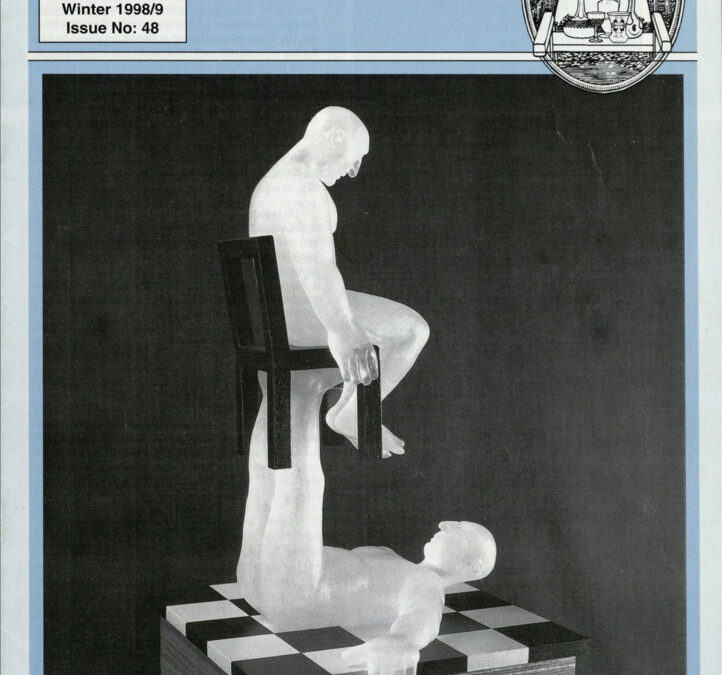
COVER ILLUSTRATION
‘Living in Confined Spaces no. V’ by David Reekie ,
July 1998 (lost-wax cast glass and painted wood, ht.
69cm), one of the eight finalists for the 1998 Jerwood
Prize for glass. (See Page 7)
EDITORIAL
As some of you know, John Brooks went into hospital
for a triple heart by-pass operation in the late Autumn.
In record time he was back home and we are delighted
to report that he is continuing to make very good
progress, though he says he will be greatly relieved when
the medical requirement of a 4-mile walk each day is
dropped. All our best wishes, John !
And our sincere thanks to all the contributors in
this issue for responding so quickly to our various
requests when they realised the editorial team would
be without John’s help.
In this issue there is a report of the October AGM
for members who were unable to attend. There have
2
been a number of changes within the committee,
particularly the offices of Chairperson and the Hon.
Treasurer. We are sure everyone wishes to convey their
thanks for the hard work put into the Association by
John Delafaille and to take this opportunity of
congratulating him and Jo on tying the nuptial knot. Our
very best wishes to you both. And our thanks too to
Sheila Leonard who always managed to bring the
committee members to financial heel by a few gentle
words, and welcome to Brian Currie who takes over
the task of Treasurer. Eileen Sanders joins the committee
and the
Cone
editorial team is already indebted to her
for the information-gathering about the acquisition of
Royal Brierley by Epsom Activities Ltd.
ABOUT IAN TURNER…
At the October AGM Ian Turner was elected as the
new Chairman of the Glass Association; he has been on
the Committee since 1991, and has served as Midlands
Region representative for the past three years.
He began collecting Monart glass in the early 1980s
at the suggestion of Cyril Manley, who also introduced
him to Paul Ysart then in retirement in Wick. With Paul
Ysart’s help, he researched the history of Monart
production at the Moncrieff works in Perth, publishing
in the Broadfield House exhibition catalogue
British Glass
Between the Wars,
1987 and
Ysart Glass, 1990.
Presently he is working on the Monart pattern books,
having just acquired all the remaining versions and his
research will appear in the next edition of the
Journal.
As well as collecting glass, Ian is interested in inter-
war art pottery and is a member of the Northern Ceramic
Society. Some of his collection was included in the
Legacy of William Moths
exhibition at the City Museum
& Art Gallery, Stoke on Trent in 1996. He hopes to
publish a monograph on Candy Art Pottery of Newton
Abbot, Devon and follow this with a more general
introduction on 20th century art pottery produced by
English tile manufacturers.
Married with three grown-up children, he has now
fully retired from his professional career as a Chartered
Town Planner in order, he says, to prevent work
interfering with far more important tasks in life. The
restoration of the 200-year house, pub and brewery in
Melbourne where he now lives has now been completed
but as yet he has not taken up home brewing.
The opinions expressed in the Glass Cone are those
of the contributors. The editors’ aim is to provide a
range of interests and ideas, not necessarily those
which mirror their own. However, the decision of
the editorial board is final.
COPY DATES
Spring
1999:
20 February
Summer 1999:
30 April
The Glass Cone’ – Issue
No 48: Winter 1998/9
GLASS ASSOCIATION AGM REPORT
The fifteenthAGM of the GlassAssociation took place
on 24 October 1998 at Stuart Crystal,Amblecote.
The Chairman, John Delafaille welcomed all
members to the important milestone of the 15th AGM.
He then went on to say that the current issues are those
associated with success and growth: growth not only in
membership but also in the scope of the things we do
and in public awareness of what we are doing.
One priority during the last year was to establish a
replacement editorial team for
the Journal.
This has been
achieved by welcoming back Roger Dodsworth, after a
two-year sabbatical, to lead a team responsible for the
Journal.
One of the more significant changes agreed by your
committee has been to establish teams to cope with the
problems of growth; in this way the burden is spread
and constant stimulus provided.
The team of Patricia Baker, Rachel Russell and Ian
Turner judged the travel bursary awards. The two
successful applicants being Marcus Newhall “Social,
Educational and Political Influences on Czech Glass
1945-90”. He aims to interview a number of the surviving
artists of the period. The other is Hugh Wilmott “16thc
and 17thc Glass from English and Dutch Towns”, a
comparison and analysis of recent finds in English towns
with recent fmds of Utrecht and Rotterdam. Their travels
complete, we await the submission of their papers.
We once more supported the Michael Parkington
lecture at Himley Hall, with Barry Sautner giving an
illuminating talk on his life and work as a carver of glass.
The notes on this talk will appear in one of the
Association’s publications in the future.
The Chairman, in stating that a further rise in
subscriptions was not proposed for this year, pointed
out the danger that income and expenditure are very
close. Our main costs are publishing and measures are
being taken to reduce these costs without adversely
influencing the quantity or quality of the publications.
He then went on to identify the co-operation with
other societies, since there had been two approaches.
Both had been on the basis that the Association is an
independent society with complementary not identical
interests. The first was from the Society of Glass
Technology who was suggesting that we explore ways
in which we could work together. In essence it was
agreed to encourage the flow of information, look at
opportunities to support each other’s meetings and more
importantly investigate the possibility of using their in-
house publishing facilities. Secondly we have been
advised that the Association for the History of Glass will
be holding an International Conference in the UK in
2003. An informal approach by them has been made
asking us to help; more details have been requested. In
general terms the opportunity to work with other
societies is welcome so long as we clearly understand
what we are doing.
After thanking the committee for their work over
the year the Chairman pointed out that an AGM being a
time for change he felt it was an appropriate moment
for a change of Chairman. When he took up the function
he had aims for the Association which included the
awarding of Bursaries and Weekend Events both these
have materialised. He now felt that his home location at
Bristol put him out on a limb and that he was not able
to give the job the necessary attention. It was time for
new blood. He also emphasised that he was not saying
goodbye; he would be available to provide support to
the committee if required and would remain an active
member of the Association.
TheTreasurer Sheila Leonard,who was also standing
down presented the meeting with the audited annual
income and expenditure account for the year ending
31st July 1998, which was adopted unanimously. In
concluding her report Sheila thanked everyone for their
help during her two years of office and wished the new
treasurer well.
Peter Beebe, the Membership Secretary announced
a continued growth of membership, which now stands
at 770.
The election of officers and committee members
followed: Ian Turner was elected fts Chairman and
Charles Hajdamach as Vice Chairman. Brian Currie was
elected as the new Treasurer with Eric Reynolds being
appointed asAuditor.The other officers, namely Dil Hier
(Secretary), Peter Beebe (Membership Secretary) and
Aileen Dawson (Events Secretary) were re-elected. The
appointment of Regional Representatives was also
approved as follows: Alan Comyns (North West), Rita
Pearce (North East), Richard Giles (South West) and
Geoff Timberlake (South East). Ian Turner advised that
he would now be standing down as Regional
Representative for the Midlands and appealed for a
volunteer. Eileen Sanders, from Stourbridge, filled the
vacancy among the three ordinary committee members.
In taking up his office Ian Turner called for a vote of
thanks to John Delafaille for the tremendous work he
has put into the Association during his time of office.
The meeting continued with reports outlining
progress with the editing and production of publications,
which will ensure their regularity, and with members’
continued support, high quality.
On the issue of travel bursaries the meeting decided,
contrary to the committee’s recommendation to
continue with two discretionary awards, to approve a
scheme that would permit the award of a single travel
bursary up to a maximum amount of 11000.
The meeting ended with a brief review of the
proposals for the 1999 programme of events, details of
which will be published in the usual manner.
D. Hier
3
The Glass Cone’ – Issue No 48: Winter 1998/9
PERSONAL RECOLLECTIONS
Having completed my term as Chairman now is
perhaps the time to break one of my rules: never look
back, always look forward.
Glass has long had a fascination for me. I remember
as
a student hitch-hiking across Europe, sitting for several
hours watching the changes of light through the Reims
Cathedral rose-window. Collecting started many years
later in the mid-seventies with basic 18th century wine-
glasses. At that time Hived and worked in the Manchester
area, and although I joined a local Antique Society,
nobody else seemed to share my interest.What I learned
was gleaned mostly from books, with one exception –
attending a Grosvenor Museum,Chester, series of
evening lectures on glass, given by people from another
planet bearing names like Roger Dodsworth, Ian
Wolfenden, etc..
In 1983 I was moved to Head Office in London and
no sooner was I there, than I read in the
Antiques
Collecting
magazine about the formation of the Glass
Association to be based, it was said, in Birmingham and
Manchester. Having just moved to London, I viewed this
as
typical Sod’s law. By then I was buying the occasional
glass from some of the better dealers, and at one fair
both John Brooks and Jeannette Hayhurst mentioned
the Glass Association and pushed an application form in
my hand.
My glass interests very quickly widened as I realised
that the 18th century was not the only century of
production. I had never really heard of the Studio Glass
movement until I attended my first weekend seminar in
Newcastle and talked to people there who were part of
the movement. This was reinforced by a meeting at
Cannon Hall near Barnsley, a place I knew well, having
lived for 10 years just a few miles down the road. Talks
by Ray Flavell and Dan Klein coupled with the exhibition
there opened up an entire new world, and it was after
this that I suggested that the Association should support
an award for Studio Glass. I was aware that many other
countries had such awards but there was none in the
UK. An approach was made to Unilever, hoping that its
interests in perfumery and thereby perfume bottles
would result in sponsorship. Unfortunately it came to
nothing.
At this time theAssociation had around 300 members
with a regular programme of events, regional and
national.Two years later when I was invited to join the
committee, numbers were approaching 400, and some
problems associated with rapid expansion were
emerging. Keeping in touch with members was
increasingly difficult; just getting papers stuffed into
envelopes required more organisation. Because the
emphasis of the Association was different to other
London-based organisations, membership in the South-
East had grown rapidly forming half the total
membership.At first this different emphasis meant local
4
one-day events in the South-East which I organised with
Alex Werner’s
help were well-supported, but the limited
venues available meant those taking on the regional
responsibility after I became Chairman were faced with
serious problems.
This was an important time for the committee.
Numbers were increasing at a far greater rate than was
ever conceived. The question was even asked if we
should become an exclusive organisation and restrict
our membership, rather then be open to all willing to
pay the subscription! The committee was restructured
into its present form to increase the number of officers
to share the load, with regional representatives to make
sure each region was represented, and we employed
administrative help.
The questionnaire sent out to members showed that
for the majority of members, the publications were the
prime attraction so we decided to increase the frequency
of the newsletter and the quality of the
Cone.
The move
to establish an editorial team for each publication,
instead of asking just one person to struggle on valiantly
has certainly been one of the most important changes
in the last two years.
Today there are almost 800 members but one of the
negative changes has been the relative decline in the
numbers of young members, and those directly involved
in actual production of glass, especially Studio Glass.
The Travel Bursaries awarded last year and hopefully in
years to come should help re-forge that link, though
regrettably current logistics mean we restrict
applications to written projects, rather than actual glass-
work.
It could be said that the Association’s problems are
those of success. It has always been a down-to-earth
group of friends sharing a common interest. But how
do we maintain the energy and informality of some of
those earlier events, when many of us were meeting for
the first time? If the committee hits on the right idea
for an event, everybody wants to come. So we have to
restrict numbers and opportunities to handle glass,
disappointing many. The excellent meeting concerned
with Royal Brierley was such a event, resolved then only
by lecturers kindly agreeing to give their talks twice,
something we cannot rely on. For me it has certainly
been the meetings and visits organised by theAssociation
which have broadened my knowledge and fired my
enthusiasm. I realise how much I owe to my
predecessors, and the incredible amount of effort and
sheer hard work undertaken by your committee.
As I said at the AGM, I still expect to be seen around
but I would like to take this opportunity to thank all the
members of the Association for their support and
friendship, and for teaching me so much.
John Delafaille
The Glass Cone’ – Issue No 48: Winter 1998/9
CHAIRMAN’S NEW YEAR MESSAGE
The editors suggested that as your new Chairman I
might like to contribute a New Year’s message for the
Glass Cone,
and immediately I started on it, I realised I
wanted to do more than just look forward. Political
historians are fond of saying that a country that ignores
its history hasn’t much of a future and this holds true
for an association like ours whose success has been
largely determined by the work of volunteers led by a
succession of able chairmen.
I particularly want to thank my predecessor John
Delafaille in this regard because his Chairmanship has
been marked by the dual distinction of continuing
success of the Association as measured by its increase
in membership and successfully reassessing its activities
and priorities. It was John’s personal initiative to consult
members by means of a questionnaire so we could fmd
out exactly what you felt about the programmes of
meetings and publications. The results were put into
effect and the Association has benefited from this
exercise.
His work will in a very real sense make my job as
Chairman easier than it might have been if we had not
taken this fundamental look at what we were doing and
I am very grateful for that.
The Glass Association starts 1999 with a rising
membership and a set of priorities determined by its
members. Just to recap on these: first priority is given
to our publications. We have created a new Editorial
Board to push this along and I think everyone will agree
that recent issues of the
Glass Cone
have set high
standards both in content and presentation. But we are
facing problems of fast-developing technology making
word-processing compatibility between editors, the
desk-top publisher and printers increasingly difficult.
John Brooks’s triple heart by-pass operation has put him
temporarily out of action but I know that he’ll be back
at the coal-face as soon as he can. As well as organising
all the DTP, John has supervised the experiment of the
Stop-Press notice including Members’ advertisements.
The success of this insert depends entirely on members
taking advantage of the service offering glass for sale
and to purchase. John has expressed concern about
the viability of this insert given the small take-up and its
continuation is entirely in members’ hands.
Regarding meetings, we shall continue with three
or four National Meetings each year, hoping to link these
to other events in the glass world, such as exhibitions
or major sales of national significance. Inevitably this
rarely leads to a fair distribution of meetings in all the
regions. Recently we have had two major National
Meetings in the North-East of England and nothing in
the North-West, but these inequalities tend to even out
in time.
Possibilities of arranging another overseas visit are
being examined. Previous overseas trips to Belgium and
Lorraine were
to a very
considerable
extent made
possible by
accompanying
Association
members
with family
contacts in
these areas.
So if there are
members
with links in
European
glass-making
areas — or
fluency in
Swedish,
Czech
or
Italian
please contact
us.
Our new Chairman
Ian Turner
Regional meetings have recently been a weak area
in some regions. Low attendance and organisational
difficulties in such problem areas as the South-East,
where membership is large but meetings outside London
mean long journeys through or round the capital, and
meetings in the capital itself entail extra costs. I hope
we can address these issues during the year.
I am very pleased that Roger Dodsworth agreed to
take on the onerous task of Honorary Editor of the
Journal.
The questionnaire showed very strong support
of a periodic ‘learned’ publication containing research
papers relating to new collecting fields, discovery of
archival material and discussion of spectacular examples
of glass. I am sure this aspect of the Association’s
activities is in the very best hands and look forward to
working with Roger on the Committee.
Lastly I would like to invite members who cannot
attend any of the Association’s meetings — only about
10% of the membership does so — to write to me c/o
Broadfield House Glass Museum, Compton Drive,
Kingswinford, West Midlands DY6 9NS if you have any
comments or suggestions.
Those of you attending meetings, please introduce
yourselves to the Committee officers.We are particularly
pleased when we get new ideas for meetings or other
activities and it is certainly my view that an Association
that listens to its members is likely to be a more
successful body than one which doesn’t.
Ian Turner
5
The Glass Cone’ – Issue No 48: Winter 1998/9
THE STANDISH SALE
O
Five of the Standish glasses, left to right:
Lot 204 (£4830), Lot 93 (£2070), Lot 93 (£2070),
Lot 7 (£2070) and Lot 132 (part) (£747).
(Courtesy of Christie’s South Kensington)
The dispersal of this hitherto unknown collection
of
English and Continental glass on 5 November 1998,
at
Christie’s South Kensington, London, provided an
exciting afternoon for a saleroom well filled with both
collectors and dealers. Although including glass from
both English and continental sources of the 18th and
19th centuries, the sale largely comprised English air-
twists and opaque-twist drinking glasses dating from the
mid-18th century — many still bearing that ubiquitous
yellow label denoting an Arthur Churchill Ltd
provenance — so it would seem that the attraction for
Mr. Standish lay in the stem or twist formation of each
glass.
Thomas Standish, the same age as the century, has
lived in Wigan all his life. Working in his father’s shop,V.
Standish & Son (est. 1890), a traditional furnishers and
upholsters with a workforce of joiners, carpenters,
french polishers and upholsters, he became a well-
known local character but few people were aware of
his life-long interest in antiques. Until recently when
he moved into a nursing home, each room of his tiny,
modest, end-of-terrace house was tightly packed with
his extensive collection which also included furniture,
Oriental ivories, pictures, British ceramics and musical
boxes — a microcosm of traditional British collecting.
Most interesting were the high prices achieved in
the English drinking-glass section where rarity often
outweighed condition. Perhaps the most notable here
was the £1150 (all prices quoted include buyer’s
premium) paid for a mercury-twist cordial-glass inscribed
‘Talyho’ with chips to the footrim. An elegant engraved
airtwist wine-glass with an acorn knop to the stem
realised11955 whilst a quadruple-knopped airtwist glass
reached £2070 and an engraved mercury-twist
ratafia
£2300. A triple-series opaque-twist ale-flute went to the
trade for £1380, an unusual opaque-twist with the ogee
bowl set onto a shoulder-knopped stem realised £920
and a rare opaque-twist glass with tulip-shaped bowl
and folded foot reached £862. The tartan-twist wine-
glass, the only colour-twist example in good condition,
realised £4800 and a beautiful facet-stemmed goblet with
fruiting vine £2300.
Bidding in the paperweight section was equally
competitive with a strong American presence. One of
the two most expensive lots in the sale,15520, was an
extremely rare St. Louis
millefiori
vase
(3 Ye
high) signed
and dated ‘SL 1846’. Other notable prices were £1724
paid for a Baccarat single orange flower weight, £4830
for a Clichy turquoise ‘barber’s pole’ weight and £5520
paid by the American trade for a Baccarat pale blue
carpet-ground
millefiori
weight dated 1848.
Mr. Standish’s fascinating glass collection divided
into 298 lots and with every lot sold realised a total of
£181505.
A NEW FUTURE FOR ROYAL BRIERLEY
Workers at Royal Brierley, West Midlands, learned
on October 7 that the 222 year old English family
business, known for its mouth-blown, hand-cut crystal
glassware, had been acquired by Epsom Activities Ltd.,
makers of glass for the pharmaceutical industry.
The Guardian
(Oct. 8) reported that the Williams-
Thomas family, which had founded the company and
run it continuously for more than two centuries, had
decided to find a buyer for Royal Brierley because none
of the latest generation was interested in taking over
the business and the family was not keen of investing
more money into it.
Tableware International
(November
6
issue) noted the company had suffered from serious
under-investment for more than ten years. Business had
suffered with the downturn in British consumer
confidence and the strong pound affecting export
orders.This is despite the fact that the order book is up
11 per cent on this time last year; about 20 per cent of
the output worth over £1 million is exported.
Epsom Activities headed by Richard Katz was quick
to announce that more than 200 jobs would be
safeguarded but warned that up to 10 jobs at the North
Street site could go in a cost-cutting exercise (in July the
company employed a total of 230 workers). A letter
from the Royal Brierley management to staff said that it
was possible 19 jobs could be lost. According to
‘The Glass Cone’ – Issue No 48: Winter 1998/9
A NEW FUTURE FOR ROYAL BRIERLEY CONT’D
Richard Katz (left) celebrating his
acquisition of Royal Brierley with its
Managing Director, Graham Webster-Gardiner.
(Courtesy of (Wolverhampton) Express & Star)
(Wolverhampton)
Express & Star
(Oct. 7) Katz has
promised that ‘millions of pounds’ will be invested in a
new factory and that plans for a new visitors’ centre
will also go ahead. However, the amount of this new
investment was stated in the
Birmingham Post
(Oct.8)
to be /1 million.
News that a new buyer was being sought for Royal
Brierley broke in the local media in late June. A month
later it was reported that firms from Asia,America and
Europe had expressed interest in acquiring the
company which had supplied fine crystal glass to every
British monarch since George III, and that a list of 10
potential buyers had been drawn up. The sale was the
subject of the BBC2
Money
programme transmitted on
November 7. It is thought that Epsom Activities had
paid about £1.7 million to acquire 68,998 ordinary
shares from David and Simon Williams-Thomas, the sole
share-holders.
Earlier this summer Richard Katz acquired the
Sunderland Glassworks; the difficulties facing the
Hartley-Woods company was covered in recent issues
of the
Cone.
Royal Brierley and Sunderland Glassworks
will remain independent of each other, according to
Tableware International
(November issue), but
combine on marketing, sales and distribution matters.
The Guardian
noted that Katz is keen to start a five-
year apprenticeship scheme at Royal Brierley
particularly in the hot shop which presently has 24
glass-blowers. The turnover of Royal Brierley uptoApril
98 was £5 million, according to the
Birmingham Post,
and the aim was to increase this within the next few
years to SAO million.
Spokespersons for the workforce welcomed the
acquisition saying that ‘It seems we have a future. The
last ten years have been rough one way and another’.
THE 1998 JERWOOD PRIZE
For the last four years, the Jerwood Foundation in
collaboration with the Crafts Council UK has honoured
an artist-maker judged to have made the most
outstanding innovation and contribution to a particular
field of the applied arts. In 1998 this field was
designated as glass.
A shortlist of eight entrants was announced in May,
all of whom were considered to be ‘distinctive in their
ability to marry the highest technical skill with the
vision and ability to take the glass forward as a creative
discipline’: these were Galia Amsel, LiseAutogena,Tessa
Clegg, Keith Cummings, Anna Dickinson, Diana
Hobson, Keiko Mukaide, and David Reekie. In the
autumn it was announced that the 1998 winner of this
prestigious prize worth £15000, the leading British
award for the applied arts wasTessa Clegg. Our sincere
congratulations to her.
While acknowledging the significant contributions
to contemporary studio glass the other entrants had
made in recent years, it was noted that Clegg’s work
had changed and developed dramatically over the last
five years. The judges in awarding her the prize
commented that ‘ [she] had made glass which has
resonance, spirituality and sexuality; it rewards patient
contemplation; it is precise and powerful.’
Of all the entrants, only Keiko Mukaide was
specified as incorporating blown glass elements into
her work. Visitors to the Contemporary Applied Arts
gallery this summer viewing the glass of contemporary
artist-makers selected by Jennifer Opie of the Victoria
&Albert Museum will have noticed a similar movement
away from hot-glass.
It raises questions: is there no artist-maker in the
UK working in blown glass showing a comparable
standard of workmanship, artistry and innovation ? is
there currently a critical perception that hot-glass
blowing techniques can offer few new opportunities
to the maker ? in the final years of the century are the
visual and tactile qualities of cast
glass preferred over
cont’d on page 8
7
The Glass Cone’ – Issue No 48: Winter 1998/9
THE 1998 JERWOOD PRIZE CONT’D
the more fluid, limpid ones of blown glass? Is it
considered that realisation of a sculptural concept in
Arco 1 by Tessa Clegg
(courtesy of Crafts Council, London).
glass is more satisfactorily achieved through techniques
owing little to the blowing iron and the ladle ?
THE IMPACT OF JERWOOD
What are the implications of the Jerwood Prize ?
Do awards of this nature and indeed the artist-makers
themselves have any impact in the field of design and
manufacture of glass ?
Readers of the Special Seminar issue (no. 18
September 1998) of the
Glass Society of Ireland
Newsletter
will know of the lively, heated Symposium
debate in March. Michael Robinson argued in his summary
`Never has there been so much creative activity in glass
at the art end, and never has the quality of design and
making at the functional [industrial manufacturing ?]
end been so dire. We are surrounded by trivia and
junk that belittles our domestic usage and depresses
our aesthetic sensibilities, and artists ignore our plight.
A wine glass, a decanter, a light, are serious sculpture
challenges. Not as starting points for ornamental
distractions and shelf and wall consuming decorations
but as hard working, totally efficient and beautiful
expressions of our lives. Maybe glass artists are not
ready to take those challenges on yet, maybe they do
not have sufficient confidence in their new language
but we will all be grateful when they recognise the
size and seriousness of the problem that faces us and
decide to do something about it.’
No doubt we should also ask manufacturers to have
faith in this creative activity and utilise it.
THE WORK OF DAVID REEKIE
TimeKeeper (drawing), David Reekie, January 1994.
David Reekle
was one of the eight glass-makers to
be considered for the prestigious Jerwood Award 1998.
Bowing to continuous pressure from the Cone editorial
team he has been kind enough to write briefly about his
work. His work is currently on show at the Miller
Gallery, New York, NY and is included in the Jerwood
Prize for Glass Touring exhibition.
I have worked as an artist using glass as my main
material since 1967. As a student at Stourbridge College
8
of Art I started working with free formed blown glass
techniques, but my ideas at that time were based around
building on constructions and I found glass blowing very
limiting. It therefore came as a great revelation when I
discovered the possibilities of forming glass in a kiln.
Within an electric kiln I was able to make formers
out of metal, ceramic and wire and then melt sheet glass
over these structures. When the glass cooled I had a
glass construction. This opened a whole world of
possibilities and by taking these prefabricated glass
sections I found I could build much larger constructions.
Over the next few years my work became very
architectural in feel and needed a sense of scale, so
around about the late 1970s, I began to introduce cast
glass figures into my work.
By introducing the human figure I had also brought
narrative into my work and the constructions soon
became environments and situations where the figure
took on a growing importance. I created surreal
theatrical stage sets where I could act out some of my
thoughts and ideas relating to us as human beings
struggling through life. As the ideas developed I
introduced a series of underlying themes to the work
based on political thoughts, dark humour and irony.
In various pieces of my work I have explored different
cont’d on page 9
The Glass Cone’ – Issue No 48: Winter 1998/9
THE WORK OF DAVID REEKIE CONT’D
relationships within society and how we reacted to
changing situations. Humour and a sense of the surreal
have always been an important part of my work and I
enjoy introducing a hidden subtext. For the same
reasons
I
like the mysterious qualities that exist in cast
glass, the way its appearance can vary from transparency
through various stages of translucency to an almost solid
stone-like state. By introducing coloured enamels into
the glass I have an almost endless palette of qualities.
I develop my ideas through drawings and
photographs, often using images from newspapers as a
vast source of facial expressions and body positions.
With some of my recent work
I
have exaggerated these
expressions and body shapes to an almost cartoon-like
state to give extra force to the pieces.
In my recent series of work
Living in Confined
Spaces,
I have used a simple format of clear glass figures,
small painted chairs and a variety of cramped
constructions on which the figures play out scenes from
mundane but surreal situations. In terms of glass these
pieces are rather minimalist and I see my work going in
this direction, where the glass takes on a smaller but
more precious role.
Being short-listed for the Jerwood Prize for Glass in
the summer 1998 was a great honour and strangely it
gave me a rare opportunity to show five pieces of my
work in this country. During the 1980s there were a
number of galleries showing contemporary glass in this
country and prior to 1979 museums ands other public
venues had healthy budgets and there were several major
exhibitions of British and international contemporary
glass. By the late 1980s this had all changed and the
difficulties in exhibiting and selling work in this country
forced me to look further afield and I was fortunate to
link up with galleries in the USA and Europe. The
majority of my work now goes to the States, which is
frustrating to me in a sense especially as the themes and
situations reflected in my work are born of feelings and
observations originating here.
David Reekie
DOES SIZE MAI
1ER ?
–
L,V4,
-:3N
e
e
5
From left to right: 1. air-twist glass (ht.7″/17.5cm), 2. air-twist glass (ht.6
1
/4715.9cm),
3.
opaque-twist glass (ht. 6
95
‘Vi 7.25cm), 4. opaque-twist glass (ht.5
3
/4715.9cm), 5. facet-stem glass (ht 6715cm).
(Photograph: Mike McEnnerney, Photolink, Wimbourne, Dorset)
Roy Kingsbury has been collecting 18th century
wine glasses for some years and has on occasions
purchased glass, the bowls of which are considerably
larger than those one would normally expect. This in
itself raises several questions.
First I must state that I have always regarded larger
capacity 18thc glasses as wine glasses rather than goblets
Although
I
have read numerous books on glass and noted
some references to the size of bowls, the whole question
of size and capacity of 18th century wine glasses has
continued to intrigue me, and I would like to raise the
question: Why is it that 18th century glasses with small
bowls seem to have survived in relatively large numbers
while glasses with larger bowls (often twice the size)
cont’d on page 10
9
The Glass Cone’ – Issue No 48: Winter 1998/9
Readers of the
Glass Cone may
have heard of the
Guild through one
of its many national
or
branch
exhibitions of
engraved glass.
Founded in
1975 when a
resurgence of
interest in glass
engraving, both
point, drill and
wheel, — was
underway — its
membership grew
rapidly from some
25 in its first year to
about 600 in 1989
since when it has
gently declined
until this year when
it steadied at about
450.
/
0
The object of the Guild of Glass Engravers is ‘to
Detail
(3′
x 2) of an angel from
Jacob’s ladder’ glass screen
(30′ x 8′ of 15mm toughened
fiat glass) recently installed in
Leeds Parish Church, designed,
sandblasted and drill-engraved
by Sally Scott FGGE in
conjunction with Nero Designs.
(Photograph by Nick Carter)
DOES SIZE MATTER ? CONT’D
seem now to be relatively rare? Were such glasses
perhaps produced in smaller quantities? And if so, why?
Were such glasses indeed produced in the same
quantities as the smaller bowls?And if so, why have they
not survived in greater numbers? Do we have enough
inventories, sales lists, etc., to give us enough
information? Do we know enough about the drinking
habits of the period?
Illustrated are three such glasses (one air-twist, one
opaque-twist and one facet-stem) to show that glasses
of the size I am referring to were produced throughout
the century They are shown separated by glasses of
‘typical’ 18th century size. For purposes of comparison
each glass in the photograph has been filled with the
same amount of liquid — 3 fl.oz.)
While glasses 2 and 4 illustrate the height and bowl
capacity we are so used to seeing (6 ‘/4″ and 5
3
/4″
respectively, glasses 3 and 5 are perhaps the best for
comparison, since no. 3 is quite clearly a larger version
of 4, down to the shape of the ogee bowl, and the
moulded fluting to the lower section.
E. Barrington Haynes in
Glass Through the Ages
gave
the capacity of an average 18th century wine glass as
57-85cc (2-3 fl.oz.). Glasses 2 and 4 are of that capacity,
while glasses 3 and 5 have a capacity of some 5 fl. oz.,
and glass 1 some 7-8 fl. oz.. RJ Charleston (in
English
Glass,
1984 p.157) quotes a reference in F Buckley
(1929) to a 1748 glass advertisement which refers to
‘Wine, Gill and Half-pint Wine and Water Glasses’.
Charleston continues: ‘A gill is a quarter of a pint, or
142 cc (5 fl.oz.), and presumably the name means what
it says — a glass to accommodate wine mixed with water,
and therefore 2
‘/2
to 3 times the capacity of an ordinary
wine-glass…There is apparently no evidence to link these
names with any particular shape.’ He goes on to record
that in the 1770s there is also documentary evidence to
suggest that goblets held a quarter to a half-pint of liquid,
and that they were not the same as ‘Wine and Water
Glasses’.
Have I answered my own questions? Well, perhaps
partly. But even if glasses 1,3 and 5 illustrated were
‘Wine and Water Glasses’, why have so few survived? I
(and no doubt others) would appreciate an answer to
this question which I feel has not to date been addressed
in sufficient depth.
Roy Kingsbury
THE GUILD OF GLASS ENGRAVERS
advance the education of the public in the art of glass
engraving and other forms of surface decoration on
glass’. To this end the Guild promotes the highest quality
of creative design and craftsmanship among glass
engravers by teaching, exhibiting, organising lectures
and visits, encouraging contacts with other voluntary
organisations and official bodies in the glass and
contemporary craft world, and spreading information
to all interested parties.
It is largely because of these objectives that the Guild
has an unusual membership. Approximately half are
practising engravers while the others are non-
professional engravers, collectors and enthusiasts, so
some are concerned about the promotion and display
of their own engraved glass and half are not. This is its
strength but also at times presents problems.
Members who are learning to engrave or extending
their experience in glass engraving have access to
weekend Workdays organised by some or all of the seven
regional branches, most of which meet bi-monthly.
These Workdays normally take the form of working
tutorials on a particular aspect of technique conducted
by an invited Fellow or Associate Fellow of the Guild.
The Annual Conference provides a chance for all
members to network with each other, exchange
information, obtain help and locate sources of glass
suitable for engraving, inspect equipment and tools
displayed and look through books and slides etc. which
The Glass Cone’ – Issue No 48: Winter 1998/9
THE GUILD OF GLASS ENGRAVERS CONT’D
are always on sale from the Guild Office. This year the
Guild also organised a day visit to NeilWilkin’s studio to
watch and learn about glassmaking for engravers and
discuss their particular requirements.
The 18-page quarterly
Newsletter
carries technical
information, articles about engraving techniques,
engravers, glassmakers, suppliers, lectures, membership
news, letters, forthcoming events and anything else of
potential interest. And regular exhibitions of selected
work offer Craft members,Associate Fellows and Fellows
the opportunity of displaying and selling their work
without incurring high overhead costs and exorbitant
hanging fees.
Glass engraving is not taught to any significant
degree at the university glass courses. It is taught largely
by engraver to engraver at the Guild or through a few
weekend courses at centres such as West Dean College,
Sussex. Morley College, Lambeth, where the well-known
Peter Dreiser runs the class, and at Eastleigh College in
Southampton where Tracey Sheppard teaches are the
only surviving Adult Further Education courses still in
operation, since many local education authorities from
1989 have cut the funding of arts courses which do not
lead to a qualification.
These AFE cuts have had a terrible effect on the
membership of the Guild of Glass Engravers. Members
tended to join either in their 20s or in their 50s through
attending evening classes or some other introduction.
The average member stays some 10 years and gives up
either for lack of progress with their hobby or from
failing eyesight. Thus although the annual loss of
members from the Guild has remained steady, the
sourcing of new members has been greatly reduced since
1989. This year’s recruitment drive has stemmed the
flow but it requires constant effort. The Guild would
particularly like to attract more student members from
the established Higher Education glass courses and to
that end the Guild Council is considering how best it
can reach and encourage a new generation of engravers.
How to reach the students is the greatest hurdle of
all facing the Guild of Glass Engravers. To mention the
words ‘glass engraving’ to many students earns a shrug
or a sniff of disdain. It needs the funds to take engraving
to the students, and demonstrate its potential. With luck
and determination this may happen in 1999.
Further information about the Guild may be obtained from
Mrs Chris Weatherhead, Secretary to the Guild of Glass
Engravers, 35 OssultonWay, London N2 OJY, te1.01817319352.
Katharine Coleman
BOOKS
ROMAN GLASS IN BRITAIN
Denise Allen, Shire Archaeology, (1998) ISBN 0 7478
0373 O. £4.99
I read this little booklet with an interest in glass, not
as an archaeologist and as such I found it quite enjoyable.
Very much an introduction it briefly covers
manufacturing, trade and the social/historical
background before describing the glass which it does
fluently giving details of the site of the fmds, description
of the pieces and their usage as appropriate. A short
section is devoted to window glass but minor objects
such as spoons and hairpins are only mentioned; I would
have liked more, at least a picture.
Of course, styles change over the four centuries of
the Roman occupation so the period is broken into four
‘convenient’ periods (AD 43-70, 70-170,170-300 & 300-
400), a useful device for the novice but no doubt
controversial to the expert.
The illustrations are mainly ‘archaeological’ line
drawings i.e. one half section showing external
patterning, and the other half as a cross-section which
facilitates a better understanding of the piece and,
perhaps more importantly, allows far more pieces to be
depicted. Well over 100 objects are clearly illustrated in
this way with a dozen photographs.
An account of the early history of glass, i.e. Egyptian,
with reference to its origins as described by Pliny seems
obligatory; here by force of space it is inadequate and it
would have been better to refer readers to, say, the British
Museum’s
5000 Yeats of Glass
which is strangely omitted
from the Further Reading listing. I would also add to
this list
Roman Glass, Two Centuries of Art & Invention
(Newby & Painter) and DB Harden’s
Ancient Glass
(Royal
Archaeological Society). However, I would suggest that
the
Journal of Glass Studies is far
too advanced to be
recommended at this level.
A real irritant for me was the word ‘outflared’; what
happened to ‘everted’. I also have to admit to an aversion
to the use of ‘cage-cups’ for
diatreta,
with its implication
that these vessels were used for drinking. I cannot
believe that such beautiful, delicate and costly objects
were ever used thus.
Anyway, that said a very useful book. When can we
have one on Anglo-Saxon glass, please?
K. Carmen
cont’d on page 12
11
‘The Glass Cone’ – Issue No 48: Winter 1998/9
BOOKS CONT’D
We also have news of
ROMANO-BRITISH GLASS
VESSELS: A HANDBOOK
by Jennifer Price & Sally
Cottam, published by the Council of British Archaeology
(Bowes Morrell House. York YOI 9WA) in its
Practical
Handbook in Archaeology
series, no. 14, 1998. ISBN 1
872414 96 6. Line drawings and 5pp full-colour. £9.50.
Although written as an introduction to the practical study
of glass vessels of Roman Britain. it includes material
collected from published and, more importantly,
unpublished excavation reports, and from the archive
notes of the Romano-British Glass Project. It provides an
up-to-date record of Roman glass found on these islands.
Until now, continental publications (especially Ising’s
Roman Glass from Dated Finds,
published 1957) have
been consulted for identification of glass found in this
country but in recent years it has become clear that the
patterns of use and deposition in Britain do not always
correspond with those in other Roman provinces in
western Europe.
Price and Cottam’s book concentrates on vessel glass,
providing the reader with one or more line drawings for
each piece. but it is hoped to examine beads, bangles.
window glass etc. in a future publication. The locations
of glass finds are discussed, along with the manufacturing
and decorative techniques employed. and characteristics
of such glass.
JOURNAL OF GLASS STUDIES
Vol.40 (1998), Corning Museum of Glass, NY. approx.126
incl. p&p)
The main article with a direct British interest concerns
the manufacture of glass in Roman York but among the
shorter notices there is a report on some apparently unique
opaque white glass from medieval London, and details on
the Whitefriars glass acquired from the Cargin and Morley
collection by Manchester City Art galleries. There is also
an article on those incredible glass models of invertebrates
by the Blaschkas, well illustrated but they cry out for colour
reproduction (see also
Glass Cone,
Spring 1995). Other
articles deal with ancient Egyptian glass-making, Roman
and Islamic glass, and spun-stem Roemers.
OLD ENGLISH PAPERWEIGHTS
Robert G Hall,Schiffer Pub1.1998,1SBN 0764305395132.50
The only book as yet available dealing solely with
English paperweights. The major part of the book is
concerned with
millefiori
weights, but sulphides, green
doorstops etc. and inkwells are also included. Separate
chapters are devoted to Bacchus, Islington, Kilner,
Richardson, Arculus, Walsh and Stevens & Williams, plus
a section on unknown manufacturers. Well illustrated
and informative even if the term ‘old’ as in the title belies
the inclusion of some weights dated to the 1990s!
A range of both second-hand and new books is always
available from Broadfield House Glass Museum. For
enquiries regarding second-hand items or a list of new
publications (post-free), ring 01384 812745.
Catalogue no. 11, an updated listing of 169
publications on glass is now available from Paul Brown,
The Glass Bookshop, 68 St James’s Street, Brighton, BN2
1PJ (tel. 01273 691253). Also John Ives Bookseller, 5
Normanhurst Drive,TwickenhamTW1 1NA (tel. 0181 892
6265) has produced its latest catalogue, no. 46, which
contains about 80 books on glass.
Ken Connell
EXHIBITIONS, FAIRS & SEMINARS
As its first exhibition of 1999,
Broadfield House
Glass Museum,
Kingswinford, West Midlands is
showing unusual and beautiful examples of glass beads
and beadwork in its BEADS OF THE WORLD exhibition,
16 January to 11 April. 19th century European explorers
in Africa were quick to learn the value of ‘trade beads’
for bartering and now today’s tourists are reversing the
trade, buying examples of beadwork as souvenirs.
Drawn from private collections and museums across the
country, the display items include a French funeral
wreath. Rosaries, prayer beads and Turkish so-called
‘worry-beads’ are well known but this is a chance to see
the vibrant work of the Yoruba, South-West Nigeria.
Olympia SPRINGANTIQUES FAIR, London, will take
place 23-28 February, and the last day coincides with
the opening of the one-day CERAMICS & GLASS FAIR at
the Commonwealth Institute,West Kensington, London.
These will be followed by the BADA ANTIQUES FAIR at
the Duke of York’s Barracks in Kings Road, London which
runs 17-23 March.
The second GRAND GLASS FAIR will be held at
Woking Leisure Centre on Sunday 28 March 1999, from
9.30 am to 5 pm. Subsequent dates are 4 July and 24
October. For further information, telephone 0181 894
0218.
News that the current exhibition
Burne-Jones
at the
Whitworth Art Gallery, Manchester features two of his
stained glass windows. This great Victorian painter was
closely associated with William Morris and the Arts &
Crafts Movement, and numerous British churches
restored or constructed in the late 19th century installed
windows to his design. The exhibition runs until 21
March 1999.