




BEILBY GLASS
The Magazine of the
Glass Association
Registered as a Charity No. 326602
Chairman
Ian Turner
Hon. Secretary
Dil Hier
Editorial Board
Patricia Baker, John Brooks, Ken Cannell,
Roy Kingsbury
Addresses for Glass Cone correspondence
2 Usborne Mews, Carroun Road, London
SW8 1LR
Broadfield House Glass Museum, Compton
Avenue, Kingswinford, West Midlands
DY6 9NS
Address for membership
enquiries
Membership Secretary, 50 Worcester Road,
Middleton, Manchester M24 1WZ
ISSN No. 0265 9654
Printed by
The Charlesworth Group
Published by
Society of Glass Technology for the Glass
Association
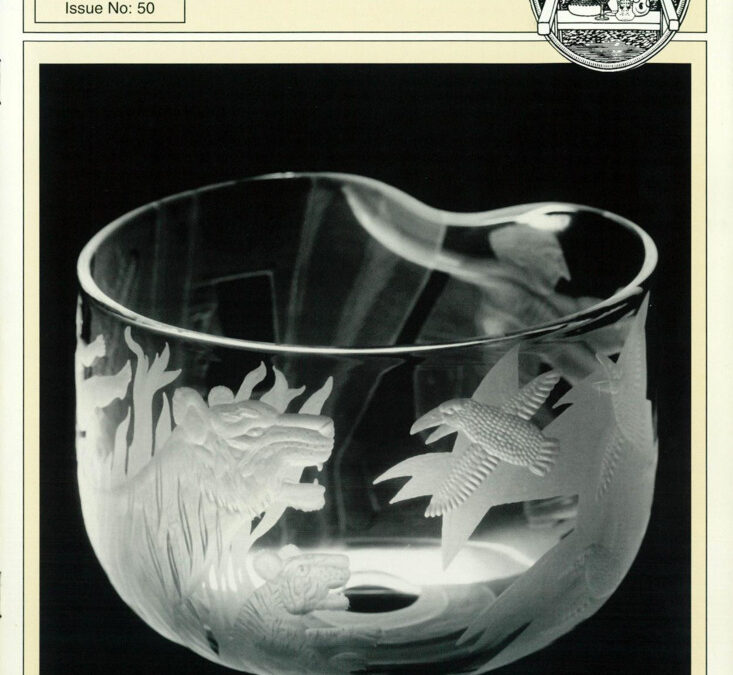
COVER ILLUSTRATION
‘Tiger Burning’, 1988. A clear glass bowl, wheel en-
graved by Ronald Pennell. (Courtesy Wolverhamp-
ton Art Gallery.)
EDITORIAL
This is the last issue of the
Glass Cone
in which John
Brooks will be involved in an editorial capacity. He
had intended to retire from the scene in 1997, after
five years of producing the Newsletter (now discon-
tinued), but then agreed to join the editorial commit-
tee of the
Glass Cone
for a limited period. Other
interests, closer to home, have now prompted him to
end his connection so all correspondence and arti-
cles for the
Glass Cone
should, in future, be sent to
Dr P. Baker, 2 Usborne Mews, Carroun Road, Lon-
don SW8 1LR or do Mrs A. Dunn, Broadfield House
Glass Museum, Compton Avenue, Kingswinford,
West Midlands DY6 9NS.
The Beilby wine glasses sold at Christie’s and
Sotheby’s, referred to in the last issue of the
Glass
Cone,
produced some interesting results. At Christie’s
the very rare glass enamelled with a sailing ship and
the name Providence sold for £29,900. By contrast
the group at Sotheby’s appeared very reasonable at
sums of between £1,380 and £9,200 but they related
to the more typical Beilby glasses which appear regu-
larly in sales and, with half of them making more
than £5,000, it is obvious that there is still a strong
demand for this type of glass.
TRAVEL AWARD
The Glass Association has given its 1999 Travel Award
(£666) to Juliette MacDonald, a self-funded PhD stu-
dent at the University of St. Andrews, researching
the stained glass windows of Douglas Strachan.
The Scottish painter and glass designer, Doug-
las Strachan, who died in 1950, was a major figure in
the Arts and Crafts movement in Scotland but little
is known of his career and very little analysis has been
carried out of his style and development, his use of
imagery and its meaning: in his later work he fused
medieval and neo-Celtic imagery with a contempo-
rary modernist form which influenced subsequent
designers. He produced over 350 windows, only a
handful of which are well known and documented.
Juliette MacDonald is particularly interested
in the symbolism of his images and how he used the
medium of glass to convey his ideas. She has already
visited churches in England and Scotland which are
readily accessible to her and will use her Travel
Award to visit more remote sites in the West of Scot-
land where there is a strong legacy of Celtic imagery
in the applied arts. She will visit 14 churches to sur-
vey and photograph 36 Strachan windows as well
as to explore the local archives, libraries and parish
records. Some of Strachan’s windows are under
threat in these remote communities and her work
will draw attention to their importance to the na-
tion’s stained glass heritage and thereby assist ap-
peals for their restoration.
Ian Turner
The opinions expressed in the Glass Cone are
those of the contributors. The editors’ aim is
to provide a range of interests and ideas, not
necessarily those which mirror their own.
However, the decision of the editorial board
is final.
COPY DATES
Autumn 1999
20 September
Winter 1999
14 November
The Glass Cone’ – Issue No 50: Summer 1999
NEW GLASS FOR OLD
History, as we know, has a way of repeating itself.
The interest which Harry Powell, of the Whitefriars
Glassworks, had in older and ancient glass is well
documented. He was not only interested in making
close copies of the things which came to his notice
but he also turned some of the designs into commer-
cial versions for the retail trade; these are now highly
collectable in their own right. When the name William
Yeoward recently came to our attention we had no
idea that we should find that Harry Powell’s philoso-
phy is alive and well in a tiny hamlet in Hampshire.
What started us on the trail was the discovery
that William Yeoward, 336 King’s Road, Chelsea,
London (opposite Beaufort Street), is selling very
good copies of 18th and 19th century styles of table
glass. Enquiries then led us to the firm of John Jenkins
& Sons Ltd., an importer and wholesale dealer of
glass and ceramics. This resulted in an interesting visit
by Ken Cannell and myself to the headquarters of
John Jenkins at Nyewood near Petersfield, where
Timothy Jenkins, grandson of the founder and cur-
rent Managing Director, told us the story of how
these reproductions came to be made which was, as
is sometimes the case, that of a happy accident. Dur-
ing the conducted tour of the showrooms (open to
trade only) which followed we passed, in the foyer, a
showcase full of modern engraved glass, the work of
well-known British engravers. This interest in engrav-
ing was reflected in what we were about to see.
We learnt that the firm was founded in 1901,
with premises in London, by John Jenkins acting as
an English distributor for crystal manufacturers in
Bohemia. It is reported that he never left this coun-
try but his son Douglas was more adventurous and,
by visiting the suppliers in Eastern Europe, developed
the business considerably. Between the wars the firm
also represented major English manufacturers such
as Thomas Webb, Edinburgh Crystal and Whitefriars.
After World War II they managed to get import
licences to restart the trade with Europe which contin-
ued until the Coronation of Elizabeth II in 1953 when
the huge business in souvenirs created a sound enough
base for the firm to give up their role as agents and to
buy and sell under their own name. However, by 1980
it was decided that there was no future as a wholesaler
of other companies’ products so they started to com-
mission production of their own designs.
In 1994 Timothy Jenkins happened to go into
the Chelsea shop of William Yeoward, a designer of
high quality furniture. There he saw some antique
drinking glasses being used to complement the furni-
ture. On enquiry William Yeoward told him that there
was a good demand for these old styles if only he could
get them in sets (and we all know how often that hap-
pens!). This possibility appealed to Timothy Jenkins
who designed and had some made samples and, in Sep-
tember 1995, exhibited the first reproductions at
Decorex, the annual interior design show in London,
under the name of William Yeoward, a name already
well known in the world of interior design. There was
enough interest to encourage Timothy to take five suit-
Period Rummer and modern copy by William
Yeoward Glass
cases of these new-old patterns to a comparable show
in New York where, as a new boy, he had to show his
wares on a trestle table in a drill hall annexe (some-
thing that will be familiar to those who deal at fairs).
This proved no discouragement to the big store buy-
ers and the interest was such that, in 1996, the com-
pany opened a permanent showroom in New York. In
the same year the firm also won the House and Gar-
den magazine prize for the best exhibit in the show, on
only their second visit to Decorex.
About 75% of their business is now in America
where their reproductions are sold in top stores across
the country and will soon be available in the museum
shops at Corning, the Metropolitan Museum of Art,
Colonial Williamsburg and Winterthur. In mid-1997
John Jenkins & Sons Ltd. took over the Chelsea shop
which now displays the full range of their products
using the brand name of William Yeoward Crystal
for all their reproductions. (For other British retail
outlets telephone 01730 821811 for your nearest
stockist.)
John Jenkins & Sons Ltd. now has an interest-
ing collection of antique glass from Britain and Eu-
rope which provides the inspiration for the William
Yeoward range although we noticed that there were
no air or opaque twist examples among them. We were
privileged to handle the originals and compare them
with the copies which, in some cases, were uncannily
accurate. (Can you tell the difference between the
original and the copy in the illustration?) It is always
a matter of concern that copies may ultimately find
their way into the antiques trade where they may be
represented as originals but all the glasses we saw were
clearly marked WILLIAM YEOWARD under the
foot. Other designs are based on design characteris-
tics drawn from several sources. This is particularly
true of the decoration on the engraved glasses where
the combination of details was not always convinc-
ing although the quality of the engraving is very high.
Cut glass has dominated the market for so many
years and it is so encouraging that one can now buy
Continued on page 6
3
‘The Glass Cone’ – Issue No 50: Summer 1999
TWO EIGHTEENTH CENTURY GLASSHOUSES
4
Derby Art Gallery owns two drawings of glasshouses
by Wright of Derby, an artist whose ascendancy in
the art world has never been higher since the interna-
tional exhibitions of his work in London, Paris and
New York in 1990.
Joseph Wright (1734-1797) was famous in his
own time for his special ability to portray the effects
of light and for his portraits. These included sitters
from the brilliant group of industrialists and scien-
tists who were at the forefront of the Industrial Revo-
lution and belonged to the Lunar Society in
Birmingham.
He was at the height of his powers in the late
1760s following the sales of ‘A Philosopher giving
that Lecture on the Orrery, in which a lamp is put in
the place of the Sun’ (now in the Derby Art Gal-
lery) and ‘An Experiment on a Bird in the Air Pump’
(National Gallery). These great ‘Candlelight’ pic-
tures were followed, in the early 1770s, by paintings
which Wright himself described as ‘Night Pieces’
showing his fascination with industrial processes.
They include ‘A Blacksmith’s Shop’ (of which there
are two versions) and ‘A Blacksmith’s Shop viewed
from without’ (now missing), ‘An Iron Forge’ and
`An Iron Forge viewed from without’. In each case
Wright uses the blinding white glow of a newly
forged iron bar as his light source.
It seems certain that Wright intended to paint a
`Glasshouse’ in a similar manner, because two pre-
liminary drawings exist showing the interiors of glass-
houses; they are both similar in style to the
preliminary drawing he had made for the ‘Iron Forge’
paintings. All three, in pen and ink on paper with grey
and brown washes, are owned by Derby Art Gallery
and the two glasshouse drawings are reproduced here.
They are thought to date to 1770-72 and Wright cer-
tainly worked them up into a sketch for a painting
because this was sold at Wright’s posthumous sale at
Christie’s on 6 May 1801 described as ‘The Glass-
House, a Sketch, the Fire exceedingly well expressed’
for £3.10.0. At that price it was clearly not a finished
work. Its present whereabouts are unknown. The in-
teresting questions, of course, are where were these
glasshouses (they are clearly not the same building),
“Study of the Interior of a Glass-House”: pen and
ink and grey wash heightened with white on paper.
(Courtesy Derby City Museum and Art Gallery)
“Study of the Interior of a Glass-House”: pen and
brown ink and grey wash on paper. (Courtesy Derby
City Museum and Art Gallery. )
to whom did they belong and, most tantalisingly, what
was being made there?
Both drawings appear to show a single circu-
lar furnace. The first has several holes for gathering
the hot glass and seems to be ‘cut away’ to reveal
the pot, or pots, within. There is a stack of firewood
poles to the left rear and a stack of cut wood (?) on
the floor to the right, but no tools. There is a cross
on top of the furnace which is a little odd. The sec-
ond drawing has less detail of the furnace but more
of the rest of the glasshouse. There appear to be
tools and a water cistern near the door on the left
and what may be a chair inside the arch to the left
rear and another, even more weakly drawn, in the
right foreground. Both buildings appear to have
stone floors, structural timber beams and wooden
ceilings! There are no products to be seen in either
and no indication of location.
Where were they? It isn’t known for certain but
we can make a guess. There is a high probability that
they were both owned by James Keir. Wright was a
great friend and neighbour of John Whitehurst, the
Derby clockmaker and amateur geologist, who was a
prominent member of the Lunar Society together with
Josiah Wedgwood, James Watt, William Strutt, Mat-
thew Boulton, James Keir and Joseph Priestley, all
of whom shared a common interest in natural phi-
losophy and were pioneers of the English Industrial
Revolution.
James Keir is one of the least known figures but
his signature appears alongside those of Wedgwood,
Erasmus Darwin, Priestley and Boulton as sponsors
to the election of Abraham Bennett as a Fellow of
the Royal Society in 1789 and there is documentary
record of Keir’s collaboration with Josiah Wedgwood
to improve the glaze used in Wedgwood’s Etruria fac-
tory in the late 1770s. Indeed, Keir is known to have
suggested to Wedgwood how he could improve his
glass frits by switching to flint glass, and Wedgwood
in his turn suggested to Keir ways in which ‘streaks
and cords’ might be reduced in glass manufacture.
This pooling of knowledge by members of the Lunar
Society was one reason why they were able to improve
technology in so many fields.
‘The Glass Cone’ – Issue No 50: Summer 1999
Resulting from Whitehurst’s close friendship with
Wedgwood and Wright, Keir’s work with Wedgwood
and his supply of glass urn bodies to Matthew
Boulton’s Soho Manufactory in Birmingham, it has
plausibly been suggested (by David Fraser) that both
of Wright’s glasshouse drawings are of Keir’s glass-
houses in Etruria or Birmingham, probably the former,
although Keir is also thought to have had glasshouses
in London and Liverpool. As for the products made
there, that is pure speculation, but they may both have
been for the manufacture of glass frits for the ceram-
ics industry in what is now Stoke-on-Trent.
And there the story ends for now, unless any
member has more information than the author about
Keir’s factories and their products. All that I have
found has been gleaned from the erudite catalogue
for the ‘Wright of Derby’ exhibition, produced un-
der Judy Egerton’s editorship for the Tate Gallery in
1990, and from Maxwell Craven’s book
John
Whitehurst of Derby
(1996). Readers wanting to know
more about the Lunar Society should consult Robert
Schofield’s
The Lunar Society
(1963).
What a shame that Wright did not go on to com-
plete his ‘Night Piece’ of ‘A Glass-House’, with the
blinding white light coming from the mouth of the
pot as an eighteenth-century gaffer shaped one of
Matthew Boulton’s urns, watched by visiting mem-
bers of the Lunar Society. If that is what the lost
`Glass-House Sketch’ shows and anyone knows where
it is, I would like to know.
Ian Turner
A MACE FOR WALES
To mark the historic opening of the new Welsh Na-
tional Assembly in May this year, Artwork Wales, on
behalf of the people of Wales, commissioned the
Cardiff-based glass artist, Jane Beebe, to create a new
mace as a constant reminder to assembly members
of the need to be a bridge between the past and the
future.
The brief required that the mace should sym-
bolise the continuity of Wales as a physical entity and
to embody the principles of the Assembly to be for-
ward looking, open and transparent in its dealings.
Jane Beebe decided “to create a work that expressed
the beauty of the materials indigenous to Wales which
would reflect the spirit of the Welsh people, confi-
dent in their rich heritage, to move forward with open
minds.” The materials she selected were glass for its
transparence and luminosity, steel and coal to recall
the great industrial and social history of Wales, and
slate and gold to record the traditional workings in
the Principality. She says she was aware of the prob-
lems, “These five materials are beautiful in their own
right and require a great deal of respect and sensitiv-
ity (from the maker) in their working to maintain their
inherent qualities.”
After her design was approved, Jane Beebe be-
came the project manager. With a mere four weeks to
deliver the finished work, time was of the essence:
“The deadline was absolutely finite; the Queen was
coming to open the Assembly officially. I could hardly
be late! Thoughts of being locked in the Tower of
London forever echoed through my dreams.” She al-
ready knew whom to ask to assist: Jan Adam for the
blacksmith elements, Roger Williams for the gold-
work and two fellow glass-makers, Steve Fry and Carl
Nordbruch. Rachel Woodman’s father, Bernard,
agreed to engrave the commemorative plaque. Each
had worked with Jane in the past, but not with each
other. The deadline was met. The finished work, in-
corporating the slate and steel base stands 3feet high,
2’/2 feet wide and 9 inches deep (91 x 76 x 23cm). Jane
and her team felt that their love of the materials in-
volved and their commitment to craftsmanship “re-
sulted in the piece taking on its own life and is greater
The TLWS. The Mace, designed by Jane Beebe, for the
new Welsh Assembly. (Courtesy Trudi Ballantyne.)
than the sum of its parts. It now has a soul and spir-
ituality, and no longer belongs to me.”
As if reaching out to the whole Assembly, and
thus to the people of Wales, the frosted glass arm
has at its centre a band of gold in which is embedded
a piece of slate. It was named `Tlws’ (pronounced
Tloose) which in Welsh means both ‘trophy’ and
`beauty’. As a very public work of art, not only did
its presentation mark a historic moment but would
the people of Wales accept it as truly affirming their
values and their aspirations for the future?
All
the
signs are that they have. Although she has years of
experience in making work for special exhibitions at
home and abroad, and in undertaking design projects
for industrial glass, the full impact of the importance
of the commission only hit Jane Beebe after its com-
pletion. She says, “It sounds pretentious to say so,
but the experience has changed me and there is no
going back”.
5
The Glass Cone’ – Issue No 50: Summer 1999
ervvZ;It.
GLASS-MAKING IN LEEDS
tagi,Mr.
;Ta
r
a Ali’Vealaaater
1
4.
1
.o
6 mid ii az Octagons .6 , (L12.14
and 16
toz. F efts,
enr.
//’*A4ree.?46%1M44;;04,K(4:4
:zior.oelet
Two brothers, John and Joshua Bower, each had a
glass-making factory in Hunslet, Leeds in the second
quarter of the 19th century. The only reference to
these factories I have been able to find in the glass
literature is one paragraph in
British Table & Orna-
mental Glass
by L.M. Angus-Butterworth, (London
1956) and a mention in an article by Frances Buckley
in the
Transactions of the Society of Glass Technol-
ogy,
Vol. 8 (1924) entitled ‘Note on the Glass Houses
of the Leeds District in the 17th, 18th and 19th cen-
turies’ (my thanks to Roger Dodsworth who drew my
attention to this article).
Apparently around 1814 a glassworks was es-
tablished in Hunslet known as Bower, Smith & Co.
but by 1818 the two Bower brothers had started their
own businesses: Joshua producing crown glass and,
according to a local directory of 1830, John making
bottles, flint glass and, by 1834, church windows had
been added to his production list. John Bower closed
down his works sometime between 1849 and 1853,
and Joshua a little later.
A few years ago I was looking idly in a philat-
ely shop window when I saw an early cover [envelope]
addressed to a druggist in Beverley with a post-mark
of Leeds June 7th, 1832 and a stamp ‘too late’. Peo-
ple obviously just missed the post even then. The
dealer had also made a pencil note ‘pictorial inside’.
The letter turned out to be an invoice dated as the
post-mark from John Bower to Messrs. Bill Robinson
& Son, Druggists, Beverley and the letter-heading (il-
lustrated above) shows a factory with three glass
cones and on the left can be seen retorts.
A transcription of the invoice is given below:
111 Doz wine bottles @ 216
£ 13 17
6
12 Doz Berry pints 31-
1 16
12 Doz oval Jills 119
1
1
12 Doz Porter pints 2/-
1
4
1 Gross 16 oz Flatts [?] 201-
1
1
36 Pint flint bottles 14..I1[?] 114
19
7
3 Doz opal green & blue
smelling botts 5/6
16
6
1 Doz Justris smelling bottles
light blue 6/-
6
4 hogs heads 3/-
12
1 hamper 112
1
2
1 crate 11-
1
[wording illegible]
21 15
9
Gent[leme]n
The above are forwarded by Clarks vessels Captain
Crawshaw to Hull which hope will arrive safe &
[?please] soliciting your future [?favours].
I remain, Yours respectfully Pro Jn Bower, J.
Williamson
Further information about this glasshouse
would be most welcome.
John P. Smith
6
New Glass for Old — continued from page 3
good quality engraved glass for use at home. The en-
graving is mostly carried out by women in the glass
houses in the Czech Republic, Slovakia, Hungary and
Poland where the glasses are being made. What a pity
that there is apparently no source in this country ca-
pable of volume engraving to this standard.
What is it that makes these older styles so ap-
pealing? Could it be that the old glassmakers, work-
ing with hand and mouth, had a real ‘feeling’ for the
material and what it could do which resulted in natur-
ally harmonious designs? This ability appears only
to survive generally, in Britain, among studio
glassmakers who presumably cannot compete with the
commercial scale of factory-made glass.
Like Powell before, John Jenkins has used a com-
bination of historical knowledge and commercial en-
terprise to revive these earlier styles and bring them
to a new market and I wonder how long it will be
before they become collectable in their own right? If
anyone has thoughts or comments to make about the
subject of reproductions or commerce versus studio
we would be pleased to hear from you. Incidentally,
the John Jenkins copy of the square-footed rummer
is on the right in the photograph.
J. Brooks
‘The Glass Cone’ – Issue No 50: Summer 1999
BOOK REVIEWS
THE GLASS OF JOHN WALSH WALSH 1850-1951
Eric Reynolds. Pub. Richard Dennis. 1999, ISBN 0
903685 69 8 softback £20; ISBN 0 903685 74 4 hard-
back £25. 148pp, 40 colour plates 170 b/w and 180 figs.
Eric Reynolds’ interest in the Walsh Walsh company
stemmed from an article by Roger Dodsworth in the
Glass Association
Journal
(No. 1, 1985) in which he
commented that little had been written on the com-
pany. The result is this, the first book devoted to the
John Walsh Walsh glassworks, which operated in Bir-
mingham, UK until 1951.
The extent of Reynolds’ research, not only into
the glass but also the history of the family and their
relationship with the company throughout its exist-
ence, became obvious to everyone who attended his
talk to The Friends of Broadfield House Glass Mu-
seum last autumn. Unfortunately, presumably for lack
of space, only brief references to this research on the
family are made in the first chapter before dealing, in
the second chapter, with the experimentation and in-
novation in design and technique introduced by the
company up to the end of the 19th century.
The fact that other companies imitated many
of the Walsh Walsh patterns is evidence that the firm
was among the market leaders and why they took care
to register many of their designs (a warning for to-
day’s collectors). Details of some patents and prod-
ucts, other than cut glass, which were introduced by
the company up to the end of the 19th century are
included: cased tableware, lamp chimneys and shades,
commercial items, muff sheet glass, millefiori canes
and raw materials for the Birmingham button indus-
try. The book then records the new product lines,
some continuing for many years, which were brought
in during the difficult trading conditions of the early
20th century. The financial management of the com-
pany by L. J. Murray and his work to improve rela-
tions between employees, management and the trade
associations are covered too briefly for this reader.
The years after World War I saw the continued devel-
opment of new designs, the introduction of colour
and of the Walsh trademark in 1926.
The 1930-45 period is covered in more detail with
good illustrations demonstrating not only the many
popular products but also the design contribution of
Clyne Farquharson. William Riley’s business acumen
ensured the fortunes of the company up to and includ-
ing WW II, but labour intensive methods linked with
high quality standards led to a struggle to survive and
the eventual closure of the company in 1951.
More than half the book is devoted to complete
reproductions of the two surviving works pattern
books from 1925-51, and the colour plates are par-
ticularly good. Its modest price will surely attract those
readers with only a passing interest in Walsh Walsh
glass but the brevity of the text can only whet the ap-
petite of the serious collector. There is, for instance,
no bibliography and the inclusion of a family tree
showing who was directly involved in the company
would have made interesting reading. That being said,
this publication will undoubtedly stimulate interest in
the glass of this influential Birmingham company.
An interesting personal note is introduced in a
forward by Peter Riley (son of WG Riley, MD 1927-
51) which provides memories, through a young boy’s
eyes, of the 1930s-40s period.
Peter Beebe
ENGRAVED GLASS – INTERNATIONAL CON-
TEMPORARY ARTISTS, Tom and Marilyn
Goodearl, Antique Collectors’ Club, 1999, ISBN 1
85149 307 7, £35. 207pp, 200 colour photographs.
It may be a trite statement, but the only way to ap-
preciate glass fully is to see it and handle it. Illustra-
tions serve a valuable purpose but they are not the
real thing! This was confirmed to me beyond doubt
at the recent excellent exhibition of engraved glass
mounted at the Glass Art Gallery in London to ac-
company this publication. However, exhibitions of
this range, quality and presentation are rare, espe-
cially outside the main cultural centres, so the book
provides an alternative and valuable access.
There have been numerous books on modern art
glass, often, I am afraid, using the same well-known
images but nothing comparable has been devoted to
engraved glass; certainly not in this larger format and
in colour throughout. In this respect this work can
be seen as a complement to Peter Layton’s
Glass Art
(1996) which explored form rather than decoration.
All the usual types of engraving are included together
with graal, sandblasting and acid etching.
The photographs are generally excellent and I
recommend the book for these alone. However, I do
have reservations regarding the text.
There is an exemplary introduction highlighting
the general unawareness of engraved glass and setting
out clearly the book’s objectives. Unfortunately, the
rest of the text does not maintain the same standard.
There is no history of engraved glass, as such, which
would would have been of greater interest and rel-
evance than the brief history of glass-making and the
description of glass-blowing which are included and
which, together with the glossary, are misleading in
several respects. The main text relies considerably on
the information submitted by the artists themselves,
which inevitably results in unevenness in pace and style.
Entries range from a few lines on the artist’s exhibi-
tion record to fully-fledged
curricula vitae,
while analy-
sis of the work varies from the highly technical to the
mystical. Standard technical descriptions of each piece
would have been better, too.
As this is a British publication, there is an inevi-
table bias towards UK engravers – nearly half the 65
represented. That said, it is reassuring that their work
is considered to be among the best. (Runners-up are
Germany with nine, and USA with six.) The absence
of anything from Scandinavia is very surprising. Does
this indicate a lack of response to the editor’s requests
Continued on page 8
7
The Glass Cone’ – Issue No 50: Summer 1999
EXHIBITIONS, FAIRS & SEMINARS
From 18th September – 13th November 1999 WOL-
VERHAMPTON ART GALLERY & MUSEUM,
Lichfield Street, Wolverhampton WV1 1DU. tel:
01902 552055 will present an exhibition of the works
of Ronald Pennell titled MODERN MYTHS. Since
summer 1998 Pennell has been working at the Uni-
versity of Wolverhampton Glass Department as Vis-
iting Professor. This has resulted in a body of new
glass forms which combine casting with engraving.
100 exhibits will be on display of which one third will
be new works.
The exhibition will subsequently tour to Phillips
Auctioneers, London; the National Museum of Scot-
land, Edinburgh; National Glass Centre, Sunderland
and the Castle Museum & Art Gallery, Nottingham.
This year’s DUDLEY GLASS FESTIVAL runs from
26 September to 3 October. It will include work-
shops, the antique glass roadshow, exhibitions, guest
lectures, demonstrations and an auction. For de-
tailed information apply to Broadfield House Glass
Museum, Compton Drive, Kingswinford, West Mid-
lands, DY6 9NS.
From 10th August – 26th September the NATIONAL
GLASS CENTRE, Liberty Way, Sunderland, tel: 0191
515 5555 will present an exhibition of the work of
Emma Woffenden, her first outside London. Her work,
although primarily of glass, incorporates other mate-
rials like rubber, metal and plastic. This will be fol-
lowed, from 5th October – 5th January 2000 by an
SWEDISH TRIP
We have received replies from 40 members saying that
they would like to visit Sweden. Not quite as many
as on our two previous visits to the Continent but
enough for us to start making plans. A preliminary
private visit has highlighted the problems and oppor-
tunities. The basic problem is that the main glass
working region in Sweden is too far from Stockholm
to allow us to include a visit to the national collec-
tions in the same itinerary. However, the opportunity
could be a visit to the `Rosenborg Collection’ in Co-
penhagen which is within walking distance of the
Malmo-Copenhagen hydrofoil. Rosenborg castle is a
royal palace which houses a collection of 17th and
18th century Venetian glass, purchased by King
Frederick IV in 1709. Norwegian 18th century glass,
its style influenced by glass-makers introduced from
England, is also represented since Norway was ruled
by Denmark until the early 19th century. We hope,
therefore, to be able to arrange a varied programme,
possibly split between two centres, covering 300 years
of glass history.
Your response was gratifying and if any other
members would like to join the party please let me
know as soon as possible.
John Delafaille
exhibition of the recent work of Norwegian artist
Franz Widerberg. A renowned painter and printmaker,
he has recently turned his attention to glass.
NORTHLANDS CREATIVE GLASS are running the
following master classes at Quatre Bras, Lybster, Caith-
ness KW3 6BN, tel: 01593 721325. From 6th – 10th
September THE STORY OF GLASSBLOWING, led
by Swedish glass artist Jan Erik Ritzman and Josiah
McElheny, will explore the potential of glass as a sculp-
tural medium. From 13th – 17th September SOLID
LIGHT – SCULPTURE – GLASS will be led by Tony
Cragg, a sculptor in more conventional materials who
turned his attention to glass in 1986. He will work with
a team led by Neil Wilkin.
These classes are intended for professionals or ex-
perienced students in any branch of the arts interested
in investigating the sculptural possibilities of glass.
Between these two courses there will be a week-
end conference from 11th – 12th September. Speak-
ers will include the artists mentioned above and
Michael Robinson, Ian Hunt and Kate Broom. Fur-
ther details of all these events can be had from Ian
Gunn at the above address.
Peter Layton informs us that about two-thirds of the
exhibition of engraved glass which was held at the
Glass Art Gallery in London to coincide with the
publication of Engraved Glass-International Contem-
porary Artists is moving to the Montpellier Gallery
in Stratford-on-Avon in July.
BROADFIELD HOUSE
Louise Edwards and Colin Hawkins are the 1999
Broadfield House Studio Scholarship winners. The
scholarship will enable them to use the studio facilities
at the Glass Museum, so giving them the experience of
running a workshop with direct public contact and an
introduction to the world of professional glassmakers.
After graduating from Sunderland University
Colin Hawkins studied at the Royal College of Art,
London, and then assisted in the Blow-Zone studio
in Amblecote. Louise Edwards spent a year at the
International Glass Centre in Brierley Hill after her
BA degree at Goldsmiths’ College. Together they will
trade under the name Lo-Co Glass.
Book Reviews — continued from page
7
for information, or evidence that Scandinavian glass
artists are moving away from engraving? If it is the
latter, how different from the 1920s-30s when, argu-
ably, they were the world’s leaders.
K. Connell
Catalogue No. 47 of books on antiques and collecting,
including sections on glass, is now available from John
Ives Bookseller, 5 Normanhurst Drive, Twickenham,
Middlesex, TW1 1NA, Tel: 0181 892 6265.