




The Magazine of the
Glass Association
Registered as a Charity No. 326602
Chairman
Ian Turner
Hon. Secretary
Dil Hier
Editorial Board
Patricia Baker, Ken Cannell, Brian Currie,
Roy Kingsbury
Addresses for Glass Cone correspondence
2 Usborne Mews, Carroun Road, London
SW8 1LR
Broadfield House Glass Museum, Compton
Avenue, Kingswinford, West Midlands
DY6 9NS
Address for membership enquiries
Membership Secretary, 50 Worcester Road,
Middleton, Manchester M24 1WZ
ISSN No. 0265 9654
Printed by
The Charlesworth Group
Published by
Society of Glass Technology for the Glass
Association
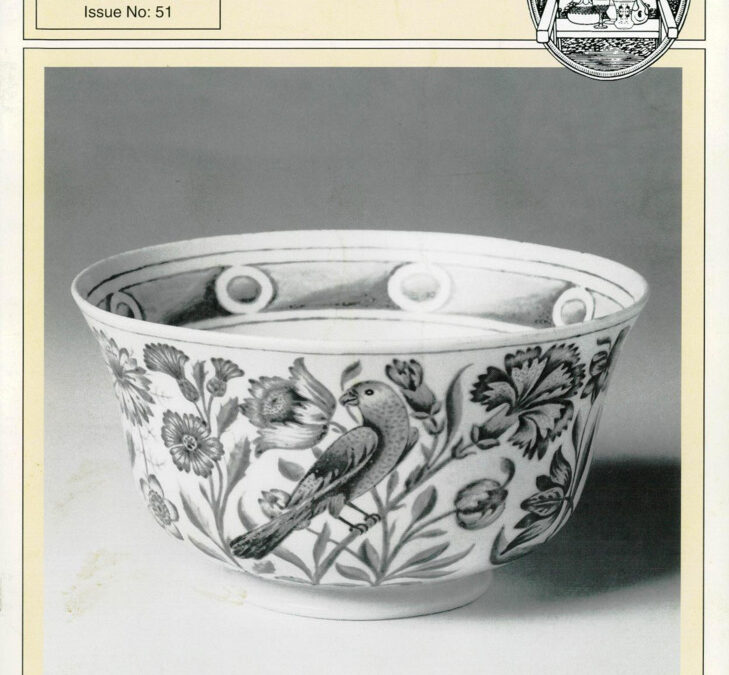
COVER ILLUSTRATION
A rare opaque white `lattino’ glass bowl, mid-18th
century, attributed to the Brussa workshop of
Murano, Italy, to be sold by Phillips, London on 24
November 1999. The gaily-painted details include a
parrot, a goldfinch among carnations, tulips and daf-
fodils, a decorative repertoire clearly influenced by
17th century Ottoman Turkish ceramics.
(Courtesy of Phillips Auctioneers, London)
EDITORIAL
Our Apologies
The unfortunate delay in printing the last, summer
issue (no. 50) of the
Cone
meant that many items
regarding exhibitions, conferences and sales were out-
dated by the time the magazine was despatched. We
do apologise. As it was, that page underwent exten-
sive revision after the text was submitted for print-
ing when it was clear that a delay was inevitable, but
further difficulties with the printing schedule totally
outside our editorial control then occurred. Sincere
thanks to John Brooks and Ian Turner for burning
the midnight oil making these revisions only to be
thwarted yet again.
Where’s John Brooks ?
Everybody could recognise John at meetings from a
distance, either by catching sight of his distinctive
beard and cheery smile, or hearing the boom of his
voice. His presence is going to be sorely missed by all
and particularly by his co-editors. Simply, it was a
pleasure to work with him, and for him. Our grateful
thanks to him for all his hard work for revitalising
the publication-side of the Association, being respon-
sible for creating the Newsletter along with Ken
Cannell, and then involving himself directly with the
Cone.
His retirement from the scene does leave us with
more than one problem. Ian Turner, our Chairman,
has already alerted the membership to the need to
find additional editorial assistance especially if the
established printing schedule is continued, as one of
the co-editors has long had working commitments
abroad during the time when the final texts of two
issues have to be submitted for layout and proof-read-
ing. We aim to prepare in-house as much of the DTP
as possible
this we hope will reduce not only the
time but costs incurred by the SGT and printers. We
will also be investigating the possibilities of chang-
ing the submission schedule, and with this in mind
you will have noted that this issue, no. 51, runs to 16
pages and combines both autumn and winter issues.
But John Brooks did much more. We particu-
larly need a contributor to undertake coverage of the
main auction houses’ sales. This could be in full or
just minimal detail, recording the hammer prices and
such information is directly available by fax from the
auction houses concerned, so it could involve little
time, providing one has access to the sales catalogues.
Also if one or more of our members who regu-
larly takes a ‘serious’ national newspaper could cut
out (after recording the source and date) any news
item concerning glass, whether business, archaeologi-
cal, foreign and home production and send such
cuttings to the editors, this too would be most wel-
come. Do we have any offers ?
The opinions expressed in the Glass Cone are
those of the contributors. The editors’ aim is
to provide a range of interests and ideas, not
necessarily those which mirror their own.
However, the decision of the editorial board
is final.
COPY DATES
Spring 2000
14 February
Summer 2000
14 May
7
7
7
The Glass Cone’ – Issue No 51: Autumn/Winter 1999
THE 1999 AGM IN OXFORD
October 23 was a wet and very windy day but about
40 members of the Glass Association came to Worces-
ter College, Oxford, to attend the Association’s 16th
Annual General Meeting. As has become the custom
and practice for our AGMs, there was a morning of
enjoyment before settling down to receive the report
of the last year’s activities. Timothy Wilson of the
Ashmolean Museum gave an entertaining, illustrated
talk showing some of the treasures of Western Art
now in the museum collection, peppered with numer-
ous scurrilous and acerbic comments from its collec-
tors and curators since its establishment in 1683 (thus
its justifiable claim to be the world’s first public mu-
seum). He also spoke of the other glass, mostly
stained, for which the Oxford colleges are well-
known. Then Martine Newby, coping valiantly with
a temperamental projector, highlighted the outstand-
ing pieces of glass at the Ashmolean which either have
come into the museum from archaeological work,
from bequests (the Fortnum collection, the Mrs
Marshall legacy, etc.) or are on loan from present-
day collectors. Her excerpts from Mrs Marshall’s
record book which noted the prices she paid, the at-
tributions given by dealers, and her direct comments
about these, the vendors, curators, etc. showed with-
out doubt the usefulness (and future enjoyment for
others) of keeping such records.
After a buffet lunch in the Great Hall of Worces-
ter College, the business of the AGM quickly got
underway with first Chairman Ian Turner, then Hon.
Treasurer Brian Currie and finally Membership Sec-
retary Peter Beebe summarising the Association’s ac-
tivities during the past year.
Ian Turner reminded members that through-
out its existence the Association had tried to pro-
vide a balanced programme of activities for members
by organising national and regional meetings, visits
(including two overseas trips, to Liege and Nancy),
and by publishing the
Glass Cone
and the
Journal,
all to promote the understanding of glass and glass-
making methods in accordance with our aims and
objectives.
The extensive questionnaire of the membership
undertaken in 1996 had resulted in certain changes
in priorities given to different activities. For example,
greater effort has been made to try to ensure four
Cones
are published each year, and a firm commit-
ment to maintaining the quality of the
Journal,
and
its publication on a more regular basis, approximately
every two or so years. The number of National Meet-
ings has been reduced from four to three, but this
could be increased if the opportunity arose.
In this, his first report, he was pleased to note
that the Association’s activities had generally reflected
these priorities. There had been three high profile
national meetings: last year’s well-attended meeting
before the AGM at the Stuart Crystal factory in
Wordsley (with Brian Watson on ‘Norfolk Glass’, Dil
Hier on ‘Burmese Glass’, and Peter Beebe on ‘Carni-
val Glass’); in May 1999 the London meeting in con-
nection with the spectacular Danny Lane exhibition
BREAKING TRADITION at Malletts, Bourdon
House which included talks by John Smith and
Danny Lane; and in mid-July on one of the hottest
days of the summer, the third in the Crystal Centre,
Amblecote, on the theme of the ‘English Cut Glass
Tradition’ with contributions from Charles
Hajdamach, Ian Wolfenden and Royal Brierley’s
Chief Designer, David Redman.
Many thanks were due to Aileen Dawson who,
as previously announced to the membership, stepped
down as Events Secretary after the AGM.
The Regional groups had been active. The
North-West and North-East have both held several
meetings in the past year, the South-West following
a more modest programme reflecting the smaller
number of members, while the South-East had seen
a revival. Sincere thanks to organisers, Alan Comyns,
Rita Pearce, Richard Giles and Geoff Timberlake
were recorded. Taking on the post of Chairman, Ian
Turner had resigned as the Midlands programme
organiser and he hoped that someone will volunteer
to take on the Midlands group, and if anyone offers
to set up another grouping in say Scotland or Wales,
the Committee would be ready to give both practical
and financial support. The Chairman then paid trib-
ute to the staff of Broadfield House Glass Museum,
especially Annette Dunn and Charles Hajdamach for
all the hours of work done on our behalf.
Credit was due to the Editorial Board for pro-
ducing the
Cone,
despite practical and logistical dif-
ficulties. We have now switched to publishing through
the Society of Glass Technology in Sheffield and us-
ing its printers. It is urgent to replace John Brooks,
who has resigned in order to pursue other non-glass
related activities. As far as the
Journal
is concerned,
the new editor, Roger Dodsworth, has advised the
Committee that enough material has been promised
to plan publication this coming summer. It is hoped
that the issue will include submissions from the win-
ners of the Association’s Travel Bursary Award
scheme. In the near future there are plans to put the
Association on the World Wide Web, and members
were able to see a detailed layout proposed by Geoff
Timberlake.
Ian Turner then spoke of the proposal to award
Life Membership of the Association to two of our
founder members for their outstanding service: John
Brooks, and Ron Brown, who was both Treasurer and
Membership Secretary, and known to many as an
expert in Davenport glass. The AGM was unanimous
in its approval of this move.
Brian Currie then presented the accounts for the
previous financial year. The Association’s turnover had
now crossed the £10,000 threshold, and so a more for-
mal financial statement was required under the Chari-
ties Acts rules. The subscription increase had offset a
slight fall in the number of members. The financial
surplus from events was lower, but a saving of over
£1000 on the printing and distribution costs of the
Cone
meant that the overall surplus for the year was
£1,309. Copies of the Trustees’ Report and Accounts
The Glass Cone’ – Issue No 51: Autumn/Winter 1999
are available to any member on request. He paid trib-
ute to Sheila Leonard, the former Treasurer, for all
her hard work in keeping the Committee both well
informed and well-behaved, and to Eric Reynolds, the
independent examiner. He ended by reminding the
membership of the Association’s charity status, and
suggested that some might like to consider giving a
donation by gift or legacy which would then be re-
corded in the financial statements in perpetuity.
Peter Beebe then reported that some sixty new
members had joined in the past year, but perhaps
because of the increased subscription rates, non-
renewals (especially of overseas members) had ex-
ceeded this number for the first time in the Associa-
tion’s history. Total membership stood at 711, as of
31 July 1999, of which 30 were corporate members.
Two new Committee members were then elected
and welcomed. Sue Newell, well-known in the North-
East region but now living in London, joins the com-
mittee and John Delafaille takes on the post of Events
Secretary. He spoke briefly about the Association’s plans
for 2000: a visit in spring to the ‘World of Glass’ St.
Helens, and the proposed 5-day visit to Denmark and
Sweden in the early summer, but he warned that a ma-
jor exhibition/trade event in China could cause serious
organisational difficulties for the Swedish factories.
SAPPHO COMES HOME
4
The Sappho plaque, c. 1895, by George & Thomas
Woodall, 32
oo
19.5 cm (Courtesy of Broadfield
House Glass Museum)
In May 1999, a superb cameo glass plaque, the work
of 19th century brothers, Thomas and George
Woodall, appeared at auction at Bonham’s, London.
Featuring the Greek poet Sappho (d.c.612 BC) re-
nowned for her passionate (‘white heat in which all
dross is burnt away’) lyrical poetry, the plaque dates
from c. 1895 and was recorded in the Woodall records
as W2790 with the information that the brothers were
paid £23.10s for their hours of work while the final
retail price was £52.10s. This may sound nothing but
the V&A Ardabil carpet was purchased two years
previously for £2500, the equivalent of r million
today, so add two zeros to these prices.
It was known that George Woodall’s daughter,
Amy, was the model for the figure of Sappho, and
probably he was responsible for this section of work,
while brother Thomas carved the detailed architec-
tural frame; such jointly signed pieces are very rare.
In fact twenty-six pieces of Woodall cameo
work seem to have survived, yet their records list over
1020 items. (The ivory cameo vase, linked to a
Woodall Webb design 1.198, in Sotheby’s 30 Novem-
ber 1999 sale, may be another; Eds.) Of these, only
five are in the UK presently on loan to the V&A Mu-
seum, London but their owners reside aboard; the
other twenty-one pieces are in private or public US
collections. No wonder Charles Hajdamach and
Roger Dodsworth of Broadfield House were deter-
mined to acquire this item for the museum. With
grants promised from the Heritage Lottery Fund, the
V&A Museum Purchase Grant Fund, and Dudley
MBC’s Glass Heritage Fund, they managed to raise
£40,000
enough, it was hoped, to enter a successful
bid including the buyer’s premium. In the event the
piece went to an American buyer for a total of
£43,500. But the story did not end there.
The buyer of course had to apply for an export
licence. Two weeks before the August hearing,
Broadfield House heard that he was withdrawing his
application, and was willing to offer the plaque at
the auction price to the museum.
The telephones and fax machines hummed as the
HLF and the V&A were asked to increase their grants,
and meanwhile the Friends of Broadfield House swung
into action. Their successful Valuation Day (organ-
ised with the assistance of Phillips, London) brought
in welcome additional monies, augmented by another
gift of £5000 from the Friends. So this marvellous
high-quality example of 19th century cameo glass
carving of two of Stourbridge’s famous sons has come
back to the town. Our congratulations to everyone
involved. Once more it shows the important role of
the Friends of BHGM, established only six years ago.
In late spring 2000 Chris Perry will publish his
book on the Woodalls, which will contain many new
details regarding the family history, and Broadfield
House will mount an exhibition about their work.
No doubt the Sappho plaque will take pride of place
in the display. (Our thanks to the Friends, and Chris
Perry in particular for thig information; Eds.)
‘The Glass Cone’ – Issue No 51: Autumn/Winter 1999
WHY SO LITTLE RED PRESSED GLASS?
As far as the
Glass Cone
is concerned, my only role
appears to be that of asking questions to which no-
one as yet has come up with any answers. Disap-
pointed but undeterred, here is another query.
Why is there so little red pressed glass? When-
ever I look at my collection (and others of pressed
glass) I am always struck by the preponderance of
blue, white, yellow, cream and various marbled ef-
fects and hardly any red or pink. While it is true that
I am particularly fond of blue, the composition of
my collection is not due to any bias but simply re-
flects the rarity of red pressed glass. Not only is red
glass rare in pressed form but it receives relatively
little mention in the standard text books. Colin
Lattimore in
English 19th Century Pressed Moulded
Glass
(1979) states that Sowerby introduced a deep
red translucent glass they called
Rubine
in 1881 and
this appears to be the first use of red as a colorant
for pressed glass in the United Kingdom. Both Simon
Cottle in his book on Sowerby (1986) and Charles
Hajdamach
British Glass 1805-1914
(1991) state that
Sowerby marketed three types of red glass under the
names of
Ruby
for the standard colour,
Rubine
for a
later pinker version and
Rose Opalescent
for a shaded
heat-reactive effect. In 1883 the New England Glass
Company of Massachusetts granted a licence to
Sowerby to make pressed
Amberina
but this is quite
distinctive and unlikely to be confused with true red
glass and is, in any case, rare in itself. The only other
pressed glass I have come across which could be de-
scribed as red and not, as far as I know, mentioned
in any of the standard works on pressed glass is the
opaque dark red glass of Greener.
The position with regard to pink glass is simi-
lar. Until Davidson introduced their well-known
Pat-
ent Rose
in 1896 there was very little of this colour
on the market. This is a rather insipid pink which
appears quite commonly at antique fairs today and,
judging from the relatively low prices asked, is not
particularly high on any collector’s shopping list. The
Sowerby ‘Ruby’ ( left), Greener Opaque Red ( top
centre), Burtles & Tate ‘Sunrise’ (below), Sowerby
`Rose Opalescent’ or stained blanc de lait (right),
(private collection)
Opaque Red, Greener production (private collection)
only other pinks, of which I am aware, are Sowerby’s
stained
blanc de lait,
presumably the same as the
Rose
Opalescent
mentioned by Cottle and also Hajdamach
(see this issue; Eds.). Of a very similar appearance to
Sowerby’s stained
blanc de lait
is the pink-tinged opal-
escent glass of Burtles and Tate known as
Sunrise
and introduced in 1891, according to Raymond Slack
English Pressed Glass 1830-1900
(1987); it is found
only rarely today and tends to be priced accordingly.
So to return to the original question
why was
so little pink or red glass produced in pressed form?
Why did it take until 1881 to produce any at all and
why was it apparently only Sowerby who produced
truly red glass and this in a limited range of pat-
terns? Although red had reputedly been a difficult
colour to produce in earlier times, we know there had
been a dramatic increase in its production in the 19th
century and red became very popular in blown glass
in the last quarter of that century as seen in the ubiq-
uitous Cranberry glass (John Brooks, ‘Cranberry
Glass’
Antique Collecting
Vol. 33, vii (1998-9). It is
all the more surprising, therefore, that red was not
used more often as a colorant for pressed glass. Was
it a matter of cost? I have no information as to the
relative price of the same pieces in different colours
compared with red, but I doubt if there was such a
vast difference as to account for the scarcity of red
in pressed glass.
I wonder if there was some quality in the red
glass mix which made it difficult to handle for press-
ing purposes but again this seems unlikely. Whatever
the reason, red remains an uncommon colour in
pressed glass and I should be interested to know if
anyone can put forward an explanation for this.
Deryk Snow
The Glass Cone’ – Issue No 51: Autumn/Winter 1999
THE AUTUMN SALES
This November and December have seen some ex-
quisite British and Continental glass coming up for
sale at the major London auction houses.
Christie’s in King Street started in splendid
manner on November 8. The glass section of the sale
was arranged essentially chronologically, beginning
with German, Low Countries and
facon-de-Venise
glass of the 17th and 18th centuries. An exceptional
goblet by
J.
W Kaldenbach and dated 1678, engraved
with Diana surprised in her bath by Actaeon, depicted
semi-transformed into a stag, made the highest price
in the glass section when it sold for £17,000. A fine
Dutch-engraved light baluster goblet, decorated in
the manner of Christoffel Schroeder with Neptune
in his sea-chariot and dating to 1760, sold for £7500.
Christie’s also offered a single-owner collection
of English and Irish cut-glass of the late 18th and
early 19th centuries. Among this collection were a
pair of blue ewers, which are perhaps unique, and
attributed to the 18th century London glass-cutter
Thomas Betts, whose workshop was in Lewisham.
These made £8,500. There was some later glass in-
cluded in the sale, illustrated here by the Webb ‘rock
crystal-style’ vase cut and engraved by W. Fritsche
and signed by him, which sold for £2600.
There were also over fifty lots of paperweights
offered, the vast majority of which found buyers.
Most unusually, there were eighteen weights included
in the sale from the rare Midlands Bacchus manu-
factory, all of which had come from a single collec-
tion. Bidders seemed divided between the charms of
the strongly-coloured concentric millefiori weight,
illustrated below, which sold for £3700, and the sub-
tler pastel shades and delicate tones of a weight,
which sold for £4200. The highest price of all the
paperweights was, however, given for a French pa-
perweight, an elegant St. Louis signed and dated
(1848) carpet-ground weight, which sold for £5500.
A Bacchus close concentric millefiori weight, mid
19th century, the large central brown and white cane
surrounded by four circles of canes in yellow, white,
green and blue and contained within an outer circle
of red-lined hollow white crimped tubular canes..
( Courtesy of Christie’s, London)
6
A Webb cut and engraved ‘Rock Crystal’ celery vase
by W Fritsche offered at Christie’s on 8 November
(Courtesy of Christie’s, London)
A St. Louis pink carpet-ground weight, mid 19th
century, with five large silhouettes including a dog, a
camel, two dancing devils and two dancing figures
set into a ground of red-lined hollow white crimped
tubular canes. ( Courtesy of Christie’s, London)
‘The Glass Cone’ – Issue No 51: Autumn/Winter 1999
The Friedrich Winter goblet with von Schaffgotsch
arms, c. 1700 ( Courtesy of Sotheby’s, London)
The star of Phillips Auctioneers, London, 25
November sale was the freshly coloured bowl in
opaque white glass (estimate £5000—£7000), featured
on the cover of this issue. Continuing the bird and
flower decoration was the diamond-point engraved
composition on a 17th century wine-glass (23 cm
high) in
facon de Venise
manner, with characteristic
convoluted ‘serpent’ stem and wide foot.
Also of interest, perhaps especially because of
its recent history was a bracelet consisting of frag-
ments of Roman glass. This piece came to public at-
tention during a BBC TV Antiques Roadshow last
year, when it was identified. The December 15 sale
included two engraved decanters, illustrated here,
which probably date from the third quarter of the
18th century; one marked for cider is decorated with
apples and the other for beer, with hops.
The collection shows clearly Dr Dettmer’s in-
terest in post-Renaissance glass, with some superb
Venetian
and facon de Venise
goblets and bowls, along
with examples of enamelled armorial German and
Bohemian
humpen
and
passglas.
The quality is first-
class; he purchased nothing other. But perhaps the
highlight of this sale was the
Hochschnitt
Silesian
goblets, one of which is illustrated here. This was the
work of Friedrich Winter who was given a patent in
1678 to establish a water-powered cutting workshop
by Count von Schaffgotsch. The arms of one of the
Schaffgotsch family decorated this cup with cover
(total height 37 cm/14°”), produced around 1700.
The estimate, in case you too have come into a for-
tune, was £35,000 to £45,000.
A pair of English glass decanters marked ‘Cyder’ and
`Beer’, engraved with apples and hops, respectively,
c.1760-70 (Courtesy of Phillips Auctioneers, London)
Sotheby’s London began with the Dettmer sale,
the glass collection of Dr. Otto Dettmer who died in
1986 at the age of almost 94. A lawyer in Bremen, he
took the opportunity of his numerous business trips
abroad to pursue this interest which first began in
the early 1920s. He shared this passion with two col-
leagues, Drs Johann Jantzen and Alexander
Lehmann, but his collection alone remained within
the family; that is until now. That of Dr Jantzen is
now in Dusseldorf Kunstmuseum, and the Lehmann
glass was purchased for the city of Bremen’s Focke-
museum.
British glass with some Irish, and a quantity of
Continental pieces was offered at the 30 November
Sotheby’s sale. The latter glass included items from
the Sudwestrundfunk Collection of mid-18th century
Bohemian work, but perhaps more importantly two
rare examples of Scandinavian glass of the same pe-
riod, especially a Kohler goblet and cover, standing
35 cm (135″), exquisitely decorated with a three-
masted sailing ship. KOhler engraved a number of
glasses for the Danish royal court, now in the
Rosenborg Palace, Copenhagen, and for the Norwe-
gian court from 1756.
If you always wanted to possess a Beilby piece
(and have an understanding bank manager) there
were two
items in
this sale. One was a small bowl
7
The Glass Cone’ – Issue No 51: Autumn/Winter 1999
A Kohler goblet and cover, standing 35cm (13f’),
exquisitely decorated with a three-masted sailing ship
and, below, a detail (Courtesy of Sotheby’s, London)
The Stephens Goblet, a previously unrecorded Beilby
goblet, c. 1765 ( Courtesy of Sotheby’s, London)
dated 1765 with the letters M and L, one of only
four known, but perhaps of more interest was a pre-
viously unrecorded goblet of about the same date,
bearing the arms of Sir Philip Stephens (d.1809),
perhaps commissioned to mark his appointment as
secretary to the Admiralty. The bucket bowl has been
extensively repaired which explains the estimate of
£5000 to £6000.
Such high-quality items featured in these No-
vember sales can only mean that in the future the
London houses will see further exciting rare glass
coming on to the market. We may not be able to af-
ford any of them but at least we will have the oppor-
tunity of viewing them ‘in the flesh’.
8
‘The Glass Cone’ – Issue No 51: Autumn/Winter 1999
WHICH IS WHICH ?
Sowerby of Gateshead-on-Tyne manufactured press-
moulded glass in the last quarter of the 19th century
in a great variety of colours and forms. Two of its
products were named
opal vitro porcelain
and
blanc
de lait,
but in recent literature there exists some con-
tradiction in the correct identification of these prod-
ucts. This confusion was highlighted at the two
auctions of the Parkington collection held at Christie’s
(see
Cone
nos 44 & 46). In the catalogue for Part I the
term
opal
was used to describe an opaque white glass,
but in Part II the same type of glass was labelled
blanc
de lait.
Perhaps I can solve the seeming contradiction.
In the report announcing the introduction of
opal vitro-porcelain
in the
Pottery Gazette
of August
1877, it was made clear that the object was to pro-
duce a glass that looked like porcelain, so it seems
illogical that a glass of an irregular, milky, semi-trans-
parent appearance would meet this objective. We also
know that Davidson, Greener and Heppell were all
advertising ‘opal’ goods during 1877 and 1880, and
their glass are all unquestionably an opal white.
JI.A• 1
4
.
Fig. I. Sowerby’s Oranges & Lemons, pattern no.
1293112 ‘opal vitro-porcelain’ (private collection)
The range
blanc de lait
was brought in during the
spring of 1880. In the
Pottery Gazette
of July that year
it refers to
blanc de lait
as a body metal, and then again
in the
Gazette
eight years later in December, an article
describes this as a rich, lustrous, milky colour verging
in the thinner portions into sky blue. This excerpt is
reprinted in
English Pressed Glass
by Raymond Slack,
and he also refers to an illustration of two opaque white
candlesticks in the
Gazette,
November 1900 with a cap-
tion identifying them as ‘opal’. Surely a contemporary
commentator would not have been in error?
We should not presume that the manufacturers
feel governed and restricted by the literal meanings of
a word or name when promoting a new colour or prod-
uct; after all it is not possible to apply a ‘dictionary’
literal approach when identifying the phrase ‘aesthetic
green’ or ‘new marble glass’. These names and descrip-
tions were used primarily to market the product.
It then suddenly occurred to me that additional
evidence was staring me in the face. In Shelagh
Murray’s
The Peacock and the Lions
(p. 41), a recipe
for Sowerby’s
opal vitro-porcelain
is reproduced, and
my contact with the British Glass Manufacturers
Confederation has confirmed that those ingredients
in those proportions would indeed produce a dense
opaque white glass. The recipe also adds that the
addition of copper scale would produce a turquoise
colour, indirect confirmation that a dense opaque
glass was meant. Then Sowerby Pattern Book VIII
(c. 1880) contains illustrations in both colour and
form. One range called ‘Green Malachite’ is shown
as one would expect with that name (p. 2), while items
called `[transparent] Gold Colour’ (p. 5) are drawn
and coloured as transparent. Six pages are devoted
to
Opal
(pp 7-11, 13) and the glasses are represented
as having a uniform, dense opaque white colouring.
Fig 2. Sowerby’s Swan Vase, pattern no. 1328 blanc
de lait’ (private collection)
I feel therefore, the case is proven beyond any
reasonable doubt. The more commonly found opaque
white of consistent body (fig. 1) is indeed
opal vitro-
porcelain.
The Sowerby glasses with a semi-transpar-
ent body, in which the colouring moves from milky
white to almost clear (fig. 2) is to be identified as
blanc de lait.
Philip Housden
ANY HOWELS OUT THERE?
Professor Michael Cable in Sheffield would be intrigued
to find out whether his European co-academics are cor-
rect in saying that the British surname HOWEL or
HOWELL indicates that at some point a member of
that family was in charge of building, maintaining or
supervising a glass cone, because the term ‘bowel’ actu-
ally meant the cone structure. Any comments ?
THAT LAST PRESENT…
Still searching for that elusive gift ? Millers Antique
Guide has come out with a 3000-piece jigsaw, report-
edly ‘devilishly difficult’ featuring an interesting as-
sortment of glass items belonging to one of our
South East members. No details are available of size,
or price but we are told stockists of Millers publica-
tions will take orders, otherwise telephone Kathy
Fraser, Publicity & Press (Millers) on 020 7531 8489.
41.
A
4,
9
The Glass Cone’ – Issue No 51: Autumn/Winter 1999
10
MERRY HILL MOVE FOR ROYAL BRIERLEY
CRYSTAL ?
Glass Association members will remember that RBC
was acquired by Epsom Activities Ltd in October 1998
( Cone no. 48)
John Sanders
brings us up-to-date:
In the early summer
The Birmingham Post
and the lo-
cal
Express & Star
confirmed that the 8-acre site of the
Royal Brierley Crystal glass-making factory at North
Street, Brierley Hill plus an adjoining two-acre indus-
trial estate had been sold to the Birmingham-based
property development company, St. Modwen Develop-
ments plc.
It is understood that Royal Brierley will move out
to a new site within the Dudley area, found with the
assistance of St. Modwen. The location of this site has
not been identified but Mr Derek West, the Managing
Director of St. Modwen, told reporters that Dudley
Council had adventurous plans for Brierley Hill, while
it recognised a need to offer a range of other services in
the Merry Hill area to attract further visitors, and that
such a move could result in the construction of a mod-
ern, re-equipped factory and visitors’ centre.
For the record, Merry Hill is the former indus-
trial site of the Round Oak Steelworks which were closed
some 20 years ago, and the huge site has subsequently
been developed with shops, offices, entertainment fa-
cilities, industrial units, factories and ‘The Waterfront’
which incorporates the 200 year old canal. Its develop-
ment has been seen by many as causing the ruin of the
traditional shopping centres of Dudley, Brierley Hill,
Stourbridge, Halesowen and other retail centres in the
surrounding Black Country. As an example of the cur-
rent industrial development at Merry Hill, Okra, the
studio glass company now owned by Moorcroft, has
its factory immediately adjacent to the main site.
In early September, the
Stourbridge News
reported
that the proposed location of Royal Brierley’s new home
remained ‘a closely-guarded secret’ although the move
is expected within 12 months. The plans include ‘a liv-
ing museum’, heritage and visitors’ centre, 24-hour fac-
tory, restaurant, on-site graduate training for
glass-makers and a shop open seven days a week. The
aim is to create 100 new part-time jobs in the heritage
& visitors’ centre, and shop. ‘The vision is for visitors
to walk around and see the factory through an encap-
sulated glass tube’ enthused Graham Webster-Gardiner,
Royal Brierley’s MD. If planning approval is obtained,
it is hoped to open the shop on 1 July 2000, and have
the factory up and running by September.
GLASS IN LITERATURE
Many of our standard books give excellent factual
descriptions of glass-making and its products, but
before reading AS Byatt short story ‘Cold’, within her
anthology
Elementals: Stories of Fire & Ice
(Chatto &
Windus, London, 1998), I do not recall any literary
allusions to the substance, its qualities and potential.
`Cold’ is a fairy tale whose heroine is a north-
ern princess happiest in a cold climate, among whose
many suitors is an eastern prince who is also a glass-
blower, from a region where the raw materials of glass
— sand and seaweed — are readily available, and
where ‘princes are glassmakers and glassmakers are
princes, and the line of artists runs true in the line of
kings’, as he tells her later.
Through envoys, he woos her with wonderful
gifts of his own making — a palace with turrets, cor-
ridors, chambers and staircases in crystal-clear glass
with a greenish-blue tinge and a thread of pink flame
running throughout; a transparent beehive with cells
containing white grubs and amber honey, and furry
insects carrying sacs of golden pollen, all finely
wrought in glass; and a wonderful tree made of glass
rods, its branches bearing exotic coloured fruits remi-
niscent of Goblin Market, gaudy tropical birds, creep-
ers and flowers.
For some really fine descriptions of small
worlds fashioned from the material we all admire (and
to find out how the story continues!) I do urge you
to read this charming romantic tale.
Yvonne Cocking
WHEN IN ALSACE…
Maurice McLain
and his wife were recently holiday-
ing with friends in the Alsace region and while in Stras-
bourg they took the opportunity to visit some of the
city’s museums:
As we had time after looking around the cathedral
with its magnificent stained glass windows, we went
into the Musee de l’Oeuvre Notre Dame, primarily
to see its outstanding mediaeval paintings and sculp-
tures, but to my delight there was a room filled with
ancient and antique glass, well displayed and lighted.
Roman and Byzantine glass was shown along with a
large collection of 17th and 18th century continen-
tal glass, totally unexpected in that type of museum.
I insisted we made a second visit after lunch.
Later in the week we took ourselves off to the
Baccarat glassworks and although the actual works
are not open to the public, we saw the museum as-
sisted greatly by the English language video available
from the receptionist. I must own up to a feeling of
disappointment with the museum as there appeared
to be an overweighted emphasis in displaying enor-
mous ostentatious glass objects made for the Middle
East market, but this is of course a personal view.
As I was considering the possibility of buying
a new suite of glasses, it seemed both reasonable and
logical to explore the Baccarat factory shop but one
look at the prices of the range of drinking glasses
quickly dissuaded me from buying. However, we
made a wonderful discovery when we entered the lo-
cal Eglise de St. Remy de Baccarat, an ultra-modern
church, very different from the many Gothic churches
in the region. The modern stained glass windows
(Baccarat of course!) were visually stunning, a veri-
table riot of colour. Even the alms dishes were large
heavy Baccarat crystal bowls, beautiful in shape and
decoration. The visit to this church was the highlight
of our visit to the town, so do visit if you are in the
area and need a short break from the serious busi-
ness of putting wine glasses to their intended use.
The Glass Cone’ – Issue No 51: Autumn/Winter 1999
A NEW LOOK FOR BROADFIELD
There are some people in the world who, having
visited a place once, never return for another
look; a case perhaps of the ‘Been There, Done
That, Bought the T-shirt’ syndrome. But often
there are good reasons to go back, and this
autumn marks one of them. After a lengthy
closure of the first two floors, Broadfield House
has opened its newly re-organised galleries. A new
lay-out incorporating a central ‘island’ display in
each room has meant more glass than before can
be shown.
an 18th century Georgian household. It
incorporates many pieces from the Michael &
Peggy Parkington Bequest, and includes perhaps
the earliest dated English enamelled glass
carrying the name Thomas Worrall, 1757.
Another celebrating the Victorian period features
a cut service exhibited by Hodgetts, Richardson
& Son, Stourbridge, at the 1878 Paris Exhibition.
It includes decanters, carafes, jugs,
ta-:as
and
separate glasses for sherry, port, claret, white
wine and champagne.
Thomas Worrall enamelled bottle, 1757
(Courtesy of Broadfield House)
Every case in every room has a particular
theme which allows interesting comparisons to be
made between the various forms of shape and
decoration. Certain glasses illustrate perfectly the
ideas of the influential 19th century designer and
thinker, William Morris and others regarding
fitness of function to form, while other items
demonstrate the glass-maker or designer’s
deliberate disregard of function. The first gallery
Eat, Drink & Be Merry
is devoted as its name
suggests to drinking glasses and table-glass from
the 18th century to the present day, from the
cheap and cheerful to the rare and precious. One
case provides an insight into the table setting of
Enamelled, gilded and cut double-walled bowl.
Thomas Hawkes, Dudley, c. 1837
(Courtesy of Broadfield House)
Important items from the Parkington
Bequest also feature in the case
By Royal
Appointment
which shows early 19th century cut
and engraved glass commissioned for the royal
household. These include two pieces from the
famous Prince Regent service, produced by Perrin
Geddes & Co. of Warrington, and a newly-
acquired bowl with enamelled, gilded and cut
decoration made for Queen Victoria by Thomas
Hawkes & Co. of Dudley, probably to mark her
visit to the Guildhall in 1837.
Alongside is a display of commemorative
rummers and tumblers, late 18th and 19th
century, one with a rare patriotic inscription
dated 1799. Taking us into the mid 20th century
are examples of mass-produced (pub) glasses
from such companies as Ravenshead and its rival,
Chance Brothers. But not everything in this room
is devoted to alcohol. The World of Tea is
represented by exquisitely cut Regency caddy
spoons, and even a contemporary Phoenix glass-
teapot.
The other main gallery
Days at the Factories
looks at the processes involved in manufacture,
whether it is design-work, decorating techniques
‘The Glass Cone’ – Issue No 51: Autumn/Winter 1999
(hot and cold working), or colour application.
Again the display has examples from the late 18th
century through to the 1950s. Three cases are
devoted to the main Stourbridge factories, Webb,
Richardson, and Stevens & Williams.
The focal point of the gallery is a display of
a glassmaker’s chair against a photographic
backdrop incorporating a video of a rare 1950s
film about Stevens & Williams.
This is not the usual promotional film
produced by the factory itself. It focuses on the
work of the glassmakers and aims to catch the
atmosphere of a busy crystal factory.
There is a narrator
Phil Drabble
but
the glassmakers speak as well and talk about their
own experiences. There are some wonderfully
evocative shots of the Black Country, which looks
so under-developed that it could be the 1850s
rather than the 1950s. Colonel Williams-Thomas
appears, speaking with great confidence about the
future of the Stourbridge Crystal Industry. This
sequence has great poignancy in view of the
industry’s contraction over the last twenty years.
So throw away that T-shirt and make a New
Year’s resolution to visit Broadfield House again
in the near future. The museum is open Tuesday
to Sunday 2-5pm and the studio from Wednesday
to Sunday.
Intaglio cut vase by Joshua
Hodgetts,
Stevens & Williams, Brierley Hill, c. 1900
(Courtesy of Broadfield House)
Cut glass caddy spoons, c. 1820-1840 (Courtesy of Broadfield House)
I2
The Glass Cone’ – Issue No 51: Autumn/Winter 1999
BOOK REVIEWS
ANTIQUE GLASS
(Starting to Collect series),
John
Sandon. Antique Collectors’ Club. 1999. ISBN 1 85149
286 0, hard-back £12.50. 190 pp, colour throughout.
We all recognise the need to encourage new and young
collectors, and a book dedicated to the practicalities of
collecting glass for the beginner has to be welcomed. It
should aim to provide a sound framework enabling the
beginner to examine, ask the right questions, judge qual-
ity and buy (or not) with confidence. Glancing at the
contents page this book looks promising: not too long,
reasonably priced yet profusely illustrated, with sections
on what to collect and how to buy, price guidelines, fakes
and repairs, as well as chapters covering glass from an-
cient to modern. So why am I disappointed?
The main criticism is that only the first quarter
of the book is devoted to the basics of glass collecting,
yet there is probably enough on the subject spread
through the specialist literature and magazines to fill a
book of this size. The problem for the beginner is how
and where to gain this information. The specialist dealer
will always help but the general antiques dealer is often
woefully ignorant and this book offers little assistance;
it does not even give the names of societies and asso-
ciations like the Glass Association and the Glass Circle
where enthusiasts can share their experience. The re-
maining three-quarters of the text is given over to a
history of glass, and arguably the beginner is already
spoilt for choice in the number of reasonably-priced
publications in print.
The section on prices happily avoids the practice
of many American publications which detail ‘guide’
prices which give little room for movement and so
shorten the useful life of a book; instead it groups the
types of glass within price ranges (e.g. under £20, £20-
50, etc. to over £500). This is useful for the beginner
but limited when it comes to individual items, especially
rarer pieces. Advice on buying relates mainly to the UK
and USA but not Europe, but buying on the Internet is
covered briefly with sound advice.
However, essential ‘house-keeping’ matters such
as photography, cleaning, recording, insurance are not
discussed. Information important for the beginner such
as dating, recognising damage, repair work, spotting
fakes, etc. is inadequately covered if included at all. The
text cries out for detailed illustrations or line drawings,
as for instance the description of glass-making in the
Introduction. Knowledge of the processes is so impor-
tant to the collector, but without adequate illustrations
(an 18th century print of a furnace, photographs of a
glass cone and the removal of a gather from a glory
hole are not sufficient), the processes are probably un-
intelligible to a beginner. However, it should be said
that the illustrations in the history sections are well cho-
sen and, although not directly referred to in the text,
have informative captions.
It should also be noted that the text contains a
good deal of solid historical information in the space
available. Unfortunately, some details will be confusing
for the beginner:
Silveria
is described as ‘not dissimilar’
to
Clutha;
Val St. Lambert is located both in Belgium
(p. 158) and France (p. 136); so-called ‘slag’ glass is cat-
egorised as `rare’; a gaffer marvers glass on the chair-
arms, and always works in a team of two or three others;
all moulds are two-pieced, etc. More serious for the
beginner are the glaring omissions in the suggested read-
ing of so many recent works on specific British glass
production, which will assist any new collector of Brit-
ish glass; no mention is made for instance of
The Iden-
tification of Pressed Glass by Thompson,
Cottle’s
publication on Sowerby,
British Glass between the Wars
( ed. Dodsworth), Ysart
(Turner
et al. ),
and both recent
books on Whitefriars.
There is undoubtedly a serious need for a com-
prehensive and accessible introduction to the practicali-
ties of glass collecting, but this publication has failed
to fulfil its promise.
MODERN MYTHS, THE ART OF RONALD
PENNELL IN GLASS & BRONZE, Antiques Col-
lectors’ Club, 1999, ISBN 1 85149 3301, hardback
£19.50, 110pp, colour and b&w.
To those appreciative of glass engraving as an art and
the work of Ron Pennell in particular this book will be
`a must’. Although published to accompany the current
travelling retrospective exhibition of his work (see Exhi-
bitions section) it is not simply a catalogue and contains
items in private collections not accessible to the public.
The major portion of the book is devoted to glass and
over 50 items are illustrated, with 15 reproduced in col-
our; these are mainly vessel forms but several of Pennell’s
recent cast and carved figures are included.
Several short and informative essays by Dan
Klein, Keith Cummings, Jiri Harcuba and others ex-
plain aspects of the work but whether or not you agree
with their assessment of the work’s deeper meanings,
you will find it skilful, clever — and fun!
THE REPAIR & MAINTENANCE OF GLASS IN
CHURCHES, Jill Kerr. 56 pp. £5 inc. p&p, from Coun-
cil for the Care of Churches, Fielden House, 13 Little
College Street, London SW1P 3SH (cheques payable
to ‘Archbishop’s Council’).
Few GA members have identified stained glass as their
special interest, but I suspect most of us show more than
a passing interest whenever we visit churches, and there
is a range of material to feed this, from typed pamphlets
(annoyingly often out of stock) to hefty monographs on
the windows of the great cathedrals, dealing with reli-
gious, heraldic, historic and technical aspects. (My choice
would be
Stained Glass – History, Technology & Practice
by E. Liddell Armitage, published 1959).
As a regular tourist-cum-visitor to churches, how-
ever, my attention is too often diverted by the poor state
of the windows, so it was with some interest that I came
across this booklet written specifically `to help those
who are faced with the responsibility for stained and
painted window-glass … and for those fortunate enough
to have that rare survival, historic plain glazing’. Rang-
ing from the historical background to modern conser-
I 3
The Glass Cone’ – Issue No 51: Autumn/Winter 1999
vation techniques, covering glass, metalwork and ma-
sonry, from shot-gun damage (sic.) to cleaning, it is an
excellent introduction. The list of ‘do’s and don’ts’ is
immensely practical, from insurance to ensuring the
church grass mower does not throw up stones. The il-
lustrations and examples of some of the problems en-
countered (and well-meaning but disastrous ‘solutions’
attempted) make this little publication a real eye-opener.
Ken Cannel!
Anyone interested in both the artistry and techniques
of glass engraving should consider purchasing the 175
minutes video GLASS
ENGRAVING WITH PETER
DREISER,
£26.99 +£3 p&p UK; +£5 p&p ex-UK.
In it Dreiser, who was trained in the Rheinbach
Glasfachschule, and so in the Bohemian tradition, dem-
onstrates the use of the lathe and the flexible drive drill.
[As he is recognised as one of the finest glass engravers
working today, with a welcome talent to make the tech-
niques accessible to student, collector and historian
alike, this recording will have a solid archival value in
the years to come; Eds.] Enquiries to Vidian, 3 Veldt
House Barns, Ledbury, HR8 2LJ (tel/fax 01531 660439;
e-mail: dmocatta@lineone.net)
HANGING IN SPACE
The rotunda hall, the main foyer of the Victoria &
Albert Museum, London, is presently featuring a new
chandelier of glass, the work of the internationally-re-
nowned Dale Chihuly. The museum already has three
other works of this American glass artist in its collec-
tion, but this piece entitled
Ice Blue & Spring Green
has
been especially designed and made ‘to celebrate the
V&A’s commitment to contemporary design’, as an-
nounced by Jennifer Opie, responsible for the 20th cen-
tury glass collection.
Dale Chihuly first came into glass in 1965, and
was one of the first five MA students of Harvey
Littleton and Dominick Labino, who established glass
in the USA as a medium for individual artists. He was
one of the first, and still is one of the few, non-Italian
glass-makers to be allowed to work in the Murano glass
industry, and echoes of the historic Venetian tradition
of chandelier-making resound in this work.
It consists of literally hundreds of elements mainly
blown and stretched in transparent glass, colourless and
in tones of blue, green, yellow as well as white, fixed to a
concealed metal frame. Unpacking each unit from the
five packing cases, the installation team worked to a de-
tailed design, actually a series of plans showing various
elevations etc., positioning each element. In all it took
five days to construct and suspend this 5 m (15′) long
fantasy-piece in place, weighing approx. 1820 kg (4000
lb) and here it will remain until the end of January.
Ice Blue & Spring Green chandelier,
by Dale Chihuly 1999, in the V&A foyer
(Courtesy of Victoria & Albert Museum)
BARNSLEY
GLASS
14
A mile south of Cawthorne is the site of the Silkstone
glasshouse, built around 1650 by the Pilmey broth-
ers, immigrant Frenchmen; it was the first successful
coal-fired glasshouse in all Yorkshire. A mile away is
the site of the Gawber glasshouse, a cone built in
1732 but totally demolished in 1824, so much so that
19th century maps even show it in the wrong field. I
excavated it in the 1960s and to this day, it remains
the only cone site to be excavated; a full report has
been published in
Post-Mediaeval Archaeology,
Vol.
IV (1970). In its time it achieved international fame
for its black glass bottles, and indeed founded the
Barnsley glass industry. The bottles have turned up
in the ale houses of Colonial Williamsburg, and many
also bear the arms of Bad Pyrmont, Germany, for
exporting Pyrmont’s famous water. There is nothing
to see now at either site: Silkstone is now a garden
centre, and Gawber a housing estate. Cannon Hall
museum has examples of their production ranges, and
both glasshouses are described in my book
History
of South Yorkshire Glass.
Denis Ashurst
7
7
‘The Glass Cone’ – Issue No 51: Autumn/Winter 1999
NEW MEMBERS
A warm welcome is extended to the following members who have joined since last spring.
Major & Mrs D Bell
Cumbria
Mr S Hunter
London
Mr B Beuzeval
Surrey
Mrs M James
Birmingham
Mr P N Bishop &
Ms C A Jenkins
Sheffield
Ms C Glover
Herts
Ms S Jones
Middlesex
Mr & Mrs W Bruce
S Humberside
Mr G E Lockley
Surrey
Mrs
I
M Buck
Essex
Mr A C McConnell
E Sussex
Mr & Mrs B Caudwell
Perth
Mr J Money
London
Miss A Churchill
Surrey
Mr & Mrs T W Morris
Glos
Mr G Clark
Middlesex
Messrs J G & G J Padmore
Lincs
Ms B Cooper
Herts
Mr A Phelps
W Sussex
Mrs V A Donaldson
Co Durham
Mr P Reynolds
Herts
Mrs E J Edser
W Sussex
Mrs C Robson
Co Durham
Miss D Evans
Hampshire
Mr R C Routledge
Suffolk
Miss G Forshaw
W Sussex
Mr W Simpson
S Yorks
Mr G Frankham
Kent
Mr & Mrs M Thatcher
Glos
Mrs V Gallop
Bristol
Mr & Mrs S Thistlewood
Hampshire
Mr & Mrs K W Gardner
Leics
Mr & Mrs C Turner
W Midlands
Miss D Grundy
W Midlands
Mrs J Vincent
Lincs
Mr A E Hider
E Sussex
Mrs S Whiles
Warks
Mr F Hudson
Wilts
Ms R Woods
Leics
Please note that, except for new members who first joined the Association after 1 May in the current year,
renewal subscriptions became due in August. The subscription rates are: Individual £15, Joint £22, Student
£8, Overseas £25 and Corporate £25. The Membership Secretary will be delighted if he does not have to send
out any further reminders, and of course our costs would be kept down.
REGIONAL MEETINGS
Richard Giles,
organiser for the South-West re-
gion, writes:
Mid-morning on Saturday 11 September
found us driving south on the M5 motorway to
Bristol, rather than north to Stourbridge for the
Association committee meeting. This gross der-
eliction of duty was, however, in a good cause
and if given the choice most other committee
members would probably have preferred to be
joining us as we headed towards the home of
Derek & Sandy W* (surname omitted for secu-
rity reasons; Eds.) for a regional meeting. We
were expecting 17 to attend but in fact 21 ar-
rived with some additional local members. As
always there was a lot of talk about glass fol-
lowed by a superb buffet lunch with even more
talk and in between we took it in turns to have
a conducted tour of Derek’s collection of en-
graved glass and other glass collectibles. Most
people had brought some pieces of glass along
for comment, and Derek’s extensive library was
put to good use. An excellent day, thoroughly
enjoyed by everyone present. Specially warm
thanks to Derek & Sandy for hosting the event.
Alan Comyns,
organiser for the North-West re-
gion, will shortly be finalising plans for our Na-
tional meeting over two days for Glass
Association members to visit the ‘World of Glass’
exhibition in St. Helens (the scheme formerly
known as ‘The Hotties’). The provisional dates
are 14-16 April 2000, so we will be among the
first visitors after its official opening. Details
later but enter the dates in your new diary now.
Rita Pearce,
organiser for the North-East, tell
us that a group, Friends of the National Glass
Centre, has been set up and its first newsletter
has been published. FNGC members can ob-
tain a 10% discount on any NGC shop pur-
chase, and this will also apply to any studio
workshop or course at the NGC. Details from
Alison Lumsdon, FNGC, Liberty Way, Sunder-
land SR6 OGL.
I5
The Glass Cone’ – Issue No 51:
Autumn/Winter 1999
EXHIBITIONS, FAIRS & SEMINARS
The last issue of the
Cone
featured on its cover an en-
graved glass by Ron Pennell to mark the opening of his
exhibition MODERN MYTHS at Wolverhampton Art
Gallery. This is a touring exhibition, so if you have not
seen the work, or wish to visit the display again, the next
venues are as follows: Phillips Auctioneers, London 27
November to 24 December 1999, then the National Glass
Centre, Sunderland 12 January to 12 March 2000, when
it moves to the National Museums of Scotland, Edin-
burgh 25 March to 30 April. The Castle Museum & Art
Gallery, Nottingham is its last UK venue, 13 May to 2
July, before being packed in readiness for its Prague open-
ing in 2001. To accompany the exhibition, the Antique
Collectors’ Club has published a book, price £19.50, the
first survey of this important British glass engraver, so
well-known for his sense of irony (see Reviews).
The NATIONAL GLASS CENTRE, Sunderland will
have an illustrated talk by Ron Pennell in the New Year to
introduce his exhibition mentioned above, and on 22 Feb-
ruary Barry Clark, the NGC Studio Manager, will talk
on THE ORIGINS OF STUDIO GLASS. The engraved
glass of young glass-maker, DOMINIC FONDE, now
working for Blowzone Glass in the Stourbridge area, will
be on display in the Mezzanine Gallery 12-24 January
2000. A conference entitled GLASS 2000— THE
SOCIETIES, the first in a planned series is scheduled for
29-30 January which will consist of demonstrations and
workshops. This will precede the second annual
MAKERS WEEKEND aimed at professional glassmak-
ers, 10-12 March 2000. Details from Alison Lumsdon,
NGC (tel 0191 515 5555; fax 0191 515 5556).
A GRAND DESIGN: THE ART OF THE VICTORIA
& ALBERT MUSEUM, at the V&A, South Kensing-
ton, London SW7 until 16 January 2000. Your chance
to see this exhibition which was highly acclaimed dur-
ing its USA tour, which shows how the world-famous
collection has been formed, many of the pieces brought
out of the stores and dusted down.
The DALE CHIHULY 5 m glass chandelier, men-
tioned in this issue will be displayed in the front hall
until the end of January 2000.
Patricia (Paddy) Baker will give a lunch-time
gallery talk on Contemporary Glass at the V&A on
January16.
Glass by Ivana Houserova and Ilja Bilek is currently
on show in ABSOLUT ILLUSION (sic) at the Studio
Glass Gallery, 63 Connaught Street, London W2 (Tues-
day to Saturday; 11.00-19.00) until 20 February 2000.
Your last chance to visit the London Crafts Council win-
ter exhibition ONLY HUMAN at,44a Pentonville Road,
London N1 (closed Mondays) includes glass work by
Emma Woffenden of the UK, and by Dana Zamecnikova
of the Czech Republic. It closes 9 January 2000.
The Scottish Glass Society is organising a major exhibi-
tion GLASS IN SCOTLAND 2000, opening at the
McManus Galleries, Dundee 15 January-17 March, be-
fore moving on to an Edinburgh venue. This, the most
important exhibition since 1979 of glass made in Scot-
land, will include over 100 pieces of glass, blown, engraved,
cast, etched and architectural, from 40 glass artists like
LALE ANDIC as well as internationally-respected mak-
ers such as RAY FLAVELL. Contact for further details:
Jack Searle, Scottish Glass Society, 32 Farington Street,
Dundee DD2 1PF (tel. 01382 669 864; fax. 0141 556 5340).
The ASSOCIATION FOR THE HISTORY OF GLASS
UK is planning another of its (successful) Study Days
for 25th March 2000, this time at Broadfield House Glass
Museum, Kingswinford. Charles Hadjamach and Dil
Hier will talk and show glass on the theme ‘How Did
They Do That?’. Write for details and application form
in the New Year to Broadfield House.
JAMES SCANLON known not only for his glass but
also work in paint and sculpture will display his most
recent work, direct from Dublin, at the Cochrane Gal-
lery (upstairs at the Cochrane Theatre), Southampton
Row, London WCI, from 19 April-7 June 2000, Mon-
days to Fridays. He will also give a public lecture on June
7 at 15.00. Contact the Glass Department at Central St
Martins College of Art (tel 020 7514 7000) for details.
The fifth GLASS FAIR at Woking Leisure Centre on
the A247 is scheduled for 26 March 2000 (tel. 020 8894
0218 for details, also www.antiquefairs.co.uk)
News that Ray Notley of Sotheby’s Institute, who has
organised many successful evening courses at Sotheby’s
on the History of Glass, has written a book on
Popular
Glass of the 19th & 20th Centuries,
to be published by
Miller’s Antiques Guide in Spring 2000. Lesley Jackson
too will see her new book on
20th Century Factory Glass
published by Mitchell Beazley in May; it will look at
the art-glass and tableware ranges of over 100 interna-
tional factories. We hope to include reviews of both
publications in future issues.
WHAT’S MORE…
Have your book featured in the
Glass Cone,
and be rewarded
with instant fame! Our member, Eric Reynolds, whose book
on Walsh Walsh was reviewed in the last issue appeared on
ITV Channel 4
Collectors’ Lot
on 3 November 1999. He is
obviously a TV star in the making as he needed only one
take. Our congratulations and let’s hope we see more much
glass on our TV screens in the future.
and
One of the
Cone’s
eagle-eyed editors has spotted that
at least two glass companies are marketing specially-
designed Millennium commemorative pieces. The Royal
Brierley ‘Millennium flutes’ stand about 18″ high and
are retailing at around £170 a pair. Waterford Crystal
also has a Millennium flute in production. If any mem-
ber sees other such commemorative glass, please inform
us as soon as possible.