




The Magazine of
The Glass Association
Registered as a Charity No. 326602
Chairman
Ian Turner
Hon. Secretary
Dil Hier
Editorial Board
Patricia Baker, Ken Cannell, Brian Currie,
Roy Kingsbury
Addresses for Glass Cone correspondence
2 Usborne Mews, Carroun Road, London
SW8 1LR
Broadfield House Glass Museum, Compton
Drive, Kingswinford, West Midlands DY6 9NS
Address for membership enquiries
Membership Secretary, 50 Worcester Road,
Middleton, Manchester M24 1WZ
ISSN No. 0265 9654
Printed by
The Charlesworth Group
Published by
Society of Glass Technology for The Glass
Association
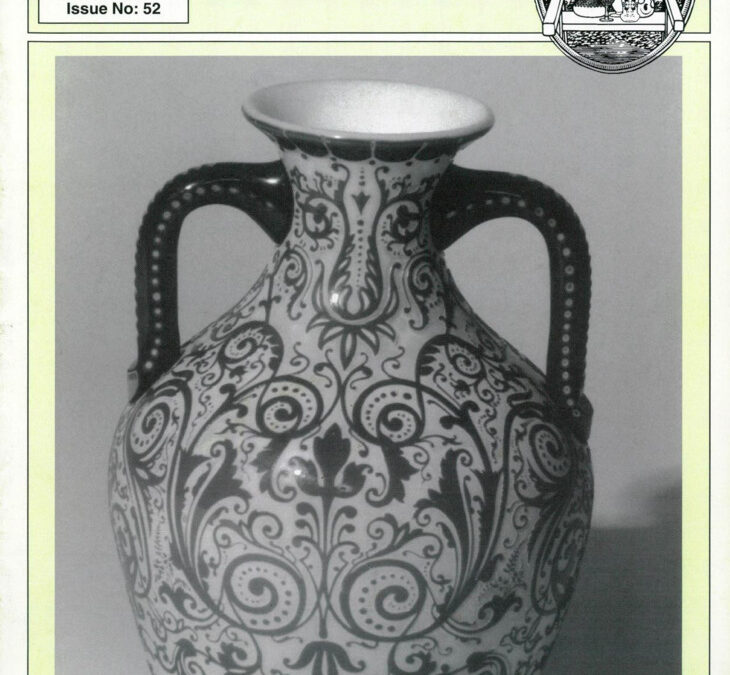
COVER ILLUSTRATION
A Richardson cameo amphora vase ( 18 cm high, pink on
opaque white on clear glass) was sold at auction in Shef-
field late in 1999, as produced by Thomas Webb & Sons,
Stourbridge, circa 1860, formerly in the Hepworth Collec-
tion. However, recent research at the Coseley Archives re-
veals this is definitely a Richardson piece, price-coded at 35
shillings around 1880. In the same archive photograph is
also featured a cameo bowl with similar but not identical
decoration which is now in the Broadfield House collection,
displayed in the museum’s Cameo Room. Although smaller
in size and with a different surface decoration to the 1878
Joseph Locke Portland Vase produced at Hodgetts and
Richardson, the similarity in shape between this amphora
and the Locke Portland vessel is striking. Whether an 1860
date is sustainable needs further investigation, but it appears
this vase was displayed at the Paris 1878 International Ex-
position. ( Private collection; photographer Mike Johnson)
EDITORIAL
Our thanks…
To Ian Turner, Eileen Sanders and their team for man-
aging to despatch the last
Cone
before Christmas and
the holiday closure of Broadfield House. At one point
there was a collective groan from the editorial team as
it seemed that once again gremlins had struck with a
vengeance. And to the members who wrote in with in-
formation and in one case, an offer to help. We do ap-
preciate such contacts.
As for those gremlins…
Apologies for several small mysterious scientific symbols in
both the text and captions in the last issue; these somehow
crept into the system after final page proofs and during the
actual printing, to replace certain numerical fractions. The
Sappho caption (p. 4) should read 32 x 19.5 cm, and the
text below as T2500, the equivalent of £250,000′, while the
measurements of the von Schaffgotsch cup, and of the
Kohler glass (second column p.7, also caption p.8) should
be read as 14.5″ and 13.75″, respectively.
Glass at auction
Chris Crabtree has kindly agreed to put this report to-
gether for us in the future. He will welcome all sugges-
tions, whether from London or the regional (or indeed
overseas) sales scene. If you have something to report,
let him know (01274 612 856). If you have digital im-
ages, email them to brian@currie.co.uk.
SAD NEWS
Ian Wolfenden writes:
It is with great sadness that I report the death of one of
our founder members, Ron Brown, aged 89, in a Cheshire
nursing home on January 29.
Ron was our first Treasurer, a job he did for a number
of years, carefully looking after the finances to ensure the
Association’s success. Everyone who joined the Association
in its early years will remember Ron. He so obviously en-
joyed our meetings. His affability made him the best of com-
pany and he always took time to make new members feel at
ease. He loved research. He had worked on ceramics before
he joined the Association and he continued to research as
long as he was able. His valuable work on the Davenport
factory was published in the first
Journal
and he added fur-
ther material in the fifth. He was still researching as time
caught up with him, but the notes from his last project, on
the Edmundson stained glass in Manchester, have been de-
posited with the University of Manchester, where a post-
graduate researcher is currently working on them. It is good
to think that his fmal piece of work will not be lost.
Ron’s transparent love of life and people brought
him many friends. He will be greatly missed.
The opinions expressed in the
Glass Cone
are
those of the contributors. The editors’ aim is
to cover a range of interests and ideas, which
are not necessarily their own. However, the
decision of the editorial board is final.
COPY DATES
Summer 2000
14 May
Autumn 2000
10 August
The Glass Cone’ – Issue No 52: Spring 2000
Patricia Hier greets Jane Spillman (centre left) and Friends at the Specialist Glass Collectors Fair.
CORNING VISITS BROADFIELD
On Saturday evening, November 6, the doors of
Broadfield House Glass Museum were opened to
welcome a group of some 34 members and Friends
of the Corning Museum of Glass NY, headed by Jane
Shadel Spillman, the Deputy Director of Collections
at Corning. The visitors, who were on a 12-day tour
of the UK from Scotland to London, had neatly
planned their weekend itinerary in the North Worces-
tershire and Stourbridge area to combine visits to
glass sites, Broadfield House and the November 7
Glass Fair at the National Motor Cycle Museum.
They were greeted at Broadfield House by Charles
Hajdamach on behalf of the Museum and its staff
and by John Sanders on behalf of the Friends of
BHGM.
Our North American guests came from all parts
of the United States. The accents echoing around the
museum galleries spread from the West Coast to New
England and from the Mid West to New Jersey, but
four real Corning residents (Jane Shadel Spillman
apart) were Jerry and Virginia Wright, and Ed and
Louise Bush. As Members of the Friends of Carder
they were especially pleased at having viewed vari-
ous Carder heritage sites in Wordsley, which was
Frederick Carder’s home before he emigrated with
his family to Corning in 1903 to found the Steuben
Glass Works. A handful of the group had visited
Broadfield on a previous trip in September 1994 and
their return visit was evidence of the continuing at-
tractions which the museum has to offer at an inter-
national level. For the majority, however, it was their
first experience of the treasures on display, and these
were enhanced on the night by the Majesty & Rebel-
lion exhibition, a display of one of the finest private
collections of 17th & 18th century drinking glasses.
This temporary exhibition included two Jacobite
`Amen’ glasses and a magnificent goblet enamelled
by William Beilby with the Royal arms of George
III. In true American style the praise for this display
was unstinted, with a good-humoured observation
that the George III of the Beilby goblet must have
been the same English king who went mad because
he lost his North American colonies.
The time available was all too short for the visi-
tors to view all that was on offer but an added at-
traction for that evening was the opening of the upper
floor storerooms where various items and archival
material not generally on show were made available
to the guests.
Those who are familiar with both the Corning
Museum of Glass and with Broadfield House know
that in respect of size and scope, of funding and dis-
play content, there is an awesome divide between the
two establishments. Yet our American visitors’ praise
for the quality and substance of BHGM’s display
presentation was spontaneous and generous. Their
unqualified thanks for the hospitality which they had
received at Broadfield left no doubt of the goodwill
created and of the further cementing of Anglo-
American friendships. Many of the group were open
in endorsing the visit as the highlight of their tour
up to that point and they departed reluctantly from
the museum to their hotel in Droitwich to rest in
anticipation of the physically-demanding ‘shop un-
til you drop’ trip to the Glass Fair the following day.
John V. Sanders
3
The Glass Cone’ – Issue No 52: Spring 2000
IN THE RED
4
To assuage Deryk Snow’s feelings of disappointment
(Cone no. 51) at the lack of response to the occasional
(and interesting) problems he puts our way, we ap-
proached David Watts and, with only the very minimum
of arm-twisting, he put pen to paper. One of his two re-
cent lectures to the Glass Circle on red and ruby glasses
will be published in the Glass Circle’s
Journal
no. 9 this
summer, free to the Circle’s members but it should be
available through Broadfield House Glass Museum shop
(discount for Friends of the Museum).
An answer to Deryk Snow’s question on red pressed
glass. In one word — trouble, or in two words –
double trouble !
Ravenscroft’s invention of lead glass focused in-
terest on the merits of colourless crystal, so colours of
any sort found little favour in England until the end of
the 18th century. This situation was further polarised
by the 1745 Excise Act, not repealed until a century
later, which discouraged glasshouses from undertaking
experimental work as too troublesome and costly. (The
opaque and colour twist glasses were defined as ‘enamel’
and so escaped duty until 1777.) By 1845 press mould-
ing had been invented and the British glass makers were
busily catching up on competition from coloured blown
glass from the continent. Gold ruby, in particular, could
be made relatively easily in lead glass whereas potash
or soda glass required the addition of tin.
The essence of press-moulded glass lay in its cheap-
ness of manufacture and, in the interests of profit, the
initial use of lead was abandoned by the 1880s when
such manufacturers were turning to colour to increase
sales. A welcome gift to glass makers at that time was
uranium (as the sodium salt), used either alone or in
combinations with well-understood heat-sensitive glasses
shading to white, such as Davidson’s Pearline. In fact a
`pinch’ of uranium was added to more recipes than one
imagines (see the Webb recipes in Charles Hajdamach
British Glass…).
But in the British Isles there was no
easy red equivalent to the cheap Bohemian copper ruby
flashed glass, and even cheaper copper red stained glass
employed on press moulded articles particularly for en-
graved or etched personalised souvenirs. I have seen a
press moulded goblet and a small footed bowl in what
appeared to be a copper red pot metal but such objects
are, in my experience, extremely rare and it is not easy to
be certain of the colouring agent. English glass makers
stuck to what they were good at. Cranberry, a dilute gold
ruby, filled the gap from about 1890 but, being a prestig-
ious lead glass, was too expensive for pressing.
The breakthrough came around 1880 with the
invention of selenium ruby in a non-lead glass, prob-
ably in America. Theoretically ideal for press-mould-
ing non-lead glass, it was here where the double trouble
began. Not only did some 80-90% of the modestly ex-
pensive selenium salts added to the batch volatilise off
during melting, but the fumes were extremely toxic.
Even worse, the colour was temperamental and fugi-
tive; it could develop in the pot perhaps transiently, or
require reheating to an exacting time schedule. Small
errors in formulating the batch could mar the product
while the same recipe behaved differently in different
glassworks. But by the 1930s selenium pink to brown
had become the hall-mark of Art Deco press moulded
soda glass as produced for example by Bagley of
Nottingly and Jobling of Sunderland.
The colour range (in non-lead glass only) was im-
proved by the addition of cadmium sulphide which forms
cadmium sulpho-selenide, giving shades from yellow to
deep red according to amounts and proportions used. I
have seen a smoky orange Davidson vase probably col-
oured in this way but not had the opportunity to study
any Sowerby reds. Whitefriars produced both ruby and
shaded ruby from about 1880, but it is unclear whether
gold or selenium based, except that Lesley Jackson
(Whitefriars Glass)
notes a cheap soda glass based sele-
nium ruby was introduced by the company in 1940, de-
scribed as an ‘all-or-nothing’ colour which the designer,
Geoffrey Baxter, found ‘unsympathetic’. I have an ex-
ample of the popular rose vase in this colour but to my
knowledge, it was not used for press moulding. Angus
Butterworth
(The Manufacture of Glass,
1948) claimed
to be the first glassmaker in Britain to produce selenium
ruby and he may have used it in pressed moulded glass
but none of his products seems to have been recognised;
this deserves further study. Am I right in thinking that
all red Sowerby (except possibly a few Ruby, Rubine and
Rose Opalescent colours) is post-World War II? After
all, once mastered, selenium with glass adapted well to
pressing. From about 1950 Nazeing Glassworks devel-
oped a good selenium red for signal glasses and this still
finds a commercial market for its badged ashtrays for
pubs and business premises (an interesting area for the
new collector). Stan Evison tells me that when Works
Manager at Thomas Webb he personally supervised the
manufacture of selenium glass blocks and confirms the
careful timed procedure needed for its manufacture. Such
complications are almost certainly why most of the press
moulded ruby glass still around today is the result of
low production runs. Ruby-red Carnival glass was not
produced until the 1920s in America and its limited pro-
duction can again be explained by the fact the selenium
was the colouring agent.
I mentioned that selenium ruby may require re-
heating and one area where America wins hands down
is in making selenium red glass shading to white or pale
yellow in the manner of Burmese and commonly called
Peachblow. Transparent selenium Amberina is, to my eye,
virtually indistinguishable from gold Amberina and is
widely available in America today, particularly in blown
glass by such firms as Blashko and Pilgrim (often of-
fered as Victorian in antique shops) and recently I pur-
chased a new tankard in selenium ruby crackle glass for
the ridiculous price of £7.95 in Hatfield Galleria, North
London, thought to be Middle Eastern production.
The collection and study of selenium coloured
glasses is a neglected field, perhaps stemming from the
mistaken belief that it is cheap, modern and imported.
On the contrary, it is one of the most challenging glasses
ever made that will stand forever to the credit of the
glass-makers who produced it.
David C. Watts
‘The Glass Cone’ – Issue No 52: Spring 2000
MR L1LLYCRAP’S HONE
At a recent fair I came across an odd piece of pressed
glass, light-green in colour, shaped as a rectangular block
but with a long semi-circular cut-out down one length.
It bore the title of LILLYCRAP’S HONE and ‘made
in England’, a Registration number 756950 and boasted
several world-wide patents.
Referring to the Glass Association’s booklet
Reg-
istration Numbers, 1908-1945, I
found no entry for the
756950 number but it would have been taken out in
1930. Presumably the actual registration entry did not
readily indicate that this was a glass article — after all,
how many glass hones have you met ? As to its precise
function, I believe it was designed as a hone for safety
razor blades, but whether it performed well, I cannot
comment.
Mr Lillycrap evidently thought he was on to a
winner as he took out patents in the UK, France, Ger-
many, New Zealand, India, South Africa, Australia and
also claimed ‘Patented throughout the World’, but its
usefulness presumably did not survive the advent of
cheap throw-away blades.
The editors would be pleased to hear of any other
such glass oddities.
Geoff Timberlake
IS THERE ANY HOPE?
Sunderland Glassworks had a miserable start to the year
2000.
The Guardian
of 22 December 1999 reported that
unless a buyer could be found quickly, the firm would
go into liquidation. In Sunderland there had been weeks
of rumours and press speculation after news that work-
ers had not been paid and, with an outstanding bill of
some £60,000, gas supplies to fire the furnaces had been
cut off. Nothing of this sad state of affairs had emerged
during the upbeat interview Mike Willshare, SG’s Man-
aging Director gave Susan Fenton, published in
Table-
ware International
Dec 1999/Jan 2000. In it Willshare
only admitted to the length of time the marketplace
took in recognising a brand-name, and being convinced
of its potential and quality; “We are getting to the point
where we have bridged the gap between what we have
got [in our production range] and tempting people to
buy it”. In the interview great emphasis was placed on
new designs in the planning stage but with no specific
names of the design team, a telling omission perhaps.
It was only in 1998 that Hartley Wood, the main
supplier of stained glass produced by coloured cylinder-
blown technique, was purchased by Epsom Activities
which later acquired Royal Brierley
(Cone
nos. 44 & 47).
In its revitalised (and renamed) form renting work space
within the National Glass Centre, the Sutherland Glass-
works proved to be a popular visitor attraction and NGC
director, Keith Jeffery, is keen to keep the tradition –
and the company — alive: “We’re hoping we can keep
1300 years of glass-making going”. Presently (at the end
of January), Harry Prior is the sole survivor of this par-
ticular Sunderland tradition, according to
The Times
on
22 January 2000, showing visitors how to make a six-
foot (almost 2m) long cylinder of glass. Thirty times a
day he does this, and thirty times a day he then smashes
the work as there is no commercial demand.
As for the NGC itself, the news is very good. Al-
though other new museums funded by National Lot-
tery money saw their estimates of visitors prove to be
wildly inaccurate, the NGC has seen a well-earned 33%
increase on their notional estimate for 1999 of 75,000.
FALLING GLASS
If you have recently travelled by Eurostar into or from
Waterloo, London, you may have noticed tarpaulins
now hide the glass roof. In December, the owners of
London’s Waterloo Eurostar terminus filed a High
Court claim for compensation in respect of a repair
bill for damage to the glass roof likely to cost millions
of pounds sterling
(The Guardian, 11
Dec 1999). Cracks
in glass apparently started some months previously and
tarpaulin sheets began to be erected to protect the
30,000 daily Eurostar passengers from possible falling
glass. Now the entire roof is covered. As the elliptically-
curved roof of glass was constructed just six years ago
as an integral part of the award-winning Nicholas
Grimshaw & Partners design, there is anxiety that this
is a manufacturing fault for some of the glass panels
have fallen foul of ‘nickel sulphide stone expansion
growth’ which means that the panel shatters like a car
windscreen when hit by a flying stone.
The Guardian
reported that all 10,000 m
2
of panels supported by a
network of tubular trusses could need replacing, which
could mean a hefty bill.
ONE GOOD TURN…
…leads to another. Following Eric Reynolds’ debut on
the small screen, he was contacted via the programme
producer by a viewer who explained that he had some
documents relating to glass production which had
passed down the Kempton family; could Eric advise
him whether they might be of interest to anyone. They
agreed to keep in contact. Meanwhile, during one of
Geoff Timberlake’s recent sessions at the British Li-
brary Newspaper Depository at Colindale, North Lon-
don, he came across in a
Pottery Gazette
back number
some reproductions of paintings by R Plant of the in-
terior of the John Walsh Walsh factory. That evening
Geoff phoned Eric Reynolds to give him this informa-
tion and mentioned he himself had been looking for
details about the Kempton family, the original owners
of the Nazeing Glass Works. Surprise and excitement
on all sides! Geoff Timberlake and the viewer have met
and Geoff now has solved a few outstanding questions,
and new avenues of research have opened up.
So the moral of the story is: if you learn any in-
formation about glass, its production and makers, please
never sit on it but tell someone; a committee member
might well know of someone who is working in this
field. It could lift a researcher’s spirits in a moment of
despairing impasse.
MILLENNIUM COMMEMORATIVE GLASS
Following our mention last time, Roy Kingsbury has
received a number of responses from members and
hopes to have a report for our next issue. Meanwhile,
let us know if you see any more pieces.
5
The Glass Cone’ – Issue No 52: Spring 2000
BERMONDSEY GLASS WORKS
Among the Broadfield House glass collection there are
three pieces marked ‘Applied Art London’ and
`Bermondsey Glass’ with the name ‘Guy Underwood’.
One is a head of the Madonna in pressed glass, while the
other two are blown glass with ‘rolled-in’ colour technique
which look very similar to pieces produced by the Nazeing
glass-works, my real interest, but somewhat lacking that
flair and finish. One is a lamp base in a cloudy green with
blue markings and the other a tumbler vase with a rough
pontil, decorated with swirls of green and blue.
I have found no entries for either manufacture
marks in the 1930 edition of the
London (Kelly’s) Post
Office Directory, so
it
would appear that neither com-
pany was in existence before 1930, when Nazeing was
registered as trading at Broxbourne. However I have
traced two later entries.
Kelly’s Post Office Directory
of
1933 lists under its Commercial Section ‘APPLIED
ARTS (Russell Art Co Ltd), Electrical fittings manu-
facturer, 20 Conduit St., W1, Tel. No. Mayfair 1181’
and in the
British Glass Industry Directory 1934
(publ.
Society of Glass Technology) under section A, the pro-
prietors are still given as Russell Art but the Applied
Arts office had moved to 26 Clarges St, Piccadilly, Lon-
don Wl, Tel. No. Grosvenor 1896, with the glassworks
registered at Bermondsey. Its production range is listed
as ‘Manufacturers of art glass, hand-made vases, dishes,
lamp bases and illuminating glass in colour, in small
quantities’, and the (managing) director and designer
is named as Guy Underwood.
Several questions spring to mind: Where was the
Bermondsey glass-works actually situated? Was
Bermondsey Glass started by associates or staff from
the Southwark Glass Works (1920-30) when the
Kemptons moved to Broxbourne to set up Nazeing?
Were former Southwark directors, AH Williams or A
Aitkins involved? Is it coincidence that the Bermondsey
glass employing the rolled-in colour technique is simi-
lar to the Nazeing range? If the inspiration came from
London-based personnel familiar with the Kemptons’
range, then presumably they saw those products being
made during the 1920s at the Southwark Glass Works…
and of those, no pieces have been identified to date.
Geoff Timberlake
ANOTHER MYSTERY SOLVED
Readers with good memories will recall my plea for help
in identifying the makers of two pieces of pressed glass
(Cone
no. 45). As no-one responded, I presume every-
one shared my bafflement, but as I think I have now
come across an answer to one of the pieces, I feel duty-
bound to reveal the solution.
I recently saw a pair of vases in an unusual light
brown ‘marbled’ colour in the possession of fellow col-
lectors and realised that their basic design was identi-
cal to the first of my problem
Pearline
pieces except
that the latter had a constricted neck flaring out into a
scalloped rim, whereas the ‘problem’ was straight sided
(Fig. 1). The ‘marbled’ pair bore the unmistakable
Davidson lion on both bases, and further research
showed that the neck-and-flare arrangement was not
an uncommon feature of Davidson products (Fig. 2).
I had always wondered whether Davidson was a
likely maker but since the ‘problem’ design did not ap-
pear in any of the Davidson catalogues in my posses-
sion, I had my doubts, so it is good to have these
dispelled. But I still have no information about the other
problematic piece. Any ideas?
Deryk Snow
Left: the previously problematic piece, in a turquoise
blue, with right, the light brown ‘marbled’ item
marked with a Davidson lion. (Private collection)
Two Davidson Pearline in pale blue, the right vase
showing the constricted neck and flaring scalloped
rim. (Private collection)
THE OLDFIELD AWARD 2000
The Society of Glass Technology is offering to make
thrcc awards to the value of £500, £350 and £150 for
research projects carried out by third or fourth year
students, as part of the requirement for their degree.
The subject may be any experimental or theoretical in-
vestigation related to amorphous solids, glasses, glass-
ceramics, sol-gel materials or ormocers, glass history
or archaeology, or glass commerce and design. A project
title with 100-word abstract should be submitted by
April 28 and the report by July 14, but as there are
various conditions and requirements involving the in-
stitution and tutors as well as the student, it would be
advisable for anyone interested to contact the SGT at
Don Valley House, Savile House East, Sheffield S4 7UQ
(tel. 0114 263 4455; fax 0114 263 4411; e-mail:
david@sgt.org) for further details.
The Glass Cone’ – Issue No 52: Spring 2000
THE CAMEO GLASS OF THOMAS AND GEORGE WOODALL
Mention the term ‘cameo’ and most people delve into their
jewellery box and hold up a brooch. It is remarkable that
so many people are still unfamiliar with a form of glass
sculpture that has existed since Roman times. Cameo work
by definition is a design produced in relief in a colour or
colours on a background of a different colour. With glass
this is achieved by producing the design on a cased article.
Two main methods were used to case glass.
The first method involved taking the blowing iron
and gathering about three-quarters of the amount of
glass required to make the article from a pot containing
the base or underlying colour. After slightly blowing and
truing the gather, the glass required for the outer layer
was gathered from another pot. This was then manipu-
lated so as to coat or thoroughly encase the first gather.
The second method, which was probably a sec-
ondary development, was referred to as the cupping
method. This involved producing an open cup from the
glass required for the outer layer and whilst this was
still at a working temperature placing a pre-formed
bubble of glass on a blowing iron into it. This was then
blown and expanded in such a way that it expelled all
the air from between the two items of glass and the cup
could be picked up and manipulated. This process had
the advantage of being able to more easily control the
thickness of the layer and be repeated where multi-col-
oured layers were required.
With most cameo articles the main body of glass
is crystal. The base colour is generally a very thin layer
on the inside of the crystal and the outer layer(s), which
were to be carved, are on the outside. It is likely that
both methods described above were used in combina-
tion to produce the blanks. The gathering process would
be used to cover a small amount of coloured glass with
the main body of the crystal and the outer layers ap-
plied using the cupping method.
The crystal performed a number of functions: it
first provided the mechanical strength of the article.
“Intruders (W2794) 16.5 inches white on brown
plaque. Signed T&G Woodall.” Picture taken from a
G. Woodall original photograph, reproduced with the
kind permission of C&V Perry.
Second, since crystal takes on the colour of any glass
in contact with it, less coloured glass needed to be used
and more subtle colours could be achieved. The third
important function was to provide the artist with a
greater tolerance of error in the depth of etching, cut-
ting and carving needed when producing the design.
Cameo glass was revived in the nineteenth-cen-
tury through the skill and dedication of two men. Philip
Pargeter who used his Red House glassworks to pro-
duce the necessary glass blanks, and John Northwood
who developed the art of carving away the unwanted
glass layers to produce the images on the layers of glass.
Two of his apprentices were Thomas and George
Woodall. The first child of Thomas and Emma
Woodall, born in 1849, Thomas followed his father’s
lead and became a skilled musician and passionate
churchgoer. From an early age he played the harmo-
nium, wrote music and conducted choirs and bands.
After an education at the Wordsley National School
and Stourbridge School of Art, Thomas became an
apprentice at J & J Northwood.
John Northwood used Thomas to work on the pre-
paratory stages of the
Portland Vase,
which remained
Woodall’s proudest accomplishment. In 1877 Thomas was
employed by Thomas Webb & Sons where he later be-
came Manager of their cameo operations. Thousands of
pieces of commercial (flower, fruit or foliage) cameo were
produced under his guidance, plus many unique vases and
plaques decorated by the Woodall brothers. Fascinated
by Chinese art glass, he designed and carved many orien-
tal-inspired pieces and worked alongside his brother carv-
ing decorative borders on larger cameo plaques. Important
pieces of work from the Woodall team were marked with
the distinctive Webb’s
GEM CAMEO
trademark. His keen
love of local causes led to him avoiding publicity. Com-
bined with his unwillingness to sign his work, his name
slipped from the public’s eye and his great achievements
in glass were largely forgotten.
Instead, Thomas Woodall preferred to spend his
time advocating the Liberal Party manifesto of social
reform and equality for all. Through sitting on various
local committees, including Holy Trinity Church Paro-
chial Church Council and the Stourbridge Board of
Guardians, he championed many local causes includ-
ing a much needed Art School for Wordsley. In 1899,
under his guidance as Treasurer, the first students en-
tered that building. After Frederick Carder’s emigra-
tion to the USA, Thomas Woodall remained and raised
enough money to extend and complete the Art School
in 1906. He retired to relative obscurity as a music dealer
and died in 1926 a modest man.
From an early age George Woodall developed a
sense of flair and showmanship. Through successful
publishing ventures George became a local celebrity in
Kingswinford. Like his brother he also went through
the local Art School, worked for J & J Northwood and
left them to work at Thomas Webb & Sons where he
helped to re-apply the cutting and polishing techniques
to produce pieces in the ‘rock crystal’ style. His tireless
work refining the production processes for cameo glass
brought its reward, as he became
an
international icon
7
The Glass Cone’ – Issue No 52: Spring 2000
at numerous exhibitions where he showcased fabulous
pieces of glass sculpture. Many of the maidens depicted
in his work were modelled on his four daughters — Amy,
Alice, Connie and Pamela.
His house was decorated with photographs of his
favourite pieces:
The Toilet of Venus, Sappho, Lord Kel-
vin, Syrena, Aphrodite, The Origin of Painting,
Andromeda
and
Dancing Girl. Moorish Bathers
was his
greatest achievement with seven figures carved in glass.
He signed the majority of his work, ensuring that he
carved his name in history. He retired to continue work-
ing as a freelance cameo artist and died in 1925.
George Woodall was also a keen photographer and
left behind a unique record of his own cameo works and
of life in the Kingswinford and Wordsley area in the last
quarter of the nineteenth century. At international auc-
tions his pieces fetch five-figure sums and his work is
valued by glass collectors world-wide. In 1980 the
Daily
Telegraph
described him as “the Rembrandt of Glass”.
MILLENNIUM TORCH IN SUNDERLAND
The Millennium Torch was presented to the Queen
to light the Millennium Beacon on New Year’s Eve.
Conceived by Stewart Hindmarch Advertising Ltd,
the torch was created by Roger Tye of Phoenix Hot
Glass at the National Glass Centre, Sunderland.
Our picture shows Roger Tye holding the torch,
accompanied by Keith Jeffrey of the National Glass
Centre, the Rev Ian Stockton, who formally blessed
the torch, and Stephanie Yearnshire, who developed
the original concept with Stewart Hindmarch. After
its return from London the torch went on display at
the NGC for a period before going on a tour of ma-
jor cities in the UK.
The Cameo Glass of Thomas and George Woodall
by Christopher Woodall Perry, the great-great-grandson
of George Woodall, documents the work of his gifted
ancestors. His research has spanned several years and taken
him as far afield as Australia, resulting in a detailed record
of the cameo glass produced by the Woodalls and a fasci-
nating insight into the brothers’ lives and times. In addi-
tion to archive material held by world-wide museums and
universities, the author has been given access to the col-
lections of sketchbooks, documents, letters, tools and pho-
tographs, owned by the many Woodall descendants. The
book contains hitherto unpublished pictures of pieces in
family and private collections and reproductions of George
Woodall’s own photographic negatives of cameo work. It
is to be a richly illustrated volume containing a wealth of
new material and information on nineteenth-century
cameo glass, including an expanded record of Thomas
Webb’s price book and previously-unpublished sketches
from Webb pattern books of Woodall work.
BROWSING THE WEB FOR GLASS
8
I’m no expert on the internet, but our Editor sug-
gested we should share our experience and I agreed
to lead off. Let me take you to some sites I like. I
won’t tell you the authors or give credits – they are
there on the sites for you to see. Apart from the overtly
commercial sites, which I’ll come to next time, there
are plenty of museum and society sites to look at.
One of the best overall guides to them is to be found
at a site called
Links on Glass from the Virtual Glass
Museum.
This is a New Zealand site to be found at
https://www.glass.co.nz/index.htm. Here is the main
index:
Links to some sites for Magazines, Newsletters
& Books on Glass
Links to some Education and Training Sites
relating to Glass
•
Some Glass General Reference Sites
•
The Glass Encyclopaedia
•
Links to interesting articles about Glass
Links to Glass Collectors’ Clubs
•
Links to other Glass Museum Sites
Links to Glass Collector’s Home pages
•
Links on putting up your own web page
•
Links to Sites with Resources for Glass artists
•
Links to Sites with Glass for Sale
•
Links to Glass Artists Sites
•
Take a look at the awards we have won
•
Other Good Places to Search
•
Some interesting links to anything but glass
Click down one level, for example on “Links to other
Glass Museum Sites”, and you’ll find links to 30
museum sites. Look them up — space precludes list-
ing them here.
One click on any item on the list, of course,
should
take you to that website. It’s a splendid re-
source. I say “should” because some of the links on
a site like this will prove to be out of date. These lists
are built up by browsing enthusiasts, who add their
own favourites sites to the lists — and if your fa-
vourite is not there, or if the link is wrong, the rem-
edy is in your hands!
Tell us about
your
favourite sites. More next time.
Brian Currie
‘The Glass Cone’ – Issue No 52: Spring 2000
STUDIO GLASS AT ILKLEY AUCTION
In December 8 in the middle of the London glass auc-
tions (Cone no. 51), John Delafaille chose to make a
400-mile round journey through wind and rain, from Bris-
tol to the north. We asked him why:
The answer is simple: a collection of British Stu-
dio Glass formed in the 1980s, comprising approxi-
mately 120 pieces from 30 makers, offered by Andrew
Hartley Auctioneers of Ilkley. Although some leading
names were not represented, the majority had had work
featured in either the CLEAR THROUGH THE
WOOD exhibition at the Fitzwilliam Museum, Cam-
bridge in 1987 or at the Crafts Council show, London
in 1993; an interesting cross section re-appearing on
the market unexpectedly early.
The sale started with ten lots by David Prytherch,
with the top price of the day of £600 (all prices, ham-
mer) bid for ‘In Defiance of Gravity’, a beautifully bal-
anced 18 cm wide bowl, with two interlocking figures. A
second taller bowl with a similar theme, the hallmark of
Prytherch’s work at this time, but less well-balanced
fetched £440 while a smaller example was withdrawn,
disappointing at least one potential bidder (Fig. 1). An-
other Prytherch piece, a curved horn with figures on the
base went for £460, a low price for a remarkable piece of
craftsmanship. Work of Morag Gordon followed. Her
glass sculpture of textured head and torso on a clear
glass panel failed to reach the estimate, knocked down
for a mere £130 probably because many viewers thought
the marble mounting was broken, rather than merely
unglued, but her engraved blue bowls with angular and
elongated figures were in line with the estimates.
1. David Prytherch, left to right: ‘Reconciliation’ 1985
fetched £310; centre lot 292 withdrawn; ‘Defiance of Gravity
no. 2’ bowl. (Courtesy of Andrew Hartley Auctioneers)
Items by such established names as Simon Moore,
Catharine Hough, Annette Meech, Annabel Newman,
Deborah Fladgate surprisingly failed to attract much ex-
citement, yet
these
pieces will be sought after in years to
come as interesting records of their early work (Fig. 2).
The next large series of 11 pieces was of Peter
Layton’s work, an installation of 21 blown pebbles (all
signed and dated) on a black base fetched a disappoint-
ing £190: one wondered whether it would suffer the fate
of old atlases and prints, split up and sold piece-meal.
A Layton 26 cm vase however reached £260. A Karlin
Rushbrooke ‘insect’ piece, to me lacking much of fluid-
ity and humour which are the artist’s strength, went for
£160. Surprisingly two sand-cast ‘icebergs’ from John
Cook, one of the influential teachers in the 1980s glass
movement, reached only £130, as did a large combina-
tion from Charles Bray, perhaps because its size pre-
sented display problems. The only lot to exceed
significantly the estimate of £100-150 was a cased bot-
tle vase by Michael Harris, achieving £320. Perhaps it
is his connections with Mdina and Isle of Wight, and
the studio glass movement that attracted the bids or
the fact that this item, unlike most of his widely avail-
able pieces, was signed.
I left the sale with very mixed feelings. Personally
I was pleased at the prices which allow more purchas-
ing than my budget usually permits, but I was disap-
pointed at the public unawareness of the importance
of our British glass-makers. Will the Internet in the 21st
century combat this?
Perhaps the most telling comparison in the sale
was a Monart vase, 23.5 cm high, sold to a well-known
specialist dealer for £390, a price only exceeded that
day for glass by the Prytherch piece. Admittedly it was
an unusual colour, large and had an identifying label
but it was misshapen, having slumped so badly that it
was not even ‘second’ quality. Such is the ‘value’ of a
piece to an established base of collectors.
2. Left: Annette Meech (London Glasshouse, now
disbanded) 1987, cylindrical vase, sold for £190; top
right, Simon Moore bowl 1986, sold for £70; lower right,
Annabel Newman (London Glasshouse) bowl 1987, sold
for £150. (Courtesy of Andrew Hartley Auctioneers)
NATIONAL MEETINGS
Following the April weekend meeting at St. Helens vis-
iting the ‘World of Glass’ exhibition centre, there will
be another National Meeting in London on Saturday
10 June, to celebrate the important Victoria & Albert
Museum exhibition ‘1900’, which will feature some
splendid glass of the Art Nouveau period. Jennifer Opie,
curator in the V&A Glass & Ceramics Department, and
Raymond Notley, Lecturer Emeritus at Sotheby’s In-
stitute, London, (see Book Reviews) have each kindly
agreed to give an illustrated talk at Imperial College,
close to the V&A, after which there will be an opportu-
nity to visit the exhibition itself. Details later — but
enter the date in your diary now.
9
The Glass Cone’ – Issue No 52: Spring 2000
GLASS AT THE AUCTIONS
10
On 21 March Sotheby’s is selling some of the collec-
tion of Dr Harwood Stevenson, a long-standing
member of the Glass Circle, including some fine en-
graved late 19th century Stourbridge pieces and rock
crystal. Other items in the sale include a small col-
lection of English drinking glasses, a rare
Rose du
Barry
cameo vase, Dutch engraved glass and a won-
derful Wolff stipple-engraved light baluster.
Three engraved claret jugs from the collection of Dr
Harwood Stevenson, all c. 1870. Left Apollo, attrib-
uted to John Baird of Glasgow possibly by Henry
Kellner; centre Amphitrite in intaglio (possibly
Webb); right, chimera and grotesque animals in
intaglio, Webb or Dobson and Pearce, possibly by F
Kny. Heights from 27 cm to 32 cm.
(Courtesy of Sotheby’s, London)
Phillips sale on 8 March included a set of six
`Turf Stack’ rummers. Each is engraved with a large
stack of turf between two trees. On the reverse is the
monogram “TS”. Phillips tell the story. In 1779 a
Lancashire farmer, Thomas Scarisbrick was killed by
lightning while building a stack of turf. When his
son died in 1824 he left sets of goblets, engraved with
the stack, to his grandchildren. Wordsworth wrote a
sonnet about the story in 1828.
One from a set of six ‘Turf Stack’ rummers, possibly
by Perrin Geddes & Co, c. 1800, 11.7 cm.
( Courtesy of Phillips Auctioneers, London)
Bonhams are offering some fine Stourbridge
cameo scent bottles onl4th March at Lots Road,
Chelsea, with estimates ranging from £400 to £1000.
Three Stourbridge Silver Mounted Scent Bottles –
from left: yellow, red, yellow backgrounds
(Courtesy of Bonhams)
Christie’s are selling at King Street on 28 March
an important collection of Venetian and
Facon de
Venise
glass ranging from 1500 to 1900. The collec-
tion encompasses 300 lots from the very rare to the
more ing examples of the wide variety and techniques
and technical accomplishments of early glassmakers.
A Venetian enamelled and gilt gadrooned low stand-
ing bowl c. 1500, 23 cm diam., estimated at f20,000-
£30,000. (Courtesy of Christie’s London)
This report has been compiled by the editors.
Chris Crabtree has kindly agreed to put the report
together for us in the future. He will welcome all sug-
gestions whether from London or the regional (or
indeed overseas) sales scene. The constraints of space
mean that we can’t include everything, but our aim
will be to cover as wide a variety as possible of the
subjects that may interest our readers. Our editing
and printing timetable, coupled with the relatively
short prospective view of the auction houses, means
that it’s difficult to get news to you in advance of the
sale date — but we’ll see what we can do.
‘The Glass Cone’ – Issue No 52: Spring 2000
BOOK REVIEWS
POPULAR GLASS OF THE 19TH & 20TH CEN-
TURIES
(A Collectors’ Guide
series), ‘Raymond
Notley, Miller’s Antique Guide. 2000. ISBN 1 84000
188 7, paperback £5.99. 64 pp, colour throughout.
This book is another in the
Collectors’ Guide
series
and my initial feeling reading the title was this was
too wide a subject for such a pocket book. However,
turning the pages, it is quickly apparent that rather
than dealing with the whole topic of ‘popular glass’,
it concentrates on press-moulded glass with a few
mould-blown pieces included where appropriate. Brit-
ish and American glass dominate but examples from
the continent are included.
The author is well-known to many of us for his
wide range of knowledge, his experience as a lecturer
on glass and decorative arts, and his ability to con-
vey information and enthusiasm to an audience and
these qualities come across in the introduction which
gives a good but brief account of why and how
pressed and mould-blown glass evolved. This is fol-
lowed by an illustrated section on early pressed glass.
The rest of the book is divided into sections deal-
ing with certain types or groups of glass over two or
four pages each. Introductory paragraphs note how or
why each type developed and how the glass fitted in
with social usage and changes. All sections are illus-
trated by good colour photographs, each bearing an
approximate price guide for that example. This all gives
a strong emphasis on coloured pressed glass, and par-
ticularly of shades few of us will have ever seen (let
alone afford) but there is the occasional reference to
more commonly available colours or clear examples.
Alternate pages bear a small ‘fact-file’ packed with col-
lecting tips or useful facts, not always exclusively con-
nected with the accompanying section. A small book
but packed with information and well worth the price,
but yet again much more space was needed to do both
the subject and the author justice.
Peter Beebe
JOURNAL OF GLASS STUDIES vol. 41 (1999),
Corning Museum of Glass, Corning USA, approx.
£27 (inc. p&p) ISSN 0071 4250 pp.288
Nothing of immediate interest to collectors of Brit-
ish glass and nothing modern, but plenty to interest
nevertheless. The emphasis in this volume is on glass
of classical times, including essays on Athenian tem-
ple glass, and on Hellenistic theatrical-mask mosaic
plaques. Particularly fascinating is David
Whitehouse’s analysis of glass references in Martial’s
epigrams, written towards the end of the 1st century
AD. Linked with these studies is an article (unfortu-
nately in German with only the briefest summary in
English) which adds to research on the cutting of
diatreta,
including the use of a bow-driven wheel.
Somewhat later in period is an investigation into the
origin and purpose of a large glass slab (3.4×1.95x
0.45 m !), produced in early Islamic times and, con-
tinuing coverage of non-European glass, an article
on Chinese 18th-century light-blue glass.
The latest annual book catalogue from Morris &
Juliet Venables is certainly impressive, covering some
500 items from £5 upwards. Dedicated mainly to
stained glass windows, there are a number of general
glass books occasionally accompanied by disarming
dealer’s comments, such as ‘another of those sickenly
[sic] prettified books’ describing a popular work on
Tiffany, or ‘librarians have run amok with stamps
and labels — but where does one find another copy?’.
Tel. 0117 950 7362; fax: 0117 959 2361.
Also available a catalogue of glass books from Tho-
mas Heneage Art Books of 42 Duke Street, St James’s,
London SW1Y 6DJ (tel. 020 7930 9223; fax: 020 7839
9223; e-mail artbooks@heaneage.com), which includes
a complete set of Anita Engle’s
Readings in Glass His-
tory
vols.1-23, as well as publications from Ankara,
Paris, St Petersburg, Turin and Vienna.
REGIONAL MEETINGS
< Geoff Timberlake, organiser for the South-East Region, writes: Last October 14 our members enjoyed a visit to the Nazeing Glass Works where we were guided around by David Royce, the Sales Executive. One highlight of the visit was the presentation of a piece of Nazeing glass in the form of a 'window brick' used in prison building. The trip was rounded off by an illustrated talk about the Glass Works and its founding family, the Kemptons, and its involvement in earlier glasshouses in the London area. Plans for activities in 2000 are being formulated. We hope to arrange a visit to the Cecil Higgins Art Gallery in Bedford, where there is a superb collec- tion of glass ranging from Venetian work to exam- ples of Harry Powell glass. Suggestions for a central London visit would be welcomed. Rita Pearce, organiser for the North-East Region, tells us about the EXHIBITION OF POST-1950 GLASS at the National Glass Centre starting on 25 February and open for the next three months - until the end of May. It includes pieces from pri- vate collections in the North East and Scotland. The exhibition ranges from items made by standard manufacturers to rare collectors' pieces, from nine different countries — the widest display yet exhib- ited at the NGC. It is particularly strong in Scandinavian glass. Open to all visitors and mem- bers are encouraged to visit. On Sunday 2 April, there will be a coach visit to the Gilles-Jones Glass Centre at Rosedale Ab- bey, North Yorkshire. Contact Rita Pearce at 0191 285 5457. The Glass Cone' - Issue No 52: Spring 2000 EXHIBITIONS, FAIRS & SEMINARS Open now until April 29, a selection of sand-blasted glass vessels by RUTH DRESMAN at the GOMSHALL GALLERY at Gomshall, between Guildford and Dorking, Surrey GU5 9LB (tel. 01483 203 795; fax: 01483 203 282). Dresman has recently undertaken architectural commissions as well as working to special commission for Her Majesty the Queen, creating presentation items in connection with the state visit of the Sultan of Brunei in 1998. The GLASS SOCIETY OF IRELAND members will hear Debbie Dawson give an illustrated talk on the famous 19th century artist and designer, William Burgess, and his ecclesiastical stained glass in Cork, on March 28. The following meeting on April 25 will be a members' Road Show, held at the Buswell's Ho- tel, Dublin. (Details: Hon. Sec., 4 The Bower, Balbriggan, Co. Dublin.) The NATIONAL GLASS CENTRE in Sunderland has just opened its SPRING OPEN! — MILLEN- NIUM SURROUNDINGS selling exhibition of se- lected work from contemporary professional glass-makers working in Britain today, inspired by aspects of the environment. Closing date May 7. The BRITISH MUSEUM has announced that, in order to install new fire alarm and emergency light- ing systems in the Department of Medieval & Later Antiquities, certain galleries will be TEMPORAR- ILY CLOSED between February and June 2000. The gallery of Clocks & Watches, and the Waddeson Be- quest will be closed until the end of March; the three galleries containing the Renaissance to 20th century collections may be closed until early June. Those of you thinking of travelling in Spain during the spring and summer should consider viewing the EXHIBITION of VAL ST LAMBERT glass in the Royal Glass Museum (Fundacion Centro Nacional del Vidrio), Segovia now open until August 27. On display are 65 pieces of Art Nouveau, Art Deco and contemporary glass from the private collection of Antonio Alonso in Belgium, some of which have not been seen since their inclusion in the International Expositions of Paris in 1925, and of Liege in 1930. Details from the FCNV Press Office (fax: +34 921 47 15 72; e-mail: rfc@fcnv.es) Members who missed the recent PLEASURES AND PITFALLS exhibition in the South West of England have another opportunity, when it goes to its second and final venue at the JEANETTE HAYHURST GALLERY, 32a Kensington Church Street, London W8 4HA, June 6-18. Not only will there be over 100 dealers but two special stands to promote the launch of two signifi- cant glass books. The first is Christopher Woodall Perry's monograph on The Cameo Glass of Thomas & George Woodall, published to accompany the ex- hibition at Broadfield House Glass Museum which will have had its Private Viewing the previous evening. The other publication is 20th Century Factory Glass by our member, Lesley Jackson. The sixth GRAND GLASS FAIR at Woking Lei- sure Centre, Kingfield Road (A247) is on June 25. (Tel: 020 8894 0218; www.antiquesfairs.co.uk) Broadfield House Glass Museum, Kingswinford, will have an important exhibition LEGENDS IN GLASS: CAMEO MASTERPIECES BY THOMAS & GEORGE WOODALL, from 13 May 2000 to 28 Jan 2001. Drawn from the museum's own collection and featuring important items from other public and pri- vate collections here and abroad, this will incorporate famous works alongside related photographs and memorabilia never previously displayed in public nor shown together. The cameo glasses will include three items jointly signed by the two brothers, at least 25 works carved by George Woodall, some produced es- pecially for his family never exhibited before, and Tho- mas Woodall's last unfinished vase. Chris Woodall Perry, the great-great grandson of George, will be giv- ing guided tours of the historic Woodall sites in the locale during the exhibition, and his publication on the Woodalls will be published in association with this exhibition. Also linked will be another display at Broadfield House CHINOISERIE IN CAMEO, run- ning during the same period, showing the cameo glass produced by Thomas Webb & Sons of Stourbridge, which was inspired by oriental themes rather than clas- sical art, challenging typical perceptions and offering new insights into 19th century British cameo glass. WHAT'S MORE... We are delighted to report that yet another of the Cone's contributors has appeared on ITV Channel 4 Collectors' Lot. Raymond Berger who wrote about Orplid in Glass Cone no.41 talked about this family firm during the programme transmitted on Decem- ber 22, 1999. Congratulations once again and perhaps this may spur more of you into writing for the Cone. A warm welcome is extended to the following mem- bers who have joined since mid-November 1999: The next NATIONAL GLASS FAIR, organised by Patricia Hier, is scheduled for May 14 at the National Motorcycle Museum, West Midlands, M42 Junction 6 (A45). (Tel/fax: 01260 271 975; e-mail: dil.hier@talk2l.com) Mr AH Beadles Ms LJ Jackson Mr P Connor Mr M Thorley Mr I Hart Mr & Mrs GW Chater Surrey West Yorks Norfolk Manchester Co Durham W Midlands The Glass Cone' - Issue No 52: Spring 2000