




Summer 200U
Issue No: 53
The Magazine of
The Glass Association
Registered as a Charity No. 326602
Chairman
Ian Turner
Hon.
Secretary
Dil Hier
Editorial Board
Patricia Baker, Ken Cannell, Brian Currie,
Roy Kingsbury
Addresses for Glass Cone correspondence
2 Usborne Mews, Carroun Road, London
SW8 1LR
Broadfield House Glass Museum, Compton
Drive, Kingswinford, West Midlands DY6 9NS
Address for membership enquiries
Membership Secretary, 50 Worcester Road,
Middleton, Manchester M24 1WZ
ISSN No. 0265 9654
Printed by
The Charlesworth Group
Published by
Society of Glass Technology for The Glass
Association
COVER ILLUSTRATION:
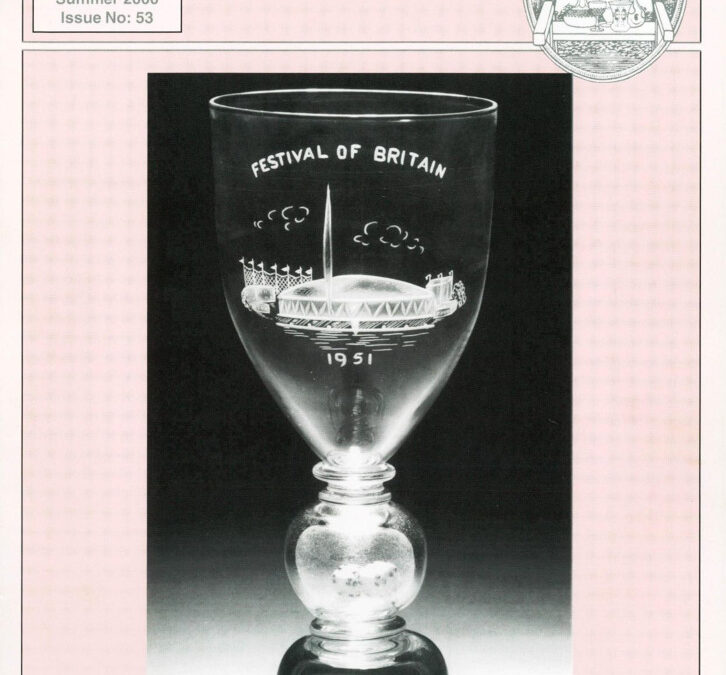
Festival of Britain Goblet, 1951 thought to be Royal Brierley
Crystal, Stourbridge. The stem has an interesting feature in
that it includes a hollow knop containing two dies which
move as the goblet is moved. ( ht. 19.2 cm) ( Courtesy of the
British Museum Trustees)
EDITORIAL
Our Apologies …
To the private collector who allowed us to feature the
Richardson amphora vase on the cover of the Spring is-
sue no.52, and to the photographer, Mike Johnson. The
definition and contrast as reproduced was not as good as
we wished.
Why weren’t you there?
In mid-April the Glass Association organised a week-end
at The World of Glass, at St Helens, but despite a full and
varied programme, and a marvellous opportunity to see
the new centre just two weeks after its official opening, only
twenty of our members attended. Those of us who were
there learned a great deal and had a fascinating and ab-
sorbing two days, but the Committee is understandably
anxious to know why the bookings were so low. Please write
into the
Cone –
if you wish, anonymously – to tell us why
this meeting did not appeal to you. Was it the distance? the
hassle of arranging your own accommodation? the total
expense of the event (most of which was the cost of pro-
viding food), along with travel, and hotel? The Committee
is already looking at the programme for 2001 and your
comments will obviously help in ensuring the future suc-
cess of the meetings organised for your enjoyment.
MORE HONES
Yvonne Cocking
enjoyed reading about Mr. Lilleycrap’s
Hone
(Cone
no.52) as she purchased one for 50p some 20
years ago at a country fair, and was pleased to have its pur-
pose confirmed. Since then (probably I only noticed them
because I had one’) she has seen many others, always in
green glass, at fairs and antique shops. But
David Watts
has
mixed feelings about the hone, writing:
I feel I am getting really old when I have to write
about this. To my knowledge the hone first appeared dur-
ing World War II (in spite of Geoff Timberlake’s investiga-
tions into the registration number/date on his example) in
response to the then acute shortage of razor-blades. It cost
about 6 old pence from Woolworth’s, I remember as I had
just begun shaving at the time and the life of a Blue Gillette
blade could be extended from about one week to two, at the
expense of a fairly sore chin! This was before stainless blades
came on to the market, so careful drying of your treasured
old steel one was vital. When they did and blades became
more plentiful, Lilleycrap was thankfully dispatched to the
dustbin or the back of the bathroom cabinet. Much the
same honing effect can be obtained using the inside of a
plain tumbler, so you can try it yourself! Incidentally, my
mother, a professional dress-maker used to hone her cut-
ting-out shears by what she called ‘the old professional’s
trick’, working the shears as if cutting off the neck of a
glass bottle. Three or four quick ‘cuts’ so that the glass passed
along the length of both blades. I always suspected that the
effect was psychological but she firmly believed it worked.
A more sophisticated razor-blade hone I still have is a
substantial chromium-plated metal box so hinged that it opens
to reveal two pairs of rollers, each carrying a leather spiral.
The blade sits in the middle between the rollers so that when
the box is closed, and the handle on the top is turned, each
spiral hones one of the sides of the blade. This works quite
well. It was called the Spiro Safety Blade Sharpener
(Pat.no.165982/20) made by John Watts (no relative) of Shef-
field (est.1765). It is still in a fancy leatherette box, 4″ tall, so
it must have been quite expensive at the time.
The opinions expressed in the
Glass
Cone
are
those of the contributors. The editors’ aim is
to cover a range of interests and ideas, which
are not necessarily their own. However, the
decision of the editorial board is final.
COPY DATES
Autumn 2000
1 August
Winter
15 November
The Glass Cone’ – Issue No 53: Summer 2000
RECENT ACQUISITIONS AT THE BRITISH MUSEUM
Annabelle Campbell-Manning
is currently undertaking PhD
research examining issues relating to collecting and curating
20th century objects, with a particular interest in the Mod-
ern Collection at the British Museum, London (curator.
Dr Judy Rudoe). This small selection of glass objects re-
flects something of the scope, quality and far-reaching na-
ture of the material in this collection which the museum
plans to expand.
Marquis of Queensbury vase
This impressive example of cut and etched glass was de-
signed by David Lord Queensbury around 1965. Tall and
cylindrical in shape, of clear lead glass its wheel-cut deco-
ration of vertical elliptical facets is polished alternately to
give matt and polished surfaces, thus creating a striking
pattern. Queensbury (b.1929) was Professor of Ceramics
at the Royal College of Art, London, from 1959-83, es-
tablishing his own design company Queensbury Hunt in
1966 together with Martin Hunt (b.1942), postgraduate
student and later Head of Glass & Ceramics at the RCA.
This particular vase in the pattern range of ornamental
glass known as Cascade was designed for Webb Corbett
shortly before the foundation of Queensbury Hunt and
the piece stands as an excellent example of what is largely
undervalued post-war British cut glass.
Festival of Britain goblet
Made in 1951, this goblet has a wheel-engraved illustra-
tion of the Skylon, and the Dome of Discovery, inscribed
with the words ‘Festival of Britain 1951’.
( See front cover
picture).
The stem has an interesting feature in that it in-
cludes a hollow knop containing two dies which move as
the goblet is moved. It is thought to have been made at
the Royal Brierley Crystal in Stourbridge, but if any reader
can tell us any more about this, we would be very grateful.
It must have been an expensive piece to produce and so
would have demanded a relatively high price tag, so again
if any reader knows how much it sold for, where they were
sold, and how many were produced, we would be inter-
ested to hear.
Cona Coffee Maker
The Cona Coffee Table Model is related to the above gob-
let, although not directly. This piece is widely considered
to be a classic of 20th century design and consequently
has become a much sought-after piece. It was designed in
1957 by Abraham Games (1914-96) who was widely
known for his graphic work of the 1940s-50s which in-
cluded striking propaganda images such as the ‘Careless
Talk Costs Lives’ series and the famous emblem of the
1951 Festival itself, Britannia and the cardinal points. The
commission came to Games from the head of Cona who
was a personal friend, and although he was not known
for his product designs, the Cona Coffee Maker is Games’s
most famous piece. Within the context of the British
Museum collection, this item provides a worthy sequel to
the Gerhard Marcks coffee maker of circa 1930.
Pop Glasses
The British Museum has a group of three goblets (gift of
Birgit Rausing) designed by the Swedish designer Gunnar
Cyren for Orrefors Glass in 1966, known as Pop glasses.
They all have a simple clean-shaped bowl but their char-
acteristic feature is the stem, formed of bands of opaque
glass in a variety of bold colours.
A break from the previous ‘refined’ style of Orrefors
designs, these glasses were produced in their hundreds for
several years from 1966 and were popularly christened
Popglas
following a major Pop Art exhibition at the Swed-
ish Museum of Modern Art, 1964.
Vase by Vladimir Zahour, Podybrady Glassworks,
Czechoslovakia in 1964 ( ht.40.5 cm) ( Courtesy of British
Museum Trustees)
Czech Zahour vase
This tall cylindrical vase was designed by Vladimir Zahour
and made at the Podybrady Glassworks in 1964. It is cut
with deep vertical grooves with an all-over pattern of tri-
angular and asymmetrical trapezoidal surfaces, lying on
different planes. Together with the triangular surfaces be-
ing alternately polished and matt, the visual effect is stun-
ning, giving an optical shimmer and illusory curved sides.
Zahour (b.1925) trained at the Glassmaking Trade
School, Zeleny Brod from 1939-43 and then attended the
School of Applied Art in Prague, studying under Prof.
Stipl. In 1954 he became a designer and modeller for the
Podybrady Glassworks alongside other exceptional Czech
designers such as Josef Pravec whose work is also now
represented in the British Museum collection.
3
The Glass Cone’ – Issue No 53: Summer 2000
4
The World of Glass with the new cone on the left
(Photograph by Tom Percival)
St Helens is still, arguably, the centre of the UK glass
industry, producing window glass, car windscreens, pub
glassware, commemoratives, bottles – admittedly not the
glass collected by most of our members but still rel-
evant to their interests. The first UK machines for mak-
ing stemware automatically were installed there by
United Glass in 1931. The ubiquitous
Paris
goblet came
from St Helens, Lancs., not from Paris, France.
The original “Hotties” project, first mooted in
1991, was to have interpreted the historic Cone Build-
ing and provided a new home for the Local Authority
and Pilkington Glass Museum collections. The collec-
tions were originally to have been displayed in the Cone.
It was only with the introduction of the national lot-
tery in 1994 that the scheme was revised and the new
buildings were planned as a home for both collections.
The Pilkington Glass Museum, venue for several
North West regional meetings, was closed in 1999 and
most of the contents were transferred to the new com-
plex, “The World of Glass”, which also includes the
contents of the town museum, a studio glass workshop,
an interactive area for experiment with glass and light,
an exciting audio-visual re-enactment of the history of
the industry, and a reference library.
The World of Glass was the venue for a National
Meeting of the Glass Association, held from 14-16 April
2000, only two weeks after it was opened to the public.
Members of the North West Regional Group had al-
ready visited the site in 1995 and 1999, so we knew
roughly what was coming, but the realisation far ex-
ceeded our expectations.
The buildings are entered through a new brick glass
cone. Cross the canal by an internal bridge and you reach
a historic old glass cone. In its day, the Siemens Regen-
erative Furnace revolutionised the making of flat glass
and the remains of this furnace are contained within the
“Jubilee Cone Building”, and the old cone projects
through its roof Once inside, visitors can walk through
the extensive network of brick tunnels which carried the
hot gases to and from the glass melting tank.
The Director, Gordon Kirk, welcomed us on the
first evening and galle us an introductory tour. After
dinner, members showed and discussed some “local”
glass including many paperweights made “unofficially”
by workers.
Dinah Stobbs, former Curator of the Pilkington
Archive, gave a historical account of the development
of the glass industry in St Helens. The Pilkington Ar-
chive is too large to be accommodated in the World of
Glass but is on another site and will eventually be made
available to the public.
The Jubilee Cone Building was especially important
in the development of glass technology because its novel
heating system permitted the use of coal as the fuel. This
was all explained to us by Dr David Martlew, Chairman
of the Society of Glass Technology. Mick Krupa, an ar-
chaeologist employed by the North Pennine Heritage
Trust, excavated the site over several years and he described
his work to us. This was not a typical archaeological in-
vestigation. Tons of rubble had to be removed from the
underground tunnels and then their functions had to be
painstakingly interpreted, with the help of David Martlew.
We had met the first project manager, Andrew
Patterson, in 1995 when the main task had been fund
raising. The present project manager, Mike Davies, de-
scribed his work to us – reconciling the often conflicting
demands of the sponsors, architects, town planners, ex-
hibition designers, and glass experts. This must be one
of the most difficult tasks, but Mike has kept his good
humour and achieved his task on time and on budget.
Ravenhead, now under Belgian ownership, con-
tinues to make glass vessels in St Helens. Leslie Jackson
had kindly given us advance copies of the relevant chap-
ter from her new book “20th Century Factory Glass”.
Ravenhead’s chief designer from 1947-74 was Alexan-
der Hardie Williamson whose glasses – over 1700 de-
sign patterns – can be found in most homes and pubs in
the UK. Curiously there is no reference to him in the
company history, but Roger Dodsworth (Broadfield
House) revealed to us that BHGM managed to acquire
the entire Williamson archive in 1994.
In the 1930s Pilkington was the leader in the use
of glass in architecture
(Cone
no. 7). This was the theme
of an illustrated talk by Alyson Pollard who has made
a special study of the panels removed from the
Mauretania when she was scrapped in 1965, some of
which are now in the Liverpool Museum.
It was a fascinating weekend of glass heritage and
it was sad that only twenty of our members attended.
Do go and see the new centre. You will not be disap-
pointed.
Alan Comyns
Some of our members, wearing hard hats as they
prepare to walk through the old furnace tunnels
below the old cone. (Photograph by Tom Percival)
‘The Glass Cone’ – Issue No 53: Summer 2000
GLASS AT THE AUCTIONS
Despite a small and very specialised market, and the
absence of a few well-known faces from the sale-room
on the actual day, the March sale at Christie’s King Street
of 16th-18th century Venetian glass went well, netting
well over £750,000. The most important sale was the
covered vase, diamond-engraved, gilded and cold-
painted, circa 1570-80 which went for £60,000 (exc. buy-
er’s premium) but rather surprisingly two other pieces
aroused little interest. One was a deep diamond-engraved
bowl with admittedly somewhat worn gilding, but few
could understand why the 17th century ewer and basin
failed to attract stiff competition between buyers; it went
after the auction for £22,000 against an estimate of £30-
50,000. However, lively bidding for a
tazza
decorated with
cherubs’ heads and dragons trebled the estimate, reach-
ing £19,000. If such prices are out of one’s league, there
were a number of small lots made up of a few glasses at
reasonable estimates but these too failed to attract much
attention, perhaps because specialised collectors already
possessed comparable items whereas new would-be-buy-
ers presumed the prices would go beyond their pockets.
Lost opportunities.
The Phillips sale of British glass, March 8 went
well with just two pieces left unsold, the top price being
paid for a set of eight 1770s drinking glasses, trumpet-
bowls and double opaque twists (£2200 exc. buyer’s pre-
mium), and also for another colour-twist with funnel
bowl, circa 1760. At Sotheby’s, the market again demon-
strated its current lack of interest in Bohemian and Ger-
man glass, but of more interest to the Glass Association
members perhaps was part of the glass collection of the
late Dr. Harwood Stevenson, former member of the
Glass Circle (a larger selection had been sold at Woolley
& Wallis in December). The 19th century English glasses
attracted attention, especially the three claret jugs illus-
trated in the last
Cone
(no.52): the John Baird of Glas-
gow ‘Apollo’ reaching £3200, the ‘Triumph of
Amphitrite’, possibly Thomas Webb, £9000, and the
third, possibly engraved by Kny, £5000. However, the
highest price (£11,500) at the sale was for a 1770s Dutch
stipple diamond-engraved glass inscribed ‘Indissoluble’.
A portrait of John Bailey
entitled The Collector’,
by Phyllis Arnold The
picture shows him with
part of his glass collec-
tion, and is itself a lot at
the auction.
(Photograph courtesy of
Hamilton Osborne King,
Auctioneers, Dublin)
In Dublin, on 6 June, Hamilton Osborne King are
selling the John Bailey collection of Irish silver and Irish
glass. John Bailey was widely known and was one of
those who set up the Glass Society of Ireland. Peter
Francis penned a warm reminiscence at the front of the
catalogue, remembering how John encouraged visitors
to handle even his rarest pieces, for only thus could they
be fully appreciated. It was his wish that all his pieces
should be sold on to other collectors for their enjoyment
rather than be kept together as a permanent collection.
Chris Crabtree
looks at other June auctions:
It isn’t often that a really important early 18′ century
glass goblet is discovered. However, when, as a part
of a routine valuation at the Schloss Hinnenburg, near
Paderborn in northern Germany, specialists were asked
to check a cellar filled with discarded family items,
first a cover then, after much searching, an accompa-
nying goblet was found – and what a goblet!
The Hinnenberg Goblet ( Courtesy of Sotheby’s London)
Standing at 68.5 cm it is probable that it is one of
two great
goblets with Emperors’ heads of gilded metal,
also base, and screw cover,
recorded in the inventory of
Augustus
III
of Saxony and Poland, and located in the
Royal Palace of Warsaw in 1739. The pair to this gob-
let is in the Nationalmuseum in Munich. Needless to
say, this piece has a high estimate – £30-40,000 in
Sotheby’s sale on 20th June.
Amongst other items in this sale are early Venetian
glasses, including a
rarefacon de Venise
gilt and
latticinio
wine glass (mid-16th century) estimated at £12-18,000
and several German armorial goblets and covers from
early to mid-18th century (est. £2,000 upwards).
On 13th June Phillips is selling 156 lots of a good
variety of British glass, ranging from 17th century wine
bottles, early balusters, air twists, composites and Jacobites,
with the highlight probably being a set of six colour twists
from about 1770, with bucket bowls and a pair of trans-
lucent dark blue spiral threads, estimated at £20-25,000.
Christie’s South Kensington hold a British & Con-
tinental glass sale on 15th June, with 246 lots of good
collectors’ items, half estimated below £500. Again includ-
ing wine bottles and balusters, but with some very collect-
able airtwists with a variety of bowls, stems and feet, and
decanters including a pair of green decanters richly gilt
decorated in the atelier of James Giles in a “mosaick”
pattern from about 1765 estimated at £5-8,000.
5
The Glass Cone’ – Issue No 53: Summer 2000
NEWS
OF HIMLEY…AND OF THE INDUSTRY
6
THE DREAM FADES…
It is official at last. Himley Hall, once a favourite weekend
hide-away for the Duke of Windsor in his pre-Wallis
Simpson days and the honeymoon location for the Duke
of Kent and his bride Marina, will not be resurrected as a
national glass centre.
Little thought had been given to its future use or in-
deed the cost of maintaining the building and grounds, when
it was purchased in a tripartite arrangement between Dudley,
Wolverhampton and South Staffordshire district councils,
fmally passing into Dudley DC hands in the 1980s. It was
then announced that Dudley Borough would promote its
claim to be the home of English glass — fair enough, given
the propinquity of Stourbridge, Brierley Hill, Wordsley and
Amblecote. Press conferences and photocalls were arranged:
Himley Hall would be a national glass museum, and ru-
mours spread that the Victoria & Albert Museum, Lon-
don, would enter into permanent loan agreements allowing
some of its glass to be displayed.
Then silence over months, extending into years. Until
mid-December 1999 when Dudley MBC Planning Com-
mittee minutes succinctly noted ‘Plans to turn the Hall
into a showpiece national glass museum were scrapped’.
Sadly, the various groups of Council Members involved
in the planning had concluded that the prospects for se-
curing the capital grants needed were too slight. They did
however affirm their commitment to Broadfield House
and to the Redhouse Glass Cone site (see below).
( Thanks
to John Sanders for information. )
WORDSLEY’S REDHOUSE
At the end of 1999 a proposal was submitted to Dudley
MBC for a £1.7 million revamp of the Redhouse site, ac-
cording to the
Stourbridge Express & Star.
Funding from
the National Lottery, EU and West Midlands Regional
Development Agency is being sought to conserve the listed
building, one of the best preserved glass cones surviving
in England, and to convert surrounding buildings into
workshops, and a new exhibition and visitor centre.
Andrew Sparke, Dudley Council’s Chief Executive, sup-
porting the scheme said ‘The project would create 30 jobs
directly, provide 15 high quality workshops and bring al-
most £1.5 million of external funding into Dudley.’
SHATTERED DREAMS… AGAIN
April 2000 and Royal Brierley directors confirm that their
glassworks would move to a new purpose-built £5.5 mil-
lion factory in Tipton Road near the Black Country Liv-
ing Museum, and looked forward to the Royal Brierley
Experience (the factory, a museum, studio space, training
centre, visitor centre etc.) becoming one of the top tourist
attractions in
the borough.
By the end of the month, some
anxieties were being expressed that a modern factory would
dominate the surroundings and that visitors would be put
off from visiting the on-site museum. But much worse
news was about to break. In early May the local
Express
& Star
reported the company was being sold for the sec-
ond time within 18 months ‘because of cash-flow prob-
lems’, with workers then unpaid for two weeks. A similar
misfortune regarding ‘cash-flow’ had hit Sunderland Glass-
works in December 1999. Readers of the
Cone
(no.
44,47,52) will remember that the operations of both firms
had been taken over by Epsom Activities in 1998.
On May 9 it was announced that an offer from the
Kenmore Group (owners of Midland Industrial Glass and
The Glass Company) for Royal Brierley had been accepted
but RB’s managing director was already warning this could
well entail ‘significant’ job losses for the 200-odd workforce.
( Thanks again to John Sanders for sending news-cuttings. )
YET MORE GLOOM
Dennis Hall Crystal Ltd, which produced glass under the
trade-name Tudor Crystal in the Brierley Hill area went
into liquidation early in Spring 2000. Stourbridge-based
Plowden & Thompson Ltd. has taken over but retaining
only eight employees in their jobs in the new company
now trading under the name Tudor Crystal Design Co. A
Plowden & Thompson spokesperson said that a major
problem had been the lack of a marketing manager, a
fault it planned to rectify shortly.
…AND YET MORE
The Stourbridge Chronicle
14 April 2000 noted that more
jobs have been lost at the Royal Doulton Crystal plant,
Amblecote. Local councillors have called for ‘small busi-
nesses’ to be brought back into the area to regenerate
Stourbridge but representatives of the National Union of
Flint Glassmakers argue such a ‘cottage industry’ approach
will not solve anything, pointing out that such firms pro-
duce ‘art work and we do not believe as a union that there
is much call for that’.
A
WORLD CLASSIC?
In
The Independent
6 May 2000, Dominic Lutyens (a family
name to conjure with!) tipped the new Waterford Crystal
stemware and vase range designed by fashion designer John
Rocha as a New World Classic. Director John Foley said
that ‘John Rocha’s reputation for simple elegant clothes per-
fectly complements our objectives in reaching a younger
market’, while Lutyens concludes ‘With their clear lines and
smooth surfaces, Rocha’s lamps, glasses and vases are not
only modernising Waterford but redefining the idea of luxury’.
A BELGIAN
PIRATED PIECE ?
GE Taylor was in France recently and took the opportu-
nity to visit an antiques fair in Angouleme when a piece
of moulded glass took his eye. It was clearly part of a
dressing table set, strikingly like the Jefferson’s
Chippen-
dale
series, and yet it bore the moulded mark ‘Val St Lam-
bert, Belgique’. He asks if it is possible, indeed if it is known
that Val St Lambert produced the Chippendale designs.
Is there any record of VSL having a licence from Jefferson,
or from Davidsons? Is it likely that such a well-known
company as VSL would ‘pirate’ a design like this? Can a
member of the Glass Association solve this mystery?
‘The Glass Cone’ – Issue No 53: Summer 2000
BOOK REVIEWS
NAISSANCE DE LA VERRIERE MODERNE, XII-
XVI SIECLES, Michel Philippe, Brepols Publ., Turnhout,
Belgium. 1998. ISBN 2 503 50738 7, hardback £65 approx..
462pp (French text).
Those members who enjoyed the delights of the Glass
Association trip to Nancy and the Vosges forest back in
July 1995 will be interested to learn of this publication
which traces the history of glassmaking in France, from
its early medieval beginnings up to the 16th century. This
covers the time when glassmaking was introduced over
here so this is essential reading for students interested in
the origins of English glass-production.
The book is divided into sections dealing with the
geographical breakdown of the glassmaking regions in
France, the technology, the glassmaking families and their
progressive spread throughout France, and the econom-
ics of glass production at the time. There is an extensive
list of glass-makers, including the Hennezels and Thysacs,
the founders of the English industry, and the Bongards,
the scourge of Mansell. It is packed with hard documen-
tary information supported by numerous tables and maps
in black and white, and an extensive bibliography, but the
twenty or so black and white illustrations are poor qual-
ity. The types of glassware produced, perhaps of greater
interest to the collector, receive only the briefest treatment.
Overall this book is about information rather than
presentation and reminds one of a University thesis. For
me the French used is fairly tough going, requiring sev-
eral dictionary referrals per page. However, it is well worth
the effort for one gains a full picture of the industry from
early medieval times and the links with England.
Brepols has an informative web site through which
this book was ordered directly. Delivery was in three days,
followed by an invoice so no credit card details had to be
put on the web. A very trouble-free way of purchasing
books from abroad.
David C Watts
THE CAMEO GLASS OF THOMAS AND GEORGE
WOODALL, by Christopher Woodall Perry, Ed: Sue
Evans, Publ: Richard Dennis. ISBN 0 903685 77 9. Hard-
back £38. 144pp. 56 pp of colour plates. 140 b/w pictures.
Christopher Woodall Perry is the great grandson of
George Woodall’s daughter Amy (you have to wait for the
last footnote in the book to find this out). His book is the
culmination of much research, both within his family and
in the archives of newspapers, museums and universities.
In the author’s own words, it is a biography of the Woodall
brothers, Thomas and George, with an extensive pictorial
record of their work.
Visually, the book is a treat, and many will buy it for
the pictures alone – 56 pages of colour photographs (and
many more in black and white) of the more important
pieces by the brothers, some echoing previous publications
but with a host of images previously unpublished.
A little of the biographical material is familiar, not
only from previous books but of course from Tom Woodall’s
own brief memoirs, included in H Jack Haden’s
Artists in
Cameo Glass.
But the author has extended it enormously
with family and other research. Sometimes the text is so
rich with names and allusions that it’s difficult to follow A
family tree would certainly have helped. So would an index.
But the narrative is itself a fascinating one — the struggles,
the tragedies, the triumphs and the disappointments of a
wonderfully human family. As in any large Victorian fam-
ily there was love, there were quarrels, there were scandals.
The author takes no sides and he tells his story with the
sympathy and affection that a family member can most
readily supply. Family pictures and George Woodall’s own
splendid local photographs leaven the text.
There is an 18-page listing at the end, derived in
part from the Webb price books, which adds the results of
the author’s research into the history and whereabouts of
many items. It’s certainly accurate for a few items
I
know
privately — it will be a useful basis for continuing research.
No one ever writes the final page of history, espe-
cially in the glass field, but this is a beautiful and useful
book that takes our knowledge and understanding forward.
Brian Currie
NATIONAL & REGIONAL MEETINGS
This year’s Annual General Meeting promises to include
an extraordinary opportunity to see a site usually totally
closed to the public. Those of the membership who have
attended past AGMs know that the committee always aims
to dispense with ‘formal matters’ with the minimum of
fuss and delay, so leaving more time to enjoy the surround-
ings and the invited speakers. So you are urged to pencil in
the date of 28 October 2000 into your diary, and the venue
is Penistone, near Barnsley in South Yorkshire. (We can
already see the raised eyebrows and quizzical looks…
Penistone?
Glass
in Penistone??) This is a wonderful chance
to see bottle-production in action at Rexam (ex Redfern
Bottle Glass), and you are URGED to come along. Invi-
tations like this don’t often come our way, especially when
one of the directors will discuss the whole process, and so
we should be keen to demonstrate that our members rel-
ish opportunities of such an exclusive nature.
A short postscript: please note that the Committee
will be seeking nominations for a Ordinary Committee
Member to be elected at the AGM, as one member will
stand down at the completion of his three-year service.
Such Ordinary Committee Members are invaluable, help-
ing to keep the elected officers aware of the wishes and
reactions of the membership.
As for Regional meetings, we have news from the North-
west: On 3 October there will be another of the popular
SHOW & TELL meetings in the Portico Library. Details
in due course from Alan Comyns, the Regional Organ-
iser, tel: 01244 382668; fax: 01244 372682.
The Glass Cone’ – Issue No 53: Summer 2000
EXHIBITIONS, FAIRS & SEMINARS
In connection with the current THOMAS & GEORGE
WOODALL CAMEO GLASS exhibition at Broadfield
House Glass Museum, on 22 July 2000 Kelsey Murphy
of Pilgrim Cameo Glass USA will give an illustrated
talk about its current product range. Details and tick-
ets (£5 or £2.50 for students) from the Friends of
Broadfield House Glass Museum.
The Glass Association has again agreed to sponsor the an-
nual MICHAEL PARKINGTON LECTURE to take place
at Himley Hall on 30 September 2000. The speaker will be
Chris Perry talking about his research on Thomas and George
Woodall (Cone no.52) and his involvement with the current
cameo glass exhibition at Broadfield House Glass Mu-
seum, and a full programme is being organised. Full infor-
mation in due course, or contact BHGM directly.
The DUDLEY GLASS FESTIVAL 2000 will run from
24 September to 1 October. It is planned to re-enact a
19th century Glass-makers’ Procession for the Open-
ing Day at 15.30. Contact Emma Warren, Asst Keeper
(Education) on 01384 812748 for details.
The fourth WEST COUNTRY SPECIALIST GLASS
FAIR will be at Newton Abbot Racecourse, Devon, on
21 October from 09.30 until 16.00. Details or further
information from Hyson Fairs Ltd., tel: 01647 231459;
fax: 01647 231659.
BROWSING THE WEB – COMMERCIAL SITES
This time we turn to commercial sites on the Internet most
likely to interest member of the Association. Let’s look at
the big auction sites and auction houses.
What do we want from an auctioneer’s site? A good
site downloads simplified catalogue pages quickly with-
out showing much detail. Thus you can scroll and scan
fast, stopping at interesting items to drill down into more
detailed linked information. An ideal site has a search fa-
cility which takes you quickly to the categories of auction
in which you are interested, and ideally to the lots you
want to see. Some good catalogue web sites carry a small
low resolution picture of every lot (the low resolution
means that the images are small in data terms and don’t
take long to download). These sites are a joy to review. It’s
actually like viewing an auction. If something catches your
eye, you can enlarge the image and the information in the
lot description — which takes time, but at least it’s time
devoted to something you’re interested in.
The site I like best is eBay, which meets all these tests.
Start at www.ebay.com (if you start at www.ebay.co.uk you
will get there in the end, but the initially presented listings
are fewer — being restricted to the UK rather than the world-
wide items). Click on Pottery and Glass. The main glass
index will show you thirty or so main categories of glass,
and many more sub-categories. When I looked on 31 May,
there were 6590 items listed for sale under Art Glass, 110 in
the sub-category Art Glass — English. Choose your cat-
egory. When it appears, you have the choice between a
straight listing of lots with their one-line summary titles, or
a Gallery View, which gives you a thumbnail image of the
lot. Enlarge by clicking on the thumbnail. Many lots are
profusely illustrated. There were 1700 pages of glass list-
ings on 31 May. Non-buyers can spend hours just looking
at glass pictures — or you may be tempted to bid!
Who sells on eBay? Anyone. Dealers, collectors, estate
executors from all over the world. Many items open bidding
at a few dollars. The better items start higher. Many items
you will think are misdescribed, but that’s part of the joy of
it! For that reason, don’t restrict yourself to the category you’re
interested in. Use the search facilities in the sites to search on
key words. You’ll fmd gems hidden in the oddest categories.
There are lots of wrinkles to bidding, paying (the
currency problem) and shipping on eBay — perhaps a sub-
ject for a future article.
Other net auction sites are developing, but they have far
to go. I checked a couple on 31 May. Icollector had 4 items
under ceramics, but no glass,while QXL had 11 glass items.
The traditional auction house sites have on the whole
not moved as quickly, perhaps due to the more severe prob-
lems entailed by the need to refresh content so frequently.
Most are not yet much help to the glass collector. But
there’s a growing number of good and helpful sites, par-
ticularly in the United States where auction houses devote
more resource and care and above all discipline to their
windows on the world. Skinner Inc. in Boston, Doyle
Galleries of New York and Sloan’s in Washington and
Miami (www.skinnerinc.com, www.doylegalleries.com,
and www.sloansauction.com) are examples of general
auction houses covering many fields in the fine arts but
from time to time with fine glass which is well illustrated.
Specialist glass auctioneers are James D Julia
(www.juliaauctions.com) and Early Auction Company
(www.EarlyAuctionCo.com) who both hold several spe-
cialist glass auctions each year with hundreds of lots usu-
ally well illustrated on their sites.
Our big London auction houses all have sites:
www.bonhams.com, www.christies.com, www.phillips-
auctions.com and wwwsothebys.com. They don’t on the
whole give much space to glass — it’s always been my grum-
ble that they submerge glass in much larger portfolios, such
as Ceramics and Glass. If you want to know about the fine
glass that they’re selling, you have to subscribe to and wade
through acres of glossy catalogues dealing primarily with
fine ceramics. The web sites tend to be the same. Things will
change. Several have now introduced a site search facility
which should lead you to any lots available.
Much better is Sotheby’s new online auction site, intro-
duced in January. Search on “glass” and a good quantity of
lots appear. We must hope that the sites for othei traditional-
style, auctions will gradually move up to the same standard.
Next time I’ll look at the many other smaller UK
auction houses who have their own web sites. Then we must
look at dealers — who have some splendid sites.
Brian Currie