




`1?
Issue No: 54
Millennium
Glass
The Magazine of
The Glass Association
Registered as a Charity No. 326602
Chairman
Ian Turner
Hon. Secretary
Di 1 Hier
Editorial Board
Patricia Baker, Ken Cannell, Brian Currie,
Roy Kingsbury
Addresses for Glass Cone correspondence
2 Usborne Mews, Carroun Road, London
SW8 1LR
Broadfield House Glass Museum, Compton
Drive, Kingswinford, West Midlands DY6 9NS
Address for membership enquiries
Membership Secretary, 50 Worcester Road,
Middleton, Manchester M24 1WZ
ISSN No. 0265 9654
Printed by
The Charlesworth Group
Published by
Society of Glass Technology for The Glass
Association
COVER ILLUSTRATION:
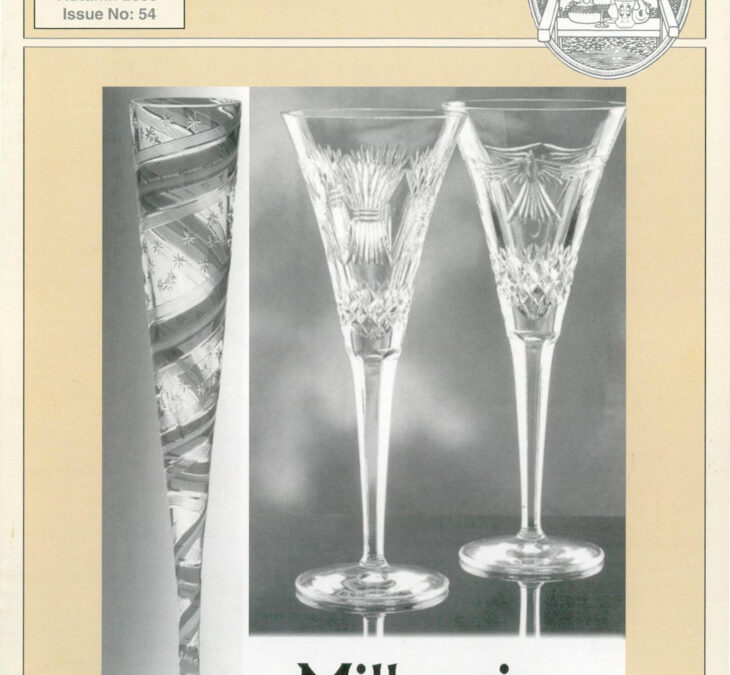
Glass for the Millennium – champagne flutes. Left.• Royal
Brierley’s ‘Stars and Stripes’ 16″. Right: Waterford Crys-
tal’s ‘Prosperity’ and ‘Peace’, both 9″. See Roy Kingsbury’s
article on page 3.
EDITORIAL
2000 Travel Award
Ian Turner, Chairman of the Glass Association, reports
as follows:
The Association received the usual half a dozen
applications for this year’s travel award and the assess-
ment panel was unanimous in recommending the Com-
mittee make only one award, to Dr Rachel Tyson to
research into the mediaeval glass used in Ireland be-
tween AD 1200-1500.
The Travel Award will enable her to visit Ireland to
examine excavated mediaeval vessel glass from that pe-
riod and compare these with those used in England dur-
ing the same period. Such glass has been excavated from
several sites but the finds have not been extensively re-
searched, and there has been little discussion of its wider
context, unlike those in England and the Low Coun-
tries. Hugh Willmott’s paper on English and Low Coun-
try vessel glass from a slightly later period will appear in
the next Journal, due to be published later this year.
Some of the questions that Rachel Tyson will at-
tempt to answer include: Were Irish vessel glasses im-
ported from England where utilitarian glass was locally
made, or was the glass imported via England from all
over Europe and the Near East? Or was there a local
Irish glass industry? Did the pattern of Irish glass usage
follow the same trends as in England? Do the Irish ves-
sels and other artefacts suggest the same trading routes
as in England, or were there different sources of supply?
Rachel Tyson is now an independent glass re-
searcher, and her research programme is a logical con-
tinuation of her former colleague Hugh Willmott’s
research which was supported by the 1998 Travel Award.
The award of £616 will be used for travel to Ireland
this autumn, and we look forward to seeing her paper
in the Association’s
Journal
after next.
Why weren’t you there?
In the Summer issue, we asked why only twenty of our
members attended the Glass Association weekend at The
World of Glass, at St Helens just two weeks after its
official opening. Our thanks to those members who wrote
in as such responses are useful to the Committee. There
was a variety of explanations, as one might expect: full
diaries, juggling family commitments, etc.. However, it
was clear that distance was not an issue, nor the total
expense. Several members asked if more advance notice
of events could be given, and as you may have noticed in
the last two issues we are advising you of forthcoming
`dates for the diary’ in the Regional & National Meet-
ings section. It is, of course, not always possible to give
details of the programme, especially if arrangements with
the speakers and the venue organisers have not been fi-
nalised, but at least we can tell you the date.
New Glass & Ceramics Fellowship
The Winterthur Museum, Delaware USA is honouring
its director 1992-9, Dwight P Lanmon by establishing a
three-month residential research Fellowship in Glass &
Ceramics, with a stipend of US$ 1,500 a month. Dwight
Lanmon is no stranger to British shores, where his occa-
sional lectures are always well attended, and his research
especially into paperweights is academically recognised.
For information: contact Pat Elliott, Office of Advanced
Studies, Winterthur Museum, Winterthur, DE 19735 (tel.
+302 888 4649; e-mail: pelliott@winterthur.org).
The opinions expressed in the
Glass Cone
are
those of the contributors. The editors’ aim is
to cover a range of interests and ideas, which
are not necessarily their own. However, the
decision of the editorial board is final.
COPY DATES
Winter 2000
10 November
Spring 2001
10 March
The Glass Cone’ – Issue No 54: Autumn 2000
MILLENNIUM COMMEMORATIVE GLASS: A BRIEF REVIEW
We need only glance at Churchill’s
History in Glass
(1937) or note the particular interest shown in engraved
glass at auction to realise how glass and historical events
go together. There seems to be something much more
permanent about the commemoration of historical
events through carving, engraving, enamelling or etch-
ing on glass than in mere printed reports, for example.
When I undertook to write this review of commemo-
rative glass produced in the UK for the Millennium,
I
first considered referring back to 1900, to see what was
produced then. Although I have found no evidence of
any ‘turn-of-the-century’ commemorative glass, that
does not mean there was none. But there was certainly
plenty for the year 2000!
This brief review deals with three kinds of glass
article: champagne flutes and other drinking glasses;
bottles, decanters, perfume bottles and the like; and
finally, paperweights, vases, bowls and other articles.
What was on offer coming up to January 1, 2000,
and what, in some cases, is still on offer?
Champagne flutes and other drinking glasses
Not surprisingly, in late 1999 there was a good range
of champagne flutes to choose from, with a correspond-
ingly good price range. Marks and Spencer, for exam-
ple, produced a pack of 6 flutes with ‘2000’ printed in
silver down the bowl. Price? £20. The House of Fraser
offered an attractive pair of champagne flutes for £7.
What was special about these was that the stem con-
sisted of the (vertically press moulded) digits ‘2000’ over
a high foot.
More expensive, but certainly with more work-
manship and style, are the millennium flutes produced
by Waterford Crystal and Royal Brierley, both still
available, I believe
(see Front Cover).
At £65–£70 a pair, the Waterford Crystal flutes
(h. 9″) are available in five designs — Happiness, Love,
Health, Prosperity and Peace. While they are less ex-
pensive and shorter than the (unusually) tall Royal
Brierley flutes, I am assured that they constitute one
of the most successful lines that Waterford has ever
produced.
Caithness Glass Millennium Snowflake weight
The Royal Brierley flutes are available in twelve
designs, including cut and colour twist, as in the Stars
and Stripes and Celebration flutes, and cut and gilded
as in the Gilded Encore flute. At 16″ tall and deco-
rated in a variety of ways, these are impressively el-
egant glasses. They retail at £140 a pair.
At the same time, of course, there was also a
wide choice of special Millennium champagnes, some
in specially designed bottles, some only with special
`2000′ labels.
I
suspect the only future collectibles here
will be unopened bottles or the labels themselves.
There were some other special drinking glasses,
too, like the Royal Doulton limited edition Millen-
nium pint mug or tankard that
I
saw in a shop shortly
before this article was to go to print. But I have seen
no more. Perhaps Glass Association members can add
to the list.
Bottles, decanters and perfume bottles
It would indeed be surprising if drinks manufacturers
had not taken advantage of the Millennium to promote
their wares — and they did. Bacardi produced a special
rum blend for the occasion and bottled it in 3,000 at-
tractive Bacardi 8 Millennium Decanters. Each
was
priced at US$700.
Other well-known drinks companies that pro-
duced bottles with at least special packing for the
Millennium include Grand Marnier, Benedictine,
Frangelico, Distilleria Bottega, Macallan whisky,
Lombard and Bell’s (with a special decanter). The
Speyside Distillery Company actually produced an
exclusive distillation ‘Millennium Speyside’ to cel-
ebrate the event. Only 2,000 were produced and, at
£350, each was presented in a special decanter in a
lockable wooden tantalus.
Remy Martin, too, produced a special com-
memorative edition of their Louis XIII Grande
Champagne Cognac in a fine ‘2000’ decanter. While,
at the other end of the price scale, Evian (the bottled
water manufacturer) produced a Millennium bottle,
shaped as a teardrop (or was it a drop of water?),
roughly 10″ high, and priced at only £2.30 each.
Paperweights, vases, bowls and other articles
As one might have expected, a number of Millennium
commemorative paperweights were produced by the
main paperweight glass companies — Perthshire, Caith-
ness Glass and Selkirk Glass.
The Caithness Glass Millennium 2000 Collec-
tion contains a wide range of commemorative glass-
ware, from paperweights to celebration glass
handbells (at £20) and ‘Skyline’ vases and bowls en-
graved with the Paris, New York, London or Sydney
skylines (at £195). The Millennium Snowflake paper-
weight was particularly popular containing, as it did,
a 2000 cane. Since the limited edition has sold out, it
will clearly be a collector’s item.
In the Selkirk range,
I
was struck by one called
`Planet’ which retails at £78. (Selkirk’s Millennium
paperweights range in price from £35.95 to £204.)
Perthshire Paperweights produced a special
‘The Glass Cone’ – Issue No 54: Autumn 2000
The Waterford Crystal Millennium Ball
Millennium Weight limited to 500 pieces and con-
taining a year cane.
Everglassting produced a millennium paper-
weight which,
I
am assured, is excellent and retails at
£30.
The Waterford Crystal Millennium Ball in Times Square
While most of us will tend to think primarily of rela-
tively small commemorative glass objects such as paper-
weights, vases, champagne flutes and the like, there is
however one piece which cannot be bought, and that is
the Waterford Millennium Ball. Composed of a whole
series of glass stars in a Star of Hope pattern, this crys-
tal ball is 6 feet in diameter and weighs 8001bs. It was a
gift from Waterford to the people of New York and was
lowered in Times Square to herald the new Millennium.
Apart from the Millennium Ball, then, quite a
lot to choose from, and there are still a lot of Mil-
lennium pieces on the shelves and in catalogues.
Who knows what will be viewed as Millennium
`collectors’ pieces’ in years to come, or what parents
The Waterford Ball in Times Square
and grandparents will be proud to hand down to their
children and grandchildren?
I
have a sneaking suspi-
cion that all will be collectable in their own way –
some because their handmade quality shines out, some
because they contain ‘2000’, but some quite simply be-
cause they embody the kind of bold optimism that many
feel as we head into the 21st century.
Roy Kingsbury
(Special thanks to Anne Metcalfe of Sweetbriar Gallery and
to Anne Moses for providing information for this article
Thanks also to Waterford Crystal, Royal Brierley and Caith-
ness Glass for permission to reproduce photographs.)
ART NOUVEAU (1890-1914) EXHIBITION
4
Just under 50 members attended the second National
event this year, built around the Victoria & Albert
Museum’s Art Nouveau exhibition. The meeting was
split between two locations, Imperial College and then
the afternoon viewing at the V&A. The morning ses-
sion started with a virtuoso presentation by Raymond
Notley.
I
can honestly say we have rarely been privi-
leged to have such an informative and interesting talk.
We have all been to talks where the selection of images
is familiar from the standard reference works. This was
certainly not the case on this occasion, and the juxta-
position of fresh images on two projectors brought new
meaning to the Art Nouveau movement. In fact ‘move-
ment’ is perhaps not the word: more a series of inter-
locking movements meeting at a point in time, all
breaking with the past and aiming for a total view, not
confined to a single art form. Needless to say, in this
presentation there was an emphasis on the important
role of glass during this time. Jennifer Opie, modestly understating her part in
the exhibition, then guided us through the concepts
underlying the selection and arrangement of the ob-
jects and drew to our attention some of the specific
items. (Although the exhibition is now at the National
Gallery of Art, Washington DC, not all the pieces
shown at the V&A have crossed the pond.) As the exhi-
bition was arranged in a ‘walk-through’ format, this
introduction proved invaluable. Already our two speak-
ers had made it a successful day.
Following a buffet lunch we then proceeded to
the V&A as two separate parties. Seeing the notices
advising of an hour-long queue, the look of horror on
people’s faces was apparent. But that was the reason
for the two parties: armed with our stickers we went
straight in, lingering where we wished. Almost the first
exhibit was the Lalique corsage adopted as the motif
of the V&A exhibition, a reminder of his skills as a
jeweller before he became involved in glass. The exhibi-
tion was in three sections (`zones’ has such a negative
connotation now) which naturally flowed together. The
first emphasised the sources, strands and background
of the movement(s), the second the underlying inspira-
tion of Nature, and finally how Art Nouveau flowered
differently in a series of cities. This section has fired my
desire to visit at least two cities in the near future.
John Delafaille
‘The Glass Cone’ – Issue No 54: Autumn
2000
SOWERBY’S IVORY QUEENS WARE
Enthusiasts of pressed glass will be familiar with this prod-
uct, but what gave the glass its unique colour? The most
obvious possibility is a uranium compound, as two of the
standard reference books suggest, but there appears to be
a discrepancy between them. So which is correct?
Raymond Slack in
English Pressed Glass 1830-1900
described the specification for Queens Ware when it was
patented in November 1878 as including uranium ‘to give
it the yellow tint’ in combination with cryolite spar added
to the usual flint glass batch, and that the proportions of
the ingredients were not fixed but varied at will. He makes
no mention of a later or different formula. The late
Sheilagh Murray also refers to this ware in her book
The
Peacock and the Lions,
stating that the later production of
Queens Ware contained uranium but claimed that an ear-
lier recipe existed which by implication did not; her rea-
sons for this assertion are not entirely clear. She makes a distinction between the original Queens Ware which had
a creamy colour and some later specimens which had a
greenish tint, less pleasing to her eyes and which she asso-
ciated with uranium. A formula for this ‘later’ version is
given as consisting of a batch of opal mixture to which
was added 251b (11.4kg) of uranium, but no firm date for
the introduction of this recipe is noted. Another recipe
dated 9 April 1888 (a decade after the patent) for her pre-
ferred colouring is included as follows: ‘Using a little batch
made up with the opal batch and using with it two pounds
of yellow arsenic [arsenic trisulphide] you will have a good
Queens Ware.’ Murray did not state that arsenic was the
colorant but in the absence of any other ingredient in the
opal mix, which anyway, gives a dense white colour (Philip
Housden,
Cone
no.51), it must be presumed as such. In
summary: Slack identified only one form of Queens Ware
whose colouring agent was uranium, whereas Murray
believed there were two versions, the ‘earlier’ with arsenic
and another containing uranium.
As it is known that uranium in glass causes it to fluo-
resce in ultraviolet light, it was decided to examine 65 pieces
of Queens Ware in a certain private collection. All fluo-
resced strongly under ultraviolet light and with equal inten-
sity, whereas no examples of Sowerby’s opal glass, some of
which are said to contain arsenic to render the glass opaque,
showed any fluorescence at all. It would seem therefore that
all the pieces of Queens Ware examined in this way were
made to the same basic formula and all contained uranium,
and in a sample of this size, one would have expected to
examples of both ‘versions’ to have appeared.
My conclusion is therefore that there was only one
basic formula for Queens Ware and that this contained
uranium, although the proportions might have varied.
Murray’s observation that some items had a greenish tint
may relate to a higher percentage than usual of uranium
being used in some examples, but this cannot be taken as
proving that the cream versions relied on some other in-
gredient for their colour.
All of which neatly brings me to other queries…
The Sowerby’s ‘new bowl’ in two sizes (private collection)
The ‘new bowl’
Sowerby’s round, ‘comb’ handled fruit bowl, sometimes
known as the ‘new bowl’ is one of this firm’s best known
products. The design was registered on 6 June 1879, and
illustrated as item number 1407 in Sowerby’s pattern book
IX of 1882. Although made
in
other colours, it is most
often seen in ‘Ivory Queens Ware’.
So much is well known; but of possible interest to
collectors is that a smaller version was also made with a
diameter of 13cm rather than usual 19.5cm size. An exam-
ple has been in a private collection for over ten years but to
my knowledge I have come across only one other example,
so these small bowls are relatively rare. Furthermore I can
find no reference to them in any of the standard works on
pressed glass. Even Sowerby’s own pattern book IX makes
no mention of two sizes of this bowl despite several other
items listed have the legends `L&S’ or ‘Two sizes’ (inciden-
tally why have two legends to describe what appears to be
the same thing?). One possible explanation is that the smaller
bowl did not go into production until after pattern book
IX was published. In which case, does anyone with access
to later pattern books know if there is a later reference to
two sizes? And has anyone else seen more examples of this
smaller size? Are they really as rare as my experience sug-
gests? And why is it known as the ‘new bowl’?
Deryk Snow
GLASS AT THE AUCTIONS
THE JUNE SALES
The
Hinnenberg Goblet
described in the last issue was
the highlight of the June auctions. Estimated by
Sotheby’s (June 20) at £30-40,000 bidding quickly raced
ahead to £100,000 (all hammer prices); a London dealer
was the purchaser (`buying for stock’!) and underbid
by an unknown private bidder. Another gem was the
goblet attributed to the Paderborn, Emde or
Altmiindener glassworks around 1732 and beautifully
engraved with an elaborate armorial for Clemens Au-
gust; it reached six times its estimate (£30,000) possibly
because August had been the subject of a recent Co-
logne exhibition. A
Hessen Goblet
engraved with min-
ing scenes, circa 1750, went for £16,000, over three times
the highest estimate. Many of the other high-quality
18th-century engraved goblets with covers from the
same source sold well above estimates and will go back
to Germany with one delighted continental dealer pur-
‘The Glass Cone’ – Issue No 54: Autumn 2000
chasing over half of these lots.
The 13 June Phillips’ sale of British glass was
well attended and a high proportion of the lots sold.
The star lot was a set of six colour twists from 1770
which went for £18,000, some way under the £20-
25,000 estimate, surprising as such ‘sets’ of good
glasses are rare, and with colour twists even more so.
Most of the lots on offer went within their estimates
with two notable exceptions: a sealed wine bottle of
1730-40 fetched double the estimate at £880, and an
early mead glass of late 17th century with a generous
cup-shaped bowl, `nipt diamond waies’, set on a ta-
pering plain stem and conical folded foot realised
£1,150, double the estimate.
The Bonhams sale of 14 June was dominated by
the major part of the Leonard Bickerton collection. The
author of
Eighteenth century English Drinking Glasses:
An Illustrated Guide,
Leonard Bickerton was the Chief
Librarian and Curator at Worthing (West Sussex) or-
ganising over 20 years a great variety of events, includ-
ing an exhibition of glass in 1968. It was preparing the
catalogue for this event that finally led to the publica-
tion in 1971 of his book, now recognised as a standard
work, and he later reassembled the dispersed items, some
450 pieces, of the Albert Hartshorne glass collection
for an exhibition. (In 1989 Glass Association members
had the great opportunity of handling a large selection
of the Hartshorne pieces, and met Mr Bickerton to see
his glass.) With 76 lots, many collectors were keen to
acquire an example from the Bickerton collection, many
of which had been illustrated in the book
(eds:
but buy-
ers should check the catalogue entry with the Bickerton
book; there have been glitches). Only a few rare items
fetched four figures, leaving some very acceptable glasses
at attractive prices.
The very next day, 15 June (obviously now one of
the major months for glass sales), Christie’s South Ken-
sington featured good English collectors’ glass, many
selling for their low estimates and giving very good value.
An item arousing much interest was a pair of green
decanters, about 1765, richly decorated in the
atelier
of
James Giles in a `mosaick’ pattern, which had featured
in a 1774 catalogue of a sale by Mr Christie as lot 29;
this time the decanters sold for £7,500. A selection of
Thomas Webb scent flasks was also eagerly contested.
An ‘Ivory’ circular scent flask with silver cover hall-
marked London 1888 fetched £1,300, four times the
high estimate, while a pale-blue four layer example, en-
graved with a flowering shrub and moth, circa 1880,
reached £700, and a citrus yellow and white silver-
mounted (hallmarked 1886) cameo flask and screw
cover reached £2,200.
Chris Crabtree
Business was brisk for the John Bailey sale at Hamil-
ton Osborne King, Dublin with the two star items, a
decanter engraved by Mary Carter, one of four known
to exist, and a twin-lipped rummer by John Ayckboum
going to an American collector. The Carter piece fetched
£10,700 against an estimate of £3,500, and the
Ayckboum glass for £4,500. The engraved and dated
1782 Waterford jug still excited much attention, tripling
the estimate although research by John Bailey had re-
vealed that it was not as early nor as rare as he himself
had first thought, but the work of Franz Tieze at the
turn of the 20th century. The Cork and Belfast decant-
ers of assorted shapes and sizes brought in healthy
prices, and the three Newcastle-type baluster glasses
with round funnel bowls quickly found purchasers, the
tallest and most attractive piece fetching £1,800.
BOOK REVIEWS
6
20th CENTURY FACTORY GLASS, Lesley Jackson,
Mitchell Beazley, 2000, ISBN 1 85732 267 3, hardback
£40, 256pp, colour throughout.
The dust-jacket describes this book as ‘for glass collec-
tors and modern design enthusiasts alike’. These are
the target readers, and the introduction lives fully up to
that promise, encapsulating the major developments in
glass during the century, as seen through the eyes of a
design historian: an excellent introduction offering a
balanced view but raising interesting issues.
The difficulty comes in the follow-up. This lists
98 different glass-makers in alphabetical order, with a
brief history of each; by its very nature, it must be dis-
jointed. Each potted history gives details of the origin
of the factory and then chronologically describes the
`house’ styles, the designers involved and the period
when specific designs were produced. If the factory was
responsible for any significant technical advance, this is
noted with a brief description of the technique with
cross-referencing with other factories as necessary. The
amount of space devoted to each factory varies, the
largest entry being Orrefors with seven pages, followed
by Holmegaard and Iittala with six pages. Each fac-
tory has a minimum of one full page, which always in-
cludes a full colour illustration. The final sections list
factory marks, suggested publications, location of ar-
chives and details of permanent exhibitions for each
factory where relevant, useful for even the specialist.
This is clearly not the type of book you sit and
read from cover to cover, and with so much informa-
tion on so many glass-houses, it was difficult to know
where to start. I decided first to read a couple of sec-
tions on glass-producers on which I felt reasonably in-
formed (choosing Orrefors and Val St Lambert), and
then on two glass factories, Dartington and Caithness,
with which I was less familiar, and finally major pro-
ducers of domestic glass with whom I had been com-
mercially involved: Dema and JG Durand.
The pages on Orrefors and Val St Lambert are
up to date in terms of historical research and techni-
cal achievement (eg.
graal),
and their current position.
The main designers are all mentioned and their work
illustrated by at least one photograph, the choices of
which were appropriate and good quality. Caithness
and Dartington, both founded in the 1960s, are now
established names and it was interesting to read how
both, originating in part from regional employment
‘The Glass Cone’ – Issue No 54: Autumn 2000
policies, have found success by different routes. I found
much fresh material. The focus on design was nowhere
more apparent than in my final selection. Dema, the
largest producer of domestic glass in the UK, had a
one-page entry giving the basic facts about the com-
pany. JG Durand (established 1815) was not men-
tioned although it is now merged with Cristallerie
D’Arques, the largest factory in Europe employing
world-wide 13,000 people with plants in Spain and
the USA. With a large unit making hand-blown glass
to a good if standard design of thin blown wine glasses,
and a degree of technical innovation, this was a sur-
prise.
(Eds. note:
also the famous Turkish Pasabahce
factory is omitted.)
This is a scholarly, encyclopaedic and compre-
hensive publication although perhaps inevitably some
glass factories are not included. It is well cross-refer-
enced and illustrated, so a valuable source book if you
are tracing the pattern of developing styles. It con-
tains an enormous amount of information and sug-
gests avenues for further investigation — in my view
in far more accessible manner than via the internet. I
am reminded of when I first moved to London: at
first all I knew was the underground system, and the
streets immediately around each station, but then
gradually I realised how all these streets linked up. This
book will help you do that.
John Delafaille
In 1997 the Glass Circle organised a symposium at the
British Museum on the subject of GLASS COLLEC-
TORS & THEIR COLLECTIONS IN MUSEUMS
IN GREAT BRITAIN. Eight presentations were made,
each by an expert with an in-depth knowledge of the
museum collection concerned. These papers have now
been published in large format with nearly 100 black
and white illustrations of glass, collectors, etc. A fasci-
nating background to most of the major UK public
collections, and essential reading before that next visit.
(Some misalignment of page numbers throughout the
index.) Available from David Watts, 27 Reydon Road,
Barnet, Herts EN5 LAN £12 plus £1.50 (UK) or plus
£3.50 abroad p&p.
Two booklets published by the Royal Stuart Society: A
DIGEST OF THE JACOBITE CLUBS by Peter Lole,
listing all the known clubs in Britain plus a few else-
where; over 200 in all, from the 18th century to date,
with references to associated glassware. Also JACOBITE
GLASS: ITS PLACE IN HISTORY by Geoffrey
Seddon, author of
The Jacobites & their Drinking
Glasses,
appraising the status of Jacobite glass in the
light of the 1996 symposium
Judging Jacobite Glass
which threatened to throw all known pieces out with
the proverbial bathwater. Both available from Dr.
Eveline Cruickshanks, The Royal Stuart Society, 46
Goodwood Court, Devonshire Street, London W1N
1LS, £3.50 inc. p&p. Geoffrey Seddon has also a few
`author’s copies’ of his book
The Jacobites…
available,
which is technically out-of-print. These he has kindly
offered to Glass Association members at £40 inc. p&p
(UK); tel. 01451 830274.
Ken Cannell
THE WINDOW GLASS MAKERS OF ST.HELENS,
RA Parkin, Society of Glass Technology, 2000. ISBN
0 900682 28 0, paperback £12.50 (SGT members:£7.50),
122pp, b/w with tables, maps, diagrams, glossary. Avail-
able from SGT tel. 0114 263 4455; fax. 0114 263 4411;
e-mail: books@sgt.org
This is a record of window glass-making at Pilkington
Brothers’ Sheet Works at Grove Street, St Helens from
1826 to 1952, incorporating both archival material and
also information from the people in the factory, such as
furnace builders, machine men, block minders and gath-
erers. By the 1930s the factory covered 120 acres, em-
ploying some 3-4,000 workers with a small management
staff ‘which does not compare with modern plants…
where the proportion of managers and technicians to
workers is completely reversed’. Technical details about
tank furnaces and flattening kilns are easy to digest, the
drawings and diagrams comprehensible and the text rat-
tles along at good pace. At a time when the future of the
Pilkington factory archives are shrouded in mist, this is
a small outlay for a piece of history.
PRACTISING STAINED GLASS SAFELY, Martyn
Stanton Harris, Society of Glass Technology, 2000.
ISBN 0 900682 26 4, paperback, £5.50 (SGT members
£5), 48pp, 3 colour, diagrams. Availability details:
see
above.
If you know anyone interested in working in stained
glass, get this booklet as a gift. It undramatically but
concisely points out the hazards and dangers working
in this field of glass, and offers solutions. Harry Clarke,
the famous Irish stained glass artist died at the age of
41 years; the metal door fittings of his basement where
acid etching was done had ‘virtually corroded away’.
Don’t let it happen to a friend…
WHISKY DISPENSERS & MEASURES, Brian
Brooks, privately publ., 2000, no ISBN registration,
paperback £6.50 inc. p&p, 34pp, b/white. Available from
Raymond Slack Books, Kingswood Road, Surrey CR2
9DQ.
This booklet with a brief text illustrates glass measures
and dispensers produced for serving whisky, with par-
ticular emphasis on the last decades of the 19th cen-
tury and into the early 20th century. As the author states
in the introduction many examples feature in antique
shops and can ‘form an interesting collection without
involving too much expense’.
CAVEAT EMPTOR
Stephen Parker has noted during the last 12 months
quite a number of
Battle of the Boyne
glasses, with the
initials TC SC, coming up for sale up and down the
country. No one appears to know what or whom these
initials stand for, but it is clear that one dealer in the
USA sold 16 (yes, sixteen) of these glasses in 1999.
Stephen Parker has not had the opportunity to inspect
one at close quarters but does have some ‘rough’ pho-
tographs, and wonders if they were produced in the
1930s or even more recently. Have you seen any?
7
The Glass Cone’ – Issue No 54: Autumn 2000
EXHIBITIONS, FAIRS & SEMINARS
The GUILD OF GLASS ENGRAVERS is holding a
Jubilee Exhibition of contemporary engraved glass, fea-
turing the work of some 70 artists at GALLERY 27, 27
Cork Street, London W1X 1HN, from 3-14 October 2000,
open 9.30-18.30; admission free. In connection with this
exhibition, on 7 October there will be a day conference at
Guy’s Hospital, London, with illustrated talks by Clare
Henshaw, John Smith (on Dutch engraving) and E Eliades
reviewing the last 25 years of glass engraving. The confer-
ence fee is £15 inc. tea/coffee or £25 with lunch. Details
from: GGE, 35 Ossulton Way, London N2 OJY, tel/fax.
020 8731 9352.
An exhibition IT’S TRANSPARENT exploring the de-
velopment of glass from Roman times up to contempo-
rary studio glass from the Crafts Council will run at
Chertsey Museum, 33 Windsor Street, Chertsey, Surrey
KT16 8AT from 23 September to 2 December 2000 (closed
Sunday–Monday). Details from: 01932 565764; e-mail:
enquiries@chertseymuseum.org.uk
The Autumn NATIONAL GLASS FAIR, organised by
Patricia Hier, is scheduled for 12 November from 9.30 am
to 4 pm at the National Motorcycle Museum, West Mid-
lands, M42 Junction 6 (A45). This Fair always attracts
interesting pieces and enthusiasts alike! Details from: 01260
271973 (e-mail: dil.hier@talk21.com).
The Society of Glass Technology, under the auspices
of the International Commission on Glass, is CALL-
ING FOR PAPERS to be given at the XIX Interna-
tional Congress on Glass, to be held on 2-6 July 2001
at the Edinburgh International Conference Centre,
Scotland. Last held in the UK in 1968, the Congress
attracted over 850 participants from 48 countries
when held recently in San Francisco. Although the
main emphasis is the scientific and technical nature
of glass, developments and applications, it is planned
to have three sections on archaeology; art design and
history; and glass education. Further information;
tel. 01943 880491; fax. 01943 880489; e-mail:
anne.wells@selecthallmark.co.uk
If Glass Association members produce a copy of the
Cone
at the forthcoming WEST COUNTRY GLASS FAIR,
21 October 2000, Tote Pavilion, Newton Abbot Race-
course, Devon, they will be admitted at half-price. En-
quiries: tel. 01647 231459; fax. 01647 231659.
REPORT FROM THE MEMBERSHIP SECRETARY
A very warm welcome to the following new members who
have joined the Glass Association over recent months:
Mr PE Barnard
Surrey
Prof. M Barnes
Newcastle upon Tyne
Mrs M Bell
Tyne & Wear
Dr JT Brown
London
Mrs S Burden
Staffs
Mr S Foster
Wolverhampton
Mr A Green
London
Mrs S Hyson
Devon
Mr A Lineham
London
Mr RJ Morgan
Notts
Mr G Pullen
Hants
Mrs J Turner
West Yorks
Mr & Mrs A Wareham
Northants
Mr R Weir
London
Mr & Mrs BR Wynne
Cambs
Peter Beebe,
our Membership Secretary, reminds any new
members please to make themselves known particularly
when attending their first meetings.
About 70 members failed to renew their subscrip-
tion in the past year — the usual number — so our mem-
bership over the year end is a little below 700.
Long-standing members who remember Mrs Eliza-
beth Hitchman of Nottingham will be sorry to hear of her
passing. She was a regular at our meetings and thoroughly
enjoyed our weekend events, especially those organised
abroad. A very pleasant and interesting lady who always
included a personal note when renewing her subscription.
This year we are introducing a Gift Aid Scheme
which our Treasurer has drawn up and details will be go-
ing out to all members. We hope this will boost funds and
so defer any increase in subscription charges. Such schemes
enable charities to claim tax refunds from British tax pay-
ers and recent legislation has made the process with the
Inland Revenue must easier to administer. Please think
seriously and positively about joining this scheme.
Finally a sincere word of thanks to Annette Dunn
of Broadfield House for all her efficient help during this
last year.
NATIONAL AND REGIONAL MEETINGS
As noted in the last issue, this year’s Annual General Meet-
ing will be on 28 October 2000 at Penistone, near Barnsley
in South Yorkshire, where members have been invited to
see bottle-production. The Committee will be seeking
nominations for an Ordinary Committee member to be
elected at the AGM, as one member will stand down at
the completion of his three-year service. Such Ordinary
Committee Members are invaluable, helping to keep the
elected officers aware of the wishes and reactions of the
membership.
Remember!
–
says the Treasurer
When you pay your subscription (now due), do please think
of adding a donation, and send a gift aid form with it. We
are determined not to increase the subscription, but our
accounts this year will show that our work is costing more
than we are raising through subscriptions alone. Please
give if you can afford it!