




Spring 2001
Issue No: 56
The Magazine of
The Glass Association
Registered as a Charity No. 326602
Chairman
Ian Turner
Hon. Secretary
Dil Hier
Editorial Board
Patricia Baker, Ken Cannel’, Brian Currie,
Roy Kingsbury
Addresses for Glass Cone correspondence
2 Usborne Mews, Carroun Road, London
SW8 1LR
Broadfield House Glass Museum, Compton
Drive, Kingswinford, West Midlands DY6 9NS
Address
for
membership enquiries
Membership Secretary, 50 Worcester Road,
Middleton, Manchester M24 1WZ
ISSN No. 0265 9654
Printed by
The Charlesworth Group
Published by
Society of Glass Technology for The Glass
Association
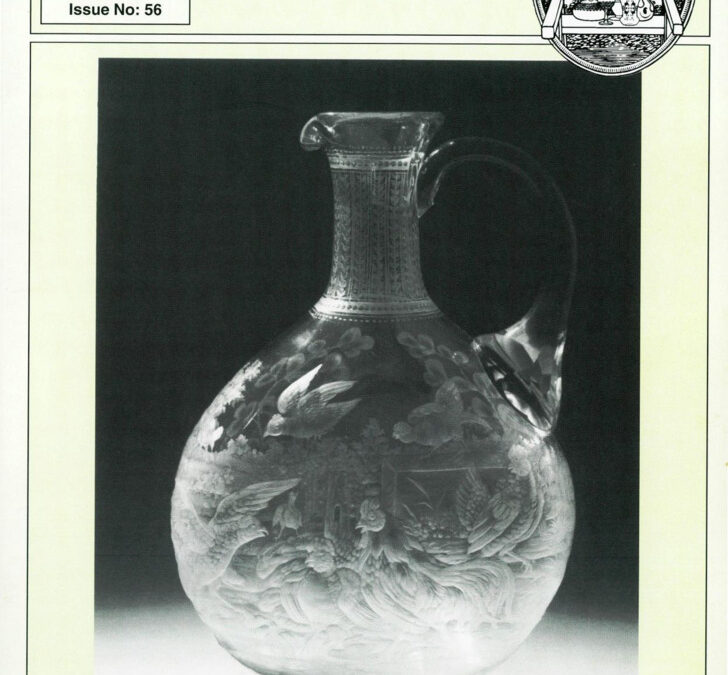
COVER ILLUSTRATION:
A Claret Jug, late 19th century,engraved in the manner of
Frederick Kny, on one side with a cockerel and other birds in a
garden, the reverse with a wreath of intertwined shamrock and
oak 26.5cm. ( Courtesy of Phillips Auctioneers London)
In offering this item at their 13 December auction, Phillips
reported that Broadfield House Glass Museum have a simi-
lar jug, signed by Kny, with identical engraving at the neck.
The curious subject and the Irish and English emblems on
the reverse suggest some political significance.
EDITORIAL
Let’s twist again…
Three members have commented on the air-twist decanter
featured on the cover of the last issue of the
Cone.
Andrew
Rudebeck knows of a pair of clear ‘white’ glass jugs with
18 air-twists, truncated conical shape with claw handles,
while Ron Havenhand has seen a ‘champagne’ glass (ht.
14cm) with a similar arrangement of air-twists to the de-
canter, numbering at least 20. The cup-shaped bowl has a
diameter of 9.3cm, and the stem and foot are hollow; when
the owner purchased it, it was attributed to Stourbridge.
And
Dil
Hier has tracked down the maker; see page 3.
Where did I read that?
A ‘contents’ list detailing the major features and news car-
ried in the
Glass Cone
has been prepared by our Commit-
tee member, Geoff Timberlake, which could be a great
assistance and save you time if you’re trying to locate a
particular item. There is a small charge to cover photo-
copying expenses and p&p; contact him on tel. 01582
423120, e-mail: geoffctim@btinternet,com
And if you want another copy of a particular
Cone
issue, or are missing any back-issues, please contact Peter
Beebe, our Membership Secretary (address above), with
details and a cheque for £1 per copy (this includes p&p)
and he will organise despatch to you. If for any reason a
particular issue is out of print, we will supply a photocopy.
Replacement glasses
If you have recently broken a cut crystal table glass from
one of the well-known West Midlands manufacturers’
ranges, DISCOUNTED DESIGNS, 112 Street Lane,
Denby, Derbyshire DE5 8NF (tel. 01773 512079, fax. 01773
512079. e-mail: discontinueddesigns@tinyworld.co.uk)
might well have a replacement in stock. The company has a
number of pieces from the ranges of Thomas Webb, Royal
Brierley, Stuart & Sons, and Webb Corbett etc., and has
facilities for reproducing designs that are out of stock.
New to Broadfield
The winners of the 2001 Studio Scholarship are Ian
MacDonald and Stephen Foster, who will now occupy
the studio glass-making space in the Broadfield House
Glass Museum grounds for this year, trading under the
name of
Glass F. M.
Both recent graduates from the In-
ternational Glass Centre at Brierley Hill, MacDonald and
Foster were clearly delighted, saying: ‘We are confident
that our time at Broadfield House will be enjoyable, en-
lightening, rewarding and ultimately successful. The Schol-
arship is an excellent opportunity to channel our existing
experience, learn new skills and old techniques.’
The Rakow Grant
The 1999 doctoral research of Jill Turnbull at the University
of Edinburgh, Scotland, has rightly received international rec-
ognition. The Rakow Grant for Glass Research, founded by
the late Dr and Mrs Leonard Rakow and administered through
Corning Museum of Glass, NY, has been awarded to her to
enable the publication of her thesis
The Scottish Glass Indus-
try, 1610-1750
by the Society of Antiquaries of Scotland. A
few Glass Association members heard her speak at a recent
Association for the History of Glass Study Day in London
and can readily testify to the fascinating information she has
gathered on this topic. Our congratulations to her!
The opinions expressed in the
Glass Cone
are
those of the contributors. The editors’ aim is
to cover a range of interests and ideas, which
are not necessarily their own. However, the de-
cision of the editorial board is final.
COPY DATES
Summer 2001
20 June
Autumn 2001
15 August
The Glass Cone’ – Issue No 56: Spring 2001
AIR TWIST… PUTTING THE RECORD STRAIGHT
The illustration of the air twist decanter on the Cone cover
( No. 55) has inspired our secretary to put pen to paper and
put the record straight
The decanter reproduced above is virtually identical to
pattern number 5519 in the Thomas Webb & Sons pat-
tern book. The pattern dated circa 1858 (Pattern No. 5644
is dated 1859) is the very first of a range of
Hollow Twist
items appearing over a few pages in their pattern book for
this period. Other articles include a “tumbler-up” (carafe
and glass), a finger bowl, a salt and a jug with
Hollow
Twist
handle.
Webb described the items as
Hollow Twist
and
continued producing them throughout the Victorian
period. In 1878 they produced a range of Venetian style
glass which combined hollow twists, coloured thread-
ing, applied and pierced decoration.
The sweetmeat shown above left appears in dif-
ferent sizes and on the other design the description
changes from
Hollow Twist
to
Air Twist.
Some of these
items are even more elaborate than that shown, where
a hollow twist snake forms the stem.
The vase above right shows the way this technique
was developed into more traditional English styles. A
vase very similar to this is illustrated in
British Glass
1800 — 1914
plate 291, where the attribution unfortu-
nately is to Stevens & Williams.
Thomas Webb & Sons also combined this technique
into their late 19th and early 20th century decorative art
glass. The high quality of their predominantly crystal
hollow twist articles does not have the same appeal as when
used in combination with coloured glass, but Webbs did
not appear to exploit this to any great extent.
Stevens and Williams, on the other hand, under
the direction of John Northwood, developed this tech-
nique to produce
Verre de soie
in styles designed by
Frederick Carder. In this type of glass the hollow twists
appear in transparent coloured glass over an opaque lin-
ing. A variation of this style utilised combinations of
shaded colour from the top to the bottom of the piece.
These are described in their pattern books as
Verre de
soie Pompeii
and led to the use of name
Pompeiian
(more
often
Pompeian)
to describe all
Verre de soie
in America.
Some of the colour combinations listed are:
Brown — Blue; Ruby — Brown; Blue — Ruby; Ruby –
Green and Brown — Green, where the colours are usu-
ally described as shading from the top to the bottom.
It is my belief that although ruby is a heat sensitive
glass, none of these articles utilised heat sensitive glass
to develop the colours. But that issue must be saved for
another article.
Thanks to Dudley MBC and Edinburgh Crystal
for the reproduction of archive material.
Dil Hier
The Glass Cone’ – Issue No 56: Spring 2001
A PERSPECTIVE ON COLLECTING
4
This article grew out of discussions before and during the
Association’s last AGM.
Before the meeting, the Committee had been debat-
ing the way in which the Association serves the needs of
its members, the content of our new website, and the pos-
sibility of using the Internet to inform members of exhi-
bitions, meetings and auctions and to facilitate member
contacts. This conversation led to a discussion about the
nature of collecting.
It became clear that there had been some interest-
ing changes in recent years. For example, two out of six-
teen Committee members now make extensive use of the
Internet, buying online – mostly through eBay – or at auc-
tions having first viewed the lots via auctioneers’ websites.
Others, who had not yet used the Internet, nevertheless
felt that the nature of collecting had changed, and that
traipsing round the fairs, antiques shops and centres was
less rewarding than it used to be.
This has certainly been my own experience. Twenty
years ago I accidentally stumbled across a collecting field –
twentieth century art glass — that was little understood let
alone researched. Visits to antiques shops and fairs all over
this country enabled me to acquire inter-war and post-war
glass for modest sums, and a day out at Newark yielded a
dozen pieces of interesting glass (and a few pots as well) to
keep my enthusiasm going until the next pay day.
Today, it seems to me that it is more difficult to col-
lect in this way, for a variety of reasons. Most of the
showground fairs are now full of bric-a-brac and far-east-
ern reproductions and have declined in quality as they have
increased in number.
In the late 1990s the Internet suddenly began to im-
pinge upon this collecting environment. In the early months
of the new Millennium the financial pages were full of head-
lines about dot.com retailers who regaled us (and seduced
the more gullible) with their forecasts of how consumers
would be able to sit at home in front of a PC screen buying
everything from groceries to antiques, furniture to holidays,
airline tickets to take-away meals and so on. Hugh Scully at
QXL held out the prospect of valuations online and of
Internet bidding at live auctions all over the world.
The hype was hugely overdone. I had always thought
that the prospect of not actually meeting people, of not
being able to see or handle the goods nor look into the
seller’s eyes, was an appalling prospect, and was not sur-
prised when the bubble burst. But Hugh Scully was right
about one thing: it is possible to do all these things online.
The question is whether the changes will affect collectors at
the margin or whether there really will be a fundamental
change in collecting behaviour.
We in the UK are living in a much wealthier society,
and disposable incomes have risen. We are spending less
on food and household goods and more on holidays, eat-
ing out and leisure pursuits. Collecting is, of course, pri-
marily a leisure activity rather than an investment, and
the financial rewards — if any — are of minor importance
compared to the thrill of the chase, the possession of beau-
tiful objects, and the fellowship of sharing experiences with
other collectors. That is why we joined the Glass Associa-
tion in the first place, and participation in its activities is
doubly rewarding.
But all is not well in the collecting field. Attend-
ances at specialist antiques fairs are static at best and are
declining at more general fairs, and membership of col-
lectors’ societies is not increasing at the rate that it was in
the 1980s and ’90s. Dealers, too, are feeling the pinch. Dr
Alun Rees, in an article in the
Antiques Trade Gazette
in
December 2000 under the headline “Is profit a thing of
the past for the small stallholder”, reported great unhap-
piness amongst dealers about the present state of trading.
Fair and antique centre rents have risen, and dealers’ trans-
port costs have risen even faster. Many part-time dealers,
who five years ago could deal for a modest supplement to
their pensions, are now leaving the trade. With a trend
towards minimalist home furnishing and decoration, and
an increased fear of crime, Dr Rees suggested that collect-
ing was going out of fashion, and his prognosis was dire.
This may seem a long way from the Internet, but it
is not. The dot.com bubble may have burst, but for a small
but very important section of the population — primarily
wealthy young men and women — the Internet has be-
come essential. Whilst Boo, eToys and Clickmango have
been and gone, the money-rich time-poor professionals
are still online at home and at work, and they are the col-
lectors of the future.
What convinced me, more than anything else, that
changes are taking place at an accelerating pace was the
survey carried out on a show of hands at the Associa-
tion’s AGM. There, though arguably an unrepresentative
sample of our own members let alone of the country as a
whole, heavily skewed towards the retired age group,
well
over half of the members present on October 28′ 2000 were
currently online and using the Internet.
Since then I have gone online, and I can now see what
a seductive medium it can be, although tediously slow at times.
I have viewed both UK and US sale catalogues and the
Internet auction sites. Prices are not extortionate (not high
enough according to some dealers); the security difficulties
of credit card transactions appear to have been overcome;
and for small high-value items like glass and pottery, the online
offerings are from a much wider supply chain than a typical
auction house sale or even the best specialist fair. Further-
more, the cost of postage and secure packaging from any-
where in the world is probably no greater than the cost of
travel by rail or car to see a London dealer or the cost of
getting into an Antiques For Everyone’ Fair at the NEC.
Having said that, I don’t personally think the Internet
will ever supersede a good relationship with an honest
specialist dealer, or the pleasure of inspecting a beautiful
vase and haggling over its price at a prestigious fair. But
for the serious collector the Internet is opening up new
world-wide collecting opportunities; some dealers are al-
ready changing their buying and selling operations, and
fair organisers will need to respond to this changing col-
lecting environment too.
I shall end by posing questions to which members
may wish to respond.
Will the Internet fundamentally change the nature
of collecting? Where is the next generation of collectors
coming from, and what are they going to be collecting?
Where does this leave the Glass Association? What will
the effects be for dealers, large and small, and for the auc-
‘The Glass Cone’ – Issue No 56: Spring 2001
tion houses? And last but not least, what will happen to
our museums if the finest objects can all be viewed online
or on CD-ROMs?
I don’t think any other collectors’ society has asked
these sorts of question, so now is the opportunity for the
Glass Association to take a lead. In my own view, learned
societies such as ours must face the challenge of a changing
collecting environment; otherwise they will be in danger of
failing to meet the needs of present and future collectors.
They must not, however, go overboard: online collecting,
for example, may in the end be no more than a niche which
enhances the collecting opportunities for a minority of spe-
cialist collectors and dealers. For the average collector, there
are unlikely to be many bargains on the Internet.
If you have views on any of these issues, write to the
Hon Editor; she will be delighted to host an off-line debate
in forthcoming issues of the Cone. Or you can email me.
Do have a look at the Association’s new website on
wwwglassassociation.org.uk, and tell us if you want de-
tails of auctions, exhibitions and meetings online.
Ian Turner
hian@turnermel.fsnet.co.uk
INNOVATION & DIVERSITY – 75 YEARS OF SWEDISH GLASS
Exhibition at Broadfield House 17 February — 20 May
If you walk into Broadfield House today, as you approach
the reception desk you will be aware of a tall sandy figure
on your right hand side. It is Bertil Vallien’s sculpture ‘The
Watcher’ and your introduction to
Innovation & Diversity.
The title is well chosen. It is an exhibition about Swed-
ish Glass today and how it has reached this point. It is an
important exhibition. Concentration is on the years since
1950, but with just enough of the earlier period to set the
scene. The Broadfield House Hald Goblet of 1926 is seen
for the first time in context and at its best, as is Ohrstrom’s
Picassoesque ‘Princess, Flower & Fish’, one of the most
enduring and popular images of the late 1930s
ArieL
Traditionally we have been told how Orrefors took
the world by storm in the 1925 Paris Art Deco Exhibi-
tion, and with a series of brilliant designers established
the basis of Swedish glass design for the next 30 years.
This exhibition does not follow that path. Instead the ap-
proach is more subtle. In the early display case you will
see a few examples of the Orrefors greats, but also the
talents of Skawonius and Bergh from Kosta, and
Stromberg from the eponymous glass house.
The ’50s and ’60s are usually seen in terms of the
well marketed way of Finnish Organic Modernism. Here
we see them as a diverse burst of individualistic talent,
often in association with lesser known glasshouses: the
lighter styles at that time of Goran Warff (Pukeberg) and
Bengt Orup (Johansfors) or Erik Hoglund’s ‘The Unfaith-
ful’ in cold crystal contrasting with the heavy bubbled col-
ours of his other work with Boda. We see again with
Orrefors the works of Palmqvist, with his technical virtu-
osity, and of Landberg, but it is the work of Lindstrand,
now with Kosta, which continues to surprise with his ver-
satility. His 1959 ‘Gossip’ engraved on two prismatic blocks
was one of my personal highlights.
The exhibition is spread over the entire ground floor
of Broadfield House which is both a good thing and a bad
thing. Bad, in that it is possible to miss exhibits, particu-
larly those in the entrance and blow-zone areas. Good, be-
cause it accentuates the turbulence of the range of artists
whose work is on display. There is no clear path to follow.
One can marvel at the fluidity and colour of Eva Englund’s
third generation
Graal
‘Neptune’, contrasting with the dev-
ilish images of Ulrica Hydman Vallien, and in turn with
the astringent cutting of Gunnar Cyren. There are inevita-
bly, with so much variety, some problems of display, as the
lighting needs for adjacent pieces may vary. These are the
exceptions not the rule, but when they occur they irritate.
What the exhibition does demonstrate are the op-
portunities created by the unique relationship in Sweden
of artists and glass manufacturers. This is particularly
noticeable with the more monumental glass and the tech-
nical excellence is always apparent. I am sure everybody
will come away with their own individual favourites, and
for many it will be the impressive sculptures of Bertil
Vallien, with their complex imagery. But for me it was
Ann Warff’s cast and cut piece in green and clear crystal
titled `Dejeuner sur l’herbe’, which I would have called
`Little girl with big feet and a funny hat’.
John Delafaille
GLASS ASSOCIATION NATIONAL MEETING
On Saturday 7th April the Association is holding its next
national event. Gunnel Holmer, the curator of SmAlands
Museum, and responsible for the exhibition
Innovation &
Diversity – 75 years of Swedish Glass
which is touring Eu-
rope (reviewed above), will talk in Stourbridge about the
exhibition and the historic background; and Dr Patricia
(Paddy) Baker
will
speak on the influence of Sweden on
British Studio Glass. The meeting will be held at the
Bonded Warehouse, Canal Street, Stourbridge and will
be followed by an opportunity to visit the exhibition.
WHAT’S IN A NAME?
In reviewing Martin Mortimer’s book
English Chan-
deliers
(see page 11),
Ken Cannell
noticed that,
whereas the family name of the late 18
th
century Irish
glass-cutter and retailer was spelled Aykbowm in the
text, it was clearly AyCkbowm in the illustration. A
check with the authorities on Irish glass elicited the
following: WA Thorpe
(History of English & Irish
Glass)
Ayckbowm in the text, but AyckboURN in a
footnote misquoting Buckley; F Buckley
(Old Eng-
lish Glass) –
Ayckbowm but has AyckboURN (sic)
elsewhere; Phelps Warren
(Irish Glass) –
AyckbowN
and AyckbowM in the first edition but just
AyckbowM in the second, with AyckboUM men-
tioned as a possible alternative; Westropp
(Irish Glass)
– AyckboUM, which is retained by Mary Boydell in
the revised edition. Help!
5
The Glass
Cone’
–
Issue No 56: Spring 2001
PONDERINGS ON PEARLINE
6
All glass collectors will be familiar with Davidson’s
annual suites of tableware in blue or yellow Pearline
finish, and it is about four of these that I have some
observations – and some queries.
First, to judge by the frequency with which ex-
amples turn up today, one of the most successful of
these designs must have been that registered on 13 Au-
gust 1889, number 130643 (fig.1). In my experience vir-
tually all examples of this range are to be found in blue
and in fact
I
have only come across two pieces in this
design in yellow, both celery vases, curiously enough.
Assuming that my experience is not unique, why should
there be this colour bias? One explanation could be that
the pattern was introduced in the same year that Pearline
glass was patented, first in blue and so this colour had
a head-start over yellow which followed somewhat later.
Nevertheless, the design remained in production for
several years and was still being advertised in the
Pot-
tery Gazette
in 1893 — plenty of time and opportunity
for yellow Pearline production to have caught up. So
why are yellow examples so scarce?
Secondly, the 1890 suite is fortunately easy to iden-
tify from catalogue illustrations (fig.2), which is just as
well since I have yet to come across an example of this
design bearing a registration mark. If, as I suppose, some
but not all examples of this suite bore the mark, why
was it omitted on others? Or was it that none was marked?
Was the design registered but for some reason the number
omitted from the mould, or possibly was it never regis-
tered as it was not considered sufficiently different from
the 1889 suite (fig.3) recorded on 31 March 1888 (number
96945) to warrant a separate registration?
My next observation relates to Davidson’s 1891
design (fig.4) registered on 2 August 1890 (number
153858) and which the company described as being ‘The
best design we have ever introduced. A good, substan-
tial and very brilliant pattern’. One presumes that such
a prestigious line, of which the company was obviously
proud, would have been produced in numbers at least
comparable to those of the other annual suites, all of
which turn up fairly frequently today. Yet
I
have come
across only one example of this pattern in Pearline. Have
I
just been unlucky or was it actually produced in much
smaller quantities than other lines?
And finally, all examples of the 1892 suite which
I
have seen bear the registration 176566. All that is, ex-
cept the cream jug (fig.5) which has the registration
number 176366 (fig.6). Was this mistake ever corrected
on moulds. The cost of altering the mould, albeit only
the plunger, leads me to think all such jugs bear this
incorrect registration mark Has anyone in the Asso-
ciation seen such jugs in this suite with the correct mark?
Deryk Snow
Fig. 1. Davidson’s Pearline registered 13 August 1889,
number 130643.
Fig. 2. 1890 suite, without a registration mark.
Fig. 3 1889 range, number 96945.
Fig. 4. 1891 design, number 153858 ‘the best design we
have ever introduced’.
Fig. 5. 1892 cream jug.
Fig. 6. 1892 mark of the cream jug above, reading
176366.
‘The Glass Cone’ – Issue No 56: Spring 2001
THOUGHTS ON SOWERBY’S
Jenny Thompson,
known for her researches into pressed
glass, has kindly spared some time to respond to ques-
tions posed by
Deryk Snow.
In
Cone
no.54, he queried two sizes of Sowerby’s ‘new
bowl’ most usually seen in the Ivory Queen’s Ware range. The
bowls illustrated were clearly round in shape, but Jenny
Thompson has handled oval versions as well, adding that it
was called ‘New Bowl’ when Sowerby’s presented the design
drawing to the Design Representations The company often
named its designs after the decoration scheme on the piece
(hence ‘Glass Ice Bowl’ no 308876, of 27 March 1877) and so
presumably the appellation ‘new bowl’ was because other than
its upright comb handles, the shape was totally undecorated in
this drawing. There is a list of exactly what Sowerby registered
but only for designs after late October 1877.
In
Cone
no. 51, Deryk Snow wondered why it ap-
pears comparatively so little red pressed glass was made,
and of course
David Watts
argued cogently for the tech-
nical difficulties involved in production. Jenny Thompson
reminds us that customer demand always plays a part.
At the time there was a number of other red glasses avail-
able such as cranberry, Bohemian red, pink Hobnail from
Hobbs, Brockunier and also some Stourbridge pieces.
Admittedly these were more pricey than pressed glass
but they could have satisfied the demand for colour.
And as for the
Blanc de lait
and the
Opal
debate (same
issue,
Philip Housden),
she wondered whether there were
several interpretations around in the late 19th century. She
has handled three white baskets of the Sowerby 24 May
1876 design registration; one was clearly opaque opal while
the other two were translucent white, rather like porcelain,
and when held up to the light, the rims were faintly opales-
cent with a fiery blue tinge. She is sure the first was
Opal
(it
also had a registration lozenge) and the other two (which
had no such marking) therefore
Blanc de lait…
Of course it
could be that the latter two were French production teach-
ing Sowerby the true meaning of the term
blanc de lait!
A GLASS BOAT
Jenny Thompson
was recently sent a photograph by Alan
Sedgewick of a pressed glass vessel in the shape of a
ribbed boat standing on four small wheels; its registra-
tion mark was 243116 but this number had not been
recorded by Jenny Thompson before. Determined to
solve the omission, she went to the Public Records Of-
fice and the hunt started. She continues the story:
`The whole episode lasted four hours. The first book
of Registration of numbers had its class for glass re-
corded correctly but someone at the PRO had written, a
hundred years ago, the word `nil’ against this number
which indicated that, for some reason, the production of
this glass design had never proceeded. But as I now knew
what the object looked like, I ordered up the relevant
`Representations’ volume for 1894. Among all the frag-
ments of textiles (it was obviously a busy year for new
textile pattern designs!), I eventually found the drawing
which matched the photographed vessel exactly.
There was little information accompanying the
drawing but at least I now knew definitely that the two,
the mark and design, had existed. It looked like a
Greener production piece or perhaps Heppell. More
digging and final success for the previously unknown
shape and mark: it was a Davidson design, possibly
using a Heppell mould.
MORE NEWS FROM THE INDUSTRY
ROYAL BRIERLEY
The
Dudley Express & Star
reported on 7 December 2000
that Royal Brierley had been saved at the eleventh hour by
a consortium led by Tim Westbrook, formerly chief ex-
ecutive of Royal Worcester (1989-99), the well-known
porcelain tableware manufacturer, and which also includes
Richard Katz under whose leadership Royal Brierley went
into liquidation
(Cone
no.53). At the height of its 224 year
history, the company employed 750 people, but in early
December the work force was down to a mere 26. It had
been scheduled that Royal Brierley was to move into new
premises in Tipton Road early in 2001, as its former
premises had been sold to St Modwen developments.
STUART CRYSTAL
Stuart Crystal of Wordsley, now part of Waterford Wedg-
wood, broke the news of 46 redundancies to its workers
just before Christmas 2000, as reported by the
Dudley
Express & Star
(21 & 23 December). Blaming interna-
tional competition for the decision, the company noted
that this number will include the loss of 22 glassmakers
and 10 cutters. The company had been the first British
industrial table ware company to install a continuous tank-
feed electric furnace rather than retaining the old ‘pot’
furnaces. The general secretary of the National Union of
Flint Glassmakers said the news was devastating as Stuart
is the sole remaining large glass-making firm in the bor-
ough. Ten years ago, membership of the NUFG stood at
3,300. Today it has just 240 members, a measure of the
decline of glass-making in the region.
RAVENHEAD
The
Sunday Times
reported on 4 March that Ravenhead is
to close its doors after 150 years, making 200 people redun-
dant. The company fell on hard times when the strong
pound made exports uncompetitive. Discussions with
Libbey, a Canadian firm that originally sold the business to
its management in 1990, failed to lead to an agreed deal.
7
9
‘The Glass Cone’ – Issue No 56: Spring 2001
GLASS AT THE AUCTIONS
SALES RESULTS
The European Ceramics and Glass sale at Sotheby’s in
London on 21st November, though with only 15 glass
lots, was eagerly contested. The prime item, The Grey
Goblet, was unsold, but the Hay Goblet of circa 1768
fetched £5,500 (hammer prices throughout), and the
rare “Jacobite” engraved decanter circa 1750 went for
£9,000. The early lead
glassfacon de Venise
goblet circa
1685 described in the last issue, fetched £12,000, its low
estimate. The Webb ivory cameo bottle vase in opaque
cream and highlighted in brown and with carved chry-
santhemums, fish scale, and flowers, was unsold. An-
other “named” goblet was the Boswell goblet of 1770,
with an ogee bowl engraved with a crowned thistle be-
tween leaves and two rose buds. James Boswell was a
Jacobite sympathiser, and visited the Hebrides in 1773
in order to meet Flora Macdonald who courageously
assisted in the flight of The Young Pretender by dress-
ing him up to be her maid! The history and association
helped this lot to reach £7,500.
Of the two sales in December at Christie’s and
Phillips, Christie’s had the more comprehensive range
of glass. A large number of baluster wines fetched be-
tween £400 and £3,000, whilst airtwists and opaque
twists made from £250 to £2,500. However, one of the
stars of the auction was the “Privateer” opaque twist
wine glass. This dated from about 1760, and had a flared
bucket bowl engraved with a ship in full sail, and in-
scribed above “Succefs to the CONSTANTINE Priva-
teer”, with the name ROBERT MILLS flanking the
ship. The ship had a tonnage of 200 tons and eighteen
guns, and was owned by Isaac Elton and captained by
John Lee. This glass was estimated at £4,000 to £6,000,
but with all its history it was very keenly contested to
£9,500. Several Venetian pieces fetched good prices, with
a large footed bowl reaching £3,000.
The Phillips sale on 13th December started with
5 lots of 18th and 19th century bottles, which went for
very reasonable figures – £170 to £600 -whilst an enam-
elled Beilby opaque twist wine fetched £2,000, reflect-
ing the growing scarcity of Beilby. A fine Staffordshire
enamelled opaque white flask of circa 1760 and beau-
tifully decorated was only bid up to its low estimate of
£3,600. The goblet engraved by Laurence Whistler dated
1976 and featured in the last
Glass Cone,
fetched dou-
ble its estimate at £2,400.
Phillips held a 38 lot sale of glass on 7th March,
at New Bond Street. The major item was a good col-
our twist circa 1765, with a bucket bowl on a stem with
a bright blue central cable; although it had a minute
chip under the foot rim, it sold for £2,300. Three inter-
esting Irish decanters are pictured below. The highest
estimated item is in the centre, and I had expected that
collectors of Irish glass would push the price above the
high end of the estimate (£1,400) – but I’ve been wrong
before! They sold for (left to right) £420, £1,400 and
£500. The last glass item in this sale was a Thomas
Webb & Sons cameo glass moon flask pictured on the
next page. The design for this vase appears in the
Woodall Sketch Book as F145 – the F referring either
to Fritsche or, more probably, to Facer, the principal
acid etcher. A handsome piece, estimated at £1,500 to
£2,000, it failed to reach its reserve but was sold pri-
vately after the auction.
8
Three Irish decanters ( Courtesy of Phillips, London):
Left: about 1800, with facet cutting to the shoulder. 29 cm.
Centre: about 1800, tapered form with basal flutes, three milled neck rings, and a bull’s eye stopper, engraved with the
initials “HST” within a circular border, below the inscription “THE LAND WE LIVE IN” within a curved banner; on
the reverse are symbols of the union, shamrock in the centre flanked by a rose and a thistle. 30cm
Right: about 1795, possibly Penrose Waterford. 26 cm.
‘The Glass Cone’ – Issue No 56: Spring 2001
A Thomas Webb & Sons cameo glass moon flask, circa
1880, with the yellow inner glass cased with a carved
outer brown layer depicting an intricate design of a
pair of birds perched on either side of a pedestal dish
piled with fruit. 15 cm.
( Courtesy of Phillips, London)
The sale on 8th March at Sotheby’s included some
superb early continental items – mostly 16th or 17th
century. The first glass lot was a large (39cm) Venetian
armorial dish; however it was decorated later. It is
moulded on the underside with
nipt diamond waies,
gilt
with a scale band painted with four rows of blue enamel
dots. It sold for £9,500. There were several other dishes,
with estimates from £2,000 upwards, but the other “star”
continental lot was a magnificentfacon
de Venise
winged
goblet, the flared bowl with spiked ribs below a trailed
band, set on a collar above a ribbed ovoid knop be-
tween two short baluster sections, supported by a pair
of incised scrolls applied with two turquoise-blue tinted
pinched scrolls, further embellished with a pair of clear
glass opposing winged sections at right angles to the
stem, set on a wide foot with folded rim. 17th century
and 20.7 cm high, this beautiful glass was estimated at
£7,000-9,000 and sold for £7,000.
There was also a pair of Baccarat opaline vases
circa 1850 and 60.4cm high. In ovoid form and with
cylindrical necks, they were decorated with floral sprays,
below vertical panels of flowers, the base with further
sprays of flowers within gilt banding above a band of
stars and an everted foot, the rims with gilded bands.
This distinct shape, painted with floral decoration is
attributed to Jean-Francois Robert. The pair were esti-
mated at £20,000 to £25,000 but failed to sell.
Following the continental glass were 19 lots of
paperweights, with estimates from £500 up to £6,000,
the latter being a Baccarat blue carpet-ground, set with
assorted coloured canes including silhouettes of a goat,
a cockerel, a bird, shamrock, a butterfly, a dog, a swan,
a flower and the signature cane B1848. At 7.8cm diam-
eter, perhaps one for a rich animal lover? It sold for
£6,500.
In a small British glass section there was a sealed
wine bottle (contested to £6,000 from an estimate of
£1,200-1,800) and two baluster wines (one sold for
£2,300, the other withdrawn), all around 1700. A col-
our-twist wine circa 1765 made £2,300. Also in the sale
were a pair of blue-tinted decanters circa 1800 (£800),
an Irish bowl of around 1790 (£2,200), a Thomas Webb
vase (unsold), a Stourbridge “rock crystal” engraved
decanter circa 1885 (£1,400), and three Laurence Whis-
tler pieces of 1960, 1972, and 1990 (£1,300, £1,800 and
£3,200). Surely something for everyone?
Chris Crabtree
AUCTIONS OUTSIDE LONDON
Phillips sale at Knowle on 21 February included three
Stourbridge cameo vases, pictured below. The vase on the
left looks very much like the vase from the Manley collec-
tion, illustrated in his book
Decorative Victorian Glass.
Three cameo vases from Stourbridge:
Left: Yellow red and white, 20 cm (sold for £1,850).
Centre: Blue and white, 15.5 cm (sold for £1,700)
Right: Citron yellow, red and white (reduced at rim)
32 cm (sold for £1,200).
( Courtesy of Phillips Midlands)
Sotheby’s Billingshurst sale over three days at the
end of January featured the collection of Joe Marshall,
who died last year at the age of 91. Tim Wonnacott’s
introduction to the catalogue described how he had vis-
ited Joe Marshall in 1996 and been shown a hidden room
containing his personal collection accumulated in the
course of 70 years working in the antiques business.
Nearly 50 lots of glass from the collection were auc-
tioned on 29 January, mostly of Stourbridge 19th century
origin – and there were enough members of the Associa-
tion among the eager bidders to have held an AGM.
Much discussion surrounded a fine Webb ivory
baluster vase estimated at £4,000-6,000, but the feeling
was that it had originally started life with handles, as
shown in pattern 1.198 in the Woodall Sketch Book. It
failed to get away.
There were many other fine items. A number of
them are shown on the next page – let the pictures
( cour-
tesy of Sotheby’s South at Billingshurst)
tell the story.
9
‘The Glass Cone’ – Issue No 56: Spring 2001
I ()
A brown ground cameo glass scent bottle with silver
cover, circa 1907, of elongated ovoid form overlaid in
white and carved with flowers above Moorish style
diaperwork panels, the silver cover engraved with the
initial P 11 cm long. Silver hallmarks for Birmingham
1907 (sold for £2,500)
An English cameo glass plate, probably Webb, circa
1890, the translucent blue glass overlaid in white and
carved on a ground etched with overlapping scales.
19cm, small chip to rim (sold for £2,200)
An unusual Webb cameo glass fish scent bottle with
silver gilt mounts circa 1884, the red glass overlaid in
white and finely carved with overlapping scales and
details to the head and mouth, the fish’s tail forming a
silver gilt screw top. Engraved registration number
15711, silver hallmarks for Sampson Morden London
1885, 17cm long; silver collar to tail fitting probably
replaced ( sold for £5,500)
An English yellow ground cameo glass vase, late 19th
century, overlaid in brown and carved with apple
blossom between leaf borders against a textured lace
ground. 23cm (sold for £2,800)
A Webb cameo red ground swan’s head scent bottle
with moulded mark RD 11109 and hallmark on stopper
for F B McCrea 1884 ( sold for £4,600)
A Webb red ground cameo glass vase, late 19th cen-
tury, overlaid in white and carved with two birds
amongst grasses and foliage, the reverse carved with a
dish of fruit above foliage and flowers. Impressed
Thomas Webb & Sons Gem Cameo. 16cm
(sold for £3,800)
A pair of English turquoise ground cameo glass bottle
vases, probably Webb, late 19th century, each overlaid
in white and carved with prunus on a cracked ice
ground beneath a lappet border, the neck carved with a
band of overlapping leaves and stylised motifs, applied
paper indicating the retailers Thomas Goode & Co.
19.75cm (sold for £3,600)
‘The Glass Cone’ – Issue No 56: Spring 2001
BOOK REVIEWS
JOURNAL OF GLASS STUDIES, vol.42 (2000)
Corning Museum of Glass, Corning NY 14830-2253,
USA ISSN 0075 4250, approx £30 inc. p&p, pp.229.
There are several articles of direct interest to members.
The first, by Peter Francis, discusses extracts from
George Minty’s
The Glass-maker’s Memoirs
which ‘of-
fer us a rare glimpse of the personal experiences of [an
English] glass-maker who lived and worked during the
mid-18th century’ in Ireland. The second article con-
cerns an Apsley Pellatt replica of the Koh-i-Noor dia-
mond exhibited at the 1851 Great Exhibition, that is
before the diamond was cut down to its present size
and shape. A number of questions are left unanswered:
was only one made, if so, for whom and why? Perhaps
it was made to forestall any robbery, as recently at-
tempted with the de Beers display at the Dome. It is
also unusual to find in the
Journal
some anomalies in
the text, particularly the explanation of the registra-
tion code (sic) – PL instead of P for the year, “registra-
tion design” instead of “parcel number”, Arabic
1
instead of Roman I for the month; acknowledgement
is made to Sotheby’s, New York, but the authors would
have been better served by seeking an explanation from
the London office. And was the 1851 Exhibition really
known as the Great
International
Exhibition?
Another article discusses Roman mould-blown
beakers, including references to the contemporary work
of Taylor and Hill
(Cone
no.46). Aspects of Egyptian,
and Italian Bronze Age glassmaking are covered, and
also included is a survey of the 12,000 Hellenistic glass
fragments (from approx 7,000 different vessels!) found
during excavations in Beirut, and details of the 150,000
glass beads from the 6th century found in China. For
car-boot sale enthusiasts, it might be worthwhile read-
ing the article on the German royal glass collection, as
many items disappeared during World War II (details
of ‘the dubious fate’ of the more important objects is
promised for a future article).
THE ENGLISH GLASS CHANDELIER, Martin
Mortimer, Antique Collectors’ Club, ISBN 1 85149 328
X, hardback £49.50, 200pp, 35 colour, 115 b/w plates.
Possession of large early chandeliers is the prerogative
of institutions, museums or the very rich; those on pub-
lic display are often difficult to see and the viewer is pro-
vided with little, if any, information about the installation.
In these circumstances, Martin Mortimer’s book, the first
ever dedicated to the subject, is very welcome.
With the exception of three chapters on lighting
fuels, restoration and Ireland, the approach is basically
chronological, tracing the development and elaboration
of chandeliers from rock crystal, via plain glass, cut deco-
ration, the rococo and 18th century glass-makers, to the
Regency period and 19th century. This approach presents
no problems at the start, which is essentially post-
Ravenscroft, but is less clear cut towards the end where;
for instance, the production of Osler is included but that
of Whitefriars is not, except as a supplier of parts, and
yet their involvement in chandelier making appears to
have run parallel throughout most of the century.
As one would expect from Martin Mortimer, the
style is a highly readable mix of facts, aesthetics and
social history. Only passing reference is made to cande-
labra, girandoles etc, allowing him to concentrate on
the more magnificent chandeliers. Personally I would
have liked a little more on the smaller, ‘down-market’
pieces which, even allowing for the ravages of changing
fashion, technology and carelessness, no doubt still sur-
vive at affordable prices.
The illustrations are high-quality and relevant al-
though, surprisingly, dimensions are not given. The foot-
notes and the Appendices are exemplary, frequently
providing additional information which could be a dis-
traction in the main text. However, a glossary of terms
would have been useful and, while the inclusion of a
list of ‘some English chandeliers in the United States’
will be useful to American enthusiasts (and no doubt
included with an eye to US sales), the omission of a
similar list accessible to the British public is regrettable.
The publication is a little expensive (printed in
England on Scottish paper!) but highly recommended,
and valuable given that there have been so few publica-
tions in monographs or articles on this theme. To mis-
quote Oscar Wilde: “We are all in the gutter, but Martin
Mortimer has got us looking at the stars”.
Ken Cannell
SIR LAURENCE WHISTLER
The renowned glass engraver, writer and poet, Sir Laurence
Whistler (b. 1912) died on 19 December 2000.
The Guard-
ian
(6 January) correctly pointed out that single-handedly
he revived the craft of point engraving on glass, a tech-
nique which had been fashionable in the 17th and 18th
centuries but then had fallen out of favour. His interest in
architecture stemmed from his school years at Stowe where
he was encouraged to make measured drawings but he
first won fame for his poems, his first book being illus-
trated by his well-known brother, Rex Whistler. Indeed
the obituary carried in
The Independent
(23 December)
stressed this aspect of his life and the closeness of the two
brothers. His initiation into glass engraving came in 1934,
when during a short stay at the Lutyens house in North-
umberland, he engraved a sonnet on one of the window-
panes. Thereafter for some years he supplemented the
meagre earnings from his successful poetry by undertak-
ing engraving commissions. The war brought two trag-
edies, the death of Rex Whistler in action and of his own
wife, Jill. He was to remarry twice. Using both antique
and modern glass for his engraving, Laurence Whistler
employed a delicate mixture of line and stipple engraving
to convey a quiet romantic nostalgia for past times, gen-
erally on a small scale, although several commissions for
church windows were undertaken, the most important
being the 12 large windows at Moreton, Dorset.
The Glass Cone’ – Issue No 56: Spring 2001
EXHIBITIONS, FAIRS & SEMINARS
This year marks the 21st anniversary of Broadfield House
Glass Museum, Kingswinford (tel. 01384 812745), so there
is an intensive programme of exhibitions to celebrate its ‘com-
ing of age’. Already running is INNOVATION & DIVER-
SITY – 75 YEARS OF SWEDISH GLASS (17 February –
20 May), moved from its first venue at Sunderland National
Glass Centre. The exhibition includes work from such com-
panies as Orrefors and Kosta Boda. On display from 3 April
will be the DUDLEY MILLENNIUM GLASS COMMIS-
SIONS from six internationally acclaimed makers (Tessa
Clegg, Alison Kinnaird, Keiko Mukaide, Steven Newell,
David Reekie and Bruno Romanelli), funded by Dudley
Council and the Millennium Festival Fund. From 8 June
2001- 6 January 2002, the exhibition POST-WAR BRIT-
ISH GLASS DESIGN will examine the influences which
inspired the designs of Geoffrey Baxter of Whitefriars, Ronald
Stennett-Wilson of King’s Lynn Glass and Frank Thrower
of Dartington Glass; it will feature a comprehensive private
collection. The opening of the refurbished Red House Glass
Cone at Wordsley will be celebrated in A COLLECHON
SAVED: 100 YEARS OF STUART CRYSTAL GLASS
(26 May – 12 August) which will include Art Nouveau pieces
from the 1900s as well as artist-designed glass made for the
Harrods exhibition of 1934.
See page 5 for details of the next national event for Asso-
ciation members – on Saturday 7th April, in Stourbridge,
to celebrate the exhibition at Broadfield:
Innovation & Di-
versity – 75 Years of Swedish Glass.
A Study Day SURPASSING THE PAST:
Historicism in
19th Century Glass
examining the retrospective, inspira-
tional, sources of glass design will be held at the Victoria &
Albert Museum, London SW7, on 22 June 2001, organ-
ised by the Association for the History of Glass. Raymond
Notley of Sotheby’s Institute (who gave such a virtuoso
performance for the GA last year) will give a wide-ranging
introduction to the subject, followed by Reino Lief
–
Ices of
the V&A Glass & Ceramics Dept. talking on Venetian glass.
The theme of Classicism will be explored by Charles
Hajdamach, and then Dr Patricia Baker (yes, she does things
other than working on the
Cone)
on Orientalism. Then the
designs of Whitefriars will be examined by Alex Werner of
the Museum of London. The cost will be £25 including a
sandwich lunch. Details from and applications to: Raymond
Notley, Sotheby’s Institute, 30 Oxford Street, London WIN
9FL, marking envelope AHG Historicism.
Just time to catch GLASS ACT – WHITEFRIARS
GLASS FROM 1880 TO 1970s, closing 7 April, a selling
exhibition at The Country Seat, Huntercombe Manor
Barn, near Henley-on-Thames (tel. 01491 641349; fax.
01491 641533; wwwthecountryseat.com)
At London Glassblowing, 7 Leathermarket, Weston
Street, London SE1 3ER (te1.0207 403 2800, fax. 0207
403 7778) there is to be an exhibition FAREWELL SHOW,
1- 8 April, to mark the departure of Layne Rowe who is
leaving the studio to set up his own work-place in Brazil.
It
will
end with an Open weekend and sale of work by six
other makers including Peter Layton.
The NATIONAL GLASS COLLECTORS’ FAIR will again
hold its spring beanfeast on Sunday 13 May at the National
Motorcycle Museum, junction 6 of M42 (A45) with over 100
quality dealers. Admission charges from 9.30am: £3.50, but
after 11 am this is reduced. Tel/fax 01260 271975 for details.
Hyson Fairs has notified us of its GLASS FAIR to be held
at Newton Abbot Racecourse, Devon, on 28 April, 9.30-
16.00 with public admission charges of £3 and £2 (Glass
Association members showing a copy of the
Cone
enter at
half-price), but also pre-public admission is possible. De-
tails: fax. 01647 231659; email shyson@freenetname.co.uk;
website: wwwhysonfairsltd.co.uk.
The Worshipful Company of Glass Sellers, London, is invit-
ing submissions for two awards this year: the first, worth £2,000,
is aimed at established glass-makers and designers while the
second, worth £600, is for young craftspersons and makers
under 30 years, studying at art college or college or within
three years of graduating. Submissions must relate primarily
to glass but exclude stained glass. Applicants must be resident
in the UK. Closing date: 31 May 2001; entry forms from So-
ciety of Glass Technology, Don Valley House, Savile Street
East, Sheffield S4 7UQ, tel. 0114 263 4455; fax. 0114 263 4411.
Peter Dreiser, widely acknowledged to be one of our great-
est contemporary glass engravers, will be giving an illus-
trated lecture A 50 YEARS LOVE AFFAIR WITH
GLASS at the Art Workers’ Guild, 6 Queen Square, Lon-
don WC1 (nearest underground Holborn or Russell Square),
on Saturday 19 May at 14.30. This talk is in fact the fifth
Spring Lecture organised by the Guild of Glass Engravers
but non-members are welcome to attend. This is a wonder-
ful opportunity to hear this greatly respected engraver who
was trained in the Bohemian glass-cutting tradition. Entry
is by ticket only, obtained in advance from The Secretary,
GGE, 35 Ossulton Way, London N2 OJY, tel/fax 0208131
9532; price £7.50. No tickets will be available on the door.
NEW MEMBERS
A very warm welcome to the following new members who
have joined the Glass Association over recent months:
Mr J Banham
County Durham
Mrs JA Bates
North Yorkshire
Mr & Mrs L Bridges
Somerset
Mrs J Browne
Essex
Mr P Calver
East Sussex
Mr & Mrs PJ Cox
Leicestershire
Mrs V Daubenspeck
Surrey
Mrs A French & Mrs J Jones
Birmingham
Mr TJ Gunner
Cornwall
Mr AS Humphreys
Somerset
Mr & Mrs Moss-Barclay
Manchester
Miss
J
Packer
Bristol
Mr & Mrs M Ricketts
Kent
Ruskin Glass Centre
Amblecote
(Glasshouse Project)
Mr A Smith
Liverpool
Mrs A Sutton
Dorset
Mr KJ Webb & Mr RP Liney
Southampton
Mr N Williams
Derbyshire