




Summer 2001
Issue No: 57
2
The Magazine of
The Glass Association
Registered as a Charity No. 326602
Chairman
lan Turner
Hon. Secretary
Dil Hier
Editorial Board
Patricia Baker, John Brooks, Ken Cannell,
Roy Kingsbury
Address for Glass Cone correspondence
2 Knight’s Crescent, Rothley, Leics LE7 7PN
Address for membership enquiries
Membership Secretary, 50 Worcester Road,
Middleton, Manchester M24 1WZ
Web site address
www.glassassociation.org.uk
ISSN No.
0265 9654
Printed by
The Charlesworth Group
Published by
Society of Glass Technology for the
Glass Association
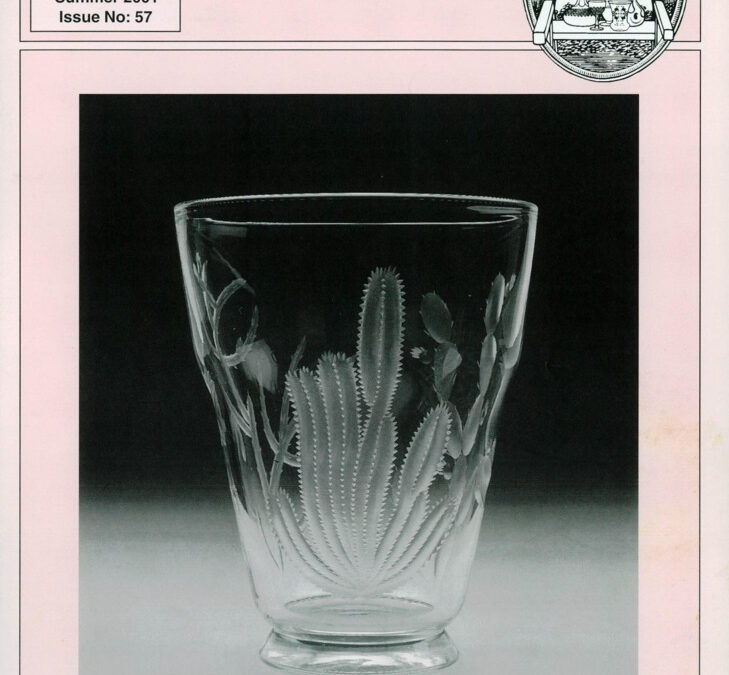
COVER ILLUSTRATION:
Vase engraved with three different types of cactus; de-
signed by Keith Murray for Stevens and Williams,
Brierley Hill c.1935. Height 20.8 ems. (Michael and
Peggy Parkington Bequest, Broadfield House Glass
Museum, Kingswinford).
EDITORIAL
Travel Award 2001
The Association again invited applicants from UK uni-
versities and colleges to apply for a travel award, but on
this occasion only one application was received, and the
Assessment Panel decided, for a variety of reasons, not
to make any award in the current year. Unlike the Na-
tional Lottery, the money will not be rolled-over until
next year, and in the light of the poor response the Com-
mittee will consider the whole future of the Award scheme
and report
to members at the AGM in
October.
The money saved may be used for other initiatives.
Although the next edition of the
Journal
will be pub-
lished later in the year, the Association is also consider-
ing other publishing projects. One is to reprint some of
the historic references to the locations of UK glasshouses
which appeared early last century in the journals of the
Society of Glass Technology, and another is to join with
Broadfield House Glass Museum to seek Heritage Lot-
tery
funding
for the publication of company catalogues
in the museum’s archives. ‘Publishing’ in this context
might mean on the Internet or CD-ROM as well as in
print. More on these initiatives in future
Cones.
Mem-
bers’ comments on both initiatives would be welcomed.
Ian Turner
To Interest Newcomers in Glass
The article by Ian Turner regarding the lure of the
Internet
(Cone no. 56)
has prompted me to suggest
how to promote collecting and encourage interest in
glass by the younger generation.
Traditionally museums have acquired many arte-
facts which have been donated to them and are displayed
as a permanent collection in unimaginative cabinets,
duly labelled and dated. Today museums need to be-
come user-friendly places, with an educational approach
where people of all ages can learn how the artefact was
used, how, where and when it was made, and how to
distinguish the genuine from the fake. Specialised trav-
elling exhibitions could stimulate public interest by
bringing together similar objects from other public and
possibly private collections. Modern computer-aided
technology could enable photographs to be sent via the
internet making the working of planning exhibitions
easier. In this way museums become vibrant and shed
their fossilised mantle. I would ultimately envisage
museums as buildings to house exhibitions with facili-
ties for study, lectures, and ‘hands-on’ sessions all of
which would foster an interest in collecting.
Brian Brooks
Fiasco or Glass Fiasco
Whilst reading
Oddities & Curiosities of Words & Lit-
erature
by CC Bombaugh (rpt.1961) Ken Cannell has
come across the following:
`A German, one day, seeing a glassblower at his occu-
pation, thought nothing could be easier than glassblow-
ing, and that he could soon learn to blow as well as the
workman. He accordingly commenced operations by
blowing vigorously, but could only produce a sort of
pear-shaped balloon or little flask
(fiasco).
The second
attempt had a similar result, and so on until fiasco af-
ter
fiasco
had been made. Hence arose the expression
which we not infrequently have occasion to use when
describing the result of our undertakings.’
The opinions expressed in the
Glass Cone
are
those of the contributors. The editors’ aim is
to cover a range of interests and ideas, which
are not necessarily their own. However, the
decision of the editorial board is final.
COPY DATES
Autumn 2001
15 August
Winter
1 November
‘The Glass Cone’ –
Issue
No
57: Summer 2001
To the members of The Glass Association:
We have now set up arrangements to be able to reclaim tax on your subscriptions as
well as your donations. If you complete the declaration below, we will be able to add
our claim to the Inland Revenue for a tax refund
(currently 28p for every £ you give)
to
the amount of your subscription and donation. If you pay tax at the higher rate you can
claim further tax relief in your Self Assessment tax return. If you are a UK taxpayer,
please complete this form and send it back to us.
Thank you for your help and support.
Brian Currie, Hon Treasurer
Notes
1.
You can cancel this declaration at any time by notifying the Assistant Membership Secretary.
2.
If your circumstances change and you no longer pay tax, you should cancel your declaration.
3.
Please notify the Assistant Membership Secretary if you change your name or address.
Please send this declaration form
to the Assistant Membership Secretary:
John Greenham, 1 White Knobs Way, Caterham, Surrey, CR3 6RH
cut>>>
GIFT
AID DECLARATION
The Glass Association
I want the charity to treat all subscriptions and donations made by me on or after
6
th
April 2000 and until further notice as Gift Aid donations.
Details of donor
Title
Forename(s)
.Surname
Address
Post Code
Date
/
/
Signed
Registered as a Charity No. 326602
SERENDIPITY – A THING OF THE
PAST ?
I was most interested in Ian Turner’s article on col-
lecting in Cone no. 56. My interest in glass, as col-
lector and dealer, goes back forty years and I too
have reflected on the changing nature of collecting.
When I first became interested in collecting it
was almost universally accepted that if one collected
glasses they would be 18′ century drinking glasses.
This field of collecting had undoubtedly originated
with the publication in 1897 of Albert Hartshorne’s
book
Old English Glasses.
Prior to that date the very
few books that had been published on glass dealt al-
most entirely with glass of antiquity, Venetian and
German glass. English glass, when it was mentioned,
was dismissed in a few paragraphs. After Hartshorne
collectors awoke to the possibilities of 17″ and 18
th
century British glass and their interest was encour-
aged by a steady stream of books by authors such as
Percy Bate, Joseph Bles, Francis Buckley and Grant
Francis, each putting forward their own knowledge
and theories. As the interest in collecting grew spe-
cialist dealers appeared to cater to the demand.
This was the fraternity that I joined in the
1950s and I drew my knowledge from these books.
As far as I am aware the first book to deal seriously
with 19″ century glass was Hugh Wakefield’s
Nine-
teenth Century British Glass
which appeared in 1961.
It seemed interesting but not relevant to collecting
at that time. However, it has proved to have been as
seminal as Hartshorne’s book had been 64 years ear-
lier and since its publication there has appeared a
steady stream of books on 19
th
and then 20t
h
cen-
tury glass.
I believe that it is the availability of knowl-
edge of a subject which fuels collecting and, since
the BBC introduced ‘Going for a Song’ and Arthur
Negus to the world, television has also done its share
to stimulate an interest in all things antique. I can-
not speak so confidently about the role that the
Internet may play in the pattern of collecting, since
I also am a ‘new boy’, but I expect that the infor-
mation it carries on antiques from dealers, auction-
eers and other collectors will reach a new audience
which has probably never been into an antiques shop
or an antiques fair. However I find it a somewhat
sterile experience to pursue a passion in solitude;
just me and my monitor. I much prefer the interac-
tion of dealing face-to-face with real people; col-
lectors or dealers.
As more information becomes available demand
is stimulated, but if we take any particular date as a
cut-off point, e.g. 1901 for Victorian, 1935 for Art
Deco or the demise of companies like Walsh Walsh
or Whitefriars, only a finite quantity of objects sur-
vives. Any increase in demand for those objects even-
tually becomes self-defeating as prices rise and the
readily available supply dwindles. When I started
dealing in 1970 I was dismissive of pressed glass such
as that of Sowerby and Davidson but as I realised
that there was a small but enthusiastic band of col-
lectors I started to buy it, rarely paying more than
£3 or £4 for a piece. All we ‘serious’ dealers in glass
were amazed when the Victoria and Albert Museum
paid £50 for a winged sphinx by John Derbyshire &
Co. at a sale at Christie’s in the early 1970s!
The first serious attempt at a book on the sub-
ject was Colin Lattimore’s
English 19
th
Century
Press-Moulded Glass
and within a very few weeks
of its publication I saw a fairly common piece of
Sowerby glass on a stand at an antiques fair labelled
`See Lattimore p.’76’ with a suitably inflated price.
Since then, as other books have added to the avail-
able information, I have seen prices rise to more than
£1000 for rare pieces and the supply all but disap-
pear. For these reasons the collecting of Sowerby
glass seemed to have declined over recent years but
I was intrigued by the considerable quantity of col-
oured Sowerby decorative pieces on offer at the re-
cent Glass Collector’s’ Fair. Is the first wave of
collectors now putting its collections back on the
market and shall we see a new generation of enthu-
siasts able to satisfy their desire for these objects?
This has certainly happened with 18′ century glass
and anybody who has followed the London sale-
rooms for a number of years will know that the same
pieces reappear as collections eventually come back
on the market.
One major aspect of collecting, and dealing,
that has changed a lot during my period of involve-
ment has been that very little now goes unnoticed
and unreported. At one time provincial sales were
only advertised in the local papers and there were
opportunities to buy good things without much
competition.
I
remember, for instance, two facet
stem wines and an 18′ century enamelled German
beaker standing among a tray of modern tumblers
bought for £7 the lot. With the advent of specialist
antiques trade newspapers and the degree to which
even the smallest local sales are now advertised na-
tionwide one is unlikely to attend any sale that con-
tains a specialist item without finding all the relevant
specialist dealers represented. The international
telephone bidders, who used to feature only at the
top London sale rooms, now make their presence
felt anywhere in the country.
I
see the Internet as
an extension of this trend since you can now get
detailed catalogue information on most sales
throughout the world at the click of a button. I
fear that serendipity, the joy of accidental and for-
tunate discovery, which used to play a regular part
in collecting, is really now a thing of the past.
John Brooks
The “Glass Cone” Contents List
A listing of the contents of issues Nos. 1 to 55 (March
1984 to December 2000) is available from
Geoff Timberlake, 114 Chesford Road, Stopsley, Luton,
LU2
8DR,
at a cost of £2.50 each including postage.
Cheques payable to:
The Glass Association.
The Glass Cone’ – Issue No 57: Summer 2001
NEWS FROM SUNDERLAND
Our regional organiser for the North-East, Rita Pearce,
has sent us recent newspaper reports regarding the
National Glass Centre in Sunderland. Keith Jeffrey,
who took over after the controversial resignation of
the first director, Shiona Airlie, in January 1999, has
decided to leave to become the deputy director of the
Gateshead ‘Baltic’ arts venue. In his place, Jules Pres-
ton, formerly managing director of Sunderland City
Training & Enterprise Council, is temporarily acting
as chief executive. As the
Sunderland Echo
reported
in early March 2001 the last 12 months had been dif-
ficult ones for the NGC with Sunderland Glassworks
(Cone no. 56, ‘Royal Brierley’), which had rented the
most of the ‘factory’ space in the new building, crash-
ing with debts of £1.5 million. Of this, some £80,000
was owed in furnace fuel bills to the NGC, which had
been allowed to accumulate.
In mid-March it was announced that Sunder-
land University would indeed transfer its Glass &
Ceramics Design degree course to the NGC in a £1
million deal; the negotiations had been protracted
over the previous year. And in another move, Sun-
derland Council approved a grant of £80,000 to sup-
port future exhibitions and the educational
programme; this follows great success in the national
Children’s Art Awards scheme by the NGC and the
local Southmoor school whose recent project won the
Gallery Partnership award presented at the Tate
Modern, London. Further good news followed at
the end of March with the
Sunderland Echo
(March
24) reporting that the regional funding body, North-
ern Arts, is to double its existing grant (formerly
£26,780) this year with similar funding in 2002-3 and
the following year.
Presently there are two glass residencies at the
NGC: Stuart Findley working in stained glass and
Anne Roxborough, an engraver. The lamp-working
unit, of Wearside Glass Sculpture, run by Norman
Veitch has now gained an international reputation
with orders for work coming from customers abroad.
RECENT SALES
4
Phillips held a sale of “Good continental ceramics and
glass” on 16
th
May. The glass section ran to 70 lots,
with paperweights being 45 lots, and the rest being a
mixture of continental items, of which a fine Dutch
stipple engraved armorial marriage goblet of 1760
carried the highest estimate of £4,000 – £6,000. It was
of “Newcastle” light baluster type, the rounded fun-
nel bowl engraved in diamond-point and stipple tech-
nique with the full conjoined arms of Prince Karl of
Nassau-Weilburg and Princess Caroline of Orange
Nassau. In 1989 this glass was in the
Guepin
collec-
tion and on 5th July it was sold by Christies Amster-
dam, however this time it only fetched £3,800 (all
hammer prices). Other items included a Venetian bowl
of the 16th century £1,800; (estimate £1,000 -1,200);
a Dutch calligraphic wine, late 17th century, in the
manner of
Willem Mooleyser,
with diamond-point
engraving of two ladies seated at a tea table toasting
each other with a wine glass, below the inscription
“De
Vrutics-Gesonthey”,
fetched £2,400, exactly its higher
estimate; a fine Bohemian transparent-enamelled gob-
let and cover; and a matching pair of beakers made in
the second half of the nineteenth century, in the style
of Anton Kothgasser. These were attractively painted
with the reclining Venus attended by Cupid, and with
panels of neoclassical figures titled
‘Allegal”, “Jupi-
ter”
and
“Callisto”,
and with gilt decoration; estimated
at £3-4,000 they were unsold. The paperweights were
a cross section of collectable lots with only half-a-
dozen or so reaching four figures, with the rest fetch-
ing from £300 upwards.
The following day, 17’ May, there was Christie’s
South Kensington sale with 290 lots of British and
Continental Glass. Surely something for everyone!
From an onion shaped wine bottle, ale flutes, Jaco-
bite wines, finger bowls, Irish glass, candlesticks,
vases, jugs, decanters, Bohemian tankards and tum-
blers, “Flash” goblets, and
Baccarat
millefiore,
Whitefriars
and
Clichy
paper weights. What a choice.
Less than 10% of the lots were estimated at £ 1,000
or more, and these included four lots of Stourbridge,
and a
Stevens and Williams
ruby and white cameo
vase, carved with sprays of hydrangea, and other
flowery scrolls, and inscribed STEVENS &
WILLIAMS BRIERLEY HILL/EE ROWLEY dated
late 19th century. A magnificent and large Bohemian
cut ruby vase and cover had a domed cover with a
cut finial above flutes, the
campana
(bell-shaped) vase
cut with diamonds, diamond panels, starbursts and
leaf-shaped panels was from the 19th century and
estimated at £2-3,000, whilst a pair of French opaline
oviform vases each with waisted neck and spreading
foot again 19th century was estimated at £1,500 –
£2,000. The paperweights included a
Clichy
moss-
ground patterned concentric weight with brightly
coloured canes including two roses (est £1-1,500) and
another
Clichy with two white and pink gentian-type
flowers flanking a central spray of smaller gentian-
type flowers, surrounded with numerous green leaves
(est £2-3,000).
Was anyone in Monte Carlo on 16
th
June? Per-
haps the auction by Christie’s of the
Meunier-
Barandiaran
collection of crystal goblets, plaques,
and paperweights was an appropriate excuse? The
bulk of the lots were paperweights (160 out of 223
lots), most estimated at £500 to £1,500, but with the
top lots estimated up to £12,000 – not too much re-
ally, as you could lose that at the Casino tables in a
couple of minutes!
Chris Crabtree
‘The Glass Cone’ – Issue No 57: Summer 2001
The Mestic measure
THE MESTIC MEASURE
Mention of the Trebmall Egg Gauge & Milk Tester in
Cone
no. 55 stirred a few memories. ‘We have one of
those’ I thought and after much searching in all the
places that things get stored in this house, I eventually
found the `Mestic Measure’. This item of kitchen
equipment is certainly
pre-war as I remember it
being used during the
1930s but I suspect it is
older than that. It looks
like an ordinary tumbler,
100mm tall, 50mm at the
base flaring to 70mm at
the top. At first glance I
thought it was acid etched
but as some of the mark-
ings have worn off, I think
the markings must have
been painted on.
It has four illustra-
tions depicting the four
ages of an egg but instead
of having markings for testing milk it has a 10 fluid
oz. measure plus markings for ‘Ch. Suet, Bread
Crumbs, Tapioca, Flour’, while others read ‘Half Pint
or Breakfast Cup, 1 gill or Half Cup’. These mark-
ings are vertical on the glass and I assume ‘Ch.’ means
`chopped’. There is no registration number to be seen.
The glass has a slight `waisting’ but this could be a
manufacturing defect along with the horizontal
striations, but I can’t blame the makers for the chips
on the rim.
I would like to think Mrs Beeton would have
wanted one in her kitchen. She certainly favoured the
use of eggs and during the 19th century through to the
late 1940s, unless you had your own hens, the freshness
of eggs must have always been suspect. Certainly in
the North-east of England during World War II, there
were eggs coming from abroad so the comment ‘Eggs
fresh from the country’ always provoked the snappy
rejoinder `
Which
country?’. An Egg Tester would have
been an essential kitchen item, and I am delighted to
have been spurred into finding this piece once again.
Roy Elwen
BOOK REVIEWS
DAVID REEKIE, East England Arts, 2001, ISBN 0
9540477 0 2, £7, 38pp, full colour; available from Broadfield
House Glass Museum or order direct e-mail:
david.reekie@virgin.net
David Reekie is surely one of the foremost contem-
porary glass artists working in Britain today, and this is a
very welcome introduction to his work with contributions
from Jennifer Opie of the Victoria & Albert Museum,
Charles Hajdamach of Broadfield House, Dan Klein etc.,
as well as including David Reekie discussing the inspira-
tion and motivation behind his work. It has been argued
that non-utilitarian glass in the contemporary art scene is
often ‘sculptural glass’, heavily dependent on the seduc-
tive qualities of the glass itself rather than achieving the
accepted meaning of ‘sculpture’ in which the concept is
given life and relevance through the medium. Reekie’s
work has never been recognised as belonging to the first
category and this booklet gives the reader a valuable in-
sight into his glass-work. For instance, although over the
last few months his piece entitled ‘A Captive Audience?’
has been displayed on the landing leading to the Ceram-
ics & Glass Galleries, V&A Museum, the connection with
the current debate on genetic cloning, as discussed here,
had escaped me; now the enjoyment in the wry humour
embodied in the piece is greatly increased. This booklet
contains much more information regarding the work of a
leading glass-maker. Totally recommended.
Patricia Baker
News from Corning Museum of Glass that the second
volume of ROMAN GLASS IN THE CORNING
MUSEUM OF GLASS, by David Whitehouse, has been
published. The first volume was printed in 1997, and a
third and final volume is scheduled for publication later
this year. This second volume describes and illustrates
nearly 400 objects in the collection, concentrating on
mould-blown vessels including ‘gladiator’ cups and pieces
incorporating Jewish or Christian symbols, and on items
decorated with trails and applique work. Medallions and
fragments of ‘sandwich’ gold form the third section while
the fourth and final category in this volume focuses on
painted and gilded decoration including the Paris Plate
and the Daphne Ewer. The price is US $185 plus $9.75
overseas surface mail, with 15% discount for Corning
Museum members; usual credit cards accepted. Fax: +
607 974 7365; e-mail: kylesew@cmog.org
STUDIO BOOKSHOP has recently issued its catalogue
no.64 containing over 500 items including articles and auc-
tion catalogues, as well as British, European and American
publications. Available from Paul Brown, 68 St James’s
Street, Brighton BN2 1PJ; tel. 01273 691253; e-
mail:paul@studiobookshop.demon.co.uk
ANTIQUE GLASS BOTTLES, Their History and Evo-
lution (1500 – 1850) by Willy Van den Bossche Antiques
Collectors’ Club. ISBN 1 85149 337 9 £50 439pp, 368 col-
our plates, 26 b/w figures.
Although at first glance something of a coffee-table
book, this is a substantial work of pictorial reference, to be
used in conjunction with the more textual works such as
Charleton, Godfrey, Dumbrell et al by both collectors of
older glass bottles and anyone interested in glass history.
The book is divided into a number of self-contained
Continued on page 8
The Glass Cone’ – Issue No 57: Summer 2001
Russell Hibbert
has come across a ‘nursery rhyme’
plate, 8
1
/2″ in diameter (21.5cm) in a gold-brown clear
glass which features the moulded legend `See-saw
Margery Daw’ in capitals around the lower rim and
`Where are you going, my pretty maid’ across the top,
with the centre area divided into three sections, one
containing the image of a girl carrying a bucket in
each hand, the second a boy in long trousers and the
larger lower section depicting the two on a seesaw.
There are no visible registration marks.
Raymond Slack has suggested it may be of
American origin but as yet an enquiry to the Sand-
wich Glass Museum, Massachusetts, USA has not
been answered. Does anyone in the Glass Associa-
tion know of a similar piece, or know a probable
manufacturer?
PERRIN & GEDDES RE-VISITED
6
It is almost 15 years since Cherry and Richard Gray
published their seminal study The Prince’s Glasses: Some
Warrington Cut Glass 1806-1811′ in the
Journal of the
Glass Association
vol. 2 1987; this provoked the appear-
ance of several significant essays relating to Perrin &
Geddes. The first was in Charles Hajdamach
British
Glass, 1800-1914
(1991) in which he added useful docu-
mented instances of the Prince Regent’s pattern produced
in later times. A year later the late Arthur Wolstenholme
reviewed the account books of the glass cutter and en-
graver, John Unsworth, and his work in Warrington
(JGA
vol.4 1992), and I published work on the Tatton Park
and V&A Museum ice cream cellars, which almost cer-
tainly came from Perrin & Geddes
(JGA
vol.5 1997). On
2 Nov 1998 Christie’s sold at auction 16 glasses from or
related to the Prince Regent’s service, two of which were
later acquired by Warrington Museum, and earlier this
year the museum acquired from the Scottish Borders a
hitherto unknown decanter and carafe of Prinny’s pat-
tern, engraved with a monogram, which may be vari-
ously interpreted as
‘H’
alone, or some combination of
T
or ‘T’ together with ‘H’ and ‘C’.
Despite the quite extensive archive John Unsworth
has left, both he and his output remain an enigma. In
the
Glass Circle Journal
(vol 4) 1982 Robert Charleston
published an engraved tumbler signed by Unsworth,
together with his trade card, which gives his address as
St Anns Square, Manchester; Charleston, however,
failed to identify Unsworth’s Warrington connections.
It was Wolstenholme who established this, finding evi-
dence for him working at Warrington from 1785 – 90,
and again from 1795 – 1806. The intervening five years
are unaccounted for as despite the evidence of the trade
card he does not appear in any of the Manchester
trade directories. This might be accounted for by the
gap in these directories between 1788 and 1794. How-
ever, from 1794 until 1814, Messrs. W. &
K.
Freer ap-
pear in thirteen directories, at 9 St. Ann’s Square, de-
scribing themselves initially as a
‘plain, cut and
engravedglass-warehouse’
and later as
‘cut glass manu-
facturers’.
Wolstenholme has established that, in the
period 1789-91, nearly half Unsworth’s sales were of
less than £10 each, whilst from 1796 the proportion of
small sales halved, with sales of over £30 doubling to
account for more than half of his turnover. Is it possi-
ble, one wonders, that he never actually worked
in Manchester, but that his Manchester trade card rep-
resents a period when he sold through Freer’s as a retail
outlet (a later hand has ascribed the card to 1792, al-
though as Charleston wrote;
‘although no warrant
is
given
for it’).
Possibly from 1795 and certainly from 1802,
until 1805 when the surviving accounts cease, Unsworth
paid for the shared use of a steam engine in adjoining
premises to provide power. The last mention of John
Unsworth is in 1812, when he is recorded in the Rating
Lists as owning a cottage in Warrington. In a trade
directory of 1811, and again in 1814, (I have not searched
later directories) Peter Unsworth is recorded as a Glass
Cutter in Warrington; one wonders whether this is a
son of John? Whilst no direct link between Unsworth
and Perrin & Geddes has been uncovered, it seem in-
conceivable that he did not work on their Glass, either
as blanks bought from the most prestigious of
the Warrington manufacturers, or as a subcontractor;
given the record of his financial problems the latter
seems more likely. However, his possible involvement
with the Prince Regent’s or other identified Perrin and
Geddes services remains entirely speculative.
Following the Grays’ article on Prinny’s service,
there were those who remained sceptical, claiming that
the design was too sophisticated to be provincial, and
citing the 1838 ‘JAM’ drawing in the V & A Museum
‘The Glass Cone’ – Issue No 57: Summer 2001
also show differing metal colour). Some examples with
the PoW feathers are also believed to have some
acid
polishing on them; surely this would put them into the
group produced by Thomas Webb in the 1900s? The
Edinburgh Crystal pattern books also have a strongly
derivative design in the 1920s
2
. Who copied whom, and
when, remains to be established; truly this is a case where
`Great fleas have little fleas, upon their backs to bite `ern,
And little fleas have lesser fleas, so on ad infinitum.’
But it seems firmly established that Perrin and
Geddes were the first producers, despite being provincial.
It appears to me entirely possible that the use of steam
engines for such elaborate cutting, established as in use
by Unsworth well before this pattern was first made
for Liverpool Corporation, may well have given an edge
to provincial manufacturers who could share steam
power more readily than perhaps established London
cutting shops could.
At the time of the Grays’ article the only items of
Perrin & Geddes Glass in the Warrington Museum were
five pieces on loan from the Wright of Flixton prismatic
cut service, forwhich the Grays illustrate the original 1809
invoice. This group comprises a wine glass, a claret glass,
two octagonal dessert dishes, and what is now believed
to be an octagonal stand to support a similar dish.
Neither of the two dishes in the Museum will fit
into this stand, but both these dishes are of the same size.
while the invoice stipulates six dishes in two sizes. Fur-
thermore, the Tatton ice cream cellars demonstrate that
parts were individually fitted to size, and apparently simi-
lar pieces are not interchangeable. In 1999 the Museum
acquired two wine glasses with the PoW crest, indirectly
from the Christie sale of the preceding year. Finally, the
decanter and carafe of the Prince Regent’s pattern, from
the Scottish borders, have just been acquired. In the field
of local glass which cannot necessarily be assigned to
Perrin and Geddes, in 1913 the Museum was given one
of the small rummers of the
Tarporley Hunt Club,
en-
graved ‘QUAESITUM MERITIS’; despite no actual
evidence it has always seemed to me entirely likely that
these (of which over thirty survive), were made in
Warrington, for Tarporley is only fifteen miles away. A
large rummer inscribed ‘SUCCESS TO THE
WARRINGTON QUAY PACKET’, together with a
canal boat drawn by two horses, has been in the collec-
tion for many years, and a large tumbler inscribed ‘SUC-
CESS TO THE WARRINGTON HUNT’ and depicting
a hare hunt in progress was acquired recently. All three
of these glasses have an unusual form of lettering; where
the capital letters cross an imaginary horizontal line
through their centre, they have an engraved ‘egg and ar-
rows’, a small cross with usually a little polished oval
overlying the centre of the cross. The ‘PROSPERATION
TO THE CORPORATION’ dedication on Unsworth’s
signed tumbler presented to Wigan has similar lettering;
perhaps there is a connection?
Notes:
1 .Harewood House Trust: ‘
`The Art of Thomas Chip-
pendale; Master Furniture Maker”
ed. Jane Sellars
(2000), p56.
2.
Glass Circle News
No: 79 (1998) F. Peter Lole:
“Limpid Reflections” p4.
F. Peter Lole
The newly acquired Decanter of the Prince Regent’s
pattern. courtesy of Warrington Museum
associated with the successor company to the prestig-
ious John Blades of London. Both the `JAM’ mono-
gram and some crested PoW feathers are on green Wine
Glasses of the Prince Regent pattern; a Warrington
Museum file note records advice received that green
hock glasses were not produced much before 1840, but
this would seem to be a mistaken assertion, for the 1795
probate inventory of Edwin Lascelles at
Harewood records in the butler’s pantry:
’12 Green Hock
Glasses”‘.
There are considerable tonal differences be-
tween the metal of colourless items in the same service;
this is recorded for the glass of Prinny’s service remain-
ing in the Royal Collections, and is notable in the most
recent acquisitions of the Museum between the decanter,
which is very dark, and the carafe which is much whiter,
although the engraving of the two would appear to be
identical. It is also true for the two ice cream cellars at
Tatton Park (and whilst quite definitely not Perrin and
Geddes Glass, the two ice cream cellars at Shugborough
7
The Glass Cone’ – Issue No 57: Summer 2001
EXHIBITIONS, FAIRS & SEMINARS
The Octagon Gallery of the Fitzwilliam Museum (closed
Tuesdays) and at Primavera (closed Sundays), Cambridge,
will celebrate the work of two famous makers, the glass
of PETER LAYTON and the ceramics of ALAN
CAIGER-SMITH from July 3 until Sept 2. Despite the
very different techniques used in both media, both artists
demonstrate a close relationship in colour, balance and
form. Peter Layton is known for his commitment to young
glass-makers, being instrumental in the setting up of the
Glass House in Covent Garden with Sam Herman in the
early 1970s, before establishing his own studio, the Lon-
don Glassblowing Workshop, at Rotherhithe in 1976 and
subsequently at the Leathermarket, London SE 1. Fur-
ther information from LGW: tel. 020 7403 2800; fax. 020
7403 7778; e-mail peterlayton@talk21.com
This year marks the 21st anniversary of
Broadfield House
Glass Museum,
Kingswinford (tel. 01384 812745) so the
intensive programme of exhibitions to celebrate its ‘com-
ing of age’ continues.
From 8 June 2001 – 6 January 2002, the exhibition
POST-WAR BRITISH GLASS DESIGN will examine
the influences which inspired the designs of
Geoffrey
Baxter
of Whitefriars,
Ronald Stennett-Wilson
of King’s
Lynn Glass and
Frank Thrower
of Dartington Glass; it
will feature a comprehensive private collection.
The opening of the refurbished Red House Glass
Cone at Wordsley will be celebrated in A COLLECTION
SAVED: 100 YEARS OF STUART CRYSTAL GLASS
(26 May – 12 August) which will include Art Nouveau
pieces from the 1900s as well as artist-designed glass made
for the Harrods exhibition of 1934.
KEITH MURRAY Glass Designer (18′ August to
11t
h
November) exhibition of the work of Keith Murray
whose designs for Stevens & Williams in the 1930’s helped
to revitalise English glass.
DUDLEY MILLENNIUM GLASS WORKS
COMMISSIONS (from 3r
d
April) The work of
Tessa
Clegg, Alison Kinnaird M.B. E., Keiko Mukaide, Steven
Newell, David Reekie
and
Bruno Romanelli,
all of whom
responded with sculptures in glass to commemorate the
Millennium, as part of a commission from Dudley MBC
and the Millennium Festival Fund.
DUDLEY GLASS FESTIVAL 2001 (from 27 –
30 September). Programme details are not available
yet, but note the dates. Telephone the museum later
in the year for further details.
NORTH LANDS CREATIVE GLASS at Quatre Bras,
Lybster, Caithness KW3 6BN will be holding its sixth se-
ries of master classes and conference, 2-15 Sept. The se-
ries commences with Alison Wilding, the sculptor working
for the first time with glass blowers, Carl Nordbuch and
Marianne Buus before breaking for a two-day conference
with contributions from such makers and critics as Ursula
Huth, Janusz Pozniak and Susanne Frantz, formerly of
the Corning Museum of Glass. Dante Marioni from the
USA, known for his use of traditional Venetian techniques,
concludes the series with a six-day master class. Details
from Alan Poole, 43 Hugh Street, London SWIV 1QJ tel.
020 7821 6040; fax. 020 7834 2480.
An exhibition devoted to the glass of the well-known
Seattle glass-artist, DALE CHIHULY, will be on display
at the Victoria & Albert Museum, London from 21 June
until 21 October. Jennifer Opie, the organising curator, is
arranging a late-night viewing and a short talk on 4t
h
July
(18.45); also, a longer talk will be given on 27t
h
September
and 10t
h
October (13.00). There is a full programme of
activities associated with the exhibition and details can be
obtained from the Museum.
Harington Glass of 2-3 Queen Street, Bath and Kosta
Boda have joined forces to exhibit recent work by BERTIL
VALLIEN and GOREN WARFF, the renowned Swed-
ish glass-designers, running from 4 July until the end of
the month, Mon-Sat 10-17.30. Details from Harington
Glass tel. 01225 482179; e-mail: GertsenPR@aol.com
BOOK REVIEWS (continued from page 5)
sections: the main section, 323 colour plates of mainly
European bottles with extensive captions containing tech-
nical details, historical notes and bibliographical references;
a chronology of key events in bottle-making 1500 BC –
1929; a glossary of bottle-making terms; a world-wide
bibliography from medieval to the present.
Specimens have been used from a wide range of
sources and are presented mainly in full-size photographs
using near standard lighting to give “true” and compara-
ble colours.
A criticism is the impracticability of matching ac-
tual specimens against the illustrations; some sort of de-
cision table, perhaps using line drawings would be
invaluable. An irritant is the frequent use of ‘black glass’
for any dark bottle glass, a continental term not used here.
There are also a number of relatively minor errors, and in
the bibliography, omissions, but these barely detract from
the author’s overall achievement.
Ken Connell
NEW MEMBERS
A very warm welcome to the following new mem-
bers who have joined the Glass Association recently:
Mr T. Courty
Buckinghamshire
Mr D.A. Cheeseman
Bournemouth
Mr M.D. & Mrs A.C. Cole
Hertfordshire
Miss E. Creah
Stratford-upon-Avon
Mrs. J.S. Falconer
North Yorkshire
Miss S.L. Fox
Derbyshire
Mr. R. J. Gower
Essex
Mr. D.U. Grout
Devon
Dr. M.A. Kelly
Lancashire
Mr. & Mrs. G. Kyriacou
London
Mr B. Lamport
West Yorkshire
Mrs C.A. Norman
Leicestershire
Mrs A. Roberts
Essex
Mr.
R.L.
Russell
Middlesex
Mr. D.W. Skinner
Shrewsbury
Mr M. & Mrs A. Smith
Devon
Mrs S. Squires
Suffolk