




Issue No: 59 Spring 2002
The Magazine of
The Glass Association
Registered as a Charity No. 326602
Chairman
Charles Hajdamach
Hon. Secretary
Geoff Timberlake (Geoffctim@btinternet.com)
Editorial Board
Patricia Baker, Ken Cannell, Brian Currie,
Roy Kingsbury
Address for Glass Cone correspondence
2 Usborne Mews, Carroun Road, London SW8 1LR
(or email to Brian Currie: brian c’beurrie.co.uk)
Address for membership enquiries
John Greenham, Membership Secretary,
1 White Knobs Way, Caterham, Surrey CR3 6RH
(john@jgreenham.freeserve.co.uk)
Web site: www.glassassociation.org.uk
ISSN No. 0265 9654
Printed by
The Charlesworth Group
Published by
The Society of Glass Technology for
The Glass Association
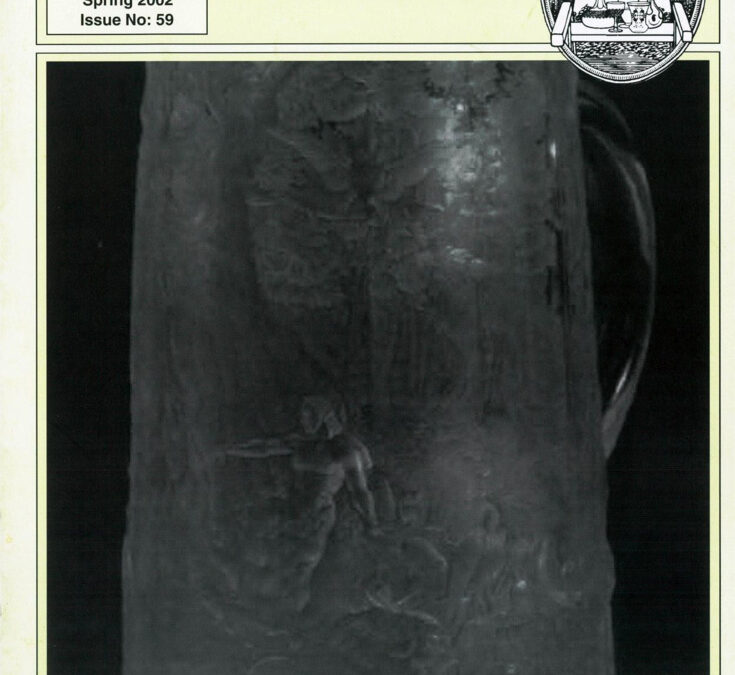
COVER ILLUSTRATION:
Detail from a Bohemian intaglio engraved jug circa
1880 inscribed `Joh. Elias Ridinger’ under the handle,
deeply engraved with Adam surrounded by woodland
animals and birds. See page 7 ( Photograph by
Sotheby’s Olympia).
EDITORIAL
Are you a bookworm?
One of our North West members died just over a
year ago and his widow would like to give members
of the Glass Association the opportunity to purchase
his books, of which there are a great number. His
main interest was in pressed glass, so a large propor-
tion of the books, which include all the well-known
British publications, reflect this. There are others
concerning American Depression glass and certain
factories in the USA. But he also collected publica-
tions on the internationally-known glass artists and
designers such as Lalique, Galle and Tiffany as well
as the work of European factories in Sweden and
France. Anyone wanting further details or a full list-
ing, please contact Peter Beebe on 0161 643 1855.
Missing Registrations
Over the years some of us have found pressed glass items
with registration marks or numbers that do not appear
in Jenny Thompson’s
The Identification of English Pressed
Glass, 1842-1908
or in Jim Edgley’s
Registration Num-
bers 1908
–
1945.
Some diamond registrations are believed
to be deliberate deceptions as these do not conform to
the standard layout. However, Jim Edgley wonders
whether he may have inadvertently omitted a few com-
panies whose names he did not recognise.
So if you have bought or see items with previ-
ously unrecorded marks or numbers, do send us details
with a description, sketch or photograph if possible so
we can include them in a forthcoming publication.
Sooner rather than later, please.
You in the North East
Rita Pearce who has admirably performed the duties
of representative for the North East Region for many
years, has informed our Hon Secretary that she wishes
to stand down and allow someone new to take over.
The job includes representing the region on the Asso-
ciation’s Committee, and, from time to time, organis-
ing local events for members. Rita would be willing to
pass any tips and advice on to her successor — all we
need is a volunteer to come forward. Anyone interested
may contact Geoff Timberlake, Hon Secretary, (tel.
01582 423120) or Rita (tel. 0191 267 8978).
Vallon with Cherries
Brian Blench wonders if anyone has information on
G. Vallon. He has come across a bowl in Lalique-
style opalescent glass decorated with cherries and an
integral mark reading: G. VALLON MADE IN
FRANCE. Any information to the Editors, please.
A Postscript to Novy
–
Bor
Manchester Evening News
(15 Jan 2002) reported that the
Harrochov glass factory, east of Novy Bor, is to open its
own brewery to assuage the thirst of its glass-workers.
Factory boss Frantisek Novosad commented ‘I expect
most workers to drink around six beers a day but some
may want as many as ten’. Is Bombay Sapphire working
to the same principle? (See back page, this issue.)
David Hammond (1931
—
2002)
David Hammond, who was chief designer at Thomas
Webb & Sons, Stourbridge from the 1950s to the 1980s,
has died at the age of 70. His career is remembered on
page 4.
The opinions expressed in the
Glass Cone
are
those of the contributors. The editors’ aim is
to cover a range of interests and ideas, which
are not necessarily their own. However, the
decision of the editorial board is final.
COPY DATES
Summer 2002
Early May
Autumn 2002
Early August
2
The Glass Cone’ – Issue No 59: Spring 2002
WILL BROADFIELD HOUSE GLASS MUSEUM CLOSE?
On 11 January, the Stourbridge
Express & Star,
West Mid-
lands, carried a news article by its senior reporter, John
Corser. He based his report on the published agenda, pre-
viewing the then forthcoming meeting on 15 January of
the Dudley Metropolitan Borough Council’s Select Com-
mittee on Culture & Recreation. This was the first intima-
tion to the public and interested parties, such as the Friends
of Broadfield House Glass Museum, that the Head of
Culture, Ian Symons, and others on the Council were putting
forward a proposal to promote the Red House Cone as a
`centre of excellence’ and auguring the consequent closure
of Broadfield House.
Attendance figures at Broadfield House were signifi-
cantly down for the six months between April and October
2001, from 8,317 to 5,752 and the October figures also re-
vealed the trend was continuing. The Council was proposing
to alter the opening hours, as from Easter 2002, from 14.00 to
17.00, to run from 11.00 to 16.00 each day and to reintroduce
an admission charge. According to that report it was not yet
decided whether this would be in addition to an admission
charge for the Red House Cone in Wordsley which is due to
open in Easter 2002 after much delay, or whether a combined
charge would be introduced.
This report also noted that if the Council decided to
move the borough glass collection to the Red House Cone
and develop this site as ‘a centre of excellence’, as the re-
gional museum service was proposing, Broadfield House
Glass Museum would close in five years. The Lace Guild in
Stourbridge has already expressed an interest in moving into
Broadfield House and establishing a museum of its own col-
lection there. In a following report by John Corser published
hours after the 15 January meeting, Charles Hajdamach,
Principal Museums Officer, was quoted as saying ‘There is a
lot of work and discussion to be done and it is not definite
that Broadfield House will close in five years’.
Stourbridge Chronicle (17
January) reported Ian Symons
as saying at the meeting that the opening of Red House Cone
on the former site of Stuart Crystal would represent
the first
phase
of a long-term plan
(emphasis added)
‘which would see
the eventual closure’ of Broadfield House ‘and a new centre of
excellence established’ as it had been decided that the Red House
Cone could be developed to display as much of the glass col-
lection as possible. Committee Vice-Chairman, Dave Tyler,
said ‘My only disappointment in regards to the proposal is
that it cannot be done sooner than planned. It would be won-
derful to open the Red House Cone with a bang and what
better way of doing that than moving the best glass collection
in the world onto the site.’ If those statements have been re-
ported accurately, the signs are that the decision has been al-
ready reached, even without any sign of financial funding
already secured to produce ‘a centre of excellence’.
Unquestionably, the Red House Cone site will have to
be developed and enlarged. At present there would not be
the space to transfer the entire glass collection, let alone house
the rich archival deposits. Currently Dudley Metropolitan
Borough Council owns or controls four sites closely associ-
ated with glass historical studies. The four sites are: Broadfield
House (with its current exhibition galleries and library); Red
House Cone (which will have some display space, with the
visitor centre and shop); Himley Hall; and Dudley Library
Archive at Coseley. Himley Hall currently houses all glass
not currently on display (lack of space means only a small
percentage of the total collection is ever on public view) and
also stores important factory archival material including
pattern books (e.g. Royal Brierley, Stevens & Williams). The
Dudley Library Archive is the prime source for archival re-
search into Parish Registers and Census Returns. It also holds
rare pattern books, photographs and other documents dat-
ing back to the early 19th century glass production. These
four centres are not located close to each other and all are
difficult or time-consuming to reach by public transport and
two have restricted parking facilities
Everyone interested in glass studies will be clearly con-
cerned for the future of the borough’s glass collection as so
many important acquisitions and bequests have been made in
recent years, and for the preservation and conservation of rare
and irreplaceable documentary material. Within the space of
two years, glass enthusiasts have seen the majority of the
Fitzwilliam Museum glass collection go into indefinite stor-
age, the archives of the former Pilkington Museum and other
St Helens glass businesses transferred to a private company
with no trained archivist in post, the survival of Harveys glass
museum, Bristol, in question, and the imminent prospect of
British Museum glass pieces not on display going into storage
off-site. All glass enthusiasts would welcome and support a
sound proposal for bringing all the Dudley glass resources
under one roof (with good transport access, please). But there
have been far too many serious disappointments in the recent
past. We all know what can happen so quickly and so quietly.
( Sincere thanks to
John Sanders
for press cuttings; the
opinions expressed are those of the editors.)
GOOD NEWS
FOR TUDOR CRYSTAL …
Just two years ago, it looked as if the writing was on
the wall for Tudor Crystal located in Stourbridge, West
Midlands. It was on the brink of receivership. The firm
then known as Dennis
Hall
Tudor Crystal was acquired
by Plowden & Thompson and renamed Tudor Crystal
Design, with the work-force relocated to the Dial Glass
Works in Amblecote. Since then two new furnaces have
been constructed and a new showroom opened in No-
vember 2001. Its export order book has been filling up,
while youngsters are learning the craft through NVQ
courses run by the company.
AND FOR ROYAL BRIERLEY
There were smiles all round at the January opening of the
new Royal Brierley works at Tipton Road, near the Black
Country Living Museum, and head glass-blower, Walter
Pinchers, celebrated by blowing the first glass gather. This
was the result of a £650,000 injection
into the new head-
3
‘The Glass Cone’ – Issue No 59: Spring 2002
4
quarters and works. The 300 year old firm revealed severe
financial troubles and under-investment in 1998 but its ac-
quisition by Epsom Enterprises did not bring about the an-
ticipated recovery and receivers were called in. Glass
Association members will remember a similar unhappy as-
sociation with this company in another glass venture in Sun-
derland. Royal Brierley was taken over at the end of 2000 by
a business consortium headed by Tim Westbrook, of Royal
Worcester Porcelain. At that point the workforce, which in
its heyday had been over 750 strong, had shrunk to 17 em-
ployee& Already 20 new staff have been recruited to man the
new works and plans are afoot to introduce factory visits
and to open a full tableware and factory shopping facility.
BUT NOT FOR OTHERS
As reported in the last issue of the
Cone,
Stuart Crystal is
to close its Wordsley works totally by June 2002. Produc-
tion in the glass-house ceased ‘on 23 November and the
cutting and polishing shops closed on 15 February to be
followed by the distribution centre by the end of March.
Some 230 workers have been made redundant. In a state-
ment reported in the
Stourbridge Express & Star,
John Foley,
chief executive of the parent company, Waterford Wedg-
wood, said that every effort had been made to ensure the
survival of the 120 year old firm but that ‘especially since
the tragic events in the US on September 11… we could not
justify the subsequent capital investment which would be
necessary to keep the facility open.’ (Interestingly, Septem-
ber 11 and the foot-and-mouth crisis were also cited by the
authorities to explain low-attendance figures at Broadfield
House, April to October, but see news item below.
Ed.)
Waterford Wedgwood had acquired the family firm in
a £4 million takeover in 1995, but many of the Stuart work-
ers now wonder whether the motivation was purely to ac-
quire the Stuart name and reputation. John Foley had
included in his press statement of early November ‘In order
to ensure the survival of the Stuart brand, Stuart has been
compelled to close its own dedicated manufacturing opera-
tions’. The glass will now be made by other manufacturers.
Our member, John Sanders, reminds us that in the
early 1900s around 80% of the working male population
of Amblecote and Wordsley were directly employed in the
glass industry, and there were then some 17 glass-houses in
the area. Based at the Red House and Whitehouse Cones,
Stuart Crystal employed 665 people in 1930. More recently,
interest in its glassware soared when in 1997 the company
produced a limited edition to mark the 30th birthday of
Princess Diana and then another to commemorate her tragic
death. On both occasions extra telephone lines had to be
installed to cope with sales demand.
THE REAL REASON?
The Times
of 8 November 2001 carried a small news item in
its business section noting that Waterford Wedgwood had
been a tad optimistic about the public demand for Millen-
nium mementos. With 2002 then rapidly approaching, the
company had accepted that ‘it stands little chance of off-
loading all those souvenirs of 2000’. These included a range
of champagne flutes, Martini glasses, wine goblets, shot
glasses and vases launched in conjunction with the fashion
designer, Jasper Conran.
The Times
business commentator,
Patience Wheatcroft, estimated that this over-production
would cost the company 12 million euros (£7.5 million).
( Grateful thanks to
John Sanders
for the news cuttings )
PHOENIX MOVING
Phoenix Hot Glass, which has been based at The National
Glass Centre since it opened 4 years ago, is moving, blam-
ing “a long long list of problems” for the decision. “Dis-
appointing visitor numbers and lack of communication”
had all contributed to the decision to move to a new work-
shop in Fowlers Yard, Durham, where, according to owner
Roger Tye, they would have more control of their own
destiny. Jules Preston, temporary director of the Glass
Centre said “This news is good and bad. We hope to use
the vacated space to bring in new artists, business and
equipment, particularly those starting out who don’t have
the resources and equipment of their own. We will be rent-
ing the facilities out and giving them advice”
Rita Pearce
DAVID HAMMOND (1931 — 2002)
David Hammond, who was chief designer at Thomas
Webb & Sons, Stourbridge, from the 1950s to the 1980s,
has died at the age of 70.
Hammond had glassmaking in his blood, both his
father and grandfather having been glassmakers at
Whitefriars in London and at Thomas Webb’s. He studied
at Stourbridge School of Art and joined Webb’s in 1947 as
an apprentice glass designer working under Tom Pitchford.
Here he learned all the routine tasks of the drawing office
such as how to draw designs into the sketch books full-scale
for use by the markers, how to produce tracings and draw-
ings for customers, and how to work out the factory price of
an article from the length of time it took to make and deco-
rate. After only a few years Tom Pitchford left, and Hammond
found himself unexpectedly in charge of the drawing office.
Two years of National Service then intervened. On
returning to the factory Hammond was sponsored by the
company to take up a course in industrial glass design at
the Royal College of Art in London. His teacher was Bill
Stanier who had taught him glassmaking and design at
Stourbridge College. The course lasted for three years (1953
— 56) and he would return to Stourbridge in the holidays
and continue with his work for Thomas Webb.
During his time at Webb’s Hammond designed a wide
range of cut and intaglio glass in both traditional and con-
temporary styles including patterns such as Bodiam and
Frensham. In the early 1960s he was involved with Stan
Eveson in the development of a range of asymmetrical
bowls, vases and sculptural pieces formed without blow-
ing, based on Swedish models. Hammond even managed
to bring flair and imagination to the potentially tedious
task of designing commemoratives; his glasses for the Shake-
speare 400′ anniversary celebrations in 1964 and for the
Prince of Wales investiture in 1969 both won awards from
the Council of Industrial Design. One of his last successes
was Webb’s Bristol Blue range, which was introduced in
1978 and which won the Supreme Award sponsored by the
Giftware Association at the International Spring Trade Fair
in Birmingham that year. Besides glass, he was responsible
for the design of Webb’s packaging and publicity material.
Hammond took early retirement from Webb’s fol-
lowing the acquisition of the company by Coloroll in the
mid 1980s, but he did not sever his links with glass en-
tirely. For the last few years of his life he acted as design
consultant to Royal Scot Crystal in Essex and continued
to design for them until a few weeks before his death.
‘The Glass Cone’ – Issue No 59: Spring 2002
GLASS ASSOCIATION EVENTS
NATIONAL MEETINGS, 2002
Sat 27 April – Pontefract
A one-day visit to Pontefract on the theme of Bagley glass.
In the morning we will visit the former Bagley factory
which is now owned by the Swiss company Stozle
Flacconage and makes perfume bottles. In the afternoon
we will see the collection of Bagley glass in the Pontefract
Museum, and hear two lectures in the Museum: Dr. T.
Spence will talk on trade unionism and the glass industry,
and Mr. A. Morris will talk on Bagley Glass. Tickets (in-
cluding lunch) £12.
Sat 8 June
–
West Dean College, West Sussex
Not a Glass Association event, but an invitation to attend
the Spring Lecture of the Guild of Glass Engravers. The
“Lecture”, entitled
From the Sublime to the Ridiculous –
Working to Commission, is
to be given by the four tutors
at the Guild’s Glass Engraving Weekend. The speakers
will be Katherine Coleman, Jennifer Conway, Sally Scott,
and Tracey Sheppard.
Cost, including lunch, about
£14.
I
Sat 26 October
–
Manchester
The Society’s Annual General Meeting and a visit to the
recently refurbished Manchester Museum and Art Gal-
lery. Lectures to be arranged.
Details of these events, and application forms, will be sent
to all members as soon as they have been finalised.
REGIONAL MEETINGS
NORTH WEST
The visit to Pontefract has been arranged for 27 April,
but it is now a fully fledged National Meeting, with a pro-
gramme of visits and talks lasting the whole day. Mem-
bers of the Glass Association last visited Pontefract
Museum in 1991. Since then its Bagley glass collection
has grown with a purchase from a private collection. That
and the newly fitted Glass Room make another visit worth-
while. In the morning we will also see the old Bagley Works,
now a bottle factory, and two talks have been organised
for the afternoon session.
In October I intend that the popular annual members’
evening will be held at the Portico Library in Moseley
Street, Manchester, together with a buffet as usual. This
year, as suggested, the theme will be ‘Lights & Lighting’.
And we will also host the Association’s AGM, so North-
West members should be kept busy. I hope to arrange
another meeting in the summer but am waiting for con-
firmation of details.
Peter Beebe
SOUTH EAST
As the newly-appointed representative for the region, I
hope that I will get to meet many of you throughout the
year and would welcome suggestions for future meetings.
On Saturday, 20 April, we will meet to view the
STAINED GLASS WINDOWS OF MARC CHAGALL
at All Saints Church, Tudeley, in Kent. This is one of only two
churches in the world where all the stained glass windows were
created by Marc Chagall 1887-1985. A local guide will be on
hand to talk to members about Chagall, the windows and the
family who commissioned Chagall to design the windows. Ap-
parently Chagall was adamant that the windows are painted
glass – not stained glass. If you are an expert in this field please
come along and perhaps we could ask you to explain the dif-
ference between painted and stained glass.
Sir Henry d’Avigdor-Goldsmid initially commis-
sioned Chagall to design a window in memory of his eld-
est daughter who was drowned in a sailing accident – the
first commission Chagall had been willing to undertake
in England. At the dedication of this window in Decem-
ber 1967, on seeing his completed work, Chagall said he
would be happy to do the church in its entirety. By the
time the last window was completed, Chagall was ninety.
Time permitting, we could visit two other Kent
churches with late 20th century windows.
You will be receiving further details shortly. Please
return the booking form promptly if you wish to attend
as places will be limited to 30.
Janet Sergison
(01732) 851663. Email:
janetsergison@waitrose.com
AN AUCTION HOUSE MERGER
As some of you may have read in the summer, the auc-
tion house Phillips, itself part of the LMVH group,
has been merged with Bonhams & Brooks. The newly
created company which includes the Phillips Bond Street
and Bayswater auction rooms now trades under the
name of Bonhams, with the former Bonhams & Brooks
company chairman, Robert Brooks, assuming the over-
all chairmanship. The shareholders are Louwman
Brooks with 50.1% and LVMH Art Investments hold-
ing 49.9% of the capital of the joint venture.
Phillips Auctioneers was founded in 1796 and quickly
established an international reputation with such sales as
the collection of Queen Marie-Antoinette. In 1999 it was
acquired by LVMH and then merged with de Pury & Lux-
embourg Art of London and New York in 2001.
Bonhams was established three years earlier in
1793, first specialising in prints and books before mov-
ing into the ‘decorative’ arts. In 2000 Bonhams merged
with Brooks, specialists in vintage cars with Robert
Brooks appointed as Chairman and Nick Bonham as
deputy Chairman. LVMH (Moet Hennessy Louis
Vuitton) controls a wide range of companies involved
with luxury consumables such as wines, brandies, cham-
pagnes, fashion, perfumes and cosmetics, watches and
art magazines and has interests in retailing outlets such
as Le Bon Marche and La
Samaritaine.
5
The Glass Cone’ – Issue No 59: Spring 2002
GLASS AT THE AUCTIONS
6
There were a number of interesting auctions in Decem-
ber. Space precludes covering the Rudolph Just Collec-
tion, the subject of Sotheby’s sale on 11 December. This
included 75 lots of glass – Biedermeier, lithyalin,
Egermann – many wonderful pieces. But our main report
covers Sotheby’s next sale a few days later. We start with
Chris Crabtree’s report of the first half of the sale.
The Sotheby’s sale of European Glass on 18th December
was held at their new premises at Olympia, London. For
those who yet have to visit, the building is very big and
such a change from their rather cramped central London
salesroom. There is space everywhere including the actual
salesroom which held the sale, so much so that if you tired
of bidding, you could hold a dance in reception! Every-
thing was presented on a big video screen which displayed
the lots very well, and the bidding was immediately shown
in several currencies on another screen. Parking is obvi-
ously better than central London, the easiest being the
multi-storey adjacent to Sotheby’s, but is inevitably ex-
pensive! Well worth a visit, even if you don’t buy!
On to the sale itself. The first 9 lots were 16th
century Venetian bowls and plates. An early (circa 1500)
Venetian footed bowl with two blue trails below a folded
rim, set on a blue-tinted rib-mounted trumpet foot with
folded rim, brushed with gilding, and 13.5cm in diam-
eter, fetched the low estimate of £5,000 (hammer prices).
Lot 10 was the star of the sale – a rare North
German
Schwarzlot
goblet and cover, circa 1675 (see
illustration above). Despite the applied wings on the
stem and cover being missing, it fetched £50,000. Even
so, it was below the lower estimate. Whilst it was quite
A rare North German`Schwarzlot’ goblet and cover,
Johann Anton Carli, Andernach am Rhein, circa 1675
inscribed on the pontil 7.A.Carli invenit et fe’, 27.4cm.,
10Xrin., applied wings lacking from stem and cover
painted with The woman of Samaria at the well with
Christ’ (John 4:1-30), a view of Sychar in the back-
ground, the cover with Roman heads between fruit swags,
the foot with ribbon-tied martial trophies and pendant
portrait medallions. ( Photograph by Sotheby’s Olympia).
magnificent, your reporter was not the buyer!
Inevitably the next few lots were an anticlimax, but
a fine Lower Austrian ”
Zwischengoldglas
portrait beaker
dated 1796, and signed
Johann Mildner,
stirred bidders
into fierce competition. It doubled its lower estimate at
£12,000. Another successful Continental item was a Vi-
enna transparent-enamelled waisted beaker
(Ranftbecher),
early 19th century, in the
Kothgasser
style.
The amber tinted form was painted in silver-stain with
the moon emerging from clouds, the reverse with a starry
night, and with a cogwheel base with gilding. It was only
just over 4″ high, but after much competition, realised
£10,500, some £4,500 over the top estimate.
Moving on to the British glass, a good range of wine
glasses went for less than £1,000. However, an airtwist ci-
der glass and a
Jacobite
ratafia glass went for £1,900 and
£1,500 respectively. A rare Beilby, with fruiting-vine enam-
elling and a plain stem on a folded conical foot, reached
£1,600 (why didn’t I buy that Beilby 20 years ago at what
now is a ludicrous price?). The next lot was another Beilby,
an enamelled crested opaque-twist wine glass painted with
a horse’s head crest of Horsley, the reverse with the mono-
gram “SMJH” in yellow, and just under 6″ high. The glass
is recorded by James Rush, and it is suggested that it is one
of perhaps a set of 12 or 24 with matching decanters. A
pair of decanters and stoppers and a pair of ale glasses
from this set were sold by Sotheby’s on 13th March 1956
for £62! This single glass fetched £17,000.
Another rare glass was an enamelled
Beggar’s Benison
opaque twist wine glass painted with a phallus between the
castle and anchor crest of Edinburgh. The society was
formed in 1732 and was a Scottish society of an erotic and
convivial nature, composed of the nobility and gentry of
Anstruther and the adjacent districts in Fife. It is suggested
that the painting may be the work of Anthony Taylor from
Newcastle-upon-Tyne. It went for £14,000.
With our feet firmly back on the ground, the rest
of the British glass comprised wines and decanters
which fetched “reasonable” collector level prices. The
best two items were an engraved
Jacobite
airtwist circa
1755 at £1,400, and a fine Stourbridge cameo vase; prob-
ably by Stevens and Williams, and in a very attractive
pink and with elegant carving, it went for £2,800.
Next there were 26 lots of paperweights going for
between £300 and £3,000. However, two fetched £5,000.
The first was a Venetian scrambled
millefiori
by Pietro
Bigaglia dated 1845, with colourful canes including sil-
houettes of various motifs, including animals and birds
and a gondola, with the signature cane R B. 1845, and a
date cane 1846, 7.1cm in diameter. The other was a rare
George Bacchus concentric basket paperweight, mid 19th
century, the mushroom set with four rows of canes within
a translucent blue basket with radiating white threads
and two spiral twist handles, 9.2cm in diameter.
Chris Crabtree
The rest of the sale was taken up with120 lots from
The Rinceaux Collection of engraved European glass,
of which ten items exceeded selling prices of £5,000.
We follow with an account of this part of the sale from
Simon Cottle,
of Sotheby’s Olympia.
‘The Glass Cone’ – Issue No 59: Spring 2002
THE RINCEAUX COLLECTION
For an auctioneer, the opportunity to oversee the sale of a
collection of high quality 18th and 19th century glass is al-
ways an attractive proposition. However, this can be tem-
pered by various uncommercial factors, especially if the
collection was assembled in very recent years through the
established trade and very publicly at auction. This was the
case with the Rinceaux Collection offered at Sotheby’s at
their new saleroom at Olympia on 18th December. An Ameri-
can assemblage where many of the glasses were purchased
at the top end of the market – indeed even establishing mar-
ket prices – and in the full glare of publicity within the last
five to ten years, the Rinceaux Collection was essentially put
together for commercial purposes but with a considered eye.
Thus, the advice oft given that if one is buying for investment
one should not sell too soon went unheeded on this occasion
and added to the auctioneer’s concerns.
Nonetheless, to everyone’s delight and in spite of
some not entirely unexpected unsold items amongst the
lower value examples, the group of 120 lots generally sold
well and there were several major surprises amongst the
English glass in particular. As a survey of the history of
engraving, the owners of this glass had put together some
very interesting Continental – especially Bohemian – and
English glass. Whilst the emphasis was on the 19th cen-
tury there were interesting examples from c.1650 to 1800.
A Silesian
llochschnite
goblet of the early 18th cen-
tury, attributed to Friedrich Winter – the master exponent of
`imitation rock crystal engraving’ – set the tone and was largely
the inspiration for the deeply cut, carved and matt-polished
glass that was to follow. Typically engraved with
laub- and
bandlwerk –
or strapwork – and in spite of a rim chip this
piece sold for £6,500. Readers may remember the example
by Friedrich Winter from the Dettmers Collection which was
sold by Sotheby’s in November 1999 for a record £110,000.
Representative examples of German glass from the hands
of other engravers such as Elias Rosbach for Potsdam/Zechlin
also featured and although several of these glasses had re-
placement metal feet and stems, most found willing buyers.
Following so soon after Sotheby’s landmark sale of
the Rudolf Just Collection at Olympia on the 11th Decem-
ber where much good 19th century Bohemian and Vien-
nese glass was sold, the auctioneers benefited from the
double marketing opportunity. Thus, many Continental
buyers had at least two reasons to come to London for
glass just before Christmas. Coincidentally, the Rinceaux
Collection featured in the main sale of European Glass
and Paperweights in which there were further fine exam-
ples to view. A lecture held at Olympia given prior to the
sale drew interest from members of both the Glass Circle
and the Glass Association and was attended by 60 people.
Mid 19th century Bohemian engraved blue overlay glass
had been a particular style favourite of the collector of the
Rinceaux Collection but met with mixed results on the day.
Two glasses from this group by Karl Pfohl of Steinschonau,
circa 1855, one with a portrait of the young Emperor Franz
Josef I of Austria and the other with a typical prancing horse,
were sold for £2,500 and £2,100 respectively.
One of the biggest surprises was the extraordinary price
of £22,300 for a tall jug overall engraved in deep intaglio
( illustrated in the next column and on front cover).
Signed by
the hitherto unknown glass engraver, Joh. Elias Ridinger, it
was discovered after the catalogue had gone to press that in
fact Ridinger was a 17th century German print engraver.
Thus the possibility of the engraving being attributed to Karl
Pfohl or even August Bohm, increased and the design was
obviously drawn from 17th century print sources.
Further Continental examples were represented by
French glass, especially from Baccarat. Here, two lots were
especially outstanding. The first, a large two-handled vase
in the Japanese style engraved with herons before a moun-
tain, the reverse with bamboo, circa 1878, was secured
with a final bid of £9,100 and an ormolu-mounted pair,
thickly-walled and beautifully engraved with swimming
carp in intaglio, circa 1890, sold for £8,000.
Bohemian intaglio engraved jug circa 1880 inscribed
`Joh. Elias Ridinger’ under the handle deeply en-
graved with Adam surrounded by woodland animals
and birds in a continuous scene, slice-cut handle.
( Photograph by Sotheby’s Olympia).
It was in the section of English glass where many
of the surprises lay. The most outstanding was a Webb
`rock crystal’ marine vase engraved by William Fritsche,
circa 1920. A late example of Fritsche’s work, his crafts-
manship had by no means diminished with age. The vase
had been sold for £16,000 by Sotheby’s in June 2000, a
considerable price at the time for such a piece – especially
when doubts about the authenticity of its signature were
raised by some members of the trade.
However, on its
7
The Glass Cone’ – Issue No 59: Spring 2002
8
outing in December it sold for £19,900! This was per-
haps largely due to the production of the original design
for the vase, thanks to David Vice, and confirmation that
Fritsche was indeed the engraver. Fritsche was paid £7
for his work and the factory price of £25 was an enor-
mous price at the time.
The
Marine Vase, Thomas Webb and Co. imitation
`rock crystal’, engraved ‘Fritsche’ on the lower side
of the bowl, 30.4cm.. deeply engraved and polished
with a variety of fish, shells and marine life amidst
waves. (Photograph by Sotheby’s Olympia).
Fritsche’s hand was involved in several other signed
examples on offer including a paperweight in the form of
a turtle at £2,200, and a footed bowl engraved with sin-
ewy tulips, £7,000. Three lots attributed to his hand also
proved popular: a pair of decanters engraved with fish at
£9,100; a silver-mounted scent flask engraved with a tur-
tle at £4,100; and a bottle vase with flowers at £3,700. Fur-
ther unattributed examples of Stourbridge rock crystal –
such as the highly elaborate decanter engraved with pas-
sion flowers which sold for £5,200 – underlined the qual-
ity of the pieces in this collection.
Fine English engraved moonflasks and claret ewers
from the third quarter of the 19th century had been a
major attraction for the collector. Thus, when a
Stourbridge claret ewer engraved with two eagles in com-
bat and a Dobson and Pearce example (with a replace-
ment foot) engraved with eagles amidst ornate strapwork
sold above their estimates at £2,350 and £4,100 respec-
tively, evidence of the importance of quality to buyers in
the current market appeared. Both examples had been
sold by Sotheby’s within the last three years but achieved
higher prices the second time around. Even an engraved
Glasgow-attributed ewer from the Dr. Harwood Stevenson
Collection sold by Sotheby’s two years ago sold above the
estimate at £4,200. Standard engraved examples performed
well as a result.
In spite of the very small amount of cameo glass
in the sale, attention should be drawn to the Hodgetts,
Richardson blue-tinted example carved by the young
Joseph Locke for the 1878 exhibition which in spite of a
lateral crack in the shoulder still attracted £8,200 – dou-
ble its price in 1993 when sold by Sotheby’s in its com-
plete state. Since Locke ended his working days in
America, it was not too surprising that much of the bid-
ding interest came from that side of the Atlantic. A later
Webb three-colour citron ground cameo vase sold for a
handsome £4,000.
Perhaps the most surprising result of the day was
the price paid for the large punchbowl engraved and cut
by Jack Lloyd (1879-1975), a Stourbridge engraver of some
repute. When this bowl first appeared for auction in Lon-
don a short time ago the signature J. Lloyd went unrecog-
nised and the quality of the craftsmanship unappreciated.
Consequently, it was sold very cheaply. At Sotheby’s it
sold for a magnificent £6,500.
From an academic viewpoint it was interesting to
see so many fine examples of Bohemian origin along-
side some of the best produced by Stourbridge. The his-
tory of German glass is dominated by the patronage the
craftsmen received from the aristocracy. The arrival of
Bohemian engravers in the Midlands in the first half of
the 19th century brought the fruits of that great tradi-
tion to the British industry, the results of which were
well exemplified by the comparable examples found in
the Rinceaux Collection.
The next sale of Fine British and Continental Glass
and Paperweights at Sotheby’s Olympia will be held on
7th May.
Simon Cottle
Referring to the sale of the Rinceaux collection,
Susan
Newell
of Bonhams commented:
It would seem to be a good time to buy finely engraved
English claret jugs, as some reasonable examples were
unsold in the mid hundreds, and other very fine ones were
selling in the region of £1,000.
Phillips/Bonhams sale on December 12th 2001, also
bore this out with a very fine engraved claret jug, with a
classical subject, possibly made at Webb’s, selling for £1500,
despite the handle being polished at the base.
This sale also included the two bottles shown be-
low. The larger one realised £13,000 and the smaller £4,800.
Left: A very rare sealed serving bottle, dated 1713,
onion shape, with a strap handle and a seal inscribed
“A:P 1713”, 17.5cm Right: A rare handled serving
bottle,
c
1700-1710, 13.4cm high.
(Photograph by Phillips – now Bonhams).
The Glass Cone’ – Issue No 59: Spring 2002
BOOK REVIEWS
The Art of Glass by Antonio Neri/Christopher Merrett,
edited by Dr Michael Cable, published by the Society of
Glass Technology 2001, black and white, 436 pp., ISBN 0
900682 37 X
L’Arte Vetraria
by Antonio Neri is one of the most cel-
ebrated texts in the history of Western European glass. First
published in 1612, Neri’s work was translated into English
by Christopher Merrett in 1662, while German editions by
Geissler and Kunckel were published in the late 1670s.
The English editions of Neri are as rare as the pro-
verbial hen’s teeth, and on the odd occasion they come up
for sale, they can fetch hundreds of pounds. Now this clas-
sic work is available to all, thanks to the efforts of Dr Michael
Cable and the Society of Glass Technology, who have pub-
lished a modern reprint of the 1662 English translation.
Boldly headed “The World’s Most Famous Book on
Glassmaking” the publication begins with a short preface
by Dr Cable, followed by a reprint of an article from
Glass
Technology
by Professor W.E.S. Turner entitled “A Nota-
ble Seventeenth-Century Contribution to the Literature of
Glassmaking”. This had first been published in 1962 to
mark the 300
th
anniversary of the Merrett translation and
the 350
th
anniversary of Neri’s original work. Turner’s arti-
cle is a real bonus here. A straight reprint of Neri’s recipes
and compositions without any sort of introduction would
have been fairly incomprehensible to anybody without a
chemistry background, but Turner manages to explain in
simple layman’s terms how the various processes described
by Neri fitted into general glassmaking practice in the 17
th
century. Technical terms such
as polverine, rochetta
and
tarso,
which crop up at regular intervals, are explained, as is the
importance of fritting, the preliminary fusing of the sand
and ash, which took place in an oven known as the calcar.
Biographical details about Neri and Merrett are included,
and Turner lists the different translations that Neri’s work
went through and discusses the influence that Neri’s work
had on succeeding generations.
We then get to the meat of the book, which is a straight
reprint of Neri’s recipes and compositions, organised into
seven books and 133 short chapters. Book IV is particularly
interesting as its 15 chapters are devoted to the use of lead in
glass, suggesting that Ravenscroft’s experiments in the 1670s
were perhaps not quite as revolutionary as they are some-
times portrayed. Book V contains recipes for glass pastes in
imitation of semi-precious stones while Book VII explains
how to extract colours from flowers and herbs. Neri’s recipes
are followed by Merrett’s own commentary on Neri’s text,
which he calls “Observations on the Author”. This forms a
substantial part of the book and throws some interesting
light on glassmaking practice in England in the mid 17
th
cen-
tury, particularly furnace construction.
This is not the sort of book for reading from cover
to cover, but for anyone interested in the chemistry of glass
it is an invaluable reference work and a worthwhile addi-
tion to any library. My only criticism would be on the
presentation of the book. The card covers are a little too
flimsy for a publication of this size, and the book is also
difficult to open flat because of the way it has been bound.
Copies are available from Broadfield House, price £18
plus £2 package and postage.
THE JACOBITES & THEIR DRINKING
GLASSES
by Geoffrey B Seddon, 2001 (first ed. 1995), Antique
Collectors’ Club, Woodbridge, Suffolk, illustr. through-
out inc. 45 colour, 280 pp ,
ISBN 1 85149
207 0; price £25.
This revised edition of what has become the definitive work
on Jacobite drinking glasses has allowed Geoffrey Seddon
to discuss arguments on the authenticity of many glasses
that emerged in the antique and popular press at the time
the first edition went on sale.
Identifying true Jacobite glassware from all those
that have a claimed association is hampered by a morass
of fact, fiction and false claims.
The book commences with a detailed history of the
Jacobite movement — a part of the history of these Isles
that most English History books gloss over. This is fol-
lowed by a study of the post-rebellion era, with a dis-
course on Jacobite Clubs
The author continues by presenting a convincing dia-
logue based on exacting study and photography of almost
500 glasses. One of the frequently disputed areas of identifi-
cation is the origins of the engraving — are they all by the
same hand? — are they true to the period? etc. Nine different
engravers’ styles are identified and the first five, determined
by the provenance of various glasses, have been accredited as
18
th
century artisans. Many close-up photographic details of
each engraver’s work are used to present the author’s case.
The book describes the meaning and origin of the
many phrases and symbols that make up Jacobean sym-
bolism.
Amen
glasses are covered in depth, before finally
moving into that most vexed of subjects, reproductions
and downright fakes.
When preparing this new edition the author has
corrected a small number of ‘typos’, although unfortu-
nately the typesetter has introduced at least one new one.
He added extra photographs and text and details and a
photograph of a newly discovered
Amen
glass. He has
also included an Epilogue in which he discusses the impli-
cation of the Peter Francis controversy that rocked the
devotees of Jacobite glass a few years ago.
In the view of the reviewer the book has benefited from
these changes by providing a more balanced understanding
of the subject. However there is a slight downside. The pub-
lishers have cut costs and do not acknowledge the second
edition status at all. The ISBN number is not revised, there is
no ‘second edition’ date nor any clue until the Contents page
and then page nine, where the author has written a ‘Preface
to the Second Edition’.
Finally, the recent discovery of yet another
Amen
glass, the Gask, has made the book out of date already,
but that is the penalty of issuing a book that sets off a
flurry of new research. So well done, Geoffrey Seddon!
The author has kindly offered members of the Glass
Association the author’s discount, reducing the book price
to £22.50 inc. p&p (overseas members should enquire about
extra postal costs). To order: tel. 01451 830274.
Geoff Timberlake
For years there has been a dearth of publication dealing
with Islamic glass (personal passion of one of the editors!),
but by the close of 2001 three publications had been freshly
9
The Glass Cone’ – Issue No 59: Spring 2002
1O
published; two from the USA and the third from the UK
GLASS OF THE SULTANS ed. Stefano Carboni and
David Whitehouse, 2001, publ. MMA & Corning Mu-
seum of Glass/Yale University Press, New Haven/Lon-
don, colour throughout, b/w illust., line drawings, 330 pp,
ISBN 0 300 08851 5; UK hardback price £50.
This is the lavishly illustrated catalogue which accompanied
the exhibition of Islamic Glass held at Corning Glass Mu-
seum and then at the Metropolitan Museum of Art, New
York. The exhibition is scheduled to be shown at the Benaki
Museum, Athens, during spring 2002. The exhibited glass
pieces are vessel forms with a few exceptions, and fall into
two main categories: finds from pre-1960s archaeological
excavations (subject of a short essay in the volume) and ves-
sels acquired on the market, with little or no secure evidence
of the original find area, while the contents of the catalogue
are organised chronologically and then according to techni-
cal process with a short introduction to each section. While
there is an extensive summary by Robert Brill regarding the
chemistry of Islamic glass and an informative picture sec-
tion on technique (with the hands of Bill Gudenrath), there
is no information alerting the reader to the role and function
of glass in Middle Eastern society so this volume follows the
established academic approach of connoisseurship, seeking
to qualify or modify dating and provenance; this is a craft
(or art?) seemingly totally unaffected by politics, religion, social
happenings and economic vagaries. In this respect the early
dating assigned by Carboni and Whitehouse to certain Syro-
Egyptian enamelled glass has caused some mild raising of
eyebrows The catalogue covers glass mainly from the east-
ern Mediterranean lands dating from the 7-8th centuries to
the late 19th century with some European vessels decorated
in the ‘Moorish’ style; but the actual display in New York
clearly demonstrated that the selection focused on pre-16th
century Islamic glass, with later work, from Iran, Turkey and
India etc., shown very much as an afterthought. That said,
the bibliography is extensive and if you plan to visit Athens
this year, do see the exhibition, as many of the pieces are
from private collections, so rarely seen in public.
GLASS FROM THE ISLAMIC LANDS by Stefano
Carboni, 2001, Thames & Hudson, NY/London, colour
throughout, line drawings, 416pp, ISBN 0 500 97607 4,
price c.£40.
This is a catalogue of Islamic glass in the al-Sabah collection,
the ruling family of Kuwait, and a number of these pieces are
included in the GLASS OF THE SULTANS exhibition, shortly
to (re)open at the Benaki Museum, Athens (see above). The 500
or so items illustrated and described follow a well-trodden path,
first established in mid-19th century Europe, that is a predilec-
tion for decorative vessel glass, especially for 13th-14th century
gilded and enamelled glass of Syrian or Egyptian production,
so beloved by the Victorians and avidly collected ever since, with
a handful of pieces from Iran and Mughal India dating from a
later period. All the pieces were purchased since the mid-1970s
from public or private sales so details of their original history
can rarely be confirmed by independent research.
FUSTAT GLASS OF THE EARLY ISLAMIC PE-
RIOD, by George T Scanlon & Ralph Pinder-Wilson,
2001, Altajir World of Islam Trust, London, b/w illus-
trations, line drawings 140 pp, 4 col., ISBN 1 901435
07 05, price paperback £18 plus p&p (£2.75 UK; £3.60
overseas book post). Orders to Fox Communications
& Publs, 39 Chelmsford Road, London E18 2PW (fax.
020 8504 2558; e-mail. melisende@btinternet.com) with
cheques payable to Altajir World of Islam Trust.
This publication has been keenly awaited for many years by
archaeologists and art historians researching on 9th-12th cen-
tury glass from the Mediterranean regions and, despite its
apparent concise format, it has been worth waiting. Excava-
tions by the American Research Centre in Egypt (associated
with the American University in Cairo) were first carried out
in 1964 and lasted until 1980 in the mediaeval city of Fustat,
now virtually submerged in the modern city of Cairo. Before
then, the site had been open to illicit digging and scavenging.
The glass finds which were revealed in the excavation seasons
are a fascinating mix of domestic vessels generally moulded,
cut glass or free-blown with a fine piece of lustre-painted glass
carrying the name and title of a governor, information enough
to date the piece securely. News of this important find was
carried in the
Journal of Glass Studies
(Corning Museum) in
1973. If you are interested in mediaeval glass of Europe and
the trade in goods, techniques and decoration, this will be a
standard reference work for decades to come.
Patricia Baker
LETTERING ON GLASS, by Charmian Mocatta, A &
C Black Ltd, 2001, ISBN (unknown), £12.99 paperback,
46 colour, 6 b/w illust.
A practical handbook using the work of well-known cal-
ligraphers and letterers on glass to discuss the different
methods of engraving.
If anyone is interested in trying their hand with glass-
engraving, the world-famous West Dean College offers several
week-end courses during the academic year with teaching from
recognised experts in the field. Details from the college, West
Dean, Chichester, West Sussex P018 OQZ; tel. 01243811301.
A great chance! The Black Country Society is offering the
publication ARTISTS IN CAMEO GLASS incorporating
Thomas Woodall’s memoirs, by Jack Haden for £2 plus £1
p&p (double this p&p charge if more than one copy is re-
quired). Usual price is £4.95. Send orders to Black Country
Society, PO Box 71, Kingswinford, West Midlands DY69YN.
JOURNAL OF GLASS STUDIES, vol. 43 (2001)
Corning Museum of Glass, NY 14830-2253, USA. ISSN
0075 4250, approx. £30.
Articles in the latest volume include: late Roman mosaic deco-
ration; excavation finds from a 4th-5th century Roman de-
posit; Byzantine lighting; German church wall tiles; a baroque
Hessian goblet with a stem of openwork (Greek god) Hermes
busts; 19th century reproductions of ancient mosaic bowls;
traditional glass-making in India. For those interested in mod-
ern glass, there is a brief history of American plate glass pro-
duction with splendid illustrations. In the Short Notices, a
convincing argument countering the accepted theories of the
making process of ancient cage cups. News is also given of the
Rakow Grants to two British scholars: Ralph Pinder-Wilson
for work in Islamic glass (see above), and John Banham for
research into John Cookson, an 18th century merchant who
‘The Glass Cone’ – Issue No 59: Spring 2002
)
was involved in glass-making ventures. One depressing note:
the
JGS
shows recent acquisitions by British museums are
again few in number (British Museum 1 item, Fitzwilliam Mu-
seum in Cambridge 2 pieces, and also 2 items by the V&A,
mainly post World War II production).
Ken Cannell
ARTISTS IN GLASS: Late Twentieth Century Masters
in Glass, by Dan Klein, Mitchell Beazley, 240 pp, colour
throughout incl. 22 full page, ISBN 1 84000 340 5, £35.
The press release describes this book as the first complete inter-
national survey of the best work produced by contemporary
glass artists. Dan Klein is well known in this field and has writ-
ten a splendid book featuring about 80 artists from over 5,000
world wide. There is a very good 8 page introduction to the
studio glass movement from the early 1960s in Toledo, USA,
telling how this event developed throughout the industrial world
with international exhibitions and interaction and free exchange
of ideas and technical knowledge between artists.
Most of the pages are taken up with two- to six-page
articles on the 80 individual glass artists, covering their back-
ground, how they came to glass, their style of work and
some technical details. 25 of the featured artists are Ameri-
can, 13 Czech, 8 Australian, 7 from the UK and 5 Japa-
nese, while the others are mostly from European countries.
The quality of the illustrations is very good, although
the background does render some examples rather lifeless.
Much of the glass could be classed as ‘sculptural’, worked in
a wide variety of techniques and forms, and will not all be to
everyone’s taste. However, I found many of the coloured ves-
sels and some of the geometric pieces staggering not only in
form but also in technical brilliance; but I was surprised that
no examples of the
Graal
technique were included.
The book ends with an international list of 178
museums and galleries showing glass, a glossary and sam-
ple signatures as well as a selected bibliography.
There is one serious fault, not normally associated
with this publishing house. The text is set in light
Helvetia
Neuw
and is far too light in tone, especially with the cap-
tions set against the strongly coloured illustrations. Some
will find it almost impossible to read, a great shame.
Peter Beebe
GLASS HARMONICA
(CD) Naxos 8.555295
Those members who attended a national meeting at Salis-
bury some twelve years ago will surely remember the de-
lightfully illustrated talk by Philip Whatmoor on musical
glasses. Except perhaps as background music for films,
television and recently the BBC Radio 4 series ‘Let There
Be Light!’, it is unlikely that most people will have heard
anything since. But here is an opportunity to fill that sad
gap with 17 short pieces, ranging from Mozart and
Beethoven to certain 20th century composers, played on
a glass harmonica as designed by Benjamin Franklin.
The accompanying text contains much interesting
information regarding the instrument and the music, for
instance that 4000 instruments were made during the height
of its popularity, c. 1760-1830, and 400 pieces were com-
posed for it. But beware, as JM Rogers said in 1803 ‘its
melancholy timbre plunges us into dejection… to a point
that the strongest men could not hear it for an hour with-
out fainting’! Nevertheless a highly unusual and entertain-
ing experience – well worth a fiver. However, I would certainly
question details of the making process which seems totally
illogical and the reference to using quartz ‘the purest glass’.
Ken Cannel!
TINKER, TAILOR, SOLDIER, SAILOR,
ETC
e
e
This dessert fruit bowl bears the rhyme “Tinker, Tailor,
Soldier, Sailor, Rich Man, Poor Man, Beggarman (sic),
Thief” around the rim, with depressions for pips. It is
marked “Regicor, made in England” on the base, and was
manufactured by the Nazeing Glass Works for Nestle,
who in the 1970s used it in a promotion for their Con-
densed Milk. To obtain a bowl you had to send in the
required number of tokens found on the tins of milk and
a postal order to cover packing and postage costs.
Nestle approached Regicor with their requirements.
The material was to be glass and they defined the colour.
Regicor, whose speciality was ceramic and glass promo-
tional and advertising wares, placed an order with Nazeing
to produce the bowls using a press mould. The colour was
required to be an exact shade of opaque blue, but due to a
temperature change when the mould was closed, Nazeing
found there was a shade change, which occurred approxi-
mately one-third up from the base.
Initially Nestle refused to accept the order but relented
after some smooth talking from Nazeing’s Sales Director, who
told them to view the bowl as representing the sky with a hori-
zon line, and underneath it the sea! This argument won the
day and many of these bowls were soon seen on British tables.
Geoff Timberlake
‘The Glass Cone’ – Issue No 59: Spring 2002
EXHIBITIONS, FAIRS & SEMINARS
From 11 April to 16 June 2002, the Crafts Council Gallery
at 44A Pentonville Road, London (nearest Underground
station: Angel) will show an installation-based exhibition
SOLID AIR featuring new glass work by Helen Maurer,
Max Jacquard, Matthew Durran and Valeria Oileon. It
will be curated by Emma Woffenden, the internationally
recognised glass artist. Free entry. Closed Mondays. Tel.
020 7278 7700.
There may just be time to catch SMASH at the Glass
Gallery of the National Glass Centre, Sunderland before
it closes on 14 April 2002. It shows the design work of
designers such as Jeffrey Bernett, Richard Hutten, Jenzy
Seymour for COVO, produced by Murano glassblowers.
And don’t forget the CHANCE BROTHERS exhibition at
Broadfield House, Kingswinford, which closes on the same
day, 14 April. Founded in 1824, Chance Brothers of Smethwick
near Birmingham produced a wide variety of glass from sci-
entific and optical glass, to tableware and even a huge chande-
lier for one of the Ottoman palaces in Istanbul (there is still an
outstanding bill to be paid as the Ottoman sultan thought it
was a gift from Queen Victoria). This exhibition focuses par-
ticularly on the domestic glassware, and includes items from a
private collection newly acquired by the museum.
The Bombay Sapphire BLUE ROOM exhibition of inter-
national contemporary glass design will move from The
World of Glass, St. Helens, at the end of March to re-open
at the National Glass Centre in Sunderland on 17 May, stay-
ing until
11
June. From there it goes to Cube, 113-115 Port-
land Street, Manchester from 27 June to 18 July. There are
three broad themes: architectural, functional and art, with
the last category displaying work by Danny Lane, William
Morris, Marc Newson (Iittala), Ingegerd Ramon (Orrefors),
Allen Scott (Caithness). All this and the chance of winning a
case of Bombay Sapphire gin in the same venue!
The Glass Art Gallery, 7 The Leathermarket, London SEI
3ER is showing 9 BY 9 – AN EXHIBITION OF CON-
TEMPORARY GLASS from 24 May to 21 June featuring
work by nine glass artists such as Bob Crooks, Ray Flavell,
Alison Kinnaird, Diana Hobson and Keiko Mukaide who
have each selected another glass-maker to exhibit alongside
them. Free entry. Closed Sat, Sun. Nearest Underground:
London Bridge or Borough. Tel. 020 7403 2800.
PETER LAYTON will be displaying his new work from 5
to 7 April in a selling exhibition FRESH AS A DAISY at 7
Leather Market, Weston Street, London SE1 (tel. 020 7403
2800); nearest underground: London Bridge, or Borough.
And this will be your last opportunity to buy that missing
piece from the Mimosa, Blossom and Tabac small-produc-
tion ranges, which are going to be ‘retired’ for the time being.
HYSON FAIRS Ltd has announced the dates for its spring
fair, Saturday 28 April, to be held in the Pavilion on the Sea
Front at Exmouth in Devon. Open from 10.00 to 18.00.
Harvey Ferry & William Clegg will have a selling exhibi-
tion of WHITEFRIARS GLASS at The Country Seat,
Huntercombe Manor Barn, nr. Henley on Thames (tel.
01491 641 349) from 15 April to 4 May. It will include
work by Barnaby Powell, James Hogan, Tom Hill, etc.
CAPES DUNN of Manchester is holding two specialist sales
of Pressed Glass from the Clive Bartlett collection, on 26
March and 11 June, beginning at 12 noon. Clive Bartlett was
one of our North-West regional members who acquired over
1500 pieces of pressed glass, mostly English but also some
American and European examples. For details: tel. 0161 273
1911 (fax. 0161 273 3474); wwwcopesdunn@yahoo.co.uk.
Its Manchester showroom at 38 Charles Street, M1 7DB, is
also holding other Glass and Ceramics sales on 9 April, 2
July, 8 October and 3 December this year.
NEW MEMBERS
A very warm welcome to the following new mem-
bers who have joined the Glass Association sihce the
last issue of the
Glass Cone:
Mr G Arnold
Co Down
Mr & Mrs M J Arnold
Co Down
Mr J Bell & Ms H Bennett Newcastle-on-Tyne
Mrs R M Butterworth
Peterborough
Mrs S Clark
Gloucestershire
Mr W Clegg
Oxfordshire
Mr G Cowan
Kent
Mrs V Dagger
Kent
Dr S Damment
Wiltshire
Messrs N Davies & W Farmer West Midlands
Mr & Mrs M Dutton
Wolverhampton
Mr & Mrs S Fisher
Somerset
Mrs M Gay
Sussex
Mr A Gilbert
Hertfordshire
Mrs W Hall
Norfolk
Mrs G Harris
Hertfordshire
Mr & Mrs D E
Hebden
London
Mr K Holt
Buckinghamshire
Mr G Hudson
Cambridgeshire
Mr J Jones
Derbyshire
Mrs S V Ketterer
London
Mr J E Lodge
Nottinghamshire
Mr B Loveridge
Shropshire
Ms G Marcon
London
Mr B Nattress
Durham
Ms J T Pawlak
Tyne & Wear
Mr & Mrs B Scheer
London
Ms S Selwyn
Glasgow
Mr & Mrs B Slater
Warwickshire
Mrs L Turner
Suffolk
Mr & Mrs G Wellings
Hereford
The database of members’ details
has recently been moved to a
more up to date computer system. A few errors may have
crept in. The address information was used for the first time
for the mailing labels used for
Glass Cone
No. 58. Do notify
me of any mistakes in your names and addresses as quickly as
possible, so we can ensure our publications and notices reach
you as efficiently as possible. If you move or your address
changes, do please let me know. My address is on page 2.
John Greenham, Membership Secretary