




The newsletter of the
Glass Association
ISSN 0265-9654
The Glass Association
Committee
Chairman:
Anthony Waugh, 7 Park Road West,
Wolverhampton, West Midlands.
Hon. Secretary:
Roger Dodsworth, Broadfield House Glass
Museum, Barnett Lane, Kingswinford,
West Midlands DY6 9QA.
Hon. Treasurer/Membership Sec:
Ronald Brown, 8 Chestnut Court, Warren
Close. Bramhall, Stockport SK7 3LH.
Ordinary Members of Committee:
Ian Burgoyne, Pilkington Glass Museum,
Prescot Road, St. Helen’s, Merseyside.
Simon Cottle, Laing Art Gallery, Higham
Place, Newcastle upon Tyne,NE1 8AG.
Kieth Cummings, Senior Lecturer in Glass,
Stourbridge College of Art and Technology,
Hagley Road, Stourbridge, West Midlands.
Richard Gray, City Art Gallery, Mosley
Street, Manchester M2 3JL.
Peter Helm. 103 Dickenson Road,
Manchester 14.
Dan Klein, 11/12 Halkin Arcade,
Motcomb Street, London SW1.
Gill Wyatt Smith, Yew Tree Gallery,
Ellastone. nr Ashbourne, Derbyshire.
Editor of Newsletter:
Charles Hajdamach, Broadfield House
Glass Museum, Barnett Lane, Kingswinford,
West Midlands, DY6 9QA.
Editor of Journal;
Ian Wolfenden, History of Art Dept.,
University of Manchester, Manchester
M13 9PL.
Newsletter Design:
Paul J. Cobb
Filmset in Rockwell and Times.
Printed in England by Jones & Palmer Ltd,
Birmingham.
Membership Rates
Individual
Joint(2)
Student
Institutional
Overseas (individual)
Life
£10
£15
£5
£20
£15
£130 minimum
Registered as a Charity No. 326602
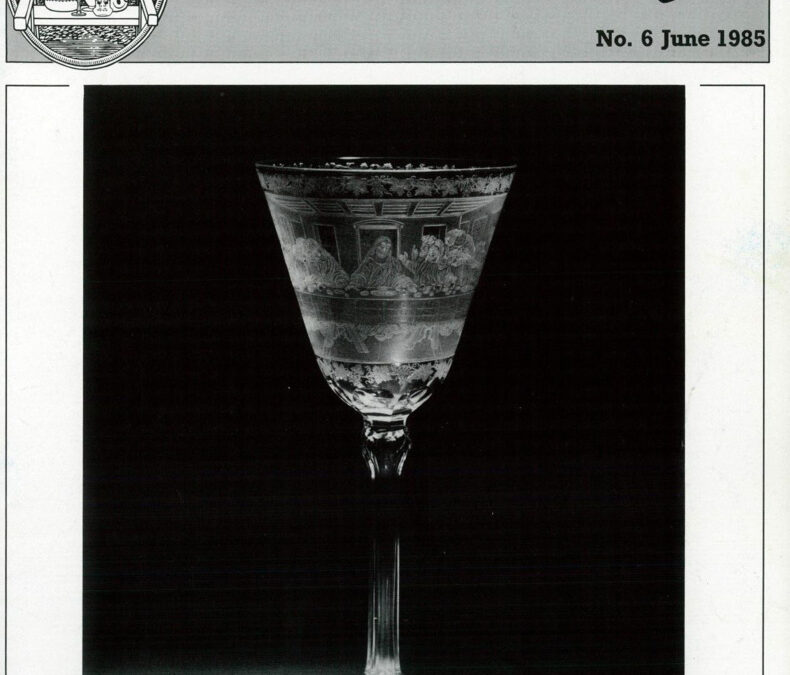
Cover Illustration
A magnificent goblet engraved on
the bowl with the Last Supper and
a band of fruiting wine on the
foot, height 10
1
/2″. The goblet was
exhibited at the International
Exhibition in London in 1862 by
Naylor and Green. Although the
Telephone Number
Broadfield House Glass Museum
Kingswinford 273011.
€ CMtli
o
At the London meeting of the Society
of Glass Technology on January 8th
1935 Keith Murray read a paper
entitled “Some Views of a Designer.”
His comments on Stourbridge cut
glass, reprinted here, make Ruskin’s
statement that “all cut glass is
barbarous” look positively
complimentary.
“Personally, I think, and I find many
people who think as I do, that a
characteristic piece of Stourbridge
cut glass of the past fifty years is,
generally speaking, a horrible object.
One can go into the glass department
of any of our big stores and see
masses of cut glass, looking exactly
the same — differences in detail,
perhaps, but in character all more or
less the same. It is the kind of thing
we have seen year after year, ever
since grandmother was alive, a
tiresome, vulgar and mediocre
convention in decoration, and it is
significant that the present Academy
Exhibition would have none of it.
A good piece of plain glass with its
obvious merits of pure form and
genuine function will always find
appreciation, but when a piece of
“best English crystal” is dug up in
some future age the queer muddle of
slashed cuts which decorate it will be
interpreted by the experts of the time
as something derived from sugar
candy. It will be labelled Stourbridge
Rock, and professors will speculate
on what manner of people we were
who could see merit in such
curiosities.
Another fetish is the boast that a
piece of glass is “hand made”. Fine
craftsmanship produces such results
that it should be reserved for only the
finest work, and I regard it as a
crowning condemnation of English
conservatism that the boast of English
hand-made glass means generally the
debasement of the skill of hundreds
of potentially fine craftsmen to the
production of the commonest type of
cheap goods. The maker is bound to
take far less trouble over his work
when he knows that its blemishes are
going to be smothered in cutting. The
result is that his eye for good form
has deteriorated.”
goblet
ob et is not illustrated in the main
catalogue, it was featured in the
separate colour catalogue.
Unfortunately the engraver has not
yet been identified.
The credit for the discovery of the
goblet’s history goes to Jeanette
Heyhurst who felt that the glass
was worth further investigation.
The goblet has been purchased by
Broadfield House Glass Museum
with a grant in aid from the
Victoria and Albert Museum.
liAzjzzue
p
2
Reflections
p 3
Exhibitions
p 6
Blowing Iron and Cutting
Wheel —
Americans in
Glass
p
7
She arings
p 8
Facets —
Reports on
Regional
Groups
Editorial
With notices for eleven different glass
shows piling up in the in-tray this
issue is devoted to those exhibitions.
Any member who achieves a 100 per
cent record in visiting all of them
should contact the Editor who will
send them a special prize, an
illuminated certificate and an extra
supply of stamina pills.
The regional events which are
planned for the summer and autumn
reflect the enthusiasm of our
members and the organising
capabilities of the regional
secretaries. At Farnham Patricia
Baker is putting together an exciting
mix of talks and working
demonstrations on the theme of
Drinking Glasses’. The one-day
seminar approach is repeated in the
next national meeting when, a week
later at Manchester, Richard Gray
and the Extra-Mural Department will
stage a full day devoted to the highly
important ‘Americans in Glass’
exhibition. Then on to September and
the first weekend seminar to be
organised by the Glass Association.
This will take place at Newcastle and
Sunderland under the banner
heading of ‘North East Glass’ whose
history continues unabated to the
present day. I look forward to your
continued support and attendance at
these very special events. I am also
aware of the fact that occasionally the
Glass Cone may arrive too late to
allow members to plan visits to other
regional groups therefore it is
planned to bring out a complete
programme of national and regional
events at the start of each year.
Every effort will also be made to
prevent any clashes of dates with
antique fairs.
Thanks
The Glass Association wishes to thank
three London firms, Jeanette Hayhurst
of Burlington Gardens, Martin
Mortimer of Delmosne and Sons,
Campden Hill Road, and Gerald
Sattin of Burlington Arcade for their
financial sponsorship of this issue.
COPY DATES
July 22nd for September issue
October 21st for December issue
Three dishes
by Henry
Greener & Co.
wca se
Madame Tussaud’s Pressed
Commemorative Glass Collection
As a possible additional attraction
to
its Royalty and Empire’
exhibition at Windsor, Madame
Tussaud’s has recently acquired a
unique collection of 19th century
pressed glass, consisting entirely
of items commemorating Queen
Victoria’s Golden Jubilee of 1887
— the only exception being a
pale blue scent bottle produced
for the Diamond Jubilee ten years
later.
The collection contains a wide
range of plates and bowls,
together with jugs, baskets, sugar
bowls, butter dishes, cake stands,
and other miscellaneous items.
Many of the designs are found in
blue and amber, as well as clear
glass: one of the most unusual is a
bowl of deep emerald colour,
with the Queen’s head in the
centre, and side decoration of
rose, thistle and shamrock and
the
words ‘1887 Year of Jubilee’. It
bears the Sowerby mark, but is
possibly a modern reproduction
from the original mould.
Among the other Sowerby pieces,
all of which are clearly marked,
is
a rare clear class crumb tray in
the
shape of a crown; and several
items with added gilding,
Including a jug and sugar bowl,
showing a crown and crossed
flags with the rose, shamrock and
thistle pattern similar to the green
bowl mentioned above. A most
elegant butter dish is of
somewhat similar design but
without gilding — it has a spire-
shaped lid. Sowerby is known to
have
made paperweights and it is
possible that the only one in this
collection is by the factory — it is
unmarked, and beneath its
curved top has a bust of Queen
Victoria in high relief.
Henry Greener & Co. is
represented by plates and dishes
giving variations on a basic and
rather coarsely executed theme
of a central crown above crossed
swords with the words ‘Queen
Victoria’s Jubilee’ (on smaller
items the word ‘Queen’ is
omitted). The variations occur
mostly in the size of the stippling
both of the words and/or
background to them. And on
each side is a shield bearing the
dates ‘1837’ on the left, and ‘1887’
on the right; on most, diagonal
lines in the body of the shield lie
in opposite directions, on some
they are parallel. Of the three
small dishes illustrated, that on
the right is of similar style, though
not positively identified as
Greener’s work. (The other two
are also unidentified). Greener’s
characteristic star pattern
appears on the foot of other
items, such as a jug, sugar bowl
and cake stand.
The largest part of the collection,
however, is made up of pieces by
George Davidson, not all of which
have the flattened 8 for which this
maker is well know. Most are of
extremely fine quality, and when
well lit, reflect light like cut glass.
Almost every type of article is
represented — from bowls of
various shapes to candlesticks,
butter dishes to round baskets;
the blue colour of many of them
ranges widely between pale
turquoise and light blue. A set of
three sugar bowls in clear, blue
and amber glass, shows the
familiar Davidson pattern of
alternating crosses and fleurs-de-
lys, with ‘Jubilee of Queen
Victoria 1837-1887’ to be read
from inside the bowl, while
another set is identical apart from
the legend which is read from the
outside. The most spectacular
pieces of the whole collection are
three fluted, simulated-cut-glass
bowls, all marked Rd.254027, and
all having a sepia photograph of
the Queen’s head attached to the
bottom; one of these is in plain
rose-coloured glass, the other two
Spill Vase com-
memorating
Victoria’s
Jubilee.
The maker
is still to be
identified.
are both pearline, turquoise and
vaseline respectively.
Two heavy triangular spill vases,
about 5″ high, one clear, the other
jet, have so far eluded
identification. Both vases are
identical: one face is illustrated
here; the others show i) a similar
heart-shaped frame with the
phrase ‘Victoria Jubilee’, and
‘1887’ enclosed within it, and a
crowfi surmounting a sword and
sceptre.
We have already received much
valuable assistance from
members of the Glass Association
who have seen this collection, but
it would be very interesting to
know whether any further
identifications can be made from
the descriptions given above, or,
indeed, whether any of the
original moulds of these pieces
still exist in private hands. The
collection is thought to be unique
in that it consists of pieces
commemorating one event only,
but the high quality of most of the
individual items would, by itself,
testify to their importance in the
history of 19th century glass
manufacture.
Undine Concannon
Archivist, Madame Tussaud’s
KNOTTINGLEY GLASS
From Bagley’s Crystal Glass Co.
1912-1975.
Wakefield Museum, Wood Street,
Wakefield.
20th April — 10th August 1985
Mon. — Sat. 10.30 — 12.30
1.30 — 5.
For 60 years Bagley’s Crystal
Glass Co. was one of the major
producers of inexpensive glass in
England but the history of the
factory remains largely unknown
to many glass collectors. Even as
late as 1970 the firm made over
seven hundred items of pressed
glassware. Several hundred of
those pieces have been on view
at Pontefract Museum and they
are currently on show at
Wakefield Museum. Here,
Richard Van Riel,
the curator of
Pontefract Museum who has
researched the history and
collected all the objects, looks at
the background of this fascinating
company.
“In 1912 Bagley’s branched out
from bottle-making into proper
lead crystal and pressed glass-
ware. True lead crystal was
produced for two years only;
Bagley’s manufactured the blanks’
to be finished off by another
company which had the cutting
wheels and the experienced
labour. The pressed ware
continued until 1975 and for most
of this period retailed as crystal
though it did not have the lead
content of real ‘crystal’.
The ‘crystal’ was very popular
and enabled a range of
inexpensive luxury items to be
made which had many of the
properties of light refraction
which characterised the more
costly lead crystal.
To begin with the ‘crystal’ was
only produced in ‘flint’ or white
glass but by the 1930s it was also
produced in a range of colours.
The range of items was initially
limited to beer glasses (or ‘cans’),
sugar bowls, butter dishes, cream
jugs and plain table sets until the
company established its own
mould department. The mould
department grew out of the bottle
shop with, at first, five craftsmen
working in a corner of the
building. By 1920 a separate
department was formed which
grew to eighteen strong including
those involved in the maintenance
of the machinery.
During World War 1 the works
were adapted to make electric
light bulbs for G.E.C. and the
Edison-Swan Bulb Company
(‘Ediswan’) which put in the metal
electrical elements. By 1916,
however, G.E.C. purchased
machines of their own and were
able to fulfil in three months their
own requirements for glass bulbs
for a whole year.
Royal patronage of the Bagley’s
Crystal at the Wembley
Exhibition in 1924 confirmed its
importance as a company selling
products to the whole of the
United Kingdom as well as
deriving a substantial proportion
of its income from exports. Item
number 1122 was supplied to the
palace and was subsequently
called ‘Queen’s Choice’. Similarly,
the commemorative plate
designed for the royal visit to the
Knottingley factory in 1937 was
remodelled for a later royal visit
to Canada and sold there in large
numbers.
During the Second World War
the company was involved in
turning steel shell cases on their
lathes as well as making battery
containers for the R.A.F., the
G.P.O., and for the railway
signalling equipment of Westing
House Brake and Signal
Company. The mainstay of the
department during the war was
the regular supply to the
N.A.A.F.I. of beer glasses to
make up for the enormous amount
of breakage. In fact they were
unable to keep up with demand
from the armed forces.
It is interesting to note that with
the discovery of the atomic bomb
at the end of the war the
Government confiscated some
three tons of uranium rich
material which had been
regularly used throughout the
1930s to give a yellow tint to
green glass.
The post-war period saw the
introduction of black glass in
plinths for coloured and white
glass as well as a new range of
The period of post-war
reconstruction gave the crystal
department its greatest boost as
households were re-equipped
with new glass-ware. From the
end of the war to the 1970’s the
crystal department employed
some three hundred people in
seven subsections:-
1.
Grinding and levelling bases
where points of attachement
to the mould were left. In
some cases chrome stands
were also fitted at Bagley’s.
This work was done by
women.
2.
The decorating or enamelling
department. This was
supervised by Miss Smith, an
art school graduate who had
about twenty women assistants.
3.
Packaging.
4.
Moulds.
5.
Maintenance.
6.
The batch’ department for
mixing ingredients for colours.
7.
The pot’ department to make
the crucibles to melt the
glass. This was a long job as
the clay had to be left to set
each time the crucible was
built up by four or five inches.
Increased post-war affluence
gave the crystal department some
new outlets. They produced plain
glass boxes for Elextrolux
refrigerators and ornate covers
for the internal lights of motor
cars.
The decline and eventual closure
of the crystal works in 1975 is
attributed to the lack of
availability of skilled labour which
had turned to newer industries
where pay and conditions had
overtaken those in the glass
industry (eg. the construction of
Ferrybridge C power station).
Bagley’s was taken over by
Jackson’s which in turn became
part of the Rockware group
which is still in business today.”
EXHIBITIONS
KINGSWINFORD
Broadfield House Glass Museum
A Lost Art Revived
Stourbridge Cameo Glass 1880-
1900
A rare
opportunity to see a
private collection of some of the
best cameos from the factories of
Webb, Stevens and Williams,
Richardsons and Stuarts.
Until 23rd June.
HEREFORD
Herford Museum
1180° Centigrade
Glass Sculpture by West
Midlands Artists.
22nd August — 21st September.
SCUNTHORPE
Scunthorpe Museum
Born of Earth and Fire
20th Century glass from the
Turner Museum collection,
University of Sheffield.
Until 30th June.
The
exhibition moves to the
Yorkshire Museum, York from
31st
August to 30th November.
EDINBURGH
The Open Eye Gallery
75 Cumberland Street,
Summer Exhibition of
Contemporary British Glass
Open Monday — Friday 10-6
.
Saturday 10
–
4.
ST. HELENS
Pilkington Glass Museum
— Cabinet of Curiosities
A display of exhibits collected
during the past five years which
have never been on permanent
display.
18th June
—
18th August.
Lampwork Demonstrations
The art of lampwork will be
demonstrated by an artist from
Tuppen and Jones who will make
decorative glass animals, figures
and other objects for sale.
151h July — 21st July.
St. Helens Museum
Central Library, Victoria Spa
Carnival Glass (from the Notley/
Lerpiniere Collection)
20th July
27th August.
LONDON
Aspects 3-5 Whitfield Street
1180°
Centigrade
Glass Sculpture by 7 West
Midlands Artists (Arlon Bayliss,
Keith Brocklehurst, Keith
Cummings, Tessa Clegg, Liz
Crowley, David Reekie and Jim
Roddis).
(A West Midlands Arts Touring
Exhibition).
Two special lunchtime events on
23rd July and 6th August; details
from the gallery.
13th July — 10th August.
V. & A. Craft Shop
Victoria and Albert Museum
`Dust Bowls’ — Christopher
Williams
This exhibition will feature new
bowls, dishes and off-centered
cylinders using the ‘Dust Bowl’
technique whereby powdered
glass is picked up several times
onto clear glass to achieve a rich
density of colour. Christopher
Williams has been a member of
the Glasshouse, London, since
1978.
22nd June —
19th July.
tiribceiti
Studio
Manager
Tony Prew is
pictured with
his
spectacular
glass
engraving.
LORD OF THE RINGS
The International Spring Fair,
held in February at the National
Exhibition Centre is an absolute
‘must’ to visit for everyone who
has been smitten by “glass”. One
of the highlights of this year’s
show was an engraved panel
shown on the stand of Grosvenor
Engraved Glass of Droitwich. The
12mm thick float glass panel,
measuring 2′ x 3′, is engraved
with a scene from the
Birmingham-born author Tolkien’s
“Lord of the Rings”. The
engraving, the result of three
months’ hard work by Grosvenor’s
Studio Manager, Tony Prew, is an
exact replica of a poster
designed by Jimmy Cauty.
The Grosvenor Studios offer a
wide range of glassware and
‘stock engravings’ suitable for
special occasions, as well as a
range of standard sport trophies
which can be individually
engraved to a customers design.
The Grosvenor works also
features the world’s first
automated glass engraving
production line capable of
handling up to 600 pieces an hour.
(Grosvenor Glass, 326/5 Site 6,
Rushock, Droitwich, Worcs. Tel.
0299 250480).
AMERICANS IN GLASS
Manchester City Art Galleries
The Gallery of Modern Art,
Princess Street, Manchester.
30 May — 21 July 1985
Mon-Sat 10-6, Sun 2-6
A major exhibition of American
studio glass will be on show at
the Gallery of Modern Art from 24
May to 21 July 1985. The
exhibition, put together by the
American Leigh Yawkey
Woodson Art Museum, is touring
major European cities including
Diisseldorf, Copenhagen and
Zurich. Manchester is the only
British venue.
Traditional concepts of glass are
shattered in this exhibition which
focuses not on decanters, goblets
and vases but on glass as an
expressive sculptural medium in
its own right.
The first impression of the show
is one of brilliant colour and a
sense of the bizarre. Amy L.
Momb’s large-scale pop art
images and Dan Dailey’s robot-
like glass head in primary colours
present strange and witty views
of everyday situations.
In the hands of Harvey K.
Littleton, Tom Patti and Jack
Schmidt glass becomes
monumental. Their works
combine a sense of solid mass
with a feeling for the essential
fluidity of the material. Italo
Scanga’s
Funnel Head II
presents
a glass construction with hidden
rich and painterly depths. Paul
Seide uses neon gas to light his
glowing serpents of glass with the
aid of a ‘broadcast radio signal’,
and Rudie Berkhout experiments
with holograms to explore the
phenomenon of light bending.
Many of the sculptors exploit the
fear we have of breaking glass. In
Linda B. Carpenter’s work,
dangerously-cracked panes with
scarred surfaces threaten
collapse and chaos. A seemingly
random collection of brightly
coloured splinters and broken
fragments fills a perfectly-formed
hemispherical bowl by Amy
Roberts.
Americans in Glass
continued
In Susan Shapiro’s
Apara’s
Approach,
the subject is the
artist’s private world. A vessel
becomes a delicately coloured
interior landscape where ‘the girl
is a self-portrait of my dreams… It
is a secret garden to which I
always run.’ By contrast, in Sam
Wiener’s constructions, the
message is a public and political
one. In
M.A.D.
(Mutually Assured
Destruction), stones resting
dangerously near glass houses
are scattered across maps of the
U.S.A. and U.S.S.R., which are
separated only by a low wall. The
whole piece is shaped like an
ugly atomic mushroom cloud.
William Warmus, the former
Associate Curator of the Corning
Museum of
Glass,
New York,
comments in the introduction to
the catalogue that the emphasis of
this exhibition is on ritual, ‘Altars,
totems and shrines are
everywhere’. Joey Kirkpatrick’s
and Flora C. Mace’s clone-like
elongated figures reflect this
theme as
does
Jon F. Clark’s
Dual
Form, Leaning,
inspired by pre-
Roman glass core vessels and
Mark Abildgaard’s
Altar Bowl
where a translucent vessel rests
on a ziggurat of stone textured
glass rods which have the look of
ancient archaeological finds.
Of the 73 works in the show, 20
are by artists invited to exhibit.
The rest were chosen by a
committee which included Dr.
Helmut Ricke, Deputy Director of
the Kunstmuseum, Dusseldorf, J.
Steward Johnson, Curator of the
Museum of Modern Art, New
York and Julian Schnabel, the
New York artist.
Dr. Ricke also served as the
Woodson Art Museum’s liaison in
co-ordinating the two-year tour of
Germany, France, Switzerland,
the Netherlands, Britain, Iceland
and Denmark. Of the tour he says
For Europe, this first great
exposition of the American (glass)
scene will certainly bring with it
important impulses.’ He considers
that American studio glass
represents, to European glass
artists, ‘daring and
experimentation, spontaneity and
unfetteredness’.
All works in the exhibtion are for
sale.
A 152 page English/German
catalogue accompanies the
exhibition. It contains full-page
colour documentation of each
artist’s work.
News & Views
INTRODUCTORY GLASS-
BLOWING WORKSHOP
Monday 16th — Wednesday 18th
September, 1985
at Buckinghamshire College of
Art and Design, High Wycombe.
10.00 a.m. — 4.00 p.m. each day.
Costs —£30 Members: £32.50 Non-
members.
Directed by Sam Herman, the
course will provide a practical in-
troduction to the basic techniques
of glassblowing. There will be an
extra charge for materials of
about £10.
For booking form contact Susan
Foster, Assistant Head of Visual
Arts, South Hill Park Arts Centre,
Bracknell, RG12 4PA.
BOOKS
GLASS ENGRAVING — Lettering
and Design
by David Peace
Published by Batsford, £14.95, 168
pages, 205 illustrations, available
June.
A highly illustrated and com-
prehensive guide to lettering and
design techniques on glass,
which include design principles.
Written by one of England’s fore-
most glass engravers, the text ex-
amines the history of letter forms
and will appeal not only to glass
engravers, but also to those inter-
ested in lettering. (In Crafts
magazine, May/June, David Peace
comments on the links between
engraving, architecture and town
planning).
OBITUARY
—
Phelps Warren
Phelps Warren died in New York
last February after a
comparatively short illness. He
will chiefly be known to members
of the Association as the author of
fish Glass
published by Faber in
their series of monographs on the
applied arts under the general
editorship of R. J. Charleston. The
book was produced in 1971 and
re-issued with various
amendments and extensions ten
year later. While it added little to
knowledge of the subject there is
no doubt it focussed interest on
the glass productions of Ireland
and promoted renewed
discussion. Indeed, Phelps was a
brave man to seek to extend the
boundaries of the standard work
Irish Glass,
(an account of
glassmaking in Ireland from the
16th century to the present day)
by M.S. Dudley Westropp,
published as long ago as 1920
and never bettered (although
extended in one or two
departments by Mary Boydell on
its reprinting in 1978).
Phelps was a delightful man: one
of a species of dilettanti
researchers who fall between
collector and academic. His
enthusiasm burned brightly when
he left his family wallpaper-
printing business some years
after the last war. He had time
and explored his interest with
vigour. His collection of Irish
glass amounted to some fifty
pieces and each was constantly
considered, discussed and
reviewed for its Irishness. The
least dogmatic of men, he would
listen with interest to other points
of view and one of two
illustrations were deleted from
the first edition of his book as a
result, once several opinions had
coincided and he could be
persuaded that a particular item
was more likely English than
Irish. He struggled manfully with
the detail patterns of the family of
factory-marked vessels, failing —
National Meeting
Cambridge, Saturday 20th April
A personal view of the day by
Jeanette Hayhurst.
“Malcolm and I driving like the wind
and nursing hangovers arrived just in
time, thanks to Rogers map. We
started the day with a fine lecture by
Simon Whistler. Within five minutes
we were totally absorbed. Simon
started with a brief history of
stippling, how the technique was
used by the Dutch copper plate
engravers and taken up by the
amateur artist Frans Greenwood and
later David Wolff. Fine slides enabled
one to see the differences between
the two masters. I must agree with
Simon that Greenwood managed to
put more feeling and depth into his
works.
On to the Whistlers. Laurence, being
a poet, composed a good luck poem
whilst visiting a friend’s house and it
was then suggested that it would be a
good idea to have it engraved on a
window. From this he revived a lost
art. It was a great experience to be
able to look at the glasses and be
told the influences, where they came
from and what to look for. The slides
were so good one could see
everything. The lecture was
concluded with the works of Simon
himself, enabling one to spot the
comparisons, which is not always
apparent unless there are a large
number to look at, as was possible
this day. During question time we
discovered that the Dutch originally
bought their glass from England and
now the Whistlers have to buy theirs
from Holland.
Tony Waugh summed up the general
feelings perfectly in his thanks. We
had all appreciated the works and
now they had an exciting new
meaning.
The following free time was spent
chatting to ones friends, sightseeing
or looking in the local antique shops
to find something exciting. A very
pleasant, extremely cheap lunch was
taken in the University Centre with
everyone chatting about their
favourite subject, Glass.
The afternoon was spent in the
Fitzwilliam Museum. An introduction
to the collections was given by Robin
Crighton after which we all had a
good look at the very fine items
which were well laid out and
properly labelled. A few of us were
treated to a look at the reserve
collection.
Everyone had a good day with many
members having travelled long
distances. It was a day that on
reflection we would have been very
sorry to have missed.”
F
acets Regional Reports
OBITUARY —
continued
as others have — to rationalise
them.
Aside from glass, he had many
interests and travelled Europe
annually almost to the end of his
life. He researched Dutch Delft
and had a good collection. He
organised the intake of American
university students to the National
Trust Summer School at
Attingham in Shropshire for many
years and was here regularly
during the course. He seemed to
know everyone and often, dining
with him in London, one would
meet interesting people one had
always hoped to meet; Helen
Lowenthal of the V & A, Marcus
Binney, now Editor of Country
Life, Dorothy Stroud from the
Soane Museum and so on.
A friendly and humorous man he
was at home in conversation on
all aspects of the Arts, while
remaining diffident about his own
contribution. His charm and
friendliness were legendary and
there would often be a call from
Heathrow as he departed home
just to say a quick farewell. I have
a happy last memory since my
wife and I dined with him at his
apartment on Lexington Avenue
last October. He was a little frail
but merry, and anxious for every
detail of our visits to historic
houses about Washington and
down along the James River. We
discussed the great collection of
American Glass in the Chrysler
Museum, Norfolk and out came
his pressed pieces for
consideration. I remember him
now in his austere apartment,
designed and furnished by
himself and lined with books and
his research files coded in one
colour for glass, another for Delft.
Writing to the end, he had just
completed a review of R.J.
Charleston’s magnum millefiori of
a book,
English Glass
for
Antiques Magazine.
A happy man
who filled his life with his
interests and nurtured his friends.
M. Mortimer
SOUTH EAST
The design and manufacture of
“Drinking Glasses” will be the subject
under discussion at West Surrey
College of Art, Farnham on Saturday,
6th July. The day will be split two
ways with a session of lectures and
talks by guest speakers, followed by
glassmaking demonstrations using the
College workshops. More information
is available from Paddy Baker, the
organising secretary of the S.E. group
and a lecturer at the College, Falkner
Road, The Hart, Farnham, Surrey,
GU9 7DS. Tel. Farnham 722441.
ANNUAL GENERAL MEETING
Date and venue is Saturday, October
26 at Nottingham Castle Museum. The
day will include a bookstall, and a
sales desk where members will be
able to sell and buy glass. Following
the A.G.M. Pamela Wood will guide
us through the notable glass
collections.
NORTH WEST
Saturday 10th August Visit to
St.
Helens, where the St. Helens Museum
is staging the travelling exhibition of
Carnival Glass, and to Pilkington
Glass Museum, where a special
exhibition of recently acquired glass,
entitled ‘Cabinet of Curiosities’, will
be on show. Janice Murray, Curator
of St. Helens Museum, and Ian
Burgoyne, Curator of the Pilkington
Glass Museum, will introduce the
respective visits.
North West members have been
circulated with fuller details of these
visits. Members from other regions
will be most welcome but are asked
please to contact either Richard Gray
at the Manchester City Art Gallery
(061 236 9422) or Ian Wolfenden at
Manchester University (061 273 333
ext 3619) beforehand.