




•
•
1/1
111151
nnn
1
10,
Summer 2002
Issue No: 60
Issue No: 60 Summer 2002
The Magazine of
The Glass Association
Registered as a Charity No. 326602
Chairman
Charles Hajdamach
Hon. Secretary
Geoff Timberlake (Geoffctim@btinternet.com)
Editorial Board
Patricia Baker, Ken Cannell Brian Currie,
Roy Kingsbury
Address for Glass Cone correspondence
2 Usborne Mews, Carroun Road, London SW8 1LR
(or email to Brian Currie: brian@currie.co.uk)
Address for membership enquiries
John Greenham, Membership Secretary,
1 White Knobs Way, Caterham, Surrey CR3 6RH
(john@jgreenham.freeserve.co.uk)
Web site: www.glassassociation.org.uk
ISSN No. 0265 9654
Printed by
The Charlesworth Group
Published by
The Society of Glass Technology for
The Glass Association
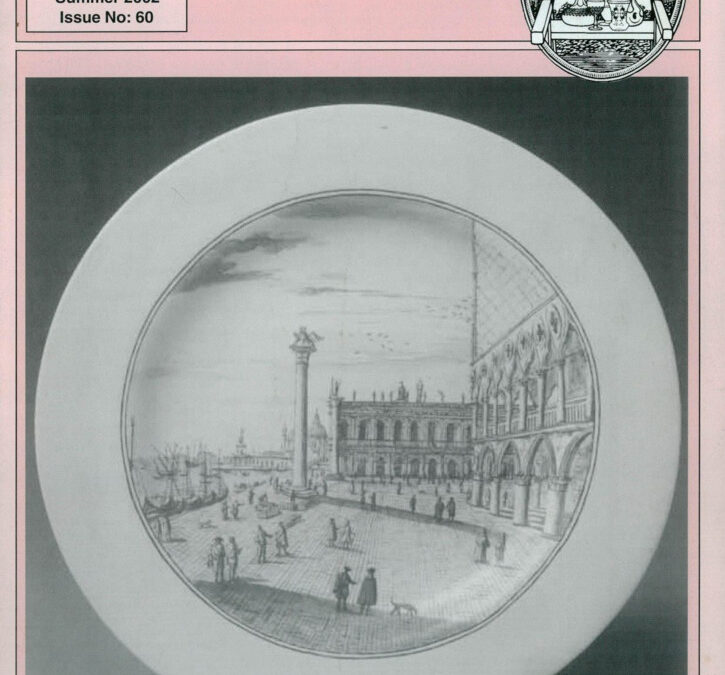
COVER ILLUSTRATION:
A Venetian lattimo plate, circa 1741, in red monochrome
showing the Vedutta della Piazzetta, looking towards the
Biblioteca and the Church of the Salute. 22.9 cm. Painted
by the Miotti family in the Al Gesu workshop. See page 9.
Photograph courtesy of Bonhams, New Bond Street.
EDITORIAL
Missing Registrations
Ken Cannell has a pressed clear glass ‘Grace Darling’
boat (11″ long) with two numbers: 39414 on the stern,
and 23527 on both the stern and the inside of the keel.
39414 is identified as Edward Bolton, 11 December 1885
in Jenny Thompson’s
The Identification of English
Pressed Glass, 1842
–
1908
(and illustrated on page 25),
and also in Raymond Slack’s
English Pressed Glass
1830
–
1900.
But neither refers to 23527 which probably
relates to the overall decorative pattern seen on this and
other items.
And at a car boot sale John Delafaille inspected a
high quality Baccarat styled pressed clear glass cylin-
der, measuring 7.8cm high and 7.4cm diameter, rimmed
to take some form of (metal?) lid, perhaps part of a
dressing table set, and clearly marked on the base
474519. The patterning is a series of ovoid shapes
infilled with a stylised multi-petalled ‘chrysanthemum’
flower head, while small rayed segments introduce a
conjoined twin lozenge form either side of the ovoid
motifs. Is the mark that of a retailer or the (supposed)
metal lid manufacturer, rather than the glass producer?
A Thought for the Summer?
As many Glass Association members will be concerned
with gardening over the summer and autumn, one of
our more active members, reading of the recent find
of an undamaged Anglo-Saxon glass bowl following
the archaeological dig undertaken by the TV Channel
4
Time Team
in the New Forest, SW England, some-
what facetiously suggests GA members bury one item
of their collection in a supermarket (non-biodegrad-
able) plastic bag for future archaeologists. No one re-
alised that the 6th century Byzantine metal banded
wooden bucket contained such a find when it was first
detected and uncovered. It was only during conserva-
tion and cleaning at the English Heritage centre at
Fort Cumberland, Portsmouth, that removal of the
thick muddy infill of the bucket revealed this pale
greenish clear glass bowl, unscratched and unchipped.
( The editors thank the sender of The Guardian news-
paper cutting, April 19, 2002. )
Perthshire Paperweights
News from John Westmoreland that Perthshire Paper-
weights of Crieff, Scotland, closed earlier this spring,
some months after the sad death of Mr Drysdale. How-
ever, the staff are hoping to open a glass making studio
on the premises.
Robert Goodden
The innovative designer and former head of the Silver
& Glass department of the Royal College of Art, Lon-
don, from 1948, Robert Goodden died on March 24,
2002 at the age of 92. During the 1930s he designed a
range of pressed glass products for Chance Brothers.
Fiona MacCarthy, who wrote his obituary for
The
Guardian
(March 26) commented that this ‘remarkable’
and innovative ware ‘was so cheap it was treated as ex-
pendable, and I had a problem finding good examples
when I was selecting the
Royal Designers’ Eye for In-
dustry
exhibition at the V&A in 1986. The day was saved
when Robert’s daughter found some fine pieces in a junk
shop and bought them without realising that her fa-
ther had designed them…’
The opinions expressed in the
Glass Cone
are
those of the contributors. The editors’ aim is
to cover a range of interests and ideas, which
are not necessarily their own. However, the
decision of the editorial board is final.
COPY DATES
Autumn 2002
Early August
Winter 2002
Early October
The Glass Cone’ – Issue No 60: Summer 2002
KNOTTINGLEY & PONTEFRACT VISIT – 27 APRIL 2002
The Association last visited this area in May 1991, taking
in the Rockware Glass bottle making factory, at Knottingley,
and Pontefract Museum, which was then establishing its
collection of Bagley and other local glass. We thought it
time to revisit the Museum, especially as a Lottery Grant
has enabled them to purchase a collection of Bagley Glass
and to refurbish their Glass Room to display it. We also
learned the old Bagley factory was still in existence and
again producing bottles, so this is where we started our day.
The Bagley company was started by two cousins in
1871, producing bottles, originally by hand and later by
machines, which by the early 20t
h
Century were fully auto-
matic. They branched out into pressed glass soon after World
War II and were taken over by Jackson Bros in 1962, which
in turn was absorbed into the Rockware Group in 1968. The
factory closed in 1975. In 1994 the Austrian-based company
Stolzle Oberglas AG, with factories in Europe, acquired the
company to form Stolzle Flaconnage. They invested over
£10m in new up to date production facilities.
On our arrival at the factory we were given a very warm
welcome and, after coffee, an introductory talk outlining the
local glass industry, the company and its products. They pro-
duce around 150 million bottles per year, 55% for the cos-
metic industry and other special bottle users. They claim now
to be the only fully automated cosmetic glass producers in
the UK and offer design facilities, to work in cooperation
with customer designers. Their product range is very wide,
from small scent bottles to probably one litre capacity bot-
tles; and the smaller bottles for cosmetics come in many shapes
and colours. Local sand is used, the iron impurity being
decoloured with selenium and cobalt compounds.
Familiar faces in unfamiliar garb. Members clad
protectively for a tour of Stolzle Flaconnage. Photo-
graph by Geoff Timberlake
We were split into four groups of 9 or 10 for the fac-
tory tour. We started with the bottle making machines,
which are without doubt the most fascinating (and noisy)
part of the process. These were similar to those we have
seen in other bottle making plants with a two stage produc-
tion method. The first stage moulds form the neck and
thread of the bottle. In the second stage moulds, the bottle
body is blown by compressed air. Small bottles can be pro-
duced in pairs. There are four production lines, all fed from
a single gas fired tank furnace upstairs, producing 10 tons
of glass per day. One of these lines is equipped to produce
coloured glass by mixing in coloured frit, which is stirred
into the glass between the furnace and the gob dispenser –
gobs are the lumps of molten glass of consistent volume
and temperature that are fed to the machine moulds.
To change the product on any line takes about 4
hours – or more if changing from single moulds to dou-
ble. It also takes 4 hours to change colour on the one line.
They will produce “short runs” but these must be at least
one day’s production (10,000 or more per line).
We were taken through an old “Bagley building”.
The block walls and concrete pillars supporting a con-
crete floor above were obviously not original but the
re-
sult
of a fire some time in the past. The building was used
for storage as well as for the acid etching plant, again a
recent sizeable investment. I got the impression this was a
process they would have preferred to be without because
of environmental requirements and problems, but it is what
many customers want.
Inspection at the exit end of the annealing lehrs,
Stolzle Flaconnage. Blue bottles for Nivea After
Shave – manually inspected because of their shape.
Photograph by Peter Beebe
Much of the line inspection is automatic. One sta-
tion with cameras “looks” at circular rotating bottles and
automatically rejects any not up to standard. Square and
rectangular bottles could not be inspected this way and so
were manually inspected. Customer requirements on size,
volume, appearance, etc are very stringent. Yet we throw
them away without a thought.
After this very interesting morning, we made our
way to Pontefract Museum for a good buffet lunch, the
caterers looking after us very well.
After lunch Dr Terry Spencer gave us a talk on ‘Trade
Unions and the West Yorkshire Glass Industry’, a some-
what different subject for our meetings, but an interesting
insight into some of the social aspects. Dr Spencer is a local
historian who writes on various historical subjects and wrote
his PhD on the influence of trade unions on the local glass
industry. His talk mainly covered the 19′ century.
In 1868 there were 18 glassworks in the Castleford,
Wakefield, Knottingley area and in the mid 19′ century
two 12 hour shifts were worked per day, 6 days a week. A
set number of bottles had to be produced per shift by
each chair of four workers. Generally this number could
be produced in half the shift time and any extras earned
bonus pay, of which one third was taken by the master of
the chair, with any apprentices taking a lower proportion.
3
‘The Glass Cone’ – Issue No 60: Summer 2002
The first local “Bottle Union” was formed in 1827
in Castleford but this was not part of the Glass Bottle
Makers Union. The Flint Glass Workers Union of 1849
treated the bottle makers with disdain saying they were
not as skilled as the flint glass makers. So here were the
beginnings of inter-union rivalry and chaos.
In 1856 employers reduced wages by 3/- per week
and someone was needed to bring the unions together and
increase their effectiveness. A man named Greenwood did
much towards this, later bringing in a national union body.
In 1862 the closed shop came in, bringing limitations
on apprentices and cheap labour, and generally a better
organised and close knit union movement. But, by 1876,
the employers had become better organised and formed
their own association for all wage and other negotiations.
In 1868 Edgar Bagley (not of the future Bagley Co)
was secretary of the Glass Bottle Makers Union. He obvi-
ously made a good job of the position and was removed by
a factory owner who took him on as his factory manager.
On the technical development side the first bottle
making machine patent was taken out in 1859. Tank fur-
naces were introduced in 1878. By the mid 1880s bottle
machines were introduced but at first manual workers
could out-produce them. By 1889 the machines had im-
proved. In the mid 1890s the fully automatic Owens ma-
chine was introduced. These most successful machines were
acquired by the Bagley Co early in the 20′ century.
During the 1880s union influence declined. Green-
wood brought in a National Federation to widen union
influence countrywide and made agreements with the Flint
Glass Workers Union, but declining trade gave employ-
ers the upper hand. Lock-outs were used to reduce wages
and restrictive practices; alliances fell apart including in-
ternational ones. Not until 1920 was the National Glass
Makers Union formed, later to come under the wing of
the Transport & General Workers Union.
Our second talk, on Bagley Glass, entitled
Varieties
and Variations
was given by Mr Adrian Norris, a Senior
Curator in Natural Science with Leeds Museums. He de-
scribes himself as a Conchologist (an expert in molluscs
and shells). We recognise his name as a collector and writer
on Bagley’s Glass. His collection now tops 5000 items,
which surely must be one of the largest single company
collections (does anyone know of a larger?).
Mr Norris used digital illustrations from a PC, pro-
jected on to a screen. He showed many variations of some
of Bagley’s well known patterns, plus others less well
known or even unknown to some of us. Some patterns
were obvious copies or should we say “influenced by other
companies’ designs” such as “Honeycomb”, very similar
to a Jobling design, and “Queen’s Choice”, a broad flute-
like pattern very similar to Davidson’s “Chippendale”. He
covered the successful “Crystaltint” four colour range of
1932 with some of their many designs.
Like other companies, Bagley’s employed a freelance
designer in the 1930s Alexander Hardie Williamson pro-
duced several designs in 1934/35, the Marine Bowl prob-
ably being the best known and produced in several colours.
An example of a long running design series was the
Jetique range of the 1930s in black glass, revitalised after
the second World War with white Polka Dots and, later,
coloured dots. Reading lights were made in several de-
signs but are now as rare as hen’s teeth.
Pontefract Museum: a rare Bagley bowl in amber
designed by Alexander Hardie Williamson 1934-35.
Photo by Peter Beebe
Some Bagley Glass is not easily recognised. None is
marked with a trademark and other makes of glass can
be mistaken for Bagley, as I found out. Bagley’s took out
21 design registrations up to 1940 plus at least two in the
late 1940s and some items can be found with registration
numbers. Apparently the company made over 6000 dif-
ferent pressed glass items during their existence. So even
if you have 5000 items, you still have a good many to find!
The Museum glass display room is quite small but
nonetheless impressive and well lit. There are examples that
most of us have never seen and would not link to Bagley.
They were a company well known for many run of the mill
designs but given little credit for their better designs.
We must thank Mr Richard van Riel, the curator of
this Museum since 1976, for his hospitality and help in mak-
ing this a very enjoyable and successful visit and, to close, I
must give the Museum a plug. They have a lot of material
on Bagley’s, including four catalogues from 1926 to 1964,
drawings, cartoons and many notes on glass compositions
and notes on designs and moulds by the late Tom Dearden,
whom we met in 1991, and who made many moulds for
Bagley’s (and other manufacturers). These records were avail-
able for inspection during our visit. For the researcher on
Bagley or the enthusiast, it is a “must visit” place.
The Museum is an Art Nouveau building on Salter
Row in the pedestrianised centre of Pontefract. Parking is
very reasonable and most convenient on the north side of
the town (look out for Tesco) for up to four hours. The
centre of Pontefract is also worth visiting and the castle is
nearby. The Museum telephone number is 01977 722741.
Peter Beebe
4
Three Bagley lamps at Pontefract Museum. Left
to right:
Patn. No. 3003, 742, 3002. Photograph by Peter Beebe
7
7
‘The Glass Cone’ – Issue No 60: Summer 2002
GLASS & ARCHITECTURE
The Blue Carpet at the Laing
Earlier this year, the national press carried news and
photographs of the ‘Blue Carpet’ installed outside
the Laing Art Gallery, Newcastle, a £1 .4 million
project funded by the European Regional Develop-
ment Fund, the Arts Council and the City Council.
In 1996, the Thomas Heatherwick Studio, London,
won an international design competition for the de-
sign of the public space.
The ‘ Blue Carpet’ installed outside the Laing Art
Gallery, Newcastle. Photograph supplied by
the Thomas Heatherwick Studio
It was a challenging site; a disused road rather
than an actual square, surrounded by an undistin-
guished assortment of buildings with a utilitarian steel
staircase providing pedestrian access, not far from the
frantic traffic of the city’s inner ring road. There was
little space for additional construction and therefore,
rather than inserting artwork, the studio chose to make
the surface the artwork and to let this surface define
the nature and location of the street furniture and trees
and unite this fragmented space. Existing paving ma-
terials did not seem to offer potential to do this effec-
tively, especially with the existing (neutral) colouring,
so it was proposed to formulate an entirely new kind
of paving material, to be coloured blue.
After several trials and setbacks, the final for-
mulation used crushed blue glass from Harveys Bris-
tol Cream bottles set in a white resin and formed into
tiles, measuring 450x150mm produced by TTURA
(www.ttura.com) and manufactured by Dew
Pitchmastic. These tiles were laid in lines detailed with
inlaid brass strips.
The finished square is as if one connecting ele-
ment, a surface, has been dropped into the space. The
`carpet’ pulls back around trees and leans up against
the gallery walls. Its surface is punctured by bollards
and peeled back to form benches, revealing glazed
voids packed with multicoloured fluorescent tube
lights. A timber staircase, a glossy wooden spiral of
laminated wood, fabricated in situ by a team of
Tyneside boat builders, now brings people into the
space, while the five benches of polished precast con-
crete with hand crafted brass armatures were made
in London.
The ‘Blue Carpet’ surface is punctured by bollards
.
Photograph supplied by the Thomas Heatherwick
Studio
Installation of the Blue Carpet took place dur-
ing the summer and autumn of 2001, and a one hour
TV film was screened in December 2001. Despite a
controversy as to whether it is ‘blue enough’ it has
achieved what it set out to do, which is to make
a
marked improvement to a formerly neglected and
dysfunctional area of the city.
On the South Bank
This summer should see the completion of the new GLA
Headquarters on the south bank of the Thames near
Tower Bridge, London. The first proposal submitted
by the architectural team, Foster & Partners, underwent
some modifications before planning permission for this
large development (of a ten floored glass building hous-
ing the Assembly chamber, the Mayor of London’s
of-
fice
and banqueting area, ice rink, shops and office
space) was granted. Media comment then was mixed:
the simulated computer images of the original Head-
quarters building reminded more than one journalist
of a giant car headlight and others queried how the
design would work against the elaborate Victorian deco-
ration of Tower Bridge, and the medieval stone of the
Tower of London. With the revised proposal, out went
the car headlight – and in came a motorcycle helmet.
Much was made of the glass fabric of the building ena-
bling ‘transparency in government’, one of those irri-
tating, overworked ‘buzz phrases’ of the late 1990s. The
building would provide ‘spectacular views for the peo-
ple working in the building, but equally it will allow
Londoners to see their elected assembly at work’. A glass
panelled ramp, we are told, spirals around the interior
of the building, and as the glazing patterns will differ
on the interior and exterior ‘the effect will be of mov-
ing through a giant kinetic work of art with the pat-
terns of the glass constantly on the move’.
However, according to
The Independent’s
archi-
tectural correspondent, Jay Merrick, (29 December
2001) the glass structure is ‘looking unexpectedly
chunky. What had been conceived as a smooth, gleam-
ing egg looks like it’s been hardboiled, diced and put
back together in a hurry’.
The Glass Cone’ –
Issue
No 60: Summer 2002
The modified profile, derived from a sphere, has
25% less surface area than a cube of the same vol-
ume, important in these times of energy conserva-
tion. Analysis of the sunlight hours in relation to the
glass walls was undertaken; so, for instance, the build-
ing ‘leans back’ towards the south with the floor plates
stepped inwards from top to bottom to provide natu-
ral shading. Solar energy is to be collected and the
heat generated by the computers and lights
( and po-
litical hot air? Eds. )
will be recycled ; so no boilers
nor air-conditioning units have been installed.
But Manchester…
The same Jay Merrick was very enthusiastic but ex-
tremely brief in the same report, extolling the virtues
of
URBIS
in Central Manchester, the work of Ian
Simpson. This ‘museum of the modern city’ is de-
scribed as a huge glassy swoop like a six storey ski
jump.
(Any views or comments from readers? Eds. )
Lloyds & Rogers
Lord (Richard) Rogers’ enthusiasm for glass in architec-
ture has not dissipated since working on the Lloyds Build-
ing in 1986, as shown by the partnership’s latest project in
the City of London, the Lloyds Register of Shipping, lo-
cated off Lloyds Avenue. The emphatic gridded plans and
elevations of this 13 storey construction and the prefabri-
cated units owe much to the Bauhaus movement, while the
protruding glazing bars remind Jay Merrick
(The Independ-
ent,
17 January 2002) of Frank Lloyd Wright’s work in the
early 1920s. Again conservation of energy has been a key
issue in the installation with heating, air conditioning and
lighting careful monitored. If a space is vacated for more
than 15 minutes, the lights are automatically shut off.
PAPERWEIGHT NEWS
6
As the Glass Association has a number of members whose
interests include glass paperweights, it has been suggested that
we give the subject a regular feature in the
Glass Cone.
I was at
the last committee meeting as the South West Region repre-
sentative and as my primary interest is glass paperweights, the
task of getting something up and running somehow fell to me.
If any members have any news or information that might be of
interest to fellow collectors please contact me or the Editor.
First, most enthusiasts probably know this but some
readers may not be aware: after mounting problems over the
past few years, Perthshire Paperweights, arguably Britain’s
finest maker of traditional style millefiori and lamp work
paperweights, was forced to cease production and closed its
doors at the end of January. There were some patterned
millefiori weights made with a 2002 date cone which went to
Sweetbriar Gallery and Stone Gallery but by now, I would
imagine, most have been snapped up by eager collectors.
We must wait to see what effect the cessation of
manufacture will have on the value of weights produced
during the past 33 years. The weights from the annual
collections have always held their value well, but over a
period of time I guess the prices of even the more basic
type weight can only go up as new collectors enter the
scene and no new weights come onto the market.
The latest news of Peter McDougal, the ex-manager
and main driving force behind Perthshire, is that he will be
continuing, we hope, to practise his skills as a paperweight
maker. I also hope the definitive book on the paperweights,
published in 1997 by the Mahoneys/McClanahans, is brought
up to date to complete the story. But, as far as I know, there
is still one aspect of their production that remains undocu-
mented: the manufacture of Monart/Vasart style art glass,
including lamps, that was only on sale at the factory in Crieff
for a short period of time around the late 1980’s. We bought
a superb table lamp on a visit there and later picked up a vase
at one of the Newark fairs. We also saw other examples where
the moulded P had been ground away!
Second, for anyone living in the North of the country
with a desire to meet fellow enthusiasts and learn more about
the subject, a Northern Paperweight Society has been estab-
lished. This is a separate organisation and not an offshoot of
the Cambridge Paperweight Circle, which is an overseas chap-
ter of the Paperweight Collectors Association of America.
Further details can be obtained from Anne Metcalf at
Sweetbriar Gallery or Sue Broughton on 01925 604358.
Finally, a date for your paperweight diary. The Cam-
bridge Paperweight Circle 21st Anniversary Exhibition is
being held at the National Exhibition Centre, Birming-
ham, in conjunction with the last 2002 LAPADA antiques
fair. The dates are Thursday 28, Friday 29 and Saturday
30 November and it is hoped to have 1000 paperweights
on display covering the whole 170 years of their manu-
facture. Planning is well under way. Unfortunately the
growing threats of terrorism have so affected insurance
costs as to make it impossible for some very rare weights
to be loaned as a centrepiece to the exhibition. All the
same, it should be a stunning display and a must for all
those with an interest in the diverse skills of the glassmaker.
Richard M Giles
Telephone: 01242 515505
PRESSED GLASS COLLECTORS CLUB
Ken Cannell
adds to the brief description in the August 1996
Glass Association Newsletter (as then was) of other UK
glass oriented established societies:•
Started in 1994 and now with over 200 members, the PRESSED
GLASS COLLECTORS CLUB publishes its journal
Mark-
ing Times
three times a year, plus occasional specialist publica-
tions which are available to non-members. It is a postal-based
club with an emphasis on English Victorian and Edwardian
glass. You can fmd further information by visiting the club’s
website: www.pressedglasscollectorsclub.pwp.blueyonderco.uk
or by contacting ‘Marking Times’, 4 Bowshot Close, Castle
Bromwich, West Midlands B36 9U H; tel. 0121 681 4872; email:
glassman@blueyonder.co.uk
Stanislav Libensky
Sad news of the death at the age of 80 of the internation-
ally-renowned Czech glass artist, Stanislav Libensky. Edu-
cated at the Prague College of Applied Arts, Libensky later
taught there and at small vocational schools, inspiring art-
ists in Europe, Japan and the United States. A retrospective
exhibition of his major sculptural pieces will open July 4 at
the new Museum of Glass in Tacoma, Washington USA.
‘The Glass Cone’ – Issue No 60: Summer 2002
ROYAL COMMEMORATIVES
Marking the Queen’s Golden Jubilee in June,
Broadfield House is mounting a special exhibition
of Royal Commemorative Glass. The exhibition will
be on display until 21 July. Drawn from the muse-
um’s own collection, with the addition of several pri-
vate loans, the exhibition contains around 100 pieces
ranging in date from the 19th century right up until
the present day.
Royal Commemoratives first became popular
during the reign of Queen Victoria, and the exhibi-
tion begins with a fine selection of pieces made to
celebrate the Queen’s Golden and Diamond Jubilees
in 1887 and 1897. These include acid etched and
pressed glass pieces as well as an imposing Bohemian
vase (above) painted with a portrait of the Queen.
Edward VII is represented by a fine portrait vase en-
graved by William Fritsche, while George V’s Silver
Jubilee in 1935 inspired a number of commemoratives
including an unusual pressed glass plate by Jobling’s
of Sunderland with a colour transfer print of the
King in the centre.
Edward VIII coronation commemoratives are
rare as most were withdrawn from sale once the ab-
dication had been announced. However the exhibi-
tion includes a massive coronation goblet designed
by Keith Murray for Stevens & Williams of Brierley
Hill as well as other coronation items. Never ones to
miss a commercial opportunity, some factories even
produced pieces commemorating the Abdication, and
the exhibition features a fascinating Stuart vase which
is engraved with part of the abdication speech.
The coronations of George VI in 1937 and
Queen Elizabeth in 1953 sparked off large numbers
of commemoratives from expensive engraved limited
edition pieces to cheap pressed glass souvenirs. One
of the most unusual items in the exhibition is a 1953
Coronation Bowl (above) which was made at
Stourbridge School of Art and is engraved with the
names of all the Kings and Queens of England start-
ing with Egbert in 802 AD! The wedding of Prince
Charles and Lady Diana Spencer was the last occa-
sion when royal commemoratives were produced in
any great quantity, and the exhibition includes ex-
amples made by Stuart Crystal and Thomas Webb’s.
(Pictures kindly supplied by Broadfield House
Glass Museum)
7
The Glass Cone’ – Issue No 60: Summer 2002
RED HOUSE GLASS CONE, WORDSLEY
In spring 2000, Dudley Metropolitan Borough Coun-
cil commenced a £1.7 million project for the restora-
tion of the 18
th
century Red House Glass Cone,
Wordsley. The developed site opened to the public at
Easter this year and seeks to establish the Red House
Glass Cone and surrounding buildings as a major
tourist attraction for the region and aims to bring
increased employment opportunities to the Borough.
Built at the end of the 18
th
century the Red
House Cone was used for the manufacture of glass
until 1936 and is now one of only four remaining in
the UK. Reaching 100ft high, this unique building
enclosed a furnace around which men made glass for
140 years. Here is where the cameo blanks for John
Northwood’s famous copy of the Roman Portland
Vase were blown in the 1870’s. For over 100 years it
was home to the glass company. Stuart & Sons.
Museums Director Charles Hajdamach with the
Mayor of Dudley, Cllr John Walters.
The project includes the repair and refurbish-
ment of the 1790’s Glass Cone, a new visitor centre,
new exhibition and interpretation facilities, audio
visual presentations and demonstrations. The com-
plex also includes the Stuart Crystal Factory Shop
and the Crystal Tea Room, and there will be facili-
ties for 12 managed workshops for small craft enter-
prises. Souvenirs and craft items made on the
premises will be available for sale.
External funding has been achieved from a
number of sources with a major contribution from
Dudley Council of £250,000. Other contributions
have come from Advantage West Midlands
(£350,000), the Heritage Lottery Fund (£375,000),
the European Regional Development Fund
(£570,000), English Heritage (£109,000), and Stuart
Crystal (£11,500).
The complex is owned by the Red House Trust
but the site and collections have been leased to Dudley
MBC and will be managed by the Council’s Muse-
ums Service.
The pictures, taken at the launch weekend, were sup-
plied by Jane Carney, Museum Development Manager,
Broadfield House Glass Museum.
From Left to Right: Reg Pierce (see below); Ralph Bowater
(worked in the Cone 1933 – 35 as a `taker-in’); John Luxton
(principal designer for Stuart’s from 1949 to 1985); Ian
Stuart; and the Mayor of Dudley, Cllr John Walters.
8
Reg Pierce, principal designer for
Stuart’s from 193 7 until the start
of the war, now in his 90th year,
with members of his family.
‘The Glass Cone’ – Issue No 60: Summer 2002
GLASS AT THE AUCTIONS
Chris Crabtree is unwell. We wish him a good recovery
and are glad to hear that he hopes to be back in action
soon. Meanwhile we miss his expert auction round-up
and commentary.
Our cover picture shows a picture of a superb
Venetian
lattimo
plate sold at Bonhams Bond Street
in their sale of Fine Continental Ceramics and Glass
on 22 May. Estimated at £30,000-40,000, it sold for
£36,000
(hammer prices throughout).
A Dutch-engraved ‘Newcastle’ light baluster wine
glass, circa 1760, inscribed ‘T GOED SUCCES
VAN’T HUWELYCK’ 21.2cm tall. Photograph by
Bonhams Bond Street.
Other glass items in the sale included a series
of four Dutch-engraved wine glasses from a Shrop-
shire estate. The most expensive of them, a ‘Newcas-
tle’ light baluster wine glass, circa 1760, brought
bidding up to £1,250, exactly in the middle of its es-
timated range.
The sale also included ten paperweights which
sold at prices ranging all the way from £170 to £4,000.
The high figure was attained by a St Louis `Marbrie’
weight from the mid nineteenth century, its base set
with a central cluster formed of a concentric cane
within a row of yellow composite canes, the whole
cut with three rows of printies around a top window.
A small gathering of members was to be seen
at Fieldings’ 25 May auction in Hagley. The attrac-
tion – two cameo vases each bearing the engraved sig-
nature ‘W Fritsche’. There was much discussion about
the signatures. Few of those present could remember
seeing a Fritsche signature on cameo glass. The prov-
enance was apparently promising. One respected
member believed he could see traces of copper wheel
fragments (from the engraving of the signature)
be-
low
the surface of the final finish of the glass.
Both fetched good prices. The squat cameo vase,
amber overlaid with cranberry and white (illustrated),
sold for £5,600 while the gourd vase, of the same col-
ours, carved with clematis and trellis, achieved £5,200.
Two Webb Ivory perfume bottles (catalogued as pat-
terns I 422 and I 299) sold for £780 and £700.
A Webb squat cameo vase, 4 inches tall, amber
overlaid with cranberry and white, bearing the
engraved signature ‘W Fritsche’. Photograph by
Fieldings Auctioneers
Peter Beebe
kindly gave us the following account of the
auction of the first part of the Clive Bartlett collection of
pressed glass, by Capes Dunn on 26 March. He will tell u.s
about the second, 11 June, auction in our next issue.
The first 61 lots were devoted to Carnival Glass, with
few run of the mill pieces. Realised prices were not high.
20% did not reach estimates, many of which were not
realistic. Only two lots exceeded £100 and surprisingly
these were both of Marigold colour, normally the cheaper
end of the range, but they were uncommon patterns.
American Depression Glass was not popular.
the ten lots going at give-away prices.
Left: a pair of John Derbyshire Hand Vases at the
Capes Dunn auction; Right: a sugar and creamer from
Percival, Yates & Vickers. Photograph by Peter Beebe
40 or so lots which included Jobling, Bagley and
other coloured and clear glass from the North East,
mainly from between the wars, failed to reach excit-
ing levels. The leaders were two Jobling pieces, a 13″
bowl and a 10 ” plaque, both registered in 1933. They
fetched £60 each. Two Bagley Marine Bowls in light
blue went for £30 each. Manchester and NE Flint
aroused little interest except for a John Derbyshire
part-frosted Hand Vase which brought £60. A simi-
lar damaged pair in uranium yellow reached £65.
9
‘The Glass Cone’ – Issue No 60: Summer 2002
1 0
A 4 1/2 inch Sowerby “Nursery Pattern” vase
in “Ivory Queen’s Ware” attained the highest price
for a single item, at £170 (estimate was £20-30). One
group that reached realistic prices was 8 lots of
Davidson
Pearline,
with a yellow sugar and creamer,
Reg. Des. No. 217752 (1893), going to £85.
Davidson Pearline items at the Capes Dunn auction.
Photograph by Peter Beebe
The remaining lots, Black, White, Blue (mainly
Sowerby), Davidson Cloud and Davidson Jade, along
with a group of common commemoratives sparked
little interest. A few malachite pieces gained reason-
able prices: a Sowerby three-swan vase, £75; a Hepple
Fish Jug, £50.
A good day for the buyers, but very disappoint-
ing for the seller.
Peter Beebe
Seeing Through a Newcastle Office Block
Contractor Millfield has completed a £98,000 deal
at Central Square South, Newcastle’s new £12 mil-
lion office block. The company, a specialist in glass
reinforced plastic and glass reinforced gypsum was
selected by McAlpine to fit out the central atrium
and reception columns. The Newburn-based business
designed, supplied and fixed six storeys of GRG clad-
ding to the atrium and decorated nine columns on
the ground floor reception area
(see picture below).
[Extract from
The Journal,
December 2001, supplied
by
Rita Pearce]
The glass
reinforced central atrium at Central
Square South in Newcastle
Geoff Timberlake
has been browsing the pages of the
Pottery Gazette. Here are a couple of nice items he found:
Victorian thoughts on diverse uses for glass
Extracts from the Pottery Gazette, March 1st 1886 “Frag-
ments” columns page 293.
When shall we hear the last on glass railway sleepers and
glass bearings to our engines? We hope to be preserved, as
much as we would encourage glass making, from riding
in a train on a railway line with these grand sleepers.
It has been gravely stated that if gas and water pipes
were made of glass, they would be in the end far cheaper
than the iron and composition pipes at present in use, and
withal would be far more cleanly.
An Italian ship has been sheathed with glass plates,
cast like iron plates, so as to fit the hull, to take the place
of copper sheathings. The joints of the plates are made
water tight by the use of waterproof mastic. The advan-
tages claimed for glass over copper are its insensibility to
oxidation and its exemption from incrustation.
The Man with a Glass Leg
From the Pottery Gazette, February 2nd, 1885 page 186.
We extract the following from a Sussex daily newspaper:
Some years ago a singular case of nonsense was the
talk of a Sussex village. In the case to which I refer the
sufferer was a baronet, and nothing in the world could rid
him of the notion that one of his legs was made of glass.
How to preserve it and protect it from accident was the
study of his life. Physicians from all parts of the country
were consulted. They attended, paid assiduous attention
to the supposed fragile limb, failed to convince the gentle-
man that his leg was as purely composed of flesh and
bone and muscle as their own, received their fees, bade the
baronet adieu, took up their hats and coats and departed.
Meanwhile, the patient rested the unfortunate and
much maligned member on a chair, and feared to trust it to
the ground lest it should be shivered in the operation. At
length a young medical man came and took up his quarters
in the neighbourhood. He had excellent credentials and in
due course was summoned by the baronet to be consulted
on the subject of the glass leg. He attended. The patient was
pleased with the young man’s appearance and manner. The
doctor sympathised and rubbed the leg. This occurred day
after day. A more than professional friendship grew up and
the baronet on one occasion offered to drive the young medico
round his neighbouring estates. The doctor, who was not at
that time overburdened with practice, gladly accepted the
offer. The carriage had proceeded some distance and the oc-
cupants mutually admired
en route
the surrounding mead-
ows and woodland scenery. It was getting dark, however,
when suddenly they were startled and very much alarmed by
the firing of pistol shots from behind the hedge.
To add to their dismay several rough looking men si-
multaneously made their appearance. The coachmen and foot-
man leapt from the box and fled; and the doctor, as he jumped
out of the carriage door, shouted lustily to his patient to follow
him for his life as he rapidly made for an old-fashioned farm-
house a short distance away. The effect of the sudden fright
was electrical. The glass leg was entirely forgotten and the bar-
onet made such rapid progress over the ground that he soon
overtook his medical advisor. It need hardly be said that the
supposed attack of the highwaymen was a ruse on the part of
the doctor and that the cure was a permanent one.
‘The Glass Cone’ – Issue No 60: Summer 2002
BOOK REVIEWS
LEOPOLD & RUDOLPH BLASCHKA. Design
Museum, London, 3Opp text with b/w illustrations,
36 colour, ISBN 1 872005 45 4, £8.50. This catalogue
which accompanies the current exhibition presently
at the Design Museum, London and later at the Na-
tional Glass Centre, Sunderland contains essays by
Henri Reiling, Chris Meechan and Dorothy Cross.
GLASS, AN INSPIRATIONAL PORTFOLIO by
Jera May Morton, Watson-Guptill Publications, NY,
144pp, 66 colour. ISBN 0 8230 0305 1; remainder
price £3.99. Containing short sections on materials
and techniques, this is mainly an introduction to some
of the finest work (mainly windows) of some of the
best living glass artists, each of whom is represented
in a single full-page detailed illustration (appro
16cm
2
) supported by a small vignette showing the
setting. About half of those artists featured are from
the UK. A real bargain.
News of a new book dealing with glass pictures (as
distinct from glass paintings) NELSON COMMEMO-
RATED IN GLASS PICTURES by LP Le Quesne,
2002, Antique Collectors’ Club, 104pp, 2 b/w, 69 col-
our, ISBN 1 85149 396 4. £25. This work details the
70 known Nelson glass pictures (reproducing prints
on glass and hand-painting with vivid colours) repre-
senting his achievements and his death at the Battle
of Trafalgar. The first publication of its kind.
Ken Cannell
LETTERS
Etna Flint Glass
I
recently came across a small plate with a lozenge mark.
The design registry credited it to George Joseph Green,
date 24 July 1851, of Etna Flint Glass Works, Birming-
ham. The 1851 census tells me he lived at 8 Yew Tree Road,
Edgbaston, that he was born in London and aged 59. It
seems at least two other designs were registered by the
glass manufacturer, in 1848 and 1850.
The plate is press moulded and coloured with uranium
which suggests that there must have been some considerable
capital investment and Etna Flint Glass Works was more
than a one man studio. Can any reader help provide more
information about George Joseph Green and his glassworks?
Barrie Skelcher
01728 830463
Missing Registrations
With reference to the missing registrations item on page 2 of
The Glass Cone
59, I recently acquired a flint bowl with the
Reg. No. 705632.1am fairly certain that I have read the number
correctly, but in any case I have tried all the possible alterna-
tives and can’t find any of them in the appropriate books
The bowl is circular with the rim turning inwards.
Height: 3″; Diameter at the widest part: 10 and a half inches;
Diameter rim to rim: 9 and a half inches; Base diameter: 4
and a quarter inches (I should have done this in metric!),
with a 20 point symmetrical star, from which radiate 20
panels ending in scallops at the rim. These panels are crossed
by two transverse rings. The pattern is rather Jacobean.
I hope you can get a picture from this description,
and from the attached photograph which Stan took for
me, and I hope that this may be of help to Jim Edgley.
Yvonne Cocking
01235 848587
A sequel to the Knottingley/Pontefract visit
In my report of the visit
(pages 3 and 4 of this issue)
I re-
ferred to the late Tom Dearden who produced moulds for
Bagleys. He died last Christmas and his widow now wishes
to dispose of most of Tom’s collection of glass I have spo-
ken to Mrs Dearden who tells me it is packed in 28 boxes It
is not all Bagley glass; some is from the North East.
If anyone is interested in purchasing any of the glass,
would they please contact Mrs Dearden, who lives in
Knottingley, on 01977 672 305.
Peter Beebe
A SAINSBURY’S RELIC
At the last AGM of the Glass Association,
Judith Vincent
showed a piece of pressed glass which was greeted with inter-
est and surprise. She tells the story:
Early in 1999
I
attended a local collectors’ fair in Gainsborough
and bought a round dish of pressed glass, registration number
176566, part of the 1891 suite made by Davidson as illus-
trated in Jenny Thompson’s book, but with the legend
`Sainsbury’s Pure Dairy Butter’ impressed on the base. As a
former Londoner, I knew that Sainsbury’s was founded in 1869
and contacted the archivist, David Stevens He was very help-
ful but could tell me little other than that there were three such
dishes in the company collection, that it had had been pro-
duced before World War I and that it was a complimentary
gift if the customer purchased a pound (weight) of butter. On
my dish there is a narrow ledge inside the top edge and I imag-
ined that perhaps this edge supported a metal lid, but those in
the Sainsbury’s collection are lidless Butter at that time was
sold loose, patted into shape and then wrapped in greaseproof
paper, and Peter Beebe suggests perhaps a waxed card lid
was
used to carry the dish and butter home.
The Glass Cone’ – Issue No 60: Summer 2002
EXHIBITIONS, FAIRS & SEMINARS
There may still be time to offer your favourite piece of
glass which evokes strong personal memories of an indi-
vidual, a place or event for inclusion in the forthcoming
exhibition YOUR TREASURES!, opening July 6 until
January 26 2003 at BROADFIELD HOUSE GLASS
MUSEUM, Kingswinford. Contact Alix Gilmer on 01384
815575. The CAMEO CLASSICS display is scheduled
to close on 30 June, while the CELEBRATION IN
GLASS: ROYAL COMMEMORATIVES exhibition (see
page 7) which opened April 20, continues until 21 July
2002. For enthusiasts of Carnival Glass, a selection of
pieces from the Notley-Lerpiniere collection will be dis-
played from July 27 until September 15, so undoubtedly
there will be a healthy influx of American visitors deter-
mined to catch this exhibition. Other events at Broadfield
House which should be of interest to members:
22 June, 1pm – 4pm Commemoratives Collectors
Society Day at the Museum
10 & 11 August 10am – 4pm Paperweight Weekend
26-29 September – Annual Glass Festival
Over the summer the work of five contempo-
rary glassmakers will be shown June 29 to Septem-
ber 29 inclusive, so those planning to attend the
annual GLASS FESTIVAL will be able to see it.
An opportunity to catch LEOPOLD & RUDOLF
BLASCHKA: THE GLASS AQUARIUM exhibition
before it closes on June 30 at the Design Museum,
Shad, London SE1 2YD (entry £6, concessions £4;
opening 10-17.45 daily). It then moves to the Na-
tional Glass Centre, Sunderland from July 2 until
September 29. Some eighty items are on display but
none of the flower items that the Blaschkas became
so famous for in the late 19th century. A book ac-
companies the exhibition. For details see
Book Re-
views
on page 11. Those travelling to and from Kings
Cross and Euston railway stations, London, also have
the opportunity of seeing (free entry) a small com-
plementary display at the Wellcome Trust Two 10
Gallery
(sic)
located at 210 Euston Road, London.
Also in London, opening June 16 until July 14, the
Plateaux Gallery, at the Tower Bridge Piazza, Lon-
don SE1 2LF, is the venue for THE EXPRESSIVE
FACETS OF PAVOL HLOSKA, the Slovak glass art-
ist who works in cut and laminated optical glass. Open-
ing hours: 11.00 to 18.00; weekends: 12.00 to18.00.
North Lands Creative Glass are holding week-long
MASTER CLASSES early in September for profession-
als or experienced students interested in investigating
the sculptural properties of glass. Different classes will
be led by Bertil Vallien, Irene Frolic, Richard Meitner
and by Gerhard Ribka with Adrian Wiszieski. For
prices/bookings contact North Lands (Quatre Bras,
Lybster, Caithness KW3 6BN, tel. 01593 721 229)
The auctioneers, Fieldings of Stourbridge will be
holding auctions containing glass items on July 20 at
Hagley Community Hall; details 01384 444140.
And Biddle & Webb of Birmingham are holding two sales
containing glass items on June 7 and July 12; further de-
tails 0121 455 8042 and free online catalogue available the
week before the sales on www.invaluable.com/biddle&webb
NATIONAL GLASS CENTRE OFFERS SUPPORT
The National Glass Centre will be offering new small
firms access to workshop units and state of the art
equipment as well as business advice. European fund-
ing of about £150,000 has been awarded to the centre
for two projects to help up and coming businesses. A
grant of £113,719 has come from the European Re-
gional Development Fund to strengthen the Glass
Centre’s studio team, so that it can offer technical help.
This includes access to hot and cold glassmaking
equipment. They will also be assisted with “incubator
units” and information technology. A second grant of
£35,000 has been given to help with the provision of
new facilities for small and medium sized businesses
which have been trading for less than 36 months.
NEW MEMBERS
A very warm welcome to the following new members
who have joined the Glass Association since the last
issue of the
Glass Cone:
Mr R
H
Albutt
Worcs
Mr I Boughey
Cheshire
Mrs P Cooper
Glos
Mrs T Cutts
Suffolk
Mr J Graff
Southampton
Mr & Mrs B Harris
Kent
Ms A Moran
Dublin
Mrs A Radcliffe
Lancs
Mr R Sanders
Hants
Mr D Scott
Glasgow
Mrs J Sinclair
Cleveland
Miss E Sood
Herts
Mr & Mrs M Wimpory
West Midlands
Please note that for members who joined the Associa-
tion before 1 May this year, subscriptions become due
in August. The subscription rates are: Individual £15,
Joint £22, Student £8, Overseas £22 and Institutiolial
£30. The Membership Secretary will be delighted if
he does not have to send out reminders, and of course
our costs would be kept down.
GLASS ASSOCIATION EVENTS
NW Region
Peter Beebe
tells us that this year’s annual members’
evening will be held at the Portico Library in Manchester
as usual, on Tuesday 8 October. There will be a buffet and
the collecting theme for the evening will be “Lights and
Lighting”. Booking forms will be sent out nearer the date.
Midlands Region
Ian Turner
has invited members to see Monart glass at
his home on Sunday 30 June. But he asked that they con-
tact him to book – because he will need to schedule view-
ers in small groups. He has also asked for suggestions for
future meetings, particularly private views. (01332862 629).-