




Autumn 2002
Issue No: 61
Issue No: 61 Autumn 2002
The Magazine of
The Glass Association
Registered as a Charity No. 326602
Chairman
Charles Hajdamach
Hon. Secretary
Geoff Timberlake (Geoffctim@btinternet.com)
Editorial Board
Patricia Baker, Ken Cannell, Brian Currie,
Roy Kingsbury
Address for Glass Cone correspondence
2 Usborne Mews, Carroun Road, London SW8 1LR
(or email to Brian Currie: brian@currie.co.uk)
Address for membership enquiries
John Greenham, Membership Secretary,
1
White Knobs Way, Caterham, Surrey CR3 6RH
(john@jgreenham.freeserve.co.uk)
Web site:
www.glassassociation.org.uk
ISSN No. 0265 9654
Printed by
The Charlesworth Group
Published by
The Society of Glass Technology for
The Glass Association
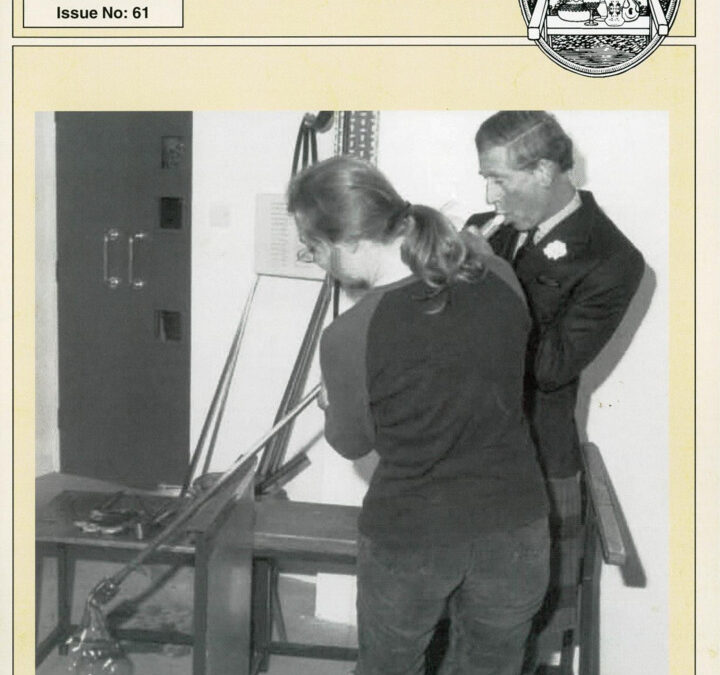
COVER ILLUSTRATION:
On July 4th HRH. Prince Charles visited Lybster
in the Scottish Highlands to inaugurate the new
Alastair Pilkington Studio. He watched Marianne
Buus, one of four artists in residence, making a
wine jug. With her assistance he blew a bubble of
glass himself.
Photograph supplied by Alan Poole, Director of North
Lands Creative Glass, in Lybster.
EDITORIAL
Vallon – who’s going to tell us?
The request for information about the glass manu-
facturer VALLON (Spring issue no.59) has
prompted another inquiry from K Scholes of Bed-
fordshire who has seen at least four similar bowls
all marked with Vallon, decorated with cherry mo-
tifs, but the work reminded him more of Jobling
than Lalique. The bowls are all deep in profile and
he wonders whether they are designed to be (in-
verted) shades for table lamps.
Design Registrations
Jenny Thompson wrote to remind us of a few points.
A Design Registration number would not be known
until the registration had taken place. Only then, prob-
ably after the mould had been used, could the number be
added to the mould, and errors could creep in.
Pressed glass was for the mass market and number-
ing accuracy was not always given top priority.
The Public Record Office could make mistakes, too.
She reminded us of her hunt in the records sparked off by
a photograph from Alan Sedgwick which we reported in
Glass Cone
56 (page 7).
Does everyone know the difference between a De-
sign Registration and a Design Representation? Do you
know how to make a search?
Jenny sent us some guidance from the Public Record
Office which we will feature, along with other comments
from Jenny in our next issue. Thank you, Jenny.
National Meeting and Annual General Meeting
This year’s meeting will be held on Saturday October 26th
in the Manchester Art Gallery, Mosley Street. Manchester.
Richard Gray, then Director of the Manchester Art
Gallery, and Ian Wolfenden, of the then Manchester Poly-
technic, were founding members of the Glass Association.
Many early meetings, especially of the NW region of the
Society, were held under the gaze of the pre-Raphaelite
lovelies in the Gallery. The Gallery closed in 1999 for its
millennial refurbishment and reconstruction, as did many
others. It reopened earlier this year and now incorporates
the adjacent Athenaeum building with an up-to-date lec-
ture theatre on the top floor. The Gallery now contains a
cabinet of Manchester glass and is also displaying the fa-
mous Manchester Goblet, engraved by Wilhelm Pohl and
presented to the Mayor to commemorate the opening of
the Town Hall in 1877. Here’s the provisional programme:
11.00 Meeting opens in the Lecture Theatre, with coffee.
11.30 The Glass Collections at Manchester Art Gallery:
Ruth Shrigley, Principal Curator of Decorative Arts.
12.00 Overview of glass manufacture in Manchester:
Peter Beebe, NW Meetings Organiser
12.30 Recent developments in the history of glass manu-
facture in the Ancoats district of Manchester:
Tom Percival.
1.00 Buffet lunch.
2.00 AGM.
2.30 Members free to view the galleries.
Attendance at the AGM and viewing of the galler-
ies will be free to members. Attendance at the morning
meeting and lunch will cost 17.
The opinions expressed in the
Glass Cone
are
those of the contributors. The editors’ aim is
to cover a range of interests and ideas, which
are not necessarily their own. However, the
decision of the editorial board is final.
COPY DATES
Winter 2002
Early October
Spring 2003
Early January
‘The Glass Cone’ – Issue No 61: Autumn 2002
FORTHCOMING TRIP TO VENICE AND MURANO
In Autumn 2003 the Glass Association is proposing some-
thing really special: a trip to Venice and Murano, places
which have greatly contributed to the history of glass and
its evolution. One only has to visit the Glass Museum in
Murano and the prestigious Salviati glass factory to ap-
preciate both the importance of this rich historical and
artistic heritage and its continuing impact on contempo-
rary glass. The earliest information about glassmaking
activities in Venice dates from 982 AD; the craft then de-
veloped over the centuries to achieve its peak in the 16th
century, the ‘Golden Age’. Decline then followed but glass-
making was revived in the 19th century and reached new
heights in the 20th century.
This 4 day (3 nights) trip will explore some of this
history, visiting museums and gaining access to some pri-
vate collections, studios and workshops not otherwise open
to the public, allowing us to understand how Murano
glassmaking is not only a tradition but how it has retained
its authoritative, international voice. Both tradition and
modernism are combined in Murano and its influence may
be seen in the American Studio glass movement and in
the work of European artists such as Stanislav Libensky
and Jaroslava Brychtova.
The approximate cost of this trip, including air travel
from the UK, transfers, entrance fees, lectures with 3 nights’
accommodation in a 3 star hotel on B&B basis, and 2
dinners will be between £400 and £500. If you are inter-
ested in receiving more details, please contact:
Gaby Marcon, 7 The Avenue, London N3 2LB
or by e-mail: gabymarcon@btinternet.com
Members of the Glass Circle will also be invited to join this
trip, so remembering the great interest of the recent Czech
visit, you would be well advised to register sooner than later!
PRINCE CHARLES AT LYBSTER
On 4 July HRH Prince Charles visited Lybster in the Scot-
tish Highlands to inaugurate the new Alastair Pilkington
Studio of North Lands Creative Glass which over the past
few years has organised a number of glass-making courses
in the summer, on the lines of the world-famous Pilchuck
summer-school in the USA. Inside the building he watched
Marianne Buus, one of the four artists in residence, mak-
ing a wine jug and with her assistance he blew a bubble of
glass himself
(see Front Cover)
before being shown around
the studio space by North Lands Creative Glass chair-
man, lain Gunn, the artistic director, Liz Swinburne and
other directors. He also met local glass artists and viewed
their work, before trying to sign his name on a piece of
sheet glass with a flexidrive. Before leaving he joked about
these newly acquired ‘skills’ in a short impromptu speech
during which he praised the new studio and the initiative
of NLCG in refurbishing an old building giving it a new
life and a centre of excellence in glass.
In 1997 NLCG acquired the 125 year old limestone
school building
(below)
with funds raised by the sale at auc-
tion of Sir Alastair Pillcington’s collection of contemporary
glass, two years after his death in 1995. Lady Pillcington agreed
to sell the collection, adding funds to the proceeds of sale
from a Pilkington Trust. Lady Pilkington, who now lives
near Boston, travelled over to attend the opening ceremony.
Additional funding was obtained from The Scottish Arts
Council, National Lottery Fund, Caithness and Sutherland
Enterprise, The Foundation for Sport and the Arts and vari-
ous other charitable foundations and private individuals.
The new studio is splendidly equipped with excel-
lent modern hot and cold glass facilities which will enable
students and residents to experiment freely with glass. This
year the 2002 International Masterclasses and Conference
sponsored by the Jerwood Charitable Foundation took
place 1-14 September. Three subsidised six-week residen-
cies are planned for the rest of this year, the first of which
is already in place with four artists: two from Holland,
one from Denmark and one from Scotland.
( If any GA member visited the area during the summer, we
would welcome your observations: Eds. )
3
9
9
9
9
‘The Glass Cone’ – Issue No 61: Autumn 2002
JAMES
KEIR
CANDLE VASES
IN BIRMINGHAM
In July 2002 Birmingham Museum and Art Gallery
purchased, from Hotspur Ltd., a pair of late 1 8
th
Cen-
tury, George
III
period ormolu-mounted, opaque glass
`wing-figured’ candle vases by Matthew Boulton (1728
— 1809). This purchase was completed with the help of
the Soho House Appeal Fund, Resource/V&A Purchase
Grant Fund, The National Art Collections Fund and
the Friends of Birmingham Museums & Art Gallery.
These candelabra will be displayed in Soho House,
Handsworth, Boulton’s base of operations from the
early 1760s. Boulton and Fothergill produced many gilt
metal and chased vases in their workshops in the hope
of satisfying the fashionable craze for vases. Most of
the ‘wing-figured’ models were produced with marble
or blue john bodies, both materials being relatively hard-
wearing, and a drawing of the design survives within
the Boulton Pattern Books preserved in Birmingham
Central Library. These models proved popular with
members of the nobility such as the Prince of Wales
and “lords, &c., as have, or pretend to have, taste” (Keir,
J. Letter from James Keir to Matthew Boulton,
1 April
1771). Glass, however, was much more vulnerable than
marble or blue john and thus was rarely used. Other
examples of opaque glass vases are not known to have
survived except for those at Osterley House. Although
the metalwork has benefited from recent conservation
work by Mike Brook, the glass is remarkable for its
virtually perfect state of preservation.
The rare opaque glass bodies are even more sig-
nificant because they were produced by James Keir (1735
— 1820), a partner in a Stourbridge glassworks during
the early 1770s, who was involved in various experiments
involving industrial chemistry. He was a friend of Mat-
thew Boulton, imparting monetary and business advice.
Keir helped Boulton to run his factory during 1779-81,
involved in the production of steam engines. Unfortu-
nately financial disagreements caused the two to split
but at the time these candelabra were produced (c.1772/
3) relations between the two were perfectly amicable. Keir
produced glass bodies to Boulton’s order, surviving let-
ters in the Central Library recording the supply of twelve
pairs in 1772. These vases are extremely important to
the local history of the West Midlands region, as they
provide documented evidence for the Stourbridge glass
industry in the 1770s. Their production demonstrates the
collaboration between two key industrialists, uniting Bir-
mingham metalwork and Stourbridge glass.
Boulton and Keir’s opaque glass, ormolu-
mounted vases will be on display in Soho House from
25 September. Soho is open Tuesday to Saturday, 10:00
until 17:00, Sundays 12.00 until 17:00. For further de-
tails telephone 0121 554 9122.
Glennys Wild (Senior Curator)
4
‘The Glass Cone’ – Issue No 61: Autumn 2002
PAPERWEIGHT NEWS
I hope that readers of the Glass Cone found the first fea-
ture with news and comment on the world of paperweights
of interest. For this second feature there is news of a new
name to be added to the list of Scottish paperweight mak-
ers, some departures from existing makers and more in-
formation on the Cambridge Paperweight Circle 21st
Anniversary Exhibition at the National Exhibition Cen-
tre later this year.
At the June meeting of the Cambridge Paperweight
Circle, Willie and Joyce Manson announced the formation of
a new paperweight company called Phoenix Paperweights
employing the talents of three ex-Perthshire craftsmen. The
weights will feature both millefiori and lampwork designs with
a
PP signature cane and be available in both facetted and un-
cut versions. The price range is expected to be around £80 to
£120 depending on the design and cutting. Twelve master sam-
ples were available for inspection at the meeting and the gen-
eral response from members was very favourable with many
members including myself ordering weights to add to their
collections. The weights showed definite signs of their Perthshire
heritage and everyone present was pleased to hear that some-
thing of the Perthshire legacy will be continued. The weights
will be distributed through the normal Manson network of
stockists and photos of the first weights can be seen on the
Manson website (wwwwilliammanson co.uk)
With regard to the current activities of Peter
MacDougal, I haven’t seen any official announcement on
the establishment of his new paperweight studio but I
understand that some examples of the latest creations from
the ex-Perthshire master craftsman can be seen on the
Stone Gallery website (www.stonegallery.co.uk)
News from Caithness Glass is that master glassmaker
Franco Toffolo who joined the company in 1981 put down
his tools and retired at the end of June. Anyone who has
visited the Perth Visitor Centre will probably have seen the
master at work making all sorts of objects in glass and
some of the finest creations from Caithness have come from
his hands. Also chief designer Colin Terris has taken semi-
retirement and at the beginning of 2002 launched his final
range of paperweights re-interpreting some of his favour-
ite designs produced during his 34 years with the company.
His vast knowledge of all things paperweight related will,
however, not be totally lost to collectors as he plans to con-
tinue to support the remainder of the design team and be
present at major promotions.
Rumours that Peter Holmes parted company with
paperweight makers Selkirk Glass at the end of June have
been confirmed. Peter Holmes and Willie Manson were
the two apprentices at the Caithness factory in Wick to be
trained by the great Paul Ysart. Whether there are any
plans for future paperweight activity is currently not
known. In the early days of Selkirk production some very
good millefiori and lampwork weights were produced by
Peter Holmes with a PH signature cane and the style re-
flected the Ysart training, but in later years such weights
have been few and far between as production concentrated
mainly on abstract designs.
Mentioning Wick reminds me of my first encoun-
ter with Willie Manson on a visit to the Wick factory in
1977 when he was working on the very first Collectors
Club weight (Christmas candle). The shops were full of
early Caithness weights like the sets of Four Seasons and
Paul Ysart weights signed with the H cane. What a pity
I
didn’t buy more at the time!
Having been asked to provide some weights for the
Cambridge Paperweight Circle 21st Anniversary Exhibition,
I know that planning of the various displays is progressing
well. From the discussions so far it would seem that the 1000
weight display really will cover all aspects of the production
of paperweights and paperweight related objects over the
170 years of their existence. As well as Thursday 28
th
, Friday
29th and Saturday 30th November, previously mentioned,
the exhibition will also be open on Sunday 1st December.
My understanding is that the hours of opening will be the
same as the LAPADA antiques fair which are from 11.00am
to 8.00pm on the first three days and 11.00am to 6.00pm on
Sunday. I will he helping with stewardship duties on the Thurs-
day and Sunday, so, if any Glass Association members are
planning to attend on either of those days, do come and
introduce yourselves. Don’t miss it! It’s unlikely that a paper-
weight exhibition of this magnitude will be staged again in
this country for a long while – if at all.
Richard M Giles
Telephone: 01242 515505
PUZZLE
CORNER
Does this creamer in light blue pressed glass belong to the
Davidson Blue Pearline? I saw it in Chester earlier in the
year and immediately thought it was; but then I realised it
had no mark, which is unusual for Davidson except on its
earliest pieces which are unrepresentative of the later fam-
ily of designs. The foot is typical Davidson, with the radial
grooves underneath; and its basic shape and plain handle
were similar to other Davidson pedestal creamers. And of
course the colouring closely matched other Pearline pieces.
In all there are three well-known Davidson patterns
with similar
features: Reg. no. 176566 of
15 August 1891,
`Daisies’ with plain parallel ribs; Reg.
no. 413701 of 14 July
1903, ‘Hearts’ with split triangles with beaded edges but no
daisies; and Reg. no.
514848 of
1
Nov. 1909 with daisies
and split vertical triangles, but without beaded edges.
I wonder whether this is one of four design regis-
trations not illustrated
but
listed in Jenny Thompson’s
The
Identification of English Pressed Glass:
123198 of 10 April
1889, 436804 of 12
July 1904, 486298 of 1 September
1906 or 512560 of 25 Sept. 1907. I have since seen an 8″
plate and an oval dish, both of flint glass with the same
patterning but neither is marked. Can anyone throw fur-
ther
light on
this,
please?
Peter Beebe
5
The Glass Cone’ – Issue No 61: Autumn 2002
GLASS AT THE AUCTIONS
LOW PRICES AT CAPES DUNN, MANCHESTER
The second sale of the Clive Bartlett collection of pressed
glass took place on 11 June this year (see
Glass Cone
issue
60 for a report of the first sale) at Capes Dunn, Manches-
ter. Admittedly this sale did not contain as many interest-
ing items as in the first sale, although there were exceptions.
Following the order of the first Bartlett sale, the first lots
offered were Carnival glass, usually consisting of more
than one piece. Most lots reached their estimates, but that
was scarcely surprising as these had often been set unreal-
istically low. Only five lots exceeded £50 (all hammer prices)
with two containing unusual items reaching £85.
The eight lots of American Depression glass lived
up to their name and went for give-away prices. The star
item listed as ‘Art Deco Depression Electric lamp’ was in
fact a Davidson lamp, reg. no. 804952 of 31 July 1935, an
item rarely seen. This was light blue in colour and still
possessed its original bulb, interestingly shaped. The esti-
mate was £30-50 but it went for £200.
Sixty-four lots of mainly late 19th century clear flint
glass mainly from the North East of England factories,
mostly marked, and with a few bearing registrations of
merchants and importers, went for very low prices with the
highest bids for each of eight celeries fetching only £60 or
£70. A lot of three boats, included one by Edward Boltom
of Warrington with its stand built up from glass rods (for
similar piece, see
Cone
issue 27, Autumn 1990), only reached
£55. A not untypical lot of twelve oval bowls raised a mere
£8 even though all but one were marked; and that one, on
later inspection, proved to be a Baccarat piece.
A single lot of eleven Pressed Commemoratives from
the Victorian era was a snip at £38. Most were reasonably
well-known shapes but the lot did include a rare dish depict-
ing the Forth Rail Bridge, circa 1887, which was not even
illustrated in the sales catalogue. In the same lot there was an
advertising plate for Stonework (a German manufacturer?)
which appeared to feature major European exhibitions.
The remaining ninety-nine lots featured mainly 19th
and early 20th century coloured glass, with few surprises.
However, there was a blue crescent in the Sowerby nurs-
ery series (£70) and two green Sowerby wickerwork dishes,
and a blue Davidson Dolphin candlestick (£65). Two
Davidson opaque dishes went for £60 and an attractive
three-piece table centre depicting Peter Pan and Wendy, in
frosted green with a chip, was purchased for £55. As in
the first sale of the Clive Bartlett collection, only the few
Davidson Primrose Pearline and the better Uranium col-
oured glass pieces saw realistic prices. A disappointing day
for the vendor but some bargains for those with eagle eyes.
Peter Beebe
On the whole the auction scene is quiet over the summer
months. We noted one or two items of interest.
Bonhams Leeds sale of 6 August included a Wiener
Werkstate green glass lidded bonbonniere, designed by
Josef Hoffman, by Meyr’s Neffe, Adolf and Oertel, the
faceted body with domed cover and faceted finial, etched
WW mark. 18 cm high. Four variant colours of this
bonbonniere (design number AL614) were produced: vio-
let, blue, green and yellow. Except for the violet colour,
production appears to have been limited to 1917-19. Esti-
mated at £200-300, it sold for £800.
On 12 September at their Aesthetic Movement and
Nineteenth Century Design sale, Christie’s, South Ken-
sington, offered an etched and cut glass pitcher attributed
to Stourbridge, etched with a design of water weed and
bull rushes with two may-fly, the base star cut and 9.5in
high. Estimated at £500-700, the bidding reached £380,
below the reserve.
6
Left: The Davidson lamp and bulb, carrying the registered mark no. 504952 of 31
July 1935. Photograph by Peter Beebe
Centre: The etched and cut glass pitcher attributed to Stourbridge . Photograph by Bonhams.
Right: The Wiener Werksteitte green glass lidded bonbonniere. Photograph by Christie’s
‘The Glass Cone’ – Issue No 61: Autumn 2002
BOOK REVIEWS
News of a new publication of major interest to those inter-
ested in post-medieval glass found in archaeological exca-
vations throughout England. Funded by English Heritage,
EARLY POST-MEDIEVAL VESSEL GLASS IN ENG-
LAND by Hugh Willmott, the first recipient of the Glass
Association Travel Bursary, provides coverage of the vessel
forms and individual types and summarises current infor-
mation on the production and importation of such vessels.
Price £30, ISBN 1 902771 29 X, publ. Council for British
Archaeology, available from York Publishing services Ltd., 64 Hallfeid Road, Layerthorpe, York Y031 7ZQ, fax 01904
430868; e-mail:
Keep an eye out for a remaindered publication:
L’ENCYCLOPEDIE DIDEROT ET D’ALEMBERT,
RECUEIL DE PLANCHES, ART DU VERRE – FAB-
RICATION DES GLACES, published by Bibliotheque
de l’Image, 2002 (no ISBN number). This famous series
of glass making prints, dating from the third quarter of
the 18th century, is an invaluable record of making tech-
niques, and furnace construction, This French reprint con-
tains 116 plates, virtually full-size with their original
explanations, including the section of Lunettier (lens mak-
ing) which is not mentioned in Duncan’s bibliography,
where the entry is, to say the least, confusing.
The 2000 edition of the JOURNAL OF STAINED
GLASS volume XXIV, edited by Sandra Coley, is avail-
able from the British Society of Master Glass Painters, 6
Queen Square, London WC1N 3AR, price £17 (UK) or
£20 (overseas) including p&p. The 200 pages and 72 illus-
trations, mainly colour, include articles relating to late 19th
century artists, recent research into medieval stained glass,
new work by contemporary artists and detailed reviews
of recent publications. Details on www.bsmgp.org.uk
We review below two new books from Schiffer Publishing
Company, both by members of the Glass Association,
both distributed in Europe (post-free in UK) by Bushwood
Books Ltd, 6 Marksbury Avenue, Kew Gardens, Surrey
TW9 4JF; tel 0208 392 8585; email bushwd@aol.com.
THE BIG BOOK OF VASELINE GLASS, by Barrie W
Skelcher, MSc CChem, Schiffer Publishing Company, dis-
tributed in Europe by Bushwood Books Ltd ISBN: 0-
7643-1474-2, 208 pp. £34.95.
The title of this book is a misnomer: it actually describes
all types of decorative uranium-containing glasses, some
of which have colours quite different from the yellow-green
colour of vaseline. The book is essentially an extended
version of the paper which the author published in
The
Journal of the Glass Association
last year (2001, 6, 38-47).
There are three parts. The first summarises prob-
ably all that is known about the use of uranium in glass,
and includes details of the author’s researches into the
radioactivity, density, and UV fluorescence of these glasses.
This is a unique and important contribution to glass stud-
ies. The second describes the activities and uranium-con-
taining products of about seventeen English glasshouses
and a few American and continental ones. The third is a
miscellany of curiosities. The quality of many of the col-
oured illustrations is disappointing – they appear in soft
focus which hides much detail.
Several other books have been published on vaseline
glass in the past few years: I hope to compare them all in
a future issue of
The Glass Cone.
Alan E. Comyns
VICTORIAN DECORATIVE GLASS by Mervyn Gulliver.
Schiffer Publishing Company, distributed in Europe by
Bushwood Books Ltd, ISBN 0-7643-1597-8, hardback £59.95,
288 pp., 850 colour photographs plus many b/w illus.
Mervyn Gulliver describes his book as part of a major
project to record designs for hand formed glass designed
for general domestic markets. His emphasis is on deco-
rated and coloured glass from British manufacturers, but
he includes some items from Europe and the USA.
Chapter 1 illustrates the components of glass items
– rims, bodies, feet – and explains in technical detail the
designs, tools and techniques used to form them. The next
three chapters illustrate the finished items: 160 pages with
about four colour plates to the page. The final chapter
contains 30 pages of clear sketch illustrations of all the
Registered Designs for glassware recorded between 1850
and 1914 by seven major British glass manufacturers:
Richardsons, Stevens & Williams, Stuart & Sons, Tho-
mas Webb & Sons, Boulton & Mills, Burtles-Tate, and
John Walsh Walsh. A real treasure trove of information.
The photographs are good, making the whole book a
feast of colour. The pieces are fully described, including esti-
mated dates, dimensions, markings and the author’s price
estimates. The author gives attributions for some items, but
only
where relative confidence can be derived from surviving
documents such as Registered Design records, pattern books
and period publications. This is rigorous and prudent, but
sometimes disappointing – many readers will be ready to go
much further in attribution of some unattributed pieces.
The title of the book, of course, attracts comparison
with Cyril Manley’s
Decorative Victorian Glass.
Gulliver’s
pictures are bigger and clearer, and they will turn this, like
Manley, into a standard reference work for collectors. I miss
Manley’s readiness to make judgmental attributions and
to give his reasons
(see below*).
I hope Mervyn Gulliver
will go further with attribution in the future, perhaps in a
supplement – he clearly knows his material well enough to
do so. An index would be useful, too.
If you’re interested in Victorian glass, there’s some-
thing to recognise and to catch your eye on every page.
Many readers will hesitate before spending nearly £60.
But this is a book loaded with fine pictures and informa-
tive material and its coverage is broad enough to help every
collector of Victorian glass. It will become indispensable.
Brian Currie
[*Certainly Manley was sometimes wrong but that’s part of his
value! He stimulated thought, research and debate Academic
methodology urges us to stick to hard evidence But perhaps
there never will be enough evidence in the glass field Judgment
and experience may always play the largest part in making at-
tributions. Should we encourage authors to share their opinions
with us, as well as the facts? Or is the danger of misleading too
great? What do readers think? Let us know Eds
7
The Glass Cone’ – Issue No 61: Autumn 2002
EXHIBITIONS, FAIRS & SEMINARS
Over recent years the annual exhibition of work in Lon-
don by members of the Guild of Glass Engravers has
received growing critical acclaim featuring new work by
established artists and up-and-coming newcomers. This
year’s exhibition CLEARLY INSPIRED 2002 will be held
at Gallery 27, at 27 Cork Street, London W1X 1HB from
23 October-1 November 2002. Contact the Secretary of
the Guild of Glass Engravers, 87 Nether St, London N12
7NP; tel/fax 020 8446 4050; email: enquiries@gge.org. uk.
The Friends of Broadfield House Glass Museum are run-
ning a series of illustrated lectures this autumn to accom-
pany the scheduled exhibitions. On 17 October there will be
a talk on AMEN GLASSES, and on 31 October another
called MEMBERS’ INTERCHANGE. The WORK OF
THE SCHOLARSHIP STUDIO will be discussed on 14
November while the last of the series on 28 November will
look at AVON NOVELTY CONTAINERS. Details from
Chris Perry, 18 Adelaide Street, Brierley Hill, West Midlands.
The World of Glass Centre at St. Helens, North-west
England, opened at the beginning of August the exhibi-
tion of WALLON GLASS, previously displayed in Paris,
Munich and Tokyo. The exhibition includes examples of
glass vessels made in the French-speaking area of Bel-
gium from the 19th century. Admission £5 or £3.60 for
children, open daily from 10.00-17.00, closed Mondays.
Visiting Exmouth in Devon in November? Then try to
organise your visit to include the HYSON GLASS FAIR
on 23 November, in the Pavilion on the Sea Front, from
10.00-16.00.
The Association for the History of Glass has arranged a
one-day conference concerning the LONDON ARCHWE
GLASS COLLECTION on 20 November at the Museum
of London’s recently opened London Archaeological Ar-
chive & Research Centre at Eagle Wharf Road. The collec-
tion covers glass supply in the capital from c. 1400 to 1900
and the day will include a tour of the new facility and discus-
sions of unusual 17th century assemblages (possibly the prop-
erty of privateers and sea-captains) and earlier imported glass
vessels. Details from John Shepherd, Mortimer Wheeler
House, 46 Eagle Wharf Road, London N1 7ED;
please en-
close sae
or by e-mail: jshepherd@museumoflondon.org.uk
The last AHG study day at the Wallace Collection, London
Wl. attracted over 120 people, both members and non-mem-
bers, so early booking is advised.
Those Glass Association members living in and around
the Cambridge region and wondering what is happening
with the FITZWILLIAM MUSEUM GLASS COL-
LECTION now that the rebuilding programme is
underway might be interested in the lecture scheduled for
17 December at the Art Workers’ Guild, Queen Anne
Square, London WC1. The Director of the Fitzwilliam
Museum, Professor Duncan Robinson, has accepted an
invitation from the Glass Circle to speak. Details from
Mrs Marianne Scheer, the Hon Secretary, Glass Circle,
66 Corringham Road, London NVV11 7BX; there will be
a small charge for non-members of the Circle.
A CALL FOR PAPERS from the International Associa-
tion for the History of Glass for its 16th Congress to be
held in London at the Imperial College of Science and
Technology, near the V&A Museum, 8-13 September
2003. This event, last held in the UK in 1979, usually at-
tracts over 250 delegates from over 30 countries present-
ing the latest research into the history of glass. Abstracts,
no more than 200 words in length, to be received by 31
October. As is custom and practice the papers and pres-
entations given at the Congress will be published in the
Annales
in due course. Details from Dr Hilary Cool, 16
Lady Bay Road, West Bridgford, Nottingham NG2 5HN
and on the website: www.historyofglass.org.uk
The Autumn NATIONAL GLASS FAIR, organised by
Patricia Hier, is scheduled for 10 November from 9.30 am
to 3.30 pm at the National Motorcycle Museum, West
Midlands, M42 Junction 6 (A45). Details from: 01260
271975 (e-mail: dil.hier@talk21.com).
NEW MEMBERS
A very warm welcome to the following new mem-
bers who have joined the Glass Association since the
last issue of the
Glass Cone:
Mr F Andrews
Netherlands
Mr I Bamforth
West Midlands
Mr V Bamforth
West Midlands
Mr S Booker
Salop
Ms D Connell
Glasgow
Ms Y D’Inverno
London
Mrs K Dodgson
Cheshire
Mr A J Poole
London
Mrs J Roberts
Cornwall
Mr A Tavroges
Tyne & Wear
Ms L A Thomas
Bucks
Mr & Mrs B Walters
Surrey
Mr M D Williams
West Midlands
The Glass Association is a charity with a number of
worthy causes. Do help to support our work by adding
a donation to your subscription. Donations towards yet
further improvements to our publications,
The Glass
Cone
and
The Journal,
are especially welcome.
GLASS ASSOCIATION REGIONS
NE Region
Jane Sinclair has taken over as regional organiser. She de-
scribes herself as a keen collector, with a special interest in
20th Century British and Scandinavian glass. In addition,
with the National Glass Centre in the region she is keen to
learn more about contemporary glass making and to enrol
in one of their practical workshops to create her own work.
She is in the process of organising events, but would
be delighted to have suggestions, including offers to see
private collections. Please contact her on 07950 713866
(mobile) or email: jane.sinclair3@virgin.net