




Winter 2002
Issue No: 62
Early February
Early May
Issue No: 62 Winter 2002
The Magazine of
The Glass Association
Registered as a Charity No. 326602
Chairman
Charles Hajdamach
Hon. Secretary
Geoff Timberlake (Geoffctim@btinternet.com)
Editorial Board
Patricia Baker, Ken Cannell, Brian Currie,
Roy Kingsbury
Address for Glass Cone correspondence
Dr P Baker, 2 Usborne Mews, Carroun Road, London
SW8 1LR (or email to Brian Currie: brian@currie.co.uk)
Address for membership enquiries
John Greenham, Membership Secretary,
1 White Knobs Way, Caterham, Surrey CR3
6RH
(john@jgreenham.freeserve.co.uk)
Web site: www.glassassociation.org.uk
ISSN No. 0265 9654
Printed by
The Charleswo th Group
Published by
The Society of Glass Technology for
The Glass Association
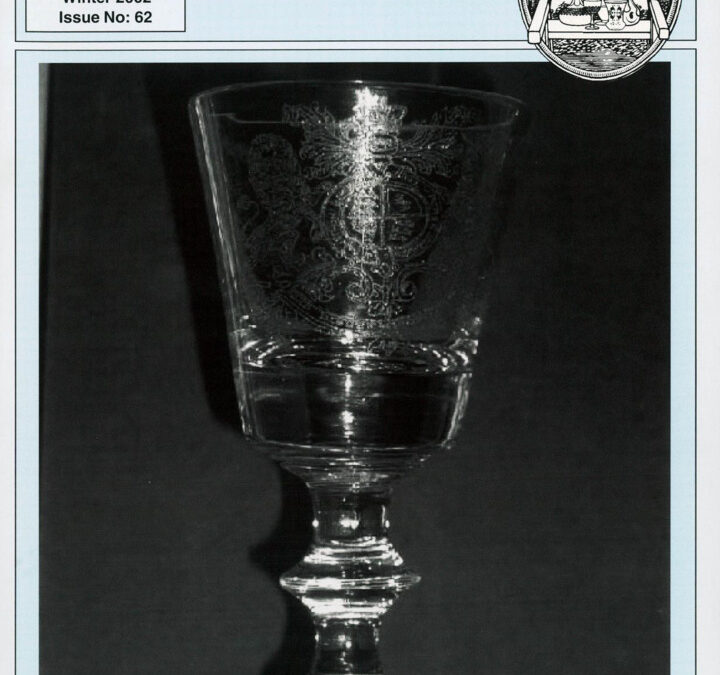
COVER ILLUSTRATION:
A wine glass engraved by T Sutherland, dated 1864, the
bucket bowl with a solid base, fully engraved with a dia-
mond point with the royal coat of arms, signed ‘Suther-
land Engraver’, the royal steam yacht and the Prince of
Wales feathers above the beehive emblem, below the royal
steam yacht a love poem, signed ‘Thomas 1864’, the bowl
set on a stem with a central bladed knop, the foot en-
graved with simple flower sprays, 11.3cm. Photograph
by courtesy of Bonhams. See page 9.
EDITORIAL
A Vallon Look-alike?
The interest of member John Greaves has been aroused
by the query regarding the Vallon (light?) bowls men-
tioned in the last issue because in the past he too has
come across two similar pieces. He wonders whether
there is a connection (either by commercial contract or
as a result of design piracy) between Vallon and an-
other company or design named ‘BEAL’. He has seen
a clear bowl, slightly frosted, and about 17cm diam-
eter, 2.5cm deep, with a pressed moulded decoration
on the underside, of three eight- or nine-petalled flower
heads, whose stamen centres each form one of the bowl’s
three feet. Is any member able to help with information
about this designer, or company ?
Family Ties with Lorraine
GA members who ventured on the Lorraine trip in
1995 will undoubtedly remember the visit to the Cha-
teau de Lichecourt in the Forest of Darney, site of
an ancient glasshouse, owned by M. and Mme Jean-
Alain Labat. (Unfortunately M. Georges, the mar-
vellous guide around the estate, has since died.) M.
Labat is keen to make contact with anyone research-
ing in the history of glass-production undertaken by
the Lorraine immigrant families working in England,
notably the Hennezels, Thierry, Thysacs, Bigault and
Massey. Any references to published works would
also be welcomed. He may be contacted through the
Chateau de Lichecourt, 88260 Relanges, France, or
by e-mail: jalichecourt@hotmail.com
Sad Losses
Sadly we have to report three deaths: Samuel
Thompson, Reginald Pierce and Tom Percival. We
remember each of them on page 5.
Small earthquake …
On September 23 an earthquake (4.8 on the Richter
scale) was felt in Dudley, West Midlands and we are
sure it was not only the
Cone
Editors who wondered if
the glass at Broadfield, Himley Hall and the Red House
had been reduced to mere cullet, given that the epicen-
tre was about a mile from Himley and about 2 miles
from Kingswinford. Fortunately no such damage has
been reported although the newsletter of the Friends
of Broadfield House reports some buildings were af-
fected in Walsall, some miles from the epicentre.
… but no movement on the market
The Stourbridge Express & Star
of 12 November re-
ported that local historians and council officers have
been in talks with Waterford Wedgwood about the site
formerly occupied by Stuart Crystal. The site has been
on the market for some months for £1.5 million but
seemingly little interest has been aroused. The new idea
is to transform this site into yet another heritage site in
the locality and English Heritage is said to be keen on
preserving the underground tunnel which links the ca-
nal and the remains of the 18th century White House
Cone.
(Thanks to
John Sanders for
picking up news reports for us. )
The opinions expressed in the
Glass Cone
are
those of the contributors. The editors’ aim is
to cover a range of interests and ideas, which
are not necessarily their own. However, the
decision of the editorial board is final.
COPY DATES
Spring 2003
Summer 2003
The Glass Cone’ – Issue No 62: Winter 2002
THE 2002 ANNUAL GENERAL MEETING
9
9
Some 50 Glass Association members attended the recent AGM
at Manchester. In the morning, prior to the AGM, Ruth
Shrigley, the Principal Curator of Decorative Arts, gave us an
introduction to the glass collections of the Manchester Art
Gallery, well illustrated with slides. Peter Beebe followed with
an overview of glass manufacture in Manchester, and contin-
ued with an account of the history and manufacturing loca-
tions of the Ancoats district. He kindly took over this task
following the death of Tom Percival, who was to have told us
about the area and Percival Vickers. Peter used Tom’s slides
and notes as well as his own great knowledge of the subject.
Over the lunch break members took the opportu-
nity to see the newly refurbished galleries at the museum.
Much to see in fine settings, and we all needed longer –
we’ll be back, Manchester!
We started the AGM with a minute’s silence in
memory of Tom Percival. Charles Hajdamach, Chairman
of the Association, then spoke about the major meetings
organised for the members during the year ended July 2002
both at home and abroad.
The trip to the Czech Republic had proved very suc-
cessful and the overwhelming response from both Associa-
tion and Glass Circle members had encouraged the committee
to investigate the possibility of another European trip, this
time to Venice. The national meetings at the newly-opened
Red House Glass Cone, to Pontefract, and then to West Sus-
sex in collaboration with the Guild of Glass Engravers ran
smoothly thanks to the various organisers, and there had
been a welcome revival of meetings in the regions. Charles
thanked all the regional organisers for their enthusiasm and
hard work, especially mentioning the newly elected organis-
ers, Janet Sergison, Jane Sinclair and Ian Turner for the South
East, North East and the Midlands respectively.
Two other significant projects had been completed:
the
Journal
under the editorship of Roger Dodsworth and
the Association’s website by Geoff Timberlake; to date
there have been over 2,200 ‘hits’.
Brian Currie, the Hon. Treasurer, gave the meeting his
report. The major expense this past financial year had been
the production costs of
the Journal
but reserves had been made
and in the event the cost, just under £8,100, was slightly less
than anticipated. Savings had again been made in the produc-
tion costs of the
Cone,
but the next year would see increases in
postage charges. Returns from events and meetings showed a
small profit, but the committee was always keen to keep charges
to members as low as possible in order to attract attendance.
Investment income was holding fairly steady, and the level of
donations to the Association had increased slightly but he urged
members to increase their giving. He wanted to see donations
reach and exceed the level of subscriptions. As he said ‘There
are many more things we ought to do to extend our work’.
There followed a discussion about our future fund-
ing.
Because the debate had to be cut short,
Brian Currie
agreed to set out in the following note some of the issues
discussed and his views:
9
Financial policies for the Glass Association
As you will all know, my view (and the committee’s present
9
membership. We should have a wide membership and then
policy) is that we should keep subscriptions low, to encourage
encourage all our members who can afford it to add generous
donations to their subscriptions to support our charitable pur-
poses. My slogan is “low subscriptions; high donations!”.
Our charity purposes are summed up in our rules: to
advance the education of the public regarding: the history and
appreciation of glass; the practice of the craft of glassmaking
and the study and collection of glass. The rules say that only
those who subscribe to these purposes can become members.
So we should all support them financially if we can.
Our aim is thus the common charitable purpose – the
advancement of knowledge and understanding. We fulfil
that aim in many ways. We have provided grants for re-
search; we sponsor lectures; we run a website; and above all
we produce publications. These are chiefly
The Journal
and
The Glass Cone.
We have researched and produced other
publications in the past and the committee are keen to see
more in the future, particularly helping to preserve and make
more widely available the historic records of our famous
glassmakers. These are charitable activities, not services to
our membership, and that’s why we are a charity Although
immense amounts of volunteer effort, in research and in
the sharing of knowledge, are the vital part of this work,
we also need more funds to cover the unavoidable costs of
the work and its eventual publication in attractive form.
Donations income rose to £432 in the year ended
31 July 2002 (as against £165 in the previous year). In the
current year they have already reached £681 – this includes
£405 of gifts in memory of Tom Percival at the very kind
suggestion of Edwina and Tom Percival’s family.
We had an interesting discussion at the AGM about
subscriptions. Some members believed we ought to raise them.
Our funds and income have been broadly adequate to
carry on our activities at their present levels – although our
aim is always to do more towards our charitable purposes.
But some members felt that if we failed to move sub-
scriptions up in line with inflation, our present activities them-
selves would eventually be threatened. If inflation continued
and donations failed to rise, of course, they would be right.
But, as
I
told the meeting, I have worked with other charities
of a similar nature where donations grew and eventually far
exceeded subscriptions. That’s the mark of members who
really do believe in their charity’s work.
The Powers Of Our General Meetings
One interesting question was raised. Why doesn’t the AGM
just revise the subscriptions – as the rules appear to per-
mit? We took an informal straw poll at the meeting, and it
turned out in fact that two thirds of those present were
content with the present subscription policy.
But the question was raised and we ought to
consider what the position is under our constitution.
Under the Charities Act the charity trustees (ie the
committee) are responsible for controlling the manage-
ment and administration of the charity. They are required
to set policies for fund-raising and a number of other fi-
nancial matters of which subscriptions are a part. Nor-
mally therefore one would expect the motions at a general
meeting to be initiated by the trustees.
Our rules give the members in general meetings the power
to decide the amount of the annual subscription. In a small
(continued on next page)
‘The Glass Cone’ – Issue No 62: Winter 2002
4
(Note by Hon Treasurer – continued)
charity, where all or most members could be expected to get to
the AGM, it might be reasonable for the AGM to broach,
discuss and decide the level of subscriptions on the day.
But in an Association such as ours, where only 50 or
so out of 500 members attend meetings, we ought to see
this rule primarily as a protection for members – to ensure
that the committee cannot arbitrarily increase subscriptions
without the support of the members. Since a resolution to
change subscriptions would affect the rights of all mem-
bers, the committee would be very reluctant to propose
or
admit
a resolution about subscriptions without at least giv-
ing notice to all members and canvassing their views.
So if a number of our members did want to use the
AGM to raise subscriptions, what should they do?
Some of the powers reserved to members require notice
of motion. Some don’t. We need amendments to the constitu-
tion specifying the period of notice required for all such mo-
tions The period should obviously be sufficient to enable the
Hon Secretary to include the motions in the AGM notices.
We also need to consider how the bulk of the mem-
bership, those unable to attend the meeting, should be
able to provide their input. Perhaps through consultation,
if the period of notice is long enough. Or should mem-
bers be able to send written votes on specified motions?
I hope we can avoid undue formality – it’s costly to
print and pack a circular to members, and it costs about
£150 to post it. We need to
provide
for formality in case
it’s needed, but should aim to keep things informal if we
can. My suggestion will be that we propose amendments
to our constitution to set out formally the notice required
for motions at our general meetings. We should also con-
sider whether members who can’t get to the AGM should
be able to send in written or proxy votes.
But if any member does have a motion he or she
would like to see presented to an AGM, I suggest using
the columns of the
Glass Cone
to air the idea with mem-
bers This will give the committee a feeling for members’
views. If a consensus seems to emerge, the committee will
be happy to take that on board and prepare the appropri-
ate motion.
It sounds as though some changes will be needed We will
welcome members’ views for inclusion in future issues. Eds.
GUILD OF GLASS ENGRAVERS EXHIBITION
The Guild of Glass Engravers mounted an exhibition of
its members’ work, entitled
Clearly Inspired 2002
at Gal-
lery 27 on Cork Street, London W1, from 23 October to
1 November 2002.
Whether one was buying or just viewing, the exhibi-
tion provided a real feast of glass decorated by a variety of
techniques including engraving (copper wheel. diamond point
and flexible drive), sandblasting, acid etching and
grad
In all, there were 150 exhibits entered by 51 artists,
amongst them such celebrated exponents of the art as
Simon Whistler and guest artists Ronald Pennell and
Steven Newell. Most of the exhibits were British in ori-
gin, while France, Japan and the USA were represented.
Most pieces were available for purchase, with prices rang-
ing from just over £100 to £4000.
Presentation of the work was excellent, spread over
two floors of the gallery with most exhibits in glass cabi-
nets with good lighting. The Guild members in attend-
ance were extremely helpful to visitors.
To choose a single very striking exhibit, one case
contained 5 goblets all beautifully and intricately deco-
rated with diamond point stipple engravings of religious
scenes, which, when viewed against the black background,
produced the most remarkable three dimensional effects
The overall effect was quite mesmerising. These were all
the work of James Denison-Pender.
It is very encouraging to know that we have artists
working today capable of producing work which is so in-
spired and executed with great skill.
Katherine Coleman, on behalf of the Guild, said
that they were pleased to see many members of the Glass
Association and the Glass Circle at the exhibition. More
than 25% of the exhibits were sold. For those who missed
the event, the Guild plans to hold another smaller exhibi-
tion in the autumn of 2003.
Ron
Havenhand
SCOTTISH INDUSTRIAL EXHIBITIONS
While researching aspects of the glass industry in Scotland,
Diana Connell
has come across some intriguing references
to glass items which were publicly exhibited. Have any of
these items survived?
At the 1865 Glasgow Industrial Exhibition in the
Trongate, a lady’s workbox (item no. 134) was shown, con-
structed from 5,000 glass pieces. It was the work of William
Smart of 89 Glebe Street, Glasgow. Also exhibited was an-
other of his creations, a glass bird-cage made up of 1,700 pieces.
There was obviously a vogue for these items, for another three
exhibitors showed lady’s workboxes. Items 141 and 147 were
inlaid with glass, the products respectively of Thomas Grainger,
a glass cutter who lived at 93 Parliamentary Road, and John
Cochrane, also a glass cutter working at nearby 42 McAsline
Street, while another was made and inlaid with about 4,000
glass pieces by Robert Gray, flint glass maker of 40 Albert
Street. All lived and worked in the city.
Perhaps the most interesting glass work was pro-
duced by a glass stainer, John Stewart of 29 Turner’s Court
of the same city. His exhibit (item 202) was an ornamen-
tal glass table top decorated with portraits of eminent
`Scotchmen’ such as Watt, Wilkie, Burns and Scott, with
the centre showing a view of Lochleven Castle.
In 1876 when the new Glasgow Industrial Museum
opened, a report detailing all the acquisitions and donations
was compiled. From it we learn that a Mr. A Jenkinson of
10 Prince’s Street, Edinburgh, presented to the museum twelve
specimens of new art glass. Geddes & Co, Glasgow, donated
nine items to show bottle-making, including a model bottle
furnace and the Clyde Bottle Co. made a similar donation.
By the 1890s many Bohemian glass workers were
employed in Scotland. Anthony Keller of Gayfield Street,
Glasgow, was one, exhibiting two engraved glass goblets,
decanters and tankards (item 1096) at one of the East
End Industrial Exhibitions, while another, Martin Herman
of Braid Street, exhibited an engraved glass water set and
teapot (item 1009).
GLASS MUSEUM TO BE BUILT IN OHIO
At the September exhibition NEXT at the Venice Biennale,
curated by Deyan Sudjic, architectural critic of
The Ob-
server,
a section displayed plans and designs for the up-
and-coming generation of new museums which included
those for the Glass Museum to be built in Toledo, Ohio,
USA, the work of Kazuyo Sejima and Ryue Nishizawa.
‘The Glass Cone’ – Issue No 62: Winter 2002
WE REMEMBER …
Tom Percival
It is with great sadness that we have to inform members
of the passing of Tom Percival from a heart attack on
September 14 at the age of 80. Tom was well known to
many of us and will be greatly missed. He was very active
not only physically but in the fields of collecting and re-
search. Certainly he enjoyed life to the full. Tom has been
described as an interesting man, a gentleman and one who
had ‘a presence’ – all very true.
Tom Percival showing us a recently acquired, acid
etched, Percival Vickers wine. We were on the bank
of the canal at our meeting in October 2001 at the
Red House Cone. (Photo by Dil Hier).
Tom said he could remember, as a young lad, glass
objects within his parents’ home but did not realise their sig-
nificance and indeed wondered later what had happened to
the pieces. About 20 years ago he went to an Antiques Fair
and ‘was faced with two pieces of glass with his family’s name
on, bought them and life was never the same again’. He was
soon involved in tracing the family tree and its involvement
in the Manchester glass industry (see the GA
Journal,
vol.3,
p.37). He discovered that his great-grandfather, also Thomas
Percival, had been manager of Molyneaux Webb & Co. be-
fore setting up the Jersey Street works of Percival & Yates in
1844 (later known as Percival Vickers).
This interest led to him building up an impressive
collection of Percival Vickers glass which later included
special pieces from other Manchester factories. He was
very proud of his roots and personally
I
shall never forget
his excitement whenever he found something unusual, the
last Percival Vickers item being a superb cut claret jug
with plated mounts by Mappin & Webb.
The Ancoats district of Manchester (a late 17
th
/early
1 8
th
century industrial estate) is being developed as a her-
itage site. Tom was instrumental in alerting the authori-
ties to the significance of the glass industry in the area,
with the result that part of the old Percival Vickers site is
earmarked for a future archaeological dig.
We extend our deepest sympathy to his wife, Edwina,
and his two daughters, Lindsey and Ruth. Edwina and Tom’s
family has asked that anyone wishing to mark his passing
should send a donation in his name to the Glass Association.
Certainly we have been honoured in knowing such a man.
Peter Beebe
Reginald Pierce
Reg Pierce, principal designer for Stuart & Sons from 1937
until the start of the war, died on 20 September at the age
of 91 at his home in South Molton, Devon. He leaves
Rosemary, his second wife, one son, Howard, three grand-
children and his six month-old great grandson.
Readers will remember (Glass Cone 60) the pictures
of Reg Pierce (and his family) at the opening earlier
this year of the Red House Glass Cone, for over 100
years the Wordsley home of Stuart’s.
Reg moved to South Molton in 1955 when he joined
a factory in Holsworthy, which made electrical hot plates.
He was mayor of South Molton no less than nine
times between 1969 and 1998. Much loved in the local
community, he was president of the Rotary Club, active
in the Choral Society and a keen supporter of the local
museum, where he had been scheduled to act as a guide
on its anniversary open day just after his death. Some of
his glass work is on display at the museum.
Charles Hajdamach visited him in Devon last
year to capture some of his recollections and knowl-
edge of Stuart’s.
Samuel Thompson
News too of the sad death of Samuel Thompson at the
age of 93. Awarded the MBE for his services to the crys-
tal glass industry, Sam Thompson worked for Royal
Brierley Crystal in the Dudley area for 75 years after
starting as an apprentice for the famous glass designer,
William Northwood, when
the company was known as
the Stevens & Williams
Glassworks. He was not
only responsible for many
designs but also invented an
innovative grinding ma-
chine which was subse-
quently patented. Finally
calling a halt to full-time
work in 1980, he then be-
came curator of the com-
pany museum until his full
retirement in 1999.
Glass Cone No. 49, Spring
1999, recorded Sam Thompson’s retirement, using the
above photograph from Wolverhampton Express &
Star.
The Glass Cone’ – Issue No 62: Winter 2002
WORKING WITH DESIGN REGISTRATIONS
6
For those members thinking of doing research into design
marks,
Yvonne Cocking
reminds us of the value of check-
ing and double-checking:
Further to my letter (issue 60, p.11)
I
recently visited the Public
Records Office at Kew to check on Rd. No. 705632 among
others. As readers may know, design registration details are
kept in two parallel sequences: volumes of representations
(e.g. drawing or photograph of the design) and other vol-
umes of registrations which give the name and address of
the applicant. I was not successful in tracing the ‘representa-
tion’ of this number as that particular volume was missing
(Bomb and firelwater damage during WWII accounted for
many losses at both the PRO and British Library. Eds).
How-
ever, the relevant Registrations volume assigned this number
to Clayton Mayers, London on 15 May 1924 noting the
copyright was to expire on that day in 1929. Since Clayton
Mayers marketed the Jacobean range of tableware (Jackson,
Journal of GA,
vol.5, 1997, pp.70-1), it seems likely that
no.705632 refers to my piece though of course without see-
ing the ‘representation’ it is impossible to be certain.
Jim Edgley might be interested in Rd. No. 252274
which does not feature in the usual listings although I have
myself seen two differently sized pieces bearing this mark.
In the Representations volume concerned there is a clear,
precise illustration of this rectangular dish and the infor-
mation that the number was assigned to Scotney &
Earnshaw, 55 Harrington Street, London as the manu-
facturer on 1 April 1895. The number 252275 was also
assigned to this company.
This checking of the two sequences has also actively con-
cerned
Jenny Thompson
on more than one occasion. She
writes:
There seems to be a growing interest lately in the
Cone
in Design Registrations or (should I say?) possibly missed
Registrations. Firstly, work error could easily creep in during
production as the registration number was only incorporated
into the mould after the design was assigned a number. I had
a query a year or two back about an Edward Moore look-a-
like piece of glass, but (oh dear!) the registration number was
31008 and did not feature in my book. However, if the number
was reversed (80013), it was one of those assigned to Edward
Moore. Of course at that time total accuracy on the factory
floor was not important, for pressed glass was everyman’s
glass or, if you prefer, ‘glass for the millions’.
Sometimes the inaccuracies occurred in the actual
recording. Readers of the
Cone
(no.56) will remember my
story regarding a photograph of a pressed glass boat which
Alan Sedgwick sent me. At the Public Records Office, de-
tails in the Registrations volume suggested that no pro-
duction had taken place against this number but on
checking the relevant Representations book, there was a
drawing of this design, a Davidson manufacture, between
two calico designs; so it
had
been registered.
And indeed the number could relate to the metal-
work rather than the glass. On one hyacinth bulb vase the
registration number (November 4, 1850) on the glass base
relates to the metal stem, as the details supplied by the
producer, George Purcy Tye of Birmingham, explained
under the entry, Design no. 2516: ‘The stem of the hya-
cinth is introduced on the upright into the space… [of the
circular plate mouth and the plate] may be raised or low-
ered on the upright… so as to [adljust the height of the
plant. When not in use as a
bulb
glass the frame… may be
removed and the vessel… constitutes a flower glass’.
In 2000 the PRO produced a useful one-page infor-
mation sheet
Registered Designs & Trade Marks
(Domes-
tic Records Information 100) giving brief details on how
to manage the complicated system(s).
One last thing: with reference to
Cone
no.60 (Summer
2002) I too have a Sainsbury’s impressed butter dish. The
rim is so narrow that it could only have held waxed card or
paper. When that was removed, one would hardly realise
there was a rim, so it sat happily on the breakfast table.
4,9(…
.4
..
7
..44.
Alf
T
ry-
.te
yafe
George Purcy Tye’s hyacinth bulb vase of 1850,
Design no. 2516.
CHIDDINGFOLD GLASS
The
Western Daily Press (7
Oct. 2002) reported that
Bath Aqua Glass in South West England is producing
a small-production range of glass, the `Chiddingfold
Glass’, based on designs produced in the Surrey vil-
lage of that name in the 12th and 13th centuries. Their
mediaeval glassmakers also supplied stained glass for
architectural use in St Stephens Chapel, Westminster,
and St George’s Chapel, Windsor. The Chiddingfold
production continued until 1615 when deforestation
in the region led the authorities to ban glass-work,
forcing the glass-workers to move to the Bristol area.
The ‘traditional’ shapes and colouring in this
contemporary range have been retained but the char-
acteristic `Chiddingfold’ bubbles in the body are de-
liberately (rather than accidentally) produced by
keeping the furnace temperature lower than usual.
(Thanks to
John Delafaille
for the newspaper cutting)
‘The Glass Cone’ – Issue No 62: Winter 2002
Figure 1
Figure 2
SOME MODERN GLASS FROM BOHEMIA
< For many years, I have been a collector of mainly Eng- lish glass. Following the joint Glass Association/Glass Circle visit to Novy Bor in September 2001, I started to think that much of the glassware of Czechoslovakia and the Czech Republic is of excellent quality and might pro- vide an interesting sideline to my main line of collecting. Since the trip, I have looked out for Czech glass at the various fairs and markets I visit. This short arti- cle deals with two pieces of Czech glass, made in the 1950/70 period, which I have added to my collection. Both are in crystal and involve cut or engraved designs. The first (figure 1: left) is a simple vase with a simple geometrically cut design of alternate polished and matt triangles. It is 19.8 cm in height, thick-walled and marked to the base with an acid-etched mark "EXBOR CZECHOSLOVAKIA". According to Lesley Jackson's book 20th Century Factory Glass, EXBOR was a design studio within the Borske Sklo National Corporation. This corporation was created in 1953 by the merger of a number of glass-making companies during the Communist regime. The EXBOR studio was internationally renowned as a centre of artistic and tech- nical excellence. It designed and made glass during the 1950s, 60s and 70s and employed a number of leading designers. It played a major role in the showpiece exhi- bitions of Czech glass held during the 1950s and 60s. I do not know who made the vase in figure 1, but the quality of the metal and the design and cutting are pleasing. Displayed under good lighting, the alternate polished and matt triangles take on quite an interest- ing aspect. I found it interesting to compare the vase with that shown at figure 1: right. This is a well-known vase from the Webb Corbett Queensbury - Harlequin range (illustrated in Frederick Cooke's book Glass - 20th Cen- tury Design). Its height is 20.3 cm and the decoration is also in a geometric style using alternate cut polished and matt diamonds (as compared with the triangles used in the design of the EXBOR piece). The Webb Corbett piece was designed in 1963 and it is probable that the Czech piece is from the same period. Did one company copy the other, I wonder? The second piece of Czech glass (figure 2) is also from the EXBOR studio. It is 26.5cm in height, very thick-walled and with the acid etched "EXBOR CZECHOSLOVAKIA" mark to the base. The design, engraved in intaglio, is of Daphne. The initials "JA" are incorporated into the engraving. Again, the quality of the metal and the engraving are pleasing. I wrote to the Egermann company in the Czech Republic, enclosing a photograph of the vase and ask- ing for information. Very quickly they supplied me with the following details. The vase is called Daphne, a cut vase with nega- tive engraving after a design of the first half of the forties: decor no. 87962/7128, 26.5 cm. high. The ini- tials "JA" refer to Joseph Aschenbrenner (b. 1935), who learned the technique of engraving glass at the Special- ised School of Glassmaking in Novy Bor. After work- ing at the studios of Umelecke Sklo at Novy Bor, he became an employee of the EXBOR studio and, in the early sixties, returned with it to Novy Bor. No precise date is given for the vase, but it was probably made between 1960 and the mid-1970s. Those who went on the Novy Bor trip will recall that we visited the Specialised School of Glassmaking. I am certain that the information gained on our trip to Novy Bor was of great help in finding out more about these two pieces. Certainly, I am sufficiently encour- aged in this field to want to continue with it. Ron Havenhand 7 'The Glass Cone' - Issue No 62: Winter 2002 PAPERWEIGHT NEWS 8 By the time you read this the Cambridge Paperweight Circle 21st Anniversary Exhibition will, I hope, have been a great success. I say 'hope' because, as I write this in mid October, some last minute problems have arisen over in- surance for the weights on display. Since September 11th 2001 the cost of insurance for such events has risen so dramatically that it now casts doubt on their viability and in this case it may mean that the target of 1000 weights on display will not be achieved. Talking to Willie and Joyce Manson at the Woking Glass Fair, I gathered that the Phoenix Paperweight range have sold well and weights from the second batch of de- signs are now on sale. A few weeks ago I saw two weights (see below) from the ex-Perthshire maestro Peter McDougall, one a typical Perthshire style patterned millefiori and the other with two colourful lampwork flow- ers on a black ground, both relatively simple weights but top quality as you would expect from this maker. Prices are in the £60 to £90 range but my understanding is that you won't find much publicity material anywhere so you need to contact a recognised paperweight dealer. Mentioning Perthshire reminds me that for the first time in about 25 years I shan't be taking a trip to Broad- way in Worcestershire during November to collect my Perthshire Christmas weight. All 32 weights produced until now (no Christmas weight was produced in 1972) look good together. I have to say that the more recent weights are not as visually effective as those from earlier years but I can understand the problem of having to come up with a different Christmas theme every year. The Broadway trip was also a social occasion, with tea and cake provided whilst we exchanged news, so it will seem strange not going this year; but it might save us some money as we generally finished up buying another weight at the same time - good salesmanship, I guess! The latest news on Peter Holmes who left Selkirk Glass back in the summer is that, by the time you read this, he should be back in production, in partnership with his son, Andrew, under the name of Scottish Borders Art Glass and located just outside Hawick. I understand there should be a return to the more traditional style millefiori and lampwork weights that were produced by Peter dur- ing the early years of Selkirk Glass. Do any of you also have flower form and other weights, including millefiori, that you know are Conti- nental rather than English but whose origin you have been unable to identify (so probably classify them as 'Bohe- mian')? They may not solve all your identification prob- lems, but two books published earlier in the year have certainly helped me to solve the mystery as to which fac- tory probably made some of my unidentified weights. Sibylle Jargstorf's book, Paperweights, started the process of unravelling some of the puzzles surrounding paper- weight production from the glassmaking areas around the borders between Germany, Poland and Czechoslovakia; but the new books go much further with detailed infor- mation about the glass manufacturers that also made pa- perweights in the 19 th and 20 th centuries. The first is entitled Glass Paperweights - The Heritage of the 19th Century Riesengebirge and Isergebirge Glasswork. written by Marek Kordasiewicz and published with both English and Polish text. It deals mainly with classic period millefiori weight production from the factories in the two glassmaking re- gions of Bohemia and Lower Silesia. Some of the confu- sion stems from the fact that during the 250 years of their existence these regions have at one time or another been part of Austria, Prussia, the Czech Republic (previously Czechoslovakia) or Poland. The second and larger of the two books is called Paperweights - Historicism - Art Nouveau - Art Deco ( 1842 to Present) written by Peter Von Brackel. To quote the cover 'It is a reference book needed for a long time about the later (post classic) folk art paperweights from the time of about 1870 to 1945 from Bohemia, Silesia, Thuringia, the Bavarian Forest, the Solling mountains and other German areas'. It includes information on similar weights from Belgium, Austria, Hungary and other, North Euro- pean, countries plus examples from the classic period and modern era. Both books are somewhat expensive at around £30 and £55 respectively but both make interesting read- ing and there are plenty of good quality colour pictures to aid identification. I trust that you have an enjoyable time over the Christmas/New Year break and good luck in the search for new and interesting paperweights in 2003 - but leave some for me. Richard M Giles Telephone: 01242 515505 At Richard's request, Kevin Holt kindly supplied images of two Peter McDougall paperweights. For additional interest he also included images of the Signature canes. These show that, as was the case in some of Peter McDougall's work from Perthshire Paperweights, different signature canes are used. The Millefiori weight is 2 3/4 inches in diameter, the Flower weight 2 518 inches. The actual width of the signa- ture canes is about 3/16 of an inch. The Glass Cone' - Issue No 62: Winter 2002 GLASS AT THE AUCTIONS Bonhams New Bond Street British Ceramics and Glass sale on 18 September included 18 glass lots, of which all but 5 sold. There were a group of 18th century airtwist wine glasses, including a good example of a cordial glass with a domed foot, sold for £1300, and a pan-topped ex- ample sold for £850. Two armorial glasses were also in the sale. One, engraved with the arms of Anne, daughter of George II, sold for £1,800, and another, engraved with the arms of Willem V of Orange with an estimate of £1,800-2,500, sold after the sale. Lot 37 was the wine glass engraved by T. Suther- land which features on our front cover. It sold for £400. Detail illustrated above. The poem below the steam yacht reads: Art thou not dear unto my heart Ah search that heart and see And from my bosom tear the part That beats not true to thee Yea thou art dear unto my heart More dear than tongue can tell And if I am guilty of a fault Tis loving thee too well. Susan Newell of Bonhams commented: These glasses rarely come up at auction. However, Barbara Morris in her Victorian Table Glass and Ornaments reviews this group of diamond-point engraved glasses, with over a dozen recorded examples, clearly by the same hand, one T. Sutherland. On page 108, she illustrates the earliest known dated glass, a goblet in the possession of Delomosne & Sons in 1967, signed and dated 1847. Like the Bonhams offering it is engraved with royal coats of arms, a doggerel verse and other devices. The latest glass recorded by Barbara Morris, inscribed 'Thurso 26 May 1863', is not signed but attrib- uted on the basis of the distinctive style. The engraving de- picts 3 royal coats of arms and it is in a private collection. Another marvellous example (also in the V &A) is illus- trated and described by her. Dated 'London, 1854' the en- graving includes a verse, a paddle steamer, Queen Victoria on horseback, Windsor Castle and other subjects. While the Bonhams glass extends the date range of known glasses by a year to 1864, it does not shed any light on who Thomas Sutherland, presumably a London- based engraver, was. Perhaps he is another in that long line of talented amateurs entranced by the material and process of working on glass. In these glasses he left us a legacy of delightful folk art objects. Christie's half yearly glass sale at South Kensington on 28 November included (above) a Bohemian cut and en- graved royal portrait goblet and a cover circa 1835. The bowl was engraved with an oval portrait medallion of Emperor Franz I of Austria wearing his robes of state and the order of the Golden Fleece, the reverse with an oval viewing lens within a border of six ruby-flash stars, the sides with ruby- flashed foliage-pattern panels of diamond-cutting, the lower edge of the goblet cut with a part amber-flashed and silvered ropetwist border, on a faceted stem with ruby-flashed ropetwist annular knop and spreading hexafoil foot, the un- derside with ruby-flashed honeycomb cutting; the cover was similarly decorated (goblet with rim chip and minute chip- ping to edges of cut decoration, the cover perhaps from an associated vessel and with minor chipping) 12 1/8 in. (30.7 cm.) high overall. Sold for £2,000, the low estimate. There was also an engraved glass bowl, 20th cen- tury, Thomas Webb & Sons, signed C R. Kimberley. Cyril Kimberley, of course, is pictured, in Charles Hajdamach's British Glass, engraving a goblet at Webbs in 1979. The Christie's bowl, 10 in. diameter, was engraved with pheas- ants in a landscape among flowers and trees with hills in the distance, on a short honeycomb-faceted foot. Esti- mated at £500 - 700, it was unsold. A Richardson's Water Lily carafe, about 1850, de- signed by Richard Redgrave, had a globular body with a short flared neck with gilt rim, the shoulder enamelled in colours with an encircling garland of water-lilies, the lower part of the carafe painted with green rushes, their brown roots extending over the foot in a criss-cross pattern. 6 in. high, it sold at a mid-estimate £800. 9 'The Glass Cone' - Issue No 62: Winter 2002 10 WHITEFRIARS 1940 FIND Janet Sergison told us of her good fortune in finding a set of four pieces of Whitefriars crystal c. 1940, with no box but with an original leaflet on Whitefriars and on the care of crystal glass. We reproduce the text below. WHITEFRIARS Est. 1680 Hand - made crystal The art of the glassmaker, as practised since 1680 at Whitefriars, is one of the few ancient crafts to which mod- ern technology has lent support rather than merely replac- ing by machinery the time-honoured skill of the craftsman. The demand for fine glass is even more widespread today than when William Davies in the reign of Charles II founded his glassworks near the Temple in the City of London, on the site of a monastery of the Carmelite Fathers, or 'White Friars'. Much of the high-quality flint glass for which England became renowned in the eight- eenth century was produced at Whitefriars. An adver- tisement in The Tatler in 1710 offered for sale 'all Sorts of Decanthers, Drinking Glasses, Crewits, &c. or Glasses made to any Pattern, of the best Flint; as also all Sorts of Common Drinking glasses, and other Things made in ordinary Flint glass, at reasonable Rates'. James Powell of Bristol acquired the glassworks in 1834. In 1923 it was moved from the City to its present site at Wealdstone, near Harrow. An old Whitefriars tradition demands that the glasshouse fur- naces shall never be extinguished, so when the glass- works was moved a brazier from the old glasshouse was used to ignite the first furnace at Wealdstone. Thus, the furnaces of Whitefriars have blazed unquenched for nearly three centuries. Present-day trends in design give Whitefriars the opportunity to exploit the natural beauty of form and colour of the material itself. Making fine glass calls for more than the skill of an individual craftsman; it de- pends on good teamwork. So strong is this tradition among the craftsmen at Whitefriars that the knowledge has been handed down from generation to generation in the same family, each member passing on his skill and experience to the next, each absorbing the latest developments of modern technology and efficient equipment. In this way Whitefriars can in this materi- alistic age still produce glassware of a quality as peer- less as any standard achieved in its proud history. Whitefriars brings the calm beauty of the Golden Age to the table of today. Care of your Whitefriars crystal Always wash crystal glassware in warm — but not hot - water, to which a household detergent has been added. Clean the facets of cut glass with a very soft brush using a soft plastic bowl, or a rubber sink mat. Rinse in clear warm water. Dry and polish with a soft, non-fluffy cloth. Glass kept shining and clear will add permanent radiance to your home. No amount of use can mar the sparkle of high-quality British crystal glass — the years will only increase your pleasure in it. Take care not to knock together when washing be- cause hand-made glass cannot be as robust as the ma- chine-made utensil. Care will give a life-time of service. James Powell & Sons (Whitefriars) Ltd., Tudor Road, Wealdstone, Middlesex AUGUST BOHM AND PERCIVAL VICKERS Here are two pictures of a magnificent piece of glass, ruby cut to clear, 21 inches tall, in the Museum fur Angewandte Kunst (Museum for Applied Art) in Cologne. The engraving depicts Richard Coeur de Lion (sic) and Saladin at the Battle of Ascalon, engraved by Au- gust B8hm and signed by him Dublin 1853. Roger Dodsworth wrote in a paper for the Glass Circle The Manchester Glass Industry (18 March 1980): "The author's attention is drawn by Mary Boydell to a ruby coated vase made by the Manchester glass firm Percival Yates, described in the catalogue of the Irish Industrial Exhibition of 1853. The picture is taken from a painting by Abraham Cooper in the Royal Acad- emy dated 1828." Tom Percival identified the piece in the Cologne museum and the connection with his former family firm. When he heard Peter Beebe was visiting Cologne this year, he asked him to bring back pictures. This is the result. Sadly, Tom had died by the time these photo- graphs were developed and Tom never saw them. The Glass Cone' - Issue No 62: Winter 2002 BOOK REVIEWS STAINED GLASS WINDOWS of Bromsgrove & Redditch, Worcestershire by Roy Albutt, privately publ. UK. ISBN 0 9543566 0 8, paperback £12.95. 118pp. 25 col. ills.. Available from tel. 01386 552127. A real tour de force by one of our members - over 40 churches and chapels, and over 250 windows. Working well as both guide and reference, the key to the book is a gazetteer of the churches giving positions for each win- dow, maker and date (if known), subject, dedicatee and donor. The bulk of the book is devoted to further de- scriptions and histories of the more significant windows. Appendices list makers, subjects and dedicatees, altogether making the book accessible from virtually any angle. There are a couple of criticisms. First, although the intro- ductory sections contain a most interesting outline of the proce- dures leading to a window - "from idea to installation" - the description of the actual stained glass making has somehow become split between the historical section and the description of the work of the glass maker, making it rather difficult to follow. Simple line drawings would certainly have helped. Second, in spite of the author's own comment that makers' marks "are often unknown to the general public, even when they are noticed", only a few are illustrated. An exten- sive bibliography is provided which might help overcome these problems, but no indication is given as to which entries might be useful. Nevertheless, a book to be recommended for the glove compartment of anyone driving around in the SW of Birmingham. Now that the author has completed this task, could he address his attention to SW London, please? DECANTERS 1760-1930 by David Leigh, Shire Books, ISBN 0 7478 0548 2, paperback £4.99. 48pp. 87 colour, 41 b/w. This delightful little book will be welcomed by anyone with a general interest in English glass, if only for the ex- cellent illustrations - over 140 photographs, all complete specimens, many in colour and well selected to match the text. The text itself deals mainly with shape and decora- tion, making little reference to custom and usage or con- temporary styles until the mid-19 th century; but this is perfectly understandable in a booklet of this size. But, and it is an important but, whereas it purports to be aimed primarily at potential collectors, it fails to provide so much of the practical knowledge which would be useful to newcomers to the field: nothing on fakes or reproduc- tions; nothing on what to buy and where (there are of course arguments for and against giving prices); nothing on dam- age (especially the vexed problem of clouding), repairs, etc. Also, while the glossary is quite extensive, it would certainly benefit from specific detailed photographs or line-drawings. To some extent this could be overcome by reference to books selected for further reading, but a number of these are difficult to find and expensive; indeed more specific technical information can be found in back-dated antique collectors' magazines Overall view? Both old hands and newcomers should buy it! STUDIO GLASS 1960-2000 by Graham McLaren, Shire Books., ISBN 0 7478 0527 X, paperback £4.99. 48pp. 106 colour, 10 b/w. While recognising the contribution of American glass art- ists during the '60s and '70s, this is essentially an intro- duction to British studio glass of the latter half of the 20t h century - and thereby to studio glass world wide. A diffi- cult task well done, especially given the format and vol- ume constraints of the book, and a recommended first step towards further investigation. First comes a brief background referencing Galle, Marmot, Labino, Littleton, et al and the influence of Sam Herman. Second is a section on techniques where, on oc- casion, diagrams might have been clearer than photo- graphs. The last section is devoted to the work of the leading glass artists in Britain, including, surprisingly, a number of engravers, usually treated as another species. The text throughout is generally free of pretentious art- speak and the examples virtually free of that "blistered, mot- tled, collapsed, unidentifiable hand blown glass object" (to quote Littleton out of context) titled "Enigma IX" or some such! Ken Connell ART GLASS - HOW TO COMPARE AND VALUE by Louise Luther, ISBN 1-84000-542-4. Hard cover £19.99. 176pp, colour throughout. This is an addition to the Miller's range, published by Oc- topus Publishing Group Ltd in 2002. It provides a study of American and European Art Glass from the 19th and 20th centuries, with a section on contemporary artists. The author, Louise Luther, is a well-known American expert who worked in the major auction house, Skinner Inc in Boston, for 25 years in the field of antique, collectible and contemporary art glass and pottery. With over 120 colour photographs, all of high qual- ity, the information is effectively presented in pairs of fac- ing pages, each pair focussing on two pieces of art glass from the same factory or artist, one piece of lesser impor- tance and one of greater, with text explaining, point by point, the factors affecting their relative value. These com- mentaries provide an insight for collectors into how and why appraisers and valuers approach their tasks. A well presented book and good value for money at £19.99 for those interested in these areas of glass collecting. Ron Havenhand News also of the publication on the work of CHARLES HORNER OF HALIFAX by our member Tom Lawson: GML Publishing (PO Box. 6722, Leicester LE2 2YH, tel. 0116 270 5426) ISBN 0 8542354 0 1, hardback £37 incl. p&p. Also distributed by The Antique Collectors' Club at £45. 304 pp. 400 colour including 3 of the glass rod press- ing process. His jewellery produced in the early 20th cen- tury included many pieces set with glass. NEW MEMBERS A very warm welcome to the following new members who have joined the Glass Association since the last issue of the Glass Cone Miss L. Alexander Sunderland Dr & Mrs B Bryant Devon Miss A Everett Warwickshire Mr D L Garnham Norfolk Mrs S A Jones Derby Mrs G P Kingsbury Hants Mr D Lancaster East Cleveland Mr J Matty Gloucestershire The Glass Cone' - Issue No 62: Winter 2002 EXHIBITIONS, FAIRS & SEMINARS The Crafts Council UK is the venue from 21 November to 26 January 2003 for THE HEART OF GLASS exhibition, first shown at the Queens Museum of Art in New York, NY It includes work by Jean-Michel Othoniel, Kiki Smith, Not Vital and Robin Winters; that of Katy Schimert is one of the larger scale pieces comprising 59 blown glass objects. Their work ex- plores the themes of nature, science, mythology and history. Open Tues-Sat. 1 lam-5.45pm, and Sun. 2pm-5.45pm; usual Christmas closures. There will be master classes in Lost Wax Casting with Angela Thwaites and Max Jacquard on Jan 17- 19, and Jan 25-26 in a Kent venue; details tel. 020 7806 2528. Terence Rowntree will gave an illustrated lecture on 16 Janu- ary to the Friends of Broadfield House, Kingswinford, on the theme DESIGN IN THE CRYSTAL INDUSTRY. Details from Broadfield House as to time and place, with information on talks planned for February and March. Oxbridge Fairs will hold its first glass fair at the Guildhall in Cambridge City Centre on Sunday 23 February 2003. It promises some of the top UK glass dealers and hopes to attract serious collectors. One of the attractions will be the sale of part of the Graham Cooley collection of Whitefriars glass recently exhibited at the Broadfield House Glass Mu- seum. Open 11 am until 4.00pm and admission £2.50. Fur- ther details from Paul Bishop 07887762872, Graham Cooley 07811375731 or e-mail Oxbridgefairs@aol.com A Study Day on GLASS OF THE ISLAMIC WORLD: NEW DISCOVERIES, NEW IDEAS will be held at the Wallace Collection, Manchester Square, London W 1. on 5 March 2003; fee £20. Organised by the Association for the History of Glass, the programme has yet to be con- firmed but any enquiries to P.L. Baker, 2 Usborne Mews, London SW8 1LR (e-mail: plbakerisl@yahoo.com) Take Five Fairs will be holding their next Grand Glass Fair at Woking Leisure Centre (Kingsfield Road, Woking) on Sunday 16 March 2003, from 9.30 to 4 pm. Informa- tion from: 020 8894 0218 or www.antiquefairs.co.uk. VENICE/MURANO TRIP The dates for the Venice/Murano trip have now been fi- nalised. They are 9-12 October 2003. Thank you to all those that have expressed an inter- est. A provisional programme together with a booking form will be sent to you either via email or by post. The programme is packed with interesting visits to mu- seums, studios, workshops and private collections but there will be some free time to enjoy the city. If you have not booked yet, please contact: Gaby Macon, 7 The Avenue, London N3 2LB, Tel 020 8371 8357, Email: gabymarcon@bfinternet.com LETTERS OPINIONS OR JUST FACTS? Following the review of Mervyn Gulliver's Victorian Deco- rative Glass ( issue 62), Kevin Holt comments,on the Edi- tors' footnote suggesting that authors should offer opinions, rather than just setting out proven attributions.. I am an amateur "home page" website author, with a current bias towards Ysart paperweights ( see his paper- weight pictures on page 8: Eds. ) rather than the "cheap and cheerful" decorative Victorian glass that started my collect- ing habit. However, my efforts at producing articles have already shown me that it can be unwise to attempt specific attributions based on hearsay. On the other hand, to offer no plausible attribution surely leaves the reader at a loss. I take the view that, with suitable caveats, and a bal- anced use of "perhaps", "possibly", "bears a strong re- semblance to" and so forth, a well-reasoned judgement can do no harm. The free sharing of reasoned informa- tion can only lead to more knowledge in return. I am very much aware that the interactive nature of the Internet allows a much simpler and effective way to maintain information with corrections and extensions. This is not easy for normal printed matter, requiring either full new editions or corrected reprints. Perhaps this is why au- thors of print-based books err on the side of caution - un- less they have the character and conviction of Cyril Manley? This brings me to my question, linked directly to Cyril Manley's Decorative Victorian Glass book. Although I have heard and read about the apparent inaccuracies of Mr Manley's opinions, I have never heard or seen any correc- tive statements. Is there anywhere in print, or on the Internet, a set of agreed corrections to Mr Manley's "errors"? If such list of errors is available I would be pleased to know of this, particularly since it was Decorative Victo- rian Glass that gave me the greatest initial encouragement in my style of collecting. ( We don't think for a moment that there is such a list of errors. Manley was very good for the most part - that's why we delight in his occasional errors. One example (which has been described as resulting from a misprint) can be found at Item 57 in the book which pictures a Loetz Marmorierte' vase. It is described as 'Tapestry', which was a Stevens & Williams pattern. But examples of 'Tapestry' have now been identified - and they are very different. We'll be glad to hear from readers who have identified other points where Cyril Manley occasionally erred. Editors.) VASELINE AND URANIUM Barrie Skelcher responds to Alan Comyns' review of his book, The Big Book of Vaseline Glass, in Glass Cone No 61: Alan Comyns was right to remark that the title of my book was a misnomer. It was not written specifically for Vaseline glass but rather to show the extent to which uranium had been used in different colourings. The title should have been some- thing like "Vaseline and Other Uranium Coloured Glass". However, after the events of September 1 1 th, the publisher decided, against my wishes, that the word "uranium" in the title would be too emotive for the American market! Inciden- tally all the items were from my own collection which I now need to thin out. If any G A Member is interested in any of the pieces, please get in touch. Telephone 01728 830463.