




Spring 2003
Issue No: 63
Issue No: 63 Spring 2003
The Magazine of
The Glass Association
Registered
as a Charity No. 326602
Chairman
Charles Hajdamach
Hon. Secretary
Geoff Timberlake (Geoffctim@btinternet.com)
Editorial Board
Patricia Baker, Ken Cannell, Brian Currie,
Roy Kingsbury
Address for Glass Cone correspondence
Dr P Baker, 2 Usborne Mews, Carroun Road, London
SW8 1LR (or email to Brian Currie: brian@currie.co.uk)
Address for membership enquiries
John Greenham, Membership Secretary,
1 White Knobs Way, Caterham, Surrey CR3 6RH
(john@jgreenham.freeserve.co.uk)
Web site: www.glassassociation.org.uk
ISSN No. 0265 9654
Printed by
The Charlesworth Group
Published by
The Society of Glass Technology for
The Glass Association
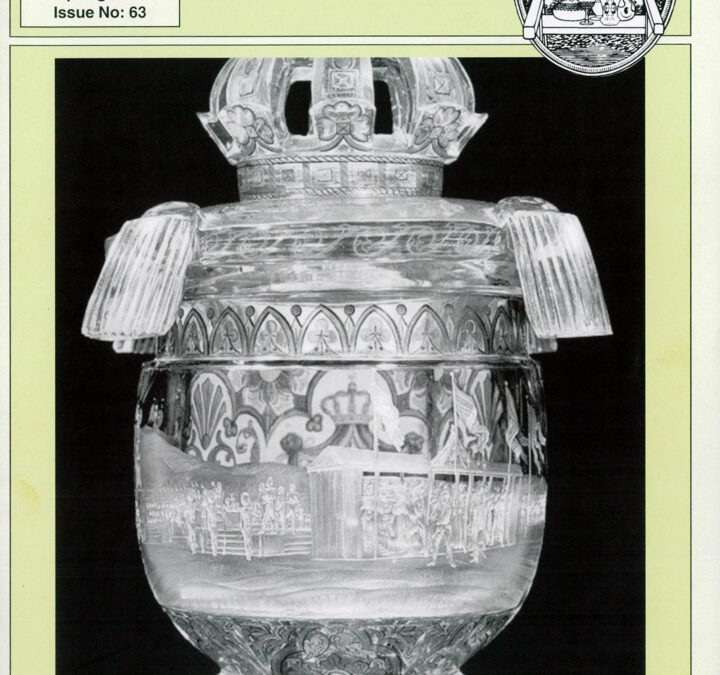
COVER ILLUSTRATION
The bowl section of the CuIm Goblet, a Bohemian enam-
elled and engraved commemorative goblet and cover, prob-
ably Harrachov Glasshouse and engraved in the workshop
of Franz Pohl, circa 1835, decorated by Friedrich
Egermann, Haida. The hexagonal faceted bowl is painted
with the crowned coat-of-arms of Saxony and rich scroll-
work in transparent colours depicting the laying in 1835
of the foundation-stone of the Russian monument at the
site of the Battle of Culm ( 1813 ). Photograph by cour-
tesy of Sotheby’s, London. See page 9.
EDITORIAL
MORE ABOUT BEAL … BUT VALLON ?
Barbara Bikker
has come up with a partial answer to
John Greaves’
query in the last issue of the
Cone
about
BEAL, thanks to John Brooks. Georges Beal, born in
Paris in 1884, was a sculptor and designer of some re-
pute, exhibiting regularly at the salons of the Societe des
Artistes Francais and Societe des Artistes Decorateurs
and awarded various gold medals for his work. He de-
signed a number of bronze figurines and glass pieces for
the retail shop Etling in Paris, founded by Edmond
Laurent Etling and fashionable between the wars. A note
of warning: a number of opalescent glass pieces pro-
duced for Etling were re-issued by the Sevres glassworks
in the 1970s but these later pieces are in frosted glass.
VENICE/MURANO TRIP
Gaby Marcon
has been in touch about hotels, flights
and costs with all those who have booked for the Ven-
ice/Murano trip (9-12 October 2003). The programme
is packed with interesting visits. Anyone who intends
to join the trip but has not yet booked, please contact
Gaby: 7 The Avenue, London N3 2LB; Tel 020 8371
8357; email: gabymarcon@btinternet.com for a copy
of the programme and booking details.
THE REPORT FROM NOVY BOR
John Smith
notified us that the report of the Novy Bor
trip undertaken by members of the Glass Circle and
the Glass Association was about to be distributed. And
within 24 hours a copy arrived; a welcome illustrated
memento of a highly successful and popular trip. If
you did not go on the trip but want a copy, the cost is
£5 (including p&p); contact John Smith at Mallett (Fine
Art) Ltd., 141 New Bond Street, London WI .
WANT TO BE CHANCELLOR?
Brian Currie
has been the Glass Association’s Hon. Treas-
urer for five years and wishes to stand down this sum-
mer. The Committee does need to find someone to take
over this task, which is not particularly time-consuming
but clearly would best suit someone with simple account-
ing or book-keeping experience. It is not necessary to
attend every committee meeting (about 6 a year), nor
live in the West Midlands (only three of the present com-
mittee do) but it would help if s/he had internet access.
He says that the committee members are well-behaved
and not given to flights of financial fancy; we attribute
that to his management and sound advice.
To the great delight and immense relief of the
editorial team, Brian has agreed to continue his work
as the production editor of the
Cone.
If you could help with the Treasurer role, please
contact the Hon. Secretary as soon as convenient, and
Brian is willing to answer any queries about the post by
email: (for details, see box top left).
SAD NEWS
We regret to inform members that Mrs Sylvia Benbow of
Kingswinford has died. Our sympathies to her family.
The opinions expressed in the
Glass Cone
are
those
of the contributors. The editors’
aim is
to cover a range of interests and ideas, which
are not necessarily their own. However, the
decision of the editorial board is final.
COPY DATES
Summer 2003
Mid
–
May
Autumn 2003
Early August
The Glass Cone’ – Issue No 63: Spring 2003
NEWS FROM STOURBRIDGE
CHANGES AT BROADFIELD HOUSE
As readers may know, Roger Dodsworth has been off work
since late spring 2002 and then Broadfield House Museum
of Glass was hit again with Charles Hajdamach, the senior
curator, also absent on sick leave. We are delighted to in-
form members that Roger is back, presently on a part-time
basis (3 days a week), working hard at cataloguing the col-
lection which is now mainly stored at Himley Hall. Sadly,
Charles Hajdamach has decided to take early retirement
with effect from the end of January 2003 and work on an
independent consultancy basis.
NUFG TO CLOSE DOORS
Sad news from the Stourbridge
Express & Star (11
Decem-
ber) that, following the closure of Stuart Crystal in No-
vember 2001 and the consequent loss of 220 manufacturing
jobs, the National Union of Flint Glassworkers announced
in mid-December 2002 that it will wind up its membership
list and close by the end of 2004.
The union started as a Friendly Society in 1848 and
went from strength to strength as the glass industry in the
Stourbridge region expanded, combining the National Flint
Glassmakers Society of Gt. Britain & Ireland and the Na-
tional Union of Glass Cutters & Decorators. Even as late
as 1987 the union had 3,500 members but, with the Stuart
Crystal closure, local membership had sunk to 40, with
another 60 in Edinburgh. This sorry state reveals the level
of redundancies in the West Midlands in the last decade.
ROYAL BRIERLEY WORKS INTO HOMES
In late January 2003 the local papers of Stourbridge (the
Chronicle
and the
Express & Star)
carried reports that the
famous 130-year-old glassworks at Brierley Hill, a listed
building constructed in 1870 in North Street, may be con-
verted into a block of 37 flats with a fitness centre in the
basement. St Modwen Developments has applied for per-
mission to convert the manager’s house and weighbridge
on the site into single homes and demolish the other build-
ings to construct the block of flat& Royal Brierley went
into receivership in 2000 following an unhappy period after
its takeover by Richard Katz; it was then taken over by a
consortium of business people just before New Year 2001.
The North Street works were closed in 2001 and produc-
tion moved to a purpose-built factory, costing £800,000 in
Tipton Road, Dudley, in early 2002.
ARCHAEOLOGICAL FINDS
An
archaeological excavation by staff and students of Bir-
mingham University in the Stone Street car park, Dudley,
has revealed the remains of an 18th century glass cone and
furnace. This was the former (Thomas Hawkes) Flint Glass-
works and examples of its glass products are on display in
the Victoria & Albert Museum, London, and at Broadfield
House Glass Museum, Kingswinford. Peter Boland, Dudley’s
borough archaeologist, told reporters of the
Express & Star
(20 Jan) that it was ‘a major discovery and is an important
addition to the town’s incredible history’; English Heritage
has been informed of the find. As a consequence, the two-
week permission to dig granted by the council was then ex-
tended for another week before work continued to construct
a new civic town square. Further information can be seen on
the council’s website www.dudley.gov.uk/council/plan_app/
conservation/stonestfindings.htm.
Also on the subject of industrial history, there are
on-going discussions between historians, archaeologists,
council officers and Waterford Wedgwood regarding the
future of the 41/2 acre Camp Hill site in Wordsley, the former
Stuart Crystal glassworks, according to the
Express & Star
(12 November). On this site are the remains of the 18th
century White House Cone and the tunnels which run from
the neighbouring canal into the site. (Eds.
Given that the
glass collections and archives from the region are housed on
four separate sites in the immediate area, some suggest it
would be of benefit to visitors, enthusiasts and researchers if
all could be brought together in a purpose-designed building
on this site, adjacent to the newly re-opened Red House Cone,.
this might help generate a serious international and domestic
reputation. Issues such as cost, traffic access and parking
will all affect the outcome The debate continues.)
The archaeological dig in Stone Street, Dudley, the site of
the former Dudley Flint Glassworks. Rear left: Peter
Boland, Dudley Council’s Archaeological Officer; Front
left: Kate Bain, Birmingham University Archaeological
Unit; Front right: air. John Elliott. Photograph: Steve
Barney, reproduced by courtesy of the Express & Star.
ANOTHER PROJECT, ANOTHER LOCATION
Elsewhere another development plan has been thrown into
the ring. It centres around the Ruskin Glass Centre and
the Glasshouse college in Amblecote at the former Webb
Corbett and Royal Doulton Coalbournbrook site. Here,
3
9
9
9
The Glass Cone’ – Issue No 63: Spring 2003
as the
Express & Star
reports (1 February) young people
with learning difficulties are taught the rudiments of
glassmaking and now the project director, Aonghus
Gordon, who came to Wordsley about three years ago,
wants £3.75 million to ‘create a place where the arts can
be celebrated as well as focussing on traditional skills’.
NEW GLASSMAKERS AT BHGM STUDIO
As of January 2003 the new occupant of the studio space
at Broadfield House Glass Museum, Kingswinford is
Samantha Sweet, who recently had a Design Internship
at Dartington Crystal, assisted by Tim Waldegrave. Also
news of the new Okra workshop moving from the Ruskin
Glass Centre in Amblecote, Stourbridge to Queen Street,
Wordsley DY8 5QW. We wish both teams success
DAVID PEACE
David Peace died on 15 February at the age of 87. Start:
ing in architecture, he enjoyed a major career as a well
known town planner. In parallel he became a leader in the
field of glass engraving. He started in the 1930s, but his
first commission came after the war. There followed work
for churches throughout the country as well as work on a
smaller scale: goblets, bowls and decanters. Examples of
his work are in the V&A (along with drawings and photo-
graphs of more than a thousand of his pieces), the
Fitzwilliam, Broadfield House Glass Museum, the
Corning Museum of Glass and many other collections.
In 1975 he played a leading role in the formation of
the Guild of Glass Engravers and became its first chair-
man. In 1968 he published
Engraved Glass: Lettering and
Heraldry,
followed by
Engraved Windows: Church Glass
in 1980. Other important works followed. He was de-
scribed as a gentle and courteous man with lifelong friends
in many countries. There was a Thanksgiving Service for
David Peace on Monday 3rd March at St Margaret’s
Church, Hemingford Abbots, Nr Huntingdon. There will
also be a memorial service at St Giles in the Fields, Lon-
don, at a later date. (
With acknowledgement to the obitu-
ary notice in The Times. )
PERSONAL REACTION TO RECENT EXHIBITIONS
4
John Delafaille
risked life and limb (literally, as he had a tyre
blow-out en route) to go to Sunderland from Bristol for the
Smoothfinnish and Dartington exhibitions He also visited the
Crafts Council in London for the Heart of Glass show, which
has since gone to the NGC These are his reactions
My last visit to Sunderland was with the Association in 1996
to the ‘Finnish Post War’ exhibition at the university, before
the National Glass centre was opened. So the overlap of the
two exhibitions there seemed a good opportunity to see them
and the centre. Information from NGC that Markku Salo
would talk and give a demonstration clinched the matter and
I was up at 05.30 for the long drive north.
Markku Salo is a leading glass designer with littala, but
in the Scandinavian tradition he also makes unique exhibition
pieces, often on a large scale. And on this day his demonstra-
tion included a team of helpers and three furnaces for the mak-
ing of two pieces. Both were based on mixed materials, for the
hot glass was to be enclosed in a fine metal mesh, which in turn
provided sound anchorage and support for the finished object.
The workshop demonstration was fascinating. This was
the first time that I had seen a designer controlling and co-
ordinating such a large team. Both objects were to be pro-
duced from clear crystal but a number of gathers were made,
into which differing colours were marvered. The reheating,
working and blowing, and the final enclosure into the metal
net required close synchronisation.
The first piece was comparatively simple. Three elon-
gated bubbles were blown and then separately dropped into
different sections of the metal mould, with a final breath to
extend them fully over the section, before being rushed to the
lehr. That was exciting enough.
But the second piece was architectural in size, approach-
ing five feet in height, funnel shaped with a ‘spout’ of solid glass
whose mouth was blown. The ‘spout’ was to form the foot, all
to be supported and mounted by the mesh. The solid section
was made by dropping a series of different coloured gathers of
glass into the mesh mould base. As they cooled slightly, water
was splashed on their surface to cause ‘crackling’. A huge bub-
ble of glass was then dropped into the funnel mouth and this
needed the glass-blower to stand on top of a six-foot step-lad-
der and blow the bubble in the required position. Five people
were needed to move the finished piece across the workshop
into the modern laser lehr, for cooling before it shattered.
The two exhibitions showed the disadvantages that the
NGC has in not having its own collection. Both were small
displays and lacked accompanying visual material.
`Smoothfirmish’ displayed the work of seven current
Finnish artists including Harri Koskinen from littala and Salo,
whose large pate de verre piece, over six feet high on an asym-
metric wooden frame, was the only large-scale work on view
The display varied from the heavy cased and carved vases of
Anu Penttinen, through cutting and edgework to lighter clear
blown vessels. There were also references to the recycling prob-
lems of glass in modern high technology products. My own
favourites were the sinuously distorted bottle shapes from the
Lasisirkus studio, in particular a facing pair, serenely balanced
and reminiscent of loving swans with intertwined necks
The Dartington exhibition I found a disappointment.
Bearing in mind that Dartington has been the only successful
major glasshouse established in the second half of the 20th
century, I was hoping to pick up some flow in the progression
of Frank Thrower who must rank of one of our most suc-
cessful glass designers. Instead I found some rather haphaz-
ard examples of his work, which lacked any clear thread; and
the information available added nothing to the few souvenir
and marketing sheets I already have from the company. Apart
from this, the Dartington exhibition contained specimens from
the current ranges including limited editions from the Gallery
Range. I admired the Arid vases and especially the ‘Paisley’
glass in an edition of only 20 and priced at £795.
As for the NGC itself, the shop is really impressive and
provides a most extensive showroom for British glass artists. I
spent more time there than at the Craft Council ‘Heart of
Glass’ which I did not enjoy. Even the actual title of the show
`Heart of…’ was a misnomer – Statement Art which can only
be displayed in a half-empty unatmospheric space is scarcely
`The Heart’. The NGC is certainly worth a visit if you are in
the area, or a diversion if you are on the A 1(M), if only to see
the shop.
John Delafaille
‘The Glass Cone’
–
Issue No 63: Spring 2003
A JACOBEAN ROMANCE
By coincidence the same post brought me both
The Glass
Cone
No. 62 and a letter, each with the unifying but totally
misleading theme of ‘Jacobean’ Glass. The Oxford English
Dictionary defines Jacobean as:
‘Of
or pertaining to the reign
or times of James I of England,• a term for the C.17`” style …
. ‘ (first used in 1770.) Jacobite, on the other hand, is:
An
adherent of James IL ; a partisan of the Stuarts after the
revolution of 1688’
and is first recorded in use in 1689, well
before the term Jacobean. After the Union of the Crowns,
James I reigned from 1603 until his death in 1625, so that
any reference to ‘Jacobean’ as a glass style should relate to
the glass of Mansell, or more broadly, of the
Fawn de Venise
The ‘Jacobean’ reference in
The Cone
was from Yvonne
Cocking; she related it to a design registration awarded to
Clayton Mayers in 1924, and they were still advertising this
`Jacobean’ range as late as 1958. From this advertisement,
and Yvonne Cocker’s earlier letter and illustration in
The
Cone
No: 60, the pattern would seem to be a pressed glass
approximation to an all-over facetted decoration of glass
vessels, and thus nothing whatsoever to do with the Jaco-
bean period, but derived from a style of more than 150
years later – or from the Romans!
The other misuse of the term ‘Jacobean’, which ar-
rived simultaneously with
The Cone,
was in a copy of a
Christmas 2002 advertising brochure of The Macallan
whisky distillers, which illustrated a reproduction Jacobite
goblet. The company produces a fine whisky, but their
marketing people surpassed themselves with their misde-
scription of this glass:
“The Macallan Jacobean Glass. In-
spired by a C.17`” original in the V & A Museum, London.
The Young Pretender must surely have drunk the quintessen-
tial Macallan from something like this?”
Wrong name, wrong
century, and wrong drink, for it is well recorded that Prince
Charles usually drank brandy as his tipple, even when on
the run ‘in the heather’ in the western highlands from April
to September 1746. He undoubtedly drank whisky on the
surprisingly few occasions when brandy was not forthcom-
ing, but probably local hooch and certainly not out of such
a goblet with Jacobite engraving.
The interesting thing is how often this misdescrip-
tion of ‘Jacobean’ for reproduction or historicist Jacobite
Glass has been used. Edinburgh Crystal used it in their
1920s catalogues, as did Walsh Walsh a few years later. I
think that Royal Brierley did, too, although I cannot con-
firm this, but they certainly described their production of.•
” … romantic goblets of Bonnie Prince Charlie’s day … en-
graved with the Tudor
(sic)
Rose”,
as too did the Hill Ouston
catalogue of 1934. Whilst Whitefriars produced around
1900 a range of glasses with Rose engraving, loosely drawn
from Jacobite Glass, unfortunately it never seems to have
had a name, only a pattern number. There are also other
instances of ‘Jacobean’ services without Jacobite overtones.
One cannot help wondering whether this euphemism
of ‘Jacobean’, when ‘Jacobite’ was the correct and widely
used term, was intentional to avoid any accusations of fak-
ing, or simply betrays ignorance of history? Certainly the
offerings from the larger and reputable manufacturers were
not truly deceptive; some, like Whitefriars or Stuart Crystal,
were loose interpretations, whilst others were closer to the
originals, but not deceptively so. What one has to worry about
are the products of the small cribs, possibly even engraved
on C.18
th
glass; there is still a significant corpus of C.18
th
`Jacobite’ Glass whose engraver we cannot recognise, and
which may, or may not, be what its owner hopes it is.
F. Peter Lole
Rosewater sprinkler and vase, c 1900, Loetz (photo by
Peter Huggins, Camera Techniques)
THE ANDERSON COLLECTION OF ART
NOUVEAU
On the left is a picture from the cover of the Spring Calen-
dar of Events at the Sainsbury Centre for Visual Arts, Uni-
versity of East Anglia, Norwich, NR4 7TJ. The items
illustrated form part of the Anderson Collection of Art
Nouveau, which was given to the University in 1978 and is
displayed every three years. It will be on display until 4 May
2003. Open 11 am to 5 pm every day except Monday.
Sir Colin and Lady Anderson were passionate about
the Art Nouveau style. Their collection encompassed a
great range of objects from the movement and includes
furniture by Galle and Marjorelle, graphics by Alphonse
Mucha, jewellery by Lalique and Fouquet, glass by Daum,
Galle and Tiffany and metalware made for Liberty. You
can see details on the website at www.uea.ac.uk/scva.
A new catalogue of the Collection, featuring 70 col-
our photographs and essays by Dr Gillian Naylor, Alice
Millington-Drake and Dr Veronica Sekules, is available.
For further details please contact the Gallery Bookshop
on 01603 593199 or email scva@uea.ac.uk
‘The Glass Cone’ – Issue No 63: Spring 2003
e..-1-. 8-4
$ —
BASKET
WEAVE –
REGISTRATION NUMBER
DIV
O
One of the rewards associated with glass collecting is to
acquire an item of glass whose identity can be positively
linked to a particular factory and better still to the origi-
nal design number and date of its first manufacture.
Rini bowl (120mm diameter) with detail of registration number.
Press moulded glass often carries a trademark or reg-
istration number, which makes this relatively easy. How-
ever, free blown items generally carry no marks to assist in
their identification; but on rare occasions the item does carry
a mark. In the case of the bowl illustrated, the relatively
easy attribution of the basket weave pattern is supplemented
by the registration number, scratched with a diamond point
onto one of the few blank spaces on the item. The number
38983 was assigned to Stevens & Williams (S&W) dated 1
December 1885 and is described as “Pattern for ornamen-
tation of flint glass tableware”. S&W also described it as
“Square basket weave wheel decoration using a multi mitre
intaglio wheel.” A single cut with this wheel produced four
parallel V grooves which enabled a basket weave decora-
tion to be cut relatively quickly into the surface of the glass.
Pattern book showing pattern number 10925. Details
from S&W Pattern Book 10 ( courtesy of Dudley
Metropolitan Borough Council).
Assisted by the date of the registration, a trawl
through the pattern books is rewarded by pattern number
10925, dated 1/1/1886. Yes, they did work on New Year’s
Day!
The size (120mm diameter) and shape of this bowl
would lead you to think of it as a finger bowl or finger
cup but this bowl appears to be described as a “Coiner”.
Other items listed under this number make up a dressing
table set; so have
I
read this correctly? Does anybody know
what it was used for?
( Perhaps a vide-poche? Eds. )
The bowl was found at the National Glass Collec-
tors Fair at the Motorcycle Museum in May 2002 and is
in remarkable good condition with not even a blemish on
the delicately scalloped rim.
The design does not appear too profusely in the
pattern books and normally is associated with decanters
and other table glass. Joseph Keller illustrates a goblet cut
in this manner in his Book of Designs.
As often with styles of decoration, the basket weave
was not exclusive to S&W, but the use of a multi mitre
wheel to achieve it, as far as I know, was. Thomas Webb
& Sons produced a basket weave made up of several sepa-
rate cuts, usually applied to part of an article, the top of
the decoration finished by laying the vertical lines in an
interwoven, undulating manner. These cuts were usually
left dull, whereas the S&W multi mitre design was usually
acid polished. Just to complicate things S&W also pro-
duced this type of decoration as well.
S&W also produced a range with a moulded basket
design
(see below).
These are an opaque ivory colour in
combination with another die-away, or shaded, colour.
Dilwyn Hier
Stevens & Williams moulded basket weave vase, 175 mm
tall, shading from light brown at rim to pale green at base.
The Glass Cone’ – Issue No 63: Spring 2003
.T
,
7
THOMAS WEBB AND THE REMBRANDT GUILD
)
9
9
The 1987
British Glass Between The Wars
exhibition at
Broadfield House included four pieces of Webb glass
which were marked “Made Exclusively For Rembrandt
Guild”, and Stan Eveson’s article in the exhibition cata-
logue discussed the relationship between Thomas Webb
and Sons and the Guild in the 1930s. Stan Eveson, of
course, was working in the factory when these pieces
were made.
Two years ago I showed him the illustrated vase
which I had recently acquired. I wanted him to con-
firm, if he could, that this was one of Tom Pitchford’s
designs; Stan said it was, but whilst he was handling it
a twinkle appeared in his eye; he turned to me and added
that he knew who had made this particular piece of
glass. There was only one man at Webb’s, he said, who
could make pieces of this quality and that was Frank
Bridgens, the gaffer who was given nearly all the com-
missions from the Rembrandt Guild because he was
the only one who could meet their exacting standards.
Frank Bridgens left Webb’s in 1937, so that was the last
possible date for the manufacture of my vase.
But who or what was the Rembrandt Guild?
Stan didn’t know much more than he had written
in his article, namely that they had shop premises in
Daimler House, Paradise Street, Birmingham, close to
the Town Hall. Recently I have tried to find out a little
more, but that has not been easy because the shop no
longer exists and no records appear to have survived.
The first entry in Kelly’s Directory for Birmingham is
in 1932:
“Rembrandt Guild (The), picture dlrs, Daimler ho.
Paradise st. TN Midland 0216.”
The same entry appears every year until 1952, but be-
tween 1944 and 1948 there is an additional entry:
“Rembrandt Studios, photographers, 167 York rd. 28”
Inquiries amongst friends knowledgeable about
Birmingham’s history yielded a little more informa-
tion. The “shop” was apparently on the second floor
in Daimler House, and there was one recollection that
it was “very exclusive” and was more like a gallery
than a retail outlet. It specialised in fine art and pic-
ture frames and other exclusive furnishings for the
home, but not furniture. The opening of a photo-
graphic branch in the suburb of Hall Green in 1944 is
unremarkable. There couldn’t have been much of a
demand for fine art in wartime Birmingham, and pho-
tography and framing are obviously linked. That en-
terprise didn’t last long, and by 1953 the Guild itself
was no more.
One lead proved to be something of a red her-
ring. I was told that there might have been a connec-
tion between the Rembrandt Guild and the
Bromsgrove Guild. The Bromsgrove Guild of Applied
Arts was founded in 1898 by a group of craftsmen
and women influenced by the Arts and Crafts Move-
ment and based in Bromsgrove in Worcestershire. In
their early years they made jewellery, tapestries, gesso,
metalwork and stained glass, and it was suggested that
the Rembrandt Guild may have been a retail outlet
for the Bromsgrove Guild’s work. I contacted the
Bromsgrove Guild’s historian, Quintin Watt, but he
thought such a link was improbable because the
Bromsgrove Guild was only active in all these fields
before the first World War, and by the 1930s most
members were metalworkers and their gates and
screens were unlikely to have been sold through a re-
tail outlet. Unfortunately we shall never know for sure
because all the Bromsgrove Guild records were de-
stroyed when it was wound up in the 1960s.
The illustrated vase, with its Rembrandt Guild
acid etched mark, is not uncommon. I saw another
identical piece in a Brighton antique shop during the
summer and this and some other designs by Tom
Pitchford will be included in the selling exhibition with
the working title “British Cut Glass, 1920s to 1970s”
that Nigel Benson and Jeanette Hayhurst are plan-
ning for the summer.
It is always nice for a collector to be able to iden-
tify both the factory and the designer for a piece in the
collection. In this case we know the retail outlet, too,
because it is included in the mark. But it is very unu-
sual indeed to be able to date a piece so precisely to the
five-year period 1932-37 and even rarer to know the
name of the workman who made it. Thank you, Stan
Eveson, for a phenomenal memory.
Ian Turner
‘The Glass Cone’ – Issue No 63: Spring 2003
GLASS IN THE VALLEE DE LA BRESLE
8
Last year Davina and I spent part of our touring holiday
in Northern France. On a visit to the city of Eu we picked
a leaflet up from the local tourist office that described the
delights of the Vallee de la Bresle, which included two glass
museums and several glass factories including one oper-
ated by Rexam.
Most of the factories in the valley were and are con-
cerned with bottle making, mainly for the perfume trade.
We visited one at Le Manoir de Fontaine, Blangy sur Bresle.
The layout of the museum was in three stages: the
pottery; manufacture and techniques; and exhibits from lo-
cal glass factories. The pottery covered the design and manu-
facture of pots, including a 16`
s
Century lithograph illustration
of a man puddling clay by treading it with his bare feet.
In the manufacture and techniques section we were
shown the chemistry of glassmaking with examples of
the usual ingredients plus various additives to obtain a
desired effect of, say, purity of the batch, or metal oxides
for specific colours. Then came various dioramas com-
mencing with cold glass working which demonstrated
stages of grinding and polishing of the glass plus a spe-
cial lathe for grinding stoppers to fit the corresponding
neck of the bottle. Nowadays a plastic seal is used which
results in a universal fit.
Other dioramas covered a pot change and glass blow-
ing into moulds and similar production activities arranged
around an old furnace. The furnace shown was a Boetius
model made by local makers, Blondin-Roussel, who are still
producing furnaces, albeit to more efficient designs than this
original one, which had no heat recovery techniques. Various
operations were shown — the making of stoppers, pressing
into moulds by hand or by semi-automatic machine. Again
this machine was a local example, being made in Blangy sur
Bresle by a firm then called Wmckler, now known as Metra.
Finally an example of the perfume bottle “L’Eau
Imperiale” first made by Guerlain 150 years ago for Empress
Eugenie, and now by the glass factory Pochet et du Courval.
The diorama showed its production from initial design con-
cept, evaluation of a 3-D model made from wood, plaster or
plastic, the making of foundry casts and the final mould mak-
ing with all necessary engraving and decorating detail added.
The final section of the museum comprised many cabi-
nets displaying examples of glass, mainly bottles but also pressed
ashtrays and other objects. There were moulded and blown
perfume bottles by Sabino, Pochet et du Courval and for com-
parison, some Lalique. The combined output of two facto-
, ries, Saint Gobain and Desjonqueres, exceeded two million
bottles per year — that adds up to quite a few litres of perfume!
We were surprised at the beauty of many of these
bottles and could understand their attraction for collec-
tors. The size was also surprising; when you consider the
expense of a small bottle of perfume, then some of these,
when filled, would have been worth a king’s ransom.
Glassmaking in the Bresle valley commenced in the le
century when the Earls of Eu gave a licence to four families—the
Levaillant, Bougards, Caquerais and Brossard. The area con-
tained all the necessary materials, sand from Le Treport, trees
for fuel, ferns for the soda-ash and seaweed for potassium. The
only material that had to be imported was the clay for the pot
making. Glass is still being produced by five factories: at Mers
les Bolos, Saint Gobain-Desjonqueres; at Hodeng au Bose,
Pochet et du Courval; at Blangy sur Bresle, Waltersperger, at
Nesle Normandeuse, Verreries et Cristalleries de la Bresle; and
at Vieux Rouen sur Bresle, the old glass factory Brosse U.I.V.
Outside the museum building was the workshop of
a resident glassblower, where we watched the usual skills
being applied to produce a beautiful vase with rolled-in
colours and applied trails. There were many examples for
sale at modest prices but for some unknown reason Davina
was not keen on me buying one.
We enjoyed our visit and were sorry we lacked the
time to explore the second museum or arrange a trip
around one of the factories. Perhaps this could be the sub-
ject of an overseas visit by the Association in the future.
Geoff Timberlake
‘The Glass Cone’ – Issue No 63: Spring 2003
GLASS AT THE AUCTIONS
Large double pedestal lamp designed by Frank Lloyd Wright,
approx. 22 in high x 32 in wide The leaded glass ai the shade of
the lamp and its base uses iridized greens yellows whites and
ambers Photograph from Christie’s New York
On December 10, at its 20
th
Century Decorative Arts sale in
Rockefeller Plaza, New York, Christie’s offered a large double-
pedestal lamp designed by Frank Lloyd Wright. It was one of
a pair from the library of the Susan Lawrence Dana House,
Springfield, Illinois. The design of the lamp echoes the design
of the House, with its strong geometric lines Frank Lloyd Wright
worked on the designs for the house from 1902 to 1904. It was
his first large commission, providing him with the opportunity
to explore innovative ideas and techniques. The house, the prop-
erty of the state of Illinois since 1981, is the best-preserved and
most complete of Frank Lloyd Wright’s Prairie style houses
and was one of the most elaborate residences the architect would
design in his seventy-year-long career. The lamp was sold for
$1,989,500 – a world auction record for FLW.
A Lobmeyr ‘Persian-style’ enamelled two-handled vase of
the 1880s yielded £12,200, while Baccarat opaline glass of the 1850s
and Bohemian hyalith of the 1830s was also much in demand.
Of the 50 or so paperweights on offer those from the
Bacchus factory proved to be the best sellers in the sale on 18
December. One millefiori basket example sold for £8,000 (esti-
mate £2,500-3,500). From a range of Pantin weights, one with a
white rose on a blue ground sold for £9,000 (estimate £3,000-
4,000) and a rare St. Louis cruciform millefiori carpet-ground
example sold for £6,500 (estimate £3,000-4,000).
The sale of “Masterpieces of European glass 1500-1900”,
a selection from the Hida Takayama Museum of Art, on 19
December; saw some impressive prices for 18
t
h century Dutch
diamond-point engraved glass and late 19
t
h century English cameo
glass. A stipple-engraved glass by Frans Greenwood, dated 1745,
for example, sold for £42,000.
A Dutch stipple-engraved glass by Frans Greenwood,
dated 1745. 24.8 cm tall. Photograph by Sotheby’s
Three impressive Thomas Webb cameo vases from the
Woodall workshop were sold for £35,000, £52,000 and £95,000
respectively
(left to right in picture below).
Pantin weight with a white rose on a blue ground 6.9cm diameter,
soklfor i9,000. Photograph by Sotheby’s Olympia
Sotheby’s held its two final glass sales of 2002 in Decem-
ber. In the first of these, on 18 December, a rare opaque-twist
wine glass with blue bowl and foot achieved (hammer prices
throughout) £27,000 (estimate £12,000-18,000), underlining the
continued strength of the 18
th
century English drinking glass
market. English colour twists of the 1770s and early heavy bal-
usters from 1710 were much in demand. Prices were realised of
£5,200 (estimate £3,000-4,000) for a blue colour-twist, £8,500 for
a Beilby wine glass with a peacock (estimate £2,500-3,500), £5,800
for a Jacobite ‘Audentior Ibo’ portrait goblet (estimate £3,500-
4,500) and £2,600 for a baluster goblet (est. £1,200-1,800).
The three Woodall cameo vases
Left: The Pet Parrot, white over blue, 21.6 cm tall.
Centre: Angling, pink and white over blue, 26 cm tall
Right: 71
,
vo acanthus -skirted angels, white over amber, 40.6
cm tall Photographs by Sotheby’s
Nineteenth century continental glass was especially
prominent in the sale, the highlight of which was The Culm
Goblet, decorated by Friedrich Egermann and engraved to com-
memorate the raising of a monument to the Russian army in
1835. It was sold for £120,000. A Russian Bakhmet’ev double-
walled beaker, c.1800, sold for £28,000 (estimate £10,000-15,000),
while a Bohemian blue-overlay goblet, c.1855 engraved by Franz
7nr,h sold for £16,000 (estimate £6,000-8,000).
9
The Glass Cone’ – Issue No 63: Spring 2003
PAPERWEIGHT NEWS
Everyone I spoke to at the Cambridge Paperweight Circle
(CPC) Anniversary Exhibition at the NEC, Birmingham,
was very complimentary about the exhibition and I too
would add my congratulations and thanks to those involved
in assembling such a fantastic display of weights, which did
great credit to the CPC in its anniversary year. There must
have been close to the target of 1000 paperweights on show
with examples in eight free-standing cabinets from the main
producers of modern and antique weights, including Ysart
(whose grandson visited the display), Whitefriars, modern
Scottish, French and British work and antique pieces of
American, English, French and Bohemian work; but it was
not possible to include everything.
Present for the four days of the CPC exhibition were
Bill Gaskell, the PCA education director, who had a laptop
display of his vast collection, and Colin & Debbie
Mahoney, the co-authors, with Gary & Marge
McClanahan, of the definitive book on Perthshire paper-
weight production up to 1997. No wonder there were nu-
merous interesting discussions on many aspects of
production and making processes. And I am able to con-
firm that a sequel to the book is in preparation to com-
plete details of Perthshire paperweight production up to
the end of 2002; it will also include information on the
relatively unpublished art glass that was produced for only
a year or so and sold exclusively in the factory shop.
Brought over by the Mahoneys and on display in the
Ysart family display cabinet were two Paul Ysart weights,
historically of interest. They featured in the first 1947 edi-
tion of Evangeline Bergstrom
Old Paperweights,
but, on
the author’s instructions, were omitted from later editions
after she found that these signed pieces were not antique.
Paperweight news at this time is a mixture of good
(the return of Peter Holmes to paperweight making) and
bad (the cessation of weight production at the Baccarat
factory). Examples of Peter Holmes’s work may be seen
on his website (www.scottishbordersartglass.com) while
confirmation that Baccarat had ended paperweight mak-
ing came from a French member of the CPC whose fa-
ther had been a manager at the St. Louis factory.
Production of weights had started afresh at Baccarat with
the sulphide weight for the 1953 coronation of Queen
Elizabeth II and the later range included
millefiori
and
lampwork pieces. In my view they were good quality, pro-
duced in relatively small numbers but expensive when com-
pared with similar products from Perthshire and the USA.
A sad coincidence, associated with the news from
Baccarat, was the death in late November 2002 of Paul
Jokelson, the person responsible for persuading both Bac-
carat and St. Louis to reintroduce paperweight making af-
ter a break of around 100 years. Paul was one of the best
known collectors and authors on weights, and was the
founder of the Paperweight Collectors’ Association in the
USA. His knowledge and expertise will be greatly missed.
Rumours had also been circulating that St. Louis
might not produce any pieces in 2003. But in late January
the latest paperweight brochure from Larry Selman in
California includes an advertisement featuring five 2003
St. Louis weights, all very limited editions and expensive;
it is unclear whether Selman has exclusive distribution
rights. That said, in the New Year I saw a 1985 Baccarat
and a St Louis flower weight on sale for £600 and £800
respectively, which might indicate prices are steadily ris-
ing (or perhaps they were just overpriced!).
The French CPC member took the opportunity to
look closely at the presentation and display at the NEC as
he is helping to organise a show in France this spring. 500
paperweights from Baccarat and St. Louis will be in the
display along with around 200 other pieces from the fac-
tory museums and individual collections. My understand-
ing is that the exhibition will run from 4 April to the end
of May, at the Abbaye des Premontres, Rue St. Martin,
54705 Pont a Mousson. That is about halfway between
Metz and Nancy on Route N57, just off A31, in the Lor-
raine region, eastern France. The organisers hope to or-
ganise a catalogue to accompany the display.
As for me, I have not found my first 2003 weight yet
but no doubt this will change with a visit to the forthcom-
ing Woking Glass Fair, and then the meeting at which the
well-known American paperweight maker, Bob Banford,
will speak.
Richard Giles
NEW RECYCLING NEEDED
10
Each year in the UK, around 2.4 million tons of glass
bottles and jars are used and chucked out, but only about
a quarter is recycled,
The Independent
Science & Nature
review section (18 November) reported. The rest goes into
landfill sites. That is bad enough; but then add the 300,000
tons of broken window glass, spent fluorescent tubes (20-
30,000 tons) and glass from TV and computer monitors
(40,000 tons) and the problem increases. New EU regula-
tions will shortly require these types of products to be
recycled as well and, to achieve this, a government-spon-
sored not-for-profit company, Waste Resources & Action
Programme (WRAP), has been set up to develop new,
stable and sustainable markets for such recycled material.
One idea is to use tiny glass particles for purifying wa-
ter. Traditionally a sand filter has been used, whether at a
swimming pool or a fish farm; but the rough, pitted surface
of the sand grains becomes quickly populated with microbes
and regular intensive flushing is required. However, glass gran-
ules may be finely ground, providing a smooth surface and
leaving a net negative electrical charge. Thus the water is fil-
tered but the microbes are not retained in the filter because
the colourant metals in green (chromium salts) and brown
(iron oxide) glass have catalytic properties. This means that
the microbes are drawn to the glass particles electrostatically
and then, in the words of the reporter Simon Hadlington,
`zapped by the oxygen radicals, which kill them’. If this sys-
tem catches on it would, at a stroke, wipe out the ever-grow-
ing surplus of green and brown recycled glass.
Another project is to develop the use of recycled glass
in the concrete industry. Researchers at the Centre for Ce-
‘The Glass Cone’ – Issue No 63: Spring 2003
9
9
9
9
ment & Concrete at the University of Sheffield are investi-
gating the possibility of using glass to provide the silica ma-
terial in concrete. One advantage would be that a glass
aggregate would enable the concrete surface to be given a
fine polished surface. The research organisation, Ceram, based
in Stoke-on-Trent has already undertaken work incorporat-
ing finely milled glass into clay and fired between 950°-1200°C,
producing bricks more resistant to frost damage. The inclu-
sion of glass means that the firing temperature is about 50°C
lower than usual for similar ‘engineering’ brick, so saving
between 1 and 2% in terms of raw energy and reducing car-
bon emissions. If plans go ahead for factory processing, it
could utilise a minimum of 160,000 tons of glass powder a
year. All this could help to reduce a glass mountain.
(Many
thanks to Malcolm Thatcher for this cutting.)
CAMEO CUTTING WORK NEEDED
A member tells us that he has a blank amphora vase of colour
(white on amber), shape and size almost identical to Lot 105
in Sotheby’s 19 Dec 2002 Auction
(see page 9).
This item, the
Thomas Webb and Sons two-handled two-colour cameo vase
by George Woodall’s team, sold for £95,000. Our member
bought his blank some years ago, along with other unfinished
pieces, and supposes that it may have been one of the spare
blanks made at the same time as that for the Woodall vase.
Glass carving teams would undoubtedly procure several blanks,
pick the most suitable for their work and retain the spares until
they were satisfied that their choice had progressed well enough
for the reserve blanks not to be needed.
Now our member is looking for someone to carve
his blank for him!
Left: £95,000 Woodall vase at Sotheby’s.
Right: Member’s vase waiting to be finished …
NEW APPOINTMENT AT NLCG
In November 2002 the internationally known glass artist,
Jane Bruce, joined the team at North Lands Creative Glass
(NLCG), Scotland, as Artistic & Technical Director. Born
in England, she first came into glass at Leicester Polytechnic
and then went to the Royal College of Art for post-graduate
studies. In 1979 she moved to the USA for further studies at
Alfred University and then worked at the New York Experi-
mental Glass Workshop (now Urban Glass) from 1985-94
before taking up a lectureship in the Glass department at the
Australia National University, Canberra in 1994. With the
tragic illness of Stephen Procter, she became Acting Head of
the glass workshop there and still maintains her links there
as Senior Lecturer, and in New York, where she has a studio.
ORIEL COLLEGE, OXFORD
In November 2002 the Bishop of Oxford, the Right Rev. Ri-
chard Harries, dedicated a series of 14 stained glass windows
at Oriel College commemorating the life and work of Cardi-
nal John Henry Newman (d. 1890). Designed and made by
Vivienne Haig and Douglas Hogg, both based in Edinburgh,
the work was made possible by a generous donation by the
late Norma Lady Dalrymple-Champneys, Honorary Fellow
of the college. Some of the material came from the now closed
Hartley Wood Glassworks of Sunderland
(see GA Journal
No. 6 for Susan Newell’s history of this firm).
The central im-
age depicts the cardinal seated and at prayer surrounded by
motifs reflecting his associations with the University Church
of St. Mary’s and
Littlemore, while in the
centre upper light the Vir-
gin stands holding the
Christ Child. Thanks to
the lighting, a gift of
Downing Abbey, the
window may be seen illu-
minated at night from the
quadrangle outside; oth-
erwise an appointment
has to be made with the
college authorities but
The Tirnes
correspondent
(18 December) warns
that viewing from the in-
terior is difficult as these
windows are located be-
hind the organ casing.
The central section of the Newman window.
(Picture from Oriel website: www.oriel.ox.ac.uk1).
A GLASS GHERKIN IN THE CITY
Yet another Norman Foster building was officially topped
out in the City of London in early December. Standing some
30 storeys high, the Swiss Re office building was immedi-
ately christened by the press as “the City Gherkin” when the
architectural plans were first revealed. This Christmas, each
floor was illuminated alternately in emerald green and sky
blue. If you are walking from the Barbican Concert Centre
to Moorgate underground station at night, there is a spec-
tacular view of this latest glass building from the walkways.
…. AND MORE GLASS FOR LONDON
No news yet whether the November planning application to
Tower Hamlets for the News International office tower has
been successful. Rupert Murdoch is planning to move his
British newspaper operations from ‘Fortress Wapping’ to this
new site just up the road. Designed by Terry Farrell, the ar-
chitect of the much admired ‘art deco’ MI5 building at Vaux-
hall Bridge on the south side of the Thames, the complex
will have at its heart a 27-storey glass-clad office block. The
design statement sent to the planners stated that ‘The build-
ing marks a cultural change in the company’s profile and a
desire to have a visible and contributory presence in the city’.
11
‘The Glass Cone’ – Issue No 63: Spring 2003
VICTORIAN DECORATIVE GLASS DESIGNS: ATTRIBUTION
Following our review of
Mervyn Gulliver’s book Vic-
torian Decorative Glass
(in
Cone No. 62), we launched
a discussion as to whether
authors should offer opin-
ions, rather than just setting
out proven attributions Col-
lectors have to decide for
themselves how important
attribution is For some, at-
tribution to a specific manu-
facturer may be essential to
the integrity of their collec-
tion; for others it may be simply a bonus. We asked Mervyn
to give us his own views
The quality and quantity of attribution that a researcher
can achieve depends on the quality and quantity of sur-
viving archive material, its location and permitted acces-
sibility, the financial costs and the time available.
Registered Trademarks, manufacturers’ pattern books
and price books, Registered Patents, Registered Designs,
trade magazines and hearsay comments can all provide
valuable information for the researcher. However, in my
experience they do not always provide the answers required.
Trademarks & Signatures:
Very little of the glass
produced in the Victorian period was given a readily iden-
tifiable trademark or signature, and some of these are
known to have been faked.
Pattern Books & Price Books:
Parts or even whole
ranges of pattern books of well-known major glass manu-
facturers of the period have not survived e.g.: John Walsh
Walsh; Burtles Tate & Co; Boulton & Mills. Surviving
pattern books often offer outline illustrations only, fre-
quently without any descriptive text. The text on a draw-
ing may be very brief, perhaps noting only one descriptive
facet, e.g. size. One can fmd that the descriptive text on a
drawing disagrees with that in an associated price book.
Registered Patents:
The documents recording Reg-
istered Patents of design/manufacturing techniques do not
always include illustrations, leaving much to the personal
interpretation of the reader.
Registered Designs:
Illustrations provided in the
Registered Design Books of Representations are often
drawn in outline and without descriptive text either on
the drawing or in the Register. The associated written de-
scriptions of the Registered Designs sometimes fail to
specify clearly the design concept being registered, again
leaving much to personal interpretation. Items incorpo-
rating a Registered Design feature are not always marked
with the respective Registered Design diamond mark or
Registered Design Number. Items incorporating a Regis-
tered Design feature are not always illustrated in a manu-
facturer’s pattern books or catalogues.
Trade Magazines:
Articles in magazines like
Pottery
Gazette
do not always have illustrations to complement the
written descriptions of glass items, leaving much to the per-
sonal interpretation of the reader. The reader also has to
weigh up the relative accuracy of the personal interpreta-
tion of the design by the original author of the article.
Hearsay Comments:
Hearsay descriptions of designs
passed down through the generations must be regarded
with caution if not corroborated by a surviving illustrated
source. There is also a risk that the original statement may
be elaborated or distorted over the passage of time.
Scientific Research:
Some researchers may have ac-
cess to a laboratory to obtain scientific analysis of glass
recipes or the metals themselves. But the findings must be
tempered by questions about the likely degree of quality
control (if any) exercised by the workmen who prepared
the mixes. And, if manufacturers were intent on copying
the designs of competitors, would they not strive for simi-
lar, if not identical recipes?
Speculative Attribution:
Where items cannot defi-
nitely be attributed to specific manufacturers, then re-
searchers can only speculate as to their likely age and
origins based on the information available. Size, shape,
weight, colour, decoration, method of manufacture, and
knowledge of similar designs may point to a likely date of
manufacture, and a possible manufacturer.
It is a personal choice for an author whether to in-
corporate speculative attribution into a publication. The
relative part it has to play in the overall concept of the
publication will be duly considered, and if it is to be used,
then the options are:
(1)
Only positive attribution of items, wherever possible,
(2)
Positive attribution of items wherever possible, together
with speculative attribution about the remainder, either
their own or those of other people or both.
(3)
Positive attribution of items where possible, together
with a limited amount of speculative information.
The prime aims of my book are to commence an
illustrated record of design concepts created for decora-
tive glassware, to record as many variations as possible,
and to draw attention to their component parts (rims,
bodies and feet).
This theme does not specifically require items illus-
trating the various design concepts to be attributed to their
manufacturers. Nevertheless, I chose to include as much
positive attribution as was possible from my research, but
to restrict speculation to the likely dates of manufacture,
and to offer additional comments on the few items that I
felt were of particular interest.
This approach may appear puritanical. It may frus-
trate experienced collectors who enjoy the debate that
comes with speculative attribution.
My own confusion and frustration with the specu-
lative comments
I
have heard over the years certainly in-
spired me to my own programme of research.
I
therefore
resolved to inflict as little speculative attribution as possi-
ble on my readers. In particular, those collectors coming
to this subject for the first time really need facts, not guess-
work, to give them the basic knowledge to build their col-
lections with confidence.
Whatever value collectors may attach to attribution,
perhaps the most important thing is to enjoy the designs that
they have in their collections, to reflect on the amazing skills
of the glass workers who created them often under appalling
working conditions, and not to worry too much if the spe-
cific company they worked for cannot be established.
Mervyn Gulliver
The Glass Cone’ – Issue No 63: Spring 2003
NATIONAL MEETINGS, 2003
Art Deco 1910-1939, V&A, Saturday 14 June 2003.
This meeting will follow the pattern of the successful Art
Nouveau meeting in June 2000 – a morning lecture, a modest
display of members’ art deco glass, lunch in Imperial College,
followed by a visit to the exhibition in the V&A nearby. The
lecture, “Ancient and Exotic Influences on Art Deco” , will be
given by Keith Baker, former Head of Art Nouveau and Art
Deco at Bonhams.
The V&A exhibition will contain about 300 objects, of
which about 16 will be of glass.
Jerwood Prize entrants and winners. Crafts Council, London.
Saturday 20 September 2003
The Jerwood Applied Arts Prize was established in 1995 to
celebrate excellence and originality in the applied arts. This year
the medium is glass and we will see a number of the candidate
pieces and the prize winning piece. The meeting will start at
2.00 pm with a talk on the Jerwood prize and the exhibits, to be
given by Amanda Hedley, Acting Exhibitions Manager, who
graduated from the Glass course in Sunderland in 1999 and
formerly worked at the National Glass Centre.
Members are invited to attend the
Spring Lecture of the Guild of
Glass Engravers at 2.00 pm on Saturday 10 May
at the Art Work-
ers Guild, 6 Queens Square, London WC1. We are delighted that
this year Alison Kinnaird MBE, Fellow of the Guild and interna-
tionally renowned glass artist, has agreed to give the lecture which
she is calling “Combining Techniques – New Work”. Alison is
known best for her copper wheel engraving, but now also uses
sandblast, moulding and etching. Glass Association members may
not know that Alison is almost as well known for her music- she is
a celebrated Celtic harp player. As a special indulgence for us all,
she has agreed to play her harp (which will be quite a problem, as
she will bring it from her Scottish home on a sleeper train) after the
lecture. Tickets in advance only: £8 per person, to include tea and
biscuits afterwards Apply to The Secretary, Guild of Glass En-
gravers, 87 Nether Street, London N12 7NP (tel. 020 8446 4050)
email: enquiries@gge.org.uk.
Annual General Meeting, Red House Cone, Wordsley, Satur-
day 25 October 2003
In the morning there will be an opportunity for a limited
number of members to visit the nearby factory of Messrs
Plowden and Thompson, manufacturers of drawn rod and
tubing and technical items
The afternoon meeting will include a lecture by Jim Frost,
entitled: “Glass – What’s in it”. Jim is a retired scientific glass
blower and is internationally famous for his lecture demon-
strations.
Further details of these meetings, and application forms, will
be distributed shortly.
NEWS OF REGIONAL MEETINGS
There will be an all-day meeting Saturday 24 May 2003 at the
Red House Cone, Wordsley (Stourbridge) for the GA
Mid-
lands
members, beginning with a ‘leisurely amble’ along the
canal system going past the former Richardsons and Stuart
factories, the Dial Glass House and ex-Webb Corbett
Coalbournbrook Glassworks, before returning to the Red
House Cone at about 13.00. After lunch (not included) there
will be a members’ glass session, finishing about 16.00, but please
don’t bring more than 5 pieces. Non-Midland GA members
welcome but contact Ian Turner beforehand for details (there
will be a minimal charge). Tel. 01332-862629 or email:
hian@turnermel.fsnet.co.uk
The
North
–
east
region has organised a talk on Scandinavian
Glass by Jack Dawson, Senior Lecturer in Glass & Ceramics
at Sunderland University, at the Quality Hotel, Scotch Cor-
ner near Darlington in the afternoon of Saturday 12 April.
And in the afternoon of Saturday 3 May, Nick Doland will
talk about Davidsons Glass, the subject of his new book, in
the Museum of Sunderland, Borough Road. Again mem-
bers from outside the region are welcome to attend but please
contact jane.sinclair3@virgin.net or tel. 01287 637115 for ex-
act location, timings and costs.
LETTERS
Following the Hon Treasurer’s notes in Glass Cone No. 62, we
suggested using the columns of the Glass Cone to air members’
thoughts about subscriptions and the voting arrangements at
AGMs.
Magda and John Westmoreland
set the ball rolling
The
opportunity for members to comment on the Associa-
tion’s fmancial policies, offered in Cone No. 62, is very wel-
come; particularly since, as indicated, only a minority of
members are able to attend any one AGM.
There are several ways in which the tariff for subscriptions
might be varied to provide increased revenue; for instance, by
those receiving the Cone and/or Journal paying more; or by hav-
ing different rates for retired and non-retired members (unwaged
and waged, in the modern parlance), the latter bearing a greater
increase. However these might cause unwelcome complications
At the heart of the matter, we think, is whether sub-
scriptions or donations should be the main source of income.
It seems to us that undue reliance on donations makes for an
uncertain income. Donations could well be appropriate for a
stated purpose or initiative, but not as the principal means of
raising the Association’s income. Members might also feel
more motivated to make donations for a specific purpose,
rather than feeling that donations were simply part of the
Association’s general expenditure.
With the uncertainty about the level of donations, it must
make it more difficult for the Treasurer and the Committee (the
Trustees) to propose a subscription figure for members to vote on
at the AGM. As to conducting proxy votes, one would hope that
a single sheet, to direct how the proxy should vote on the resolu-
tions listed on the proxy form, could be included in the AGM
mailing, without excessive cost, should that be appropriate.
It is pleasing to have the Treasurer’s confirmation of the
adequacy of the Association’s present funds, and perhaps the
discussion at the AGM prevented proper recognition of his
work in this regard. We personally would support an increase
in subscriptions whilst inviting donations for identified purposes.
Magda and John Westmoreland
13
9
9
‘The Glass Cone’ – Issue No 63: Spring 2003
II vacinth Vase: Pattern
–
Details from S& W Pattern Book 3. Courtesy of Dudley Metropolitan Borough Council.
HYACINTH BULB VASE – REGISTERED
DESIGN.
In Glass Cone No. 62 Jenny Thompson referred to the
design for a hyacinth bulb vase where the registration
number ( November 4, 1850) on the glass base related to
the metal stem, as the details supplied by George Purcy
Tye of Birmingham, explained under the entry, Design
no. 2516. Two members comment.
Concerning the bulb vase by G P Tye,
I
sold a marked
example to the Birmingham Museum and Art Gal-
lery some time ago and I had the metal insert repro-
duced for them. I do not know whether it is out on
show at present. As Jenny remarked, this was not a
glass registration but a metal registration, and more
importantly G P Tye was not a glass maker but a
mould maker. So the registration, although glass re-
lated, would be missed by anyone trawling through
the glass category.
John P Smith
Further to the article in
Cone No. 62
on design regis-
trations, my attention was attracted to the note refer-
ring to the metal work associated with a hyacinth bulb
holder, since
I
had seen a remarkable entry in the Stevens
& Williams pattern book for a vase used with a brass
holder of a different design. The entry is remarkable
because it is the only record
I
have found where the
design is accompanied by a photograph and engraving
of the design. As can be seen, the registration was taken
out on 20 July 1877 under the number 312057. This
design does not appear in Jenny Thompson’s book. So
was this also taken out for the metal work, as presum-
ably the Class
I
would indicate?
There are other interesting facts that can be
gleaned from this S&W entry:
•
The vase was produced in Flint, Blue, Amber, Green,
Puce, another colour and Ruby with the (Gold)
Ruby costing 44% more than the other colours.
The engraved decoration of Ferns and Palms was
carried out by Miller at a cost of 21/4d (old pence)
and included the registration mark. Miller (Edward)
was an Austrian glass engraver who produced for
S&W, alongside Schiller, the wonderful engraved
glass of this period.
It was sold complete with the Brass fitting.
In my early days of collecting
I
owned such a ruby
vase but foolishly sold it to a dealer not knowing the
significance of it, even though it had the lozenge en-
graved on the base. Below is the illustration from the
S&W pattern book.
Dilwyn flier
14
The Glass Cone’ – Issue No 63: Spring 2003
BOOK REVIEWS
CZECH GLASS by Sylva Petrova, Gallery Praha, 283pp.
ISBN 80 86010 45 7. (For price, see below). Although
published in 2001, this book has only recently been brought
to our notice. It will be welcomed by any reader with an
interest in studio glass of the last 50 years, especially by
anyone who came on the Novy Bor visit in 2001.
The approach is chronological, divided into what might
be called socio-cultural periods: the 1940s and 1950s (mainly
dealing with post-war production), the 1960s, 1970s and 1980s
(Soviet occupation) and the 1990s (post ‘velvet revolution’).
Over 300 objects are illustrated, most in colour and the text
is in English (the author has been Research Professor of Glass
at Sunderland University for several years).
The bibliography provides an excellent research aid in
that it lists references under the names of the individual art-
ist-makers, ranging from a single entry to 250 in connection
with Libensky. A minor criticism is the absence of any infor-
mation regarding permanent exhibitions but perhaps this is
because there are none of any significance outside Bohemia.
Note: this publication is already difficult to obtain.
Apparently stocks were seriously damaged during the re-
cent Prague floods, and rumour has it that it is unlikely to
be reprinted. The price seems to vary from £35 to £49.
GLASS OF THE AVANT-GARDE FROM VIENNA SE-
CESSION TO BAUHAUS by Torsten Brohan and Martin
Eidelberg, Prestel NY, 192pp, 239 colour, 85 b/w illust. ISBN 3
7913 2511 6, £39.95. Czech decorative glass is often lumped
together as ‘Bohemian Art Nouveau/Art Deco.’ Many of those
who saw in it in any quantity for the first time during the 2001
Novy Bor trip would have found it a real eye-opener, and, of-
ten, instantly desirable. Disappointingly, this glass is barely rep-
resented in British collections, although why this should be so is
not obvious, perhaps something to do with post-war anti-Ger-
man sentiment. Even Vavra in his massive tome
5000 Years of
Glass-making
(Prague 1954) illustrates only more traditional
pieces up to 1951 (but then Duncan in his
Bibliography of Glass,
published in 1960, does not even mention Vavra).
Even in present-day Europe there are few major exhi-
bitions displaying this glass production. The Prague collec-
tion is mainly in store (those of us on the Novy Bor trip were
privileged to see it) and the Vienna collection, on which the
1985 exhibition
Glass 1905-1925
was based, is poorly labelled.
The only other known collection is the private collection of
Torsten Brohan on loan to the National Decorative Arts
Museum in Madrid and currently on tour in the USA; this is
the subject of this publication.
(See our back cover for exhibi-
tion tour details.)
On the face of it, this is an expensive catalogue but it is
an excellent one, worth every penny for the illustrations in full
colour and overall format 24 x 30cm. The text is in English and
Spanish which of course does reduce the actual text by half.
A major benefit, possibly unforeseen by the publisher,
is that many of the illustrations make up for those which
should have appeared in the second volume (now vol. 3) of
the 1985 Vienna catalogue which we are still awaiting.
THE HISTORY OF BROAD & BOTTLE GLASS PRO-
DUCTION IN EAST SHROPSHIRE by Paul Andrew
Luter, (no ISBN ref , date or publ. information) 17pp, £2
(available from Broadfield House Glass Museum).
Little seems to have been published about glass-making and
glass-makers in this area of the UK; most authors venture
no further than Wrockwardine’ glass and then only in asso-
ciation with Nailsea (noting that the characteristic of Nailsea
glass is the stripes, whereas that of Wrockwardine is the spots).
The problem, no doubt, is the absence of reliably attributable
pieces. Apart from listing the types of glass made, such as
doorstops, rolling-pins, walking-sticks and ‘unusual baskets
with eartherware
(sic)
bases’, the author avoids the problem.
However, this leaves him to concentrate on the probably more
interesting business and manufacturing background, with the
people involved, management and workers, from the late 16th
to the mid-19th century. (It is worth noting that Robert
Charleston in
English Glass
stated that window-glass making
in Shropshire dated back to the 14th century, but gave no
details of exactly where.)
Unfortunately the poor presentation of this inter-
esting and potentially valuable piece of research makes
one doubt its factual reliability. The references, for exam-
ple, read like the author’s rough notes: source details are
inadequate or omitted, a publisher’s name is given instead
of the author, and some references are replaced by ques-
tion marks. The author should really consider withdraw-
ing unsold copies for independent editing and
proof-reading. The effort would be worthwhile.
JOURNAL OF GLASS STUDIES vol.44, 2002, Corning
Museum of Glass, Corning NY 14830-2253.ISBN 0 87290
044 4. Approx. £30 include p&p. The latest JGS contains 11
articles ranging from the technical to the historical, from classi-
cal to the early 20th century. There is nothing directly concern-
ing British glass production but one article deals with the British
Museum’s Aldrevandin beaker and related items, and another
(in German) is on the slightly later nipt-diamond-waies’ tum-
bler, the so-called ‘old Petronell Welcome’ (my translation). For
those with an interest in American ‘brilliant’ there is an article
on cut glass from the Elmira district, adjacent to Corning.
The issue sadly contains three obituaries: Estelle
Sinclaire (researcher of American cut glass), Stanislav
Libensky (Czech glass artist and teacher) and the archae-
ologist, Glenys Weinberg.
Notice is given by the journal’s editors that after 2003 the
checklist of recently published books and articles will be dropped
from the publication, to be replaced by an on-line system. Any-
one without on-line access is recommended to contact the Bib-
liographer at the Museum’s Rakow Research Library.
Ken Cannell
Also received for review in the next issue: Jason Ellis
Glassmakers of Stourbridge & Dudley 1612-2002,
h/back £23;
p/back £14, available from
BHGM
and www.amazon.co.uk.
THE JOURNAL
Roger Dodsworth
would like to hear from anyone who is in-
terested in contributing an article to the next volume of
The
Journal of the Glass Association.
Articles (two copies of text
and if possible a disc detailing the programme used, captions
and illustrations) need to be submitted by the end of Decem-
ber this year, with an eye to publishing late summer/early au-
tumn 2004. Please contact Roger at
BHGM
(01384 812 745).
I5
9
9
9
9
‘The Glass Cone’ – Issue No 63: Spring 2003
EXHIBITIONS, FAIRS & SEMINARS
If you are planning a break in New York between 22 April
to 3 August 2003, you could take in the second NA-
TIONAL DESIGN TRIENNIAL: INSIDE DESIGN
NOW at the Cooper-Hewitt National Design Museum,
corner of 91st Street and Fifth Avenue, which will include
the work of 80 designers and firms, in the fields of light-
ing, glass, interiors, automobile customisation, fashion,
graphics etc.. A catalogue
Inside Design
will be available.
Admission: US$8 but concessions available; closed Mon-
days; daily hours vary but always open 10.00-17.00, ex-
cept Sunday when open from 12 noon.
Going further afield in the USA? The exhibition of
Torsten Brohan’s private collection of Bohemian glass
entitled GLASS OF THE AVANT GARDE FROM
VIENNA SECESSION TO BAUHAUS is currently on
show in Nashville, Tennessee until 12 May, after which
it travels to Tacoma, Washington, opening 15 June until
14 September 2003. (See Book Reviews on page 15)
Until 27 April the exhibition NINE COLOURWAYS (ex-
clusive to this venue) at Blackwells, Bowness-on-Winder-
mere, Cumbria features studio and production work by
some of the UK’s leading glass artists including Pauline
Solven and Fleur Tookey, Annette Meech and Chris
Williams, founding members of the renowned Glasshouse
in London’s Covent Garden, as well as Bob Crooks, Steven
Newell, Jane Bruce and Lindean Mill. Open daily: 10-17.00
(Fridays until 16.00), admission £4.50 (tel. 015394 46139).
The National Glass Centre in Sunderland is the venue
for COMMEMORATIVE GLASS exhibition display-
ing some private loans until 27 April, which is then fol-
lowed by a selling exhibition of CZECH GLASS IN
THE UK from 27 April until 30 May 2003. For de-
tails, contact Alison Atkinson 0191 515 5555.
Keen on WHITEFRIARS glass? Then don’t miss ACT
2: WHITEFRIARS IN THE JAZZY 20s & 30s selling
exhibition at The Country Seat, Huntercombe Manor
Barn, Henley on Thames, Oxfordshire from 15 April till
5 May 2003 (tel. 01491 641349 for details).
Fieldings of Stourbridge will be holding an AUCTION
SALE on 26 April, with viewing the day before from 15.00-
20.00. A catalogue will be available on www.invaluable.com
or from Fieldings (tel. 01384 444140).
It will soon be time to raid the piggy-bank for the NATIONAL
GLASS COLLECTORS’ FAIR at the National Motorcyclee
Museum on
11
May 2003. For details, phone 01260 271975.
If you know anyone conserving and repairing stained glass,
then please tell them that FLAT HANDMADE GLASS
is being made again in the Midlands. The English Antique
Glass Company is up and running making cylinder glass
using equipment purchased from the former internation-
ally known Hartley Wood Co., which closed five years ago.
The company operates from Bordesley Hall, Alvechurch
(nr. Redditch), Birmingham B48 7QB just off the M42 Junc-
tion 2 and the workshop is open to the public on Tues and
Wed; tel. 01527 61100, www.englishantiqueglass.co.uk
GLASSBLOWING LESSONS are offered on Sundays,
morning or afternoon, at LONDON GLASSBLOWING,
7 The Leather Market, Weston Street, London SE1 3ER
(tel. 020 7403 2800;
the studio space of Peter Layton. If you’ve never tried it,
then this is your opportunity. Book one lesson initially
and see how you go. Take it from one of the editors, it’s
not easy but immensely enjoyable … and one quickly learns
to admire the maker and the art-craft.
The 33rd Annual Conference of the GLASS ART SOCI-
ETY in the USA will be held in Seattle, Washington over the
period 12-15 June 2003. You can fmd information about the
conference (and the society) at www.glassartorg/conferences.
Members wishing to attend the 16
th
INTERNATIONAL
CONGRESS FOR THE HISTORY OF GLASS, 8-13 Sep-
tember 2003 should note that bookings received before 31 May
qualify for a discount. There will be 24 sessions over 4 days and
two poster sessions with approximately 60 presentations on dis-
play, a day of visits to collections in London and elsewhere out-
side the capital, and a full social programme including a reception
in the House of Commons. Full details from the website
www.historyofglassorg.uk or from Ms Martine Newby, 17
Steele’s Road, London NW3 4SH, tel. 020 7586 6702.
STAINED GLASS IN ABERDEEN
Thinking of a visit to the Aberdeen region when the weather
gets better? If so, why not take the opportunity as did the
British Society of Master Glass Painters in the winter. Their
members visited St Machar Cathedral to look at the win-
dows of Douglas Strachan, Marjorie Kemp, Margaret
Chilton, Daniel Cottier and William Wilson before walking
to Marischal College. Interested in Tiffany? Then the win-
dow at Fyvie Parish Church is a ‘must’, while William Mor-
ris fans will search out a Morris & Co. window at Ballater
and another by AE Child, late 19th century manager of the
An Tur Gloine studio
in
Dublin. For modern examples, visit
St Nicholas Kirk in Union Street with its references to the
off-shore oil fields, and Ferryhill Parish Church has a me-
morial window commemorating the Piper Alpha tragedy.
(Our thanks to the GGE for this information.)
NEW MEMBERS
A very warm welcome to the following new members
who have joined the Glass Association since the last
issue of the
Glass Cone.
Mrs V Allen
Gloucestershire
Dr & Mrs M K Baldwin
Kent
Miss V J Burley
Newcastle Upon Tyne
Mr E Day
Somerset
Miss N Edwards
New Zealand
Mr S Jones
Liverpool
Mrs M O’Keefe
Co. Durham
Mr B J Porter
West Yorkshire
Mrs C Robertson
London
Mrs A Roxborough
Co. Durham
Ms H Uchida
Norwich
Dr R A H Washbrook
West Midlands
Mr K M Wolfe
Middlesex