




Summer 2003
Issue No: 64
Issue No: 64 Summer 2003
The Magazine of
The Glass Association
Registered as a Charity No. 326602
Chairman
Charles Hajdamach
Hon. Secretary
Geoff Timberlake (Geoffctim@btinternet.com)
Editorial Board
Patricia Baker, Ken Carmen, Brian Currie,
Roy Kingsbury
Address for Glass Cone correspondence
Dr P Baker, 2 Usborne Mews, Carroun Road, London
SW8 I LR (or email to Brian Currie: brian@currie.co.uk)
Address for membership enquiries
John Greenham, Membership Secretary,
1 White Knobs Way, Caterham, Surrey CR3 6RH
(johngjgreenham.freeserve.co.uk)
Web site: www.glassassociation.org.uk
ISSN No. 0265 9654
Printed by
The Charlesworth Group
Published by
The Society of Glass Technology for
The Glass Association
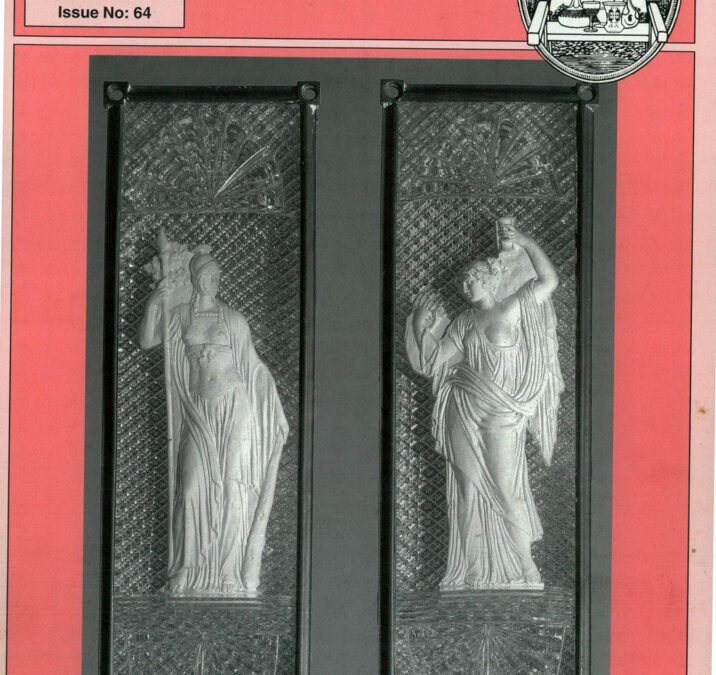
COVER ILLUSTRATION
Door plates, sulphide glass, by Apsley Pellatt, as mentioned
and illustrated in his memoirs of 1821. Now in the Corning
Museum of Glass collection. Pellatt learned of the French
process for making sulphides and introduced it to his own
works in Southwark, obtaining a patent in 1819. He called
his pieces “cameo incrustations”. ( Photograph courtesy
of Mallets (Fine Arts) Ltd, London W1 )
EDITORIAL
THE SEPTEMBER NATIONAL MEETING
A reminder about our meeting at the Crafts Council,
London. Saturday 20 September 2003.
(See our back
page).
The Jerwood Applied Arts Prize was established
in 1995 to celebrate excellence and originality in the
applied arts. This year the medium is glass and we will
see a number of the candidate pieces and the prize-win-
ning piece. The meeting will start at 2 pm with a talk
on the Jerwood prize and the exhibits, to be given by
Amanda Hedley, Acting Exhibitions Manager, who
graduated from the Glass course in Sunderland in 1999
and formerly worked at the National Glass Centre.
GLASS AT THE AUCTIONS
Covering auctions in a balanced way is never easy. We
suspect that auction houses may often themselves be good
judges of what will interest our readers. So as an experi-
ment we are inviting auction houses to provide us with
copy: preferably one or two paragraphs about items from
recent
auctions and one or two pictures of the glass items
concerned. We may have to ration and rotate our cover-
age even more than at present, of course, but will be
glad to receive help. Contact brian@currie.co.uk.
ANNUAL GENERAL MEETING,
This will be at the Red House Cone, Wordsley, on Satur-
day 25 October 2003. In the morning there will be an op-
portunity for a limited number of members to visit the
nearby factory of Messrs Plowden and Thompson, manu-
facturers of drawn rod and tubing and technical items.
The afternoon meeting will include a lecture by
Jim Frost, entitled: “Glass – What’s in it”. Jim is a re-
tired scientific glass blower and is internationally fa-
mous for his lecture demonstrations.
PLANS FOR OUR 21′
2004 will see the 21st anniversary of the Glass Asso-
ciation and the Committee thinks we should mark this
event in some way. If you have any ideas how we should
celebrate this ‘coming of age’, let the
Cone
editors know.
Suggestions will be passed ‘on to the committee, and
published in the next couple of issues.
MEMBERSHIP FORMS
New membership forms for the Association have been
designed and printed so if any readers have a stock of
the old paper forms, would they please jettison them.
The new forms for prospective members may be ob-
tained from the Membership Secretary (address in the
box on this page) or from Broadfield House.
SAD NEWS
Our sincere condolences to David Watts over the sad
death of his wife Rosemary in late January. David Watts
of course is known for his long-standing involvement
with the Glass Circle but he and Rosemary have always
been staunch supporters of the Glass Association. In-
deed Rosemary was a founder member not only of this
Association but also of the Friends of Broadfield
House. She always made a point of chatting to new-
comers at Glass Circle meetings, making them feel very
welcome. She will be much missed.
The opinions expressed in the
Glass Cone
are
those of the contributors. The editors’ aim into
cover a range of interests and ideas, which are
not necessarily their own. However, the decision
of the editorial board is final.
COPY DATES
Autumn
Early August 2003
Winter
Late November 2003
The Glass Cone’ – Issue No 64: Summer 2003
Ananas comosus – Pineapple
Coffee arabica L., Coffee
GLASS FLOWERS
The National Meeting in Sunderland in 1996 was de-
voted to the subjects of Finnish glass and Art Nouveau
and Art Deco glass, but there was an unexpected bo-
nus in the small exhibition of beautiful glass models of
sea anemones by Leopold Blaschka (1822-1895), which
I
found quite entrancing. So when
I
was in Cambridge,
Massachusetts, recently, I made a beeline for the
Harvard Museum of Natural History where
The Ware
Collection of Glass Models of Plants
is on permanent
display.
These 4,400 models were commissioned by Pro-
fessor George Lincoln Goodale, founder of Harvard’s
Botanical Museum, and made by Leopold Blaschka
and his son Rudolf between 1886 and Rudolf’s death
in 1936.
According to an explanatory leaflet, Professor
Goodale wanted life-like representatives of the plant
kingdom for teaching botany. At the time, only crude
papier-ma.ché and wax models were available. The life-
size models include over 800 species with remarkably
accurate anatomical sections and enlarged flower parts.
Since the flowers are always in bloom, tropical and tem-
perate species may be studied at any time of the year.
Unlike the Blaschka sea anemones, the plant
models do not really look like glass at all. However, as
the leaflet continues “The models are made entirely of
glass, often reinforced internally with wire support…The
parts were shaped after the glass was softened by heat.
Some models were blown. Colored glass was used for
many or they were enameled with a thin wash of colored
ground glass or metal oxide(s) and heated until the
material fused to the model. The early models were ‘cold
painted’ with artist pigments.”
Susan Newell gives a fuller description of the
Blaschkas’ working methods, based on Professor
Goodale’s account: “The Blaschkas used traditional
lampworking techniques, choosing glass of different
chemical composition depending on the way it was to
be manipulated to achieve the desired shape. The glass
elements were carefully fashioned with traditional tools
and the model then constructed using, when necessary,
wire, glue and occasionally paper or card. The finished
models were cold-painted with minute care to match
colours and create appropriate textures. Finally they
were often glued to plaster bases coloured to resemble
their original habitat. This combination of superb tech-
nical skills, manual dexterity and artistry in glass paint-
ing applied to the making of scientific models was
unique to the Blaschkas at this time and remains so to
this day.” (from
The Sea-Anemone Models made by
Leopold Blaschka
in
The Art of Glass,
ed. by Victor
Arwas. Andreas Papadakis, 1996, p.98)
The incredible number, fine detail and botanical
accuracy of the models make this an exhibition not to
be missed. And I only found out about it by chance
when browsing through a guidebook to Boston!
Yvonne Cocking
Photographs by Hillel Burger. They illustrate items in
the Collection of The Botanical Museum, Harvard Mu-
seum of Natural History. Excellent colour postcard ver-
sions of the pictures are available from the Museum.
Ken Cannell
reports that he has a book
The Glass Flow-
ers at Harvard
by Schulter and Davis, photographs by
Hillel Burger, published by the Botanical Museum of
Harvard University. ISBN 0 963 4405 0 0, 120 pp. His
edition was published in 1991.
The Glass Cone’ – Issue No 64: Summer 2003
Ian Turner with his first piece of glass.
Part of the collection
AN ENTHUSIAST CHANGES DIRECTION
4
Ian Turner,
a past Chairman of the Glass Association, has
announced that he is selling the whole of his collection of
Monart Glass Brian Currie talked to him about his decision.
Why are you giving up your collection now?
For a combination of reasons: partly because
I
can’t find
any new pieces that I desperately want to buy at a price that
I can afford, and partly because I’ve run out of space in
which to display it all. Acquiring and owning such a large
collection has given me a lot of pleasure, but I enjoy
collect-
ing,
and when the collection has become static, as mine has
been for the past few years, some of the fun has gone. So –
very reluctantly — I’ve come to the conclusion that I should
sell what I’ve got and start collecting something else.
How did your collection start?
Very much by accident. Hilary and
I
started going to an-
tiques fairs in the early 1980s when she was interested in
Shelley porcelain. On one such occasion
I
wandered off and
found a big mottled pink vase which the dealer said he thought
was Monart but he wasn’t sure because there was no label
and nothing had been published about this sort of glass.
I bought it because I liked it and then, at the next
Stafford Bingley Hall Fair,
I
found myself standing next
to an elderly man who was talking to a stall-holder about
a
piece of glass on her stand which she thought was
Monart. The man she was talking to wasn’t sure about it
because the pontil mark “wasn’t right”. After he had
moved on, I asked the dealer who he was. She said that his
name was Cyril Manley and that ‘what he doesn’t know
about glass isn’t worth knowing’. She had sold glass to
Cyril before, and so she gave me his telephone number.
I rang him, told him that I was interested in Monart
Glass, and received an invitation to go to his house to have a
look at his collection. When I got there I found not only that
Cyril had a huge glass collection, which included some very
nice pieces of Monart that are illustrated in his book
Deco-
rative Victorian Glass,
but that Paul Ysart, its maker, was a
personal friend. Friends for nearly 50 years, both were by
then widowers who were almost housebound and lonely, and
they used to call each other on alternate Fridays to chat about
glass After a couple of very late night visits to Cyril’s home,
by which time I had started to learn more about both the
Ysart family and their glassware and paperweights, it was
obvious to me that, unless someone researched its history by
interviewing Paul Ysart and the other workmen at Moncrieffs
in Perth where it had been made, the history of this glass
would be lost forever. So, that’s what I did.
How did you go about that?
Well, I joined the Glass Association, and got a lot of en-
couragement and help from Charles Hajdamach and
Roger Dodsworth at Broadfield House. Through the As-
sociation
I
got to meet other collectors who were into glass
research. But in truth my greatest break came from Cyril
Manley. He gave me an introduction to Paul Ysart, and
during 1984 and 1985 I made several long journeys to
Paul’s home in Lyth near Wick.
I interviewed him at length about the whole of his life,
including his childhood in France when his father worked at
the Schneider factory, as well as his own working life at
Moncrieffs in Perth and later at Caithness Glass in Wick.
Without these personal reminiscences the facts about the
French connection might have been lost. I also went back to
the North British Glassworks in Perth and interviewed some
of the people who had worked with Paul before he left
Moncrieffs to become the Master Glassblower and Training
Officer at Caithness in 1963. Betty Reid, who was the dis-
patch clerk at Moncrieffs from 1944 until 1982, was very
helpful, and when she died in 1993 she left me all the factory
pattern books and other Monart archives that she had been
able to ‘rescue’ from a skip after Monart production ceased.
Again, without people like her, this important part of Scot-
land’s manufacturing history would have been lost.
How did you put your collection together?
For the first few years I bought a lot of pieces at antiques
fairs and from antiques shops in Scotland, and then in 1985
I bought Cyril Manley’s own collection just before he sold
the rest at auction in 1986. I then wrote a couple of articles
about Monart, one for the catalogue for the
British Glass
Between The Wars
Exhibition at Broadfield House in 1987.
There was such a big increase in prices that it al-
most forced me out of the Monart market for a few years,
particularly when Michael Parkington fell in love with it
and had dealers searching the length and breadth of the
‘The Glass Cone’ – Issue No 64: Summer 2003
country for every good piece that came onto the market.
This continued after the publication of the book
Ysart
Glass ( to which Ian was a major contributor),
but after
Michael Parkington’s death I went to both his sales – at
Christie’s – and selected some of the best pieces from his
collection which complemented my own. I also bought
selectively from Frank Andrews and later from Nigel
Benson, the only two dealers who have specialised in this
kind of glass.
How are you going to dispose of your collection?
It will be offered for sale by Christie’s South Kensington
on September 24 2003 as a single owner Monart sale. I
shall be helping to compile the catalogue, so that I can
attach a provenance to all the important pieces, including
those from Cyril Manley’s collection and the Parkington
collection.
Are you keeping any back?
Only a few small and broken pieces which have no real
value; I shall keep these to illustrate a lecture that I give
on Twentieth Century Scottish Art Glass.
Didn’t you acquire some of your pieces from Paul Ysart
himself?
Yes. I was very fortunate to be able to buy some of his
personal pieces of Monart when he eventually moved from
Lyth into a retirement home in Wick.
What will happen to the Monart archives?
I shall give the factory pattern books and the lamp cata-
logues to Perth Museum and Art Gallery in memory of
Betty Reid, but there will be one or two of my own bits of
Ysart memorabilia in the sale.
Will you miss it?
Very much so, but I’ve already started to collect twentieth
century factory art pottery, and that will take my mind
off it for a while.
The photographs were taken by our member
Denis Hebden
who asks us to credit them to
wwvv.web
–
mouse.com
–
the
attribution he uses for his photography work.
APPLAUSE FOR EILEEN
Do you know how your
Glass Cone
reaches you?
At the end of a long process by volunteers (cajoling
news from the glass world, editing, proofing and ar-
ranging the printing), the printed copies are despatched
to Broadfield House. The membership secretary pro-
vides address labels.
At Broadfield House, our member
Eileen Sand-
ers
(sometimes helped by other members, sometimes
helped by the kind members of staff at the museum,
sometimes all alone) leads the effort of packing and
despatching 500 copies to our readers – a task that, as
you may imagine, can take days.
The Committee members are enormously grate-
ful to Eileen for such dedicated work over a long pe-
riod. At their request, in January at Broadfield House
Charles Hajdamach presented Eileen with a surprise –
a large bouquet of flowers.
Eileen Sanders and Charles Hajdamach ( centre) with
John Smith and Jeanette Tranter from the staff at
Broadfield House. Photograph by Kari Moodie, Glass
Interpretation Officer.
NEW MEMBERS
A very warm welcome to the following new members
who have joined the Glass Association since the last
issue of the Glass Cone:
Miss N Hildebrand
London
Mr & Mrs D Holland
Wiltshire
Dr A Jackson
Crewe
Dr R L Judson
Oxford
Mr B Lawlan
York
Mr & Mrs P Luxton
Somerset
Mrs S Piquemal
London
Mr R B Rose
Cheshire
Please note that for members who joined the Associa-
tion before 1 May this year, subscriptions become due in
August. The subscription rates are: Individual £15, Joint
£22, Student £8, Overseas £22 and Institutional £30. The
Membership Secretary will be delighted if he does not
have to send out reminders, and of course our costs would
be kept down.
EVENTS
The CONTEMPORARY GLASS SOCIETY, founded
in 1997, has launched a new website www.cgs.org.uk,
which includes up-to-date information on events, list-
ings, exhibitions, members, as well as reviews, features
and news. To apply to be a CGS member either visit
the Members section on the website or contact The
Administrator CHG, PO Box 1320, Stoke on Trent,
ST4 2YS. (tel. 01603 507737).
The next major event to be organised by the CGS will
be a three-day workshop at 36 Lime Street, Newcastle
on Tyne with Jan Hein van Stiphout exploring WORK-
ING WITH GLASS AT HIGH TEMPERATURES,
Oct 1-3 to be followed by a one-day symposium at the
International Centre for Life in the same city; the speak-
ers will include two of the 2003 Jerwood prize finalists
(see back page).
Information from CGS.
9
9
‘The Glass Cone’ – Issue No 64: Summer 2003
PAPERWEIGHT NEWS
As I write this article we are in Aberdovey, West Wales, for a
week away from the usual routine and enjoying magnificent
views over the Dovey estuary and Cardigan Bay with not a
paperweight or glass book in sight. It has been a favourite haunt
of ours for many years and we always keep our eyes open but
know there is really little chance of finding any interesting weights
or glass in this part of the country. Having said that, we did
pick up a Pinchbeck weight for the vast sum of £15 in a small
antiques shop near Aberaeron about fifteen years ago.
Our visit to the Woking Glass Fair back in March was
very enjoyable and we always bump into a few other mem-
bers of the Association. For anyone wanting to see a good
selection of weights it is an ideal place as most of the main
paperweight dealers take stands there and several general glass
dealers also have weights As a fair it doesn’t perhaps have the
top quality glass that you will see at the National Motorcycle
Museum fairs but is well laid out and does have plenty of
room between the stands.
We took the opportunity to add a nice crown weight
from Peter MacDougal and a delicate butterfly weight from
Phoenix Paperweights to our collection. Both in our view rep-
resent good quality at a reasonable price. As I also have an
interest in commemorative pressed glass I couldn’t resist a nice
example of a Davidson photograph frame complete with origi-
nal Jubilee portrait of Queen Victoria.
The visit of Bob Banford to the Cambridge Paperweight
Circle meeting in Stourbridge at the end of March had to be
called off due to the death of his father, Ray Banford, the
previous week. Ray had been a dealer in antique glass for
many years and living in New Jersey, an area rich in
glassmakers, gradually developed an interest in paperweights.
In 1971 he and Bob set up their own studio behind the
family home and have been making top quality weights ever
since. Some weights made by Bob had already been sent over for
the meeting so it was a good opportunity to see a selection of his
weights Normally you would be lucky to see more than an iso-
lated example. The consensus of those that I spoke to was that
they were rather on the expensive side even at the discounted
price available to members.
I
couldn’t resist the temptation to
buy the only non-flower weight, to go alongside a double flower
weight produced by his ex-wife, Bobby. Now I will have to look
out for a Ray Banford weight to complete the family collection.
In place of Bob Banford, Roy Brown talked about
milleflori
canes using slides of examples from his own superb
collection and this was followed by a presentation by Bob Hall
on unusual weights from the Strathearn factory. This included
examples from his own collection and photographs of weights
and art glass from Herbert Dreier, one of the craftsmen who
worked at the factory in the 1970s after a couple of years at the
Caithness factory at Wick.
Herbert was present at the meeting and contributed
some fascinating information on both the people that he
worked with, which included members of the Ysart family,
and the production of paperweights and related glass during
his time with Strathearn.
Of particular interest were photographs of complex
millefori
canes which looked exactly like those made in earlier
times by Paul Ysart but which Herbert confirmed had been
made by himself and other craftsmen at the Strathearn fac-
tory. Strathearn type weights containing a mix of both com-
plex and simple canes had presented collectors with a pi r771e.
Were they fake weights produced at a later date? Herbert’s in-
formation appeared to allay this suspicion.
Herbert is currently working at the Plowden and
Thompson Dial Glassworks in Stourbridge and making
Vasart/Strathearn type art glass For those attending the AGM
meeting in October, there should be an opportunity to see
him at work and view examples of his glass.
Back in April the Northern Paperweight Society held a
weekend exhibition of some 1300 weights provided by mem-
bers in Lytham. Unfortunately we were unable to make the
trip but gather it was very successful with a wonderful selec-
tion of weights on show.
I have recently received details of the Cambridge Pa-
perweight Circle meetings for the remainder of the year with
news of a special meeting to discuss a name change to re-
move the specific link to Cambridge now that it has a world
wide membership. No details of possible titles have been re-
vealed at this stage but I support a change to a more appro-
priate title even if the bulk of the meetings continue to be held
in Cambridge.
A friend and fellow paperweight collector is currently
in Scotland and visiting some of the current paperweight
makers so
I
wait to hear if he has any information that I can
use in the next article. I haven’t seen any of the more complex
weights from Peter MacDougal or Peter Holmes yet, but I
gather that they are around.
John Deacons has come up with some new and differ-
ent weights including some that have an overlay of large
millefiori
canes which is then cut and facetted in the normal
way to reveal lampwork in the centre – very unusual!
Our next paperweight event is the second CPC regional
meeting to be held at Godstone
in
Kent in mid June. More of
this and other news next time.
Richard Giles
BROADFIELD HOUSE
From 7 June to 18 September, at Broadfield House Glass
Museum, you can visit an exhibition
Cutting Edge: Designer
Cut Glass from the 20
th
Century.
It will show cut glass from
the 1920s to the 1970s produced by Stourbridge and Birming-
ham factories. The displays show off the innovative designs
that broke away from traditional patterns of cut glass. A di-
verse range of styles were created by home-grown and im-
ported talent, such as Keith Murray, David Queensberry,
Ludwig Kny, David Hammond, Clyne Farquharson and John
Luxton.
“This exhibition shows that cut glass from this area
was very creative and innovative during the 20
th
century”, says
Kari Moodie, Glass Interpretation Officer.
“It
will be a rev-
elation to those who only associate traditional prismatic cut
crystal with Stourbridge, as many of the designs on show still
look very modern today” The glass in the exhibition is from
the Museum’s own collection and some pieces are on display
for the first time. Contact the Museum for further informa-
tion on 01384 812745 or email glass.museum@dudley.gov.uk.
Other Broadfield House Diary Dates:
5 July-28 September
Where are they now? exhibition
19-20 July
Pressed Glass Collectors’ Weekend
2-3 August
Paperweight Collectors’ Weekend
25-28 September
The Glass Festival
25 September-2 Nov Touch: New Work by Denis Mann
The Glass Cone’ – Issue No 64: Summer 2003
The Glass Association
Nominations
for the following committee positions are required by Monday 15
th
September
2003.
Chairman, Vice-Chairman, Hon Secretary, Hon Treasurer, Events Secretary, Membership
Secretary, and one member to serve for three years.
If you can nominate a person for one of the above positions, please obtain their consent and
complete the tear-off form below, sign and obtain a countersignature of a seconder.
Return the form to G, C Timberlake, Hon Secretary, 114 Chesford Road, Stopsley, LUTON, LU2
8DR by or before the due date.
Note:
Brian Currie
has informed the Committee that he is retiring from the Treasurer’s post at
this AGM so a replacement will be needed. All other current serving Officers are willing to seek
re-election if the membership desire it.
n
•
11•=1
•
n
• MI= • III•M •
•
•
• 11•11111 I
The Glass Association
Nomination form for Committee position
I,
nominate
to serve on the Glass Association committee in the position of
Dated:
I,
second the nomination of
to serve on the Glass Association committee in the
position stated. Dated:
I,
agree that my name should be put to the
Annual General Meeting for as a nomination for service on the committee.
n
GLASS AT THE AUCTIONS
A pair of swelling beaker vases of Gu
shape, circa 1755-
60, probably South Staffordshire (detail at right).
Photographs from Christie’s.
On 14 May, Christie’s King Street held a sale enigmati-
cally called
50 Years of Collecting: The Decorative Arts of
Georgian England,
composed of the fine English furni-
ture, ceramics and glass, put together by a very discerning
collector. The London and Staffordshire white enamelled
glass was a small group which had immaculate prov-
enances, many having featured in that ground-breaking
exhibition,
Gilding the Lily,
held at Delomosne’s in 1982,
or having come from collections such as those of George
Lockett, Sir Hugh Dawson, Dyson Perrins, Alfred Trapnell
and Thomas Berners. The highest price paid was for pair
of small beaker vases, exquisitely painted in raised enam-
els
infamille rose
style with flowers issuing from rockwork,
dated to 1755-60; although only 5 % inches high, they
made £19,000 (hammer prices throughout). A
guglet,
painted with birds, made £18,000 and two closely similar
candlesticks, which, although not a pair, were complete
with their contemporary enamel drip-pans, made £14,500.
Bonhams Fine Ceramics and Glass Sale on 21 May in-
cluded a small selection of
fawn de Venise
and Bohemian
glass and fifty lots of paperweights. The most interesting
piece from the early glass section was a rare
fawn de Venise
glass drinking vessel in the form of a boot, circa 1600,
fashioned as a shapely calf, with traces of gilding and red
enamelling, 23cm tall. Bonhams referred to other such
pieces in major collections and commented that while
novelty glass drinking vessels are usually associated with
the drinking traditions of the south German and Tyrolean
regions, the fine work and detail on this piece suggest it
was made as an amusing cabinet piece demonstrating the
most sophisticated Venetian glassmaking techniques for
a rich and noble patron. They suggested a south Nether-
lands attribution for this example. It sold for £7,000
Of the paperweights four Paul Ysart weights all sold
above low estimate, the most expensive, a rare magnum
bouquet on an amethyst ground, selling for £850. One
Bacchus weight also featured in the sale and, despite
scratches and abrasions, made £950. The majority of the
remainder were good French classic weights, 20 from
Clichy, 7 from St. Louis and 14 from Baccarat. Among
the highlights from Clichy were a garlanded weight in-
cluding a sulphide portrait of Queen Victoria (£850); a
blue ground concentric
millefiori
weight (£1,350); a rare
pedestal weight (£1,100); and a signed Clichy scrambled
Facon de Venise Glass Drinking Vessel in the form of a
boot, circa 1600, fashioned as a shapely calf, with
traces of gilding and red enamelling, 23cm Photograph
from Bonhams.
millefiori
weight (£1,300). Good prices were also achieved
for a St. Louis crown weight (£1,500) and a Baccarat
spaced
millefiori
at £800.
Among the items in Halls Fine Art sale on 23 May was
an oval cut glass basket
(picture below from Halls Fine
Art),
early 20th century, engraved with a vignette of a
bird in branches; 12 ins wide.
It looks like a Stuart medallion cameo bowl. These
were made from 1887 when the design was patented, but
this piece bears the registered number 556784, which was
registered to Stuart & Sons Ltd in 1910. Jeremy Lamond
of Halls told us that the carved medallion was without
colour. Your reviewer has only ever seen them coloured
(on clear background). Can a Stuart expert tell us more,
and what was in the specification 556784? An interesting
piece, and it sold for £80.
7
9
9
‘The Glass Cone’ – Issue No 64: Summer 2003
Sotheby’s sale of Glass and Paperweights at Olympia
(14t
h
May) produced an important documentary flask
which sold for £12,000 (estimate £5,000-7,000). Prob-
ably of German or Dutch origin, circa 1700, and of
soda glass, the 1 lin.tall flask is formally engraved on
both sides with stylised domestic scenes of dining and
toasting
(picture below from Sotheby’s).
8
Simon Cottle of Sotheby’s wrote: “It provides a
useful insight into the table manners of the day. One
scene is inscribed
The Kitcat,
the other
The Toasts.
Found in a loft in the South-west of England and a
curiosity to its owner, sadly the flask is suffering from
crizzling. However, it is thought to have been deco-
rated in London in the early 18t
h
century by an itiner-
ant German engraver and bears the name of Jacob
Tonson, a London bookseller and publisher. Tonson
was a founder member and secretary of the renowned
Kit Cat club. He regularly entertained the fifty or so
members of the club at his home at Barn Elms in Lon-
don. Sir Godfrey Kneller famously records the club
in the magnificent group of portraits now hanging in
the National Portrait Gallery. It is probable that the
flask may have been used there rather than at
Christopher Cat’s tavern near Temple Bar in the City
where the members first met and after whose famed
`Icitcat’ pies the club was named.
“The history of the Kit Cat Club is well docu-
mented, flourishing as it did during the first two dec-
ades of the 1 8t
h
century. Its members were some of the
leading members of society, Whig politicians and the
nobility. Whatever the origins of the flask and in spite
of its crizzled condition today, it adds significantly to
our knowledge and appreciation of the fashionable so-
cial world of London in the early 18t
h
century.”
Of a much later date and standing over 2ft. high,
a tall blue-cased goblet and cover engraved possibly in
Russia or Bohemia in the 1860s, was reminiscent of the
work of the Bohemian engraver Franz Zach. Sotheby’s
sold this work
(illustrated here, courtesy of Sotheby’s
Olympia)
of sculptural glass for £72,000 (estimate
£60,000-80,000).
Geoffrey Stafford Charles of Dreweatt Neate tells us that
the firm will be announcing the sale later this year of
part of the stock of well-known member and West Coun-
try glass dealer Wing Cmdr. Thomas. The sale date has
yet to be finalised but “probably 24th September”.
Bonhams, New Bond Street, 30 September to 2 October,
will be selling the contents of Harvey’s Wine Museum
with the glass being sold on 1 October. The collection con-
tains many remarkable items, some formerly in the Walter
E Smith collection, including the ‘Russell’ Amen glass. A
range of decanters, bottles and wine glasses covers devel-
opment from the 17t
h
-19t
h
centuries. A group of items with
Bristol connections includes an important privateer glass
and ‘Bristol Blue’ signed by Isaac Jacobs.
‘The Glass Cone’ – Issue No 64: Summer 2003
LETTERS
ATTRIBUTIONS
Mervyn Gulliver raises some interesting points as to whether
authors should give attributions in their books. There is a
wide spectrum of areas of interest amongst collectors. To
some attribution or dating may not be relevant, but I suspect
that to the majority these matters are important if not funda-
mental to their collections. For this reason I believe authors
should make attributions and give dates where their specialist
knowledge permits. The fact that such attributions must al-
ways have a degree of uncertainty should not be a deterrent
providing the commentator’s confidence levels are declared.
This was the view I took when compiling
Big Book of
Vaseline Glass.
I did not like the loose terminology adopted
by some authors For example the word “probably” is fre-
quently used but what does it imply? Does it mean a 99% or
a 75% or a 50% confidence level? Much the same applies to
the term “circa”. Does that mean plus or minus 10 years, 20
years or 30 years?
My first approach to the problem was to try to estab-
lish mathematical confidence limits, but
I
found this unwork-
able and instead resorted to “gut feeling”. The procedures I
adopted for attributing and dating are described in Chapters
7 & 8. I summarise them as follows.
In the absence of any universally accepted understand-
ing I define the level of uncertainty used in my terminology
and also give the reasons behind every opinion. Thus an attri-
bution without qualification is based on strong prime evidence
with the absence of contradictory evidence. I give it an error
rate of 1 in 100. The qualification
“almost certainly”
implies
that I would expect it to have an error rate of 1 in 50,
“prob-
ably”
an error rate of 1 in 20,
“could be”
an error rate of 1 in 5.
With regard to dating I defined the term
“about”
to mean
+ or – 10 years, and
“period” +
or – 20 years. To these I add a
confidence limit of 1 in 50; anything less is further qualified.
How the foregoing appears in the text is illustrated by
the following examples:
“Photo 58, oval dish, 15.5 cm long. Density 2.57 Wcc,
uranium 0.43% wt. It is press moulded but not marked. A simi-
lar pattern has been seen with a Sowerby trademark.
Probably
Sowerby
about
1900.” [This is shorthand for saying that I would
give it a 95% chance of being Sowerby with a 95% chance that it
was made between 1890 and 1910.]
“Photo 79, a pair of knife rests. Length 8.5 cm, density
2.95 Wee, uranium 0.3% wt. Closely resembles an illustration
in the Molineaux catalogue, but with such a simple design
this is far from conclusive. The density is within the expected
range.
Could be
Molineaux Webb,
period
1870.” [This is short-
hand for saying that I would give it only an 80% chance of
being Molineaux Webb and that I am 95% sure it was made
between 1850 and 1890]
It is not for me to say whether this approach is helpful
to the reader but I do argue that there should be a defined
terminology upon which we all agree when dating and mak-
ing attributions.
Barrie Skelcher
The response from Mervyn Gulliver on the principles of at-
tribution was very detailed and laudable. His book
Victorian
Decorative Glass
is excellently illustrated.
I think I would have tried to include more attributions,
in the light of the fly-cover notes and introduction. These say
that the emphasis of the content deals with the production of
the British factories, but add that American and European
glass is included to illustrate a particular technique or design.
A number of items of Czechoslovakian, Bohemian and Ba-
varian Woods origin are included without attribution.
Identifying the origin of the type of decorative glass
dealt with in this book is not easy and, as Mervyn says, this
was not his aim. For those interested in the manufacturers,
records of some of the styles and techniques of the major
Stourbridge factories have survived, such as those of Stevens
& Williams, Webb and to a lesser extent Boulton & Mills and
Richardsons. Mervyn included some of this material in his
excellent Chapter 5 dealing with British designs
Lesser-known glassworks, like Harrop & Co. and Smart,
also produced glass items in the “continental” manner. Some
records show that they manufactured this type of glass for Webb
and Stevens & Williams There is much good material yet to be
brought into the public view (see below), and to further this
work is one of the chief aims of the Glass Association.
A page from a S&W pattern book
showing the distinc-
tive
work by Harrop. Photo by Dil Hier and courtesy
of Dudley Metropolitan Borough Council.
The Cone has also linked Cyril Manley’s book into the
discussion on attribution. Personally, having spent many hours
in the early days of my collecting in his company, I would still
point the beginner, who is interested in differentiating the ori-
gin of Victorian decorative glass, to the basic rules of identifi-
cation he describes.
Although there are exceptions, which of course prove
the rule, I have successfully applied Cyril’s rules over the years
and believe that they should encourage people to be bolder
with their attributions One of the great things about Cyril
was that he was not afraid to make mistakes
Dil flier
It is indeed worth re-reading Cyril Manley’s guidance (in the
introductory chapters to his
Decorative Victorian Glass)
from
time to time. He reviewed a host of possible identifying factors:
the mode of making, the formation of the neck and rim, the
ground and unpolished pontil as opposed to the ground and
polished pontil, the hollowness of the foot, the diameter of the
foot in relation to the rest of the piece, shapes, colours, the ring,
the reaction to ultraviolet light – and so on for page after page.
Each factor on its own is unreliable, as Manley says
But an accumulation can point strongly to a country or a
9
9
9
9
9
‘The Glass Cone’ – Issue No 64: Summer 2003
region or a maker. Or a set of contradictory factors can leave
you as puzzled as ever.
Some of what Cyril Manley wrote was subjective, based
on his huge knowledge and experience in the glass field. He was
wrong about a few things, both in his generalisations and in his
particulars. But, as Dil Hier says, his rules are a splendid guide
on which to build. They are then to be reinforced and amended
by experience and by help from the ever-growing knowledge
base available in glass literature. Hajdamach, Dodsworth,
Brooks, Perry, Thompson are but a few of the many fine con-
tributors among our own members; and we certainly include
Dil Hier himself and Mervyn Gulliver in the list.
Charles Hajdamach has promised to write about Cyril
Manley in our next issue.
Brian Currie
And on another subject,
Jenny Thompson
writes:
In
Glass Cone
63 I found the article on page 6 fascinating.
I
think the bigger bowl is a centre bowl and the smaller a cor-
ner bowl.
Several Stourbridge firms, and others, made mirrors
for dining tables (Boulton & Mills registered these as pla-
teaux of silvered glass with plated or gilt rims). These, de-
pending on how elaborate the setting was to be, could be in
the middle of the table with a central bowl and smaller ones
in the corners. Like the Sowerby flower troughs, there were
permutations. The mirror illuminated the effect and with can-
dles made a pretty scene.
The Registration of December 1885 for Stevens &
Williams is for “Flint glass tableware”. On a big table they
could be grouped in many ways.
Anyway, this is my interpretation of the writing in the
S&W Pattern Book. We had these mirrors and similar bowls
in our old home.
BOOKS ON VASELINE/URANIUM GLASS: A CRITIQUE
1O
Alan Comyns
gives us a guide to the books on this subject:
Six books have been published on these glasses in the last
twelve years. Serious collectors will need to own four of
them. All Vaseline glass contains uranium, but not all ura-
nium-containing glass looks like Vaseline.
Bibliographic details are given in the Box. For brev-
ity
I
refer to the books as Glickman 1, Glickman 2, Davis
1, Davis 2, Davis 3, and Skelcher.
Glickman 2 is Glickman
1
expanded by the second
author, so Glickman
1
need not be collected. Glickman 2
has a 36-page introduction, notes on about 48 American
producers, a good bibliography, and good coloured pho-
tographs of 593 pieces, of which about 30 are European.
So it is primarily a book on American Vaseline glass.
Davis 1, 2, & 3 are also primarily on American glass.
Davis 2 differs from Davis 1 in having a different photo-
graph on the cover, nine extra photographs, and some
expanded captions. Yes, it is “revised and expanded”, but
only marginally.
Davis 3 is quite different. It may appear to be a third
edition of Davis 2. However, although the text of Davis 3
is an expanded version of Davis 2,
all
the pieces illustrated
are different. Most of them are American.
Skelcher has already been briefly reviewed in
The
Glass Cone
(Issue 61, Autumn 2002). Most of his illustra-
tions are of English pieces but there are a few continental
and US pieces too. There are brief descriptions of 16 Eng-
lish glasshouses. His big contribution has been to attempt
attributions by measuring physical properties.
The general problem of accurate attribution is not
really tackled by any of these authors except Skelcher.
Most attributions are little more than hearsay.
In summary: Vaseline aficionados will need to pos-
sess Glickman 2, Davis 2, Davis 3, and Skelcher, but even
so they may feel that the documentation of their obses-
sion is patchy at best.
Alan E Comyns
Yellow-Green Vaseline! A guide to the magic glass
Glickman 1
Jay L Glickman, Antique Publications,
Marietta, OH, 1991. ISBN 0-915-410-761; 457
illustrations
Possibly both hardback and softback editions
Reprinted 1995.
Yellow-Green VaselineM guide to the magic glass
Glickman 2
Revised edn Jay L Glickman and Terry
Fedovsky, Antique Publications, Marietta,
OH, 1998, ISBN 0-57080-045-6 (softback);
ISBN 0-57080-046-4 (hardback) 144 pp. 593
pieces illustrated in 42 colour plates plus nu-
merous in b&w.
Picture Book of Vaseline Glass
Davis 1
Sue C Davis and Bill McFarling
Schiffer Publishing Ltd, Atglen, PA, 1999
ISBN 0-7643-0830-0, 160 pp.
Picture Book of Vaseline Glass, Revised and
Davis 2
expanded
2nd edn. Sue C Davis and Bill McFarling
Schiffer Publishing Ltd, Atglen, PA, 2001
ISBN 0-7643-1257-X; 160 pp, 450 photos, 675
pieces.
Pictorial Guide to Vaseline Glass
Davis 3
Sue C Davis and Bill McFarling
Schiffer Publishing Ltd, Atglen, PA, 2002
ISBN 0-7643-1644-3; 160 pp.
The Big Book of Vaseline Glass
Skelcher
Barrie Skelcher
Schiffer Publishing Ltd, Atglen, PA, 2002
ISBN 0-7643-1474-2; 208 pp.
‘The Glass Cone’ – Issue No 64: Summer 2003
BOOK
REVIEWS
GLASSMAKERS OF STOURBRIDGE AND
DUDLEY 1612 — 2002 by Jason Ellis, Published by Xlibris
Corporation ISBN 1-4010-6799-9, 601 pp., 3 maps and
15 illustrations. h/back £23, p/back £14 available from
BHGM and wwwamazon.co.uk
This book represents many years of research into the his-
tory of the owners of the Stourbridge and Dudley glass-
works. An enormous amount of data has been incorporated
into this book, which is presented to the reader in such a
way that you can easily dip into the text for information on
specific manufacturers, as well as being absorbing enough
to have you read it from cover to cover.
Chapter notes and an extensive bibliography com-
plement the main body of the book, identifying the origi-
nal source material and providing other incidental
information to supplement the main text.
Anyone with a local knowledge of Stourbridge and
Dudley will gain an invaluable and previously unrecorded
insight into the history of glass manufacture in the area.
However rudimentary maps do little to acquaint a casual
reader with the geographical backdrop to the text.
Jason Ellis has succeeded in writing a book that pro-
vides an exhaustive chronological history of many
glassmakers. This approach can however result in a some-
what linear view of history, leaving less room for the fas-
cinating exploits of factory owners who had a vested
interest in more than one glass manufacturer. Perhaps this
could have been resolved with the addition of some ap-
propriate tables in an appendix.
The emphasis of the book is on the glassmakers rather
than on the glass produced by the various glassworks. This is
an area that obviously requires as much research as Jason
has devoted to the owners of the factories. Perhaps as a re-
sult, he has often quoted or interpreted other less researched
authors and in some instances this lets the book down.
Those are minor observations. The book is excel-
lent; it vividly portrays the sorrows and joys of the people
involved in the glass industry. It also provides a greater
appreciation of some remarkable glass, which would never
have been produced without the dedication and spirit of
the glass manufacturers of Stourbridge and Dudley. This
book successfully fills a gap in the knowledge of this im-
portant heritage.
Dil Hier
And
John Sanders
reviewed the same book for “The
Blackcountryman”:
Jason Ellis has deep personal interests in glass as a collec-
tor and researcher dating back well over twenty years, while
the Ellis family themselves can trace their history as
glassmakers to around 1780. The outcome of this per-
sonal and family involvement is painstakingly brought
together in this impressively-researched work.
Its introductory chapters present to the reader the
broad history of the English glass industry from its early
beginnings: the Weald in 1226; immigrants from Lorraine
and Normandy in the sixteenth century, migration and
movement to the Midlands; the search for fuel and the es-
tablishment of Colemans glasshouse between 1610 and 1614
at Lye (for purists, at Stambermill) just outside Stourbridge,
an area abundant in coal and clay resources. The body of
the book describes the forces which led to the establish-
ment of the glass industry in that particular part of the
Black Country around Stourbridge, Amblecote, Audnam,
Wordsley, Brierley Hill and Dudley. It identifies the indi-
viduals and families whose initiative and enterprise over a
period of some 300 years, from the early 17th Century to
the mid-20th Century, created and shaped a glass industry
renowned world wide for its utilitarian and artistic prod-
ucts, for its innovative techniques and for its craftsmanship.
The names of those individuals who made the name of
Stourbridge synonymous with English glass of the highest
quality are chronicled as never before in one publication.
These details are by far the most impressive feature of
Mr. Ellis’s work. He identifies 49 glassworks (including three
outside the Stourbridge area in Hagley, Worcester and Wa-
terford) and dozens upon dozens of glassmakers and glass-
house owners, financiers and bankers, industrialists and
landowners whose lives were closely bound up with those 49
glasshouses. In the historical presentation of those glasshouses
Mr. Ellis names individuals, families, family relationships and
associated commercial connections. He draws on extensive
and authoritative prime sources of parish and public records
of births, baptisms, marriages and deaths, original legal and
conveyancing documents, county and commercial directo-
ries, the Public Record Office, local and national probate
records, the London Gazette and bankruptcy records (un-
happily an all too regular source of reference), contempo-
rary newspaper reports, and census records. By no means
least, he draws on personal conversations with a selection of
individuals who, in recent years, played a personal role within
the Stourbridge glass industry.
The strength of this book is its solid platform of
scholarly and thoughtful research, with the references an-
notated and presented in such a way as to expand on, not
intrude on, the flow of the narrative. Virtually every chapter
has its own unique characters, as unique as the character
of the glasshouse brought to life in that particular chap-
ter, revolving around the real lives of real people and those
places where they lived and worked (and worshipped) in
conducting their glass business.
For the parochial there is the bonus that Mr. Ellis pro-
motes Dudley, all too often presented as a minor player in
the glass industry, into a casting role. For the glass technician
there is the attraction that Mr. Ellis knows his stuff and can
discourse fluently on glass production techniques. For the
historian there is the reassurance of the authoritative research
work and the fact that he has physically trodden on the ground
where the Stourbridge and Dudley glass industry flourished.
In
his introduction Mr. Ellis quite properly and un-
selfishly acknowledges those authors and scholars who pre-
ceded him and openly makes no apology for quoting from
their works. He expresses the hope that his book will be the
reference book which he always wanted but could not fmd.
This reviewer agrees that this hope has been fulfilled.
John V. Sanders
For those interested in the conservation of glass, Sandra
Davidson has recently published the second edition of
CONSERVATION AND RESTORATION OF GLASS,
Butterworth Heinemann, 2002, 384 pp, 395 photographs,
62 illustrations, ISBN 0 7506 4341 2, h/b £80.
The Glass Cone’ – Issue No 64: Summer 2003
EXHIBITIONS, FAIRS & SEMINARS
We hope this issue reaches you before the close on 10 July of
an exhibition, AZTEC CAMERA, of new work by Eva
Vlvkova and Petr Vlcek at the Studio Glass Gallery, 63 Con-
naught Street, London W2 (closed Sunday and Monday).
ART IN ACTION is celebrating its 27th birthday with a four-
day event from 17-20 July inclusive (10.30-17.30 each day) at
Waterperry House, near Wheatley, Oxfordshire off the M40
Junction 8. Full details and programme from Art in Action,
96 Sedlescombe Road, London SW6 1RB enclosing a sae, or
telephone 0207 381 3192.
Peter Layton’s GLASS ART GALLERY at 7 The Leather
Market, Weston Street, London SE1 3ER (tel. 0207 403
7778, e-mail info@peterlaytonglass.co.uk) is organising
HEAVENLY SCENT, an exhibition of glass perfume bot-
tles and paperweights by contemporary British glass mak-
ers, 11 July to 8 August (open Mon-Fri, 10-17.00). At the
same time and venue, Chinks Vere Grylls shows her glass
work PARALLAX II which explores light, shadow and
shifting imagery.
Visiting Dublin in July? Then why not visit the National
Museum of Ireland? Several late evening events have been
running since the late spring including a special exhibition of
GLOINE: HISTORY OF IRISH GLASS. For details con-
tact bbyron@museum.ie or phone the Marketing Dept on:
( Eire code) + 01 6486392.
And, staying in Ireland, 17-21 September 2003 will see a work-
shop and conference in Waterford City with an exhibition of
contemporary glass. Information from GSOICM: tel. (Eire
code) + 046 75616 or e-mail info@glassartireland.com.
The organising committee of the 16th CONGRESS OF THE
INTERNATIONAL ASSOCIATION FOR THE HIS-
TORY OF GLASS, to be held in two lecture theatres of Im-
perial College, London SW7 from Sept. 8-13, has announced
that there are some seats available at a special day-rate of £60
(rather than the full conference-fee) to hear the papers and
see the poster presentations from some 250 participants, from
the UK, Europe and further afield. This price does not cover
lunch nor the various social events but will include tea and
coffee in the morning and afternoon breaks. As in other con-
gresses there is a strong emphasis on Hellenistic and Roman
glass, but medieval glass in Europe and the Middle East will
have some four sessions and various poster displays.
Facon de
Venise
will be discussed in two sessions while British glass
from the late 17th century onwards will cover some four slots.
The exact order of the papers and presentations is currently
being finalised but why not register your interest in attending?
After all, several Glass Association members will be present-
ing their research and the Association is sponsoring the open-
ing session. Contact: e-mail martine.newby@virgin.net, or
telephone 0207 586 6702.
The shortlist for the 2003 JERWOOD PRIZE in GLASS
has been announced: Alexander Belenschenko, Katherine
Coleman, Mathew Duran, Amber Hiscott, Angela Jarman,
Helen Maurer, Colin Rennie and Koichiro Yamamoto. The
winner of this prestigious prize will be decided on Sept. 8 to
coincide with the 16th Congress but the work of the eight
finalists will be on display at the Crafts Council from Aiigust
22 (closed Sunday and Monday).
Also planned to link in with the 16th Congress will be the
Guild of Glass Engravers’ annual exhibition IMAGES IN
GLASS at the Fine Arts Society, 148 New Bond Street, Lon-
don W.1 from Sept. 1-11. In recent years, this annual display
of the members’ work has gone from strength to strength,
winning much critical acclaim.
The WALLACE COLLEC, ION, Manchester Square, Lon-
don W.1. has organised a number of events as part of the
Glasfest this autumn, organised to coincide with the 16th
International Congress for the History of Glass. A major
exhibition FROM PALACE TO PARLOUR: A CEL-
EBRATION OF 19TH CENTURY BRITISH GLASS
curated by the Glass Circle, opens 21 August until 26 Octo-
ber 2003. It will include sumptuous Regency cut glass table-
ware made for the then Prince of Wales, the rediscovery of
cameo engraving and the production of mould pressed glass.
A fully illustrated colour catalogue will be available. On 30
September there will be a Study Day DIAMONDS, DRILLS
AND WHEELS! centred on this display where it will be pos-
sible to try Victorian-style engraving yourself under the watch-
ful eye of Katherine Coleman, one of the finalists for the
2003 Jerwood Glass Prize and a key member of the Guild of
Glass Engravers, and a tour of the exhibition arranged by
Martine Newby, the exhibition curator. A day of lectures by
various speakers highlighting various aspects of the displayed
glass will take place on 18 Octobei and three days later an-
other exhibition tour but this time including the permanent
glass collection will run with an afternoon visit to Peter
Layton’s studio for a demonstration. Further details from the
Wallace Collection Events Office, or the website
www.wallacecollection.org
The Cambridge Glass Fair on Sunday 14th September will
be showcasing Mdina and Isle of Wight art glass by bringing
together some of the major dealers in the work of these fac-
tories and of Jonathan Harris, the contemporary glass artist.
Jonathan Harris is the son of Michael Harris who was the
founder of both Mdina Glass and Isle of Wight Glass in the
1960’s and 1970’s respectively. And the fair will host a non-
selling exhibition of Chance glass in the foyer. For details con-
tact Paul Bishop on 07887 762 872 or e-mail
Oxbridgefairs@aol.com
The SOCIETY OF GLASS TECHNOLOGY’S AN-
NUAL CONFERENCE has the title:
Creativity in Glass.
21-23 April 2004 at the University of Liverpool. The meet-
ing will incorporate UK New Researchers Forum on Glass,
and History and Heritage of Glass as well as technical
papers on subjects as varied as: Environmental Emissions;
Melting; New Techniques in Analysis; The Secret in the
Surface; The Strength of Structure; Furnaces – Little and
Large. Details from Sara Lindley, SGT, Don Valley House,
Saville Street East, Sheffield, S4 7UQ. Tel: 0114 263 4455.
Website: www sgt. org.
And see page 5 for events at The Contemporary Glass Society