




2
Issue No: 65 – Autumn 2003
The Magazine of
The Glass Association
Registered as a Charity No. 326602
Chairman
Charles Hajdamach
Hon. Secretary
Geoff Timberlake (Geoffctim@btinternet.com)
Editorial Board
Patricia Baker, Ken Cannell, Brian Currie, Roy
Kingsbury
Address for Glass Cone correspondence
Dr P Baker, 2 Usborne Mews, Carroun Road,
London SW8 1LR (or email to Brian Currie:
brian@currie.co.uk)
Address for membership enquiries
John Greenham, Membership Secretary,
1 White Knobs Way, Caterham, CR3 6RH
(john@j greenham. freeserve. co. uk)
Web site:
www.glassassociation.org.uk
ISSN No. 0265 9654
Printed by
The Charlesworth Group
Published by
The Society of Glass Technology for The Glass
Association
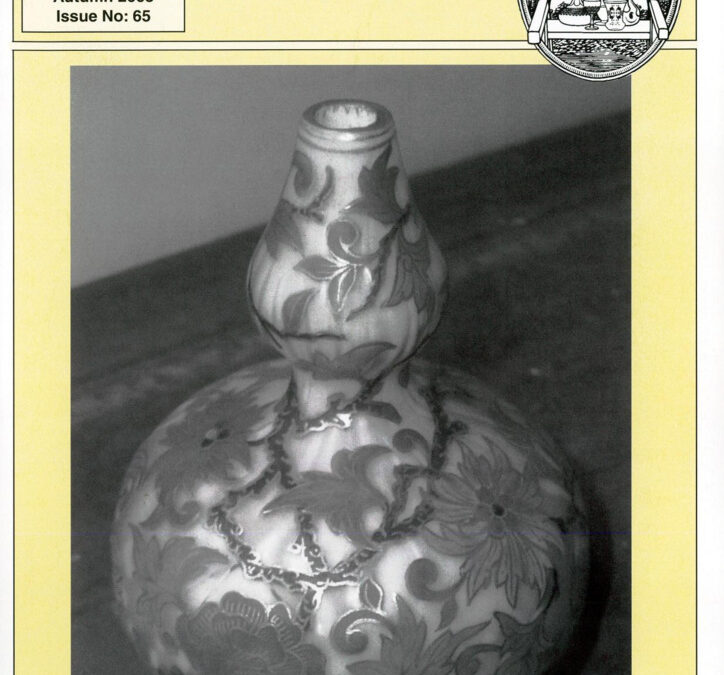
COVER ILLUSTRATION
A Stevens and Williams airtrap glass vase, circa 1885, of
double gourd form, clear glass overlaid on an acid etched
opaque layer with a foliate design, finished with gilt-out-
lined leaves andflowers enamelled in reds and greens, 14cm
high, offered by Bonhams, Edinburgh, on 16 June 2003.
With slight damage, it sold at the low estimate of £300.
Photo courtesy of Bonhams, Edinburgh.
EDITORIAL
OUR 21
ST
BIRTHDAY
In 2004 we will reach our 21″ Birthday! The Glass Asso-
ciation has been extremely successful since the inaugural
meeting held on 5 November 1983 at Stourbridge College
of Art and we plan to acknowledge and promote those
achievements throughout next year. We will also honour
our various members’ successes in research and publica-
tion and we will focus on the rich glass heritage that we
have in Britain. The committee is already working on a
programme of national and regional events which will cover
a wide range of glass topics and be spread periodically and
geographically to allow members maximum access to all
events. During the rest of this year I will be working with
the National and Regional Organisers to come up with a
programme by the end of October. By the time we have
recovered from our Christmas festivities every member will
have received the final programme of events.
Some events are already being finalised including
our Birthday Party which will be held in the spring. Gaby
Marcon is working on the details of that event.
While celebrating our first 21 years, I hope that
next year will also see the introduction of new ways of
delivering our service to our members in order to ensure
our survival for another 21 years. I would therefore be
delighted to hear from any member who has ideas for the
21″ celebrations or for suggestions about ways forward
for the Association.
Charles R. Hajdamach
In our last issue we asked members to suggest how they
would like the anniversary of the Glass Association’s
founding to be marked.
John Westmoreland
points out that a London venue
for any major event is difficult and expensive for a number
of members to attend. Conversely one editor who is a
non-car-driver always despairs when a meeting or lecture
is scheduled for Stourbridge as “everything but a flight and
a ferry is involved” in the journey combination. Obviously
cost is a factor but a pleasant lunch, with the opportunity
of chatting to fellow members, with a couple of lectures
followed by a handling session of glass seems to win sup-
port. But should there be a special theme for the talks and
display glass, as this may deter some people from attending
while persuading others to make the trip?
Or should we mark the anniversary with a purchase
of a glass object for presentation to a national or regional
museum? Some might argue that such an object may be
confined to the stores after six months on public display,
never to be seen again. And if we did do that, should the
glass be antique, modern or contemporary work? Again,
one member of the editorial team suggests that organising
and publishing a fully comprehensive list of the archival sources (that is: documents, pattern-books, photographs,
etc.) held at Broadfield House and Coseley might be a
fitting and useful mark. What do you think?
The opinions expressed in the
Glass Cone are
those of the contributors. The editors’ aim is to
cover a range of interests and ideas, which are
not necessarily their own. However, the decision
of the editorial board is final.
COPY DATES
Winter
Late November 2003
Spring
Early March 2004
Subscriptions became due in August. The Mem-
bership Secretary will be delighted if he does not
have to send out reminders, and of course our
costs would be kept down. And while paying your
subscription – do please add a donation, as many
members already do, to help us with our wider
work of spreading knowledge about glass.
‘The Glass Cone’ – Issue No 65: Autumn 2003
19th century firing glass (fig. 2)
BEEF IS SUBLIME
Earlier in the year I was given the chance by a dealer
friend to see a small, late 18th/ early 19th century firing
glass (ht. 9.5cm). Although the rim was badly chipped,
the intriguing inscription led me to investigate further.
19th century firing glass (fig 1)
The glass has on one side the capital letters `SSBS’
(fig. 1) and, on the other, a medallion with a badge of
some kind (later found to be a gridiron for grilling
steaks), surrounded on three sides by a ribbon incorpo-
rating the words ‘BEEF AND LIBERTY’ (fig. 2). And
what a fascinating tale it had to tell!
From an account by Walter Arnold, published
in 1871, it transpires that in 1733 the actor, John Rich
(1682-1761) became the owner of the Covent Garden
Theatre, London. Under his stage name of Lun, Rich
had starred as Harlequin in what was to become the
traditional pantomime. One evening in 1735, it is said,
Lord Peterborough, dining with Rich in his private
room, was so delighted with the steak Rich grilled for
him, that he suggested the meal should be repeated the
following week.
From this meeting was born The Sublime Society
of Beef Steaks. Its constitution limited the club to 24
members at any one time, and each brother was allowed
to bring one guest. Many of the prominent celebrities
of the day were admitted, such as William Hogarth,
John Wilkes, David Garrick and Bubb Doddington. In
1785 the Prince of Wales joined and later his brothers,
the Dukes of Clarence and of Sussex, taking the oath
as others did: ‘You shall attend duly, vote impartially,
and conform to our laws and orders obediently. You
shall support our dignity, promote our welfare, and at
all times behave as a worthy member in this Sublime So-
ciety. So Beef and Liberty be your reward’. The original
annual fee was £26. 10s., while guests paid lOs 6d each.
The aims of the Society appeared to be nothing more
than the enjoyment of each other’s company and the
excellent food, although unspecified ‘ancient customs’
were observed.
The Brethren were uniformed in blue coats over
buff waistcoats with brass buttons impressed with the
Society’s gridiron badge and motto ‘BEEF AND LIB-
ERTY’; their ring had the same emblem.
Dining was on Saturdays from November to June.
The meal started punctually at 2pm in the Painting Room
of the Covent Garden Theatre, where large beefsteaks
were served on pewter plates accompanied by baked
potatoes, Spanish onions, cold and fried beetroot and
chopped
eshalot (echalotes –
French for shallots), all
washed down with porter, port wine and whisky toddy,
with a Latin toast translating as ‘Let none beyond this
threshold bear away what friends in confidence may
say’. Toasted cheese ended the meal and smoking was
permitted after ‘the song of the day’.
In 1808 the Covent Garden Theatre burnt down
but the Society moved a short step away to the Bedford
Coffee House, and then, a year later, to the newly built
(Old) Lyceum Theatre, known as the English Opera
House in the Strand. There the brethren continued to
meet for the next 29 years until in the early morning of
16 February 1830 when fire struck again and the theatre
was burnt down. The Society returned to the Lyceum
Tavern and then back to the Bedford Coffee House. In
1834 a new English Opera House was built and the So-
ciety was installed in its own room there, surrounded by
paintings and engravings by some of the greatest artists
of the time, some of whom were members.
The Sublime Society was finally killed off by the
coming of the railway which made it all too easy to
leave London at the weekend. On a sad 7 April 1869, the
Society’s effects were auctioned off and the valuable pic-
tures and other relics dispersed into oblivion. However,
in 1876 the actor J L Toole formed a new society called
`The Beefsteak Club’ which is still in existence.
Derek Whitcher
3
The Glass Cone’ – Issue No 65: Autumn 2003
COMPARING GLASS DENSITY MEASUREMENTS
4
Density is defined as the weight of the material per unit
volume and, with glass, will vary with the batch recipe as
finally conditioned in the furnace. There may be minor
density variations (of a few percent) between batches,
and therefore within, say, a suite of drinking glasses.
Factory recipes may also vary over time. Measurement
of glass density can be used to infer lead content and
(together with details of design, decoration and marks,
of colour, dimensions, refractive index, UV induced
fluorescence to confirm presence of lead and X-ray
fluorescence) to assist attribution and dating.
The density of soda or potash/lime/silica glass is
nearly 2
1
/2 times that of water. Boron, as in Pyrex (boro-
silicate glass), will reduce this density. Other ingredients,
particularly lead, barium and uranium, will increase it.
Fortunately these changes are measurable so making it
possible to distinguish between UK and Continental
lead crystal, or between early (lead containing) and later
pressed glass, as detailed in Barrie Skelcher’s latest book
on Vaseline Glass (see Appendix 1 below).
Three Glass Association members, Eric Reynolds,
Barrie Skelcher and John Westmoreland, agreed to com-
pare density measurements in order to check the equip-
ment each of them held. The method was to circulate
six glass pieces varying in size (3-15cms), weight (30-300
grams), and density (2.46-3.42; the highest being equiva-
lent to about 40% lead). Two pieces contained uranium.
The principle is based on weighing in air, then weigh-
ing immersed but suspended in cold water. As the density
(specific gravity) of cold water is 1 (see Appendix 2), the dif-
ference between these two weights is the volume. The weight
in air divided by the volume gives the density. Some adjust-
ment has to be made for the additional weight of the device
used to suspend the glass in water (see Appendix 3). The
density may be used to estimate the lead content, referring
to the graphs published in EM Elville
English Table Glass;
roughly 0.02 density change represents 1% lead
(Glass Cone
No. 33 by Skelcher, and Nos. 34-35 by Plesch).
There are a number of options for the weighing
equipment:
ER: used twin pan equal arm laboratory balance with
hanging pans, using purchased weights down to 1 g.
and others, made of fuse wire by ER, down to 0.01g.
The minimum reading was 0.01g, and the maximum
5kg. Balance on a plank with the glass suspended from
a platform, made by ER to fit on the balance pan, plus
a length of fishing line. (Independent endorsement of
the accuracy of this set-up is being sought.)
BS: twin pan mechanical laboratory balance, using added
weights (some made by BS) and two sliding scales for
final balancing. Minimum reading 0.05g. and maximum
lkg. Balance used at a table edge with plastic suspension
support cantilevered out from one pan, and plastic hook
to attach glass piece to suspension thread.
JW:
single pan electronic laboratory balance. Minimum
reading 0.1g. and maximum 300g. Used with balance
resting on a plank, the glass piece suspended by cotton
thread from a metal coat hanger, resting upside down
on the balance pan, the plank passing through the
hanger. Checks were done with a 200g. brass weight.
Our results for the six sample glass pieces were as follows
(to two decimal places):
Densities
2.45
2.67
2.82
3.10
3.39
3.41
2.46
2.67
2.82
3.11
3.40
3.42
2.46
2.67
2.83
3.12
3.42
3.44
Weights (grams)
307.7
245.5
78.7
130.8
28.2
76.0
Rounding up the results in this way, the spread of
density results between our three tests, averaged across all
six samples was less than 0.02 (i.e. less than 1% lead content)
and the widest spread was 0.03 (1.5% lead). These tests were
carried out under ‘kitchen sink’, not ‘laboratory’ conditions,
e.g. using cold tap water at its delivered temperature, which
varies seasonally, whereas a desirable figure is 15°C (60°F).
But a few
caveats:
1)
Using tepid water will yield density values which are
too high.
2)
Seemingly identical pieces may have come from dif-
ferent batches, and so have different densities.
3)
Hollow stemmed glasses and hollow decanter stop-
pers, etc. will give misleadingly low readings.
4)
Suspending the glass in a plastic net (as used by fruiterers) will
contribute negative weight as they are buoyant; try a hair net.
5)
Very old glass (e.g. dizzied) unsuitable for immersion in water
should be tested with an organic solvent in lieu of water, amend-
ing the density calculation. This is a laboratory exercise.
6)
Very occasionally glass improperly annealed may
crack on submersion in cold water; to avoid this, dip
any suspect (or valuable!) glass in and out of the water
several times to ‘cool’ it before total immersion.
7)
This note relates to conventional silicate glasses, rather
than borosilicate or more exotic glasses. For health, safety
and environmental reasons new recipes are being tried in
lieu of lead and barium, especially in some continental
glass. The use of uranium has very largely ceased, though
it is present in some 1990s American, French and Murano
glass (as noted by Sue Davis in
The Picture Book of Vase-
line Glass
and Ken Tomabechi in
Uranium Glass).
8)
Conversion from density to lead content may be
uncertain because:
i)
Conversion graphs vary, especially at the top end;
ii)
Barium may be present ( not revealed by UV fluo-
rescence);
iii)
Uranium may be present (yellow or green colour and
UV fluorescence). 0.5% uranium affects the density by
as much as 1.0% of lead.
So in the absence of a complete glass recipe, it is advisable
to express the measurement as `°/0 lead equivalent’.
The most important decision, when embarking
on taking density measurements, is the choice of the
weighing balance. The ability to weigh to one part in a
thousand (e.g. to 0.01g. for a 100g. piece) is desirable.
Only the more expensive electronic kitchen scales are
likely to approach this if you wish to achieve a very ac-
curate reading. And, of course, the continuing accuracy
of the scales needs checking at both low and high levels,
as does the accurate working of the balance itself.
Members wishing more information or to make their
own comparison measurements are welcome to contact any
of us: Eric Reynolds 01822 615317; Barrie Skelcher 01728
830463 (also for information about uranium glass measure-
ments); or John Westmoreland 01524 822072.
‘The Glass Cone’ – Issue No 65: Autumn 2003
Appendix 1
Some Typical Densities:
Amorphous Silica
2.20
Borosilicate Glass
2.23
Non-lead Silicate Glass
2.40 upwards
Natural Rock Crystal
2.65
Continental Lead Crystal 2.98 (24% lead)
UK full Lead Crystal
3.20 (33% lead)
Early lead-bearing pressed glass densities range between
the non-lead and full-lead densities. Other lead glasses
may show readings indicating lead content from 15% to
40% (densities 2.8 to 3.4), the latter in some 18th century
glass. Even higher densities are known but barium may
be present.
Appendix 2
Density of Ice and Water
Density of Water Ice is 0.90
at 4°C (40°F)
1.00
at 15°C (60°F)
0.999 (insignificant change)
at 32°C (90°F)
0.995 (significant change)
Appendix 3
Calculation of Density
[Weight of Glass in Air + Weight of Suspension Device]
minus [Weight of Glass in Water including Suspension
Device] = Volume of Glass.
Alternatively, one can deduct the Weight of the
Suspension Device from the in-water weighing result,
which gives the apparent weight in water of the glass
alone. Then [Weight of Glass in Air] minus [Weight of
Glass in Water] = Volume of Glass.
Finally, [Weight of Glass in Air] divided by [Volume of
Glass] = Density of Glass.
Worked Example:
Weight of Glass in Air = 216.4g;
Weight of Suspension Device = 41.3g;
Weight of Glass in Water with Suspension Device = 181.8g.
Therefore:
Volume of Glass = (216.4 + 41.3g) minus 181.8g = 75.9m1 (or cc)
Density of Glass = 216.4/75.9 = 2.85 (19% lead equivalent).
John Westmoreland
PAPERWEIGHT NEWS
It seems no time at all since I put together the last article and now
Wimbledon, the Open Championship and the Tour de France
are over for another year. I suppose the main item of news, which
most of the paperweight enthusiasts will already know, is the
decision by Joyce and Willie Manson to close down both Willie
Manson Paperweights and Phoenix Paperweights and move on
to pastures new in the field of teaching. Back in May there were
rumours that changes were afoot but now the decision has been
made. The order books were closed on July 1st and final closure
of the businesses occurred at the end of September.
Willie Manson’s career spans some 35 years from his ap-
prenticeship alongside Peter Holmes at Caithness Glass under
the guidance of Paul Ysart, leaving in 1970 to join Paul Ysart in
the setting up of Harland Glass. He returned to Caithness Glass
in 1975 but went to work for Aidenhall Company in 1979, mak-
ing weights with either WM, or thistle canes, or a Scotia paper
label. From 1981 he was a freelance artist-maker for Caithness
until he formed William Manson Paperweights in 1997, then
the short-lived Phoenix Paperweights in 2002.
In
Glass Cone
No.61, I wrote that I had ordered two
Phoenix weights at the Cambridge Paperweight Circle meeting
in June 2002 on hearing the announcement of the new company.
I never received those weights despite enquiries and I obviously
won’t get them now but I should add quickly that the butterfly
weight I purchased recently
(Glass Cone
No.64) is far superior
to the two I originally chose. Needless to say, I await with interest
the next chapter in the Manson story.
News from Anne and Peter Metcalfe of Sweetbriar Gal-
lery is that son, Ray, is to join them and eventually take over the
business. With this in mind, Sweetbriar House has been sold
and a shop opened in the village of Frodsham, near Helsby.
The address is 3 Collinson Court, off Church Street, Frodsham,
Cheshire WA6 6PN (tel. 01928 730064), open 09.30 to 17.00
weekdays, 09.30 to noon Saturdays.
The Cambridge Paperweight Circle regional meeting at
Godstone in June provided an opportunity to visit friends as
well as take in the meeting, itself always a relaxed and informal
affair starting with a pub lunch. Assemble a group of collec-
tors together in a room and there is never a real problem with
conversation. The official business of the afternoon commenced
with a news update from Bob Hall, the Chairman, including
details of the visit to the Paperweight Collectors’ Association
convention in San Antonio, Texas. This was followed by an en-
tertaining talk by a Circle member on the joys and problems of
buying weights via internet auctions. Being a dinosaur regarding
computers, I found it an insight into a totally unfamiliar world
and confirmed to me that it will be probably some time before
I venture down that road.
Among the weights on sale were examples of the more
limited production weights from Peter MacDougal and Peter
Holmes of Scottish Borders Art Glass. Somehow a magnum
closepack
millefiori
weight by MacDougal found its way to the
car when we left. However, I confess to a little disappointment
seeing the Peter Holmes’s bouquet weight: the lampwork was
very good but there were far too many striations within the en-
casement for me to consider buying. I trust this was an isolated
case and
I’ll
wait to see others before making a judgement.
In the last article I mentioned a proposal to change the
name of the Cambridge paperweight Circle and at the Extraor-
dinary General Meeting on July 5, a majority voted in favour to
amend the name to Paperweight Collectors’ Circle, a far more
appropriate title.
Recent cof
lespondence from American friends has con-
firmed how much they also enjoyed the PCA biennial gathering
over three days of makers’ presentations, lectures and dealers’ fair.
I confess it sounds too big and organised for my liking with too
much emphasis on the size of one’s wallet. For us the enjoyment
of collecting has come from hunting out those weights in the most
unexpected places and even more if purchased for a bargain price.
I accept we were fortunate to start in the days when paperweights
were more plentiful and today, many collectors have little option
but to buy from specialist dealers, especially if time is at a pre-
mium. To us, weights form a catalogue of holiday memories, trips
around the country, or the early days of the big fairs like Newark
before the advent of antiques programmes on TV
Enough! I understand the exhibition of Baccarat and
St. Louis weights in France in April/May was very impressive
judging from the published catalogue. My next paperweight
session will be at the Woking Glass fair at the beginning of
October, which coincides with a visit by paperweight friends
from the USA. More in
Cone
No. 66.
Richard Giles
‘The Glass Cone’ – Issue No 65: Autumn 2003
The Shaw Goblet at Woolley & Wallis
Jeremy Lamond, at Halls Fine Art (Shrewsbury),
drew our attention to an interesting bottle in Halls sale
on 18
th
July. Described as a Nailsea type octagonal green
and white mottled glass bottle, 19t
h
century, 8″ high (see
next page) it was included in a lot with three other items
and sold for £520.
Sotheby’s Olympia sale on 9 September, Fine
Decorative Arts and Design from 1870, offered a large
collection (over 100 pieces) of Loetz glass. Most of them
bore designs overlaid in silver. The piece illustrated on
the next page sold for £4,500, one of the highest prices
for the Loetz pieces.
6
GLASS AT THE AUCTIONS
18
th
century drinking glasses at Bonhams. From left: Lot 4: 20cm, lot 5: 17.2cm, lot 8:11.4cm, lot 10: 14.2cm, lot 19.•
16.9cm. Photos by Bonhams.
Bonhams, New Bond Street, 10 June sale included over thirty
lots of 18
1h
century drinking glasses. Among them were some
unusual balusters including: lot 4, with a triple annular knop
above a stem containing a tear, on a conical folded foot, which
sold for £880; a glass with a similar
stem, lot
5, but with a bell
bowl and a domed and folded foot, which sold for £950; a
deceptive baluster, lot 8, which sold for £800; a cordial glass,
lot 10, with a bladed knop, £800; and lot 19, with a four-sided
pedestal stem glass containing a teal; which also sold for £800.
A ‘Fiat’ Jacobite wine glass of typical drawn trumpet shape
with a multiple spiral air twist stem sold for £920.
Other items included a shagreen
etui
containing two
facet-cut blue scent bottles mounted in gold and with deco-
ration attributed to the workshop of James Giles which sold
for £880; a Webb and Sons cameo scent bottle attributed to
George or Thomas Woodall in pink glass, cased in white
and carved with a
putto
seated among scrolling foliage, sold
for £5,500, over double the estimate. A good Apsley Pel-
latt small perfume bottle and stopper enclosing a sulphide,
probably depicting the Duke of York, sold for £900.
The September auction at Woolley & Wallis, Salisbury,
ran over two days, 2-3 September. The 57 lots of twenti-
eth-century glass on Day 1 included Whitefriars, Monart,
Loetz, Gall& and Lalique pieces, but bidding was mixed. The
Whitefriars
Banjo
and
Drunken Bricklayer
vases did well, and
a Lalique plafonnier moulded with monkeys’ heads fetched
£3,600, over twice the estimate, but a superb large (40cm.
high) Galle cameo vase clearly failed to reach its reserve.
Day 2 included just 29 lots of English and European
glass, of which the most impressive piece was the Shaw Goblet.
Estimated at £4,000-£6,000, it finally sold for £9,800. Made cir-
ca 1720, this large and imposing English glass armorial goblet,
with funnel bowl over a heavy knopped stem and domed and
folded foot, stands 47.5cm with its cover. The bowl is engraved
with the arms of Shaw of Eltham Bt above the motto
Vincit
Qui Patitur.
It is thought that the glass was made for the third
baronet who married in 1716. The goblet was accompanied
at auction by a number of letters and a cheque relating to the
purchase of the goblet in 1926. This is the kind of provenance
which seems to be rare in the world of glass.
‘The Glass Cone’ – Issue No 65: Autumn 2003
Loetz large silver
mounted vase, the cylin-
drical sides of frosted
glass with combed
decoration in shades of
blue and a continuous
band of grasses, the de-
tails carved through the
glass and the silver foot,
16in high, the glass with
engraved mark, ‘Loetz,
Austria’ and ‘1530’, the
silver marked, STER-
LING SILVER, DE-
POSIT. Shape: Prod
no. 87. Photograph
from Sotheby’s.
Nailsea type octagonal green and white mottled glass bottle, 19
12
century, 8″ high, in Halls sale on 18
6
July (see previous page).
Photograph from Halls Fine Art.
CHINESE WHISPERS – A PARTY GAME
Reference to Wrockwardine glass in my review of Paul Luter’s
booklet on East Shropshire glass
(Glass Cone
No. 63) led me
to check in my own library of glass books to see how earlier
writers had described it. The result was a salutary lesson in
confusion, contradiction and, perhaps, simple plagiarism.
The earliest references to Wrockwardine were by JC
Varty-Smith in
The Collector
(vol.3, 1907, pp.307, 316) who
illustrated several glass flasks under this attribution. Unfortu-
nately these, along with manufacturing details, all related to
the striped glass we would now call `Nailsea’ or Nailsea-type,
although Nailsea, as such, was nowhere mentioned.
Four years on and H. St. George Gray, in the first
of his seminal articles on Nailsea
(Connoisseur,
June 1911)
noted ‘Some glass ewers of amber colour and pale green
splashed with white, red and yellow are said to have been
made at Sunderland, Wrockwardine Wood (Salop), Hop-
ton Waters [sic.], etc..’ It was another nine years
(Connois-
seur,
June 1920, with Margaret Lavington) before he added
in another footnote ‘It cannot be positively stated that every
piece here described was actually made at Nailsea, but all,
or nearly all, of them are of the Nailsea
type.
Many of
the pieces were collected at Nailsea or in the immediate
neighbourhood.’ However it is unclear as to which items he
was referring since, apart from a single colour plate, all his
illustrations are in black and white. By this time Maciver
Percival in
The Glass Collector
(1918, p.188) had offered
his attribution of a ‘darkish green splashed red, white and
pale blue’ jug in Shrewsbury Museum as possibly coming
from the Hopton Wafers glasshouse, Salop.
In 1922, SC Johnson had no doubts: ‘At Wrockwardine
and other village centres in Shropshire there were small factories
which produced a ware having a peculiar striped and splashed
outer surface, … being rendered in a colour other than that of
the body. Both opaque and transparent metal was used for the
ornaments, which consisted of small drinking glasses, jugs,
scent-bottles, trifles for the dressing-table, and playthings. As a
rule, the work was quaint but not always pleasing’
(Collecting
Old Glassware,
pp.27-8). But WA Thorpe
(A History of English
& Irish Glass,
1929, p.287) warned of the difficulties differentiat-
ing the glass produced at Nailsea and at Wrockwardene (sic)
stating ‘only the yellow mottling seems to distinguish it from
the Nailsea types’. Six years later in his
English Glass
(p.234) he
was rather less specific writing ‘Blotched decoration probably
arose independently in many bottle factories.’
It was with some excitement that I came across a refer-
ence which appeared to be based on documentary fact rather
than unsupported typology: Bernard Rackham (Transactions
of the SGT, vol.18 (1934), p.320) referring to a jug of the Nail-
sea-type ‘with flecks in several colours, is
recorded to
have been
made at Wrockwardine’ (my italics). Unfortunately no further
details were given. That did not stop GM Vallois
(First Steps in
Collecting,
1939, p.219), whose wording suggests a production
range unique to Wrockwardine including ‘spirit flasks, double
and single, the double ones having the necks curving across
each other, like the twin oil and vinegar bottles’.
WB Honey in his guide to the V&A collection
(Glass: a
Handbook,
1946, p.122) was presumably following Rackham
in referring to a V&A jug (inv. no. C. 10-1932) ‘traditionally
ascribed to a glasshouse at Wrockwardine’. This piece was not
illustrated but presumably it is the one currently on display (no.
9168) as ‘possibly Wrockwardine, early 19th century’. That
said, nothing distinguishes this piece from others very similar
in appearance not so labelled, including one (no.9141) with
applied and rolled coloured glass chips which many collectors
nowadays would happily label as Wrockwardine.
In 1951, H Mordaunt Rogers
(The Making of a Con-
noisseur
p.269) having described Nailsea glass as somewhat
freakish, simply added Wrockwardene [sic], with its splashes
of bold colour, is more freakish still’. Edward Turleigh a year
later
(Antique Dealer & Collector’s Guide,
hereafter
ADCG),
July 1952) suggested that ‘Shropshire Nailsea’, as he called
it, was ‘generally distinguished by yellow mottling .. being
7
The Glass Cone’ – Issue No 65: Autumn 2003
8
influenced by local conditions, the raw materials available
and the preference of the people where it was made’ but
gave no evidence for these assertions. Elville, writing in 1954
and 1961, just referred the reader to St George Gray and
Thorpe, and Bernard Hughes
(English Glass for the Collector
1660-1860,
1958, pp.192, 195) also accepted the theory that
so-called `Nailsea’ glass was made in a number of places
including Wrockwardine but states that it was known for its
rolling pins of striped glass of two or more colours, a view
repeated by his wife, Therle Hughes, a year later
(Collecting
Small Decorative Antiques,
p.74).
Even an authority like Hugh Wakefield
(19th Century
British Glass,
1961, p.27) was undecided, referring to a jug in
the V&A with colour-splashing as ‘almost certainly made’
in Wrockwardine, changing this in the 1982 edition to ‘is be-
lieved to have been made’ and preferring Donnington Wood
glasshouses… (otherwise known as the Wrockwardine Wood
glasshouses)’. In 1962 the Glass Circle exhibited a dark green,
white-flecked jug noting that these had ‘been ascribed to both
Nailsea (probably wrongly) and to Wrockwardine, but were
probably made in several bottle-glass houses’, the information
being repeated for the 1968 V&A exhibition catalogue.
In 1968 R Wilkinson
(The Hallmarks of Antique Glass,
p.149) defined Rockwardine (sic.) as dark green bottle glass
`spottled’ with blue, white and red, but George Savage five
years later
(Glass & Glassware,
p.46) associated the glass-
house with a pale green jug speckled with opal adding ‘they
were also made at Stourbridge and attributed to Nailsea.’
Ever hopeful, I turned to a local guide book (W
Howard Williams
A History of Wrockwardine Wood Church
& Parish,
1974, pp.10-11) but it only listed the range as ‘dark
green bottles for the French wine trade, some window glass,
ornamental walking sticks, rolling pins and dark green door-
stops’ and makes no mention of colour decoration, spotted
or striped. Ruth Hurst Vose
(Glass,
1975 p.102) is the only
one to associate striped and flecked
clear
glass with Wrock-
wardine, while Sylvia Coppen-Gardner in the same year
(A
Background for Glass Collectors)
includes Wrockwardine in
a list of centres producing ‘peasant’ glass before 1851.
H Newman’s
Illustrated Dictionary of Glass
(1977)
says only ‘some Nailsea-type glassware was made at nearby
Rockwardine [sic].’ Different spelling again was given by
Graham Webb
(ADCG,
Dec. 1977): Hopton Wafter and
Wrocmandine; hardly inspiring confidence!
A year later, Barbara Morris (
Victorian Table Glass &
Ornaments,
p.71) apparently had no problems in identifying
a V&A piece as ‘certainly made… in Wrockwardine’; pre-
sumably this was the piece attributed by Honey as ‘possibly’
and Wakefield (1961) as ‘almost certainly’. In 1984 Rob-
ert Charleston
(English Glass…,
p.210) followed Wakefield
(1982), writing ‘believed to have been made…’
More recent writers such as Charles Hajdamach and
John Sandon have wisely followed the approach taken by
John Brooks and Felice Mehlman in the early 1980s who
pointed out that this type of simple flecked, speckled and
striped ware was made in various glasshouses in England and
Scotland ‘and their uniform appearance, in terms of colour
and decoration [and the absence of manufacturers’ marks],
has made the process of attribution difficult, if not impos-
sible’ (Mehlman,
Antique Collector,
Feb 1981). I agree!
Ken Cannell
( Wrockwardine is on the western fringes of Telford and Hop-
ton Wafers lies east of Ludlow, both in Shropshire. Nailsea,
of course, is south west of Bristol. Eds. ).
CONTROVERSY FACES PORTLAND VASE
An American scholar has put forward a theory that the
Portland Vase is a product of the Renaissance period and
not Roman. Dr. Jerome Eisenberg, a specialist in fakes
in ancient art, who advises museums such as the Getty
and the Metropolitan in America, will publish his con-
troversial findings in the September issue of
Minerva,
the
international review of ancient art and archaeology. He
will also present his findings at Harvard University at the
XVIth International Congress of Classical Archaeology.
Dr. Eisenberg believes that it was a late 16t
h
century artist,
possibly an engraver of cameos, who created the vase rather
than an artist of the 1st century. Amongst his reasons, he
cites his views that the artist who created the vase did not
possess a true knowledge of classical mythology, that the
unusual lack of attributes for the principal protagonists
shows an artistic naivety which could not have occurred in
Roman times, and that the figures on the vase are far more
three-dimensional than those on most Roman cameo glass.
Eisenberg emphasise that he is not dismissing the vase as a
fake but simply “reallocating” it to the late Renaissance.
The findings are already causing ripples at the Brit-
ish Museum where the Portland Vase is on display. Susan
Walker, deputy keeper of Greek and Roman antiquities at
the museum is quoted as saying “We await the publication
of Dr. Eisenberg’s article with interest.” Museum staff still
believe the vase is Roman.
Until we hear more, all we can say is watch this
space!
(Information courtesy of The Times, 21 August 2003, article
entitled “Roman Vase ‘is work of Renaissance man.'”)
CUMBRIA CRYSTAL
In May 2003, the future looked very bleak for Cumbria
Crystal of Ulverston as it went into formal liquidation
because of financial difficulties, largely owing to the fall in
tourist numbers following the foot-and-mouth outbreaks.
As reported in the
Westmorland Gazette,
23 May, two
thirds of the 21 staff had already been made redundant
and just seven staff had been retained to keep the compa-
ny’s shop open for the high-quality tableware which graces
many British Embassy dinner and banqueting tables.
However, on 4 July the
Gazette
stated that a con-
sortium, `Greatdale Ltd.’, had made a successful bid,
and already nine of the skilled glass-makers had been
re-instated. Leading the consortium as Managing Direc-
tor is Colin Dachtler, head of a London-based wedding
list service and one of Cumbria Crystal’s best custom-
ers. He said that he felt confident that all the company
accounts with such stores as Harrods, John Lewis and
Linley will continue. In late August came the news that,
with significant orders received, 13 of the staff were now
back at work.
( Thanks to
John Westmoreland
for the newspaper cuttings. )
NEW MEMBERS
A very warm welcome to the following new members
who have joined the Glass Association since the last
issue of the
Glass Cone:
Mrs S Brown
Hants
Mr A Cleaver
Walsall
Mr M Cripps
Middlesex
Mr M Gorringe
West Sussex
‘The Glass Cone’ – Issue No 65: Autumn 2003
CYRIL MANLEY: IMPRESSIONS AND MEMORIES
Recent issues of the
Glass Cone
have carried references to
Cyril Manley and his glass collection, and his book
Deco-
rative Victorian Glass,
published in 1981, often features in
conversations on the subject. In this context I felt it might
be useful to record my memories about Cyril whom I knew
for many years after I came to work on the glass collections
in Dudley in 1974.
After being in post for a few weeks, I eventually met
Cyril and was invited to visit him at his bungalow in Quarry
Bank. My initial impression was that it was not dissimilar
to the `Tardis’ in the
Doctor Who
television programme;
on the outside a relatively small building, but on the inside
it seemed to go on forever. My reaction was one of amaze-
ment at the size of the collection and admiration that one
person had been responsible for building it up over many
years while running a business and bringing up a family.
One never left the Manley house early and on that first
visit I think I left sometime after 3 a.m. having arrived at
8. The earliest I ever left was 1 a.m. but, to achieve that,
one had to stand up and move to the door of the lounge
making suitable noises about having to get home. After an
hour one was able to move into the kitchen making similar
utterances. Another hour passed and one got to the kitchen
door. After another hour elapsed one was eventually al-
lowed to make one’s way up the garden path, but inevitably
you were always called back to be shown something that
Cyril had forgotten to mention earlier.
Cyril’s three most notable achievements were his
collection in all its myriad aspects, his inspiration and
encouragement to fellow collectors, and the publication
of his book. Not only was he one of the first collectors to
appreciate 19t
h
century glass, putting together examples of
the finest techniques such as cameo, pull-up, moss agate,
matsunoke,
satin air-trap and so on, but he also collected
20th century British glass years ahead of any other collec-
tors and many museums. He also appreciated continental
glass and although that part of the collection was rela-
tively small, there were some stunning pieces, notably a
large Murano Handkerchief vase, now at Broadfield, and
a Fish
Graal
vase by Edward Hald. He was fascinated by
paperweights and put together an impressive assoi
tinent
of contemporary Caithness weights. One of his collections,
which tends to be forgotten now, was the salt cellars. For
a number of years he tried to find a home for it with a
museum but had no takers. Eventually it was sold by Giles
Haywood.
Cyril’s collection and his stories and knowledge about
glassmakers inspired new collectors of glass to specialise
and build up their own collections. Ian Turner, his collec-
tion of Monart glass, and his solid research and publication
about Ysart glass, is perhaps the most well known example
of that inspiration.
In the last twenty years of his collecting career Cyril
would often approach contemporary engravers and com-
mission one-off pieces from them for his collection. Even
today, there are not many collectors who partake in that
kind of patronage and support. One of those to benefit was
Doug Burgess, the stipple engraver from Holmes Chapel.
His commission from Manley, a goblet showing Dudley
Castle, is currently on loan to Broadfield House.
In 1981 his collection received international publicity
with the publication of
Decorative Victorian Glass.
Having
spent many, many weeks and months writing the text and
working closely with Angelo Hornak, the photographer,
Cyril was extremely proud of it when it was printed. The
book was probably the first of its type to focus on one
person’s private glass collection and it must have been a
brave publisher to make the decision to commission it. The
foreword by Eric Lineham, a highly respected dealer of his
day, shows the high esteem that Cyril enjoyed within the
trade. Brian Currie and Dil Hier have already stressed the
benefit of Cyril’s advice about the basic rules of identifica-
tion
(Glass Cone
No. 64). The section at the back of the
book on marks on glass was also a first.
The book seems to divide glass collectors into two
camps, those who use it as a bible and those who are more
sceptical of many of the comments. In the foreword Cyril
admits that although he did do research through archives
and pattern books he was happiest talking to glassmakers
and engravers about techniques as well as their memories
of the industry. As far as I know he never kept any written
records of these conversations and it is perhaps this lack
of what can best be described as an ‘academic’ approach,
which risks devaluing many of the statements in his book.
If he had followed up some of the leads given to him by the
glassmakers who still had links with the 19t
h
century, and
recorded them, the information would have been invalu-
able. But because there are many confusing and erroneous
statements in his book, what may well be true is tainted by
association with the mistakes. The best way to appreciate
his book is to come to it after absorbing information from
other books on the subject. In this way one can avoid the
pitfalls of some of Cyril’s more idiosyncratic views.
Cyril was the victim of his own achievements. When
he was putting his collection together, the Black Country
was still an unknown area to many outsiders. It was a very
insular place with each village having its own identity and
dialect. Some of that still survives, especially in areas such
as Quarry Bank and Lye. Although public glass collections
had been set up in Brierley Hill in the 1930s and in Stour-
bridge following the 1951 Festival of Britain exhibition, the
museums tended to be run by caretakers, as at Stourbridge,
or the work was handed over to the nearest member of staff,
as at Brierley Hill where Herbert Woodward did a sterling
job looking after glass having been trained as a librarian.
In this relative vacuum of glass expertise it was in-
evitable that Cyril was given the mantle of the local glass
expert, a reputation which he adopted and enjoyed. (See
Ian Turner’s interview,
Glass Cone
No. 64, where he quotes
an unnamed dealer- ‘what he (Manley) doesn’t know about
glass isn’t worth knowing’) Because of that he inevitably
came to feel that when asked to give an attribution he
could never say ‘I don’t know’ or ‘ there are two or three
possibilities’.
An example occurred at one of the Glass Weekends
that Dudley used to organise in the 1980s. On the Friday
evening the arrangement was to invite VIPs from the glass
industry to meet the participants. On this occasion every-
one had been invited to bring along items for the panel to
discuss and identify. When it came to Cyril’s turn, he was
shown two different water goblets dating from the late
1870s with all the characteristic features of Stourbridge
9
The Glass Cone’ – Issue No 65: Autumn 2003
10
glass that anyone could wish for. After some minutes it
became obvious that he was having trouble arriving at an
identification. Finally he came out with the comment that
they were ‘Dutch’. The embarrassment was palpable. Poor
Cyril was hostage to his reputation for omniscience.
As word spread about his amazing glass collection
in a bungalow in Quarry Bank, security became a major
problem. After his wife died he would often need to get a
`minder’ to stay in the house while he went shopping and the
collection became a prison for him. Eventually he decided
to sell the entire collection. After an abortive approach to
Christie’s, where he disagreed with their estimates, the col-
lection was sold by Giles Haywood at The Auction House
in Stourbridge over two days on the 7 and 8 July 1986.
The sale attracted all the major glass players. Even
Michael Parkington paid Cyril the compliment of coming
out of London to attend the viewing. The only other time
that Parkington did this was to visit Broadfield House to
see his own collection. The sale also saw the beginning of
the sponsorship partnership between Graham Knowles of
the Hulbert of Dudley Group and Broadfield House Glass
Museum. The pieces which were acquired by the museum
from the sale with financial backing from Graham form
the nucleus of the growing Hulbert collection.
In
1999 when searching through some second-hand
books at an antique fair in Telford,
I
found Cyril’s signed
copy of
The Caithness Collection; the Complete and Official
Listing of Colin Terris’s Modern Art Glass Paperweights.
More recently, in March of this year at Fieldings auction
in Stourbridge,
I
bought a goblet engraved with Pictish
symbols which Cyril had commissioned from the engraver
Harold Gordon in the 1960s. I plan to illustrate it in my
book on 20′ Century British Glass. So I continue, like
many others, to be indebted to one of the most fascinat-
ing glass collectors of the 20
th
century. I doubt we shall see
his like again.
Charles Cyril Manley died 19 December 1994 aged
93 years. His wife Rheola Nellie Manley died on the 4′
November 1977 aged 74 years. They are buried at Christ
Church, Quarry Bank.
Charles R. Hajdamach
REGIONAL MEETINGS
Regional meetings have become very difficult to organise.
Richard Giles
describes the problem:
“It is accepted that, unless there is some major glass
event in a regional area, the general response to a regional
meeting will be fairly low. This applies particularly to a region
like the South West where the members are spread across
the region from North Gloucestershire down to Dorset and
westwards to the tip of Cornwall as well as taking in part
of South Wales. A circular to all South West members costs
around £15 in postage plus any charges for photocopying and
envelopes. Add to this possible speakers charges or expenses
and the total bill will be well on the way to £100 without any
allowance for provision of food and drink.
“The principle adopted by our treasurer and endorsed
by the committee is that all events should aim, at least, to
break even, although small losses are tolerated. This means
that to keep the meeting costs at between, say, £5 and £10
per head, an attendance of between 10 and 20 is required.
Members like to know in advance what the cost of a meet-
ing will be so the organiser has to opt for a charge of say £8
and then hope that 13 people will turn up. If a decision to
proceed is taken with less than the required number a loss
will be made and there will be a small audience – which is
scarcely polite to the speaker.
“If you cancel the meeting, the cost of printing, sta-
tionery, postage and possible room cancellation charge still
have to be paid so an even bigger loss could result. Similar
or even greater figures will apply to events organised in
other regions but for national events held in such places
as London or Manchester the cost of room hire and food
will be considerably higher with a greater risk of even big-
ger losses.
“The committee members know that apart from the
meeting cost, members have travelling costs and possibly
parking charges. The actual time involved in travel and at-
tendance also discourages many working members.”
While some are saddened that attendance numbers at
our meetings have declined, our members are under no
obligation to participate in meetings. They must judge for
themselves what activities or events they want and let their
regional organiser know.
With our current constitution the regional organisers are
committee members and trustees. One of their prime pur-
poses is to keep the committee in touch with the views of
members in the regions. Their role is important even if the
organisation of regional events is a diminishing function.
Keep in touch with your regional organiser and tell us what
you want – or indeed write to the
Cone
about it.
Editors
TALKING STORY
A 16 panel glasswork,
Talking Story,
by Franki Austin,
will be on view until 31 October in the Symphony Hall
windows in Birmingham as part of the festivities around
Birmingham Book Festival. The panels weave a version of
one of the greatest musical myths — that of
Orpheus and
Eurydice —
using images inspired by the artist’s journey to
India and poetic words and phrases drawn from three clas-
sic tales of rescue: the ancient British Border Ballad
Tam
Lin, Diwali
(the Hindu festival of light) and W.H. Auden’s
poem
Orpheus.
Below is an image of one of the panels,
birds,
from the work.
The Glass Cone’ – Issue No 65: Autumn 2003
BOOK REVIEWS
A CELEBRATION OF NAZEING GLASS WORKS
1928-2003 by Geoffrey C Timberlake, pub. privately; no
ISBN; 118pp, 18 colour plates, numerous b/w illus., index,
spiral bound. Available from The Lowewood Museum, High
Street, Hoddesdon EN11 8BH, £22 plus p&p.
Most books on individual glasshouses follow the development
of styles, or the development of techniques and traditions in
their workshops to give a clear and coherent pattern to their
history. Geoffrey Timberlake has no such luxury, as Nazeing,
described in the foreword as the last family owned glasshouse
in England, has survived because of its owners’ banking back-
ground, and quick-footed responses to niche markets. The
author traces its roots to 1879 and a lamp warehouse which
evolved into the Albert Glassworks in Vauxhall. In 1928 its
owners moved to Broxbourne and established Nazeing, but
within four years there was a change of ownership and an
inherent discontinuity, though they did make electric light
bulbs – perhaps a continuation of their origins.
I used to associate Nazeing with the 1930s to 1950s Art
Glass and little else. I understood they continued to survive as a
supplier to the catering, travel and contract trade, where continu-
ity, reliability and cost reign supreme, while neither brand loyalty
nor fashion play any part at all. It therefore came as a surprise to
find that in 1980 they were producing 1 5 million advertising ash
trays a year in various shapes and sizes using Johnson Matthey
transfer prints for the advertising slogans, and with small batch
production matching the corporate colour in the glass. That
really is niche marketing – and possibly niche collecting! Other
forays were made as openings occurred: glass for ships’ lanterns,
lenses for rail signals and crown glass windows, all of whose
success turned on cost control and moderate runs. Ranges of
stemware based on their catering ranges were developed for
retail sale, usually by mail order or from a factory shop.
This book is timed to celebrate the 75th anniversary of
Nazeing. Reading from the beginning, its origins are quite clear,
but one appreciates the amount and variety of research needed
to get this information. The advertisements for the Albert Glass-
house are very evocative of their period, but inevitably records
are fragmentary and derive primarily from official sources and
publications. The slum clearance programme in Vauxhall led to
the move to Broxbourne, but exactly what happened thereafter
is unclear except that four years later the 64 year old main share-
holder sold out to Sterling Industries. They in turn appointed a
young banker to oversee the running of the glassworks, and he,
Malcolm Pollock-Hill, eventually purchased the glassworks in
1942 since when it has remained in family hands.
From the start Nazeing was a factory of experienced
glass makers but, until recent work with studio artists, not
innovative. In the 1930s it had H Elwell of Harlow as its
main dealer in Art Glass, who insisted on his own labels,
and one is left wondering how strong his influence was on
the designs produced in that era. Appendix 2 showing the
1930s Catalogue and the post war working drawings will be
the first focus of any Nazeing collector.
The book contains much information about Nazeing,
and the appendices and photographs, which are two thirds of
the content, provide reproductions of all known 1930s and
1950s catalogues together with a set of Company working
drawings from the post-war era. The combination of the op-
portunistic development of this factory without a clear theme to
follow, and problems in the layout and editing do make the book
rather disjointed and at times frustrating. The author though
has provided a good index and lists of figures and photographs
to assist in relating these to the text. The book will help Nazeing
collectors to identify and perhaps enla rge their collections away
from their present range, but may not entice new collectors.
John Delafaille
AND A NOTE ABOUT THE NAZEING EXHIBITION
( This note, by the organisers, overlaps with some of the infor-
mation above, but tells us some more about Nazeing).
Nigel Benson, 20
th
Century Glass, is holding an exhibition
Naze-
ing Glass and its Origins
in conjunction with Geoff Timberlake,
whose book is reviewed above and will be available at the show
The event is at Lowewood Museum, Hoddesdon, Herts. and
runs until 25 October. The core collection is drawn mainly from
the 1930’s, from a collection built up by Nigel Benson over the
last 20 years and will be supplemented by borrowing from other
private collections along with loans from Nazeing Glass Ltd.
The exhibition illustrates the factory’s history, show-
ing the progression of its production from Victorian roots,
through the twentieth century and into the twenty-first,
covering the whole range of work over the last 130 years.
Much of the production during the late 19t
h
and early
20t
h
centuries was centred round lighting as well as what is now
regarded as Victorian “fancy glass”. Work from this period has
often hitherto been attributed to the London firm of James Pow-
ell & Sons, and occasionally to the better quality Stourbridge
factories. In particular, a series of Lily vases that range from
small
solifleur
vases to huge floor standing two-piece items with
metal connectors are now known to be by Charles Kempton, a
predecessor of Nazeing, working in Vauxhall, London.
Though the Nazeing site was bought in 1928 by Ri-
chard Kempton, it was not until 1930/31 that production
began in the “Goat Shed”, the only building then on the site.
Known as “Nazeing Glass” the company produced a range
of art glass items that included vases, bowls, lighting, desk
accessories and paperweights.
Much of the current production includes press-mould-
ed glass raging from traffic light lenses to architectural street
lenses (for basements). Only twenty percent of the current
output is domestic in nature, being mainly tableware for
hotels and caterers. Nowadays the company has close links
with glass artists who can produce more intricate wares that
require different skills to those available in-house.
NATIONAL GLASS COLLECTORS FAIR – A
CHANGE OF VENUE FOR 9 NOVEMBER
On 16 September the National Motorcycle Museum, which
is the regular venue for the National Glass Collectors Fair,
was severely damaged by a massive fire.
Patricia Hier (Specialist Glass Fairs Ltd) says her in-
tention is to hold the next fair on 9 November as planned,
probably at the Heritage Motor Centre, in Gaydon, War-
wickshire. The centre is off junction 12 on the M40, 30 min-
utes drive from the National Motorcycle Museum. Details
can be found at wwwheritage-motor-centre.co.uk.
As soon as the location has been finalised, Patricia
will post full details at www.glassfairs.co.uk. Alternatively
contact Specialist Glass Fairs
Ltd
by phone: 01260 271975
or 01260 298042.
The Glass Cone’ – Issue No 65: Autumn 2003
FROM PALACE TO PARLOUR;
A CELEBRATION OF 19
TH
CENTURY BRITISH GLASS
The exhibition at the Wallace Collection, London, continues
until 26 October.
Charles Hajdamach
writes:
The Glass Circle has an impressive track record of staging
major exhibitions at special times in its history. In 1962 a
commemorative exhibition celebrated the first 25 years of
the Circle’s existence. The Fiftieth anniversary was marked
with the popular ‘Strange and Rare’ exhibition, an ambi-
tious range of objects which even included a section on ‘The
Art of Glass on Stamps’. That august gathering of glasses
from collectors whose names form a glass roll of honour,
was shown at Broadfield House Glass Museum and the
Pilkington Glass Museum. In 1997 the Circle celebrated
their Diamond Jubilee with a more focussed exhibition of
18
th
century glass that was hosted at Christie’s auction house.
Now in 2003 the cause for celebration is the visit to Britain
of the conference of the International Association for the
History of Glass. ‘From Palace to Parlour’ continues the
idea of focussing on a particular period and celebrates 19t
h
century British glass. This whole venture shows how far the
Glass Circle has travelled. At one time it would have been
unthinkable that the Circle would give more than a passing
nod to 19t
h
century British glass, an area considered very
dubious by certain members of the society, let alone produce
a full colour catalogue funded in part by advertising monies
from dealers, auction houses, galleries and publishing com-
panies. So congratulations are due again to the Glass Circle
for providing us with yet another feast of wonderful glass.
The original idea for the exhibition came from that
notable Circle member Henry Fox, who carried out many
of the initial visits to collectors to identify potential loans.
Martine Newby was also involved from the beginning and
while she visited lenders in London, Henry travelled further
afield. The offer of a gallery space at the Wallace Collection
came at a committee meeting, appropriately, of the Associa-
tion for the History of Glass, the British section of the AIHV
which both Martine and Suzanne Higgott, the curator at the
Wallace, attended. With Henry taking time of to recover
from illness, the selection of the pieces for the exhibition fell
to Martine. By the beginning of July the glass had been col-
lected or delivered by its owners to John Smith at Mallett’s
who undertook the photography for the catalogue. The job
of cataloguing every item was done by (yes, you have guessed)
Martine Newby, who also organised other ‘incidentals’ such
as the hire of showcases. The contribution from the Wallace
Museum was not only the availability of excellent gallery
space but the provision of exterior and interior banners,
information panels and the staff to help set up and ward
the exhibition. The benefits of this co-operation are clear to
Suzanne Higgott who pointed out that ” it is the first time
that decorative art has been on loan to the Wallace, and it
is the first time that the Wallace has worked with a private
group. It’s brilliant because the public can see fresh items
apart from the handful of loans from museums.”
The exhibition is a visual delight. Important docu-
mentary pieces sit side by side with aesthetically stunning
creations. And there is a nice balance between the expensive
glasses intended for Royal households and the cheap mass-
produced items from the lowly cottage. Well spaced out in
tall display cases every piece can be enjoyed at close quarters,
alongside related glass material of letterheads, a glassmak-
ers’ certificate, and paintings and prints of glasshouses at
work. Although Martine admits to being a novice when it
comes to 19
th
century glass, her selection covers virtually
every type of glass produced in those 100 years. The first
case that one comes to, in the small lobby area, is stunning
and literally takes one’s breath away. Here are examples of a
large group of the 1806-1808 cut glass service made for the
Prince of Wales by Perrin Geddes of Warrington; there are
pieces from the ‘gold and enamel dessert service’ made by
Thomas Hawkes of Dudley for Queen Victoria’s banquet
at the Guildhall in 1837; and, for the first time in any glass
exhibition, there is a large selection of William Collins enam-
elled and cut pieces for the Duke of Sussex. The expression
comes to mind ‘if you’ve got it, flaunt it!’ The remaining
display cases continue in the same vein. Two of the lenders
to the exhibition, Jack and Penny Pacifico were especially
complimentary about the layout describing it as “Beautiful;
we are particularly impressed by the groupings where you
have examples of the same type which you can compare;
because it is made up of loans from members of the Glass
Circle it provides a unique opportunity to see the best glass
that has never been together before.”
The exhibition has made it possible for one glass to
return to its original home. The Copeland Vase, engraved
by Paul Oppitz, was bought by Sir Richard Wallace from
the International Exhibition in Vienna in 1873. Somehow,
the Vase left his collection and in 1961 was acquired by the
Victoria and Albert Museum. At the Wallace it is exhibited
with a recently discovered letter from Paul Oppitz which was
written at the request of Wallace to explain the intricacies of
copper-wheel engraving. Other archive material relating to
the Vase is the drawing by John Jones which was the initial
inspiration, and one of Oppitz’s drawings on tracing paper
which he must have used to transfer the design onto the glass.
This tracing is an extremely rare survival; how Oppitz used
it is the subject of on-going research by Suzanne Higgott
who will publish her findings in the forthcoming
Glass Circle
Journal
No. 10. The tracing and the full text of the letter are
published, for the first time, in the catalogue.
For those glass enthusiasts who are unable to visit the
Wallace Collection, the catalogue is a worthy substitute, with
every piece illustrated in full colour and with good catalogue
entries. Unfortunately a few of the photographs are out of
focus and the lighting was not adjusted to suit the objects, as
with the first photograph, of the six Prince of Wales items lent
by the Queen. The nature of some of the groupings suggests
they may have been hastily made – undoubtedly due to the tight
time-scale between collection of pieces and publication.
Related events have also been organised including a
member’s lunch, a study day, a tour of the Wallace glass
collection, and a visit to Peter Layton’s studio.
The Glass Circle is deeply in debt to Martine Newby,
to Henry Fox and to John Smith for creating a very special
exhibition with hitherto unknown objects to enjoy and fresh
research to add to our store of knowledge. I, and many oth-
ers, have already enjoyed it thoroughly. When it ends, the
memories will last for a long time. Then we can look forward,
perhaps, to a show of 20t
h
century glass – but only when
Martine has recovered.
Charles R. Hajdamach