




Winter 2003
Issue No: 66
Issue No: 66 – Winter 2003
The Magazine of
The Glass Association
Registered as a Charity No. 326602
Chairman
Charles Hajdamach
Hon. Secretary
Geoff Timberlake (Geoffctim@btinternet.com)
Editorial Board
Patricia Baker, Ken Cannell, Brian Currie, Roy
Kingsbury
Address for Glass Cone correspondence
Dr P Baker, 2 Usborne Mews, Carroun Road,
London SW8 1LR (or email to Brian Currie:
brian@currie.co.uk)
Address for membership enquiries
John Greenham, Membership Secretary,
1
White Knobs Way, Caterham, CR3 6RH
(john@jgreenham.freeserve.co.uk)
Web site:
www.glassassociation.org.uk
ISSN No. 0265 9654
Printed by
The Charlesworth Group
Published by
The Society of Glass Technology for The Glass
Association
COVER
ILLUSTRATION
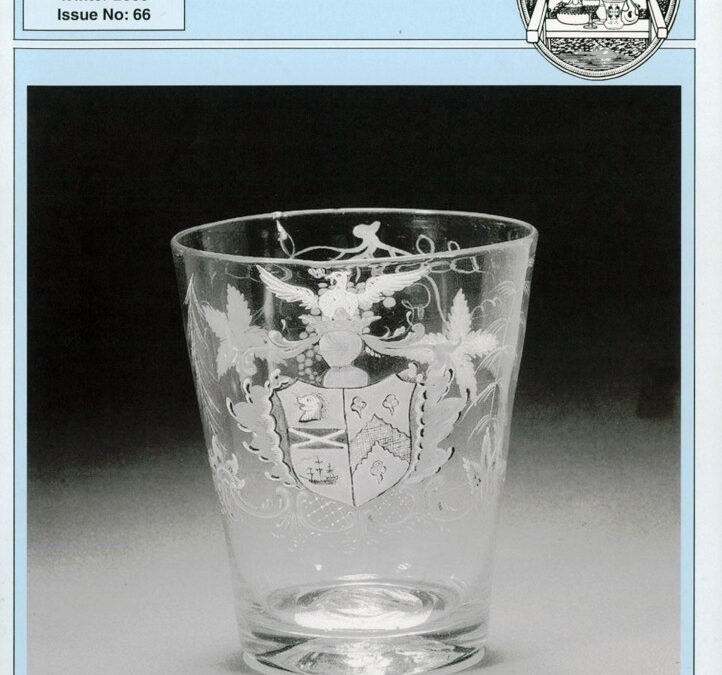
The Richardson Beaker, a rare Beilby polychrome
enamelled armorial beaker, Newcastle upon Tyne, circa
1765. The flared cylindrical form is painted with the coat-
of-arms of Richardson and Williamson below the crest of
a bird with outstretched wings holding a wreath in its beak
and standing on a coronet and helmet, all within a cartouche
flanked by grasses, the reverse painted in opaque-white enamel
with a spray of fruiting vine. 12.8cm., Sin. Sold by Sotheby’s
Olympia on 17 December for £20,000. Photograph courtesy
of Sotheby’s.
BLASCHKA GLASS FLOWERS
Yvonne Cocking
writes: “Anyone who was interested in my
note
(Cone
64, p3) about
the glass flowers created by the
Blaschkas for the Harvard Museum of Natural History, will
find a much better account, illustrated with excellent colour
pictures, by the museum’s Administrator for the Glass Flow-
ers, Susan M. Ross-Wilcox, in the Venetian journal
Vetro,
no.17, 2003, pp. 36-40. This journal was probably sent to all
those who went on the trip to Venice in October. I assume
that is why
I
received a copy!”
AUCTION REVIEW
We again ask for help in reviewing auctions. As production
editor, Brian Currie assembles material in the closing stages
of going to press. He asks the auction houses to submit
material – and sometimes they do. Otherwise he prepares
notes about the items at auction that have interested him,
which are likely to be late 10 century and early 20
th
century
glass. He is, he says, simply not equipped to write about
18
th
century wine glasses, antique glass, paperweights, con-
temporary glass or many other topics that readers want to
read about.
So if you go to an interesting auction, make notes
and email (or less preferably, write) them to Brian. He can
often get images to support your report from the auction
houses or their websites – but the review knowledge is what
he wants from you.
GLASS DENSITY MEASURING
In the last issue of the
Cone
(no.65), a small error regret-
tably crept in to the text concerning density measuring
on page 4, right-hand column, penultimate paragraph so
remember to amend it. The sentence read: weighing bal-
ance. The ability to weigh to one part in a thousand (e.g.
to 0.01g for a 100g piece) is desirable…’ This should have
read: ‘0.1g for a 100g piece’. Our apologies to our three
`kitchen scientists’.
Also on the subject,
Michael K Baldwin
writes:
I
had a similar problem of density measurement deter-
mination in order to see whether expended ammunition
contained metal cores, such as tungsten, within the lead. I
found an easy method of density measurement which relies
on a simple truth; that the buoyancy effect caused when an
object is immersed in water causes an equal and opposite
downthrust on the container of water. The technique is
as follows.
1.
Put a container of water on a pair of scales and weigh
it in grammes.
2.
Dangle the object of interest in the water using a thin cord
and record the new weight reading for the container.
3.
Take one reading from the other. The result is numerically
equal to the volume of the object in cubic centimetres.
4.
Take the pan off the scales and weigh the dry object in
grammes.
5.
Divide the weight of the object in grammes by the volume
of the object in cubic centimetres. The result is the density
of the object in grammes per cubic centimetre.
It is much easier to do it this way than to rely on all
sorts of other gadgets to determine the weight of the object
suspended in water: It follows Newton’s Law that action
and reaction are equal and opposite.
The opinions expressed in the
Glass Cone
are those of
the contributors. The editors’ aim is to cover a range of
interests and ideas, which are not necessarily their own.
However, the decision of the editorial board is final.
COPY DATES
Spring
Early March 2004
Summer
Mid-June 2004
The Glass Cone’ – Issue No 66: Winter 2003
ANNUAL GENERAL MEETING
The Annual General Meeting was held at the Red House Glass
Cone on 25 October. It was preceded by morning tours of
the Plowden & Thompson glassworks kindly arranged by the
company. After the AGM Jim Frost gave us an interesting and
informative talk “Glass – what’s in it?”.
After the opening formalities of the AGM, our chairman,
Charles Hajdamach, gave members his report. He reviewed the
three national meetings held in the year to 31 July 2003. The
2002 AGM held at Manchester City Art Gallery allowed us to
enjoy the new building while learning in detail about Manches-
ter glassmaking. In June, 35 members visited the Victoria and
Albert Museum to see the Art Deco exhibition and to hear a
talk by Keith Baker on the hallmarks and icons of the Art Deco
style. Our third meeting, in September, was to have been held at
the Crafts Council in London and we were to see the Jerwood
Glass Prize exhibition. Sadly, our speaker left for another job
without making any arrangements for our visit and we had no
alternative but to cancel. Charles extended his apologies to the
members who had signed up to support the day.
Regional meetings had been ably organised by our en-
thusiastic regional representatives. Like the national meetings
these had met with mixed success. The committee is consider-
ing the issues involved. Charles thanked the regional organisers
and especially Alan Comyns, as National meetings organiser,
for the great deal of effort they had put into their tasks.
Charles looked forward, to the Association’s trip to Ven-
ice and Murano in October, and thanked Gaby Marcon for her
hard work and patience in organising this major event.
He spoke of our birthday celebrations in 2004, which
need to acknowledge and promote the achievements of the
Glass Association, to honour our members’ successes in the
fields of collection, research and publication, and to focus on
the rich glass heritage of Britain.
He congratulated Roger Dodsworth on the publication
of our
Journal,
Volume 6. We aimed to publish Vol. 7 in time
for the AGM in 2004.
He thanked the editors of the
Glass Cone
for producing
a “wonderful and regular mouthpiece” for the Association
and all the contributors whose consistently high quality ar-
ticles stimulate discussion and correspondence between our
members.
He described the organisation and work involved in
mailing out our publications and notices of national and re-
gional meetings. He thanked Annette Eardley, Eileen Sanders
and Brian Firmstone for their efforts.
During the year we had sponsored two educational
events. The first was the opening session of the Congress of
the International Association for the History of Glass which
was hosted by the British branch of the organisation. Paddy
Baker was our contact and through her good services the Glass
Association received international publicity via almost two hun-
dred delegates. The Association also sponsored the Michael
Parkington lecture for the Dudley Glass Festival but this might
well be the last time we sponsor this event as the format of the
Festival may be changing in 2004.
Brian Currie, Hon Treasurer, reported on the year to
e
31 July 2003. Our subscription income had risen a little while
donations were substantially higher at £919 compared with the
previous year’s £432. They included £495 of gifts in memory
of Tom Percival at the very kind suggestion of Edwina and
Tom Percival’s family.
After considerable work we had been able to assemble
our claims for tax repayable under the Gift Aid scheme since
its inception. This produced repayments of £3,040 for the
last three tax years. Of course £1,974 of these repayments
properly related to previous years, but are shown as incoming
resources in our Statement of Financial Activities, so that our
total income turned out at a handsome £12,755.
Our operating surplus for the year came out at £5,532.
compared with a deficit of £3,108 the previous year (in which
the Journal was published). Our general fund stood at £16,715
– fully adequate to meet our continuing commitments. But, said
Brian, there are many more things we ought to do to extend
our work for our charitable purposes. He reminded us of his
slogan: “Low subscriptions; high donations”. He asked those
who can afford it to remember our charitable status and add
generously to their subscriptions. He warmly thanked those
who are already contributing.
( If you would like a copy of the Trustees’ Report and
Accounts, ask Brian Currie to send one to you).
As this was his final appearance after five years in the Hon
Treasurer’s chair he thanked all the members and committee
members who have helped him during those years; especially
the Hon Chairmen, Ian Turner and Charles Hajdamach, the
editors of our publications, the events organisers, and above
all the Hon Membership Secretaries, Peter Beebe and John
Greenham, whose support and help had been absolutely vital
to getting the job done. He extended thanks to Eric Reynolds,
our independent examiner, for his work in reviewing our
financial records, and to Annette Eardley and all others at
Broadfield House and the Red House Cone for their help on
the organising side.
After the Membership Secretary’s report, we turned to
the elections. Charles Hajdamach was re-elected as Chairman.
Brian Clarke was elected Hon Treasurer to succeed Brian Currie.
Ian Turner stood down from the committee as Midlands rep
and no replacement has yet been proposed. Alan Comyns stood
down as National Events Secretary, but no nominations had
been received to succeed him So we need volunteers for both
positions. Alan was elected to the committee as an ordinary
member, succeeding Ron Havenhand. Charles thanked Brian,
Ian and Ron for all their services to the Association
Ian Turner is of course one of our past Chairmen. Be-
fore retiring after 15 years on the Committee, Ian sold his glass
collection at Christie’s in September and is now pursuing other
collecting interests, although he will contribute occasionally
to the
Glass Cone
and is writing an article for the next
Journal
on Monart Lighting. He will be cross with us for telling you
this, but to commemorate his retirement Ian made a
very
substantial Gift Aid donation to the Association. He
has
already done so much for us – and this was a complete
surprise. What a fine example!
On the subject of meeting.
Ken Connell
supplies afootnote:
Apropos recent discussion within the Association of the
difficulties in holding meetings, potential organisers might
be excused a twinge of envy at the following noticed in the
American Collector Magazine
of September 1941:
“The Early American Glass Club of Omaha, Nebraska, closed
its season with a special exhibition
On the opening day,
Miss Ethlyn Jackson
lectured on Early American Glass
before an audience of 700 people.”
The Glass Cone’ – Issue No 66: Winter 2003
i
I
A learned discussion over one of the museum displays
VENETIAN SPARKLE
An excited crescendo of voices filled the breakfast room
of the Hotel Riviera del Lido as the 48 members of The
Glass Association and Glass Circle assembled on the first
morning of the long-awaited trip to Venice and Murano.
Our organiser, Gaby Marcon, ably assisted by Brian Clarke,
explained that as many of the venues were small we were
to be divided into four parties, identified by the names of
famous Venetian Glassmakers. So we had Salviati, Tosca,
Barovier and Venini groups.
I
Pro essor Sarpellon assisted by interpreter Natalie giving a
brief history of Murano glass
A journey by motor launch took us to Murano. In the
Palazzo da Mula representatives of the local authorities cor-
dially greeted us before a lecture by Prof. Giovanni Sarpel-
lon on the history of glass making in Venice and Murano.
It was refreshing to hear the Professor factually placing the
origins of Venetian glass in the time frame of glass making
and acknowledging developments in glass making made in
other centres that helped the local glassmakers.
Dodging the waves en route to the Murano Museum
Our first experience of the problems of flooding
facing Venice came as we walked around to the Murano
Glass Museum. The high tide was lapping over the top of
the quayside and we had to wait for each incoming wave
to recede before making a dash forward.
Dr Dorigato, assisted by Natalie, welcoming us to the
Murano Museum
In the museum Dr. Attila Dorigato, the former cura-
tor and author of the Museum guidebook, welcomed us.
She guided us through the various galleries, which were
laid out in a rough chronological order. A disappointment
for Davina and me was that the more modern items were
still not on display — nothing had changed there since our
previous visit 11 years ago. We did enjoy the large table
ornament made to represent a formal Italian garden with
fountains etc, all in glass. We had seen a similar item in the
Bowes Museum but that was sculptured in sugar, which
lacked the sparkle and life of the glass version.
After a three-course slumber-inducing lunch our boat
delivered us to Venice, where we were divided into two groups
to visit a bank, the Casa di Risparmio, and a commercial
gallery where we saw items from local and international glass
studio workers. The bank had over the years bought items
from the biannual Festival of Arts, resulting in an unique
collection of masterpieces commencing from the 1930s.
4
‘The Glass Cone’ – Issue No 66: Winter 2003
Archimede Seguso enthusing about his work
Charles giving our thanks to Gaby
The following morning we were back in Venice,
this time in four groups and our venues included Galleria
Rossella Junck, Arte Daniele Lucchetta, Gianolla Vetro
Antico and Galleria Marina Barovier. In these we were
dazzled by a wealth of glass ranging from old traditional
vessels to outstanding studio glass. Some of the latter had
the glassmakers in our party in deep debate and “how did
they do that?” discussions.
The afternoon was spent in Murano, to see a dem-
onstration of traditional
reticello
techniques and
facon de
Venise
glass making by a master glassblower. He achieved
an excellent goblet with a gold-foiled serpent stem, for our
group but when he tried a repeat for the second group it went
disastrously wrong. This was coupled with a visit to the studio
of Archimede Seguso who gave us an entertaining insight into
his achievements, passions and hopes in glass making. At 94
years of age, the continued enthusiasm of the man for his
work was an inspiration.
We returned to Murano for a private viewing of work
by the young artists of the Centro Studi Vetro and for dinner
at the Al Vetrai restaurant. The exhibits were of high standard
and also high price!
After dinner various votes of thanks were given and gifts
were presented to Professor Sarpellon, to our interpreters
who had worked hard keeping us informed of all proceed-
ings and especially to Gaby for her efforts in getting the
visit together.
Sunday was the day of departure but as most of us
had evening flights there was time for another trip to Venice
where we visited the bead museum housed in the Palazzo
Rota. Our guide was once again Professor Sarpellon, who
had made a detailed study of Venetian bead and Murrine
techniques. Most of us purchased a most enlightening book
written by the Professor on the subject. After an afternoon
sightseeing we made our way back on one of the water buses
to the hotel to await our transfer to Marco Polo Airport
and home.
It was a very well organised trip enjoyed by all. Our
thanks go to Gaby and Brian and the members of Centro
Studi Vetro for all the preparation and arrangements which
made it such a success.
Geoff Timberlake
(And our thanks also to Geoff for all the photographs he
provided)
AIHV 2003 – AN ADVENTURE IN SPACE AND TIME
Having missed out on glass meetings all the year, it was
rather on impulse that I signed up to join the 16th Congres
de l’Association Internationale pour l’Histoire du Verre,
London. I had little idea what to expect. Now, after 40
lectures, 6 receptions, numerous posters, and 5 exhibitions, I
am very glad I did. I will try to give a flavour of the week.
Due to rail delays and then a London Tube network
paralysed by an emergency practice, I missed Sunday Reg-
istration and it was Monday before I arrived at Imperial
College and received the comprehensive information pack
to start planning the week. The lectures were to be given in
blocks of three or four on loosely related topics, simultane-
ously in two lecture theatres. So, apart from the delegates
from Hogwart’s School of Witchcraft and Wizardry, del-
egates could only attend half the lectures. The first choice
of session between “The English market in the late 17th
Century” and “New Research on Hellenistic Glass” was
not difficult.
We started with “John Greene’s Glass Designs 1667-
167?”. This produced diagrams I recognised, which gave rise
to a general feeling of well being. We had put our feet in the
water and were not out of our depth. The second lecture,
on Ravenscroft, emphasised his contacts with the Italian
glassmakers and diminished the role played by Ravenscroft
himself – nothing really new, just a reinterpretation. A talk
on the excavations of Baker’s, a late 17th C London glass
house was followed by a lecture on compositions of late
17th C glass from Silkstone, Yorkshire. This is where the
e
e
The Glass Cone’ – Issue No 66: Winter 2003
water got a bit deeper, and tables of chemical analyses of
glass and discussion of oxide ratios, loomed out the Power
Point projector. I have a science background so this proved
manageable.
In light of the later lectures
I
am grateful to the organ-
isers for providing this revision lesson on the significance of
chemical ratios, an area I knew something about. We had
however moved from the “Antique Collector” through “Cur-
rent Archaeology ” towards the “Journal of Glass Technolo-
gists”. This spread was reflected throughout the week.
The ground rules for the lectures had been estab-
lished. Speakers were given fifteen minutes plus five for
questions and not a second more. There was some time
for more general questions after the lectures. So after a few
clarifying rather than confrontational questions we broke
for lunch. With no lunch provided, I went off to the V &A
for a sandwich with another GA & GC member. Though
the two groups were not well represented by non-profes-
sional members, there was invariably someone familiar to
talk to.
Monday afternoon brought “Developments in the
second and first Millennia”. This did not sound like my
strong suit, but nothing ventured …! “The Mycenaean Glass
Warriors” was at least an intriguing title, and proved a real
eye opener. Discovering that there were late Bronze Age
sword hilts and armour plates made of glass, made the
lecture worth while. The arguments as to whether they were
produced in the Aegean or imported was a bonus. There
followed equally intriguing lectures, one comparing cobalt
blue production in Iron Age Iraq with Egyptian produc-
tion, and one on the evidence of primary production on
Rhodes.
The tea break saw my first discussions with people
I did not know. Whether they were Museum curators, sci-
entists or historians, they were prepared to chat. As well as
talking about glass, I discussed amongst other things the
causes of the American War of Independence with a curator
from the Metropolitan Museum in New York, and higher
education funding with a Belgian physicist.
On the second afternoon session I chose “Contem-
porary Glass” rather than “Glass as Ornament”. A talk on
Architectural Glass by someone from Norman Foster’s
Design team provided one of the most memorable im-
ages of the week. Animated diagrams of the new London
council building debating chamber showed how changes
in design improved the acoustics and presumably the flow
of hot air!
In the next lecture the speaker argued that much
Silesian ware was presented as Bohemian. The speaker
kept referring to the expert in the audience, who did well
to keep her pique under control, as the talk appeared to
based at least in part on her work. These little academic
tensions added spice to an already interesting cocktail.
The final lecture of the day was by a French contempo-
rary studio glass maker who referred to his work as low
temperature
pate de verre.
It seemed to me to be a vari-
ation on kiln cast work but it produced interesting and,
to me, new effects.
There was hardly time to draw breath before we set
off for the evening Reception. This was at the Fine Art
Society to coincide with the Guild of Glass Engravers exhi-
bition. A very high quality exhibition, on what was for me
home territory; it was, I think, the 18th Guild exhibition
I have been to. In spite of that the memory I shall take
away is of the chairs, by (though not obviously so) Rennie
Mackintosh at a paltry £85,000, which made some of the
glass seem very reasonable. There was too much talking
and socialising to give the exhibition a proper look and
I had to return later to look at the glass properly Some
of it was stunning. Pieces by Gillian Manning Cox, Sally
Scott and Catherine Coleman were my choices. All too
soon, it was out onto Bond Street to do battle with the
London Underground.
The daily pattern for the four days of lectures was
broadly similar. All the lectures proved informative and
most I found interesting (two foreign language lectures I did
find beyond me). The topics covered every period of glass,
and every aspect of glass from its production, through its
social significance to its conservation. Though references
to 19th C and early 20th C glass were few, a lecture on the
deterioration of 19th C and 20th C glass in the National
Museum of Scotland raised a few eyebrows. Analysis sug-
gested that pitting and crizzling were due to organic acids,
probably associated with Victorian wood preparations and
modern glues in composite wood substitutes used to make
the cabinets. Another lecture of general interest covered
correspondence relating to an 1832 selling trip by salesmen
from the Waterford company, who were trying to auction
off a load of glass in Southampton. The reaction of the lo-
cal trader, the complaints about tariffs, inferior imports and
the snobbish customers all resonate with present economic
conditions. What I hadn’t realised was that Irish glass had
a very poor reputation at that time.
There were also two poster sessions where presenters
used a board about a metre square to display pictures or
text to illustrate their research. These varied from displays
of pictures of 18th C glass (James Giles) with no text, to
pure text expounding the merits of various statistical tech-
niques. Those presenting the posters were on hand to field
the numerous questions. There was a higher proportion of
technical content than in the lectures but the variety was
staggering. One of the posters was presented by two studio
glass makers who specialised in recreating Roman Glass.
They felt that some pieces normally considered to be cast
were actually shaped with tools. This caused great debate.
Visits had also been arranged for the Wednesday and
Saturday to museums and places of glass interest, often
with guided tours, so there was no let-up.
Now that it is all over, I am not confident of re-
membering which points were made by which speakers at
which lectures. So any reference to a lecture or speaker, in
the parlance of some of the posters, “…may or may not,
more or less accurately reflect views which might have been
expressed.”
But I have come away with broader knowledge of
technology and history as well as glass. I have a new interest
in some areas, notably medieval stained glass and red glass.
One message, which I came away with, was just how easily
and how often a social, fashion or technological change
can cause a skill to be lost.
I congratulate the organising committee on a var-
ied programme and for their success in finding so many
sponsors. They also deserve praise for preparing the final
reception at the Society of Antiquaries in London on
Saturday.
John Pitcairn
[The Congress papers will be published in late 2004 or early
2005. Eds. ]
6
‘The Glass Cone’ – Issue No 66: Winter 2003
‘Cactus’ vase circa 1935. 14 inches tall. Photo: Gorringes
GLASS AT THE AUCTIONS
Bonhams auctioned the contents of the renowned Harveys
Wine Museum over three days, and the sale of fine glass
took place on 1 October. A silver-mounted glass table wine
fountain, circa 1795, hand-blown as a perfect barrel shape,
applied with spiral trails and engraved at one end with the
arms of Sir Henry Vane-Tempest, sold for £8,500
(hammer
prices throughout)
against an estimate of £5,500-7,000. A
`Privateer’ wine glass, circa 1757-60, engraved with a ship
in full sale and inscribed around the rim ‘Success to the
DEFIANCE Privateer’, sold for £7,800.
One successful buyer was James Adlington, a glass-
blower at the Bristol Blue Glass Company Ltd., where man-
agement are acquiring objects of local interest for a proposed
A ‘Privateer’ wine glass, circa 1757-60. 15.2 cm.
Photo: Bonhams
museum of their own. He bid £1,600 for a rare blue glass
wine rinser, gilded by Isaac Jacobs, circa 1805. Jacobs was
the proprietor of the Non-such glassworks in Bristol where
it is thought the glass was both made and decorated. The
purchase was financed by donations and the company intends
to make copies for each subscriber, signed on the base by Mr
Adlington in place of the Isaac Jacobs signature.
An expected highlight was the ‘Russell Amen’ glass
finely inscribed with diamond point engraving commemo-
rating the Jacobite cause, an elaborate JR monogram over
the figure 8, all beneath a crown denoting King James, the
Old Pretender. This is flanked by a verse from the Jacobite
anthem, ending with the word ‘Amen’, hence the name. It
has been known as the ‘Russell Amen’ glass because it be-
longed in the Russell family of Edinburgh from the 1880s to
1949. Estimated at £40-50,000 it failed to sell in the room,
but was sold afterwards to a collector.
At Woolley and Wallis Salisbury Salerooms on 25
November, a good-sized (8″) Orrefors
Kraka
vase sold for
£380 and a lime green glass vase sold for £200. This vase
(illustrated on page 14) has an unusual shape, and the lime
green glass body was cased in clear before enamelling.
On 2 December Gorringes [Lewes] sold a Keith
Murray ‘Cactus’ vase circa 1935, tall and tapering, deeply
engraved with a flowering cactus, on a circular base, with an
etched facsimile signature, Royal Brierley. It realised £900,
three times the estimate.
7
The Glass Cone’ – Issue No 66: Winter 2003
The Ian Turner Collection of Monart Glass was sold
by Christie’s South Kensington on 24 September, raising
over £87,000, with 137 of the 142 lots sold. A Paul Ysart
paperweight formerly part of Paul Ysart’s collection, with
a bouquet in a Monart vase with aventurine on a black
ground, sold for £4,200. A rare orange, brown and white
lamp with pulled up panels sold for £3,000. A VII P 23 395
mushroom lamp mottled orange, yellow and green, sold for
£2,800 and a JA VI 100 Paisley Shawl case in green, blue
and white, with iridescence and whorls, for £2,800. Each
of these leading lots went to a private buyer.
At Sotheby’s Olympia British & European Glass &
Paperweights sale on 17 December, 177 lots sold out of
313 lots on offer. There was some nice cut and engraved
glass from Stourbridge, but many lots failed to sell. Prices
were led by a
facon de Venise
enamelled armorial beaker,
dated 1556, which made £26,000. And, illustrated on
our front cover, the Richardson Beaker, a rare Beilby
enamelled armorial tumbler, circa 1765, sold at £20,000.
The sale included items from the Batiste collection of 19t
h
century French paperweights which realised a total of
£222,000 (including premium). Leaders here were a very
rare Baccarat chequer paperweight dated 1849, described
as one of only two known examples, at £18,000, and a
rare St. Louis mushroom close-pack paperweight dated
1845, described as the earliest signed and dated St. Louis
paperweight, which realised £16,000.
The St. Louis mushroom close-pack paperweight dated
1845 and the Baccarat chequer paperweight dated 1849.
Photos: Sotheby’s Olympia.
US AUCTIONS
The dollar has fallen from $1.40 to $1.70 to the pound over
the last year. So prices for items bought in the United States
are at a discount of over 20% from a year ago. Worth a
look? It is, of course, a vast market place, with much greater
volumes than are available this side of the Pond. Most US
auction houses provide full catalog(ue)s on their websites
as well as being ready to notify you of auctions by email
and send their printed catalogs by express post. You can
easily find their websites via a Google search.
The big auctioneers, including Sotheby’s and Christie’s
and such houses as Butterfields, Doyle, Skinner of Bolton,
Massachusetts, and Waddingtons of Toronto all have fine
glass in their sales from time to time. It’s sometimes easier
to stick with the houses that have something of a special-
ity in glass. Green Valley Auctions, Virginia enjoys a wide
reputation among specialist collectors. It specialises in early
American glass and lighting; pressed glass including cup
plates and salts; coloured flint glass; 19th and 20th century
early American pattern glass; early bottles, flasks and fruit
jars; coloured opalescent; milk and Carnival glass. Their sale,
starting 30 April, of 18th & 19th century blown & pressed
glass and lighting, is already advertised on their website.
Other houses with something of a glass speciality are:
James. D. Julia in Fairfield, Maine; Early Auction Company
in Ohio; and Jackson’s, Cedar Falls, Iowa.
Jackson’s auction on 26 October centred on the sale
of the collection of Bob and Deborah Truitt, authors of the
well known two volumes of
Collectible Bohemian Glass.
The
sale (over 500 lots) included many of the pieces illustrated in
the books, and much else besides. On the whole many of the
prices realised seem modest; perhaps because the volume
was so great or perhaps because American collectors prefer
American glass. This can be illustrated by comparing the
prices for the items pictured below. Josef Ahne produced
enamelled figural compositions on opaline blanks (based
on Italian & German oil paintings). He exhibited at the
1878 International Exposition in Paris where he won a
Bronze medal. His pieces have recently been popular and
usually realise good prices. But the illustrated pairs of
opaline vases enamelled by Ahne sold for $475 and $650,
while the C F Monroe
Nakara
cracker jar decorated with
the chief in head dress sold for $1,600.
Two pairs of opaline vases enamelled by Josef Ahne, 11
inches tall. Photo: Jackson’s, Iowa.
C F Monroe Nakara cracker jar . 7.5 inches tall.
Photo: Jackson’s, Iowa.
A number of fine Loetz pieces fetched more than
$3,000 apiece. The leading price on the day was realised by
a contemporary piece.
Emergence,
a Labino glass sculpture of
hot tooled glass, enclosing air trapped bubble and two dich-
roic veils with gold aventurine, signed “Labino 11-1979″ and
7.75” tall, realised $6,000, markedly above the estimate.
8
‘The Glass Cone’ – Issue No 66: Winter 2003
Cameo rose jar, etched with crimson blossoms
over a
citron
airtrap body. 8.75 inches tall. Photo: Early Auction Co.
Early’s Fall Auction on 7-8 November included
some fine Stourbridge glass, including items from the Al-
ice Woodall collection, provenanced by letters. The most
impressive was a huge 18 inches tall three colour (reddish,
blue and off-white) Webb cameo vase with several sepa-
rate design fields carved with flowers and Persian motifs.
Estimated at $50-75,000 it failed to reach its reserve. Other
cameo vases sold well, a couple over $8,000.
The highest price of the day was made by a cameo
rose jar, etched with crimson blossoms over a citron airtrap
body. A similar vase is pictured on the cover of Revi’s
Nine-
teenth Century Glass.
It sold for $19,500, several times the
estimate. Another such vase was shown recently on Andrew
Lineham’s website www.antiquecolouredglass.com – at a
much lower price. Not surprisingly, Andrew reports con-
siderable interest since the auction. Early’s attributed their
jar to Webb, in line with Revi. Revi’s book is now 40 years
old and perhaps wrong. Andrew surmises that the vase may
be Bohemian, probably Loetz. It might indeed come from
the same craftsmen who produced their
Federzeichnung
or
Octopus
airtrap work while the ornate metal collar and
domed lid is certainly more redolent of Bohemia than
Stourbridge.
There was much good American glass among the
remainder of the 800 lots. A very large 16 inches high
decorated Mount Washington Burmese vase with a detailed
“Garden of Allah” desert scene of a human figure kneeling
on oriental rug with camels, pyramids, sphinx and palm-
trees, sold for $6,250.
James. D. Julia’s Fall Lamp & Glass sale on 19-21
November totalled nearly $1.7 million (including some
jewellery and other material). A Tiffany floral bouquet
hanging shade estimated at $50-70,000 finally sold for
$190,000. Following close, a Tiffany Poppy table lamp
sold for $71,000.
A green overlay decanter attributed to Steven &
Williams
with flowers and stylized leaves cut to clear, a cut matching
stopper and notched clear handle, 10″ tall. Photo: James.
D.
Julia Inc.
Among the 1,000 or so lots of glass there were
around 40 carved Stourbridge pieces, intaglio and cameo.
One cameo swan bill scent bottle, white over yellow, with a
marked silver top, sold for $4,000. Two others with higher
estimates and marked “Rd.11109” were unsold. Among
the other good cameo scent bottles, four sold for between
$3,000 and $4,000 apiece.
Mount Washington
Burmese vase with a
detailed “Garden of
Allah” desert scene.
16 inches tall.
Photo: Early
Auction Co.
The Glass Cone’ – Issue No 66: Winter 2003
An amethyst overlay pitcher; cut to clear with intricate
swirling flowers and leaves with a clear decorated handle
and a silver rim and spout marked “JE Caldwell & Co.
Sterling 55018″ 14.25” tall. Photo: James. D. Julia Inc.
Among the intaglio pieces, an amethyst overlay pitch-
er, with a silver rim and spout marked “JE Caldwell & Co.
Sterling S5018” sold for $5,500. A green overlay decanter
attributed to Steven & Williams with flowers and stylised
leaves cut to clear, a cut matching stopper and notched clear
handle, sold for $2,200.
Steuben
Aurene
had a strong showing led by an
Au-
rene
blue decorated vase with applied collar that closed at
$22,500, three times the estimate.
Steuben blue Aurene vase decorated with silver leaves and vines
ivith blue-green iridescence Interior of vase is opal white. The
gold Aurene applied cuff rim has white and deep blue zigzag
intarsia
design. Signed on bottom “Aurene”. 7.5″ tall.
Photo: James. D. Julia Inc.
There is much of interest in American auctions and
more British collectors are bidding and buying. There are
some obvious warnings to observe.
Though buyer’s premiums are not high (usually
around 15% at the provincial houses), there may be an
additional charge to pay by credit card.
US houses vary in their packing (double boxing, of
course) and despatching policies. Some do the work in-
house and their charges are often reasonable. Others, as
is increasingly the case in the UK, farm the work out to
specialist agencies, who often have higher charges.
Mailing by airmail post will cost between $20 and
$50 for most items of reasonable weight and the service
seems to be reliable, although journey times vary from one
to four weeks. There are systems of insurance and tracking
available for the nervous. Using one of the courier firms will
be faster but certainly more expensive.
Finally there will be VAT and duty to pay to UK
Customs. The postal services and courier firms handle this
for you. How they do this depends very much on how the
items are labelled by the dispatcher. So it’s vital to give
clear (and honest) labelling instructions when you arrange
despatch. Antique items (over 100 years old) are subject to
VAT at 5%. Later items may be subject to VAT at 17.5%
and duty on top – too complex a subject to cover now (see
the Customs website: www.hmce.gov.uk), but worth an
article another time.
BMC
REGIONAL MEETINGS
Peter Hayes
writes to say:
Richard Giles, in the last
Glass Cone,
described the prob-
lems of organising regional meetings. I wonder if the
problem is the boundaries of the regions. In theory I am
SW but, from Cheltenham, meetings at Broadfield house
are much easier to get to because of the M5 motorway. The
same problem applies to national meetings. The cheapest
way for a couple to travel is by car so the start time needs to
be set to allow the maximum number of members to travel
on the day instead of staying overnight. The high price of
hotel rooms is even greater for single members.
In the South East region
Janet Sergison
recognises this
problem and is planning a programme of visits to celebrate
our 21″ anniversary, based on meetings in Greater London.
Members will be able to travel in by train, if they wish, to
three of the events, and to one by car – without the need
for overnight stays.
NEW MEMBERS
A very warm welcome to the following new members who
have joined the Glass Association since the last issue of
the
Glass Cone:
Ms F Binnington
London
Mr & Mrs P J Black
Kent
Mr & Mrs R Draysey
Dorset
Mrs J A Fairburn
Lancs
Dr H P M Goddard
Cambridge
Mr M Hill
London
Mr W G Jackman
Somerset
Mr I D Page
Northants
Ms S Salanon
USA
Mr & Mrs L Switzer
USA
Mr D Taylor
Leicester
Mr & Mrs R Wheeler
Somerset
Mr & Mrs
R
J Wilcock
Essex
Ill
The Glass Cone’ – Issue No 66: Winter 2003
CORE MOULDED GLASS – A
GLIMPSE INTO HISTORY
It is said that there is nothing new in glass making and one
has only to think of the re-invention of ancient techniques like
double walled glass with interior decoration by Kothgasser in
the 18t
h
century, cameo cutting on glass by John Northwood
in the 19t
h
century and the cage cups made by George Scott in
Edinburgh in the late 20t
h
century to prove this. These styles
were all effectively re-invented many centuries after they were
first practised in ancient times. Now we can add an actual
manufacturing method to the list.
Imagine my surprise, on receiving the brochure for this
year’s Dudley Glass Festival, to find that Tim Waldegrave and
Sam Sweet, the current Studio Scholarship holders in residence
at Broadfield House Glass Museum, proposed to give demon-
strations of core moulded glass making on 27-28 September.
Others may have tried it but this is the first instance I know
of an attempt, in public, to revive such an ancient technique.
Yesterday I watched, fascinated, as the distant past was resur-
rected and brought to life in the West Midlands.
I have often wondered how core moulding was actually
carried out. What was the rod made of on which the core was
formed? How was the core made and how easy was it to re-
move from the finished vessel? Writers on the history of glass
all mention the method but for obvious reasons are short on
the practical detail. It would always have to be a practising
glassmaker who would work out the details of the process
and this is what Tim and Sam have done. They believe that the
process would originally have been carried out over the open
mouth of a small furnace, of the type used for bead making,
that provided enough heat for continuous working. Modern
furnaces, designed for glass blowing, are arranged differently,
so compromises have had to be made.
The core is made of a mixture of silica, clay and horse dung
(perhaps camel dung originally?) formed on to a stainless steel rod
(not available to the
Egyptians – so did they use metal or wood?)
and baked. It is not clear whether they managed to get the thread
of glass which forms the body of the vessel to adhere directly to
the core but Tim and Sam have found that they need to melt a
thin layer of frit on to the core to get the glass to stick. After this
the development of the body by means of a continuously wound
thread of glass drawn from a gather is a matter of a good eye and
co-ordination between the gjassmakers. Smoothing the coil to an
even finish requires care, since too much pressure tends either to
free the glass from the core or the core from the rod.
Finer threads of different colours are applied for the
decoration and the result is a vessel which is a recognisable
copy of those 3,000-year old examples we only normally see
in museums. The process to make one vessel took about fifty
minutes and required many visits to the mouth of the furnace.
It is interesting to speculate on how long the original makers
might have taken to produce the same result if they were work-
ing over a continuous heat source.
One thing that is particularly noticeable is that the
surface of the modern example is very shiny. I wonder if the
matt surface we normally see on those that have survived
more than two thousand years of burial is due solely to age
and atmospheric conditions? If the originals were as bright
as those I saw being made, one can understand why they were
highly prized luxuries.
I had always wondered how easy it was to remove the
baked core from the finished article. Tim and Sam have devel-
oped a mixture that provides a strong enough base on which
to build the body of the vessel but is friable enough to be easily
scraped or washed away when it is cold. I cannot believe that
those early glassmakers had not arrived at a similar solution.
Finally, the whole process was illuminated by a running
commentary, a readiness to answer questions and the obvious
enthusiasm of the two glassmakers for their craft.
John Brooks
ROTARY MOTION OF CUT ROCK CRYSTAL
Among the boxes and bundles of papers in the National Archives
of Scotland are those indexed as ‘miscellaneous’ — the odds and
ends which do not fit in elsewhere. Occasionally they contain relics,
like a lock of hair or a sample of cloth. Often there are newspapers,
advertisements, sketches or trade cards, but the fact that they repre-
sent such a random selection means they are worth examining.
One such bundle, in the papers of the Campbells of Barcal-
dine, yielded a printed sheet, which is transcribed below. It refers
to a Mr. Sanderson of 32 St. Andrew Square, Edinburgh, and is
dated 30 July 1831. John Sanderson is described in the Edinburgh
and Leith Post Office Directory of 1831-2 as a lapidary.
“The Rotary Motion of Cut Rock Crystal on an inclined
plane, was discovered by Mr. Sanderson by mere accident. Having
a piece of Rock Crystal in his hand, nearly the size of a Garden
pea, flat on one side and a little convex on the other, he was about
to attach it to a plate of Glass, when it dropped out of his hand
on the Glass, and commenced whirling around — this led Mr. S.
to examiner into the cause of the motion, and to cut the Crystal
more scientifically; and having shown the discovery to Professor
Leslie, the professor exhibited the motion in his Natural philoso-
phy Class, and mentioned the above circumstance. The Theory
of the motion is explained in the following article which appeared
in the Edinburgh Literary Gazette in July 1829.
“Every time we step into Mr. Sanderson’s St. Andres Sqr.
We are highly amused with the pleasing Rotatory Motion he
produced on wetted Window Glass, with various pieces of Cut
Rock Crystal. Some of the Specimens have figures fixed on them
Waltzers, Harlequins et., which, during the Rotatory movement
presents a very pleasing effect. The least inclination of the win-
dow Glass is sufficient to make the movement commence, and
it sometimes become accelerated to such a rapidity that we are
unable to perceive the shape of the Crystal. The Cut Crystal has
six sides, is polished flat on the top, but on the under part is ground
regularly down from the faces to a point which is rounded off, so
that the Crystal can balance itself upon the table. The Theory of
the movement is very simple: when the Cut Crystal is set upon
the table, on the wet Window Glass, held parallel with the floor,
no motion takes place, because the centre of gravity of each is
balanced and supported in this position of the Window Glass;
but if we slant the plate of Window Glass a little then the rotatory
motion commences, because we now remove the support from
the centre of gravity, and therefore the objects have a tendency to
tumble down till a support be obtained, the circular and regular
shape[s] enable them to rotate so long as their centres of gravity
are, by the inclined plane of Glass, left unsupported.
“NB. Any smooth surface wetted serves the purpose
equally well as the Window Glass.”‘
Jill Turnbull
1
1
7
The Glass Cone’ – Issue No 66: Winter 2003
PAPERWEIGHT NEWS
This latest offering for the
Glass Cone
has been put together
whilst away for a late autumn break as part of the celebra-
tions for one of those birthdays that are best forgotten.
Thoughts of the passing years made me realise that we have
just entered our thirtieth year of collecting paperweights.
It all started with a birthday present in 1974. Don’t
panic! I am not proposing to reminisce; but it is interest-
ing to reflect on some of the changes in the world of pa-
perweights and paperweight collecting during that time.
The biggest change, and in my view a great shame for any
future collectors, is that there is a total lack of glass paper-
weights other than Caithness and Chinese weights in the gift
shops. So people never see anything of the amazing range
of weights that are on offer today. I know that the interne
has filled some of the gap, but if you use this facility you
will probably already have an interest in the subject and
wish to pursue it further.
I accept that there weren’t many specialist dealers
around when we started collecting, but I doubt if we would
have become quite so hooked if it hadn’t been for shops
in places like Broadway and Bourton-on-the-Water selling
Perthshire, Strathearn and Whitefriars weights.
The visit to the Woking Glass Fair in early October
was very enjoyable, as always, and this time we came away
with wallet intact. The evening before and lunch after the
fair were spent with paperweight collecting friends both
from Basingstoke and, for the first time in about three years,
from California. No prizes for guessing the main topic of
conversation but we did manage to stray onto other sub-
jects. It was good to get an update on paperweight news
from the other side of the water, which these days is the
main source of modern weights. Due to a clash of dates
with the Association AGM I was unable to go to the latest
Paperweight Collectors Circle regional meeting at God-
stone but I am currently involved in helping to organise a
similar style meeting in the Bristol area in June next year.
If a suitable venue can be found I hope to be able to invite
members of the Association who might be interested in
attending. Watch this space in the next edition or contact
me for further details nearer the time.
Part of the birthday celebrations also involved a visit to
the Ironbridge Gorge. There we located David Keenan of Red
Hawk Glass in the Maws Centre, formerly the ceramic tile works
of Maw and Company, where he specialises in making sculptures
mainly in clear or frosted finish glass. Well worth taking the time
to cross over the river to seek him out, and the location also has a
fascinating history.
We then went on to seek the workshop of Jonathan Harris
and to see examples of his cameo vases and paperweights. We
eventually found him tucked away behind the old Coalport China
Works, complete with surviving cone, which is now a museum and
shop. For the benefit of anyone contemplating a visit, you can’t just
walk in. You have to ask in the shop and after signing a visitors
book you will be shown the way to his workshop. You don’t have
to pay to go into the museum. His work is absolutely amazing and
it wasn’t surprising to learn that the majority of his work is done
to order with a waiting time of around 12 to 18 months – at least
it gives you time to save up for that special item. We were lucky to
visit at a time when there was a 2003 silver overlaid cameo trial
weight for sale, we both liked it so we didn’t have to join the queue
for one to be produced -waiting patiently for things that I want is
not one of my strong points.
The highlight of the L H Selman autumn auction of paper-
weights was a full Clichy signed moss ground scattered millefiori
weight. Weights with the full signature are very rare and it will be
very interesting to see what price was realised. Whilst on the subject
of auctions, the Paul Ysart weight featuring the bunch of flowers in
a Monart vase that was bought from Paul Ysart by Ian Turner and
featured in several books, as well as being on display at the CPC an-
niversary exhibition last year, sold for £5,000 (including premium)
in the recent auction of Ian Turner’s Monart collection.
Our final activity covered by this article was a visit to the
Glass Fair at the Heritage Motor Museum where, as well as the
specialist dealers, there were weights of one type or another for
sale on many of the stands. The first people that we encoun-
tered, even before we got inside, were William Manson Senior
and Junior. From the ensuing conversation it was obvious that
both were enjoying life more without having to constantly make
weights to satisfy the demands of the collectors and travel long
distances to sell them. William Senior is revelling in his teaching
role for his master classes and is trying to build up this side of
the activities. William Junior was off to Australia later that week
and Joyce is preparing for a return to the nursing profession.
Their intention is to continue with a presence at the twice yearly
glass fair and Broadfield House paperweight weekends and to
make weights when the fancy takes them; so examples of their
work should continue to be available.
After my initial disappointment with the new weights from
Peter Holmes at Scottish Borders Art Glass, the fair provided an
opportunity to see more examples of his work and they were much
more like the quality that I would expect from this paperweight
maker. Finally, I had a very interesting conversation with Alan
Sedgewick who is probably better known to many of you for
dealing in carnival glass but in recent years has expanded into
paperweights, particularly those made by John Deacons. Alan
has an interest in glass design and in collaboration with John they
have been turning some of his ideas into reality. On Alan’s stand
were weights and weight-related objects that are that little bit dif-
ferent from the usual range from this maker. More ideas are in the
pipeline so keep an eye on his stand and I will also try and keep
you updated on what is being produced.
By the time you read this we shall be well into 2004 and I
trust that everyone will have had a peaceful and enjoyable Christmas
and New Year.
Richard Giles
COLLECTING COMMEMORATIVE PAPER-
WEIGHTS
Vivian Walker,
who trades under the name “Forget Me
Knot”, recently wrote a book on commemorative pressed
glass and is now planning to follow that up with a book
on commemorative paperweights. She asks whether any
readers can help. Do you have any paperweights in the
following categories:
Royalty
Political
Military
Sport
Exhibitions
Industrial
Notable figures and events
and would you be willing to photograph them and provide
relevant information? If so, she would be delighted to hear
from you at: Woodlands.BW@btopenworld.com.
12
The Glass Cone’ – Issue No 66: Winter 2003
IRIMIEA GLASS
One of the most attractive presents that I received
last Christmas was a pair of modern glass goblets. They
were overlaid with green with a gold trailing effect as on
all Irimiea glassware.
The range of glassware produced by Irimiea has be-
come extremely popular in this country during the past 3-4
years. Why? Well, perhaps the fascination of this particular
range lies not so much in the variety of vessels or shapes (of
which there are some two dozen), but in the interesting effect
achieved through the combination of clear glass, colouring,
and gold ‘dribbling’. Once you have seen and handled an
Irimiea glass, you will immediately recognise another piece
by the same manufacturer.
Irimiea Glass is made to order by master glass blow-
ers in a glass factory in Romania. I gather that the factory,
which is now privately owned, has been producing glassware
for some twenty-five years and that its present production
is 100% for export.
I am not a glassblower, so naturally my curiosity was
aroused as to the method of production, in particular the
method of decoration.
Each glass in the range is hand blown with clear soda
glass and annealed before the second part of the production
process. First of all decorators add a colour (red, blue, green
or purple), or a combination of colours, by hand. (For sales
purposes, red is called ‘Valencia’, blue is called ‘Fantezia’,
green is called ‘Genova’, and purple is ‘Iris’.) The distinctive
gold ‘dribbling’, if I may call it that, is applied randomly
as a gold paste after the application of the colours, and the
glass is then fired at 550°C.
Some of the shapes have been designed by Catalin
Irimiea himself
In the present economic climate, with many ventures
facing an uncertain future, it is good to learn that the com-
pany has over 100 outlets across Britain, from Inverness
to Cornwall.
One of the main reasons for the growing popularity
and appeal of this range of glassware must certainly be its
colourfulness. Another, however, is the fact that the glasses
can be put into a dishwasher, although the manufacturers
state quite clearly that ‘when using a dishwasher we recom-
mend washing all
IRIMIEA
glassware at 55°C to reduce
the chance of clouding (silica etching)’.
And one further attraction must surely be the range
of vessels — from wine flutes and goblets, to fruit bowls,
comports and vases, candleholders, decanters, tumblers,
cocktail glasses and even beer glasses. So whatever your tip-
ple, there’s a glass in this range for you to drink it from!
Roy Kingsbury
The glass by Irimiea in the two photographs needs to be seen
in colour to appreciate it fully. The images in colour could
be seen last year on the Irimiea website: www.irimiea.co.uk
and we were going to suggest readers looked at it there, but
we couldn’t find it when we looked recently. The address may
have changed. Eds.
ROYAL BRIERLEY CRYSTAL
Richard Giles
reported a note in a construction industry
brochure saying that an old tannery next to the Black
Country Living Museum at Dudley has been converted
into the new headquarters for historic glassmakers Royal
Brierley Crystal. Preservation of the rich brickwork facade
of the building at Mullins Yard, Tipton Road, was a key
part of the brief from the architects. The note continued:
“The £650,000-plus contract involved totally stripping and
refurbishing the rest of the 25,000 sq. ft building to create
the Royal Brierley Experience, which includes a factory
where visitors can see craftsmen at work.”
In The Crystal Years RS Williams-Thomas noted that the
Stevens &Williams Lighting Glass Factory was at Tipton
and Caerleon glass was produced there in 1919. ( Tipton is
seven or so miles NW of Brierley Hill). More from our local
reporters in due course.
DARTINGTON CRYSTAL
The Western Morning News of 25 October reported as follows
under the headline Glass factory jobs go as sales fall:
Just over 40 staff at the Dartington Crystal works
ended their employment at the North Devon factory
yesterday as part of a package of measures designed to
get
the firm back on an even keel. The staff were made
redundant several weeks ago and yesterday was their
official last day.
The firm, which was established in Torrington in
1967, made the job cuts following a 20 per cent fall in
sales, also being experienced by its competitors.
Other measures being planned by the firm to
safeguard its future include selling off unwanted parcels
of land
etc. …
Dartington Crystal was set up by the Dartington
Hall Trust, which wanted to extend its activities into
North Devon.
The
firm has become a tourist attraction,
with visitors able to get a close-up view of glass blowing.
(Photo:
Irimiea
Glass)
I3
‘The Glass Cone’ – Issue No 66: Winter 2003
A SPA GLASS?
Can anyone confirm, or otherwise, the purpose and, pos-
sibly more difficult, source and date of the mug illustrated
(above)?
It is handsome and, apart from some slight acciden-
tal scraping of the handle, neatly wheel-engraved; the pat-
tern being a classical frieze with a circular cartouche (left
blank) opposite the handle. It is small for a mug (capacity
0.251it or
I
/
3
pint) and is calibrated in 50 ml. divisions to
250 ml; the numbers are scratched by hand, the Ts with
continental tails.
The base and rim are ground and polished, and show
little sign of wear, indicating little use and possibly a souve-
nir – but of where? Or a reproduction – but of what?
The lightness of its metal, the metric measurements
and the tailed Ts point to a continental origin and the
absence of a lip for pouring, its overall shape and quality
point to drinking rather than measurement; but what sort
of drink, alcoholic or otherwise, would be served in such
amounts in such a glass?
However, given that it was probably too large for nor-
mal medicinal purposes, was it perhaps used for “taking the
waters” at some spa where quantities would be greater and
yet carefully controlled; the cartouche being used, perhaps,
for the patient’s name or initials?
And date: late 19
th
, very early 20
th
century?
Ken Cannell
The problem with asking about a “curious object” is the per-
ceived risk that everyone else will know exactly what it is and
will be mightily surprised that you don’t – very embarrassing!
But we can all learn.
Ken Cannell’s glass falls in this category and the editors will
welcome anything similar – a brief description highlighting
any enigmas, plus a photograph or a drawing. If you’ve some-
thing in your collection that fits, do let us know. Eds.
And here’s another puzzle to be going on with, from
Woolley and Wallis Salisbury Salerooms on 25 November – a
lime green glass vase, 11.5″, cased in clear, described as be-
ing “in the style of Dr Christopher Dresser and of geometric
form”. With a round pyramid base and body, tall cylindrical
neck and slightly flared rim, painted with three Egyptian
motif bands, this vase (photo: Woolley & Wallis) does have
an unusual shape. Does it have an Arts & Crafts feel to it?
Where does it come from – any ideas out there?
BAGLEY GLASS
A CD ROM about Bagley Glass is now available. Developed
from the original video catalogue on Bagley first published
around ten years ago, the CD is in sections:
1.
Bagley Glass in Perspective – a history of the company,
the people involved and further references.
2.
Index and Picture Gallery of Bagley Glass – enabling
you to find items from several sub-lists: a) Registration
Numbers; b) Patterns by Name in Alphabetical Order;
c) Catalogue Numbers of Bagley Patterns; d) Items by
Category e.g. Boudoir Sets, Ice Plates, Ashtrays, etc.
3.
The Original Bagley Glass Video
4.
Text and Pictures from the video – for those who would
prefer to see the catalogue in print.
5.
Original Price Lists of Bagley Glass – these not only list
all the original prices charged by Bagley but also state
exactly what items were available in all patterns and the
colours available.
In the UK the CD is available from B L Parsons, 42
The Knoll, Kingswinford, West Midlands, DY6
8JT
for £19
plus £1 p and p. Purchasers outside the UK should log on
to www. glass-time.com/orderbagleyglasscd.
I4
‘The Glass Cone’ – Issue No 66: Winter 2003
BOOK REVIEWS
Journal of Glass Studies Vol. 45, 2003, The Corning Mu-
seum of Glass, Corning, New York 14830-2253. ISSN:
0075-4250. Approx. £26 inc p&p.
Maintaining the emphasis on early glass only two of
the ten articles deal with anything later than medieval: one
relating to 18th century American Freemasonry, the other
to the specially built workbenches of the Blaschkas (see
Cone
No 44). In addition a short notice by Ian Freestone
and Mavis Bimson of the British Museum on the use of
chromium as a green colourant before the 18th century
casts doubt on its use for dating.
But no chromium is needed to make the curators of
other museums green-eyed as beautiful glass continues to
pour into the Coming collection, including last year over
30 highly desirable late 19th, early 20th century pieces of
art glass from the Olsen collection, mainly American but
also English and other European.
Obituaries this year include Paul Jokelson (paper-
weights), Roy Newton (conservation), Ernesto Wolf (col-
lector of ancient, medieval and renaissance glass) and George
Scott who dedicated the last 15 years of his sadly short life
to researching and actually making Roman-style cups
(dia-
treta)
in his Edinburgh studio. Arguably
diatreta
are the most
beautiful glass objects ever made, only fully appreciated in
the pristine objects made by him with such dedication.
Ken Cannell
The Society of Glass Technology is continuing its series of
`Old Masters’, reprints of influential historic publications
now annotated by Professor Michael Cable. It is also looking
into past issues of its
Journal
and selecting articles, no longer
available, of interest to researchers and collectors of glass.
The first of these reprints was Christopher Merrett’s 1662
translation of Antonio Neri’s
L’ Arte Vetraria
(first ed. 1612),
which was reviewed by Roger Dodsworth in the
Cone.
The second work to be republished is Michael Cable’s
translation of
Glass Making [in France]
by Paul Bosc d’Antic,
a physician and chemist who worked at St. Gobain in the mid-
18
th
century. This contains twelve essays in all with extensive
notes, nine of which are concerned with glass-making, two on
the assaying of ores and the manufacture of
faience.
ISBN 0-
900682-44-2, 256 pp., £25 (discount of £5 to SGT members).
The third is another translation by Michael Cable of
an early 19
th
century work by Professor B Scholz and Fac-
tory Superintendent Kim. The latter worked at the Royal
Wilmemburg Glasshouse, Schonmunzach, and his essay on
the preparation of wood, from cutting, for firing the fur-
naces is the only known detailed description of the process,
while his essays on furnace design and operation were still
useful. (As yet no details regarding price or ISBN no.)
The first of the JSGT articles to be reprinted is entitled
OLD ENGLISH GLASS HOUSES, a collection of articles
by Francis Buckley, originally published in the 1920s. This
includes John Houghton’s 1696 listing of all the (then) known
glass houses in England and Wales, but Buckley then incorpo-
rated his research into those of Yorkshire, Cumberland and
Scotland, along with details of his sources. ISBN 0-900682-
46-9, 242 pp., £20 (discount of £5 for SGT members).
Details and ordering from: The Society of Glass
Technology, Don Valley House, Savile Street East, Shef-
field S4 7UQ; tel. 0114263 4455; e-mail: orders@sgt.org
and also website: www.sgt.org.
Also in press: Kieron Tyler and Hugh Wilmot
(Glass Association travel bursary award) will have their
work on John Baker’s Vauxhall glasshouse, 1663-81 to
1704 published by English Heritage/Museum of London
Archaeology Service; scheduled date Summer 2004. ISBN
1-901992-44-6; p/back; 90 pp.; 125 b/w and colour illus. No
price details. Order through www.molas.org.uk
NEWS of a DVD/VHS ‘Glass Now – Illuminations’ which
features the work of the eight 2003 Jerwood Prize in Glass
finalists including Katharine Coleman and Colin Rennie.
Running time 54 mins. Details from Louise Machin, Illu-
minations, 19-20 Rheidol Mews, Rheidol Terrace, London
N1 8NU; tel: 020 7288 8409; e-mail louise@illumin.co.uk
and website: www.illumin.co.uk.
A catalogue will accompany the exhibition at Smithsoni-
an’s Cooper-Hewitt, National Design Museum, (see back
page)- entitled Shock of the Old: Christopher Dresser’s
Design Revolution. Published by Cooper-Hewitt and V & A
Publications, in collaboration with Harry N. Abrams, Inc.,
it will feature essays by eminent scholars of 19th century
design, including Stuart Durant, Charlotte Gere, Widar
Haien, Simon Jervis, Harry Lyons, Judy Rudoe, David
Taylor and Michael Whiteway. The commissioning editor
is Michael Whiteway. The catalogue will be available in
bookstores in March 2004. The price advertised for the US
outlets is hardcover edition $55 and soft cover $39.95.
FENTON’S 100TH ANNIVERSARY
James S. Measell
wrote to those he met at the Glass Fair in
Cambridge in September saying:
The year 2005 will mark Fenton’s 100th anniversary, and
we are planning many special events.
At present, Fenton runs two shifts of glassworkers,
making blown (off-hand, iron mould, and paste mould) and
pressed (side-lever and four-mould rotary press) glassware
using the tools and techniques of the late 19th century.
The Fenton Museum houses 2000 items from our
98-year history as well as American glassware made in the
Ohio Valley which dates back to the 1880s. For more about
Fenton, visit our web site: www.fentonartglass.com
Fenton is located in Williamstown, West Virginia, and
there are many glass-related sites within a 200-mile radius.
Pittsburgh (a major hub for USAir which flies from the UK)
has the newly-opened Heinz Historical Center, with a major
emphasis on 18th-19th century Pittsburgh glass. The muse-
ums at Oglebay Park in Wheeling, West Virginia (between
Pittsburgh and Williamstown) have an outstanding collec-
tion of 19th century art glass from Hobbs-Brockunier, and
a new Northwood Gallery opens on 25 October 2003 (this
gallery has the world’s most comprehensive collection of
20th century glassware associated with Harry Northwood,
who emigrated from Stourbridge in 1881).
Museums devoted to Imperial glass, Cambridge glass, and
Heisey glass are within 90 miles of the Fenton plant. Two
small plants (Boyd Glass and Mosser Glass), making mostly
pressed ware, are 45 miles away in Cambridge, Ohio. Blenko
Glass, which makes blown ware in wooden moulds, is 100
miles away in Milton, West Virginia.
I5
The Glass Cone’ – Issue No 66: Winter 2003
EXHIBITIONS, FAIRS, ETC.
If
you are planning to visit New York in the Spring, make a note
that the Cooper-Hewitt National Design Museum on 2 East 91′
Street holds the first full-scale retrospective exhibition
Shock of
the Old
about the influential designer, Christopher Dresser, who
died in 1904. It runs from 5 March until 29 July (open Tuesday
to Sunday; hours vary according to the week-day). The exhibi-
tion will then come to the Victoria & Albert Museum, London,
in the autumn. The exhibition will explore the evolution of
Dresser’s career, and feature over 300 of his major works. In-
formation online at https://www.cooperhewittorg/press. Contact
Laurie Olivieri, press office, at 001 212-849-8420, or via email
CooperHewittPress@si.edu. A catalogue will accompany the
exhibition
(see previous page).
Decanters through the Ages.
Decanters of all shapes and sizes
from the 18t
h
century to the present day are the subject of the
latest exhibition at Broadfield House Glass Museum.
A richly cut claret decanter and a threaded claret jug
with “Claret” cut through the threading, both by Stevens
& Williams, late 19th century ( Photo from Broadfield
House)
This exhibition traces the development of the decanter
over the last 300 years and contains nearly 100 examples
drawn mainly from the collections of Broadfield House. The
exhibition begins ‘with a group of early serving bottles and
carafes followed by some classic decanters from the second
half of the 18t
h
century, in clear glass and dark green and
blue, engraved with coats of arms and inscribed with the
names of drinks such as Ale, Cherry, Brandy, and Hollands
(a type of gin). The Victorian period is represented by a
group of pint and quart decanters with richly cut decora-
tion including pieces from the Great Exhibitiom and the
Paris Exhibition of 1878. Also on shoNV are handled claret
decanters and jugs with exquisite engraved decoration and
a group of tall mid-Victorian spirit decanters in cased and
coloured glass. New types of decanter came into fashion
in the early 20th century, and the exhibition contains a
number of these.
Besides British decanters there are examples from
Bohemia, Venice, Russia and the USA, including a Russian
marriage set and a decanter and glasses in marigold carnival
glass from the USA, which must have been made for decora-
tion rather than use. The exhibition will run until 18t
h
April
2004. Broadfield House Glass Museum is open every day,
except Mondays, from 10am to 4pm and admission is free.
For further information contact: Kari Moodie Broadfield
House Glass Museum, Dudley (01384) 815745 or Jan Jen-
nings (01384) 815219
The Association for the History of Glass announces a Study
Day
The Archaeology of the Post-medieval urban glass industry
to be held Tuesday 9 March at The Linnean Society, Burling-
ton House, Piccadilly, London W1J OBE. The programme
will cover archaeological evaluations and excavations, archive
and laboratory research, concentrating on urban sites of the
period 1700 — 1900. Speakers will include Ian Ayris [City of
Newcastle], Pete Boland [DudleyMBC], Colin Brain, David
Dungworth [Engliih Heritage CfA Fort Cumberland], Gra-
ham Eyre-Morgan rSandwell MBC], Mike Hodder [City of
Birmingham], Bob Jones [City of Bristol], Ian Miller [Oxford
Archaeology North], Norman Redhead [University of Man-
chester Archaeological Unit], Andrew Smith [Avon Archaeo-
logical Unit] and Hugh Willmott [ARCUS]. Contact David
Crossley, 5 Canterbury Crescent, Sheffield S10 3RW (email:
d.crossley@sheffield.ac.uk) for information.
Just received: 2004 dates for the Glass Fairs at Woking
to put in the new diary: 21 March and 3 October, 9.30am
— 4pm, at the Woking Leisure Centre, Kingfield Road
(A247; M25 Junction 11-A320), Surrey.
Oxbridge Fairs have announced that the Cambridge Glass Fair
is moving to Chilford Hall in Linton just south-east of the city.
Paul Bishop said, “We have decided to change to this venue,
which offers free parking, better access and onsite catering. The
fair will include the work of contemporary studio glassmakers as
well as Continental, British and other glass from the eighteenth
century to the present day. The fair will feature a non-selling
exhibition of Hartley Wood glass in the foyer.” The next Cam-
bridge Glass Fair will be held on Sunday 15th February 2004 at
Chilford Hall, Linton, Cambridgeshire, which is off J.10 of the
M1
1
and will be AA signposted. 1 lam until 4pm; admission
charge £3. There is space for 95 stands. Contact Paul Bishop on
07887 762 872 or e-mail Oxbridgefairs@aol.com
25-30 August 2004, International Festival of Glass, Stour-
bridge, West Midlands. Workshops, beginners to master
class level in hot glass, engraving, casting, glass painting,
lampwork, copperwheel engraving with international artists
including Danny Vargus, Fritz Driesbach, Zoltan Bohus,
Stephen Durow and Catherine Thompson. Major exhibition
of the best of current British glass. Juried competition, full
details in next newsletter. Festival details and workshop book-
ing information from Janine Christley, Ruskin Glass Centre,
Wollaston Road, Amblecote, Stourbridge DY8 4HF. Email:
janinec@glasshouse.ruskin-mill.org.uk Tel: 01384 399444
In its publishing history
Country Life
has regularly featured
articles and short notices about a variety of glassware. Copies
of these articles are now available to glass collectors and histo-
rians thanks to the work of David and Barbara Swindlehurst
who can supply any glass article from
Country Life
between
the years 1900 and 1969. Articles are offered on approval and
are charged at £2.50 per page photocopied with a £2 charge
for postage and postage tube. The sample which they supplied
(reports
Charles Hajdamach),
of an article from the March
1927 issue, was of excellent quality and very close to the origi-
nal. Contact: David and Barbara Swindlehurst, Westways,
Bury Road, Rawtenstall, Rossendale, Lancashire B134 6JS; Tel.
01706-229083; e-mail davidswindlehurst@hotmail.com.