




Spring 2004
Issue No: 67
ItIO***It
Issue No: 67 – Spring 2004
The Magazine of
The Glass Association
Registered as a Charity No. 326602
Chairman
Charles Hajdamach
Hon. Secretary
Geoff Timberlake (Geoffctim@btinternet.com)
Editorial Board
Patricia Baker, Ken Cannell, Brian Currie, Roy
Kingsbury
Address for Glass Cone correspondence
Dr P Baker, 2 Usborne Mews, Carroun Road,
London SW8 1LR (or email to Brian Currie:
brian@currie.co.uk)
Address for membership enquiries
John Greenham, Membership Secretary,
1 White Knobs Way, Caterham, CR3 6RH
(john@jgreenhamfreeserve.co.uk)
Web site:
www.glassassociation.org.uk
ISSN No. 0265 9654
Printed by
The Charlesworth
Group
Published by
The
Society of Glass Technology for The Glass
Association
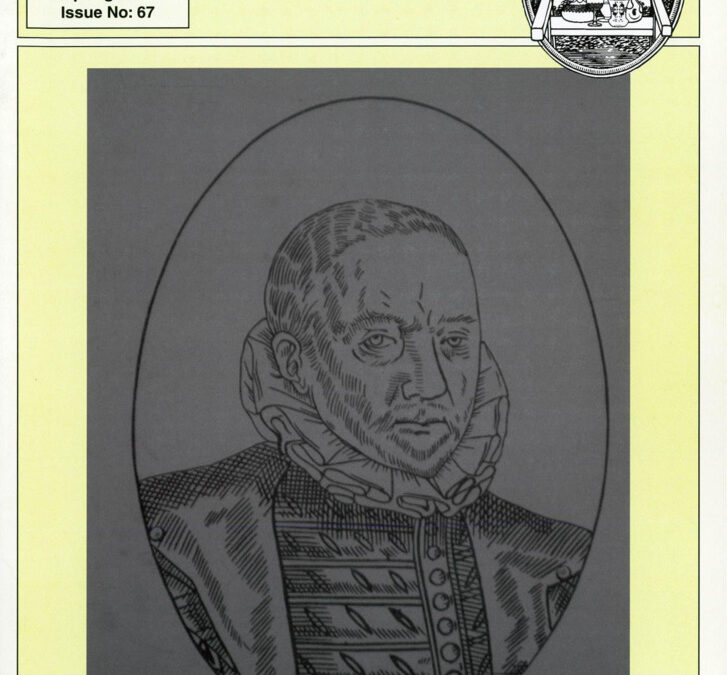
COVER ILLUSTRATION
Portrait of Jacopo Verzelini ( 1522-1616 ) from a line draw-
ing in Hartshorne’s ‘Old English Glasses’ published in 1897.
Verzelini came to England in 1571 to work at the Crutched
Friars Glasshouse in London. In 1574 Elizabeth I granted
him a monopoly for 21 years to make glass in the Venetian
style and to teach glassmaking to his English workers. He is
generally regarded as having established the glass industry
in this country.
THE VERZELINI BRASSES
On Thursday 17 June the Glass Association will be visiting
Downe Church in Kent to see the Verzelini brasses which
show him with his wife and his many children.
See page
13. Anyone wishing to join that visit should contact
Janet
Sergison
on 01732 851663.
SAD NEWS
Stanley Reginald Eveson, born 25 April 1913, died suddenly
after a short illness on 8 February 2004. Widowed twice, he
leaves a daughter and two stepdaughters. Famous for his
involvement in all things glass, he will be much missed, for
all his stories and anecdotes, let alone his encyclopaedic
knowledge about glass-making in the Stourbridge area.
John Sanders
describes Stan’s life and career on page 3,
while
Charles Hajdamach
pays his personal tribute on page
4. There’s a slight overlap, but both are fine accounts of a
fine man. We also have a lasting memorial in Stan’s articles
for the
Journal
of the Society of Glass Technology, 1990
onwards.
ANNUAL GENERAL MEETING 2004
A message from Geoff Timberlake, Hon. Secretary.
We are planning a joint programme of lectures with the
Guild of Glass Engravers at Guys Hospital, London. Dur-
ing the day we and the Guild will hold our separate AGMs
before concluding the day’s activities. The date set for this is
16 October, so note this in your diary now! Full details will
be circulated with the next issue of
The Glass Cone.
Under
the Rules governing the Association’s affairs, nominations
for Chairman, Vice-Chairman, Hon. Treasurer, Hon. Sec-
retary, Membership Secretary, Events Secretary and one
Committee Member must be received by
1
October 2004.
All the officers may seek re-election. The retiring Committee
Member is Gaby Marcon and a replacement is needed under
the Rules. Nomination forms can be obtained from Geoff
Timberlake, Hon. Secretary, 114 Chesford Road, Stopsley,
Luton, LU2 8DR.
Last year, although we sent a Nomination Form with
the
Glass Cone
to every member, none were submitted, so
that the present Committee had to be nominated from the
floor of the AGM. We hope that this year the response will
be better. If not, then you will get a Committee for better
or worse! So if you are dissatisfied with the Committee and
the way the Association is going, ensure that your name is
nominated, seconded and submitted by the closing date.
Regions are reminded that their representatives for
the forthcoming 12 months after the AGM need to be con-
firmed prior to the AGM. Currently there is no representa-
tive for the Midlands Region.
BRITISH 20TH CENTURY GLASS
Charles Hajdamach is now finalising his book on British
20th Century glass and tells us he would like to hear from
any of our members who may have important and unusual
glass or archive information in their possession which might
be useful to print. The book will cover every topic of the
20th Century from Pyrex to Studio Glass. Anyone who
can provide information will have their privacy respected
and can remain anonymous if so requested. Charles can be
contacted at home at Glassmakers Cottage, 10 Villa Street,
Amblecote, Stourbridge, West Midlands DY8 4ER and on
telephone 01384 376137.
2
The opinions expressed in the
Glass Cone
are those of
the contributors. The editors’ aim is to cover a range of
interests and ideas, which are not necessarily their own.
However, the decision of the editorial board is final.
COPY DATES
Summer
Late June 2004
Autumn
Late September 2004
‘The
Glass Cone’ – Issue No 67: Spring 2004
STAN EVESON
Stanley R. Eveson, better known as Stan Eveson, one of the
last outstanding figures of the Stourbridge glass industry,
had lived for many years in Amblecote near to The Dennis
Glassworks of Thomas Webb & Sons Limited where he
spent the whole of his working life.
Born on 25 April 1913 he was brought up in Wol-
lescote and attended King Edward VI Grammar School,
Stourbridge, where his scholastic ability pointed towards a
University education. This was prevented by family circum-
stances, and instead he joined Thomas Webb & Sons on 1
April 1929, a few days short of his sixteenth birthday, as a
Glasshouse Manager’s Assistant at a weekly wage of 13s 10d
(69p). On his arrival at The Dennis he was shown around by
Jack Lloyd, a renowned glass engraver who eventually retired
at the age of 95, and was introduced to Franz Joseph Palme,
the last of the great Bohemian engravers whom Thomas
Wilkes Webb had brought to England in 1882.
The glass industry was badly affected by the Depres-
sion in the early 1930s. The fortunes of Thomas Webb &
Sons were revived with the appointment of a Swede, Sven
Fogelberg, as General Manager in 1932. He introduced
updated methods of production, technical improvements
which included a change from coal to oil-fired furnaces,
and rebuilt parts of the factory.
The young Stan Eveson was involved in these changes.
He was encouraged to continue his technical education at
Summer Schools at the Department of Glass Technology
at Sheffield University and attended Stourbridge Techni-
cal School in the evenings and at weekends. In 1941 he
was awarded the Sheffield University Certificate of Glass
Technology. He became a Member of the Society of Glass
Technology and was the author of numerous papers pub-
lished by that Society.
With his knowledge of glass technology and the
chemistry of glass Stan Eveson was responsible for creat-
ing and establishing the first ever laboratory at The Dennis.
For the first time it was possible to deal on a scientific basis
with problems in glass-making which could not previously
be tackled satisfactorily without laboratory facilities. That
scientific approach was necessary not only in the manu-
facture of the firm’s decorative and utilitarian glassware,
but also for the production of industrial glass which from
1939 consisted of vital components for highly secret radar
equipment. More than 80% of the total glass envelopes for
radar valves were produced at Webbs during World War
II
together with other essential items such as transmitting
valves and X-ray tubes. The glassworks was never bombed,
but Stan Eveson often observed that if The Dennis had been
put out of action by an enemy attack it would have done
incalculable damage to Britain’s war effort.
In 1951 Stan Eveson was appointed Works Manager
at The Dennis, and after the retirement of Sven Fogelberg in
1963, he became Works Director and Technical Director. In
his full time working life at Thomas Webb & Sons Limited
he progressed from boy assistant to Board Room.
After his formal retirement in April 1978 his attach-
ment to the company continued as a consultant and adviser
to Thomas Webb & Sons Limited for some ten years until
the Amblecote glass works was infamously acquired by
Coloroll Limited, the home furnishings group, when it was
wound down and its assets sold off in the late 1980s.
Among Stan Eveson’s many achievements was the crea-
tion of an outstanding works museum at The Dennis, housing
many late Nineteenth Century works of the glassmaker’s art,
including irreplaceable cameo pieces by George and Thomas
Woodall. The new Managing Director of the Coloroll division
running Thomas Webbs was instrumental in selling the most
important pieces from this museum to an American dealer.
The collection which Stan Eveson had brought together as
representative of a century of Thomas Webb’s best glass pro-
duction was broken up and shipped to the United States.
His knowledge of the history of Thomas Webb &
Sons was unique. He researched the company’s archives from
the earliest days of the Webb family business in the 1830s,
recording details of craftsmen, glass decorators, technical
and manufacturing processes and patterns. He was involved
with the crystal glass industry for 60 years, and his first-hand
experience spanned an era which included Joseph Palme
whose career at The Dennis began in the 1880s to World War
II
technology and ultimately the demise of Thomas Webb’s
in the 1980s. His reputation was national and international.
His opinions and advice on glass and Webb’s products were
constantly sought, even as recently as two weeks before his
death, by museums, dealers, auction houses and collectors.
On many occasions his expertise was called upon by The
Corning Museum of Glass, Corning, New York, the larg-
est and most prestigious glass museum in the world, and
nearer to home his advice was always unstintingly available
to Broadfield House Glass Museum, Kingswinford.
He was an assured and witty speaker with charm and
an unruffled personality and a deeply religious faith. He
was a lifelong Methodist and a member of the Providence
Methodist Church, Colley Gate, where his humour and
intellect and his ability as a poet won him many admirers.
As a young man he played badminton to county standard,
but declined to play matches on a Sunday in deference to
his religious commitments.
He was a devoted family man. Following the death
of his first wife, Winnie, he subsequently re-married, but
sadly his second wife, Betty, also pre-deceased him. He is
survived by his daughter and two step-daughters.
He will be long and fondly remembered for his many
contributions to the Friends of Broadfield House Glass
Museum, of which he was a founder member. His humour
and extensive knowledge of glass and glass-making will be
sadly missed.
John V. Sanders
The Glass Cone’ – Issue No 67: Spring 2004
CHARLES HAJDAMACH PAYS TRIBUTE TO STAN
Stan Eveson was a national and international glass expert
who represented all that was great in the Stourbridge glass
industry. Educated at King Edward VI Grammar School in
Stourbridge, Stan joined the glassworks of Thomas Webb
and Sons in Amblecote in 1929 at the age of 15 on All Fools’
Day, a fact he was always proud of. Developing his technical
knowledge he rose from Glasshouse Manager’s assistant
to become Works Manager in 1951 and later Works and
Technical Director in 1963.
His role at Webbs was more than just a technical and
chemical expert and he was involved in every aspect of man-
agement, training, research and development, and even some
designing. He would regularly meet important visitors and
host events at the Works and was involved in fact-finding
tours to glass factories in Sweden and Bohemia. From those
visits he would bring back the latest technical developments
which, when put into practice on the factory floor, allowed
Webbs to maintain their position as a leading glassmaker.
In 1978 Stan officially retired but continued at the
Works for another ten years as consultant when he devel-
oped the Works Museum. His curatorial work in checking
the company’s pattern books to identify dates and informa-
tion for the glass collection was exemplary; the catalogue
still stands collectors in good stead.
From his house at 107 Collis Street in Amblecote,
overlooking Dennis Hall and the Webb site, he welcomed
a steady stream of glassmakers, collectors, historians and
museum curators who benefited hugely from his extraor-
dinary and encyclopaedic memory. When asked to assist
with an enquiry from an American collector Stan was able
to provide instantly the pattern number of the glass in the
early 1930s and its name, the source of the colour from
Czechoslovakia and, not least, the names of the four glass-
makers who had made the glass in question. The American
collector was so impressed that he published the entire letter
in his collector’s club magazine as the finest example of
identification he had ever come across.
In February of 1990 Stan published the first of a
series of articles in the Journal of the Society of Glass
Technology providing a unique eye-witness account of a
major glass producer at a time of great change.
Stan became an active supporter of the Friends of
Broadfield House Glass Museum when that group was
formed in 1994. From his place in the audience at the
Friends’ lectures, Stan would contribute important glass
knowledge but always with a sense of humour which usually
brought the house down with laughter. Friends will fondly
remember Stan’s demonstration of his patent Arachnid
Catcher which consisted of a yard of ale glass and a long
wooden handle with a piece of cardboard.
Stan’s professional life was integrated totally with his
private life which he led as a devout Methodist. He devoted
much of his energy to his church. As Superintendent of the
Sunday School he prepared for those lessons as thoroughly
as he would for his technical glass work. In his youth Stan
had also been a keen sportsman and achieved County level
in badminton until an injury stopped further progress.
Throughout his professional and private life Stan
carried out his activities and duties with dignity, generos-
ity, honesty and integrity. Those who had the privilege of
meeting him will remember him not only as a dapper and
genial host but as a glass legend in his own lifetime. In the
words of his family he was ‘a truly amazing man’.
C.R.H.
A NEW METHOD FOR CREATING MURRINE
Those of our members on the Venice trip last year, will
•
remember the exhibition of antique
murrine
at the Pal-
azzo Rota and the various methods of their manufacture,
enthusiastically introduced by Prof. Giovanni Sarpellon.
The classical methods required the use of different coloured
canes of glass, placed together and worked so as to produce
the desired design, be it landscape, portrait or abstract. The
rod of glass so created could then be cut across anywhere
along its length, much like a stick of rock. The design could
be seen and slices taken as needed for inclusion in the object
being created.
Mike Hunter, the owner and maestro of Twists Glass
Studio in Selkirk, Scotland, has invented a new method for
creating these
murrine.
Mike studied and mastered the art of
glassmaking at Wedgwood Glass before moving to Scotland
and working for David Kaplan and Annika Sandstrom.
Since 1997 he’s worked from his own studio and gained
recognition for his creativity in making glassware in the
manner of the 18′ Century, including excitingly elegant
colour twist stemmed drinking glasses and sweetmeats, and
also for exploring the techniques of the ancient Venetian
masters of glass.
Mike is using a technique of hot working by the glory
hole of the furnace, layering colours of glass over each other
and then pulling the glass mass into a rod, which is then
the first time that he can tell whether all the colours have
been placed correctly. This is both creative and technically
demanding. The end result is a
murrine
design without
any joins.
The clown’s face pictured has the nose in red, eyes and
mouth in black, the hat in blue with a yellow central section
and brown for the hair. The whole is cased in clear glass.
Mike is always pleased to see visitors at his studio in
Selkirk — but do call first: 01750 23195.
Brian Clarke
4
‘The Glass Cone’ – Issue No 67: Spring 2004
MORE JACOBITE REPRODUCTION WINES
In searching through the Stevens and Williams Pattern
Books at Himley Hall recently,
I
came across three designs
for Jacobite wine glasses dated 6 June 1930.
It is not unusual to find reproduction 18′ Century
wines in the pattern books of the Stourbridge factories in
the early 20′ Century but these are unusual in that they
give the reference for the original source. In this case it
was Albert Hartshorne’s ‘Old English Glasses’ published
in 1897.
The Stevens and Williams pattern numbers on the
illustrated page bear the following references:
•
Pattern number 60643: ‘See Hartshorne plate 62’
•
Pattern number 60644: ‘See Page 59 Hartshorne / air
stem’
•
Pattern number 60645: ‘See plate 56 Hartshorne’s
Book’.
The pattern book is not explicit as to whether the
engraving on the last is copper-wheel or diamond point.
There is no reference to the identity of the engraver but
for no. 60643 he was paid 1/3d, for 60644 he received 4/-
and for 60645 he was paid 3/-. The retail prices were 5/3d,
10/6d and 8/3d respectively. Each price also has the word
“each” against it, suggesting that they were made in some
quantity and not just as one-offs.
Charles R. Hajdamach
Above right: the page from the Stevens and Williams Pattern Book.
60643 displays a Jacobite rose;
60644 displays a portait of Bonnie Prince Charlie and the motto “Audentior Ibo”;
60645 is an Amen glass with the motto “God Save the King” and the date 1749.
Details from Albert Hartshorne’s ‘Old English Glasses’. Left to right: page 62; page 59; page 56.
All photos provided by Charles Hajdamach.
The Glass Cone’ – Issue No 67: Spring 2004
GLASS AT THE AUCTIONS
6
Boldon Auction Galleries (www.boldonauctions.co.uk) is
based in the village of East Boldon between Sunderland
and Newcastle. Over the last 3 years, they report, they have
been dispersing items from two collections as well as selling a
collection of Edward Moore glass in their quarterly Antiques
Auction. They also hold twice-a-year auctions titled
Design
and Style from 1930 to the Present Day
which usually include
a good range of Scandinavian glass which, along with local
glass, has always had a good following in the North East.
On 25 February they sold approximately 70 lots from
the Green collection of North East and other Pressed Glass.
Although many of the best pieces from this collection had
been sold in December 2000 by Sotheby’s South, there still
remained a number of interesting items.
Rare Greener & Co. green malachite glass butter dish
and cover of oval form, the lid surmounted by a cow, both
pieces with first Greener mark. 19.5 cm. across. Photo:
Boldon Auction Galleries
The highest price of £400 was reached by a Henry Greener
green malachite glass butter dish surmounted by a cow.
Estimated at £200-300, this was unsold at Sotheby’s (when
estimated at £300-£400). Four pieces of Edward Moore
glass sold at prices from £130 to £180 each and 13 other
lots sold for £100 to £150 each.
Susan Newell reports that Bonhams sale on 3 March in-
cluded two interesting bottles which sold for £3,000 and
£18,000. The latter was an early sealed bottle, circa 1670-80,
in green glass, of shaft and globe type with a string rim,
applied on the front with a seal of the arms of the Hanson
family granted to Sir Robert Hanson.
Robert Hanson was a successful London merchant
and trader and was elected Alderman of the City in 1664.
He was knighted 1 February 1665 and elected Sheriff in the
same year. As Aldermanic Sheriff of the City of London
he would have attended closely on the infamous Mayor
Bludworth, whose predictions about the seriousness of the
Great Fire proved so disastrously inaccurate. He became
Master of the Grocers’ Company in 1678, and Lord Mayor
of London 1672-73. He died in 1680.
Early sealed bottle circa 1670-80 in green glass 23.5cm.
Photo Bonhams Montpelier Galleries.
Detail from the bottle above – the seal of the arms of the
Hanson family granted to Sir Robert Hanson, comprising
three voided diamonds (mascles) on a chief of three lions
rampant. Photo Bonhams Montpelier Galleries.
Edward Moore
& Co turquoise
malachite vase
of chained bird
pattern. 17.5
cm Photo:
Boldon Auction
Galleries.
‘The Glass Cone’ – Issue No 67: Spring 2004
Wine glasses from Dreweatt Neate’s 5 February sale (photographs from Dreweatt Neate).
Dreweatt Neate’s sale on 25 February included some fine
wine glasses.
The leading items are shown at top of page.
Left:
A colour-twist wine glass, the bell bowl supported on
a stem filled with alternate spiral threads in red, opaque-
white and green, on a conical foot, 16.5cm high, circa 1770,
sold for £1,850
Centre:
A Dutch-engraved light-baluster marriage goblet,
the round funnel bowl engraved with a rocaille cartouche
with a pair of love-hearts on an altar, beneath an inverted
cornucopia of fruit and flowers, the reverse inscribed
HET.GOED.SUCCES.VAN.HET AANSTAANDE.HUWELYK,
on a stem with cushion-knop and knop above section with
bead inclusions, 20.5cm high, mid 18th Century, sold for
£2,400.
Right:
An engraved pedestal-stemmed wine glass, the funnel
bowl decorated with a band of stylised flowerheads, the solid
lower section supported on a cushion knop, fluted octagonal
stem, 16cm high, mid 18th Century, sold for £800.
The same firm’s sale on 24 March included a Lau-
rence Whistler stipple-engraved goblet, ‘The Alternatives’
(see picture at left by Dreweatt Neate).
The broad cylindrical
bowl on knopped stem shows a male figure, half white, half
black standing by a wall which acts as a barrier. There is a
distant view of a power station in a rural landscape, 24cm.
high, finely signed ‘L.W.’ and dated 1979. Estimated at £400
to £600 it sold for £560.
In their 16 January auction Jacobs & Hunt of Petersfield
Hampshire included a George III wine glass with funnel shaped
bowl, double opaque red and white twist
stem
and plain circular
foot, 15cms high. Estimated at £150 to £250 it sold to one of
five telephone bidders for £2,300, reported
The Antiques Trade
Gazette.
FORTHCOMING SALES
As usual Biddle & Webb of Birmingham have a glass sale
on the second Friday of every month, with viewing during
the week prior to the sale; tel. 0121 455 8042 for details.
Fieldings’ next sales will be Saturday 4 May and 12
June at Hagley Community Hall; tel. 01384 444140.
Henry Fox tell us as we go to press that on 7 June
Bonhams will be selling 17
th
and 18`
h
Century glass from
his collection.
7
‘The Glass Cone’ – Issue No 67: Spring 2004
OVERSEAS AUCTIONS
The auction house Dr. Jurgen Fischer (www.auctions-
fischer.de) was founded in 1976 in Heilbronn and started
out as a small family business. It now holds at least five auc-
tions a year, three of them concentrating on European glass.
The catalogue for the auction on 20 March covered nearly
1200 lots of glass — all pictured in colour. The catalogues
are themselves treasured as reference books because of the
auction house’s reputation for knowledgable attribution
(staff are very helpful in English, but you need a working
knowledge of German to read the catalogues). Below are
three of the images from the 20 March catalogue (with our
rough translation).
Left.•
Rare decanter with stopper, signed by August Bohm,
a finely cut representation of a mother with child, in cobalt-
blue cut to clear glass. 35.5 cm tall. Est €8,000. Unsold.
Top:
North Bohemian beaker from Neuwelt, around 1850, colour-
less glass with reeds carved in cobalt-blue Bearing Crown and
monogram “AW”. 10.5 cm tall Est €700, sold for
a ma
Bottom:
Ranftbecher with View of Josephs Platz in
Vienna , in very fine transparent enamel painting by Anton
Kothgasser, Vienna, around 1825. 11 cm tall. Est €2,800,
sold for €7,000.
In
Glass Cone
66 we illustrated a cameo rose jar at the Fall
Auction of Early Auction Company in Ohio, which sold
for $19,500. An identical jar appeared in their Spring sale
on 2-3 April; estimated at $15,000 to 20,000, it was one of
the few items that failed to sell.
In over 700 lots, five surpassed a five figure hammer price:
a Mount Washington lyre-form candlestick at $10,000; a
Plated Amberina pitcher at $33,500; a Wheeling Peachblow
vase with crimped rim with a lavender interior at $15,000; a
Mount Washington Royal Flemish “Garden of Allah” lamp
at $16,000; and a Tiffany “paperweight” vase at $15,000
A very attractive cameo vase, attributed to Webb, in
frosted white glass with alternating diagonal bands of green
ivy and blue cameo flowers, 7 inches tall, sold for $4,250, well
over estimate
(photo below from Early Auction Company).
ROGER EARLY
Early’s website reports that Roger P. Early, founder of
Early Auction Company in Milford, Ohio, at the age of 87
years, passed away after a short illness on 29 December. He
was the son of Roger and Loura Early who were antique
dealers and started an auction business in the 1940s. He
graduated with a Bachelor degree in Business from Ohio
Wesleyan University in 1938 and was a member of the Delta
Tau Delta Fraternity. He then served in World War II as a
Captain in the Army Air Corps.
During the 1950s Roger and his brother David further
developed the business, specializing in Victorian Art Glass.
He became a recognized authority in the field.
He loved the business and auctioneering, and in fact,
he conducted his last auction on 14 November 2003. I spoke
to Roger by telephone a number of times when buying at
his auctions. His kindness and courtesy to customers was
legendary and I invariably enjoyed his dry humour.
The Early Auction Company continues today under
the management of his son, Steven S Early, wife Paula Early,
and Roger’s grandchildren, Sarah Early and Steven Jr.
BMC
8
‘The Glass Cone’ – Issue No 67: Spring 2004
INDIAN COUNTRY GLASS
The Indian sub-continent holds many surprises. To be wan-
dering along the beach in Kovallam in the state of Kerrala,
S.W. India, in sweltering heat in early January, and to stumble
across an antiques shop was in itself a surprise. Having pulled
the shop to pieces I finally decided not to purchase a pair of
silver ( humm?) altar sticks from Calcutta. When I was sitting
down at last in negotiation with the owner (an Indian version
of any dealer from Portobello Road or anywhere else come to
that), three very dusty glass objects, living on the floor under
a bottom shelf were in view. A few minutes later and a deal
was struck. Two trailed vases and a bowl with a wonderfully
created multi-coloured handle were purchased.
I’d assumed they were imported during the British
Raj; the dealer however, held that they were manufactured
locally in the 19t
h
Century. He couldn’t tell me more and
there was no time for local verification. The internet has
not been able to come up with any supporting information.
Perhaps one of our members knows more.
Each piece has been made in the same fashion. The
coloured “blobs” are cased internally and externally with trans-
lucent glass. The yellow decorative “swags” have been layered
externally on the outer clear glass layer and marvered in.
The 210 mm. diameter bowl has been created with
translucent pale grey/blue glass and the blobs of colour
are in red, orange and opaque white. The amazing and
very individual handle is hollow blown and coloured with
red, orange, blue and opaque white. Its fixing to the bowl
is masked with large blue-grey prunts.
The smaller vase, 190 mm tall, is also in blue/grey
glass with coloured blobs in opaque white and orange. The
taller vase, 200mm. is in colourless glass and has many air
inclusions; the blobs are yellow, orange and red.
All three objects have a weight which suggests a fair
content of lead (not tested), are “clumpy”, suggestive of an
unsophisticated origin, but have manufacturing details of
high complexity. Does anyone know more?
Brian Clarke
CAITHNESS GLASS IN RECEIVERSHIP
The Glasgow Herald
reported on 21 February that the
world-renowned glass company, Caithness Glass, had gone
into receivership with around 150 jobs in Wick, Perth and
Oban under threat.
The company with an annual turnover of £6 million
to £8 million, was established in 1961 and won a reputation
for paperweight manufacture as well as trophy work (such
as the BBC Mastermind prize, and the annual Scottish tour-
ism Oscars). It was taken over in 2001 by Royal Worcester
and Spode but the recent down-turn in sales, especially to
the United States, given the poor exchange rate, alongside
East European competition, has meant its export market
has particularly suffered.
The receivers noted that Royal Worcester & Spode
Ltd had decided to concentrate all its financial resources
on its core business and therefore was ‘unable to provide
additional support to Caithness Glass’. While accepting
the importance of these market conditions, Richard Carr,
Honorary Reader in Design History at Dundee Univer-
sity, suggested that Caithness Glass had failed to exploit
changing tastes. ‘I also don’t think Caithness has kept up
its designs to meet the changing market… Somehow you
have to balance the old with the new and I am not sure
Caithness has been successful’.
The Liberal Democrat MP for Caithness, Suther-
land and Easter Ross, John Thurso, son of the company’s
founder, along with Scottish MPs Roseanna Cunningham
and Rob Gibson are meeting the receivers to discuss the
future for the company and its workforce.
( Many thanks to Ian Turner for the newspaper cutting )
9
The Glass Cone’ – Issue No 67: Spring 2004
COLLECTING MODERN EUROPEAN ART GLASS 1940-1980
Tim Paterson is an experienced specialist dealer in late 20
Century Art Glass who regularly exhibits at the National Glass
Collectors Fair.
There are several criteria to reflect on when first considering
collecting in any field, but especially “Art Glass”. First and most
importantly: do you like the piece? Far too many people fall into
the trap of “buying the name” rather than viewing a piece of glass
as an individual item. This is especially true if it is well, or modestly
priced. You also have to remember that even great designers, such
as Edward Hald or Vicke Lindstrand, had off-days.
You may want to collect glass from a specific period
in time, or glassware produced by a particular designer or
company. You may even want to take a much broader interest
in a type of glass, collecting 20
th
Century art glass from Italy,
Sweden or Finland. Before starting out it may be advisable
to find out how easy it is to find the sort of glass you want
to incorporate into your collection. This should be informed
by both the price and availability of any particular type of
glass. There can be little more frustrating than having a sum
of money put aside to expand your glass collection, only to
find nothing to buy. Finally, and most delicately, you need to
study the amount of money you are going to have to invest
in new acquisitions. At one end of the spectrum you can find
examples starting at less than £50, whilst at the other extreme
you can expect to pay £10,000 and higher for highly rated and
rare pieces. So the cost of a particular type of glass will be a
very important consideration indeed.
Condition is also important, and although it would be nice
if each piece of glass in your collection were a “mint” example,
the reality is often far removed. As a general rule of thumb, you
should both expect and accept “fair wear and tear”. After all, the
glass from this period can often be heavy, relatively old, and indeed
initially functional. You may not even consider putting a bunch
of daffodils in your glorious Venini
Pezzato
vase, but there might
well have been a time when it did hold flowers. Water damage,
scaling or sickness, is one of the glass collector’s worst enemies.
Although a small amount may be acceptable, heavy staining is
most definitely not. A sealed vase is almost impossible to clean.
In contrast, scratching and fine wear to the base is not only to be
expected, but can provide a good indication that an item of glass
is genuine. If you can’t see base wear on a 4 kilo, 50-year-old vase,
you need to ask yourself why. You could be dealing with a piece
of glass that is either a fake or has been highly restored. Whilst
some exterior damage may be acceptable, try to steer clear of
examples of glass with serious scratches or chips. Although such
items are sometimes restorable and it may be worthwhile having
the work done, it can be an expensive and time-consuming job,
with no guarantee of success.
The identification of a piece of 20
th
Century art glass is
also an important issue, especially when it comes to glass pro-
duced by Italian firms, as only a few of the major companies
of the period actually signed their pieces. In fact most items
of glassware were only issued with paper labels, and after time
and cleaning these are all too often lost.
Scandinavian glass is a different proposition entirely. The
vast majority of pieces were not only signed by the company,
but were often signed by the designer as well. Orrefors, Kosta,
Iittala and Nuutajarvi, four of the best-known Scandinavian
companies, all used both company and designer signature
marks. All but Nuutajarvi also used individual design codes,
to identify each design from the company catalogues.
In the identification of art glass, good books and publica-
tions are a must. There are plenty of books on the market at
the moment, which cover most aspects of the European glass
industry. And whilst you may think some are expensive, they can
often prove their worth in a very short time; especially if you find
a well-priced piece of glass that you recognise from a book, and
the seller has no idea what they have. Old auction catalogues can
also be very valuable, as they may have photographs and price
estimates of items actually sold in the marketplace.
As a collector of Art Glass you should try to visit as
many shows, collectors’ fairs and auctions as your time permits.
These events will provide a good opportunity to get an idea of
price and general availability of the type of glass you want to
collect. Any decent dealer or auctioneer will try to find the time
to give you honest advice; but also be aware they have a living
to earn. When buying any piece of glass, especially an item of
some value, it is always in your interest to consult a specialist
dealer, as they should offer you a full receipt together with a
guarantee of authenticity. While auction houses can be a good
source of information, they tend to employ “specialists” to cover
all aspects of “Modern Design”, rather than any specific field.
Another thing to consider is the fact that an auction house at-
tribution may boil down to “their opinion”, and it is the buyer’s
responsibility to confirm the identification of a piece of glass.
You should always contact the auction house to clarify this
point before bidding, as there will be no return of sale, even if it
turns out that they have incorrectly attributed an item of glass.
However, if a piece of glass is later identified as a “deliberate”
fake, which was made to deceive, then you would be entitled to a
full refund. Unfortunately, obtaining the correct documentation
to prove your case may be both time-consuming and costly. In
the end it can be as much as 20% of the claimed amount that
may be unrecoverable. All in all, it might be beneficial, especially
in your early collecting career, to rely on a specialist dealer. In
time you will gain the experience and knowledge to evaluate a
piece of glass, making an informed judgment based on your
own considered opinion.
Finally, and most importantly, enjoy the time you spend
both learning and collecting and you will develop a collection
of glass that will not only give you pride and pleasure, but
also a great potential for future profit. After all, 20th Century
design is the field with the biggest proven growth area in the
entire antique and collecting market.
© Tim Paterson
(www.retrogallery.co.uk)
NEW MEMBERS
A very warm welcome to the following new members who
have joined the Glass Association since the last issue of
the
Glass Cone.•
Ms S C Every
East Sussex
Ms J Green & Mr J Dick
Surrey
Dr G Jenkins
Bristol
Mr & Mrs S Jordan
Essex
Ms F Lambert
Surrey
Mr J Masson
Tyne & Wear
Mr B G Mitchell
Merseyside
Mr & Mrs D Reekie
Norfolk
Mr N T J Reynolds
Bedford
Miss
J
Townsend
Edinburgh
Mr & Mrs C Yates
Bucks
10
The Glass Cone’ – Issue No 67: Spring 2004
CAMBRIDGE GLASS FAIR NO 3
The 3
rd
Cambridge Glass Fair, on 15 February 2004, organised
under the auspices of the ‘Oxbridge Fairs’ team of Graham
Cooley, Paul Bishop and Christina Glover, was yet another fair
to move to a new venue. However, unlike Pat Hier’s National
Glass Fair this was not due to a calamity affecting the previ-
ous venue but a need for a venue outside Cambridge and its
associated parking and unloading problems.
The new venue, Chilford Hall Vineyard at Linton cer-
tainly overcome any concerns about parking; although, due to
the restricted space for unloading, the scene when we arrived
at the entrance to the hall was chaotic to say the least, with
harassed members of the Chilford Hall stewards team attempt-
ing to cope with at least two-thirds of all the dealers who had
arrived within the same five-minute period. Eventually all had
off-loaded their wares and display paraphernalia. Davina and
I set up the Glass Association’s stand
(photograph below)
in the
foyer before taking a look around the main hall.
With almost 70 dealers present, there was a busy edge
to the atmophere. The range of glass eing displayed ranged
through 18 Century, Victorian, 20 Century, paperweights
and modern Studio glass. I was pleased to meet a fellow student
of a Kiln Glass course held in Luton a couple of years ago.
He had gone on, developing considerable skills in that field,
and had some very interesting items for sale.
We noted, with surprise, that this time there was not
much pressed glass on show and the only examples available
were rather run-of-the-mill. In the other areas of collecting, the
samples presented were of good quality. Collectors and glass
enthusiasts were soon waiting patiently for the doors to open,
despite the rather keen chill in the air. Once inside they made for
their favourite dealer(s) to see what goodies they were about to
be tempted by. Viewing was brisk although, if you believe the
dealers, trading was slow. However we did see many bags being
clutched carefully as visitors left, so some were buying.
Oxbridge Fairs at their previous fair held a non-selling
exhibition in the foyer—this was repeated at this fair. This time
the theme was Hartley Wood decorative glass ware, on loan for
the day from private collections. With kind permission from
the authoress, Sue Newell, the exhibition was illuminated by
copies of her article on Hartley Wood that was re-produced
in
Journal
No. 6. The Glass Association’s stand was directly
opposite the exhibition so we promoted sales of
Journal
No
6 as well as back issues of the
Glass Cone
and other Journals.
If you are not familiar with Hartley Wood glass, when next in
Sunderland go along to the Museum where there is a good dis-
play of it. The colours are striking, an attribute unfortunately
lost in this black and white photograph showing approximately
one half of the glass that was exhibited.
Altogether the fair seemed to have been successful despite
the change of venue. Prior to the event the organisers were a little
apprehensive whether the public would venture out of the city,
but the crowds soon dispelled any fears they had. Chilton Hall is
well signposted off the Mll but to make doubly sure, AA signs
for the glass fair were also set up. Catering was available which
helped to provide a pleasant ambience. We understand that the
next Cambridge Glass Fair will also be held at this venue and
thus should prove to be successful again.
Geoff
Timberlake
A MOVE FOR TUTBURY CRYSTAL
The
Burton & South Derbyshire Advertiser,
17 March, reported
that Tutbury Crystal will probably be forced to move from its
Ludgate Street premises, which have become a target for local
vandals. However, Managing Director Ian Nicklin hopes to
find a new site in the region, large enough to allow a measure
of expansion, to include a museum, theatre and glass-blowing
facilities. In the past the firm has produced work for the prestig-
ious Queen’s Awards, but this move is aimed firmly at the tourist
market. From 1906 the factory was part of Thomas, Webb &
Corbett (later Webb, Corbett) but in 1982 it became known as
Tutbury Crystal.
(Thanks to Ian Turner for the cutting )
SHEDDING LIGHT
Has anyone travelling around the British coast-line spared
a minute to wonder about light-house glass production? If
so, then Alan Taylor of Kingswinford might well be able
to answer all your queries. In 1946 he started an engineer-
ing apprenticeship at the Lighthouse Works of the famous
British glass manufacturers, Chance Brothers Limited in
Smethwick, and over the next six years saw enough of the
production of lighthouse optical apparatus to engender an
enthusiasm which has lasted nearly fifty years. He has a web-
site: www.uklighthouse.info.
11
The Glass Cone’ – Issue No 67: Spring 2004
PAPERWEIGHT
NEWS
A friend rang with the news that Caithness Glass had been
put into the hands of receivers. By the time that you read
this their fate will probably have been sealed one way or
another as my understanding is that the receivers have given
interested parties a month to formulate their bids. In discus-
sions with fellow collectors over the years we have always
wondered how they managed to sell the volume of weights
that they produce, particularly the large numbers of the
unlimited ranges; but because of their recent connections
with Royal Doulton and latterly Royal Worcester they did
have access to a worldwide publicity and sales network.
Over the years since it was set up in Wick in 1960,
Caithness Glass has had a variety of owners including, I
believe, at one time, the Drambuie Company, plus at least
one management buyout before the more recent ownerships
mentioned above. Most of you will probably know that Paul
Ysart was employed at the Wick factory as training officer
from 1963 to 1970 and was responsible for the training of
both Peter Holmes and William Manson. He was also al-
lowed to make his own weights outside working hours.
The trigger for official paperweight production hap-
pened when Colin Terris joined the company in 1968 to set
up and develop an engraving and design studio. The first
Caithness paperweights in their now familiar abstract form
came out of the factory a year later.
Reports suggest that the paperweight order books
are up on last year. As a paperweight collector one tends
to think of the company in that light, overlooking the vast
range of other glassware, from relatively inexpensive house-
hold items to very expensive individual pieces manufactured
in the factories in Perth and Wick. I would have thought
that some aspects of the business might be of interest to
potential buyers but perhaps the reality is somewhat dif-
ferent; I remember that only two years ago no buyer could
be found for Perthshire Paperweights. I guess that if the
company does survive in some form it won’t keep the cur-
rent size or structure.
For the information of Perthshire paperweight col-
lectors, an interesting and previously undocumented pa-
perweight made by Perthshire has recently been purchased
by a fellow Glass Association member. A large three and a
quarter inch diameter weight, with superb quality complex
canes all packed closely together
(see photographs),
left lit-
tle doubt that it was from the Perthshire factory. But two
large special canes, one containing the date 1898 and the
other comprising three white crossed keys on a plain green
ground, surrounded by a ring of pink canes, proved a bit
of a mystery. So I sent a photograph to the one man who I
felt must be able to help, Peter MacDougal, the ex-manager
of the Perthshire factory.
I got a reply by return post. It transpires that it was one
of their commercial commissions, made for the Swiss Bank
to commemorate an anniversary in the 1980’s. Working back
from the 1898 date, I assume the anniversary was probably
either 85 years (1983) or more likely 90 years (1988). Peter
thought that they produced 100 of the large size and also
made some medium size weights; but the most interesting
information that he was able to supply was about the large
crossed keys cane. It took four days for Roslyn Ward to set
up the cane design on the bench and because of its size it
took Peter two hours to get the heat right through to the
centre when making the cane. He says that there should be
a P cane somewhere in the weight but we haven’t managed
to find it yet. My grateful thanks to Peter MacDougal for
his help in providing the above information.
Another interesting and possibly unique signature cane
has turned up in a weight bought by a friend at an antiques
fair local to them. The weight comprises five large spaced
complex millefiori canes set on a blue ground, similar in style
to some weights made by Paul Ysart. It is marked on the
underside with an etched CGII indicating a Caithness Glass
second. Set in the middle is a cane with AM 1973 inside in a
ring of complex canes; this same cane is set in the top of the
crown weight made in a limited edition of 100 to celebrate
the wedding of Princess Anne and Captain Mark Phillips.
The unusual cane is set into the underside and com-
prises a ring of complex canes with clear glass centre into
which is set the white letter OG above JA. OG is for Oban
Glass, the Oban factory operated by Caithness Glass until
a few years ago, and JA is for Jack Allen who, after working
for Vasart and later Strathearn, crossed the road with Stuart
Drysdale and the other workers in 1969 to the new Perth-
shire Paperweight factory where he stayed until 1973.
In the Caithness paperweight records the making
of the wedding crown weight is attributed to Jack Allen
and research indicates that he was employed by Caithness
Glass on a short term contract in 1973. While working
for the company he also designed the unlimited
Flower in
the Rain
weight that they have produced over many years
and has since been copied by other makers. It looks, there-
fore, as though the complex cane weight was probably an
experimental one that never went into production, being
sold off as a second in the factory shop, whilst the crown
weight was preferred for production but without the OG
JA signature cane.
12
The Glass Cone’ – Issue No 67: Spring 2004
My final task is to give you details about the South
West regional meeting of the Paperweight Collectors Circle
on Saturday 19 June (not 4 June as shown on the list of
GA Anniversary meetings sent out earlier in the year). Any
interested Glass Association members are welcome to at-
tend. The venue is the Star Inn, Clevedon Road, Tickenham,
North Somerset which is at the Bristol end of Tickenham
village on the B3130. The B3130 runs from Clevedon to-
wards the junction with the B3128 from Failand and Long
Ashton and on to Nailsea. From the M5 Motorway take
junction 20 (Clevedon) and B3130 and from Bristol take
A370 and B3128, or A38 and B3130. As one of the organ-
isers, I will be present from noon, when food will be avail-
able from the bar. The meeting will start at 1.30pm, when
it is expected that paperweights will be on sale. The two
afternoon talks will last from around 2.00pm to 4.00pm,
when tea /coffee will be available before finishing at around
4.30pm. There will be a charge of £4 per head payable on
arrival. Contact me by telephone on 01242 515505 or email
rg@rpsl.com.
(Thanks to Derek Whitcher for the photographs.)
Richard Giles
SOUTH EAST REGION SUMMER MEETING
Janet Sergison
on
has announced that the second event of 2004 for
the SE will be a visit on Thursday, 17 June, to the parish church
of St Mary The Virgin at Downe to view the memorial brasses
for Jacob Verzelini, followed by a guided tour of Eltham Palace.
Meet at 10.45 for 11.00 am in the parish church of St Mary The
Virgin, Downe (https://cudhamanddowne.org/dhistory.htm).
In 1606, Giacomo Verzelini (born 1522), a glass-maker
from Murano, near Venice, paid £20 to have a brass memorial
of himself, his wife Elizabeth (daughter of a glass-maker in
Antwerp) and their children put in the chancel to cover the
family grave in the crypt below. The brasses are in total ap-
proximately 200cm by 90cm.
Jacob (Giacomo) Verzelini came to England in about
1571 and took over a glass-making factory at the Hall of the
Crutched Friars in Aldgate, London. In 1574 he obtained a 21
year licence from Queen Elizabeth 1, provided he taught his skills
to Englishmen and imported no glasses. Despite the glasshouse
being destroyed by fire in 1575 his business was very successful
and he bought property in Downe (including Downe Court)
as well as a great number of estates in the area.
Only a few of his drinking glasses remain. Examples can
be found in the Victoria & Albert and British Museums. The
brasses were damaged during World War II and after repair
they were replaced in the North West wall in 1978.
In the afternoon we visit Eltham Palace, Eltham
(www.english-heritage.org.uk/elthampalace/visit/visit_
eltham.htm), a showpiece in early 20t
h
design with a fascinating
history. It is the only English Art Deco house open to the public
built on a site of great antiquity and joined to a medieval hall.
Commissioned by Stephen and Virginia Courtauld and com-
pleted in 1936 the house was filled with the latest all-electric
gadgets including sound system, centralised vacuum cleaner
and under-floor heating.
The exteriors have fine sculpture by artists who are little
known today (Alfred Hardiman and Filbert Ledward) but
whose works can be seen all over London. The whole house is
a fascinating and eclectic mix of high style French-influenced
Art Deco, ultra-smart ocean-liner style and cutting-edge Swed-
ish design. The dining room is a
tour de force,
with pink leather-
upholstered chairs, pale fawn bird’s-eye maple veneered walls
and silver ceiling. It is entered through black and silver doors
featuring animals and birds drawn from life at London Zoo.
Even more exotic is Virginia Courtauld’s vaulted bathroom,
lined with onyx and gold mosaic, complete with gold-plated
bath taps and a statue of the goddess Psyche.
Janet Sergison can be reached by telephone: 01732 851663 or
email: janetsergison@onetel.net.uk
GLASS ASSOCIATION WEBSITE
As announced at the last AGM, your committee has given the
go ahead for the development of a new professional website.
The first phase is now accessible to the public. The website
address has not changed: www.glassassociation.org.uk .
At present the content is similar to the old website but
the committee aims to provide a platform from which the aims
of the Association can be furthered in a cost effective manner.
Plans are in hand to develop the Gallery area so that it provides
information about specific fields of interest. This will include
illustrations, historical and background information as well as
details of collections and archive materials available to collec-
tors. The Links page will also be expanded to provide quick
access to other sites of interest to glass enthusiasts.
We need the contributions of Glass Association mem-
bers. In the past such contributions have usually been supplied
by committee members. However, their interests cover only a
limited number of collecting fields. To ensure that this website
appeals to as many different glass enthusiasts as possible we
need your help to promote your specialist collecting field on the
site.
All
we need from you is 500 words and ideally some accom-
panying photographs or illustrations. You do not need to be a
professional writer. Just email what you have to your Webmaster
at hier-asl@btconnect.com and he will do the rest.
We plan a ‘members only’ area with access to exclu-
sive materials and an online forum where members can post
questions and share their knowledge and experience of glass
collecting.
I hope you find the website interesting and if you have any
comments about the site or have suggestions, let us know
Dil Hier
DONATE TAX REPAYMENTS TO THE ASSOCIATION
From 6 April 2004, a taxpayer can nominate a charity to re-
ceive a tax repayment due to him/her as a result of making a
tax return. The donation can be made to just one charity which
must be chosen from a list published on the Inland Revenue
website (from April 2004 onwards). Charities that wish to
receive donations this way have been asked to put themselves
forward for inclusion on the list. Each charity on the list has
been given a unique code which should be used on the tax
return to identify the charity to receive the donation.
Our unique code is
SAN11FG.
If you elect to use this
facility to give to the Glass Association, we’ll be delighted.
The Inland Revenue tell us we should continue to make
good use of the Gift Aid scheme, which is not affected by
the change. Contact our Hon Treasurer,
Brian Clarke,
7 The
Avenue, London N3 2LB for more details
13
The Glass Cone’ – Issue No 67: Spring 2004
THE PUZZLE MUG REVISITED
Brian Balman
wonders whether the engraved glass
(below
left),
described and illustrated by
Ken Cannell
in the last
Cone
(p.14), is in fact a Pasglas, with the horizontal banding indi-
cating the level to be drunk before passing it on to another
companion to imbibe. Another possibility is a Pegmug with a
similar function although these are generally made of wood,
and the levels are marked with internal wooden pegs. Such
vessels were produced in Germany and Norway respectively,
but generally have a much greater capacity. He thinks this
example very probably dates from circa 1860 and, given the
ground rim and base, is probably of North German or Dutch
manufacture. It’s certainly a possibility but of course the Ger-
man and Scandinavian examples are usually much larger (but
then perhaps this is not for beer but for stronger spirits!).
But
Graham Cowlin
thinks it is definitely a spa glass,
continuing ‘of the sort widely used in 19
th
Century Europe…
by cautious spa visitors to monitor their intake of the heal-
ing fluids on offer. Usually they just bear the name of the
spa, roughly executed.’ However, Ken Cannell’s example is
an ‘exception, being finely cut and well proportioned… At
the other end of the scale of desirability are the Bohemian
glasses, flashed in red or yellow, meticulously engraved with
views local to the Spa, of architectural landmarks… presum-
ably intended as souvenirs rather than mere utensils.’
Also on that page a vase
(above right)
was illustrated
with a Christopher Dresser-like decoration, from the Woolley
& Wallis Salisbury salerooms.
Michael Thatcher
of Stroud
points out its close resemblance to a Lindthorpe Pottery
vase, shown in the 1999 New Century’s Dresser exhibition,
although the proportions are slightly different. But it ap-
pears it may be of German or Bohemian manufacture as
Stephen Ozier
of Riddetts of Bournemouth, the auctioneers,
has come across three such examples in sales in Germany,
priced in the region of 600-700 Deutschmarks (as was) over
the last decade and indeed has one in his personal collec-
tion. They have been identified as manufactured by Moser
of Karlsbad circa 1895.
Our sincere thanks to them all for finding the time to write.
ANTHONY & CLEOPATRA
Some of you might have read in August of Dr Jerome Ei-
senberg (Harvard University, USA) and his theory that the
famous Portland Vase at the British Museum, London, is a
16
th
Century fake. (Actually, as Ian Freestone of the British
Museum has pointed out in the recent Assoc. for the History
of Glass newsletter, Eisenberg in his
Minerva
article, no.14(v)
pp.37-41, seems to accept that the blue glass is Roman produc-
tion but that the cameo frieze was cut in Renaissance times.) In
a recent lecture in London, Dr. Susan Walker, Deputy Keeper
(Greek and Roman Antiquities) at the British Museum rejects
this hypothesis and offers a new interpretation of the scene
cut into the cameo glass: that it is in fact a meeting between
Anthony and Cleopatra, and alludes to the Battle of Actium.
Numerous other theories, some 79 in all, attempting the iden-
tification of the figures have been aired, largely drawing on the
mythological world rather than the historical arena, suggest-
ing that the male and female figures are Achilles and Thetis,
Perseus and Andromeda, etc.
( Many thanks to
Ken Cannel!
for the cutting from The Times, 6 March. )
WINDOW AGAIN SEES LIGHT OF DAY
In the 1960s, the 3m (10′) stained glass window that decorated
the main staircase of Newcastle’s Laing Art Gallery at its open-
ing in 1904 was taken down and consigned to a storeroom,
where it was recently re-discovered. Believed to be the work of
local designer, J Edgar Mitchell, it has since been restored by
Chris Chesney of Iona Glass specialist glass conservation unit
of Warkworth, Newcastle. It has been reinstalled as part of the
Laing Art Gallery’s refurbishment, which was unveiled to the
public on April 17. It contained unusual types of textured and
clouded opalescent glass, so that finding replacement panes for
repairs proved a headache. The search for suitable glass extended
to Glasgow, France and the United States. It is thought that
originally the window, featuring the City of Newcastle’s coat
of arms and a triptych of three standing ladies in Art Nouveau
attire, was produced by the Sowerby’s Gateshead glassworks.
( Thanks to
Rita Pearce
for the cutting from the Newcastle
Journal, 6 February. )
CLAUS RIEDEL
The Times
of 27 March carried an obituary of Claus Riedel,
designer and manufacturer of elegant and distinctive wine
glasses, who died aged 79 on 19 February. Born in 1925 in
what is now the Czech Republic, Riedel was conscripted into
the German army and was sent to the Italian front where he
was captured by US forces. While being repatriated in 1946,
he jumped train in Austria and went to the Swarovski Crystal
factory whose founder had been trained by Riedel’s great-
grandfather. On his father’s release from Soviet authorities
in the mid-1950s, they decided to buy a bankrupt glassworks
in Kufstein, Austria, which could trace its origins back to
1756. Almost immediately Claus Riedel decided to design
wine-glasses which could exploit the various properties of
wine in terms of taste and aroma, experimenting with shape,
thickness, balance etc. By 1958 his Burgundy
Grand Cru
glass,
capable of holding 37 fl.ozs. was on display in the Musuem
of Modern Art, New York. Since then it has been joined
by another 126 pieces from the Riedel range. His first son,
Georg, succeeded him as president of the family firm in 1994
and has continued to develop the glassware range.
VANDALS IN AMBLECOTE
No news yet whether the latest episode of vandalism on the
glass-blower statue in High Street, Amblecote in Stourbridge
has been repaired. Yet again the blowing iron has been bent
out of shape, despite reinforcement. Located virtually on the
site of the old Glassmaker’s Arms Public House, opposite
the old Webb Corbett works, the statue has been the target
of anti-social behaviour for some time, as reported in the
local
Express & Star,
3 January. Some councillors are asking
for the statue to be moved but Amblecote History Society is
campaigning for increased security.
14
The Glass Cone’ – Issue No 67: Spring 2004
BOOK REVIEWS
BOSC D’ANTIC ON GLASS MAKING, translated by Michael
Cable, published by the Society of Glass Technology 2003, ISBN
0 900682, 234pp., 5 figs. Copies available from Broadfield House
Glass Museum.
Paul Bosc D’Antic is not a name that readily springs to
mind, but he is occasionally mentioned in books on British glass
history on account of the fact that in his most important essay he
included a brief piece on the
Progress in the Art of Glass Making
in England.
This includes the well-known criticism of English
glass as being “much too heavy”
(beaucoup trop lourd)
due to its
high lead content.
Bosc D’Antic was born near Toulouse in 1726 and studied
medicine at the University of Montpelier. However, he could not
graduate from there, being a Protestant, and so did not receive
his physician’s diploma until 1753. Keenly interested in natural
philosophy, D’Antic joined the celebrated Saint-Gobain glass
works in 1755 as some sort of scientific adviser, but was dismissed
a couple of years later. Thereafter he was involved with several
other glassmaking enterprises in France, and even came to Eng-
land in 1775 hoping to obtain a position with the Ravenhead plate
glass works in St Helens, but was unsuccessful. Back in France
he resumed his medical career, became physician to the King and
practised medicine until his death in 1784.
In 1760 D’Antic wrote a long essay on
Means of improving
glass making in France,
which was awarded a prize by the Royal
Academy of Sciences. This essay along with his notes and other
writings was published in 1780 under the title of
Collected Works,
and it is this book (with one or two omissions) that has now been
reprinted by the Society of Glass Technology. Some of the content
is quite technical and went way over the head of this reviewer.
Nevertheless there is much here for the non-specialist to enjoy,
and the book offers some fascinating insights into glass making
practice in the 18
t
Century. For example until reading D’Antic
I did not realise that manufacturers in the 18t
h
Century only used
collet in the cheaper forms of glass while the white flint and crystal
was usually made from batch. Nor did I realise that the clay for
making firebricks for the furnaces came from the Windsor area as
well as Stourbridge. D’Antic writes informatively about furnace
building, pot making, fritting and alkalis etc, as only someone
who has had first-hand experience of these subjects can. There is
an interesting section in which he discusses which sorts of wood
make the best fuel for glass furnaces. The text is prefaced by an
excellent introduction by Dr Michael Cable, the translator.
This is the second in a series of technical treatises being
reprinted by the Society of Glass Technology (Neri’s Art of
Glass was the first), and Michael Cable and the Society are to be
congratulated for making this obscure but genuinely interesting
text available to a much wider audience.
Roger Dodsworth
The exhibition catalogue VENISE ET EKON DE VENISE by
Edwin Baumgartner & Jean Luc Olivie, which accompanied the
recent display at the Musee des Arts Decoratifs is obtainable from the
museum, 107-111 rue de Rivoli, 75001 Paris. Containing 90 colour
and 60 black and white pictures, it illustrates about 60 Venetian glass
objects in the museum’s collection, previously unpublished.
Michael Thatcher
has found that Ironbridge Gorge Museum
in Shropshire has a leaflet on Wrockwardine Wood glassworks
(`Chinese Whispers’,
Cone
no.65) associating it with the many
industrial enterprises of William Reynolds, the Quaker Shropshire
ironmaker. It mentions that the museum has ‘the most extensive
collection of this glass’. Can a member of the Glass Association
be tempted to make further enquiries?
JERWOOD APPLIED ARTS PRIZE 2003. Now available, a
video or DVD of the eight finalists for last year’s Jerwood Prize,
featuring them, their work and a commentary by Dan Klein;
duration 56 mins. Further information from: Illuminations, 19-20
Rheidol Mews, Rheidol Terrace, London Ni 8NU; tel. 020 7228
8400; mail@illumin.co.uk
An illustrated catalogue (photocopy) of the recent WATER-
FORD FRIGGERS EXHIBITION is available at 3 euros plus
postage. Contact Mary Boyden tel. Dublin (01) 260 7879 or email
edwardhamilton@esatclear.ie.
Glass Association member,
Eric Reynolds,
has produced a 7-page
newsletter updating his recent book THE GLASS OF JOHN
WALSH WALSH, 1850-1951, following his discovery of a note-
book listing over 100 recipes. A must for collectors! Obtainable
by emailing e.reynolds@ntlworld.com
OLD ENGLISH GLASS HOUSES by Francis Buckley, Reprint
by Society of Glass Technology, ISBN 0-900682-46-9,235pp,
p/back £20 available from SGT, www.sgt.org.
For most people interested in finding out about historic glass pro-
duction, there are few tasks more dispiriting than trawling through
numerous dusty volumes of past journals and magazines sum-
moned up from library basements, in the hope of finding even a
snippet of information. It can be rewarding but exacts a toll in time,
effort spent and the resultant eye-strain. So the SGT has performed
a valuable service in collating and reprinting 14 articles by Francis
Buckley, first published in its
Journal,
volumes 8-11, and 13-14
during the 1920s and 1930, recording the fruits of his research into
18th and 19th Century newspapers and magazines.
The first section of each article discusses the development of
glass production in a particular region, and then in the final section
gives the relevant extract, detailing the reference exactly- a boon for
any researcher. Sometimes these extracts contain little more than
brief news of an untimely death, a merge’ or a bankruptcy, but the
very wording conjures up the historic period magically. Obviously
since these articles first appeared in print, research has continued
but this is a valuable source in one paperback.
The glass-making regions discussed are: England & Wales;
Leeds; Wear, Tyne; Bristol; Nottingham; Cumberland; Stour-
bridge, Dudley & Worcester; Birmingham; Southwark, London;
the West Country; and Lancashire.
Patricia Baker
GLASS DENSITY MEASUREMENTS
John Westmoreland
rounds off the subject.
Michael Baldwin, in
Cone
no:66, describes a neat and more direct method for high
density and, I suggest, small items. The volume of water required
to submerge a typical glass piece (as opposed to a laboratory
sample) is not insignificant – possibly upwards of a litre. In the
method described by Michael, this volume of water is also
weighed. To maintain the accuracy suggested in the original
article, it becomes necessary to weigh to 0.1g in, say, 1 kg. This is
rather more demanding of the balance – and of the purse! We
three kitchen scientists, who did the original intercomparison, do
not all have equipment which would cope with this demand.
15
The Glass Cone’ – Issue No 67: Spring 2004
EXHIBITIONS, FAIRS, ETC.
Advance information on the 2004 Conference ‘ARCHITEC-
TURE & LIGHT’, 4-5 September at Lybster in the far north-
east corner of Scotland, sponsored by the Corning Museum of
Glass and organised by Northlands Creative Glass Speakers
will include Thomas Heatherwick, designer of the Newcastle
`Blue Carpet’ (see
Glass Cone
no 60), Tina Oldknow, curator
of Modern Glass at Corning, Jakub Cigler of the Prague-
based architects Cigler/Marani, Dan Klein, Wendy Turner
of Bullseye Glass Co., Portland USA. On either side of these
conference dates will be the annual summer master classes with
international glass-artists and designers. Further information
from: Lorna Macmillan, Administrative Manager, NorthLands
Creative Glass, Quatre Bras, Lybster, Caithness, Scotland KW3
6BN; tel. (44) 01593 721 229; email northlands@freeuk.com
BROADFIELD HOUSE GLASS MUSEUM has announced
its summer and autumn programme. For further information
telephone the museum 01384-812745. Do note the amended
OPENING HOURS, which now run from 12 noon (no longer
from 10am) to 16.00, Tuesday to Sunday. Special arrangements
can be made for morning visits by groups.
The current display, THE ART OF FIRE, featuring both
Raku ceramics and glass will run until 4 July, with a demonstra-
tion of Raku firing (always dramatic!) by Geoff Townsend on
15 May. Raku is an ancient Japanese ceramic technique that is
now widely practised by potters in this country – red hot pots
are removed from the kiln and plunged into a bed of sawdust
that spontaneously combusts. In “The Art of Fire”, this use of
extreme heat to produce ceramic works of art is compared to
the glassmakers’ skill of blowing red hot glass.
OKRA: 25 YEARS OF GLASS opens 24 April, closing
in mid-August. This retrospective exhibition celebrates the his-
tory of Okra Glass, founded 25 years ago by Richard Golding
and Nicola Osborne.
GALLE: A CENTENARY, an exhibition of glass by
Emile Galle will run from 21 August to 30 January 2005 to
mark the 100t
h
anniversary of the death of one of the most
famous glassmakers of all time. Galle was one of the leading
proponents of the Art Nouveau movement that swept across
Europe and Northern America in the late 1800s. The majority
of works in this exhibition are on loan from the MSC Forsyth
Centre Galleries at Texas A&M University.
A PAPERWEIGHT DAY and EXHIBITION is
being organised by the Paperweight Collectors Circle (ex
Cambridge) and Broadfield House Glass Museum on Sat-
urday 7 August from 10am to 4pm. It is hoped that this will
become a major annual attraction. Each year a theme will
be chosen to highlight paperweights made in a particular
area or country. The theme for this first exhibition will be
paperweights and related objects made in the Birmingham
and Stourbridge areas.
Rare Bacchus weights and typical locally made objects
will be on show from many private collections. Among the at-
tractions will be an identification and valuation table, demon-
strations by Willie Manson, a talk and slide show on the English
Paperweight Makers of the region as well as the museum’s own
collection.
See picture at head of next column.
The GUILD OF GLASS ENGRAVERS Spring lecture will
take place in York on 15 May. After a tour of the Minster glass,
James Denison-Pender will talk about his recent work and new
projects in the offing. Details from Christine Reyland, 87 Nether
St., London N12 7NP.
A sample of the items for Paperweight Day at BHGM
on 7 August: candlesticks, paperweights and miniature inkwells
plus a huge inkwell made by Walsh-Walsh. Photo: Bob Hall
In South Shields in late April to mid May? Then do visit an
innovative exhibition HAIKU & GLASS which will feature
the work of 11 glass artists with 11 British
haiku
poets, at The
Custom House, curated by Dominic Fonde.
But if you’re in Cornwall, then try to see a recently installed
commission by the engraver, Simon Whistler. Celebrating the
work of the novelist, Thomas Hardy, it is to be found in St.
Juliet’s Church, Boscastle.
At the time of printing, details of the 19′ & 20′ Century
STAINED GLASS conference at Newcastle scheduled for late
May had not been released. Beside papers on the art and sci-
ence of stained glass, techniques and problems, visits to Jarrow,
Selby and Jesmond are planned. Details from Linda Cannon,
Linda@cannon-macinnes.co.uk.
To mark the 60
th
anniversary of the Allied landings in Normandy,
a naval memorial consisting of three engraved panels of blue float
glass, designed and worked by GGE member Frank Grenier, will
be unveiled on 5 June, at the Musee de Paix, Caen.
The London Glassblowing Workshop and Gallery, 7 The
Leathermarket, London SE1 3ER will have its Summer
Open Weekend 16-18 July. Information from tel. 020 7403
2800;
www.londonglassblowing.co.uk
Make a note in your diary that this year the International Dud-
ley Glass Festival will take place over 25-30 August, rather than
in September.
PARIS ON ICE
The new Baccarat headquarters in Paris has opened at the
former Noalles mansion, a well-known salon for writers,
painters and musicians in the early 20
th
Century. The interior
has been transformed by designer Philippe Starck to display
`a glass palace’, called the Ice House, open to the public, at 11
Place des Etas-Unis
(probably a misprint for
‘Etats-Unis), Paris
75116, tel. 00 33 1 40 22 11 00.