



Olass C
Summer 2004
Issue No: 68
Ibt
Issue No: 68 – Summer 2004
The Magazine of
The Glass Association
Registered as a Charity No. 326602
Chairman
Charles Hajdamach
Hon. Secretary
Geoff Timberlake (Geoffctim@btinternet.com)
Editorial Board
Patricia Baker, Ken Cannell, Brian Currie, Roy
Kingsbury
Address for Glass Cone correspondence
Dr P Baker, 2 Usborne Mews, Carroun Road,
London SW8 1LR (or email to Brian Currie:
brian@currie.co.uk)
Address for membership enquiries
John Greenham, Membership Secretary,
1 White Knobs Way, Caterham, CR3 6RH
(john@jgreenham.freeserve.co.uk)
Web site:
www.glassassociation.org.uk
ISSN No. 0265 9654
Printed by
The Charlesworth Group
Published by
The Society of Glass Technology for The Glass
Association
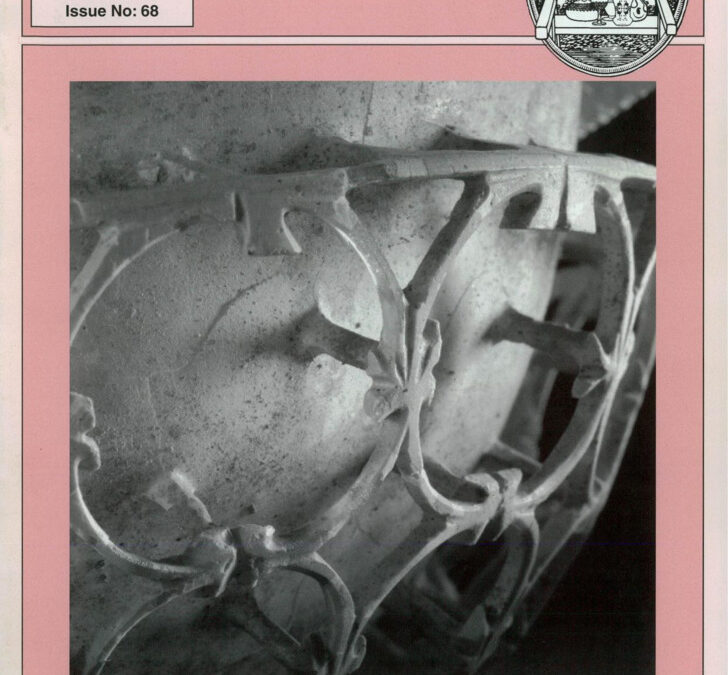
COVER ILLUSTRATION
A detail from an extraordinary and fragile Roman glass bowl,
dating from circa A.D. 300, which broke the world record price
Mr a piece of glass sold at auction on 14 July in London.
Selling to a telephone bidder at Bonhams’ Sale of Highly
Important Antiquities, the Constable-Maxwell Cage-Cup
fetched £2,646,650. It was once used as a lamp and had been
carved from a solid piece of glass. Following the sale, Joanna
van der Lande, head of antiquities at Bonhams, said: “The
Cage-Cup is exceptionally fragile, cut from a single block of
glass. It would have been clear but has become iridescent due
to a reaction between the earth it was buried in and the glass.
Its probable use was as an oil lamp suspended by a collar
around the rim. It’s really a very highly prized piece.” More
on this remarkable piece of glass on page 6. Photographs
c
ourtesy of Bonhams.
CHANGES FOR THE CONE EDITORS
Patricia (Paddy) Baker says she has decided to call it a
day, that is in editing the Cone magazine, a task which she
has
shared with others since Autumn 1993. Her overseas
tour schedule every year shows little sign of slowing down
although she keeps telling the companies concerned that
she’s tired of travelling back and forth to Heathrow; and
although her latest book on Islamic art
has
at last been
published, she’s fully involved with writing an educational
project for a forthcoming Royal Academy exhibition, and
co-editing a
festschrift
for her former professor as well as
compiling information for the new edition of her Iran
travel guide.
The time for tributes to Paddy will come later. Over
the past few years she has acted as Commissioning Editor,
soliciting and getting articles from members and others.
She also compiles the events listings on the back page and
organises book reviews. She sends the material to Brian
Currie (in digital form as he’s the world’s slowest typist).
He composes the pages, adds pictures, writes additional
material to fill gaps (including the auction reports, where
we still need contributors), then arranges the sub-editing
work and co-ordinates the printing (via the Society of Glass
Technology) and proofing.
So if you have good contacts in the glass world and
would, as Commissioning Editor, help co-ordinate the gath-
ering of material
for
the
Glass Cone,
Brian, Roy and Ken
would be delighted to hear from you. Paddy will continue
until the Winter issue goes to the printers so there’s time
to clear your desk!
ANNUAL GENERAL MEETING 2004
A joint programme of lectures with the Guild of Glass
Engravers at Guys Hospital, London, on 16 October. Under
the Rules governing the Association’s affairs, nominations
for Chairman, Vice-Chairman, Hon. Treasurer, Hon. Sec-
retary, Membership Secretary, Events Secretary and one
Committee Member must be received by 1 October 2004.
All the officers may seek re-election. The retiring Commit-
tee Member is Gaby Marcon and a replacement is needed
under the Rules. Nomination forms can be obtained from
Geoff Timberlake, Hon. Secretary, 114 Chesford Road,
Stopsley, Luton, LU2 8DR.
REVIEWS
News of a new publication expected in August, based
on the ancient glass collection in the Royal Museum,
Edinburgh. Written by CS Lightfoot of the Metro-
politan Museum of Art, NY, it is an extensive study
of this little-known but important collection, with both
colour and black/white illustrations. ISBN no. will be
1-901663-28-0, paperback. We hope to include a review
in the Autumn or Winter Cone. We also hope to review
Andy McConnell’s
The Decanter — An Illustrated History
of Glass from 1650.
2
The opinions expressed in the
Glass Cone
are those of
the contributors. The editors’ aim is to cover a range of
interests and ideas, which are not necessarily their own.
However, the decision of the editorial board is final.
COPY DATES
Autumn
Late
September 2004
Winter
Late November 2004
‘The Glass
Cone’ –
Issue No 68: Summer 2004
THE START OF THE GLASS ASSOCIATION
John Brooks
(for a long time the Editor of the Glass Cone)
wrote to us to say that he still had the original notice con-
vening the meeting at which the Glass Association was to be
formed. Charles Hajdamach suggested to him that this might
be of interest to those of us who joined later. We agree and
reproduce the text below; timely in our 21″ anniversary year.
( John also tells us that though his participation in the Glass
Association is now minimal, he still leads a fairly busy life and
sends his best wishes. Thank you, John, and our best wishes
to you!). The notice is dated 10 October 1983:
NEW GLASS SOCIETY
Proposed by:
Ian Burgoyne (Pilkington’s Glass Museum);
Simon Cottle (Laing Art Gallery, Newcastle on
Tyne);
Charles Hajdamach and Roger Dodsworth (Broadfield
House Glass Museum);
Richard Gray (City Art Gallery, Manchester)
Ian Wolfenden (History of Art Dept., Manchester
University),
Keith Cummings (Stourbridge College of Art),
Ron Brown,
Peter Helm,
Dan Klein,
Tony Waugh &
Gill Wyatt-Smith
Dear Mr Brooks
Over the past few months the above named have been meet-
ing together to discuss the possibility of forming a new
Glass Society. We have come to the conclusion that in spite
of the various Glass Societies already in existence there is a
need for a new Society which will cater for a wide range of
glass interests, cover all parts of the country and provide a
varied and entertaining programme of events. We therefore
intend to go ahead with the formation of such a Society,
and are now writing to enlist your support.
The specific aims of the Society will be –
(1)
to promote the understanding of historical and
contemporary glass and the practice of glassmaking.
(2)
to publish information relating to the study and
collection of glass.
(3)
to increase the general public’s awareness and appre-
ciation of glass through exhibitions and other methods.
All who subscribe to these aims will be welcome to
join, including dealers, provided it is understood that
the Society has not been formed for the purposes of
dealing or trading.
The Society intends to organise two outings each year,
followed by an A.G.M. in the autumn. The provisional
programme for 1984 is as follows: in March or April a
visit to Pilkington’s Float Glass Works combined with a
discussion between Martin Harrison and John Piper about
the latter’s work in stained glass, and in June a visit to the
Bristol Glass Exhibition at Bristol Art Gallery. In addition,
Regional Groups will be formed in different parts of the
country. These will play an important part in the Society as
they will enable members to meet at more frequent intervals
and organise their own local programme of events.
The Society aims to produce two different sorts of publica-
tion, a quarterly newsletter which will contain, among other
things, news about the activities of the Regional Groups,
and a Journal which will be published every two years and
act as an outlet for recent research.
It is proposed to hold the inaugural meeting of the nev,
Society at Stourbridge College of Art and Technology on
Saturday, 5th November at 2.00 p.m. If you would like
to attend, please could you complete the attached form.
Copies of the draft rules, the agenda and instruction on
how to find the College will then be sent to you. If you are
interested in the idea of a new Glass Society but are unable
to attend the meeting, we would still be grateful if you could
complete the form. After the meeting is over, there will be
a demonstration of glassmaking techniques by the staff of
Stourbridge College. If you can arrive in the morning, you
will have the opportunity of seeing a fascinating exhibition
of Carnival Glass at Broadfield House, Kingswinford. The
museum will be open between 10 a.m. and 1 p.m.
SOUTH EAST REGION WINTER MEETING
Janet Sergison (Email: janetsergison@onetel.net.uk; Tel:
01732 851663) reminds us about the South East Region Winter
Meeting.
The final event of 2004 for the SE will be a tour of
the Library and Museum of Freemasonry, the Grand Tem-
ple and its immediate environs at the Freemasons’ Hall in
the morning, followed by a visit to Peter Layton’s London
Glassblowing and Glass Art Gallery in the afternoon.
The Library and Museum of Freemasonry houses
one of the finest collections of Masonic material in the
world. A changing series of exhibitions portrays the history
of Freemasonry in England and specific aspects of Masonic
life. A tremendous variety of objects including Wedgwood,
glass, metalwares — even bedwarmers — have, over the cen-
turies, been produced with Masonic decoration.
The Museum’s collections are extensive including
interesting glass, pottery and porcelain, silver, furniture
and clocks, Masonic jewels and regalia. Items belong-
ing to famous and royal Freemasons including Winston
Churchill and Edward VII are on display together with
examples from the Museum’s extensive collection of prints
and engravings, photographs and ephemera. You will find
articles on “Masonic Glass in England” by Dr David Stuart
and “British Studio Glass” by Peter Layton in the
Glass
Circle Journal,
Volume 8.
10.45 for 11.00 am. Freemasons’ Hall, 60 Great Queen
Street, London WC2B 5AZ. Our guided tour, lasting ap-
proximately an hour, will commence from the Library and
Museum and you are asked to note that you may be required
to show photographic ID before the tour commences.
2.30 pm. The Glass Art Gallery, 7 The Leather
Market, Weston Street, London SE1 3ER. We will meet in
The Gallery for an introductory tour of the workshop and
gallery, including the exhibition
“CUTTING EDGE” – The
Best of the Guild of Glass Engravers.
This will be followed by a glassblowing demonstration
by the workshop team.
3
‘The Glass Cone’ – Issue No 68: Summer 2004
Dennis Hall as we saw it
DENNIS HALL
Home of the Thomas Hills,
Glass & Iron Masters.
Later the works of
Thomas Webb
tz.„.11b,
DENIS HALL REDIVIVUS
4
A couple of years ago, during a tour of the district guided
by Charles Hajdamach, we visited Dennis Hall, Amblecote,
the mid-18C country house which became the home of
the Webb family and the site of the Thomas Webb & Sons
glass works.
After the demise of Webbs in the early 1990s the house
fell into disrepair and, although Grade
II
Listed, it became
derelict and the target for vandals and arsonists and was
on the verge of being demolished. Fortunately imaginative
and pragmatic cooperation between Lord Edward Develop-
ments and Dudley MBC saved this magnificent building,
with the ruin converted into apartments, and its magnificent
entrance hall restored. The 19 high-specification apartments
are currently on offer from about £185,000.
The pre-refurbishment history of Dennis Hall can be
seen on
www.amblecote.org,
the website which is home to
the Amblecote History Society. Here are some extracts and
pictures, for which we thank the Society. Thanks especially
to
John Sanders
for telling us about it.
Dennis Hall (named after the 12
th
-century family of
Deynis), was built in the 1760s by Thomas Hill, founder of a
dynasty of important ironmasters, who developed extensive
holdings in Staffordshire, and at Blaenavon in South Wales.
The Hills, made rich by their industrial activities, also funded
the building of Christ Church in Lye, as well as other churches
and schools both in the Black Country and in Wales.
The Hills manufactured iron and glass and mined clay
in Amblecote. As glassmakers they owned a succession of
works, but consolidated their activities at the Coalbournhill
Glassworks, later Webb Corbett and now the Ruskin Glass
Centre. Here it would seem they operated two glass outputs
producing fine glass tableware and bottles, illustrating once
more their ability to produce for all markets and not become
dangerously reliant on a single product.
Dennis Hall became a focus for the Hill family in
the Stourbridge area for many years until, in the 1830s,
Thomas Hill III sold up all his business interests and retired
to Ross on Wye.
It was purchased by William Seager Wheeley, another
glassmaker, who lived there until the mid 1840s, but Wheeley’s
tenure ended when he was accused of fraud. The Dennis
Estate was then sold to a consortium of local businessmen
including William Blow Collis (one of a dynasty of Collises
who variously controlled legal and investment interests in the
Stourbridge area during the 19th and 20th centuries), and the
executors of the estate of William King, a Clay Master. The
estate was sold piecemeal for development, much of it for
housing that stands to this day. Collis Street and King Wil-
liam Street are named after Collis and King respectively.
In 1851 the Hall was occupied as tenant by the Rev.
John Grier, the first vicar of the new Amblecote Parish.
However, by 1855 Thomas Webb the Glass Master was in
occupation and had built a brand new glassworks at its rear,
moving his manufacturing from the Platts Glassworks. In
addition Thomas Webb operated an iron foundry at Dennis
as well as one in Brettell Lane – thus continuing the long-
standing connection between glass and iron on the site.
The Webb Company, operating under a number of names
(and latterly owners), although generally known as Thomas
Webb, continued on the site until the 1990s.
Dennis Hall was used by the Webb family as both a
family home and an office, following the usual Victorian
tradition of living above or at least alongside ‘the shop’.
Over time the house was variously occupied by the Webbs,
their managers and even at one point served as a social
club for the workforce, with billiard rooms and a bowling
green. It finally became company offices. The Glassworks
was closed in 1990 after the collapse of Coloroll plc., and the
land including Dennis Hall sold for development. Dennis
Hall, despite being a fine example of an 18th century man-
sion with many original fittings, including some renowned
plasterwork, fell into dereliction.
In 2002 the Hall was saved, through a mixture of
planning pragmatism on the part of Dudley MBC and
its Historical Environment Team and investment by Lord
Edward Developments, for conversion into apartments.
The Refurbished Dennis Hall
A hundred members and guests of the History Society
gathered at Dennis Hall on the evening of 16 June for an
Open Evening at the invitation of Lord Edward Develop-
ments.
Eileen and John Sanders were there. The developer,
Paul Tibbetts, wanted to know what had happened to the
original chandelier. John was able to tell him that it was now
in situ
at Himley Hall and owned by Dudley MBC.
Paul’s response, in true Black Country entrepre-
neurial style, was, “How much will they want for it?”.
The entrance gate plaque
‘The Glass Cone’ – Issue No 68: Summer 2004
Image supplied by Andrew C. Picklock
RE-EMERGENCE OF MAJOR GEORGE
For a collector to see and handle a delightfully large (11.5cm
high) lemon squeezer-base rummer, handsomely engraved, is
a pleasure. But to find out the history behind the glass, includ-
ing tracing its original owner some two hundred years ago, is
very satisfying!
The large ovoid bowl is intriguingly engraved with a
grassy knoll surmounted to the left by a barrel, to the right
by a windmill and in the centre the finely engraved figure of
a Highlander or Highland Divisional officer, and above this,
the name ‘G. Smith’.
A friend suggested I contacted the National War Mu-
seum of Scotland, based in Edinburgh Castle, to find out if it
was possible to identify the figure, and Mrs Edith Philips of
the museum duly replied. The gentleman portrayed wears the
uniform of a Highland Regiment of Foot and, given the age
of the glass (c.1790-1820), it is likely the glass commemorates
the role of the Highland regiments in the successful English
campaign in the Helder, Holland in 1799, and in particular
the Battle of Egmont-op-Zee, known for its ‘bold’ bayonet
attack, ‘executed with the greatest gallantry and success’. Two
of the four regiments involved were the 92′ and 79
th
Highland
regiments and examination of the Army lists revealed a Major
George Smith in the 79t
h
Cameron Highlanders (the `Camero-
nian Volunteers’), whose commanding officer, Lt. Col. Alan
Cameron, was wounded in the arm early on in the action. The
day after the battle, the Duke of York passed by to enquire after
his health and to congratulate the men on their conduct.
Presumably Major George acquired this glass in some
manner after his safe return from the battlefield and doubt-
lessly filled it with rather more than a ‘wee dram’ with his
military pals on several occasions!
Andrew
C.
Piddock
CLAUS RIEDEL
Michael Savage writes to say:
With reference to
The Times
obituary of Claus Riedel in
the Spring Glass Cone, I visited the Museum of Glass at
Jablonec in 1991 during a tour of Czech Glass Museums
in Northern Bohemia and the visit happened to coincide
with an Exhibition of Riedel Glasses through 10 genera-
tions from 1756 to the present.
A wonderful Catalogue was produced with all the exhibits
in colour and the text in Czech, English and German; and
there was also a very comprehensive account of the Riedel
family history. If anyone would like to borrow this I should
be very happy to accommodate them.
( Michael Savage: michael@savage2695.freeserve.co.uk.)
DARTINGTON CRYSTAL
Torrington-based Dartington Crystal has been facing seri-
ous financial difficulties in the last twelve months following
a 20 per cent fall in sales, which it pointed out, was also
being experienced by its competitors.
Dartington Crystal was set up in 1967 as Dartington
Glass by the Dartington Hall Trust, which wanted to extend
its activities into North Devon. Since a management buy-out
10 years ago the majority shareholder has been 3i, the venture
capital company. The factory is itself a tourist attraction
with over 300,000 visitors a year. The company also has 14
shops in the UK.
In October the
Western Morning News
reported that,
after a long period in which staff had been working a three
day week, over 40 had been made redundant. In April came
news that over 12 acres of land surplus to the company’s
need had been sold for residential development for several
million pounds.
However this was not enough to cover the company’s
liabilities, built up over the years. The
Western Morning
News
reported that the company was placed in receivership
on 21 July.
Shortly afterwards came a further report that the
receivers, Grant Thornton, had sold the business to the
UK subsidiary of Enesco Group Inc. Enesco, a worldwide
supplier of gifts, collectibles and home accessory products,
with annual sales of nearly $250 million, had been in nego-
tiation to buy Dartington for some time.
184 employees, over 100 of them at the factory site,
transferred to Enesco Limited. John Hammond, the compa-
ny’s UK chairman, said: “We are delighted to have secured
the acquisition of Dartington, which is a highly respected
brand in the crystal glass industry. We are already developing
opportunities to add to the Dartington business, which we
believe will ensure a successful future for the company.”
The Glass Cone’ – Issue No 68: Summer 2004
THE CONSTABLE-MAXWELL CAGE CUP
More about our front cover item, the Constable-Maxwell
cage-cup. Estimated at £1.5m to £2m, it soldfor f2,646,650.
The Bonhams’ catalogue notes are of great interest and we
reproduce extracts on this page. The photographs, here and
on the cover, were kindly supplied by Bonhams.
Blown or cast in colourless glass, wheel-cut, ground
and polished, the hemispherical body with a rounded base
and curved, out-splayed rim, the decoration comprises a
faint horizontal ridge below the rim and above a collar
consisting of a projecting openwork flange with 103
ovolo
perforations separated by darts.
The network cage is formed from three concentric
rings of more or less circular meshes, fourteen in the top two
rings, decreasing to seven in the third and a single circular
mesh in the centre of the base. At the junction of each
pair of meshes is a small cruciform motif that conceals the
strut or bridge which connects the openwork cage to the
inner body. 4in. (10cm.) high, 7’/
8
in. (18.2cm.) diameter,
covered in light honey-coloured weathering with brown
speckles revealing iridescence where missing.
[The damage
and repairs are described].
This extraordinary survival from antiquity was
carved from a thick blank of colourless glass, so that the
decoration in the form of a network cage stands proud of
the main body of the vessel, connected to the internal cup
only by very slender bridges ‘hidden’ in strategic positions
behind the decoration. It is the only published example that
remains in private hands.
The manufacturing process was first described in
detail by Fritz Fremersdorf (1956). It was a very slow and
time-consuming process, fraught with potential disaster
throughout its manufacture. Consequently it would have
been exorbitantly expensive to produce and, like the cameo
vessels of the early Imperial period, cage-cups could only
have been commissioned by the very wealthiest of Roman
society. Cage-cups were first discussed as a group by Donald
Harden and Jocelyn Toynbee in 1959 after the Lycurgus Cup
was ‘re-discovered’ in a home of Lord Rothschild in 1950.
Harden and Toynbee divided these priceless pieces into two
classes:
A)
with figured decoration and with or without
network inscriptions, and
B)
with network, but with no
other decoration and with or without inscriptions.
A more recently discovered cage-cup now in The
Corning Museum of Glass (Whitehouse 1997, pp.283-5,
no.478). is the closest parallel to this piece, although it
is
much smaller with a rim diameter of only 12.2cm. It also
has an outsplayed rim with an openwork flange below and
a hemispherical body with two concentric rings of circular
and heart-shaped meshes with cruciform elements at the
junction of each pair of meshes. More importantly, it has a
copper alloy collar attached to the vessel below the rim and
above the flange and a lamp-hanger with three hooks and
loops and three looped elements. The collar was certainly
attached to the vessel in antiquity, although the lamp hanger
might be a more recent addition (ibid. p.285) but nonethe-
less it does suggest that these three hemispherical cage-cups
could have been designed as hanging lamps.
Paul the Silentiary, in his early description of Santa
Sophia (Istanbul), noted both polycandela and single hang-
ing lamps: ‘Near the aisles, too, alongside the columns, they
have hung in order single lamps apart from one another,
and through the whole length of the far-stretching nave is
their path. Beneath each they have placed a single vessel,
like a balancing pan, and in the centre of this rests a cup
of well-burning oil’ (ibid.).
Several cage-cups of upright beaker form, like the
`Trivulzio’ cage-cup in Milan and the cup in Cologne from
Koln-Braunsfeld, bear the inscription, ‘Drink! May you
live for many years’ in Latin or Greek (Haynes,
Glass of
the Caesars
1987, pp.238-41, nos.134-5). This confirms that
cage-cups of this form at least were used for drinking, albeit
only on very special occasions.
If the Constable-Maxwell cage-cup was indeed a
hanging lamp then, when filled with oil, the network cage
on the outside would have cast a very interesting geometric
shadow on the surrounding walls and floors.
The total number of whole and fragmentary cage-
cups has now reached over fifty and whereas known prov-
enances were previously concentrated in western Europe,
several fragments have more recently come to light from
the Mediterranean. Indeed, both the Constable-Maxwell
and Corning cage-cups were allegedly found in the east,
so that it is possible that they were made in at least two
different centres.
The highly-specialised glass-cutters
(diatretarii)
prob-
ably worked as close as possible to the main centres of glass
production, on the Syrian coast, in Alexandria, in Italy and
in Cologne, but also perhaps at the late-Roman imperial
seats where luxury goods were produced and traded
(Glass
of the Caesars
1987, p.24 I ).
6
‘The Glass Cone’ – Issue No 68: Summer 2004
GLASS AT THE AUCTIONS
Susan Newell
writes about the Henry Fox Collection of
English 18
th
century glass.
Bonhams sold the first part of this collection on 2 June. Chosen
with great care, either for their rare shape, or for some aspect of
their decoration, the collection has many unusual or notewor-
thy pieces. Other more frequently seen types were also included
in order to make the collection as comprehensive a survey of
le century English drinking glasses as possible.
Henry’s passion for collecting glass has lasted over forty
years, during which time he has winkled pieces out of dusty
shop windows, snapped them up at fairs, or acquired pieces
at auction or from well-known dealers. The earliest glass on
offer was lot 1, a dwarf `wrythen ale’ (14.3 cm) with a propel-
ler knop. Estimated at £1,200-1,500, it made £1,900.
Lot 1: A dwarf ‘wrythen ale’. Picture from Bonhams
The small group of heavy baluster glasses included
lot 3, a rare rounded funnel glass with a massive cushioned
knop set on a high domed foot which sold for £2,800. An-
other, lot 4, had a large bladed knop over a small basal
knop, set on a terraced foot. Despite a small chip under
the footrim, this made £3,400. Lot 13, a very rare decep-
tive baluster toastmaster’s glass made £3000. A group of
light baluster glasses included a rare example with a triple
annulated knop, lot 20, £1,000, and a wonderful example,
lot 22, with two triple annulated knops, the bowl moulded
with `nipt diamond waies’, the domed and folded foot with
similar moulding (18.2 cm), which sold for £4,600.
Lots 22 and 33 Pictures from Bonhams
The most expensive glass in the sale was the rare
Jacobite ‘Cycle Club’ glass, lot 33, which sold for £6600. Of
plain drawn trumpet shape with an air twist stem, 16.8cm
tall, it was engraved around the rim ‘Success to the Friends
of Sr. Watn. Wlms. Wynne’ above a `Gothick’ arcade. This
seemingly harmless toast conceals the world of political in-
trigue and ferment in the mid eighteenth century. Sir Watkin
Williams Wynne led the support for the Jacobite cause
in
North Wales. These glasses are believed to have been used
by the members of the Jacobite ‘Cycle of the White Rose’
club which met at Sir Watkin’s seat of Wynnstay.
Lots 35 and 85. Pictures from Bonhams
Other rarities included a delightful ‘Cyder’ glass with
an engraved fruiting apple tree behind a trellis flanked by
flowering urns, lot 35 which sold for £3,200. A plainer cider
glass, also engraved with an apple tree, lot 11, sold for £900.
An exquisitely engraved air twist glass with an acorn knop,
lot 52 sold for £5,200, and an opaque twist cordial with an
engraved and moulded bowl set on a helmet-shaped foot
sold for £1,400. Lot 85, a colour twist ship’s glass, so-called
for its short thick stem, with blue and green threads enclos-
ing the central corkscrew, sold for £5,400; and a rare mixed
colour twist, lot 86, with a pretty bell bowl set on a spiral
air
twist gauze alternating with a translucent blue spiral thread,
sold for £3,600. Lot 92, a large tankard decorated with
an
applied chain and `nipt diamond waies’, and engraved with
hops and barley and the name 11 Hinde’, sold for £1,800.
The second (slightly larger) part of the collection will
be sold by Bonhams in New Bond Street on 8 December.
In addition to the Fox collection, a remarkable large
glass two-handled cup and cover was included in the same
sale (lot 96, sold for £15,000). Closely based on silver pro-
totypes of circa 1715-30, this rare object was perfect except
for a small loss to the topmost ball of the cover’s finial.
Lot 96 A glass two-handled cup (33.5cm) Picture from Bonhan is
7
The Glass Cone’ – Issue No 68: Summer 2004
On 19 June, Michael J Bowman’s auction at Chudleigh
Town Hall (on the edge of Dartmoor) included about 20 lots
of glass from the estate of the great-granddaughter of John
Northwood (she was daughter of Kenneth Northwood; he
died in 1997 and was the youngest son of John Northwood
II). Some of the lots are illustrated on this page.
A spherical decanter decorated with applied tendril
stems and engravedflowerheads with matching stopper,
7in. high, sold for £180.
A Caerleon ewer, described as a mottled amber jug in
the classical taste, with a moulded mask to handle, 7.5in.
high, sold for £150.
Three wine glasses carved with arabesque scrolls
to bowls, sold for £80. The patterns bear a strong
resemblance to those found on Stevens & Williams
intaglio decanters around 1900. Detail pictured below
A dolce relievo cylindrical vase with spreading base,
overlaid amethyst on white to show two classical female
figures, yellow interior, 7in. high, sold for £490.
8
‘The Glass Cone’ – Issue No 68: Summer 2004
On 23 April Charterhouse Auctioneers offered an
18th Century blue glass decanter and stopper, of club form,
gilded in the manner of James Giles with an exotic bird
standing in a landscape, the faceted stopper decorated with
grapes and vines (the stopper repaired) 28 cm. It had come
from a local vendor, who reportedly kept it in his front win-
dow, but had told the auctioneer, Richard Bromell, that it
was similar to a pair sold at Christie’s many years ago for a
high price. On seeing it, the auctioneers were happy to agree
its quality. Estimated at £1,000-1,500, it sold for £13,000.
( Picture above from Charterhouse Auctioneers).
Oscar Pierre Erard. The pair, 8.5″ tall, were of baluster form
with a raised collar neck decorated in the Islamic Persian
taste on an opaque ivory ground in tonal reds, greens and
blues. The pontils were marked
0. E & Co
in red enamel
Estimated at £300-£500, they were bought by Broadfield
House Glass Museum for £3,900 and are on display at the
museum.
On 23 June Dreweatt Neate sold 185 lots of glass
at
their Donnington Priory Salerooms. Leader among a good
collection of fine wine glasses was the above left
(pictures
by Dreweatt Neate)
colour-twist wine glass, the round fun-
nel bowl supported on a stem with a red corkscrew
core
entwined by a broad opaque spiral, on a conical foot, circa
1765. Estimated at £3,00044,000, it sold for £2,000. On the
right is an airtwist wine glass of Jacobite significance,
of
drawn trumpet
form, engraved with rose, bud and thistle and
inscribed
FIAT,
the stem with a pair of entwined cables, on
a
conical foot, the glass mid 18th century. With an estimate
of
£800 -1,200, it sold for £1,250.
At Fieldings auction in Hagley Community Hall on
3 April the glass lots included
(picture above, by Fieldings)
a pair of late 19th Century Stourbridge enamelled vases by
At Sotheby’s on 29 June there was a large pair
of
enamelled vases (35cm., 13
3
/4in tall) and a bowl which the
auctioneers described as possibly Scottish, circa 1900,
perhaps by Hannah and Helen Walton
(picture above by
Sotheby’s).
Each vase was painted with pairs of kingfishers,
9
The Glass Cone’ – Issue No 68: Summer 2004
bulrushes, flowering plants and fish. The wide shallow bowl
on three ball feet was similarly painted with fish and plant
life and incised
‘T. Goode & C LONDON.
Based in Glasgow
and trained at the School of Art, Hannah (1863-1940) and
Helen (1850-1921) Walton were decorators of both glass
and ceramics. Their finely detailed enamelled glassware can
be found in museums in Glasgow. For further information
on this talented family see the exhibition catalogue,
Glasgow
Girls, Women in Art and Design 1880-1920,
Glasgow, 1990.
Estimated at £2,000-3,000, the threesome sold for £1,800.
On 15 July Sotheby’s New Bond Street auction in-
cluded a number of rare pieces. This two-colour ‘Chinese-
style’ cameo vase
(picture above by Sotheby’s)
circa 1890,
26cm., 101/4in tall, has a compressed ovoid form of opal-
escent glass encased in clear glass, overlaid in translucent
ruby and carved with songbirds perched amongst blossom.
The auctioneers noted that a similar form may be seen in
R.& L Grover’s
English Cameo Glass,
p.19, fig.C1, signed
by George Woodall. Chinese cameo glass provided the
inspiration for a number of pieces carved by the Woodall
team, several in direct imitation. A two-handled bottle vase
carved in the same manner as the present lot and attributed
to Woodall is illustrated by C. Woodall Perry’s
The Cameo
Glass of Thomas and George Woodall,
p.56. With its high
quality, unusual carving and the use of the Chinese subject
matter, Sotheby’s thought it tempting to attribute the vase to
the Woodall team. It’s difficult to see in a grey-scale picture
but the underlying glass appears to contain floral air-trap
patterns. The vase sold at its lower estimate £12,000.
60TH ANNIVERSARY OF D DAY
As we noted in GC68, to mark the 60th anniversary of
the Allied landings in Normandy, a naval memorial was
unveiled by Prince Charles on 5 June, at the Musee de Paix,
Caen. Recently we talked to Frank Grenier AFGE who
designed and engraved the engraved panels which form the
memorial. Himself a retired submariner and Rear-Admiral,
Frank shared with us some of his pictures.
The memorial was created from three panels of blue
float glass, 12mm thick, each approx. 5ft by 3ft., shaped in
the form of a wave and hand engraved on both sides. It was
commissioned by the “British Friends of Normandy” to com-
memorate the many Royal and Merchant Navy units involved
in the landings in 1944.
Detail from one of the panels
Under the codename Operation Neptune (the naval part
of Operation Overlord), naval activity included a wide range
of operations. Depicted on the three memorial panels are:
reconnaissance, minesweeping, escort duties with merchant
shipping, air support, towing and placing the Mulberry
harbour and fuel pipeline, shore bombardment, landing craft
operations, X-craft beacon guidance and beach marshalling.
Frank Grenier working on a panel; and the memorial in situ.
REGIONAL NEWS
The May meeting, part of the Glass Association anni-
versary events, at Pontefract Museum produced a deal
of lively discussion after the talk by Dil Hier and Charles
Hajdamach ‘How do they do that?’ – discussion that con-
tinued during the buffet lunch and the tour of the Bagley
glass collection.
NEW MEMBERS
A very warm welcome to the following new members who
have joined the Glass Association since the last issue of
the
Glass Cone:
Mr
P
Bone
Lancs
Mr A Herdman
Cumbria
Mr G N H Toldi
Conwy
10
The Glass Cone’ – Issue No 68: Summer 2004
PAPERWEIGHT NEWS
Before starting to put this current article together I reviewed
the last two articles and realised that I had mentioned the full
Clichy signed moss ground scattered millefiori weight that was
coming up in the autumn auction at L H Selman but not fol-
lowed it up with details of the outcome. The weight realised
$165,000 including the buyer’s premium which, depending
on the rate of exchange at the time, equates to somewhere
between £90,000 and £95,000. I haven’t seen any details of
who purchased it; all I know is that it wasn’t me!
With regard to the latest news from Caithness Glass, the
factory shop at Oban has closed down, with the stock moved
back to Perth; the factory at Oban closed some years ago
and manufacturing operations at Wick and Kings Lynn have
ceased. The remainder of the company has been purchased by
Edinburgh Crystal and I understand that they are reviewing the
current operations before making any decisions about future
production. I recently met someone who had just come back
from Scotland and they reported that things appeared to be op-
erating more or less as normal at the Perth factory/visitor centre.
I have just received the renewal notice for my membership of
the Caithness Paperweight Collectors Society plus notification
of one of their specialist dealers promotions, so it seems reason-
able to assume that paperweight production is set to continue.
Whether the range of weights will be as large as before will
presumably be revealed in the coming months.
Since my last article we have visited the Paperweight
Collectors Circle regional meeting at Godstone and the Wok-
ing Glass Fair, conveniently on the same weekend, and plenty
of weights were to be seen at both events. A visit to the Glass
Fair at the National Heritage Motor Museum in early May
also presented the opportunity to look at lots of weights both
old and new. Interestingly, in the light of news that has since
come through, the Manson family were absent.
The Paperweight Collectors Circle first regional meeting
in the South West took place on 19 June at Tickenham near
Nailsea just South of Bristol. As part organiser and one of the
speakers I am bound to say that it all went off very well and the
feedback we had on the day seemed to back this up. Close to 40
members attended with a good mix of regulars and people new
to such events, so I think that meetings in the South West will
continue. There were the usual dealers present plus members
with weights for sale so there was plenty for members to look
at. Various friends had kindly brought along collections of
millefiori canes and lampwork from most of the paperweight
makers both past and present and Caithness/Ysart millefiori
jewellery with other glass beads and accessories. Amongst the
sellers was Alan Sedgewick who had some of the latest offerings
from his collaboration with John Deacons, including lampwork
butterflies with Dichroic glass on the wings, so that the colours
really glowed when they caught the light. When we got home
the one that had been on display had somehow found its way
into the box of weights that I had taken with us to illustrate the
talk. I think my wife probably knows something about that but
she assures me that she did pay for it!
Reported at the meeting was the latest information from
the Manson family. It appears that their current intention is to
leave paperweight making behind them. The master classes
and presence at various special events have been cancelled,
with Willie concentrating on his new career as a driving
instructor, Joyce having already returned to nursing while
William junior has decided to join the Military Police. We
understood that Willie has an agreement that would allow
him to return to the glassmaking facility on certain occasions
so it remains to be seen whether any new creations come from
these very talented craftsmen in the future. For the time being
collectors will have to be satisfied with the past creations from
the Manson family that are still available; over the years they
have produced a fair range and number of weights. Both their
glassmaking history and details of paperweight production
have been fairly well recorded, so, whatever happens in the
future, they will always have a well deserved place in the story
of modern paperweight making.
Our next paperweight event is a Paperweight Collec-
tors Circle meeting in August. Rick Ayotte, one of the very
talented American paperweight makers who have taken the
art of paperweight making to a level previously unseen, will
be present along with his wife and daughter Melissa, who
has now also taken up the glassmaking tools. I think that it
might be advisable for me to leave the cheque book at home
that weekend and keep a close eye on what my other half is
up to while we are there. More next time.
Richard Giles
NAILSEA GLASSWORKS QUERY
Andrew Smith
writes with a request for help:
I have been commissioned to produce a comprehensive review
,
of the Nailsea Glassworks, looking not only at the archaeology,
which is my primary interest, but also at the technology and
the social and economic impact on the local community.
I have a copy of a transcript of a notebook kept by a
works manager at Nailsea between 1836 and 1837. All his
references are to either the Alkali Works or the production
of crown glass. I underline below the terms that I would
like further explained, if at all possible.
When describing the furnaces he uses a term
“Dead
Mug.
3 feet at bottom varying to 2ft 10in.”.
After having described the various holes “Working (12in.
& 12. 5/8in high (inside),
Foot holes
15 in. wide and 23 in.
height, Punty holes 5 in. x Sin.”, he adds
“Inclination of Rest-
ings,
3in. (Set pots in 11 days, Furnace
“turned”
in 7 days).
Describing coal consumption he says
“Brazling
Cullet, per
week,3.2/3rds Quarter small (for one glass house)”.
Describing glass sizes he refers to
“Export squares”,
“small squares”, “Quarries”,
“10s” and sizes less than 6 x
4. This is working from 50 to 50.5 inch diameter tables. A
cutting diagram would be useful.
Under wages, he gives a very comprehensive listing,
but there are two trades that puzzle me: there are 2 “Hi-
m” and 1
“Crambo Keeper (N.S.).
Pliers, like Flashers and
Blowers were paid 30 shillings p.w. A ponty sticker was paid
12/-, and marver cleaners 5/-.
The
Crambo Keeper was on
15/-. I have wondered if “Pliers” is a mistranscription of
“Pilers”, piling tables in the annealing kiln?
If you or any of your readers could cast any light, I
would be most grateful and due acknowledgement would
be given in the final report which is due for publication on
the www. As I am approaching the end of the project speedy
replies would be very much appreciated. I have been asking
these questions already but had drawn blanks until Roger
Dodsworth suggested that you might be able to help.
My home address is 148, Southmead Road, Bristol,
BS9 4LX. (email: afsmith@bristolbs941x.freeserve.co.uk)
‘The Glass Cone’ – Issue No 68: Summer 2004
EXHIBITIONS, FAIRS, ETC.
The COWDY GALLERY in Newent, Gloucestershire is
hosting a solo exhibition of CARL NORDBUCH’s recent
work from 15 August to 18 September, while upstairs new
glass from such established figures as Bob Crooks, Keith
Cummings, Steven Newell, Pauline Solven and Rachel
Woodman will be on show. For opening hours, contact
the Gallery on 01531 821173; www.cowdygallery.co.uk
BROADFIELD HOUSE’s main summer exhibition is
HEROES OF THE WHEEL, celebrating the work of
such contemporary international stars as Peter Dreiser,
Alison Kinnaird, Ronald Pennell and Katherine Coleman
and Jiri Harcuba. At last year’s International Congress for
the History of Glass (Imperial College, London), Kath-
erine Coleman alerted the 250 delegates to the difficulties
glass engravers have in to-day’s world…with such talent,
so avidly collected abroad, this craft needs much-deserved
recognition.
There will be the usual full calendar of events at
BHMG held in connection with the International Festival
of Glass at Stourbridge, from 25 to 30 August. Make sure
you book your ticket in advance for the lecture on Emile
Galle by Dan Klein on Monday 30 August.
If you’re interested in 18t
h
century English glass vessels, then
the forthcoming exhibition THE GLORY OF GLASS will
be a ‘must’. There will be 350 pieces from the John Butler
collection on display at the famous Georgian townhouse
FAIRFAX HOUSE, York (close to the Jorvik Centre)
from 10 September to 31 December. For opening hours,
tel. 01904 655543.
If you’re planning on a trip around Northumberland this
summer, then check out the FASHION’ AT BELSAY, at
Belsay Hall, 14 miles NW of Newcastle because Stella
McCartney, the fashion designer is exploring glass as did
her contemporary Jason Conran some years back. The
daughter of Sir Paul McCartney and Linda has produced
a 10′ (3m) chandelier, containing more than 8000 Swarovski
crystals, to decorate the Great Hall until 30 September.
News of another ASSOCIATION FOR THE HIS-
TORY OF GLASS Study Day, on public Glass Col-
lections, scheduled for 25 November at the Wallace
Collection, Manchester Square, London Wl. Details from
Jennifer.Price@durham.ac.uk
FORTHCOMING FAIRS AND SALES
Oxbridge Fairs are holding their 4
th
specialist CAM-
BRIDGE GLASS FAIR at Chilford Hall Vineyard, Linton,
Cambridgeshire on 12 September. The fair will include a
Foyer Exhibition of Bimini glass. Bimini Werkstatte was
founded in Vienna by Fritz Lampl in 1923 and produced
finely blown figures, animals and other decorative items. The
Glass Association will be represented at the fair. 11 am until
4pm; admission £3. More information from Paul Bishop
on 07887 762 872.
And one for the diary: the SPECIALIST GLASS FAIR at
the Motor Heritage Centre at Gaydon on 9 November; tel.
01260 271975. Pat Hier has been running the glass fair, now
with over 100 dealers, since it was established in 1991. At its
inception it was the first all-glass antiques and collectibles
fair. Details on their useful website: www.glassfairs.co.uk.
As usual BIDDLE & WEBB of Birmingham have a glass sale
on the second Friday of every month, with viewing during
the week prior to the sale; tel. 0121 455 8042 for details.
FIELDING’S next sale will be Saturday 4 September at
Hagley Community Hall; tel. 01384 444140.
BLASCHKA AT THE NATURAL HISTORY MU-
SEUM
The Natural History Museum is the custodian of a col-
lection of 170 Blaschka models of natural history objects,
created by the father and son team, Leopold (1822-1895)
and Rudolf (1857-1939) Blaschka. Blaschka models are
amongst the finest examples of glass craftsmanship in the
19th Century and are highly sought after for their aesthetic,
historical and scientific value.
The majority of these models arrived at the Museum
between 1866 and 1886, and due to their age, many are dam-
aged and in urgent need of conservation. For this reason
the Museum has recently undertaken a new initiative to
restore these spectacular models to their full glory and to
preserve them for future generations, with the ultimate aim
of placing them on public display. Due to their intricate and
delicate nature, coupled with the diversity of their design,
this will be a painstaking process. While the Museum is
able to meet some of the costs from its own reserves, it is
seeking the support of individuals and organisations to help
meet the remaining costs of the project. If you can help, or
would like information, contact Jonathan Ayes telephone:
020 7942 5270 or by email at J.Aves@nhm.ac.uk.
Striking images of the Blaschka models stored at the
Museum. Photos from The Natural History Museum