




Autumn 2004
Issue No: 69
Glass Cone 51.1
know she has been a member of the edito-
rial team since Autumn 1993.
Paddy’s a busy person, running overseas tours so
regularly and frequently that she seems to be permanently
arriving or departing. Her latest book
Islam and the Reli-
gious Arts
was published in March. She’s preparing a new
edition of her Iran travel guide. She has projects in hand
on•all sides.
Yet she has found time and patience to lead the edit-
ing of the
Glass Cone,
soliciting and getting articles from
members and others, compiling the events listings on the
back page and organising book reviews. She does it all with
a mixture of forthrightness and good humour which I and
the rest of the team have enjoyed and appreciated. She has
the knowledge to select material with discernment; she has
the sharp eye for bad grammar, cliché and solecism that
every editor needs.
Thank you, Paddy, from us all and from all the mem-
bers of the Glass Association.
Let me also record my thanks to Ken Cannel] and Roy
Kingsbury, who have been good contributors and, above
all, provided sharp-eyed and knowledgeable sub-editing and
review during the closing stages of each of the nineteen
issues I have prepared.
Nigel Benson is now going to take over the leading
role.
Welcome, Nigel! I will now start reducing my own
involvement, which has rather exceeded what was originally
intended. But I will see Nigel into the chair and will continue
to help and contribute after that.
A personal apology
I am very busy at times — and I fear that’s one of the main
reasons why this issue is over a month late. My apologies
to you all.
Brian Currie
QUESTIONNAIRE
In 1996 the committee circulated to the members a ques-
tionnaire to help provide the right mix of activities. The
committee feel that there have been rapid changes in the
way we collect glass, what we collect and what information
and support we need to help us.
It is now time to plan the way forward for the next
few years. At the time of going to press, work has started
on the compilation of a new survey which we hope will be
mailed out with this, the last
Glass Cone
of this year.
Please send in your views. In particular Nigel Benson
will be considering what changes to make to the
Glass Cone.
Let us know what changes you’d like to see.
The opinions expressed in the
Glass Cone are
those of
the contributors. The editors’ aim is to cover a range of
interests and ideas, which are not necessarily their own.
However, the decision of the editorial board is final.
COPY DATES
Autumn
Early January 2005
Winter
Late March 2005
Issue No: 69 – Autumn 2004
The Magazine of
The Glass Association
Registered as a Charity No. 326602
Chairman
Charles Hajdamach
Hon. Secretary
Yvonne Cocking
14
Southfield Drive, Sutton Courtenay,
Abingdon, Oxon, OX14 4AY (yvcocking@aol.com)
Editorial Board
Patricia Baker (retiring), Nigel Benson, Ken Cannell,
Brian Currie, Roy Kingsbury
Address for Glass Cone correspondence
EmailtoNigelBenson:nbenson@20thcentury-glass.com
or
(pro tern)
Brian Currie: brian@currie.co.uk.
Address for membership enquiries
John Greenham, Membership Secretary, High Trees,
Dean Lane, Merstham, Surrey RH1 3AH
(john@jgreenham.freeserve.co.uk)
Web site:
www.glassassociation.org.uk
ISSN No. 0265 9654
Printed by
The
Charlesworth Group
Published by
The
Society of Glass Technology for The Glass
Association
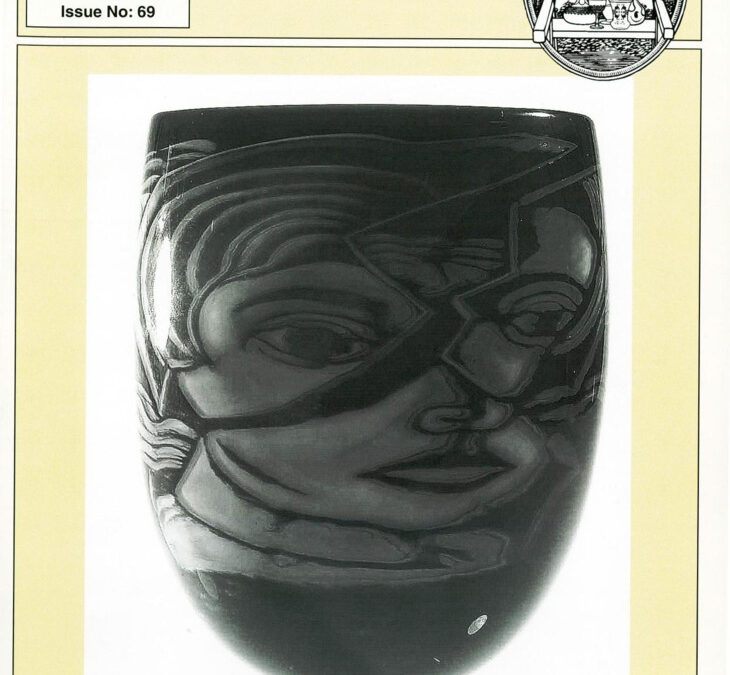
COVER ILLUSTRATION
A striking Graal vase decorated with faces in blue, yellow,
green and black. Marked “Eva Englund Muraya unik graal
09 09 90 Dorothy K Wilke A”. When Eva Englund, who
had learned Graal technique from Edward Hald himself
left Orrefors in 1990 to return to Pukeberg, she continued
Graal work on her own, along with the engraver Dorothy
Konberg and the glassblower Wilke Adolfsson who had his
own studio. This vase, 25 cm tall, 17 cm diameter, was sold by
Bukowskis of Stockholm at their Modern Autumn Auction
on 2 November 2004 for SEK 12,000 (about £950). See
also page 12. Photograph by Bukowskis: www.bukowskis.se.
Bukowskis hold regular auctions of fine glass and this pic-
ture is from one of their website catalogues, which are well
illustrated.
CONE EDITORS
This issue is Dr Patricia Baker’s last as chief editor and
commissioning editor. She has been doing these jobs for a
long time — certainly before I started to help, in 1999 with
The Glass Cone’ – Issue No 69: Autumn 2004
THE GLASS ASSOCIATION
21′ ANNUAL GENERAL MEETING
This year we held a joint conference with The Guild of Glass
Engravers at the Robens Suite at Guys Hospital, London.
Delegates were welcomed with a stunning view from the
29′ floor of Guys Tower over London. Our viewpoint was
higher than the London Eye and members enjoyed identify-
ing landmarks before studying the displays of glass blanks
and engraving paraphernalia provided by various traders
for the benefit of members of the Guild. I recognised one
face amongst the traders, that of Barbara Beadman with a
collection of blanks from Plowden and Thompson.
The conference opened with a talk, illustrated with
slides, by Gill Manning-Cox on her beginnings and de-
velopment as a glass blower/engraver. This was delivered
in a humorous and sometimes wry manner that held the
audience spellbound. Gill explained that her education fol-
lowed an academic path in which art and design were not
encouraged. She branched into art/design at university and
discovered the fascination of glass. She became inspired to
learn glass-blowing as well as cold-working in glass.
After the lunch break, each association went to separate
rooms to conduct their AGM business. Our AGM was con-
ducted under the Chairmanship of Charles Hajdamach, whose
report follows. The Trustees’ Annual Report and Financial
Statement were presented. The following Executive and Com-
mittee Members were elected: Chairman: Charles Hajdamach;
Vice Chairman:
Dil
Hier; Secretary: no nomination
(though we
understand with pleasure that Yvonne Cocking has now agreed
to take on the job – Eels);
Treasurer: Brian Clarke; Membership
Secretary: John Greenham; National Events Co-ordinator:
Gaby Marcon; Editor of
The Glass Cone:
Nigel Benson;
Editor of The Journal: Roger Dodsworth; and, this year, two
Ordinary Members: Paul Bishop for 3 years and Ruth Wilcock
for two years. The need for two Ordinary Members arose as
Alan Comyns had decided to resign from the Committee,
as also did Paddy Baker (past Editor
The Glass Cone)
and
Geoff Timberlake (past Secretary). Regional Representatives
appointed were Janet Sergison (South East), Richard Giles
(South West), Judith Vincent (Midlands), and Peter Beebe
(North West). The position of representative for the North
East is vacant and any willing volunteer is requested to contact
the Chairman for further details. The meeting ended with a
lively debate concerning the recently revamped website.
We returned to the lecture theatre for our next speaker,
Ann Tye from Cohesion with
Getting glassmakers to stick
together.
She outlined the project which started in 2000 in
the North East to provide a sales and exhibition outlet for
glassmakers in the region. The Cohesion project has partners,
including the National Glass Centre, the City of Sunderland,
ONE Arts Council and various business links.
Cohesion has staged several major exhibitions, in-
cluding
BLAST 2003
for prominent glass artists and, also
in 2003,
Ever changing Light
for lesser known artists, and
Designer Glass for Designer Homes.
Since then, Cohesion has expanded. They have a website
and the membership now includes several national figures.
The final speaker was Charles Hajdamach with
The
Art Nouveau Masterpieces of Frederick Carder.
Charles, using
slides to illustrate points, commenced with Carder’s beginnings
in his father’s pottery before joining Steven and Williams where
he worked as a designer until 1903. Then he left for America.
Although he had been largely ignored as a designer in England,
the Americans appreciated his talents, which he developed to the
full. The audience greatly admired the many slides of Carder’s
and other contemporaries’ cameo art glass.
The proceedings were wound up after hearty votes
of thanks to all concerned with the organisation of the day
and a suggestion from the Guild’s executive that we hold
more joint conferences in the future.
Geoff Timberlake
CHAIRMAN’S REPORT TO THE 2004 AGM
As one of the founder members of the Glass Association it
gives me extra special pleasure to present my third Chair-
man’s Report in this the 21″ year of the Association.
Events in 2003
Our year started with the visit to Venice from 9 to 12 October.
Previous efforts to organise such a visit had been abortive due
to various cultural and geographic differences. Many of those
problems were still there on this occasion but were bravely
overcome by Gaby Marcon whose Italian background,
promotional and tourism skills and her contacts in Venice
resulted in a historic first venture to one of the great seats
of European glassmaking. We express our most heartfelt
thanks to Gaby for a memorable and thoroughly enjoyable
visit. The mix of glass visits, sightseeing opportunities and
social occasions was perfect in every sense.
Later in October we held our 20t
h
AGM based in
Stourbridge. In the morning our members were treated to
guided tours of Plowden and Thompson by Richard and
Barbara Beadman and their staff. The many elements of
this quite unusual and productive factory meant that any
programming of the separate tours quickly went out the
window but gave us some fascinating insights. Following
the AGM at the Red House Glass Cone, Jim Frost asked
`Glass — what’s in it?’, a broad perspective of some of the
more unusual and little known aspects of glass.
21St Birthday Celebrations
The celebrations to mark our anniversary were one of the
focal points of the year. Planning started towards the end
of last year by your committee to present a series of events
celebrating 21 years of our activities. Those events focussed
on different aspects of this country’s glass heritage and were
held in each of the Association’s regions.
The first ‘Birthday’ event was held at Pontefract
Museum where Dil Hier and I presented our double act
entitled ‘How Do They Do That?’ which examined the
making processes of a wide range of 19`
h
and 20`
h
century
glassware. Despite technical hitches with equipment and
bright sunshine bleaching out the projected slides, much
discussion was generated about the various processes.
The South East event,
held in mid
June, was a visit to
see the Verzelini brasses in Downe Church in Kent followed
by a guided tour of Eltham Palace. As far as I know our visit
to the Verzelini brasses was the first ever made by a glass
society. Although the visit had not inspired many of our
members, the few that did attend had a most enjoyable time
with the churchwarden and her fellow Downe residents.
The Art Deco splendour of Eltham Palace was a marked
contrast but rounded off a memorable day.
3
‘The Glass Cone’ – Issue No 69: Autumn 2004
In July the main highlight of our 21′ year was the
long weekend at King’s Lynn based around the exhibition
of glass by Ronald Stennett-Willson at the Arts Centre. The
weekend would not have been possible without the help I re-
ceived from Liz Falconbridge and I wish to thank her for her
dedication and commitment. Over 30 members attended the
weekend with a few extra coming along on the Saturday for
the ‘discussion’ between Ronnie and Graham Cooley. The
Association has broken new ground with this informal ques-
tion and answer session with one of this country’s greatest
glass designers; the format may be copied by organisations
including The Wedgwood Society whose Chairman felt it
was one of the best events that he and his wife had ever at-
tended, a view supported by our Australian speaker Susan
Tobin. Special thanks go to Graham Cooley for writing
the superb PowerPoint presentation and for ‘interviewing’
Ronnie in a relaxed and professional manner.
The 2004 AGM also breaks new ground by being
held jointly with another glass organisation.
The Glass Association was founded on Guy Fawkes
night in 1983 and 21 years later we are paying a visit to Free-
masons’ Hall and to the Glass Art Gallery in London.
Like the previous event, which theoretically falls
outside the time scale of this report, the final event of our
celebratory year is the major glass auction which was mas-
terminded by your committee. On 11 December Fieldings
of Stourbridge will hold a massive glass-only sale at Hagley
Community Centre. The sale is intended to benefit our mem-
bers by offering an opportunity to ‘rationalise’ their glass
collections or alternatively to acquire more examples via their
fellow collectors. The auctioneers have been inundated with
glass and we hope that the auction will be a fitting end to a
milestone year in the history of the Association.
The Launch of the Glass Association’s Website
The other major event of the year was the launch of our web-
site. A great deal of hard work was put in by many members
of the committee on the content of the site. In order to achieve
our objectives and have the site up and running by this year
we decided to employ an outside web designer, David Hier,
on a short contract to provide the necessary professional and
technical skills to complete the process. This decision was not
taken lightly but involved much discussion when every nuance
of that decision was scrutinised in an open and transparent
way. As a result I believe that we now have one of the best
websites provided by any of the glass societies. Links with other
societies and institutions are constantly added as is informa-
tion on glass events plus articles offering historical information
for collectors. The website is a vital and important addition to
our service to our members and complements the traditional
publications of the
Cone
and the
Journal.
Publications
As I promised in my last report we are able to publish
Volume 7 of the
Journal
at the time of this year’s AGM.
Each
Journal
sees new achievements and this issue is no
exception. For the first time collectors and researchers will
have access to the complete Monart Lighting Catalogue
which is described by Ian Turner, our former Chairman and
renowned Monart expert. My thanks go as ever to Roger
Dodsworth for juggling with all the editorial demands in
addition to his busy schedule at Broadfield House.
The
Glass Cone
came out in its regular quarterly time
scale masterminded in their usual professional manner by
Paddy Baker and Brian Currie with the assistance of Roy
Kingsbury and Ken Cannell as the background team. I
also thank other members of the committee for providing
articles at short notice. Plans are in hand to re-examine the
look of the
Cone
to reduce printing costs but without losing
any of the size or quality.
Questionnaire
In 1996 the committee circulated to the members a ques-
tionnaire to help provide the right mix of activities. The
plan then was to repeat that process every ten years but the
committee felt that there have been rapid changes regarding
the way we collect, what we collect and what information
and support we need to help us. It is now time to plan the
way forward for the next few years. Work has started on
the compilation of a new survey which will be mailed out
with the last
Glass Cone
of this year.
Membership of the Committee
At the previous AGM four committee members stood down,
namely Alan Comyns, Brian Currie, Ron Havenhand and Ian
Turner. We are grateful for all their support. Alan continued
to support the Association by organising the present AGM
and of course Brian continues to act as the co-ordinator of
material for the
Cone
and is the link with David Moore at
the Society of Glass Technology and the printers. He also
continues to provide support to our present Treasurer.
Finally it remains for me to thank all of the com-
mittee for giving of their valuable time in a generous and
unstinting manner. It is no mean feat to run a society with
almost 500 mailing addresses. The task of dealing with
incoming subscriptions each year and the mailing of four
Glass Cones
is substantial and my special thanks go to those
individuals both on the committee and as unofficial assist-
ants for handling that workload smoothly and efficiently.
Charles R. Hajdamach, Chairman
EXTRACTS – HON TREASURER’S REPORT
Our subscription income has again risen a little, while sales
of publications have fallen, as have donations and invest-
ment income. The tax repayable under the Gift Aid scheme
has not been finalised, but will amount to about £1,000.
Events and meetings in our 21′ year generated a deficit
of only £230 compared with a deficit of £651 in the previous
year. There was a decrease from £3,231 to £2,591 in the cost
of producing the
Glass Cone
(only three issues fell within the
year). The
Cone
currently costs about £800 for a 12 page issue
and £1,000 for a 16 page issue, plus distribution costs.
Our operating surplus for the year came out at £3,672,
compared with a surplus of £5,532 the previous year, the
year in which our backlog of Gift Aid tax was reclaimed.
Following our usual practice we have transferred £2,000 to
our Publications Fund which now stands at £8,481.
Our total funds stand at a healthy £20,387 — enough to
meet our continuing commitments, remembering the imminent
costs of printing
The Journal
(over £9,000). Our donations are
lower, but, if we exclude the effect of two large donations last
year, the underlying trend has been upwards. We are a charity
and following the wishes of our previous treasurer, I would like
those who can afford it to add generously to their subscriptions.
Let’s make it a habit. So I again ask you, when you send in your
subscription cheque, to add a donation and complete the form
which enables us to add a tax reclaim to your support. We would
additionally ask you seriously to consider adding a small bequest
4
‘The Glass Cone’ – Issue No 69: Autumn 2004
to your wills— this could have an enormous impact on our funds.
My thanks to those who are already contributing.
These accounts really do need the application of
someone with accountancy knowledge. If one of our
members feel that they could fulfil this role, we’d appreci-
ate them coming forward.
Our thanks to Eric Reynolds, our Independent Exam-
iner, for his work in reviewing our financial statements, this
year and the previous six years. He now wishes to stand down
and we’ll need to appoint a new Independent Examiner.
Brian Clarke, Hon Treasurer
SOUTH EAST REGION
Janet Sergison,
our SE Area Representative writes:
On Friday, 5 November 2004, a group of 27 members and their
guests celebrated the 21′ Anniversary of the inaugural meeting
of the Glass Association with visits to Freemasons’ Hall and
Peter Layton’s Glassblowing Workshop in London.
Our day commenced with a guided tour of the Library
and Museum of Freemasonry at Freemasons’ Hall. In antici-
pation of our arrival the Curator had arranged for two pieces
to be taken out of the stores and added to the collection of
Masonic glass in the Museum. These were a blue decanter,
gilt with the Mason’s Arms as used by the “Moderns”, Lodge
of Perfect Union, c. 1770, and a Beilby firing glass with poly-
chrome Masonic enamelling, c.1760. We were also privileged
to go into the Grand Temple as no ceremonial events were
scheduled to take place on the day of our visit.
After lunch we went to the London Glassblowing
Workshop and Glass Art Gallery to view
Cutting Edge,
an
exhibition by the Guild of Glass Engravers and guest artists,
and a glassblowing demonstration by the workshop team.
I was contacted by a number of members the follow-
ing weekend to say how much they had enjoyed themselves
but I think Roger Ersser’s email describes what most of us
remember about the day: “We were somewhat overwhelmed
by the spectacular Art Deco architecture of the Freemasons’
building. The memorabilia in the museum were also very
impressive. The gallery/workshop was equally interesting. It
made a change to see the glass-blowers making “flat” pieces.
The Glass Engravers exhibitions are always an unbelievable
mixture of technical brilliance and artistic invention.”
Looking forward to 2005, among other events I plan
to arrange a group private tour of the V&A’s new gallery of
Contemporary Glass when the maximum number will be 25.
A programme is being drawn up for a day visit to the Public
Record Office, Kew; possibly a visit to Wilkinson’s who carry
out glass repairs, bespoke glass-making, chandelier restora-
tion and cleaning, mirror restoration and art metalwork; and
an evening at the Glaziers Annual Lecture, the Worshipful
Company of Glaziers & Painters of Glass, Glaziers Hall.
Janet Sergison
Email: janetsergison@onetel.net.uk. Tel: 01732 851663
REMEMBERING THE BEGINNING
In Glass Cone 68
John Brooks
reminded us of the first meet-
ing of the Glass Association on 5 November 1983. Now
Ian
Wolfenden
reminisces for us.•
It seems odd to say it now, but back in the early 1980s it was by
no means obvious that a new glass society would meet with suc-
cess. Was one even necessary? The glass world is small and was
already well served by the Glass Circle with its regular lectures
and respected publications. Even the late Robert Charleston,
that great friend and supporter of everyone interested in glass,
responded to the suggestion of a new society by writing that his
heart sank whenever such an idea was raised! The Glass Associa-
tion did not begin in entirely auspicious circumstances.
Conceived in the early hours of a morning in the
autumn of 1982, as Charles Hajdamach and I engaged in
animated (possibly inebriated) discussion after a lecture of
his, the Association was born on 5 November 1983, at an
inaugural meeting in the Stourbridge College of Art and
Technology. The way for that meeting was prepared by a
working party of a dozen people – collectors, museum cura-
tors, academics and dealers – who gathered over the previous
few months to set the wheels in motion. The first committee
of the Association (a body which was truly good fun to be
part of) was to come from among those people.
Three ideas regarding the shape of the new Associa-
tion emerged from the early working party discussions. The
first, and perhaps the most important, was that the Associa-
tion should have a strong regional basis. Interest in glass
was growing (particularly, at that time, in the Midlands and
North West), and yet many found it difficult to get down to
London for meetings of the Glass Circle. The second idea
was that dealers should not be excluded from joining, as
they normally then were from learned societies. And the
third was that there was room both for a high quality, quar-
terly newsletter and a journal to publish research, especially
into glass of the nineteenth and twentieth centuries.
The inaugural meeting was a success, attended by a
hundred or so people from diverse backgrounds. They left
the working party in no doubt that there was a genuine
need for a new glass society. Tony Waugh was installed
as our first President, to take the Association through its
early years with great charm and devotion to the job, until
sadly incapacitated by illness. The meeting set the tone for
many later gatherings of the Association, with a range of
demonstrations of glassmaking techniques organised by
Keith Cummings of the Stourbridge College. Our meetings
should be lively as well as educational.
From the outset, national meetings were supplement-
ed by meetings in the Midlands and North West, where
the first regional groups were quickly set up. Further such
groups were to follow, offering members the opportunity
to share interests and forge friendships at a local level. The
Association has come a long way from the days when the
committee anxiously counted the membership at each meet-
ing. Long may it flourish!
Ian Wolfenden
NEW MEMBERS
A very warm welcome to the following new members who
have joined the Glass Association since the last issue of
the
Glass Cone:
Mr & Mrs R Bench
Northants
Mrs M Burd
Shropshire
Mr S Carter
Surrey
Mr & Mrs
B
Clarkson
Essex
Mr C Farlow
Herts
Mr G Hudson
Cambs
Mr G Roberts
Glos
Mrs H Thompson
Suffolk
Mr & Mrs P Tolley
Stoke-on-Trent
Ms C Vaughan
Kent
Mrs P Watson
Surrey
Mrs C Wheeler
Wiltshire
The Glass Cone’ – Issue No 69: Autumn 2004
FIRST INTERNATIONAL GLASS FESTIVAL AND BIENNALE
What a wonderful week! The festival had a formidably full
programme of lectures and demonstrations, and was both
fascinating and fun. The Biennale was brilliant, with some
breathtaking pieces. British factory glass-making may be in
near-terminal decline, but studio glass is clearly thriving, and
there were some world-beating pieces on display.
The Festival was spread over four sites in and around
Stourbridge. The principal site was the Ruskin Glass Centre.
Near the entrance, Crystal With A Twist vividly demonstrated
the old and the new in British glass Spun out of Stuart Crystal
they primarily make the classic Stuart Crystal air-twist glasses,
a team of four working together in beautifully co-ordinated
precision. The twist is made from a single gather of crystal us-
ing a four-pronged former. Coloured twists are produced by
inserting thin canes of colour into the four holes formed by
the former, and the twists have an interesting iridescent edge
from the residual air. The techniques and the resulting glasses
are very different from classic air and enamel twists. These
were among the many superb items on display at the second
venue, Broadfield House Glass Museum. While the principal
permanent displays chronicle the development of glassmaking
from the mid-eighteenth century onwards, very much functional
glass and classical vases etc. of the highest quality, one gallery
is devoted to the birth of modern British art glass in the 1970s
and 1980s It intrigued us that some looked dated. Others are
timeless, and could have graced the hall of the Biennale.
The judges had selected works from 85 artists out of 225
who had submitted entries, and their choice was fascinating and
thought-provoking. There was not a single functional piece, not
a single classical shape. The judges were clearly looking for flair
and imagination, and it was present in abundance. The majority
of pieces were superb, but the judges were clearly setting out to
be provocative in selecting one or two entries, as were the art-
ists who made them. These pieces had flair and imagination in
abundance, but skill seemed to be absent. They were fun pieces,
but were they making fun of the viewer? And were there pieces
submitted that were skilful and technically masterful, but lacking
that certain something and that did not make the cut?
Many of the pieces had sold by the end of the Festival,
and the very friendly organisers were happy to put visitors
in touch with exhibitors (quite a few of whom were there) to
enable work to be commissioned or whatever.
Galle at Broadfield House
There was almost no beadwork in the Biennale, but
that was to be found in the Stourbridge Bonded Warehouse.
Similarly there was virtually no engraving, but engraving of the
highest quality was to be found in two temporary exhibitions
at Broadfield House, one featuring major works by modern
masters, the other a small but exquisite display of the works
of Emile Galle.
The exhibitions were supported by Festival lectures and
demonstrations, and indeed the Festival covered every aspect
of glass-making, and catered for everyone, novice, collector,
student, expert practitioner. The organisers scored a major
coup in attracting renowned artists from the United States and
Venice. With British experts, they offered master classes for the
up and coming professionals, and talks and demonstrations.
The demonstrations were free, and those we saw were both
informative and entertaining.
Many of the pieces made in the demonstrations found
their way into the fun auction on the last afternoon, along
with pieces donated by Biennale artists and others, and fun it
was, with small and zany items going for a couple of pounds
or so, and keen bidding taking the more serious items up to
several hundred pounds.
Those interested in the history of glass making were
especially catered for in the Red House Cone where the per-
manent tour was supplemented with re-enactment of the story
of the creation of the famous copy of the Portland Vase.
The festival closed with a superb firework display. To
the tune “I’m Forever Blowing Bubbles” and dramatically lit
with coloured flares and a ring of flame, a young glassblower
did indeed blow bubbles. Two firework glass-blowers then
heralded a traditional fireworks finale.
The fireworks
There was much, much more than described here, indeed
the programme was so full, there was no way you could see
everything, but whatever your taste and interest, there was
something for everyone virtually all the time. To find out more
look at www.ifg.org.uk. It was an excellent weekend, and we
can’t wait for the next in two years time!
Bob Wilcock
who also kindly supplied the pictures.
The Glass Cone’ – Issue No 69: Autumn 2004
Fritz Dreisbach.
e
International Festival of Glass Biennale Award
The winning piece was selected by the jury on the day of the
preview. The winner of the inaugural International Festival
of Glass Biennale Award was Hannah Kippax, for her kiln-
cast glass sculpture
Seeking Rovnovaha.
•
Winning piece: “Seeking Rovnoveiha” by Hannah Kippax.
(“Rovnovaha” — “Balance” in Czech).
Her work was chosen from among 150 exhibits by
80 selected glass artists. Hannah received her £5,000 award
from Debra Shipley MP at the official opening of the show
on 26 August.
The jury (Professor Andrew Brewerton, University of
Wolverhampton, Keith Brocklehurst, Charles Hajdamach,
Jeanette Hayhurst, and Zafar Iqbal) admired the formal as-
surance of the work, its technical achievement and sureness of
touch. They commended its scale and strength of presence in a
show of exceptional range and diversity, in which a generation
of young British glass artists had appeared to ‘come of age’.
They noted increasing evidence of international influ-
ences within the exhibition as a whole, and acknowledged that
their final decision had been a difficult, though unanimous
one, in a field in which established artists were also seen to
be pushing their own creative boundaries.
One in a series of pieces exploring the combination of
contrasts and divisions, searching for balance and resolu-
tion. Abstract forms and textures are intended to encourage
individual interpretation and have been inspired by the coastal
landscape, the subtle and dramatic relationship between sea,
land and sky. Hannah Kippax was born in Sunderland in 1978.
BIENNALE CATALOGUE
A
full colour 112 page hardback catalogue featuring works
by the exhibiting artists accompanied the exhibition. De-
signed to be a snapshot of the state of UK glass, marking
the emergence of styles, fashions and artists, it will prove a
valuable resource for anyone interested in researching glass
over the years. Available at £25.00 (+p&p £5 to UK) from
www.ifg.org.uk.
The impressive list of masters who held classes in the week
leading up to the Festival included Fritz Dreisbach. The
recipient of many awards, he has taught and lectured in
over 100 institutions worldwide, and was a co-founder of
the famous Pilchuck Glass School near Seattle. An inspiring
glassmaker, Fritz is passionate that glassmaking should be
fun. He is renowned for his fanciful and innovative goblet
designs, often influenced by Venetian glass.
Katharine Coleman, who lectured on ‘Heroes of The Wheel’.
The exhibition hall before and after its preparation. The
Exhibition Organiser was Candice-Elena Evans.
7
The Glass Cone’ – Issue No 69: Autumn 2004
RETIREMENT PARTY FOR JENNIFER HAWKINS OPIE
From left to right, standing: Catherine Hough, Angela Jarman, Bruno Romanelli, Annica Sandstrom, Dillon Clarke, Dan
Klein, David Kaplan, Fleur Tookey, David Taylor, Alan J. Poole, Jennifer Hawkins Opie, Max Jacquard, Anna Dickinson,
Margaret Alston, David Reekie, Danny Lane, Peter Layton, Geoff Opie & Simon Moss. Seated: Clare Henshaw, Tessa Clegg
& Diana Hobson. Picture by: Fiona Meldrum ( Danny Lane Studios).
Alan
Poole
sent us this picture of a party for
Jennifer Hawkins
Opie,
Senior Curator of the Ceramics & Glass Department at
the Victoria & Albert Museum, London, who retired in July,
after thirty-eight years’ service. He tells us:
Alan and Dan Klein chanced upon an ideal retirement
present for Jennifer whilst in Oslo this Spring, a Tapio
Wirkkala designed Rosenthal tea service. Wirkkala is one
of Jennifer’s favourite designers. This service, a special cen-
tenary edition, was decorated by Tapio’s wife, Rut Bryk.
Alan decided that it would be rather nice if some of the
British born and based glass artists with work in the permanent
contemporary glass collection at the V&A, could be included
in this retirement gift. They were invited to contribute.
Fifty-two artists willingly did so, resulting in a sum in
excess of the cost. The surplus money was used to organise
a surprise party kindly hosted by Peter Layton at ‘The Glass
Art Gallery’, part of his London Glassblowing Workshop,
in Bermondsey, London, on 9 July.
Although now officially retired, Jennifer will stay on
at the V&A for the near future in a freelance, part-time
capacity, mainly in order to see the new extension to the
glass gallery through to its completion and finalise the
publication of her book on the glass works held within
the collection of the glass department.
NEW GLASS GALLERY AT THE V&A
Alan Poole
also drew our attention to thefollowing announcement.
At the time of going to pres.% there was no further information on
the V&A’s website at www.vam.ac.uk. We’ll keep watching.
The V&A announced that it would open a new gallery for con-
temporary glass, The Marit Rausing Gallery, on 8 December
2004. This new gallery adjoins the V&A’s historic Glass Gallery
and will provide dedicated space specifically for international con-
temporary work from the Museum’s permanent collections.
The first display will include over 60 works by leading
contemporary glass artists including Dale Chihuly, Tessa
Clegg, Deborah Cocks, Bert Frijns, Gillies-Jones, Mieke
Groot, Laura Heyworth, Angela Jarman, Antoine Leper-
lier, Dante Marioni, Richard Marquis, Richard Meitner,
William Morris, Klaus Moje, Stepan Pala, Zora Palova,
Kirstie Rea, Colin Reid, Judith Schaechter, Per B Sundberg,
Lino Tagliapietra, Emma Woffenden and Toots Zynsky.
The Glass Gallery at the V&A houses the national
collection of glass with around 8,500 objects telling the
story of glass making of over 4,000 years, from the 2nd mil-
lennium BC to the present day. The display was redesigned
in 1994 in a million-pound project and features a rippling
glass balustrade by American glass artist Danny Lane.
The V&A’s glass collections have expanded consider-
ably in the last few years, partly due to the great generosity
of artists, patrons and collectors. The result is a collection
that includes many fine examples of recent glass from Eu-
rope and Britain, the United States, Australia, New Zealand
and Japan. As part of the display programme the gallery
may be given over to single artist or themed exhibitions.
The new gallery has been generously supported by
The Hans and Marit Rausing Charitable Trust.
A new book
Contemporary International Glass
by
Jennifer Hawkins Opie (V&A Publications 2004) is to be
available in hardback at £25.
GARDEN DESIGN WIN
A piece of England will be planted in France after success-
ful students from Tonbridge won an international garden
design competition.
Hadlow College mature students David Grisely and Fern
Alder are celebrating after their design, the Musical Glass Gar-
den, was picked by seven judges above numerous other ideas.
The plan will be recreated in the Parc de la Paix in the north east
area of Bitche where glass-making is a local industry.
Course Area Manager Kemal Mehdi said the students
had to create a 21st century English garden with a glass-related
theme. The pair included glass with musical qualities. She said:
“Both are looking forward to seeing the finished project”.
8
The Glass Cone’ – Issue No 69: Autumn 2004
NAILSEA GLASS WORKS
Dr Michael
Baldwin
( michael@baldw in96 3 .fslife. co. uk )
responded to
Andrew Smith’s
query in Glass Cone 68 relating
to the Nailsea glass works. He had found no answers in a 47
page article on glass, written in about 1880, in a book titled
“Chemistry, theoretical, practical and analytical, as applied to
the arts and manufactures”. He had then turned to “The Shorter
Oxford English Dictionary on Historical Principles”, a very
useful book for ancient terminology. He continued:
BRAZLING, is referred to as brazil, bra 771e, or brassil.
It is an old word for iron pyrites or coal containing much
pyrites. The latter usage is probably the appropriate one.
The old use for the word PLIER is one who folds
(plies), or who moulds or shapes anything plastic. The oc-
cupation at Nailsea would probably have been a man who
folded or moulded semi-molten glass.
A MUG is defined as any large earthenware vessel or
bowl. Perhaps a “dead mug” was a large earthenware vessel
for holding spoiled material.
CRAMBO, as I am sure that you know, is the name for
a rhyming word game. However, the word “Cramble” means to
twist about. Is it possible that the crambo keeper was the man
who was skilled in the particular task of twisting glass?
QUARRIES might have the modern meaning of
square stones of brick or tile. Did the glass works make
such items in glass?
Regarding the TURNING of a furnace, R R An-
gerstein’s
Illustrated Travel Diary, 1753-1755,
translated by
Torsten and Peter Berg and published by the Science Museum
(ISBN 1 900747 24 3), referring to glass furnaces and factories
for bottles in Bristol, states (page 130) that “A week’s work
is called a furnace. One furnace of work on both sides is 240
dozen bottles, and anything produced above this figure is paid
for extra”. Because of the requirements of the Sabbath, it
was not unusual for work to be done in a weekly cycle, with
Sunday being left free for churchgoing. Furnaces could be
kept running, but manufacturing articles on Sunday would be
frowned upon. I think it very probable that the molten glass,
which would take several days to make, would be produced
in batches to allow six days’ working, after which it was re-
charged. The following week the glassblowers would work
from another furnace.
Andrew
Smith
responded with thanks, and continued:
Since my appeal for help, I have managed to access the note-
book, and the following are corrected pages.
Page 37 includes the reference to ‘Brazling’ that ap-
peared in the original transcript, but in the notebook itself
the initial letter looks very much more like an ornamental
‘C’, giving “Crazling”. However your definitions of “Brazils”
was useful as they were mentioned in another reference, so I
have been able to illuminate that corner.
“Plier” turned out to be an erroneous transcription. It
is actually “Piler”, and I have taken that to be the man who
piled the finished tables in the annealing kiln.
The “dead mug” seems to be part of the furnace. I have
assumed that it is part of the space below the furnace bars,
but have no idea how it might be arranged.
The entry for “Crambo keeper” has (N.S.) after it,
which I think might be a reference to “(St.) Nicholas Street”
(in Bristol) where there seems to have been a warehouse and
accounts office, rather than a production unit. So I do not
think we are any the wiser.
With respect to “Quarries” I had come to the same
conclusion as you, namely that they are fairly small panes
of glass.
Thank you too for the Angerstein reference, which I
have seen. It has become apparent that there were different
terms used in different parts of the country and there also
seems to have been changes with time as well as place. I think
that the reference here to “turning” is for some operation
involving a furnace shut-down of some sort, due to the refer-
ence to “setting” pots, which reads to me like putting (new)
pots in to the furnace, rather than refilling them.
Andrew Smith goes on to present the text of the origi-
nal notebook in more detail. We won’t reproduce it here — he
says that publication on the internet is imminent, and the
“notebook” contents will be there in full. His email address is
afsmith@bristolbs941x.freeserve. co. uk.
ACTION BY FULVIO BIANCONI’S HEIRS
A stir was caused in the glass world when the heirs of Fulvio
Bianconi (1915-96) announced that they would take action
to prevent the making and selling, in Italy and abroad, of
glass copied or attributed to Fulvio Bianconi. The response
from eBay has been to require vendors to remove any refer-
ence to Bianconi.
The family’s website at www.fulviabianconi.com hon-
ours the designer’s work and we quote below their approach
to the protection of Author’s copyright:
“Glasses designed and created by him continue to be
copied, produced and sold as his, in order to fetch a higher
price; or, again, these present-day makers fail to attribute the
paternity to him, in order to avoid having to pay royalties.
So-called glass experts, give him the “paternity” of glasses
that were never created
“manu propria”
by Fulvio Bianconi.
They use expressions such as “by” or “from designs by”, or
“designed by Fulvio Bianconi for…”, or again “produced on
a drawing by Fulvio Bianconi”. The mere mention of his
name will ensure a higher price on the market.
“There are three different categories of glass, which
have different artistic and economic value:
1.
the objects made under the personal supervision of the
artist present in the furnace: either by a glassmaker or usually
by himself, with his own hands. These are unique pieces, they
are the ones that he has personally photographed, exhibited
and, later on, sometimes given or sold.
2.
the objects made shortly afterwards, by master glassmak-
ers, copying the unique sample, generally 5 to 10 days after its
creation, often with Fulvio Bianconi’s agreement (as a pay-
ment in exchange for his use of the furnace), as often not.
3.
objects made later, sometimes decades after the date of
creation of the “unique sample”.
“We have decided to move in three specific directions:
1.
Participate in those exhibitions which can contribute to
preserve the originality of the glasses created by Fulvio
Bianconi.
2.
Put ourselves at the disposal of anyone who needs to verify
the paternity of the glasses, using our long experience and
our historical archive.
3.
Undertake all necessary legal actions to prevent the mak-
ing and selling, in Italy and abroad, of glasses copied or
attributed to Fulvio Bianconi.”
9
‘Trip (l
a
ss r,nnp’ – kg! IP
NIn Fill’ Ai rti imn
9nnn
GLASS AT THE AUCTIONS
( Hammer prices throughout. All pictures supplied by the auctioneers or from their websites).
At their Scottish Sale on18 August, Bonhams Edinburgh
sold the three lots illustrated above.
Lot 403 A rare Jacobite diamond point engraved
Wine Glass, circa 1750, the bell shaped bowl with solid base
enclosing a tear engraved with a coiled border above the
Royal Crown perched on a tree, a fallen Crown beside a rose
turned towards the sun, inscribed below `tibe jollie, janu-
ary 30th 1648, Rejoys not, abor me o myn enimie, Althog
I foil, I may arise again’, the reverse inscribed ‘and Singe
woth them, that Singes, Long Live the King’, above a heart
of luckenbooth type surmounted by a rose, 16.6cms high,
provenance: The Bowie Collection. The catalogue noted
that this glass appeared to be by a different hand from
that of the “Amen” series. Estimated at £1,000 to 1,500, it
sold for £2,700.
Lot 405 A Jacobite air twist Wine Glass, circa 1750,
the round funnel bowl engraved with a multi-petalled rose
spray with single closed bud, the reverse with a flowering
plant below a star, on a multiple spiral air twist stem and
conical foot, 15.6cms high. Estimated at £800 to 1,200 it
sold for £1,250.
Lot 410 A rare polychrome enamelled firing glass,
circa 1765, enamelled by a member of the Beilby family,
the waisted bowl enamelled with the arms of the Lodge of
Journeymen and Masons, No 8, Edinburgh, within a scroll-
ing cartouche flanked by trowel and hammer, the reverse
enamelled with set square and plumb bob, within foliate
sprays, the rim showing traces of gilding, with thickened
foot, 7.9cms high Estimated at £2,000 to 3,000 it sold for
£11,000.
Not illustrated, lot 409, a Jacobite colour twist wine
glass, circa 1765, the waisted bowl engraved with a six-
petalled rose spray with two buds, one partially open, the
reverse with star and oak leaf on a white twist stem enclosed
by two blue spiral threads, 16.1cms high, foot chipped, the
engraving possibly later. Estimated at £1,000 to 1,500, it
sold for £2,600.
A rare Whitefriars ‘Meadow green’ Banjo vase, designed by
Geoffrey Baxter, circa 1967. 32cm. high. Sold for £1,600
by Woolley and Wallis.
Michael Jeffery of Woolley and Wallis, Salisbury,
reported on their 7-8 September sale of 20th Century
Decorative Arts, probably his largest ever sale of glass.
10
The Glass Cone’ – Issue No 69: Autumn 2004
His overview was that prices were strong, reflecting keen
interest in Whitefriars in particular. Prices of interest were
£1,600 for the Meadow Green Banjo above, £8,500 for a
Tete de Paon
Lalique car mascot, £2,600 for a Daum winter
landscape vase
(below)
and a noteworthy £200 for a John
Walsh Walsh vase.
A Daum Nancy enamelled glass landscape vase decorated
with a winter forest scene. 12cm. high. Sold for £2,600.
Picture: Woolley and Wallis.
A Clichy scrambled weight, the canes including a white
rose, and inscribed ‘LICH’, c.1845 small chip to side,
7.5cm. wide. Sold for £1,700 by Woolley and Wallis.
A John Walsh Walsh glass vase by Clyne Farquharson,
cut and etched with foliate sprays, etched signature. 21cm.
high. Sold for £200 by Woolley and Wallis.
Other auctioneers had Clyne Farquharson pieces on
offer. They are illustrated below.
Vase in “Kendal” pattern by Clyne Farquharson at John
Walsh Walsh. 20.5 cm tall. Sold by Auktionshaus Dr. Ji,irgen
Fischer, Heilbronn, on 16 October for 400 e ( about £280).
A John Walsh Walsh glass decanter and stopper, designed by
Clyne Farquharson, cut with meandering stems and leaves, the
design repeated on the stopper, 28cm. high. Sold for £200 by
Dreweatt Neate, Donnington Priory, on 3 November 2004.
Dreweatt Neate also sold
this Stevens & Williams
glass vase for £780.
Designed by Keith Murray.
35.3cm. high, it bears the
Brierley mark and designer’s
facsimile signature.
‘The Glass Cone’ – Issue No 69: Autumn 2004
Christie’s South Kensington offered glass in a series of
auctions in October. On 7 October a carafe designed by Ri-
chard Redgrave
(below)
sold well below
estimate for £420.
A ‘waterlily’ carafe designed by Richard Redgrave, marked for
Felix Summerly’s Fine Art Manufactures. Decorated in enam-
els, the foot with roots, the sides with a frieze of leaves and the
shoulder with a garlandof waterlilies. 6 518 in. ( 17 cm.) high.
On 12 October Christie’s
offered this
enamelled and
engraved glass coupe by Galle, decorated with a deeply
engraved and gilded grasshopper, 1
(29crrz. ) diam.,
8in. (20cm. ) high. It sold for £13,000.
Our front cover picture shows one of the faces on a
graal
vase sold by Bukowskis of Stockholm at their Modern Autumn
Auction on 2 November 2004. Beautiful or ugly? It’s certainly
breathtakingly clever! Here is the face on the other side.
The reverse
of
the Eva Englund graal vase shown on our cover.
From the same Bukowskis auction, a ‘graal’ vase with a
ground of dark red glass by Edward Hald, Orrefors, 1918,
sold for SEK 150,000 (about £11,800).
And a “graal” vase with blue stylised flowers on a green ground by
Simon Gate for Orrefors 1917, sold for SEK 76,000 (£6,000).
The leading price at the auction was achieved by a Swed-
ish
marqueterie de verre
glass vase, 33.5 cm. tall, designed by
Ferdinand Boberg, probably made by Fredric Kessmeier, Re-
imyre, 1902. It sold for SEK 260,000 (about £20,500). There
12
On 19 October
Christie’s sold items
from the Harry Lyons
Collection. This James
Couper and Sons
Clutha Glass Vase,
designed by Christopher
Dresser, brown with
vaseline yellow whorls,
25cm. tall, sold for
£4,000.
The Glass Cone’ – Issue No 69: Autumn 2004
was much beautiful glass, some of it more affordable. There
were five Edward Hald
Fiskgraal
vases from Orrefors which
sold in the range SEK 4,200 to 7,800 (£330 to 600). There were
some pieces of glass from Italy and Bohemia, including two
attributed to Dagobert Peche — one illustrated below.
A pair ( one shown) of Stevens & Williams toffee-coloured
bowls with gilded branches, fruit and foliage, bird and in-
sects by Oscar Pierre Erard. 5. 5″diameter . Sold for £1150.
A vase attributed by Bukowskis to Dagobert Peche at Lotz,
around 1910. Purple cut to grey with stylised flowers. 19
cm. tall. Sold for SEK 7,000 (£550).
On 3 November at their Cosford (Shropshire) auc-
tion rooms, Walker Barnett & Hill offered around 500 lots
from a single owner collection of mainly 19C. Stourbridge
coloured, clear & decorative glassware. There were many
interesting pieces. With realistic reserves set, all but about
20 of the lots got away. Highest prices were secured by three
cameo vases at £2,100, £1,600 and £850. Here are some pic-
tures of other lots from their website: www.walker-barnett-
hill.co.uk, together with the auctioneers’ descriptions.
Stevens & Williams? Dolce Relievo cameo vase in rose du
barry cut to white, 12″ tall, sold for £480.
These rose cut to clear vases appear from time to time.
There has been much discussion as to their source. Most
think they are Stourbridge. Walsh has been suggested. Cer-
tainly the techniques are akin to those used in
dolce relievo.
Two opaque cased pieces, one with blue
crimped rim,
the
other with pale amber rim and handle, both with applied
amber and pink flower sprays, 7.5″. Sold for £170.
Richardsons Bronze “Brain” lidded vase with fish finial, 11″
high, sold for £280.
13
The Glass Cone’ – Issue No 69: Autumn
2nna
PAPERWEIGHT NEWS
This article was put together just after our return from a holi-
day in Scotland and as difficult as it may be to believe, not a
single paperweight made the return journey with us. We didn’t
even divert from our route to visit any of the current makers.
Brief visits into Fort William and Oban on two days when
walking conditions weren’t ideal turned up a couple of abstract
weights plus a small selection of the art glass from Scottish
Borders Art Glass and a small selection of Caithness weights
in the respective locations. I know it is harping back onto my
favourite hobbyhorse about the current lack of paperweights
for people to see and get them interested in collecting but the
current situation in Scotland, the home of the majority of
British paperweight makers, is very different now from past
visits when you could take your pick from a plentiful supply
of weights from Caithness, Strathearn, Perthshire, Highland
Glass, J Glass plus several other minor makers. Back in 1976
we made the long trek up to the Caithness factory in Wick and
wherever we stopped the shops were filled with paperweights,
particularly the Caithness set of four seasons weights which at
the time nobody wanted to buy. On the subject of Caithness,
following renewal of my subscription to the Caithness Paper-
weight Society I received brochures about the Perth and Kings
Lynn Visitors Centres so it would seem that manufacturing
operations are to continue at both locations but I have heard
nothing about how large their range of paperweights is likely
to be in the future. Rumours continue to circulate about who
is working for whom or who has been seen coming out of
various paperweight making facilities but no confirmed news
of any collaborations yet.
The Paperweight Collectors Circle weekend of meetings
with the Ayotte family in August was well supported on both
days. We went to the Sunday meeting held at the Whitemoors
Antiques and Craft Centre in Shenton about fifteen minutes
drive from Nuneaton. On display was a mouth watering se-
lection of weights by both Rick and daughter Melissa and I
was able to purchase an unusual weight by Melissa containing
a mixture of Pate de Verre figure and lampwork flowers. It
was really special just to be able to see such a large selection
of their weights and marvel at the complexity of some of
the lampwork. Talking to them about their normal working
day, which starts at around 6.30am with a hour and a half
of botanical study before the glassmaking is started, makes
you realise just how they are able to get such accurate detail
reproduced in the weights. One can understand their passion
for making paperweights and their desire to work continually
on new subjects using new processes and techniques.
The week before we made the short trip up to the
Paperweight Day at the Broadfield House Glass Museum
where PCC Chairman Bob Hall and other committee
members had put together a really impressive display of
Stourbridge/Birmingham weights. It gave collectors an
insight into some of the differences between the various
makers but still there remains a large proportion of such
weights that cannot be attributed to any particular maker,
and it would seem that this may remain the case unless
someone unearths new information about other makers.
Putting on my hat as South West region representative
for a moment about a subject that is not totally paperweight
related, I have to express my disappointment at having to
cancel the presentation by Jonathan Harris that I had or-
ganised at the end of September for the South West region
members. This was part of the Association’s 21st Anniver-
sary year celebrations but like several other planned events
this year had to be cancelled due to the lack of support and
presumably lack of interest from the members. I find his
glass absolutely amazing and believed that his presentation
would have been fascinating for anyone with an interest in
glass and glassmaking whatever their specific interest. A big
thankyou to members who offered to support the meeting but
a response from six people out of the 70 addresses notified
is not sufficient to make it worthwhile for either the speaker
or the Glass Association. As it was the cost of postage alone
without photocopying and envelopes meant that the South
West region’s funds were reduced by some £18 .
No doubt you
will
see details elsewhere over the com-
ing months
(see back page)
about a weekend gathering in
Perth next August on Ysart glass. My understanding of
the current proposals are that it will cover all aspects of the
Ysart family and their glass rather than concentrate on any
particular aspect, but paperweights will feature somewhere
in the programme. A varied selection of speakers is being
lined up to cover the various elements of their glassmaking
story and the event will be based around the Perth Museum
with a registration fee for attendance at the various events
that are being organised. There is a website that can be
visited for more information.
It seems no time at all since I mentioned the last Wok-
ing Glass Fair in March and, now that summer has come
and gone, it is time for the next fair at that venue. No doubt
we shall meet up with some friends and fellow collectors
which always provides an opportunity to catch up on eve-
ryone’s recent finds and the latest paperweight gossip.
Richard M Giles.
SIMON WHISTLER
On a Glass Lightly, The Selected Glass Engravings 1954 — 2004,
is Simon Whistler’s own choice from his collected work as a
glass engraver, in a career spanning fifty years. As most of his
work is commissioned and held in private collections, this is
an opportunity to see many of the pieces illustrated. The book
is designed and produced by Libanus Press in Marlborough.
The foreword by Christopher Booker draws us into this subtle
and fascinating world where, as Hooft, the seventeenth century
Dutch poet says, ‘One scratch, and the dumb glass speaks’.
Simon Whistler,
the son of actress Jill Furse and
poet and glass engraver Sir Laurence Whistler, was born
in North Devon in 1940. After three years as a chorister at
Magdalen College, Oxford, he went to Stowe School. The
spectacular landscape gardens at Stowe were, and remain, a
source of inspiration in his glass engraving. Learning from
and encouraged by his father, he had been engraving glass
since the age of ten. Ten years ago Simon decided to give
up his career as a musician and in recent years has devoted
more time to work on flat glass in the form of windows
and lit panels. There are now more than twenty of these in
churches from Inverness-shire to Cornwall. He is a Fellow
of the Guild of Glass Engravers, gives lectures on glass,
and has taught at West Dean College, Sussex.
The book, ISBN 0 948021 61 6, is available, price
£26 incl. p&p from Maggie Whistler (maggiefaultless@
onetel.com) The
Old
School, Alton Barnes, Marlborough,
Wiltshire SN8
4LB
tel/fax 01672 851322.
14
The Glass Cone’ – Issue No 69: Autumn 2004
BOOK REVIEWS
JOURNAL OF GLASS STUDIES, vol. 46 (2004), publ.
Corning Museum of Glass, ISBN 0-87290-046-0, US$ 43.75
inc p&p.
Of the main twelve articles, nine relate to mediaeval
glass and earlier. Of these about half could be considered
of a technical nature, judging from the quantity of detailed
chemical analyses they contain. The remaining articles con-
cern 18th century Chinese glass, Venetian table settings and
19th century New England Pomona. Two obituaries are
included in this issue: Claud Riedel and Paul Hollister for
whom his bibliography lists some 130 books and articles,
many, of course, dealing with paperweights.
While allowing for the editors’ reliance on the subject
matter and quality of articles submitted, the apparent em-
phasis on the archaeological and early glass scientific-tech-
nical aspects does seem to be squeezing out their third remit,
that is art historical. With post-1945 glass, now including
museum acquisitions being covered by Corning’s
New Glass
Review,
maybe there is room for a third journal concentrat-
ing on, say, Renaissance to mid-20th century glass.
A significant change to the JGS has been the transfer
of the publications check-list to an on-line system. Given
that the only index available until now has been for volumes
1-15, this is an immense improvement. Indeed, the CMOG
library will still supply printed lists for ‘subject-limited’
searches and anyone without on-line access should con-
tact Peter Bambo-Kocze, Rakow Research Library, CMOG,
Five Museum Way, Corning, NY 14830-2253, tel: +607 974
8235; e-mail bambokp@cmog.org.
If anyone wishes to fill in gaps in their JGS collection,
vols. 14-17 and 20-41 are currently on sale from CMOG at
$5 each plus p&p.
Ken Cannell
FENTON BURMESE GLASS Debbie and Randy Coe,
Publ. Schiffer Publishing. ISBN: 076431968X. Hardcover
191 pages, available direct from Bushwood Books Ltd., 6
Marksbury Avenue, Kew Gardens, Surrey, TW9 4JF. £24.95
incl. p&p.
For collectors of Fenton Burmese Glass this must be
regarded as the definitive reference book, as it describes the
whole range of production, from its introduction in 1970
to the present day. The book is beautifully illustrated with
probably every shape and style of decoration finding a place
in its pages. As with all price guides, the value against every
piece will be of great use. Because of the rarity of this glass
in the UK, it might be more appropriate to read the values
as pound sterling rather than dollars.
The book starts with a brief introduction to Burmese
Glass, its discovery by Frederick Shirley at the Mt Washing-
ton Glass Company, in 1885, and the subsequent licensing
to the English glass manufacturer, Thomas Webb and Sons,
in 1887. As an introduction it is adequate although it some-
times puts the author’s imaginative slant on commonly held
belief. With only two illustrations of Webb Fairy Lamps,
an opportunity was lost to show comparative designs from
the three producers of this ware. However, a study of the
decoration, shapes, colour and above all the thickness of
the glass used for the pieces in this book is sufficient to
prevent any confusion between Fenton’s Burmese and that
from either Webb or Mount Washington.
The next chapter provides an introduction to the
Fenton Art Glass Company and the remarkable story of
the development of their Burmese Glass by Charlie Goe.
The success of Fenton over the years is owed to the
people involved and the book finds the space to describe
their roles and sing their praises. It is clear that without the
dedication and commitment, as well as the artistic and busi-
ness acumen of the family, Fenton would not be the force
they are today. They have also nurtured the talents of their
workers and designers, who have exploited the beauty of
Burmese Glass to the full. Two chapters in the book identify
the most significant designers and decorators. Many of the
captions to the illustrations provide further details of those
involved with each piece.
The manufacture and marketing of Fenton Burmese
Glass has been carried out so as to develop a strong group of
collectors. Their demands have been sustained by the gradual
release of limited editions, special orders and connoisseur
items, all again illustrated and described in the book.
To identify failings, I found that the book was not
easy to read after the first few introductory chapters, as the
text became mixed with the captions for the illustrations.
Although the illustrations show various signatures, the Fen-
ton signature, as moulded on some pieces, is alluded to but
not illustrated; and the periods of use for the various paper
labels would have been of interest. It is also clear from the
signatures that other artists were involved with the hand
decoration and for completeness a list of these people would
have made the book truly comprehensive.
Dilwyn Hier
THE DECANTER: AN ILLUSTRATED HISTORY
1650-1950. Andy McConnell. Hardcover 520 pages Publ.
Antique Collectors’ Club. ISBN: 1851494286.
( We haven’t yet received a review for this book — but to
keep you in the picture, we quote the synopsis from Amazon
( www. Amazon. co.uk), who offer it at £45 plus p&p. At least
one of your editors concurs with the synopsis).
This exciting new book, the result of five years’ research
and writing is the first-ever in-depth study of the leading vessel
in the European glassmakers’ repertoire between 1650 -1950.
In presenting the subject on a wide stage,
The Decanter
pro-
vides the reader with a history of European and American
glassmaking from ‘a decanter perspective’. Illustrated by pho-
tographs and patterns and drawings of thousands of exam-
ples drawn from numerous public and private collections, the
text encompasses the stylistic and technical evolution of fine
glassmaking and its influences and social uses. Few who have
handled antique glass can have failed to muse over its former
uses and what it contained in previous lives. This fascinating
book provides many of the answers. Drawing from hundreds
of documentary sources and benefiting from the knowledge
and experience of scores of expert proof-readers in Britain,
Europe and the United States,
The Decanter
is the most
comprehensive and current history of fine glassmaking ever
published. It provides a glossary of the names of all familiar
shapes, for the first time, and dispels the innumerable myths
surrounding the subject. Written by a former journalist and
glass dealer with twenty-five years experience,
The Decanter
is
readable and accessible, and provides an indispensable guide
to social historians and lovers of antique glass and wine.
15
The Glass Cone’ – Issue No 69: Autumn 2004
EXHIBITIONS, FAIRS, ETC.
EXHIBI [IONS AND
EVENTS
FRAGILE CARGO
is an international touring exhibition
bringing together the work of 24 glass artists from Great
Britain and Hungary. The exhibition has been put together
by New London Glass in co-operation with the Hungarian
Glass Art Society. The exhibition seeks to explore the dif-
ferences and similarities between the works of these artists
and discuss why these differences have developed.
At THE WORLD OF GLASS, St Helens 25 November
2004 to 5 January 2005. Tel: 08700 11 44 66.
Then 15 January to 5 February 2005 at the GLASS ART
GALLERY, 7 The Leather Market, Weston Street, London
SE1 3ER. Tel. 020 7403 2800. Fax. 020 7403 7778. www.lo
ndonglassblowing.co.uk. A symposium is planned for 15
January to include lectures and demonstrations.
BROADFIELD HOUSE GLASS MUSEUM — A re-
minder that the exhibition
GALLE: A CENTURY
runs
until 30 January 2005, Running concurrently and finishing
9 January 2005 is
WaldegraveSweet,
an exhibition marking
the end of Tim Waldegrave and Samantha Sweet’s tenancy
of the Scholarship Studio at Broadfield House and show-
ing their functional ranges along with sculptural pieces.
www.glassmuseum.org.uk. Tel: 01384 815745.
THE NATIONAL GLASS CENTRE —
CIRCUS OF
SPHERES –
new work by Monica Guggisberg and Phillip
Baldwin, glass artists based in Paris. The work encapsulates
their ability to attain symmetry and balance on a large scale
whilst retaining the delicacy of their medium of glass. 12 No-
vember 2004 to 31 January 2005. wwwnationalglasscentre.com.
Tel: 0191 515 5555.
LUSTRE.• BRITISH CONTEMPORARY GLASS.
incl.
Katharine Coleman, Suresh Dutt, Sally Fawkes, Katy Hol-
ford, Richard Jackson, Angela Jarman, Jessamy Kelly, Peter
Layton, linclean Mill’ (David Kaplan & Annica Sandstrom),
Charlie Macpherson, Gavin Marshall, Rob Marshall, Naoko
Sato, Anthony Wassell & Louise Watson. TULLIE HOUSE
MUSEUM & ART GALLERY, CARLISLE, until 19 January
2005. Tel: 01228 534 781. Email: enquiries@tulliehouse.co.uk.
Website: wwwtulliehouse.co.uk.
21″ CENTURY BRITISH GLASS.
incl. over 50 British Glass
Artists to include Katherine Coleman, Tessa Clegg, Sally
Fawkes, Angela Jarmen, David Reekie, Colin Reid, Bruno
Romanelli, Rachel Woodman and many more. 11-21 January
2005. DAN KLEIN ASSOCIATES @ DANIEL KATZ LTD,
London. Email: alanjpoole@aol.com.. Tel: 020 7821 6040.
INSPIRATIONAL AWAKENING: IRISH CON-
TEMPORARY GLASS 2003.
The Glass Society of
Ireland/Contemporary Makers Exhibition. Touring
Exhibition at Ulster Museum until 23 January 2005.
www.ulstermuseum.org.uk. Tel: 028 9038 3076.
Frank Andrews tells us that he is planning an
YSART AND
SCOTTISH GLASS GATHERING 2005
6-7 August 2005
at Perth Museum and Art Gallery, 78 George Street, Perth,
Scotland, PH1 5LB. He says it is to be a two day event on
Saturday 10 am — 5 pm and on Sunday 1 pm – 4.30 pm.
Speakers who have confirmed are: Ian Turner, Kevin Holt
and Peter Holmes. The talks will not address ‘basic’ informa-
tion on glass, but rather present original and divergent views
on Ysart glass in particular and on Scottish glass in general.
Details are at www.slistress.demon.nl/Perth2005_2.
EUROPEAN GLASS MASTERS
incl. Sabrina Cant, Eva
Cvrckova-Vlckova, Sally Fawkes, Javier Gomez, Milan Handl,
Richard Jackson, Stanislav LibenskY & Jaroslava Brychtova, Ja-
roslav Matous, Anna Matouskova-Kopecka, Ivana Sramkova-
Sokova, Brian Usher & Marian Volrab. THE STUDIO GLASS
GALLERY, 63 Connaught Street, Marble Arch, London W2
London. 11 January to 5 March 2005. Tel: 020 77063013. Email:
mail@studioglassco.uk Website: www.studioglass.co.uk
FAIRS, AUCTIONS, ETC.
(It’s wise to check with event organisers before travelling any
distance, in case there have been alterations).
The continued success of the original NATIONAL GLASS
COLLECTORS FAIR can mostly be attributed to the support
of the dedicated and knowledgeable exhibitors that take part in
the event. Following the most recent fair, which took place on
Sunday 7 November, approximately 65% of the exhibitors said
they had a successful fair, whilst several new and regular dealers
experienced a day of excellent trading. The next National Glass
Collectors Fair will be Sunday 8 May 2005 and is likely to be once
again at the Heritage Motor Centre, Gaydon, Warwickshire.
More information at www.glassfairs.co.uk.
THE NATIONAL GLASS FAIR — The Alban Arena, St
Albans, Hertfordshire, approximately 46 stands, 28 Novem-
ber 2004, Tel: 01933 225674
(Don’t confuse this event with
the original “National Glass Collectors Fair” above. Eds).
THE INAUGURAL BEDFORDSHIRE GLASS FAIR is
proposed at the Holiday Inn, Garden Court Hotel, Sandy,
Bedfordshire; room for 40 stands, 30 January 2005. Tel:
01234 325679 or 01933 386385.
THE CAMBRIDGE GLASS FAIR — Chilford Hall Vineyard,
Linton, Cambridgeshire;. approximately 65 stands. The fair
will include a Foyer Exhibition of Powell Drinking Glasses,
which are on loan from Robert Marris, 20 February 2005,
Ham — 4pm. Adm. £3, email info@cambridgeglassfair.com
or tel: 07887 762872 for details.
ANDREW LINEHAM has closed his shop in Camden Pas-
sage, London. His stock has outgrown the available space
and details of his new premises in Central London or Wim-
bledon Village will be announced shortly. Meanwhile, he is
contactable via his website at www.antiquecolouredglass.com,
by telephone: 01243 576241, or mobile: 07767 702 722.
Antiquestradegazette.com has developed AUCTION ALERTS,
a new email service. For a monthly subscription it will search
its range of online catalogues, find those lots that match your
interests and email the results to you, including any colour im-
ages available. It’s clearly a service that will compete with that
hitherto mainly provided by Invaluable and other organisations.
For details, telephone 0207 420 6691, email alerthelp@antiques
tradegazette.com, or visit the website itself.