


The
Glass Cone
Issue No: 70 — Spring 2005
The Magazine of
The Glass Association
Registered as a Charity No. 326602
Chairman
Charles Hajdamach
Hon. Secretary
Yvonne Cocking, 14 Southfield Drive, Sutton Courtenay,
Abingdon, Oxon, OX14 4AY (yvcocking@aol.com)
Editorial Board
Nigel Benson, Ken Cannell, Charles Hajdamach
Address for Glass Cone correspondence
Email to Nigel Benson: nbenson@20thcentury-glass.com
Address for membership enquiries
John Greenham, Membership Secretary, High Trees,
Dean Lane, Merstham, Surrey, RH1 3AH
(john@jgreenham.freeserve.co.uk)
Web site:
www.glassassociation.org.uk
ISSN No. 0265 9654
Printed by
Jones & Palmer Ltd
Published by
The Glass Association
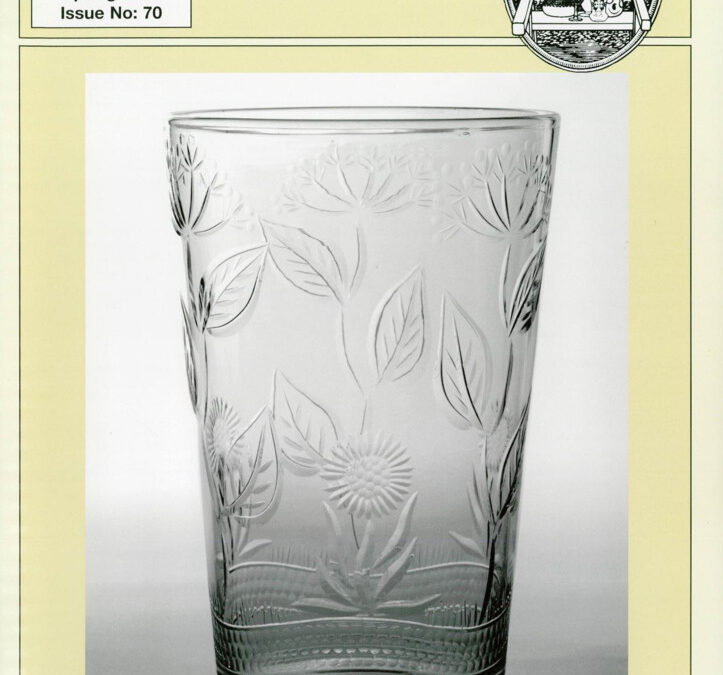
COVER ILLUSTRATION
A beaker vase 10
1
/4 in/26cm high designed by Gordon Russell
and made by Powell & Sons (Whitefriars) Ltd c.1927. Powell
produced this series of wares as a result of an invitation given
to Russell to produce some designs for them. The Russell range
all uses the shallow-cut technique to decorate the items and has
an “R” prefix to its numbering in the records. This technique
was originally used by Harry Powell in about 1894 as a result
of seeing a Roman cut bowl at the British Museum, and
developing a suite of glassware using that shallow-cut method
of decoration. There is a page of drawings in Harry Powell’s
notebook “Glasses with Histories” entitled “Roman” that deals
with a number of patterns produced by the company using the
technique. Photo courtesy of Nigel Benson 20th Century Glass
and taken by Steve Tanner, e-mail stevetannerphoto@aol.com.
INTRODUCTION FROM THE EDITOR
As you all read in the last
Cone
I have taken over from Paddy
Baker as Commissioning Editor. A few members have very
kindly offered, and sent in, articles that I trust you will find
entertaining and informative, but we need to know what you, the
members, want from the publication. To be fair we’d also like
members to send in their own contributions as well. You’d be
surprised how valuable small pieces of information can be to
other readers, so don’t consider that little things don’t matter,
and, if you feel that you can’t write, just jot something down and
e-mail it in, or send it, and we’ll help you put it together. This
is, after all, the members’ newsletter, so get sending!
You may realise from this that I’d like to make the
Cone
more interactive, despite its limitations as a quarterly
Newsletter. Some of the information that you send in might be
more useful on the Association’s web site –
www.glassassociation.org.uk — if it requires more immediate
attention.
Here might be the place to apologise to all our readers for
the delay in producing this edition, which I’m afraid has been
influenced by a series of personal problems. We have been
aiming to begin the changes we would like to make to the
Cone,
but this has proved not possible for this issue, so we are looking
to introduce some changes over the next few issues — colour in
particular. I would especially like to thank both Bob and Ruth
Wilcock for their help and encouragement in producing this
issue. You will see from the copy dates below that the aim is to
get back on schedule.
As hinted at above, one of the tasks that I will be
undertaking as your editor is to see through the changes to the
Cone
that are currently being discussed by the committee — and
that has been influenced by the returned questionnaires. Paul
Bishop and I have collated and analysed the answers and a
report has been presented to the committee. We will also report
the results through the
Cone.
One of the suggestions that I gave the committee for
improving the content of the
Cone
was that I felt we should have
regular `themed’
Cones.
Usually these will be announced in
advance, so that members might feel that they can participate. It
was decided that it might be a good opportunity to give you all
a taster of the sort of thing that we might do by using this, my
first issue, as an example. Therefore, since my favoured subject
is the 20th century, this issue will largely have a bias to articles
about glass from that era, with a weighting towards
contemporary glass.
Nigel Benson
CALL FOR PAPERS — Journal No. 8
Following publication of Journal No. 7, the editor, Roger
Dodsworth, is actively seeking articles for inclusion in the next
issue. Any member who has an article that they feel might be
suitable is asked to contact Roger for details at Broadfield
House Glass Museum, Compton Drive, Kingswinford, West
Midlands, DY6 9NS (01384 812747 or e-mail
roger.dodsworth@dudley.gov.uk)
The opinions expressed in the
Glass Cone
are those of the
contributors. The Editors’ aim is to cover a range of
interests and ideas, which are not necessarily their own.
However, the decision of the editorial board is final.
COPY DATES
Summer issue
11 July 2005
Autumn issue
5 Sept 2005
2
‘The Glass Cone’ – Issue No 70: Spring 2005
A VISIT TO SWEDEN
THE GLASRIKET PASS
In 2004 visitors to the Glasriket — the Kingdom of Crystal in the
Smaland region of Sweden — had the opportunity of purchasing
a newcomer to the numerous tourist discount cards that are a
feature of the Scandinavian
countries. This one, called the
Glasriket Pass, gave the holder
many benefits when visiting the
fourteen glassworks in the region.
Although each person needed their
own pass at a cost of 95 kronor, we soon calculated that the outlay
would be recouped quickly with the benefits available.
These included free entry to the glass works and their
associated museums and discounted prices when having a go at
glass-blowing, engraving or glass painting. The activities varied
from one glassworks to another, so it is necessary to consult the
information given out with the pass. There was a 10% discount
available in the factory shops at Kosta and Boda on purchases
over 500 kronor; this was sometimes supplemented by special
discount, only for pass holders, on certain items. The hotel
at
Orrefors offered 10% off your first night’s stay.
Four of the glassworks, Orrefors, Kosta, Mats Jonasson
Malerds, and Pukeberg, organise regular “Hyttsill” evenings –
the traditional herring supper in the glassworks. Here the pass
really came into its own as a 50 kr. reduction was available for
all, reducing the price from 325 kr. to 275 kr. per head. This one
event offset over half the cost of the pass.
Our “Hyttsill” evening was a qualified success; the meal
was simple, different and tasty. I do not recommend the free
beer on offer; it was the one of the worst ‘chemical’ lagers I
have ever had the misfortune to try. Swedish ‘Schnapps’ was
available but at a premium price, so not many people sampled
that. Our table neighbours did, to their disgust, as, like the beer,
the taste was not to their liking. Light entertainment was
provided during the meal and afterwards we saw a
demonstration of glass-blowing from one of Kosta’s master
blowers, who produced a beautiful rippled-effect bowl in blue
and white. This was one of his own designs, not the bread-and-
butter work he was doing during the day. The photo shows the
bowl receiving the final touches before being sent to the lehr.
We visited Orrefors, Kosta, Boda and Pukeberg glass
works and attended the “Hyttsill” at Kosta. We did not go for
any of the activities on offer but did visit all the museums and
exhibitions available at the works. Our 95 kr. per head was good
value and we would recommend the Glasriket Pass to visitors to
the Kingdom of Crystal.
USEFUL INFORMATION
The Museum of Smaland in Vaxo is also well worth a visit for
glass enthusiasts. They have many displays of Swedish glass,
mainly from the late 19th century, which are the origins of the
modern Swedish glass tradition. If you have heard of a glass
designer but do not know what his/her work looks like, then this
is the place to go. Additionally, there are some displays of
earlier glass from Swedish and other sources which portray the
development of the glass manufacture from Royal/aristocratic
patronage to the modern industry of today. Other displays cover
aspects of life in Sweden and the Forestry/Timber industries –
even those were quite interesting.
Glass-blowing demonstration at Kosta Glassworks
Accommodation in the vicinity of most of the
glassworks is limited, comprising mainly smaller hotels
or
campsites with wooden chalets for hire, or pitches for your own
camping unit. The towns of Vaxo to the west and Nybro to the
east both have larger hotels and are in easy reach of the
heartland of the Kingdom of Glass. If any member who is
planning to go to Sweden requires more information about the
Glasriket Pass, and they have Internet access, then visit the
Glasriket web site at www.glasriket.se where it appears that the
costs and benefits of the pass remain the same for 2005 as
in
2004. A bargain still!
Geoff C Timberlake
Food for Your Thoughts
Referring to my reminiscence of Tom Dale made on page 10
and on the subject of Powell glass. Tom had postulated a
thought about the factory’s production. Particularly their ability
to earn enough money from Harry Powell’s designs during the
late 1800s through to, say, the First World War. These pieces
were regarded as avant-garde for their time and would have
appealed to only a tiny proportion of the buying public. When
one considers the scarcity of pieces from this period it may well
be that much of their production was actually based on the
1860s catalogue. These ‘designs’ would have been the more
staid and acceptable ranges to the majority of the buying public
— so was that how the factory survived? Or, was it purely
through their work with stained glass? Certainly these
considerations applied to many factories when they tried to
change course during the 20th century: for instance the
introduction of designer, or art cut glass produced by many of
the Stourbridge companies, and Edinburgh & Leith between
about 1920 and 1970.
If anyone has thoughts or comment they wish to make
please contact one of the editing panel. (Ed)
‘The Glass Cone’ – Issue No 70: Spring 2005
Flame-working in the new studio
Exquisite flame-worked piece
SARS-POTERIES & TROYES EXHIBITION Glass In France
Some time back, I explored the Crafts Council Library in
Islington. There was no need to make an appointment and I was
soon enjoying a browse through the interesting selection of
books on glass. The librarian also drew my attention to several
magazines on glass, amongst them
Werre et Creation’,
a
contemporary glass newsletter, published in France four times a
year. I read about Sars-Poteries as well as various French
glassmakers and centres, and wanted to know more. I already
had found several glass sites for France whilst trawling on the
Internet, but decided that it would be worthwhile having a
subscription to the magazine which had much information on
glass artists and exhibitions in France and other countries.
Glass, Colour and Creation
That was how we came to visit Sars-Poteries in October 2004
for a special five day festival of glass, entitled
‘Glass, Colour
and Creation’,
organised by the ‘Musee-Atelier du Verre’.
Although we were only able to spend two days there, what a
feast there was, in more senses of the word than one! All will be
revealed! Between 1802 and 1937, the population of the village
grew considerably with the development of two glass works,
employing up to 800 people. In 1969, a local priest organised an
exhibition of
`bousilles’
or ‘end-of-day’ friggers made by the
workers at the end of a shift in the former residence of one of
the glassworks owners, which was such a success that it was
decided to set up a museum there. In 1987, the museum started
a
buying programme of contemporary glass and in 1994 the
museum was taken over by the departement du Nord and is open
all the year round.
The Museum at Sars-Poteries
We enjoyed the permanent exhibition of the locally made
19th and 20th century glass and all the exhibits in the
contemporary galleries (these are changed during the course of
the year, as the collection is too big to be shown in its entirety).
In addition, there was an exhibition of work by Polish glass
artists Barbara Idzikowska and Get Staniewicz, described as ‘a
poetic exercise on graphism and light’. In the old workshop of
Sars there was a fascinating exhibition of flame-working, based
on the interpretation by Jean-Michel Othoniel of a work by
Pierre Loti, brought to fruition by the pupils of the Dorian
Technical Lycee in Paris under the guidance of their teacher,
Claude Robert. I hope that Bob’s photos do justice to their
delicate and exquisite work. This exhibition was held at the
Theatre du Chatelet, Place du Chatelet, Paris from 8 February to
12 March 2005.
When we arrived at the purpose-built modem workshop
we were amazed to see a familiar face. Raphael Seguso was just
as startled to see us, for, although we had never actually talked
to him until then, we recognised each other, since we had spent
many hours watching him at the demonstrations as assistant to
the Murano master glass-blower Livio Sereno at Stourbridge at
the Biennale, where we had enjoyed
a
superb week of activities.
We soon established that Raphael was French, not Italian as we
had assumed, and he introduced us to his fellow glass-blowers
who were to be demonstrating their skills during the festival –
Isabelle Poilprez, who works on Murano, was experimenting
with copper in her work, Catherine Picaud who was blowing
glass into metal shapes, Gerald Vatrin who was blowing large
pieces which he would later cut and polish and Catherine Farge
who was experimenting with blowing and then collapsing and
folding glass. Raphael is a master of the
incalmo
technique and
made some superb pieces during our visit. The young students
from Paris were also giving displays of flame-working.
4
The Glass Cone’ – Issue No 70: Spring 2005
LA PUISSANCE
DU VERRE
Gans Part
NI
LI
Gerald, Catherine, Isabelle and Raphael
The opening ceremony was on the first evening and
started at the museum, went on to the old workshop, then to the
new workshop where our new friends gave a demonstration of
blowing. Everyone then adjourned to the huge luxury marquee
next door for the official reception and speeches of welcome by
Anne Vanlatum, the director, and various officials of the Nord
departement. The event was being held as part of the
celebrations for Lille being European Capital of Culture for
2004 and no expense had been spared by the departement on the
vast array of food and drinks. We’d never seen such a lavish
opening night! It was wonderful. Having feasted our eyes on
glass all day, our taste buds thoroughly enjoyed themselves that
evening, as indeed they had done the previous evening at the
hotel restaurant!
In the company of other visitors, including coach parties
and school groups, we enjoyed more demonstrations the next
day. We were able to chat to the glass-blowers again, as one kiln
and one glory hole had been removed to make more room for
seating for the visitors, so they had to take it in turns to work.
The centre is well equipped for most glass working techniques
and offers various courses during the year, as well as hosting an
artist in residence, who has an exhibition at the end of the
residency. Sadly, we had to miss Dan Klein’s lecture on the
`Role of Glass in Contemporary Art’,
but at least had heard his
fascinating lecture on Galle at Broadfield House during the
Biennale. I understand from Anne Vanlatum that it was well
attended and well received. So, what can pull two glass addicts
away from such a festival? There’s only one answer there — the
grandchildren in Lyon! It had been a wonderful couple of days
for us, and a well-deserved success for Sars-Poteries, with much
press and TV publicity and 2,000 visitors over five days.
The Power of Glass
On our way back north from Lyon we stopped off at Troyes, a
beautiful town with many half-timbered buildings. There the
Maison de l’Outil was hosting an exhibition of glass,
‘The
Power of Glass’,
which had been the idea of Patrick
Toumarkine There were 300 works by 130 artists from 30
countries displayed, slightly bizarrely, amongst the permanent
collections of tools of all types. The aim of the organiser was to
open up the world of glass to a wider audience, to avoid just
showing works by the same 20 or so top glass artists seen so
often in exhibitions, to include not just well-established but also
lesser-known artists, from different generations and different
countries, and that he certainly achieved — Austria, Canada,
Denmark, Germany, Italy, Japan, Lithuania, Romania, Slovakia,
South Korea, Spain, Sweden and many others were represented.
He also wanted to present works demonstrating as many
different techniques as possible.
What a variety there was. It was amazing. There were
pieces by Warren Langley, Maria Lugossy, Matei Negreanu,
Lino Tagliapetra, Yan Zoritchak, Czeslaw Zuber, the list could
go on and on. Most of the young artists we’d seen at Sars had
pieces on display, and Great Britain was represented by
Christina Bothwell, Martin Bradley, Catherine Golding, Graeme
Hawes and Michaela Grimshaw, Peter Layton, Marianne
Spottswood (USA/France also), Angela Thwaites, Kate
Williams, with Cannel Mooney from Ireland. It was a feast, at
times a bit indigestible, but enjoyable too. Our main criticism
was the catalogue, which was not presented in alphabetical
order and did not contain an index, so when we wanted more
information on an artist we had to struggle to find it. Once the
relevant page was found, all was well. It is hoped to make this
a biennial event with a chosen theme. It should certainly be
worth visiting in 2006.
Well, what
what a year 2004 has been for glass
the Glass
Association’s 21st Birthday celebrations (many thanks to all the
organisers), including the weekend at King’s Lynn, the
Stourbridge Biennale and, for us, Sars-Poteries and Troyes, the
group exhibition by Cohesion in London, as well as visits to the
National Glass Centre in Sunderland (with exhibitions including
Baldwin and Guggisberg), to name but a few, and last but not
least that never-failing pleasure of visiting studios and seeing
artists at work.
Is it possible for 2005 to better 2004,
I
wonder? Yes,
quite possibly! Already in January we’ve visited the new
exhibits in the V & A galleries, been to
‘Collect’
there and
enjoyed more glass, especially the works by Bob Crooks and
Australians Ben Edols and Kathy Elliott, David Hay, Rod
Coleman, Deb Cocks and others. There was the most enjoyable
exhibition ’21st Century British Glass’ organised by Dan Klein
Associates at the Daniel Katz gallery and the fascinating
symposium at the Glass Art Gallery in the Leathermarket, also
in London, in conjunction with the exhibition by the Hungarian
Glass Art Society and New London Glass. That was just
January! Now we have the news of a Chihuly exhibiton at Kew
Gardens — what a year this could be!
Ruth Wilcock
who also kindly supplied the pictures
5
The Glass Cone’ – Issue No 70: Spring 2005
WORLD FIRST IN CAMEO GLASS BY OKRA GLASS
Okra Glass is one of the longest established glass studios
working in Britain today. Twenty-five years ago, Richard
Golding and Nicola Osbourne completed the unique one-year
glass course at the International Glass Centre in Brierley Hill
and after a short spell in Yorkshire they moved into the newly
opened glassmaking studio at Broadfield House Glass Museum
where they stayed for five years. Since then they have moved a
few times and gone through various partnerships but have
remained one of the most successful studios in the Stourbridge
district, selling their products both nationally and
internationally. One of the keys to their success is the constant
exploration and striving for new techniques and effects by
Richard Golding, one of the top British glassmakers and colour
technologists. One of those areas has been cameo glass.
In 1980, when Okra Glass moved into the studio at
Broadfield House, Richard was already fascinated by
Stourbridge cameo glass represented so well in the museum
collections. In that year he produced a handful of pieces, but the
time-consuming nature and costs prohibited any further
development. His partnership with Moorcroft plc enabled a new
source of funding to allow him to take up cameo production on
a full-scale basis. The new cameos consisted of up to seven
layers and were carved and enamelled by Sarah Cowan.
Technical improvements consisted of the refinement of thinner
layers of casing, and a more accurate form of masking, blasting
and carving using different coarseness of sands in the
sandblaster. Another innovation was the use of enamel paints to
add colourful highlights.
When Sarah left the firm Terri Colledge was appointed to
continue the cameo range. Terri had worked as a paintress for
Bilston enamels for eighteen years when she was made
redundant. Her move to Okra four years ago has been extremely
fruitful. Having no previous expertise or training in cameo glass
production Terri is now a natural, as anyone who watches her
work at the Okra Studio in Queen Street, Wordsley, will testify.
Her preferred method of carving is with an air turbine driven
flexible drill which is water cooled, the cameo piece sitting in a
plastic container as it is worked from its blank state.
Colours include gold ruby, royal blue, pink, green and
amber. White is melted as an opal colour and used with other
colours, which may be in powdered form, and are used to shade
into the white when that layer is carved. The white opal has to
be dense enough to give impact but translucent enough to carve.
Richard prefers to make his own colours as bought-in colours
are very difficult to work with. Black glass is also used as a
shading in much the same way that Thomas Webb and Sons
used blue in the late 19th century to shade under cameos with
subjects such as bunches of grapes, producing the characteristic
bloom on the fruit.
Normal Okra cameo pieces consist of three colours but
special orders may be made in five layers. Subjects are mainly
floral and Terri will often just get a flower from the garden and
copy it directly onto the cameo. No two designs are the same
and even the borders, which are her favourite, will also alter
slightly. All pieces are recorded in her personal catalogue with
details of costs and purchasers.
If this level of cameo production is regarded as an
important continuation of the Stourbridge cameo glass tradition,
then Richard Golding’s new foray into cameo glass is a first in
the history of cameo glass. Okra’s hallmark is iridescent glass
and for many years Richard admits that he has been wanting to
incorporate it into his cameo.
Some eighteen
months ago he began
to work seriously
on the project and
now has achieved
the first successful
results. Iridescence in
cameo glass is not new,
but in the past pieces by
Tiffany
and Carder,
for example, had the
iridescence on the top
outermost
layer.
Richard has achieved
the
technically
challenging task of including the iridescent layer between other
layers. In the hot glass studio a silver based glass, such as blue
aurene, is blown between other coloured layers, the whole piece
then being allowed to cool as normal. The next stage is to carve
away the layers so that the silver based glass is revealed
amongst the pattern. At this stage the carved blank is placed
back into the kiln and reheated, picked up onto the post on the
end of the blowing iron and then put into a reduction
atmosphere two or three times so that the reheating of the blue
aurene layer causes the silver to rise to the surface thereby
giving the iridescent effect, a process known as ‘striking’ in the
trade.
What makes this truly awesome unique achievement
even more amazing is that it has been created by one of the most
modest glassmakers working in a side street in Wordsley and
not by some large conglomerate with bottomless coffers to
provide the finance.
We flan to bring you pictures of the new range in a
forthcoming colour issue. As they say, watch this space.
Charles R Hajdamach
The Glass Cone’ — Issue No 70: Spring 2005
Foyer exhibition of Powell Glasses at the Cambridge Fair
TOO MANY FAIRS, OR NOT ENOUGH INFORMATION?
In the article on paperweights sent in by Richard Giles he made
some comments that set me thinking. His thoughts were about
the fact that the Woking Glass Fair, which has been running for
some years, falling into a twice-yearly pattern, was to be held
only once this year — in March.
Richard’s comment continued: “I shall probably be
treading on a few toes when I say that I can understand the
desire for other organisers to want a slice of what I will call the
`glass cake’ and in recent years the number of glass specialists
seems to have grown quite significantly, but in my mind the
amount of money that the glass collecting public will spend is
likely to remain fairly constant, so each slice of the cake is likely
to get smaller over a period of time. Eventually this could put
many of the fairs at risk if traders are not able to make it
worthwhile taking selling space. In my view much of the
ordinary glass being offered for sale is overpriced, but maybe
that is because we have been collecting for some thirty years
and I am out of touch with the current market. I guess that only
time will tell.”
What is Richard is referring to? A number of additional
glass fairs have been announced for 2005. Locations range from
Honiton to St Albans to Harrogate, in addition to the existing
Cambridge and Gaydon Fairs.
Leaving aside Richard’s feelings about the pricing of
glass, experience tends to confirm his supposition that the
`cake’ can only go so far, and unless the organisers put in a great
deal of effort to promote their specialist event, then might it be
a question of diluting the current status quo? In all probability
the answer is yes. However, maybe this should be viewed more
as an opportunity to promote glass and collecting rather than a
disaster. Perhaps it is possible that with the multiplied
promotion of these various events glass might gain a higher
profile and attract a wider audience. It would mean that in all
likelihood organisers should ensure that they tune their
promotion not just toward their existing customers, or to a
known glass clientele, but that it should aim to attract new
collectors to the fold by promoting, in this case, the glass.
Both Cambridge and Gaydon are actively trying new
methods of promotion. Cambridge by hosting what has been an
increasingly successful series of free foyer exhibitions, and
recently Gaydon by combining with the Glass Circle to host
lectures. Each has chosen a different way to disseminate
information about glass.
The Motor Heritage Museum, venue for the Gaydon Glass Fair
Other glass fair organisers who are newer to the scene
have opted to promote their fairs in the standard way, often
relying on visitors that already go to other fairs run at the same
venue by the same organiser. Sometimes these are local, general
fairs, but occasionally they are other specialised fairs. Whereas
this leads to a cross-fertilisation of buyers it can also confuse the
visitor who has become unclear as to what to expect — despite
the associated advertising and publicity. Whilst this attracts new
glass collectors it neither maximises the potentially interested
audience nor gives added value to that group of visitors.
Yet perhaps this is far too negative, since the influx of
new venues is surely an opportunity for collectors to buy and for
glass in general to be promoted. The ‘glass cake’ that Richard
refers to can always be made bigger, since there is plenty of
scope to attract fresh interest through these new venues.
Furthermore, it might be considered an opportunity for
organisers to promote glass in a more cohesive way, rather than
in the isolation regarded as a necessity by most. In al I
probability this could benefit organisers, sellers and collectors
alike, whilst giving the subject a well-deserved boost.
We seem to be at a time when glass is in the public eye
through life style magazines and the like, yet this has brought very
few newly interested collectors, since much of what is being given
publicity is either low priced high street orientated ware or items
for the minimalist market often at the expensive end of the scale.
Much of the problem could well be that to most of the
uninitiated, it is a difficult subject to understand. What is good or
bad? What has quality and even what might have a “pedigree” that
can be appreciated? Indeed, how do you identify an object as being
by a particular manufacturer, designer or maker? Sadly, glass is
a
closed book to many, which inevitably begs the question, “what can
we all do to change, or begin to change, this?”
In truth, there is no one answer, although as collectors
who appreciate the subject, perhaps we all have a vested interest
in promoting the topic that many of us are so passionate about
in order that we not only promulgate the collecting of our
particular favoured sphere, but in so doing we find new
custodians of those collections. Without new collectors who
appreciate the subject values might also become moribund, or,
as they say, go down as well as up.
NPB
If you have any comments resulting from this article
please write or e-mail them to the editor
(Note: John Slade, who organises the Woking Glass Fair,
al
the Leisure Centre, has announced that there will be a glass fair held
in conjunction with the Art Nouveau and Art Deco Fair this coming
August bank holiday.)
7
‘The Glass Cone’ – Issue No 70: Spring 2005
Webb ruby background cameo case
GLASS AT THE AUCTIONS
The Fieldings Auction
“Three Centuries of Glass”,
11 December 2004
This auction devoted to glass, the first ever mounted by
Fieldings, was planned as part of the Association’s anniversary
celebrations and also dedicated to a local collector Seaun Peter
Orpen. Arriving at West Hagley’s modest Community Hall (near
Stourbridge), we were greeted by two sets of doubled tables laid
out with a colourful display of glass totalling 750 lots.
Auction viewing in December 2004
Two hours were barely enough to inspect the glass before
the sale started at 11.00 a.m. and, with three auctioneers rotating
in the rostrum, it continued all day without a break.
Fieldings’ catalogue described each lot in adequate detail
but was rather short on pictures. Although the premium plus
VAT, totalling 14.69%, had to be taken into account, most of the
estimates seemed modest.
Of the 37 lots of 18th century glass, most were very
ordinary items, but a pair of double series colour twists with
white, brick red and translucent green threads was bid to £2,500,
the lower estimate, while three lots of Lynn glass raised £760 for
a nice decanter, £420 for a wine on an opaque twist stem and plain
foot, and £350 for a pair of salts. A marked Lauenstein glass of
typical form with air
bubble in the thick base
of the bowl fetched a
modest £230.
The 223 lots
of 19th c. British
glass were not only
colourful but included
some spectacular and
historically important
items, including cameo,
the highest price of
£7,200 being paid for a
Webb white over ruby
vase decorated with
sunflowers. However,
an unusual Webb Ivory cameo vase remained unsold.
A Richardson’s satinised opal alabaster goblet and ewer,
superbly hand enamelled en grisaille with Egyptian style scenes
and coming from the Cyril Manley collection, fetched £1,250
while, from the same source, a pair of alabaster vases with
typical classical Greek decoration, the bases marked
“George
Bacchus & Sons, vitrified enamel colours”,
brought only £200
in spite of their excellent condition.
Fine engraving and rock crystal cutting was also well
represented. An impressive rock crystal engraved bottle vase in
the style of William Fritsche, 15.75 in. tall, made £300 in spite
of some severe damage. Equally spectacular was a vase cased
pink over crystal with two intaglio-cut panels depicting winged
cherubs holding oak and laurel branches; 11 inches tall, it sold
for £3,400. Particularly enchanting were a matching pair of
finger bowls, wheel engraved, one with a pair of jays and a
thrush, the other with a grouse nursing chicks, both within floral
flourishes, which made £220.
Among the other items of historical interest, a small
Northwood triple-cased bowl pulled into spiral bands made
£490, while a small “grotesque” bowl (c.1897) shading
amethyst to crystal, designed by Frederick Carder for Stevens
and Williams, was given away for £45. At the bottom of the
prices was a Vaseline pig of the type made by Thomas Webb &
Sons at the Franco-British Exhibition in 1908. It struggled up to
£12 — a real bargain! In fact, there was plenty of choice under
£150. For under £50 you could have had one of those spiky tree-
trunk vases, some in shaded colours. One pair went for £30.
There was a considerable body of relatively inexpensive
Vaseline glass and a potential collector could have created an
enviable assembly on the spot.
Broadfield House went home satisfied with an unusual
item, being an 1832 signed letter by Benjamin Richardson and two
gilt fobs intaglio engraved respectively with the initials “R” and
“B.R.”
They came from the Richardson house sale after WWII and
were vigorously bid to £270, around twice the estimate (see
illustration above).
The Continental glass contributed more colour and
decoration, ranging from £25 for a tankard, £290 for a
magnificent pair of 6-inch heavily decorated Theresienthal
roemers of elaborate form, to a copper ruby and gilt 23-inch tall
table-centre at the top price for this section of £550. Among the
group of paperweights, one item was outstanding: a 31/4 inch
Clichy barber pole weight from the 1851 exhibition. With minor
scratches, it made £2,900. Two typical Clichy vases with
colourful spiral stripes made £120 and £145 respectively.
The 78 lots of press-moulded glass contained a number
of unusual items, but many sold for well under £50, even quite
8
The Glass Cone’ – Issue No 70:
Spring 2005
Molineaux Webb sphinx
Richim m(trto vase (c. 1951)
nice Queensware pieces. Most expensive was a Molineaux
Webb 8-inch long sphinx in colourless satin glass at £260.
A Derbyshire clear glass Punch and Judy went for £150
the pair, while a 9-inch finely moulded figure of the young
Queen Victoria, in a blue colour, called soapstone, made £230.
Recumbent St Bernard dogs were a mystery. A single 61/2 inch
long version in cobalt blue was vigorously bid to £280, over
twice the top estimate while, later, a 7-inch
pair
of the same
colour sold for £180, a little over the top estimate. Likewise, a
pair of Landseer lions with
the
JD
mark sold for £82
while another pair sold for
£150, although unmarked.
A single greyhound that
had been seen held
lovingly by Broadfield’s
curator fetched £180, three
times the upper estimate.
Ordinary clear glass
tableware is still unloved
and you could have had a
fistful of tankards or
pressed goblets etc. for
Roger Dodsworth viewing
around £25.
My brief review closes with the early stages of
the section on 20th century Italian and Continental glass.
The real surprise here was a number of “Between the Wars” and
early Post War Murano art glass pieces, interspersed among the
more usual Lalique, Schneider, Sabino and similar items. The last
of these, a signed swan with an opalescent frosted finish, made
only £45, the better
Lalique pieces around
£200 to £250. A pair of
undated Salviati goblets
with applied aventurine
swags, lion masks, etc.
went for £40. I am no
judge of the early
Murano glass but the
obviously fine pieces
made relatively high
prices. A Richiarmarto
vase designed by
Archimede
Seguso
(c.1951) decorated with
a lattice of pink and white canes over an aventurine and clear
ground, and with its original paper label, made £2,750.
Not everything was that expensive. A 91/2-inch 1931
Barovier cockerel with trailed white loops within clear over an
aventurine ground, also with original paper label, found a happy
owner at £270. A range of other Murano vases sold in the low to
mid three figures each, but my visit closed with a spectacular
1956 91/5-inch Kiku vase designed by Ermanno Toso for Fratelli
Toso. The body is made entirely of identical interlocking black
and white millefiori sections loosely described as flower heads.
It fetched £1,850.
(DCW)
Kiku vase
(c. 1956)
The 20th century Scandinavian and British glass sections
reflected the rest of the auction with its highs and lows. Some
bargains occurred along with some anomalies. For instance, an
above average Monart bowl reached £290, despite being
damaged. Other Scottish glass was represented by a quantity of
Strathearn that all reached around £70/£80, against £40—£50
estimates. Including the premium that would be equivalent of the
retail price. An unusual, possibly academic, piece of Gray Stan,
having tooled festooning within transparent turquoise, over a pure
white inside, reached the bottom estimate at £210. There was a
good representation of Clyne Farquharson designs but much of it
was from one source and estimates were too high, preventing
them from selling. Conversely, there were bargains amongst other
cut glass wares. A Stuart engraved and enamelled spider cocktail
shaker was a variant on the norm. Unnoticed by most, it was
bought by a keen collector for a very reasonable £210.
David C Watts and NPB
Two typical
Clichy vases
on sale in
December
2004
9
The Glass Cone’ — Issue No 70: Spring 2005
OBITUARIES
SIMON WHISTLER: 10 Sept 1940-18 April 2005
The death of the noted glass engraver and musician Simon
Whistler was reported in
The Times
on 26 April. Whistler came
from a gifted and artistic family, his father being the renowned
glass engraver Laurence Whistler, and his mother the actress Jill
Furse, and there were family connections to Eric Ravilious
(through his sister’s marriage), Sir Henry Newbolt and,
distantly, to Sir Joshua Reynolds.
Simon continued in the tradition begun by his father. He
first exhibited his work at the Festival Hall in 1962 when he
showed seven pieces. Like his father he explored the effect of
light, but his forte was landscape. He attended Stowe School and
its landscape gardens and temples remained an inspiration to him
throughout his life and career as a glass engraver.
His mother died when he was four placing him firmly
within the influence of his father, whom he helped in his
workshop from the age of eight. At ten, Simon produced his first
piece of engraved work and also began to learn to play the violin
after being given his own by a relative, Sybil Eaton. He went to
Magdalen College School before going on to follow in his
father’s footsteps to Stowe School. When Simon left Stowe he
went to the Royal Academy of Music, finally becoming a
professional viola player, which he continued in tandem with his
career as an engraver for thirty years, retiring from music in
1994. It was natural that music also permeated his work as an
engraver through to some of the subject matter.
During school holidays his apprenticeship to his father
continued, as on return from school, Simon would find a
sketched-upon goblet to complete. By the age of 21 he was
producing work professionally and went on to create mainly
one-off commissions of specific subjects, following in the
traditions and using the artistic vocabulary that had made his
father so successful. He was proud that he continued in the same
idiom as his father, whom he would consult about his designs
until Laurence’s death in 2000. There were also collaborations
between the two, notably a panel for the Jacqueline du Pre
music building at St Hilda’s College, Oxford, for which Simon
engraved staves of music by four composers.
By 1994, Simon had decided to devote himself to
engraving, giving more time to working on flat glass for
windows or lit panels. Some twenty examples of this work can
be seen in churches spanning Britain from Cornwall right up to
Inverness-shire. A number of these were millennium
commissions for commemorative windows. During this time
Simon also lectured about engraving and taught at West Dean
College. However, for the last five years he suffered from motor
neurone disease, which eventually made it impossible for him to
continue engraving.
His love of music helped to give him solace during these
years and he even managed to complete two windows for
churches in Wiltshire and Cornwall to add to his canon of work.
The book
“On a Glass Lightly”
is a retrospective of 50
years of Simon Whistler’s designs and work encapsulating his
legacy to us. We are fortunate that we can also enjoy his work
through the panels incorporated into public places, in addition to
individual items held in museums.
NPB
HUGH TAIT
It
is with great regret that we have to announce the death of
Hugh Tait, former Deputy Keeper, Department of Medieval and
Later Antiquities at the British Museum. A graduate of
Cambridge and the Courtauld Institute, and an internationally
recognized expert in the area of European antiquities from the
early Christian era to the beginning of the nineteenth century,
Hugh was President of the Glass Circle until he died on 12 April
2005.
We will publish a fuller appreciation of Hugh in the next
issue of the Cone, Ed.
KENNETH M WILSON: 4 Feb 1922-29 March 2005
Regrettably, we have to report the death of the American glass
historian Kenneth M Wilson in March this year. Kenneth, who
was 83, spent his working life within the museum system, serving
as chief curator at Old Sturbridge Village, Massachusetts, the
Corning Museum of Glass, New York State, and the Henry Ford
Museum at Dearborn, Michigan. He wrote a number of major
books about American glass in his own accessible style, including
“New England Glass & Glassmaking”,
his first, in 1972. Six
years later he completed
“American Bottles & Flasks and Their
Ancestry”
on behalf of Helen and George McKearin who had
started the project, but due to Helen’s failing eyesight it had been
in danger of being lost. The greatest written achievement by
Kenneth was his two-volume study
“American Glass,
1770-1930”.
We await his latest book, a study of Mount
Washington & Pairpoint Glass, which is to be published by the
Antique Collectors’ Club.
NPB
AN APPRECIATION OF TOM DALE, 1949-2004
Many of our readers will not have known Tom Dale, a quiet
unassuming man, who once you got to know him had a wicked
sense of humour. He was a thoughtful man, not only in the
humanitarian sense, but also in the way he mulled over things to
do with glass.
I visited Tom and his wife Amy less than a month before
he died so unexpectedly on 18 December 2004, and he was on
form as usual, pulling my leg about being a poor dealer who
never made any money. As usual, when glass people meet, the
conversation turned to the subject of major interest — food –
oh, and the liquid stuff (glass!).
I talked of my misgivings at having taken on the
editorship and tried to persuade Tom that he had a number of
articles in him, but typical of so many collectors he insisted that
he had very little to contribute, since in his opinion Christine
Colledge had written the authoritative article on the subject of
his `fun’ collection
(Journal of the Glass Association No. 3 –
1996).
Tom had put together probably the most definitive
collection of Stuart enamelled glass since the factory produced
the wares in the late 1920s and 1930s.
Like many collectors, he found that his favoured subject,
double-cased
intaglio
cut glass, was so difficult to find that he
decided to start collecting something that was more plentiful.
Ironically, even Stuart enamelware is now difficult to find in any
quantity.
I0
The Glass Cone’ – Issue No 70: Spring 2005
Our conversation turned toward this very phenomenon
— scarcity — and he proffered a theory about Powell’s
production, which is outlined in a separate article in this issue
(page 3) as a possible topic of discussion by members.
Although I knew Tom for quite a number of years I feel
that I had only just begun to scratch a source for a different view
on things glass, and had I managed to persuade him to write we
would all have enjoyed and learnt from him. I shall certainly
miss him, and our thoughts go out to Amy, Jo and Liz.
NPB
19 December 04.
REGIONAL NEWS
SOUTH EAST REGION
Janet Sergison
our SE AREA Representative writes:
We are indebted to the Worshipful Company of Grocers for
permitting us to hold the SE Region’s Spring Meeting on
31 March at Grocers’ Hall, as they do not normally receive
visitors. There members spent an interesting and enjoyable
morning viewing the collection of English 18th century drinking
glasses, tapersticks, candlesticks and early Irish cut glass, formed
by Colonel Walter Churchill Hale in the first half of the 20th
century, and the Eddison collection. Wendy Evans, who is
currently recataloguing the collection, very kindly acted as our
guide.
For our Summer Meeting on 20 May we went to the
National Archives at Kew. The morning was devoted to
catalogue searching and Jane Brown spoke to us about the glass
documents held there, which include registered designs of the
major Stourbridge factories and historic documents such as
Verzelini’s Will. After lunch members had the opportunity to
look at selected documents and carry out some personal
research.
Reading Museum Stores is the venue for our Autumn
Meeting on 21 September. This will be a visit of discovery to one
of the unknown collections of glass in the country, when members
will have the opportunity to ferret around in the storeroom,
followed by a cataloguing exercise, with the aim of providing the
museum with an inventory. We will be able to see a collection of
Venetian glass, Roman glass, including glass from Silchester and
a rare piece of a cage cup. Also, 18th Century glasses, an
electioneering goblet, sealed wine bottles, a few pieces of post-
reformation stained glass and some late 19th century Bohemian
glasses. Full details and application form to follow.
Janet Sergison
Please note my new e-mail: janetsergison@onetel.com Tel:
01732 851663
MIDLANDS REGION
Your regional representative, Judith Vincent, reports a
successful meeting held on the 9 April when 22 members from
the Midlands and North West regions met at Lichfield
Cathedral, Staffs. After a welcome coffee, members enjoyed a
guided tour of the Cathedral with the emphasis on the stained
glass. This was followed by a convivial lunch that preceded
John Brooks’ excellent talk on 18th century wining and dining,
entitled “Fill Ev’ry Cup”.
Judith is currently putting together details for an event in
the Rotherham/Barnsley area for later in the year.
PAPERWEIGHT NEWS
SELKIRK GLASS & CAITHNESS
Since my last article, the situation with paperweight making in
Scotland has changed, with the purchase of Selkirk Glass by
Caithness Glass and the official confirmation that Willie
Manson has returned to the world of paperweight making by
helping out John Deacons on a part time basis with the
production of lamp work for his weights.
I shall be interested to see whether Selkirk Glass
continues as a separate entity and/or becomes another outlet for
Caithness products, since the Selkirk area remains a popular
tourist destination and is sufficiently far away from the
headquarters at Perth. In 1980, Caithness Glass bought the
remnants of Whitefriars Glass, including the name, and before
too long started to produce weights with the Whitefriars name
and using Whitefriars style canes, including a signature cane.
There was much consternation among many purist glass and
paperweight collectors who would have preferred to have seen
the name disappear along with the factory, but nowadays it is
common for many products, including a lot of glass, to be sold
under a well-established label, yet having been made by some
totally different manufacturer.
On the subject of Caithness, I see from the latest
Collectors Society newsletter that despite his official retirement
Colin Terris continues to have a presence at the Perth factory and
weights from his designs were made in 2004 with more in 2005.
OTHER NEWS
There is an interesting article for the Paperweight Collectors Circle
by John Deacons on the changing face and, in his view, the
inevitable downsizing of paperweight making establishments. Also
included is an insight into his philosophy for the future and a
picture of the current team, which includes Willie Manson. It will
be very interesting to see what collaborative work will be produced.
My understanding from Alan Sedgewick, who sells John’s weights,
is that there are some snake weights already in existence
Following publication of the information on the
Perthshire paperweight made for the Swiss Bank in
Glass Cone
67,
and the
Paperweight Collectors Newsletter,
one eagle-eyed
enthusiast spotted that the 1889 date cane was featured in figure
66.22 on p. 160 of
“Paperweight Signature Canes”
by Andrew
Dohan. This shows a selection of complex signature canes, of
which some also have details of the weights in which the canes
were included, but interestingly no attribution for the 1889 cane.
Our visit to the Woking Glass Fair was, as always, very
enjoyable with a good range of glass, including paperweights,
on view. In making our way around I heard talk of a rare footed
Bacchus millefiori weight with a central Victoria head cane that
Ray Metcalfe of Sweetbriar Gallery had recently purchased, and
he was kind enough to let us have a look at it. According to Ray,
it is only the second recorded footed weight from Bacchus and
we appreciated the chance to see it.
To close, I have preliminary information on the next
major paperweight exhibition to be held in this country. If all
goes to plan, the date will be November 2006 and the venue the
Olympia Fine Art and Antiques Fair in London, where the
Paperweight Collectors Circle have been invited to provide an
exhibition of weights similar to that held at the National
Exhibition Centre at the end of 2002.
Richard M Giles
11
‘The Glass Cone’ – Issue No 70: Spring 2005
EXHIBITIONS, EVENTS, FAIRS, ETC.
EXHIBITIONS AND EVENTS
A real treat is in store this summer! Indeed the
GARDENS OF
GLASS: CHIHULY AT KEW
exhibition at the
ROYAL BOTANIC
GARDENS AT KEW
will run throughout 2005 until 15 January
2006, closing only on 24 and 25 December. There is one piece on
view in the Princess of Wales Conservatory entitled “The Sun at
Kew Gardens”, which, in typical Dale Chihuly fashion, is on the
grand scale — four metres by four metres, weighing a total of
4,600 pounds, being made up of hundreds of pieces of hand-
blown glass. It is said that the visitors’ experiences of the pieces,
both outside in the landscape and inside the glasshouses, will
change from day to night and from season to season. The gardens
open generally at 9.30 but opening hours vary according to the
seasons. For more information see the Kew Gardens web site at
www.rbgkew.org.uk or phone 020 8332 5655.
Timed to coincide with Gardens of Glass the Just Glass
Society is having an exhibition
TRAIL OF GLASS
in June and
early July. The trail will include the A & T Gallery, Richmond,
Richmond Adult and Community College, as well as the Karen
Taylor Contemporary Gallery, Par-Ici both in Twickenham and
Mia Wood Limited, Station Parade, Kew. More details are
available
from
www.just-glass.co.uk,
and
on,
www.glassassociation.org.uk.
It is very easy to miss Alison Kinnaird’s superb
PSALMSONG
at the V & A, situated as it is at the entrance to the
museum that is reached via the underground tunnel from South
Kensington tube station. It is situated near the main restaurant, see
picture above. Do ask for directions if you cannot find it, as this
internationally acknowledged piece will eventually be placed on
permanent display in the new Scottish Parliament building. It will
be in London until 5 July. Psalmsong is also the name of a piece
of music, for harp and cello, composed and played by Alison. The
music was analysed by computer and the patterns produced by the
sound waves inspired the piece. All is explained on a panel beside
this dichroic-coloured work. This exquisite piece of work is over
three metres long and is composed of 24 engraved crystal panels,
lit by optical fibre lighting, with a linen banner shadowing the
piece. Do not miss it!
SHIPLEY ART GALLERY in Prince Consort Road,
Gateshead has an exhibition entitled
SEA GLASS
by three well-
known northern artists, glass-blower Jane Charles and engravers
Peter Furlonger and Julia Linstead. This will run to 4
September. Tel: 0191 477 1495, Fax: 0191 478 7917,.
www.twmuseums.org.uk/shipley.
NOTE: Ruth Wilcock is organising a trip to the exhibition,
on 16 July, for North East
.
Region members, who will be
contacted by post. If any other members are interested please
contact Ruth, Tel: 01277 219598. Jane Charles will be giving a
talk on her work and philosophy, in addition to discussing the
exhibition. There is an opportunity to socialise at the Springfield
Hotel at 12.30 p.m. (reasonably priced food). The meeting will
start at 2.00 p.m. at Shipley Art Gallery, Gateshead.
No visit to the North-East would be complete without a
trip to the NATIONAL GLASS CENTRE, Liberty Way, at
Sunderland. From 15 June there will be an exhibition entitled
TRANSITION: GLASS AND CERAMICS
by new artists and
from 5 July to 2 August,
WHEEL AND WATER: GRIND AN
EDGE.
The NGC is open every day except 25 December and
1 January from 10 a.m.-5 p.m., entry is free to the shop and
exhibitions. It is worth paying for the tour and a visit to the
restaurant is also a must. Tel: 0191 515 5555
www.nationalglasscentre.com.
In the Midlands at BROADFIELD HOUSE Glass
Museum at Compton Drive, Kingswinford, from 14 May to
4 September is a
GLASS THREADS
exhibition and from 10 July
until 3 October
ROMAN GLASS.
The museum is open Tuesdays
to Sundays and Bank Holiday Mondays 12-4 p.m. Tel: 01384
812745, Fax: 01384 812746 or www.glassmuseum.org.uk.
If you’re in York before 12 July why not visit the
PYRAMID GALLERY at 43 Stonegate, near the Minster, for
their annual glass exhibition? Judging by last year’s show, your
visit would be worthwhile. 01904 641187.
www.pyramidgallery.com.
Should you be in Gloucestershire, COWDY GLASS will
be holding their Summer Exhibition from 16 July to 20 August,
featuring the work of a number of artists inspired by a huge
range of motivations and using varied techniques to achieve
their goal. This is a great chance to see works by a number of
well-known artists, including Keith Brocklehurst, David
Flower, Hannah Kippax, David Reekie and Rachel Woodman,
as well as lesser known but equally challenging and inspired
glass workers. www.cowdygallery.co.uk Tel: 01531 821173.
12
`The Glass Cone’ – Issue
No 70: Spring 2005