


The
Glass Cone
Issue No: 71 — Summer 2005
The Magazine of
The Glass Association
The Glass Association is registered as a Charity No. 326602
Chairman
Charles Hajdamach
Hon. Secretary
Yvonne Cocking, 14 Southfield Drive, Sutton Courtenay,
Abingdon, Oxon, OX14 4AY (yvcocking@aol.com)
Editorial Board
Nigel Benson, Ken Cannell
Address for Glass Cone correspondence
Email to Nigel Benson: nbenson@20thcentury-glass.com
or write to PO Box 7251, Bishop’s Stortford, CM23 2XB
Address for membership enquiries
John Greenham, Membership Secretary, High Trees,
Dean Lane, Merstham, Surrey, RH1 3AH
(john@jgreenham.freeserve.co.uk)
Web site:
www.glassassociation.org.uk
ISSN No. 0265 9654
Printed by
Jones & Palmer Ltd
Published by
The Glass Association
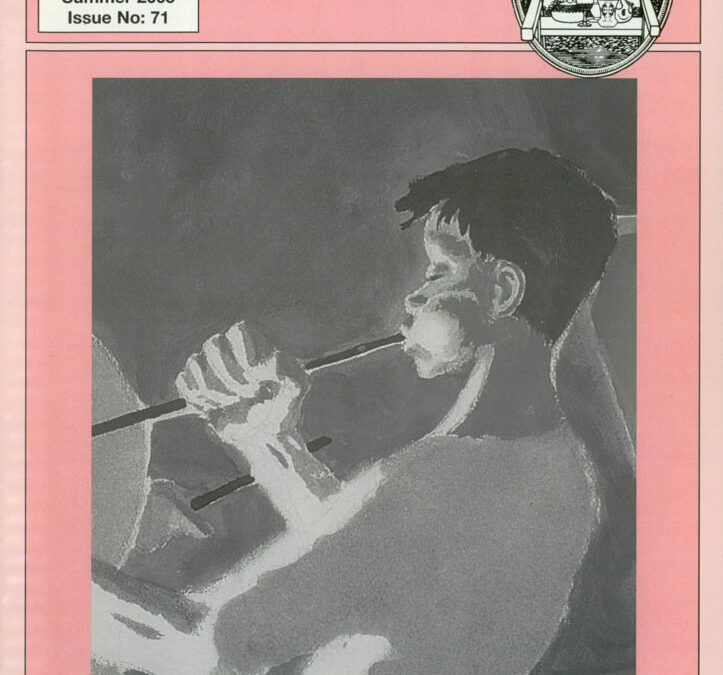
COVER ILLUSTRATION
Detail from
The Glassblowers
by Mervyn Peake (1911-1968)
signed ‘Peake’ (lower right); pencil, watercolour and
bodycolour; 19
1
/4 x 261/4 in. (49 x 66.7 cm). In 1943 Mervyn
Peake was commissioned by the Ministry of Information to
paint the glassblowers in the factory of Chance Brothers in
Birmingham. The glassblowers were producing cathode ray
tubes that were made for radar use during World War II. It is
noteworthy that, in common with many industrial images
commissioned at that time, Peake does not make it clear what
(apart from glass) is actually being produced, since the ministry
would have had to censor the image had he put any detail of the
final product. Images courtesy of Christie’s and thanks to Claire
Cohen for her assistance.
EDITOR’S ROUND UP
Brian Currie has handed over the reins to me, since the last issue
of the
Cone.
I feel Brian’s contribution to the Association should
not go unnoticed. He devised the layout system for the
Cone
and
took on far more than he originally intended when he joined the
Editorial Panel. Prior to working on the
Cone,
Brian held the
post of Treasurer to the Glass Association. He introduced a
number of helpful practices that have positively benefited the
organisation of the Association and its finances. His steadfast
help and advice will, I am sure, be sorely missed by many on
the committee. I would like to take this opportunity to thank
Brian for his help and guidance in handing over the work of the
editor and to say that we are all extremely grateful for all his
efforts on our behalf.
Now for a confession. When we sent out the
questionnaire we deliberately left out address details in order to
allow members anonymity, should they prefer it. Unfortunately,
this has meant that we are unable to take advantage of the
generous offers by a number of members to either write articles
or allow us to use photographs of pieces within people’s
collections. Would the members who made these offers, or
anyone who feels they wish to make a contribution, please be
very kind and contact me with their details, either via email or
by post (see the title block in the previous column).
You will all notice the absence of colour in this issue,
which is for a number of reasons. It was also felt that it would
be a good idea for me, as editor, to get at least one more issue
through the process before going over to colour and addressing
the technical problems of program compatibility with the
printers. We are also taking the opportunity to do some minor
alterations within the layout.
This issue has a cross section of articles, ranging from
ideas for visits by individual members, through to a lesson in
science and including a letter replying to my article,
Too Many
Fairs, or Not Enough Information?
in the last issue. In it there
are a number of interesting and thought-provoking ideas. I trust
that you will all find something of interest and should you have
any comment to make, do contact me and have your say in
your newsletter.
I’d like to thank members Michael Baldwin, Richard
Giles, Jeanette Hayhurst, John Sanders, Janet Sergison, David
Watts and Bob & Ruth Wilcock for their contributions. Mike
Moir and Susan Newell both drew attention to items of interest.
(Ed)
APPEAL FOR INFORMATION
•
Our member, Mark Hill, is finalising the content for a new book
on Michael Harris and his work at Mdina Glass on Malta and
the Isle of Wight Studio Glass factory. Mark asks that if anyone
had dealings with Mr Harris during his lifetime (until 1994),
worked at either factory, or if they have any related important
information, would they please contact the author on
07798 915474 or email him at stylophile@btopenworld.com.
2
The opinions expressed in the
Glass Cone
are those of the
contributors. The Editors’ aim is to cover a range of
interests and ideas, which are not necessarily their own.
However, the decision of the Editorial Board is final.
COPY DATE
Autumn/Winter
14 November 2005
The Glass Cone’ — Issue No. 71: Summer 2005
www.glassassociation.org.uk
The Glassblowers
by Mervyn Peake
COVER ILLUSTRATION IN FULL
THE ROLF HARRIS “CHAGALL” PAINTED GLASS
WINDOW
GOLDSMID HALL, TUDELEY, TONBRIDGE, KENT.
The Rolf Harris BBC Television series “Rolf on Art” covered
Chagall and All Saints Church, Tudeley, as part of that
programme.
Glass-makers Jill and Keith Hill, from Speldhurst in
Kent, made the glass for the window by Rolf Harris which is in
the Chagall style. The window depicts Day and Night and
includes All Saints Church, Kent Oasts and a donkey, which
represents happiness and usually appears in Chagall’s works.
Goldsmid Hall was the brainchild of Sir Julian
Goldsmid, from a Jewish banking family, who lived at
Somerhill House nearby. The Arts & Crafts style Hall was built
of bricks from the Castle Hill Brickworks for the estate workers’
recreation and education. Sir Julian died in 1896.
The producers wanted the window to be placed
somewhere in the village and as the restoration of Goldsmid
Hall itself coincided with Rolf’s programme it was decided to
install the window there.
A UNIQUE EXHIBITION OF CHAGALL WINDOWS
All Saints Church, Church Lane, Tudeley, near Tonbridge in
Kent, is one of only two churches in the world where Chagall
created all the stained glass windows.
Although All Saints can trace its existence to the
Doomsday Book — and maybe as far back as the seventh
century — the most remarkable feature of this church is
a
twentieth-century addition.
Following the tragic death of their daughter in a sailing
accident, Sir Henry and Lady d’ Avigdor-Goldsm id
commissioned the Russian-born artist Marc Chagall to design
the striking east window, the first commission Chagall had been
willing to undertake in England.
Following the success of its installation, a further
11 windows were designed by Chagall and installed at All
Saints between 1974 and 1985. By the time the last window was
completed Chagall was ninety. The simplicity of the church
provides the perfect backdrop for what comprises the country’s
largest collection of Chagall’s works. A brochure on the history
of All Saints may be purchased in the Church, together with sets
of photographs of the windows.
All Saints Church can be found at Tudeley on the B2017.
There is a signpost for All Saints Church which is at the end
of
a short lane. The car park can be found on the right-hand side.
For members travelling by car head for Tonbridge A2lor A26
then B2017. A useful web site is www.Streetmap.co.uk and
search for Tudeley, Kent, TN11.
Janet Sergison
3
Magazine of the Glass Association
The Glass Cone’ – Issue No. 71:
Summer 2005
NEODYMIUM GLASS
At the BADA antiques and fine art fair at Chelsea in March
2004, Mr Mark West had a beautiful pinkish perfume bottle
exhibited. On enquiry, he told me that it was of Alexandrite
glass, and he showed me how the colour changed depending on
whether it was in fluorescent or filament light. I was fascinated,
and have spent nearly a year looking for a piece at antiques fairs.
Eventually I found a small bowl, which I purchased for £5.
As a chemist, I learned about the chemistry of
Alexandrite glass from the Internet. The material that gives the
colour is a chemical element called Neodymium, which wasn’t
even isolated until 1885. That is not completely true, because it
had been obtained previously mixed with another substance
Praseodymium. They are so similar that nobody expected that
the mixture had two components.
The mixed substance was called Didymia. These two
substances are members of a group of metals called “Rare
Earths”. There are actually fifteen of them, and their separation
was, in its day, a triumph of chemistry. They are interesting in
the way that they absorb light. White light, of course, is a
mixture of all the colours of the rainbow, which can be separated
out using a prism of glass. The various colours are characterised
by the distance between crests of maximum intensity of the light
as it rushes along at 186,000 miles a second. This distance, the
wavelength, is between the size of a small bacterium and a large
virus, very small indeed.
Many metals, as salts, have the ability to absorb light, and
the range of wavelengths at which they absorb is usually rather
wide. When white light shines through a piece of glass containing
such a metal salt, the light that emerges is depleted in the range of
wavelengths absorbed by that metal, so that it looks to the eye as
having the complementary colour to that which it has lost. The
familiar coloured glasses are made by incorporating the
appropriate metal salts into the molten mixture.
Neodymium glass, however, absorbs light over a very
narrow range of wavelengths, mainly within the yellow light
range. When I looked through my bit of glass using a
spectroscope, which analyses light, I was amazed to see that the
yellow part of the rainbow, or spectrum, was almost completely
blacked out. That accounted for the delicate lilac colour of the
glass in daylight. However, using a low energy light bulb, which
is fluorescent, the colour was greeny grey. The colour at night
with an ordinary light bulb was redder than with daylight. I tried
to work out why.
Daylight, and filament light bulbs, give what is called a
“continuous spectrum” and contain all the colours of the
rainbow. That is because the light comes from a hot solid or
liquid; the surface of the sun for daylight or a piece of glowing
tungsten for a light bulb. The sunlight is richer in blue light than
is the light from a light bulb. Fluorescent lights work on an
entirely different principle, because the light source is a gas
stimulated by electricity. The light from a gas consists of
extremely narrow ranges of wavelengths. Through the
spectroscope, the spectrum shows a few thin coloured lines
separated by blackness.
The white light is obtained by mixing gases which give blue,
red and green lines. The eye is fooled into thinking that it is seeing
white light, just as television screens consist of blue, red and green
dots, which make all the colours of the rainbow when they are
4
combined. (You can see the dots clearly with a magnifying glass.)
The absorption range of Neodymium glass is so narrow
that it doesn’t interfere with any of the main light wavelengths
emitted by a fluorescent bulb. That is why it just has a rather
nondescript grey colour in that light.
However, with daylight or a filament bulb, the light that
comes through the glass is strongly depleted in yellow, and
appears of the complementary colour. Since daylight has a lot of
blue in it, the glass appears bluer by daylight than it does by
light bulb. The overall effect is quite enchanting.
Neodymium glass is used for many purposes, including
the windows of space vehicles and for special car headlight
bulbs, which give a light which enhances colour.
It is also used for decorative items, including the “Crystal
Belle” range, which can be found on e-Bay. For myself, I will
continue to search the antique fairs for it. The next time that you
see a chap gazing at a piece of coloured glass through a metal
tube, it could be me checking out an item with my spectroscope.
Michael Baldwin
LAURENCE WHISTLER AND T.S. ELIOT
In September at Bonham’s in a sale of
Presentation Copies and
Letters from T.S. Eliot to the Faber family
there were three
important lots of glass with literary connections, each of a glass
engraved by Laurence Whistler in the mid-1950s.
The first, a glass rummer supported on ‘lemon squeezer’
base, incorporated verses specially composed by Eliot to
commemorate Sir Geoffrey Faber’s knighthood, and was
presented to him by the Directors of Faber & Faber in 1954.
There was a second, similar glass, also with a specially
composed verses by Eliot to celebrate Enid’s thirty-fifth
wedding anniversary and was presented to her by her children
Thomas, Ann and Richard. Each glass was accompanied by its
own documentation, the former with a letter initialled by Eliot
and the latter with a file of letters between Eliot and Whistler.
Both had minor damage to their base, but they achieved £4,300
and £3,000 respectively, both below their estimate.
A third, more decorative glass was engraved with a
fireworks display above a crowd of spectators, flanked by two
statues, the foot engraved with verses by Laurence Whistler. It
was signed and dated, ‘LW 1955′. This glass, which had been
commissioned by Sir Geoffrey Faber and given to his wife,
Enid, for their thirty-fifth wedding anniversary, had a lower
estimate since there was no Eliot connection. It sold for £2,100,
comfortably above its £1,000—£1,500 estimate.
Right, 1954 rummer engraved with Eliot’s verses.
Left, 1955 rummer given to Enid by her children.
Centre, the 1955 fireworks glass. Image courtesy of Bonham’s
The Glass Cone’ — Issue No. 71: Summer 2005
www.glassassociation.org.uk
Listening to Jane helped
exhibition to life, and not just her
glass used by Julia Linstead. Julia
Northumberland countryside and
elegant bowls in
attractive
colours,
large bowls, platters
and vases with more
complex cased colour
overlays, carefully
graded blues, greens
and yellows, all to
be the foundation
for Julia’s expert
engraving — of fishes,
dolphins, sea horses,
sea otters . . .
to bring the pieces in the
own pieces: she blows all the
‘s engraving is inspired by the
coast. Jane blows her small
Some of the permanent collection,
with works by Danny Lane and
Colin Reid in the foreground
NORTH-EAST VISIT: SEA GLASS
Shipley Art Gallery, Gateshead: talk by Jane Charles
With the two hundredth anniversary of the Battle of Trafalgar in
mind, Helen Joseph, Keeper of the Contemporary Craft
Collection at Shipley Art Gallery, invited three Northumbrian
glass artists to create a collection of largely new works with the
sea as a common theme: “Sea Glass”.
The artists are Jane Charles, who since 1990 has had a
studio in Newcastle, Peter Furlonger, the expert calligrapher on
glass, who lives in Gateshead, and Julia Linstead, who
graduated from Sunderland Polytechnic in 1988 and in the early
nineties set up her present workshop and studio at the Hirsel
Homestead Centre just over the Scottish border at Coldstream.
After an informal lunch in a nearby hotel, the Glass
Association visit started with a look at the Contemporary Craft
Collection which has on permanent display some 120 or so
carefully selected works
from (mostly) North-
Eastern artists. Helen
Joseph is particularly
proud of the silver, but
there
are
textiles,
carvings, pottery, and of
course glass, with major
works by, amongst
others, Colin Reid,
Danny Lane, Keith
Cummings,
Charlie
Meaker, and, Helen’s
latest glass purchase on
behalf of the Gallery, a
masterful head by Bruno
Romanelli.
We then had a
most interesting hour or more, surrounded by Sea Glass, and
listening to Jane’s fascinating story. Like many a glass artist, her
early studies were in ceramics and in design — with others
making the pieces. She was not totally happy, and at a
particularly low ebb when she was blessed with one of those
chance events that change people’s lives. The stranger on the
train to whom she poured out her woes turned out to be the
Principal of North Staffordshire Polytechnic. Within days she
had transferred her studies there. She quickly discovered hot
glass, another sea change, and she never looked back. That is
not to say everything flowed smoothly thereafter, but she gained
enormous experience working for a number of well-known and
respected, and very diverse, glass artists and companies, and at
the same time developed her ideas and her skills until she was
ready to branch out on her own. She set up a cold workshop in
Edinburgh but was hiring a furnace in Newcastle (Scotswood)
to do her blowing. The travelling and logistics proved too much
and so she made the decision to move to Newcastle.
She became more and more successful and initially
reacted by employing more and more glass makers, but she has
no love of management and it was taking her from the glass, so
she cut back to just one hot-working assistant and one cold
worker. Hot workers tend to move on after a year or two (that
was what she did!), but her cold worker, Alan (“one of the best
in the business”) has been with her for over six years.
Jane with two of her pieces (right), one of Julia’s (left)
and one of Peter’s
Away from the furnace Jane’s other love is the sea. She
is a consummate diver, and finds the light, colours and shapes
both in and around the sea most stimulating: her journey in glass
keeps taking her back to the oceans for inspiration.
This is so well reflected in the pieces in the exhibition:
beautiful free-flowing forms and free-flowing colours, sea-
greens and blues but also coral and yellow and red; grottoes
with pebbles, stunning tall graal vessels.
5
Magazine of the Glass Association
`The Glass Cone’ – Issue No. 71: Summer 2005
6
Jane blows some of the pieces for Peter Furlonger.
Lettering features more strongly in his work, and his most
dramatic piece, “Salmon Falls, the Mackerel-crowded Sea”, is a
large platter with stunning golden fishes in the centre and his
beautiful script around the edge.
All three artists rose masterfully to the challenge set by
Helen Joseph, and Sea Glass was a really excellent exhibition.
Jane’s talk added an extra dimension, and we are grateful to her.
It was a most enjoyable visit.
Bob Wilcock
Shipley Art Gallery is just off the A167 leading from the
Al by the Angel of the North, into Gateshead, and is open
Monday to Saturday 10 — 5, and Sunday 2 — 5
(www.twmuseums.org.uk). A visit to see the permanent
collection is planned as part of the AGM weekend, but, sadly,
the Sea Glass exhibition will have finished by then.
YSART GLASS CONFERENCE
The conference ran over two days, 6 & 7 August 2005, and was
organised using the Internet, from inception through to
registration. An idea by New Zealand glass collector Bill Smith,
using the pages of the Ysart Glass message board on
www.glass.co.nz, to pressurise its moderator Frank Andrews to
plan a meeting, culminated in a highly successful weekend for
both learning and socialising.
Speakers included two glass blowers, Dave Moir and
Peter Holmes, who had trained and worked with members of the
Ysart family — Vincent and Paul respectively; Catherine Rae,
Vincent’s daughter; Ian Turner, historian and writer about
Monart (and past President of the GA); Brian Blench, retired
Keeper of Decorative Arts at Glasgow Museums and Art
Galleries, Scotland, and founding chairman of the Scottish
Glass Association; Kevin Holt, a collector and researcher of
paperweights; and Ray Metcalfe, dealer in paperweights.
The proceedings began with Ian Turner who discussed
areas of the history of the Monart firm not generally known,
along with techniques used by the Ysarts to achieve the wares
that they produced. Particularly interesting was the insight Ian
From left to right, Peter Holmes, Dave Moir, Fiona Rae,
Frank Andrews, Catherine Rae and John Deacons
gave us into how he obtained much of his research material
through Betty Reid, who had answered an advert that Ian had
put in a Scottish paper asking for either information on the
company, or for pieces that people might wish to part with.
Betty was the Despatch Clerk at Moncrieff’s, the firm that
produced Monart. When the company closed she saw the
documents in a skip, and to her eternal credit, rescued as much
as she possibly could. One should bear in mind that this was
done at a time when the hobby of ‘skip-diving’ was not common
and would have probably been frowned upon. Without this rich
resource many questions about Monart production would
remain forever unanswered.
During his talk Ian discussed the use of coloured
enamels and their source within the various firms that the Ysart
family worked with. An important feature of Monart, Vasart and
Strathearn, as well as subsequently Ysart influenced glass, is
what was referred to as the `Ysart Swirl’. This is a swirl of
colour produced within the glass by using a metal tool with a
whirling action to produce the swirl whilst the metal is still on
the blowing iron. This technique was imparted to some
apprentices and glass blowers and can be traced from the
original wares through Caithness Glass and is currently used by
Peter Holmes in his art glass production, and in Franco Toffolo’s
work. Dave Moir, who has only recently returned to glass
making after being away since he left Strathearn Glass when
they ceased production of coloured art glass, is now making
vessels using this same decorative technique. During the break
immediately after the talk Ian Turner formally donated all his
original documents to Perth Museum and Art Gallery. These
consisted mainly of various Monart catalogues, including the
lighting catalogue that was featured within Ian’s article on the
subject in
The Journal, Vol.
7. His correspondence with Betty
Reid also formed part of the donation. Councillor Elizabeth
Grant of Perth and Kinross District Council accepted the
donation on behalf of Perth Museum and Art Gallery in a
ceremony that was separate from the conference.
Kevin Holt was introduced as a glass archaeologist,
rather than historian. He discussed his observations and theories
regarding the use of canes and their dating in Ysart
paperweights and their successors made at Perthshire
The Glass Cone’
–
Issue No. 71: Summer 2005
www.glassassociation.org.uk
upon them. This was likened to the movement of glass workers
in the twentieth century. Brian chose to use Jenkins of
Edinburgh as the start for modern Scottish glass history,
touching on the production of James Couper & Sons and the
designs of both Dr Christopher Dresser and George Walton.
The First World War affected the Scottish glass industry
badly, such that new workers were required. This is where the
Ysarts’ history begins within Scottish glass. However, since the
audience were aware of the Ysart history, Brian then discussed
the hugely influential effect of Helen Monroe, her rise within
the glass industry at Edinburgh & Leith and her work both as an
engraver and as teacher within Edinburgh College of Art. Her
strength of purpose and her ideas about design being linked to
glass making were to be particularly significant to post-war
glass making. It was she who reintroduced the art of engraving
on glass in the UK, but she did not force it onto her pupils,
preferring to allow them to show their own interest within the
canon of glass making and design. Her influence can still be felt
today through the work of Alison Geissler and Alison Kinnaird.
Here Brian returned to the Ysarts talking about Isobel
Moncrieff’s
A Friendly Talk on Monart Ware
of 1925 and its use
as a marketing tool. Having spoken generally about adaptability
of the Ysarts as glassblowers, the talk moved on to Strathearn
Glass and Perthshire Paperweights, their physical proximity in
Crieff, and their rivalry. Then followed the rise of Caithness
Glass, initially under the auspices of Domhnall OBroin as
Managing Director and Chief Designer, then through Colin
Terris, another of Helen Monroe’s graduates. Although Paul
Ysart was taken on as Training Officer and Technical Adviser,
the paperweights produced by the company took a distinct turn
toward the abstract style as opposed to the traditional milleflori.
Mention was made of John Laurie, the stained glass designer
who took over at the College of Art, and his successor Ray
Flavell, bringing us through to production and influences
nowadays.
We were then treated to a short film about Colin Terris
and Caithness Glass, which gave a rare opportunity to see Paul
Ysart at work during a piece of the film that had been provided
by Ian Turner as an extra event within the agenda. Paul would
have been sixty-four at the time, but he still made blowing
look easy.
Peter Holmes talked of his time as an apprentice to Paul
Ysart and what it was like to work with a man who had high
demands. We were treated to a number of personal anecdotes
about Paul, as well as being given an insight into the man
himself. When Peter set up Selkirk Glass they were having
trouble with the mix and Paul’s advice was sought on the phone.
The problems did not abate, so Paul travelled down and spent
several days sorting out the problem. The first melt, although
poor, was used up by making `Monart’. Peter continued by
talking about Paul and his time at Caithness, followed by the
period making paperweights at Harland and the closing of that
period of Ysart history. Peter’s son, Andrew, is now his
apprentice at Scottish Borders Art Glass, so continuing the
history of Scottish glass and the Ysart influence.
Our last lecture was from the dealer’s perspective and
was given by Ray Metcalfe, who explored the investment
history and potential of Ysart paperweights. Ray proclaimed
that he felt Paul’s weights, marked with the `PY’ cane as the best
Ian Turner donating his Monart archive to
Councillor Elizabeth Grant
Paperweights, by Willy Manson, John Deacons and
Peter Holmes.
Kevin talked about the use of an ‘S’ cane, the butterfly
cane and their origins and importance. The use of canes in
Monart glassware and their relationship to paperweight use and
dating was of particular interest. Frank Eisner weights and their
dating were also discussed. Much of what Kevin spoke about
had not been resolved, but he took the opportunity to lay out his
thoughts to an audience who might well give input to Kevin’s
`archaeology’ of the subject.
This was a major chance to listen to and meet blowers
who had known and worked with the Ysarts and to discuss the
influence on their own work. It was the first time Dave Moir had
spoken in public of his time as a glass-blower. He regaled us
with his reminiscences of working with Vincent Ysart. Dave
discussed techniques and difficulties in producing items of
Vasart and Strathearn Glass. He stated quite categorically that
the Tulip lamp, that was made by both firms, was technically the
most difficult thing that they produced. Indeed Perthshire
Paperweights, who later copied the idea, never did manage to
produce these lamps with the kink in the glass at its base to
allow for the wire to access the bulb holder. Apparently friggers
were made on a daily basis. They are difficult to identify now
and do not have any form of identification that would help the
collector. The room found Dave’s memories and the information
spellbinding.
The afternoon finished with a personal view of the Ysart
family given by Catherine Rae. She entertained us all with
family photographs, many of which had not been seen in public
before. The photographs stimulated comment and allowed
Catherine to interject with many anecdotes. Both Catherine and
Ian Turner had substantially adapted their standard talks to cater
for an audience that had more than a passing knowledge on the
subject, which was highly successful and greatly appreciated by
the meeting.
On the Sunday morning proceedings were initiated by
Brian Blench, having discussed the ethics of being a museum
keeper whilst collecting personally, set Ysart glass into its
context within the history of Scottish glass production. The
lecture started with the outlining of movement of glass workers
as far back as the sixteenth century and the legal limitations put
7
Magazine
of the Glass Association
‘The Glass Cone’ — Issue No. 71: Summer 2005
and most collectable. He showed a number of similar examples
of weights giving the difference in pricing over various periods
of time.
Thanks were given to the various contributors and those
who helped to make the conference run so smoothly. Sadly the
major organiser, Marie Aitken, who put in so much of the
groundwork in Perth, passed away earlier this year. Naturally
she was thanked, along with Alice MacLennan, Carol Booth and
Mary Houstan.
In
turn Mary proposed a vote of thanks to Frank
Andrews as overall organiser. The general feeling by delegates
was that much had been learnt and many pieces of history had
been added to the story of the Ysarts, putting a number of things
into context.
Nigel Benson
REFLECTIONS OF VENICE
Malcolm and I recently returned from a fascinating trip to
Venice, after a twenty year gap.
With intrepidation, we booked our first ever home made
package tour via the Internet. We would highly recommend
www.flybmi.com; all the options in a language we understand!
A bus from our village took us straight into Heathrow for our
flight to Marco Polo, where we picked up our Venice Cards
(highly recommended and purchased in advance from
venicecard.com) and finally an exciting waterbus ride
to Murano.
•
We decided to stay on the island but would not
recommend it. Although it was delightfully peaceful in the
evening, there was only one excellent restaurant that was good
value for money, but all the bars were closed by 6 pm, including
the one attached to the hotel! Thank goodness for the Co-op.
Our first morning: a stroll in 32 degrees took us to the
Glass Museum which looked just the same, but every visit you
notice something that did not register before. I don’t know how
I had managed to ignore the wonderful table centrepiece;
perhaps it now registered as we have recently purchased a
similar little urn.
It was not long before we had to have refreshments and
lunch alongside the canal. It is now almost impossible to find an
outside table, as all old buildings are non-smoking (except for
glass factories!).
Detail of an eighteenth century Venetian table centrepiece
Then a walk up and down the Fondamenta Vetrai canal
looking into the glass shops seemed appropriate but, surprisingly,
it was like going back into a time warp. Every shop was either full
of the usual tourist trinkets or the same ‘Art Glass’ that they were
making when we visited the
Vetri de Murano Oggi
exhibition at
the Palazzo Grassi in 1981. The Gallery Schiavon was the one
exception, with a small shop dedicated to showing their latest
designs, using a combination of cane work and cutting. We would
have brought home an example but at 18 inches high and around
£2,000, we resisted the temptation.
The next day we took the scenic route down the Grand
Canal to St Mark’s Square hoping to find that the new
innovative glass was in the grand shops but yet again we were
disappointed, nothing was new, even Venini were still
presenting
incisi
and
battuti
from the fifties as well as Tapio
Wirkkala’s
‘bolle’
and
‘quarto stagion’
by Lauro Dias de
Santillana from the 1980s. It was obvious that the glass makers
had not lost their skill, all the glass was wonderfully made, but
designers have got caught in a time warp. It is such a shame that
in the rest of Europe one can find new designs but not at the
`home of glass’.
Never mind — we may have been disappointed with the
glass, Venice still has all the magic that it has always had, and
we hopped on and off vaporettos around the islands. Burano is
still the prettiest, ice cream on the Lido was still superb and in
the words of Napoleon, St Mark’s Square is still the `world’s
greatest drawing room’.
Jeanette Hayhurst
INTRODUCING
STUDIO GLASS
EXHIBITION
Resident glassmakers Hannah Cridford and Jonathan Rogers are
marking the end of their first scholarship year at Broadfield
House Glass Museum, with a special exhibition of their work
called
Introducing . . .
Hannah and Jonathan run Mulika Glass from the hot glass
studio at the Glass Museum in Kingswinford, West Midlands.
The scholarship is awarded on an annual basis, but because of the
success of Mulika Glass, they have been awarded a second year
of residency, continuing their first year that began in January
2005. Whilst at the museum, Hannah and Jonathan have
participated in several high-profile trade shows, such as Pulse and
Top Drawer, but
Introducing . . .
is their first major exhibition.
Mulika Glass was founded by Hannah and Jonathan
shortly after they graduated from The Edinburgh College of Art.
Initially they received funding, in the form of studio time, from
the National Glass Centre in Sunderland which greatly assisted
with their fledgling business. It is Jonathan’s contention that
“Mulika Glass produces a sophisticated collection of glassware
with an emphasis on innovative design and pure aesthetics.
Although much of our time this year has been spent establishing
Mulika Glass, we still try to find time to explore our own
personal projects. Our time at the Broadfield Studio has been
invaluable, and has enabled us to blossom as glassmakers in a
supportive and nurturing environment.”
For details see page 16 — Ed
The Glass Cone’ – Issue No. 71: Summer 2005
www.glassassociation.org.uk
volunteered to meet us at the airport. He speaks no English, but
good German, and brought along his delightful daughter Agata
who speaks excellent English. They took us to the hotel (the
Ibis), on the edge of the Old Town, and then took us for a gentle
stroll around the historic centre of Bratislava, showing us not
only the beautiful buildings and squares, but also of course, the
galleries and shops with glass.
Ruth, Agata and Milog in Bratislava’s main square
It was a Monday, the day most museums and galleries
are shut, but the most important was open, and we would never
have found it by ourselves. Next to the Tourist Office, at the
entrance to the Hummel Museum is a quality music shop,
“Divyd”, and at one end, not very obvious from the outside, is
a
glass gallery. The spring 2005 exhibition was devoted to Slovak
artists and comprised some 20 pieces by Yan Zoritchak, Palo
Macho, Oliver Leggo, Patrick Illo, Frantigek Csandal, Slavomir
Bachorik, and, of course, Milos. Apart perhaps from the
Zoritchak, prices were extremely reasonable: buy one piece, and
you could easily pay for your trip, and now that Slovakia is in
the EU there are no tax or duty problems. Divyd has its own
wcb
site at www.divyd.sk and it is worth a look.
We had coffee opposite the university building where
Milos had honed his craft, and were joined by Pavol Hlogka.
Whereas Milo§ works purely with glass, much of Pavol’s work
involves applying thin layers of metal to glass, using vacuum
technology, and then gluing pieces together to produce stunning
optical art glass or architectural objects. Many of us have seen
“Object
2002” with
applied gold
9
“Point/circle” taking on life
LET THE GLASS SPEAK MILCA BALGAVY
villa
Balgavy is a master from the small but highly skilled
school of Slovakian artists working in optical glass. The school
was founded by Vaclav Cigler, and Milog attended his classes
for a short period. The best-known member today is perhaps
Yan Zoritchak, now living in France. From the beginning,
however, Milog has worked in a very different way, and with a
unique philosophy.
Milos Balgavy’s “Point/circle”
We first saw Milog’s work in Paris, at Elodie Bernard’s
gallery Eclat du Verre. We were both drawn to one piece in
particular, “Point/circle”, a perfect near-hemisphere in yellow
optical glass, shading to brown. It is a single piece of glass, with
a totally flat polished surface, yet from almost every angle the
eye sees the surface as curved, and the glass as many concentric
layers. Touch the rim, move your finger and the glass comes to
life and, though stationary, moves before your eyes, the optical
equivalent of St Paul’s Whispering Gallery perhaps.
We returned to Paris a few weeks later especially to
collect the piece, and it took pride of place in our collection,
until we acquired a new display cabinet and disaster struck: the
door was stiff, and as it was jerked free, shot across the front of
the cabinet and caught the rim of the piece. We were mortified!
Every Cloud has a Silver Lining
To our mind, there was only one man who could repair the
piece, Milo§ himself. Eclat du Verre had closed, but thanks to
Dan Klein and to Leo Duval of Plateaux Gallery we found
Milog’s address. He could repair it, and it became clear that the
best course was to courier the piece to him and then collect it
personally a few weeks later. Fortunately, the insurance
company agreed — a return flight by Easyjet to Bratislava cost
no more than the courier! Milog arranged a hotel for us and
Magazine of the Glass Association
The Glass Cone’ – Issue No. 71: Summer 2005
`Point/square’
Pieces by Helmut Hundstorfer in the
Ezzo Gallery
I
0
his work without realising it: he designed the safety glass on
London’s Millennium Bridge.
Vienna
By good fortune, the next morning Milog had an appointment in
Vienna with the proprietor of Gallery Ezzo in the heart of the
Austrian capital, and he invited us to go with him, along with his
charming wife Beata who also speaks very good English. While
milog conducted his business we explored the exhibition of Slovak
glass, including works by Milog (of course), and Stepan Pala and
Zora Palova, currently
Visiting Professors at
Sunderland, and the
very different works by
the Austrian glass artist
Helmut Hundstorfer.
The gallery’s web site
can be found at
www.galleryezzo.com.
Milog
and
Beata then took us on
a guided tour of the
centre of Vienna. We
could not resist a brief
detour into the
Rosenthal
shop,
modernity in a
historic building with
a beautiful painted
and gilded façade.
Trnava
The high point of our visit now awaited us, Milog’s own studio
gallery downstairs from his apartment in Trnava half an hour’s
drive from Bratislava. The gallery was designed by Milog and
his architect Zuzana Nadaska and is modern, attractive and well
lit. At the entrance is a dramatic blue pottery orb, made by
Mila’s late father, his inspiration, and the source of his patience
and his perfectionism.
Milos has pieces by other glass
artists on display,
but it
was his work we had come to see, and we were not
disappointed! We had had a taster in the galleries in Bratislava
and Vienna, and now we could feast!
Our favourite pieces, his lotus flowers, are, sadly for us,
too large for our small house, but the purity of the glass, the
perfection in the shaping and polishing and the elegant and
deceptive simplicity in the design we find just breathtaking.
Most artists aim to express themselves through glass. MiloK has
a very different philosophy, to let the glass speak through his
craftsmanship.
Thus he personally selects his own glass (mostly from
Corning), is meticulous in the melting and casting, and an
absolute perfectionist in his shaping and polishing. He adds
nothing to the glass, there is only its purity, shape, colour and
texture to draw the viewer into its soul. And the optics, the
refractions and reflections, enhanced by the cutting and
sometimes augmented by a mirror. He most frequently uses just
a single piece of glass, or, as with his lotus flowers, two pieces
precisely juxtaposed not joined, though he does produce pieces
joining two, three or four colours in very precise shapes to
maximally reveal the optics. He is currently working on what
blandly might be described as crystal balls, but made of two
absolutely perfect hemispheres invisibly joined using NASA
technology, and with subtly different optical properties which
are revealed as you slowly turn the orb. As well as the smaller
ones visible in the gallery photo above, he showed us one he is
working on, some 80 centimetres in diameter, and 40 kilos in
weight!
Choosing a piece for our collection is always difficult
when there is such a tempting choice arrayed before us, but we
knew it must be Milog’s latest shape. In the galleries we had
seen wedge-shaped pieces in interesting colours
and with
“Lotus
Flower” on a
mirror base
The
Glass Cone’ — Issue No 71: Summer 2005
www.glassassociation.org.uk
Lotus flower reflected on a mirrored surface
fascinating optics, but now Milog has taken a cube of yellow
optical glass and rounded two sides with geometric precision to
make an optically perfect ‘slice’. “Point/square” with its
intriguing and absorbing optical properties, makes a natural
companion to our now impeccably repaired “Point/circle”.
`Point’ refers to the ability of light to focus and orient itself
thanks to the myriad of surfaces and angles, and the orientation
of the piece as seen by the observer, and ever changing as the
observer moves.
We retired to the apartment to deal with the business part.
and, over a cup of tea sweetened with honey and Beata’s melt-
in-the-mouth cheese strudel, to admire their private collection.
This includes more impressive pieces of pottery from his father
(large pieces from a small man Beata told us), and of course
works by the master himself, Vaclav Cigler.
The visit would not have been complete without a visit
to the workshop This is a mile or so out of town, in part in order
to give Milog the peace he needs for the intense concentration
required to reach his standard of perfection — an unexpected
visitor causing him to jump can ruin months of work (and has).
We saw some of the failures, and also the carefully selected
blocks of optical glass, the works in progress, and the moulds,
the forty or so different polishing surfaces, the powders and
lubricants, the specialist equipment, all of which helped to give
us a full picture of a master craftsman and artist, and a deeper
understanding of his philosophy and his work.
A leisurely stroll through the historic centre of this old
walled town took us to its best restaurant where we had a
delightful meal in the courtyard, before Milog drove us back to
Bratislava at the end of a truly memorable day.
Bratislava
Our visit was not yet over: we had a day and a half to explore
Bratislava, its cathedral, churches and museums, and the shops
and galleries MiloS’ had pointed out.
For modern cameo and other crystal tableware there is
Rona in Laurinska Street, selling mostly Slovak glass from
Lednicke Rovne, and Sklo Porcelan in the main square. A third
shop, Katka, in Panska, a little way along from the British
Embassy, also sells tempting crystal jewellery, paperweights,
and just a little art glass (though not optical).
On the other side of the street the City Art Gallery in the
Palffy Palace is worth a visit, though the only glass pieces of
note are the chandeliers. Bac’k in the main square, the museum
in theOld Town Hall is even more worth a visit. In the courtyard
are carved figures recreating Napoleon’s visit to the town during
his Russian’ campaign. Inside are some very fine rooms and
small displays of glass from the thirteenth century onwards. You
can climb down to rather gruesome dungeons, and up the tower
for some fine views over the Bratislava rooftops.
We were unlucky that only one of the galleries that Milo
had pointed out to us had any glass, the Komart Gallery — in
another a glass exhibition had closed the day before we arrived!
The Milan Dobes Museum of Modern Art proved well worth
a
visit. There are two floors of paintings from the 1950s onwards.
with an optical and geometric bias reflecting the taste of Milan
Dobes himself, and even more effective in the floor devoted to
his own works which use mirror glass and motion to create
fascinating optical effects and illusions.
Further Information
All too soon it was time to catch the plane home — and to baffle
the customs official with two intense lead crystal images on the
X-ray machine! We have some wonderful memories and
photographs — and a very special new piece for our colledtion
— and we cannot thank Milos, Beata and Agata enough for their
kindness, generosity, hospitality, and convivial good nature –
we laughed a lot!
Milos
had repaired our piece and sold us a companion.
He added white gloves and special chalky protective paper.
together with a book on his work in Slovak and English, edited
by Beata, and published in 2004.
He also added a copy of
Thinking in Glass: Vciclal
Cigler and his School
published just this year, in English
and
Dutch, and written and compiled by Beata Balgava and Titus M.
Eliens. If you are interested on optical glass, and Slovakian
glass in particular, the book is obtainable from the publishers.
Waanders Uitgevers, Postbus 1129, 8001 BC, Zwolle, The
Netherlands, price €29,95. It can be ordered on-line from
www.kunstboeken.nl (ISBN 90 400 9052 1)
From our visit we gained a deep insight into the artist,
his philosophy and his work. We gained a greater understanding
of our pieces; when they speak to us they do so in Milos’s gentle
voice.
Bob and
Ruth Wilcock
(Photos by the authors except for Pavol Hloska’
“Object 2002” which is taken from “Thinking in Glass”)
CONGRATULATIONS DAVID
Dr David Watts, who is Hon. Vice-President of the Glass
Circle and a member of the Glass Association, has been
elected as an Hon. Fellow of The Corning Museum of Glass.
This important tribute recognises David’s great contribution
towards glass. Part of his duty as a fellow is to promote the
Rakow Library of Corning Museum. We take this
opportunity in congratulating him.
Magazine
of the Glass Association
The Glass Cone’ – Issue No. 71: Summer 2005
OBITUARIES
1
2
HUGH TAIT, 1927-2005 — An Appreciation
Hugh Tait was one of those unusual people whose interest in
many things translated into a detailed knowledge within a
number of subjects. His knowledge encompassed much within
the decorative arts, including ceramics, glass, clocks and
watches, jewellery, silver and silver plate, and he wrote, or
contributed to, important works on all these subjects.
First employed, in 1953, as a volunteer graduate assistant
at his old college, Fitzwilliam, Cambridge, Hugh’s first area of
interest became its important collection of porcelain. Yet the
first seeds of an interest in glass were also sown here, through
the early English glass collections that had been bequeathed by
two Cambridge dons. It was here that Hugh was first published
under the title
Hearse Cloth of Henry VII Belonging to the
University of Cambridge,
proving his diverse interests at such
an early point in his career.
The following year Hugh moved to London, joining The
British Museum as Assistant Keeper, whilst taking a diploma in
History of Art at the Courtauld Institute. By 1986 he had
become the Deputy Keeper of Medieval and Later Antiquities, a
post that he held until he retired in 1993.
Although Hugh was introduced to glass early in his career
his strong interest was not to come to the fore until he discovered
the Felix Slade (1790-1868) collection of “fragile Venetian
beauties” that had been bequeathed to the British Museum. This
area of glass was to dominate his life and culminated in his book
The Golden Age of Venetian Glass
in 1979, which accompanied
The British Museum exhibition of the same name. Along with
others, Hugh sought to specify the separate contributions of the
Islamic and Byzantine worlds. His conclusions are set out in
Five
Thousand Years of Glass
with minor corrections in his recent
chapter in
Musee du Verre
(1999).
Hugh Tait’s broad knowledge and wide interest soon
brought him into contact with the problem of fakes and
forgeries, both in The British Museum and elsewhere.
Objects contrived from more than one source or material
were a particular problem for which Hugh adopted the word
pastiche.
However, it was a measure of his English upbringing
that he generally preferred cautious circumlocution, such as
“should no longer be considered as authentic”, to the brutality
of single word condemnation. Hugh made a significant
discovery when, as he told me, a quiet ten minute browse
through the putative sixteenth-century catalogue of the Colinet
glassworks in Beauwetz convinced him of its fraudulent form.
Subsequent investigation at The British Museum and at
The Corning Glass Museum of Glass (the catalogue’s owner)
proved him correct. Understanding the importance of detail
may, however, also rescue condemned pieces from
the wilderness.
Following his discreditation of the
Catalogue Colinet,
I
was fortunate to enlist Hugh’s support for a study of the 1762
catalogue of the Belgium glassmaker Sebastian Zoude, using
documentary material and microfiches provided by the Rakow
Research Library of The Corning Museum of Glass.
In America, his achievements were recognised with his
election as an Honorary Fellow of The Corning Museum of Glass
in 1993. Similarly his organizational abilities were generally
flawless, as demonstrated in his preparation of exhibitions at The
British Museum, in his planning of a meeting of the Association
Internationale pour l’Histoire du Verre, which he served both as
Secretary and as President. He became Honorary President of the
Glass Circle. His editorial skills were beyond reproach. In his
editing of
Five Thousand Years of Glass
(1991), a book that
became an instant public success, he broke new ground by
including precisely detailed section “Glassmaking Techniques”
by William Gudenrath. It provided clear, practical answers to
numerous questions on such subjects as Roman millefiori
(mosaic) and pillar-molded bowls. This visual hands-on approach
has been adopted in several later books.
Although more will surely be written about Hugh’s other
interests and achievements within the applied arts, here it seems
correct to have concentrated on Hugh’s input toward glass, yet
it should be acknowledged how greatly he enriched both our
understanding of the applied arts and our critical attitude
towards it. He will be sorely missed on both sides of
the Atlantic.
Our thanks to David Watts for permission to use this
abridged version of his Appreciation of Hugh Tait that appeared
in
Glass Circle News
No. 103 (Ed).
H JACK HADEN, 1916-2005
Harry Jack Haden was born on 28 June 1916 at “Ivydene”, John
Street, Wordsley, Stourbridge. “Ivydene”, situated almost in the
shadow of The Red House Cone, had been the home of
Frederick Carder until he emigrated in 1903 with his family to
found the Steuben Glassworks in Corning, New York. Jack’s
own family was involved with glass production at Haden’s
Premier Glassworks, Brettell Lane, Amblecote, and as glass
factors with Haden Mullett & Haden, of Coalbournbrook. With
that kind of background it was almost inevitable that he grew up
having a lifelong interest in Stourbridge and its glass history.
He was educated until the age of 17 at King Edward VI
School, Stourbridge. In 1933 he joined
The County Express,
the
local weekly newspaper covering North Worcestershire and
South Staffordshire, as a junior reporter. He spent the whole of
his professional life as a journalist with
The County Express,
ultimately as Chief Reporter, having declined the appointment
as Editor because he did not wish to become desk-bound. He
never drove a car. He was a familiar figure travelling from one
reporting engagement to another around the district on his sit-
up-and-beg bicycle, dressed in his distinctive navy blue beret,
belted mackintosh and trousers wrapped tight round his legs
with bicycle clips.
His journalistic career was interrupted for 6 years during
the Second World War when he served with the Royal Army
Medical Corps in a Field Ambulance Unit. He landed in
Normandy shortly after D-Day, and his Unit made its way across
Northern Europe finally reaching the Kiel Canal. Jack’s Medical
Unit was involved in numerous skirmishes, and many of his
colleagues were killed. The Unit eventually had to be disbanded
because it had suffered so many casualties, and he is on record as
describing himself as “one of the lucky ones at having survived”.
The Glass Cone’ – Issue No. 71: Summer 2005
www.glassassociation.org.uk
In 1946 Jack returned to
The County Express
where, in
tandem with his reporting duties, he built up an extensive
knowledge of the glass trade, becoming an expert in its history,
practices and products He played a vital part in founding the
Stourbridge Historical Society and in establishing the
Stourbridge Glass Collection which became a major basis of the
Broadfield House collection. He was a member of the Dudley
MBC Advisory Committee when Broadfield House Glass
Museum was established. He was a member of The Glass Circle
and of The Glass Association, and a founder member of the
Friends of Broadfield House Glass Museum.
He was a historian, a researcher and an author. His
publications,
“The Stourbridge Glass Industry in the 19C’
and
“Notes on the Stourbridge Glass Trade”
and
“Artists in Cameo
Glass incorporating Thomas Woodall’s Memoirs”
might be
familiar to readers. His knowledge of Stourbridge, its local
history and its glass industry was encyclopaedic.
Always regarded as the archetypal confirmed bachelor,
he puzzled the staff of
The County Express
one day in 1966
when he failed to show up for work. The following day he
arrived at the office announcing that he had taken the day off to
get married. Sadly, his wife Joan, a retired school teacher, died
in 1999. In his personal life Jack was a lifelong Methodist, and
one of his few relaxations was as a member of Stourbridge
Cricket Club.
Jack Haden died on 6 June 2005. He was a character and
will be sadly missed.
John V Sanders
REGIONAL NEWS
SOUTH EAST REGION
Six hard-working members spent a most enjoyable, worthwhile
and interesting day at Reading Museum Service’s store on
Wednesday, 21 September.
Thanks to Martine Newby’s ability to write rapidly and
Jeanette Hayhurst’s expertise with camera/tripod/laptop we
were able to identify and provide the curator with photographic
and written descriptions of some 44 items, mainly Venetian –
about half of their total Venetian collection — which were
brought to us in the Research room, together with some
Bohemian pieces and a few eighteenth century drinking glasses.
Verbal identification of the Roman pieces was provided
(Martine got very excited about a minute fragment of a cage
cup) and also a number of sealed wine bottles, which were in the
store room itself. Yvonne Cocking, Ken Cannell, Tony Pott and
I contributed to the BD and improved our measuring skills. We
were also shown an enormous and elaborately decorated
“Rhubarb Jar” — a giant-sized apothecary’s jar.
An article on our discoveries will be published in a
future
Cone.
Janet Sergison
DATE FOR YOUR 2006 DIARY:
GA member Simon Cottle
will be speaking on “Taking the lead — British Glass 1600 to
1900” at Tonbridge Decorative & Fine Arts Society members’
meeting to be held on Thursday, 23 March 2006 in the Medway
Hall, Angel Centre, Tonbridge, Kent, starting promptly at 2.30
pm and finishing around 4.15 pm.
Our TDFAS Chairman is very happy for GA members to
attend this meeting. The visitor’s fee, payable on arrival, is £4.
The venue is only a couple of minutes’ walk from
Tonbridge Station (approximately 40 minutes from Charing
Cross/Waterloo/London Bridge) or there are large pay and
display public car parks adjoining the Centre.
Please allow time to park and sign-in. Nearer the date, I
would be grateful if anyone interested could let me know if they
plan to attend.
Janet Sergison
Contact Janet, our South East Area Representative, by
phone on 01732 851663, or email janetsergison@onetel.com
AGM AND NATIONAL EVENT, SUNDERLAND,
29/30 October 2005
Sunderland, what an ideal place for holding The Glass
Association 2005 AGM! Sunderland is in fact home to the
National Glass Centre, a cultural centre dedicated to the
exploration, creation and promotion of glass. The city is also
close to another vibrant cultural centre, Newcastle/Gateshead
with its fabulous riverside and attractions. So put the date in
your diary and take a look at the provisional programme. The
AGM itself will be held at the NGC together with talks and
demonstrations while Sunday will be dedicated to visiting
Newcastle/Gateshead.
Full details of the programme will be in
Cone
No. 72.
Please contact Gaby Marcon 020 8371 8357
gabymarcon@btinternet.com
NEW MEMBERS
A very warm welcome to the following new members who have
joined the Glass Association over the course of this year.
Miss L Charlton
Hants
Ms C Cropper
W. Sussex
Ms D J George
London
Mr T Graham
Co. Armagh
Mr T Hemming
Warks
Mrs D Hill
Kent
Mrs M Houston-Lambert
Ottawa, Canada
Mr D Howlett
Scunthorpe
Mrs B Johnson
Scunthorpe
Dr S Levene
London
Mr R Martiello
Bedford
Mr G Mason
Lancs
Ms M Maynard
London
Mr L Megahey
London
Mr B Nairn & Miss N Burns
Caithness
Ms A Nichols
Lancs
Mrs C Parsons
Cumbria
Mr R Pavey
Hants
Mr N Pundole
Kent
Mrs P J Purslow
Shropshire
Mrs J A Reffin
Nottingham
Mr B Rourke
Surrey
Mr N Salmon
Suffolk
Mr A Stone & Mr R Brunton
Pennsylvania, USA
Mrs T Tansey
Shropshire
Mrs M Toyne
Scunthorpe
Mrs C Wetherell
Wirral
Mr C Yates & Ms B Charlton
Bucks
13
Magazine of
the Glass Association
‘The Glass Cone’ – Issue No. 71: Summer 2005
PAPERWEIGHT NEWS
To my knowledge nothing really significant has happened in the
world of paperweights since the last
Cone
but I hope that
readers will find something of interest here. Reports would
seem to indicate that falling sales in the High Street shops are
being reflected in the paperweight market and on recent Internet
auctions I understand there have been cases of good quality
modern paperweights receiving no bids at all. I wonder if this is
just a temporary situation or whether this is a trend for
the future?
I had just written that I heard nothing further on the
acquisition of Selkirk Glass by Caithness Glass when my
Caithness Paperweight Collectors Society magazine dropped
through the letterbox and there was an article about the future of
both companies. The best way to summarise the situation is to
quote the article:
`Caithness Glass and Selkirk Glass paperweights each
have their own unique style, both emerging from the long
tradition of glassmaking in Scotland. The acquisition will not
lead to any changes at either Selkirk Glass or Caithness Glass
and we will continue to independently produce the high quality
paperweights for which both companies are world famous’
On a recent visit to Alan Sedgewick we saw an ever
increasing range of weights and inkwells from the hands of both
John Deacons and Willie Manson containing an amazing array
of lamp work subjects. Willie Manson has been developing a
series of three-dimensional fruit and flower weights.
Lampworker Duncan Smith has produced three-dimensional
birds with dichroic glass feathers and Craig Deacons is working
on weights using whorl cane overlays and cushions in the style
of nineteenth-century Italian weights. This must be keeping
them all very busy along with producing orders for other
customers.
Due to the early Easter holidays we missed both the
Paperweight Collectors Circle meeting at Godstone and Woking
Glass Fair in March, which was a great shame as I always enjoy
my visit to Woking and from the report that I read, the PCC
meeting on the subject of Strathearn weights was very
informative. I hope to be present at the next meeting in July
when the speaker will be American paperweight maker Jim Hart
whose name, I have to admit, is not known to me but from the
pictures published in the PCC newsletter his weights look to be
good quality and comparable to many other American makers.
I look forward to learning more about him and seeing more of
his weights.
Following the success of the first Paperweight Collectors
Circle South West regional meeting last year the organisers
arranged another one on the 25th June. Following her recent
presentation at the Paperweight Collectors Association bi-
annual convention in America, Anne Anderson gave a talk about
Mrs Applewhaite-Abbot, the paperweight collector whose name
appears in most paperweight reference books because of the
auction of her paperweight collection in 1952.
Along with weights produced for the coronation of
Queen Elizabeth II and the discovery of the Baccarat church
weight, they were all events that helped to raise the profile of
paperweight collecting and brought the subject to a wider
audience. I always believed her to be a British version of
14
Evangeline Bergstrom, travelling the world with her
businessman husband buying paperweights for her collection
but from a brief conversation with Anne it seems this was not
the case as she was collecting some years before Mrs.
Bergstrom and included the latter part of the nineteenth Century.
Also, rather than travelling the world she appears to have been
more of a recluse who was visited at home by dealers working
on her behalf.
I
also understand that despite recent research she
still remains a rather mysterious person about whom little is
really known and to date no photograph has been found. The
theme for the members part of the meeting is Vasart/Strathearn
weights and related objects so it was interesting to see the
variety of weights brought in by members; with the dealers and
collectors present, there was plenty of expertise on this subject
on hand. What interests me in particular is the period of
paperweight production around the time of the name change
from Vasart to Strathearn and the move to a new location. It
would seem to me that one week they would have been making
weights under the Vasart name and the following week the same
people were making weights using the same stock of canes to be
sold under the Strathearn name. It is confusing, since we do not
know whether the old Vasart stock was sold under the new
name, or under its original name.
Following that line of thinking, how long was it after the
name change before the new style canes that we all recognise
today as Strathearn were introduced? Whilst earlier Vasart and
later Strathearn spoke pattern millefiori weights are fairly easy
to identify, it seems to me that it will remain impossible to tell
exactly which company was responsible for producing the
weights made in that changeover period. If anyone out there has
information that might help answer any of these questions
please contact me.
Richard M Giles
FOB SEALS – AN APPEAL
We have received an appeal for information from Colin Stewart,
who writes that he
is
looking for research material relevant to
Jacobite Fob Seals with the view of writing a paper on this
subject. He adds:
“To give you some background, I have been collecting
Jacobite medallions for over 10 years, which have quite a few
reference books to support them, but this had led me to
collecting Jacobite seals, which I have discovered do not appear
to have any books to support the subject. This in turn has started
me on a personal quest out of sheer frustration at not being able
to find reference material. I have even trawled the Internet, but
to no avail! As many Jacobite seals were made with glass it
seemed sensible to contact the Glass Association for
assistance.”
Specifically, Colin is seeking information on
manufacturers/engravers, and details of known Jacobite fobs in
private hands or public collections, and if possible . . . images.
You can contact Colin Stewart via email:
poshpantries@aol.com or by mobile phone: 07739 693375
(or write via the Glass Association to the PO Box number on
page 2 — Ed)
The Glass Cone’ – Issue No. 71: Summer 2005
www.glassassociation.org.uk
LETTERS TO THE EDITOR
I was interested to read your article on the state of glass
collecting in the last edition of the
Cone
(GC70).
Whilst I agree with Richard Giles that organisers and
dealers appear to be feeding on a limited cake, I do not agree
with his pessimism about the future.
As an organiser of the Cambridge Glass Fair, I am
acutely aware of the seemingly finite number of collectors and
glass enthusiasts that are prepared to attend the major glass
fairs. Your article rightly points out that we at Cambridge have
tried to be innovative in how we promote the Glass Fair with our
postcards, exhibitions and such like. The success that we have
enjoyed to date has been down to hard work, a commitment to
continually increasing marketing and the support of our
exhibitors.
The problem is, however, that the size of the glass
buying public does seem to be limited. This is a problem not
only for fair organisers and dealers but also for the associations
and collectors clubs. All of us have an interest in increasing the
size of the market through promotion of glass as an art form that
should be bought and collected.
You contend that the ‘glass cake’ can be enlarged and
is
being enlarged by the setting up of new fairs. This is true and
must be welcomed. The more small events that take place the
more people are likely to be introduced to beauty and diversity
of glass. A visit to a small local glass fair is likely to lead to
further visits to the larger specialist fairs and hopefully
becoming regular long-term customers and collectors.
The ‘glass cake’ is already far larger than fairs ever
experience as many collectors never even visit a glass fair,
preferring to build their collections using the Internet, buying
from dealers’ web sites or through on-line auctions.
Smaller, more easily accessible and less intimidating
sales settings may encourage these people away from their
computer screens.
The current climate means that all of us in the trade have
to work harder to encourage a wider interest in glass.
Dealers must promote themselves more. I will always
give preference to a dealer who actively tries to bring customers
to the fair by advertising or mailing out to their customers.
Dealers must promote their wares much more effectively using
all the marketing and promotional techniques used in the high
street. That means good display, keen pricing and hard work.
Currently, the glass fair organisers do not really compete
with each other, all are wary of intruding on each other’s
territory or place in the calendar. They neither operate together
as a cartel nor in outright competition. I believe that change is
inevitable and will benefit the trade and the public. Either the
fairs will cooperate, agreeing marketing strategies, pooling
advertising budgets or they will begin to compete with each
other in a real sense. Either option will do something to
invigorate the business.
As I stated before, a network of smaller feeder fairs
around the country would be good for encouraging interest
amongst the public and introducing potential dealers to the
market. The problem with small fairs is they are rarely
commercially viable in the longer term. However, it may be
possible for the fair organisers and dealers to set up small events
jointly, sharing costs on the basis that although the individual
event might not be profitable the net result of increased interest,
publicity for glass and the opportunities for advertising the other
fairs could be increased attendance at the larger fairs.
Finally, whereas the commercial sector of the business
e.g. the dealers and the fair organisers have a major role to play
the associations and particularly the Glass Association with its
almost umbrella position in the glass world should actively take
on the role of promoting glass to the non-glass buying public by
providing information so that people feel confident to venture
into the market. The associations’ role should be to promote the
appreciation of glass in the media, through staging events and
exhibitions and of course working in partnership with all the
other stakeholders to take the message about glass outside the
confines of their memberships. Whilst suggesting that fair
organisers work together, I also think the associations should be
working much more collaboratively.
In conclusion, my view is that there are not enough fairs
and still not enough information. The responsibility lies with all
the stakeholders in the market to try to develop a much wider
appreciation of glass. Fairs to provide quality venues, a good
experience and the publicity, dealers to provide good quality
well-presented stock and the associations to keep glass in the
public eye by providing information.
Paul Bishop
Oxbridge Fairs
NEW EXHIBITION AT BROADFIELD
If you missed the exhibition
Ronald Stennett-Willson: Glass
Design 1954-1980
last year, then this is your opportunity to
see
work by this celebrated designer. Broadfield House Glass
Museum is to reprise the exhibition, under the title
Modern
Glass: The Glass Designs of Ronald Stennett-Willson.
There
will be a number of new additions that have been acquired by
the lender, Graham Cooley, since King’s Lynn — an
opportunity to learn more for those who went last year.
Details
on page 16 — Ed
A
group of Sherringham
Candlesticks, designed
by Stennett-Willson in
1967
15
Magazine of the Glass Association
The Glass Cone’ – Issue No. 71: Summer 2005
EXHIBITIONS, EVENTS & FAIRS
16
INTRODUCING . . .
Solo Hannah Cridford & Jonathan Rogers
Exhibition as
Mulika Glass’.
The Glassmakers Gallery,
Broadfield House Glass Museum, Kingswinford, GB. 10/09/05
to 09/01/06. Tel: 01384 812 749. Fax. 01384 812 746
Email: kari.moodie@dudley.gov.uk
Website: www.glassmuseum.org.uk
CONTEMPORARY DANISH GLASS.
inc: Trine Drivsholm,
Torben JOrgensen, Charlie Meaker, Stig Persson, Lulu Sylvest &
Lotte Thorsoe. Flow, London, GB. 15/09/05 to 19/11/05. Tel: 020
7243 0782. Fax. 020 7792 1505.
Email: info@flowgallery.co.uk Website: www.flowgallery.co.uk
[DIS]COMFORT.
Mixed Media Exhibition, inc: Frangoise Dupre.
Angel Row Gallery, Nottingham, GB. 21/09/05 to 19/11/05.
Tel: 0115 915 2869. Fax: 0115 915 2860.
Email: angehow.info@nottinghamcity.gov.uk
Website: www.angelrowgallery.com
(UN)HOMELY.
Mixed Media Exhibition, inc: Richard Meitner
& Louise Rice. 28 David’s Road, London, GB. 1-3, 7-10,
14-17 & 21-24 October. Mobile: 07811 606630.
21st ANNIVERSARY EXHIBITION.
A mixed media show, inc:
Jane Charles, Robert Crooks, Catherine Hough, Siddy Langley
& Peter Layton. Candover Gallery, Alresford, GB. 02/10/05 to
31/10/05. Tel: 01962 733200.
MODERN GLASS: THE GLASS DESIGNS OF RONALD
STENNETT-WILLSON
to be held at Broadfield House Glass
Museum, Kingswinford, West Midlands and is the second
exhibition, selected from Dr Graham Cooley’s collection, of this
designer’s work. Although smaller, this presentation will
include more works from the earlier Wuidart and Lemington
period, as well as fresh pieces from the King’s Lynn and
Wedgwood era. 8/10/05 to 28/1/06 12 noon to 4pm daily, except
Mondays. Tel: 01384 812749 or www.glassmuseum.org.uk
WEARING GLASS: CONTEMPORARY JEWELLERY & BODY
ADORNMENT.
A touring exhibition of contemporary glass
jewellery and adornment designed by 39 artists, inc: Yvonne
Coffey, Diana East, Antje Illner, Andrew Logan, Kelko
Mukade & Susan Cross, Patricia Niemann, Alex Ramsay &
Michaela Theodorakakou. the.gallery@oxo, London/National
Glass Centre, Sunderland, GB. (the.gallery@oxo, London:
28/10/05 to 13/11/05.) Tel: 020 7751 3435 & 07801 480037.
Email: info@27fishes.com & jill.quintcomms@virgin.net
THE BOMBAY SAPPHIRE BLUE ROOM 2005,
inc: winners:
Anne Brodie, Ruth Dupre & Louise Gilbert-Scott & Finalists:
Esther Adesigbin, Anne Brodie, Anna Dickinson, Ruth Dupre,
Geoffrey Mann, Robert Pratt McMachan & Jessica Townsend.
The Bombay Sapphire Foundation Winners & Finalists Touring
Exhibition, Triangle Centre, Manchester/The Lighthouse,
Glasgow. (Triangle Centre, Manchester: 01/10/05 tO 10/11/05).
Tel: 020 7224 1020. Email: foundation@bombaysapphire.org
Website: www.bombaysapphire.org
HEREFORD CONTEMPORARY CRAFTS FAIR,
inc: Tamsin
Abbott, Martin Andrews, ‘Designer Glass’ (Siobhan Jones),
Allister Malcolm, The Glass Partnership’ (Santa & Andrew
Lavender) & Frans Wesselman. The Courtyard Centre For The
Arts, Hereford, GB. 18/11/05 to 20/11/05. Tel: 01432 260129.
Email: rpritchard@herefordshire.gov.uk
Website: www.craftfair.uk.com
GARDENS OF GLASS: CHIHULY AT KEW
contiues from now
until 15 January 2006. Don’t forget to go before the trees lose
their leaves – you might want to compare the effect when
they’ve gone? www.rbgkew.org.uk or tel: 020 8332 5655
THE GREAT WHITEFRIARS EXHIBITION
at The Country
Seat, Huntercombe Barn, Nr Henley-on-Thames celebrates the
working lives of the men and women at Whitefriars and
commemorates its closure 25 years ago. 18 November to
10 December 2005. Tel: 01491 641349, or
email: info@thecountryseat.com
EAST MEETS WEST: EXPO 6: WILD FLOW,
inc: Cate
Watkinson, at Galerie Art-O-Nivo, Bruges, B. 03/12/05 to
22/01/06. Tel: 00 32 50 335 061. Fax: 00 32 51 203 393.
Email: info@artonivo.be Website: www.artonivo.be
COLLECT.
Craft Council International Art Fair For
Contemporary Objects. Temporary Exhibition Galleries.
Victoria & Albert Museum, London, GB.
09/02/06 to 13/02/06. Tel: 020 7806 2512.
Email: collect@craftscouncil.org.uk
FAIRS
(It’s wise to check with event organisers before travelling any
distance in case there have been alterations.)
COLLECT IT,
22 & 23 October 2005.
Collect It
magazine has
joined forces with the NEC organisation (now Clarion Events,
NEC Ltd) in order to run a fair of the same name. It will be an
event where collectors can buy items, attend workshops (a sort
of master class on a subject within a specialist’s chosen field) or
go to various lectures – including glass.There will also be an
area for specialist collecting clubs. Tickets £10 (early entry
9-10 am £15) through the Booking Office, telephone 0870 010
8626. More details on www.collectit.info
HARROGATE GLASS FAIR,
at the Pavilions of Harrogate,
Yorkshire Showground, on 30 October 2005. This is a new
venue, at which the organisers expect to have 50 stands,
including the Northern branch of the Society of Glass
Engravers. For information, tel: 0151 653 8606 or check
www.annzieroldfairs.co.uk
THE
ORIGINAL
NATIONAL GLASS COLLECTORS FAIR
Held at the Heritage Motor Centre, Gaydon Warwickshire,
6 November 2005, starts at 9.30 am and closes at 4 pm. Apart
from 100 stands selling the full range of glass from the
eighteenth century through to twentieth century contemporary,
as well as two booksellers, Chris and Val Stewart will be
launching their book
Davidson Glass, a History.
Admission £4
until 11 am, then £3 until last entry at 3.30 pm. More
information at www.glassfairs.co.uk
THE NATIONAL GLASS FAIR –
The Alban Arena, St Albans,
Hertfordshire, approximately 46 stands, 27 November 2005,
10 am-4 pm. Admission £2.50. Tel: 01933 225674 or look on
www.nationalglassfair.com
(Don’t confuse this event with the
original “National Glass Collectors Fair” above – Ed.)
NEC ANTIQUES FOR EVERYONE
in Hall 5 at the NEC,
Birmingham from 24 to 27 November 2005. This fair always
has a large number of glass dealers covering the eighteenth
century through to the twentieth, with a 1914 dateline in Section
1 and 1950 in Section 2. www.antiquesforeveryone.co.uk
The Glass Cone’ – Issue No. 71: Summer 2005
www.glassassociation.org.uk