


c
The
Glass Cone
Issue No: 74 — Spring 2006
The Magazine of
The Glass Association
Registered as a Charity No. 326602
Glass Association Committee Vacancies
As with any organisation the committee running that society
changes gradually as people leave to pursue other interests, run
their own businesses or simply do not have the spare voluntary
time to help. In an effort to ensure that our committee of the Glass
Association stays at full strength I enclose with this Glass Cone a
sheet which gives details of the various vacancies. Two of these,
for the North East and South West Regional Organisers, have been
vacant for a while whereas the vacancies for the National Events
Organiser, the Treasurer, and the Commissioning Editor of the
Glass Cone will become available at the Annual General Meeting
in October of this year. If any member feels they can help by filling
one of these posts I would be delighted to give you more
information. The way that we work on the GA committee is to give
help to each other, for example the National Events Organiser is
supported by the Regional Organisers, so that anyone coming in
afresh will be given guidance and support.
The GA committee also has the ability to co-opt a
member for a specific task. If any members feel they are able to
help in a particular area but do not have the time to be a full
committee member then I would be happy to discuss this option
with you.
For anyone who would like to discuss any of these
positions with me, my contact phone numbers are 01384 376137 /
mobile 07715529588.
Charles R. Hajdamach Chairman
Chairman
Charles Hajdamach: chairman@glassassociation.org.uk
Hon. Secretary
Yvonne Cocking, 14 Southfield Drive, Sutton Courtenay,
Abingdon, Oxon, OX14 4AY
(secretary@glassassociation.org.uk)
Editorial Board
Bob Wilcock (Acting Editor), Roger Dodsworth, Charles
Hajdamach, Yvonne Cocking
Address for Glass Cone correspondence
E-mail to editor@glassassociation.org.uk or mail to
Bob Wilcock, 24 Hamilton Crescent, Brentwood, Essex,
CM14 5ES (01277 219598
)(pro tern)
Address for membership enquiries
John Greenham, Membership Secretary,
High Trees, Dean Lane, Merstham, Surrey, RH1 3AH.
(membership@glassassociation.org.uk)
Committee
Brian Clarke (Treasurer); Gaby Marcon; Roger Dodsworth;
Judith Vincent; Janet Sergison; Paul Bishop; Bob Wilcock; Ruth
Wilcock
Website:
www.glassassociation.org.uk
E-mail news & events to newsAglassassociation.org.uk
Printed by
Jones and Palmer Ltd: www.jonesandpalmer.co.uk
Published by
The Glass Association
ISSN No. 0265 9654
FROM THE ACTING EDITOR
Welcome to our second full colour issue, but back to the regular
size of 16 pages. The promised articles on Czech glass at Corning
have been held back, but it is pleasing to be able to report how well
Richard Golding has done as a result of going on our US trip.
Apologies to those who tried to use the new e-mail
contact addresses but had messages returned. They are now active.
In particular, you may now join the e-mail news service by sending
a request to news@glassassociation.org.uk
Bob Wilcock
Membership
Fees
and Subscriptions
At
the AGM in Newcastle last September, we discussed the need
for a rise in the annual subscription, to come into operation from
August 2006. Several factors were presented:
•
The Cone to be printed in colour, with four issues a year
•
Rising postage and other distribution costs of publications
•
Requirement for a part time paid person to assist in
running the association. (we made additional payments for
help in previous years)
•
Costs of running a well managed website.
The results of our survey last year, showed that members really
enjoyed the publications and were beginning to appreciate the
updated information on the website. These areas also fulfil our
charitable role, in disseminating information on glass. The double
Cone publication, No.72-73 shows what can be done.
In order to sustain the above work and take the association forward,
a rise in the subscription from £15 to £20 for a single membership
and £22 to £25 for a double membership was decided upon. The
subscriptions have remained static for many years and
unfortunately, the level of donations has not been enough to allow
us to retain the old amount. We hope that the members will support
and join us in our endeavour to provide a first class association.
Members who pay their subscriptions by standing order will
shortly receive amendment forms. These should be returned to the
Membership Secretary as soon as possible, to give the banks and
building societies as much time as possible to effect the changes
ready for 1
st
August.
Brian Clarke
Hon Treasurer
John Greenham
Membership Secretary
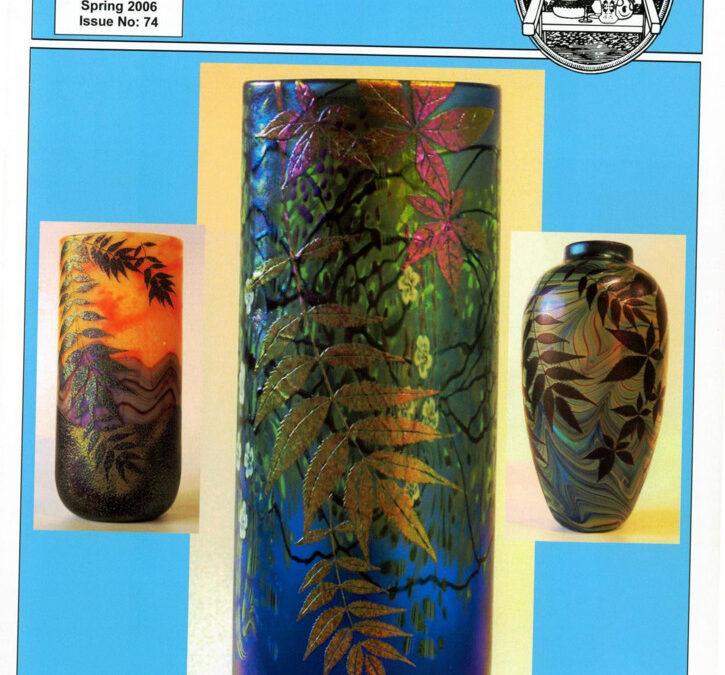
COVER ILLUSTRATION
Richard Golding’s Corning Museum of Glass piece,
Everglade, and other US inspired pieces, Sunset, and
Silhouette.
The opinions expressed
in the Glass Cone are those
of the
contributors. The aim of the Editorial Board is to cover
a range of interests, ideas and opinions, which are not
necessarily their own.
The decision of the Editorial Board is final.
The Glass Cone—Issue No: 74, Spring 2006
2
CHINESE G
Two typical late 19
th
century claret decanters or ewers were sold at
auction at Sotheby’s in London in May 2005 for a total of just over
£6,000. Simply engraved with Chinese characters accompanying
an English heraldic crest, these vessels proved to have a complex
story connected with them which goes far beyond their relatively
unadorned appearance. Known as the Gordon Decanters, these
items are believed to have been commissioned either by or for
Major-General Charles George Gordon of Khartoum, famously
known as ‘Chinese Gordon’.
Possibly made in the Stourbridge area, circa 1870, each
vessel is of ovoid form with tapering neck and trefoil rim. Each is
engraved with the Gordon crests of a buck’s head with ducal
coronet and a boar’s head flanking Chinese characters. The taller –
a magnum — is 30cm. or 113/4in. high. The shorter version is 26cm.
or 103/4in. in height. The Chinese characters represent the syllables
GE-DENG, the phonetic pronunciation of the European family
name GOR-DON. This Pinyin or ‘spell sound’ illustrates the
frontispiece of
The Story of Chinese Gordon’,
by A.H.Hake,
London, 1884, whilst
the crests are
commonly used by
many branches of the
Gordon family.
Charles
George Gordon (1833-
1885) came from a
family with a tradition
of military service. The
son of an artillery
officer, he was born at
Woolwich on 28
th
January 1833 and was
commissioned in the
Royal Engineers in 1852. He distinguished himself in the Crimean
War, and in 1860 volunteered for the ‘Arrow’ or Second Opium
War against the Chinese. In May 1862, Gordon’s Corps of
Engineers was assigned to strengthen the European trading centre
of Shanghai, which was threatened by the `Taeping’ insurgents. He
commanded the Chinese peasant force ‘The Ever Victorious
3
Army’, and played a vital
part in suppressing the
rebellion. Gordon returned
from China in November
1864, a popular figure with
the sobriquet ‘Chinese
Gordon’. His death at the
fall of Khartoum on
26
th
January 1885 assured
his place in the pantheon of
Victorian heroes.
Gordon was not
interested in social display,
indeed his tastes were
ascetic. However, his
household at 5 Rockstone
Place, Southampton,
presided over by his spinster
PORTRAIT OF GORDON AS A AIANOAR/N.
sister Mary Augusta
Gordon, would have reflected the standing of a senior army officer.
As a bachelor, Gordon bequeathed the proceeds of his estate in
trust to Mary Augusta Gordon for her lifetime and, at her death, to
be apportioned between his nephews and nieces.
In the event, Gordon’s death at Khartoum, and the public
opprobrium which consequently fell upon the then Prime Minister,
William Gladstone, produced a grant to the family of £20,000 from
a contrite Parliament, making the sale of Gordon’s estate
unnecessary.
General Gordon’s personal effects, the souvenirs of a
military and diplomatic career spanning thirty-three years,
apparently remained at 5 Rockstone Place, Southampton, occupied
by Mary Augusta Gordon and her sister Helen Clarke Moffitt,
widow of China veteran Surgeon Major Andrew Moffitt Mary
died in 1893 and, following the death of Mrs. Moffitt on 9
th
May
1919, the house and contents were sold by Messrs. Weller and
King, 17 Above Bar, Southampton on 1 1
th
December 1919. The
sale catalogue does not specifically mention General Gordon’s
personal effects and it appears from Mrs. Moffitt’s will that these
were especially bequeathed to her son, Lieut. Col. Frederick
William Moffitt.
After a distinguished military career Lieut. Col. Moffitt
retired to live at Lynwood House, Farnborough, Hampshire. He
died in 1952, leaving to the British Museum “all letters in my
possession written by General Gordon to his sister and all
documents kept by me with them”. His companion, Mrs. Alma
Wroughton, inherited the residuary estate including General
Gordon’s effects. She continued to live at Lynwood House until
her death on 20
th
September 1963 when the house contents were
put up for sale by Messrs. Weller, Eggar and Co. where they were
described as ‘mainly originating from the collection of General
Gordon of Khartoum’. There were 120 lots of china, glass and
bric-a-brac in the sale but the decanters are not specified.
The links between the East and the West are historically
bound up in the background to these fascinating decanters. The
Eastern and Western styles captured by the engraver are the
enduring key to one of the most memorable events in Britain’s
colonial history of the late 19
th
century.
Simon Cottle
The Glass Cone—Issue No: 74 Spring 2006
GLAS
.
MAKER’S CORNER
The article that follows is the first of a regular new series by
Richard Golding and Sandra Whiles looking at aspects of glass-
making from a maker’s point of view, aiming to increase our
understanding of the glass-making processes in a light-hearted and
not too technical way. If there are particular areas you would like
Richard and Sandra to look at in future issues, or particular
mysteries you would like explaining, please contact the Editor .
America in the Fall.
The experiences and challenges of the Glass Association trip to
America in October 2005 have inspired Richard to produce some
stunning original designs which take Okra Glass down a new
pathway in terms of the quality and beauty of its iridescent cameo
pieces.
Whilst it was a brave step on Okra’s behalf to let Richard
take the best part of two weeks out of the busy pre-Christmas
production schedule the “holiday” has paid off in more ways than
one.
Corning Museum of Glass asked Richard to make a
special piece for the Museum, and are now selling his work in
their amazing showroom alongside many of the other great
glassmakers of the world.
Influenced heavily by how Richard saw the autumn
leaves in Pennsylvania, Ohio and Corning, the new designs are
taken directly from nature and are made using Okra’s latest
iridescent cameo technique. Quote: “These pieces are very labour
intensive. After the piece has been blown and annealed, it is
masked out and etched back through the colour layers to reveal the
pattern. Then the piece is reheated over about three hours to avoid
cracking, picked up on a punty iron and hand finished. The last
process is the application of the iridescent surface.”
(See the article
by Charles Hajdamach in Cone 70, p. 6).
As usual, Richard has managed to sum up a very
complicated process in a few words, so he has had photographs
taken of the piece for Corning as it is being made, and given a
small explanation of each shot.
Taking the first
gather of glass, in
this case blue
aurene. There are
two more gathers
over this in clear
to get enough
volume to make
the piece.
The hot glass is
shaped using wet
newspaper
prior to having
the first colour
added to it.
Green glass chip being
applied to the hot gather; this
is repeated with the gold
brown colour after the green
is melted in the glory-hole.
immiummw
The Glass Cone—Issue No: 74 Spring 2006
Black threads of glass being added to the gather over the applied
chip, to give the impression of branches.
Flower cane being picked up off the marver. This is the last colour
application before the outer layers of colour are applied.
After all the colour
has been melted in
the glory-hole, and
the piece reshaped,
the first of three
layers
of
powdered glass is
applied. The photo
shows a layer of
copper ruby
powder being
picked up. After
this layer is melted
in the glory-hole, there are two
more
pick ups of gold aurene.
Now the piece
has been fully
blown to size
it is ready to
be re-heated
in the glory-
hole and
shaped into a
cylinder. Only
then will the
piece begin to
emerge… ….
4
5
The Glass Cone—Issue No: 74 Spring 2006
The cylinder is reheated in the glory-hole then gently reshaped into
an oval.
Terri carefully removes the mask after sandblasting, then she
uses a diamond-point drill to engrave the fine detail into the
leaves. The blue aurene is now fully revealed, with branches,
green leaves and cane flowers, but the autumn leaves have not
yet taken on the full majesty of fall.
Now the punty
iron is stuck to the bottom of the piece so that the top can be tapped
off the blowing iron, opened up with the jacks, and roughly shaped
prior to the final shaping on the marver. After this the piece is
taken off the punty and placed in the lehr to anneal overnight. This
removes any stress from the piece so it can be sandblasted.
After the engraving is finished, the
piece is washed and placed in the
reheat kiln. It is brought up in
temperature from cold to 520 C in
3 hrs. Then the piece is picked up
with a punty again for the final heat
treatment and iridising using
Richard’s unique and innovative
process.
Sandra Whiles & Richard Golding
www.okraglass.com
01384 271644
This is where Terri Colledge
starts to add her magic.
Here you see the masking
being glued to the surface of
the piece. These shapes are
cut from thick vinyl and act as
a resist to the sand blast.
Blasting typically takes some
two hours.
BOSH, CODSWALLOP, HOW
DID I LOSE MY MARBLES?
Before we get on to Balderdash and Piffle, we have a letter
from Peter Beebe in relation to Charles Hajdamach’s
recollection that a glassmakers’ kettle was also called a
`bosh’
(Cone 72 p. 24):
Peter consulted the Oxford English Dictionary and
found several meanings under “nonsense, trash, worthless,
humbug” etc. He also found:
•
The sloping walls of a blast furnace from the widest part to
the hearth
•
A trough in which bloomary tools (or for copper-smelting, hot
ingots) are cooled. A bloomary is described as the first forge
in an iron works.
So, interestingly, the OED does not include a receptacle
for molten glass. And is “a load of bosh” the rubbish that goes into
the kettle (or trough) when a furnace is cleared out?
Now as viewers of ‘Balderdash and Piffle’ on BBC2 will
know, the Oxford English Dictionary is also struggling with
`codswallop’. The earliest written use of the word they had found
was 1962. Thanks to someone in Canada, they now know that Sid
James is the first person recorded as saying ‘codswallop’ in an
episode of Hancock’s Half Hour in 1959. Simpson and Gallon,
who wrote the show, found the original typewritten script, and said
that they used the word “because it was there”. They know, as do
we in the world of glass, that it was in common parlance long
before 1959, but can we make its origins crystal clear?
Having dismissed the suggestion that codswallop was
how fishermen stunned and mercifully killed Britain’s favourite
fish, having rapidly passed over a ram’s testicles (hence
`codpiece’) and the Wallop family
that have several Cotswold villages
named after them, the programme
focussed on Hiram Codd’s 1876
patented bottles. The suggestion was
that beer in the nineteenth century was
sometimes known as ‘ wa I lop ‘ .
Sheffield steel makers drank wallop,
but in the Methodist, Salvationist tee-
total movement afflicted steelworkers
turned to non-alcoholic
`Coddswallop’. This, to the traditional
beer drinkers, wasn’t a true drink, it
was codswallop!
So what was sold in Codd’s
bottles? Did beer and ale makers use
Codds, or was it only lemonade
makers?
Certainly my father-in-law,
now approaching 90, remembers
lemonade in Codds when he was a
boy, and he has a different
explanation for `cod(d)swallop’ one
that was not touched on by the
programme. Having drunk your
lemonade you had an empty bottle
that wasn’t much use to you, but inside was a marble. One wallop
and the marble was yours, two bottles, two wallops, two marbles
and now you could play with your friends, but the bottles really
were useless. So is this in fact where codswallop comes from?
The Codd bottle illustrated has no reference to Codd’s patent, just
the maker of the beverage within. If this is general, how did small
boys know that the bottles were Codds?
So glass historians, glass enthusiasts, to your reference
books please; one of you must be able to cast light on this. The
BBC managed to take the OED explanation back three years; can
one of you take it back three score?!
Can someone also prove the existence of the ‘kettle’
definition which it seems will be a brand new meaning for the
OED. It is in a French on-line multi-lingual dictionary of glass
making terms (as a translation of the French “baguet” which in
general is a `tub’). What British reference did they get the term
from I wonder?
Further, a Codd bottle is useless when it loses its marble,
so finally, what is the origin of the phrase “to lose one’s marbles”?
Glass marbles are certainly very easily lost. But could it be an
oblique reference to the Parthenon and the Elgin Marbles? Or is it
something else altogether? I’m intrigued.
Are there other expressions that glass has given the
world? Answers to the Editor please.
EDWARD VARNISH
One of our members has sent a query about the two items shown
here. They are made of silvered or mercury glass, each being
double-walled. The larger piece is about 18 inches tall, in two
joined parts, one set above the other with mercury within, with a
very smooth inner top. How was this smoothness achieved? The
smaller item is about 2 Y2 inches, again with mercury inside and
with a seal; the metal rim is inscribed “Edward Varnish & Co
Patent London”.
The member asks what was the relationship between
Varnish and Frederick Hale Thompson? A quick look on the
internet shows that Thompson and Varnish registered a patent for
silvering glassware in December 1849 and that their work
fascinated commentators at the Great Exhibition. Do any other
members have Varnish and Thompson pieces? Were they
manufacturing glass? Where were their premises? What is known
about them?
6
The Glass Cone—Issue No: 74 Spring 2006
COHECT 2006 … AND ROUND ABOUT
What
do you have when you put works by Tessa Clegg, Sally
Fawkes, Catherine Hough, Etsuko Nishi, Steven Newell, Carl
Nordbruch, Neil Wilkin, Emma Woffenden, Rachael Woodman
and Koichiro Yamamoto with a goodly mix of works from abroad,
and that’s without mentioning all the artists in other media whose
work was also of outstandingly high quality, all a joy to behold?
The answer is, of course, Collect 2006 at the V & A.
It is said that a picture is worth a thousand words;
hopefully the photos on the following pages give a flavour of what
was on offer. Colin Reid’s stunning kiln-cast piece in the photo
was made using a mould with fruit and vegetables. Noel Hart’s
work is influenced by his native Australia, living as he does near
the sub-tropical rainforest of the far north coast of New South
Wales, where he achieves an outstanding depth and intensity of
colour in his glass. Fellow Australians Edols and Elliott shone as
usual with the influence of the Venetian style in their blowing and
of Tagliapietra in the carving evident in their elegant pieces. A
boat, composed of several pieces of cast glass with different
coloured sails, made by Japanese artist Aiko Ueshima, was most
striking; it was good to have the somewhat rare opportunity to see
much Japanese work on Plateaux’s stand and they will be featuring
two more Japanese artists in an exhibition in March and April.
From the Bullseye Connection in America were pieces
from several artists including Klaus Moje with his typical mosaic
plates of brightly coloured glass, even more vivid than his plate in
the V & A collection. More comparisons with that collection were
possible with Mieke Groot’s startling work and that of Richard
Meitner presented by Collectief Amsterdam. The Scottish Gallery
had works by Alison Kinnaird, Keiko Mukaide, and table-ware
from Lindean Mill. There was even glass from Italy and a little
from Israel; more about them perhaps next year! What a feast!
Round about.
As part of Collect the Crafts Council launched “London
COLLECTion”, a ‘fringe’ type programme of events, lectures and
exhibitions so extensive that we had to be very selective. Firstly we
enjoyed the exhibition presented by Dan Klein Associates of pate
de verre works by Margaret Alston, George Jackson, Sylvie
Vandenhoucke and Karen Vincent. We were particularly taken
with Sylvie’s mounted wall hangings, so skilfully made and
delicate. At The Studio Glass Gallery, in Connaught Street, scale of
size was much larger, but the works just as interesting in their
different way. Most were impressive cast pieces by Fiaz Elson,
Javier GOmez, Richard Jackson, Keiko Mukakle, Stepan Pala, Zora
Palova, Angela Thwaites and Brian Usher. There was an eye-
catching work by the great late Rene Roubi6ek, but outstanding for
me was the orange Petr Week piece in the window, very sensuous,
just exquisite.
Over at Zest Gallery at Roxby Place. Adam Aaronson
presented works using a variety of techniques, illustrating the
dynamism of glass as a medium. There were some of his own
elegant blown works, with others by Naoko Sato, who uses lead
glass for her flowing cast and kiln-formed works. The highlight of
the exhibition were four works by Alison Kinnaird MBE – a huge
piece with galloping horses and three smaller works – and she also
gave a talk on her recent inspirations and motivations.
Alison is a professional musician, specialising in the
Scottish harp and to a lesser extent the cello, as well as a highly
talented glass artist and it was a treat to see extracts from her CD
explaining how she came to make Psalmsong
(see Cone 70)
which
the public can now see in The Scottish Parliament building in
Edinburgh. For her works Alison uses a mixture of techniques,
copper-wheel engraving, some cutting, sandblasting, acid etching
and casting, making the most of glass’s reflective and refractive
qualities. In explaining the thinking and effects that she wished to
create she showed us many of her works, all beautifully
photographed. People appear to move in and out of the different
layers of glass; she leaves many of her figures naked so as to avoid
a time-frame, to be time-less. Clothed figures are seen in her
`Streetwise’ series, a contemporary night time street scene; one is
in the McManus Galleries in Dundee, another in Munich; indeed
her works can be seen world-wide. Probably her largest work to
date was a window in memory of an organist at Domoch
Cathedral. This presented a particular challenge, where a modem
window had to sit happily beside fine stained-glass from the late
19th and 20th centuries. The lines across the window represent a
rainbow and staves of music; the organist is portrayed in one
corner. Like many of her works this window can be seen at
www.alisonlcinnaird.co.uk/glass_gallery.htm. With the assistance
of her husband, Alison has been moving away recently from the
optical fibre lighting that she used for Psalmsong and others, now
using LED lighting, which avoids any heat and whirring problems,
though it doesn’t transmit colours as well as optical fibres; she
sometimes uses a red LED and puts dichroic colour over it and
then manipulates and tones down the effect. A new major piece,
entitled ‘Passing Through’, has been chosen for the Coburg Glass
Prize Exhibition in Germany this year; a series of standing figures,
each with its own shadow, are lit by an LED, which can be
programmed to come on at different times. .
An exhibition and symposium took us to London
Glassblowing in the Leathermarket. The Glass Art Gallery had an
interesting and diverse display of works by the group called
Tangents, Teresa Almeida, Sarah Blood and Laura Wessel, who
met whilst studying at Sunderland (the fourth member Cicy Ching
was not present), together with a fine selection of pieces by
members of the London Glassblowing’s own workshop’s team –
Peter Layton, Bruce Marks, Layne Rowe, Anthony Scala, Louis
Thompson and Marie Worre Hastrup Holm. Let the photos speak!
At the symposium the Tangent group members spoke
about their work — Sarah, using cold and lamp-working techniques
to create sculptures, Teresa making beautiful organic shapes
inspired by her native Portugal, and American Laura painting on
glass and paper, influenced by Thermon Statom and Cappy
Thompson.
Candice-Elena Evans then spoke about the problems,
issues and rewards of curating international glass exhibitions, with
special reference to Wearing Glass and The British Glass Biennale.
She is currently working with the National Glass Centre,
organising the transfer of Wearing Glass to Sunderland in May. It
was fascinating to hear of all that was involved, including research,
recruitment and selection of artists, design and display, promotional
material, installation and de-rig, sales and finance, funding, legal
and insurance questions as well as shipping and touring. It was
stressed that items for most exhibitions have to be selected on the
basis of images plus a comprehensive written statement. Therefore
it is vital that really good images are obtained of the works. This
theme was repeated by other speakers — good image quality is
essential, not only for submissions, but for obtaining coverage in
the press, whether for one’s own glass works or for exhibitions or
events for which one wants media coverage.
7
The Glass Cone—Issue No: 74, Spring 2006
COH ECT 2006
Aiko Ueshima
(My Favourite Things) in
the Plateaux Gallery’s
Japanese artists’ display.
Ethereal work by Bruno
Romanelli and a fruitful
optical illusion from Colin
Reid on the Clare Beck at
Adrian Sassoon stand
Fallen Leaf by
Ben Edols &
Kathy Elliott
(Australia) at the
Raglan stand
Vibrant colours
From Noel Hart
(Australia)
at the Cosa Gallery stand
The Glass Cone—Issue No: 74 Spring 2006
8
At Connect at the
Studio Glass Gallery:
Petr Vlcek (Woman)
Bohumil Elias
(My Universe IV)
and below on the plinths,
Marian Volrab (Detail 1),
Angela Thwaites
(Dawn & Dusk),
Fiaz Elson (Projection II)
plus other stunning works
in the show case.
Iv*
Teresa Almeida (Portugal)
at Tangents
Laura Wessel (USA), glass
painting (at Tangents)
9
The Glass Cone—Issue
CO[]ECT 2006 … … AND ROUND ABOUT
The next speaker was Dominic Fonde, who
works at
St. Helens World of Glass. I was somewhat distracted from making
notes by his witty presentation of his ‘tangential approaches to
glass’. He is a thoughtful and amusing raconteur, both orally and
on glass, engraving his own stories on the glass plates and other
items that he has blown. He was bombarded with questions,
literally, having distributed paper to the large audience for them to
send in questions by paper plane. He spoke about the glass facilities
at St. Helens and the collection there, mostly scientific, but some
items of art glass, many of which had been donated, including a
work by Dale Chihuly. He is currently working on a wedding
anniversaries’ project – watch this space!
Katherine Pearson discussed the role of the National
Glass Centre within the national and international scene. The
forthcoming programme illustrated admirably her theme, ranging
from snowdomes – both newly commissioned and ones in local
people’s collections, thus engaging new audiences – to Libensl4r
and Brychtova! The Guild of Glass Engravers will be holding an
exhibition in May and June and various conferences are being
arranged. There have been changes within the building, with the
creation of four new studios to let, visiting artist studio space and
two education rooms. The Crafts Council has a showcase in the
shop and in April and May will feature work by Bob Crooks. In the
Collections Gallery Katherine hopes to mount exhibitions of
memorabilia, works which are presently in storage elsewhere in the
UK, as well as various private shows. Events here and at other
venues are, as ever, listed on The GA website, with as many as
possible mentioned on the events page of The Cone.
After an excellent buffet lunch there was a presentation
by Sylva Petrova, Director of the Institute for International
Research in Glass at the University of Sunderland, on Czech
modem glass ideas and philosophy. She explained the constraints
imposed by the borders of Czechoslovakia being closed to the west
between 1948 and 1989 when no private commercial initiative was
allowed. Over the last 50 years there was much architectural glass
produced, a more recent example shown was that by Vaclav Cigler
in the gardens of Prague Castle. Works such as the installation by
Rene Roubicek for the 1958 Expo in Brussels or Bohumil Elias’
kinetic fountain for Expo 67 in Montreal helped Czech glass gain a
world-class reputation. From 1962 to 1987 the late Professor
Libenslqr trained many important artists such as Pavel Tmka and
Ivan Mara.
Many Czech works will be on view at Brighton
University from 16 March, which Sylva had just been visiting with
the surprise speaker, again with excellent images to show. This was
Zdenek Lhotslc,
,,
another
Libensky
student, who owns a glass-
casting studio in ZeleztV1 Brod, making both his own designs and
those of others, such as some of the sculptures of Libensky and
Brychtova, Ann Wolff, Hannah Kippax, and Karen Lamonte’s
well-known large dresses. Zdenek employs sixteen people; his
team will make moulds from wax models and then cast the glass
and later polish it, work of the highest quality. They also do fusing
and slumping, window-panes and work on many architectural
projects, offering a complete design service where required.
The final speaker was Peter Layton, speaking about his
40 years in glass and 30 years of London Glassblowing Workshop,
the longest running studio in Europe. He gave a fascinating insight
into his early life and career. In America he taught ceramics and
did a glass summer school. The epiphany moment for him in glass
(we had heard about those of earlier speakers too!) was at the 1967
Montreal Expo, seeing the Czech pavilion. He was instrumental
with Sam Herman in starting the Glass House in Covent Garden.
He subsequently established his own small glass studio at his
pottery at Morar in the Highlands of Scotland. Peter had his first
major exhibition at the Commonwealth Gallery in 1972 and started
his own studio in 1976 in an old towage works by the Thames in
Rotherhithe. He researched the iridising techniques employed by
Carder and Tiffany, and we were able to see some of his lovely
early blue pieces. Many well-known glass artists have worked with
Peter over the years, the list reads like a who’s who of British glass,
and in recent years he has been collaborating with Simon Moss on
garden pieces and water features. We saw examples of his different
ranges, including Floral, Gaudi, Spirale, Mirage and Paradiso, all
beautifully photographed.
Finally it was time for well deserved thanks to all the
speakers and to Sylvie Marks and her helpers of London
Glassblowing for organising such a stimulating and successful
symposium. The chatter and the networking continued in the
studio, as people relaxed with a glass of wine and viewed the
exhibition. We were loath to leave. Let us hope there will be
another such gathering soon. Collect is no longer just an event, it is
a collection of events. We could not fit in all those related to glass
this year; and we can’t wait for next year.
Ruth Wilcock
Photos by Bob Wilcock
E 7
th
CAMBRIDGE,GLAS,S FAIR
The Cambridge Glass Fair goes from strength to strength, and the
latest, on 19 February, was the best attended ever.
It was certainly very inviting looking down from the
entrance foyer into the main hall sparkling with light and with glass
and with a throng of eager collectors. The fair has adopted the
slogan “300 years of collectable glass in one day” and there
certainly was quality glass from every era, in sufficient quantity and
variety to tempt any collector.
There was much modem glass in the main hall, but many
of the artists now have stands in the adjacent Contemporary Hall-
•
ewellery makers, glass blowers, engravers more than happy to give
an insight into their work, sell and take commissions.
The foyer, between the two rooms, housed an attractive
exhibition of Stuart enamelware, and stands made available at no
charge by the organiser and GA committee member Paul Bishop for
the main glass organisations, including of course the Glass
Association, and we were delighted to meet members from the
South, the Midlands, and as far north as Sunderland and Alnwick.
They departed with bagsful of bubble-wrap so clearly found the trip
worthwhile!
The catalogue is developing into an excellent small
reference-work with details of the foyer exhibition and of the glass
on the popular promotional postcard. Much more information is
available on the web-site www.cambridgeglassfair.com and this is
well worth looking at, even if you are unable to get to the fairs—a
new “Focus on Glass” article on Arts and Crafts Glass was added in
early March.
The next fair is on Sunday 24 September. Details, and
details of other fairs, will appear in forthcoming Cones and on the
Glass Association web-site.
Bob Wilcock-
The Glass Cone—Issue No: 74, Spring 2006
10
JAMES POWELL & SONS AT TYNTESFIELD
I am sure that many of you may recall that in 2002 The National
Trust acquired Tyntesfield after an unprecedented emergency
fundraising. I live only five miles away, and have been fortunate in
being taken on as a voluntary guide giving me regular access to
those parts of the house covered by tours, and occasional peeps
into other parts.
Tyntesfield stands on a ridge overlooking the Yeo valley,
with Nailsea just out of vision. Originally tours were brought to the
property by a shuttle coach service which ran from the Tesco car
park in Nailsea. This stands on the site of the Glassworks
(see
Cone No 58 Page 10).
As William Gibbs purchased the original
house in 1843 there was a substantial overlap before the
glassworks closed in 1869 and it seemed a possibility of finding in
the house some examples of windows from the local factory and
documentary proof However, the Chapel, completed 1875 after
the closure of Nailsea had glass by James Powell & Sons.
William Gibbs and his wife were devout High Anglicans
and supporters of the Oxford Movement. In the 1860’s they
decided to convert their Georgian Manor into a Gothic Revival
country residence befitting one of the wealthiest London
merchants, and with their deep faith they included within the house
an oratory, for daily prayer. Ten years later they decided to add
their own private chapel. When going through the Whitefriars
archive for the Chapel, completed 1875, a look back to the earlier
period just in case they had been involved in the earlier project
seemed worthwhile. Indeed it was. James Powell & Sons had
supplied and fitted the windows in what they termed the prayer
room in 1864 and in several other places. Those in the Oratory
have not survived the later changes to the house after the Chapel
was completed in 1875, but further records show that windows in
several other parts of the
house were supplied by the
firm, and some of these
have survived.
Most of the
surviving glass is in the
form of quarries, the
stamped diamond form that
James Powell developed as
a way round excise
restrictions which excluded
flint glass producers from
making flat glass. In
particular there is a two
light window of quarries in
a bird and flower design
(Photo 1) in the corridor to
the Billiard Room which is
complete, and there is still
some Whitefriars glazing,
mainly grisaille, in the
Library (Photo 2) which can be seen by the visitor. The bulk of the
survivals though are on the first floor, currently not generally
accessible. Here there is a three panel doorway of oak and acorn
quarries, (Photo 3) with similar quarries filling the tracery in the
door arch. Intriguingly from the outside of the house the tracery in
the top of a three light window in the turret bedroom, which
appears in the archive, shows the original lead diamond framing
for quarries, but inside the bedroom there is a wall but no window.
11
The chapel at Tyntesfield is an extremely beautiful and
impressive example of Gothic revival architecture, light and airy
without the oppressiveness so often associated with this style. The
stained glass has survived almost completely. The overwhelming
impression is of colour and light much of it derived from this glass
and both the wall and floor mosaics. It is paved and glazed by
James Powell & Sons. Salviati was responsible for the wall
mosaics behind the altar which give a Greek Orthodox feel,
without the heaviness of much of his other work
Based on La Chapelle in Paris it is the jewel of the
property. The James Powell Order Book of July 1873 shows the
architect as A. Blomfield Esq., 28 Montague Square, who was one
of more important ecclesiastical gothic revival architects. He went
on to become vice president of the Royal Institute of British
Architects. The son of a previous Bishop of London whose
ministry had been devoted to balancing the two wings of the
church, his architecture
had
no such inhibitions with superb results.
One can sense the input of the architect, the designers, the
craftsmen, and as importantly the client who are all completely in
harmony.
The windows in the nave and apse, a total of ten lights,
were all designed by A.R. Woolmer, aged 28 at the time, a gifted
medievalist with a light touch, who went on to succeed Ruskin as
the Slade Professor of Art at Oxford. He was instructed to depict
specific Biblical scenes, and I suspect he was selected because of
his
style and palette, the order book of 23 July 1873 stating “single
figures and subject below each. Foliage work also plants of the
Holy Land.” The input of the client? Conflict with the local vicar,
fearing that the chapel could poach some of his flock, led the
Bishop to permit the chapel to be only dedicated, that means no
parochial services, baptisms, marriages or burials permitted. This
may well have been behind the non appearance of a Baptism panel
ordered in 1873, and the
replacement by his widow of the
two lights behind the altar.
William Gibbs himself died in
April 1875 when the chapel was
barely completed and was buried
at the nearby church in Wraxall.
The Chapel crypt was never
therefore used for its planned
purpose.
The Rose window at the West
End of the chapel always
appeared to be by a different
hand, (Photo 4) and the entry in
the order book talks of “Rose
window at West End as sketch
The Glass Cone—Issue No: 74 Spring 2006
5
14.,,
it
tA
i
…..4
t
l
9
tre
r)
td
s
;*
1111
1
6tQn
;j111
Iliii
rr
itiliti
I
0710
. Io’vkip” is
iiik
4
lilill
Il
leltr*.il
v
li
f
il
li
l
a
vv
7
,,
z
og
i
ilitt:c
.
if
i
r
iiiist;ff,osi: 1
if n.
—
…..
—
2….::q
…..„,,,…..—…7…….
– .-;__.
Agnus Dei in cartoon and semblances of evangelists instead of
figures”. The final entry in the Dec 1874 cash book appears to
confirm this with the entry “Rose window at West end as sketch
JCP”. I feel we are safe in assuming this to be James Croft Powell,
grandson of the firm’s founder,
as according to the Museum of
London book on Whitefriars he
was at this time head of the
window department, and his
surviving architectural sketch
books in the V&A archive show
he had the skills. One may
surmise that the sketching for
this key window formed part of
the negotiations with the
architect or possibly William
Gibbs. Whatever the detail the
result is exquisite.
The floor in the chapel
is also the work of James Powell,
though in this case the design is
that of the architect. A mixture of
stone of increasing value and
rarity culminating in Blue John
on the altar step, though with the
black and white lines being one
of Powell’s glass mosaic mixes.
There is also in the Chapel a
Head of Christ in mosaic
attributed to Sir William Boxall,
and possibly in Powell’s Opus
Sectile. However I could not
trace a record of this in the
archive and there is a suggestion
it was produced by Salviati, but I feel this is unlikely
The family went to the chapel over a bridge from the first
floor of the main house, and this also is glazed by James Powell.
The windows here do not have an ecclesiastical theme but are
primarily floral in the Arts & Craft style, and whilst not on the scale
of the main windows are amongst some of the most attractive and
colourful in the chapel and house (Photo 5).
The combination of the mosaic work for the “pavings”
and all the glazing make this the most integrated example of the
ecclesiastical work of James Powell & Sons of which I am aware.
Together with the earlier glazing in the house, there is about a
15 year time span of the firm’s work, and the bridge linking the
chapel and house is in many ways a summation of the property.
My thanks to the National Trust in permitting me access
and allowing me to take photographs, primarily to assist in
identification, which are reproduced in this article.
John Delafaille
POSSET POT AT SOTHEBY’S
itittPb-
Sotheby’s will be offering a very rare
sealed Ravenscroft posset-pot in their
Bond St. sale on 24th May. It was last sold
in 1952, also at Sotheby’s. No examples
bearing the rare raven’s head seal (of which
there are only about 12 extant) have been
on the market, it is thought, since the late 1960s.
In October, Sotheby’s are holding a “Great Exhibitions
Sale” They are currently looking for high quality items, including
glass, that have an authentic connection to any of the Great
Exhibitions or were inspired by them. For general information
e-mail
greatexhibitions(&,sothebys.com,
and for glass phone Simon
Cottle (020
7293 5133) or Nette Megens (020 7293
5070)
Welcome to New Members
Ms J Dorner
London
Miss S Phillips
W. Midlands
Mr & Mrs P Arlidge
Oxon
Mrs M Eminson
Humberside
Mr & Mrs S Piper
W. Midlands
Ms Y Asian
London
Mrs J Geddes
Wilts
Ms L Pyke
Suffolk
Mr P Burdick
Exeter
Miss C Gray-Smith
Lincolnshire
Mr J Renton
Lincolnshire
Mr .0 Chaplin
Sussex
Ms J Harding
Yorkshire
Mrs G Roche
Coventry
Mr W Clegg
Mrs J Clevely
Oxon
Worcs
Mr P Harris
Mrs P Hilton-Robinson
Essex
Sussex
Mr A W Ross
Mrs A Russell
Glasgow
Middlesex
Dr G Cooley
Oxon
Ms L Hodgson-King
Northampton
Mr L Sidoli
Warks
Mr G Cope
Wiltshire
Mrs W Holden
Devon
Mrs V Simmonds
Hefts
Ms M Courter
USA
Mrs P Holt
Bucks
Ms J Stone
Bath
Mrs S Crawford
Derbyshire
Mrs M Kiddie
Hants
Mrs D M Sutton
Lincolnshire
Mr M Culley
Essex
Mrs T King
Worcs
Mrs J Taylor
Worcs.
Mr & Mrs P Cummings
Lanes
Miss A Marshall
Lines
Mrs P Taylor
Bristol
Mrs M Curry
Devon
& Mr D Elford
Miss E Waters
Sussex
Mr D Davis & Mr J Stout
USA
Mr & Mrs D Matheson
Glasgow
Ms S Whitfield
London
Mrs M Donachie
Bucks
Mr & Mrs R Peper
USA
Ms V Young
Kent
The Glass Cone—Issue No: 74 Spring 2006
12
MH cane is set in the top. From the photographs that I have seen
of his presentation to the PCC he also produces some very unusual
and large art glass vases using similar techniques so a visit to his
workshop could well be on the itinerary when we go to Scotland
for a holiday later in the year.
Vasart Commemorative Weight
The only other weight of
interest that has
come my way in recent
months is a Vasart spoke
pattern millefiori weight
from the late 1950’s but
what makes it different is
the gold coloured
medallion set into a
recess in the base. On
the medallion is a coat of
arms which includes an
open book, a Scottish
saltire and a thistle. A
friend found the weight several years ago and set about the task of
researching the armorial emblem via the College of Arms in
London who referred him to the Court of the Lord Lion, their
equivalent in Scotland. They were soon able to identify the coat of
arms as that being granted to papennaking company Tullis Russell
in 1947. Luckily when he contacted the company there was
someone around who
kept in touch with
some of the retired
members of staff and
was happy to make
some enquiries as to the
reasons for the
production of the
weight. After a while
and much to his
surprise an envelope
arrived and inside
was
a copy of the old
headed notepaper
complete with crest together with a note saying they had been able
to speak to one of the former directors and that along with some
other mementos, the weights had been commissioned in 1959 to
celebrate the 150th anniversary of their founding in 1809. Further
research with some people who had worked at Strathearn, the
successor to the Vasart company, revealed that the encasement of
coins and medals in to the bases of glass items was a speciality of
master craftsman Jack Allen. How many of these weights were
made remains unknown but rather amazingly the friend managed
to find another example so was happy to pass one on to me. The
information has also solved another longstanding mystery for some
other friends who have a Vasart weight with round indentations in
the base – it could have been that the medallion has fallen out or
been removed but probably more likely a case of over production
of the weights with the indentation and the medallion was never
inserted. For the full story of the research for the origins of this
weight see the article by Dave Webber in the 2002 PCA Bulletin.
Richard Giles
MD.
The Glass Cone—Issue No: 74 Spring 2006
PAPERWEIGHT CORNER
Departures From The Paperweight World
I was wondering how to start off this latest article about the world
of paperweights when the quarterly bulletin from the Paperweight
Collectors Association in America dropped through the letterbox
and I saw the sad news about the death of the President William
Gaskill. In his previous role as Education Director he was present
at the Cambridge Paperweight Circle 21st Anniversary exhibition
at the NEC in 2002 and during my two stints on stewarding duty I
was fortunate to have time to talk to him and look at his laptop
display of pictures of his vast collection of American folk-art type
weights and Victorian bottle-glass dumps. I showed him several
examples of dumps from my collection and even though he had
over 600 examples of course we found that I had one that he
didn’t. I then had to stubbornly resist his approaches to part with it
but he did have more luck in persuading me to join the PCA. A
very knowledgeable and pleasant person he ensured that all his
research into the subjects that interested him is recorded in the
PCA annual bulletins for the benefit of those who share his passion
for paperweights.
I had just finished typing up this article when I received a
phone call informing me of the death of another major contributor
to the world of paperweights – Colin Terris. He is probably best
known for his many years association with Caithness Glass and
being the first person to come up with the idea of a themed abstract
paperweight design . This was back in the late 1960’s and he went
on to see his concept develop into a worldwide phenomenon
adopted by most other manufacturers. As well as a renowned
designer he was also a craftsman who had developed his skills
from the early days when he was a talented copper wheel
engraver. He officially retired in 2002 but returned to the company
to help out with designs for 2004. Paperweight enthusiasts and
Caithness Glass in particular owe him a great deal for his
contribution to the subject in which we have particular interest.
Murrine Techniques
Having seen pictures and read about the new techniques
that Mike Hunter of Twist Glass from Selkirk in the Borders has
developed for the making of murrine canes (See article by Brian
Clarke in Glass Cone No. 67) we have been waiting patiently to
see some examples. We were unable to get to the September
meeting of the Paperweight Collectors Circle when he was the
guest speaker so we had to wait until the Gaydon fair where several
different types of his weights containing face canes were available.
In the end we opted for a weight that comprises two layers of two
directional spiral threads that start at the top of the weight, the inner
layer with equally spaced white threads and the outer layer of
spaced blue and
white threads. In
the spaces created in
the outer layer of
threads are twelve
clown
face
canes. The result is
an unusual weight
that is different to
anything produced
by other makers,
and for collectors
who like to have
signature canes a
13
Refreshments of all types from full restaurant lunch to baked
potatoes, ice-cream and pancakes were available. Not only
was there a wine bar, but also the chance to have a wine
tasting session with an expert.
But what of the main glass marquees? Several artists
were on hand to talk to the public and sell their glass –
Dominic Fonde had lovely hand-made glass engraved with
The dates are already in the diary: 13 – 16 July 2006. The only
problem will be to decide how many days to spend at the beautiful
Waterperry Gardens, near Wheatley, in Oxfordshire, because last
year one day was not enough to see and do even a fraction of what
was on offer.
Art in Action 2005 was the 27
th
of that Ilk. What an
event! Where to begin? It is an arts and crafts show on the grand
scale, with all the major crafts represented — first and not least there
was glass and glass blowing, then painting, ceramics, calligraphy,
metalwork and jewellery, print making, woodwork, sculpture,
Abrahamic Arts, clockmaking and textiles, virtually all with their
own marquee. But there was much much more besides the
opportunity to speak to artists, see them at work, buy examples of
their work. There was the chance to take part in practical classes;
whilst some were specifically for children, adults could enrol in
classes to practise pastel work, raku pottery, pottery throwing; only
one ticket per person per day could be bought and the choice was
vast — add to the list batik, copper enamelling, landscape water
colour painting, pottery, sculpture (there was a life model — a
horse!), silk painting and marbling, glass engraving and
pyrography!
Roger Tye Composite Sculpture
Performing Arts were not neglected with live
classical music being played by various groups of musicians;
there was music from different countries, and not only choral
music, but also the possibility of joining a choral workshop.
There were dialogues taking place— with an artist, a sculptor, a
ceramicist and an illustrator (glassmaker, next year?!), as well
as dialogues about ‘Spirit, Nature and Design’. For children
there was storytelling and for adults a talk about the history of
the beautiful Waterperry Gardens followed by a conducted
tour. Other tours were available to see the new frescos in the
House.
Much of the work on display in the various marquees
was for sale. There was a separate market tent where artists
who were not demonstrating their work could sell items,
including Martin Andrews of The Ruskin Glass Centre at
Stourbridge and Rob Marshall of Hampshire, both with a fine
range of work. Various firms supplying art materials were
present too. Creature comforts were not forgotten!
original short stories and Haiku poems, whilst nearby Iestyn
Davies from Blowzone also had an impressive selection of his
work, including garden sculptures and chandeliers, with
projected images of large works installed for clients. By
contrast Emily Bellhouse was creating a large-scale pixelated
image from hundreds of individual glass tiles with photos
embedded. Diana East, who had a great selection of beads and
jewellery, was demonstrating her flame-work techniques.
Amanda Lawrence demonstrated engraving, some of it on her
own beautiful kiln-formed glass shapes, whilst Jane Radford
showed the ‘sous verre’ technique, mixed media painting
working directly to the underside of glass panels. Further
engraving demonstrations were given by Tracey Shepherd
who skilfully showed ‘the illusive quality of the medium, with
a strong emphasis on the importance of drawing and design’.
Stained glass was in evidence with Frans Wesselman, who
demonstrated the skills required for his attractive work. There
was a large display of work for sale by members of the
Cohesion group, once representing only north-eastern artists,
but now with a wider membership; particularly attractive
work by Roger Tye and also by the London Glassblowing
Workshop were amongst those exhibits.
The second glass marquee was primarily devoted to
demonstrations. There were selling exhibitions of work by
Anthony Wassell of Nottinghamshire and Ed Burke of E & M
Glass in Cheshire, but the majority of the space was taken up
by kilns, glory hole and annealing oven, with a large area of
seats for visitors to sit and watch the glassblowing
demonstrations throughout the day. Ed Burke started the
proceedings with an interesting demonstration of glass in its
historical context, explaining and demonstrating techniques
used in Roman times, then in Venice and through to modern
The Glass Cone—Issue No: 74 Spring 2006
14
Iestyn Davies angel reflecting the garden
Engraved
platter by Margaret
Burke
in the ‘Best of the Best’ display
Anthony Wassell with enamel twist wine glass
times. Anthony Wassell used lead crystal to explore
techniques, including air-twist, colour-twist and overlay. He
showed how both colour and air-twist glasses can be made
without using any moulds, skilfully using his jacks to make
Roger Tye at work.
Pieces by Ed & Margaret Burke in the background
the indents in the stems before he twisted them.
By contrast Roger Tye made a gloriously coloured glass
piece, showing how he built up layers of colour before blowing his
piece into a mould and then, after further blowing, creating an
elongated shape which would be one element in a future composite
sculpture. One of his sculptures was amongst many pieces of
sculpture in the gardens, a display at Waterperry that was on view
for all of July and August. Hopefully other Glass Association
members will have seen the exhibition even if they could not attend
Art in Action, as both were mentioned in advance on the GA
website. After seeing such a feast of glassblowing skills we decided
to sample other demonstrations in different media and also visit the
`Best of the Best’ tent, with wonderful examples from all
disciplines, but we could have stayed with glass all day, as there
were further demonstrations by the London Glassblowing
workshop and by Dominic Fonde.
The whole event was exceptionally well organised.
Admittedly we had to queue a few minutes for our entry tickets, but
had we booked in advance that would have been avoided. The
use
of metal walkways facilitated access for wheelchair users.
Attention to the smallest details in the planning made for a trouble-
free day; for example, such was the provision of toilets that there
were no queues for the ladies loos! It was a very hot day, so the
organisers had laid on free drinking water too. My only complaint
was that there weren’t enough hours in the day to see and do all
that we wanted. It would have been good to linger in the beautiful
gardens, visit the old chapel in the grounds, try a new skill ….. but
that will be for this year. What an inspiring and uplifting
experience.
Ruth Wilcock
Photos by Bob Wilcock
Link: www.wateipenygardens.co.uk/
Dramatic sculpture by Peter Layton and Simon Moss
111
n
11.
The Glass Cone—Issue No: 74 Spring 2006
15
Nearby, the
Gallery at Brighton University
is hosting
the
Lhotsky Studio in Pelechov
exhibition
(see p. 11)
from
16 March-31 May, showing work from 15 artists who have had
pieces cast there. There is a
Symposium on Czech Decorative
Arts and Crafts
on Saturday 29 April. Details at
wvvw.brighton.ac.uldgallery-theatre/index.html (01273 643010).
The Brighton exhibition is organised by the
Studio Glass
Gallery.
At the Gallery itself (24 Connaught St. London W2 2AE)
from 30 March-15 May the exhibition is
Space, by Javier Gomez,
the first solo show in the UK by this talented Spanish artist.
www.studioglass.co.uk Tel: 0207 706 3013
A treat is in store with Japanese glass rarely seen in this
country. Featuring works by various artists including Etsuko Nishi
& Koichiro Yamamoto,
Japan: A Premier Exhibition Of Glass
Art,
will be held from 9 March to 30 April, at
Plateaux Gallery,
1
Brewery Square, Tower Bridge Piazza, London SE1 2LF.
Underground: London Bridge/Tower Hill. Three minutes from the
Design Centre. Meter parking or multi-storey car park in Gainsford
Street — just outside congestion charge zone.
www.plateaux.co.uk. Tel: 020 7357 6880.
The next
National Glass Collectors Fair
will be held on
Sun 21 May from 9.30am to 4.00pm. at The Heritage Motor
Centre, Gaydon, Warwickshire, about 3 minutes drive from
Junction 12 (B4100) of the M40. Last Entry 3.30pm. (Reduced fee
after 11.00am). www.glassfairs.co.uld or Tel: 01260 271975.
In the Midlands from 4 Feb-6 Aug you are invited to give
your opinions on the exhibitions and displays at
Broadfield House
Glass Museum
at Compton Drive, Kingswinford, West
Midlands , DY6 9NS.
Ask the Audience
explores different types
of interpretation, including hands-on activities, and a range of
topics. You can discover why the Stourbridge glass industry was
so important and why there is a museum. Find out more about
collecting and the collectables of the future. Guess the mystery
object, and feel the difference between cameo and carnival glass!
All the exhibits are from the Museum’s own collection, including
many brought out from storage. Your feedback will inform the
future redisplays of the Museum’s permanent galleries. On Sat
20 May, 10-4, there will be a
Beads Day,
with displays,
demonstrations, lecture and beads for sale. Tues-Sun 12-4.
www.glassmuseum.org.uk or Tel: 01384 812745.
In Belfast until 29 August the Ulster Museum hosts
A Perfect Cut: Irish Historic Glass,
an exhibition from the
Museum’s collection of C18 and C19 Irish glass. The glasshouses
of Belfast, Newry, Dublin, Cork and Waterford are all represented
in this exhibition, which uses the Museum ‘s collection to show the
beauty, skill and diversity of Irish glass, and includes some of the
most important pieces of glass to be made in Ireland.
At the Ulster Museum , Botanic Gardens, Belfast , Northern
Ireland , BT9 5AB. https://www.ulstermuseum.org.uk/
whats on/exhibitions/?article=975 or 028 9038 3000
If you like jewellery head to the
The World of Glass,
Chalon Way East,
St Helens,
Merseyside, WA10 1BX between
7 Feb and 9 April for
Hot Glass Jewellery,
an exhibition
showcasing the outstanding jewellery of three of the UK’s leading
designers, Isla Osborne, Clare Charlesworth, and Annie
Darlington. A chance to see some of the hottest original hand-
crafted designs in lamp-worked beads and dichroic glass.
www.worldofglass.com/ or 08700 11 44 66
RW
Some of these events have already been posted on the GA website
where the most complete and up-to-date information can be found
www. glassassociation.org.uk/.
If you’re going to Cornwall this Spring why not visit
Malcolm Sutcliffe’s Studio Glass Gallery
at 2 West Street,
Penryn, near Falmouth? It’s normally open Wednesday to Friday,
1 lam to 5pm and Saturdays from 10am to 1pm. His elephant
bowls and sunset bowls are just two of a wide and attractive range
available. His next Open Studio event will be in May 2006, so
keep an eye on his website www.malcolm-sutcliffe.co.uk/ or ring
for details on 01326 377020
As in previous years, there are Open Studios in many
parts of the country, where the public can visit artists in their
studies and see how they work. There are details on a general
website www.info-britain.co.uIc/uk.art/artweeks.directory/ and
tourist offices will eventually have brochures for their areas.
North
Cambridge All Arts Open Studios
will be on 29-30 April, and
Norfolk
3-14 May (www.n-joy.org.uk/ or 01603 766400).
As part of their exhibition of Islamic treasures,
Palace
and Mosque,
Sheffield Galleries & Museums Trust has
commissioned Farhad Ahrarnia, a mixed-media artist and Kalim
Afzal, a glassmaker, to produce
Through a Glass Brightly.
Their
focus has been the crafting and function of glass. Glass was
originally handcrafted in the Middle Eastern regions of Egypt,
Syria and Mesopotamia. The practical and aesthetic qualities of
glass were well understood in the early Muslim world. The Middle
East has imbued glass with mystic qualities symbolising both
scientific clarity and artistic refinement and this is explored by the
artists. At the
Millennium Galleries, Arundel Gate, Sheffield,
S1 2P until 17 April. 0114 278 2600. Mon—Sat 10- 5, Sun 11-5.
www.sheffieldgalleries.org.uk/coresite/html/
edu_PM about.asp#9594395
In the capital, at
London Glassblowing,
7 The Leathermarket, Weston Street, London, SE1 3ER, from
Fri 24-Sun 26 March, American glass artist,
Ron Rogers
will be
demonstrating
Venetian glassblowing techniques
during the
Open
House and Spring Sale.
There will also be new work by Peter
Layton and a chance to see studio artists at work. Free entry,
refreshments and parking in the courtyard at the weekend.
Nearest underground/train: London Bridge or Borough.
www.londonglassblowing.co.uk Tel: 0207 403 2800
The Crafts Council will be featuring the superb works of
glassblower
Bob Crooks
in their showcase at the
National Glass
Centre,
Liberty Way, in
Sunderland
from 30 March to 21 May.
The
Guild of Glass Engravers
is holding an exhibition at NGC,
entitled
Cutting Edge 2006,
of high quality art in glass, 5 May to
30 June, 2006 and in May the exhibition
Wearing Glass
will
transfer to Sunderland. The NGC is open every day from 10-5,
free entry. Tel: 0191 5155555
www.gge.org.uk/events.asp and www.nationalglasscentre.com
GA member Andy McConnell has opened
Glass etc,
a
large gallery and exhibition space at 18-22 Rope Walk, Rye, East
Sussex, TN31 7NA, where he will specialise in table and lighting
glass from c1700 to the present day. From 10 April to the end of
May there will be an exhibition,
The Glass Salt Cellar, 1750-1980,
over 300 examples, mostly British, dating between c1770-1820,
the classic period of glass cutting. Open 7 days a week, 10.30 -5
weekdays, 12-5 Sundays) Tel:01797 226600.
The Glass Cone—Issue No: 74 Spring 2006
16
EXHIBITIONS, EVENTS AND FAIRS