




The
Glass Cone
Issue No: 77 — Winter 2006
The Magazine of
The Glass Association
Registered as a Charity No. 326602
Chairman
Charles Hajdamach: chairman(&,glassassociation.org.uk
Hon. Secretary
Yvonne Cocking,
14
Southfield Drive, Sutton Courtenay,
Abingdon, Oxon, OX14 4AY
(secretary(&,glassassociation.org.uk)
Editorial Board
Charles Hajdamach (Editor), Bob Wilcock (Technical Editor),
Roger Dodsworth, Yvonne Cocking
Address for Glass Cone correspondence
E-mail to editor@glassassociation.org.uk or mail to
Charles Hajdamach, 10 Villa Street, Amblecote, Stourbridge
West Midlands, DY8 4ER
Address for membership enquiries
John Greenham, Membership Secretary,
High Trees, Dean Lane, Merstham, Surrey, RH I 3AH.
(membershipAglassassociation.org.uk)
Committee
Peter Beebe; Paul Bishop; Brian Clarke (Treasurer); Roger
Dodsworth; Mark Hill; Gaby Marcon; Janet Sergison; Judith
Vincent; Ruth Wilcock.
Website:
www.glassassociation.org.uk
E-mail news & events to newsAglassassociation.org.uk
Printed by Jones and Palmer Ltd: www.jonesandpalmer.co.uk
Published by
The Glass Association
ISSN No. 0265 9654
CHAIRMAN’S LETT
With the mailing of this Cone members will receive the
programme of events for 2007. The programme has been put
together to present the varied face of British glass and attempts to
provide all collectors with something of interest. The first event of
the year will be a celebration of the work and career of Peter
Layton and will be held at a relatively new art centre in Sleaford in
Lincolnshire. Because it will take place fairly shortly after
members receive this issue, we are hi. blighting it here to ensure
no-one who is interested in studio glass misses the event.
Two years ago, in collaboration with Dr. Graham
Cooley, one of our life members, we organised the very successful
weekend at King’s Lynn which focussed on the work of Ronnie
Stennett-Willson. Since then Graham has been busy collecting the
work of Frank Thrower and his collection will form the centrepiece
of a weekend of celebrations at Dartington. It will include a
question and answer session with Eve Scanlon, Frank Thrower’s
daughter and two colleagues who worked closely with Frank.
Among the other speakers Mark Hill will talk about Michael
The Glass Cone—Issue No: 77 Winter 2006
Harris and his work while Hilary Green, the Head of Design at
Darlington will bring the story up to the present day. For those
interested in post-war glass designers this event is another ‘must
attend’ weekend.
It is hard to believe that a year has passed since our last
overseas trip and plans are now afoot to visit one of Europe’s great
centres for glass production, Sweden. European glass will also
form the subject of a special day with major international speakers.
The programme will be completed with ‘Glass
Workshops’ in which collectors will have the opportunity to meet
glassmakers and engravers and handle rare and important objects,
an idea that was suggested at the last AGM. The events have been
spread out across the country and we hope to see many of you
throughout the forthcoming year.
Highlights of the 2007 Programme
Friday 16
th
February
Peter Layton and The London Glassblowing Workshop.
A day of events at The Hub Art Centre at Sleaford, Lines.
Saturday 2
nd
June and Sunday 3`
d
June
Dartington Glass Weekend Conference.
Thursday 23
rd
August to Tuesday 28
th
August.
Flying into Gothenburg and out of Stockholm, the trip
will take in the major Swedish museums housing glass such as
Rohsska and Vaxjo and other smaller, private museums. Visits will
also be made to Orrefors and Kosta Boda, and Stockholm with its
many museums and antique shops for bargain hunting.
In this issue of the Cone we include a number of reviews
of recent books including Andy McConnell’s ‘Miller’s 20
th
Century Glass’. It is not usually our policy to publish more than
one review of any book but Andy’s new publication has caused
something of a stir hence we print two different viewpoints. Ron
Havenhand’s letter in the last issue of the Cone also raised the
hackles of a number of dealers and we print three letters replying, I
think the term is robustly, to the points raised by Ron. It is
gratifying that members are willing to send their views to the Cone
and I hope many others will follow their example. If you have any
material, or research, or items for identification, or queries,
however small they may be, or however insignificant you think
they may be to other readers, please do send them in for
publication. You will be surprised to find how much interest they
generate.
Finally, I will continue to act as Editor of the Cone for the
next year, but at the end of 2006 I would like to express my thanks
to the editorial team, especially our resident technical whiz-kid
Bob Wilcock, and to the many contributors for their help and
support last year.
Charles R.
Hajdamach
The opinions expressed in the Glass Cone are those of the
contributors. The aim of the Editorial Board is to cover
a range of interests, ideas and opinions, which are not
necessarily their own.
The decision of
the Editorial
Board is final.
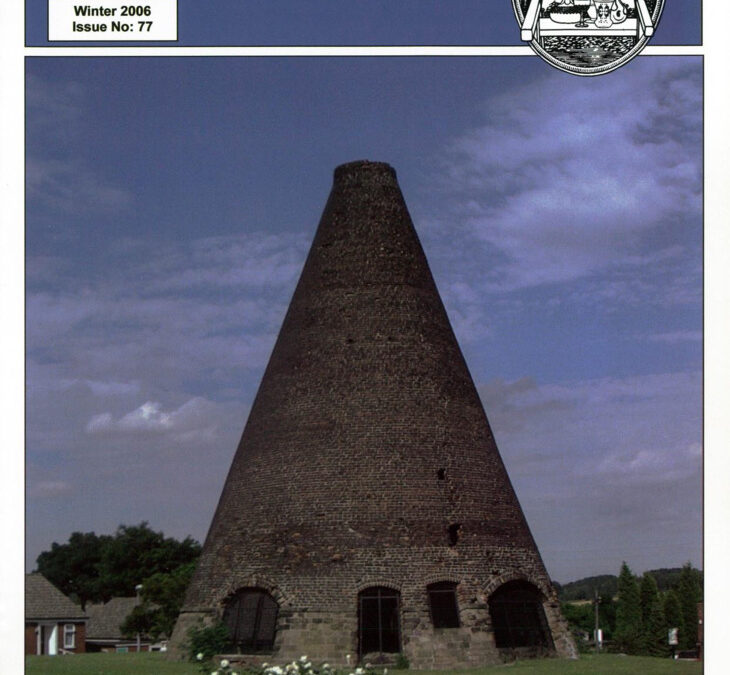
COVER ILLUSTRATION
The Glass Cone at Catcliffe near Rotherham, now surrounded by
pensioner’s bungalows. Photographed in the summer of 2006.
Brick built to a height ofsixO?feet (18.2m) with a base diameter of
about forty feet (12.1m), the Cone is a Grade II Listed Building.
The Cone can be seen from the M1 as it approaches Sheffield
from the south, (exit Junction 33 then A630 south to Catclffe);
public transport from Rotherham bus station, number 132.
2
CATCLIFFE GLASS CONE
Glass cones were a common sight in the major
glassmaking centres of Britain during the 18′
h
and 19
th
centuries but
during the 20
th
century many were demolished or reduced in height
or collapsed with deterioration. Today only four complete 18
th
century cones survive as silent witnesses to a once great industry.
They are at Wordsley near Stourbridge, at Catcliffe near Sheffield,
at Lemington on the banks of the Tyne near Newcastle-upon-Tyne,
and at Alloa near Clackmannan. Of the four, the Catcliffe Glass
Cone is claimed to be the oldest, dating from about 1740, and
originally was one of two on the site
(Front cover).
The Catcliffe cones were part of the thriving South
Yorkshire glass industry in the 18
1
and 19
th
centuries and continued
in operation until 1901. The glasshouse was started by a William
Fenny (c.1700-1789) who was the works manager at the
neighbouring glassworks at Bolsterstone
(P1.1).
The Fenny’s were
P1.1.
Plan of the Catcliffe glassworks showing shaded areas
denoting the site of the other cone and the remainder of the works
buildings. Featured on the interpretation panel at the Cone site.
Courtesy Rotherham MBC.
an important local glass family and Joshua Fenny, probably
William’s brother, leased and operated the Rothwell Haigh
glassworks, south-east of Leeds in 1726, making flint glass and
bottles. William Fenny improved the quality of glass made at
Bolsterstone to such an extent that one historian writing in 1779
records that Fenny’s products
“were carried to London and other
places and sold at higher than market price by the name of London
glass or some other name”.
Fenny had married Mary Fox, the
daughter of the glasshouse owner, but there may well have been
some animosity between him and his mother-in-law. Fenny had
planned to set up his own business at Bolsterstone but on his
mother-in-law’s death, the terms of her will prevented him from
doing so within ten miles of Bolsterstone. In 1740 he moved to
Catcliffe, ten and a half miles away, with other workmen and began
to make bottles and window glass. A document dated 1755 records
that the Catcliffe works supplied the Wentworth Estate with
900 square metres of window glass at a cost of O. 15s.0d. Fenny
was succeeded by the wealthy May family in 1759; the Baines
Directory of 1822 lists Joseph and Thomas May as Glass
Manufacturers. By 1833 the works was run by the partnership of
Thomas Blunn, a glassmaker, and Henry Booth, an iron and steel
magnate, trading as Blunn and Booth and making flint glass and
bottles. From 1856 until its closure in 1884 the factory was operated
solely by the Blunn family and known as Blunn Brothers. The
census of 1871 records a Joseph Ramsbottom Blunn, aged 40, born
3
in Sheffield, as a glass manufacturer, employing 17 men and
7 boys. Samuel Blunn lived next door to the factory at Rother Villa
and was recorded as a landowner. The last reference to glassmaking
at Catcliffe appears in a directory of 1901 which lists C. Wilcocks
& Co., glass bottle manufacturers, who seemed to have re-opened
the works for a short period before they went bankrupt.
After the works closed, the Catcliffe Cone had
a
chequered history. During the First World War it served to
house
P1.2
The Catcliffe Cone photographed before restoration in the
1960s. Sheffield City Museums
prisoners of war and during the Great Strike of 1926 it served as a
canteen for feeding children. By 1960 the Cone was threatened with
demolition and Sheffield City Museum organised a week-long
archaeological dig around the site
(P1.2).
As a result of the interest
generated in the excavation, an exhibition of South Yorkshire glass
was held by Sheffield Museums and the Catcliffe Cone was
restored and saved
(Pls.3&4).
The dig and the exhibition not only
provided evidence of some of the products of the Catcliffe works,
including a fragment of colour twist, but also brought forth
documented Catcliffe glass in the possession of local residents.
Particularly common were jugs, vases and flasks decorated with
opaque-white stripes which would normally be described as
`Nailsea’. Other items included two clear pressed dishes for holding
cruet bottles and a green doorstop with an internal flowerpot design.
These and other items can be viewed on the Sheffield museum web
site:
www.idigsheffield.org.uk
The first restoration of the Catcliffe cone simply stabilised
the building and made it safe. The arches and various openings
were left open to allow access to the interior. By January 2003 local
residents claimed that the building was dangerously close to
111111V
-41=111
n
The Glass Cone—Issue No: 77 Winter 2006
P1.3
The arches and openings of the Catcliffe cone after
restoration, photographed in the
mid-1970s.
collapse and that it was a target and meeting-place for teenage
vandals. The issue was discussed by Catcliffe Parish Council,
Rotherham District Council and English Heritage. At the time a
spokesperson for English Heritage said
“We are actively
encouraging Rotherham Borough Council to enter into a more
comprehensive scheme to repair the building and install
appropriate railings together with interpretation panels”.
By
January 2005 the gratings and grilles were placed over all the
openings and an interpretation panel was placed close to the Cone
with a brief history of the works and diagrams and plans explaining
how the Cone operated. In 2006 the issue of maintaining the Cone
was further raised at a meeting of Catcliffe Parish Council when a
consultant’s report confirmed that a bid of up to £50,000 under the
`Your Heritage’ scheme could be made to the Heritage Lottery
Fund. It was suggested that the bid would cover:
•
A conservation survey to identify the precise
nature and costs of restoration works that may be
required for the Glass Cone
•
A budget to carry out as many as possible of these
restoration works
•
An archaeological survey of the Glass Cone and
additional interpretation on site once the results of
the survey were known
•
Community History work with Catcliffe residents
to include provision of additional local history
resources for the local school, reminiscence work
and a community exhibition.
P1.5
Every front garden should have one!
The Glass Cone—Issue No: 77 Winter 2006
P1.4
Looking up to the opening of the Catcliffe cone,
photographed in the mid 1970s. Photo courtesy Ian Wolfenden
The decision to develop such a bid was postponed as the
Museums, Galleries and Heritage Service did not have the capacity
to develop an application until the end of 2006. In the meantime,
staff would continue to maintain a watching brief over the Cone
carrying out maintenance works where possible and reporting more
serious issues
(Pls.5&6).
Any further developments about the future
of the Cone will be reported in these pages.
Charles R. Hajdamach
References:
Vose, Ruth Hurst. Glass. Collins Archaeology 1980.
Lewis, Geoffrey D. The South Yorkshire Glass Industry.
Sheffield City Museums 1964
Lewis, Geoffrey, D. The Catcliffe Glassworks. The Journal of
Industrial Archaeology, Jan 1965, 1, no.4: 206-211. Published
by The Lambarde Press.
mi
ss
AIMINIMINEWIA
ININIV
TI
.IIIW
_
1
I., I
v
I
P1.6
“There’s a Cone growing out of my garage”
4
BIRMINGHAM CONE
ONE 3, SMAIPIT
(“),
GLASS MA INT ’13’ FACT u
ASTON JILL, 1 MII 13
–
11
‘
Xu.se..v.‘in„ 1iermzizsZan,
2/12,1″
. -AZ 7,:4;.:”.
f.”,
ri- 2
1,:777 n
7 V,
7,
4…e? eiZagr,
Print of a glassworks inscribed ‘Jones, Smart & Co. Glass Manufacturers, Aston Hill, Birmingham’, ‘Published by I. Bisset, Museum, Birmingham for His
Magnificent Directory & Grand National Register’ and ‘Hollins. del. Howe. Sct. The designer has treated the interior scene as a stage set with the theatre
curtains drawn back to reveal the drama of the glassmaking process. Probably dating to c. 1800 the exterior image of the glassworks is similar to a print of
the Aston Flint Glass Works dated 1815. As far as we know this print is published here for the first time. Height.6.5in.(16.5cm) Width.4in.(10cms).
Editor’s Collection
5
The Glass Cone—Issue No: 77 Winter 2006
ALLAN SCOTT AND HARRY MACKAY
It
is amazing how often you write about someone or
something and no sooner has it appeared in print everything has
completely changed. In my article in Glass Cone 75 I wrote about
the rarity of weights with A and H canes produced by Allan Scott
and Harry Mackay at the Caithness factory. Now, through no fault
of their own the partnership has been broken up, meaning that as
things stand at the moment it is possible that there will be no more
such weights.
Most of you will by now have heard about the demise of
Edinburgh Crystal and the subsequent knock-on effect, taking with
it both Caithness Glass and its subsidiary company Selkirk
Glass. The Administrator appointed to sort out the financial
situation made a decision to retain 10 Caithness staff to maintain a
degree of production whilst potential buyers for the business were
sought. Allan Scott was one of the 10 lucky ones to be retained but
Harry Mackay was one of the first to be released. Other
consequences were the closing of the associated Caithness factory
at Kings Lynn (ex Wedgwood Glass factory) and Selkirk
Glass. My understanding is that there was initial interest from
several parties, but in the end only one serious bid from the
company that own Dartington Glass, and after some negotiation
they are now the new owners of Caithness Glass. The factory at
Kings Lynn plus Selkirk Glass will not be reopening their doors for
business and currently the 10 retained staff are continuing limited
production whilst helping to sort out all the stock that has been sent
to Perth from Kings Lynn, the Edinburgh Crystal factory near
Edinburgh and the Edinburgh Crystal shops. As one can well
imagine the situation must be somewhat chaotic and it seems
unlikely that a decision will be made on what direction or what
form the new company will take until the whole stock situation has
been sorted out and they know what they have to sell . The site at
Perth is undergoing total redevelopment so it would seem highly
likely that the new company will be
moving to a new and probably much
smaller unit on the same site. What
happens to the collection of weights in
the Museum remains unknown.
PAPERWEIGHT CORNER
and paperweights produced in limited amounts can rival the best of
the products from other UK makers and always sold quickly despite
a high price tag. Caithness ran a Paperweight Collectors’ Society
that boasted many thousands of members worldwide and many of
those members collected solely Caithness weights so there must be
continuing market possibilities there, but when it comes to many of
the collectors that we know, Caithness weights are often totally
discounted and in many cases Caithness weights don’t form part of
their collection. I assume that part of the reasoning behind this is
the sheer numbers of weights that they have produced over the
years, in many cases in large edition sizes, with the majority of
their production based on the abstract themed weights for which
they established their name in the early days. However, over the
years they have also produced some very good and in some cases
quite different millefiori and lampwork weights. Our collection
includes a selection of weights from the early years when many of
the edition sizes were smaller though many of the designs have
been revived over the years but in different colours and with
different names. At the end of the day there is only so much that
one can do with a pattern of bubbles and coloured swirls. The
other factor is of course cost and in recent years the prices
have continued to rise to the point where it is possible to purchase
weights from other UK makers and even the lower end of the
American market which are arguably better value for money as they
are produced in much smaller numbers. By the time the next article
is due hopefully there will be news of the plans for the future.
MINIATURE PAPERWEIGHTS
To those readers who like paperweights but for whom a
collection of normal sized paperweights is not possible or does not
appeal, how about a collection of miniature weights such as those in
the accompanying illustration? As you can see the biggest weight
is only a fraction larger than the penny piece and most cost under
£20. These type of weights are often sold as dolls’ house weights
but in reality would still be too large
for most dolls’ houses unless the weight
was meant to represent a triple
magnum! They are perfect replicas of
the normal weights and therefore
involve all the same skills or in some
cases even more skills because of their
diminutive size. As far as I am aware
Peter MacDougal who, up until 2002
was the master paperweight-maker at
Perthshire Paperweights, is the
only British producer of miniature
weights, but in North America there are
at least three. Charles Kaziun Jr. was
making weights including miniatures
from the 1940’s up until his death in
1992 and I believe has been followed
by his similarly named son Charles
Kaziun III. Meanwhile in Canada
John Gooderham has been making
miniature
weights
and buttons including
absolutely amazing double overlaid
and facetted examples for over 30
years.
Being paperweight collectors
it is very easy to think of Caithness
purely in the terms of the paperweights
and ignore the vast range of decorative
and household glassware that they also
produced. These days it seems to be the
general opinion amongst
glassmakers and collectors that with the
competition from Europe and now
China the days of large scale glass
production including paperweights
are long gone and it will be
interesting to see if the new
owners consider there is a market for
any of the Caithness products which
will allow production on some level
to continue in Perth. Much of the
product range was quite good but
nothing exceptional and similar
items could be bought for less
elsewhere but the top quality glass
Richard M Giles
Key to the illustrated items (clockwisefrom the penny piece):
Complex millefiori weight by Peter MacDougal
Complex millefiori weight by Peter MacDougal
Unidentified maker but using Italian casework
Double overlaid weight with gold foil inclusion by John Gooderham
Plain weight with gold foil inclusion on blue ground by John
Gooderham
Complex millefiori weight by Peter MacDougal
Complex millefiori weight by Peter MacDougal
Facetted complex millefiori weight by Peter MacDougal
Centrepiece:
Facetted pedestal weight by Charles Kaziun Jr with gold inclusion
on blue ground.
The Glass Cone—Issue No: 77 Winter 2006
6
celebrating london glassblowing
PETER LAYTON & FRIENDS
Established by Peter Layton in 1976, London Glassblowing Workshop was
among the first hot-glass studios in Europe. Surviving the vicissitudes
of economy and fashion, the studio has developed in parallel
with the Studio Glass Movement, having a major influence
on both the British and international glass scene. In the
few short decades since its beginnings in the 1960s,
the Studio Glass Movement has evolved into a
truly international phenomenon.
a new book
celebrating london glassblowing
HALSGROVE
FREE*
POSTAGE AND PACKING
£
TOTAL ORDER VALUE
Z
L
•
1.
17
*CI
NV
19N3
NI 0383151936
‘03111
1\1
1
1 3
/(
O
CD
CD
o
Peter Layton & Friends
(published in October 2006) is a hardback, 210x260mm format book
and includes 120 colour photographs. This stunning book is available at £19.99 post free*
All copies ordered on this flyer will be personally signed by Peter Layton.
ORDER FORM
To order your copy/copies, simply complete the form below and return it, along with your
remittance, to:
Halsgrove Direct, Halsgrove House, Lower Moor Way,Tiverton,
Devon EXI6 6SS, UK. Tel: 01884 243242 Fax: 01884 243325
E-mail: sales@halsgrove.com www.halsgrove.com
All orders will be acknowledged.
Title
Quantity
Price Each
Total (£)
Peter
Layton & Friends — Celebrating London
Glassblowing — SIGNED COPY
£19.99
* UK ONLY. For orders outside the UK: Europe, please add
f5.00 per book while all other international orders should add
f8.00 per book. Please make all payments in pounds sterling.
Please debit my:
q
Visa
q
Mastercard
q
Switch
Card No•
Start date•
Expiry date:
Security Code•
Issue No:(Switch)
Amount: £
OR I enclose my cheque for £
made payable to
Halsgrove.
Name
BLOCK CAPITALS PLEASE
Address
Postcode
Telephone
PLEASE TICK THIS BOX IF YOU DO NOT WISH TO RECEIVE FURTHER MAILINGS FROM HALSGROVE. WE DO NOT MAKE OUR MAILING LISTS
AVAILABLE TO THIRD PARTIES.
f
www.halsgrove.com
This book brings together the fruits of Peter’s tireless
efforts in establishing glassmaking in the UK and bringing
the art of glass to the attention of galleries, collectors
and the general public. Sumptuously illustrated with
works from some our best contemporary
makers, and including an informative and
entertaining text, Peter
Layton & Friends
is an important addition to the
literature of contemporary
studio glassmaking
in Britain.
This superbly designed book includes essays and
contributions from a number of important artists
and experts in this field. Chapters include:
PETER LAYTON AND THE ART OF
SURVIVAL
by Dan Klein
CELEBRATING 30 YEARS OF LONDON
GLASSBLOWING WORKSHOP
by Jane Donner
EARLY DAYS IN STUDIO GLASS
by Sam Herman
THE CZECH CONNECTION
by Michael Robinson
A CATALYTIC CONTRIBUTION
by Katharine Coleman
LONDON GLASSBLOWING –
AN INSIDER’S VIEW
by Candice-Elena Evans
a new book
AN ADDICTION TO GLASS
by Peter Layton
GLASS EQUALS ART
celebrating london glassblowing
by Aleda
Goethe
BOOK REVIEW
Peter Layton and Friends, Celebrating London Glassblowing
Compiled by Peter Layton 2006
The title sums up the essence of this enjoyable book.
Peter Layton is one of the most influential people in British glass,
has been Britain’s ambassador for the medium for many years, but
the book is not just about him. Sure, there is a brief biography
written by his brother, the actor, writer and broadcaster George
Layton, but the book is much more about his contribution to glass,
to the help and support he has given and continues to give to many
young glassblowers, to his friends.
There is a short tribute from Dan Klein, Sam Herman
takes us back to the early days of studio glassblowing and Peter’s
involvement and influence. Michael Robinson writes about the
Czech Connection of the 1970s and 1980s and introduces those,
like myself, who have only known Peter’s more recent work, to
some astonishing cast work that rightly impressed the Czech
masters.
Jane Domer describes the man, his inspirations and his
glass, Katharine Coleman his “catalytic contribution” to glass, and
Alexia Goethe lightly demonstrates where Peter’s glass equals art:
not a worthy and wordy contribution to the perennial debate about
glass and art, but a simple exposition of Peter’s works of art — in
glass, or mostly.
Candice-Elena Evans, whose first real encounter with
glassblowing was when she went to work at Peter’s studio,
introduces the reader to many “friends”, and Peter himself takes up
the story, reminding us of some of the early glassmakers he worked
with, and introducing us to the installations he has been making
with Simon Moss.
The book is profusely illustrated in colour throughout with
a beautiful selection of images of Peter’s finest work, and then in
the second half of the book we are introduced to the current
“friends” working at London Glassblowing, and their supremely
varied range of quality glass.
Over the thirty years that this book celebrates there have
been some 43 associates of London Glassblowing. A few are
unknown now, the current team is still making its mark, and an
impressive number has gone on to make very successful careers for
themselves in glass. Few if any of them though have shown the
range and versatility of Peter and his work, and none has had the
influence on glass that Peter has.
This book is a genuine tribute, as David Flower writes on
the dust jacket “a wonderful man who occupies a legendary place in
glass history”. It is a book I heartily recommend.
Halsgrove Publishing:
www.halsgrove.com
RJW
ISBN 1 84114 571 8; ISBN 978 1 84114 571 6
Published October 2006, Price £19.99
Techniques of Glass Engraving (Second Edition)
Peter Dreiser &Jonathan Matcham
assisted by Katharine Coleman
The first thing that strikes you when you open this book is
that it is a book for glass-lovers. It is still a text book, though it no
longer looks like one, and it remains an essential guide for anyone
who wants to try their hand at glass-engraving, but with superb
colour illustrations of some of the finest pieces of modern engraved
glass, and improved illustrations of historical pieces, this is as much
7
a book about engraved glass as it is about engraving glass. The
student will learn how to do it and what to aspire to, the glass-lover,
collector, curator and auctioneer will learn how it was done and
admire what has been achieved.
A&C Black asked Katharine Coleman to write a book on
engraving but readily agreed that a revision of Peter and Jonathan’s
book would be so much better. Jonathan passed away several years
ago, but Peter, ill though he was, was pleased and eager to be
involved. All the contemporary work was selected by Peter from
scans on Katharine’s laptop, but finding the original illustrations
from 25 years ago proved a bit of a challenge! The text has been re-
ordered and reformatted, and chapters added on water-jet and laser
engraving to bring the book right up-to-date.
The first edition is described on www.abebooks.com as “a
landmark in the technical history of glass decoration”. This second
edition introduces a whole new dimension. It is a guide to glass
engraving for everyone. See the insert with this Glass Cone for a
special members’ offer; it is well worth taking up.
RJW
A & C Black (Publishers) Ltd
www.acblack.com
ISBN 10: 0 7136 7516 0; ISNB 13:978 0 7136 7516 0
Published December 2006, Price £35.
Miller’s 20th-Century Glass
Andy McConnell
Twentieth-century glass is a booming collecting area,
which to the uninformed can appear an un-identified mass of
complexity. With prices still affordable and great objects still
readily available the field is a perfect entry point for the new design
collector who is prepared to do some reading. However, the
potential collector should beware, 20th century glass collecting is
very addictive; the authors own collection exceeds 20,000 pieces
and he apparently lives in a glass shop.
The book includes over 2,000 beautifully photographed
pieces from very affordable and available objects to rare and highly
valuable design icons. The book is directed at the key difficulty for
collectors of identifying glass that rarely bears any marks. This is
laid out country by country in alphabetical order making
identification easy. The ‘identifying and collecting’ section gives
great tips for buying and a price guide for each piece (put together
by the author talking to glass dealers) will help you identify
bargains. Price guides, however, are a snapshot in time and should
be viewed as relative and not absolute.
The key factories are explored, each with a ‘key dates’
box and presented using visual timelines that provide an excellent
view of the company’s design development. The sections on
Holmegaard (Denmark) and Iittala (Finland) are excellent and are
the result of the author’s ability to get into previously unexplored
company archives. The sections on British designers such as
Alexander Hardie Williamson, Ronald Stermett-Willson and Frank
Thrower are also very useful and show great glass which is still
readily available.
This book is the result of two years of solid research, and
it shows. The author visited most of the glassworks featured and has
interviewed many of their key designers and ancillary staff The
inclusion of designer sketches, catalogue illustrations and
contemporary advertisements adds to overall feeling of quality and
depth.
The Glass Cone—Issue No: 77 Winter 2006
BOOK REVIEWS
continued
THE NATIONAL ARCHIVE
As an accessible guide to identifying the glass this book
really works and is a great entry point for the new collector. It even
contains some very interesting surprises for the old hacks.
Well done Andy McConnell…where do you put it all?
Graham Cooley
We have been waiting in anticipation for this much hyped
and publicised tome, which we were led to believe was going to be
the definitive book on this period. It is a noble effort but it contains
a very idiosyncratic selection of topics and only covers a very small
proportion of glass produced in the 20th century.
The first section discusses collecting by country and the
second has page features by factory, but there is a complete lack of
spreads for many of the countries discussed in the first part. There is
nothing relating to factories such as Kosta, Boda or Stromberg from
Sweden, neither are there any spreads from France,
Czechoslovakia, Germany, Belgium or USA and many of the
British factories. This may be due to lack of space with the over-
emphasis on certain designers, such as 6 pages on both Michael
Harris and Frank Thrower, 10 pages on Ronald Stennett-Willson
and a staggering 24 pages on Holmegaard.
The moment one puts pen to paper mistakes are bound to
be made but this is one of the opening statements: “It is another
appalling fact that, many, if not most, of the written descriptions
applied to glassware by dealers, particularly generalist, are false.
When challenged, some dealers can even produce a book
containing the source of their fiction!”. This is not amusing to
the many dealers in 20th century glass, who are passionately
accurate, especially those who exhibit at the glass fairs. This
comment is especially rich, as whilst going through the text one
finds numerous mistakes: Argy-Rousseau was not even born in
1878, when his work at the Paris Exhibition, according to the
author, was an inspiration for Galle; glass animals have not been
“made on Murano for 1000 years”, the glassmakers only having
moved to that island in 1292; and Timo Sarpaneva did not start at
littala in 1948 but in 1951. And that’s just to name a few.
The studio glass movement which evolved in the late
1960’s has almost been completely ignored, with no mention of the
all-important Glass House in London or The Experimental Glass Workshop in New York, both of which were inspirational to this
new group of glassmakers.
Books are meant to be educational for potential new
collectors, so what is the point of mentioning that there are many
fakes and later editions without an explanation of how to tell the
difference between the right and wrong.
I
appreciate that the emphasis for this book was to be on
`affordable’ lower value items hence there is little about Lalique,
Venini etc.. However it would have been useful to include books on
the excluded factories/designers in the bibliography.
The photographs are excellent, the key date panels act as a
quick and handy guide, and there is some new information from the
author’s extensive trip to Scandinavia which is helpful, but this is by
no means a definitive book on this enormous subject.
Jeanette Hayhurst
Miller’s 20th Century Glass
By Andy McConnell
Mitchell Beazley, ISBN: 1-84533-099-4, Hardback, 256 Pages
RRP £30 (Amazon £16.09 post paid)
Mir
The Glass Cone—Issue No: 77 Winter 2006
18th Century documents relating to minor glass
manufactories are rare survivors in the archives. However by
manipulating data in one of The National Archives most popular
databases researchers may obtain information as to the location of
manufactories, proprietors or dealers in glasswares 1384-1858.
WWW.nationalarchives.gov.uk/documentsonline
allows
remote access (via the internet) from any location in the world to
wills proved by Prerogative Court of Canterbury 1384-1858
(Document series: PROB 11). The Court of Canterbury dealt with
the wills of relatively wealthy individuals who were (mostly)
living in the South of England, though the records encompass
others throughout England and most of Wales.)
The PCC wills on DocumentsOnline are all registered
copy wills, meaning they are copies of original probates written
into volumes, by clerks at the church courts. Over the years, styles
of handwriting changed, and you will find that many of the earlier
wills are written in Latin. (The National Archives also provides in
depth learning guides to palaeography (handwriting) and Latin
through the website
liati
sato x den
Heeds I Derry
Home nOo
t itesearth,,lucaton & Search
us
us
an, extobihons
arch
Services.e
on
rot
he
,
. tin= a
two Os archives
a
Oecurnentsnelina
a Redone atone
DocumentsOnline
Dovantoulyou, hisoy_
2Weicome ?Help
&MP
q
Quick Search
1,ro,y,
[type keywords
Family History: Wills
Data range
)
Goo
mere are leo marry mages to list Pone specny olgoonalcriterieend Oct…eh to Osplay all
tnatchingimages
A.m. search,
Cleo Sea.,
b
lase NOT locking
1
0
Clear Search,
n
=,
Olsars, moo…Wm
pm_ uxncarp>son.
Obviously by doing a name search you may find an
individual you are researching but by using the ‘other keyword’
option in the search box and the terms ‘Glass NOT looking’ entries
such as the following can be found:
Will of Edward Doyle,
27 April
PROB
Glass Cutter and Dealer 1827
11/1724
See details >
in Glass of Saint Pan-
cras , Middlesex
Will of Thomas Bull,
02 Octo- PROB
Dealer in Glass and Cut ber 1827 11/1731
See details >
Glass Manufacturer of
Saint Thomas Bristol ,
Gloucestershire
Any additional term such as ‘glass AND maker’ or
subtractional term such as ‘glass NOT looking’ should be entered
in Upper Case. If the number of items found is too large searches
can also be limited by date range and by adding place names as
required.
Copies of any documents selected can be downloaded
via the internet for a fee of £3.50 per image. Visitors to The
National Archives at Kew can download the images for free.
Jane Brown
The National Archives, Kew, Richmond, Surrey KT4 8DU;
Tel: 020 8876 3444 ext 2113
Email:
jane.brownAnationalarchives.gov.uk
8
Browse categories:
Forney History
> other Records
What, newt>
Ahoy>
Research ludo>
Scanning on demand>
Word or
phrase
Date range
tOdOntn011,
yyrY)
Finn
na1110
Lae nook.
Occupation
Place
Keywords
Sgn
in le Athena>
What is thin >
ARE GLASS DEALERS NECESSARY?
Dear Editor,
As always I look forward to the arrival of the Glass Cone,
always a good read, but on reading R. Havenhand’s double-
barrelled blast at the barn door of glass dealers I felt a reply was
necessary. I believe his comments to be a gross generalisation
unfairly denigrating ALL glass dealers, when they stem from only
his personal experiences
Firstly the writer does not mention what type of antique
glass makes up his collection. If it is 19
th
century coloured wines
etc., and these were bought at the very top of the price range, then I
am not surprised that disposal is a problem. All antique drinking
glasses and related items are prone to changes of fashion and
desires of the collectors and many items of 19
th
century glassware
have shown little movement in prices for many years. However if
the writer is referring to 18
th
century drinking glasses then I am at a
loss as to how one could acquire a collection of GOOD quality
glasses over a period of 25 years and not even be able to resell them
at cost. One only has to look at auction results and sales catalogues
of well known and respected dealers to see that the retail prices of
Georgian drinking glasses have gone up in value many fold, some
by a factor of 10 over this period. It will be noticed that with the
likes of heavy baluster glasses, colour twist wines etc. that their
value today is far far greater than 10 ,15 or 20 years ago.
It is possible that if the writer was buying in a vacuum,
without reference to other glasses being offered from other sources,
that indeed he did pay far too much for them. However
I
still find it
very hard to accept that good quality glasses purchased 20 years
ago cannot return a good price today,
With regard to the writer’s comment on buying at auction,
I can only advise that if a collector’s knowledge of glass is
sufficient then auction houses can be a good place to buy. But as
always with auction rooms it is ‘Caveat Emptor’. Restoration and
repair techniques have advanced greatly making the detection of
repaired glass extremely difficult unless you have a very
experienced eye, and there is no redress for a ‘wrong un’ bought at
auction. When buying from dealers it is important to also remember
the time and effort put in by those dealers, firstly learning there
subject over decades and in sourcing good quality glass travelling
many if not thousands of miles, and that you will be provided with a
receipt stating the age origin and condition of the glass. If later it is
shown a mistake has been made then return should never be a
problem. If a premium price is being asked for by a dealer it is
because of those guarantees, not available from auction houses.
Has the writer forgotten the pleasure he has obtained from
his collection for all those years. We are, after all, only custodians
of these fine articles which will with proper care last far longer than
any of us, and give much pleasure for many more generations of
glass lovers.
Lastly I would suggest that Mr. Havenhand attend one of
the specialist glass fairs where he will find many experienced
18
th
century glass dealers who will be more than pleased to advise
him on the content and disposal of his collection, and hopefully
enable him to pursue his latest love.
Yours faithfully,
Peter Adamson,
Collector/Dealer.
9
Dear Editor,
Ron Havenhand wrote a letter to Glass Cone (Issue 76,
Autumn 2006) titled “Are glass dealers necessary”, in which he
bemoans the fact that his collection, purchased mainly from
specialist glass dealers, will not return the money that he paid for
it. Dealers, apart from their customers, are at the top of the glass
collecting food chain. People who use them must pay sufficient
money to support them in their business. In return for their
expertise, customers are assured of accurately described goods,
and they have available to them a ready collected stock from
which to choose. The dealer can keep items in stock until someone
is found who will pay the asking price. However, when the
customer eventually sells his collection, he is not selling it into the
top of the food chain, but to a much lower trophic level. The prices
at that lower level are not as high as specialist dealer prices
because the seller doesn’t have the kudos of the specialist, and the
sale is made at one time point and relies on people who will bid for
it at that time.
I have built up a very nice collection of uranium glass,
and my wife has a collection of latticinio glass. Nothing has been
purchased from specialist dealers. We enjoy the thrill of the chase.
We don’t buy our fish from the fishmonger’s slab, but go fishing
for it ourselves. The collections grow slowly, but there is nothing
to beat the thrill of finding something that you want at a bargain
price. I am grateful that there are people like Mr Havenhand, for
they support experts who are an invaluable source of reference.
For myself, it isn’t the collection that is most enjoyable, but the
getting of it, however long it takes.
Yours faithfully,
Michael K Baldwin
Dear Editor,
I do not know what field of glass
collecting Mr. Havenhand is referring to in his letter because his
statement is just not true, especially regarding 18th century
drinking glasses. I have just purchased a glass for £2200 which
was bought from Howard Phillip (always known as the top priced
dealer) in 1979 for £220. Not all examples have risen by this
percentage but I remember buying my first rummer for £8 now
selling for £65 and a drawn trumpet multi-spiral air twist for £40
now selling for £300.
These increases in value also apply to many other fields
of glass collecting. I would be happy to offer a profit on the many
items from the 19th and 20th centuries that have been though my
hands over the last 25 years.
Yours faithfully,
Jeanette Hayhurst
COPY DATES FOR THE GLASS CONE
News and articles are welcome at any time, but copy dates for the
next issues are:
Spring:
21 January
Publication:
late-March
Summer:
21 April
Publication:
late-June
Autumn:
21 July
Publication:
late-September
Winter:
21 October
Publication:
mid-January
E-mail:
editor(&,glassassociation.org.uk
rall111111111
n
111IF
The Glass Cone—Issue No: 77 Winter 2006
GLASS-SELLERS SAJLLSEYE
PRIZEWINNERS
E-MERGE 2006 AWARDS
E-merge
is
Bullseye Glass Company’s
juried biennial
exhibition recognizing kiln-glass art and emerging artists in the
field. The exhibition offers over $6,000 in prizes and finalists’ work
is recorded in a full-colour catalogue.
Miho Higashide
showed impressive work at the
Wolverhampton University exhibition at the International Festival
of Glass and it is a pleasure to report that she won the Academic
Prize with
Summer Ending Moss,
a piece that has particular appeal
to
two of
our committee
members!
GLASS-SELLERS PRIZE 2006
This year’s award went to
Colin Reid
for his fascinating
optical glass piece
Cello.
The runner-up was
Jessica Townsend,
and the student
award went to
June Kingsbury,
with
Tracy Nicholls
taking the
student runner-up prize.
Last year’s winner,
Anthony Scala
will be giving one of
the talks at the Conference at the Hub on 16 February 2007 (see the
booking form with this Cone).
EDWARD VARNIS
H
Congratulations also to
Jaqueline Cooley,
from Sutton
Maddock, who was placed second in the Functional category with
Millstone 2:
First prize winner in the non-functional category, and
winner of the Popular Prize was
Cobi Cockburn
of Australia with
Spring Grass.
Dear Editor,
Belatedly
reading my “Glass Cones” I see, in the Spring
edition, a question is raised about Edward Varnish.
Fredrick Hale Thompson and Edward Varnish registered
patent No 12905 on 19th December 1849. The patent was granted
on 19th June 1850. It was for “Improvements in the manufacture of
Inkstands, Mustard Pots and other vessels of glass” It says that “Our
invention consists of blowing glass so as to leave hollow spaces
between the sides, so the effect of silvering can be seen” It goes on
to quote the formulae for the silvering liquid which is poured into
the hollow but it does not explain how the hollow space was blown.
I have heard it claimed, as indeed your correspondent mentioned,
that the silvering was from mercury. I do not believe this to be the
case. The patent clearly indicates that silver, in the form of
ammonical silver nitrate was used. I well remember, many years
ago in chemistry lessons, doing a related experiment when silver
was deposited from a solution of silver nitrate and ammonia with
sugar.
It seems unlikely that Varnish manufactured the glass. It
has been suggested that it may have been made for him by Powell
& Sons (Whitefriars). I have only examined two examples, both of
which were sealed on their undersides with a metal disk bearing the
inscription “Varnish & Co. Patent London”. These two pieces are
made from non-leaded glass which suggests to me they were
probably not made by Powell who, at that time, was using a basic
flit with about 30% lead.
Barrie Skelcher.
A
Warm Welcome to New Members
Mrs P Berriman
Cornwall
Mrs J Kidd
Surrey
Ms A De Bathe
Bucks
Mrs J MacDonald
Dunfriesshire
Ms K Denham
Essex
Mrs V Ovenden
Jersey
Ms J Hepworth
W. Yorkshire
Miss L Ranson
Cheshire
Mr & Mrs J Hockton
Coventry
Mr & Mrs Rayner
Kent
Mr D Holmes
Nottingham
Mr P Saunders &
Bath
Ms A Curtis
10
You can see the prize-winning pieces from around
the world on the Bullseye site www.bullseyeglass.com. The
48-page exhibition catalogue is available from the site for $25
plus postage.
The Glass Cone—Issue No: 77 Winter 2006
OBITUARY: DEREK WYNDHAM PARSONS 1927-2006
Born in Wincanton, Derek moved with his parents firstly
to Chelmsford, then to Gloucester and at the age of ten to
Birmingham. After leaving school he worked in Colchester for a
short while and gained his B.A. degree in chemistry before joining
B.I.P. (British Industrial Plastics) in Birmingham. At the end of the
Second World War he worked as an Ammunitions Examiner
checking ordnance that had been returned from the various
campaigns. Part of his work involved bomb disposal and he
especially enjoyed his responsibility which allowed him to
countermand any officer’s orders in the event of an emergency.
In 1948 he met his wife Betty at the Birmingham Ice Rink
where he was slightly less technically adept than his future wife and
crashed into her on their first meeting. Married in 1951 they had
two daughters and by then Derek was teaching at Wednesbury
Technical College. From there he moved to Tipton Grammar
School teaching chemistry and obtained degrees in that subject
from the R.I.C. (Royal Institute of Chemistry) and an Honorary
B.Sc. from Aston University. After a spell as Head of Chemistry at
King Edward Camp Hill Girls School in Birmingham he worked
for the firm of Ferro at Wombourne, near Wolverhampton, doing
chemical colour matchings amongst many other tasks. But his main
love was teaching and he returned to it at the Harry Cheshire High
School in Kidderminster where he stayed until ill health forced him
to retire at the age of 58.
Even with his many interests which included geology,
solving difficult crosswords, quizzes, making home-made wine, and
music, he quickly became bored at home and applied for a job as
museum attendant at Broadfield House Glass Museum where he
worked for two years. This was to be the start of his, and Betty’s,
passion for glass collecting. While at the museum Derek and Betty
attended various series of glass lectures by a certain glass curator
and joined the Glass Association to further their knowledge of the
subject. After joining the Association their collecting began in
earnest and they made their first purchases from the first glass fair to
be organised by Pat Hier as part of the Dudley Glass Festival. The
first buys were general but their wish to collect a specific factory led
them to glass made by Bagley’s, then an under-rated factory
disregarded by most glass enthusiasts. Derek quickly amassed a
large body of information about the company from his researches
into the records including Pottery Gazette and gradually formed the
largest collection of Bagley glass. With his mathematical brain
Derek could remember every single pattern number of the Bagley
catalogue, no mean feat if one has seen the extent of the ranges
produced by the company.
In the autumn and winter of 1993 Derek, with his wife
Betty and Ann Smith-Hajdamach began to discuss the idea of
forming a Friends organisation to support the work of Broadfield
House Glass Museum. With legal advice from John Sanders the
organisation was established in 1994 with its inaugural meeting
held on 10th March.
Derek’s first job on the Friend’s committee was as editor
of the ‘Cameo’ newsletter, a post which he held until the autumn of
1997. At that stage he became the membership secretary and helped
the organisation grow quickly in numbers through his dedication
and hard work. He continued to promote the aims of the Friends
even when he had to retire from the committee through ill health.
During the late 80s and early 90s his collection was
growing steadily and he became interested in glass by Chance
Brothers in Smethwick due to his friends at the company which he
had met while working for B.P.I., a close neighbour. With the same
thoroughness he gave to Bagley Derek formed a comprehensive
collection together with a supporting file of adverts and articles
about the company. A large part of the Bagley collection was
acquired by Pontefract Museums and can be seen on display there
while the Chance collection of bent glass dishes and handkerchief
vases was bought by Broadfield House Glass Museum with a
donation from the Friends.
After disposing of the two collections Derek and Betty
began to collect studio glass with the iridescent work by Richard
Golding of Okra Glass being Derek’s special favourite. Even in his
last few days Derek was still enquiring about the progress of studio
glassmakers and the collection of British and European
contemporary glass which he so loved will be kept in its entirety.
In my dealings with Derek throughout my time at
Broadfield House I held him in the highest regard as a man of great
integrity who was passionate about the museum and constantly
supported decisions to fund new acquisitions. His research into all
aspects of glass was of the highest academic order including his
joint publication on Bagley Glass both in book and disc form, and
future generations of visitors to the collections at Pontefract and
Kingswinford will benefit from his studies. Few people get the
chance to leave a permanent mark on the chosen sphere of their
work. But Derek will be remembered not only for his pioneer work
on the collecting of Bagley and Chance glass but also for being a
supportive and loyal friend, and a caring husband and father.
C. R. Hajdamach
Derek Wyndham Parsons. Born 18th October 1927.
Died of emphysema and a weakened heart on 6th October 2006.
He is survived by his wife Betty, their daughters Karen and Olwen
and their husbands, and five grandchildren.
gMIXBITIONS,
EVENTS AND FATS
(Continued from page 12)
Centre, Cannon Hill Park
Birmingham B12
9QH from 27 January
to 14 March (0121 440 3838 or https://www.macarts.co.uk) and
then Worcester City Museum & Art Gallery, Foregate Street,
Worcester, ‘WR1 1DT from 18 May to 29 June. For full 2007
schedule details, including
Milton Keynes, Leamington Spa,
and
Stafford see www.craftspace-touring.co.uk/mitm6.htm.
0120 608 6668
hi Gateshead from 5 Jan. to 5 May is Crystal Clear:
Glassmaldng in the North East, an exhibition which chronicles
the history of the industry in the region from Roman times to the
present day, taking in early glassmaking, the industry’s major role in
international trade, the lives of factory workers, modem design and
the Pyrex revolution. See glass from Tyne and Wear Museums’
collections, loans from the V&A and items from private collections.
Mon. to Sat. 10-5, Sun. 2-5, (closed Good Friday) at
Shipley Art
Gallery,
Prince Consort Road, Gateshead, NE8 4JB.
0191 477 1495. www.twmuseums.org.uk/shipley
The 9
th
Cambridge Glass Fair
will be held on Sunday 18 February
2007 at Chilford Hall Vineyard, Linton, Cambridge, CB1 6LE.
This is a lovely venue near M 11, with plenty of parking,
refreshments, foyer exhibition, plus much glass of all periods to
buy. See website for map: www.cambridgeglassfair.com or write
Oxbridge Fairs, PO Box 7251, Bishop’s Stortford, CM23 2XB.
RW
11
The Glass Cone—Issue No: 77 Winter 2006
Many events have been posted on the GA website
(www.glassassociation.org.uk) and it is always worthwhile
checking the events and fairs page there for the most complete and
up-to-date information. Because of deadlines, it is not possible to
list all events in The Cone, though we endeavour to give a good
representative selection.
In
Bath,
Rachael Woodman has an exhibition, Dreams in
Glass, until 1 April 2007. Rachael is a well-established studio glass
artist with work in international museum collections. This display,
surveying 25 years of her work, is her first in Bath, her home since
1986. You’ll find it at the
Victoria Art Gallery,
Bridge Street,
Bath, BA2 4AT, in the centre of Bath, next to the famous Pulteney
Bridge. The Gallery is open from Tuesday to Sunday all year round
except Good Friday, Tues. to Sat 10 to 5, and Sunday 1.30 to 5.
Details on https://www.victoriagal.org.uk/ or 01225 477233.
Contemporary glassmaker Suresh Dutt has a fascinating
show at the Gallery of Craft & Design at
Manchester City Art
Gallery,
Mosley Street, Manchester M2 3JL. This runs until
29 July 2007, Tuesday-Sunday 10-5; closed Mondays except Bank
Holidays, and also Good Friday. Don’t forget the Gallery of Craft
and Design on the second floor with its 1300 objects, including
ceramics, metalwork, furniture, toys, textiles, armour and lots of
glass! Tel: 0161 235 8888 or www.manchestergalleries.org/
Suresh Dutt’s work will also be at
“Collect” 2007,
the
Craft Council’s Art Fair held at the
Victoria & Albert Museum,
South Kensington,
London
from 8 to 12 February 2007. He will
be represented by the
Grace Barrand Design Centre.
41 galleries
will present work by over 350 leading artists covering ceramics,
jewellery, silver and fine metalwork, textiles, wood and furniture.
There will be much glass; Australian glass will be presented by
Maureen Cahill of the
Glass Artists’ Gallery of Sydney,
with
some from
Australian Contemporary of Adelaide. Dan Klein
Associates
and
Adrian Sassoon
are collaborating to mount the
exhibition
“Four Decades of Glass Graduates from the Royal
College of Art, 1967-2007”.
This will celebrate 40 years of
excellence since the new spirit of glass was introduced into the
curriculum at the instigation of Lord Queensberry, then head of the
ceramics and glass department. On show will be works of graduates
from each decade (all now well-established artists), including
Margaret Alston, Galia Amsel, Laura Birdsall, Clare Henshaw,
Angela Jarman, Steven Newell, Carl Nordbruch, Clifford Rainey,
Gerhard Ribka, Bruno Romanelli, Pauline Solven, Sylvie
Vandenhoucke and Rachel Woodman (www.dankleinglass.com or
www.adriansassoon.com or Tel: 020 7821 6040 or 020 7581 9888).
There will also be glass from
Contemporary Applied Arts,
Plateaux Gallery, Galerie Helene Port*, The Scottish Gallery
and others. 11 to 5.45 every day apart from 12 Feb until 4. Tickets
£12, concessions £8, can be booked in advance. Tel: 020 7806 2512
www.craftscouncil.org.ukkollect.
Fringe – COLLECTion 2007
will take place between
3-8 February 2007 and will include events, exhibitions and talks in
venues all over the UK. Crafts Magazine will be producing a 32
page colour supplement listing all the COLLECTion participants,
which will be included in their January/February 2007 issue and
distributed from all the COLLECTion venues. Amongst glass
events on offer is
Connect 7, Contemporary European glass
Sculpture
with works by Max Jacquard, Richard Jackson, Mari
Mezaros, Javier Gomez, Angela Thwaites, Anna Matouskova &
Jaroslav Matous, from 8 Feb. to 28 Mar. 2007, Tue-Sat 11-6.
On Sat 10 February 2-4, meet the artists, talk by Max Jacquard and
Angela Thwaites — at
The Studio Glass Gallery,
63 Connaught
Street, Marble Arch W2 2AE (0207 706 3013 or
www.studioglass.co.uk).
There will be glass-blowing demonstrations on Sat
10 Feb. at 10-1 and 3-5 at Adam Aaronson’s Earl’s Court studio,
adjacent to the gallery (open Tues-Sat 10-6). Ring to book with
Zest Contemporary Glass Gallery,
Roxby Place SW6 1RS
020 7610 1900 or see www.zestgallery.com.
See
“The Heart of Glass”
with poetical sculptures by
Erwin Eisch and contemporary religious stained glass by Mark
Angus, from 5-23 Feb., 11-5, Mon — Fri, at
The Glass Art Gallery,
7 The Leather Market, Weston Street, SE1 3ER. 020 7403 2800,
www.londonglassblowing.co.uk .
Dan Klein Associates at 43 Hugh Street,
London
SW1V
1QJ offer
“Making Your Mark”,
with Christopher Ainslie,
Peter Furlonger, Jiri Harcuba & Charmian Mocatta, an exhibition of
surface decoration on glass; open days 2 and 3 Feb. and then until
24 Feb. by appointment. (0207 821 6040; www.danldeinglass.com).
March in
Liverpool?
Try the
Bluecoat Display Centre
Two,
54 Hanover Street, Liverpool L1 4AF, 10-5.30 Mon —Sat
From 3 March to the end of the month there is a mixed media
exhibition which includes work by the talented Kelko MulcaTcle.
More details on 0151 709 4014 or www.bluecoatdisplaycentre.com.
Catch up with
Peter Layton and Friends –
Sabrina Cant,
Marie Worre Hastrup Holm, Bruce Marks, Simon Moss, Yoshiko
Okada, Layne Rowe, Anthony Scala, Lucy Swift and Louis
Thompson. From 8 Jan. – 21 Feb. 2007 at the
Hub Design Centre,
Sleaford,
Navigation Wharf; Cane Street, Sleaford, Lines,
NG34 7TW; Mon – Sat 10-5, (01529 308710 or
www.thehubcentre.org) — see the flyer for details of the
Glass
Association event there on 16 February.
From 2 Mar. – 16 Ap.
the exhibition moves to
The National Glass Centre, Sunderland.
Information from the Glass Art Gallery as above.
The
National Glass Centre Snowdomes
exhibition
continues until 4 March, overlapping with Peter Layton for two
days! 10-5 daily at The NGC, Liberty Way Sunderland, SR6 OGL.
Details on 0191 515 5555 or www.nationalglasscentre.com/.
Contemporary Glass
from Kamini Chauhan, Karen
Lawrence & Michael Ruh will be displayed from 27 January to
14 February at
The Open Eye Gallery,
34 Abercromby Place
Edinburgh,
EH3 6QE, open Mon-Fri 10-6, Sat 10-4. Details from
0131 557 1020 or www.openeyegallery.co.uk.
Also in Edinburgh from 26 January to 29 April will be an
exhibition,
The Cutting Edge,
a mixed media Scottish Crafts
Touring event with glass from Ray Flavell, Keiko Mad& and
others.
National Museums Scotland, Chambers Street
Edinburgh
EH1 1JF has more information on 0131 247 4227 or
www.nms.ac.uldroyal. This exhibition will then travel to
The Dick
Institute,
1 Elmbank Avenue,
Kilmarnock,
East Ayrshire, KA1 3BU in May. 01563 554343.
Made in the Middle
is the title of a travelling selling
exhibition of contemporary craft being produced in the West
Midlands. Selected by a panel of curators, design historians, and
leading craft practitioners, 37 cutting edge designer makers are
showing their latest work, including glass artists Stuart Garfoot,
Dean Hopkins, ‘Sheldon Cooney’ & Andrea Walsh.
Midland Arts
(Continued on page 11)
The Glass Cone—Issue No: 77 Winter 2006
12