




–
The
Glass Cone
Issue No: 78 — Spring 2007
The Magazine of
The Glass Association
Registered as a Charity No. 326602
Chairman
Charles Hajdamach: chairman(iiglassassociation.org.uk
Hon. Secretary
Yvonne Cocking, 14 Southfield Drive, Sutton Courtenay,
Abingdon, Oxon, OX14 4AY
(seeretarya,glassassociation.org.uk)
Editorial Board
Charles Hajdamach (Editor), Bob Wilcock (Technical Editor),
Roger Dodsworth, Yvonne Cocking
Address for Glass Cone correspondence
E-mail to editorAglassassociation.org.uk or mail to
Charles Hajdamach, 10 Villa Street, Amblecote, Stourbridge
West Midlands, DY8 4ER
Address for membership enquiries
John Greenham, Membership Secretary,
High Trees, Dean Lane, Merstham, Surrey, RH1 3AH.
(membershipa,glassassociation.org.uk)
Committee
Peter Beebe; Paul Bishop; Brian Clarke (Treasurer); Mark Hill;
Gaby Marcon; Janet Sergison; Judith Vincent; Jane Brown.
Website:
www.glassassociation.org.uk
E-mail news & events to newsaglassassociation.org.uk
Printed by
Jones and Palmer Ltd: www.jonesandpalmer.co.uk
Published by
The Glass Association
ISSN No. 0265 9654
The opinions expressed in the Glass Cone are those of the
contributors. The aim of the Editorial Board is to cover
a range of interests, ideas and opinions, which are not
necessarily their own.
The decision of the Editorial Board is
final.
INL
FROM THE EDITORS
Following the successful Studio Glass Day at
The Hub
Sleaford, attended and appreciated by as many non-members
as members, including students from Lincoln University and
at least one professional glassmaker, the next major
Glass
Association Event
is the
Dartington Weekend
on
2-3 June,
commemorating
Frank Thrower and 40 years of Dartington
Glass.
Full details are in the flyer with this Cone, and as
tasters we have an article on Graham Cooley’s collection,
and on one of Dartington’s most celebrated former designers,
Rachael Woodman.
We hope you enjoy the articles, and look
forward to seeing many of you at Dartington in June, and at
other events, of course (C18 Glass—Telling Right from
Wrong, and Nazeing).
CH & B
W
Peter Furlonger’s An Inwar g t , acquired by Broadfield House Museum
from the Dan Klein and Alan Poole exhibition Making Your Mark (seep 8)
The Glass Cone—Issue No: 78 Spring 2008
2
1
NTERVIEW WITH GRAHAM COOLE
Graham Cooley is the Chief Executive of Metalysis Ltd.,
a spin out of Cambridge University. Graham spent 11 years in the
power industry and was Business Development Manager for
National Power PLC and International Power PLC. Graham
specialises in setting up companies, managing intellectual property
and technology development. He has a BSc in Physics, BA in Art
History, MPhil and PhD in Materials Technology and an MBA.
Graham is a collector of post war British design and
decorative art, specialising in glass, ceramics, stainless steel and
furniture. His strategy is to collect the work of overlooked or little
known designers ahead of the market and to create interest and
expand knowledge by exhibiting their work. Graham is the glass
consultant for The Price Guide Company and a founder of the
Cambridge Glass Fair. In this interview with Charles Hajdamach he
outlines his philosophy in collecting glass:
CH:
Firstly, the obvious question, how did your passion
for collecting begin?
GC: The first glass piece I bought was a Geoffrey Baxter
`T.V. screen’ textured range vase in a junk shop in Bristol. The
dealer said it was a really weird 60s vase but he didn’t know what it
was. Over the next six months I bought more similar examples then
found out that they were the Geoffrey Baxter textured range. I
pursued them for a period of about ten years, perhaps a bit less. That
was from about the early 90s. I thought it was fabulous stuff and I
ended up with nearly every design in every colour known. The
range is very striking and is easily identifiable, especially after the
Whitefriars exhibition at the Manchester City Art Gallery in 1996
and subsequently at the Museum of London. I have never been to
another exhibition that was so inspiring as the Manchester
exhibition, curated by Lesley Jackson. Most of the items were on
loan from Brian Cargill and Chris Morley’s collection and soon
after I contacted them and started to visit them in Cumbria. They
are very experienced collectors and excellent at identifying items
before the rest of the collecting world appreciate them and they
became my mentors. Then I expanded into other Baxter items but
they were more difficult to identify and I made mistakes which
ended up as other parts of the collection, for example pieces by
Ronnie Stennett-Willson.
CH: You collect by concentrating on a particular factory
and get to know the factory’s products intimately so that they
become almost part of your thought processes. In that respect you
remind me very much of the late, great collector Michael
Parkington who operated in exactly the same manner. But the
difference is that you are constantly ahead of collecting fashions.
GC: With the Whitefriars pieces I liked the correlation
between shapes and colours and I learned that way as I put the
ranges together. I buy many pieces that are unidentified, that way
they are cheap and it allows me to find out who they are made by. I
like to buy undiscovered things. I have found that I am more
interested in buying from charity shops, junk shops and antique
centres and I do not get a buzz from buying known items for
expensive amounts. My advice to other collectors would be to buy
pieces when other people think they are ugly, and eventually those
same critics will come to think they are beautiful. This can,
however, take a long time.
CH: By buying unidentified things you must have to go
beneath the immediate general collecting perception of a particular
period and see the quality before others perceive that beauty and
achievement?
GC: Another way to look at it is that if there are a lot of
things around of a similar type, then people must have bought a lot
of them at the time. They then go through a dip in perceived
desirability until people rediscover them. If your parents liked them,
those pieces go underground in a sense for a generation then
resurface. If they didn’t have a design merit they wouldn’t have sold
in their day to people going into gift shops and buying quality.
Buying unidentified things is also about having confidence in one’s
judgment but also having the confidence to make mistakes. Lots of
people on the other hand prefer the endorsement from others.
CH:• When you first see something in a charity shop that
interests you what criteria do you judge it by before buying?
GC: One thing I ask myself is how difficult was the
technique used to execute the object and how expensive were the
materials. Being a scientist, techniques and materials are important
to me. At the moment I am interested in sandblasting; the different
grades of sands and abrasives which result in different tones. I look
for complex design features such as turned under feet or turned over
rims, air stems and hand blown features like applied straps. I also
look for the use of expensive materials like gold particles, silver
chloride, fumed tin chloride iridescence and coloured lead crystal.
I buy objects if I like the design but am particularly
interested if the object is typical of its time. I also look for objects
that appear in journals of the period. This is the main process: you
go backwards and forwards between buying objects and using
libraries to identify objects. You need a good memory for shapes
and colours!
Sometimes the items you buy only gain relevance when a
small collection develops; this normally involves putting similar
items together in a corner and looking at them again and again;
sometimes it takes years to understand them. Gradually as one adds
similar items, you can see them as a group, then you search for
catalogues and documents and articles about them, and begin to
start filling in the gaps in that group. Then one day you find one
with a paper label and all is revealed.
It’s a strange and chaotic process followed by an ordered
one. When a particular group builds up the pieces form their own
significance and that’s the time to buy from dealers and eBay. The
last few pieces that complete the range can cost as much as the rest
put together. The early opportunistically bought pieces keep the
average cost down, the dealer pieces produce completeness. I think
that all sources of buying have their particular relevance.
CH.• What do you think is the effect of the formation of
large collections such as yours on the marketplace?
GC: The desired effect is that objects that you have
selected get repositioned in the minds of other collectors as people
begin to see how the designer worked and appreciate his or her
relevance for a particular period. This is why I enjoy putting on
exhibitions; it’s all about presenting objects in context and
repositioning them from junk to a desirable collectable. Large
collections also take objects out of the market and large
accumulations can make them appear rarer then they are.
3
The Glass Cone—Issue No: 78 Spring 2007
Stevens and Williams large cut vase in dark green by Keith Murray
Image courtesy of the DK Collectables Price Guide 2007
by Judith Miller & Mark Hill, www.dk.com/iudithmiller,
and taken by Graham Rae, www.graham-rae.co.uk
CH: What collecting opportunities still exist?
GC: Many of the recent collecting opportunities have
begun to run out largely due to new published material and
exhibitions. The four notable areas I have been working on which
have become thin on the
ground (or more expensive
depending on your buying
strategy) are designs by
Domhnall OBroin (who
started Caithness Glass in
1961), Frank Thrower
designs for Darlington
Crystal, Michael Harris
designs for Mdina and Isle
of Wight Glass and
Chance Glass, all of which
have slowly become
repositioned. Before that it
was the glass of Ronnie
Stennett-Willson and
before that Geoffrey
Baxter. One other group
which had been missed
was Stourbridge
progressive cut glass from
the 50s and 60s, exhibited
a few years ago by
Jeanette Hayhurst and
Nigel Benson. I think it is
true to say that many of
these areas followed your
lead at Broadfield House
Glass Museum.
A
k e y
opportunity still left is
glass designed by
Alexander Hardie
Williamson for Sherdley
and Ravenhead. One can
still find sets of six glasses
from the drawing board of
a Royal College glass and
textile designer on the
shelves of charity shops, a bizarre situation that says much for our
appreciation, or lack of it, of contemporary designers working in
Britain. By buying things by a qualified designer and using existing
adverts and original source material one can identify things and give
them a provenance.
One other thing to say, and it is not necessarily about
money, but the reason that I like building collections is that once
they go through a price hike, you can never go back. It’s like an
exciting race. Going back five years one thinks of the big
`Handkerchief vases by Chance which were regarded by many as
bits of tasteless British kitsch in poor imitation of the Italian
originals. A few collectors began buying them cheaply, then they
started to appear on Ebay and people liked them and bought them.
As soon as there is an identifiable group of objects like this they
vanish quickly from charity and junk shops. It is somehow as if by
osmosis a change of consciousness is created by the collecting
group.
CH: An important part of your collecting activity is to
share your knowledge with other collectors through exhibitions of
your glass?
GC: I love doing exhibitions; it’s the end of an exciting
process and very
rewarding. Two of my
favourite experiences are,
finding a great piece of
glass in a junk shop with a
dead spider in the bottom
and seeing the same object
in a glass cabinet in a
museum years later.
My first exhibition was at
Broadfield House Glass
Museum in 2001 when as
curator there you offered
me one of the ground floor
galleries and I showed
pieces by Geoffrey Baxter,
a smaller group by Ronald
Stennett-Willson and an
even smaller selection by
Frank Thrower. At that
time I was in the middle of
buying pieces by Stennett-
Willson and Thrower and
the subsequent exhibition
of Stennett-Willson’s work
at King’s Lynn in 2005,
and the forthcoming
exhibition of Thrower’s
glass at Darlington Crystal
in June of this year, can be
traced back to that
exhibition. I see myself as
a post-war glass collector
but since that first
exhibition I have
broadened my collecting
into other avenues, not
always glass.
CH: Many people will not be aware of the other non-glass
areas of your collecting. Can you say something about them and
how, if at all, the areas fit into one overriding philosophy?
GC: I collect ‘design’ encompassing glass, ceramics,
stainless steel and furniture. My particular interest is post war
British design; however I also study other post-war European
design, particularly progressive Scandinavian objects. I love
German and Italian ceramics and recently staged an exhibition
called ‘Fat Lava’ with an accompanying catalogue written and
published by Mark Hill.
The broadness of my approach means that I can nearly
always find a bargain. At a large antiques fair like Swinderby or
Newark I will typically buy 50 to 70 objects at an average price of
just a few pounds each.
The broadness of my approach also means that storage
space is a major issue for me. I also like minimalist modem interior
decoration; this is a difficult circle to square!
The Glass Cone—Issue No: 78 Spring 2007
4
CH: You collect contemporary documents and archive
material to support your collections. Is that something you want to
develop further?
GC: This is fundamentally important to being a good
collector. Original reference material is harder to find than the
objects themselves but when you do find reference material it adds
huge value. I have always added more value from buying a book
then the actual cost of the book; I buy old magazines and try to find
original catalogues. I recently visited the Ray Slack library and
learned a thing or two about reference material!
CH: You have known a number of the major design
figures of the 20th century. Which one have you enjoyed
interviewing the most and which one do you regret never having
met?
GC: The process of working with Ronnie (Stennett-
Willson) was the most rewarding for me and resulted in an
exhibition that gave me great satisfaction. I interviewed Domhnall
OBroin a number of times which was very interesting. I would have
liked to have had a beer with Frank Thrower. I met, but missed
properly interviewing Geoffrey Baxter, David Hammond and
Robert Welch in each case by a few weeks. Organizing a meeting
with me can prove fatal! There are a few designers I am trying to
find!
CH: Doing a glass Desert Island Discs which ten pieces
of glass would you take to your desert island and why? And which
would be the one if you could only take one?
My one piece of glass would be a nine-section Ronald
Stennett-Willson Sheringham candlestick in steel blue; the other
nine, in no particular order, would be:
Whitefriars Banjo in indigo by Geoffrey Baxter
•
Whitefriars Large Drunken Bricklayer in Meadow Green by
Geoffrey Baxter
•
Dartington Sunflower floor vase in clear by Frank Thrower
•
Lemington floor vase in Steel by Ronald Stennett-Willson
•
A Mdina Large `Axehead’ vase by Michael Han
–
is
•
Sam Herman ‘Torso’ vase with Silver Chloride
Webb Corbett ‘Random’ cut vase by David Queensberry
•
Caithness Scaraben’ decanter by Domhnall OBroin
•
Stevens and Williams large cut vase in dark green by Keith
Murray
CH: The problem with desert islands is the lack of charity
and junk shops. Would you give up collecting and find an alternate
activity?
GC: I’d probably try to amass the definitive collection of
parrot droppings.
CH: You have obviously spent a huge amount of time and
money collecting glass and other design objects; what’s your long
term plan?
It was my daughter Beth’s first birthday in February so I
reckon I’ve got another 20 years of collecting and then I’ll probably
let her decide!
Darlington Sunflower Floor Vase in clear by Frank Thrower
Image courtesy ofwww.markhillpublishing.com and taken by Graham Rae,
www.graham-rae.co.uk
(This interview took place over two sessions, in
November 2006 and February 2007.)
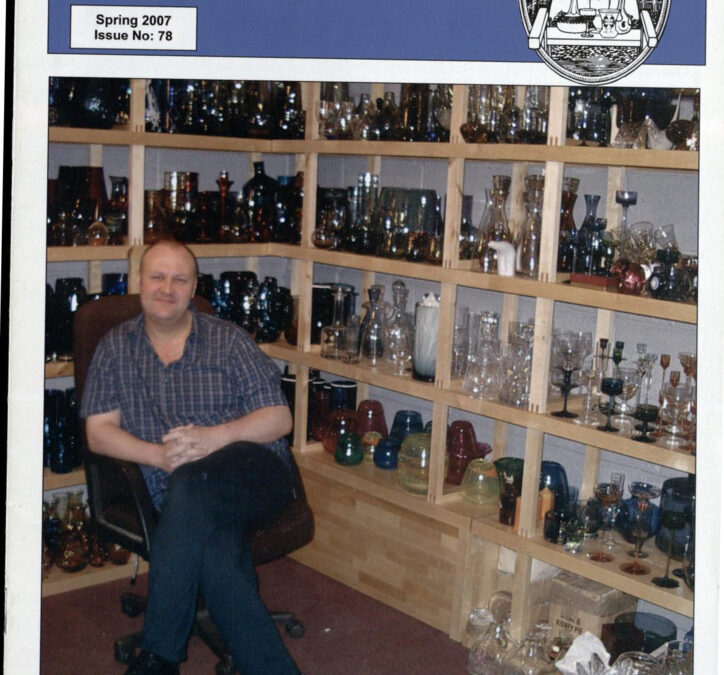
Cover Illustration:
Graham Cooley in a corner of his
glass store room showing a small part of his collection.
Photographed by Charles Hajdamach in November 2006.
•
5
The Glass Cone—Issue No: 78 Spring 2007
This year’s Co[ ]ect at the V & A was the fourth, and for
lovers of contemporary glass, the best to date. The variety was
enormous, and with one, for us, very sad exception, the quality was
outstanding. It was a feast for the eye, and good to see that many of
the big-name artists had produced some smaller works, of the same
high quality as their museum-standard pieces, but more suited to a
domestic setting and the average collector’s pocket. Space
limitations mean we are unable to illustrate as many pieces as we
would like. Instead there are a large number of links which will
take you to a lot more information and many more illustrations.
Good examples of smaller collectable pieces were the
Balance
series of intersecting slice and cone of cast and polished
transparent glass in complementary colours from
Peter Layton
and
Simon Moss
(www. peterlaytonglass.co.uk), and on the
Clare
Beck at Adrian Sassoon
stand,
Colin Reid.
On the same stand were the first of
Bruno Romanelli’s
new works,
Genubi, Shelia
and
Betelgeuse,
intriguing and
mysterious cast pieces inviting you to look in to discover their
cosmic secret (www.adriansassoon. com/glass/glassp3. asp?
Artistr6 ).
Another artist launching major new works
was Bob
Crooks
on the
Contemporary Applied Arts
stand. Most
collectors will be familiar with his
Flower, Contour
and
Mosaic
vases. He is now applying
the same fluid colours and
interacting trails to more
sculptural pieces. We were
very tempted to buy. Those
coming for the Dartington
Weekend in June will be able
to see Bob at work, and we
are sure to be in for a treat.
(www.bobcrooks.com/
new work.html ).
Australian glassmakers were well represented.
Maureen
Cahill (www.glassartistsgallerv.com.au )
had brought over works
by some young and talented artists:
Tali Dalton’s
interlocking
spirals were chosen to appear in some of the publicity material for
Co[ lect, Tony Hanning’s
large vases held a surprise — the picture
on the inside is different from that on the outside — while
Nicole
Ayliffe
applied photographic images of the South Australian coast
and beaches to flattened clear glass vessels in a highly original way.
Gerry King
showed his attractive kiln-worked
archaeological forms. A pioneer of glass studies at the famous Jam
Factory Craft and Design Centre in Adelaide, Gerry was one of four
artists explaining their work at an
Australian Arts in the UK
seminar at the V & A. He has fun with glass, and likes to make
pieces that enable people to make interpretations that aren’t in fact
in the work, for example the
“Views with a Room”
series that each
have a chair in them: why is it there, and why is it where it is? He
likes coverings that suggest an object that is not there, like a t-shirt
that takes the form of a body when it is worn, but the floor when it
is discarded.
Another presentation came from
Scott Chaseling
whose
work was on the
Contemporary Australian
stand. Scott currently
holds a Leverhulme Research Fellowship at the NGC in Sunderland
where he has been particularly impressed by the water-jet cutter. He
Bob Crooks Flower Vase acquired by
Broadfield House Glass Museum
CO[] ECT AND CO[ ]ECTION 2007 …..
The Glass Cone
—
Issue No: 78 Spring 2007
produces vessels that are a metaphor for the figure with a public
image on the outside and a private, sometimes shocking image on
the inside, using a highly unusual rolled mosaic technique to create
rounded vessels from flat sheets of glass and murrines.
Presentations from a ceramic artist and a silversmith rounded off the
seminar, very much in harmony with Co[ ]ect which features the
best in all the major media (we were particularly impressed by
some of the works of art in wood).
I do not recall French Glass at Co[ ]ect 2006 but this year
Galerie Helen Poree from Paris brought attractive cast panels by
Udo Zembok,
runner up for the 2006 Coburg Prize, and works by
Antoine Leperlier
from his
Still Life/Still Alive
series, pate de
verre fruit flowing from cast glass frames. Highly philosophical
pieces, they are very French in style and concept, and perhaps not to
British taste, but they are certainly thought-provoking (see
Dan
Klein’s
article in Crafts Arts International, No. 63, 2005 and
www.galerie-helene-poree.fr ).
Bullseye
(www.bullseyeglass.com ) not only make glass,
they are very important supporters and sponsors of glass artists, and
their stand had a very wide range of works from several artists,
including kiln-formed, blown and cold-worked glass ensembles
from Californian
Steve Klein’s
Balance
and
Lybster
series (he
taught in Northlands in 2003 and 2004).
The lady on the
Collectief Amsterdam
stand
(www.collectiefamsterdam.nl ) was wearing one of
Mieke Groot’s
necklaces. These are clearly glass, and attractive, but for me her
well-known vessels are less appealing, they could too easily be
ceramic. More interesting was the work of
Elizabeth Swinburn,
and more interesting still three large engraved bowls by Gareth
Noel Williams. He created a stir at Coburg in 2006, having moved
from his bizarre child-like figures with fabric bodies and glass
heads to engraving on the inside of straight-sided bowls, and taking
the prize for engraving. His pieces at Co[ ]ect were larger than
those at Coburg, and more deeply incised, and you will either love
or hate the pearl on the dinosaur’s nose
(Magpie),
or the leather lead
coming out of the glass to enable the interior-carved crocodile
Pet
to break out of the vessel; delightful artistic statements or a
detraction, it is for the viewer to decide.
For us, the star pieces on the Collectief stand, were the
three
beautiful
Toots Zynsky
vessels, all for sale, and each sadly
beyond our budget, but just a joy to behold.
We took a break for lunch in the new cafeteria-restaurant
in delightful Arts and Crafts rooms, then returned to a feast of
6
e, Orange
by
Oliver
Slovak optical glass at the
Plateaux Gallery
stand
(www.plateaux.co.uk ).
Vladimir Zbynovsky, Milog BalgavST,
Stepan Pala, Zora Palova
all impressed, but the star was
undoubtedly
Oliver Legit,:
perfect geometry, perfect casting,
perfect polishing, sheer genius!
Sadly the same could not be said about the
Murano
glass
at Galleria Blanchaert
next door. Visitors were giving the glass
no more than a quick glance; those looking after the stand must
have been as bored as the glass was uninspiring; Murano really
does seem to be rooted in the past not the present.
Fortunately there was quality glass elsewhere, including
two
David Reekie
heads with his usual dash of humour, and some
interesting Swedish glass on the
blas&knada
stand, such as
Anna
Carlgren’s
footed di-pyramids and triangular prisms in optical
glass on wine-glass stems (www.blasknada.com ).
Then there was the keynote display
Four Decades of
Glass Graduates
on the
Dan Klein Associates
stand. This
presented current work from thirteen graduates of the Royal
College of Art, from each decade between 1967 and 2007 and
celebrated 40 years of excellence since the new spirit of glass was
introduced into the curriculum at the instigation of Lord
Queensberry, then head of the Ceramics and Glass department at
the Royal College.
Gerhard Ribka, Angela Jarman, Clare
Henshaw,
and
Bruno Romaneffi
and
Rachel Woodman
(featured
in a separate article in this Cone) were among the artists showing
their current work. was for us the most outstanding piece. All are
well-established artists, but each has a very different appeal, and it
was fascinating to see the work of all of them together. We were
particularly impressed by
Gala Amsel’s
Sirocco 6.
Dan Klein
and
Alan Poole
have produced a catalogue of
the exhibition, only available on-line at www.dankleinglass.com/
exhibitions/COLLECT2007Catalogue.pdf and it is well worth
viewing and downloading.
Co[
]ection
2007
Linked to Co[ ]ect were a series of events and activities all
over the UK. With the notable exception of the NGC in
Sunderland, nowhere outside London put on a glass event. Some of
the London events clashed; hopefully this will not happen in 2008,
and national coverage for glass will be much better.
Sensibly before the main feast,
Dan Klein
and
Alan
Poole
hosted
Making Your Mark,
an exhibition of surface
decoration on glass by
Christopher Ainslie, Peter Furlonger, Jiri
Harcuba,
and
Charmian Mocatta.
Peter Furlonger’s calligraphy
Is so elegant, and he uses a number of different glass artists to make
his pieces, which he finds challenging and inspirational, leading to
“new discoveries”. We were pleased to learn that Broadfield House
has acquired
“An Inward Light’,
words by William Wordsworth
engraved on glass blown by
Jill Ellinsworth; it
will no doubt be on
display shortly
(photo p. 2).
Dan and Alan have produced another
superb on-line catalogue: www.dankleinglass.com/exhibitions/
MakingYourMark2007Catalogue.pdf. This is a welcome initiative,
and sure to be seen more and more often in the future.
There was another treat in store for lovers of engraving at
Zest Contemporary Glass Gallery:
A Sense of Place,
an
exhibition of the latest work by
Katharine Coleman.
The
exhibition shows Katharine’s enormous skill and versatility.
Katharine herself gave a fascinating insight into the sources of her
inspirations — from the peaceful Japanese tea ceremony to London’s
high-rise buildings; and her
City of Glass
is a breathtaking
ensemble of 5 pieces blown by
PotterMorgan Glass
to
Katharine’s design. Her unique combination of skilled engraving
enhanced by the optical effects of carefully cut and polished glass
produces magical pieces.
7
The Glass
Glass Cone—Issue No: 78 Spring 2007
The exhibition at Zest also included engraved pieces by
Alison Kinnaird,
some of them small enough for a domestic
setting, the amusing graal works of
Vic Bamforth,
and the latest
offerings of
Adam Aaronson,
who seems to go from strength to
strength (www.zestgallery.com )
ISASTER GLASSES O
A
F
Many years ago, during my days as a dealer, I came across
an engraved glass that was to lead me to investigate an interesting
social use of glass in the 19th century that has, I believe, never been
fully appreciated. My interest in this has subsequently been shared
by my friend Dr. Bill Cowan, who lives in the Northeast and I am
grateful to him for the hours he has spent delving into the local
records that reveal the background of many of the inscriptions on the
inscribed glasses we have since recorded.
The glass I found bore the following sad inscription but
gave no details of the tragedy that provoked it.
In Memory of John
& Thomas William Nobley Who Were Drowned at Barrington
Colliery Jan 9 1895 Age 11 & 8 Years’.
Had they been employed in
the colliery or had they been playing around a disused mine shaft
and fallen into it? I found it rather morbid but somewhat to my
surprise I sold it quite quickly and when, two years later, I came
across a similar glass engraved with a reference to another mining
accident I began to wonder if there was a common purpose to these
glasses.
The second glass had been engraved in a similar style to
the previous one with the inscription
‘Hetton Colliery Explosion
20.12.1860 22 Lives Lost.
This was obviously a much more serious
event which must have been publicly recorded and it did not take
too much effort to discover that both Hetton and Barrington
collieries were in the Northeast of England. Now that my attention
had been drawn to them and as I began to find more of these glasses
bearing other inscriptions I realised that it must have been common
practice in the Northeast of England to commemorate mining
accidents on glass. I could find very little published information on
the subject but they are generally called
‘Disaster Glasses’
and, after
twenty five years, I have now recorded inscriptions relating to some
The
Heart of Glass
exhibition at Peter Layton’s
Glass
Art Gallery
gave an exceptional chance to see works in both glass
and paint by the spiritual father of studio glass,
Erwin Eisch,
and
stained glass artist extraordinaire
Mark Angus
(www.londonglassblowing.co.uk )
Cast glass reigned supreme at
The Studio Glass
Gallery
at Connaught Street (www.studioglass.co.uk — incidentally the web-
site has a very good downloadable magazine). We particularly
liked
Richard Jackson’s
ice-like pieces in heavily incised clear
cast glass and monumental works by
Ales Vasicek
and
Javier
Gomez.
The gallery was packed with enthusiasts for presentations
by
Amanda Thwaites
and
Max Jacquard.
You have to admire
Amanda for casting pieces far too large and heavy for her to lift
herself! In his presentation Max coincidentally took us back to the
Australian presentation earlier in the day by Gerry King. He
showed us the incredibly detailed work that went into preparing and
making his latest casting, a girl sleeping as suggested by the drapes
over her. Questioning inevitably looked back at the tissues that won
him the Biennale prize in 2006. The clever part was undoubtedly
the idea and its execution, but Max confirmed that the hardest part
was removing all the plaster mould from the (glass) tissue!
Make a note in your diary for Co[ ]ect 2008!
Bob Wilcock
NoirtirEAST
–
ENGLAN
thirty coalfield accidents. However, the inscriptions are not all
confined to mining accidents. In addition to accidents involving
multiple loss of life and individual deaths among the mining
community other glasses record matters of more general interest to
miners, among which are miners’ strikes, wage increases and the
building of a miners’ hall
(Fig.
1).
From the consistent style of the engraving and the
glassware it is now clear that this group of glasses embraces not only
non-accidental events relating to mining but a great variety of non-
mining events; the accidental
and natural deaths of
individuals, loss of life at sea,
and public events of both
local and national importance.
In fact the Nobley brothers
inscription, referred to above,
later turned out to belong to
the non-mining group; the
two boys had fallen through
the ice on a water tank at
Barrington Colliery. Another
glass bearing the legend
`A
Serious Fire Ashington
Colliery on Saturday 19 Oct
1895′
which at first sight
might be assumed to relate to
a mining accident turned out,
on investigation, to refer to a
fire in a row of miners’
cottages. However, mining is
not the only topic recorded on
Vic Bamforth’s ‘Lobster and Pineapple
The Glass Cone—Issue No: 78 Spring 2007
8
The following are the names of two of the
unfortunate suffers who has since died.
William Macon, boy. Westmoor.
Robert Gorden, boy. 1Vestmoor.
The following are the names of the suffers who
have bees got out alive, bat severely burnt. and
there is no hopes entertained of their recovery.
Christopher Young, married, VI’estmoor.
Robert Nicholson, married, Westmoor
George Ellison, bry. Westmoor.
Joseph Ellison, married, Waggonman’s Row.
George Harding, Westmoor.
Musgrove Clark, Westmoor.
We have since heard by report that they are all
dead.
Gateshead : Printed by
ROBERT
RANKIN, 38, BottleZik.
We regret to have to record thin day (Saturday),
The following are the names of the unforusaide
.
one of those fearful colliery accident. so fatal to sufferers
:-
hnmao life, and which it seems neither skill nor
experience can prevent. The catastrophe in ques-
tion occurred at West Moor Colliery, situated
about b miles from Newcastle, the accident took
plate about I o’clock yestardayafternoon (Friday).
and was attended with loss of life. The following
are
–
the particulars which we have been able to
glean :—
Robert Cam, has left a wife and four children.
IYestmoor.
George Cray, has left a wife wed eon, Wea-
l:110W%
Jacob lledley, has left a wife and three children.
Westmoor.
Wilkens Ilay, aged
pgs,
law left a wile nod
two
children. Weetwoor.
George Hewitt, has left a wife. Westmoor.
George Campbell, has left • wife and dune
children. Westmoor.
these glasses. As a result of our researches it has become apparent
that there was a flourishing local practice, during the period 1880 to
1915, to record many local events that occurred in Northeast
England. In this article, I shall explore some of the mining
connections and save the other subjects for a sequel.
Serious mining accidents were widely reported in the
national press but smaller tragedies, like the loss of one or two men
were only reported locally, often on halfpenny broadsheets. I have
one
(Fig.
2)
which gives details of an explosion at West Moor
Colliery on October 31 1851 and the names of six miners who lost
AN ACCOUNT OF THAT DREADFUL
The inhabitants roundabout this col-
liery were ihrown into a state of great
excitement yesterday Afternoon, (Fri-
day,) about one o’clock a dreadful ex-
plosion, it appears that the unfollunate
sufferers went down the pit at 12
o’clock to work, the pit then being con-
sidered safe, as the other men had just
left their work, when all went on well
up to I o’clock, when she fired. It
seems that 6 of the unfortunate saffer-
era went to work at a place called the
Metal Coal, where she fired upon the
unfortunate sufihrers ; but by what
cause there is no one left to tell, it ap-
pears that she has fired twice before in
the same place, when it seems that
there was one man killed named Wm.
Simpson who has to be buried to-day,
but IViliam Hall Is lying in a very
precarious state.
South Wales had no glass making and although pottery was an
important manufacture there, as in the Northeast, it did not lend
itself to the immediate response to these tragedies that could be
achieved by decorating glass. It was undoubtedly the presence of
glassmaking in the area that made these inscribed glasses peculiar to
the Northeast.
Explosions, flooding and tunnel collapses were the most
common causes of mining accidents but the most disastrous
incident in the area, the Hartley Colliery disaster in which 204 lives
were lost
(Fig 3),
was caused by freak circumstances which
resulted in a change to the laws governing mining. It was
normal practice, at that time, to have only one shaft giving
access to the workings. In a large colliery this would be
divided by wooden
shuttering to allow the cage
to travel up and down on one
side while pumps on the
surface pumped air down the
other side of the shaft and
water out. In the case of
Hartley Colliery, as in many
others, pumping was carried
out by a steam powered
beam engine situated over
the pit head. On January 16
1862 the main beam of the
engine, weighing forty tons,
broke in two and one half fel
l
into the mine shaft blocking
it completely.
The only
possibility of rescuing any of
the trapped miners was to
sink a new shaft, but with no
fresh air being pumped in
and the several days it took to sink the new shaft the result was
inevitable and 204 miners suffocated. The desirability of
having two shafts had been recognised for some time and as a
result of the ensuing government enquiry legislation was
introduced that made it a legal requirement. Half of the beam
which caused the accident is in the Science Museum in London
(Fig. 4).
Most glasses refer to accidents in which a number of
miners died but a few recall individuals. At first sight the
reason why they were remembered in this manner may not be
EXPLOSION
WIII01111 TOOK PLACE AT
WEST =OR COLLIERY,
On FRIDAY, October 81,18811.
WHICH WAS ATTENDED WITH
LOSS OF LIFE.
their lives. In the 19th century the loss of life, as a consequence of
coal mining, was appalling. Haydn’s ‘Dictionary of Dates’ for 1906
recorded that
‘about 1000 miners lost their lives annually in mining
accidents between 1856-1876’.
It goes on to list hundreds of
individual accidents between the years of 1858 and 1905:
explosions being one of the commonest causes. In view of this
public acknowledgement of the national scale of the problem it
seems strange, at first sight, that it is only those accidents which
occurred in the Northeast which are recorded on glass. Several
years ago I was speaking to an audience in South Wales, where the
coal mining tradition is as strong as that in the Northeast, who had
never heard of this practice. The answer is, of course, that glass
making, as much as coal mining, is part of North-eastern history
and glass provides a surface that can easily be worked upon, with
the minimum of equipment, to provide a permanent memorial.
Fig. 4
THE BROKEN BEAM.
9
The Glass Cone—Issue No: 78 Spring 2007
clear unless they were particularly well known, as in the case of the
inscription,
‘In Memory of Robert Lancelot Booth Died 25 Nov
1891 Ashington Colliery. Gone but not forgotten”.
He was the
manager of the colliery and a man of some importance who died as
a result of a stroke. Another inscription naming an individual
revealed, on investigation, a truly dramatic story.
‘Robert
Richardson Rescued alive after 91 hours peril’ on a small jug turned
out to be connected with another glass bearing the legend
‘The
Sacriston Disaster 3 miners entombed November 16th 1903’.
Richardson was one of those three men; he survived against all the
odds but the other two died. His extraordinary rescue made
national news and prompted an article in Wide World Magazine.
Of the eight men working in the mine when it flooded five managed
to get clear and little hope was given for the other three but
Richardson was recovered alive after 91 hours by a team led by
Wm. C. Blackett who was a mine agent, colliery engineer,
explosives expert and a Captain in a Volunteer regiment. Although
it was considered risky he had a temporary dam erected to hold
back the water, entered the mine and, as the water level dropped
enough to provide some air, gradually managed to penetrate the
shaft until he heard Richardson respond to his shouts. Richardson,
detached from the other two, had found himself in an air pocket
where he turned his coal tub upside down and, before his lamp went
out, constructed on it a platform of planks to keep him clear of the
water. He had lost track of time and had given up hope when he
heard the sound of his rescuers. Blackett had remained
underground for all but an hour of the time it took to find him and
was hailed as a hero. He went on to become a Col. in the T.A.,
commanded a regiment during WW I, received an Hon. degree
from Durham University and became Deputy Lt. of Co. Durham in
1918.
This was not the only occasion on which Blackett was
involved in rescue operations and he kept a scrapbook of his
exploits which gives the impression that he was aware of his own
importance. In a copy of a long letter detailing the saving of
Richardson he relates that when he found him alive he thought he
was too weak to take soup so went all the way back to the surface to
fetch him a flask of Bovril. It is perhaps a little strange that it was
Richardson who was commemorated on glass when it was obvious
that it was Blackett who was the hero of the day. Perhaps a glass
with his name upon it will come to light one day?
What of the glasses on which these events are
commemorated? The majority are small, cheaply made pub glasses
with round bowls and plain stems and feet; the sort of glasses which
can still be found, undecorated and modestly priced, at most flea-
markets. Other types of glass were also used, including pressed
glass. I have seen inscriptions on tumblers, tankards and goblets
both pressed and blown as well as jugs (large and small), vases and
sugar bowls. They all date from the last quarter of the 19th century
and the early years of the 20th century. For most of the period
during which these glasses were produced the engraving is
generally of indifferent quality in cursive script. However, there are
enough variations in spelling and the style in which certain letters
are formed to suggest several hands at work. The glasses relating to
the Nobley brothers, referred to at the start of this article, bear
The Glass Cone
—
Issue No: 78 Spring 2007
witness to this. We have recorded two versions of the name;
Nobley and Noble. Most glasses have the name Nobley and the
birth and death certificates of the boys confirms this. However, the
Newcastle Daily Journal reported the name as Noble so one may
assume that the engraver of the ‘Noble’ glass took his information
from the newspaper report
(Figs. 5&6).
From about 1900 inscriptions began to appear in upper
case letters as on a tumbler commemorating the Woodhorn Colliery
disaster on August 13, 1916 when 13 lives were lost
(Fig.
7). The
inscription commemorates the most recent accident of which I have
any record. The engraving generally gives details of the event on
one side and bears a stylised fern or clover leaf on the reverse.
Occasionally a pious quotation such as
‘In the midst of life we are in
death’
or
‘Gone but not Forgotten’
appears on the reverse.
The fact that this was all cheap glass leads one to question
the market it was made for. They hardly seem important enough or
of good enough quality to be worth displaying alongside the wealth
of decorative glass that garnished most Victorian homes. The most
popular theory to date is that they were produced and sold to
provide financial assistance to the dependants of those who were
killed in an accident at a time when there were no state benefits;
rather as we have flag days today. If this was the case it raises a
number of questions that have yet to be satisfactorily answered.
What organisation was there in place to commission the purchase
and engraving of the glasses? How were they distributed and sold?
Who had the responsibility for collecting the money and deciding
who should receive it? The relief funds started as a consequence of
major disasters such as that at Hartley Colliery raised so much
money from the public at large that they still had large balances
many years later when the last of the beneficiaries had died.
Miners’ Lodge records do record functions like concerts, dinners
and dances that were promoted to raise local relief funds but
extensive research has produced no evidence that these engraved
glasses were connected with any charitable intention and unless
some documentary evidence or reliable family tradition comes to
light
I
am of the opinion that they were produced as commercial
ventures by engravers to meet a local demand for mementoes or
commissioned by families to record the passing of a family
member. I know of one instance, handed down through a family, of
engraved glasses being presented, as souvenirs, to the members of a
mine rescue brigade for their efforts at a particular colliery accident.
John Brooks
10
PAPERWEIGHT CORNER,
CAITHNESS MUSEUM COLLECTION
In my last article I mentioned the uncertain future of the
collection of weights that were in the museum at the Caithness
Glass visitor centre at Perth. My query was answered at the
beginning of December with the arrival of a postcard from a fine art
auctioneers in Nottingham announcing the sale of the collection on
behalf of the administrators on Tuesday 16th January 2007. It will
be very interesting to see what prices are realised. As I mentioned
last time, there is a large worldwide collectors club with dedicated
collectors of Caithness weights, but amongst the wider public the
weights are generally not rated that highly. I have seen the museum
collection on past visits but not in recent years. However I seem to
remember that although incomplete it was pretty comprehensive,
though from reviewing the catalogue there appear to be quite a few
gaps. From reports, the market for glass would seem to be fairly
depressed at the current time so my guess would be that many
people will be after the same weights so prices for those could go
quite high, whereas other more ordinary weights could be available
at bargain prices. By the time of my next article all will have been
revealed.
MINIATURE PAPERWEIGHTS
Having done the feature on miniature weights last time
and included weights made by John Gooderham from Canada in
the photograph, once again events have overtaken me, with his
death on New Year’s Eve. He was in his late seventies and probably
best known for his millefiori buttons that he made in a variety of
patterns and colours, and these can be obtained from specialist
dealers, but the amazing double overlaid weights in the photograph
are currently almost impossible to find and will obviously become
even rarer now that he has died. I had the chance to add one to my
collection last year but didn’t grasp the opportunity so I shall have
to be satisfied with the millefiori button that I did have the foresight
to purchase some years ago.
It is always sad to report the loss of a very talented glass
artist, but over the past few weeks some friends have discovered
another glass button maker in Florida
called Mary Graumond who they have
persuaded to turn a button into a
paperweight by leaving out the wire
hook. From the photographs that I have
been sent they appear to be very good,
with a range of subjects including a
snowflake, parrot, shamrock, millefiori
canes and even a three-dimensional
snowman, so I look forward to learning
more about her and seeing more of her
work in the coming months.
1951 FESTIVAL OF BRITAIN
I have recently bought my first weight off eBay! For those
readers who are aware of my lack of computer skills this statement
might cause some amazement, so I will hasten to add that I didn’t
actually do the online bidding. A friend kindly did that on my
behalf and all I did was send off a cheque once the auction had
closed and I was informed that the weight was mine.
Commemorative glass and paperweights in particular have always
been of particular interest to me, as they can be tied back to a
particular event or time in our social history. The Festival of Britain
Exhibition was held on the South Bank in London in 1951, and I
11
know that I was taken there as an eight year old by my parents, but I
have to admit that I have only scant memories of the trip. I seem to
remember standing and staring up at the Skylon, which was a long
slim vertical structure pointed at both ends and suspended in the air
by wires. I think that that this structure remains foremost in my
memory because around that time I entered a children’s painting
competition sponsored by the chocolate maker Cadburys and I did a
painting of the main exhibition hall alongside the Skylon. Of the
exhibition I remember nothing, which is a shame, as I have might
have seen the two paperweights that were made to commemorate
the event. An example of one of these was the item that came up
for auction on eBay. I know of two other similar weights that are in
friends’ collections, but I have never been lucky enough to find one
for myself They were made in Murano, and comprise a circle of
large complex millefiori canes with a clear glass cane in the centre
though which runs white lettering reading LONDON 1951 set on a
multicoloured base and encased in clear glass. How many of these
weights were made is unknown, they are certainly not what you
would call top quality, but nevertheless remain an interesting and
different souvenir of that event because most of the other
commemorative glass items were of the press-moulded variety.
The other weights assumed to have been made for that event are
those featuring concentric millefiori rings with a single cane in the
centre that reads ‘Triplex 1951’ and made by Whitefriars.
Until a few years ago the first English examples of
modem millefiori weights were thought to be the similar examples
made by Whitefriars for the 1953 Coronation, but eventually
examples of these Triplex weights have come to light, plus an
ANIL.
to be 1951. The link between Whitefriars and Triplex is unclear but
Whitefriars were experimenting with toughened glass around that
time and Triplex were major manufacturers of toughened glass for
car windscreens. Once again the exact number of the Triplex
weights made remains unknown but is thought to be fairly small. I
was lucky enough to get the opportunity to purchase one some
years ago and that time I didn’t hesitate, so both weights are shown
in the accompanying photograph, along with the Coronation
weight.
Richard Giles
The Glass Cone—Issue No: 78 Spring 2007
example of another
similar weight
commemorating a
Royal Visit to
either the factory or
the exhibition with
an indistinct date
that is also thought
Rachael Woodman is
one of the UK’s best-known
and most respected
glassmakers. Unusually, she
has as much a reputation for
her skills as a designer for
commercial production —
particularly at Dartington
Crystal where she was engaged
for nearly 20 years — as she
does for her elegant and
sensitive art glass. The two
roles have proved inseparable
in many ways. She says ‘I
enjoy the freedom I have to
move between industrial design work and studio work and find no
conflict in this. Indeed the opposite is true, the two strands of my
work running parallel and often overlapping!’
After four years on glass courses at Bristol and North
Staffordshire Polytechnics, followed by a period at the celebrated
Orrefors Glass School in Sweden, Woodman completed her studies
by graduating with an M.A. from the Royal College of Art in
London in 1984. With this varied training in glass-blowing and in
the cold-working techniques of cutting and grinding she had learned
the skills she needed to control her glass to match her highly tuned
vision.
Three key influences may be traced in Woodman’s glass.
Her time as a student in Sweden in particular and also in Denmark,
provided two early yet lasting lessons. The famed success of
Scandinavian design, driven by sound principles of functionality
and beauty were thoroughly absorbed. Throughout her career this
well-learned lesson has underpinned her highly successful
stemware for Darlington Crystal and, more recently, for other
companies. Equally, in her individual, studio work she also
demonstrates a sound appreciation of form and volumes. In Sweden
she was introduced to two techniques that are specialities of the
Orrefors works. ‘Great’, the complex and demanding method of
internally decorating that was invented at the glassworks in 1916
was made there under conditions of secrecy for many years. In
1991 Dartington presented a ‘studio collection’ for which
Woodman designed a charger with a splendidly orange centre and a
rim in the ‘great’ technique. More importantly though, she acquired
a life-long adherence to the technique of cased glass, known in
Sweden as
overfang
(overlay). This method of wrapping glass in
different colours, one layer
over another, has underpinned
her individual art for the whole
of her glass-making life.
The third vital
influence in Woodman’s art is
her Christian faith. Her belief
informs everything she does; it
sparks ideas for subjects, it
suggests titles.
Like many artists,
Rachael Woodman has found
an exploration of the vessel
absorbing and infinitely
The
Glass Cone
—
Issue No: 78 Spring 2007
productive. Others artists
whose own exploration of such
apparently simple a form has
been similarly rewarding are
British artists Tessa Clegg and
fellow glass-blower Jane
Bruce, and further afield, Ann
Robinson in New Zealand and
Dante Marioni in the US. Each
of these has followed a
distinctively individual path of
discovery and Woodman’s has
been as specific to her personal
aesthetic as any of these.
In 1985, a year after she
graduated from the RCA, Woodman set up Wilkin & Woodman
Glass with Neil Wilkin. The two worked symbiotically. Neil
Wilkin was the specialist glassblower in the partnership while she
concentrated on the cutting, grinding and polishing skills that she
had worked so hard to perfect. Woodman explained that her bowls
were ‘free-blown in order to maintain purity of form, but the cutting
and bevelling enable me to make decisions that would be denied to
me in the hot glass stages’?
Her artistic journey took her into a series which became
known — rather prosaically — as ‘Bevelled Bowls’. This plain
description hardly does justice to the mysterious depths which
Woodman achieved, in skilfully employing the ‘overlay’ technique.
The sense of wonder that is intrinsic to the material was multiplied
layer-by-layer, and enhanced by her choice of complementary
colours. The depth seems magical, revealed as it is by the cut and
superbly polished broad rims.
She said: ‘This is the challenge, to make the perfect piece,
the most beautiful bowl’.
3
This series kept her occupied for some
years as she continued to respond to this personal challenge, and
also satisfied the demand by collectors. But by 1990, even as she
still felt these words to be true, she was also moving on. At first the
bowls were stretched into ‘vases’ perhaps nearly a metre in height,
and then they were taken apart altogether.
Woodman began to assemble these new forms in groups,
creating in each case a ‘still life’. Her skill in composing these
assemblies grew until by now it has been honed to a level of
refinement matched by few others. At its most simple, a group
might consist simply of a bowl and one tall, tapering ‘vase’. But in
their quiet introspection, in the
affectionate tension between
the two, in the subtle
complementing of greys and
blues, or a rich earthy orange,
they deliver an almost audible
interaction. Their silence
speaks. While playing with
such assemblies, Woodman
continued to investigate,
unpick, and re-present her
trademark forms.
This de-construction was done
with the carefulness that is
typical of Woodman’s work.
12
RACHAEL WOODMAN
She began by ‘taking apart’ the overlay, thus separating the
individual elements into a wider artistic vocabulary. Freed-up, she
has been able to use them afresh in a multiplicity of ways with no
sign of dwindling inventiveness. Tiny bowls were gathered like
clusters of egg-shells and nestled in one large dish, or held within
one large, enclosing bowl,
‘Safe Within’,
or lined up like a precious
cargo in
‘Canoes’ .
Sometimes they were threaded with
shimmering colour and for a while, almost controversially, they
were made in white and gold. Others were in strong red and black
or in translucent glass, barely tinged with colour. All of them
seemed to have started life as the single-coloured, cup-shaped, very
centre of the bevelled bowls.
ideas and her always-present single-mindedness we see it becoming
something very much more – a very personal art that can speak to
all of us.
Jennifer Hawkins Opi
CV for Adrian Sassoon, 2006.
From a number of statements dated February 1986; Victoria and Albert
Museum records.
Rachael Woodman/Jane Beebe. New Work 1990; Glass Designs Gallery,
Bath.
Psalm 130, verse 6; Rachael Woodman Glass; Contemporary Applied Arts,
2001, reference given in a text by Lesley Jackson accompanying the
exhibition.
The tall shapes too were subjected to this treatment. They
had already come into being as the bowls pulled vertically and thus
the
‘Guardians’
and then
‘Empo/ Vessels’
evolved – sometimes
numbering up to 40 or more in a group. One of the most beautiful
and intense of these highly refined concepts was the series in which,
no longer as overlay but instead, as with
‘Safe Within’,
one tall, slim
shape was held within another, transparent and only slightly wider.
The tension is due as much to their extreme height as to the
obviously risky business of lowering one inside the other. Called
`Watchmen’
this title reminds us of Woodman’s committed faith,
the third key influence on her art. It is taken from: ‘My soul waits
for the Lord more than watchmen wait for the morning’ .
4
She continues to add to her personal language. Most
recently, works like ‘
Vertical’
were begun in 2001 and
‘Chosen’
emerged in 2005.
‘Vertical’
is another play on attenuation, but
unlike the 3-dimensional
‘Guardians’,
these are flattened and
virtually 2-dimensional. In vividly singing colours, they are
reminiscent of broad-brushed stripes of paint and yet their glowing
presence could only be of glass.
‘Chosen’
achieves the same
impact yet through a very different formal solution. Completely
enclosed bubble-like, in the most luscious colours these bulging
shapes are balanced one atop the next, like exotic pebbles on a
wonderland beach. In a return to the precious treasure of the
`Canoe’
cargoes, the top-most, smallest pebble is often in gold.
More development
may be confidently
expected.
The
instant appeal of
glass will always be
in the visceral
response that this
most versatile and
beautiful of materials
naturally draws from
the viewer and
Rachael Woodman
is supremely skilful
at manipulating this.
But with her sense of
form, her pleasure in
colour and her
disciplined control of
detail, in her hands
glass takes on an
even richer life. In
understanding the
step-by-step
progression of her
This article first appeared in the catalogue for the Exhibition
“RachaelWoodman—Dreams in Glass” at Victoria Art Gallery
Bath from 18 November 2006 to 1 April 2007. Text and
illustrations are reproduced by courtesy of Adrian Sassoon.
The full catalogue is available on-line at https://adriansassoon.com/
rwcat06/assets/rachaelwoodmancat.pdf
13
The Glass Cone—Issue No: 78 Spring 2007
LETTER TO THE EDITO
Dear Sir,
I read with interest your comments in Glass Cone 77
regarding the submission of queries for publication. I have dithered
over asking for help on two items that I acquired several years ago
and would appreciate the views of members.
Item 1 is the glass carafe of which I enclose two
photographs and a photocopy of the illustration taken from your
own book of the plate in the Art Journal catalogue. My question is
simple; was the carafe and tumbler put into commercial production?
The piece I acquired several years ago for a termer bears a striking
resemblance to the piece illustrated allowing for any simplification
on the part of the illustrator. The foot underneath is cut in the shape
of a garter star and the optic effect can be seen in the photograph
and illustration. The engraving of the fuchsia is very well carried
out and matches in most instances that in the illustration in the Art
Journal. In particular the looping branches on the neck of the carafe
are quite distinctive.
I found the carafe on a stall of dross and I knew I had
seen it or something similar illustrated. After a search I came across
the Art Journal illustration in your work and then checked my own
copy of the Journal. Sadly the tumbler was not with the carafe. So,
is this by J.G. Green or is it a plagiarised copy? Any thoughts would
be appreciated.
Item 2 is a tall Victorian goblet with a dumb-bell stem.
The engraving is entitled ‘The Breakdown’ showing a coach that
has crashed, a gentleman shaking his fist, and what is not noticeable
in my photograph is a further coach disappearing into the distance
at the top left hand corner of the scene.
What I am seeking is the source of the print the scene
was taken from. I believe it relates to an elopement to Gretna Green
and is one of a series of illustrations.
I know one other glass exists of this shape with the
same shaped panel and floral engraving around it. It was illustrated
in an article in an antiques magazine but I cannot trace the article.
The caption on that glass was along the lines of the getaway or
escape and showed the couple leaving a house on the first stage of
the journey. This suggests a series of glasses may have been done .
Do any members have any knowledge of further glasses?
I hope that these queries may engender some interest
and apologise if they are not the sort of contribution that you are
seeking.
Yours faithfully,
Russell Stephenson
(Address supplied)
Dear Russell,
This is exactly the sort of query that we like to publish
especially when it involves such rare items.
I have no doubt that your carafe is the one illustrated in the
Art Journal or from the same service. The Neptune jug on the left of
the group is in the collections of the Victoria and Albert Museum
and is illustrated on page 79 by Barbara Morris in her book
Victorian Table Glass and Ornaments.
Your carafe is therefore only
the second item to have been discovered, as far as I know, from this
important group of glasses. I am certain that it dates from 1851
period and not a later plagiarised copy. There would be little gain for
a later engraver to attempt to fake one of the smaller items from this
service. Without having any records from the company it is
impossible to say how many of these items may have been put into
commercial production, and in any case, existing pattern books and
records from other companies show that no record was kept of how
many items of a particular pattern were made. However the
circumstances surrounding the Crystal Palace suggest that a sizeable
number must have been produced. Fashionable visitors to the
exhibition would have wanted to own pieces on display and to have
the kudos of using them at home for dinner parties and the like.
Clear engraved glass became the height of fashion after the
Exhibition providing an eager demand for glass like your carafe for
the next decade.
From existing letters we know that the London firm of
J.G. Green were obtaining glass from Richardsons in Wordsley but
they must have also been using other suppliers probably nearer to
home. The only unknown fact therefore with your carafe is whether
it was made and engraved in Stourbridge or in London. Whatever its
origin there is no doubt that the engraving and the cutting on the foot
are of the highest quality, and fit to be
shown at the Crystal Palace Exhibition.
To own an item that may well have
been shown at that amazing exhibition
must give you a special thrill.
Congratulations for spotting it in the
first instance.
On the question of the goblet I am afraid
I cannot throw any light on the other
goblet or the series of prints, but I hope
our knowledgeable membership will
come up with the information you need.
We both await their replies.
Yours sincerely,
Charles Hajdamach
The Glass Cone—Issue No: 78 Spring 2007
14
BIRTHDAY CELEBRATIONS FOR DARTINGTON
STILL LOOKING GOOD AT FORTY!
The Beatles, Free love, the twist, a man on the moon and of course… the birth
of Dartington Crystal! Pay homage to the swinging Sixties and raise a celebratory glass
to Brit-favourite Dartington – the only remaining large-scale manufacturer of crystal in
the U.K.
For 40 years Dartington has produced the highest quality hand-blown crystal
homewares, achieving popularity among a worldwide fan-base of customers. Flying the
`Made in England’ flag, Dartington’s range reflects the functional and decorative needs of
any home.
Commemorate the best of British with the large special edition ‘Sharon Fizz
Flute’, inspired by the classic Frank Thrower design which has already been given
accolades by the V&A Museum and The Design Council, not to mention thousands of
proud owners throughout the world. In addition Dartington are reproducing the classic
FT15 ship’s decanter now with matching port glasses.
A pair of Sharon Celebration Flutes costs £50, Ships Decanter £85 and a pair of
Port Glasses just £30. All items available worldwide from Dartington’s online store
www.dartington.co.uk
or in high street in department stores and leading independent
kitchen and home shops, and of course at our factory shop.
www.dartington.co.uk (01805 626262)
Dartington look
forward to welcoming
the Glass Association
for the weekend
2-3 June
Book now using the
form with this Cone
15
The Glass Cone—Issue No: 78 Spring 2007
Mb
EXHIBITIONS, EVENTS AND FAIRS
The Grove, Chandler’s Cross,
Hertfordshire, WD3
4TG is an
hotel with many sculptures indoors and out. Their garden sculptures
include works by
Neil Wilkin,
with his series of Sun Catchers,
anchored in ponds on The Glasshouse terraces , which sparkle and
twinkle when catching rays of sunlight. Hotel 01923 807807 or
www.neilwillcin.com/
Should you be planning a trip to Ireland this summer
don’t miss the exhibition at the
Craft Gallery of the Crafts
Council of Ireland,
Kilkenny from 11 August to 30 September
2007 –
‘The Light Fantastic: Irish Stained Glass Art Since the
Arts & Crafts and Celtic Revival styles of the late 19th century
and early 20th centuries’.
Irish stained glass has been renowned
worldwide for its innovativeness and high quality. This art form is
no less alive today, and by bringing together the work of 13 leading
Irish glass artists this exhibition focuses attention on the use of
stained, painted and etched glass for the domestic interior.
www.ccoi.ie/ Tel: +353 (0)56 7761804 or awhitty@museum.ie.
Whilst in Ireland perhaps a visit to National Museum of Ireland –
Decorative Arts & History, Collins Barracks, West Block, Benburb
St, Dublin 7 may appeal. www.museum.ie/
New Creators
shows glass and ceramics by young artists/
potters who have recently graduated, including work by Rachel
Cross, Emelye Davis and Kate Oliver. At
Towneley Hall Art
Gallery & Museum,
Towneley Park,
Burnley, BB11 3RQ, from 3rd March to 15th April. 01282 424213.
www.towneleyhall.org.uk
Belated congratulations to
Broadfield House Glass
Museum,
Compton Drive, Kingswinford, West Midlands , DY6
9NS which was voted Best Small Visitor Attraction in the Heart of
England Excellence in Tourism Awards in October. The Museum
has treats for us with
The Bigger Picture: Glass in Art,
which
runs until 20 May, showing an interesting selection of paintings,
prints and photographs, inspired by the people, places and products
of the glass industry, chiefly of Stourbridge. Most of the pictures
are from the Museum’s own collection including many brought out
of storage and on public display for the first time, while several
works are on loan from local glass manufacturer Plowden &
Thompson. Come face-to-face with John Northwood, Thomas
Hawkes and other glassmaking heroes, and contrast the historic
Interior of Richardson’s Glassworks
by Emily Hodgetts with
contemporary glassmaking scenes by international artist Lev
Vykopal. Until 8 July you can see
Cocktails of Colour: The Dale
Collection of Stuart Enamelled Glass.
Stuart Crystal, based in
Wordsley, became famous in the 1920s and 30s for their enamelled
glass with its bright palette of cheerful colours and modem
designs. This collection, amassed by the late Tom Dale over a
number of years with the help of his wife Amy, features rare and
typical examples of Stuart enamelled glass, including floral, fanciful
and geometric designs on a range of glassware, from dressing-table
sets to cocktail decanters. The exhibition includes a personal
account by Amy about the origins and highlights of the collection.
Tel: 01384 812745 www.glassmuseum.org.uk
The National Glass Collectors Fair will take place at
The Heritage Motor Centre,
Gaydon,
Warwickshire on Sunday
13th May 2007, from 10-4. The fair will include all types of glass,
from 18th Century Drinking Glasses to Contemporary Studio Glass.
As usual The Glass Association will be in attendance at this event,
selling past issues of The
Cone
and The Journal. Come for a chat!
01260 271975 www.glassfairs.co.uk
Many members will be interested in a memorial
exhibition to
Helen Munro Turner,
who was an important
influence on Scottish Glass. She taught engraving to many
students, including Alison Kinnaird, at the Edinburgh College of
Art. GA members saw her glass-fibre wedding dress at the Turner
Glass Museum at Sheffield University. The exhibition will now
take place later than originally announced, from 2-28 July 2007 at
The Scottish Gallery,
16 Dundas Street, Edinburgh, EH3 6HZ:
0131 558 1200 or
www.scottish-gallerv.co.uk
A Celebration of the Life and Times of Charles Bray
will take place from 2 April to 1 May at
Red Barn Gallery,
Melldnthorpe, Penrith, Cumbria, CA10 2DR (4 miles south of
Penrith, just off the A6). 01931 712 767, redbam@ukip.co.uk or
www.bizeraft.co.tilecbglass/. Charles Bray was responsible for
initiating the degree course in glass and ceramics at Sunderland
University. He works with glass and stone, inspired by nature. The
Upper Gallery is devoted to painting and sculpture. The Lower
Gallery concentrates on applied arts: glass, ceramics and jewellery.
Those members who did not go on the GA visit to
Corning now have a chance to see the superb exhibition that was
there, but now nearer to home.
‘Czech Glass in the Age of
Adversity 1945 – 1980’
will be from 25 April — 23 Sept 2007 at
The National Gallery, Trade-Fair Palace,
Prague.
vvww.upm.cz/
index.php?page=123&year=2007&id=71&language=en.
If you prefer France for holidays then you might like to
visit the
Centre International d’Art Verrier
(CIAV) which was
founded in 1992 on the site of the old glass works of Meisenthal
(1704-1969). As well as an exhibition celebrating work made there
in the last 15 years there is another on Art Nouveau glass by
Desire
and Francois Christian;
both run from 8 April to 31 Oct., open
2-6 daily. Desire Christian, who first worked for many years in
close collaboration with Emile Galle, later began to work
independently along with other glassmakers in his family,
producing pieces that are remarkable for their accomplishment and
the mastery of glass decoration techniques which they express.
Glassblowing demonstrations take place most days. Muss& du
Verre de Meisenthal, Place Robert Schuman, 57360 Meisenthal;
Tel: from England 33 3 87 96 91 51. The website is being
developed www.ciav-meisenthal.com
Bristol’s City Museum & Art Gallery,
Queen’s Road,
Bristol, BS8 1RL, has a permanent dedicated gallery exhibiting the
city’s Chinese glass collection – one of the most significant outside
Asia. On display are 180 pieces ranging from 2,000 year old beads
found in burials to exquisite carved altar vessels made for the
Chinese imperial household in Beijing in the 18th century. Open
7 days a week, 10am – 5pm. www.bristol-city.gov.uk/museums
01179 223 571.
Don’t forget the glass at Gateshead amongst the
Shipley
Art Gallery’s
fine decorative arts collection. For those members
also interested in ceramics the gallery has on view The Henry
Rothschild Collection, which is one of the country’s finest
collections of 20th Century studio pottery. Showing will be 75
pieces of work by major international ceramicists including Lucie
Rie, Hans Coper and Bernard Leach can be seen, alongside video
footage of Henry Rothschild talking about his lifetime spent
collecting. Both the ceramics exhibition and
Crystal Clear:
Glassmaking in the North East
continue until 5 May.
Prince Consort Road, Gateshead, NE8 4JB. 0191477 1495.
www.twmuseums.org.uk/shipley/index.php.
RW
The Glass Cone—Issue No: 78 Spring 2007
16