




The
Glass Cone
Issue No: 79 — Summer 2007
The Magazine of
The Glass Association
Registered as a Charity No. 326602
Chairman
Charles Hajdamach: chairmanAglassassociation.org.uk
Hon. Secretary
Yvonne Cocking, 14 Southfield Drive, Sutton Courtenay,
Abingdon, Oxon, OX14 4AY
(secretaryAglassassociation.org.uk)
Editorial Board
Charles Hajdamach (Editor), Bob Wilcock (Technical Editor
Roger Dodsworth, Yvonne Cocking
Address for Glass Cone correspondence
E-mail to editorglassassociation.orzuk or mail to
Charles Hajdamach, 10 Villa Street, Amblecote, Stourbridge
West Midlands, DY8 4ER
Address for membership enquiries
John Greenham, Membership Secretary,
High Trees, Dean Lane, Merstham, Surrey, RH1 3AH.
(membershipAglassassociation.org.uk)
Committee
Peter Beebe; Paul Bishop; Jane Brown; Brian Clarke (Treasurer);
Brian Firmstone; Mark Hill; Gaby Marcon; Janet Sergison; Judith
Vincent.
Website:
www.glassassociation.org.uk
E-mail news & events to newsAglassassociation.org.uk
Printed
by
Jones and Palmer Ltd: www.jonesandpalmer.co.uk
Published by
The Glass Association
The opinions expressed in the Glass Cone are those of the
contributors. The aim of the Editorial Board is to cover
a range of interests, ideas and opinions, which
are
not
necessarily their own.
The decision of the Editorial Board is final.
SUBSC
Subscriptions
for 2007/8
will become due on August.
Members who do not pay by standing order will find a Renewal
Notification leaflet inserted in this magazine which gives full details
of the methods of payment.
My thanks to those UK members who paid their subscriptions by
internet banking transfer last year. This saved time and effort and I
hope even more members will use this method this year.
John Greenham
Membership Secretary
LETTER TO THE EDITOR—
ARE GLASS DiiiiiiNEl
i
eSSARY?
Dear Editor,
In The Glass Cone Issue 76, you published my comments
on Nigel Benson’s article “Are Glass Dealers Necessary”. Issue 77
contained comments from other dealers criticising my position and
justifying their own. My point was that investment in glass should
be viewed as a very long-term investment. I have no quarrel with
the position set out by the correspondent dealers, except in one
respect, which I shall outline below. Since the views were
published, I have attempted to dispose of my collection of 18th and
19th century drinking glasses (about 40 or so) at a specialist glass
auction. The auctioneer’s appraisal revealed that I would not
recover my initial outlay but I went ahead nevertheless, because
other avenues (selling to dealers, selling at fairs, etc) had been tried
without much success. In the event, the auctioneer was right and 11
of the lots failed to sell (these were mainly 19th century items – so
Peter Adamson’s comment about them being out of fashion is
correct). But, of course, that does not help me in the disposal
process and it means that those items will now have to be re-
offered, probably at a substantial loss. With regard to the 18th
century items, most of them sold. Overall, and after deduction of
auctioneer’s commissions, I received about 55% of what I had paid
several years ago. So, if one also takes account of inflation and the
loss of interest on the money which could have been achieved
through other investment, my overall loss is probably well over
50%. So, based on my own experience, buying glass has not
proved to be a good investment, although the enjoyment factor
whilst I was collecting was undoubtedly satisfying. I have to say
that the investment issue only arose when I decided to sell and it
was not a serious factor at the time of purchase.
One thing that did emerge during the auctioneer’s
appraisal was his view that some of my glasses had been
“tampered with”, e.g. feet or rims trimmed. This came as (bad)
news to me because I had bought them from specialist dealers, with
receipts, at premium prices, and no mention was made of the
tampering at the time of purchase. All of these items came from
dealers who were members of recognised antiques trade
associations such as LAPADA and BADA. So, the question arises,
did the dealers not know about the tampering or did they choose not
to declare it? Either way, it tends to undermine Peter Adamson’s
claim about guarantees on condition etc in support of premium
prices charged by specialists. It could be, of course, that the
auctioneer’s opinion about the tampering was wrong„ but who is to
say whose opinion is right in a situation like this?
All in all, despite having lost more than half of my
money, I have no regrets. My pension never depended on selling
the glass! The collection is now history and I have some cash in the
bank. I have no quarrel with the dealers (except perhaps some
resentment over the alleged “tampering” issues, but it can’t be
proved anyway). They have a living to make and they are entitled
to put their own price on their expertise – nobody forced me to buy
anything. All I will add is that my collecting days as such are now
consigned to history. Doubtless, if I see a piece of glass I really
like, I will probably acquire it, despite the risks, although,
inevitably, I am now much more aware of and influenced by price
levels than I was previously.
Yours faithfully,
R.
Havenhand
The Cambridge Glass Fair is Mk
C
°
A
111
”
1
Please send a postcard with
offering a pair of complimentary tickets to the first
20
readers
who apply. The tickets will be for the next Cambridge Glass
Fair on Sunda 30th Se ember 2007.
The Glass Cone—Issue No: 79 Summer 2007
your
name and address on the reverse to:
Cambridge Glass
Fair, PO BOX 7251, Bishop’s Storord, CM23 2XB
Further details on www.cambrid • e lassfair corn
Directions
The village hall is to be found in Coles Lane, Linton,
Cambridge, CB21 4JS. Parking is available on the road
close to the hall.
Accommodation
If you need details of
places to stay in the
area, please look at our
website or contact us
and we will try to help.
Further information:
07887 762872
or
oxbridgefairs@aol.com
Booking and payment form for Glass Association
members
Discounted rate £35 per person
Name:
Name:
PLEASE RETURN THESE DETAILS WITH YOUR
CHEQUE MADE PAYABLE TO OXBRIDGE FAIRS
the
cambridge
fair
glass photography workshop
linton village hall
coles lane, linton
cambridge
cb21 4js
saturday september 29
th
2007
10:30am to 4:30pm
*booking form*
oxbridge fairs
www.cambridgeglassfair.com
p.o. box 7251
Tel: 07887 762 872
bishop’s stortford
e-mail: oxbridgefairs@aol.com
cm23 2xb
Oxbridge Fairs is organising this glass photography
workshop to help people learn how to get better results
when photographing glass. The course will be held at the
Village Hall, Linton on Saturday, 29
th
September and is a
one-day workshop, starting at 10.30am and finishing
around 4.30pm.
We have secured the services of Ester Segarra, a
professional photographer based in London, who has been
working with a variety of clients including designer/makers
over the last 5 years. She works regularly at the London
Glassblowing Workshop with Peter Layton.
The workshop is aimed at glass collectors and enthusiasts.
We are offering a reduced fee of £35 per person to
members of the Glass Association.
The course programme will be as follows:
MORNING SESSION-THEORY
q
The basic mechanics of photography
q
Analogue versus digital photography
q
Choice of film or digital camera and lenses
q
Use of the manual/automatic settings on your camera
q
Shutter speed and movement
q
F-stops & depth of field
q
How to create digital images using cameras or scanners
q
Understanding resolution in digital photography
q
Use of appropriate digital file types and resize for various
outputs (email, web, print)
Li An introduction to using Photoshop
q
Importing images into an image-editing program
(Photoshop) and performing simple edits
q
The basics of lighting
q
Understanding different light sources
q
Exploring the particularities of glass and how best to
photograph it
AFTERNOON SESSION- PRACTICAL
q
Resolving classic mistakes when photographing glass
q
Analysing pictures of glass and how they were achieved
q
Learning to use elements around you to improve your
pictures
q
Choice of lights and backgrounds
q
Photographing glass
q
Using your own camera to photograph your own piece of
glass
Coffee, tea and biscuits will be available during the day.
Sandwiches or lunch can be purchased from various outlets
in the village.
Places are limited to 20 so early
booking is advised
www.cambridgeglassfair.com
A NATIONAL MEETING OF THE GLASS ASSOCIATION
TWO GLASS WORKSHOPS
The Bonded Warehouse,
2 Canal Street, Stourbridge, West Midlands DY8 4LU
Saturday 3
rd
November 2007
10.00 A.M. -16.30 P.M.
The final event of the Glass Association year consists of two workshops in which
members can get a practical hands-on feel for the subject.
GLASS ENGRAVING WORKSHOP
In this workshop, members can watch Steve Piper, a notable Stourbridge engraver,
demonstrate glass engraving, and discuss engraving tools, equipment and processes
and how they have changed over the last three centuries. A survey of late Victorian engraved glass masterpieces will examine the difficulties surmounted by the
engravers to create them.
TELLING RIGHT FROM WRONG
This workshop, led by Jeanette Hayhurst, a well known dealer and glass expert, will
take members through collecting and identifying English 18
th
century glass. Using
examples from her collection Jeanette will also explain the pitfalls of identifying
damage and alterations to glass which can be found at fairs and auction rooms.
Programme
10.00
10.30 — 1.00pm
1.00 — 2.00pm
2.00 — 4.30pm
Arrival and coffee. Free car parking in Canal Street.
Glass Engraving Workshop
Buffet Lunch in the Bonded Warehouse.
Telling Right from Wrong Workshop
Members can attend either of the workshops, with or without lunch, or make a full
day in Stourbridge and attend both and meet fellow members at the buffet lunch. Tea
and coffee will be provided during each workshop. The cost of each workshop is £10
per person; the buffet lunch costs £5 per person. Please note that the workshops will
be held in an upstairs room where there are no lifts available.
Please return your booking form by 22
nd
October, with a cheque payable to ‘The
Glass Association’, to Charles R. Hajdamach, Glassmakers Cottage, 10 Villa Street,
Amblecote, Stourbridge, West Midlands DY8 4ER. Tel. No 01384 376137.
BOOKING FORM —WORKSHOPS DAY
I/We wish to book
place/s for a) the full Workshop Day incl. lunch @ £25
OR b) Glass Engraving Workshop only @ £10
OR c) Telling Right from Wrong Workshop only @ £10
I/We also wish to book…..places for the buffet lunch @ £5 if only attending one
workshop.
Name/s
Amount enclosed
Address
Tel.No
Any Special Requirements
An example of a Dartington strip advert; the
elongated shape was less expensive than a
landscape format advert. According to Frank
Thrower they were effective because they
looked
like editorial.
–
-wommiv
Dressing for dinner.
Oil and Vinegar Bottles to
grace your table.
FT159 Mushroom Candleholder in
two sizes L2.53 and £2.83
There’s not mushroom
for improvement
if
you’re a fungi. The
Mushroom Candleholder
with candle.
Hand-made in Torrington, North
Devon by Dartington Glass.
Designed by Frank Thrower.
Write for a free colour
brochure on all our g,lay, to
Dartington
1’he
hand
–
made,
hand-made glass,
4 Portland Rd, LondonW1 I4LD.
WORKING GLASS HERO
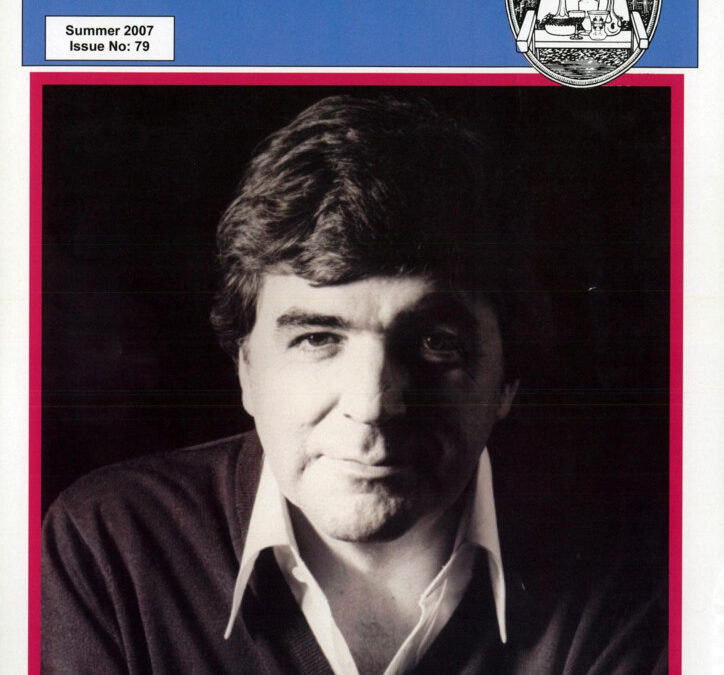
For twenty years Frank Thrower, whose photo graces the
front cover, designed almost exclusively for Darlington Glass
during which time he produced over 700 designs and was one of the
most prolific and commercially successful glass designers of the
post war era. Frank Thrower became a household name and
during his lifetime he enjoyed a kudos rarely experienced by
product designers in the table and glare industries. In this article
his daughter
Eve Thrower
shares some rare personal insights
about his fife and career.
Almost two years ago I revisited the Dartington factory in
Great Torrington. It was the first time I had been there since the
death of my father, Frank Thrower, in 1987.
I was given an unexpectedly warm welcome – more so
because, for the family and many of Frank’s
friends and colleagues, it appeared that in the
years immediately following his death, he had
been ‘erased’ from the history of Darlington
Glass. My visit inspired me to once again take
up my pen and attempt to write a biography of
my father — a previous attempt having been
abandoned many years since. During the
course of my research I was approached by Dr.
Graham Cooley and Mark Hill.
Our
collaboration has led to the publication of
`Frank Thrower & Dartington Glass’, which
will be launched at the opening of the Frank
Thrower exhibition, at the Plough Arts Centre,
Great Torrington, on June 2nd 2007. This year
marks both the 40th Anniversary of the glass
factory, which was renamed Darlington
Crystal in 1987, and 20 years since Frank’s
premature death at the age of 55.
Frank was a self-taught, self-made
man, who rose from humble working class
beginnings to become one of the most prolific
and commercially successful glass designers of
the 20th Century. During his 20 years as a
designer he produced over 700 designs, around
500 for Dartington Glass and a further 200 for
Wedgwood Crystal following its merger with
Dartington in 1982.
Yet design and glass were not areas
in which Frank had originally chosen for a
career path – it just seemed to evolve, or in his
own words ‘Things just tended to happen…”
Until the early 1950’s Frank’s only
involvement with design had been that of an
interested consumer who liked to dress well
and wanted his home to look good. Joining J.
Wuidart & Co., the UK agent for Orrefors and
Kosta Glass and Rostrand porcelain, in 1953
opened
up
a new world for Frank. He was
inspired by the beautifully simplistic lines of
the Scandinavian designs. Working under
Ronnie Stennett-Willson, Frank developed an
interest in the design process, although his
involvement went no further than occasionally
drawing up some of Ronnie’s designs.
In 1960 Frank joined Grays, a small
pottery in Stoke on Trent, which had recently
3
FTI63 Oil and V
boxed in pai
Frank Thrower with, from left to right,
Kim, Nicole and Sharon in November 1963.
been taken over by husband and wife Euan
and Susan Williams-Ellis. They were looking
for someone to manage their sales and Frank
saw the opportunity for personal
advancement. At Wuidart’s Frank had been
one of a team of salesmen but at Grays he was
head of sales — albeit initially he was the only
salesman and on substantially lower pay.
However within the first couple of months
working for Susan and Euan, Frank had sold
the entire year’s production of the newly
named `Portmeirion Ware’. It was clearly
necessary to find something else to sell — he
could hardly sit back and twiddle his thumbs
for the rest of the year. Frank suggested they
import Swedish glassware and Danish
stoneware. Having travelled many times to
Sweden on business with Wuidart’s, he knew
exactly how to go about it. Following closely
in the footsteps of his mentor, Ronnie
Stennett-Willson, it was not long before Frank
himself began designing glassware. The glass
was initially sold under the banner of ‘Grays
Glass’ and was imported from several of the
smaller Swedish glassworks, such as
Hovmantorp and Skruf. They were less
expensive and could therefore be retailed at
more competitive prices. These factories also
manufactured Frank’s designs.
It is hardly surprising that these early designs
were strongly influenced by the distinctive
Scandinavian style. However, in 1962, Frank
happened upon a pair of Georgian wine
glasses in an antique shop in Hampstead
Village.
He loved their solid shape and strong bold
curves. This pair of goblets initially provided
The Glass Cone—Issue No: 79 Summer 2007
One of the early 19th century goblets which Frank Thrower
found in a Hampstead village antique shop and which inspired
his Victoria suite.
the inspiration for the Victoria suite, originally designed for
Portmeirion Glass in 1963 and later lead to the development of his
unique style of heavy, bold, wine glasses for which Dartington
Glass became renowned. Though contemporary in style many of
Frank’s stemware designs for Dartington Glass had an aura of the
18th Century, particularly so with the Rummer, Regency and
Sharon suites.
Also in 1962 Frank took Euan and Susan to Sweden to
visit the various glass factories which had been making his designs.
It was following this that a series of coincidences occurred which
ultimately led to the creation of Darlington Glass. The Dartington
Hall Trust, a charitable organisation set up with the purpose of
sustaining local communities, were looking for suitable industries to
extend their activities into North Devon. Peter Sutcliffe, the Trust
Director, approached Euan Williams-Ellis for advice, who was at
the time a financial advisor to the charity. Euan readily suggested a
glass factory, Portmeirion could sell it through their already
established retail network and Frank Thrower would be the ideal
person to design the glass. Following five years of research,
feasibility studies, negotiations and construction the Dartington
Glass factory was finally opened in June 1967.
Sales of Darlington Glass in the first year were
disappointing and the losses greater than anticipated and despite
having received the Observer Award for Design in 1969, it was not
until the fourth financial year that the company saw its first profit.
However from that point on there was no turning back and within
only a few months orders were
outstripping production. This
situation remained the status quo
for years to come as the demand
for the glass continued to escalate
and the year’s production was
generally sold by April. Many
stores found the supplies of
Dartington Glass to be very much
a ‘feast or famine’, a huge
delivery would arrive and then
they would see nothing for several
months. The commercial success
and popularity of the glassware
must inevitably be credited to
Frank Thrower.
Frank Thrower was
eminently pragmatic about his design for Dartington Glass. He once
said, “When people say I’m an artist I frown…. it’s industrial
design not art.” He had no illusions about creating ‘art’ glass or
achieving design awards, although he was immensely pleased when
he received the latter. He wanted to design glass that the public
would buy and the stores would want on their shelves. Hence he
adopted the expression ‘designing for shelf space’. Frank had an
excellent if not intuitive, understanding of consumer penchant. No
doubt his years as a ‘Knight of the Road’ for J. Wuidart & Co and
Portmeirion Potteries provided invaluable opportunity and
experience to develop his skills. That being said Frank also had a
very good eye for design, a point made by David Marquis of
Queensberry when he said, “Frank had a really good knack of
refining the archetype. He would take a standard thing and he
would get it right”. Whenever Frank travelled abroad to trade fairs
and factories around the world, particularly Scandinavia, he brought
home samples of new lines, prototypes and generally anything
which interested him, either for its design, ingenuity or both. These
items often served as inspiration for his own design. He wanted his
designs to be both
beautiful
and
practical.
Design drawn by Frank Thrower
in January 1987.
important as the glass itself and he
petitioned stores to display the
boxes alongside the glass. He also
responded quickly to feedback
from customers, for example
including an appropriate sized
candle in the box with the
candleholder. Initially boxes were
introduced solely for giftware,
vases and candleholders, but
packaging for the stemware soon
followed.
As well as the design of the glass,
Frank was also integral to every
aspect of the marketing and sales
of the glass. From the opening of
the factory until the merger of
Dartington and Wedgwood in
Frank was
also extremely
conscious of social
trends and was very
quick to spot gaps in
the market.
It is
perhaps the designs,
which he referred to
as his ‘innovations’,
that many will
remember him for.
The Irish coffee glass,
avocado and corn on
the cob dishes and the
ring tree, to name but
a few were all
designed to fill these
gaps and proved to be
exceedingly popular
with the consumer.
Frank understood the importance of the ‘gift’ market and designed a
complete package — literally. Frank strongly believed that the
packaging was almost as
x
c
/
ck‘44’5-‘-a, .93-11-71,7
OPM.:
S.. V
,
DESIMO BY PAW TIMM
as
23/0
*y.
Frank working with Stig Pettersson, master blower, and
discussing the design of the Sangria jug.
The Glass Cone—Issue No: 79 Summer 2007
4
1982, Portmeirion and Darlington shared a showroom in Portland
Road, London. Working closely with photographer, Mike Newton,
Frank involved himself in the design of advertising, catalogues and
packaging. The advertising campaign, which comprised vertical
strips of photographs of the glassware accompanied by pun-laden
copy, became a signature of Dartington Glass. The often rather
corny puns like ‘Oil be seeing you’ for the oil & vinegar bottles and
`Jam session’ for the covered marmalade pot were composed by
Frank and his close associates, Peter Robinson, Dick Bentley and
Robin Hawkins. They spent many a Friday afternoon in Frank’s
office at the Portland Road showroom lubricating their creative
flow with cans of Carlsberg Special Brew.
Frank was never shy of mixing business and pleasure.
Twice yearly Frank held press parties at the showroom to preview
his new designs where the invited press and buyers were lavishly
supplied with champagne and strawberries. In fact the Dartington
Portmeirion hospitality was renowned. In the early days, before the
Blackpool Trade Fair was replaced by the NEC in Birmingham, an
invitation to join the Portmeirion & Dartington party at Yates Wine
Lodge each evening was eminently sought after. Buyers, from
retail outlets, large or small, were generously wined and dined and
often further enticed by VIP invitations to visit the factory.
In addition to attending all of the major trade fairs in
England and also Hanover, Frankfurt and Paris, Frank went on
sponsored trade missions around the world. Over the years he
developed valuable contacts with many individual stores and
distributors in the United States, Canada, South Africa, Australia
and Japan. The fact he never abandoned his role as Sales Director
was undoubtedly another reason for the commercial success of
Frank’s designs as he had continual access to the customer.
By the mid seventies Dartington Glass had become a
household name along with that of its designer. Frank was reaping
a vast income from his 2% commission and living the life of a pop
icon. He had three homes, numerous cars, seven children and a
menagerie of pets.
Over the years many of the people he did business with
became close personal friends, which resulted in a band of
exceptionally loyal colleagues. In fact, from the vast majority of
people Frank encountered, factory floor to the retail outlet, he
received a level of attachment and respect that could only be
described as extraordinary. Whether Frank was aware of this is
debatable, his self effacing humour would never reveal anything so
immodest. However, shortly before his death, when he was deeply
unhappy with the status quo at Darlington Glass and his days with
the company were numbered, Frank wrote:
“In the truly successful company, titles are unimportant
because the team works with the leader. The leader can run through
the corridor shouting ‘follow me chaps’ and if he is persuasive
enough people will follow.”
Frank is remembered by those who knew him as a
charming, charismatic man. He had a thirst for knowledge and
experience which expanded his cultural horizons; he enjoyed many
kinds of music from jazz to classical music and even opera. He
read avidly and widely and enjoyed writers as diverse as Scott
Fitzgerald, Stephen Leacock and Raymond Chandler. Frank loved
the countryside, gardening, theatre and films, particularly those of
the forties and fifties. And he loved sports, cricket being his long
abiding passion. Becoming a member of the MCC was a crowning
moment in Frank’s life. The expression ‘living life in the fast lane’
could not be more apt than when describing Frank’s life. Looking
over his appointment diaries whilst carrying out my research I am
amazed that we, his children, ever got to see him at all. Yet home
life was exceedingly important to Frank.
I remember well the excitement when he was due home
The Thrower family on the lawn at Danesgate
House, the family home, in the summer of 1967.
Frank and Inga at the back with Kim, Sharon, the
twins Scott and Misch with Nicole in the foreground.
Taking a moment to celebrate during a sales meeting at Danegate House about 1974.
Front row left to right Frank Basil Cantor (Midlands) Frank ‘Hoppy’ Hopkins (West Count
–
1y) Dick
Bentley (London & South East) . Back row left to right Robin Hawkins (London & South East),
Peter Robinson (London & South East), George Errington (North)
Frank with Dick Bentley, taken
during a sales meeting on the
beach in Devon.
5
The Glass Cone—Issue No: 79 Summer 2007
Frank and his colleagues following a working lunch
around Apri11987, after his second operation.
Collect its
from work or travels. In the winter welcoming fires burned in the
grates, the house warmly glowing in candlelight and Frank Sinatra
or Dean Martin playing on the record player. In the summer Frank
and Inga, his Swedish wife, would walk through the garden, gin and
tonics in hand, and survey the progress of the vegetable garden.
Looking back they seem such halcyon days but in truth the reality
was far more turbulent. Regrettably the lavish lifestyle Frank &
Inga were enjoying was causing a fissure in their marriage. By the
end of the seventies he was deep in an exceedingly costly divorce
and personal bankruptcy proceedings loomed on the horizon.
The early eighties saw Frank set his personal life back on
track, the merger between Darlington Glass and Wedgwood Crystal
certainly being a contributory factor financially. However the
management at Darlington had changed and, in Frank’s opinion,
Wedgwood appeared to be calling the shots. Frank found it difficult
to maintain the laissez-faire style of business he was used to, when
sales meetings were often held on the beach and business lunches
evolved into social afternoons sharing several bottles of Chablis.
Following Frank’s seizure and subsequent surgery to remove a
malignant brain tumour, in October 1985, he felt relationships
between himself and the upper management at the factory had
become untenable. Sadly, despite steadfastly loyal and unflagging
support from his colleagues, this situation prevailed until his death.
Yet despite his illness and unhappiness with the status quo he
continued to work on his design.
In early 1987 Frank had a second seizure, the tumour had
re-grown and fluffier surgery was required. Thankfully Frank
recovered sufficiently to receive his M.B.E. in April 1987, he was
immensely proud to have been honoured. He died at his home in
East Winterslow, Wiltshire two months later.
No doubt I am biased but I truly believe Frank Thrower
was a remarkable man. Frank had a profound effect on many of
those he touched. I am thrilled that there is a revival of interest in
his work and that at last he is receiving the recognition he deserves.
In a recent e-mail my brother Adam wrote “‘Bout time too!” – our
feelings expressed most accurately, if not that eloquently.
PUBLICATION REVIEW: COLLECT I
Collect
it!
describes itself as “The UK’s No. 1 Collecting
Magazine” Published monthly, it reaches its tenth birthday this year.
Each issue includes a variety of articles on numerous areas of
collector interest, with a firm bias towards “quality”. As might be
expected, the balance varies each month, but with 100 or more
pages, there is almost always an article or two on glass, and regular
readers offers. In the last year there have been two features on
Dartington glass, one of them by Glass Association new committee
member Mark Hill who is a regular contributor to the magazine.
The entertaining writer and broadcaster Eric Knowles is another
egular contributor, though not always on glass of course.
The stunning
work of Bob Crooks
has been featured in a
superbly illustrated 3
page article.
In
November 2006 Mark
Hill shared his passion
for Mdina glass, and
in another article
revealed the latest
graal pieces from
Timothy Harris at
Isle of White Glass.
In the same issue,
Margaret Powling
looked at OurGlass
of Cockington,
Torquay.
A vase
from OurGlass was
offered as a competition prize in April, while that month’s reader
offer was an exclusive golden floral vase from Richard Golding at
Okra. Peter Andrews contributed a very good overview of Venini,
Val Baynton reported on 40 Years of Dartington Crystal, and the
issue was rounded off by “Trip the Light Fantastic”, an article on
the fascinating interplay of glass and light. Jonathan Harris,
Scottish Borders Glass, Cambridge Glass Fair have all had features,
and there was timely coverage of the joint Glass Association and
Peter Layton event
at
the Hub, Sleaford. .
If you are interested in the latest developments in the
contemporary glass market then you will enjoy
Collect It!
Go
along now to any large newsagent (and many not so large), to pick
up the special Tenth Anniversary issue which looks back over the
last 10 years of collecting—you might find yourself tempted by the
limited edition Jonathan Harris piece on offer—and more.
www. col lectit. in fo
01778 392055
BW
TALKING ABOU,’UDIO GLASS /MI
On Friday February 16
th
2007 a group of Association
Members and other delegates gathered at The ‘Hub’ Craft and
Design Centre in Sleaford, Lincolnshire to celebrate 30 years of the
London Glassblowing Workshop, established in 1976 by Peter
Layton. As well as an opportunity to view the travelling exhibition
the day comprised talks by members of the Workshop, Peter Layton
himself and our Chairman Charles Hajdamach.
Charles set the scene by examining the precedents for
studio glassmaking in the early 20
th
century and the rise of the idea
in America in the late 1950s. He covered the progress of the
movement up to the present day, highlighting the position of British
glass artists in the glass world today.
After lunch Marie Worre Hastrup Holm, Anthony Scala
and Louis Thompson spoke about their personal routes into
glassmaking, giving the audience an insight into the experiences that
lead to their work today. Peter Layton followed with a fascinating
and entertaining account of his life and the paths that lead eventually
to the successful London Glassblowing Workshop and his impact on
international studio glass.
I was encouraged by the attendance of students and
glassmakers from the Midlands. Not only was it an enjoyable and
informative event, it gave us the opportunity to publicise the Glass
Association to a new audience.
Judith Vincent Midlands Representative
The ONLY mowing for collectors
care
Jonathan Harris
Overlooked…
tooliOdeforiiiii
colletiq
4nI2007
93 Your CaDnaio
•
TEDS & DOLLS • TOUR COLLECTIONS
SCOTTISH RIMERS GLASS • MORE GREAT COMPETITIONS
6
The Glass Cone—Issue No: 79 Summer 2007
THREE CENTURIES OF GLASS – THE TOP TWENTY FI
Fieldings’ sale of ‘Three Centuries of Glass’ has become
an established feature in the auction calendar and the third annual
event took place in Stourbridge on Saturday 14th April. Despite the
fact that the Grand National and the two F.A. Cup semi-finals were
taking place on the same day the auction attracted the usual full
attendance in this stronghold of glassmaking. The lots were split
into nine categories including 18th Century (151 lots), 19th C.
British (294), 19th C. Bohemian and Continental (45),
Paperweights and Related Items (29), 19th and 20th C. Pressed
(107), Reference Books and Catalogues (33), 20th C. Continental
(103), 20th C. British (116) and 20th C. Italian and Scandinavian
(59). Here we present the top twenty-five selling lots. All prices are
hammer prices.
1.
The top selling item in the sale was this mid 19th
century
Clichy barber’s pole cartwheel paperweight with a central green
and pink rose and assorted star, hollow tube and composite canes
spaced by blue and white latticino tubes set on a cushion of parallel
white latticino tubes. Measuring 8cm. across, it sold at the top of
the estimate for £2500.
2.
This 19th century
claret jug was attributed to
Richardsons of Wordsley
and was finely engraved with
an oasis scene with a figure
seated before a tent with two
camels surrounded by palm
trees. Similar scenes appear
on Richardson opaque white
glass decorated with transfer
prints. The body was
mounted with a silver gilt
arched and reeded handle
with vine leaf supports. The
mounts were stamped with
the mark of N. & J.
Creswick of Birmingham
and dated 1854. Height
32cm. It came in at £1900
just below the estimate of
£2000-2500.
7
3.
A classic heavy
baluster shape, this wine glass
was estimated at £600-800 but
was eventually knocked down
at £1850. It measured 19cm
high.
4.
Francois Emile
Decorchement was one of the
masters of the pate-de-verre
technique in France in the early
part of the 19th century and he
was represented here by Lot
677, a small bowl measuring
13 cm. across, decorated with
theatrical mask handles with a
running ribbon border in
marbled black, blue and green
glass. It sold at the bottom of
the estimate of £1500-2000.
5.
Estimated at £700-800 this mid 19th century Bacchus of
Birmingham paperweight attracted a great deal of attention.
Decoration consisted of an internal canopy close packed with
complex cane construction in pink, red, white, green and blue
including miniature oak leaf canes. Even with a small bruise on the
side it doubled its estimate at £1400.
The Glass Cone—Issue No: 79 Summer 2007
6.
A large late 19th
century Thomas Webb Ivory
cameo vase of globe and shaft
form with a double cased ivory
body cut back with a fruiting
rowan tree bough below a stiff
leaf collar picked out in tonal
green and brown staining, this
was as nice an example of
Webb’s Ivory that one would
expect to find. Measuring
24.5cm. and with a Webb acid
etched mark, it made the bottom
of the estimate of £1400-1600.
7.
The 20th century
Continental section contained
some real gems and the highest
price achieved was for this early
20th century Loetz Art
Nouveau green Papillon vase
with a triform lip and dimpled
body with silver electroplated
whiplash stems and flowers.
Three telephone bidders battled
out the ownership of this
desirable example with the
winning bid reaching £1250
against an estimate of £500-
600.
8.
In the 19th century
Bohemian and Continental
section this pair of mid century
opaline vases from Baccarat,
decorated in the manner of Jean-Francois Robert went for the
bottom of the estimate at £1200. Ht.23cm.
The Glass Cone—Issue No: 79 Summer 2007
9.
A small amount of glass had been consigned to this
auction by Ronald Stennett-Willson, the grand old man of British
glass who is best known, amongst other achievements, for setting
up the King’s Lynn glass factory in the 1960s and his classic
Sheringham candlesticks. Three of those items were vases which he
had designed in the Ariel technique and had made at the factory in
1970 for a special exhibition at the King’s Lynn Arts Festival. One
of the buyers at the exhibition had been the late Queen Mother. The
three vases had been exhibited for the first time since then at King’s
Lynn in 2004. Estimates for all three were £1000-1200 but
surprisingly only this lot, 808, sold, for £1180, a classic example if
ever there was one of a prophet in his own land being ignored.
Ht.15.5cm.
10.
Coloured, cased and enamelled and gilt Bohemian
examples from the 19th century were in much demand here with
this pair of lustres, in the manner of Neuwelt, with clear crystal
buttons and albertine droppers, fetching £1150 compared to an
original estimate of £600-800. Ht.28.5cm.
11.
The highest price in the auction for a piece by Lalique was
paid for this vase in the Plumes pattern from about 1920 and
standing 21cm. high. The scrolled overlapping feathers were picked
out with a jade green stain over an opal ground. Hammer price was
£1100 against an estimate of £1200-1500.
(photo next page)
8
12.
Andries
Dirk Copier’s large
1930s Leerdam vase
in the Unica series
was decorated
internally with an
ariel pattern in black
against a sea green
ground with fish and
seaweed.
Measuring 35cm. it
was inscribed with
the pattern code
`W 1618′. It
attracted one
telephone bidder to
pay £1000, the
bottom of the
estimate.
Amberina glass at the Mount Washington
factory in 1883. This night light table centre
was an unusual example compared to the
small posy vases one normally sees, and
consisted of a triform brass stand with three
pressed flint Clarkes patent night light bases
with Burmese shades and four frilly posy
trumpets raised on radial brass work.
Hammer price was the lower estimate of
£1000. Ht.26cm.
14.
A pair of 19th century Bohemian
vases standing 34cm. tall continued the
demand for this type of glass and sold well
above the estimate of £400-600 at £920.
15.
An early 20th century small Daum
vase, the blue body cased with mottled
orange, yellow and green enamels, with a
landscape of autumnal trees in front of a
mountain backdrop. Ht. 8cm. With an estimate of £600-800 bidding
opened in mid estimate and eventually went to a telephone bidder
for £890.
16.
This tiny drinking glass probably caused the most
excitement in the pre-viewing of the sale due to the almost
microsopic engraving of the Lord’s Prayer inside a cartouche panel.
Engraved and signed by the great William Fritsche working at
Thomas Webb and Sons, it had a strong provenance back to the
factory and had been acquired by the family of the vendor in the
early 20th century. The rest of the
engraving consisted of another cartouche
with a classical female portrait bust
surrounded by swags and scrolls with
insects. The estimate for this small glass
no more than 9.5cm. high was £200-300.
Bidding quickly out-stripped that figure
with a great deal of interest from London
dealers as well as local enthusiasts but it
was finally bought for £890 by Broadfield
House Glass Museum with support from
13.
Thomas Webb and Sons had bought the rights to make the Friends of Broadfield House. It will
Burmese glass from Frederick Shirley in America who had copied now join the other examples by Fritsche at
the heat-sensitive technique from Joseph Locke’s invention of the Museum
(detail p.10).
9
The Glass Cone—Issue No: 79 Summer 2007
17.
Selling at £880, just above
the lower estimate, was this 18th
century wine glass with a thistle bowl
and a four sided hollow pedestal stem.
Ht.17cm.
18.
The auction included a
number of Whitefriars glasses
including a number of textured
examples headed by a Banjo
vase. Two or three years ago
those would have made the
higher prices but there seems to
be a move by collectors towards
the earlier blown and coloured items from that factory and they are
now fetching the higher prices. This
early 20th century ‘Hugo van der
Goes’ tear vase designed by Harry
Powell in 1901, with an applied blue
milled foot and trailed tears went for
£860 in comparison to what many
thought was too high an estimate of
£1000-1200. Ht.22cm.
19.
Lot 264 was a fine example
of the Verre-de-Soie range made by
Stevens and Williams in the 1880s
using the very difficult technique of
thinly blown clear glass tubes between
two cased layers to give the air-trap
effect. Estimated at £600-800 this
29cm. vase went for £840.
20.
Of the handful of Stourbridge cameo vases in the auction,
this late 19th century Webb vase, measuring 19cm., with an unusual
scene of a duck in flight over water lilies, fetched the highest
amount of £790, the higher end of the estimate.
21.
Ronald Stennett-
Willson had consigned this
piece for auction from his
collection of European 20th
century glass. A post war
Kremlin Kellot double
decanter and stopper designed
by Kaj Franck for Nuutajarvi
Notsjo about 1955, the lower
spherical decanter was fitted
with a hollow blown and spiral
cased stopper in the shape of
another decanter. Signed by
the artist, it had been presented
to Stennett-Willson on a visit
to the factory. The estimate of
£250-300 soon vanished and it
reached a hammer price of
£750. Ht.35cm.
22.
An R. Lalique vase
in the Coquilles pattern, relief
moulded with overlapping
shell motifs picked out with a
blue stain over the clear
ground, with an engraved
signature to the base and standing 18.5cm. high. It did not make its
estimate of £800-1000 but sold at £750
(picture p.11).
23.
The gilded decoration of a floral bouquet and flower
sprigs on this 18th century cordial glass was attributed to the
London decorating workshop of James Giles which helped it to go
over its estimate of £400-600 fetching £750 at the fall of the
The Glass Cone
—
Issue No: 79 Summer 2007
10
24.
A late 19th century Lobmeyr rock crystal pedestal bowl
designed by Ludwig Lobmeyr about 1880, the foot rising to a
shallow rimmed bowl decorated with polished intaglio rococo style
acanthus leaf scrolls within a black, white and gilded enamel
border. Width 25cm., height 8.5cm., engraved and gilded signature.
Estimated at £800-1000 it sold for £710.
25.
The reputation of Michael Harris as a major force in the
early years of the studio glass movement in this country and as an
important glassmaker who influenced and helped many up and
coming makers, is gradually being re-established. The recent
monograph on Harris by Mark Hill has speeded up that re-
assessment. From Stennett-Willson’s collection, this limited edition
Isle of Wight vase designed by Michael Harris circa 1973 was a
cylindrical deep-sided body cased with blue and white cane work
threads and iridescent panels with an engraved signature and
numbered 54 of 500. Measuring 22cm. by 20cm. across it went for
the middle of the £600-800 estimate at £670.
At the end of the auction Will Farmer estimated that the sale had
done much better than its two predecessors. He highlighted the
trend towards buying good quality early 20th century Whitefriars
and the lessening interest in the Baxter textured ranges probably as
a result of most dedicated Whitefriars collectors already owning
those examples. The other noticeable trend was the falling of
interest in 19th century pressed glass. Two major private collections
formed the bulk of that section, from the late Tom Percival in
Manchester and Dr. Edwards. Rare examples such as the Sowerby
posy vase with a scene of Old King Cole (£200) and a pair of
Derbyshire Punch and Judy figures (£150) met their estimates but
many of the lesser items struggled to find new homes. Plans for
Inext year include increasing the minimum value and slightly
reducing the overall number of lots. Fieldings Auctioneers are still
the only rooms in the country offering a specialist glass sale and the
Three Centuries of Glass sale is set to gain further momentum.
CRH
GIFT AID
Members who have signed a Gift Aid declaration are reminded tha
they must pay an amount of income tax and/or capital gains tax a
least equal to the tax that we reclaim on their subscriptions an
donations in the relevant tax year (currently 28p for each £1 given).
We are very grateful to the 200+ members who have completed
declarations as the claims we make under the Gift Aid scheme
provide us with valuable extra income.
Please remember that:
1.
You can cancel your declaration at any time by notifying me.
2.
If your circumstances change and you no longer pay tax at
least equal to the tax we reclaim then you should cancel your
declaration.
3.
If you pay tax at the higher rate you can claim further tax
relief in your Self Assessment tax return.
4.
If you change your name or address you should notify me.
If any member would like a Gift Aid declaration then please
contact me and I will gladly send you one.
John Greenham
ERS
Ms M Cahill
Australia
Mr & Mrs S Fisher
Somerset
Mr F Grew
London
Mrs B Hayes
Worcestershire
Mr A Hussain
Coventry
Mrs J L Lapage
Hants
Mr R Pietkiewicz
Nottingham
Mr S Pollock-Hill
Hefts
hammer. Ht.15cm. Over half of
the 18th century section,
including this example, came
from the collection of Michael
Savage, one of the early
members of the Glass
Association.
1
1
The Glass Cone—Issue No: 79 Summer 2007
WO 20TH CENTURY GLASS EXHIBITIONS
During the course of 2006
there were
two exhibitions that
covered significant sections of 20
th
century glass. One, cut glass,
that reprised a subject looked at only once before, but from a totally
different viewpoint on this occasion; the other, 20
th
century
decanters, covering a subject that has received little attention in the
past. Both were promoted by dealers.
Here I have to declare personal interests. The first was put
on by myself at the request of
Clarion Events NEC.
In the second,
originally initiated by Circa Glass and myself, I was unable to take
part as other commitments precluded that possibility.
BRITISH ART CUT GLASS FROM THE 1920s TO 1970
The first of the two was held at the NEC “Antiques for
Everyone” Fair 27-30 July. This exhibition attempted to view what
has been termed British Art Cut glass (designer glass) under a
number of categories, and, unlike the previous selling exhibition
held by the author in conjunction with Jeanette Hayhurst in 2003 it,
concentrated its attention on the types of design on the glass rather
that on its manufacture or history.
Whilst the history of an item is highly important in order
to put it into context it often clouds the viewer’s overall impression
and ability to judge the glass on its own merits. Therefore the
purpose of trying to categorise items was to centre attention upon
the glass, whilst at the same time illustrating the similarities and
differences between factories and designers.
For far too long this branch of British decorative art has
suffered from a lack of understanding, which in all probability is
mainly due to the mistaken belief that it is all so multi-cut with
criss-cross lines that very little of the original surface is left
untouched by the cutter’s wheel and is therefore counter to the
modern taste. This is largely an unfortunate legacy from the
Victorian era when flamboyance and over ostentation seemed to be
the credo associated with design.
Georgian cutting, however, was far more sympathetic to
the vessel it was decorating and had a restraint that has become
classic. Here is the link to the twentieth century, its cutting and its
designs. Indeed many of the designers of the post-war period were
influenced by Georgian cut glass — a tendency toward simplicity.
Designers have to consider what the inspiration for the
design is going to be and how that inspiration is going to be
interpreted. Is it going to be a straightforward geometric pattern, is it
figurative, is it to be abstract, or indeed abstracted? An abstract
design can be something that relies on a number of things that will
result in a non-representational motif, whereas if an image is
abstracted then it will be something that is based upon a tangible
item, such as a leaf, tree, animal, fish or even the human figure.
Further questions ask
if the
vessel in question
and its decoration can
be considered as sculptural.
bb (David Hammond), Stuart & Sons, and Royal Brierley (Deanne Mean
It is therefore possible to categorise British cut glass of the
twentieth century under a number of headings. Those headings can
themselves be subdivided. The exhibition used five different
categories, Geometric, Figurative, Abstracted, Abstract and
Sculptural. Largely speaking they are self explanatory, Geometric
being repeated regular designs that can be simple or can become
quite complex in their interpretation, especially if a number of
geometric devices are used in conjunction with each other. By
contrast Figurative cutting relies on motifs derived from flora and
fauna. Abstracted motifs are those that relate to their inspiration,
which is most usually flora and fauna, including the human form.
Abstract’ patterns –
all designed by David Queensberry for Webb Corbett c1960s
Abstract is neither geometric, nor figurative and therefore has its
origins entirely in the mind of the designer. Lastly there is the
Sculptural, which, although cut with a pattern relies heavily upon
the form of the vessel that the cutting is on, or else the cutting
creates that form.
This attempt to categorise cut glass design was to help the
uninitiated gain an understanding of the subject whilst allowing
those with knowledge a greater insight. In addition to breaking the
subject into categories there was an opportunity to compare related
designs produced by one factory with another. For instance was
horizontal wavy mitre cutting the sole province of one company, or
was it used by a number of firms? If more than one how is the
device used? Is it deeply cut, or shallow? Or, are the lines used in
conjunction with some other motif?
Hopefully, the exhibition answered some of the questions
it posed, so that the subject of British Art Cut Glass might have
greater understanding and accessibility to those who had the chance
to view it.
The Glass Cone—Issue No: 79 Summer 2007
12
A shelf of
Czech decanters fi om the 1930’s and 1950’s
THE 20
th
CENTURY DECANTER
Held at
Glass, etc.,
based in Rye, from 2 September –
28 October 2006, this was
the first time that 20
th
century
decanters had been the
specific subject of an
exhibition. Some 160
decanters from across the
world (a number with their
associated drinking glasses)
were assembled to delight
the viewer, with an overspill
in the main shop. Unlike the
cut glass exhibition, the
majority of items were for
sale and were provided by
Circa Glass, Graham Cooley
and Andy McConnell, whilst
others, were borrowed from
Nick Allen, Geoff Lawson,
Basil Loveridge, Mike and
Debbie Moir, Stephen
Pollock-Hill and Nick Toldi.
Decanters were
displayed in groups, under
country and manufacturer,
and told a story. Combined
with the talks given by Andy
Cabinet two, containing British
McConnell and Graham
pieces mainly from Whitefriars,
Cooley one gained a greater
Caithness and Nazeing
understanding and
appreciation of the progression of the 20
th
century decanter.
Unfortunately, if one was to visit the exhibition independently,
without the privilege of these entertaining and illuminating talks I
felt it would be difficult to gain such perception.
According to the catalogue, we learnt that the 20
th
century
decanter has been largely overlooked as an area of collecting and
that it is currently regarded as less desirable than the equivalent vase
by the same maker and designer. By comparison it was stated that
this was incorrect and that the decanter should be given much
greater credence, particularly as it grates against the continuing rise
in popularity of wine consumption. Sadly, without the talks to back
up this assertion it is difficult to understand the arguments behind
that claim, even though it has some validity.
Andy McConnell’s talk in the morning set the 20
th
century
decanter into context by briefly covering its history before delving
into the design credo behind the modern versions. The lecture
began with the drinking glass, its importance and how the decanter
developed from the bottle in this country. Initially the decanter
was
plain, but by
the time it was
allowed onto
the
dining
table it became
a medium for
decoration in
order
to
impress.
Probably the most important factor behind the 20
th
century
decanter was the introduction of the
designer,
initially through the
work of Dr Christopher Dresser, then through companies such as
James Powell & Sons
under the auspices of
Harry Powell. Whilst
items from these
sources were largely
plain, on the continent
art was introduced
through the work of
Galle and Daum and,
later,
Lalique.
McConnell then
considered how
architects and sculptors
were foremost amongst
designers of 20
th
century decanters.
Edvin Oilers’ work for
Orrefors was the first
to be marketed under
the name of the
designer in 1918, but it
was Lalique who was
the king of marketing
under what we now
containing a mixture of mainly continental
Cabinet seen when entering the exhibition,
pieces with a few representing the USA.
understood the need for
promotion, which
refer to as the
“designer label”. He
enabled him to market industrially produced goods for a premium
that lasts into modem times.
Andy then took us through a tour of decanters that acted
as a vehicle of fine art, whether through the decoration placed onto
the body of the decanter or whether, as with Holmegaard’s
Aristocrat
decanter it became an art form in its own right. He
asserted that the
Aristocrat
was a sculpture and could be used
purely as a form of decoration, even though its original concept was
solely functional. The lecture finished with reference to the
designer/blowers of today and their ability to combine art with
function.
In the afternoon we re-assembled for Graham Cooley’s
thought provoking lecture about the design of the decanter, what
governed its form and the decoration that might be expected on a
given shape. Graham’s stimulating lecture divided the decanter into
its constituent parts. Not just the base and the stopper, but rather the
base, the body, the neck, the rim and the stopper.
Having reduced the decanter down to these elements
Graham then
discussed what
governed each, and
how one might
influence another,
so that for instance
a narrow base
would in turn mean
that the decanter
would invariably
be tall with a long
neck, whereas a
wide
base would
13
The Glass Cone—Issue No: 79 Summer 2007
21s
t
October 2007
EUROPEAN 20TH CENTURY GLASS
A Two Day Seminar
At the Manchester City Art Gallery
Saturday 20
th
and Sunday
And the
AGM of The Glass Association
We are delighted to welcome four internationally acclaimed speakers, to give the following presentations:-
Saturday:
Thimo de Duits:
An art historian, formerly of the National Glass Museum in Leerdam, now curator of the
Boijmans Van Beuningen Museum in Rotterdam, will talk on “Leerdam Glass 1925 -1932; ‘ a thing of beauty
is a joy forever’
Sylva Petrova:
A major authority on Czech glass; author, lecturer and curator over the last twenty five years.
Was in charge of the Czech Glass presentation at Expo 2005 in Japan. Her talk is entitled ” Czech and Slovak
Glass; integration into other cultural contexts”
Sunday:
Gunnel Holmer:
the well known curator of the Smalands museum in Vaxjo, Sweden, since 1978. A
specialist researcher and writer on 19
th
& 20
th
century Swedish glassmaking. Her topic is simply ” Swedish
Glass”
Rosa Barovier Mentasti:
of the renowned Renaissance glassblowing family, course organizer at the Scuola
del Vetro Abate Zanetti in Murano — author of works on Venini, Seguso and Fuga, a reference book on the
history of glass and a specialist work on Murano, will speak on “Contemporary Venetian Glass”
There will be a full accompanying programme on both days, including visits to the Gallery’s Glass Study Collections. On
Sunday the Glass Association will be running a “Silent Auction” of glass from members collections; sale items will be on
display in the lecture theatre from the start of the seminar until Sunday lunchtime, written bids can be entered at any time until
the auction closes.
*** The Glass Association’s AGM will be held on Saturday afternoon, after the speakers’ presentations ***
A dinner is arranged on the Saturday evening, which all four speakers will attend. Everyone is invited to attend and enjoy this
special evening. The cost for dinner will be £25.
Certificates of attendance will be available at the end of each day
This major event in the glass calendar is presented by and sponsored by
The Glass Association.
COSTS:
for both days of the seminar;
Saturday only (lunch included);
Sunday
GA members £58
Non GA members £78*
GA members £34; Non GA members £54*
GA members £24; Non GA members £44*
includes a year’s membership of the Glass Association, entitling you to the latest issues of our quarterly publication,
The Glass Cone—and our latest Glass Journal)
To request a booking form and for further enquiries please contact
Gaby Marcon, Events Organiser, The Glass Association, 7 The Avenue, London, N3 2LB.
email to: gabymarcon(kbtinternet.com or phone her on 07711262649 or 0208 371 8357 . The full programme and
booking form will be sent out to you. Please make cheque payable to The Glass Association .
CONCLUSION
dictate a far more squat form.
Graham also split the 20
th
century into its different eras
and showed how the relevance of these periods influenced the
design that one might expect for a decanter. Finally, he gave us his
own top twenty — which he acknowledged might change, but was
representative of his current taste and knowledge of the subject.
Rather than just present them to us as a given, Graham took the
trouble to explain his choices and admit that others might choose
differently, which was extremely informative and thought
provoking.
Each exhibition had an aim, and both largely achieved
their goal of arousing interest in collecting subjects that have
received little or no publicity. Maybe the moral of the story is that
these events involved objects that were quality items when first
produced and deserve the attention of collectors who wish to take
advantage of being in the vanguard of new areas of collecting, as
well as acting as a continuum for collectors of earlier periods.
Nigel Benson, 20
th
Century Glass
The Glass Cone—Issue No: 79 Summer 2007
14
Having been made
welcome with tea and coffee and
met
the llamas and Soay sheep that she keeps in an adjacent field we got
down to the serious business of glassmaking. Whilst the friends
were choosing their weight we gazed in admiration at the wonderful
array of glass that was on display in the room next door. Amongst
the items on display was a vase using a tree design on both sides
where the trunk and branches are visible through the green
leaves.
With our
interest in trees and in particular Bonsai, we were
soon discussing
with her
the techniques employed in producing
such an item and inevitably whether or not a paperweight using the
same basic design could be made. Although she had never
considered such an idea without any hesitation she asked if we were
in a hurry to get away and if not she would attempt to make a
weight for us there and then. Needless to say we were enjoying
ourselves far too much to want to leave so we then had an hour of
absolutely fascinating entertainment whilst we watched her creating
a paperweight employing the tree design. This included picking up
the various background colours. the green for the leaves and then
applying the trunks and branches with a torchworking process
before final shaping and finishing. We only got a fleeting glimpse
of the finished article as it was hastily put into the lehr to cool
slowly so we agreed to return two days later. There was no
CAITHNESS NEWS
Before I go any further I would like to thank the readers
who kindly contacted me following my article for Glass Cone
Nr.77 when I raised the subject of the future of the Caithness
Museum Collection. Due to the time lag between writing these
articles and their publication situations often change and more often
than not news seems to reach me just after I have finished an article.
This was the situation in this case, the decision to sell the museum
collection being made before the sale of Caithness Glass to
Dartington Crystal. I have spoken to several people who were
present at the auction and our initial thoughts on the likely outcome
of the sale were more or less right with some of the earlier weights
fetching higher prices and others going quite cheaply. I was sent a
couple of photographs of all the weights laid out prior to the auction
and it looked very impressive. Whether or not you like their
weights the company were the first to create modem style abstract
paperweights and it is a great shame that such an important part of
paperweight history should have to be sold off to raise money to
pay creditors but that I guess is a reflection on the 21st Century
world that we live in. As a member of the Collector’s Society I
have received a letter assuring me that both Caithness Paperweight
production at Perth and the Collectors Society will continue to
function as normal and the intention is to start a new museum based
on paperweight production from the takeover onwards which I
guess is some consolation for future collectors of their
weights. To add insult to injury I understand that back in the earlier
part of the year the factory at Perth suffered the theft of 118 boxed
limited edition weights from the latest range so be wary if you are
offered Caithness weights at bargain prices! At the recent Shepton
Mallet fair we got the opportunity to see some of the more
expensive weights from the current range for the first time and were
reasonably impressed with the weights if not the price. They
certainly looked far better in reality than they did in the catalogue
that arrived recently which also showed that they are continuing to
produce a large number of unlimited weights. As I conclude writing
this part of the article I have just received news of further
redundancies at the factory which includes glassmaking people as
well office and other support staff. As with any business there is
always a need to monitor overheads and production costs and
presumably they have now had some time to assess these aspects of
the business but this is an unfortunate start for the company under
the new ownership.
MIDDY LANGLEY – FROM VASE TO PAPERWEIGHT
Prior to a recent holiday in South Devon where we met up
with fellow paperweight enthusiasts for a couple of days an
arrangement to visit Siddy Langley at her studio near Collumpton
had been made. Siddy is a well respected glass maker with over
twenty five years of experience since first being apprenticed to Peter
Layton at the London Glassblowing Workshop. She left them in
1988 to set up her own studio near Maidenhead eventually
relocating to South Devon in 1998 and has examples of her work in
many British and European museum collections. Although
primarily a glass maker rather than a paperweight maker she does
make some paperweights particularly those with a Tiffany
style iridescent surface finish. Our friends had seen a picture of one
of her recent pieces of glass featuring cave dwelling type
representations of animals as seen at the Lascaux caves in France
and had enquired as to the possibility of making a paperweight
featuring similar designs.
obligation on us to purchase the finished article but unless it was a
total disaster it was highly unlikely that having seen it produced we
would not have it. When we saw the weight we were really pleased
with the way it had turned out and Siddy herself expressed
satisfaction with the end result. I will leave you to judge for
yourself from the accompanying illustrations of both the vase and
paperweight.
Richard M Giles
15
The Glass Cone—Issue No: 79 Summer 2007
PAPERWEIGHT CORNER
EXHIBITIONS, EVENTS AND FAIRS
July 19-22 (10.30- 5.30) sees the 30
th
Art
in Action.
Staged in the grounds of the graceful Georgian house at
Waterperry, Oxfordshire,
this is the UK’s only art fair where so
many artists and craftsmen from around the world—over 250
can
be seen at work. See and buy new art; attend demonstrations; learn
new creative skills; buy art materials from the Craft Market. All
that, plus fine music, performing artists, storytelling for children and
dialogues on creativity and work. Junction 8 or 8a off the M40.
Waterperry House, Waterperry, Nr Wheatley, Oxon OX33 1JZ.
Tel: 01844 338 085 or
www.artinaction.org.uk
Oh, nearly forgot
the vital part – glass demonstrations throughout by Ed Burke and
Anthony Wassell; sales and/or demos by Julie Anne Denton, Diana
East, Amanda Glanville, Ed Iglehart, Michelle Keeling, Amanda
Lawrence and Dora Schubert.
If you’re in London mid-July there is an opportunity to
hear about
The glass engraving of John Hutton
at Coventry
Cathedral from his widow Marigold on Mon, 16 July 2007, 6:15 for
6.45. For more details and information on charges contact The
Clerk’s Office, Glaziers Hall, 9 Montague Close, London Bridge,
London
SE1 9DD. See vvwvv.worshipfulglaziers.com/
LaymanGuide.asp or phone 0207 403 6652.
July in
Edinburgh
perhaps? From 7 to 28 July 2007
enjoy a memorial exhibition of works by
Helen Munro Turner,
as
well as glass by Tessa Clegg, at The Scottish Gallery,
16 Dundas Street Edinburgh EH3 6HZ.
0131-558 1200 or www. scotti sh-gallery. co. uk
Should you be visiting Germany this year why not try the
reopened
Hentrich Glass Museum
in
Dusseldorf?
It is one of the
most comprehensive glass collections in Europe illustrating the
development of glass art from luxury glass of the pre-Roman period
to contemporary studio glass. Outstanding works by Galle, Daum,
Tiffany, Koepping and Loetz; also groups of Persian, Indian, and
Chinese glassware, which illustrate the importance of the Middle
and Far East for glass of the Art Nouveau period. Open 11-6, closed
Mondays. Glasmuseum Hentrich at Museum Kunst Palast
Ehrenhof 4-5, 40479 Diisseldorf www.museum-kunst-alast.de/
mediabig/1373A/index.html or phone 00 49(0) 211 8992463.
Member Andy McConnell has a new exhibition, devoted
to
Scandinavian Glass,
at Glass Etc., 18-22 Rope Walk,
Rye,
East
Sussex TN31 7NA, Mon-Sat 10.30-5, Sun 12-5, from mid-May
until the end of July. 300 pieces will be on show at all times, both in
the Gallery and in the shop. A great opportunity for those going on
the GA visit to Sweden to prepare for the trip. 01797 226600 or
andy@decanterman.com
Over in France feel at home, near Cannes, with work by
Colin Reid
and many other artists at the Galerie Internationale du
Vern, Chemin des Combes, 06410
Biot,
7 July to 30 Sept, 10-6
Mon to Sat, Sun 10-30-1.30, 2.30-6.30. Tel: 00 33 4 93 65 03 00.
www. gal erieduverre.com
Many GA members went to Devon for the
Dartington
Crystal’s 40th anniversary celebrations
and study week-end, but
if you missed it, the
exhibition
runs at the Plough Arts Centre,
9-1
1
Fore Street,
Great Torrington,
EX38 8HQ, from 2 June to 30 June. There will be an associated
book. www.plough-arts.org/ or 01805 622552. A Torrington
couple is also commemorating the event with an exhibition of their
own unique collection and the launch of a book at Torrington
_____
„,etwwwwwwwwwx
Rugby Club. Linda and Stuart Smithson have put together
a
definitive collection of some 1,200 pieces of Torrington glass
representing 600 designs of Frank Thrower for Dartington and
Wedgwood Crystal. The exhibition will be open on Fridays,
Saturdays and Sundays, from 1 ltill 6, until the end of June.
More information 07890 889645.
From 26 May to 23 September you can visit an exhibition
on
Dartington Designers: Factory meets Studio
at
Broadfield
House.
Dartington Crystal has always worked with artists and
designers to produce contemporary glass and innovative design; this
exhibition features some of the best known who have worked for
Dartington, as in-house or free-lance designers. Each artist is
represented by their personal studio glass and examples of their
factory production.
Exhibitors include Rachel Woodman,
Catherine Hough, Jane Beebe and Sam Sweet, as well as the current
team of in-house designers led by Hilary Green. Broadfield House,
Compton Drive,
Kingswinford,
West Midlands, DY6 9NS.
Tel: 01384 812745 or www.glassmuseum.org.uk
The Crafts Council of Ireland is organising
The Light
Fantastic: Irish Stained Glass Art
featuring the work of 13
leading Irish glass artists,
,
focusing attention on the use of stained,
painted and etched glass for the domestic interior, at the National
Craft Gallery. Castle Yard,
Kilkenny,
Ireland from 11 August to
30 September 2007. Tel: +353 (0)56 7761804 or www.ccoi.ie
From 13 May to 31 August
Artdejardin 2007
includes
work by Rebecca Newnham at Wingwell Nursery and ArtDejardin
Sculpture Garden, Wingwell Top Street, Wing,
Rutland,
LEIS
8SE. Tel: 01572 737 727 or rose.dejardinAbtopenworld.com
Fresh Air 2007
is the title of a major biennial mixed
media (including glass) selling show by The Quenington Sculpture
Trust, a creative mixture of traditionally modern and cutting-edge
contemporary work in the stunning grounds of Quenington Old
Rectory,
Cirencester,
Gloucs, GL7 5BN from 16 June to 7 July, 10
– 5 daily including Sun. Admission is free except for Sun 24 June
with an entry charge of £4 in aid of the National Gardens Scheme.
The annual glass exhibition at Pyramid, 43 Stonegate,
York,
YO1 8AW, is always well worth a visit. Pieces by Aaronson
Noon, Martin Andrews, Laura Birdsall, Brian and Jenny Blanthorn,
Criss Chaney, Joe Harrington, Catherine Hough, Anita Klein, Loco
Glass, Sheena Maxwell, Susan Nixon, Colin Reid, Bruno
Romanelli and Kevin Wallhead. Many stunning works. Until
9 July, Mon to Fri 10-5, Sat 10-5.30, Sun 11- 4.30 most Sundays.
01904 641187. www.pyramidgallery.com/
The Cambridge Glass Fair is organising a
Glass
Photography Workshop
led by professional glass photographer
Ester Segarra at
Linton
Village Hall on Sat 29 Sept. A discounted
fee is available to Glass Association members. The Fair itself will
be on Sunday 30 Sept at Chilford Hall Vineyard, Linton,
Cambridge,
from 10 to 4. Admission £5. For more details contact
07887 762872 or OxbridgefairsAaol.com.
The fair is also offering
20 pairs of free entry tickets to GA members. Apply for a pair
of tickets by sending a postcard with your address to
Cambridge Glass Fair, PO Box 7251, Bishop’s Stortford,
CM23 2303.
www.cambridgeglassfair.com.
(It’s wise to check with event organisers before travelling any
distance in case there have been alterations).
RW
The Glass Cone—Issue No: 79 Summer 2007
16