




(CODE
The newsletter of the
Glass Association
Registered as a Charity No. 326602
Chairman:
Anthony Waugh
Hon. Secretary:
Roger Dodsworth
Editor:
Charles Haidamach
Address for correspondence:
Broadfield House Glass Museum,
Barnett Lane, Kingswinford,
West Midlands DY6 9QA.
Tel 0384 273011
ISSN 0265 9654
Printed by Jones & Palmer Ltd.. Birmingham
Exhibitions & Events
LONDON
ROYAL COLLEGE OF ART
A Glass Environment
Directions in Craftsmanship,
Architecture and Design
Next spring London will host an
international conference on
architectural glass.
The symposium will take place at
the Royal College of Art (7th — 10th
April, 1986) and is being jointly
organised and financed by the
Crafts Council, Royal College of Art
and the Royal Institute of British
Architects, with sponsorship from
Pilkington Glass Limited.
The aim of the conference is to bring
together architects, glass artists and
designers, with manufacturers, and
glass scientists to explore the full
breadth of glass as a design
medium. The aim is to promote a
broader use of glass in architecture
and interior design, and closer
working relationships between the
professions in the production of new
work.
The general public will be able to
preview the latest ideas in
decorative glass through a variety of
related events, exhibitions and
publications. Next April, the Crafts
Council will be publishing a
broadsheet detailing all the events
taking place. The March/April
edition of Crafts magazine will be
publishing articles on many
different aspects of architectural
glass. Glass Age magazine will be
previewing the conference and
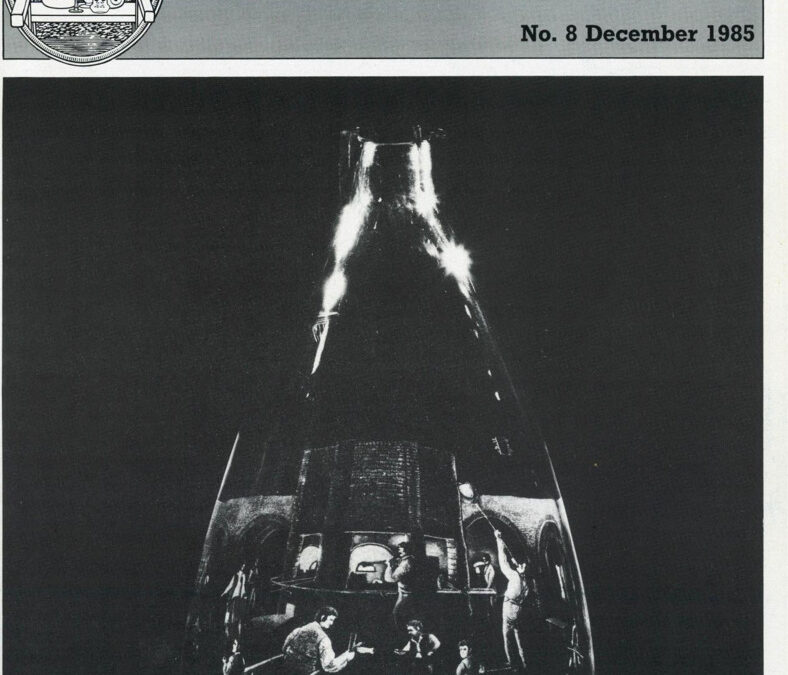
Cover Illustration
The Glass Cone, stipple engraved
by Doug Burgess of Holmes Chapel
1985. Stuart Crystal made the blank
based on the outline of the Red
House Cone at Wordsley; the scene
is derived from the 1818 interior
view of the Aston Flint Glass Works,
Birmingham.
See Showcase article.
Photography by Alan Rickett LMPA
14 Queensway, Knutsford, Cheshire.
SPONSORS
The Glass Association wishes to
thank John Brooks and Wing Co. Ron
Thomas for their financial support of
this issue.
producing technical papers to
complement the Conference
programme. A film on the new
Lloyd’s of London building and the
Maison de Verre in Paris is in
preparation.
The Crafts Council also runs a
commissioning service which offers
free and impartial advice to those
interested in using decorative glass
in an architectural context; full
details are available on request.
For information write to — Penny
Egan, Project Co-ordinator, Crafts
Council, 12 Waterloo Place, London
SW1Y 4AU.
SUNDERLAND
MUSEUM & ART GALLERY,
BOROUGH ROAD.
Jobling 1930s Decorative Glass
November 1985 will see the
opening at Sunderland Museum of
an exhibition of the decorative art
glass produced at the West Glass
Works during the 1930s by the
firm of James A. Jobling and Co.
(now Corning Ltd). This range, an
interesting response by a British
firm to the challenge posed by
continental glass, particularly that
of Lalique, consists of some 70
designs of bowls, vases,
ornaments and light-fittings in
clear, coloured and opalescent
moulded glass. Examples of this
glass can be seen at many antique
fairs and markets, but few dealers
know anything about its origins
and unmarked pieces in
opalescent glass are often
attributed to French factories.
The exhibition (the first to
concentrate exclusively on this
range) will show a wide variety of
Jobling’s decorative glass, with
examples of Lalique for
comparison kindly loaned by the
Victoria and Albert Museum who
have also lent furniture for a
period setting.
The exhibition will be
accompanied by the publication of
a collector’s guide to Jobling’s
decorative glass, produced by
Tyne and Wear County Council
Museums with sponsorship from
Corning Ltd and the Corning
Foundation of America. This
booklet will contain a detailed
history of the origins and
development of the glass, an
article setting it in the context of
1930s design and a list of relevant
Patent Office Design Registrations.
It will be illustrated not only by
colour and black and white
photographs but also with
facsimile reproductions in colour
of some pages from the original
1934 and 1937 Jobling art glass
catalogues.
20th November 1985 — 19th
January 1986
Mon — Fri. 10-5.30; Sat. 10-4; Sun.
2-5.
SALISBURY
SALISBURY & SOUTH WILTSHIRE
MUSEUM,
THE KING’S HOUSE,
65 THE CLOSE.
Lecture on English Stained Glass by
Michael Archer.
Wednesday 19th February at 2.30
p.m.
Admission Fee of £3.
STOKE-ON-TRENT
CITY MUSEUM & ART GALLERY,
BETHESDA ST., HENLEY
.
History of Wine Collection from
Harveys of Bristol.
7th December 1985 — 9th February
1986.
Mon-Sat 10.30 — 5; Sun 2-5.
COPY
DATES
January 20th for March issue
April 21st for June issue
A Glass, Glass Cone
The Liverpool and Manchester Railway Goblet. Stipple engraved by Doug
Burgess. 9″ H.
The engraving covers the main features of the line i.e. the Northumbria
Locomotive which pulled the Duke of Wellington’s train on the opening day, the
Sankey Viaduct and the Sankey Canal, the Rocket coming across Chat Moss and
in the background the Liverpool Road Station at Manchester. This splendid
scene is viewed through the Moorish Arch which was at Liverpool but now sadly
demolished.
The amazing effect of three dimensions is achieved by engraving the subject on
all four surfaces i.e. both sides of the front of the glass and both sides of’ the far
side. Of the Northumbria Loco the two near wheels, rails and loco are engraved
on the outside of the front, the two offside wheels, offside rails and offside tender
are engraved on the inside of the front. When the glass is rotated the viaduct
arches cast a shadow which enhances that already engraved on the glass.
This impressive goblet now forms part of the glass collections in America, in the
Corning Moseuni of Glass.
As a painter, mainly in oils, I first
became interested in glass
engraving by way of a mechanical
engraver, but much later, following
an introduction to a hand-tool and
linear and stipple engraving by
David Smith, the Head Designer
with Webb Corbett, I quickly
realised that this method was more
to my liking and there followed a
natural progression to “stipple only”,
a
technique I have adopted ever
since.
I
suppose stipple engraving by hand
tool can best be described as a
labour of love to a certain extent,
time consuming in execution, not
really commercially viable but
tremendously satisfying on
completion. Without doubt it is the
slowest form of engraving, no
mechanical aid whatsoever being
employed, but it is because of this
that I feel I have a closer affinity to
my work.
Glass, being the wonderful material
that it is, is there to help in producing
the exciting effects which can be
created by trapping the light as it
passes through the glass, giving
subtle changes of tone by variation
of
depth and distance apart of the
‘dots’. It is also waiting for all kinds of
new
effects to be discovered by the
engraver, in the same way as a
musical scale of eight notes
produces yet another new melody
for
a composer.
It is
stipple-engraving which lends
i
tself so naturally to the portrayal of
the
black and white style of
architecture of the 15th and 16th
Centuries and being a lover of old
buildings and history, living in
Cheshire as I do, it is not surprising
that I have engraved
.
many of the
halls and manor houses of this
period, which are so much a feature
of the County.
The York
Minster
Goblet. 1983.
Private
Collection.
In the last few
months the
stipple
engraving of
Doug Burgess
has explored a
variety of
lighting effects
from
moonlight on
fairy tale castles
or starlight on a
snow scene. In
this glass the
floodlighting
on Bootham
Bar acts as a
dramatic
counterfoil to
majestic York
Minster. It is
one of the first
of the night
scenes.
It was following an exhibition of my
work entitled “Cheshire on Glass” at
Broadfield House Glass Museum
that Charles Hajdamach suggested
glass as possible subject matter. At
the time we did not discuss any
particular subject or idea, other than
we both felt that the engraving
should reflect the Glass Industry of
the West Midlands. I was attending
a series of lectures at the Grosvenor
Museum, Chester, one of which was
given by Charles, when suddenly
there it was, the very idea, projected
on a huge screen, right before my
eyes and though I realised it was a
tremendous challenge,
nevertheless I knew this just had to
be “it” — the inside of a 19th century
glass cone — the chairs, the gaffers,
the blowing irons, the pots, punties
and pucellas — the whole scene of
glass being produced and shaped
— this had to be the subject. I
broached the idea to Charles who I
hoped would be as enthusiastic as I
was and so it proved!
Some thought had to be given now to
the glass on which I was to engrave.
Here again, shape reminiscent of
the Glass Industry would appear to
be the thing and then the penny
dropped
to both Charles and
me, may I say miles apart, why not a
glass cone!
Our thoughts were materialising at
the same time as Stuarts were
renovating their Red Cone in order
that it might become a living
museum and they were approached
as to whether they would be
prepared to produce such a cone in
glass. We were not turned away.
Following discussions with Roger
Pauli, Peter Hoar and Julie Knight
when our ideas were explained and I
drawings produced, things began to
happen — the talk was of actual size,
of moulds, of thickness and then one
day a telephone call told me that our
shape was being blown at 4 p.m. that
afternoon and would I like to be
there? Without delay I was on my
way to Wordsley to watch the
piece being created by these
highly-skilled craftsmen,
photographed at every stage and
the following week I had six lovely
pieces of glass from which to
choose.
Having selected my glass, it was
now entirely up to me — Stuarts had
produced the glass with which I was
highly delighted and now I had to try
to produce a stipple-engraving
worthy of the confidence that had
been put in me in order to complete
the project.
Slowly, very slowly the scene
developed, patient hours tapping
away, experiencing problems not
foreseen — I knew that the
curvature of the glass would present
one problem — it always does and
that is making the most acceptable
compensation of the curvature
without much distortion, in order
that the engraving could be viewed
through 180 degrees without
distraction to the viewer,
Of course, one had the usual
decisions to make — do I treat this
area as light against dark, or dark
against light, straight lines
becoming curved when seen at a
different angle — but
stipple-engraving, like painting, is
all about problems and overcoming
them. Some three hundred and
eighty hours later the last problem
had been overcome when I
pronounced the engraving finished.
All I hope now is that the good
people at Stuarts look a little kindly
at my part of the project and do not
think I have spoilt their efforts
in
producing this lovely shape —
perhaps they may think I might have
enhanced it a little in some way. I
hope so.
Doug Burgess
The 19th century glass industry
relied heavily on the use of young
boys both in the glassmaking and
the glasscutting sections of the
factories, as witnessed in the
engraving on the Glass Cone on the
front cover. The following extracts
are taken from the REPORT TO THE
COMMISSIONERS ON THE
EMPLOYMENT OF CHILDREN
1842 which describe in vivid detail
the working conditions and hazards
that those boys faced.
“There are several very large glass works in the neighbourhood of Stourbridge, and the glass trade generally is carried on very
extensively. The trade may be divided into two main branches — viz., glass making, and glasscutting and grinding.
….The glasscutting works, which are sometimes attached to the glassmaking works, and sometimes conducted as a separate
trade. are mostly carried on by respectable. if not by wealthy men, and in a manner that only leaves one objection to be made. It
is that of the noxious process of feeding the wheel with a dry putty-powder, which is made of oxide of lead and tin — about
three-fourths of lead to one-fourth of tin. It is used with water. I have seen a boy stand with his head close over the box or trough
which contained the putty-powder, so that he was constantly inhaling it while he supplied the wheel of the man who sat or stood
above him, and who of course also had his share of the injury, which, however, was of a less degree than that received by the
boy.
….In the glassmaking and glasscutting trades the boys are all outdoor apprentices. They are paid wages by the masters, who
have a contract with the parents. Girls are not employed at these works, except one or two occasionally in washing glass and
other articles. The apprentices seldom commence working at the Glass Trade till they are twelve years of age.
Mr Thomas Irwin, aged 57, Glass
–
cutter.
Employs six men and four apprentices; the two who are bound are above 18 years of age, the other two agree to be bound, and
have been with him three years. There are several of the same trade in the place, but none of them employ above a dozen boys at
the outside. Considers his business an unhealthy one, and all the medical men know it. Thinks the first process of cutting glass is
not unhealthy, provided they are not in the same shops where the glass is finished, and to effect this requires a material, a sort of
putty made of lead and pewter, and this gets under their nails and often causes the hand to contract; they also breathe it, and it
causes rheumatic pains. The chief thing as a preservative is to have plenty of ventilation at the top of the shop, and for those who
use the putty to be more careful as to cleanliness, particularly under the nails. Has often seen boys eat their victuals without
washing their hands, to their certain injury. Frequently his boys come to work at 12 years of age; thinks they should not come
sooner; they ought to be kept to school. Thinks they ought not to come to his sort of work after they are 12 years of age; if a boy
of 15, habituated to the air of the country fields, were to come to this work for the first time, it would probably much injure him
in a short time.
Mr Richard Timmins, aged 46, Glass
–
cutter
Employs from three to eight men, according to the demand for work. Has three apprentices bound; they do not live with him; he
pays them about 4s. at the age of 14 and advances 6d a week every year till they are 20 years of age, and then advances a shilling a
week, and sometimes more if he had the boy as early as from nine to eleven. His business is no doubt injurious to health, but
thinks very much of this might be avoided if the boys could get more exercise in the open air, and if the shop had a contrivance to
separate it from the shop of the putty department, or at all events to contrive that the particles of putty dust should be driven out
by some specific ventilation, as by a current of air from below, with some corresponding opening above. If he were to build for
himself he would so construct the shops. Rents his workshops, as do four other small glass-cutting establishments, of a mill
owner, who also lets them off a sufficient quantity of steampower for each.
Henry Ellis, aged 14
Works at glass-cutting; works for Mr Irwin; is paid by the week; gets 5s. a week regularly — not by the piece; gives it to his
father. Does not feel sick ever with the work. Has the headache sometimes. Has worked at it about four years; likes it pretty
well. Comes at six in the morning till six at night, with half an hour for breakfast and an hour for dinner; goes home to tea.
Breaks his work sometimes, and gets beaten a bit; does not feel the beating quite half an hour; it is not much to signify. Can read
and write; learnt at a day-school, and then went to a night-school after his work. Take 25 from 100 there remained 75; 10
farthings are 21/2d; there are four feet in a yard — no, three; and 36 inches in a yard. There were twelve apostles. Knows about
Jonah; he was in the whale’s belly three days and three nights, because he did not go to the place where the Lord sent him.
(Pretty well grown: not unhealthy, but pale. A smiling, happy expression; clean, and in a proper working dress.)
Richard Pickering, aged 16
Works at glass-cutting; has worked at it five years; gets 5s a week regularly; does not work piece work. Feels the headache, but
very seldom; feels sick sometimes, and has the stomach-ache nearly every week; thinks it’s the putty: sometimes has a
handkerchief round his mouth while at work, but this don’t do, he must breathe, and it makes him too hot; very seldom vomits.
The work is not hard, only it’s disagreeable, because it makes you feel ill. Seldom hears the men complain; has heard one
complain very often, who has not been at work this week — been ill — not drunk. One man has been ill these six or seven weeks
now; thinks it’s with the work.
Can read, not write; learnt to read at the Sunday-school of the Independent Dissenters, who never teach writing on Sundays, but
two nights in the week instead. Is not bound apprentice yet, but means to be. His master treats him kindly. He’s a good–natured
master, and works hard himself too.
(Pretty well grown; not strong; pale, clean, and in a proper working dress.)
I
I
JOHN-HARDMAN
n
STUDIOS •
n
0.1
It:11)tit]
Blown and Stained Glass Studios
Ai
D WOODMAN
ass
Wilkin and Woodman Glass is a new
glass studio situated in Bath, Avon
and co-founded by Neil Wilkin and
myself, Rachael Woodman.
Neil and I formed the partnership in
November and Neil began building
the furnace at Christmas whilst I ran
up and down the country in order to
fulfil my teaching commitments in
Sunderland. Neil and I both teach
one day at North Staffs. Poly now.
We began blowing on 11th March,
Liz Swinburn assisting Neil until I left
Sunderland at Easter. In July, we
took on a full time assistant, Steve
Bradley, who had just graduated
from North Staffs. Poly. Jane Beebe
from Manchester has been there
helping us until she left recently to
work at the Royal Brierley Foundry.
The workshop is a new industrial
unit (750 square feet) on a small
estate just outside of the city centre
— the unit actually overlooks the
River Avon.
We have a small single crucible
furnace and an electric lehr, also
built by Neil. We melt Dartington
cullet and Kugler when we can get
it. The hot glass facility went
together very quickly — it had to
because we had to start producing
very quickly in order to make the
repayment on the bank loan (we
obtained a loan on the Government
loan guarantee scheme). Initially I
was able to help Neil in the hot glass
team but as my unique work began
to sell, I was spending half my time
running around the country to get
access to grinding equipment. (The
R.C.A. were very helpful in this
respect). So, in June, I applied for a
Crafts Council Grant and was
fortunate enough to be awarded
one. The grant together with a
working overdraft, have enabled us
to go ahead and order grinding
equipment and we’ve just taken
delivery of the sand-blaster and
compressor. Engineers in a
neighbouring unit are building us a
big flat-bed grinder and we are
expecting the linnisher to arrive at
any moment… consequently, we’ll
soon have so much equipment in this
little unit that we won’t have room to
turn round!
We produce tableware and gift
ware as well as unique work and
although it’s early days, the signs are
promising. We would like
eventually to rent more space as
Neil would like to build a larger
furnace and run two teams.
Visitors are welcome — just give us
a ring first:-
Wilkin and Woodman Glass,
10 Stable Yard,
Windsor Bridge Road,
Bath, Avon BA2 3AY.
Tel: (0225) 319870
Most of the traffic coming into
Birmingham City Centre from the
West quickly passes Lightwoods
Park, Bearwood little realising that it
is the home of one of the important
English stained glass studios.
Lightwoods House, built in 1789, has
been the home of the John Hardman
Studios since 1972 when it was
purchased by the firm who began a
programme of restoration on the
building.
The history of the firm dates back to
1838 when John Hardman (1811-67)
left his partnership in the family
button-making business to produce
metalwork in the mediaeval style
and method, for the growing
number of revived-Gothic buildings
then being erected. The company
prospered, as Hardman’s friend and
active collaborator, Augustus
Welby Pugin produced most of the
designs. Eventually, Pugin insisted
that the company extend its
activities to making stained glass, as
the quality and service of the
contemporary manufacturers was
inconsistent. The result was a
brilliantly successful venture which
made furnishings, enamel work,
embroidery, precious and
functional metalwork as well as
stained glass of the highest quality.
A large part of the metalwork and
stained glass for Sir Charles Barry’s
new Palace of Westminster was
designed and supervised by Pugin.
After Pugin’s death the work was
continued by his pupil and John
Hardman’s nephew, John Hardman
Powell. These were all made in the
company’s Birmingham workshops
and the records of that period
supply a fascinating insight into the
running of one of the largest teams of
decorative craftsmen ever
assembled. Hardmans supplied
many new windows and restored
much of the old glass after the
Second World War.
Export orders are still an important
part of the business. A glance
through the bound records of past
commissions justifies the firm’s
claim that most major cathedrals,
churches and many civic buildings
contain some examples of the work
of John Hardman and Company.
Recent commissions include St.
Nicholas Church, Codsall, near
Wolverhampton; Ladywell Convent,
Godalming; St. Mary’s Roman
Catholic Church, Warwick and the
Baptistry at St. Vincent de Paul,
Nechells Parkway, Birmingham.
The firm relies for the bulk of its
glass on the Sunderland firm of
Hartley Wood and Co. Recent work
has included use of the thick slabs of
glass known as Dalle-de-Verre.
But the overriding impression on a
visit to the studios is one of tradition
and skill in a splendid, almost
Dickensian setting of craftsmanship.
Visitors are always welcome and if
you can spare half an hour ask for
Edgar Phillips, the firm’s present
director, who will provide one of the
most memorable tours of any glass
studio. You will never pass
Lightwoods Park again without a
glance at the “Studio in the Park”.
(John Hardman Studios, Lightwoods
Park, Hagley Road West, Warley,
West Midlands B67 5DP. Tel: 021-
429 7609)
News & Views
A
Visit to Sweden
Late this summer I spent a few days
in southern Sweden’s glassmaking
district of Smaland. Highlights of the
visit were the glass museum at Vaxjo
(you pronounce this something like
‘Vaychyu’) and a trip to the nearby
glassworks at Kosta (pronounced
‘Coaster’ by the locals).
Kosta is one of several works in
Smaland which can be visited and it
has a splendid museum and
showroom combined. The museum
contains two period room
reconstructions (all Swedish
museums have good educational
features) and a vivid display of their
historic and contemporary glass.
Most impressive was the works visit.
This was quite different to a
Stourbridge or Murano visit, giving
one an insight into the design as well
as the making process. On the day I
went we saw a beautifully organized
team making production drinking
glasses (with a two-tier marver to
facilitate the making of the particular
design) and, side by side with them,
a unique animal sculpture being
created, with a Kosta designer
working alongside the blowers. We
arrived in the engraving studio over
lunch. Nobody minded, and
designers and engravers sat round a
table while we browsed along
engraving benches (mostly flexible
drive but two or three copper
wheel) and along the designers’
desks. Here our guide picked up a
solid blue cone, roughly engraved
in a floral pattern; the realization
dawned that we were seeing a
piece of Graal in the making. I
imagine most visits offer similar
experiences.
The Vaxjo museum is unique in its
presentation of the whole
development of Swedish glass. It
consists of one large gallery,
showing glass from the seventeenth
century to the present. Emphasis is
naturally on the modern period, and
the museum is rich in classics of the
twentieth century. Every major
factory and designer is well shown,
allowing for assessment of the
individual contribution of each.
There are things one rarely sees in
English collections (the
economically cut figurative designs
of Ewald Dahlskog for Kosta in the
20s and the eccentric, vividly
realized engraved animals of Erik
Hoglund on 60s Boda glass) and
there are superb examples of more
familiar things (looking at one of Mona Morales Schildt’s colour
overlay pieces at Vaxjo was like
finding the end of a rainbow). Some
contemporary works are on open
display and the whole collection is
attractively lit and presented. The
museum is an instruction and a
delight.
A visitor to Smaland should allow as
much time as possible, as the
factories are some miles apart; a car
is undoubtedly an asset. The town of
Vaxjo itself is also worth exploring
— my hotel had three splendid
Orrefors panels and a Lars Hellsten
60s sculpture made at Skrufs. And, if
you like walking, there is a
landscape of lakes and pines like no
other I have seen.
Ian Wolfenden
We regret to learn of the death of
Mrs. Joan White of Yonkers, New
York. She was one of the most
enthusiastic of writers, collectors
and reseachers whether it was on
ceramics or glass. Her dedicated
work was recognised when she
was elected President of the
Wedgwood Society of America.
She supported the idea of the
Glass Association from its
inauguration. Our deepest
sympathy goes to her family and
to her friends including Leonard
and Juliette Rakow.
Anglo-Saxon
Glass Seminar
A seminar on Anglo-Saxon glass has
been organised by the British
section of the International
Association for the History of Glass,
on Friday 21st and Saturday 22nd
February, 1986. Lectures will be
held at the British Museum and the
Art Workers Guild, 6 Queen Square,
London WC1. For further details
contact Hugh Tait, Dept. of
Mediaeval and Later Antiquities,
The British Museum, London WC1B
3DG.
Swedish Glass
Sylvia Coppen-Gardner has kindly
brought to out attention a 73 page
publication entitled “Swedish
Glass-Awarded Design”
documenting a competition
organised by the National Swedish
Industrial Board in collaboration
with a group of designers. Various
categories including art glassware,
hand-crafted ornamental and utility
glass and pressed glass were
judged by an expert jury who took
into account the technical and
commercial points of view. The
book covers the work of top
designers 011e Alberius, Monica
Backstrom, Gunnar Cyren, Anna
Ehrner, Kjell Engman, Mats
JOnasson, Anne Nillsson, Ingegerd
Raman, Ulrika Hydman-Vallien and
Bertil Vallien with high quality
colour illustrations of their glasses as
well as glassmaking scenes.
A
useful list of Swedish glass
companies gives founding dates
and numbers of employees. The
book is available from the National
Swedish Industrial Board, 117 86
Stockholm; it is priced at 12 U.S.
dollars.
Wishing you
all a very Happy
Christmas and a
Prosperous New Year.
ace
Regional Reports
Chairman’s Report
On Saturday October 26th, The
Glass Association ended its second
year, with an Annual General
Meeting, held in Nottingham.
Your Association goes from strength
to strength. Our Treasurer and
Membership secretary Ron Brown
announced an increase in
membership of 26% in the year.
The Glass Cone, thanks to Charles
Hajdamach, has continued to be
issued quarterly, even allowing for
the delay caused by printing
disputes. A very high standard has
been maintained. Selected articles
of interest are always required;
Charles would be very pleased to
hear from anyone who can help by
writing or suggesting a short article.
At the time of writing this report,
The Journal, edited by Ian
Wolfenden, is about to go to print
and will be sent to all who have
currently paid subscription.
Three National outings were
arranged during the year:-
Cambridge, where we enjoyed a
lecture by Simon Whisler on stipple
engraving. Lunch was followed by a
visit to the glass in the Fitz-William
Museum.
Manchester,
for a one day seminar
on Studio Glass. This included a
view of the ‘Americans in Glass’
Exhibition.
Newcastle-on-Tyne,
where a full
weekend seminar was held on
Newcastle Glass. Visits to
Lemington & Teams Glass Works,
Shipley and Laing Art Galleries,
together with a full and informative
series of lectures made this a most
successful and memorable
weekend. Our organisers for these
events should be justly proud of
their achievements.
Each meeting was attended by
between 50
70 members.
Our thanks to Roger Dodsworth, Ian
Wolfenden, Richard Gray and Simon
Cottle.
On the Regional side, this year has
seen the formation of groups in the
North East and the South East, to
support those in the North West and
Midlands, which are now
established and flourishing.
Unfortunately, a South West group,
although having had one meeting,
failed to ‘get off the ground’ through
A.G.M.
NOTTINGHAM CASTLE
MUSEUM,
Saturday, 26th October.
The events organised as part of
the A.G.M. attracted 70
members to the Castle Museum
where the Keeper of
Decorative Arts, Pamela Wood,
began the day with a lecture
about the glass collections and
the
history of glassmaking in
the town. Lunch was next at
Joshers Restaurant near the
Canal Museum; en route
somehow we managed to resist
the thirst-quenching temptation
of the Trip to Jerusalem. The
jovial and friendly A.G.M. was
followed by the Association’s
first venture into a glass sale.
Members had supported the
idea well and some 80 objects
were on offer. The success of
the sale will ensure that it is
repeated next year with the
added attraction of a glass book
stall. Finally before departing
everyone spent a long time
enjoying the fascinating array of
glasses on display while
Pamela organised trips to
reserve collections. Our thanks
go to Pamela and to Roger for
organising another memorable
day.
lack of support.
The committee are
aware of the
need for even more members, and
have in fact convened a meeting
dealing solely with this topic. A
policy has been instituted and
information leaflets distributed.
However, I do feel that every
member could play this part, by
introducing a new member in 1986.
A full programme is under
discussion for next year, and I hope
that we can maintain the very high
standards we have set. I am sure
with the support of the committee
and members, this will be so.
Finally to the past year; I would like
to thank all the members of the
committee for their hard work and
endeavour in putting The Glass
Association so firmly ‘on the map’ in
such a short space of time.
A Waugh
NATIONAL MEETING
NORTH-EAST GLASS SEMINAR
13th — 15th September
All 50
places were eagerly taken
up
for the first weekend
seminar to
be
organised by the Association. By
Sunday lunchtime the unanimous
decision was that it had been an
outstanding success. The key to that
success was a well-organised blend
of visits and lectures interspersed
with enough time to chat with old
friends and opportunities to make
new ones.
Visits included a private view of
North East studio glass at the
Shipley Art Gallery; tours of the
Lemington glass cone and the
Teams Glassworks at Gateshead,
(the latter a marvellous historic
collection of half-demolished
furnaces, old pressing machines and
rows of steel moulds as well as
glass-pressing in action); and a trip
to Sunderland to take in the
Museum displays and glass making
demonstrations by Jim Griffiths at
the Polytechnic. The lecturers
covered glass making on the Tyne
and the Wear over the last three
centuries. Cathy Ross, John Baker.
Simon Cottle, Alan Leach and
Frances Bugg provided new
information on their respective
subjects especially Alan Leach who.
in only 18 months of research, has
built up a huge record of local glass
engravers.
The pleasant surroundings of the
Castle Leazes Hall of Residence
coupled with the friendly and
helpful staff, made the stay so much
more enjoyable; and will the
delegates ever forget those huge
helpings at lunch and dinner!
Everyone echoed the Chairman’s
thanks. especially to Simon Cottle.
but also to all who made this
weekend such a great pleasure.