




The
Glass Cone
Issue No: 80 — Autumn 2007
The Magazine of
The Glass Association
Registered as a Charity No. 326602
Chairman
Charles Hajdamach: chairmana,glassassociation.org.uk
Hon. Secretary
Yvonne Cocking, 14 Southfield Drive, Sutton Courtenay,
Abingdon, Oxon, OX14 4AY
(secretary(a,glas sassociation.org.uk)
Editorial Board
Charles Hajdamach (Editor), Bob Wilcock (Technical Editor),
Roger Dodsworth, Yvonne Cocking
Address for Glass Cone correspondence
E-mail to editor@glassassociation.org.uk or mail to
Charles Hajdamach, 10 Villa Street, Amblecote, Stourbridge
West Midlands, DY8 4ER
Address for membership enquiries
John Greenham, Membership Secretary,
High Trees, Dean Lane, Merstham, Surrey, RH1 3AH.
(membershipa,glassassociation.org.uk)
Committee
Peter Beebe; Paul Bishop; Jane Brown; Brian Clarke (Treasurer);
Brian Firmstone; Mark Hill; Gaby Marcon; Janet Sergison; Judith
Vincent.
At a time when many similar societies to ours
are faced with falling membership, the Association has maintained
enviable levels of numbers. My thanks go to every individual
member for your support and continued membership of the society.
Many of you have given donations alongside your annual
subscriptions and those have helped enormously in keeping the
society solvent. Some of you have also been “encouraged gently”
to write for the Cone and the Journal and your contributions have
ensured that our publications provide knowledge and news at many
levels to our members, supported by the society’s Web site.
After the AGM I will carry on as a member of
the Association and continue to give my support to my successor
and to the committee in whichever way possible. The Glass
Association is unique in this country in that it provides wide-
ranging activities on glass of all periods to its members on a
regional basis, and that work needs to continue and develop. I
therefore urge all of our members to increase their support for the
activities of the Association, either offering themselves for posts on
the committee or writing articles and notes for the publications or in
attending events on a regular basis. During the remainder of this
year for example, the events include the European Glass Weekend
and AGM on 27th and 28th October in Manchester, and the Glass
Workshops event on 3rd November in Stourbridge. Without your
attendance at these events the committee could be led to assume
that members do not wish to have this type of activity and they will
no longer be organised.
The Glass Association was started because of a
real need by glass collectors right across the country for a society
which offered a mix of events and publications without the need to
travel to London to enjoy their pastime. I believe that need is still
there and although the way we collect now, or gather information
about our purchases, has altered drastically over the last two
decades, the role of the Glass Association is still as vital as when it
was inaugurated twenty-three years ago.
Charles R. Hajdamach
Website:
vvvvw.glassassociation.org.uk
E-mail news & events to news@glassassociation.org.uk
Printed by
Jones and Palmer Ltd: wwvvjonesandpalmer.co.uk
Published by
The Glass Association
ISSN No. 0265 9654
The opinions expressed in the Glass Cone are those of the
contributors. The aim of the Editorial Board is to cover
a range of interests, ideas and opinions, which are not
necessarily their own.
The decision of the Editorial Board is final.
At the AGM in October I will be standing down as your
Chairman after six years in the post. As this issue of the Glass Cone
is the last with myself as Chair I would like to take this opportunity
to thank the many people who have supported me during those six
years. The committee of the Glass Association are one of the most
dedicated groups of people that I have known and I have enjoyed
great pleasure working with them towards our common goals. They
give freely of their valuable time which could be spent in other
pursuits and the great level of their expertise and enthusiasm has
guided the Association through many exciting ventures. I send my
heartfelt appreciation to all of them, both past and present.
At the AGM in Manchester in October the
Association will introduce a brand new event to its proceedings in
the form of a
Silent Auction.
The idea originated two years ago
when a group of our members visited America and attended the
annual convention of the Vaseline Glass Collectors’ Club in
Pittsburgh. The Silent Auction is a regular event with them and it
was felt that our members would benefit from a similar event held
at a national
meting
such as the AGM. The Auction allows
members to sell their glass with a minimum reserve set by them.
During the two days while the items are on offer other members
can then write their bid on the form next to the glass and at a
predetermined time the Auction ends and the highest bidder walks
away with their purchase. A booking form for the Auction will be
sent out with the AGM papers asking members to notify us of the
likely pieces they will be bringing or sending to Manchester in
order that we can organize the necessary amount of table space. If
the American experience is anything to go by, it promises to be a
fun event.
AWNT 1111W8
**SILENT AUCTISer
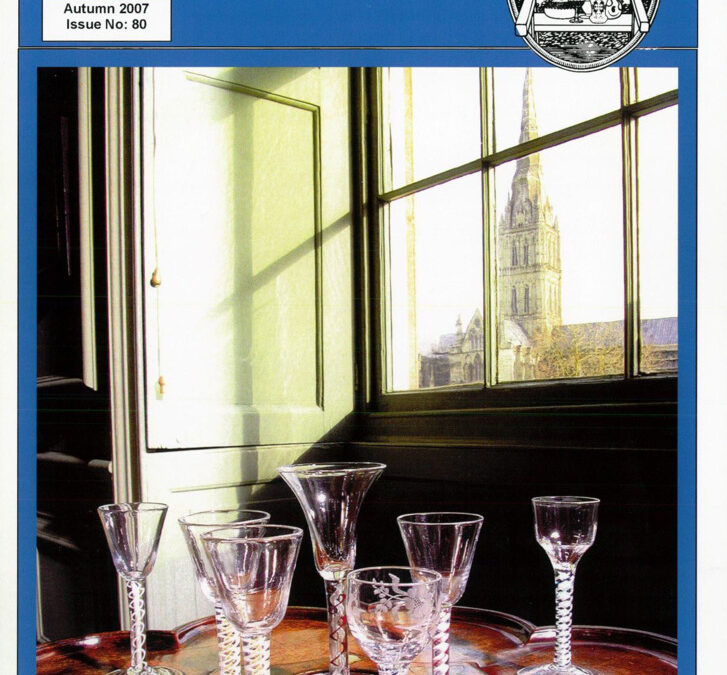
Front Cover:
Mompesson House: Seven colour-twist wineglasses c.1770
displayed on a George II tea-table, with the majestic spire of
Salisbury Cathedral visible through the window.
The Glass Cone—Issue No: 80 Autumn 2007
2
Captain Oswald Graham Noel
Turnbull in his tennis whites. A
member of the British Davis Cup
Team in 1921, 1925 and 1926, he
also won a gold medal at the 1920
Antwerp Olympics.
Between the 24
th
of March and the 28
th
of October 2007, Mompesson House in Salisbury
is staging a special exhibition of the Turnbull
Collection of English 18th century drinking
glasses. Roger and Pat Ersser visited the house
and here Roger explains some of the glassmaking
techniques and drinking habits of the 18th century
explored through this remarkable collection of
370 drinking glasses.
Mompesson House
Mompesson House was built in 1701 by
Charles Mompesson on Chorister’s Green in
Salisbury’s Cathedral Close, on land leased from
the Church authorities. The interior was enhanced
forty years later by his brother-in-law, Charles
Longueville, who added sumptuous plasterwork
ceilings and a fine carved oak staircase. The
fabric of the building, with its limestone facade,
symmetrical windows and wrought-iron railings,
remained virtually untouched by a succession of
families during the following 200 years, and in
1952 the freehold was purchased by Mr. Denis
Martineau, who presented it to the National Trust.
It was considered to be such an elegant Queen
Anne townhouse and walled garden by the Trust,
that, after Mr. Martineau’s death in 1975, it was
Salisbury. In celebration of the completion of the
catalogue, it was decided to show the complete
collection, some in an exhibition in the small
drawing room, and the rest, including 140 pieces
from the reserve collection displayed for the first
time at Mompesson House, in the large breakfront
cabinet.
The Exhibition and Display
Forsaking the predominance of 20th century
glassmakers and factories featured in recent Glass
Association events, to view classic drinking
glasses, in their relevant 18
th
century setting,
restored some balance to my perspective on our
English glassmaking heritage. Those of us who do
not specialise in this period do not so much forget
the quality and historic significance of the pieces,
but perhaps just accept the class, without too close
an examination of the finer details of technique
and decoration. I also find that I stumble over the
systematic nomenclature for bowl, stem and foot
shapes and types so vital for accurate description.
The exhibition, curated by James Grasby, consists
of a series of display cabinets containing groups of
glasses, notes on the techniques used in their
construction, and contemporary accounts of both
glass making and 18th century drinking habits. It
illustrates the influences of fashion, changes in the
furnished, with the help of many donations, bequests and loans, as
an 18th century residence. It was decorated in the appropriate style
and has been open to the public since 1977.
Captain Turnbull and his Collection
In a house full of original 18th century furniture, ceramics,
silver, and such rare gems as a collection of 17th century raised
embroidered pictures, known as estumpwork’, the crowning glory
just has to be The Turnbull Collection of English 18th Century
Drinking Glasses.
Captain Oswald Graham Noel Tumbull, MC (1890-1970)
was born into a family of wealthy shipbuilders and spent his
working life in the family firm. He was awarded the Military Cross
during the First World War and was a distinguished sportsman. He
played tennis at Wimbledon, before and after the War, was a
member of the British Davis Cup team in the 1920’s, and together
with his partner, Max Woosnam, won the doubles Gold Medal at
the 1920 Antwerp Olympics. He was also a keen golfer and sailor.
It seems unclear what prompted his almost frenzied interest, but
during four years, at the height of his tennis career, he formed a
collection of over 370 18th century English drinking glasses. They
were bequeathed to The National Trust in 1970, and many are on
permanent display in a large Regency mahogany breakfront
cabinet, which also belonged to Captain Turnbull, in the dining
room of Mompesson House.
Until recently, visitors, collectors and researchers have
been frustrated by the lack of a suitable catalogue for the collection,
which is the largest owned by the Trust. This has now been rectified
by the persistence of the property manager, Karen E. Rudd, and the
encouragement and financial donations of American collectors,
such as A.C. Hubbard Jr., Jay and Anne Kaplan, and other bequests
especially by the executors of the estate of Mrs. Dorothy Minett of
3
Late 17th and early 18th century baluster wineglasses and goblets
displayed on a George III mahogany three-tiered dumb-waiter.
–
1
1111111111111111″
The Glass Cone—Issue No: 80 Autumn 2007
Naatiossik.
V
interesting description of the collecting scene in the 1920’s-30’s,
aided by a series of 47 bills, primarily from London dealers, mostly
Arthur Churchill, with a few from Cyril Davis. He was in
competition with other famous collectors of the time, such as
Joseph Bles, Hamilton Clements, Grant Francis, Walter Harding
and C. Kirby Mason, all of whom subsequently disposed of their
collections in the 1930’s. Between 5th January 1920 and 2nd July
1923, 239 glasses were bought for a total of £3,326.11s. Engraved
Jacobite glasses were the most expensive, from £58 to an eye
watering £220. He also purchased a couple of fake ‘Williamite’ wine
glasses (£34 and £30), probably engraved by the famous Dublin-
based engraver Franz Tieze. I wonder what his generation of
collectors, with relatively fewer sources of reference, would have
made of the recent correspondence in The Cone on the role of
dealers?
Apart from a jelly glass, sweetmeat, two decanters and a
Dutch wine glass engraved with an armorial, the collection consists
of over 370 18th century English and Scottish drinking glasses, and
Martine Newby has organised this guide to the collection
essentially, as in the exhibition, as an historic progression. The 108
glasses chosen are attractively illustrated, several grouped on period
furniture, in a series of photographs by Richard Pink. Each is also
described in detail, including purchase price where possible, in an
appendix at the end of the book.
The text is divided into 16 short sections, each with
relevant background history, notes on makers and decorators such
as the Beilby family and James Giles, and pictures of pieces from
the collection, illustrating the techniques.
The sections are: –
Short history of English glass; Baluster glasses; Ale-
glasses; Champagne glasses; Cider-glasses; Cordial and Ratafia
glasses; Air-twist stems; Opaque-twist stems; Colour-twist stems;
Enamelled glass; Gilded glass; Facet-cut glass; Wheel-engraved
glass; Jacobite glass; Williamite glass and later fakes, and Glass
with later engraving.
In her introduction Martine Newby states that the
collection contains examples of most but not all glass types and
styles produced during the 18th century. There is, however,
sufficient variety for her to have produced an impressive, scholarly
celebration of a time when English glass was very, very special.
Roger Ersser
The help and interest of Karen Rudd is gratefully acknowledged.
Illustrations by kind permission of The National Trust and Richard
Pink
References and Links
The Turnbull Collection of English 18th Century Drinking Glasses.
Martine S. Newby. 2006. 48pp
Pub. by The National Trust. ISBN 1-903394-02-3
Available from Mompesson House. £5.99. (f7.20 incl. p+p)
(Also the National Trust shop, 41High St. Salisbury SP1 2PB.
Tel: 01722 331884 )
Mompesson House, The Close, Salisbury, Wiltshire, SP1 2EL
Open 11-17.00 late March to late October each year
(Closed Thursday and Friday) Tel: 01722 335659
e-mail: mompessonhouse@nationaltrustorg.uk
www.nationaltrust.org.uk
Karen.Rudd@nationaltrustorg.uk
Emsie Sharp, Dorset Centre for Rural Skills, West
Farm Barn,
Farringdon, Blandford, DT11 8RA.
Tel: 07799 624 256. www.sharpglass.co.uk
Jacobite air-twist wineglass engraved with a heraldic rose,
oak leaf and the motto ‘Fiat, c. 1745-50, and the Erskine of
Cardross Amen glass, c.1745.
popularity of different alcoholic beverages, advances in technique,
and the tax system, as drinking glasses progressed from baluster
stemmed goblets and short-stemmed ale glasses, through air and
enamel twist stems, enamelling, gilding, and engraving, to facet-cut
cordials. Accounts of aristocratic binge drinking, the design of
toasting glasses with bases capable of surviving being banged on
the table, and glass engraving as a vehicle for political statement, all
provided a fascinating insight into the age.
In the centre of the room is an installation incorporating a
video of glassmaker Emsie Sharp making an 18th century-styled
wine goblet, a collection of tools, and several invoices and
documents, including the notebook Captain Turnbull used to record
his purchases (this was uncannily similar to the one my wife uses
for her more modest investments). It is worth touring the room with
a copy of the catalogue as the glass numbers on each cabinet
correspond to those illustrated in the catalogue, which contains
much additional information. Whilst many of the glasses in the
large cabinet in the dining room on the opposite side of the entrance
hall are less ornate than the exhibition pieces, the balusters in
particular complement the simple elegance of the period furniture.
There are so many fabulous examples of the numerous
styles of the drinking glass makers’
art,
choosing a few favourites is
almost impossible, but I could look at a multi-spiral air-twist cider-
glass, wheel-engraved with a fruiting apple spray and codling moth
(circa 1750-1755 cat.48) for hours. In contrast a wine glass, with a
trumpet bowl drawn out of a ‘mercury-twist’ stem over a conical
foot (circa 1750 cat.56) seemed to have such perfect balance, and,
with my botanical interests, I was naturally attracted to the wheel-
engraved floral motifs on the bowls of the Jacobite wine glasses
(circa 1750-1770 cat.98-103). My wife’s choices would be the
ribbed ale-glasses (circa 1 710-1760 cat.34-40), the facet-cut stems,
and the myriad of stem twists.
The Turnbull Collection of English le
–
Century
Drinking
Glasses
Martine S. Newby.
This book is considerably more than just an illustrated
catalogue of the most significant 108 pieces of the collection. The
foreword, as mentioned above, highlights the reliance of custodians
of national collections on benefactors to adequately catalogue their
treasures. The section describing Captain Turnbull’s life includes an
The Glass Cone—Issue
No: 80
Autumn 2007
4
ERWEIGHT CORN
Millefiore with sulphide cross
Sulphide of child’s head
EARLY COMMEMORATIVE PAPERWEIGHT
A friend monitors the paperweights that come up for sale
on eBay and forwards to me the details of any unusual or
outstanding ones. Just after I had completed my last article, details
arrived of a commemorative weight for the coronation of
George IV on July 19th 1821. From the description and
photograph it looks like a genuine paper backed souvenir type
weight typical of the Victorian period but 1821 is one of the earliest
events that
I
have seen commemorated in a paperweight. It is well
before the appearance of millefiori weights in 1845 and the only
type of weights that were around at this time would be early
sulphides by the likes of Apsley Pellatt in London and John Ford in
Edinburgh plus the French and other continental manufacturers
from Bohemia/Silesia Other than engraved glass, commemorative
glass items from that period prior to Victoria’s coronation in 1838
are pretty scarce, as the technique of producing press moulded glass
was very much in its infancy. The postal service hadn’t been
established and paper and pens were not in use by the bulk of the
population, and would have been even less common some
seventeen years earlier. I have never seen any items for events
prior to the start of Victoria’s long reign, let alone paperweights, and
I checked the book on commemorative pressed glass that was
published a few years ago and there is nothing as early as 1821
illustrated in it. Assuming it was genuine the item advertised would
appear to be very rare—unless the readers of this magazine know
differently as they have examples tucked away in a cupboard!
As I complete this article details of another interesting and
unusual weight have arrived, again another paper backed souvenir
type weight but this time dating from 1863 with a picture of Prince
Albert inside a black border in which are the words “IN MEMORY
OF H. late RH.PRINCE ALBERT”.
NEW RESEARCH ON BOHEMIAN AND
SILESIAN WEIGHTS
On a recent trip to Anglesey for a few days holiday we
took a slight diversion to the Chester area to attend the most recent
meeting of the Northern Paperweight Society where, as visitors, we
were given a warm welcome.
The speaker was Peter Von Brackel from Germany who
has already published a very comprehensive book on the subject of
Bohemian and Silesian paperweights, or perhaps what should be
more accurately described as paperweights from the Iserbirge and
Riesenbirge regions of those countries.
Over the centuries they have formed part of various
empires, but currently lie in the mountainous region on the border
between Poland and the Czech Republic. Along with the book
published at around the same time in Polish and English by Mark
Kordascewicz, they started to unravel some of the mysteries
surrounding the production of paperweights that due to lack of more
information were given the general title of Bohemian. The book
from Peter Von Brackel has a small section on millefiori weights,
but the bulk of the book is devoted to the many types of flower
form weights plus the personalised types of weights encasing
names, photographs and the like, that will be familiar to most
collectors. Since it was published he has been continuing his
research on the millefiori weight production from the various
factories. Because the first signed and dated weights from
5
The Glass Cone—Issue No: 80 Autumn 2007
Millefiore canes, some with silhouettes
Bohemia/Silesia appeared in 1848, most reference books lead the
reader to believe that the production of weights from these areas of
the Austro-Hungarian Empire followed after those produced by the
French factories that were on show at the Exhibition of Industry in
Vienna in 1845, and also that production appeared to cease at the
end of that year. Both the aforementioned
books indicated that this was probably
incorrect on both counts, with several of
the major factories having rediscovered
the techniques of making millefiori in the
early 1830’s, going on to use the millefiori
in jewellery and other decorative items
and probably some paperweights well
before 1845.
Production was most prolific
during the ten years between 1850 and
1860 when it ceased. What we saw in the
presentation were illustrations prepared
for use in the book, showing examples of
both the weights and enlarged pictures of
all the various canes used in the weights
from all the known factories, plus a few
that still remain unidentified. Many of
Members may wish to know that Jim Edgeley — long-
standing partner of Eva Frumin — died recently after a long and
debilitating illness. He was the compiler of the Glass Association
publication “Registered Numbers 1908-1945” in which he listed all
the glass registration numbers and the names of the manufacturers/
agents/dealers in whose names the numbers were registered.
Although the list was compiled for their personal use as students/
collectors, he was prevailed upon to allow the Association to
publish the list, making it available to all members. It represented
the result of many visits to Kew from his base in Manchester, and is
a valuable and valued memorial to his assiduous devotion to the
subject.
He and Eva were very keen collectors of pressed glass,
principally from the Manchester and Salford factories, but they were
just as knowledgeable on the products of the North Eastern
factories. In his later years, Jim changed the emphasis of his
Three trumpet type flowers in a pot
the weights were very rare with only a handful known to exist,
others were more common, but the main fact to come from his
research was to confirm virtually without doubt that many of the
weights had been produced from around 1840 onwards, up to some
five years before the appearance of the weights from the French
factories. Also it became evident that
weights had been produced by some
factories that it was previously thought
had not produced such items. The
information was so comprehensive that it
was too much to take it all in at the time,
but will obviously become much clearer
once the new book is published and one
can study the book and the illustrations at
leisure. It should be a superb reference
book for all collectors trying to identify
the makers of their Bohemian/Silesian
millefiori weights of which I am one.
Richard M Giles
The illustrations show five typical
Bohemian/Silesian paperweights. .
collecting, and concentrated on commemorative glassware,
accumulating a wide-ranging collection before illness prevented his
continuing. That collection has now been dispersed.
Eva’s monumental collection of Manchester pressed glass
has now been disposed of — apart from a single piece of tableware –
as she has now moved to a small sheltered housing flat close to the
house in which she and Jim had lived for over 30 years. Visitors to
that house were always overwhelmed when faced by its contents –
glass, pictures, enamels and ceramics, including a vast collection of
Eichwald pottery — which spread throughout the house. Before she
moved, the glass collection was offered to, and accepted by,
Broadfield House Glass Museum, on the understanding that the
Museum would retain pieces which would augment their
collections, but that the bulk of the collection would be sold by
auction in Stourbridge, possibly in 2008.
Peter Helm
Red overlay with etched
scene
OBITUARY
JIM D. EDGELEY
The Glass Cone—Issue No: 80 Autumn 2007
6
Yan Zoritchak with some of his works, in the private gallery above his
studio, with stunning views of Lake Annecy through the window.
AN
ORITCH
We have long admired the works of Yan Zoritchak, and
were privileged to have an opportunity to meet him on a recent trip
to France, thanks to Jean-Pierre Postaire of Galerie Nadir in Annecy
(which has subsequently closed, Monsieur Postaire now
concentrating on organizing exhibitions in glass).
Yan Zoritchak was
born in the Slovakian village
of Zdiar in 1944 and studied
at ZeleznY Brod then at
Prague under Vaclav Platek
and Stanislas LibenskY. He
graduated in 1969. In Prague
he met Catherine, they
married and in 1970 they
moved to France, to Talloire
on the edge of Lake Annecy.
His most well-
known early pieces are
relatively uncomplicated
works in cast glass, notably
his
“Homage to Brancusi’
series. These do not just pay
tribute to the enormous
contribution Brancusi made
to artistic sculpture, but reflect
an affinity Zoritchak
felt
between the two artists, both
coming from Eastern Europe
(Brancusi from Rumania) to
make their mark in France.
Zoritchak has a
powerful sense of the
insignificance of man,
existing at a brief fixed point
for but a moment
of time in a universe that is infinite and endless. This
philosophy infuses his work, most notably the
various
Celestial
series using optical glass and
very precise cut and polished shapes, sometimes
simple elementary figures—a pyramid, a
prism, a wedge—sometimes more complex
shapes and combinations of shapes, all
with the geometric perfection only
achieved by the Slovakian masters.
Some pieces are of pure optical
glass, without colour, or with a
coloured pattern on one face,
relying on the optics to add ever
varying dimensions to the piece
as the observer walks around it.
One such piece,
Arctic Flower,
he personally placed at the
North Pole on 27 April 1993
with the first Slovak polar
expedition. It is a clearly cut prism with majestic lines leading to its
summit interrupted by a single lens representing the sun shining on
the polar world. It has become the centre of the Earth’s rotation, an
imaginary extension of the earth’s axis and it offers a new symbolic
way of sending and receiving cosmic messages.
It is the cosmos that inspires
him, has been his
leitmotiv.
Celestial Flower, Celestial
Garden, Messenger from
Space, Cosmic Signal,
Asteroids, Supernova,
all
these series of sculptures are
pictures of space in glass,
some based on actual photos,
but to say that does not do
them justice. They are much
more than beautiful but
simple representations: Yan
Zoritchak offers a larger space
to send the cosmic message to
the viewer’s mind. The image
is created through the
insertion of achromatic veils
into the glass, ranging in
intensity from solid to
ethereal. Solid “holes” with
asteroid-like shapes and
multi-coloured surfaces add
an intriguing dimension.
Natural gold veils feature in
many works, with gold and
other metal salts being used to
create a whole range of
colours, primary colours in his
Celestial Flowers,
pastel
pinks and blues in his
Celestial Gardens.
At right-angles to a principal surface you see
but the physical piece. Step to one side and you
step into the galaxy as it opens up before you.
You lose all sense of what is real and what is
illusory. The internal images combine
and multiply, take you outwards and
upwards into space, and down into
the centre of the earth. Yan
Zoritchak has set free the
inner space of the glass,
and taken the observer’s
eye and mind deep
into the heavens, the
earth and the
universe.
Etoile 2005
from different viewpoints
a pyramid transformed into
a star.
7
4111111111ak
Aft
The Glass Cone—Issue No: 80 Autumn 2007
Zoritchak explaining the casting process
In his workshop
Zoritchak explained
to us how his pieces
are created. He buys
his glass, crystal and
optical glass in
blocks,
sourcing
them from all over
the world. In a large
electric furnace he
arranges boards to the
rough shape of the
piece, blocking off
areas where more
glass is to be added
later. The first piece
of glass is heated in
the mould to just the
temperature required
for the glass to gently
Zoritchak’s sunny patio with raw glass
melt to take the shape
blocks and unfinished pieces
of the mould. Gold,
silver or metal salts
will be applied to the surface and more glass is added. The
temperature is maintained at just that necessary for the pieces of
glass to slowly fuse together; this is absolutely crucial to maintain
the optical purity of the glass, and avoid cords and stresses and
unwanted bubbles. Small plaster casts are used to create the ‘holes’.
The process is repeated as many times as necessary. The raw
pieces we saw clearly showed the different layers of glass, still had
the plaster insertions.
To the supreme casting skill is now added skilled cutting,
shaping and polishing, and this is just as slow and meticulous a
process as the casting. His latest piece, a homage to Boticelli,
casting a Madonna and child within a block of optical glass, is still
not perfected to his satisfaction after two years of work.
Since the turn of the millennium Zoritchak has created
some powerful pieces in coloured glass, still mostly with a celestial
theme, notably his
Super-nova
series, and his
Eclipse
series, cast
and shaped in
such a way as
to reproduce
the effect of
an eclipse for the
observer as the
viewpoint changes.
Zoritchak
works alone. He has
taught in the past,
finding that students
quickly learn what to
do, go off to do it,
only to find that they
have not properly
learnt how to do it.
There are only a
handful of glass-
makers the world
over who have
mastered
the
techniques he uses
(Colin Reid in the
UK is one).
From 1983-
1986 he was charged by
the French Ministry of
Culture with the task of
establishing the
International Centre for
Research into Glass and
Art (CIRVA) at Aix-en-
Provence, and in the
following year was
awarded the
Chevalier de
I
‘Ordre des Arts et Lettres,
the French equivalent of a
knighthood. His glass has
won him many prizes
(though he no longer enters
competitions) and can be
found in public (and
private) collections around
the world, from Australia
to the USA. Great Britain
is a notable exception. He
has never had a major
8
The Glass Cone—Issue No: 80 Autumn 2007
MN I
Two of the Eclipse s
Bob Wilcock
exhibition in this country, something he and
M
Postaire would like
to put right in the not too distant future. If it comes off, it will be an
exhibition not to be missed. We were privileged to be able to meet
him, to see him in his studio, to see his latest works and those from
the past that he treasures, and gain an insight into his genius.
9
The Glass Cone—Issue No: 80 Autumn 2007
ROYAL BRIERLEY CRYSTAL – THE FIN
The derelict site of Royal Brierley Crystal on North Street, Brierley
Hill photographed in April of this year.
Honeyborne, the home of John Northwood I, and later his son John
Northwood 11, seen here covered with tarpaulins, is one of the historic
buildings that have been preserved on the otherwise empty site. (CH)
Richard Katz and Epsom
Activities Limited, the owners
of Sunderland Glass. This
change of ownership did not
evive the fortunes of the under-
funded, ailing company, and
receivers were appointed in
2000. The factory closed with
the loss of some 200 jobs. This
marked the end of glass
production at North Street. The
site was sold to property
developers. The majority of the
buildings (many of which had
been vandalised) were
demolished. Planning consent
for residential development was
granted and is now in the hands of Barratt Homes.
Glass production did, however, continue at a scaled-down
level. In 2001 Royal Brierley was purchased by a consortium led by
Tim Westbrook, former Chief Executive of Royal Worcester
Porcelain. Production was transferred to a new location in Tipton
Road, Dudley, where the first piece of glass was blown on 10th
January 2002, and where Tim Westbrook launched the new
enterprise on 18th March 2002 under the style of “The New Royal
Brierley Experience”. In addition to the production and decoration
of glass, it offered the visitor factory tours, demonstrations and
factory shopping. On the Tipton Road site, adjacent to the
established Black Country Living Museum tourist attraction, the
new Royal Brierley was itself geared towards tourism, providing
the opportunity for people to see how glass was created.
But there were difficulties, and the site was plagued with
continuing roadworks and access problems, and by 2006 Royal
Brierley had a new owner, Darlington Crystal (Torrington) Limited,
located some two hundred miles away in Great Torrington, set
among a patchwork of rural fields and the idyllic surroundings of
the sand and surf of North Devon, a total contrast to the reality of
the industrial Black Country. Darlington’s recent history had not
been straightforward. In addition to acquiring Royal Brierley it had
also become the owner of Caithness Glass and had experienced a
situation which had led to its own management buy-outs
Go to Great Torrington as I did in the middle of June, go
to the customer-shy factory shop and see for yourself the display
shelves where virtually every item of Dartington, Royal Brierley
and Caithness glass was on offer at a discount of anything between
25% and 75%. You did not need an Economics Degree or an award
from Sir Alan Sugar to recognise the smell of stock clearance on the
grand scale as the precursor to a more dramatic commercial event.
That event came shortly after my return from Devon with
Dartington Crystal’s announced intention to close Royal Brierley.
Royal Brierley may be no more, but the history will
remain. Just as Stevens and Williams, Moor Street, North Street,
Honeybourne, Northwood (father and son), Hodgetts, Orchard,
Schreibner, Keller, Carder, have a national and international
significance in the heritage of the Stourbridge glass industry, so also
at a parochial level in my own heritage does the name James
Husselbee who was recorded on the Wages Sheet at the Moor
Street factory in 1853. He was my great-great-grandfather.
John V. Sanders
On 26th June 2007,
Darlington Crystal (Torrington)
Limited Glass, the owner of
Royal Brierley Crystal,
announced that production at
Royal Brierley Crystal would
end on 27th July, as would the
jobs of the last seven
glassworkers, the remnant of a
workforce that once numbered
700.
The furnaces were, in
fact, turned off on Friday 13th
July. The event was covered by
BBC Midlands Today TV
News, when Walter Pinches, a
glassmaker with a lifetime’s
service at Royal Brierley, spoke of the shock of learning of the
closure both for himself and for his colleagues, several of whom
had been at the company since leaving school. They had no idea of
what the future held for them, and he deeply regretted the end of a
proud company that had been so much part of the industrial Black
Country. Darlington Crystal’s Marketing Director attributed the
closure to difficult market conditions and competition from cheap
foreign imports.
This factory closure comes as a huge blow to the region’s
once-renowned glass-making history. Between 1990 and 2002 all
the big factory names of the Stourbridge glass industry either
disappeared or became mere shadows of their former selves. During
those twelve years Stourbridge, Amblecote, Wordsley and Brierley
Hill saw four centuries of glass manufacture, craftsmanship and art
almost totally wiped out.
First to go was Thomas Webb and Sons. They had held
centre stage in the international glass market, producing not only
some of the world’s finest art glass and cameo pieces but also the
glass envelopes for the radar sets which were an instrumental part
of victory in World War 2. They fell foul of the cynical asset
stripping and liquidation of Coloroll, who installed as director of the
world-famous Amblecote glass makers a man whose previous
industrial experience was of managing a fertilizer factory.
Then Webb Corbett, re-named and re-branded as Royal
Doulton, ceased to exist. The marriage between glass and crockery
was never a happy one, and the making of glass on the
Coalbournbrook site at Amblecote ended after more than two
hundred years.
Stuart Crystal, quintessentially English and respected
world wide, abandoned its family ownership to Waterford and
suffered reverse Irish colonisation of its iconic Red House Cone at
Wordsley. Glass manufacture and decoration ceased to be replaced
by a Factory Shop with an emphasis on Waterford products and an
ironic museum display of Stuart glassware, produced for the White
Star Line which did not go down with The Titanic.
Finally, it was the turn of Royal Brierley Crystal, the up-
dated Stevens and Williams with their Royal Appointment
Warrants and their underused site in North Street, Brierley Hill.
First, in 1998, came the sale of the historic contents of their famous
Honeybourne Museum. Within months Royal Brierley, owned for
some 200 years by the Silvers-Williams-Thomas family, was sold
to the Katz Discretionary Trusts, the Home Counties entrepreneur
The Glass Cone—Issue No: 80 Autumn 2007
10
PICNIC AT NAZEING WITH STEPHEN GEOFF AND NIG
On the 29
th
June 2007 the South East Region of the Glass
Association held its summer meeting at the Nazeing Glass Works
Ltd., Nazeing New Road, Broxbourne, Hertfordshire, EN10 6SU.
The day, which was hosted by the affable Chairman of Nazeing
Glass, Stephen Pollock-Hill, included a factory tour, an exclusive
pre-opening visit to its new museum, and talks by two Glass
Association stalwarts, and Nazeing experts, Geoff Timberlake and
Nigel Benson. Buffet lunch was taken in the museum area, and
morning and afternoon refreshments were served in the shop.
Company Profile
We were greeted by Stephen, in the factory shop, who
gave us a brief history of the company and its current activities.
Nazeing Glass is one of the few remaining British handmade glass
manufacturers, and is proud to continue the tradition of family
ownership. To date, they have survived the massive contraction of
the British glass industry, which is regretfully reported so regularly
in the pages of The Cone, by continuing what John Delafaille
termed in his review of Geoff Timberlake’s book, ‘quick-footed
responses to niche markets’. They are experts at using their skilled
workforce for economic, customised small production runs, which
these days are mostly industrial contracts. The shop is still supplied
with stemware, drinking glasses, Bristol blue, and various
decorative items, but ranges from other British and, especially,
lower cost foreign manufacturers, heavily supplement these.
One of the teams making conical inspection units for high pressure
petro-chemical fluid lines.
ground so that the worker gathering the glass stood on a platform.
He removed the rod from the furnace, made a half turn to his left
and dropped the molten glass into moulds at bench level, where
other gang members pressed and released the pieces and, when
appropriate, transferred them to the lehr. One group were making
conical inspection units for high pressure petro-chemical fluid lines,
and the other large circular lenses for commercial lights. A third
Filling the pre-heated moulds
with molten glass.
Cutting off the required
amount of glass before the
disc is pressed.
Stephen Pollock-Hill, Chairman ofNazeing Glass with a limited
edition whisky bottle. The difficulty with this commission was that
the client wanted the hand-made look for this exclusive range but
with the need for each bottle to hold the exact same amount which
would come to a certain level on the neck
Stephen then introduced us to his production manager,
Shaun Full, and accountant, John Doyle. We were divided into 3
groups, issued with safety glasses, and then each of them led their
group through the factory to see the various stages of the handmade
production processes.
Factory Tour
It was the last production day before the summer holiday
shutdown and gangs were at 2 single pot furnaces completing
urgent orders. The furnaces were sufficiently elevated from the
The lenses after pressing
before they are carried into
the annealing lehr.
furnace was being rebuilt and it was hoped to recommision a fourth
smaller unit soon for specialist items such as lead crystal pieces. All
other stages took place in the large finishing shop, which was
arranged with stations for cutting, drilling, grinding, flaming,
polishing, sand and water blasting, etc. There were also areas for
testing the lenses for focal length, colour matching and ensuring that
11
The Glass Cone—Issue No: 80 Autumn 2007
,
rmalmlin
n
orff
Nazeing Glass Museum of 20th Century British
Domestic Glass
A selection of the many lenses produced by Nazeing for various
lighting applications including traffic lights.
all other items achieved critical product specification. The diverse
product portfolio, illustrated by factory samples, and including
drinking glasses, luxury whiskey bottles, badged commemorative
items, ash trays, bulkhead, deck and shop lights, scientific and
industrial measuring devices, and lenses for ship and railway
signals, reinforced the versatility required of the workforce.
A selection in the samples room of the many ranges produced at
Nazeing over the years.
Amongst the many hundreds of metal moulds, were some
from closing factories such as Sowerby Ellisons, George Davidson
and Sons, Wood Brothers, Davey and Moore, and Phoenix. Those
used for the centrifugal formation of leaved bowls, on a machine
purchased when Nazeing supplemented Darlington’s production in
1970’s, have provided a great demonstration on public open days!
In contrast to Dartington where ‘Production was kept away from the
public eye as the pieces were not hand blown’ (Eve Thrower &
Mark
Hill p. 73).
‘By the time we officially open this museum in September
2007, there will be a map of Great Britain on that wall.
It
will
indicate the sites of the 60 or so British handmade glass factories
who were active during the 20th century, and, if we exclude studios,
the half dozen still open today’.
Stephen Pollock-Hill. June 2007.
Whilst this situation defines the life span of a factory and
therefore conveniently limits the number of both pieces produced
and dates for research by collectors and historians, the resulting
human hardship, loss of a skilled workforce, and its effect on
communities cannot be ignored. At least a museum like this can
celebrate the talent, and preserve the social history.
Spread across 4 rooms, with an attached courtyard garden,
and drawn from the 2500 pieces in Stephen’s collection, the displays
in cabinets and on shelves are a microcosm of 20th century British
decorative and functional factory glass, with some continental
pieces for comparison. The lively discussions on correct attribution
were further fueled by a cabinet of items labelled ‘do you know who
made these?’ It is also hoped to mount occasional special exhibits
and provide a study area/library for scholars.
A most splendid buffet was provided and those of us who
could tear ourselves away from the exhibits, picnicked in the sunny
courtyard, under the shade of 2 magnificent 40 year old citrus trees,
by a black fountain pretending to be a Danny Lane sculpture, with
glass ducks paddling in the water. I doubt if the format of the
museum will ever be completely finalized, as the collector’s urge to
re-arrange the exhibits, and incorporate new finds, was much in
evidence.
Afternoon Talks
In 2003 Geoff Timberlake and Nigel Benson collaborated
in mounting an exhibition called ‘Nazeing Glass and its Origins’ at
The Lowewood Museum, Hoddeston, Herts. close to the factory.
This marked the 75th anniversary of the founding of the Nazeing
factory and the launch of Geoffs book ‘A Celebration of Nazeing
Glass Works 1928-2003′. It was a combination of Geoffs history,
and glass from Nigel’s extensive collection of mainly 1930s pieces,
supplemented with items from the factory and some private
collections. Unfortunately an illustrated catalogue especially of the
art glass was not produced, but Nigel is still working on a reference
book. Their talks, with additional anecdotes from Stephen, extended
this information and were examples of the two most common,
distinct but overlapping, approaches to glass research.
Geoff Timberlake
The meticulous use of public archives, trade publications,
specialist libraries, catalogues and company documents, has
allowed Geoff to trace the history of the company from the
Kempton family in Vauxhall, London in 1874 to the present day
Pollock-Hill family at Nazeing, Herts. There are still gaps in this
continuum, not helped by a serious fire, which destroyed the offices
The Glass Cone—Issue No: 80 Autumn 2007
12
in 1973. (The company’s website traces the Vauxhall glassworks
back to the 17th century before the 2nd Duke of Buckingham and
George Ravenscroft. Research is continuing into their connections
with this illustrious past).
Charles Kempton’s Albert Glass Works, established in
1880, made glass globes and fittings, lamps, flute and lily vases and
other decorative pieces often wrongly attributed to the neighbouring
firm of James Powell and Sons or even to some Stourbridge
factories. Next the Kemptons expanded into electric light bulb
production and Charles’ son Richard moved the company to
Nazeing in 1928. Their fortunes have waxed and waned ever since.
They made the decorative hand blown coloured glass vases, bowls,
paper weights and lamps, which most of us immediately think of
when Nazeing is mentioned, for some time in the1930s, and again
later in the immediate post-war period.
After another foray into electric lamp manufacture with
Stirling Industries, the banker sent to oversee the running of the
company, Malcolm Pollock-Hill bought the company in 1942 and
his son, Stephen runs it today. In addition to the items already
mentioned, the company has found success over the past few
decades with supplying crystal drinkware to the Admiralty and
NATO, stemware etc. to the catering and travel trade, produced 1.5
million advertising ash trays per year in the 1980s, provided a
Bristol Blue range for the City of Bristol Museum and Art Gallery
and collaborated with glass artists such as Jane Beebe.
Geoff but is it Nazeing?’ Timberlake highlighted how the
patchy records, lack of factory labelling and the insistence of their
main retailer, H. Elwell of Harlow, on their own paper labels, led to
uncertainties in the attribution of Nazeing art glass. He hoped that
after the tea break Nigel would sort it out for us.
Nigel Benson
In order to maximize their chances of identification,
committed 20th century glass collectors such as Nigel and Graham
Cooley assemble study collections. Once they have sufficient
examples to form what Graham Cooley calls a critical mass they
can make meaningful comparisons, establish identity criteria, and
hopefully publish their results. The deep pockets of 18th century
drinking glass collectors are not required to amass lots of previously
unfashionable, more contemporary objects, but I’m sure you need a
pretty big shed. An added bonus of this method is the chance to
handle the pieces for weight, texture, finish and light transmittance.
After explaining the Benson Rule of Three, i.e. in the absence of
clear provenance, a piece must have three established characteristics
to be attributed to a factory and conversely three atypical features
would lead to its rejection, we were allowed into today’s corner of
his ‘shed’, via a collection of beautiful slides. Whilst he showed
some Charles Kempton items, most were from the 1930s and
slightly later. As well as illustrating designs, colourways, sizes and
other variations, they were often pictured with examples of similar
design from other sources. Some obviously compromised the Rule
of 3, and he admitted that he reverted to the infamous ‘gut feeling’
honed by the possession of three hundred pieces, and many more
from other factories.
Recently the factory has purchased a large hoard of glass
from a descendant of the Elwell family. Much of it is illustrated on
the Ysart website and identity and attribution of this diverse
collection will probably re-write the criteria. Both Geoff and Nigel
are uncertain how much of this sometimes poorly finished hoard
will turn out to be Nazeing. On the other hand they may indicate a
third, hitherto unsuspected, period of decorative glass production.
It is difficult to exaggerate the warm welcome we
Roger Ersser
received from all the staff at Nazeing, especially as they were trying
to close down for their holiday. Each member receiving a small
blue box at the afternoon tea break epitomized it. The box contained
a small (60mm) vase from the Elwell hoard (p. 4 on the Ysart
website) and 3 Leonidas chocolates (one of Stephen’s tenants packs
them). Special thanks are also due to the South East Region
Organiser Janet Sergison who liaised with Stephen over the
arrangements but was unable to attend.
I would also like to add my personal thanks to the
glassmakers for giving me an excuse to visit a La Senza lingerie
shop to admire the Nazeing light fittings.
References and links.
A Celebration of Nazeing Glass Works 1928-2003.
Geoffrey C Timberlake
Pub. Privately, no ISBN. (Available from factory shop)
Review by John Delafaille: The Glass Cone no 65,
Autumn 2003 p.11
(description of Exhibition at Lowewood
House on same page)
Nazeing Glassworks Limited by Frank Andrews.
1989 revised
2003 by Mary Houston-Lambert. See Ysart website.
Frank Thrower & Dartington Glass.
Eve Thrower & Mark
Hill. 2007
Mark Hill Publishing, P.O. Box 36041, London SW16 5XL,
England.
ISBN-10:0-9552865-2-2. ISBN-13: 978-0-9552865-2-0
www.nazeing-glass.com
www.ysartglass.com/Otherglass/Nazeing
www.20thcentury-glass.com
With my head full of new knowledge following the Glass
Association’s recent Dartington Weekend, I entered our local
hospice shop in search of 20th century glass design classics. Thanks
to these sociable, informative gatherings and the generous sharing of
their painstaking research by speakers such as Graham Cooley,
Mark Hill, Nigel Benson and many others, with the usual gems from
the audience, post war designers are receiving the recognition they
deserve. Insights into the professional experiences and often
colourful lives of designers such as Ronald Stennett-Willson, Frank
Thrower, Michael Harris, and Geoffrey Baxter, add a certain
charisma to their iconic pieces.
So, what will I find left in the Charity shop, following the
recent publication of several books on these superstars? Needless to
say there were no Baxter Banjo vases, Thrower decanters, chunky
Mdina pieces or Stennett-Willson candlesticks. But, there amongst
the poor copies was a pristine pair of Dartington Irish coffee glasses
(FT83) still sporting their gold labels and reduced to £1 for the pair.
Further along the shelf was a Dartington Crystal candlestick
(FT352) again perfect with its gold label and reduced from £3.50 to
£1.75. Irresistible mementos of a fabulous weekend and one of my
generation’s design giants. I passed up 5 avocado dishes for £2.50
citing lack of space and still too high a naff quotient!
The lady at the till said she had ‘some of those coffee
glasses’ in her cupboard at home but never uses them. I replied that I
doubt if I ever will, but they reminded me of someone I wished I had
met. I wondered if I was about to be hooked on Dartington, but as I
also bought a nearly new pair of Hawkshead trousers for gardening
and a carved wooden Buddha, it must be charity shops that ring my
bell. Besides I’m still looking for one of those elegant 1960s crystal
vases that Nigel Benson showed at King’s Lynn.
111M111•111Pt.
Ro er Ersser
13
The Glass Cone—Issue No: 80 Autumn 2007
WOTES OF A 20TH CENTURY
GENTLEMAN GLASSMAKER”
With the closure of most of the hand made British
domestic glass factories since 1980, the owner and Managing
Director of the last family owned company, Stephen Pollock-Hill
has decided to launch a museum consisting of around 2,500
examples of mainly (95%) British domestic glass, made between
1900 and 2000. The largest part, over half consists of examples of
early Nazeing glass of the 1930s, the largest single collection in the
world, mostly displayed in the Nazeing Glass Room, especially
designed by Stephen for that purpose. An account of a recent visit
by The Glass Association to the almost completed Museum, due to
open in mid September is told in this issue. Stephen has decided to
write down some of the amusing and memorable events he has
experienced in nearly fifty years of glassmaking, much as Stan
Eveson of Thomas Webb and Sons did for the Stourbridge
tradition.
Here are a few excerpts from his notes:
I think the proudest claim of anyone who has worked in
the glass industry is that it is different in many ways from other
industries. It may be the combination of skill, craft and art, or the
fact that you have just under three minutes from the time the glass
comes out of the furnace until it solidifies, unless you return it to the
furnace again to re-melt it, which may change its colour, that makes
glass such a fascinating material with which to design and work. So
much so that in seventeenth and eighteenth century France, the son
of a noble before inheriting the family estate could join the Army,
the Church or take charge of a glass factory! It was regarded as such
a noble profession that they were known as “Gentilhommes
verriers” or gentlemen glassmakers, hence my title to this
recollection. The memorable thing was, that although rivals, there
was a camaraderie and a gentleman’s code of conduct rarely seen in
other industries.
For instance if an out of work glassmaker came to see for
a job, after enquiring where he had worked previously, you would
ring up your friend at that factory and make sure that he was leaving
freely and you could not be accused of “poaching” a craftsman!
My first visit to our tiny family glass factory 18 miles
north of London on the banks of the River Lea (I hate the modern
spelling Lee!), I remember very little about! Hardly surprising as I
was but a few weeks old and carried round by a proud father and
mother, who had lost their first two children, one stillborn, the other
dying after a few weeks. I only know about this from craftsmen
who remembered well my “arrival” and “visit”.
My first recollections were aged about seven, (I can fix
the date fairly well as we then lived in Broxboume and moved to
Ware when I was eight). It was a spring morning in 1955 and father
said, “How about coming with me to earn some pocket money at
the factory ?” Money was important to me even at that early age.
I
used to be given a threepenny piece (how wonderfully strange those
bronze odd shaped coins seemed to a youngster) if I took all our
waste greens across the path to Mrs. Ryan’s, for her chickens, and
she rewarded me with this magical coin, which allowed me to go to
the Spittlebrook corner shop and buy some sweets. So keen was I,
that a neighbour reported me to my parents when I was seen
standing by the bus stop trying to sell my Dinky toys to raise
cash! It also helped that she had an attractive daughter who was ten
and we used to play together!
The prospect of half a crown (2/6d – 25p in today’s
money) for four hours work seemed a fortune! I started in the
packing department under Jim Wilson, and later Joe Cook. I was
shown how to wrap glasses in tissue and left to get on with it!
Imagine my chagrin, when after packing about 25 sets of glasses, a
senior packer came and unwrapped them all and re-wrapped them,
as my folds were not correct!
I
made sure
I
watched more acutely in
future!
In those days the Factory Act was far less onerous than it
is now, and Health and Safety was unknown! But it was still illegal
to employ a seven year old, (that dates back to the Victorian habit of
sending small boys up chimneys !), so I was told that I may have to
“scarper off to the sand pit and pretend you are playing there” if
a local council official came round! It did happen on a couple of
occasions but a bit later when I was about ten and there during the
school holidays.
At this stage around 1958, Nazeing looked a very decrepit
and unkempt site. There were ex Army tents storing tea chests of
glass, packed in straw, old ammunition boxes storing cullet, and
very primitive skittle pot furnaces.
A skittle pot incidentally looked like a large Ali Baba jar,
and you could turn it around or angle it so that if a crack appeared
you could lean it so that no glass could seep out of the crack. They
held about 200kgs just under a third of what our modern pots can
hold. We have recently discovered every balance sheet since 1932,
except two from 1948 and 1949, where we have just charred
covers! Also EVERY minute book chartering the growth and
expansion of the company!
Stephen Pollock-Hill
(Editor’s Note. The official opening of the Nazeing Glass
Museum takes place on Saturday 8th September 2007 and The
Glass Association takes this opportunity to wish Stephen and his
staff every success for the future of this exciting nclv mitt ire. )
rofrAmEmpir
Imempri
ART NOUVEAU AT CAMBRIDGE
A suite of Lobmeyr drinking glasses, made in Vienna, late
19th Century featured in an exhibition ofArt Nouveau drinking
glasses being staged by Andrew Lineham and Roger Harris at the
Cambridge Glass Fair on 30 September. This is a unique opportunity
to see such a collection outside London.
The Glass Cone—Issue No: 80 Autumn 2007
14
& LASS – M
Write for information to Town Hall Extension,
Lloyd
Street, Manchester, M60 2 LA
or telephone 0 871 222 8223, Mon – Fri, 10 – 5.15 (recorded
information at other times) also www.visitmanchester.com
Further afield, 21 miles away at Accrington, is
Haworth
Art Gallery
which is home of Europe’s largest public collection of
Tiffany Glass – over 140 pieces of hand-made glass – ‘Favrile’
vases, tiles and mosaics from the New York Studios of Louis
Comfort Tiffany (1843 — 1933), as well as other items of glassware
from the modem era. There is also a collection of watercolours and
oil paintings. Haworth Park, Manchester Road, Accrington, BB5
2JS Lancashire. Wed-Fri 2-5, Sat-Sun 12-4.30; Bank holidays 2-5.
Tel: 01254 -233782 . www. hyndburnbc. gov.u1c/roundabout/
opencms/leisure and_culture/leisure/HAG.html
Near Warrington, 25 miles from Manchester, is
Daresbury,
the birthplace of
Lewis Carroll,
where his father was
the curate. The church’s fine stained glass window devoted to
Lewis Carroll’s work merits a visit. Daresbury Lane, Daresbury,
Halton, Merseyside, WA4 4AE. Tel: 1925 740198.
www.daresburycofe.org.uk/index.htm
The World of Glass
at Chalon Way East, St Helens,
Merseyside WA10 1BX (24 miles Manchester) offers live
glassblowing and over 30 displays and shows including – Glass
Revolution Special Effects Show, Glass Roots Interactive Galleries,
Earth Into Light, The Victorian Tunnels and the Mirror Maze.
Tues to Sun, 10 to 5; last admission at 3. Tel: 08700 114466.
www.worldofglass.com
Liverpool (33 miles) has much to offer,
World Museum
Liverpool, Walker Art Gallery
(one of the best collections of fine
and decorative art in Europe),
Tate Liverpool, Merseyside
Maritime Museum & the Beatles Story
at Albert Dock etc.
Check with tourist office re 2007 roadworks & events. Tel: 0151
233 2008. www.visitliverpool.com/site/home
For stained glass –
Liverpool Cathedral,
6 Cathedral
Close, St James Mount, L1 7AZ. Tel: 01298 812 070.
www .1i v erpoolcathedral org. uldindex. asp x and
Liverpool
Metropolitan Cathedral,
Mount Pleasant, L3 5TQ
www.liverpoolmetrocathedral.org.uk Tel: 0151 709 9222 or
0151 708 7274 and also
Christ Church –
late Victorian, stained
glass of 1914 and 1950, in the unique picturesque village of Port
Sunlight. Christ Church, Church Drive, Port Sunlight Village,
Wirral, Merseyside, CH62 5EF. Tel: 0151 339 0801.
www.ccpsurc.info. Nearby is the wonderful
Lady Lever Art
Gallery.
A mostly glass-related selection open mid-October to mid-
November which may interest delegates to our Association Seminar
on
European 20th Century Glass
Sat 27 & Sun 28 October.
The
Manchester Art Gallery —
venue for the seminar in
Mosley Street, Manchester M2 3JL . Open Tues to Sun 10 — 5. The
Gallery has superb collections and will be featuring
Art Treasures
in Manchester: 150 years on,
from 6 Oct to 27 Jan 2008,
including beautiful Venetian and northern European historic glass,
and works by Gainsborough, Turner, Stubbs, Constable and the
Pre-Raphaelites, as well as old masters including Michelangelo and
Rembrandt. The museum has 1249 items of glassware, amongst
which is the industrial art collection of 1930s ceramics & glass, a
large collection of 18th century English drinking glasses, 229 pieces
of James Powell and Whitefriars glass, a Beilby goblet, a Jacobite
wine glass with a portrait of Bonnie Prince Charlie & 20th century
Continental glass, & some Victorian moulded glass made in
Manchester and Salford. We shall be visiting the Gallery’s Glass
Study Collections during the seminar week-end.
The
Manchester School of Art’s
collection derives from
the School’s Arts and Crafts Museum founded in 1898 – ceramics,
glass, metalwork, jewellery, textiles and wallpapers feature. There
are fine examples of Arts and Crafts glass, including a significant
group from the Whitefriars Glass Co., Tiffany, Lodz, Koloman
Moser, examples from Salviati and the Rheinische Glashutten;
works by Lalique and Bamaby Powell, modem pieces by Vallien,
Crooks, Wilkin, Sundberg (for Orrefors) & others. Also stained
glass panels by Walter Pearce and Mabel Esplin, and glass bead
jewellery by May Morris. Research resources include important and
rare texts on glass and glass making from the Book Design
Collection & a range of trade catalogues.
Access is by appointment, Mon—Fri 10-4. The staff are
happy to offer our delegates short tours of their Special Collections
(either all, or just the glass) at Manchester Metropolitan University,
All Saints Building, All Saints, Manchester, M15 6BH. Tel: 0161
247 6610. www.specialcollections.mmu.ac.uk/?page id=15 .
Manchester Cathedral
has a stained glass Fire Window
which evocatively bleeds flame-coloured light into the Regimental
chapel. Indeed some feel that the post WWII stained glass from
Holloway and Traheme represents the best of the new decoration
in the Cathedral. The hi-tech, interactive displays in the exhibition
area offer and insight into mediaeval Manchester, the Cathedral and
local history. Until the end of Oct., Set All Free, an exhibition for
the bicentenary of the abolition of the British slave trade. Cathedral
Yard, M3 1SX. Open 8-7 Mon- Fri; 8-5 Sat; 8.30-7.30 Sun
0161 835 4030
www.manchestercathedralonline.co.u1c/index.html
Manchester Jewish Museum
is in the premises of the
1874 former Spanish & Portuguese Synagogue, a beautiful listed &
restored example of Victorian architecture, executed in Moorish
style. See the lavish Moorish decor, fine stained glass & exhibition
of Manchester’s Jewish history. Mon – Thurs 10.30 – 4.00; Fri by
appointment only; Sat closed; Sun 10.30 – 5.00. 190 Cheetham Hill
Road, M8 8LW. www.manchesterjewishmuseum.com
The Manchester area offers much for the visitor including
The Lowry, Imperial War Museum North, the Museum of
Science and Industry, The Manchester Museum.
www.manchester.gov.uldvisitorcentre
Preston’s Harris Museum and Art Gallery
(35 miles
from Manchester) has wonderful collections including costumes
and fine art. The excellent glass collection has about 750 items,
almost exclusively British in origin – a significant selection of 18th
and 19th century drinking glasses including engraved examples and
a variety of ornate stems and a collection English Coloured Glass;
also commemorative glass, including Jacobite drinking glasses, and
a display of Triggers’ (novelty items including miniature ships);
green glass ‘dumps’ and a huge scent bottle collection. Also a
beautiful stained-glass window by Henry Holiday. Market Square,
Preston, PRI 2PP. Mon — Sat 10- 5, except Tuesday 11-
5;
closed
Sun and Bank Holidays. Tel: 01772 258248.
www.harrismuseum.org.uk
The Glass Cone—Issue No: 80 Autumn 2007
15
ITIONS, EVE TS
EXHIRITIONS, EVENTS AND FAIR
“K
On your way to the Manchester seminar why not visit The
Turner Museum of Glass,
at the Department of Engineering
Materials, The University of Sheffield, Sir Robert Hadfield
Building, Mappin Street, Sheffield, S1 3JD? It has one of the UK’s
most interesting and comprehensive collections of nineteenth and
twentieth century glass, from drinking glasses to contemporary
installations. The collection is unrivalled in its display of work from
the 1920s to the 1950s. Open Mon to Fri, 10-4.
tumermuseum.group.shefac.uk/ .w.smedley(a,sheffield.ac.uk )
Perhaps you are travelling via York this autumn? The
dynamic
Cohesion
has an exhibition at the excellent
Pyramid
Gallery
with work by Stephen Beardsell, Criss Chaney, Catherine
Forsyth, Zoe Garner, Rachel Gretton, Jessamy Kelly, Tord
Kjellstrom, Ruth Lyne, Brett Manley, Joanne Mitchell, Sue Parry,
Karinna Sellars & Dean Hopkins, Roger Tye & Kathryn
Wightman. From 8 Sep to 31 Oct, Mon-Fri 10-5, Sat 10-5.30, Most
Suns 11-4.30 at 43 Stonegate, York, YO1 8AW.
www.pyramidgallery.com Tel: 01904 641 187. Also at St. Mary’s,
Castlegate, York, YO1 9RN,
The Memory Of Place,
an
installation by Kelko Mukaide Solo Site Specific Installation.
Castlegate, York. Daily 10-4 until 28 Oct. 01904 687687.
vvvvw.yorkmuseumstrustorg.uk
The
Bowes Museum, Barnard Castle,
DL12 8NP offers
an exhibition on
Emile Galle & the Origins of Art Nouveau.
The
exhibition will explore Art Nouveau’s main themes and inspirations
— the natural world, women, and Japanese art and design. The focus
will be on French Art Nouveau, although some works from other
European countries will be included; Majorelle, Mucha and
Longue. 29 Sept 2007 — 20 January 2008, open daily (not 25 &
26 Dec., 1 Jan.) 10-5; 10-4 Nov 1— 20 Jan. Tel: 01833 690606.
www.thebowesmuseum.org.uk
In Gloucestershire
The Cowdy Gallery
has an exhibition
with over 30 great British glass artists from 11 Sept to 3 Nov, open
Tues — Fri 10 – 12.30, 1.30 — 5 and Sat 10 — 1. Check hours on
www.cowdygallery.co.uk or 01531 821173. 31, Culver Street,
Newent, GL18 1DB.
See
‘Faces Reappearing’,
a Mark Angus Solo
Exhibition opening Tues 21 Aug at 6.15 with illustrated talk by the
artist at 7.15; tickets £4.50. Runs from 22 Aug to 30 Oct, 10.30 -5.
The Stained Glass Museum,
The South Triforium,
The
Cathedral, Ely,
Cambs CB7 4DL. www.stainedglassmuseum.com
Tel: 01353 660347.
Off to Cornwall? Why not visit the exhibition
“Beyond
Blown Glass”,
including engraved works of Chris Ainslie,
Katharine Coleman, Ruth Dresman, Peter Furlonger, Rebecca
Morgan, Andrew Potter & Patricia Hilton-Robinson. Potter Morgan
Glass, Laurelin, Altarnun, Launceston, Cornwall, PL15 7SN.
29 Sep- 12 Oct Tel: 01566 880122. www.pottermorganglass.com.
There will be more high quality engraved glass on show
in
Oxford
from Mon 8 Oct until Sat 20 Oct,
from 11-4, (but closed on Sun 14 Oct), by the
Associate Fellows
of the Guild of Glass Engravers.
It is to be held at
‘The North
Wall Arts Centre’ ,
South Parade, Oxford OX2 7NN (tel. 01865-
319452). This is adjacent to St. Edward’s School on the Woodstock
Road. Tel: 0208 446 4050. www.gge.org.uk
GA members are invited to
Tonbridge Decorative &
Fine Arts Society’s
meeting at Angel Centre, Angel Lane,
16
Tonbridge, Kent TN9 1SF when Peter Gibson will speak on
“The
Christmas Story In Stained Glass”
on 22 November at 2.30. £4.
www.angelcentre.co.uk for a map and directions to the Angel
Centre or Tel: 01732 359966. Please let GA member
Janet
Sergison
know if you plan to attend: 01732 851663 or
j anetsergison@onetel.com.
If you can go to
Bovey Tracey
this autumn between Sat
22 Sept to Sun 4 Nov 2007 there will be even more to see than
usual at
The Devon Guild of Craftsmen’s
Riverside Mill at Bovey
Tracey; there is always a wide range of crafts on display, all for
sale, including glass, in a beautiful setting. There is a good
restaurant and café too. As part of its 10th anniversary celebrations
the
Contemporary Glass Society
in collaboration with The Devon
Guild have curated and organised
Side By Side,
a major survey of
contemporary glass. Tel 01626 832223. www.crafts.org.uk
Also in
Bovey Tracey
is
Teign Valley Glass.
There is an
amazing array of marbles available and marbles runs to marvel at,
but also a wide range of glass available made by TVG, as well and
other makers. House of Marbles, The Old Pottery, Pottery Road,
Bovey Tracey, TQ13 9DS, open everyday 9-5, Sun 11-5; 0162
6835285 or www.houseofmarbles.com.
The
Contemporary Glass Society
is also organising a
conference,
‘Looking Into Glass’,
at the Eden Project in Cornwall
28 to 30 Sep, on sustainability, the environment, technology and
recycling in glass making. Details on this and other anniversary
events from 01603 507 737 or vvww.cgs.org.uk
Devon
is also hosting
Peter Layton and Friends
–
Celebrating 30 years of London Glassblowing. On show will be
work by the team and Peter Layton’s new installations commenting
on the precarious nature of life and society’s drive towards
disintegration. At the
Delamore Gallery,
Delamore Park,
Cornwood, PL21 9QP, 29 Sept – 31 Oct, 10 – 5.30; artist talk
20 October 6:00 pm. Tel 01752 837711. www.delamore-art.co.uk
The
Cambridge Glass Fair
will be on Sunday 30 Sept at
Chilford Hall Vineyard, Linton, Cambridge,
from 10 to 4,
admission £5. Tel. 07887 762872; www.cambridgeglassfair.com
The
National Glass Collectors Fair
is at the
Heritage
Motor Centre, Gaydon
on Sunday 11 November, 10-4, admission
£4. Tel. 01260 271975; vvww.glassfairs.com
Last but far from least
Broadfield House Glass Museum
has a major solo exhibition,
Hot Metal.
Resident glassmakers Lynn
Baker and Dave Ward,
Ice Blue Studio Glass,
mark the end of
their tenancy with their first major solo exhibition of studio glass,
glass jewellery, sculpture and architectural panels, from 29 Sept to
8 Jan 2008. Starting on 2 Nov and running until 2 Mar 2008 will be
Ale &
Hearty: Beer Glasses through the Ages.
From dwarf ale
glasses to giant tankards, historic rummers to modern pub glasses
with badged decoration – this exhibition reveals an amazing range
of shapes, sizes and materials used for beer vessels – a must-see
exhibition for anyone who has spent time down the pub! Tues –
Sun 12-4, At Compton Drive, Kingswinford, West Midlands,
DY6 9NS. Tel: 01384 812745. www.glassmuseum.org.uk
Fuller details of some of these events are on the website, together
with further events which it is not possible to include here.
www.glassassociation.org.uk/News/events.htm
RW
The Glass Cone—Issue No: 80 Autumn 2007