



Presentation by incoming Chairman Brian Clarke to Charles
Hajdamach at the dinner during the AGM in Manchester.
A thank you to the membership present at the last AGM
in Manchester for entrusting me with the chairmanship of our Glass
Association and another thanks to Charles Hajdamach, who has
now stood down from the committee, for his years of leadership at
the helm of the Association.
I have a “day job” as the saying goes, as a dentist in
practice in London. Early in my career, I lost my driving licence for
a few months – to get to the practice, I lived during the week with
my “boss” and his family; Bob had a collection of 18
th
century glass
from which we enjoyed the odd nightcap – my appreciation and
love of glass had begun. I bought my first glass at the Grosvenor
House Antiques Fair, back in 1975; an 1 8
th
century drawn trumpet
air twist glass. This glass has grown into various collections,
coming right up to the studio glass of today.
During those years I’ve treasured meeting collectors and
dealers, glass makers and museum curators, researchers and
writers, all of whom have displayed an enthusiasm and
commitment to that miraculous medium of glass. I hope that the
knowledge I have accumulated and my love to share it with others,
will put me in good stead to lead the Glass Association for a while.
We’ve a great team and will introduce them to you in the
pages of the Cone as the year goes by. I’ve inherited a schedule
whereby the Cone, now in full colour, is being produced four times
a year and our Journal every three years. We will work to maintain
the high standard and interest in these pages, with the Cone being
the lighter and chattier carrier of news and events and shorter
articles on all aspects of glass. We also wish to improve our
website, to extend communications with new collectors and
improve our links with museums and other educational
establishments. Looking forward to interesting times.
Brian Clarke
The
Glass Cone
Issue No: 81 — Winter 2007
The Magazine of
The Glass Association
Registered as a Charity No. 326602
Chairman
Dr. Brian Clarke: chairman@glassassociation.org.uk
Hon. Secretary
Yvonne Cocking, 14 Southfield Drive, Sutton Courtenay,
Abingdon, Oxon,
OX14
4AY
(secretaiy(2i glassassociation.org.uk)
Editorial Board
Bob Wilcock (The Glass Cone), Mark Hill (The Journal),
Yvonne Cocking
Address for Glass Cone correspondence
E-mail to editor@glassassociation.org.uk or mail to
Bob Wilcock, 24 Hamilton Crescent, Brentwood, Essex,
CM14 5ES
Address for membership enquiries & backnumbers
Pauline Wimpory, Membership Secretary,
150 Braemar Road, Sutton Coldfield, West Midlands,
B73 6LZ
(membership@glassassociation.org.uk)
Committee
Mark Hill (Vice-Chairman); Paul Bishop; Roger Dodsworth;
Jackie Fairburn; Valerie Humphries; Gaby Marcon; Janet
Sergison; Maurice Wimpory (Treasurer)
Website:
www.glassassociation.org.uk
E-mail news & events to news@glassassociation.org.uk
Printed
by Jones and Palmer Ltd: www.jonesandpalmer.co.uk
Published by
The Glass Association
ISSN No. 0265 9654
ITOR
I have now taken over full editorial reins from Charles.
The existing policy of providing a balanced coverage of all areas of
glass, to reflect our members’ interests will be unchanged, but I plan
a move to bolder, brighter, larger images: if you do not feel
confident writing about a wonderful piece of glass, do send me
images—a picture is, as they say, worth a thousand words.
Discoveries, background and research
articles have been a key
element of the Cone; I naturally welcome more. This issue
introduces what I hope will be regular features, including:
•
Glass in churches:
we start with Vaxjo Cathedral and its
wonderful variety of glass. If you know a church worth visiting
for its glass, do please tell us about it.
•
Glass exhibitions:
if you attend an exhibition and are bowled
over by the glass (or just one piece!), do share your pleasure
(I can get a picture from the organisers if need be).
•
Glass-maker’s Corner:
insights into glass-making today.
Members’ Corner:
why members love glass, their favourite
pieces, thoughts on collecting.
•
Class in
public places: is there a sculpture
or other
glass feature
mSkr0Alla
The Glass Cone—Issue No: 81 Winter
2007
CHAIRMAN’SlAl
it
iL
R
near
you, worth our members coming to see?
•
Glass in art:
do you know a painting in which glass is
prominent or interesting? I welcome a photo and brief text.
•
Questions from members—and
answers!
•
Auctions:
we do not have a regular contributor; can you help?
•
Events, Exhibitions and Fairs:
you will notice that we do not
have our usual detailed coverage. Is there someone able to take
over this task, which also involves sending the web-site manager
details of events where notice is too short for publication in the
Cone (no web skills required!)?
Paperweight News
will continue, but is there an aspect of glass that
interests you that is not mentioned above? Let me know, and I will
try to solicit an article. Better still can you provide an article?!
My aim is to maintain a balanced and varied Cone of high
quality, with something for every member. To do this I need your
suggestions and of course your articles! Things have got off to a
good start—I have articles ready for Cone 82—but an Editor is
always in need of more, so please keep them coming!
Bob
Wilcock
2
A SWEDIS DESIG
Swedish Art Nouveau by Axel
Boman with Gunner Wennerberg
(left) for Kosta, and Greta
Welander (right)
Design and Art at the Rohsska:
Blue Urn 2006′ by Hannah
Ljungstrom alongside classical
C18-19 glass urns
An understanding of the form and style of glass objects is
possible by experiencing the culture and history of the environment
in which they were created, and the market they were to serve. This
is one important reason why we go on Glass Association visits,
such as our recent trip to Sweden. Glass is integrated into the
general lifestyle of contemporary Swedish Society, which
purchases 50% of the considerable output of Orrefors Kosta Both
AB (rest: 25% to USA, 25% rest of World) for example. An
Orrefors bowl is the expected reward for 25years service with a
company, and replicas of the gold-stemmed drinking glasses used at
the Nobel Prize dinner are must haves for a certain type of social
climber. Whilst advertisements suggest that modern life is
dominated by stylistic perceptions and design concepts, the clean
and tidy Swedish city streets and buildings seem naturally to
promote a healthy, ‘green’, recycling way of living. At rush hour,
crossing the busy cycle lanes of Gothenburg and Stockholm was
more hazardous than confronting the motorised traffic.
With such a huge reputation for ‘design’, it is unsurprising
that this aspect dominated the presentations on Swedish glass on
this trip. This emphasis on design, in my view sometimes to the
detriment of craft and skill, has made me contemplate the relative
contribution of designers, craftsmen, artists and corporate
manufacturers to the production of the functional and decorative
glass objects which surround us, we buy or just covert. How these
interactions worked in practice were well illustrated in the places we
visited. They also offered some insight into the considerable
Scandinavian influence on 20th Century design.
HISTORY
The first event for us latecomers, who narrowly avoided
spending the night locked in the airport following an hour and a half
delay to our evening flight to Gothenburg, was to spend the next
morning at the Rohsska Museum of Design and Applied Art. Our
main focus, once we could tear
ourselves away from the Chinese
art
and craft, the silver and the
dress collections, was the
permanent exhibition of Swedish
design from the early 20
th
Century to the present day. This
consisted of a series of cabinets
each displaying a mixture of
furniture, ceramics, glass, textiles
and other domestic items
arranged according to their
historic chronology. Glass was
well represented, but if you were
a chair fancier you were in
heaven. On a visit to the Smaland
Museum, Vaxjo, later in our trip,
Gunnel Holmer treated us to a
masterful account of the history
of Swedish glass. It was, however, enlightening to see how its
development progressed within the context of various 20
th
Century
creative movements and changes in domestic and public life. It is a
precious and inspirational resource well used by students from the
adjacent college of design and the nearby art school. As we were
3
guided past exhibits illustrating items from 19
th
Century early
industrial production and Art Nouveau to late 20
th
Century Cartoon
Fantasy, several themes began to emerge that would stay with me
for the rest of the trip and beyond. The reference points of
20
th
Century Swedish glass development were reinforced by the
displays we saw in museums, glass factories, and galleries, of both
historic collections, and the colourful exhibitions by today’s artists
and designers.
Glass making at Kosta started in 1742 but few
commentators, on this trip, allotted much time to work produced
before the end of the 19
th
Century. They argued that the small
glassworks were derivative, employing foreign, mainly southern
German, workers, were late into production of materials such as
lead crystal, had little individual style, and local items were inferior
to imported products I think this was a bit harsh, as the examples in
museum cabinets often had interesting features, and in future if I see
a stemmed 19
th
Century wine glass with a square foot
I’ll
probably
assume it is Swedish. It may also be that Sweden as a modern
nation was emerging at the turn of the 20
th
Century, and the gaining
of international recognition for its glass is one of its success stories.
When a critic (whose descendents are probably commentators on
English football) condemned a Swedish glass display at a late
19
th
Century Exhibition as ‘dull, lacking originality and uninspired’
it started an ever-evolving change in outlook which still echoes
through today’s glass creations.
SWEDISH STYLE
In response to this criticism, the glass manufacturers such
as Orrefors, Both and Kosta, started to employ designers with
experiences in media outside glass, such as painting, sculpture and
architecture, to add originality to their products. They assimilated
the craft and artistic influences of other countries, such as France
and Germany, started developing their own techniques, such as
Graal, devised their own colour palate and engraving methods, so
that within the first 20-30 years of the 20
th
Century a Swedish style,
particularly for art glass and prize winning exhibition pieces, began
to emerge.
Factory production of functional domestic, industrial and
municipal glass items mirrored the increased mechanisation of the
rest of the world, and was driven by a burgeoning export market.
Before branching out into decorative items in the 20
th
Century, the
small glass factories were making bottles, jars, light fittings, lamps
A
The Glass Cone—Issue No: 81 Winter 2007
GLASS IN CONTEXT
‘It may not be a particularly amuctive or beautiful piece
but it is interesting and challenging’
Classic Swedish Graal: Edward Hald’s Fish Vase
embryo and completed vase (1936)
and window glass. The history of the Pukeberg Glassworks as
described by Gunnel Holmer has many similarities to that of the
Nazeing Glassworks described in Geoff Timberlake’s book.
Pukeberg ‘s moulds put out to grass
(inset: what they made)
Unfortunately we visited the factories at the weekend so did not see
present-day processes, and were unable to compare them with the
combinations of mechanical and hand made techniques seen on
visits to other countries. We did see glass blowing of skill and
precision in the public display areas. This expansion in glass
production was part of an increased international demand for
Swedish products and materials, like wood and steel, which in turn
resulted in a more affluent domestic economy.
Following the austere pragmatism of the1940’s (an
Orrefors kilner-type jar may be iconic!), the extensive use of named
in-house designers for domestic items from tumblers to furniture,
resulted in Sweden’s contribution to the simple, sleek, elegant
Scandinavian look which dominated the western World for a time,
as those of us furnishing in the 1960s will confirm. Various
materials were transformed, apparently effortlessly, into objects of
three-dimensional geometric
form, as pleasing to the eye as
they were functional. This was an
inspiration for the post-war glass
designers featured in recent
editions of the Cone, has been
much copied, and present day
examples are still a by-word for
quality and attractive design, even
The Glass Cone
—
Issue No: 81 Winter 2007
at the IKEA value end of the
market. There seemed to me to be
an underlying almost corporate
Swedish ‘identity’, a sort of
consensus of good design, a
subconscious agreement on the
direction of progress, and an
intuitive feeling for
the next fashion
trend. There has
obviously been a
cross-fertilisation of
ideas
and
techniques with
movement between
international glass
centres but perhaps in Sweden more than
elsewhere, these have been adapted to fit
the national, if relatively young, tradition.
The development of decorative pieces and art glass is
fascinating, as the same designers at Kosta, Boda and Orrefors, for
example, may have been responsible for limited-edition and unique
pieces as well as mass-production. Several techniques were devised
to expand the variety of textures and decorative effects available.
Competition was fierce, especially for export markets, and
designers, glass artists and master glass-blowers, moved between
glass works. Initially, designers such as Simon Gate and Edward
Hald stayed with Orrefors for generations, building their
international reputations, and Erik HOglund collaborated with Boda
for 20 years, whereas some of today’s designers move on with a
restless rapidity. Glass artists would sometimes rent time in factory
hot-shops, or in-house designers and glass blowers were allowed
shop time to develop their own ideas. It has been the marketing
strategy of the large factories to promote the reputation of their
designers and give less credit, in my view, to the glass-makers often
responsible for turning their ideas into reality and maintaining their
quality. It has resulted, however, in a tradition of limited edition,
high quality, interestingly-shaped, vases, bowls etc., exhibiting
wondrous optical, engraved and coloured effects which have
become collectors’ items and timeless essentials for interior
decorators. They sit comfortably with
the eclectic mixture of styles and periods
in which many homes throughout the
world are furnished.
Kjell Engman (Kosta Boda):
Floral Display and Inner
Man in Trenchcoat
4
GLASS ARTISTS
Several times our guides said ‘It may not be a particularly
attractive or beautiful piece but is interesting and challenging’. The
more avant-garde and experimental glass artists have also thrived in
this somewhat fidgety ever-evolving environment. Some with the
patronage of the large and small factories, others, more wary of
corporate influence and restriction, renting time in smaller studio-
type arrangements, or co-operating with other glass workers or
artists from other disciplines. Many have contributed
to the international exchange of ideas and techniques
of the global market. Brightly coloured flower items,
chandeliers and animals revealed a humorous strand,
balancing the more thought-provoking pieces in the
current output. Exploring the sculptural qualities of
glass is a recurring theme. We visited two
commercial galleries in Stockholm which showcase
the work of modern glass artists:
The Glassery
which
promotes those at the cutting edge, and
Blas &
Knada,
a co-operative of glass and ceramic artists.
As with most other Glass Association visits I have
attended, the vigorous response of our group to the
confrontational nature of many pieces at the former
reflected their firm views and diverse interests,
whereas the more comfortable feel of the craft-based
items at the latter produced a more mellow debate.
PUBLIC GLASS
We saw some brilliant uses of glass in
public places. They ranged from a glass hammock
suspended from the ceiling, and a large window
populated by glass figures climbing both up and
through it in the Smalands Museum, a display room
at Kosta with walls, floor and ceiling made of glass
products, the Crystal Bar at Orrefors, and the font,
triptych and tree of life in the Cathedral in Vaxjo. The glass
staircase at the Erik Hoglund Gallery in Stockholm rivals Danny
Lane’s at the V&A but its construction devoured the cash
earmarked for an impressive entrance, which remains a warehouse
door!
WHAT OF THE FUTURE?
Orrefors and Kosta Boda are now branches of the same
company and one expects some rationalisation as, like other
Western manufacturers, they face competition for volume
production from the Far East. I suspect they feel their reputation for
quality and flair, and loyal domestic customers, will help maintain
their market share, but so do their European competitors. One
initiative has been to promote the Smaland cluster of factories with
their excellent exhibition facilities and shops, as a visitor attraction
collectively called the ‘Kingdom of Crystal’. Welcome oases
amongst the miles of trees and lakes.
The studio and art glass movements are as buoyant as
those of other countries but all depend on willing buyers and the
vagaries of fashion.
REMAINING CONUNDRUMS
I would welcome the views of other members, in the
pages of the Cone, on the contribution of designers to what I
consider the practical skills of the craft of glass-making. Studio
glass makers seem to manage to control all the processes from
conception to completion of the objects they sign. Sure Frank
Thrower’s designs for the volume production at Dartington are
classic, but he did not personalise them with a signature. Is it just
that in these days of
branding and logos that as
with the fashion industry,
Swedish glass designer
labels sell product? Why
else would fashion designers
Jasper Conran and John
Rocha be asked to create
ranges for Waterford
Crystal? Reading the 7-page
confused me even further. Can
Roger Ersser
REFERENCES AND LINKS
Rohsska Museum of Design and Applied Art. Gothenburg
Smalands Swedish Glass Museum.
Vaxjo
www.smalandsmuseum.se
Orrefors Kosta Boda AB, Orrefors, Sweden
www.orrefors.se
Kosta Boda, Kosta, Sweden
www.kostaboda.com
Pukeberg Glasbruk
www. zero . se
Glass from Pukeberg — a Journey Through Time
Gunnel Holmer
A Celebration of Nazeing Glass Works 1928-2003.
Geoffrey C Timberlake
Pub. Privately, no ISBN. (Available from factory shop)
The Glassery
Ragvaldsgatan 17, Sodermaim, Stockholm
www.theglassery.se
Blas & Knada
Hornsg.26, 11820 Stockholm
www.blasknada.com
Erik Hoglund Samlingen
Lovholmsbrnken l,Liljeholmen 1, Stockholm.
Photos by the author and by Bob Wilcock
Roger would also like to give credit to Brian Holt for some of the pictures
that accompanied his article Picnic at Nazeing’ on pp. 11
–
13 of Cone 80.
Sculptures at
Kosta
and Orrefors
entry for design in Wikipedia has
somebody please help?
5
The Glass Cone—Issue No: 81 Winter 2007
Owl
Undated;• marked Bob St. Clair
Dove
Undated;• marked Joe St. Clair
NEWS FROM SCOTLAND
Two snippets of information regarding paperweight
making in Scotland have recently come my way. The first is with
regard to Caithness Glass and the implementation of further
redundancies in the glassmaking staff which I understand
leaves just five glassmakers, Allan Scott the lamp-worker
and one cutter in the Perth factory. At a private
function back in July where Caithness Glass were
present there still seemed to be considerable
interest from their dedicated fans who were
present, as they snapped up the latest offerings,
but from the news one has to assume that the
current work force is a reflection on the demand
for their products in general. The article by John
Sanders in the last issue of the Glass Cone on the
final demise of Royal Brierley Crystal which
was also owned by Darlington Crystal, was
particularly interesting in the light of the above
news, and one has to wonder exactly what the
future holds for Caithness Glass in Scotland.
The other piece of news was picked up from a
paperweight that appeared on eBay; it appeared
in mid-August and the accompanying
information announced the re-launch of William Manson
Paperweights. No other details have reached me so I do not know
whether this heralds the end of the collaborative work with John
Deacons, but presumably Willie will now be concentrating on
making his own weights. The latest Paperweight Collectors Circle
newsletter featured a prominent advertisement for a master class
based at John’s studio and involving himself, Craig, Willie, master
glassmaker Franco Toffolo, and cutter Gordon Taylor. Having
spoken to John I understand that Willie’s participation in the master
classes will continue and that the first one went very well.
AMERICAN WEIGHTS WITH CHINA OR CERAMIC
INCLUSIONS (PART 1)
With the ever increasing prices of the very best American
paperweights to the point where, despite the favourable exchange
rate, putting together a collection of American weights has become
a fairly daunting prospect and out of reach of the general collector.
This has led to a rise in interest in the weights made by some of the
lesser-known American makers particularly those making weights
in the last half of the 20
th
Century many of whom had learnt their
glassmaking skills in Europe. A large proportion of the weights
make by these glassmakers were of the ‘frit’ variety, using powdered
glass and pre-formed stencils or templates to create the required
design and any associated lettering, which is suspended in clear
glass or more often above a multicoloured base.
These were reasonably easy and cheap to produce
for organisations, commemorative or in many cases
personalised weights. The other popular form of
weight from this period is the Bohemian style
flower form which I discussed in my last article
and it’s popularity reflects the European origins of
the glassmakers. The book by Jean Melvin entitled
‘American Glass Paperweights and Their Makers’
published in 1967 is an excellent introduction to the
subject but of course many of the people featured
were middle-aged when the book was written, so
are now very elderly or died some years ago.
To the purist collector whose interests are in millefiori or
lampwork, these types of what Bill Gaskell, who, before his
premature death, was President of the PCA, called ‘Folk Art’
weights would probably only be of passing interest. Most are
certainly nothing special in terms of the skills involved in
their making, but do have an appeal in their simplicity
especially if they are of the personalised variety with
names and dates and reflect the average American
lifestyle of the period. There is, however, a
further type of these American weights which are
more attractive although many would say they
reflect the ‘cute’ aspect of American art. These are
weights with china or painted ceramic inclusions
of figures or animals. In most cases the quality of
the inclusions are excellent and the makers have
mastered the technique of encasing them in glass
without masses of bubbles and or introducing the
risk of stress fractures due to the mixture of
materials. In many cases the glass makers were
able to make and decorate the china or ceramic
inclusions themselves as well as encasing them.
One particular family of glassmakers who
produced all the various types of weights
described above as well as sulphide weights were the St. Clair
family from the Elwood area of Indiana.
The origins of the
St. Clair family were typical with
the first John St. Clair moving
with his glassmaking father and
family when 12 years old from
Alsace Lorraine. John’s son John
B St. Clair had five sons and
eventually all five were to
continue the family glassmaking
traditions. Up until 1938 father
and four sons John, Joe, Ed and
Bob worked for the local
Macbeth-Evans Company
making commercial and
industrial glassware but in their own time, as glassmakers
worldwide have always done, made the usual range of glass
novelties for themselves and friends. When the factory closed all
the family except Joe left the area to find work returning in 1941
when Joe opened St. Clair Glass in Elwood. After a major fire in
1964 the factory was rebuilt and improved and they continued with
the production of the usual range of glass up until 1971 when Joe
sold the factory. Just to confuse collectors glass made at the factory
after that date continued to be signed St. Clair
Glass! Bob set up his own company called House
of Glass and employed Joe on a part time basis also
introducing his wife Maude into the business. Bob
died in 1986 and Joe Rice, a nephew and great
grandson of the original John St. Clair, bought the
equipment and re-opened House of Glass
continuing to produce glass items and paperweights
in the family style. Of the two brothers Joe was
generally considered to be the more skilled in
glassmaking terms and weights were generally
signed with an impressed stamp in the base for
either Joe or Bob and occasionally Joe and Bob or
Indian Chief Head Plaques:
Top centre: Tecumseh
Left: Yellowhand
Right: Sitting Bull
Bottom.
–
Geronimo
(Undated,• marked St.Clair; pre-1971)
The Glass Cone—Issue No: 81 Winter 2007
6
Dutch Boy
Undated; marked Maude and Bob
St. Clair
Betsy Ross
Marked Joe Rice 1993
Standing 83 cm high “Triune’ IV was kiln cast in one piece,
sculpted, polished and finally carved.
Bob and Maude
with often a
date
as well. Products from the
Joe
Rice factory are also signed
with and impressed stamp and
date but this does not guarantee
that Joe himself had anything to
do with the manufacture of that
particular item. The quality of
the glass is first class, and the
accompanying illustration is a
1993 weight containing a
ceramic figure of American
folklore heroine Betsy Ross at
work sewing together a stars and
stripes flag. Born Elizabeth
Griscom in Philadelphia in 1752
she married John Ross in 1773
and they set up a small upholstery
business. John died in 1776 but
she continued the business and
shortly afterwards when George
Washington was seeking
a
suitable symbol for the
independent colonies she was
approached, via a connection with
her late husband, to create the
stars and stripes flag from an initial design by Congress member
Francis Hopkinson.
On June 14th 1777 Congress adopted the new design and
her place in American history was secured. She survived two
further marriages and the birth of five children and died in 1836.
2007 GLASS SELLERS AWARDS
This years Glass Sellers
Prize
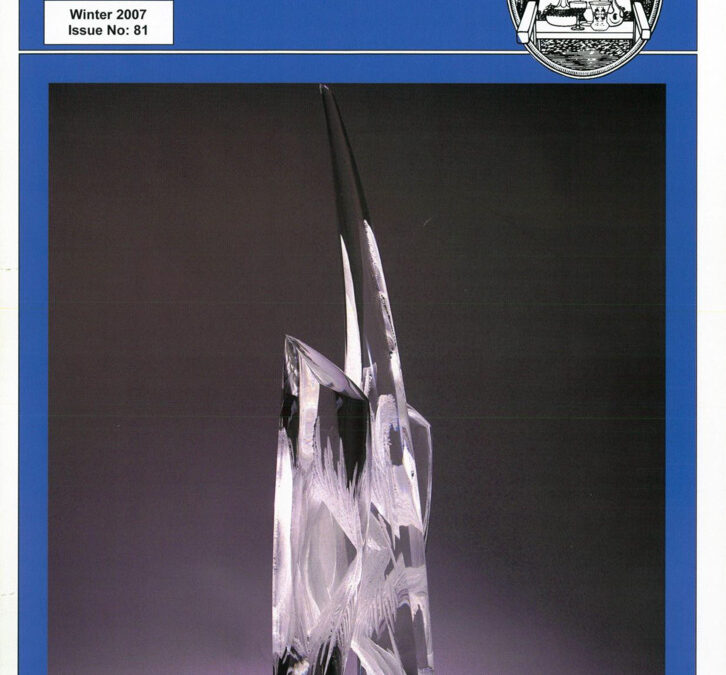
has been awarded to
Richard Jackson
for Triune IV,
a courageous and dynamic
sculpture in cast glass
(illustrated on the front cover).
Richard explains that the
“Triune”
series explores the
notion of trinity in various areas of life, from similarities in different
belief systems, to creation mythology. In society, the spiritual,
secular and pecuniary all come together in our individual lives to
give structure, establishing personal balance. The idea came to
fruition during a month travelling in India several years ago.
Inspired by tridents seen on shrines and temples, both as images and
objects, the series
“Triune”
now had its starting point.
The
Glass Sellers Prize for Engraving went to
Katharine Coleman
for her masterpiece,
City Blocks
Vase, and
the
Glass Sellers Student Award
was given to
Ramon
Beaskoetxea Sans
for
Bullfighting,
a large installation and a
powerful indictment of his
country’s
controversial sport.
Ramon Bea.s/ioeLvea Sans
by his
installation
Flower Form Teapot ring stand.
Undated; marked Joe St. Clair
Other illustrations are of weights made by the various
members of the St. Clair family. More details on other I
makers of such weights next month.
Since the above article was written, Caithness Glass have
announced that they are completely closing down their operations
in Perth, and a small number of staff (not including Allan Scott the
lamp-worker and designer Helen McDonald’) will be retained with
a proposed move early in 2008 to a new facility alongside other
craft concerns in Crieff. More details will be in the next Cone.
Richard M Giles
Ruby
Woo: ‘Made in 2007, melted in 1997’
‘Pollux’ by Bruno
Romanelli
Ed.
Photos liver the artists, and taken at the Exhibition 1)- Ruth Wilcock
7
The Glass Cone—Issue No: 81 Winter 2007
VAXJO CATHEDRAL GLASS
Vfixjo is the largest town in Sweden’s
“Kingdom of Crystal”, and was an ideal
base for the recent Glass Association visit.
Towering high above the town, and
acting as a beacon, are the twin spires of
Vaxj6 cathedral, slim and elegant, if
slightly austere.
The cathedral has changed its appearance
many times: the 11
th
century wooden
church was replaced by a stone building
in the 12
th
century, and that was damaged,
attacked, rebuilt and extended several
times. Between 1957 and 1960 the church
was restored to its late mediaeval
appearance, with its interior refurbished in
1950s style. In 1995 Mats Edstr6m
restored the church and transformed the interior to reflect in art and
design its long history. The interesting glass dates from these two
latter restorations.
Our tour started in the
Chanty Chapel where there are
two “traditional” stained glass
windows by Bo Beskow dating
from the 1950s restoration. The
west window shows
Death
playing Chess with Everyman
(a
knight), and the tall window in the
south wall shows
Christ as the
Tree of Life.
In the nave by the chapel entrance is
The Spring of Life,
a
font and surround in glass and stone made by Kosta Boda’s master
glass-maker
Goran Warff
in 1995. His particular skill in making
glass ‘flow’ is particularly evident
as the water springs down from the
rock in paradise to reach the River
Jordan at the bottom, in which the
presence of Jesus is hinted at by his
two feet. Carved in stone to the
right is John the Baptist, and to the
left Saint Sigfrid, the apostle and
baptist of Vaxj6. The baptismal
font is an Ark in blue glass, and
above is a golden ring enclosing
blue glass symbolising the Spirit
descending on Jesus in the Jordan
and for those baptised in the
cathedral today. It is a very original
and moving creation.
The Tree of Life and Knowledge
by
Erik Hoglund
111,4os by Roger.
Ersser, Bob Wilcock & from the cathedral guide, by Mats Samuelsson
IMMEgt
The Glass Cone—Issue No: 81 Winter 2007
At the heart of it is the altar, a stone table-top on a stone
block symbolising the Rock of Golgotha, and also the coffin from
which Jesus rose. It is surrounded by a beautiful oval sanctuary
carpet designed by Ulla Gowenius in 1995, but one’s eye is drawn
to the stunning glass and gold Triptych
From Darkness to Light
by
Bertil Vallien,
made in 1992.
When the doors are closed
the triptych stands dark and
foreboding. The key that opens the
doors is the Cross, and then the
pilgrim is bathed in light. In the centre
is the Cross of Christ with a drop of
blood from his pierced side trickling
down to the grave of Adam and Eve.
On either side are the heads of the
Apostles, and above all Jesus rises
from the grave, surrounded by the
Tree of Life. The triptych is beautiful
and moving.
Behind it, and half hidden now,
are two 1959 windows by
Jan Brazda.
The large blue and yellow Quire Window
is a reminder of Heaven; the reliquary of
St. Sigfrid can be seen encircled with rays
of light. On the cerise-coloured lower
window is the text of the Vaxj6 hymn.
As befits a cathedral, the glass is
inspiring and thought-provoking, a true
reflection of the glass-making of the area,
and of Christian beliefs.
8
assisted by wrought-iron
craftsman Lars Larsson,
is a symbol of creation,
of the cosmos, and
illustrates
man’s
continual
choice
between good and evil,
between light and
darkness. It dates from
1995.
AROUND THE EXHIBITI
Guild of Glass
Engravers
North Wall Arts Centre
Oxford
8-20 October 2007
‘Lulworth Plate’
Drill engraved with amazing
detail on Krosno Plate by
Patricia Hilton-Robinson
Shades ofBlue’
by Frank Grenier,
sculpted and polished
graal blown by
Neil Wilkin
Summer Days’
boat with drill engraved
and sandblasted sail by
Marilyn Goodearl
`The Sea Flora I’
a cut and engraved block
on a bed of red glass by
Arno Cancik of the
Czech Republic
SAM
Zest Gallery,
I:oirdwO
May-
20 June
2007
This was a unique exhibition of blown glass from two
eras, by a legend of the studio glass movement. Sam introduced the
concept of glass as an art form to the U.K, and was a founder of the
Glasshouse in 1969. In 1974 he set up Australia’s first hot-glass
studio at the Jam Factory in Adelaide. For 15 years he has explored
the creative possibilities of sculpture and painting, but “hot glass
was missing in his life” and he worked
with Adam Aaronson to create new
works to sit alongside rare early pieces in
this fascinating exhibition.
BW
Sam Herman (right) with Lord
Queensbury who invited Sam to become
a Research Fellow at the Royal College
of Art in 1966. The next year Sam was
made head of the Glass Department.
007 Aaronson Noon Stu
111M1=11111111
n
11=1116.
The Glass Cone—Issue No: 81 Winter 2007
9
Picture 3. Two Nailsea type ale jugs with flecked (marvered)
enamel decoration. Jug (h) c 1 820. Jug (i) c1810.
SS JUGS 1750 TO 1900
Glass jugs made in Britain before the middle of the
Eighteenth Century are rare. A few examples survive from the
Ravenscroft period of the 1670’s though these are true museum
pieces; some early serving bottles — simple variations of the shaft
and globe and onion shaped bottles of the late 17
th
and early
18
th
centuries occasionally appear; and exceptionally, jugs on
baluster stems and domed feet do exist but are rarely seen on the
market.
Before 1750 glass was relatively expensive and the
vulnerability of the jug form did not make glass a material
particularly suitable for serving vessels — pottery, pewter or silver,
porcelain and even leather providing more robust alternatives. In the
second half of the 18
th
century the start of the industrial revolution
and some improvements in transport links enabled glass to be
produced more reasonably and transported more successfully. Glass
became available to a wider buying public and this probably
encouraged the production of glass jugs though they remain scare
before 1780. The slashing of duty levied on tea had the effect of
making tea drinking cheaper and this no doubt fuelled the market
for tea accoutrements including cream jugs. Cream jugs from the
1780’s onwards are relatively common.
Jugs from around 1750
(Jug b)
are characterised by a low,
pot-bellied form. If they are footed the feet tend towards the conical
and are pontilled. The handles are always applied at the top and
pincered into the body to form a tail with the terminal normally
turned up. In the 1760’s they are sometimes found with tripod feet
which are occasionally moulded with lion-face masks. These follow
the Rococo form seen in silver jugs. Some early jugs from around
1760 appear with Lynn moulding. These can be found in both
cream and ale jug forms though both are rare. Very occasionally
some early cream jugs are found in blue metal
(Jug d).
Picture 1. A group of English cream jugs. Left to Right:• Jug (a)
c1800. Jug (b) c 1 750. Jug (c) c 1 780. Jug (d) c1760. Jug (e) c1820
In the 1770’s and 80’s the form becomes more elegant.
Typically, the belly of the jug moves up the body. Thus the widest
part of the body is central or at the shoulders
(Jug c).
From the
1780s numerous decorative variations are found. The use of colour
is more common, blue providing the most examples though white,
amethyst and, rarely, green are seen. Reticulated moulding was
used to pattern the surface of the jug giving some pieces from this
period the look of earlier glass patterns
(Jug a).
The Venetian
technique of trailing colour around the rim was also used to provide
ornament. Again, blue is more common
(Jug f)
but sometimes
amethyst is seen
(Jug g).
Rarely white on blue can be found though
one suspects some of these may be of Scandinavian origin. Ale jugs
with trailed rims are scarce whilst coloured examples are
exceptionally rare.
The Glass Cone
—
Issue No: 81 Winter 2007
Picture 2. Two English ale jugs with trailed rims.
Jug (f) c1790 and Jug (g) c1810.
Around 1800 the forms exhibited by the larger ale and
water jugs appear to diverge from the smaller cream jugs. The ale
form follows those examples seen in pottery. They are often
without feet and are wide bellied
(Jug g).
Ale jugs are often
monogrammed or named along with the typical hops and barley
engraved decoration. They are occasionally dated but rarely
engraved with pictorial decoration. One suspects that many finer
examples were never intended for everyday use. The cream jugs of
around 1800 adopt the dumpier wide bellied form and are often
footed
(Jug a)
but soon develop a more elegant ewer form
characterised by a generous pouring lip and taller proportions
(Jug e).
This is the dominant form by the 1820s and continues into
the Victorian period. These jugs are often found with their bodies
cold enamelled with requests to
Be canny with the cream.
They
sometimes have references to locations in the North east of England
such as Newcastle and are attributed to this area.
Some jugs from around 1800 appear in non-lead glass –
usually in bottle glass and are flecked with coloured (though often
white) enamel. These are generically referred to as Nailsea because
early writers attributed them to the factory at Nailsea near Bristol. In
reality they were probably made throughout the country. Certainly
factories at Wrockwardine and Aloa in Scotland are known to have
produced these types of ware. The pieces vary greatly in the quality
of workmanship.
Jug i,
for example is a fine vessel made by a
1
0
highly competent glassmaker around 1820 and is comparable with
Jug g
in its execution.
Jug h
on the other hand appears naïve with
the handle showing great inexperience (it actually has a tear in the
glass that is fire polished).
Cut glass jugs appear in the 1790s and remain in
production for most of the 19
th
century. In the late Georgian period
most larger jugs are cut whilst most cream jugs are not. Many of the
cut patterns found on decanters of the period are reproduced on the
bodies of the jugs and are not particularly scarce. A resurgence in
the fashion for cut glass in the last quarter of the 19
th
century led to
Brilliant Cutting where the whole surface of the vessel is deeply and
profusely cut.
Jug k
is an example probably made by Thomas
Webb. The handle is hollow and has been cut with deep hobnail
type cutting.
Jug k
provides a useful example of a (more or less)
universal change that occurred around the 1870s. The handles from
this period onwards are applied at the bottom and pulled up to the
neck of the jug. Thus, the thinner end of the handle now appears at
the top. The fancy pincered tails are no longer seen after this date
(though they do seem to continue on vessels such as custard cups).
This change was apparently brought about in an attempt to
strengthen the handle joints. Certainly the joint between the handle
and body on all jugs is the weakest part of the vessel and is often
cracked. Purchasers should always attend very closely to the joints
of handles at both top and bottom as damage can make a great
difference to the value of a piece.
Picture 4. John Northwood claret jug & brilliant cut lemonade jug.
Jug (j) c1870. Jug (k) c1880.
Glassmaking in England became more experimental in
the 1840s and this is reflected in the many styles of jugs that were
produced in the second half of the century. Styles followed taste and
jugs were produced in the many new glass forms. For example
Jug j
is a claret jug with plated mounts decorated in the acid etching
workshops of John Northwood in the 1870s and depicts numerous
classical figures taken from the 18th century etchings of John
Flaxman.
An exhibition at the February 2008 Cambridge glass fair
will show the development of jugs between 1750 and 1900. It will
provide visitors with the chance to compare vessels from across the
period and to chart the changes in form that enable collectors to date
accurately Georgian and Victorian glass jugs.
Australasia’s Ranamok Prize for 2007 has been awarded
to Evelyn Dunstan of Auckland, New Zealand for
“Ngahere
Karauna (Forest Crown)”.
It was made using lost wax, kiln-cast
as one piece using Gaffer crystal glass, cold worked, engraved and
acid etched.
It represents the native clematis climbing to the top of the
forest to display its crowning beauty, supported by, and dependent
on the strength and survival of the fauna below. The crown of the
forest or a vase made of flowers?
The piece not only shows masterful glass-making skills it
has a beautiful artistic and aesthetic quality that helped set it apart
from the other entries. All were of a high quality and the calibre of
the entries showed that Australian and New Zealand artists are
producing world-standard works.
To see more of the works visit www.ranamok.com. You
may download a pdf catalogue, or purchase a paper copy.
Sea Urchin’ Tall Form by Kevin Gordon
(blown, overlaid colour, diamond wheel
cut, sandblasted, cameo carved and
brush polished)
‘Milk & Honey 4’ by Mathew Ryan
(Swedish overlaid, hot formed, cold
worked, fused and
slumpedfiirnace glass)
11
The Glass Cone—Issue No: 81 Winter 2007
in
LEMINGTON GLASSWORKS AND ‘HIGH CONE’
Travelling a few miles west
from the centre of Newcastle upon
Tyne, keeping fairly close to the river,
you will not fail to notice the Lemington
glass cone standing not far from the
edge of Lemington Gut, the old course
of the river. On the north bank you
might be following Hadrian’s Way or
the A6085 — take the 22 bus from
Central Station, if you wish; on the south
side there are clear, though more distant,
views from trains to Hexham and
Carlisle, after they have passed Blaydon
station. If all else fails, the cone can be
seen to the west from the Al as it
crosses the River Tyne. The grid
reference is NZ183645 and the postcode
NE15 8SX.
The modern village of
Lemington, now within the City of
Newcastle, overlooks a site now called
Lemington Cone from the East
the Glassworks Business Units, but
former the Lemington Glassworks. At one time the Glassworks was
hemmed in by wagonways and railways, coal staithes, ironworks
and, more recently, Stella North power station. Most of these were
removed years ago, leaving a single glass cone, the ‘High Cone’, to
dominate the view.
It would appear that the glassworks was originally opened
by the Northumberland Glass Company in 1787 on land owned by
the Duke of Northumberland. The money was put up by a group of
partners including such well-known glass workers as Tyzack and
Henzell. The site was ideal for river transport and for locally mined
coal. The Company produced flat glass. The largest glass cone was
built in 1797 and is said to contain 1.75 million bricks. This is the
one that remains today. It stands some 35m high and has a diameter
of 21m at the base.
The Northumberland Glass Company closed in 1837 and
ownership of the glassworks passed to Joseph Lamb (possibly a
coal owner) who retained control until 1845. A map of 1860 shows
only two large cones on the site, though earlier maps show three.
Three cones are shown in a photograph of unknown date that is
reproduced in Walton’s Bygone Bell’s Close & Lemington. At this
time the glass industry started to decline on Tyneside. Nevertheless,
Sowerby took over in 1898 and continued operations until 1906
when the General Electric Company purchased the site.
The Glass Cone—Issue No: 81 Winter 2007
12
In 1992 English Heritage offered GB a grant of nearly
£48,000 towards the repair of the cone, which was to be opened as a
museum or heritage centre (English Heritage, Conservation
Bulletin, July 1993).
In 1993 English Heritage and Newcastle City Council
collaborated to have the cone cleaned and repointed. 1997 saw the
final closure of the glassworks and most remaining buildings were
demolished. About this time the site was taken over by North-East
Motors from Dema Glass. In 2001 there was still talk in some
quarters of the cone being used as a museum of glass production.
The intention was to have a tearoom, a factory outlet, an exhibition
space (the cone itself) and the Lemington Crystal Craft Village. By
this time the National Glass Centre in Sunderland had been in
existence for three or four years.
On visiting the site just as final demolition work was
GEC expanded the works and equipped it
for the manufacture of light bulbs and
tubes. By 1915 six covered pot furnaces
were working. Demolition of the old
glasshouses continued. One of the old
cones was demolished in 1918 to make
way for a Westlake bulb machine plant.
This work was transferred to Wembley in
1921. By 1940 an Ohio bulb blowing
machine was in production and is said to
have achieved an output of one million
bulbs in one week. The Glass Bulbs
Company (GB) was formed by GEC and
AEI in 1952 and a new gas-fired process
was installed along with new machinery.
Round about the middle of the 20
th
Century the cone was capped with a flat
concrete roof. It was listed in June 1976
as Grade II*, number 10/24.
About 1960 there was a considerable
expansion in the amount of work at
Lemington and the labour force
approached 700. Production included good quality Scandinavian
style domestic glassware, though it consisted in the main of street
lighting equipment. Later GEC and AEI combined to form a new
company, Glass Tubes and Components Ltd. Commercial clear and
translucent quartz tubes were produced at Lemington. Eventually
production fell away and machine manufacture came to an end in
1996.
EXHIBITIONS, EVENTS AND FAIRS
starting in August 1997, we were able to enter
the site, including the
cone itself that had been used for storage, as well as an office
building strewn with papers and a large building that seemed to
have been used in the manufacturing process. There were numerous
abandoned examples of recent products – mostly industrial light
covers of various designs and colours. In addition we could peer
through the windows of a smaller building that appeared to house a
dusty collection of moulds. One would have said that the previous
owners had simply walked away from the site. What became of the
work force?
Two archaeological investigations were carried out for
Colvin-Smith (Construction) Ltd at the end of 1997.
The desktop assessment includes copies of maps
from1767, 1802, 1848 (Tithe map), 1858 (OS.1), 1896 (0S.2),
1937 (0S.4) and 1984 just before major demolitions. There are also
copies of two photographs taken in October 1997. Site visits were
carried out by Jonathon Godfrey and John Nolan of Northern
Counties Archaeological Services. Evidence was found of flues or
tunnels beneath the cone. It is known that they were used as air raid
shelters during World War 2. There were annealing ovens (lehrs)
attached to the cone.
The recording and evaluation carried out concentrated on
the annealing ovens and the area to be redeveloped. The records
include plans and elevations of four annealing ovens dating from
about 1858. Excavations were carried out following a brief by Ian
Ayris, County Industrial Archaeologist. It appears that the cone was
out of use as a glass production area by 1895, though lack of
conclusive evidence leaves room for speculation. Site records and
finds were to be deposited with the Museum of Antiquities at the
University of Newcastle upon Tyne.
The site of the works is now the Glassworks Business
Units and is owned by Colvin-Smith Limited. A motor vehicle
dealership occupies the area west of the cone. The cone itself, with a
new floor and false ceiling, is used as a showroom and sales area for
stoves. A renovated building is an engineering workshop. In spite of
problems of water seepage still to be resolved, the High Cone
continues in use and there is public access six days a week. The old
glassworks site is therefore still an area of commercial and
industrial activity after 220 years of continuous development. The
cone itself was used in the making of the film of Catherine
Cookson’s ‘The Glass Virgin’ issued in 1995.
Mike Pearce
Selected references:
1
Web Site of the Sine Project, University of Newcastle upon
Tyne (2002, modified March
2004)
https://sine.ncl.ac.uk/view structure information.asp?struct id=485
2
English Heritage, Conservation Bulletin, Issue 20, July 1993
3
Northern Counties Archaeological Services, Lemington
Glass Cone, Archaeological Recording & Evaluation
(January 1998)
4
Northern Counties Archaeological Services, Lemington
Glass Cone, Archaeological Desktop Assessment (October
1997)
5
Walton A D, Bygone Bell’s Close & Lemington, Newcastle
City Libraries and Arts (1991)
6
Alec Colvin-Smith, Personal Comment (November 2007)
7
Anon, A Brief History of the Lemington Glass Works and
the Work carried out (undated)
•
Final venue of the touring exhibition
Peter Layton and
Friends –
Celebrating 30 years of London Glassblowing
Glass Art Gallery, 7 the Leather Market, Weston Street
London, SE1 3ER
Exhibition
dates: 21st January – 29th February 2008
Open Monday – Friday 11:00 am – 5:30 pm
Symposium:
Saturday 26th January 2008 3-6pm
Sustainability – challenges to the future of Studio Glass
Tel 020 7403 2800 / Fax 020 7403 7778
www.londonglassblowing.co.uk
•
Exchange of Information
An Exhibition of new Glass
Sculpture by
David Reekie
Dan Klein Associates, 43 Hugh St. London SW1V 1QJ
Thursday January 24
th
Open Day 11 am-6pm
Thereafter Mon – Sat 11 am-6pm strictly by appointment
www.dankleinglass.com
•
CO[ JECT 2008
Victoria and Albert Museum, Cromwell
Road, London, SW7 2RL
Fri-Mon 25-28 Jan, 11-5.45pm; Tue 29 Jan, 11-4pm
Co[
]ect
is the only art fair for contemporary objects in
Europe. Glass from the finest makers in Britain, France,
Australia etc. Not to be missed. £12 (£8 concessions)
https://collect.craftscouncil.org.uk/index.html
•
The Glass Menagerie: Amalric Walter’s Pate de Verre
National Glass Centre, Liberty Way, Sunderland SR6 OGL
Until 24 March 2008, daily 10am -5pm, admission free.
From Broadfield House, but even better lit, so worth seeing
again.
www.nationalglasscentre.corn
•
11th Cambridge Glass Fair,
Chilford Hall, Linton, Cambridge, CB21 4LE
Sunday 24 February, 10:30-4:00, admission £5
Foyer Exhibition: British Glass Jugs 1750-1900
Sam Herman
in conversation with Adam Aaronson at 2pm
www.cambridgeglassfair.com
•
The National Glass Collectors Fair
the Heritage Motor
Centre, Gaydon
Sunday 20 April 2008,
10-4, admission £5
Important: the date is provisional—check before you travel
Tel. 01260 271975; www.glassfairs.co.uk
•
**Glass Circle Trips to the Czech Republic**
*Jablonec
glass & bead museum *
Zelezny Brod
glass-
making school & museum (strong on
Libensky &
Brychtova) * Harrachov
museum & factory *
Jelenia
Gora (Hirschberg) Poland *
and much more.
Two trips:
Wed. 15 May to Mon. 19 May—with
optional
additional
trip
to Pilnitz, Dresden, Potsdam (Sans Sourci) & Berlin
and
Wed. 17 to Mon. 22 September
Start & finish at
Prague
airport.
GA
members welcome.
Cost c. £360 pp inclusive, plus cost of flight.
For more details e-mail John Smith (Chairman, Glass
Circle) johnpsmiAglobalnet.co.uk
or write to him at 42 Vespan Rd London W12 9Q
Advance Notice: GA Events
•
13 July “Hi Sklo, Lo Sklo” King’s Lynn:
a visit to an
exhibition of Czech Glass by Graham Cooley with
presentations by Graham and a guest speaker.
•
Launch of the GA DVD on Frank Thrower
in the
GA-sponsored Video Room
at the
International Festival of Glass
22-25 August
2008—THE EVENT OF THE YEAR!
www.ifg.org.uk
Ed.
13
The Glass Cone—Issue No: 81 Winter 2007
HYTTSILL HIGHLIGHTS
,
One highlight of the
recent tour of Sweden by Glass
Association members was the
Hyttsill or ‘Hot-shop herring
supper’. These can be enjoyed at
most of the major glassworks
in
the ‘Kingdom of Crystal’ region
of Smaland; ours was held at the
world famous Kosta site.
The tradition of the
Hyttsill dates back to when the
glassworks was the meeting place
for the entire village; and passing
vagabonds, attracted by the
prospect of free warmth and food,
would gather in the hot-shop to
entertain the villagers with news
from outside their community. The heat from the furnaces was used
to bake bread, and to cook herrings, jacket-potatoes, crispy bacon
and sausage. During the evening someone would produce an
accordion, songs were sung and the food eaten. Later the vagabonds
would sleep in the warmth until the glass workers arrived for the
next day’s production.
Nowadays, the Hyttsi I I
tradition is kept alive as a special
treat for tourists to the ‘Kingdom
of Crystal’. The evening includes
the meal of slightly salted herring,
bacon, sausage, jacket potato, all
washed down with a bottle of beer
or soft drink. When Davina and
I
toured Sweden three years ago we
enjoyed a Hyttsill evening at Kosta
and we were pleased to see that
Kosta’s “Vagabond” musical trio
were the same people. There was
Sven playing an instrument unique
to Sweden, a fiddle style instrument played with a bow but the
strings were selected by keys – this is called a
Nyckelharpa
or
`keyharp’ and Sven had made his himself. He was accompanied by
The Glass Cone
—
Issue No: 81 Winter 2007
his wife on a guitar and his
daughter on a keyboard. Sven also
delighted us with bursts on a
ukulele and a conventional fiddle.
Our group was the largest, the next
largest group came from Sweden –
they took a little time to get into
the party mood, the third group
came from Germany.
Unfortunately for them, only Sven
spoke their language so when the
girls from Kosta explained details
in Swedish and then English, the
Germans were left wondering
what was going on. That did not
hold them back however when the
food was being served – a universal
language there!
After the main course we were entertained by a glass
blowing demonstration by two of Kosta’s master blowers. They
produced a first a jug then a dish. Unfortunately at the spinning
stage, the dish opened too far and lost a piece of the edge, and also
picked up a lump of the vessel
liner; so not as good a demo as
they hoped. Members of the
audience were invited to have a go
at blowing glass, we thought about
asking Richard Golding but then
dented and Gaby represented the
Association. The Swedish group
did
not volunteer anyone from
their number.
We showed much interest in
Sven’s Nyckelharpa and he
entertained us with a number of
songs or tunes from the UK –
learned during his sea-faring days.
With his beard, one wondered
whether those included Viking raids on the
North-eastern coast of Britain.
After a really enjoyable evening,
which had followed from the drive up to
Smaland from Gothenburg, we were all
pleased to return
to our hotel in
Vaxjo to recharge
our batteries for
the next day’s
itinerary.
Geoff & Davina
Timberlake
(Photos by Geoff and
by Bob Wilcock
14
WAREHOUSE WORKSHOPS-E
differed from the 18
th
Century originals.
There were two tables of glassware, one was a mixture of
true and reproductions; these were identified, the second was again
a mixture but not identified. We were asked to decide for ourselves
whether each glass was a true example of 18
th
Century drinking
glass or a reproduction. Everyone enjoyed this ‘quiz’ and soon
many a serious discussion took place as members debated the finer
points of each glass. In conclusion, Jeanette then put us out of our
misery by giving the
answers. No one got
100% correct but most
had high scores which
was a tribute to the
success of the
afternoon workshop.
Everyone joined with
Charles in praise of
both Steve and
Jeanette for providing
such learned and
entertaining
workshops. We also
thanked Charles for
organising the event.
Xue Lu, (Shelly)
concentrating for
her first attempt
A goodly number of members (19 in the morning, 24 in
the afternoon) attended the two workshops held on Saturday
3′ November at the Bonded Warehouse, Stourbridge.
The morning session was a discussion on
copper wheel
engraving
on glass as practised by the Victorian and earlier
engravers. Steve Piper was introduced to us by Charles Hajdamach
as the last of the long line of great and inspired engravers who
worked in the Stourbridge glass factories. Charles almost made
Steve blush by associating him with the legendary
names such as William Fritsche (Webbs) and Joseph
Keller (Stevens and Williams. Certainly the examples
of his work that Steve had on display were of high
quality indeed.
Charles started the session with a slide show
whistle-stop tour of engraving with particular emphasis
on the work carried out in the Stourbridge area, Steve
added explanations of how the engraver had tackled
certain problems created
by individual items of
glassware and/or the
required design. Since his
retirement from full time
employment Steve has
studied many examples
of Victorian and
Georgian engraved
glassware in order to
establish the techniques
used by those long-dead
master engravers. He
explained to us that some
of their skills have been
lost over time and he
wanted to re-discover as
many as possible.
Following this
nostalgic introduction
into engraving we all
retired to the floor below
where, with the help of a really ancient-looking engraving lathe and
associated tools borrowed for the occasion, Steve led us into the
mysteries and skills needed to set up the tools and lathe for accurate,
quality work. Although he made everything seem simple, it was
obvious from the casual yet precise manner in which he checked the
cutting wheel for true running, and correct profile that these were
skills only gained from many years of experience. Following the
talk on techniques members were given the opportunity to ‘have a
go’. One of the first up was a young glass student Xue Lu (Shelly),
who quickly mastered the basics of engraving a line on a glass just
where it was needed. Her concentration was admired by all of us
and we joked with Steve that she would put him out of a job.
After lunch, we went back to the top floor to see another
slide show, this time given by Jeanette Hayhurst on the subject of
identifying real Georgian drinking glasses
from the many
reproductions that have been made in later years. Jeanette started by
showing us a potted history of the development of English drinking
glasses from the late 17
th
through to the 18
th
Century, the acclaimed
`golden age’ of English drinking glassware. She explained why the
examples shown were correct for the period, and followed up with
examples of later reproductions and explanations where they
Geoff Timberlake
Now a challenge from Jeanette:
She
used these three glasses in her presentation.
Only
one is genuine, two are reproductions. Do you
know
which is the genuine
18th
Century glass, and
how could you tell?
(Answer in the next Cone!)
15
The Glass Cone—Issue No: 81 Winter 2007
.4
small selection of Manchester
ass from the reserve collection
EUROPEAN GLASS WEEKEND 27-28 OCTOBER 2007
In accord with The Glass Association’s educational remit,
our chairman, Charles Hajdamach suggested at committee, that we
should create a special seminar weekend around our 2007 AGM.
Committee agreed that we could help fund the weekend from
reserves, so that we could both bring together top line speakers and
offer free places to students of glass. The subject of European Glass
was suggested, and Charles gave the necessary leads for speakers.
Gaby Marcon, our Events Organiser, had brought together
Job Meihuizen, curator of the National Glass Museum in Leerdam,
Holland, since 1999; Sylva Petrova, a major authority on Czech
glass; author, lecturer and curator over the last twenty five years,
now the Director of the Institute for International Research at the
University of Sunderland; Gunnel Holmer, since 1978, curator of
the Smaland museum in Vaxjo, Sweden, a specialist researcher and
writer on 19
th
& 20
th
century Swedish glassmaking, and Rosa
Barovier Mentasti, of the renowned Renaissance glassblowing
family, with a history of 30 years of studying & writing on glass
and glassmaking, both Venetian and International.
Just over 40 participants gathered together on Saturday
morning at The Manchester City Art Gallery. Over coffee and tea at
registration, there was a buzz in the air — old friends were meeting,
new friends being made and we were anticipating a fascinating
weekend programme.
Our member, Janet Boston, Curator of Decorative Art at
The Manchester City Art Gallery, who had facilitated this weekend
event, introduced the Gallery and gave us a welcome, followed by
Charles Hajdamach, our chairman, outlining the weekend.
Job Meihuizen, sparked off the day with a well illustrated
talk on the glass of the Leerdam factory, mixing in
the social history of the growth of the factory with
the glassware that was produced. He particularly
emphasized the contribution of the director,
P.M.Cochius, who together with the architect De
Bazel, created a factory environment where
architects and designers worked hand in hand
with the glass artists and gaffers.
During the lunch break, we divided up into groups, and
were allowed into the reserve glass study collection, where Janet
had prepared a number of pieces for us to handle (with the usual
protective gloves) and comment upon. This became a bit tight on
time — we would all have wished for longer.
The afternoon was led by Sylva Petrova
— angling her presentation to the contribution of
Czech glass artists living outside of the Czech
Republic. This was a commanding overview, with
a vast number of slides of the work of Czech artists
from all over the world; Sylva appeared tireless and her enthusiasm
was evident.
The late afternoon broke up for the AGM meeting, where,
amongst the business in hand, the new committee was voted in. (see
inside cover of the Cone for a list of the Committee). We retired
variously for drinks in establishments remembered by Charles
Hajdamach and Roger Dodsworth during their earlier days. The
evening saw almost everyone meet again at a restaurant, where with
fine food and wine we entertained each other with glassy tales. The
new committee made a presentation to Charles, in thanks for his
7 years of endeavours on behalf of the association.
Miraculously, we made the Sunday
morning start at the correct hour — the clocks had
gone back overnight.
Gunnel Holmer
began the
day with an historical overview of the Swedish
Glass Industry and with maps, showing the
contraction of the industry into three main groups –
even the mighty Swedish industry has had to cope with initially the
Czech Industry and currently the competition from China. We were
then presented with many shots of the typical styles of Swedish
glass in the 20
th
century. An obviously well
researched presentation of depth.
Lunch and then the afternoon slot —
Rosa
Barovier Mentasti
gave a supercharged talk; she
had notes but hardly ever referred to them. Her
command of the history of the whole of European
Glass was evident, as she tied in the history of
Venetian glass, its rise and fall and eventual rebirth, with the glass
industries in the Lowlands and France, England and the Czech
Republic. Rosa presented a slide of the Italian book produced in
the early 17
th
century, where the different ingredients of glass were
noted down — including lead glass — it was in Italian and didn’t have
an English translation until the 1660’s — very close to the
“discovery” of lead glass in England! She also produced arguments
that suggested that many glasses in museums’ collections, timidly
entitled “facon de Venise”, were in all probability from Murano.
Rosa’s presentation ended the weekend on a highpoint,
Charles thanked her and Brian Clarke, our new Chairman thanked
everyone and closed proceedings. For those many members who
didn’t make it to the weekend — you really missed something!!
The weekend was such a success that we hope to repeat
the format in the future. Resumes of the four talks will be published
in future Cones.
Brian Clarke
A warm welcome to new members
111111111111111111
Mr D Burland
Lincolnshire
Mr R Kerr
Shropshire
Mr & Mrs Couling
Cheshire
Miss J Learmonth
Cambridge
Mr V Cowdy
London
Mrs J Peterson
East Sussex
Dr J Davies
West Midlands
Mr & Mrs K Rainford
Tyne & Wear
Ms D Dolinka-Korda
Hertfordshire
Miss L Richards
East Sussex
Mr & Mrs N Faulkner
Cambridge
Mr & Mrs P Robinson
Buckinghamshire
Mrs S E Fonge
Oxford
Mr A Sharman
Flintshire
Dr S Head
Oxon
Mr M J Sorrell
Essex
Mr M Hudson
Cambridgeshire
Mr M
Woodall
London
The Glass Cone—Issue No: 81 Winter 2007
16