


The
Glass Cone
Issue No: 82 — Spring 2008
The Magazine of
The Glass Association
Registered as a Charity No. 326602
Chairman
Dr. Brian Clarke: chairmanAglassassociation.org.uk
Hon. Secretary
Yvonne Cocking, 14 Southfield Drive, Sutton Courtenay,
Abingdon, Oxon, OX14 4AY
(secretarvAglassassociation.org.uk)
Editorial Board
Bob Wilcock (The Glass Cone), Mark Hill (The Journal),
Yvonne Cocking
Address for Glass Cone correspondence
E-mail to editor@glassassociation.org.uk or mail to
Bob Wilcock, 24 Hamilton Crescent, Brentwood, Essex,
CM14 5ES
Address for membership enquiries & backnumbers
Pauline Wimpory, Membership Secretary,
150 Braemar Road, Sutton Coldfield, West Midlands,
B73 6LZ
(membership@glassassociation.org.uk)
Committee
Mark Hill (Vice-Chairman); Paul Bishop; Roger Dodsworth;
Jackie Fairburn; Francis Grew; Valerie Humphries;
Gaby Marcon; Janet Sergison; Maurice Wimpory (Treasurer)
Website:
www.glassassociation.org.uk
E-mail news & events to newsAglassassociation.org.uk
Printed by
Jones and Palmer Ltd: wwwjonesandpalmer.co.uk
Published by
The Glass Association
ISSN No. 0265 9654
The opinions expressed in the Glass Cone are those of the
contributors. The aim of the Editorial Board is to cover
a range of interests, ideas and opinions, which are not
necessarily their own.
The decision of the Editorial Board is final.
Copy Dates:
Spring:
21 January—publication late March
Summer:
21 April—publication late June
Autumn:
21 July—publication late September
Winter:
21 October—publication early January
Articles are welcome at any time, but please bear the above dates
in mind ifyou have an event you would like to be publicised.
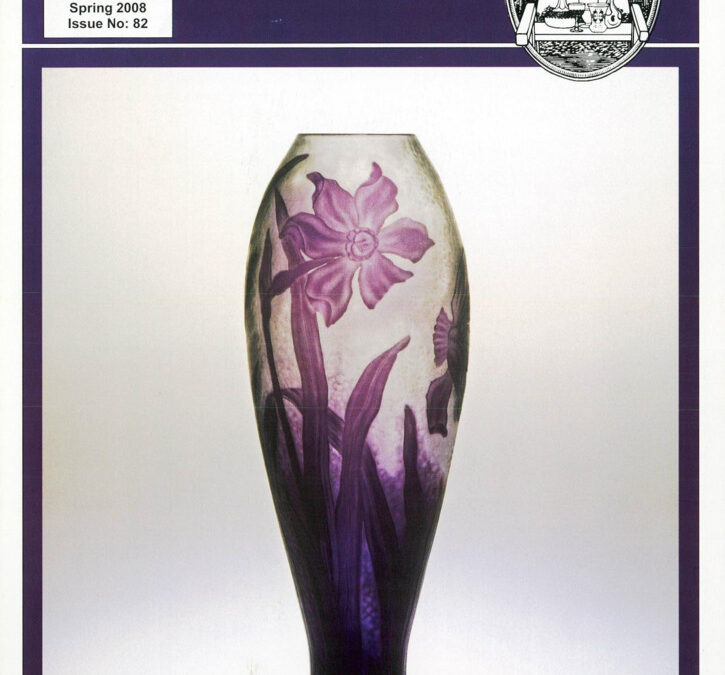
Cover Illustration:
Vase, Kosta Glasshouse, c. 1900, Gunnar G: son Wennerberg,
Flared, etched & cut overlay;
H: 43 cm, D: 14.7 cm
Signed: Kosta G Wennerberg 114
Shown at the 1900 Paris Exhibition
Smdlands Museum — Swedish Glass Museum, Viixjo
Photo: Jurgen Ludwigsson
I am delighted to open this Cone with the first of three
papers given at the European Study Weekend in October 2007.
Gunnel Holmer’s paper gives a very informative overview of the
development of the Swedish glass industry, from the challenge of
the end of the 19
th
Century when Swedish glass was seen as well
made but lacking in imagination, to where it is today.
Future issues of the Cone will feature the papers of Job
Meihuizen on Leerdam Glass, and Sylva Petrova on Czech glass.
Czech glass is the subject of a major exhibition by one of
our members, Dr. Graham Cooley, “Hi Sklo, Lo Sklo” at the
King’s Lynn Festival. The Glass Association is running a special
event to coincide with the opening of the exhibition. Further details
are on the back page, and a booking form accompanies this Cone.
With the opening of a new glass fair in central London,
Reflect 2008, at the Glaziers Hall on 8 June, we have taken the
opportunity to have a brief look at the longest running fair, the
National Glass Collectors Fair at Gaydon in Warwickshire. The
spring fair is normally held in May, but do make a note that this
year it has had to be brought forward to 20 April.
We are still looking for a volunteer to compile a proper
events page for us. Meanwhile for up-to-date information, there are
some events listed on the Glass Association web-site, or you might
like to subscribe to Alan Poole’s excellent news-letter via:
www.dankleinglass.com/services/index.html
As we go to press, the sad news has reached us of the
death of Henry Fox. An appreciation will appear in the next Cone.
Bob Wilcock
,.
wa
rm
wel
cami
gneun
e
mber
s
Mr G Lawson
E. Sussex
Mrs P Metcalfe
Surrey
Dr E R Moerman
London
Mr & Mrs J Sinreich
London
Mr & Mrs C Hearn
Ontario
Mr D Encill
West Midlands
Mr J Pyle
Essex
Mr R Parkin
S Yorkshire
In Cone 81 we illustrated 3 wine glasses, only one of which was
genuine 18
th
Century.
Jeanette’s answer is that it is the one on the right. The one on the
left was made in 1930’s specially for the late Dr Emanuel’s father’s
collection, The metal is too bright, there are no striations or seeds or
bubbles, and although it has a folded foot, there is no pontil scar.
The air twist, although it looks quite good in a photo, has a similar
metal to the first, but the real give away is the foot. It has a rounded
edge which indicates it was made by
using a foot board and not from a sheared
blown bubble, thus giving a sharpness to
the edge. The third was made in a good
greyish metal has lots of striations, small
bubbles and seeds and a rough pontil
scar. Another clue is that when you look
down on the rims of the glasses, the first
2 are bright white, but the right one is
very dark.
ROM THE EDITOR
The Glass Cone—Issue No: 82 Spring 2008
2
SWEDISH GLA
I. Bowl, “Ducat Bowl’ /”The Czar’s Crystal
Kosta Glasshouse, 1897
Mitre-ground; H: 15.5 cm, D: 30.2 cm
2. Covered Urn
Simon Gate, 1925
Mould-blown, decor engraved
with the name “GRIPSHOLM”
and the monogram “WA”
H: 38 cm, D: 27 cm
S.• ORREFORS. 1925. S.Gate –
E. Weidlich. G. 356
Engraved by Emil Weidlich
Made for the Swedish- America
line’s Gripsholm
The art of glassblowing arrived in Sweden relatively late
compared to the Roman Empire, where it was brought to a high
degree of perfection in the early part of the Christian era.
Archaeological finds show that although drinking vessels and other
articles of glass did occasionally reach Sweden during this period
and the centuries immediately following the fall of the Roman
Empire, glass was regarded as an exclusive luxury. Early records
suggest that in the 14
th
and 15
th
Centuries sheet glass was
manufactured by monks, but secular glass vessels still had to be
imported and were extremely expensive.
There is no certain evidence for the manufacture of
hollow-ware in Sweden until the 16
th
Century, when the King
summoned two glassblowers — probably from Venice — to
Stockholm.
During the 16
th
and the 17
th
Centuries some twenty
glassworks were established in Sweden. The founders were
members of the nobility, and as the craftsmen were almost all
recruited from Germany or Venice, the glass was principally
German or Venetian in taste. More glassworks were founded during
the 18
th
century, and now the founders were often wealthy
landowners whose forests and farms produced wood for the
furnaces and food for the employees. Among the most important of
the new glassworks was Kosta, which was founded in 1742 and is
making fine quality glass to this day.
Almost one hundred new glassworks were founded in
Sweden during the 19
th
century. The great majority were founded
during the second half of the century and, from about 1870, are a
nice reflection of the Swedish Industrial Revolution. And whereas
during earlier periods the founders of the new enterprises had
almost always been members of the aristocracy or wealthy
landowners, after about 1850 it became common for the
glassblowers themselves to set up in business.
During the first few decades of the 19
th
century most
Swedish glass was manufactured in the English style; conical
decanters and wine glasses with oviform bowls were fashionable, as
were pieces of solid blue. The first cut glass was also introduced
from England and soon cutting had spread to jugs, decanters and
drinking vessels and was becoming ever more popular. In the
eighties and nineties, mitre-cut crystal based on English and
American prototypes was the height of fashion. Nevertheless, the
3
mainstay of production was still simple household wares, for by no
means everybody could aspire to a set of expensive crystal. Cut
glass could, however, be imitated for example by pressing, which
was introduced into Sweden in the 1830s. Designs were sought
chiefly in France and Belgium. New technical development
continued throughout the century, revolutionizing the glassmaking
industry: production increased immensely and prices fell, bringing
glass within reach of practically everyone. But although machines
had taken over many aspects of manufacture, the ancient craft of the
glassblower still lived on, and it was this that during the closing
years of the 19
th
century enabled Swedish art glass to flourish as it
did.
“The products of the Swedish glass manufacturers can no
doubt compare with their foreign rivals as far as the clarity and
strength of the actual material is concerned. What they lack,
however, is a sense of new design; they have no imagination. In this
respect, it would be desirable if our glass factories were to imitate
the method adopted to such advantage by the porcelain factories,
that is, they should stir up an interest in their products among artistic
circles.” Thus wrote a critic of the Swedish glass shown at the
Stockholm exhibition of 1897.
The comparison was almost certainly with the Art
Nouveau pieces displayed at the same exhibition, and more
particularly with those by the Frenchman Emile Gana.
Kosta was the first Swedish glassworks to take the
criticism seriously, and in 1898 employed. Gunnar G:son
Wennerberg to design a range of new models for the World Fair in
Paris in 1900. Inspired by Galle, Wennerberg produced a number of
exclusive wares in overlay technique
(see the front cover).
His art
glass represented only a small percentage of the company’s overall
production, yet his brief stay at Kosta was important: for the first
time, the services of an artist had been employed by a Swedish glass
firm. Although artists were by then more than willing to experiment
with new designs, the glass put on
display to the public was still
almost always of the old, cut
variety. After some years,
however, the critics’ call for
innovation in Swedish glass
gained an audience. This was
largely due to the efforts of the
Swedish Society for Industrial
Design and through whose
agency, set up in 1914, artists
were to be employed at some of
the glassworks.
Without the skills of the
craftsmen who made the glass,
however, the artists would never
have been able to realize their
ideas. When the master blower
Knut Bergqvist at Orrefors
developed “graal” — a technique
in which the coloured pattern is
enclosed in a casing of clear glass
— he had in mind the early overlay
pieces mentioned above. The
artists Simon Gate and Edward
The Glass Cone—Issue No: 82 Spring 2008
4. Vase
Orrefors Glashouse, 1950s
Edward Hald, 1938
Fish graal;• H• 16.3 cm, D:
10.5 cm
S: ORREFORS Graal Nr 170
K Edward Hald
II
3.
Goblet
Orrefors Glasshouse, 1919; Simon Gate, 1919
Graal H: 26.2, D: 19.2
S: SGraal Orrefors 19 KB n:801/2 IIW
Blown by the master Knut Bergqvist,
Etched by Heinrich Wollman
Hald, who were taken on by Orrefors in
1916 and 1917 respectively, designed
unique graal pieces that were much
acclaimed in Sweden and in Norway. It
was not until the Paris exhibition of
1925, however, that Swedish glass was
to gain international recognition. There it
was noted that Orrefors had developed a
wide range of pieces executed in thin,
exquisitely engraved glass. At the
exhibition, visitors were able to admire a
number of such pieces by Gate and
Hald, produced with the assistance of
skilled teams of blowers and engravers.
Gate’s engraving frequently features
groups of nubile women rendered in a
style nicely offset by Hald’s more
delicate, more narrative approach. There
was little doubt that Orrefors had
become the leading glassworks in
Sweden.
But in Europe, a new style had
been born, and this was Functionalism.
In Sweden it was first introduced to a
wider public at the Stockholm exhibition
in 1930 and soon began to exert a strong
influence on architecture, furniture and
recognized as the ideal opportunity. Here
Edward Hald presented the “fish graal”,
while Edvin Ohrstrom showed new
“Ariel” wares which at the time were
among Orrefors most interesting pieces.
By the late thirties, goods manufactured
in Sweden had acquired an excellent
international reputation, and the products
of the Swedish applied arts industry in
particular were referred to as “Swedish
Modern, a movement towards sanity in
design”. In other words, the prospects for
continued export success looked bright –
until, that is, the advent of the Second
World War. In spite of difficulties during
the war, however, some art glass was
still made. Among the new designs were
Sven Palmqvist’s “Kraka” bowls,
produced by Orrefors.
After the end of the war, the Swedish
economy boomed. With wages
increasing and the standard of living
steadily rising, the demand for everyday
articles and luxury products grew apace.
The role of the designer became even
more important, and a line of
contemporary pieces was shown at great
interior design. Glass styles changed too. Gone was the delicate
refinement of “Swedish Grace”; instead, glass vessels became
heavier and more practical, their thick walls setting up intriguing
new optical effects. The engraved scenes which had hitherto
covered large areas of the glass gave way to a decor of discretely
positioned ornamentation which stood in strong contrast to the
unadorned glass around it. During the run up to the Stockholm
exhibition, many competent artists and designers were attracted to
the Swedish glassworks. In 1928, for example, Vicke Lindstrand
was taken on at Orrefors, where his early production includes
painted glasses and vases in undulating crystal, often decorated with
an engraved underwater motive. In 1929, Elis Bergh, began his long
career at Kosta, designing bowls,
vases and tableware in a
restrained yet supremely elegant
style. Hugo Gehlin, who began at
Gullaskruf in 1930, soon won
acclaim for his imaginative free-
blown glass and painted decor. At
Eda, meanwhile, Gerda
Stffimberg had been producing
simple, polished pieces with a
pleasing decor since 1927.
The thirties, though marked with
deep recession, were for many
glass firms a decade of intense
experimentation and one in which
several of smaller companies
succeeded in creating their own,
unique profile. By now it had
become essential for the glass
manufacturers to exhibit their
wares on a international scale, and
the Paris exhibition of 1937 was
exhibitions both in Sweden and abroad, for example at the Milan
“Triennales” in the 1950s. International exhibitions were important
factors in once again drawing attention of the world to Sweden as a
producer of exclusive handcrafted and industrial wares. In 1950, at
Kosta, Elis Bergh was succeeded by Vicke Lindstrand, who
undertook a long series of experiments with form, colour and
technique. Sculptures, heavy crystal vessels vigorously cut and
engraved, free-blown pieces and table-ware for both the festive
occasion and everyday use bear witness to the extraordinary
versatility of this remarkable artist. Some years later, in 1958, Mona
Morales-Schildt also arrived at Kosta, where she became known for
her elegant pieces executed in a ground under- and overlay
technique known as “Ventana”.
At Orrefors Edward Hald and Edvin Ohrstrom continued
their work with unique objects. Sven Palmqvist and Nils Landberg
were meanwhile producing designs for both advanced art glass and
more simple, everyday wares Palmqvist in particular is
remembered for his functional
“Fuga” bowls manufactured by a
centrifuge technique and his
sophisticated “Ravenna” pieces
developed from “Ariel”.
Landberg, who mostly produced
everyday tableware at Sandvik,
also designed art glass for
Orrefors, and among his most
interesting pieces were the
elegant “Tulip glasses”. At the
same time Ingeborg Lundin
brought new ideas to free-blown
glass and produced polished,
engraved designs that were a
radical departure from the
traditional Orrefors style. The
5. Vase, “The Apple”
Orrefors Glasshouse, 1957
Ingeborg Lundin, 1955
Free-blown, underlay technique
if 37 cm, D: 35 cm
S.• Orrefors Expo 32-57
The Glass Cone—Issue No: 82 Spring 2008
4
smaller glass firms, like Boda, Flygsfors and Johansfors, also
started looking for fresh approaches. Erik Hoglund, who arrived at
Boda in 1953, struck out boldly, creating robust designs featuring
encapsulated air bubbles and a variety of cast-on decorative
elements. At Flygsfors, Paul Kedelv was bringing out his aptly
named Coquille, a range of colourful, gracefully undulating vessels
that was to prove immensely popular. Johansfors had taken on
Bengt Orup, whose production ranged from popular glass dinner
sets to pressed wares and unique glass sculptures.
In the sixties bold young artists enthusiastically started
blowing and teasing the glowing material into the most fantastic
shapes. There was total freedom! The tone was set by Boda, whose
leading designer, Erik Hoglund, was a constant source of inspiration
for his younger colleagues. At Kosta, Ann and Goran Warff began
experimenting with uncooled glass, which in their Brava series,
they allowed to solidify into dishes and bowls more or less at
random. Monica Backstrom at Boda was not averse to “polluting”
the hitherto “inviolable” crystal with tacks, tinfoil and wire, while at
Pukeberg, Eva Englund created sculptures by “clicking” the molten
glass, and thought nothing of designing a bottle in the shape of an
old exhaust pipe. The new designs were noted — and much
discussed — by interested visitors to numerous exhibitions. Side by
side with the young “revolutionaries” worked artists whose
approach to glass was more conservative.
6 Vase
Boda Glashouse, 1960s; Erik Hoglund, 1960
Flared, with seals; if 26,5 cm, D: 25.4 cm
S: Boda H 767/275
A few years later, with the international tableware market
becoming increasingly tough, and, facing cut-throat competition
from cheap imports, the Swedish glass factories were forced to
become mechanised simply in order to survive. Still the artists came
to devote most of their time to hand-blown glass, for although there
were undoubtedly advantages to be gained from products made
en
masse,
Sweden’s best competitive weapon was still excellence of
design, coupled with
traditional
methods of craftsmanship. For
those artists unwilling to go the way of commerce, there was, in fact
a way out. This was the “Studio Glass” movement. In 1968
Asa
Brandt had opened a studio where she produced glass to her own
designs — an idea which had originated in America and which
Brandt brought to Sweden via London, where she had trained. A
few years later Ulla Forsell followed suit, opening a studio in
Stockholm. Soon quite a number of artists had set up on their own,
revelling in their total freedom to experiment. Similar developments
were taking place abroad, and the studio artists would meet at
international exhibitions and conventions to swap experiences and
discuss new ideas.
7.
Vase
Afors Glasshouse; Ulrica Hydman-Vallien, early 1970s
Free-blown, flared, painted; H: 15.5, D: 14.5 cm
S. Boda Afors Unik 110 Ulrica
Swedish glass of the eighties and the nineties was a
veritable kaleidoscope of form and colour, largely because the
factories and the studio glass artists by then had developed a range
of new techniques. At Orrefors young artists like Anne Nilsson and
Erika Lagerbielke were now designing pieces elegantly capturing
the spirit of the times, and contrasting strongly with more formal
crystal of earlier decades — which, however, was still being made
with consummate skill by the designers of the previous generation.
At Kosta, for example, while Goran Warff was reflectively
exploring the innate qualities of pure transparent crystal, Ann
Wahlstrom, and Gunnel Sahlin were producing colourful wares
designed with verve and panache. In nearby Afors, Bertil Vallien
was concentrating on his monumental sand-cast sculptures, often in
the form of elongated vessels charged with symbols, while Ulrica
Hydman-Vallien tried something new with her own unique style of
painting on glass. Monica Backstrom at Boda, finding inspiration in
the themes of modern times, designed a series of stackable bowls
and ashtrays of shiny foil glass in the form of rocket nose cones.
Her colleague Kjell Engman, also at Boda, adopted a more playful
5
The Glass Cone—Issue No: 82 Spring 2008
8. Vase,
–
Seasnair
Kosta Glasshouse, 1996
Ann Wiz’hlstrom, 1996
Free-blown, flared, applied decor
H: 56 cm, B: 21.5 cm
S: 8AWAUN 964002 Kosta Boda. Ann
Wa hlstrom Unique/Ann Wahlstrom
approach, producing sculptures of
glass that might, for instance, take
the form of giant pencils. Among the
smaller glass firms were Skruf, that
deserves particular mention,
receiving a number of awards for the
work of the designer Ingegerd
Raman, while at Mileras, Mats
Jonasson won international acclaim
for his cast and engraved animal
sculptures. In the 1990s the sector
was further enriched. Artists and
artisans from various glass works
and kilns used many different
production techniques, such as casting, centrifugal casting, fusing
and slumping, which are just some of the alternatives to traditional
methods. New and audacious combinations of glass with
stone,
metal, ceramic, fabric and other materials were adopted both for
one-off pieces and everyday objects.
Today there are 11 glass works in Sweden – Orrefors,
Kosta, Boda and Afors belong to the Orrefors Kosta Boda AB
group, and Skruf, Johansfors, Malera s, Nybro, Pukeberg and
Reijmyre are independents. The market leader is Orrefors Kosta
Boda AB, which markets its own products under the Orrefors and
Kosta Boda brands, the first still distinguished by elegant, exclusive
crystal in modern style, while the latter is more associated with a
variety of colour and freedom of artistic expression. The designers’
studios are often close to the production area in the glass works,
allowing them to follow the production processes and discuss these
directly with the craftsmen who make the moulds, blow the glass
and carry out the cutting. The high prices of precious glass, and
change in consumer tastes are increasingly persuading the glass
works to focus on production completed in the kiln. This change
most affects the engravers and cutters, whose numbers have
dropped considerably. Mechanised production is also used
alongside handcrafting, and one of the techniques that has taken on
greater importance is centrifugal casting.
9. Bowl, “Cheers”
Ulla Forsell, 1978;
Own Studio, Stockholm, 1974-
Photo: Anders Qwarnstrom
A
n
Iir
The Glass Cone—Issue No: 82 Spring 2008
According to The Glass Academy, the product made by
studio kilns
is now defined as ‘glass from a small workshop, where one or more
artists take charge of all stages, from design to production,
marketing and selling. These artists actively work the glass but may
also delegate some stages of production to assistants or specialists’.
The use of glass as an artistic expression is common to all, and in
various ways they have helped develop the various production
techniques.
In Sweden young people are now very interested in the
design of glass and the number of enrolments in courses has
increased considerably in recent years. The education offered by
The College of Arts, Crafts and Design is always highly regarded,
as is that of the glass schools in Orrefors and Kosta, and there are
numerous university courses. Not all the students will become
actively involved with glass, but some will probably be taken on by
the glass works or they will set up their own studios. If we want
Swedish glass to maintain its position on the international market in
the future, we also need young creative talents in this sector.
Gunnel Holm&
Senior Curator
Smilands Museum—Swedish Glass Museum, Vizjo
All items illustrated are from the Snuilands Museum—Swedish
Glass Museum, Viixjii, and the photographer is Jorgen Ludwigsson,
except where indicated
10. Sculpture, “Cathedral”
Ingalena Klenell, 2003; Own studio, Edsbjörke, end of 1970s
Photo: Ragnar laenell
6
There are also a
certain number of
studio kilns that
have nothing at all
to do with
industrial
production. About
75 of the studio
glass artists belong
to
The Glass
Academy, a forum
for art glass that
provides
information,
inspiration and
knowledge.
NEW! GLASS
WORTH
Smalands Museum — Swedish Glass Museum, Vaxjii
Some seventy independent glass practitioners have
donated more than 200 objects, worth millions of kronor, to a new
permanent exhibition that will be opening at Smalands Museum –
Sweden’s Museum of Glass in Vaxjo on 24th May, 2008.
This generous donation has been made possible through
cooperation with the Glass Academy and will constitute its own
section of the Museum’s permanent collection, “Six Centuries of
Swedish Glass”. Now, at last, the Museum of Glass can give a long
awaited account of the entire history of Swedish glass.
Besides illustrating the growth and development of the
studio glass movement and studio glass since the sixties, the
exhibition will show glass produced by contemporary craftsmen
alongside objects by artists and designers who express themselves
in glass.
The exhibition will also include many exciting objects that
will get visitors wanting more. For example, among the items on
show will be
Asa
Brandt’s experimental, chained “Free the Bowls”
dating from 1978, Zandra Ahl’s tights-and-chain “Vase”, and
Gunilla Kihlgren’s “The Princess’s Boudoir” from 1991, which
with its neo-Baroque design idiom heralded a new approach to
glass. Also included in the exhibition is a film showing Anna
Viktoria Norberg’s “Seventeen Minutes” performance.
In a special project room adjacent to the permanent
exhibition, the Museum will be creating a forum for current events
in the shape of small, temporary exhibitions. In addition, the
Museum will provide information for students and researchers and
will illustrate contemporary trends through such activities as talks,
seminars and workshops.
The Museum’s objective is to become a living centre for
glass in all its forms, to stimulate the development of the glass
industry and to become a meeting place for the many different
players in the world of glass.
The form of the exhibition was suggested by Tom
Hedqvist, principal of Beckmans College of Design.
“Stiletto heel size 36 ”
Asa
Jungnelius, 2005; Active since 2004, own studio, Stockholm
Kiln-cast; H: 21 cm, B: 16 cm
S: ASA
JUNGNELIUS 2005
Asa
Jungnelius 2005
Photo: Jorgen Ludwigsson
Glass Summer 2008!
Smalands Museum — Sweden’s Museum of Glass in
Vaxj8 invites you to Glass Summer 2008, when a whole variety of
exhibitions will be taking place. Numerous exciting pieces will be
on show — everything from astronauts and soaring kites to a pair of
stiletto heels! In the project room, objects by Benjamin Slotteroy
will be on show at the Glass Dialogue.
On 24th May, “What Glass Smells Like”, an exhibition of
works by
Asa
Brandt, will be opening in the Museum’s big
exhibition hall. Brandt is one of the leading pioneers of the
international studio glass movement. It is now exactly 40 years
since she opened her glass studio in Torshalla, where she both
designed and blew her own glass, making her the first European
glass artist of the modem studio glass movement to have a hot shop
of her own. Since then, she has continually reinvented and
rejuvenated her approach to glass and has shown her works all over
the world. Her range is exceptionally broad, spanning everything
from colourful objects for everyday use to large-scale public
commissions.
To impart knowledge and inspiration and arouse curiosity
in glass, the Museum’s educationalists have put together a project
entitled
Glasklart — en pedagogisk resa in i glasets vdrld
(“Crystal
clear — an educational journey into the world of glass”) and created
a unique meeting place for children and young people.
Installation, “The Princess’s Boudoir” Gunilla Kihlgren, 1991
Made in Konguro, Stockholm, Nuutajdrvi Glasshouse,
and Gullaskrufs Glasshouse
Photo: Nicklas Fransson
7
111
n
111111t
ANL
The Glass Cone—Issue No: 82 Spring 2008
a
ka
i
gSSMAKERS’ CO
A couple of years ago, I went to “Art in Action” at
Waterperry House near Oxford. This has to be the premier arts and
crafts event held annually in the UK. The vast majority of
exhibitors demonstrate their particular expertise be it : cello making,
silk embroidery, horology,
sculpture or pottery. Glass is well
represented with engraving, bead
making and glass blowing all
being demonstrated. E&M Glass –
Ed and Margaret Burke
(Fig. 1)
were one of the two hot glass
concerns demonstrating and I sat
fascinated watching an excellent
demonstration. I next met Ed at
one of the Gaydon Glass fairs and
broached the subject of visiting
him at his base in Wales to
compile a profile. Ed was
agreeable and after many attempts
we were able to agree a mutually
convenient date.
Ed enrolled on a glassmaking course at Stoke — it was here that he
met Margaret who was also on the course. Margaret was from the
Wirral and had come to Stoke after a Foundation Arts course
specialising in glass. At the end of the course at Stoke they both
ended up applying for the same
job! – making wine goblets at
Lindean Mill in Scotland with
David Kaplan. Ed got the job
although Margaret maintains she
was the better glassmaker at that
time!
I
. I A and Margaret
2. General
workshop view
view
I
“f
year later in 1984 Ed and
Margaret moved to London to the
Glasshouse Studio where Ed
honed his skills under a collective
of makers including Stephen
Newell, Simon Moore, Annette
Meech and Catherine Hough. He
recalls that the flat they were
renting was costing more than he
was earning from the Glasshouse
Studio but luckily they could use
the Studio during his time off to make their own
items to sell and make ends meet. This made him
realise that here was a goal in life — to one day have their own glass
studio. Ed then moved to south London to work with Anthony
Stern where his improving skills were put to greater use. The first
step towards the dream came when Ed was invited by Simon
Moore to join him at the newly formed Glassworks
London Ltd studio as one of the craftsmen. By now,
he and Margaret were married and
this ‘big break’ and the increased
salary that came with it meant that
Margaret was able to give up work
and instead join Ed working on
engraving in the cold glass
department.
When their first son Charlie
arrived in 1987, the time seemed
right to move out of London
especially when the Brixton riots
flared up not far from their home.
Margaret’s dad found the old
bakery for them in the tiny village
Tallarn Green near Malpas in the
Wrexham area and after being
interviewed by villagers, to ensure they were not property
developers, the family moved into the bakery. It took 6 — 8 months
to convert into a glass studio but eventually the great day arrived
when, as E&M glass, they melted the first tankful of metal. Ed
recalls that they then stood back, looked at the furnace, looked at
each other and wondered what to make and how to sell it !!!!
Ed and Margaret were initially helped by timing – in the
mid ’80’s art galleries in the UK were enjoying a boom – and E&M
glass were soon busy supplying many galleries. Ed also was
teaching one day a week back at his old college in Stoke. However,
the UK gallery boom soon turned to bust and in the early ’90’s Ed
and Margaret realised how serious it was getting with two or three
of the galleries they were supplying closing each week!
Ed and Margaret live in
an old converted bakery right on the English/Welsh
border, literally, as the border line is about 20 yards
from his property! The old bakery shop now serves as a display area
and the bakery is used for the glass studio, ancillary rooms and
upstairs a design studio. I arrived, coincidently, along with the
Health and Safety inspector, and so while Ed was busy with him
discussing the woes of the Welsh rugby team,
Margaret showed me around the glass studio. This is
approximately 1000 sq feet,
housing a 100kg capacity tank
furnace, 2 glory holes, annealing
kiln, two chairs and all the usual
glass making sundries.
(Fig. 2)
The tank furnace has a
recuperator which uses the waste
heat from the furnace to heat the
incoming air. This reduces the fuel
used considerably – a very
necessary saving, as given their
remote location, the only fuel
option is Propane gas. Even with
the recuperator, the gas has to be
recharged every 7-10 days. Ed
uses around one ton of K glass
cullet — a lead free crystal imported from Belgium – every month.
German Kugler colours in both stick and powder form are used and
the rod colour is melted in a small ceramics kiln. As well as the
glass studio there are ancillary rooms for finishing and sandblasting
Once Ed had finished with the inspector, I learnt from him
that he had started in glassmaking by accident. He was on a Graphic
Design course at Sunderland college when he was walking past the
door of the hot glass studio. He was amazed at the noise from the
furnace, the excitement of the glassblowers and the hypnotic effect
of the white hot glass — needless to say, he went in through the door
and the rest as they say is history!
The graphics design aspiration was quickly shelved and
The Glass Cone—Issue No: 82 Spring 2008
8
4. Who says glassmaking isn’t a spectator sport !
Luckily the American art glass market was still buoyant
and the Crafts Council had money available to promote British
crafts abroad. Ed managed to secure funding for E&M Glass to
attend five prestigious trade shows — the first four of these produced
little interest but the fifth and fmal one succeeded and a deal was
struck with two major international chains. Ed recalls that once
these two groups had started stocking their glass, it was not long
before others came knocking at the door.
The situation rapidly got out of hand as, despite having
twelve glassworkers working for them, they were being swamped
by the orders. Ed tried managing the situation, by sub-contracting
an outside firm to do some of the work. Even then they were
working around the clock and at weekends. It clearly was not what
they had intended for their rural glassworks! Ed said that he
realised that to maintain their dream, drastic measures were called
for. So he increased the product prices sharply and this had the
desired effect. Order volumes have now settled down to a point
where they can manage with just two glassworkers Sue and Sara
who have been with Ed and Margaret for 13 and 10 years
respectively.
E&M glass sells through their excellent web site at
www.emglass.co.uk. They have a database of glass collectors and
also undertake commissions. They have a contract with the Four
Seasons hotel chain to supply all their quality glassware and with
another firm to supply curtain rail finials. Around 5% of their output
is paperweights — mainly low end abstract designs which sell well at
the shows. 10% of their output is commission work and the rest
retail and contract work.
In addition to these outlets, Ed and Margaret are different
to most glassmakers in that they demonstrate hot glass at major arts
and craft shows throughout the country in all weathers.
(Fig 3)
3. Sunny weather not guaranteed!
Most of the shows are organised by “Living Heritage” and this year
E&M Glass are scheduled to attend 30! Their demonstrations are
very popular
(Fig 4),
but just imagine transporting a portable
furnace around the country towed behind the motor home they use
for accommodation!
Ed recalls the problems he had getting to one event at
Gatcombe park. He turned on his trusty sat-nay in the motor-home
and followed the instructions of “she who must be obeyed” and was
lead down a narrow road that was closed due to flood damage. By
the time Ed was stopped by a bather the road was so narrow that
there was no hope of turning around so he had to unhitch the
2 tonne trailer, reverse the motor-home ‘A mile, turn it around and
back up to the trailer. Next Ed had to turn the trailer round, a job
which normally takes 3 or 4 people — on his own it took Ed
20 minutes! Thinking nothing else could go wrong (how wrong he
was!), Ed switched his sat-nay back on and eventually neared
Gatcombe Park — the sat-nay then directed him down a tiny lane
that was covered in wet leaves — over a small canal bridge and then
the road started to climb vertically ! Needless to say with a 2 tonne
trailer and wet leaves it wasn’t long before the grip was lost and the
motor-home and trailer started sliding backwards towards the canal.
Ed ended up having to call out the AA to extricate him from his
precarious position. The full story of this adventure is in Ed’s blog
which is accessible from his web site — well worth reading!
Ed has a rare talent as a very accomplished demonstrator
as I discovered at “Art in Action” I was particularly impressed by
the running commentary Ed gave whilst making the various pieces.
5. Ed working a large blue platter
9
The Glass Cone—Issue No: 82 Spring 2008
Whilst these shows generate a lot of sales, they also give Ed and
Margaret the opportunity to talk to the public about their love of
glass. They both feel that there is no point in doing this unless their
products are affordable, so keeping prices within reach is an
important driving force in their dream.
After the “Art in Action” show one year, someone wrote
to Ed saying “have you ever thought about writing a book about
glass making”. Ed said that the idea grew on him, especially when it
turned out the person who wrote to him was a commissioning
editor! The result “Glass Blowing — a Technical manual” was
published in 2005 and even if you have no pretensions to becoming
a glass worker, I can highly recommend the book for the
photographs it contains of their output and glass being worked.
In terms of design, Ed takes his inspiration from the
Welsh hills whilst Margaret finds hers in the countryside around the
studio and in primitive art. Their signature pieces are large platters,
Ed blows the platter then Margaret decorates it.
(Figs. 5 & 6)
Designs tend to be organic and evolve over time — such as changing
a design by the incorporation of silver and gold leaf. The final
element of the design process is slotting it into a price bracket which
sometimes involves minor changes to the design. Pricing is based
on the % of a days work the item takes to make.
Ed and Margaret now have three children — Charlie the
eldest has just started a fine arts degree with emphasis on the use of
art in therapy, Tim is 14 and the youngest Josh is 5. Josh, who has
Downs syndrome, has just started at the village school and I met
him after school — Ed says he is always keen to wander off into the
countryside around their home so everyone keeps their eye out for
Josh. At the shows he is keen to help Ed with the demonstration!
Ed is an accomplished folk musician playing the
mandolin. Music is a constant companion in the studio — Ed likes
anything from Moby to Mahler whilst Margaret confesses to a
liking for James Blunt! Margaret finds it harder to get away from
glass and really enjoys designing and making glass jewellery. When
they can get away from the Studio its usually to take their sailing
dingy to the Welsh lake district and go sailing on the nearby
Colemere lake .
Many thanks to both Ed and Margaret for such an
enjoyable visit.
Derek Carter
(Figs. 1, 3 & 4 – Ed Burke; 2, 5 & 6 – Derek Carter)
Art in Action, one of the UK’s longest running and
finest arts & craft festivals takes place on
17-20 July
2008.
Visitors can learn or buy from the artists who recreate their
studios in one of the many Art in Action marquees.
More than 200 artists and craftsmen from around the
world will take part in
Art in Action 2008.
There are marquees
which bring together practitioners of the same discipline and others
which bring together artists from the same culture: Painting,
Sculpture, Drawing and Printmaking; Ceramics, Calligraphy and
Illustration, Glass, Metalwork and Jewellery, Nature in Art,
Textiles, Woodwork and Art of Asia.
Art in Action has always provided practical classes for
adults and children in a number of disciplines. In 2008, adult classes
will be organised and run by some of the most established art
schools and societies in the country including the Guild of Glass
Engravers. There are classes for children and young people.
A key focus this year is the hot glass tent, where there will
be two glass blowing hot-shops demonstrating techniques including
graal, as well as flame working and glass sculpture. The Studio
Glass movement in the UK is vibrant but as an art form it’s not well
known, something that Art in
Action is set to remedy. Glass
artists participating or exhibiting
are listed in the panel.
For more information visit
www.artinaction.org.uk
or
write
to
Art in Action
Waterperry House, Near Wheatley
OXFORD OX33 1JZ
Martin Andrews
Frances Binnington
Sarah Blood
Ed & Margaret Burke – E & M Glass
Katharine Coleman
Diana East
Amanda Glanville
Amanda Lawrence
Peter Layton – London Glassblowing
Ed Iglehart
Claudia Phipps
Felicity Scholes
Dora Schubert
Roger Tye Glass
Anthony Wassell
Michael Ruh
Julie Anne Denton
Michelle Keeling
Ema Kelly
The Glass Cone—Issue No: 82 Spring 2008
10
LATEST NEWS OF CAITHNESS GLASS
You may remember a previous comment about news
arriving just after having finished an article. Sure enough about a
week after I had sent off my last article to the Editor with news of
further redundancies at Caithness Glass I received a phone call to
tell me of the Scottish newspaper headlines announcing the closure
of Caithness Glass in Perth by the end of the year. Somehow the
news wasn’t much of a surprise and luckily there was sufficient time
to be able to add the Editor’s note with the latest news at the end of
the article. My understanding is that despite good sales on the
lampwork paperweight side of the business, Caithness Glass in
general has not had a good year since being placed in administration
and the subsequent purchase by Dartington Glass. This has
obviously prompted a review of the costs associated with the
proposed relocation within the redeveloped Perth business park,
and one has to assume that the proposals were not viable so it led
to the making of some difficult decisions on the future of the
company. Since the administration, the premises at Perth have been
leased and I understand that the lease expires at the end of January
making it a convenient time to move.
I assume that it all comes down to cost but what seems
strange to me and others who have known Caithness Glass over the
years is that the lampwork weights made by Allan Scott and in
more recent times Linda Campbell appeared to be one of their most
successful lines, but both of them have both now gone, along with
Helen McDonald, one of the chief designers, so in what direction
does the future lie? In recent years the company had been making
sand-cast items so maybe this is an area that they hope to expand as
it doesn’t involve the time or technical skills that are required to
make top quality lampwork and abstract weights. The last I heard
was that the furnaces had been shut down prior to the Christmas
holidays and that only seven members of staff are being given the
opportunity to move to the new location in the old pottery at the
visitor/craft centre in Crieff that is adjacent to what was
the Perthshire studio. I understand that the initial space that will be
available is fairly limited for the glassmaking facilities, a shop and
administrative space, but there may an opportunity for more space
in the future if the new location proves to be
successful. Irrespective of what you may think about the company
or its products, it is always a great shame to see the demise of any
glassmaking company, but unfortunately it has been an all too
regular occurrence over the past few years. It is pure speculation on
my part but now they are both no longer part of Caithness Glass I
wonder if we shall see some more weights from the combined
talents of Allan Scott and Harry McKay?
AMERICAN WEIGHTS WITH CHINA OR
CERAMIC INCLUSIONS (PART 2)
The St. Clair family were probably the company who
produced the greatest number of these types of weights and as
mentioned previously, Joe Rice, a nephew of Joe and Bob and
great-grandson of the original John St. Clair, took up the St. Clair
mantle in Elwood in 1986. He had learnt his glassmaking skills
from uncles Joe and Bob, and was able to make paperweights in the
family style by the age of 16. In 1970 another nephew Tom
St. Clair had set up on his own, specialising in making lamps, and
operates today as Tom St. Clair Studio Glass in nearby Anderson,
Indiana. During the intervening years they have been joined by two
other companies who have produced similar weights, Prestige Glass
who are also based in Elwood, Indiana and Gibson Glass
from Milton, West Virginia.
As far as I am aware there was only one other company
who were making similar style weights around the same time as the
St. Clairs and that was Zimmerman Art Glass. Joe Zimmerman,
Zimmerman hound and cobra, both undated.
was of French descent and his father and grand-father had both
worked for large American glass makers. As a child he helped his
father making glass at the Glass Handicrafters factory in Corydon,
Indiana, eventually joining the company himself and working
alongside Gene Baxley with whom he set up Zimmerman Art Glass
in 1963. A fire destroyed the factory in 1983, but with support and
donations from local people Joe was able to rebuild the factory and
when it re-opened he was joined by sons Bart and Kerry, the fourth
generation of Zimmerman glassmakers. Sadly this arrangement
was destined to come to an abrupt end in July 1986 with a dispute
between Joe and his partner, resulting in Baxley fatally shooting
Zimmerman before turning the gun on himself. The local
community was devastated over the loss of a popular and successful
businessman, but sons Bait and Kerry picked up the pieces and
continued operating the business. The weights from the years prior
to the fire contain a china figure rather than ceramic and instead of
the figure being totally encased in glass it is set within a large
bubble that sits in the centre of various coloured waterlily flower
type petals. The weights are signed with an impressed Z on the
underside but generally not dated.
Prestige Glass bear (1992) & rabbit (1995)
Even with the help of the internet I have been unable to
unearth any facts about Prestige Glass other than that it was
founded by Jeff and Carol Ball, and from the weights illustrated,
you can see that their weights are very similar to those from the
St. Clair days with ceramic inclusions totally encased in glass.
There is an impressed mark on the underside with the name Prestige
Glass and a date.
The man behind Gibson Glass was the Revd. Charles
Gibson who trained and worked as a minister in the Church. He
The Glass Cone—Issue No: 82 Spring 2008
11
opened the doors of
Gibson Glass in 1973, closing down and
returning to his role as a minister in 1975. To date I have not been
able to establish where he learnt his glassmaking skills, or which
came first, glassmaking
or the
Church, but there is a reliable report
Gibson Glass dalmatian (1990) and walrus (1991)
of a signed Joe St. Clair rose weight, where the man holding the
pontil rod was actually Charles Gibson. I understand that this is a
recurring problem with glass made in Mid-West America with
everybody working for everyone else at some time and much of the
glass incorrectly marked. In 1980 Gibson returned to glassmaking
and revived Gibson Glass which he continued to operate until 2006
when ill health forced him and his son Philip to retire. Two
daughters continue the family glassmaking tradition
elsewhere. Like St. Clair and Prestige, Gibson used hand-painted
ceramic figures totally encased in glass, but from the examples I
have seen the quality of the finished article is not quite up to the
standards of the others. Whereas the St. Clairs and Prestige Glass
seemed to have found the secret of eliminating small bubbles during
the encasement process, the Gibson weights that I have seen
generally have one or two small bubbles attached to the bodies of
the figures. Gibson weights are generally magnum size, and have
the name Gibson impressed on the underside together with a date.
Charles Gibson is probably better known to collectors in America
for the various types of glass marbles that he has produced over the
years.
Richard M Giles.
tT
National Glass Collectors Fair—Gaydon-
Sunday 20 April 2008
Due to unforeseen circumstances, the forthcoming
National Glass Collectors Fair
has had to be rearranged to
Sunday 20th April 2008
and will once again be held at the
Heritage Motor Centre (situated near to Gaydon in Warwickshire –
3 min. from Junction 12 of the M40).
With more than 100 dealers in 4 exhibition spaces under
one roof there will be a diverse range of quality glass dealers.
Collectors can also expect to find an extremely wide selection of
antique glass, including 18th & 19th Century drinking glasses,
decorative Victorian pressed glass and Art Glass from various
periods.
Collectors of with more modem tastes will be offered a
vast array of 1950s ’60s and ’70s Art Glass, ranging from
affordable factory produced items, through to highly desirable
Studio pieces. The organisers are currently seeking out other
makers who specialise in glass jewellery and hope to showcase a
good selection of unusual hand-made designs at April’s fair.
EVENT
S
Loetz, Marie Kirschner c.1905 offered by Debby and Mike Moir
Gray! paperweight from Vic BanOrth
Necklace Siddy Langley
Open: 10am — 4:30pm;
Admission: £5 (£4 After 12 Noon)
Further information: www.glassfairs.co.uk or
Swans, Richard Golding & Terri Colledge (Ab Fab Glass)
R EFL ECtoo8
Timed to coincide with the first
week
of
the London summer antiques season and the
Olympia Fine Art and Antiques Fair, this
prestigious new specialist fair will take place at
Glaziers Hall, London Bridge
on
Sunday,
June 8th 2008.
It is presented by Oxbridge Fairs
in association with Peter Layton at London
Glassblowing, who will be opening his studio and
showroom to visitors.
Open 10.30am until 4.00pm, Admission £5
E-mail: Oxbridgefairs@aol.com
Website: www.reflectlondon.com
26th April, 2:30 p.m.
Go’
)
6
a
rave
ass
Spring Lecture 2008—Poetry on Glass-
rs
T
a
h
1
e
8th
E
c
xc
e
e
n
ll
tu
en
ri
c
ee
s
bof
Simon Cottle
Engraving in the late 17
th
Art Workers Guild, 6 Queen Sq., London, WC1N 3AR
Info:
SAE
to the Secretary, 87 Nether St. London, N12 7NP
www.gge.org.uldevents.asp
FORTHCO
M
Saturday 12
th
April
Three Centuries of Glass
Fieldings Auctioneers Ltd, Mill Race Lane, Stourbridge, DY8
Tel: 01384 444 140
www.fieldingsauctioneers.co.uk
e-mail:info@fieldingsauctioneers.co.uk
Wednesday 4
th
June
The Ron & Mary Thomas Collection of English Glass
Bonhams, New Bond Street Saleroom, London
Tel: 020 7468 8282 (Simon Cottle) www.bonhams.com e-mailinfo@honhams.com
1111r
The Glass Cone—Issue No: 82 Spring 2008
12
Edinburgh has perhaps two claims to glass fame:
Edinburgh Crystal, and Alison Kinnaird’s
Psalmsong,
Glass
Sellers Award winner in 2004, and now located in the main
entrance hall of the Scottish Parliament. Edinburgh Crystal can be
seen in all the big stores, but the company’s headquarters and visitor
centre are at Penicuik, some way south of the city on the road to
Peebles.
And the Scottish Parliament has not given
Psalmsong
the
best home: it is rather tucked away at the back of the entrance hall,
we had to ask where it was, and Alison’s recording of
Psalmsong
on harps, cello and glass was not playing.
Tucked away in Edinburgh there is some fascinating
glass. Before looking for hidden treasure however, the visitor must
head for the National Museum
of Scotland in Chambers
Street just off the Royal Mile.
Their on-line database lists
and illustrates more than 750
pieces of glass. Not all of it is
on display in the museum of
course, but the glass gallery
offers visitors a superb
selection of glass spanning
the centuries, and not confined
to Scottish glass. Following
the European Study Weekend
we were fascinated to see a
display of innovative Leerdam
glass from A D Copier. The
contemporary glass is
predominantly from the
1980s, and is an educational
glimpse of early pieces from
some very famous names.
Now the place for lunch for glass-lovers is the
Butterflies
Café
in the new community hall of Marchmont St. Giles Church, a
short cab ride or a 10 minute bus ride from the Royal Mile. You
will enjoy a good but simple meal, and
Butterflies
by Alison
Kinnaird greets you as you enter. It is not hidden like
Psalmsong,
and to my mind is a more attractive set of panels. It is double-sided
and fascinatingly, although it looks transparent, each side is
completely different. 6 metres of engraved and lit panels, it uses the
life cycle of the butterfly to represent the rebirth of the soul.
An alternative for lunch, although the glass shows to
better effect in the evening, is the Café Royal Bar and Buffet hidden
away at the eastern end of Princes Street. The best way to find it is
via the pedestrian crossing across Princes Street in front of the
Balmoral Hotel near Waverley Station. Cut up the side of the
Burger King and past the Guildford Arms (also very attractive) and
you find yourself outside the Café Royal Bar. The ceiling is
spectacular and an especially beautiful feature are six pictures on
the wall painted by John Eyre and manufactured as tiles by
Doultons. All show inventors, each at the moment of their
discovery. You will need to go into the buffet to see the handsome
Victorian stained glass windows from the inside, but at night they
stand out really well from the street.
From the Café Royal another 10 minute bus-ride will take
you to Leith and the Royal Yacht Britannia, and more intriguing
glass.
Cameo vase
signed ‘Geo Woodall’
1880s for Thomas Webb
Author’s photo reproduced with permission
of the Trustees of the National Museums
Scotland
(not on the on-line database)
13
The Glass Cone—Issue No: 82 Spring 2008
FORTHCOMING EVENTS
Broadfield House Glass Muse
ekraitax ‘
–
)e
,
ifia/
.7-1.444…../
y
I
Ae: eJ 1. evoty0 4414’4 1
QT
er,,,,,,we.=…o4..4.
y.-4.414,.,
1
eSer.,
…{a
,.d
Nei
‘wade of 4draItat
WM’ eltpReI
OP Al
17./
I,
11.174,
ZUr
.
44.1 .
hwee4de.44,;:m c/ilve
,,,,
‘7,11,, ,
ft
eel e
ft,. I A
n
• /I
I 4,14, (A
.
I.I
-,
-ity.
,
ty ‘-
n
‘16.41
,,413..e/exat
et ,
,/,..,
thvolmai.4.c.tim
s
o
Sunbird cameo vase and
Riverbank cameo vase
(Photograph by Simon Mumma)
A visit to the
Royal Yacht is high on the list for any visitor ,
to Edinburgh, and for most the glass is just incidental. There are
stylish table settings and glass cabinets, but tucked away in two
corners are a Gibraltar Crystal goblet, and a curious wine pourer.
Like me, I suspect that most are unaware of Gibraltar
Crystal. It was formed in 1994 with three British glassmakers, Paul
Alexander, Stuart Quick and Stuart Shute. Using barium crystal
they initially supplied prestigious retailers in the UK but from 1999
they have primarily served corporate clients, with commissions
world-wide, including one undertaken for the Royal Yacht .
The piece commemorates the Britannia’s last port of call
before her decommissioning, and depicts the vessel in front of the
Rock of Gibraltar. It is inscribed on the rim:
“Last overseas port
call at Gibraltar by HMYBritannia before decommissioning — 28th
July 1997”
and on the base:
“Gibraltar government and British
Invisibles Financial Services Seminar on board HMYBritannia”
The wine pourer hides a mystery that hopefully a reader
can solve. As can be seen, instead of a conventional wicker basket,
the bottle, glass basket and handle constitute a single piece. I
presumed this was a special royal commission, but not so.
According to the Marketing Manager of the Royal Yacht Britannia
Trust
“the angled wine bottle is not an original item from Britannia,
we bought it in a local shop to enhance the visitor route so we know
very little about it.”
So if you can cast any light on the origins of
the piece, who might have made it, where and when, I shall be
happy to pass on the information to the Trust (
and include it in
the next Cone).
Bob Wilcock
Links:
www.scottish.parliament.uk/vli/holyrood/faq/answers/art002.htm
https://nms.scran.ac.uk/
(search for ‘glass )
www.alisonkinnairdcom/sections/news/
www.undiscoveredscotland.co.uk/edinburgh/pubguide/caferovalbar. html
www.royalvachtbritannia.co.uk
The Secret Garden: Cameo Glass by Helen Millard
– Until 6 July
Helen Millard is one of the finest contemporary cameo
engravers, using beautiful colour combinations and traditional
engraving techniques to create modem works of art in glass. Her
love of nature provides endless subject matter, from the delicacy of
the smallest insect to the power of a polar bear. Not only is Helen a
gifted engraver, but she also blows her own blanks for
engraving. This was unheard of in the 19th century when there was
a sharp division between
glassmakers and glass decorators,
and even today it is rare to find
someone who both blows and
decorates glass. It was during her
time as a lecturer at the
International Glass Centre in
Brierley Hill that Helen became
familiar with the collections at
Broadfield House Glass Museum
and realised the strong links of
the Victorian cameo artists to her
own work.
This exhibition is the
first solo show of work by Helen
Millard and will feature glass on
loan from private collectors,
some on public display for the
first time, as well as new work
for sale. The exhibition
will also feature a selection of limited edition photographs by
Simon Bruntnell, who has captured some of the charming creatures
on Helen’s work. For more images of Helen’s work, visit her
website www.helenmillard.co.uld.
Innovation and Inspiration: The Richardson
Bequest
– Until
10
August
In 1952 Benjamin
Richardson BI bequeathed his
collection of glass to Stourbridge
Town Council for inclusion in their
new public glass collection
displayed in the Council House in
Mary Stevens Park.
Known for their
pioneering use of colour and
ground-breaking techniques, such
as etching and threading, the
Richardson family ran the
Wordsley Flint Glassworks for 100
years. This exhibition will see the
Richardson Bequest displayed in
almost its entirety for the first time
in 25 years.
Broadfield House Glass Museum
Compton Drive, Kingswinford, DY6 9NS
Tel:
01384 812745
Opening Hours: Tuesday – Sunday 12noon – 4pm
i
llus
tra
t
ions
© T
he
Roy
a
l
Yac
ht
Br
itann
ia
Trus
t
The Glass Cone—Issue No: 82 Spring 2008
14
4
•
SEUM OBJECT IDENTIFICATI
In September 2005, a number of members of the Glass Association
visited Reading Museum with the object of assisting the staff
identify, or confirm the identity of various items in the museum’s
glass collection. This is the first of an occasional series of articles
showing the pieces, and giving the conclusions reached. Readers
may have a feeling that some of the attributions may not be right,
and are welcome to contact the Editor so that the question may /
explored further with the Museum and the original experts.
1.
Object: 1972.47.1
Venetian wineglass, turquoise blue trumpet bowl set on
clear merese and hollow stem, plain foot.
Copy of first half 17
6
Century wineglass.
H. 12cm R. diam 9cm B. diam 6cm
Labels: Compa di Venezia e Murano, 30 St. James St. SW;
Price 5/-
Number 77
c. 1880-1g00
2.
Object: 1965.23
Venetian sepia-tinted blown-glass reliquary, cylindrical body with tooled hollow flange and
decorated with 3 large gilded moulded prisms alternating with small clear raspberry prunts,
set on gilded moulded lion’s mask stem and plain foot.
Copy of Venetian (or Tyrol facon de Venise), late 16
th
Century.
H. 23.5cm R. 8cm B. 8cm
Labels: Large circular with MV monogram. Price £1/1/0 Number 33
c. 1880-1900
3.
Object:
1972.72
Venetian slender small cased glass jug with opaque white,
overlain with brownish-yellow and clear glass, set on a cased
conical foot with folded rim, high curved handle with applied
and pincered clear glass trail.
H. (jug) 18cm H. (handle) 21cm
Labels: Price 6/6 Number 701 (?) 70
c. 1880-1900
4.
Object: 1965.16
Venetian straw-tinted blown glass flask with
tall expanding neck and bulbous body, pushed-
in base with low kick, decorated with 12
vertical trails in opaque white glass
(vetro a fili
in
lattimo
glass), the neck with 2 applied wavy
straw-coloured trails.
Very close copy of Spanish or Tuscan flask, late 16
th
or early
17`
1
‘
Century
H. 21cm;
Labels: Price 15/- Number 45
c. 1880-1900
The Glass Cone—Issue No: 82 Spring 2008
15
5. Object: 1965.27
Venetian footed amphora of classical
form, blown in aventurine with emerald-
green splashes, which survive as small
granules to the upper body; 2 clear glass
handles (repaired).
H15cm rim D 3.7cm;
Labels: Price 8/6
Number 60
c. 1880-1900
(
1
ri
Post War
Czechoslovakian Glass From The Graham Cooley CollectioP
FORTHCOMING EVENTS
Hi Sklo Lo Sklo
From Masterpiece to Mass Produced
Glass Association Visit, King’s Lynn,
12
–
13 July
The Visit
The Glass Association returns to King’s Lynn on
Saturday 12th July to celebrate the opening of the exhibition.
The GA weekend begins at 10am on Saturday 12th July
when participants will gather at the Fermoy Gallery of the Kings
Lynn Arts Centre. Graham Cooley will give an introduction to his
collection and then take us on a personal tour around the exhibits.
After a break for lunch, Graham will be in open dialog with guest
speaker Dan Klein, and the afternoon will be completed with Dan
giving his own presentation on Czech glass.
Dinner on Saturday night will be arranged locally while
on Sunday morning a visit to historical sites in King’s Lynn or local
National Trust properties with glass collections is contemplated.
A booking form for the weekend, including the detailed
programme, is enclosed with this issue of The Cone. Please return
the form to Gaby Marcon, 7 The Avenue, London, N32LB
gabymarconAbtintemetcom Mob 07711 262 649.
The Kings Lynn Festival,
including Graham’s
exhibition, runs through from 13th July to 9th August 2008. Further
festival details can be found at www.kingslynnfestival.org.uk
The Exhibition
From the 1950’s onwards Czechoslovakia was a hotbed of
modern glass design. Skilled and experienced designers produced
hundreds of colourful and vibrant designs which were exported to
the West in their thousands. Sold as art glass for the home and
available on the high street, the designers behind them were rarely
named – despite the fact that many are recognised today as masters
of 20
th
Century glass design.
Unique art glass masterpieces pushed the boundaries of
modem glass design and acted as inspiration for these visually
stunning ranges. Today, these vases and bowls typically lie un-
attributed and forgotten. In July and August 2008, this new and
unique exhibition will reveal the names and fascinating story
behind these exceptional and quintessentially modern designs. With
over 400 objects selected from the Graham Cooley Collection, the
exhibition considers the themes behind the innovative masterworks
at the high end of the market, but focuses on how these were
translated into designs for the mass market.
The exhibition will be accompanied by a 178 page full
colour catalogue by antiques and collectables author Mark Hill, and
will contain an illustrated introduction and over 200 specially
commissioned photographs ( information at www.sklo.co.uk) .
The Glass Association at the International Festival of Glass
Stourbridge, 22″d to 25t” August 2008
Major Launch of DVD on
“THE LIFE AND WORK OF FRANK THROWER AND DARTINGTON GLASS
– I’m
forever blowing bubbles”.
The DVD on Frank Thrower and his life is being given its
major launch at the IFG, the first showing to be on Saturday
23″ August. It will be shown several times a day, along with other
DVD’s of glass interest. Kim Thrower, Frank’s son, a respected
artist, & his daughter Eve will be making short presentations
throughout the festival.
A video room is being arranged for the three days, 23’
d
to
25
th
August, in which Glass Association members will also have an
opportunity to bring along and present and discuss items of interest
from their collections — please contact our secretary or chairman if
you’d be interested in participating.
The concept of the DVD was inspired by the GA visit to
Dartington last year; the visit itself providing the opening sequence.
The story is entertainingly documented, linked by Graham Cooley,
and includes the interviews with Frank’s daughter Eve & son Kim
and contributions from Charles Hajdamach and Ronald Stennett-
Wilson.
Along with glass making demonstrations, lectures, the
studio glass competition and display and many other attractions, this
Festival and Biennale will provide several days of non-stop glass
interest. Full details can be found at www.ifg.org.uk
An
event not to be missed!!
The Glass Cone—Issue No: 82 Spring 2008
16