


Summer 2008
Issue No: 83
The opinions expressed in the Glass Cone are those of the
contributors. The aim of the Editorial Board is to cover
a range of interests, ideas and opinions, which are not
necessarily their own.
The decision of the Editorial Board is final.
The
Glass Cone
Issue No: 83 — Summer 2008
The Magazine of
The Glass Association
Registered as a Charity No. 326602
Chairman
Dr. Brian Clarke: chairmanAglassassociation.org.uk
Hon. Secretary
Yvonne Cocking, 14 Southfield Drive, Sutton Courtenay,
Abingdon, Oxon, OX14 4AY
(secretary(&,glassassociation.org.uk)
Editorial Board
Bob Wilcock (The Glass Cone), Mark Hill (The Journal),
Yvonne Cocking
Address for Glass Cone correspondence
E-mail to editorAglassassociation.org.uk or mail to
Bob Wilcock, 24 Hamilton Crescent, Brentwood, Essex,
CM14 5ES
Address for membership enquiries & backnumbers
Pauline Wimpory, Membership Secretary,
150 Braemar Road, Sutton Coldfield, West Midlands,
B73 6LZ
(membership(&,glassassociation.org.uk)
Committee
Mark Hill (Vice-Chairman); Paul Bishop; Roger Dodsworth;
Jackie Fairburn; Francis Grew; Valerie Humphries;
Gaby Marcon; Janet Sergison; Maurice Wimpory (Treasurer)
Website:
www.glassassociation.org.uk
E-mail news & events to newsAglassassociation.org.uk
Printed by
Jones and Palmer Ltd: wwwjonesandpalmer.co.uk
Published by
The Glass Association
ISSN No. 0265 9654
Copy Dates:
Spring:
21 January—publication late March
Summer:
21 April—publication late June
Autumn:
21 July—publication late September
Winter:
21 October—publication early January
Articles are welcome at any time, but please bear the above dates
in mind if you have an event you would like to be publicised.
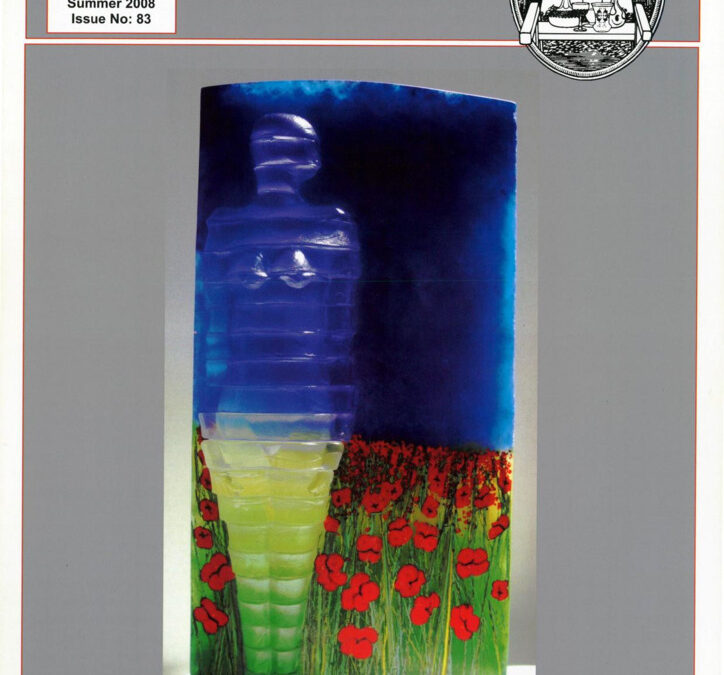
Cover Illustration:
One of the ‘Poppies’ series by Stephen Beardsell
at ‘Blast’ 2008.
The Glass Cone—Issue No: 83 Summer 2008
FROM THE EDITOR
What a feast there is in store for glass lovers this summer!
12-13 July sees the Glass Association weekend to
celebrate the opening of
Hi Sklo Lo Sklo
at King’s Lynn.
There
was very little 1950s and 1960s glass in the Czech museums visited
during the Glass Circle trip to the Czech Republic this spring. It
seems that glass from the communist period is not highly regarded
where it comes from, but this exhibition will enable us to look at
the glass in a new light. There are still places available, so do come
along, you are sure to have an informative and enjoyable weekend.
From Norfolk we must dash to Oxford, and to
Art In
Action
from 17-20 July. Those who have been before will know
that the emphasis is on quality in every artistic discipline, and glass
features particularly strongly this year. Book on-line in advance for
reduced prices.
Enjoy your summer holidays and come back refreshed
ready to plunge into the
International Festival of Glass
and
Biennale
over the August Bank Holiday weekend.
The Glass
Association Video Room
is only one of the many, many
attractions, and you can be one of the first to own the Frank
Thrower DVD & the FT2 paperweight! We all know that glass is a
wonderful material worthy of serious attention. The Festival is a
true celebration of glass, and it is also fun!
As we go to press, images of some of the
Biennale
entries
have been added to the web-site (www.ifg.org.uk/imagebank.html )
– who would be your winner? There are three prizes this year, the
Biennale Award, the Worshipful Company of Glass Sellers Award,
and the Glass Sellers Student Award. The entries will be for sale at
prices from £200 to £10,000.
Details of the
Master Classes
are available. You don’t
always have to be an expert—you can try glassblowing for
beginners with Alistair Malcolm, or an introduction to bead-making
with Melanie Rudd. (https://ifg.org.uk/masterclasses.html )
A
Glass Emporium
will be open throughout the Festival,
with the
Bead Fair
open from Saturday to Monday. On the
Festival Saturday Stourbridge town centre will be closed to traffic
and taken over by the IFG for its first ever
Glass Market—glass
stalls alongside the traditional crafts and farmers market, with
glassblowing and lampwork demonstrations, along with “more live
street entertainments than you can shake a stick at”. Sunday sees
the new
Stourbridge Glass Fair
organised by Oxbridge Fairs:
everything from antique glass to contemporary to tempt the glass
lover and collector.
There is just time to catch your breath if you love
Czech
Glass
and were not able to go on the Glass Circle spring trip. There
is a second trip from 17-22 September. A number of Glass
Association members are going, and there are still places available
for those who would like to join the party. The spring trip was
excellent. For full details e-mail iohntismi@globalnetco.uk or
write to John Smith, 42 Vespan Road, London W12 9QQ.
If you attend these events, or indeed any glass event and it
inspires you, can I ask you to share your excitement with the
membership? It doesn’t have to be a long narrative, although that
will always gladden any Editor’s heart, a couple of pictures with a
few words will do just as well.
Just space to mention that with the Cone you will find an
offer from the
Antiques Trade Gazette.
It has been arranged as a
special service to our members, and is an offer worth serious
consideration.
Bob Wilcock
2
A THING OF BEAUTY IS A JOY FOREVER
LEERDAM GLASS
The first glass factory in Leerdam was founded in
the 18
th
Century by German emigrants. Until the end of the
19
th
Century the production consisted solely of dark-coloured
bottles. The take-over by two Dutch merchants in 1878, was the
start of a new episode. Clear glass was introduced in the factory and
the emphasis shifted to the production of blown and pressed
tableware. The unpretentious design of the products was aimed at
the masses.
All in all the production of the Leerdam glass factory was
not so different from other European glassworks. In truth Leerdam
produced a mediocre quality that could be produced cheaper and
better in other countries where well-industrialised glass industry had
gradually taken root. In England, for example, no glass industry of
any importance existed before the Great War, which made it one of
Leerdam’s most important export markets. This comfortable
situation changed drastically after the modemisations that took
place. To meet the new competition, the Leerdam Glass Factory
was forced to produce high quality glass and crystal.
P.M. Cochius The then director of the Leerdam glassworks had been
there since 1912, P.M. Cochius, a memorable man whose
endeavours towards innovation on the technical side of glass-
making matched his desire for aesthetic, social and educational
improvements in the glass industry. For Cochius, an idealist with
progressive ideas, business and spiritual life were inseparable.
Cochius was director but also theosophist, Freemason, Rotarian,
leader of the practical idealists, Vicar-General of the Free Catholic
Church and founder of the Saint Michael’s Foundation.
Driven by ethical and aesthetical ideals, which were based
on theosophy and socialism, he made the factory bloom.
Besides striving for technical innovation and the
improvement of the factory environment for the workers his goal
was to improve the production aesthetically. In his vision, a better
industrial design would not only uplift the taste of the public, it
would also guarantee the factory a healthy existence and future.
A certain revolutionary spirit also impelled Cochius. It
looked as though what had started with William Moths and been
continued by the German and Austrian
Werkbund,
was finally
becoming reality in the inter-war period with its burning urge for
Innovation: the aesthetic mass product.
Designer glass
At the beginning of the last century, the Leerdam Glass
Factory was one of the first factories in the Netherlands to introduce
cooperation between artists and industry. The goal was to obtain
better-designed products and to create a higher appreciation for
them with the public. Consequently the policy was focused mainly
on utility glass for daily use. A well-designed object in glass or
crystal should be affordable for everyone.
From 1915 onward, on Cochius’ initiative, the factory
approached leading architects, designers and artists for designs in
glass. Cochius first turned to the generation for whom William
Morris had been a living legend and a source of inspiration:
Cornelis de Lorm, Chris Lanooy, Dr. H.P. Berlage and Chris
Lebeau. Each had won his personal spurs in architecture and/or
decorative arts. Glass — Cochius hoped — might inspire them with
bold new ideas.
The designers’ lack of knowledge about the material was
quite insignificant compared to the lack of skill and the low level of
the equipment at the Glass factory. This meant lots of failures at that
time. Nevertheless, Cochius hoped, that confronted with the
technical limitations, the artists would discover new possibilities.
The operation was highly successful. The artists sought
new forms, which broke totally with the historical styles so firmly
rooted in the 19
th
Century. It triggered an innovation of Dutch Glass
that was to have a lasting impact and lead to international acclaim.
K.P.C. de Bazel (1869-1923)
Part of the blue and green pressed glass breakfast service set,
1920, made by the Leerdam Glassworks; h. max. 19 cm
Collection National Glass Museum Leerdam
Between 1915 and 1933, a large number of their designs
were put into production. Among the many artists who worked for
Leerdam were the architects K.P.C. de Bazel, H.P. Berlage and the
American Frank Lloyd Wright, the potter Chris Lanooy and
designers such as Cornelis de Lorm, Chris Lebeau and Jaap
Gidding. By using simplicity as a starting point, these artists gave
the Leerdam Glassware its characteristic feature. They concentrated
not on decoration
but on pure, functional forms and designed
H.P. Berlage (1856-1934)
Part of the yellow pressed glass breakfast service set, 1924
h. max. 12.5 cm
Collection National Glass Museum Leerdam
3
The Glass Cone—Issue No: 83 Summer 2008
drinking and breakfast
services, flower vases, ashtrays
and
candlesticks that became renowned as the ‘Arts and Crafts
Collection’ or Designers-Collection’ of the Leerdam Glass factory.
Often designers were approached with the demand to enrich the
collection with a specific product, so that from 1928 onward, the
factory was able to introduce many new elements such as pressed
mosaic tiles, glass bricks, car mascots, lamps, plastic art and even
glass for religious purposes. In total more than 1,500 new products
were brought onto the market, designed by around thirty different
artists on a freelance basis.
Andries Copier
Copier is beyond any doubt the most important and best-
known Dutch glass designer of all time. His name is a hallmark in
the world of glass art. During the many years that he was employed
by the Leerdam Glass factory he established an international
reputation for the company. He was the only designer on permanent
contract to the Leerdam Glass factory during the inter-war years.
After the economic crisis in the 30s he was the only one to stay. It
was only after the Second World War that designers like Floris
Meydam, Willem Heesen and Sybren Valkema became important
for Holland.
A.D. Copier (1901-1991)
Three ‘Leerdam Serica’ vases, 1928
made by the Leerdam Glassworks; h. max. 32
Collection National Glass Museum Leerdam
The image of Dutch glass in the inter-war years is
dominated by the designer glass. Completely different from his
utility work — and in a way hard to fit into the ideals of Cochius –
was another kind of Art glass that was officially launched in the
Leerdam catalogue
‘Thing ofBeauty’.
In this catalogue, besides the
designer glass, for the first time
Leerdam Unica
was launched as a
product group. Around 1923 Copier started experimenting with
autonomous glass outside working-hours at the furnace. Together
with Gerrit Vroegh, the master glassblower of Leerdam, he
experimented with the possibilities of the material and the
techniques.
Conclusion
For years Leerdam and Copier were synonymous to the
public. Leerdam or Copier meant pure and simple use of glass, no
decoration whatsoever, utilitarian with clear lines.
Ultimately it was Copier who continued the technical and
creative basis of working in glass. During World War Two in the
40s he set up a training course in glass. This course ensured that
after the war Leerdam upheld its international reputation, the
tradition being continued in the work of Floris Meydam, Sybren
Valkema and Willem Heesen.
A.D. Copier (1901-1991)
Part of the glass service set ‘Guild’, 1930
together with the Dutch Association of wine merchants
h. max. 15.5 cm
Collection National Glass Museum Leerdam
Copier started to work for the company at the age of only
13, as a good Leerdam boy should…. Cochius spotted his obvious
gift of drawing and gave him the chance to develop his talents in
that direction.
Job Meihuizen
i.meihuizen@xs4all.n1
Job Meihuizen is curator of the National Glass Museum
Leerdam. He is a specialist on the field of modern Dutch glass.
This article is based on the paper he gave at the European Study
Weekend in October 2007.
He attended a drawing course in typography in Utrecht
and took painting courses. He obtained a position at the factory
supervising the manufacturing of glassware that artists like
De Bazel and De Lorm had designed.
He also was responsible for some publicity material.
Around 1922, Copier made his first designs, which vaguely
resemble the designs of De Bazel. In 1923 his first glass service was
taken into production.
Leerdam Unica
Copier responded to the ideal of Cochius to design
something of beauty that could be produced for a reasonable price.
In his designs he combines simplicity and technical perfection: his
mould-blown highly functional utility glasses are excellent
examples.
Sylva Petrova’s paper on “Czech and Slovak Glass in
Exile” will follow in Cone 84, to complete our reports on the
European Study Weekend
lir A warm welcome
members
Ms D Collard
Mr K Thrower
Mr & Mrs P Trapmore
Mr S Davie & Mr P Ward
Mrs Z Thornton
Hampshire
E Sussex
Lincolnshire
London
Hertfordshire
The Glass Cone—Issue No: 83 Summer 2008
4
Fig 1: Globe vase by Jiri Suhajek for Exbor
The edited transcript of an interview of Graham Cooley
by Jeanette Hayhurst regarding the forthcoming “Hi Sklo Lo
Sklo” exhibition.
JH:
Can I begin by asking what inspired you to start
collecting Czech glass?
GC:
I first went to the Czech Republic in 1991, which
was just after the changes. I had a contract with a university there,
when I was Development Manager at National Power. I then
became the Development Manager for International Power and our
regional head office was in Old Town Square in Prague, the Square
with the famous old clock. Initially, I visited the Czech Republic
every few months but by the end of the ’90s, I was visiting twice a
month. So I had quite a strong association with the Czech Republic
at that time. Also my PhD tutor Drahosh Vesely is Czech. In 1989,
he left for a secondment to Liverpool University and watched the
tanks roll into Prague on TV the week that his wife visited him in
Liverpool. That was rather lucky for them, and they stayed.
JH:
When did you actually start collecting Czech glass?
Did you buy much to begin with, or have you bought most of it in
the last few years?
GC:
I first started collecting Czech glass in ’92. The
changes had just happened and, for a short period of time, great
objects were available and were very undervalued in my opinion. I
think one of the best things I bought at that time was a piece by
Suhajek, a big yellow and blue ball vase made by Exbor
(Figl).
JH:
So you were collecting it alongside your British
glass?
GC:
I tend to be interested in the things that surround me,
and that I’ve got a reasonable amount of access to. Interestingly
great British glass has disappeared recently, but great unattributed
Czech glass is still readily available. There are at least 40 designers
represented in the exhibition and all of the major factories are
covered.
JH:
What is the overall theme of the exhibition?
GC:
Well, there has been a reasonable amount of
coverage on high-end Czech glass. There have been a number of
major exhibitions over the years such as
“Glass Design from
Behind the Iron Curtain”
exhibition at Corning. 25 years ago, Dan
Klein mounted
“Masters of Czech Glass”,
a great exhibition in the
UK. So the high-end is well understood. The book
“Czech Glass.•
Design in an Age of Adversity”
is almost pornographic. You can
lust after the objects, but you can’t really have them – they’re just
not available. On the other hand, there are lots of really well
designed Czech glass objects around that are just not documented.
So what the exhibition does is identify them and relate them to the
well understood high-end art objects. However, there are also some
very good high-end things in the exhibition. There are three very
notable pieces of Jiri Harcuba’s work which were executed in ’65
when he was at the RCA. He gave them to Ronald Stennett-
Willson, who gave them to me. There are also some of the beautiful
Jelinek sculptures executed by Moser, mostly from ’69, which is
when they won many international awards. The
exhibition explores glass design all the way through
to the optical moulded vessels made in Novy Bor in
the 50’s and 60’s and pressed glass from the Sklo
Union, cut glass of Podebrady, tableware… and by
good designers as well. I mean pressed tableware that
turns out to be designed by Matura!
(Fig2).
You
wouldn’t know, and you’d probably walk past it in a
charity shop.
JH:
Well you might…. (both laugh).
GC:
If you look at post-war European glass, it
seems to me that there are three major progressive
movements, one is Italian glass, one is Scandinavian
glass, and the final one is Czech glass. The first two
have been done to death but people can’t name even
two or three Czech glass designers. The reason is that
the movement was behind the Iron Curtain – it really
hasn’t been promoted very well in the West at all. I
look through studio year books and it’s only in the
late 70’s
(studio year books ended in 1980)
that the
odd object by Pavel Hlava appears. In general
though, there’s no real mention of Czech glass at all.
JH:
This seems quite surprising when they had such
a large presence in the World Exposition in Brussels
in 1958.
GC:
Yes, I’ve actually got a vessel that was
exhibited at the exposition, and it’s an incredibly
progressive object. If you look at the pictures of those
exhibitions, and think about all the prizes that their
designs won, the only explanation is that the New
5
The Glass Cone—Issue No: 83 Summer 2008
Fig 2: Decanter and tumbler by
Adolf Matura
1
. •(
–
)
00
-1,
=
r.
°141
11
n
…..
n
–…-
n
.0•11611
10
Fig 3: Vases by Milan Metelak made at Harrachov
together, which is what I do, then you
can check
colours and shapes and so on.
JH:
Well, that’s what we did with the early
Whitefriars. The only way you can learn is to think
“does this colour match that colour?” Okay, they’re
two different designs, but it’s the same colour, so it
may be the same factory. Its a bit haphazard at the
beginning, but when you can put 20 or 30 pieces
together then a picture begins to emerge.
GC: Exactly; if it wasn’t for the process you’ve just
described I wouldn’t be involved in collecting things
because that detective work is the exciting bit.
There’s a range of objects that I personally always
thought were by Schott Zwiesel. I liked them, so I
bought them and I’ve collected them for probably ten
years or longer. I found a reference to one shape in
CGR and another shape with a different colour way
and so on, and the whole thing unfolded: it actually
turns out the range was designed by Milan Metelak
and made at the Harrachov factory
(Fig3).
That gives
me real satisfaction because I now can explain the
whole range from a few photographs and you know,
that’s what doing exhibitions and collecting is all about
for me. You’ll see that whole range in the exhibition.
There are also other ranges that people have always
thought were Murano glass and actually many of them
were designed by Frantisek Zemek for Mstisov or by
one of the Beraneks for Skrdlovice, and are actually
very well documented in CGR. The hot-worked glass,
particularly Josef Hospodka’s vessels from the 70’s
and 80’s, are nearly always mistaken for Italian glass.
York publishers just decided to not include things from Eastern
Europe. I think
“Modern Glass”
by Ada Polak (1962) features a
leopard by Frantisek Zemek, and that’s one of the
first post war references. As regards other books,
Ronnie Stennett-Willson’s
“The Beauty of Modern
Glass”
was compiled using pictures from studio year
books, and so has nothing about Czech glass. On the
other hand, Geoffrey Beard’s
“International Glass”
contains some good references for Czech glass.
The odd thing is that actually Czech glass is
better documented than Italian or Scandinavian glass
but it’s in
“Czech Glass Review”
(CGR) the Czech
equivalent of the English
‘Pottery Gazette and Glass
Trade Review’.
Interestingly, there isn’t an
equivalent publication about Italian and
Scandinavian glass.
JH:
How else have you managed to
identify some of these designs?
GC: There are also two other very good
books. One was published in 1963 and is called
`Modern Bohemian Glass’,
by Josef Raban, and the
other was published by Crystalex in 1985 and is
called
`Bohmisches Glas’,
But the best way to
identify anything is by going back to the objects
themselves. I’ve worked reasonably hard at labels
and signatures, but by bringing all the objects
It makes me realise that no one’s previously properly
gone through CGR; now of course much of it is in Mark Hill’s
catalogue.
The Glass Cone—Issue No: 83 Summer 2008
6
Fig 4.• A Rosice glassworks pressed glass vase
designed by Vladislav Urban and
.
produced from 1967
.4011111
n
1111M.a
;
c‘
,
7,..7
MIN 11111111§6
AIIIIMI
n
1111/
JH:
Why do you think that such great
designs came out
of the Czech Republic in the period we’re talking about?
GC: I think it’s a combination of three things. It’s having
a very long tradition of producing quality glass, a central European
academic approach, and it’s something about having gone through a
really awful time post-war. They had a lot to say because they were
having a bloody difficult time.
.11-1: In 2001 when we were in Novy Bor and at
Kamenicky Senov, and going to the glass schools, what was evident
was that they weren’t even allowed near glass until they had learnt
to draw. Ifyou look at what’s happening in this country today, there
are very few successful glass companies or glass designers because
they’ve lost that strict training. Do you agree that the strict training
regime in the Czech Republic is important?
GC: It is incredibly important. If I look at the book
“Czech Glass: Design in an Age of Adversity”,
the collector
primarily collected paintings and drawings, with the glass coming
second. He understood that the art comes first, and the production
of the object is secondary to that. The process of Czech glass design
is one where you start with a ‘high end’ object that derives from a
piece of art like a painting or a drawing. That then goes into an
exhibition, and when it comes back the factory, where the artist
happens to be the chief designer as well, does something easier to
make that is almost homage to that art work.
That’s what Hi Sklo Lo Sklo is about. Its saying “we
know what those art objects look like but what about the bits that
were made by the factory afterwards in homage to those things.”
It starts right at the top, with the art. In my opinion, the
other amazing thing is that, if you just look at the very low end,
there are two areas that are incredibly underrated. The first of these
are the optical moulded pieces made in Novy Bor, many of which
were designed by Jan Gabrhel. The other is Sklo Union pressed
glass, which includes very well designed objects by very notable
designers such as Frantisek Vizner, Vaclav Hanus, Vladislav
Urban, Rudolf Jurnild and others, some of which won awards at
international exhibitions.
JH:
I know that people look down on moulded glass, but
you get designs in moulded glass that you couldn’t get with any
other technique. The strength and depth of some of those mouldings
means its using moulding to make art glass. Its not using the
technique at the high end of the market. It may be an inexpensive
process, but you’ve got an inexpensive process producing high art.
GC: Look at this piece of Sklo Union, and consider the
design
(Fig4) .
First of all, when you get one of these they’re always
exactly the same. That’s one of the things about pressed glass, you
do actually have what the designer intended. If you take a hot
worked piece of glass, something quite knobbly and organic, then
of course you get the blower’s interpretation of what the designer
intended rather than the actual design itself. There are some
advantages in looking at pressed glass.
JH:
They’re always the most common ones you come
across aren’t they?
GC: They are the most common because they were
imported in quite large numbers in the UK by Dexam and others. In
fact, we have a copy of a page from an original catalogue
(Fig5).
They come in light blue and amber as well, and there’s a full range
of them. This vase is the most common vessel but there are lots of
other things like candlesticks,
ashtrays,
and jardinieres
and so on.
JH:
But they’re a great design.
GC: Yes they’re lovely things aren’t they? One of the
things that the Sklo Union objects do is to freeze a moment in
design. Another point is that you used to see these everywhere.
People didn’t appreciate them, but it’s very hard to find them now –
they’ve disappeared.
JH:
In the catalogue are you explaining that there are
later versions of many of the objects? Like Italian glass, although it
might have been designed in the 50s or 60s you might find examples
made in the 1980s?
GC: Yes we have tried to do that, but the information is
nearly impossible to get hold of, if it is out there at all. However,
colours can often help identify a later example. The catalogue does
a number of things. Firstly, it shows you the object, sometimes with
others from that range, or details of what else was made in the
range. Secondly it gives the designer and factory names and,
thirdly, it gives a year of design based on the design’s first
appearance in CGR. It doesn’t tell you when they stopped making it
because they may have carried on making it for twenty years, and
there are examples of designs that they carried on all the way
through. It contains as much information as we could find and work
out.
7
The Glass Cone—Issue No: 83 Summer 2008
Mark has also included brief analytical notes for
many of the objects included, which are very useful. The
photography is superb, with stunning images by Graham
Rae. In many instances, it’s the first time that these objects
have been included in a publication of this type. It really is
new information for collectors and the marketplace.
JH:
Are you worried that Czech glass being made
today might be misattributed as an original production?
GC: I don’t know whether you’ll like this but I
actually don’t care. If something was designed by Paval
Hlava, who is now dead, then it’s part of a distinct body of
work. If it’s made later on by similarly skilled craftspeople
and they use the same quality of glass, then that’s okay with
me. If you have a very high end object that they decided to
reproduce and the quality is still as good, what difference
does it make?
J11:
Tell me a bit more about the themes in the
exhibition.
Fig 5:
page om I exam
Ltd’s trade catalogue
from 1975
ORNAMF,NTALGLASS
Long famous for traditionally not Bohemian
crystal, Czech designers have made their name
too with contemporary glass forms.
These decorative pieces are hand-moulded in
high-quality soda glass.
The decanter Shown with Susanne and
the dams shown in illustrations 159 and
160 are from Poland.
63
6)
ASHTRAY BIM
663
VASE 1361
VASE IMO
166006.1
ASHTRAY B63
CANDLEHOLDER 1366
JARDINIERE 11114
GC: One key theme is the Sklo Union press moulded
glass which I’ve described already. I have dedicated a separate
room to that because in some senses it’s almost a separate subject.
The other three major themes are the optical glass ranges from
Novy Bor, the hot worked glass which is often misattributed as
being from Murano, and the cut and engraved glass. I think all of
those are really exciting areas, particularly the hot-worked objects
by the likes of Zemek and Klinger. The forms and the organic
nature have been endlessly copied. Every time they brought
something out you can see how it affected European glass. The
work is very progressive.
The cut glass is really astonishing. It’s just completely
misunderstood as people can’t identify it, because much of it is
unsigned. When I look at the high lead crystal cut glass, made at
Podebrady and designed by Josef Pravec and Vladimir Zahour, I
always wonder how they could see in three dimensions – I think to
myself ‘how could they see all those angles working together?
When I look at English cut glass, although I like it very much, many
designs are largely two dimensional by comparison.
JH:
Yes, that classic Zahour vase which uses a
combination of depths, matting and polishing it just works so well.
It’s the matting that just gives it that hint of superb design.
GC: They really are amazing things. Using a number of
different sandblasting techniques you change the opacity: you go
from something that’s semi-transparent to beautifully transparent
because its incredibly high lead crystal and all the little angles throw
back the light, so you see different colours from the spectrum in it.
The other area of the hot worked designs which I think is
truly amazing are the Moser optical sculptures, or art objects as they
were called, by Jelinek. What amazes me about Moser is that they
had an incredible tradition to live up to and then they also produced
incredibly progressive objects by Jiri Suhajek. I think the people
selecting the designers all the way through the post war period have
actually been very brave.
JH:
Yes. There are some spectacular things. You just
think “Who had this wonderful idea?”, and there’s so much of it in
the Czech Republic. So here’s my final question. Do you ever sell
anything?
GC: No not really, I do occasionally swap things.
JH:
Is there anything you ever regret having sold?
GC: My biggest regret is selling two nine ring Stennett-
Willson Sheringham candlesticks to Jeanette Hayhurst, which I sold
very inexpensively!
JH:
(Laughs) But it was a long time ago; almost 10yrs
ago I think, they’re still up there on the shell
GC: How much is your Svarc bowl?
JH:
Its not for sale (laughs a lot)
The idea for this interview came from our Chairman,
Brian Clarke. Jeanette Hayhurst is one of the UK’s most respected
glass dealers and a Czech glass enthusiast.
Figures 1-4 are from the Graham Cooley collection ©
Mark Hill Publishing. Figure 5 is reproduced with the kind
permission of Dexam Ltd, Surrey
“High Sklo, Lo Sklo—From Masterpiece to
Mass Produced ” is being held at the Kings Lynn
Arts Centre from 13
th
July — 9
th
August 2008.
Join fellow glass enthusiasts for the Glass
Association Weekend to celebrate the opening of the
exhibition.
You can choose to attend only Saturday (Graham
Cooley will take us through the exhibits and Dan Klein will
give us an update on ‘Masters of Czech Glass’), or the full
programme entailing talks, dinner on Saturday evening
and The John Betjeman’s walk conducted by historian
Dr Paul Richards on Sunday morning.
Full details of the programme and a
downloadable booking form can be found at
www.glassassociation.org.0
k
Or for those not wishing to use the internet, e-mail
gabymarconAbtinternet.com
or call her on 07711 262649,
to request a booking form and/or the programme.
The committee look forward to seeing many of you
join us for a very interesting weekend.
The Glass Cone—Issue No: 83 Summer 2008
8
INTERNATIONAL
FESTIVAL
GLASS
THE GLASS ASSOCIATION AT THE INTERNATIONAL FESTIVAL OF GLASS
STOURBRIDGE 22ND TO 25TH AUGUST 2008
MAJOR LAUNCH OF GLASS ASSOCIATION DVD
“THE LIFE AND WORK OF FRANK THROWER AND DARTINGTON GLASS”
The DVD on Frank Thrower and his life is being given its
major launch at the International Festival of Glass (IFG), the first
showing to be on Saturday 23rd August. It will be shown several
times a day, supported with other DVDs of glass interest, including
those produced by our member David Carter. Kim Thrower,
Frank’s son, a respected artist, & his daughter Eve will be making
short presentations, and along with Mark Hill, helping to introduce
the film before each showing.
The concept of the DVD was inspired by the GA visit to
Dartington last year; the visit itself providing the opening sequence.
The story is entertainingly documented, linked by Graham Cooley
and includes the interviews
with his daughter Eve & son
Kim and contributions from
Charles Hajdamach and Ronald
Stennett-Wilson. This is a
priceless record of one of the
major design influences in
British glassmaking of the 20th
century. Frank Thrower’s
“Sharon” design of drinking
glasses (1971), was exhibited at
the V&A Museum as one of the
hundred best ever British
designs, along with Concorde
and the Mini — it is still in
production.
Copies of the DVD,
to be signed by Kim or Eve,
will be on sale in the “Art
Room”. They will also be on
sale in other places around the
festival and can be taken to the Art Room for signing. The cost to
Glass Association members will be £7 and to non-members £9. If
you can’t get to the IFG, please fill in the accompanying order form
or email our secretary at secretaryAglassassociation.org.uk
The “Art Room”, on the Ruskin Mill site, will be the
GA’s base for the duration of the festival. We will be showing the
DVDs, giving the talks and presenting members’ glass. (All GA
members are invited to bring along, present, and discuss items of
interest from their collections). Additionally, to celebrate the launch
of the Frank Thrower DVD at the 2008 IFG, the GA is sponsoring
the manufacture, by Dartington Glass, of a special limited edition of
100 glass paperweights, a remake of Frank Thrower’s FT2 design,
each presented in a commemorative Dartington box.
The accompanying photo is of a group of the FT2
paperweights from previous years. Other than the seal, which is
under design by Kim Thrower, the outline is the same. We have
enclosed an order form for the paperweights, (or e-mail our
secretary at secretary@glassassociation.org.uk), each of which will
have its number engraved, from 1 to 100. All pre-ordered
paperweights will be signed by Kim Thrower and can either be sent
to you or collected from one of the major glass fairs, (see order
form). We anticipate a heavy demand for these commemorative
weights, because the IFG will also be advertising them. At the IFG,
you will be able to buy the weights in the “Art Room”, where Kim
will be set up to sign them on
the spot. Future orders will not
q.
be numbered or signed.
The price for the paperweights
will be £11 for Glass
Association members and £13
for non-members, with an
addition for postage.
Lastly, if plans go as
anticipated, Dartington will set
up an outlet at the Fair, selling
some of the current production
of Frank Thrower’s most
successful designs.
Along with glass making
demonstrations, lectures, the
studio glass competition and
display and many other
attractions, the Festival and
Biennale will provide several
days of non-stop glass interest;
the committee is looking forward to meeting you in The Art Room
and around the festival.
Downloadable order forms for both the Frank Thrower
DVDs and the Commemorative paperweights will also be available
on our website: www.glassassociation.org.uk
Full details of the International Festival of Glass and the
Biennale can be found at
www.if2.orzuk.
To give you an idea of the treats in store there are reports
on the 2006 Festival and Biennale in Cone 76
(Autumn 2006).
•
•
1
0
,
// •
• • •
‘`
09
–
7
..
-_
11=
2
e
,
The Glass Cone
—
Issue No: 83 Summer 2008
9
What a fifth anniversary year Cohesion has enjoyed! This
dynamic network for glassmakers, based in Sunderland, has
successfully exhibited and traded in Abu Dhabi and Dubai, at the
Pyramid Gallery in Stonegate, York, in Washington DC, at the
Affordable Art Fair in Battersea, at the British Craft Trade Fair in
Harrogate, and from 10 May to 8 June returned to London to
Cohesion member Peter Layton’s Glass Art Gallery at The Leather
Market for another selling exhibition.
The opening of
Blast 2008
was an event which lived up to
its name in more ways than one. There was certainly a blast of
wonderful glass, a truly vibrant showcase for twenty of Cohesion’s
members, and there was equally a blast of exceptionally warm May
weather which made the lovely refreshments very much
appreciated. On entering the beautifully light and airy gallery the
visitor could see at a glance that a wealth of glass techniques
including blown, cast, slumped and cut pieces were featured.
First to catch the eye was a striking
Red Helix
by
Phil
Vickery.
Phil has perfected
a
technique where an interna
I
membrane of glass is twisted along
the length of the piece in a graceful
manner, which for him, and indeed
the viewer, “represents nature, life,
energy, and movement”.
Red Helix
had then been cut on a diamond
saw down the length to reveal the
twist, ground and polished to
a
high finish, and UV bonded to
an
aluminum base. Phil explained
how the slightest error in the cold-
working processes could, and
had
indeed resulted, in the loss of more
than one piece (in this case four!).
Works from a anothe
r
talented artist were the colourful,
flamboyant and theatrical pieces by
James Maskrey.
For him glass
making is about having fun, and
this was reflected in
Caught in the
Act,
a beautiful free-blown and
hot
sculpted piece, and his striking
and
humorous desert island.
Across the gallery the sunlit vibrant poppies of Cohesion
newcomer,
Stephen Beardsell,
delighted the eye
(see front cover).
Stephen works at The University of Sunderland and The National
Glass Centre, and works with many different techniques of glass
making, his striking kiln work being exhibited in the 2006 Biennale,
whilst his hot glass sculptures for the garden, such as
Seeds of Time
have been well received. Like so many artists in this exhibition
Stephen will be one to watch.
Sue Parry
is based in Stourbridge, but the rugged terrain
of rural Western England where she grew up has influenced her
works of art; in fact before studying glass she gained a degree in
geology. Sue showed her fascination for rocks, textures and the
power of the sea, but this time far removed from England, in her
beautiful pieces
Sun Bowl
and
Tropical Paradise View.
She pours
molten glass into moulds and then manipulates the pieces by hand
using protective hand coverings. Because these pieces are
individually made while the glass is hot no two pieces are exactly
the same.
Another artist influenced by nature is Roger Tye.
Much
of his work is derived from plant forms, both in large scale garden
sculptures and smaller bowls and bottles, all in exquisite colour
combinations. In this exhibition he has drawn on the Lake District
where he goes walking, and “Grid Ref NY348110”, his map
reference work, wonderfully combines blue-tinged clear glass and
slate to create a mountain stream.
Desiree Hope
is yet another who finds inspiration from
nature, her
Fossil
range being sculptural glass inspired by ammonite
hunting along the North Yorkshire Coast. The glass is hot worked
using the Graal technique, which involves engraving the glass
before adding more layers over the top. The beautiful
pattern hidden inside is revealed by extensive grinding
and polishing. In Blast 2008 Desiree showed examples
of
Murmur, Rime,
and
Elements,
more sculptural pieces
inspired by fossils, where each block is cast in solid
glass, before being ground and polished.
Catherine Forsyth, based like Desiree at the NGC, also
produced two very striking kiln formed works. Other
artists who had contributed to make this such an
outstanding and varied exhibition were Gill Hobson
(Glass, metal and wirework pieces), Cate Watkinson,
Brett Manley, Claudia Phipps, Gavin Marshall, Gill
Hobson, Hazel Burnham, Inge Paneels, Jessamy Kelly,
Joanne Mitchell, Kathryn Wightman, Ruth Lyne,
Steven Revesley and Zoe Garner — congratulations to
them all.
The Glass Cone—Issue No: 83 Summer 2008
10
EVERY PICTURE TELL
STORY
Peter Layton, Anne Tye, Dan Klein
Since its inception in 2002 Cohesion has organised an
array of events and exhibitions which reflect the interests and needs
of its ever growing number of members — architectural showcases,
garden sculpture exhibitions, art fairs, trade fairs and gallery
exhibitions, supporting established artists and new talents alike.
Cohesion receives funding from Sunderland City Council and
Europe, and has truly filled its aim “to assist and support glass
businesses and practitioners to develop their skills, to create new
opportunities and to promote the quality and diversity of their work
to wider markets”.
When opening
Blast 2008
Dan Klein rightly paid tribute
to the enormous amount of work carried out on Cohesion’s behalf
over the years by Cohesion’s project manager, Anne Tye, her work
being a model of best practice. Her determination and dynamism,
and that of her team, have already helped so many glassmakers.
Long may she and Cohesion continue to flourish.
Cohesion has a new improved website, very user friendly,
with artists having an individual page, with an image bank for
collectors to see at a glance the range of work produced by
members. Collectors and interested parties can sign up for
Cohesion’s colourful and interesting free quarterly newsletter by
clicking on the
‘Newsletter’
link.
Enjoy the work of other Cohesion members, including
The Glass Studio Denby, Gillies Jones, Charlie Macpherson,
Amanda Notarianni, Kathryn Pearce, Sanders & Wallace, Jo
Vincent, Louise Watson, Kathryn Wightman and others, at
Northern Glass,
The Platform Gallery, Station Rd, Clitheroe,
Lancs, BB7 2JT, 17 May to 12 July 2008, Mon. — Sat. 10- 4.30.
Several members will be taking part, giving
demonstrations and selling at that yearly treat,
Art in Action,
Waterpeny, Wheatley, Oxfordshire from 17 — 20 July 2008 (see the
back page and Cone 82 for outline details – there is more glass than
ever this year!)
Ruth Wilcock
https://www.cohesionglassnetwork.org/
https://www.ribblevalley.gov.uk/platformgallery
https://www.artinaction.org.uk/event.asp
Here we have a large 9 I/2 ins drawn trumpet goblet with
teared plain stem and folded conical foot Circa 1740/50. It has an
intriguing engraving and it is hoped readers may be able to throw
some light upon it. The goblet came into
my possession sometime ago, with an old
crumpled piece of paper giving an
explanation for the engraving: “A
Smokers Club Goblet: to break two pipes
in one evening was considered bad form
and this goblet had to be drunk from as a
penalty’.
The engraving is of very good
quality and appears to be contemporary
with the goblet. Firstly we have two very
well executed churchwarden pipes, each
broken in two places, then around the
bowl rim in a very competent script
“THIS
FOR THE SECOND FAULT”.
The goblet when full to a level just off the top to avoid
spillage holds
3
/4 of a pint. Now!!! Accepting that alcohol in most
of its 18
th
Century guises was stronger than today’s,
I
still can’t
help feeling that it wouldn’t be such a great penalty to consume its
contents (unless a fine cask strength malt was involved). I have
found it to be most acceptable with a drop of Burgundy, so is this
the answer to the story on the glass? Possibly not: research so far
into smokers clubs, drinking houses, churchwarden pipes etc. has
revealed nothing. Hopefully amongst the readers somebody may
be able to confirm or offer another interpretation of this interesting
piece of social history.
Any replies and ideas to the editor please; also if any
members have interesting but unexplained items in their
collections please forward details to the editor for possible
publication in later issues, maybe some long unanswered questions
could be resolved from the wealth of knowledge that no doubt the
Association’s membership has.
Peter Adamson
IMF
The Glass Cone—Issue No: 83: Summer 2008
11
CAITHNESS GLASS IN CRIEFF
At last some positive news, and hopefully an end to the
Caithness saga, with the relocation to Crieff completed, furnaces
installed and fired up and glass production under way. According to
the Caithness Collectors Society magazine
with the death of John Gooderham but the good news is that John
Deacons and Allan Scott have added their names to the ranks of
miniature weight makers. John has introduced a range of millefiori
dolls house weights that include silhouettes which they developed
primarily for use in their jewellery introduced some eighteen
and 2008 catalogue that arrived recently,
there is a viewing area where you can get up
close and see the paperweight maker at
work, an information area where you can
learn all about the history of Caithness
Glass and of course a shop selling Caithness
wares. Also within the visitor centre are
other craft units, a cafe and restaurant. I
love the mountains and islands of the west
coast, but as a county Perthshire rates as one
of the best, and Crieff is an attractive town
set in superb countryside on the road from
Perth to Loch Earn and the gateway to the
central highlands. The facilities may be
considerably reduced from what they were,
but in today’s financial climate companies
are forced to make difficult decisions to
survive. Crieff is certainly a more attractive
location than the outskirts of Perth and is on
a popular tourist route so I am sure that
visitors will soon be heading that way.
Looking through the catalogue I was somewhat surprised
at the extent of the product range for 2008; I had thought that with
the reduced manufacturing facilities they might take the opportunity
to refine the range of weights produced. The majority of designs
are obviously carried over from last year, with a few new designs
added to both the abstract and Whitefriars ranges. As previously,
some of the designs continue to be limited editions but most are
unlimited. To try and bring the name of Caithness and their
products to a wider public they have involved Lawrence Llewellyn
Bowen in the design of a series of weights in varying colours that
represent a gemstone associated with each month.
The limited edition weights are still quite expensive but
many of the new designs appear to be competitively priced with the
unlimited weights priced for the mass market. Following my recent
articles on weights with inclusions it was interesting to see in the
catalogue that Caithness are offering a unique range of silhouettes
of pure copper encapsulated with sculptural blocks called
‘Inspirations’
and they will accommodate people’s requests for a
particular motif. The company is certainly putting in the effort to
try and maintain their previous profile, and as I have said before,
there are many dedicated Caithness collectors around the world, but
with the current situation of rising costs and less spending money
around, only time will tell if they have found the right formula and
the public supports all the changes that have been implemented, by
purchasing the products.
ADDITIONS TO THE RANGE OF MINIATURE
PAPERWEIGHTS
In Glass Cone 77 I wrote about miniature paperweights
and the small band of glass artists that have used their skills to
produce superb weights that are a fraction of the size of the normal
range. In Glass Cone 78 I reported the reduction in their numbers
months ago, plus a range of weights that are around an inch (26mm)
in diameter. They contain a single complex millefiori cane with
facetted overlays or set within a basket of ribbon canes. The
accompanying picture shows three dolls house weights including a
bird and heart silhouette plus four miniature weights.
From left to right the miniature weights are a facetted red
and white double overlay (26mm diameter), facetted single green
overlay (28mm diameter), millefiori cane set inside a basket of
sixteen various coloured latticinio ribbon canes with large top facet
(33mm diameter) and finally a blue and white double overlay
(28mm diameter).
With regard to Allan Scott, I have just received news that,
with luck, his lampwork making skills will not be lost to collectors
following his departure from Caithness Glass earlier this year.
Using limited glassmaking facilities at his home he has been
experimenting with miniature weights that, instead of using a
millefiori cane, contain a tiny lampwork flower or even flowers. I
have seen both facetted and unfacetted versions and the
accompanying picture is of an unfacetted example containing a red
and white flower above green leaves and set above a blue and white
spiral ground. In the picture the weight is sitting on top of a five
pence piece to indicate just how small it is, and a bonus for
collectors is that the weights have an A cane set in the underside.
Richard Giles
The Glass Cone—Issue No: 83 Summer 2008
12
LUE VAS
ROM THE ROCK AN APPRECIATION OF
In March 1997 we were staying in the Reina Christina
Hotel in Algeciras, whose commanding view of the naval base in
Gibraltar across the bay ensured that it was a popular haunt for spies
during the Second World War. Our curiosity, however, was
satisfied by the customary bus tour of The Rock. Our leisurely post-
lunch amble back to the pick-up point was almost complete when
we happened upon a display of handmade crystal and colourful
glass items with a hint of Dartington in their design. We had a few
minutes to spare before our rendezvous so entered the Gibraltar
Crystal workshop for a quick browse.
We did not linger over the shelves of well made
flamboyant vases, dishes, bottles etc, nor did the workers at the
3 furnaces in the modern practical display area detain us for long, as
Pat had spotted a shelf at the very back of the shop holding several
`unique’ pieces. She had been attracted to a tall (37cm) blue and
white, encased glass vase. The lady at the purchase desk did not
know the price and summoned the artist, Paul Alexander. Whilst
awaiting his appearance (and checking the time), the engraver John
Ford happened by and, as well as showing us a recent example of
his exquisite work, he described how they were doing good
business with commemorative engraved glass pieces for their naval
clients. Paul soon arrived, suggested a price we instantly accepted
and they both offered to sign the base of the vase (it is also initialled
SQ which I assume is Stuart Quick). We explained our haste, and
whilst the packaging was completed he told us that, yes, he had
been a production manager at Dartington, how he, Stuart Quick and
Stuart Shute had helped set up Gibraltar Crystal in 1994, and the
commissioning, training etc had left him little time for his own
pieces. We rushed to the bus, Pat carefully cradling her precious
purchase, hoping to avoid the ultimate humiliation of being the last
to board.
In the decade since its safe transport home, the vase has
been displayed in a prominent position and interest by visitors has
allowed retelling of the tale of how
it was acquired. The comment
on Gibraltar Crystal’s
Britannia Goblet (also
from1997; the certificate
signed by Paul and John) by
Bob Wilcock in his article on
glass in Edinburgh
(Cone 82)
is an excuse for a further outing
for this story! Knowing Paul
Alexander’s links with
Dartington, Pat took the
opportunity at dinner during
the 2007 Glass Association
weekend to ask the designers if
they kept in touch and they
gave her an update on the
group they called ‘the
musketeers’. I checked the
website the following week to
find that there had been a lot of
changes since our brief visit
but the company was still
going strong.
Pat and Roger Ersser
13
Henry, a passionate collector of 18th century glass for just
on 44 years, an active member of the Glass Circle for nearly 40
years, died at home on February 27th. He had been battling prostate
cancer for a number of years.
He joined the committee in 1994 and quickly became a
constant and valued contributor to the “Glass Circle News” and
subsequently one of its editors. He wrote in his own style “Auction
Highlights” and “Henry Reviews the Fairs” and would never draw
back from saying it as he saw it; he wrote in the first person, as
though he was just chatting to you. His eye was such, that his
comments on fairs and auctions and his thoughts written out in his
“Glass Clippings” were always a knowledgeable, valuable and
humorous read.
Many of our members knew him and perhaps were
victims of his sharp wit, though, in Jo Marshall’s words, he was an
intrinsically kind and generous person. She relates the story of a
Glass Circle outing when it was discovered that there were one too
many people for the seats on the coach to Bristol — it was Henry
who gave up his seat and travelled by train.
Henry built his collection with great care and chose
rarities as well as more frequently found examples so as to create a
very comprehensive group of 18th century glasses. The quality was
such that he exhibited examples at Haslemere Museum in 1978 and
then onwards at other venues, including London Transport (as it
then was) — his place of work. He was fortunate to have been at the
auction of the well known Walter Smith collection.
With others, he was actively involved in the Glass Circle’s
50th anniversary exhibition held at Broadfield House and then
Pilkington’s in 1987, titled “Strange & Rare” and also the 60th
anniversary exhibition, held at Christie’s in King Street, London in
1997 — at this time
I
remember him visiting members collections
and ticking off the pieces he thought to be appropriate; we were
flattered to have our glasses chosen, but nervous until they were one
day returned in safety. Henry also worked hard on the “From Palace
to Parlour” exhibition, a celebration of British 19th century glass,
held at The Wallace Collection in 2003 and curated by the Glass
Circle member Martine Newby.
After this, perhaps aware of his medical problems, Henry
decided to pass his glass on to a new generation of collectors: this
was carried out in two sales held at Bonhams, in June & December
2004, when the true scale and quality of his love for 18th century
glass became apparent.
Certainly in public, Henry enjoyed his life; a charming
companion, always with a knowledgeable quip. I’ll just remember
the twinkle in his eyes.
Brian Clarke
The Glass Cone—Issue No: 83 Summer 2008
right, and are welcome to contact the Editor so that the question
may be explored further with the Museum and the original experts.
This continues the series of articles showing the pieces in Reading
Museum and giving the conclusions reached as to their identity.
Readers may have a feeling that some of the attributions may not be
6.
Object: 1972.47.1
Venetian footed double gimmel flask
made in moulded ribbed olive-green
glass, decorated with applied and
pincered winged decoration in clear
glass, vertically ribbed knop, clear
merese, moulded ribbed olive-green foot
Copy of early 17
th
Century gimmel
H. 21.5 cm Base diameter: 7.5 cm
Labels:
Price 8/6
Number 59
c. 1880-1900
7.
Object: 1965.24
Venetian (Salviati) sepia-tinted footed
glass jug, the lobed body decorated with
two horizontal turquoise trails and four
small raspberry prunts, and four gilded
sepia-coloured large leaf-shaped prunts,
with moulded lions mask, pulled high
mouth and applied handle.
H. 28 cm Base diameter: 8.5 cm
Labels:
Price £1/10/- Number 25
c. 1880-1900
Object: 1965.14
Venetian (Salviati) cased glass winged
flask, with opaque white overlain by
turquoise-blue and clear glass, &
decorated with aventurine splashes and
prunts around the widest part of the
body, set on a high pedestal foot. Pair of
clear handles (one broken).
H. 22 cm Base diameter: 7.5 cm
Labels: Price £1/1/- Number 27
c. 1880-1900
Object: 1965.14
Venetian serpent-stemmed goblet, the
bowl and foot made in cased glass, pink
over opaque white, the stem in clear
with a twisted ring, pincered wings & 3
pink flowers, set on a double hollow
knopped stem. Copy of a Rosenburg
Castle type goblet of c. 1708/9
Broken into two pieces, chips to stem
Base diameter: 7.5 cm, rim 9.5 cm
Labels: Price £2/12/6 Number 11
c. 1880-1900
The Glass Cone
—
Issue No: 83 Summer 2008
14
13.
Object: 1972.86
Venetian glass plate made in
vetro a retorti in opaque white
and aventurine, clear gless
pontil.
Diam. 18 cm
Labels: Price & number
unreadable
C. 1880-1900
10.
Object: 1972.92
Venetian (Fratelli Toso?) blown brown
glass oenochoe with a trefoil mouth and
decorated with yellow spiral trailing,
opaque white and brick red feather
trailing, handle with folded thumb rest.
Inspired by Greek core-formed vessel of
5
th
-3`
d
Century BC
H.
(handle) 11 cm
Labels:
Price 15/-
Number 9(?)
Late 19
th
Century
Object: 1965.5
Venetian flask in yellow glass, optic
blown with vertical ribbing, flaring
mouth on expanding neck with 4 footed
lobes, squat bulbous body. Pair of wing
handles from shoulder to top of neck,
turquoise-blue looped trailing overlain
by pincered clear glass trailing.
Copy of a flask in a German(?)
museum—copy also made by Harry
Powell of Whitefriars, late 19
th
Century
H. 13.5 cm
Labels:
6/6
Number 72
C. 1880-1900
14.
Object 1997.166.11
Venetian clear
glass shallow bowl with turquoise-blue rim
trail & decorated with 8 turquoise prunts, underside base with
4-stump pontil. Tooled hollow tubular foot-ring. Rim chip.
Diam. 18 cm
c. 1880-1900
Object 1972.41
Venetian 2-handled slender footed flask in light-
purple glass, applied gilded swags in clear glass with
raspberry prunts to top, pair of gilded ribbed clear
shell handles with cased opaque white & clear glass
horizontal thumb-rests (one broken). Bowl damaged.
H.
18cm; rim 8cm; Price 17/6 No.35 c.1880-1900
The Glass Cone—Issue No: 83 Summer 2008
15
FORTHCOMING EVENTS
Art in Action
Thu 17 – Sun 20 July 2008
New this year:
Studio Glass in Action
Art in Action endeavours to bring you some of the best
artists working in this exciting medium. A must for contemporary
art collectors.
(See Cone 82 p.10 for the list of artists participating)
On 18 July GA member Andy McConnell is lecturing on
“The Impact of Glass” (11 am) and “20
th
Century Glass ” (2 pm)
Art in Action
Waterperty House, Near Wheatley, OXFORD OX33 1JZ
www.arlinaction.org.uk
DESIGN SHOW LIVERPOOL
19-22 June at the Contemporary Urban Centre,
Greenland Street, Liverpool Ll.
Glass artists exhibiting: Brodie Nairn & Nichola Burns
(Glasstorm); Clare Henshaw; Gillies Jones Glass; Jayne Apperly;
Kathryn Wightman; Lara Aldridge; Notarianni Glass; Jo Vincent
20 June: Fast Glass Challenge (including live glass-
blowing)
www.designshowliverpool.com
Ely Cathedral Stained Glass Museum Summer Exhibition
24
th
May – 8/12 July
Alhambra’
The Stained Glass Museum is showcasing the work of
Sudanese born stained glass artist Nour el Huda Awad who now
lives in Wales. Huda draws inspiration for her work from Islamic
pattern-making that includes both geometric and floral designs.
The Stained Glass Museum, The South Triforium
Ely Cathedral, Ely, Cambridgeshire CB7 4DL
01353 660347
www.stainedglassmuseum.com
You are advised to check before travelling—opening & closing
dates are not wholly clear.
Postgraduate Glass and Ceramics –
University of Sunderland at the Biscuit Factory
Thursday 10—Wednesday 23 July
Opening on Thursday 10th July, the exhibition celebrates
its eighth year at the prestigious Biscuit Factory Gallery, in
Newcastle upon Tyne. The exhibition features works by students
from China, Belgium, and Japan as well as the UK, and is curated
by Professor Sylva Petrova.
Glass artists: Thomas Beach, Griet Beyaert,
Emma Duncan, Jason Morris, Tim Jago
Morris,
Dawn Routledge,
Ayako Tani, Ji Xiaohong, Li The, Su Wen, Ben Walters, Xu Shan,
Su Rui, Debbie Wilson.
Private view: Thursday 10th July 2007, 6:00pm- 8:00pm.
The Biscuit Factory in Newcastle upon Tyne, Stoddart Street.
www.thebiscuitfactory.com
kevin.petrie@sunderland.ac.uk
Don’t forget:
* The GA Visit to Kings Lynn 12-13 July *
Places still available.
* The GA Video Room at the International Festival of Glass *
23-25 August
IMF
The Glass Cone—Issue No: 83 Summer 2008
PRISM
at
Designed & Made Gallery
Friday 13th June – Saturday 26th July 2008
Gallery opening times: Wed-Sat 12.30-6pm
Level 1, Live Theatre, Broad Chare, Quayside,
Newcastle, NE1 3DQ
PRISM
is an exhibition of innovative work showcasing
contemporary design and applied art created specifically to work
with or respond to light the exhibition includes neon work by Alec
Finlay, Sarah Blood and Dan Civico, glassware by Kathryn
Wightman and Vanessa Culter.
DIVERSITY
OF
WOLVERHAMPTON
Art&Design
GLASS ROUTES EXHIBITION
23
rd
August – 15
th
November
GLASS ROUTES is a major international exhibition
showing the work of Professor Keith Cummings and his students.
The exhibition examines the role and impact of the teaching of
Professor Keith Cummings on glass education in the UK, and
internationally, over the last 40 years.
Among the international glass artists and designers are:
Colin Reid, UK; David Reekie, UK; Tessa Clegg, UK; Susan
Nixon, University of Wolverhampton, UK; Catherine Hough, UK;
Stuart Garfoot, University of Wolverhampton, UK; Katy Holford,
UK; Professor Donghai Guan, Tsinghua University Beijing;
Professor Xia wei Zhuang, College of Fine Arts Shanghai
University; Maureen Cahill, Glass Artists Gallery Sydney,
Australia; Gerhard Ribka, Germany.
Bilston Craft Gallery, Mount Pleasant, Bilston, Wolverhampton,
WV14 7LU
www.wolverhamotonart.org. uk/bilston/visit
CREATIVE PATHWAYS
SYM POSIU M
9 am-7 pm, Friday 22
nd
August
The CREATIVE PATHWAYS symposium complements
the GLASS ROUTES exhibition and will examine how we
navigate the interactive creative process between materials, process,
creativity, style, function and context.
School of Art and Design, Lecture Theatre MK045
University of Wolverhampton, Molineux Street, Wolverhampton,
WV1 1DT
The cost is £20 and includes a private view of the exhibition.
For full details contact Stuart Garfoot
S.Garfoot@wlv.ac.uk
Both events are part of the International Festival of Glass
“Gathering Light: International Contemporary Glass”.
Metropolitan Cathedral Of Christ The King, Liverpool.
June 7
th
– August 27
th
2008.
Forty years after the completion of the Metropolitan
Cathedral, with its famous glass and concrete lantern by John Piper
and Patrick Reyntiens, new glass of the 21
st
Century will be shown
in this outstanding building. Twenty years ago a group of female
artists from around the world met in Germany. To celebrate those
twenty years the Women’s International Glass Workshop will
premiere twenty specially made pieces.
16