




Spring 2009
Issue No. 86
The
Glass Cone
Issue No: 86 — Spring 2009
The Magazine of
The Glass Association
Registered as a Charity No. 326602
Chairman
Dr. Brian Clarke: chairman@glassassociation.org.uk
Hon. Secretary
Position vacant
(secretaryAglassassociation.org.uk)
Editorial Board
Bob Wilcock (The Glass Cone), Mark Hill (The Journal),
Yvonne Cocking
Address for Glass Cone correspondence
E-mail to editor@glassassociation.org.uk or mail to
Bob Wilcock, 24 Hamilton Crescent, Brentwood, Essex,
CM14 5ES
Address for membership enquiries & backnumbers
Pauline Wimpory, Membership Secretary,
150 Braemar Road, Sutton Coldfield, West Midlands,
B73 6LZ
(membership@glassassociation.org.uk)
Committee
Mark Hill (Vice-Chairman); Paul Bishop; Roger Dodsworth;
Jackie Fairburn; Christina Glover; Francis Grew; Valerie
Humphries; Gaby Marcon; Janet Sergison; Julie Stanyer;
Maurice Wimpory (Treasurer)
Website:
www.glassassociation.org.uk
E-mail news & events to news@glassassociation.org.uk
Printed
by Jones and Palmer Ltd: www.jonesandpalmer.co.uk
Published by
The Glass Association
ISSN No. 0265 9654
The opinions expressed in the Glass Cone are those of the
contributors. The aim of the Editorial Board is to cover
a range of interests, ideas and opinions, which are not
necessarily their own.
The decision of the Editorial Board is final.
Copy Dates:
Spring:
Summer:
Autumn:
Winter:
21 January—publication late March
21 April—publication late June
21 July—publication late September
21 October—publication early January
Articles are welcome at any time, but please bear the above dates
in mind if you have an event you would like to be publicised.
Pending appointment ofa new Events Editor for the Cone, events
are being primarily publicised on the GA website.
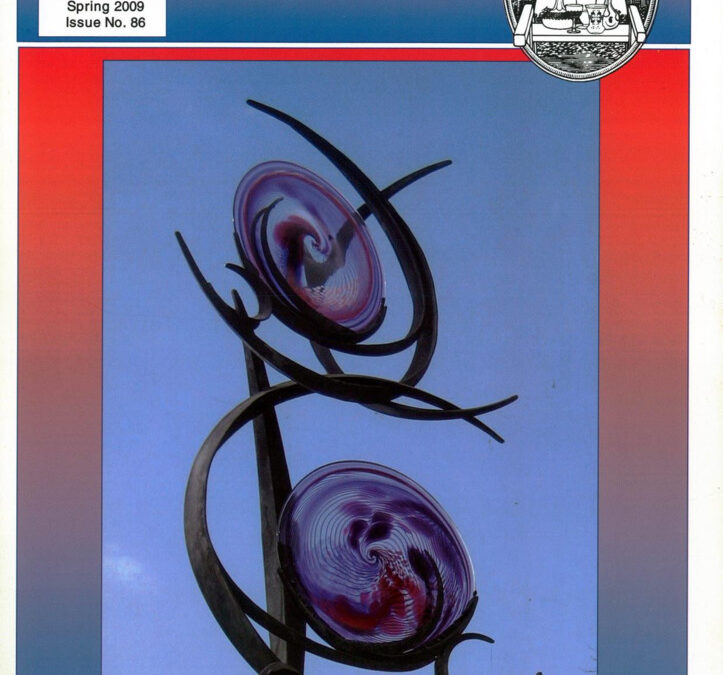
Cover Illustration:
Circles of Life (detail) designed by Jenny Pickford
(see Glass in the Garden, pp. 8-11)
BROADFIELD HOUSE
In a notice circulated with Cone 85 we gave news of what
seemed a real threat to the glass museum at Broadfield House. You
will be pleased to know that the position is more hopeful, and one of
the local councillors has written that
“there are, to the best of my
knowledge, no Council documents indicating a closure date for
Broadfield House.”
Nonetheless there remains some confusion and
uncertainty, and as yet there has been no statement from Dudley
Council that clearly resolves the ambiguity in the situation; if one is
made before the Cone is distributed there will be another insert.
The confusion has arisen from a conflict between Dudley
Council’s budget proposals for 2009/10 and strategy to 2011/12, and
their Glass Quarter Development Plan. The budget proposals are at
https://cmis.dudley.gov.uk/CMISWebPublic/Binary.ashx?
Document=12727 (para. 36(b)), and the development plan is at
https://cmis.dudley.gov.uk/CMISWebPublic/Binary.ashx?
Document=12733 (paragraphs 35 et seq.)
Now it is clear from the web-site that Dudley Council’s
general policy is very supportive of all the facilities in the Glass
Quarter, and they, and Dudley residents, want to see positive
developments. Unfortunately, someone in the finance department
looking for efficiency savings hit upon the bright idea of closing
Broadfield House, moving the glass museum to the Red House
Cone, and conjured up, out of thin air, savings of £120,000 a year,
without seemingly having the faintest idea of the realities of the
situation. Now budget proposals of this nature are never more than
aspirations in the first instance, but these became very serious when,
at a meeting with council officials, Broadfield House staff were
given to understand that the proposals would be acted upon,
Broadfield House would close in March 2010, and many of the staff
would lose their jobs. It was that meeting which led to the dynamic
campaign to save the glass museum, involving national and local
press, local radio and TV, and the glass community in Britain and
around the world. This showed the power of the intemet and of e-
mails to spread the news and really galvanise people into action. It
is a campaign that shows every sign of being effective.
The budget document proposes a feasibility study of the
possibility of moving the collections to the Red House Cone. This
is in advance of the preparation of the Planning’ Document for the
Glass Quarter, raising the real fear that Broadfield House will close
before the future of the collections has been determined. The
councillor’s statement quoted above suggests the more optimistic
interpretation that the results of the feasibility study will feed into the
Planning Document, and a letter to staff from the Assistant Director
of Culture and Leisure appears to confirm this. There will be a
public consultation in the summer, and we hope to give details in the
next Cone. Meanwhile, it is recognised that if the glass community
is to be heard and taken seriously we should talk with a common
voice. Steps are being taken to try to coordinate the efforts of the
various glass organisations through the Friends of Broadfield House.
www.friendsofbroadfieldhouse.co.uk, their web-site, is the best
place to see the latest developments. Do visit the site, and do sign
the petition if you have not already done so.
There is no doubt at all that Dudley Council created the
crisis by presenting its plans in such a way as to suggest a threat to
the glass museum. Through the pressure of the glass community we
hope that we have a golden opportunity to move towards an even
better museum, be it at Broadfield House, or elsewhere. We trust
that we are moving from the period of protest to the development of
serious and exciting proposals for the future.
Brian Clarke & Bob Wilcock
The Glass Cone—Issue No: 86
Spring
2009
2
GOODBYE TO AN OLD FRIEND.
AN APPRECIATION OF THE LIFE OF TONY WAUGH
LIFE PRESIDENT OF THE GLASS ASSOCIATION.
10
TH
JUNE 1931 – 21
ST
OCTOBER 2008.
Tony Waugh was one of the most
remarkable men that I, and I suspect most of
you, have ever known. Someone said to me
a few days ago that their overriding
memory of Tony was that he was a
gentleman — he was certainly that but much
more besides. Chatting round the supper
table after a golf match a couple of weeks
ago one of our number asked if there was
anything we regretted not doing in life. I
said that I wished that I could have been a
real expert in something. Tony was a real
expert in almost everything he touched.
Born in Tettenhall, educated at
Wolverhampton Grammar School and
trained as a dentist at Birmingham
University he joined his father’s practice in
Snow Hill. When the premises were eventually obliterated by the
ring road he moved to Park Road West in Wolverhampton. He
established a fine reputation as a brilliant dentist and was much
loved by his patients, which is not always the case with dentists!
My mouth, and probably those of many of you, is a testament to his
dental skill.
His professional life would have been sufficient for many
people but what made him so different was his wide range of
interests, and his ability to become an expert in whatever interested
him.
While in practice he used to get up at 6am, tend his
vegetable plot on the other side of the lane, have a swim in his pool
and then do a day’s work in his surgery. We built a pool in the early
70’s and I phoned Tony to ask what temperature was ideal. This
was the only time he let me down because he advised 65 degrees.
We heated to 65 and the whole family jumped in for the first time,
only almost to turn to ice and jump out immediately. Tony was
obviously made of sterner stuff than us, as that was at least 10
degrees below our comfort zone!
Cars were one of his interests and I think he was the only
person I ever knew who had two Lamborghinis at the same time –
albeit that one was a tractor!
He kept an excellent cellar and was a great connoisseur of
port. He was a knowledgeable collector of period oak and walnut
furniture, pictures and porcelain. He shot, he fished and was a
competitive golfer. He was a member of South Staffs Golf Club and
a past captain and president of Borth Golf Club. It was at Borth with
him that I hit my first ever golf shot. Bernice tells me that he played
off a handicap in the teens, but whenever he played against her and
Averil he seemed to play much better than that!
Borth was a favourite place of the Waugh family. They
holidayed every year in Hillboro, which was their house on the cliff
in which their son Nick lived for the last few years and which, if
you will forgive the commercial, is now on the market for him. In
these hard times Estate Agents cannot afford to miss an opportunity.
One of his principal interests was old English Glass. I sold
him what I think was his first piece of glass, which was an air-twist
3
stem drinking glass, at a small house in
Woodfield Avenue in Penn. This was the
start of a collection which was to become of
national significance, and whilst assembling
it Tony became a recognised expert and
eventually a member of The Glass Circle.
He was acknowledged as an authority by his
glass collecting peers by being elected
Chairman and subsequently Life President
of The Glass Association.
Eventually insurance demands and
requirements made it advisable to dispose of
the glass collection and he, in typical
fashion, decided to become a farmer and
then started breeding rare and unusual sheep.
This was on the land which surrounded the
new house which despite many trials and
tribulations, was being built. So life was good and all was going
well until in 1991 he had a bypass and then two years later a stroke
which left
him
with the severe disability of being almost unable to
speak.
He still retained his sense of humour with that twinkle in
his eye and the mischievous grin with the slightly pursed lips which
we remember so well. When I first met him after the stroke I said
now it was my turn. Tony looked surprised and his eyes asked why.
I said it was because for many years I had sat in his dentist’s chair
with my mouth full of instruments and unable to respond to
anything he said. Now it was my turn! I took a bit of a risk in saying
that, but when he laughed I knew he still had a sense of humour and
would be all right.
‘ I have always found it incredible that such a consummate
communicator could cope with taking everything in but being
unable to respond. That encyclopaedic knowledge was still there
but had no release and the frustration must have been extreme. I
have an enormous respect and admiration for his uncomplaining
acceptance of the situation — I know I could not have coped.
I confess with some shame that when it became obvious
that he would not get his speech back I wondered if it would have
been kinder if the stroke had been terminal — but I was wrong
because he seemed to adapt and I am sure that with the love and
support of his family and many friends he still gained much
pleasure and enjoyment from his life during the last 15 years.
From 1967 Tony was a distinguished member of the
Rotary Club of Wolverhampton. He was President in 1973-74 and
his year was memorable for the raising of funds to purchase a
lifeboat which was launched at Rhyl and some of us will remember
with varying degrees of pleasure the sponsored swim which helped
to raise the money. He was honoured as a Paul Harris Fellow in
1992 and made an Honorary Life Member in 2005. He continued to
attend the club meetings and indeed on the Thursday before he died
he enjoyed the annual Past Presidents Dinner.
Tony took great pleasure in his family. He and Bernice
were married in 1956 and they made a great team. He was
justifiably proud of Nick and Averil and their achievements and of
The Glass Cone—Issue No: 86 Spring 2009
the grandchildren Rebecca and Jonathon. Bernice carried an
enormous burden after Tony had his stroke and her life also
changed considerably. He was fortunate to have her love, care and
support for so many years. All the family are in our thoughts.
Tony, wherever you now are may you have tight lines,
may your birds fly high and may all your putts drop but more than
anything else may you regain your powers of communication. We
were all enriched by knowing you and are the poorer for your
departure but you will live on in our memories.
David Berriman, Rotarian.
Eulogy read at Tony Waugh Funeral at Telford
Crematorium on Tuesday 4` November 2008.
Within a few weeks of moving to Dudley in the
autumn of 1974 to work on the two glass collections held by
Brierley Hill and Stourbridge, I had the great privilege to meet Tony
Waugh. Tony was in the process of organising an exhibition of
glass at Wolverhampton Art Gallery the following year and
contacted me to ask if Dudley would be prepared to lend glass from
the two collections. We duly met and discussed the agreed loan and
Tony then asked me to assist him with travelling to other public
museums and to private collectors to choose further items for the
exhibition. To a newly appointed Keeper of Glass and Fine Art this
was seventh heaven and the ensuing experiences will always be
high on my list of special memories. One of the most surreal stories
from our travels was when I took Tony to see the glass collection
housed on the first floor in the former library in Moor Street in
Brierley Hill. At that time the local butchers Marsh and Baxter had
their abattoir across the road from the library. The sight of pigs
being driven across the road from the unloading bays with Tony’s
blue Lamborghini in the midst was perhaps the most bizarre
experience of our research trips. The exhibition, entitled
300 Years
of British Glass’,
was a huge success and cemented a life-long
friendship. Tony of course needed no assistance to help him make
his choices and his excellent eye and breadth of knowledge for the
finest British glass of the last three centuries was reflected in his
own collecting policy which ranged from Ravenscroft glass to
contemporary studio pieces by major artists. In later years
Broadfield House acquired a rare Ravenscroft ewer from him, and
Tony, in typically generous fashion, added a smaller flask with `nipt
-diamond-waies’ decoration as a gift to the museum, perhaps the
first example of buy-one-get-one-free in glass collecting.
In the early 1980s Tony played a huge part in
establishing The Glass Association. During my time at Manchester
City Art Gallery I had met Ian Wolfenden, a lecturer on the
Museums and Galleries Course at the University of Manchester
who was also interested in glass. Ian and I often discussed the need
for a new society for glass collectors as the only society in Britain at
that time, The Glass Circle, held all its meetings in London, with the
exception of a summer outing, and we felt a society with a more
regional bias was needed. Eventually we galvanised ourselves into
action and in thinking about names for a supporter of the idea it was
only natural that the name of Tony Waugh was uppermost. Tony
had been thinking along the same lines and immediately agreed to
help with the new scheme. After initial meetings with other like-
minded enthusiasts it was decided to found a new society. Tony
again readily agreed to be the founding Chairman and without his
expertise and guidance on matters ranging from finances, to
membership drives, to events programmes and to dealing with the
Charity Commissioners, those early stages would have been far
more harrowing than they were with Tony’s gentle but firm
guidance at the helm. It was due to his great personal skills, tact and
diplomacy, and glass knowledge that established the Glass
Association as the respected organisation it remains to this day.
After Tony had his stroke in 1993 I would see
him occasionally at lectures of the National Trust or NADFAS
meetings in Wolverhampton. Always dressed immaculately and
walking with a stick, his enthusiasm for glass knowledge was
undiminished. From the twinkling eyes one could recognise
immediately his excitement for a new glass topic. In 2000 when
Broadfield House organised the exhibition of
Cameo Glass by
George and Thomas Woodall
as part of the Millennium
celebrations in Dudley, Bernice brought Tony for a special private
viewing of the amassed treasures. It was my privilege once again to
guide him round the many exhibits loaned by the Woodall family
and to watch his evident pleasure at seeing so many cameo
masterpieces in one gallery. There was no need for verbal
communication on that occasion; his smile, his nods and his
gestures said it all. That day it was my honour to repay in a very
small way the generosity and warmth that he had shown to so many
glass collectors throughout his career. Thank you Tony for those
unique glass memories.
Charles R
Hajdamach
NEW YEAR’S HONOUR –
KATHARINE COLEMAN MBE
We are delighted to report that one of Britain’s foremost
engravers, Katharine Coleman, has been awarded an MBE in the
New Year’s Honours list, and
I
am sure every member will join us
in offering congratulations to her.
Katharine has received a number of prestigious awards,
and her engraved glass is in many public collections. Her latest
work may be found at www.katharinecoleman.co.uk
Bob Wilcock
City Blocks’
Crystal Canvas
exhibition,
Red House Cone, 2008
The Glass Cone—Issue No: 86 Spring 2009
4
THE GARTON COLLECTION AT THE MUSEUM OF LONDON
The successful industrialist,
Sir Richard Garton (1857-1934), was an
early pioneer in the application of chemistry
to brewing and drinks manufacture. He
served as a director of several breweries,
including Watney, Combe, Reid & Co. Yet,
ironically, he was probably unaware that
what has become the most famous item in
his glass collection, the Scudamore Flute,
may itself have been commissioned by a
businessman who made his fortune in the
drinks industry. Manufactured in the middle
of the 17
th
Century, probably in England, the
flute stands over 35cm tall. Beneath its
elegantly slender bowl is a ribbed knop
between a pair of mereses, and then a
folded, blown foot. Engraved in diamond
point on the bowl are several ‘S’s, the Royal
arms, the arms (three stirrups) of Sir John
Scudamore (1601-71) and a series of apple
trees. Recent research has revealed that
Scudamore, a leading Royalist, cultivated
apples on his estates at Home Lacy in
Herefordshire, and as early as the 1630s was
experimenting in the production of bottle-
fermented cider. Some vintages at least
came to be dubbed ‘yin de Scudamore’. The
flute, in all probability, was commissioned
to combine advertisement of a best-selling
product with celebration of a momentous
occasion — the Restoration of 1660, perhaps.
We know very little of how Garton
became interested in glass, though he
acquired most of his collection of over 400
items during the 1920s. His daughters
presented it to the London Museum
(forerunner of the Museum of London) after his death, virtually
without documentation. With a broad date range of around 1650 to
1820, the bulk of it is English and might loosely be termed
`Georgian’. As such, it is a quintessential product of its times. The
publication in 1897 of Hartshorne’s Old English Glasses had
created a fashionable new interest in 18
th
Century glass, and
collectors were in a position to benefit from the numerous sales that
followed the First World War. Some of these collections, such as
Captain Tumbull’s (now at Mompesson House, Salisbury, National
Trust), have ended up in the public domain. Others, including the
enormous collection of Captain Horridge (around 1,500 items, sold
in 1959), have since been dispersed. Garton probably relied entirely
on dealers such as Arthur Churchill or Cecil Davis, either buying
from their stock or commissioning them to bid at auction on his
behalf. Correspondence in the Donald Beves archive (Fitzwilliam
Museum, Cambridge) reveals the excitement of the early 1930s,
when sales were frequent and novice collectors were driving prices
higher. By 1936 — just after Garton’s death — the bubble had burst,
and price deflation had set in.
The Scudamore Flute reminds us that Garton and his
contemporaries were fascinated by glass made in the second half of
the 17
th
Century. This was the formative period in English glass-
making, when soda gave way to lead, but earlier shapes and fawn
de Venise ornamentation still persisted.
Garton did not find anything to match the
magnificent jug and bowl, each sealed with a
raven’s head, which were bought by that
other noted brewer and collector, Cecil
Higgins (Cecil Higgins Museum, Bedford).
But he did acquire a crizzled bowl — not
sealed, though probably by Ravenscroft –
and a fine pair of gadrooned decanter-jugs
(one of which still has its lid). Several
covered ceremonial goblets display
impressively twisted and pincered stems and
finials but, sadly, at least one may be a much
later imitation of genuine late 17
th
Century
work.
Yet for most collectors in the 1920s the
principal subject of interest was the
18
th
Century drinking glass. Garton was no
exception. Besides nearly a hundred
commemoratives of various kinds (see
below), he acquired over 30 plain balusters;
over 80 glasses with plain bowls or non-
commemorative engraving, and air-twist or
opaque-threaded stems; 12 glasses with
facet-cut stems; and a further 39 plain or
simply engraved glasses in various 18th-
century styles, including the ‘light baluster’
and the drawn trumpet. Together, these
represent nearly 40% of his total collection.
Other important categories include
candlesticks or tapersticks (over 30), and a
fine group of nearly 40 sweetmeat glasses;”
but jugs, decanters and large bowls or dishes
are noticeably absent. In the choice of what
to collect, practical considerations no doubt
played their part. Garton probably housed
the bulk of his collection in a long narrow display cabinet of the
type that Turnbull bequeathed, with his glasses, to the National
Trust or that can be seen in photographs of Donald Beves’ study at
King’s College, Cambridge. Rarely more than a foot deep
internally, cabinets such as these are ideally suited to displaying
drinking glasses, sweetmeats, goblets and candlesticks.
In the 18th century, of course, such glasses would neither
have been particularly noteworthy nor particularly valuable. Much
of the most highly prized glassware was cut, usually with low-relief
diamonds, and served either as lighting or in elaborate centrepieces
for the table. The trade card of Maydwell and Windle (Victoria and
Albert Museum), whose ‘cut-glass warehouse, the King’s Arms’
was ‘against Norfolk Street in the Strand London’, features just
such an array of magnificently cut chandeliers, candelabra and
ewers, all staged on a rococo overmantel. This advertisement
probably dates to the 1750s, simply noting, as a postscript, that the
dealers ‘likewise sell Plain Glasses of all Sorts’. In the days before
steam power, heavy cutting was laborious and expensive. Thus
another London dealer, Thomas Betts, could advertise in 1757
`twist-stem wines’ at 6d. each and ‘cut wines’ at 2s. — four times as
much. Fortunately, the Garton Collection does contain two cut
sweetmeats of this period, showy glasses to surmount a tiered
arrangement of jelly glasses and salvers of the type that forms the
5
The Glass Cone—Issue No: 86 Spring 2009
centrepiece of Maydwell and Windle’s card. Both sweetmeats have
scalloped rims and lozenges on the stem; but, whereas one is squat
and massive, the other is tall and elegant, with star-centred
diamonds around the bowl and a scalloped foot.
Other forms of surface decoration added considerably to
value in the 18
th
Century. High prices were achieved on Monday,
March 21 1774 at a Christie’s sale, which included ‘an Assortment
of cut and gilt Glass’, offered by Mr James Giles, ‘Chinaman and
Enameller’ of Cockspur Street, London. Garton owned none of the
gilded blue or opaque white glasses that are commonly attributed to
Giles, but he did acquire a number of enamelled pieces from the
Newcastle workshop of the Beilby family (floruit 1760s and
1770s). These include a small tumbler with Masonic devices and
several wine glasses delicately painted in white enamel with
landscape scenes. Perhaps the most interesting item, however, is a
large wine glass that apparently bears the arms of the Paton family.
Whereas most glasses decorated by the Beilbys have air- or opaque-
threaded stems, this is a ‘light baluster’. The pink and white rococo
scrollwork with black highlights, swirling around conjoined
heraldic shields, is almost a match in colour and delicacy for the
enamelling on a much grander tumbler with the Royal Arms in the
Victoria and Albert Museum. The glass may well have celebrated a
marriage by one of the Patons of Grandhome and Ferrochie, whose
arms
arms — three crescents argent — appear on one shield. But to whom?
The device on the other shield — three acorns gules — is unidentified.
One suspects, as often with Beilby glasses, an element of adaptation
or even fabrication of arms for those who were not officially
entitled to them.
Armorial and other types of commemorative glass were
particularly prized by collectors in the 1920s. Garton owned around
a hundred, nearly a quarter of
his entire collection. Some are
fine examples of Dutch
engraving and a few — such as
a glass with yellow-threaded
stem and bowl inscribed
C LANGE 1779′ and
`LT LANGE’, the proprietors
of the Nostetangen glassworks
in Norway — are rarities. More
common, however, is the
familiar repertoire of Jacobite
and Williamite motifs. Grant
Francis, writing for collectors
in 1926 (Old English Drinking
Glasses) remarked that in the
years immediately following
the Great War ‘prices of
genuine and especially of
inscribed specimens rose to
unprecedented, almost to
ridiculous heights’ and that ‘in
no other branch of
collecting … are forgeries and
modern reproductions so numerous, or so often sold as genuine.’
Sadly, Garton was one of those so duped. Along with several
doubtful items, his collection includes a glass whose design — an
Artillery Company medallion featuring a lyre and cannon, with the
motto ‘VOLUNTEERS OF DERRY 1782’ — exactly matches one
in Franz Tieze’s scrap book (Victoria and Albert Museum). Tieze
6
The Glass Cone
—
Issue No: 86 Spring 2009
has been unmasked as an engraver and forger, who worked m
Dublin chiefly in the first decade of the 20th century. But what of a
large glass with air-twist stem and bucket bowl, decorated with a
leafy apple branch? Though forgeries are known, this looks genuine
— quite possibly the very glass that Hartshorne described and
illustrated in 1897 (p. 312 and pl. 51). He was, he says, ‘fortunate
enough to obtain [it] in Hereford’. Such a provenance makes this
attractive 18
th
Century cider glass thus a fitting companion to that
other, much greater glass with Herefordshire connections, the
Scudamore Flute.
Francis Grew
iiclatowhgranewts
The writer is grateful to “ilex
Werner, to Hazel Forsyth and especially,
to Wendy Evans (present or foriner staff at
Museum of London) also to Victoria
Partridge (Cecil Higgins Museum,
Bedford) and to Julia Poole
Museum, Cambridge); for remarks about
Hartshorne’s cider glass, he is grateful to
Brian Watson (Brian Watson Antique
Glass).
Photographs C Museum of London
7
PAPERWEIGHT CORNER
COMMEMORATIVE PAPERWEIGHTS PART 3
Following the 1976 weight to celebrate their first ten
years, Dartington Glass issued a series of 9 press-moulded
paperweights from 1977 to 1985 designed by Frank Thrower. The
first two, plus the fourth in the series, commemorated royal events:
the Queen’s Silver Jubilee in 1977, the 25
th
anniversary of the
Coronation in 1978 and the 80
th
birthday of the Queen Mother in
1980. The 1979 weight marked the running of the 200
th
Derby,
1981 marked the 400
th
anniversary of the demise of the Dodo, and
1982 commemorated
Maritime Year and
featured the name HMS
Dartington. 1983 saw
the centenary of the
Orient Express and 1984
was the centenary of the
NSPCC. The final
weight of the series in
1985 commemorated the
300
th
anniversary of the
birth of J.S. Bach. From
some of the events
marked it was obviously
difficult to find suitable events to commemorate each year, so I
assume they decided to call a halt after 1985. A far as I am aware a
moulded plaque featuring the same design for each year was put
onto a glass tankard. In 1978 the State of Israel celebrated the 30
th
anniversary of its formation, and Whitefriars produced 100 weights
featuring a central Star of David cane. A year later the State of
Western Australia celebrated the 150
th
anniversary of its
founding ,and Whitefriars produced two slightly different weights
for two Australian companies but both featuring a black swan, the
state symbol, in the centre of concentric rings of millefiori. Only 50
weights were made for Myers, but the number made for Boars still
remains a mystery and examples of either weight are highly sought
after by collectors. 1979 saw the election of Mrs Thatcher as Prime
Minister, the first woman to hold the position. I have seen various
engraved drinking glasses commemorating the event but to date no
paperweights, however in 1988 a flat glass weight containing a
medallion commemorating her re-election for a third term was
available through a mail-order company. 1980 brought the
Olympic Games in Moscow, and Whitefriars took the easy route
with regard to a design by repeating the weight produced four years
earlier
(see Part 2 in Cone
8.5), but this time the millefiori rings
were set on a clear rather than coloured ground. The only example
that I had the chance to purchase was not
up to their usual quality, with some of the
canes forming the rings out of line, and
with the clear ground was generally not as
attractive as the previous weight. At the
time none of us knew that Whitefriars was
in the last few months of its existence, with
the last ever weight to be produced shortly
afterwards for Christmas that year, but
maybe that goes some way to explaining
why the quality of that weight was not up
to their usual standard.
Richard M Giles
Richard’s review will be continued in
Cone 87
Ed
The Glass Cone—Issue No: 86 Spring 2009
SCULPTURED GLASS IN THE GARDEN
Glass sculptures have become focal points within buildings and other
enclosed spaces in recent decades, culminating in the extravaganza of structures
that adorn the headquarters building of the Coming Corporation
(Peter Beebe,
Cone 72-3).
They have progressed into our ‘outdoor rooms’, and glass is, either
alone or in combination with other materials such as metals and stone, an
increasingly popular material for dramatic and decorative objects in public,
corporate and domestic gardens. Glass sculptures are appearing with greater
frequency in the outdoor displays of art and craft exhibitions and garden shows.
This has also encouraged designers, glassmakers and workers in metal
and stone to co-operate in the production of colourful, multi-media masterpieces.
Many capture and interpret the transient shapes, colours and forms of the natural
world, whilst others include architectural, geometric and abstract features. Some
work on a scale that is compatible with a
town or suburban plot, whilst others strive
to leave their fingerprint on the landscape.
The diversity and originality of the current
output of some British artists is illustrated
here, primarily by considering the glass
techniques used in their construction.
Glass components that are formed by
various methods may be present in an
individual sculpture.
Water Features
Small, mass-produced glass
water features abound in garden supply
catalogues and in garden centres. Units
with water spouting from or cascading
over glass pillars, plates, mirrors or spheres
and rotating globes have their charm, and
bespoke models are considered essential
elements of modem show garden design.
Whilst they may be architecturally pleasing, few have the
monumental impact of a Danny Lane post-tensioned, stacked glass
fountain, or the floral magic of those described here.
Hot Glass working
The scaling up, modifying and expanding of
traditional blowing and hot glass working techniques
typifies the style of the first group of artists. The
grandest sculptural glass display in an horticultural
setting in England in recent years was the series of
installations by
Dale Chihuly
and his team at Kew
Gardens in 2005
(Ruth Wilcock Cone72-3).
The
interaction of his trade mark fluid glass forms, in
rainbow hues, with the plants and the changing light
was spectacular. They were, however, temporary and
mainly in the greenhouses and conservatories.
Similarly,
Roger Tye
groups elements of
his signature sinuous, elongated, multi coloured,
blown, moulded and further worked plant form studio
pieces, to produce intricate outdoor sculptures. Their
triffid-like qualities, echoing the revived interest in
growing carnivorous plants, are enhanced when they
are suspended like Chihuly’s, or surrounded by water,
which also protects their apparent brittle vulnerability.
Another artist whose work closely reflects
botany and also petrified water in numerous forms is
the prolific
Neil Wilkin
(Figs 1
Free
standing, on metal rods or stone bases, as
fountains or on land
,
the flowers
,
trees
,
water drops and, latterly, seed heads
produced by Neil and his team can both
complement and occasionally out shine the
nature they mimic and interpret
(Fig M.
Julia Webster,
amongst many others, also
creates exuberant glass’ bon-bons’ on rods,
to co-habit beds and containers
(Fig
4)
The collection of 22 tall clear glass,
winding spirals called Seed Forms, by
Stephen Beardsell,
captured and reflected
the changes to the environment which surrounded its outdoor
waterside installation at Crook Hall in 2006
(Fig 5).
A further group
(Seeds of Time) were featured in a meadow at Burghley House in
2007 and Stephen hopes to display 50 or so in a suitable setting in
the future.
The Glass Cone—Issue No: 86 Spring 2009
8
The Glass Cone—Issue No: 86 Spring 2009
9
Cast, Fused, Slumped & other ‘Warm Glass’
Techniques.
Fusing and casting of glasses of suitable composition,
often with inclusions of other materials, in modern horizontal kilns,
is
a cornerstone of the studio movement, and can be used for objects
ranging from jewellery to large-scale, weather-resistant,
architectural features and sculptures. An exceptional example of up-
scaling transfer from studio to garden is ‘The Magic Sail’ series by
Julia Webster
(Glasszoo). A 3 metre high glass sail dominated the
great pavilion of 2008 RHS Chelsea Flower Show
(Fig 6).
The cast
and slumped, curved sail was a modification of the studio pieces
Julia has been making for 5 years since inspirational visits to Luxor
and Lesbos, and constructed in partnership with Mehrdad Tafreshi
(Quist) who was commissioned by Hillier Garden Centres to
provide a sculpture with a sailing theme and who built the metal
frame.
Stephen
Beardsell
also uses cast
glass either displayed on a
wooden plinth like his
poppy series, or embedded
in the wood in ‘Tree
Fungus’
(Fig
Anne Collins
has
extended her fascination
for fused and cast dichroic
and iridescent glass to
shimmering flower heads
bolted into winding, locally
made metal stems
(Fig 8).
At about a metre tall, these
sculptures, which respond
to changes in light, suit the
modest scale of suburban
plots.
Metalworkers who
incorporate glass.
Architectural elements
characterise the work of
Jackie Richardson,
which
I
reflects her dual glass and
metalworking
qualifications, and her
innovative solutions to
amalgamating the two
materials. She cleverly
incorporates flash and
coloured glass panels in her
metal screens, which seem
to be billowing in the wind
although actually flat
(Fig
9). She also uses fused and
slumped
glass in her ‘springy’ curved metal sculptures such as
`Ben’.
In the past four years Mehrdad Tafreshi, who has an
international reputation for producing metal tree sculptures
and fountains, has ‘crowned’ his copper tube and leaf
fountains with glass flowers, such as the ‘Midsummer’ range with
blue and red arum shaped flowers, and ‘Halcyon’ with blue and
orange open flowers
(Fig 10.
The hand
blown scarlet and purple
bud forms (Colin
Webster; Glasszoo),
which adorn ‘The
Belladonna’ group, are
reminiscent of a vibrant
clump of bulrushes
(Fig
11
).
Jenny
Pickford is an artist
blacksmith, who
combines galvanised
forged steel
and blown
and spun glass,
made by Stuart
Fletcher (Top
Glass), Alistair Malcolm and others, to create
dramatic outdoor sculptures both in water
(Fig
–
12)
and free standing in the landscape
(Fig 13).
She
also creates highly original metal gates with spun
glass inserts, and is at present constructing a set of
gates for a
school
in
Bromsgrove
Worcestershire,
which has 27
glass elements
that have been
cast around
copper wire
illustrations
made by the
children.
F’12
Fg
8
F4r
The Glass Cone—Issue No: 86 Spring 2009
10
Pragmatic Considerations.
Leaving personal aesthetic preferences to one side, some
practical aspects related to placing glass-containing objects outside
are worthy of consideration. Talking on ‘Masters of Czech Glass’ at
the recent ‘Hi Sklo, Lo Sklo’ meeting in Kings Lynn, Dan Klein
described how he once displayed the famous Libensky and
Brychtova sculpture ‘The Green Eye of the Pyramid’ in a courtyard,
where it captured unique reflections and light effects, totally
different from those of its now permanent home in the Corning
Building. This would seem to be the ultimate justification for the
temporary outdoor installation of even quite fragile sculptures.
Surrounding them with water offers additional reflective
opportunities, as well as a protective boundary, and probably
explains the popularity of fountains.
Small pieces can be treated like exotic plants that spend
the summer outside but are brought under cover for the winter.
Sculptures made of metal, wood or stone are often deliberately left
exposed to the elements and the consequent weathering changes in
character are felt to enhance their attraction. Preventing or
encouraging climatic influence on the various types of glass, their
expansion or contraction relative to metal co-components etc will
influence the appearance and longevity of many of the examples
illustrated in this article. Neil Wilkin assures me that the adhesive
used to bond glass, metal and stone allows for these changes and
cleaning them with the frequency one cleans the windows keeps
their sparkle. Several artists agree that fused and cast coloured glass
is robust and weather resistant
F4
,
13,
Gardeners blend hot and cool coloured plantings to
achieve their personally attractive vision of nature. Introducing
brightly coloured sculptures into this environment requires careful
placement, particularly the juxtaposition of floral representations
close to their aspirational originals. They do, however, use our
favourite material to introduce interest and drama into outdoor
spaces.
Roger Ersser
Except for fig
6,
(which is the author’s own) all
illustrations were provided by the artists, who retain copyright
Links
Stephen Beardsell
www.nationalglasscentre.com
Anne Collins
www.warmglassart.co.uk
Stuart Fletcher (Top Glass) www.jinneycraft.co.uk
Hillier Garden Centres
www.hilliergardencentres.co.uk/chelsealive.php
Danny Lane
Jenny Pickford
Jackie Richardson
Mehrdad Tafreshi
Roger Tye
Julia and Colin Webster
Neil Wilkin
www.dannylane.co.uk
www.
j ennypickford. co. uk
www. j r-glassdesign. co .uk
www. qui st .co .uk
www. rogertyeglas s .co uk
www. glasszoo . co .uk
www. neilwilkin. com
11
The Glass Cone—Issue No: 86 Spring 2009
Blue opalescent duckfrom Molineaux, Webb & Co.
1879 Sowerby aesthetic green ‘New Bowl’
ENGLISH VICTORIAN PRESSED GLASS
Variety of shape, design and colour, together with an
admiration for the skill of the mould makers, are the elements that
attracted me to collecting English Victorian pressed glass and have
maintained my interest over the past 15 years.
The last quarter of the nineteenth century saw a
flourishing of design ideas and production methods. Some pressed
glass factories were short-lived. For example, W.H.Heppell & Co.
of Gateshead was only in business for 10 years. They had novel
designs that fortunately lived on beyond the factory’s life as their
moulds were bought by George Davidson & Co. in 1884.
Some factories leave us (to my knowledge) with no
surviving catalogues of their products, the prime example being
Henry Greener & Co. of Sunderland. They made unusual items
such as clock surrounds, tea pot stands and lustres which fortunately
can be identified by their trade mark. Other makers such as
Sowerby have left us with a much better picture of their products.
The upshot is that these Victorian entrepreneurs have
bequeathed us a rich legacy of items for the antique collector of
today. Whilst much of their production was utilitarian in nature
there was also an emphasis on design and colour of items that were
clearly intended for decorative and display purposes.
Design and colour of English Victorian pressed glass was
the inspiration for the foyer display at the Cambridge Glass Fair on
22′
d
February. Some 65 items were selected, which were
representative of the tremendous range of colour and design that
came from factories based in the Newcastle and
Manchester areas.
1878 Double-ended swan dish
One cabinet was devoted entirely to the production of
Sowerby’s Ellison Glass Works which was in Gateshead. For sheer
variety of colour and design Sowerby was unsurpassed. The detail
and intricacy of some items is a testament to the skill of their mould
makers, whose abilities seem to be largely overlooked. Putting
together 30 items from one company, made largely in the 15 years
between 1875 and 1890, was the best way to demonstrate the
tremendous vitality of the business during those years. A couple of
the rarely seen items included in the display were an aesthetic green
New Bowl’ (pat 1407) and a common green swan dish (pat.1398).
In the second cabinet were items from eight other
manufacturers and a couple of items of unknown attribution. The
colours and designs of these items were selected to complement and
supplement those from Sowerby. Although many of the factories
copied each other’s designs and colours, some were unique to one
producer, such as Edward Moore’s
“caramel” and an amber `pearline’ from
Henry Greener, examples of which
were included.
Some of the more rarely
seen items were a blue opalescent
duck from Molineaux, Webb &
Co. of Ancoats and a deep amber
‘Judy’ from John Derbyshire of
Salford.
The display was a
testament to lost skills and
a time in our history
when inventiveness
and confidence
flourished.
Philip
Housden
Deep amber
.14/from
John Derbyshi
(Philip attends all the fairs run by Oxbridge Fairs and is
always willing to help collectors with questions about English
Victorian pressedglass).
The Glass Cone—Issue No: 86 Spring 2009
12
THE GRANICUS GOBLET
A magnificent Bohemian glass masterpiece engraved by I Harrach in Neuwelt in Bohemia, the goblet’s thickly walled
bowl
August Bohm, circa 1845, recently sold at auction for
£64,000.
has been deeply carved with a scene vigorously depicting
Alexander the Great defeating the Persians on the Bridge over the
River Granicus. It may have served on his arrival in England in
1845 as a supreme demonstration of the artist’s work. The
engraving is identical to that on a large carved goblet of different
form now in the Victoria and Albert Museum, London, hitherto
known as the Alexander Goblet. In its form it is practically identical
to that once owned by the great 19
th
Century English glassmaker
and writer Apsley Pellatt – hitherto known as the Arbela Goblet.
The appearance of the Granicus Goblet adds a third example to the
established series of history pieces engraved by August Bohm.
Standing 57cm (22’/2in.) high, the goblet has a slightly
waisted deep octagonal bowl which has been cut with a large
rectangular panel with chamfered corners. The panel is engraved
with a battle scene, after Charles Le Brun, depicting the central
figure of Alexander the Great at the head of his cavalry attacking
the Persian King with his sword, surrounded by men in combat.
The reverse of the bowl is inscribed
‘Ca ‘Vertu surmonte taus
obstacle _A.thxandre avant passe Ce Granique attaque Ces
Perses aforces inegas, a mis en suite Ceur innombrable
multitude’.
The bowl sits above an octagonal collar and waisted
section with wide scallop-edged collar below. The octagonal stem
and wide spreading panel-cut foot with scalloped edge and radial-
cut base supports the whole. The high domed and stepped cover is
of similar faceted style and is surmounted by an octagonal pointed
finial with broad cut glass scalloped section below and scalloped
rim. The bowl is signed `Gravirt v. A. Bohm aus Meistersdorf i.
Bohmen im Jahre 1845′, beneath the engraved panel.
The French inscription translates as
`Tafour
overcomes all obstacs. ..iqtxancr crosses the Granicus,
attacks the Persians whose armed forces are
outnumbered and_puts their vast hordes tonight’.
wire elyw
z
i
off
.,
A
,,-,
..
../ 6..
awiefre* aiegelTi
Employing techniques inspired by Mediaeval and
Renaissance rock crystal carving and Hochschnitt engraving of the
17
th
and 18
th
Centuries in Central Europe, August Bohm Senior is
now considered to be the finest 19
th
Century Bohemian engraver of
his generation. He may indeed be regarded as perhaps the greatest
European engraver of the 19
th
Century. Bohm’s work was a
triumph. He created topographical, portrait and hunting scenes of a
monumental nature, best exemplified by the Granicus Goblet, a
recently discovered masterpiece, dated 1845. It was sold at auction
in March 2008 for £64,000. Probably made by the glassworks of
13
The Glass Cone—Issue No: 86 Spring 2009
– – –
114.r,
=
ow.
– – •
-gm.
–
The Battle of the Granicus River took place in May
334 BC and was the first of three major battles between Alexander
and the Persian Empire Fought in North-western Asia Minor, near
the site of Troy, it was here where Alexander defeated the armies of
the Persian satraps of Asia Minor, including a large force of Greek
mercenaries led by Memnon of Rhodes.
The battle took place on the road from Abydos to
Dascylium (near modem day Ergili, Turkey) at the crossing of the
Granicus River (modem day Biga Cayi).
August Bohm was bom on 10th January 1812 in
Meistersdorf in Northern Bohemia and died on 19th January 1890
in nearby Warmbrunn. Meistersdorf was the centre of the industry
for glass engraving and it is likely that Dominik Biemann
influenced the young August and other significant Biedermeier
craftsmen including Franz Anton Pelikan in whose workshop many
young glass artists were trained. Although his life history is vague,
it is believed that August travelled to England in the 1840s where he
may have settled for a short time. However, as his son, also called
August, was born in Meistersdorf in 1848, it is possible that his
embarkation may have been after this date. His son was probably
also taught the art of glass engraving in the Pelikan workshop.
August (Junior) emigrated to England in about 1865 where he
married an English national, established a family and continued to
work in the Bohemian tradition in the West Midlands.
The Glass Cone
—
Issue No: 86 Spring 2009
APSLEY PELLATT IV (1791-1863) AND THE WORK
OF AUGUST BOHM (Senior)
When in 1849 Pellatt published ‘Curiosities of
Glassmalcing’ it coincided with the arrival in England of an influx
of leading Bohemian engravers. August B6hm may have been one
of these immigrants. The English tradition of glass engraving was
swept away by Bohm and his contemporaries, setting up a fine
future for the glassmaking and decorating industry in the West
Midlands where most of them settled. So impressed was Pellatt
with the work of these new arrivals that he featured a goblet by
BOhm — the Arbela Goblet – on the frontispiece of his book,
alongside the Roman Portland Vase, the Naples Vase and the
Auldjo Jug, thus elevating Bohm’s work to a position amongst
those considered to be the most important works of art in glass of all
time.
APSLEY PELLATT.
14
on the Granicus Goblet five years later.
Based on a mention in a contemporary journal, the
Alexander Goblet is recorded by Hajdamach and Paul von
Lichtenberg as having been exhibited at the Great Exhibition in
1851 in London’s Hyde Park where it was widely admired.
However, as there has been some confusion about that glass
belonging to Apsley Pellatt and the Alexander Goblet we are unsure
which example was shown. Von Lichtenberg has also discovered
that the cover of the goblet on exhibition was broken prior to the
event and an identical replacement was supplied by the Harrach
glasshouse. The cover of the Alexander Goblet is indeed a different
colour from that of the body strongly indicating that it was the one
on exhibition rather than that owned by Pellatt.
Von Lichtenberg and Walter Spiegl (Glas des
Historismus, 1980) describe several other key works by B6hm
some of which were presumably undertaken whilst he was briefly
resident in England. These are notably portrait goblets of Kent &
Stratheam and Lord Stanley. There is some suggestion, yet to be
confirmed, that Bohm worked for one of the American glass
companies.
Of the monumental topographical goblets an example of a
different form but also with a battle scene was located in the
Hohenzollern museum in Berlin before the Second World War but
is now missing presumed destroyed (illustrated Pazaurek, op.cit.,
p.56, p1.37). That with Richard the Lionheart and Saladin at the
Battle of Ascalon is in the Kunstgewerbemuseum Kohl and another
Pellatt wrote: “A
most beautifully engraved vase by a
Bohemian artist, is in the possession of the author; the
workmanship is even more elaborate than that of the Portland
Vase; the subject is from Le Brun ‘s painting of the conquest and
final overthrow of the Persians at the battle of Arbela, by Alexander
the Great For depth of workman*, and artistic execution, as a
modern intaglio engraving, this vase is unrivalled”
(op.cit. p.22)
When closely examined, from the line drawing in Pellat’s
publication the ‘vase’ – or to describe it more accurately the
`covered goblet’ – does indeed depict the Battle of Arbela (or
Arbella) after the painting now in the Musee du Louvre by the
17
th
Century French artist Charles Le Brun. Le Brun
‘s picture was
completed before 1669 and forms part of a series of at least three
paintings depicting the History of Alexander. The other two
paintings from the series are now in the room devoted to Le Brun at
the Louvre. These include ‘Alexander riding Bucephalus’ and
`Crossing the River Granicus’, the subject of the present goblet.
Writing in his seminal work on 19
th
Century glass, British
Glass 1800-1914, (pp.156-157) Charles Hajdamach has confused
the Alexander Goblet, which was exhibited at Broadfield House
Glass Museum and now in the V&A, with that mentioned by
Pellatt. The Alexander Goblet bears the same battle scene as the
Granicus goblet but is dated 1840. It too bears the French
inscription. The Alexander Goblet was so highly considered in his
homeland that plaster casts were taken of the decoration by a friend
of Bohm’s, the Steinschonau engraver Wilhelm Helzel, and kept in
Bohemia to inspire other engravers – see Gustav Pazaurek, Glaser
Der Empire- and Biedermeierzeit (1923), p.5, pls.38 and 39. These
plaster casts may thus have inspired Bohm to reproduce the subject
15
The Glass Cone—Issue No: 86 Spring 2009
The Alexander Goblet
It may be no coincidence
that the Granicus Goblet is dated
1845. Such masterful work must
have opened the artistic door for
August Bohm. According to
Spiegl, Pellatt’s goblet took some
years to produce. The work may,
therefore, have been carried out
between 1840 and 1845. The style
of the Alexander Goblet owes
more to those gothic ‘parade-like’
vessel produced in Bohemia during
the 1830s whilst the portrait goblets with English subjects –
presumably executed in England or produced on commission after
Bohm’s visit — are very similar in form to the Granicus and Arbela
Goblets indicating a likely post 1845 and pre 1850 production date.
Pellatt makes no reference to his glass being of actual Bohemian
origin. Nonetheless, the character of the Granicus Goblet under UV
light points directly to a Bohemian production.
As one of the finest and rarest examples of the work of
August Bohm, the Granicus Goblet represents a triumph of
virtuosity during the -Age of Revolution in Europe, the turmoil of
which its engraved subject matter reflects most eloquently. Within
the history of European engraved glass the Granicus Goblet
epitomises the 19th century and alongside the Alexander Goblet
should be considered as one of its greatest successes and a most
remarkable survivor. It is intriguing to consider that Pellat’s Arbela
Goblet has yet to be found, whilst the possible discovery of a fourth
example — depicting Alexander on Bucephalus, for which a plaster
cast exists — would complete Le Brun’s three masterpieces of the
Alexander history series as seen through the eyes of August Bohm.
Simon Cottle
Acknowledgements..
Roger Dodsworth and Paul von Lichtenberg
Photographs e Simon Cottle,. Paul von Lichtenberg (the Alexander
Goble)
The National Glass Collectors Fair
NationalMotorcycle Museum, Solihull, R92 OEJ
Sunday 3 May
2009
Don ‘tforget to use the discount voucher with Cone 85
for admission at .13 (instead offs)
HIVw.,elassfafr&co.uk
The Glass Cone—Issue No: 86 Spring 2009
PAPERWEIGHT NEWS
Bonham’s sale of paperweights from the estate of Philo
Woodrow Wagoner (and other vendors) in December 2008
produced some stunning realisations, but only 37 of the 63 lots sold.
The star was a rare Baccarat faceted ‘Swans-in-a-Pond’
paperweight, c. 1850, with, very unusually, three swans. Estimated
at £4-5,000 it reached a staggering £24,000 (plus VAT and
premium). A St. Louis pink dahlia with the same estimate failed to
sell, whereas the fine Mount Washington thousand-petal pink rose
magnum paperweight below, at 11.5cm diameter possibly the
largest American weight with a lampwork flower, went for
£13,200.
At the lower end, a St. Louis pink double-clematis weight,
estimated at £5504750
reached only (only!) £456.
Bob Wilcock
The paperweight sale
followed the sale of the
James Hall collection and
other fine British and
European glass. A report on
that sale has had to be held
over to Cone
87.
16
with the battle of Lipan (illustrated
Von Lichtenberg, cat.no.120) is in a
private collection.
Walter Spiegl suggests
that the Alexander Goblet was
executed by Bohm as some form of
artistic visiting card when
introducing himself to the English
glasshouse owners such as Apsley
Pellatt. He maintains that Bohm
may have travelled to England in
1845 the year in which the glass tax
was repealed exactly 100 years
since its introduction. This lifting of
the tax was a great impetus to the
glass industry, one that was
probably recognised by the glass
craftsmen of the much poorer
Bohemia.
i