

The
Glass Cone
Issue No: 87 — Summer 2009
The Magazine of
The Glass Association
Registered as a Charity No. 326602
Chairman
Dr. Brian Clarke: chairmanAglassassociation.org.uk
Hon. Secretary
Alison Hopkins (secretary(&,glassassociation.org.uk)
Editorial Board
Bob Wilcock (The Glass Cone), Mark Hill (The Journal),
Yvonne Cocking
Address for Glass Cone correspondence
E-mail to editor(&,glassassociation.org.uk or mail to
I
Bob Wilcock, 24 Hamilton Crescent, Brentwood, Essex, CM14 5ES
Address for membership enquiries & backnumbers
Pauline Wimpory, Membership Secretary,
150 Braemar Road, Sutton Coldfield, West Midlands,
B73 6LZ
(membershipAglassassociation.org.uk)
Committee
Mark Hill (Vice-Chairman); Paul Bishop; Roger Dodsworth; Jackie
Fairburn; Christina Glover, Francis Grew; Valerie Humphries;
Gaby Marcon; Janet Sergison; Julie Stanyer; Maurice Wimpory (Treasurer)
I
Website:
www.glassassociation.org.uk
E-mail news & events to newsAglassassociation.org.uk
Printed
by Jones and Palmer Ltd: www.jonesandpalmer.co.uk
Published by
The Glass Association
ISSN No. 0265 9654
The opinions expressed in the Glass Cone are those of the
contributors. The aim of the Editorial Board is to cover
a range of interests, ideas and opinions, which are not
necessarily their own.
The decision of the Editorial Board is final.
Copy Dates:
Autumn:
21 July—publication late September
Winter:
21 October—publication early January
Articles are welcome at any time, but please bear the above dates
in mind ifyou have an eventyou would like to be publicised
For an up-to-date lest offorthcoming
events &
erhibitions
visit
our web-site
www..elassassocolzulcatewshnn
Membership & Subscriptions:
Individual: £20
Joint:
£25 Overseas (Ind/Jt): £28
Student:
£10
Institutional: UK £40; Overseas £50
Subscriptions are due on 1 August(for those joiningMay-July subs
are valid until 31 July ofthe following year)
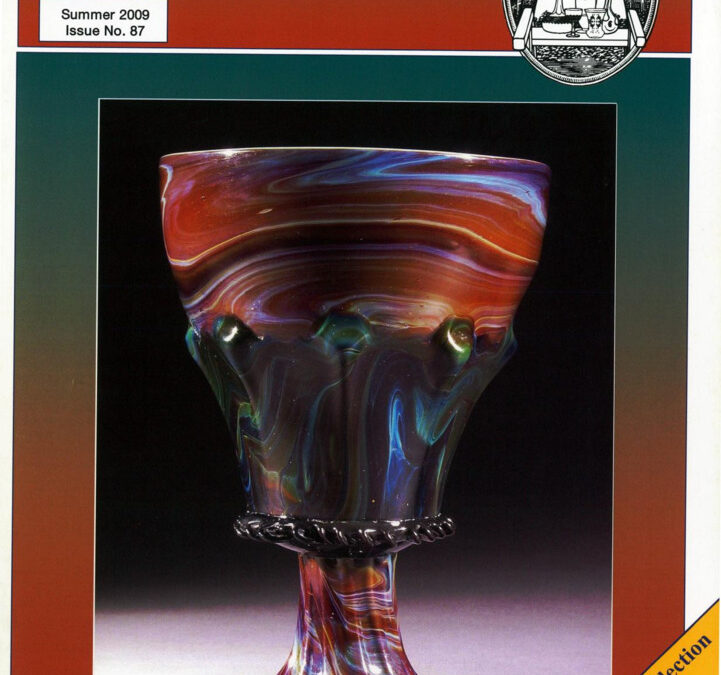
Cover Illustration:
Calcedonio goblet, Venice,
c.1500 (Wallace Collection: XXVB92,
h:18cm; diam:12.1cm)
(see the article pages 9
–
14)
GLASS ASSOCIATION EVENTS
Saturday 13 June 2009, 12:00
Greenway—Agatha Christie’s House (Nat. Trust)
Galpton, Nr. Brixham, Devon
For full details, including costs & travel arrangements, contact
Valerie Humphries –
7874 221217
valeriehumphries ,btinternet.corn
Thursday 2 July & Wednesday 29 July, 6:15-8:45 pm
Garton Collection
(400 mainly C.18 glasses
—
see
Cone 86)
Mortimer Wheeler House, Eagle Wharf Road, N1 7ED
Cost £6. For full details, including access map, contact
Janet Sergison—
01732 851663
/anetsergivongonetelcorn
Saturday 18 July, 12:30
Blackwell, The Arts & Crafts House
Bowness
–
on
–
Windermere, Cumbria
“Whitefriars: Arts & Crafts Glass-makers” –
special
exhibition featuring glass made by James Powell & Sons of
Whitefriars c.1850-1920. See www.blackwell.org.uk
Cost, including tour & lunch £14 For full details, including
access map, contact Pauline Wimpory-01 2 1 3544100
crystal-edgeghotmailco.uk
Thursday 10—Tuesday 15 September
***NORTHERN IRELAND & IRELAND***
•
Ulster Museum (
C17
&
C18 & contemporary
including Brychtova & Hlava)
•
Karl Harron Studio; Jerpoint Glass Studio
•
Guinness Store House
I •
National Museum of Ireland
I •
Glass Society of Ireland
evening
Waterford Crystal
(new
ownership)
•
National Gallery of Ireland
•
National College of Art & Design
•
Trinity College Dublin
•
Private collections—andmore
Cost £580 pp plus flights (£160 singles supplement). Forfull
details contact Gaby Marcon— 077 1 1 262649
gabymarconabtinternet corn
Saturday 14 October
***ANNUAL GENERAL MEETING***
The Bonded Warehouse, Stourbridge &
Broadfield House, Kingswinford, Dudley
•
Talks on 20
th
Century Glass,
including
Charles Hajdamach
“British
J(
Century Designers
—a Success Story”
(the subject
ofhis new book)
•
Exhibition of 20
th
Century Glass
at
Broadfield House
Glass
Museum—Charles Hajdamach & museum
curator Roger Dodsworth in attendance
Cost £20 including lunch.
Forfull details contact Gaby Marcon-077 1 1 262649
gabymarconabtinternetcorn
After AGMs at the NOC in Sunderland, Manchester, and the
Wallace Collection in London, we return to Stourbridge for a
full and interesting day-
**
Make a Note in your Diary now **
2
The Glass Cone—Issue No: 87 Summer 2009
GLASSMAICER’S CORNER KATHARINE COLEMAN M. B. E.
Katharine thought it was a letter from the taxman, and
didn’t even open it for two days. When she did, it was a bolt from
the blue—but a very nice one!
She is honoured by the award of the MBE for services to
glass engraving. Like so many things, it all started by accident. She
was in London with her two children, then aged 4 and 7, and they
happened to walk past the Cork Street Gallery where the Guild of
Glass Engravers was having an exhibition. It was for her a true
coup
de fouelre—she
just had to pop inside “for five minutes”. Half an
hour later with wonderful work by Peter Dreiser, Michael Fairburn,
Alison Kinnaird and others spinning around in her head, and a
Guild Newsletter in her hand, she had her sights set on Morley
College, the one place they had told her she could “learn how to do
this”. She rang the college to be told that all but one of the places
on the next course had been taken by students continuing from the
present course, but nothing was going to stop Katharine. Armed
with a sleeping bag, she arrived at the college the night before
enrolment, and was the first through the door. She has never looked
back.
The courses were 2’A hours each Monday morning,
afternoon and evening (though with a young family, she could not
make the evening sessions). They moved through stipple and drill
engraving, and then to wheel engraving on some old resurrected
lathes, and she was in heaven –it was the first thing she had ever
found that spoke to her. She cannot speak more highly of Peter
Dreiser as a teacher. He worked with his students at their individual
speeds, and Katharine found that the more you wanted to know, the
more help and encouragement he gave. He taught her that the key
to success lay in understanding the process of engraving (or indeed
any craft), and applying that understanding with lots and lots of
practice. The process is not just the physical act of engraving, but
preparation and design, visualisation “in reverse” for intaglio, and
so on..
After three years Peter suggested she “go away and do her
own thing” for a while, though he would always be there if she
needed him. She already had her own drill, but now she needed a
lathe, and at £3,000 it cost more than a car at the time (1986), and
she is grateful to her husband, David, for indulging her and having
faith in her. When it arrived, every one of the 40 spindles was out
of true, and it was a full week before she had her first wheel in use.
At first she did very conventional engraving using
commercial lead crystal glass—heraldic engraving
(F/g. 1),
small
commissions, bowls for weddings. She was working part-time as a
Fig.
1: 4n early piece; Hermann
Schwinger beaker, 10cm high soda glass
tumbler, engraved 1986
secretary, so for the next 10 years it was a hobby, until the children
went off to university. The Guild of Glass Engravers was a vital
step ladder and support to her.
The first real breakthrough came when she started using
colour, thanks to Neil Wilkin bringing some coloured discs to a
Guild of Glass Engravers AGM. Then came thick-walled glass.
She had a commission from a livery company, who wanted a large
piece that could be seen from the back of the room. Neil blew it for
her, and when she went to collect it, it was clear to her that there
was some ash embedded in the glass (one of Neil’s assistants was a
smoker), and she refused to take it. Neil was adamant that it was
just on the surface, and that Katharine would be able to polish it off
in seconds. Katharine would have none of it, but eventually it was
agreed that Katharine would take it and polish it, and if Neil was
wrong he would then make her
another bowl. So Katharine took
it home, polished it, and humbly
had to admit that Neil had been
right. However it was also a
Eureka moment—Katharine saw
the wonders of optics and the
magic of refraction.
She started with egg
shapes, working with the size
and shape of the bubble. One
day Neil was in the middle of
blowing her a piece when the
phone rang. He answered the
call while keeping the bubble
moving on the end of the rod. It
was a long conversation, and
when he’d finished, the bubble
had become a tube … which
became ‘Barley’, one of the
pieces that took her to the final
for the Jerwood Applied Arts
Prize in 2003
(Fig.
4
The optical effects are
enhanced when the top of the
piece is cut at an angle. Waste
not, want not, the cut-off top
F4
,
. 3:
Oranges and Lemons
& companion piece
loweyoufrefarthings)
The Glass Cone—Issue No: 87 Summer 2009
makes an ideal paperweight, and ‘City of Glass’ (2006—illustrated
in Cone 78, p. 7) is an outstanding ensemble of five pieces.
Katharine, and cold-worker Stephen Frey, thoroughly enjoyed
experimenting with solid tubes cut up like French bread to find the
ideal angles—`Oranges and Lemons’ is a superb example
(Fig. 3).
This, and the blown hemispherical ‘Edo Orange’ pieces (one of
which is in the V & A) beautifully illustrate Katharine’s mastery of
the process to produce astonishingly lifelike slices of fruit, full of
juice.
`City of Glass’ and ‘City Blocks’ which won the Glass
Sellers Prize for Engraving in 2007 (see Cone 81 & Cone 86) were
inspired by the views from Katharine’s 26
th
floor apartment in
London’s Barbican. In 2004 the Crafts Council funded a research
visit to Japan. Katharine had already engraved koi fish. Now the
tea ceremony became a source of inspiration, as Katharine
explained in a presentation at the Guild of Glass Engravers
conference in October 2008:
“The first tea installation Iprepared
(Fig. 4) I called The Crown Prince and Princess Take Tea: The
bowl on the right, which is hollow, is the Crown Prince’s bowl. The
tea whisk cha-sen, is cut from a single strip of bamboo. On the left
is the Crown Princess’s bowl, which is semi solid; refracted in the
middle is a miniature bowl, a little clone of herself – her small
Fig. S: Yellow Coral Words
Opaque canal)
,
yellow overlaid clear lead crystal bowl, 180mm
dia. Blown by Potter Morgan Glass; cut, polished & wheel
en
g
rave d zooz
The title is plural because of the illusion of
another bowl suspended within.
4
daughter. Her life has been made truly miserable as she has only
had one child and that a female; that this may not be her fault is not
questioned. She lives as a prisoner in the palace, not even allowed
her own telephone or money. She was a commoner, brought up and
educated for diplomatic life, a Harvard graduate. She sits there.
with her little clone, appearing to take tea, but she cannot drink out
of such a bowl She cannot participate in society, ergo she cannot
drink tea. Tea Ls Japanese society ”
During a visit to Australia in 2006, to see members of her
family, she was inspired by the beautiful tropical sea-life in an
aquarium
(Fig _5).
A moving story of a shipwreck led her to
attempt to reproduce in glass the effect of silk floating in water,
engraving on tiles with bent stringers—or canes—of glass slumped
into a bowl shape, and she found working with an eggshell-light
bowl satisfyingly different from her other work
(Fig 6).
Katharine’s engraving has brought her many awards in
this country and abroad. She does not know where her talent comes
from, but recently discovered, to her surprise and delight, that her
great-great-grandfather was an engraver in Edinburgh, (as was his
father) in Edinburgh, a friend and contemporary of Thomas Bewick
in the late 18th century. However she believes that her engraving
as such played only a secondary part in the award of the MBE. She
was Secretary of the Guild of Glass Engravers for four years,
Chairman for three years, and Exhibition Organiser for 10 years,
including the 2000 and 2002 shows in Cork Street. Throughout that
period she has been trying to raise the profile of glass engraving in
contemporary
glass, and to interest new and young people in glass
F4:: 6: Whalebones
Originally to be called the Loss of the SS Dunbar – meant to
reflect the whalebone corsets of the young ladies lost with the
SS Dunbar, 1859
The Glass Cone—Issue No: 87 Summer 2009
`
41
ONNEr
–
an•
n
=
n
_
engraving. She has taught for many years. In the eighties and
nineties it was difficult to interest galleries in contemporary
engraved glass, but the breakthrough came in 2000 when the Crafts
Council became interested, thanks to the
‘ Clearly Inspired
exhibition by the Guild at the Cork Street gallery. She has
championed the cause abroad, sometimes outspokenly and
controversially. She feels there is still work to be done: in Britain
craft skills are losing out to the political ambition to produce more
and more academically trained graduates, and the traditional centres
in Germany and the Czech Republic seem to be following down the
same path.
Nonetheless, within the contemporary glass world
engraving is rising in prominence: specific awards for engraving
have been introduced, and engraved glass has taken high awards in
general international competitions. Katharine delights in the way
that contemporary engraving is moving away from traditional
engraving: too seldom does the traditional really connect with the
glass—inscriptions, images or armorials can show outstanding
engraving skill, yet fail to exploit the unique qualities of glass and
could be equally effective in silver or ceramic.
Engraving today is strong in Russia where they are taking
laser cutting to new heights, and in the Baltic states. The Germans
and Czechs do not value point engraving, while in Japan there is
only stipple and line, with exquisite work using diamond point
rather than tungsten. From Australia, Katharine is particularly
impressed by the work of Kevin Gordon (who was represented by
the Glass Artist Gallery at Collect in May), son of glass artists and
engravers Alasdair and Rish Gordon.
Fig. 7: Waiting Crabs
This weighs over 6kg and was blown by Carl Nordbruch and
engraved last year, winning the 2008 Pearsons Prize for Best Use
of Engraving on Glass – there is so much movement in the clear
crystal, you can imagine that the crabs were whirling so fast,
theyd stirred it all up themselves./ Grey on clear lead aystal,15cm
diam. x 17.5cm, cut and polished with helP fiom Steve Frey, and
wheel and drill engraved.
Throughout May Katharine was teaching in Spain, at the
wonderful glass school near Segovia, and is currently working hard
for an exhibition in Paris, at the Helene Porde Gallery, and will be
featured in Carolyn Gender’s forthcoming companion book to
‘ Sources of Inspiration’ , Patten:, Colour & Form’
(A&C Black,
May 2009). 2010 will be “a year to look round and gather breath”.
Before that she is very much looking forward to the
presentation at Buckingham Palace on 24 June. Congratulations
Katharine!
Bob Wilcock
This article is based on a discussion with Katharine, and
her presentation ‘Pursuing Ideas, Recent Themes” published in
The Guild of Glass Engravers Winter Special Newsletter 2008/09
The illustrations have been provided by Katharine. Her website
zs
WHIN.
katharthecoleman.co.a
CONGRATULATIONS!
As well as to Katharine for her MBE, congratulations are
due to:
•
Peter Layton—on being granted the
Freedom of the
City of London and made an
Honorary Liveryman of
the Worshipful
Company of Glass Sellers.
Peter’s London Glassblowing studio and workshop is at
7
The Leather Market, Weston St., London, SE1 3ER, and
is open Mondays to Fridays 10am-5pm.
0207 1032800 wwwiondonglassblowing.co.uk
•
Roger
Dodsworth—keeper of glass at Broadfield House
Glass Museum, who won the ‘outstanding individual’
category in the ‘Best of the West’ regional awards granted
by Renaissance West Midlands. He was chosen for the
award for his dedication to preserving and promoting the
area’s glass heritage.
•
Kari Moodie—also
of Broadfield House, who secured the
award for ‘the best exhibition on a small budget’ for
‘The
Danger of the Image: Glass Dresses by Diana Dias-
For details of the latest exhibitions at Broadfield House
please seep. 6
Diana’s glass dresses are revealed in Glassmakr’s
Corner in Cone 85
BROADFIELD HOUSE
Details of the feasibility study into the possibility of
moving the glass museum to the Red House Cone, mentioned in the
last issue of the Cone, have still not been published, nor are there
yet details of the public consultation exercise in relation to the
development of the historic Glass Quarter.
The petition has been presented to Dudley Council, and a
meeting of interested parties, convened by the Glass Association,
was held in mid-April. Further meetings are planned.
Any major developments will be reported on a flyer with
this Cone. Otherwise you can keep up-to-date by visiting the
Friends web-site www.friendsofbroadfieldhouse.co.uk and Dudley
Council’s web-site at www.dudley.gov.uldleisure-and-culture/
museums–galleries/glass-museum and of course the GA web-site
www. glassassociation. org. ulc/News/broadfield.html#updates
And ifyou have a chance, do visit the museum—there are
excellent permanent displays, as well as the temporary exhibitions,
and glass-blowing by /Illister Malcolm.
5
The Glass Cone—Issue No: 87 Summer 2009
The Glass Cone—Issue No: 87 Summer 2009
6
Frank Hudson passed
away on the 22 January 2009
following a courageous battle
against oesophagus cancer. He
was born in Great Harwood,
Lancashire in 1941 and left school
at fifteen, becoming a miner. He
was also a weaver before joining
the army where he served for five
years, then buying himself out to
marry Pearl in 1965. Frank spent
most of his working life with
British Telecom, and then taking
early retirement he started a new
phase of life looking after their
three daughters, before stepping
outside the rat race became widely
popular.
Frank’s interest in glass
was apparent many years ago, on
his honeymoon he spent almost all
of their holiday money on a single
glass goblet starting his collection. Frank could always turn his
hand to anything, and spent many years building, decorating and
gardening. However, it was only after the girls left home that he let
his artistic leanings take over. Starting with a ceramic pottery day
class, and not surprising to those who knew him, he ended up
helping to teach it two years later.
Wanting to challenge himself further, he studied an Arts
Foundation course at Trowbridge College gaining a variety of
experience in different media. Following this, he became a full
time student at Plymouth College of Art & Design; doing a degree
in Ceramics, Hot Glass and Metals. Like everything Frank did he
threw himself totally into the
student life, and was soon enjoying
the night life of Plymouth and was
well recognised in the student
community as one of the oldest
swingers in town! Taking Pearl
with him, he then spent time
studying Glass Techniques and
Technology at the International
Glass College at Brierley Hill.
Frank’s artistic work has a
tremendous variety and range, as
he always wanted to try new
things out to see what would
happen, and of course, invariably
the outcome was a successful one.
His work ranges from modernist
paintings through all manner of
ceramic plates, dishes, bottles, jugs
and abstract pieces. His preferred
medium of glass amply
demonstrates his versatility and
imagination with his glass chairs, the infamous ‘bum’ vases, Inca
glass masks, mushrooms and paperweights.
Frank and Pearl were active members of the Glass
Association, having joined in 1998 they went on the Association
international trips to Sweden, Czech Republic, USA and Venice,
and Pearl is intending to be part of this year’s trip to Dublin. Pearl,
Samantha, Rebecca and Lorraine are hoping to arrange exhibitions
of Frank’s work in Frome and Bristol, and would welcome all
members of the Glass Association.
Broadfield House—CURRENT EXHIBITIONS—National Glass Centre
Petrol Heady
is a fascinating display of 17 illuminated
glass petrol globes from the 1940s, 50s and 60s; all are from a
private collection. Other highlights of the exhibition are a 1961
Isetta bubble car and motoring memorabilia on loan from Coventry
Transport Museum and the Black Country Living Museum.
Hi Sklo–Lo
From Masterpiece to Mass Produced
If you missed this exhibition of Czech Glass from 1950 onwards
when it was in Kings Lynn, don’t miss it now (see
Cones 83 & 840!
M Sklo
—
.Lo SA*
runs until
11 October,
and
Paw
Heads
until
1 November
at Broadfield House Glass Museum,
Compton Drive, Kingswinford. The Museum is open from Tuesday
to Sunday, 12noon to 4pm, and admission is free. For further
information call 01384 812745 or visit www.glassmuseum.org.uk.
S)tace
–
lime
sees a kaleidoscope of works from various
artists coming together to reflect on the importance of astronomical
observations. The exhibition provides an insight into the role time
plays in our everyday lives, memory and future, drawing inspiration
from the Venerable Bede and his 8
th
Century treatise,
On the
Reckoning of Time.
Featured artists are Heike Brachlow, William
S. Burroughs,
Vaclav Cigler, Keith Cummings,
Bill Drummond,
Tehching Hsieh,
Dominick Labino,
Liliane Lijn, Steven Pippin,
Ginny Reed,
Kilts Smith.
The exhibition runs until
6 September
at the National
Glass Centre, Liberty Way, Sunderland, SR6 OGL. The Museum is
open every day, 10am to 5pm, and admission is free.
For more information call 0191 515 5555 or visit
www.nationalglasscentre.com
PAPERWEIGHT CORNER
COMMEMORATIVE PAPERWEIGHTS PART
4
The weights in this final part of the article commemorate a
very diverse selection of events that are generally of no major
significance to the general populace, but the next weight marks an
event that affected us all in the UK and other countries that were
watching events with great interest. I am referring to 1982 and the
invasion of the Falkland Islands by Argentine
forces. Mrs Thatcher’s response was to assemble and despatch a
task force involving both naval fighting ships and back up support
vessels, and amongst the ships requisitioned for duty as a hospital
ship was the P & 0 cruise ship Canberra. Following the successful
return of the islands to UK control and the ship’s safe return from
the Southern hemisphere with eventual resumption of normal
duties, the company commissioned some faceted plain glass
weights on the base of which is an etched map of the Falklands and
the words “Falklands Task Force P & 0 SN CO 1982”. From the
shape of the
weight my guess
would be that
they came from
the Webb
Corbett factory
and
were
presumably
given to chosen
customers.
In 1982 the
Pope at that
time, John Paul
II, made the first
ever visit by a
Pope to the UK,
and the event
was
commemorated
by Wedgewood
Glass and
Thomas Webb
& Sons. The
Wedgewood
weight, which
was limited to
1000, comprised
a blue and white
Jasperware
plaque featuring
their usual
cameo style bust of the Pontiff, and underneath a banner similar
to
that used in coats of arms on which are written the Latin words
‘Joannes Pavlvs
II’,
the plaque then being set in the top on a flat
clear-glass weight. The Thomas Webb weight was a plain flat
weight with a bishop’s mitre and the words Visit of the Pope to
Great Britain 1982′ acid-etched onto the underside.
1983 brought the 200
th
anniversary of the founding of the
non-alcoholic drinks company Schweppes, probably best known for
its tonic water advertisements back in the 1970s. The company
decided to commemorate the event with a flat glass weight of
similar shape to the souvenir and advertising weights from the late
19
th
and early 20
th
Century, and acid etched on the underside is a
large ‘200’ with the name Schweppes across the centre.
After the Falklands War the Canberra resumed its normal
cruises. From 7
th
January to 8
th
April 1986 it went on a world cruise,
and a weight was made by Caithness Glass for Edinburgh Crystal to
mark the event. It comprises two concentric rings of millefiori canes
set floating in the lower part of the weight, with an acid etched
picture of the ships and details of the cruise dates visible through the
centre of the rings I think that they were a free gift to first class
passengers rather than just being for sale on board, but maybe
someone out there was lucky enough to go on the trip and can
confirm that information.
October 1986 brought the centenary of the gift of the
Statue of Liberty by France to the City of New York as a mark of
the longstanding friendship between the nations, initially built up
about 100 years earlier during the American War of
Independence. The design by Frederic Auguste Bartholdi is of a
Roman goddess with the pedestal on which it stands being of
similar height to the statue. The seven spikes on the crown represent
the seven seas of the world as well as the seven continents, and the
25 windows in the crown represent the natural minerals of the
earth. The chains below her feet that are not visible from ground
level symbolise the broken shackles of slavery, and for those who
like trivia, her sandals are the equivalent of size 879! The engineer
given the task of designing the internal framework that ensures that
the statue, weighing some 225 tons, remains stable and upright was
none other than Gustav Eiffel, later to become much more famous
for his design for the Eiffel Tower in Paris. The idea of a huge
statue came from the Colossus at Rhodes and when Bartholdi saw
Bedloe’s Island in New York Harbour he knew he has found the
perfect site for
his statue.
I
would have
thought that
numerous
American
glassmaking
companies
would have
taken
the
opportunity to
produce weights
commemorating
the event, but to
date the only
examples I have
7
The Glass Cone—Issue No: 87 Summer 2009
seen are one from Murano using a transfer picture of the statue and
name set above a royal blue ground, and a faceted weight featuring
a gold foil inclusion of the head of the statue and five gold stars
surrounded by a ring of millefiori canes from the St. Louis factory.
It was a fairly rare occurrence for the Perthshire factory to
issue commemorative weights, but in 1988 they issued a weight to
mark the 400
th
anniversary of the defeat of the Spanish Armada by
the British naval forces under the command of Sir Francis Drake,
and then a year later weights to mark the bicentenary of the French
revolution and the storming of the Bastille on
15
th
July 1789. The
former weight contained a complex central cane featuring a ship
under full sail surrounded by four outer rings of millefiori canes,
and for the French revolution anniversary they produced three
slightly different weights. Two featured patterned millefiori/ribbon
canes, and one had spaced complex canes on a scrambled latticino
ground inside an outer ring of canes.
All three contained a
complex cane with crossed French flags in the centre ,and a
separate complex 1789-1989 date-cane, but according to the records
very few of these weights were made, presumably because of a lack
of demand from the UK and America, their two principle
markets. One could have reasonably expected the French factories
to have made the most of
the event by producing
commemorative items,
but the only weight that
I
have seen to date is the
red, white and blue spiral
ribbon weight illustrated
which is from the St.
Louis factory. On the top of the weight
is a complete cane with the SL signature
and the dates 1789-1989.
My next weight remains
somewhat of a mystery, it was made in
Murano, limited to an issue of 300, and
features outer rings of complex millefiori
canes around a blue central area on
which are the words ‘Liberty 1998’. 1
have checked the interne and 1998 does
not appear to be a year related to any particular event in the history
of the Liberty Company so may be they just tried selling a weight
dated for that particular year and it has no significance at all but
maybe a reader knows the answer. They obviously did not sell very
well, as we found a whole load of them at an antiques fair at Penrith
in 1998.
That year also saw
the hosting of the World Cup
of Football by France, and no
doubt other French glass
factories produced items to
commemorate the event but
the only one that we have
found to date is the one
produced by Crystal De
France in the shape of a
rooster, the mascot for the
whole event, standing on top
of half a football so that the
weight will rock from side to
side when touched.
The last event in my list for commemorative weights is
the Millennium in 2000. Needless to say Caithness Glass went to
town for this event, with a whole host of weights and other items
from the simple to the complex. We could not find anything that we
really liked at the time, but saw several well after the event had
come and gone, and settled on the one illustrated, featuring a
ladybird crawling slowly towards the numbers 2000 which are
becoming visible in the sand. The only other weight that I have seen
was produced by Tweedsmuir Glass and consisted of a white
transfer of the world with the words
`Millennium 2000′ set on a green-coloured
ground, but I would imagine that there are
weights by other manufacturers out there
somewhere.
I trust that you, the reader, have found the
journey through 150 years of
commemorative paperweight-making to be
of interest. Looking back over that time
makes one realise just how much has
happened over the passing years, but even
more so how many other events have come
and gone that remain unrecorded. No doubt
other commemorative weights will come to
light as time passes, and if they do I will keep
you informed.
Richard M Giles
11111111
n
1111.
The Glass Cone
—
Issue No: 87 Summer 2009
8
SIR RICHARD WALLACE’S COLLECTION OF GLASS
F4
,
I
The Modern Gallery, c1890
F4
,
– 2
The Sieteenth Century
Gallery, 2009
9
son of the 4
th
Marquess, was brought up
in Paris by his father and paternal
grandmother and he later acted as his
father’s secretary. After receiving an
inheritance following the death of his
father in 1870, Wallace had both the
means and the opportunity to acquire
collections available as a result of the
collapse of the Second Empire in France.
In Paris in 1871 he bought part of the
collection of European arms and armour
formed by Sir Samuel Rush Meyrick
(1783-1848) and in the same year
acquired the entire collection of European
arms, armour, medieval and renaissance
works of art of the Comte de
Nieuwerkerke (1811-1892),
Sur/ntendent
des Beaux-Arts
under Napoleon III, for
the asking price of 600,000 francs.
Wallace also bought the collection of
another Louvre official, the Vicomte
Both de Tauzia (1823-80) in 1872, in total
adding over 700 new works of art to the collection.
When Wallace moved over to London in 1872 he had to
refurbish and extend Hertford House considerably in order to
accommodate his expanding collection. Hertford House had
previously been used by the 4
th
Marquess as a store for his artworks:
between 1872 and 1875 Wallace effectively doubled the display
space and the additions included dedicated galleries for paintings,
and arms and armour. According to the 1890 inventory of Hertford
House, Wallace’s glass collection was mainly displayed in the
Modern Gallery surrounded by 19
th
Century pictures. As can be
seen in a photograph of c.1890
(Fig I),
a painting by Bonington,
Venice: the Piazza San Marco [museum number P375], displayed
above the staircase, perfectly complimented the Venetian glass in
the case nearby. Today the glass is displayed in Wallace’s former
Sixteenth Century Room, on the ground floor, surrounded by
renaissance sculptures, wax medallions, Limoges enamels and other
objets d’art.
This room was recently refurbished and the
Wunderkammer,
or cabinet of curiosities, experience of Wallace’s
time has remained a focus of the displays
(Fig.
The Glass Cone—Issue No: 87 Summer 2009
The glass in the Wallace
Collection today is mostly Venetian and
lacon de Venire
(Venetian style) of the
16
th
and 17
th
Centuries, with some
German, French and a middle-eastern
example.
This small but beautiful
collection of glass is a testament to Sir
Richard Wallace’s passion for medieval
and renaissance works of art, a growing
interest amongst mid- to late-19
th
Century
collectors.
Sir Richard Wallace (1818-
1890) dramatically extended the range of
the art collection formed by successive
Marquesses of Hertford and previously
dominated by his father, the
4
th
Marquess, whose taste was for old
master paintings and 18
th
Century French
works of art. Wallace, the illegitimate
Fug. 3
Agtefrom Les affections caihres d’oeuvres
d’ar4 F.douartiLkplg1866
Fig. 3a
Flut4 Venice orfacon de Vent* late
le Century – early17′ Century
(111B177, h:28cm; diam:9.3cm)
Ft. 34
Catalan rose-water sprinkler, S),ak4 probably
Barcelona% late le Century – ear. 5 717
*
Century (AXVB74 h:15. 7cm; diam:182cm)
Of all the 53 glass vessels now on display in the
16
th
Century Gallery, 46 are known to have been acquired by
Wallace and 4 other pieces are likely to have been bought by him.
Only one of the remaining pieces, a Bohemian enamelled and
gilded jug of 1600, can be linked to earlier generations of the
Hertford family. Half the glass now in the Wallace Collection had
probably belonged to the Comte de Nieuwerkerke. His splendid
collection was described in the 1867 Paris Guide as containing
Venetian glasses which compete with the marvellous collections of
de Rothschild
and in the Gazette des Beaux-Arts, 1868, Emile
Galichon stated that
‘you can find glasses of Murano, remarkable
for their elegance of form’.
An image published in Edouard
Lievre’s,
Les Collections Celebres d’Oeuvres dMrt,
of 1866
(Fig-. 3)
clearly depicts four pieces then in Nieuwerkerke’s
collection, including a
facon de Venise
and a Spanish glass
(Figs. 3a & b)
both now in the Wallace Collection. The central
glass ewer is similar but not an exact match to an example in the
Collection. Since Wallace bought Nieuwerkerke’s entire collection
in 1871 it is possible the piece depicted here was sold or damaged
prior to the sale, or that the same may have occurred under
Wallace’s ownership before the Collection was bequeathed to the
nation in 1897.
often also incorrectly described facon de Venise glass). The glass
was considered by Nieuwerkerke as just one part of his diverse
collection encompassing medieval and renaissance works of art, an
approach he had in common with the artist and collector Thomas
Gambier Parry (1816-1888), rather than with a specialist glass
collector such as Felix Slade (1788-1868). In the Wallace
Collection, 45 pieces of glass are either Venetian or facon
de
Venise,
which is indicative of the popularity of collecting Venetian
glass by the second half of the 1860s. It was not until the inclusion
of such glass in sales and exhibitions from the mid-1850s that the
public really became aware of the creative and technical virtuosity
of Venetian glassmakers from the 16
th
to 18′
h
Centuries. In the mid-
19
th
Century, the Venetian glass industry, which had been almost
non-existent for half a century, was revived through the
establishment, by the Abbot Vincenzo Zanetti (1824-1883), of a
glass museum and School of Design for glassmakers on Murano in
1861-2. In France and Britain, the publication of articles on
Venetian glass in the Gazette des Beaux-Arts and Le Cabinet de
l’Amateur and the inclusion of Venetian glass in the Special Loan
Exhibition at the South Kensington Museum of 1862 also increased
the interest in this type of glass. This in turn led to the popularity of
contemporary Venetian glass exhibited in shows such as the
Exposition Universelle in Paris in 1867. Wallace appears to have
had an earlier interest in collecting Venetian glass. In the catalogue
at an enforced sale of his personal art collection, which took place in
1857 (necessitated by unsuccessful financial speculation), 15 lots
appear under the heading
Vores de Venire’.
Research into inventories and receipts, often annotated
with drawings and notes, has shown that Nieuwerkerke bought
more than 30 pieces of glass between 1865 and 1868. (Many of
these pieces are described as Venetian, a term which historically has
The Glass Cone
—
Issue No: 87 Summer 2009
10
One the finest and earliest pieces in the Collection is a
Venetian calcedonio goblet, c.1500, which can be seen on the cover
of this edition of The Glass Cone. It has mould-blown, applied and
tooled decoration and the bowl is of ogee profile with ribbed lower
section, with marbling in aubergine, brown, blue and green.
Calcedonio was made in imitation of banded agate, a variety of the
microcrystalline quartz chalcedony. The technique was developed
by the Venetians in the second half of the 15
th
Century. Calcedonio
was a labour-intensive, luxury product Various metal oxides were
added to a soda-lime-silica glass base and then ingredients that
hindered the mixing of the glass were added to obtain the swirling,
marbled effects and the glass was deliberately poorly mixed. This
goblet acquires an extra luminosity when lit from above due to the
bowl interior being a contrasting yellowish-green.
A fabulous acquisition by Wallace is a grey tinted trick
glass, of the last quarter of the 16
th
Century
(F4
,-
.
4). The soda-lime-
silica glass used by the Venetian glassmakers could be blown so
thin as to be almost weightless, and manipulated into fanciful
designs such as this. The mould-blown stem and lion couchant
were gilded and the hollow lion has a small hole beneath its
forequarters which would once have allowed the wrythen tail (now
broken, unfortunately) to serve as a sucking tube. Such pieces
Fig. S: Gable4 Franc mid-16th century
(XXYB96,
h:22.4cm; &am:14cm
11
Fig.
Trick glass,
1 enic4 1575-99
h:17.3cm;
&am:166cm)
would have brought puzzlement and delight to the
owner’s guests and candlelight reflections on the
glass and liquid contents would have accentuated
the effect The glass is comparable to a group of
ewers, some Spanish, in the form of crouching
lions. These are generally filled through an aperture
in the head and utilise the tail as a spout Giovannis
Maggi’s
Bichiograjica
of 1604 depicts a ewer in
the shape of a lion, and there are similar glasses in
the Museum Kulturen, Lund, Sweden, and at
Waddesdon Manor, Buckinghamshire.
A clear glass chalice-shaped goblet
(Fig.
_5) was
almost certainly made by Italian glassmakers
working in France, probably in close association
with the French court. It is decorated in blue,
yellow, red, green, brown and white enamel. The
foot is painted with an image of the Crucifixion and
snakes and rays radiate from the base of the bowl.
Venice in the 16th century was the most prestigious
centre of production for luxury glass and so wealthy
French patrons would have been keen to attract
these glassmakers to work in France. The quality
of the glass along with the technique and bold style
of the enamelled decoration are comparable to
Venetian glasses. The Crucifixion on the front of
the broad trumpet foot is the centrepiece. The sign
above Christ’s head is inscribed INRI, an
abbreviation of the Latin for ‘Jesus of Nazareth
King of the Jews’. Christ is flanked by a ribbon
scroll bearing the Latin inscription SINE ME
NICHIL (Without me, nothing’), referring to
Christ’s sacrifice for the Redemption of humanity.
The receipted bill for this glass, presented to
Nieuwerkerke by the Parisian dealer Pillet in 1867,
was amongst those passed on to Wallace at the time
of his purchase of the Nieuwerkerke collection, and
is now in the Wallace Collection archives.
INF
The Glass Cone—Issue No: 87 Summer 2009
The largest piece of glass also bought by Wallace from
Nieuwerkerke is a mid-14
th
Century Islamic lamp from Cairo
(Fig: 6).
Although often referred to as ‘mosque lamps’, these
vessels were used more widely to hang from the ceilings of various
religious buildings. They were produced in large quantities in both
Cairo and Damascus during the Mamluk dynasty (1250-1517).
Primarily these types of lamps had a symbolic function, alluding to
Allah’s guiding light. They were often inscribed with the first part of
the Verse of Light from the Koran (24:35), the Islamic sacred book.
Applied here in Mamluk Thuluth script, this
translates as,
is the light of the Heavens
and the Earth. The similitude of this light is as
a niche wherein is a lamp’.
These exotic lamps
were so highly prized by European collectors
in the second half of the 19
th
Century that by
1880 few remained in Cairo. Nieuwerkerke
bought this example in Paris, in 1865. Wallace
considered this lamp as a part of his Oriental
collection and displayed it amongst arms,
armour and other works of art from the Middle
and Far East in one of his purpose built galleries on the first floor of
Hertford House. It can be seen here on a table at the bottom left of a
photograph of the gallery c.1890
(Fig 6a).
F. 6:
Mosque lamp, Cairo, mid
le
Century
F* 7: Wineglass Venice orfacon de Venis4 1630-99
(XXVI19
,
1, h:39.4fcm; diam:2Z8cm)
(XXVB73, h:173em; diam:&2cm)
The Glass Cone—Issue No: 87 Summer 2009
12
Recently Suzanne Higgott, Curator of Glass, Limoges
Enamels and Earthenwares, has been examining the glass collection
with Juanita Navarro, the Wallace Collection’s external conservator
of glass and enamels (Senior Conservator of ceramics, glass and
enamels at the Victoria and Albert Museum). During this survey,
new discoveries have been made about the composite nature of
some of the pieces. A Venetian or
fawn de Venise
wine glass
(Fig. 7)
of the late-17
th
Century has been assembled from two
unrelated pieces. The aubergine bowl and the top, green knop are
from one glass, the rest of the stem, comprising six hollow blue
knops, and the foot, from a second glass. It was after removing an
old and weakened repair that ground edges at the join could be seen
rather than the glass breaks that are
typical of damage. The green
colour inside the top knop was
probably painted to match the blue
glass below it, but the colour has
degraded with time. Another piece,
a miniature ewer, dated to the late-
17
th
to early-18
th
Century, has four
components that have been added
from other vessels, including the
spout and the prunt mask. The detail
image taken during conservation
work
(F 8)
shows the
uncharacteristically straight edge at
the join of the spout to the body and
chipping caused during grinding.
The prunt mask was added in front
of the repair to hide the straight join
line.
F:r Mimidure ewer, Venic4 late
1P Century-1e century (Z1/1181,
hd29cm; diam:Z2cm)
It is unlikely that Wallace would have been aware of these
alterations, at least perhaps not until after the point of purchase.
They might have been sourced and bought on his behalf or acquired
as part of a larger lot at a sale. It is interesting that this ewer was
sold to Nieuwerkerke by the Parisian dealer Alfred Beurdeley, who
may also have sold two other composite pieces to him. Such was
the demand for Venetian and Venetian style glass in the mid- to late
-19th century that dealers were not adverse to ‘improving’
fragmentary objects. We cannot know whether Beurderley
commissioned this work himself or acquired the glasses in this
state, nor whether he was aware that they were composite pieces
when he sold them on.
As Suzanne Higgott’s research, published in the
Glass
Circle Journal, Volume la 2005,
has shown, Wallace also owned a
small collection of contemporary British glass which relates to his
cultural and philanthropic interests. Wallace was a highly regarded
and influential member of the art establishment, serving as a trustee
of the National Gallery and the National Portrait Gallery and having
an extensive knowledge of the European art world, developed
through his many years of living in Paris. He was appointed to the
Royal Commission Committee for the Fine Arts for both the
Vienna Universal Exhibition (1873) and the Paris Universal
Exhibition (1878). It was from these exhibitions that Wallace
acquired 19
th
Century glass, most notably the Copeland Vase, now
in the Victoria and Albert Museum
(Fig.
W.
T. Copeland &
Sons commissioned Paul Oppitz (1827-1894) to engrave the vase
with a design after a grotesque ornamental print depicting the
themes of water and the fertile earth by the French designer Jean
Berain (1640-1711) for their display at the Vienna exhibition.
According to a letter Oppitz wrote to Alfred Copeland, dated
F47. 9: The Copeland Vase, c1872-3.
Vet I Images/ Vidoria & AlbarMuseum.
13
The Glass Cone—Issue No: 87 Summer 2009
F4. 10
Sugar bowl or Campo
English, a 1872 (200Z1
c.1873, the design on the ‘two handled jug’ took him 243 days to
engrave. The glass blank was produced by Thomas Webb and Sons
of Stourbridge, and was unusually heavy to take such fine
engraving, causing great difficulties for Oppitz. He stated that the
vase was ‘the finest and most tedious work what has ever come out
of an engravers hands…’. The piece received much acclaim, and
caught Wallace’s attention. Once displayed in Hertford House, the
vase would have complimented the Boulle marquetry in his
collection, which was inspired in part by Berain.
Amongst the 16
th
and 17
th
Century glass listed in
Wallace’s Modem Gallery in the 1890 inventory of Hertford House
there was
An engraved claret bottle, with double handles’.
This
was almost certainly the Copeland Vase. Also in the case were ‘A
pair of decanters engraved mounted with gilt metal.
Neither the
bottle nor the decanters found their way into the Wallace
Collection. At the time of Lady Wallace’s bequest to the nation in
1897, glasses produced just 20 years previously may well have been
considered as modem, functional pieces rather than as works of art.
Indeed, the Wallace’s secretary and other major beneficiary, John
Murray Scott, who oversaw the fulfilment of the bequest, generally
excluded modem objects. However, Wallace’s inclusion of these
objects in his displays suggests that he did see them as works of art
in their own right. It is perhaps also an indication of Wallace’s
experience of the French custom of not decanting wine or claret that
he regarded these contemporary, functional jugs as objects for
display. Either way, it is possible that Lady Wallace intended these
objects to form part of the Wallace Collection, especially as the
bequest stated that works of art on the ground and first floors of
Hertford House, including those in the Modem Gallery, where these
glasses were displayed, were to be included.
One glass that did not actually belong to Wallace, but is
now at Hertford House, is a pressed glass comport or sugar basin
inscribed ‘Richard Wallace’ c. 1872
(Fig. 10).
During the late-18
th
to 19
th
Century an increased awareness of and interest in public
figures and events led to a market for inexpensive commemorative
items.
This glass is one of a group of
pieces celebrating contemporary
philanthropists that was produced by
Henry Greener’s Wear Flint Glass
Works, Sunderland, between 1869
and c.1872. Other celebrated figures
include Prime Minister Gladstone
and the American-born
philanthropist George Peabody.
This glass may have been produced
to commemorate Wallace’s work to
ease the sufferings of people trapped
during the siege of Paris during the
Franco-Prussian war. It was in
recognition of this work that in 1871
Queen Victoria gave Wallace the
title of baronet. The glass may also
have been made in recognition of
Wallace’s loan of much of his art
collection to the Bethnal Green
Museum between 1872 and 1875
whilst the refurbishments were
carried out at Hertford House. By
its closure in 1875, five million
people from all walks of life had
seen the free exhibition. Although
the Wallace Collection is
unable
to add to the main collection due to
the terms of Lady Wallace’s bequest, this glass was acquired in
2002 for the separate Hertford House Historic Collection.
The Wallace Collection, including the glass collected by
Sir Richard Wallace, continues to enthral audiences today, with
over 350,000 visitors coming through the doors in the last year
alone. They range from parties of school children to social groups,
from the first-time tourist to those who return on a weekly basis for
the various free talks and lectures, and yet the Wallace Collection
never feels too crowded. The visitor is easily able to view the
smaller works of art, such as the collection of glass, which rely on
close examination and appreciation of their delicate and brilliant
craftsmanship. The Collection has also expanded outside the
confines of the building through Wallace Live, the online database
which gives images and information about this glass, along with
other works of art. Suzanne Higgott is also currently writing the
Catalogue of Glass and Limoges Enamels due to be published in
2010.
My thanks go to Suzanne Higgott and Juanita Navarro for
their generous contributions to this article.
Rebecca Wallis
Curatorial Assistant at the Wallace Collection
The Wallace Collection is admission free and is open
from 10am to Spin everyday including public holidays. For more
information visit www.wallacecollection.org or write
to:
Curatorial
The Wallace Collection
Hertford House
Manchester Square
London W1U 3B
All images are reproduced by kind permission of the Trustees
of the Wallace Collection unless otherwise stated
The Glass Cone—Issue No: 87 Summer 2009
14
>S4
THE JAMES HALL COLLECTION OF ENGLISH GLASS
FINE BRITISH & EUROPEAN GLASS & PAPERWEIGHTS
1
Following on from Bonhams June sale of Ron Thomas’s
glorious 18th century glass collection, this whole day in December
set aside for the sale of 17th and 18th Century glass was a further
tribute to the importance and fascination of this period of English
glass and the collecting eye of James Hall, whose collection filled
the morning session and Messrs. Ffoulkes and Hunter whose
collections were sold during the afternoon; the day being completed
with a sale of paperweights. The quality of glass made this a very
special day.
After the very early glass, there was a fascinating array of
mead glasses and short ales, some wrythen and some with propeller
blade knops. The trend was followed of a few lesser examples
being bought in, whilst the best easily made their estimates and
more; Lot 17, a late 17th century flammiform bowl over a propeller
knop made £3500 (£2000-£3000) and Lot 20, with both a wrythen
bowl and a rib moulded conical & folded foot made £1800 (£1600).
Lot23
short neck and a
teared
inverted
baluster stem, with a
wide folded foot, was
estimate, to £10,000
probably the effect of
something rare and
Lot 38, an
almost perfect example of a cylinder knop
glass, with a conical bowl over a centrally-teared stem and folded
conical foot, made £6000 (£500047000),
cf.
Lot 15 from the
Thomas sale, £5500 (£2000-£3000). The wealth of glass on sale is
well demonstrated by Lots 40 and 291 (from the afternoon), another
two cylinder knop glasses, the former with a slightly yellowish tint
and not sitting perfectly made £2250 (U50043000), whilst the
latter, another near perfect example, with a pointed funnel bowl
making £4200 (£2000-0000). A rare drop knop example, Lot 48,
(16.8cm tall) made £4500 (£2500-£3500). A collector’s “must
have” in a collection of baluster stem glasses, is an example with an
acorn knop; Lot 52 admirably filled the slot, going for a surprisingly
uncontested £2800 (£3000-£4000),
cf
the example from the
Thomas sale, almost identical, Lot 16, which was contested to
£8200(£3000-£5000).
The Glass Cone—Issue No: 87 Summer 2009
The later wrythen bowled, propeller
knop ale with folded foot, sold in
the afternoon session, Lot 306, a
fine glass, only made £550 (£600-
800) — perhaps weariness had set in
over such a long day. The addition
of good provenance also adding to
the sale value, the
fawn de Venice
wine, Lot 23 and goblet, Lot 24
made respectively £2800 (£1500-
£2000) & £2400(£1200-£1800).
A superb array of baluster glasses
was the major part of lots 31 to 85.
Lot 31, a large (20.3cm), iconic
early baluster circa 1700, was bid to
£6500
(£2500-£3000),
cf
Lot 13 from the Thomas sale, a similar,
I
though smaller (17cm) example sold at £2600 (£1500-£2000). Lot
36, a mammoth heavy baluster with a round funnel bowl over a
15
Lot 31
again bid up way over
(£4000-£5000); this,
several bidders desiring
desirable for their
collections.
Lot 129, a rare Beilby polychrome
enamelled firing glass, (waisted bucket
bowl style), a mere 8.1cm tall reached
£9500 (£8000-£l 2000), this stylish glass
is one of seven known examples (see
catalogue notes), others are in the
Museum of Freemasonry in London, in the Julius Kaplan collection
and one was sold from the Hamilton Clements collection. A larger
beaker, of similar style, 12.8cm tall, Lot 130, in Sotheby’s sale of
December 2003 was bid to £20,000! A fabulous Beilby goblet, Lot
130 (of this sale!), with bucket bowl on a double series opaque
twist stem, 19cm high, picturing a peacock in white on a rococo
scroll in turquoise, a peahen on the reverse, was bid up to £17000
(£12000418000); a similar example is in the Manchester City Art
Gallery.
Most of this remaining section
found willing buyers; two large coin goblets, lots 79 & 80,
produced an anomaly, both estimated at (£2000-£3000), Lot 79
sold at £1800, Lot 80 selling at £8000 — perhaps only the buyers
know why. Lot 87 was a rare example of an ale flute, with a
hollow stem (three part glass). The writer has seen examples of
this stem before on wines and once on a cordial; being dated to
just after the introduction of the swingeing glass excise duty in
1745, the discussion still goes on as to whether this style of stem
was a glass saving measure, or just an attempt at a new
fashionable stem — from the number of examples in evidence,
the style did not particularly catch on.
The four Jacobite glasses on offer, Lots 95 to 98, all with
provenance, sold well: I found Lot 98 particularly pleasing, a drawn
trumpet cordial example on a mercurial twist stem, engraved with
one rose and a bud (Seddon, engraverl).
A group of air twists, incised twists and opaque twists
followed, taking us to Lot 163. Some lots were grouped in pairs or
threes, but most were aimed at the collector — being sold singly; I
consider this a welcome and necessary policy if the auction houses
are to encourage collectors.
The Glass Cone
—
Issue No: 87 Summer 2009
16
Remaining glasses to note were
Lot 288, a rare opaque-twist Captain’s
glass, with a very tall double series opaque
twist stem of 25cm. This made £6500
(£300045000). Lot 289, The Sutherland
wine glass, with an enamelled cat sat on a
wreath and the inscription ‘Sans Peur’,
probably from the Beilby workshop, had
a
provenance from the Julius Kaplan
collection and sold for £11000 (£6000-
£8000).
NB. All prices were the hammer
prices, the figures in brackets were the
estimate prices.
Brian Clarke.
Link:
www.bonhams.com
Other than the glasses already
mentioned above, the afternoon contained
a complete spectrum of glasses for I
collectors to fill in gaps in their collections
and also some outstanding examples.
There were three gilt
glasses in the morning session, Lots
143-145, probably decorated in the
workshop of James Giles, a small
wine, a round funnel ale and a
goblet, on opaque twist stems; they
all sold around the lower estimates — the gilding being somewhat
worn. In comparison, one similar glass in the afternoon, Lot 328
with a small round funnel bowl, sold at almost double its lower
estimate, £950 (500-700), — the gilding being in fine shape.
The morning also had a fine privateer wine glass, Lot 146,
15.5cm, inscribed “Succefs to the ENTERPPIZE”, bucket bowl on
a single series opaque twist stem and
conical foot With good provenance,
this made £9500 (£6000-£8000). A
similar glass, but engraved “Succefs
to the DEFIANCE Privateer” was
sold by Bonhams from the Harveys’
Wine Museum Collection sale in
October 2003, for £7800. ( see
The
Glass Cone,
issue 66, p. 7).
Amongst the Ratafias and Cordials on
offer, Lot 157 was unusual. A small
round funnel bowl with dimple moulded
base, above a double series opaque twist
stem and a well proportioned helmet foot;
this made £1300 against an estimate of
(£600-£800).
Lots 164 through to 173 were an
interesting set of colour twists, most selling
well above the lower estimate, a red colour
twist, Lot 171 making £4200, against an
estimate of (£2000-0000).
Lots 179 through to 192 gave a good choice
of facet stem glasses, most being offered in
groups of two to three, others in sixes — a
“dealers” lot. These still seem to be a group
of stems, glossed over by so many collectors,
but with many different bowl styles, a basic
collection can be built up without too great an
expense and will give endless enjoyment,
both in viewing and using them for drinks on
special occasions. For in depth information on
facet stem glasses, see
The Journal of The
Glass Association,
vol. 8, 2008, pp. 6-13. As
ever, the unusual went way above
estimate, the pair of glasses in Lot
190 reaching a contested £1400
(£500-£700).
IMEN
n
mon
Lot171
The Glass Cone—Issue No: 87 Summer 2009
17
Fig 3.. Office
windows M
Pittsburgh USA
LIGHT AND GLASS: PARTNERS IN SHINE
Last summer, I chanced upon the sun striking our
Holmegaard dish, which sits on top of a small display cabinet, and
casting an intricate pattern onto the wall
(Figs 1 & 2).
The pattern
changed as I rotated the dish. It was
a spectacular reminder of the special
way glass objects come alive when
lit. This fascinating phenomenon is
probably the prime reason we are
attracted to a material, which in its
numerous forms, shapes and
colours can handle light to produce
a mesmerising variety of optical
effects. From the dawn of glass
making its light handling properties
have been observed and used both
for practical solutions and
decorative effect. Over time these have been refined and extended
as both glass manufacture and ways of working it have expanded.
Scientific explanation does little to diminish the feeling of joy we
experience when we view our scintillating treasures.
Lenses, mirrors, prisms and fibres
Scientists have manipulated light, using lenses, prisms,
mirrors, and latterly glass fibres, to investigate both the Universe
and the minute detail of the World. Many of us depend on the
modifying properties of lenses to view the World in focus and
capture it in photographs. The light projecting prismatic lenses and
mirrors of lighthouses keep mariners safe. Our voices, transformed
into laser pulses, can be transmitted, along cables of hollow glass
fibres, across oceans. Prisms and other diffraction devices have
been used to investigate light itself and to split white light into its
rainbow hues.
Many scientific analytical instruments use these
monochromating optical devices to direct light of specific
wavelength (colour) through coloured test solutions onto a detector,
which measures the amount of light they absorb. The lenses and
mirrors used to focus and direct the light can be replaced by flexible
bundles of glass fibres in a dark sheath, which can bend the beam
around corners. Decorative illuminated glass fibre trees have found
favour with those who like conversation-piece technology on their
side table.
Figs 1 & 2: Per Lutken
Holmegaard dish 20.5 cm
diameter, monogrammed, 1959.
Windows
Glass windows are used to allow natural light to
illuminate the internal spaces of buildings and retain heat, whilst
holding back other climatic elements. They can also provide a
translucent canvas for coloured and engraved images. The partially
reflective windows of modem angular buildings allow light in, but
not the gaze of the passer-by, although the occupier can see out.
They also seem to project multiple images outwards onto cityscapes
(Fig 3).
The history of the development of totally transparent
The Glass Cone—Issue No: 87 Summer 2009
18
window glass, and coloured sheets, parallels the advances in
chemistry and furnace technology of general glass making, with the
added requirement for flat panes.
‘Only today does the float process
give us window glass that is substantially flat and perfect; post-
mediaeval buildings exploited the vaned lively reflections from far-
fi-om-peect panes produced by earlier manufacturing
processes’
(Alan Gardiner). The quirky distortions of ancient
windowpanes made from cut and flattened cylinders, and the
random lenses of crown glass roundels, are a characteristic delight
of old buildings. Modem double-glazed units are not without their
own parallax effects and multiple reflective images. Glass doors,
partitions and mirrors are used to create internal illusions of space in
buildings and when engraved can suggest three dimensional and
holographic images which confuse the unwary. Electron
microscope enlargements of pollen grains etched by artist Rob
Kesseler onto panes of the glasshouses of the University of Oxford
Botanic Garden are said to seem to float against the background of
lush foliage
(Fig
4).
Fig
4.
Pollen grains etched on windows by Rob Kesseler
(Images by Rob Kessekr)
In the recent
Art of Light’
Exhibition, 16
th
Century
German stained glass panels from the Victoria and Albert Museum
were displayed together with German paintings of the same period
from the National Gallery. It was a time of advance for both
techniques, illustrated by exquisite examples, but the stained glass
exhibits, frequently based on etched copies of work by artists such
as Albrecht Durer and Jorg Breu the Elder, were backlit and had a
unique luminous glow
(Fig 5).
The Virgin as Queen of Heaven’ Getman after Dilrer
about 1530, 23.8cm diameter. (v & A images)
19
-1
11•1111
The stereoscopic illusions produced by the combination of
stained glass and special glass painting methods were only possible
by using a translucent panel
(Fig 6).
The beautifully illustrated
publication accompanying the exhibition explains the chemistry of
the coloured glasses and associated techniques developed for these
masterpieces, and the numerous enthusiastic press reports of this
show suggest I was not the only gob-smacked viewer.
Fig 6.
–
Esau gives 4.6 his birthnkht;
.
detail ofwindow pane/
Manawald Abbey, Germany 1521. (v i images)
Lighting
‘ Glass was a vet)/ important part of Byzantine mosaics
and was a standard element from earliest times,• it results in bright
images because of the 14.
–
ht reflecting properties Mosaics work best
on either uneven or curved su
r
faces like in an apse. Each tessera is
inserted by hand on a wall mosaic and some were deliberately tilted
to reflect light downwards. They were designed to be viewed
from a
distance and the interaction of the dynamic forces of kkht and glass
were used as a skin to illuminate buildings’
(Liz James).
The warm dancing reflections of flickering candlelight on
faceted and cut glass crystal chandeliers
(Fig 7
.
Chandelier, Royal
Palace, Madrid /aver/egg),
torcheres and other lighting fitments
may have been replaced by brighter, more constant light sources,
but glass lampshades in a myriad of shapes and colours, mirrors,
and many glazed sculptural panels and forms are used to illuminate
both public and domestic rooms and create soothing, lively or
moody atmospheres.
The Glass Cone—Issue No: 87 Summer 2009
11•1
n
117
blown vessels is rarely available with other media (except glass’s
1 poor cousin, modern plastic) and can be spectacular on a large scale
in the hands of sculptors such as Livio Seguso
(Fig 8)
and Joan
Nemtoi
(Fig9).
frb
,
J
Eye Catching ‘2003, 120 cm,
loan Nemtoi (catalogue)
Decorative pieces
Illuminating ceramics, stone or metal sculptures can create
dramatic effects as the light bounces off or is absorbed by the
smooth or textured surfaces, producing highlights and
shadows .The transparency, and translucency of glass, even when
coloured, and the possibility of the addition of reflective and
absorbent internal elements, adds enormously to the variety of
effects open to the artist. This has been the lifeblood of the
development of the studio glass movement so well represented in
The Corning Museum of Glass and documented by Susanne
E Frantz in 1989. More recent developments are regularly featured
in the pages of The Cone. The use of internal air spaces and hollow
Perhaps the real magicians with clear glass objects are the
engravers and cutters who transform simple shaped vessels into
containers of intricate three dimensional worlds of pictures, stories,
shapes, designs and reflections by judicious marking and shaping of
the surface to direct the light at their command
(Fig 10.
They have
enlisted dichroic halogen lighting to enhance their theatrical
displays (Tom
and Marilyn Goodearl).
A personal favourite is the Memorial Prism to the artist
and designer Rex Whistler engraved with a view of Salisbury
Cathedral by his brother Laurence Whistler
(Fig 11).
It is on display
in the Cathedral slowly rotating on an illuminated table and the
changing 3 dimensional images captivate all who view it (There is a
video on internet site
You Tube).
F4
,
– 8: Ovoid scu‘otur4 60cm, by Livia Seguso, photographed
in his gallery in Murano 2003
The Glass Cone
—
Issue No: 87 Summer 2009
20
fig 10.• The Upper Gallery’
J Ruijterman Goodearl)
Fig
.
12.. .Z1lue.htg’ 2006.. Mem,. Richard
Golding. Commissioned as 40 wedding
atmivetsaty gzylfir the author’s wife.
References and Mr&
Engrained on Glary.
The Garden Feb 2008, p142. Royal
Horticultural Society: www.rhs.org.uk.
Rob Kesseler: www.robkesseler.co.uk
University of Oxford Botanic Garden:
www.botanic-garden.ox.ac.uk
Alan Gardiner at History & Heritage of Glass Seminar, Society of
Glass Technology Annual Conference 2007. Reviewed in Glass
News 23 p 11 2008. Association for the History of Glass:
www.historyofglass.org.uk;
www.societyofglasstechnology.org.uk
Liz James
‘Glass and the Byzantine Church’.
Reviewed in Glass News 23 p12 2008 AHG as before.
Art
of Light: German Renaissance Stained Glass.
Susan Foister
2007 National Gallery. ISBN 978 185709 348 3 (£4.95)
www.nationalgallery.co.uk
Contemporary Glass: J1 World Surveyfrom the Coming Museum of
Glass.
Susan K. Frantz 1989.
Harry N. Abrahams Inc. New York.
ISNB 0-8109-1038-1; ISNB 0-87290-120-3 (paperback)
Corning Museum of Glass: www.cmog.org
loan Nemtoi.
‘ My Exfravaganza.
Exhibition at
thegalleiy@oxo &
Bargehouse,
London 2004. Catalogue `Nemtoi’ printed in
Romania.
www.nemtoigallery.com
Engraved Glass: International Contemporary Artists.
Marilyn and
Tom Goodearl, 1999, p11. Antique Collectors’ Club Ltd.
Woodbridge, Suffolk. ISBN 1 85149 307 7
www.antiquecollectorsclub.co.uk
Guild of Glass Engravers. www.gge.org.uk
Salisbury Cathedral: www.salisburvcathedral.org.uk
Hnmcmurray: www.youtube.com/watch?v=fAkg95drY8
Richard Golding: www.okraglass.com
Jonathan Harris: www.jhstudioglass.com
21
In Roger’s article ‘Glass in the Garden’ in Cone 86,
Fig
4
should have
been attributed to
Ark
–
Glass;
we apologise to them for the en-or.
THE GLASS CONE ON THE WEB-
COPYRIGHT
Committee is considering placing early copies of the
Glass Cone onto the Association’s web-site, with free access for
members and the public. Many of the early issues contain articles
of lasting value, but frequently only reference copies are held. We
are sure that digital copies in a photographic format will be of
interest to many members, and add value to the web-site.
Copyright in the articles is held jointly by the authors and
the Glass Association, and the Association would not wish to
publish any article against the wishes of the author.
Accordingly, would any author who does not wish his
or her :tracks to be re-published on the GA web-site please
notify me by letter or e-mail
There is no need to take any action if you have no
objections. The listing will be a gradual process, starting with issue
no.1 from 1984, and at present it is not planned to re-publish Cones
less than 10 years old. It will be made clear that the digital copies
remain copyright, and any person wishing to use or republish
articles for commercial or other purposes should seek permission
from the Association.
Bob Wilcock
editorAgjassassociation.org.uk
The Glass Cone—Issue No:
87 Summer 2009
Coloured opaque and opalescent
glass objects often radiate light in ways
seldom seen in ceramic versions (unless
they have glass based glazes and enamels)
.
Iridescent, and fluorescent effects can be
achieved using heavy metal salts, multiple
coloured layers etc. Some glassmakers such
as Richard Golding
(Fig
and Jonathan
Harris continue to explore and extend these
possibilities. The memory of the eerie
results of shining UV light onto Vaseline
Glass stays with all who made the Glass
Association trip to the USA
(Cone 72-3,
200i).
All glass enthusiasts have
examples of the effects I have described and
probably many others such as those
produced by domed paperweights and by
cast and polished pieces. Whether precious
pieces in an illuminated display cabinet or
just a twinlding glass of wine on the dinner
table, glass and light are inseparable.
Roger
Ersser
Fig
–
ll
Memorial prism
to
Rex
Whistle/
–
by Laurence
Whistler
Matt jade vase in mottled greens and browns Produced c 1900
DAUM EXPLAINED-PART 1
110
The Daum Glassworks
has been in operation for 130
years. Throughout its life it has
produced some of the finest, most
innovative, art glass.
No other glasshouse has
driven new fashion and style, in
the way they have, for over 125
years. Even though it lacks a
single pure ‘glass
Emi
le
such as
Rene Lalique or Emile Galle, the
Daum Company have always
been a family affair. Although,
they may lack creative or technical
genius, they excel as art glass
entrepreneurs. When it came to
gaining the ‘crown’ as the greatest
French (and probably the world’s)
Art Glass maker, Daum often
played the ‘tortoise’ to other
greater ‘hares’ — as we all know
well, your best bet is on the good-
old solid tortoise. No one else can
match nearly a century and a half
of dominating the Art Glass
market.
Even the family history
of the Daum is unlike that of any
of the other glass greats. Jean
Daum was a successful notary
(lawyer) in Alsace part of the far north-east corner of France
working in the second half of the nineteenth century. His eldest son
Auguste also trained to be a notary. War broke out, in this case the
Franco-Prussian war; a nasty bitter and long drawn out war. After
the peace treaties were signed, the Daum family like many others,
found themselves on the wrong side of the line, no longer in their
beloved France, but instead in German Alsace. Fortunately there
was a possible escape route. Anyone wanting to retain French
nationality simply had to acquire a permanent French address and
declare themselves French. Not being short
of money or friends, the Daum family was
soon repatriated a few miles across the border
and living in the French town of Nancy.
Jean Daum was both an arden
French nationalist and a very astute
businessman. He knew well that
Alsace had been France’s main
supplier of glassware and with the
partition blocking trade, there was
now a very big gap in a lucrative
market. Beyond that, he knew
almost nothing about glass making
or the glass business. He was
approached by a number of French
glass makers, ex Alsatians like
him, wanting financial backing to
set up a glassworks in Nancy. It
seemed like too good an
opportunity to miss. However, the
initial loan proved inadequate and
soon Jean Daum had made
significant investments in the new
`Verreries de Nancy’.
Unfortunately, the majority of
people that had come across the
border were glass makers
themselves, not the managers, nor
the salesmen, nor even the
financial experts, so the factory
was doomed and promptly went
bust. The Daums were left as
principal debtors and faced an
Interesting dilemma, lose all their
money and allow the factory to
close down, or take on the factory
themselves, and with it all its other debts. So in 1878 the Daum
family (Jean, his son Auguste and later a younger son Antonin)
became master glass-makers without any real idea as to how glass
was made. Fortunately in those days the factory mostly made
simple blown and cut glass; drinking glasses, carafes, watch glasses
etc. They quickly
found out that even
this level of simple
glass manufacture
Matt jade bowl with extensive carved
branches and
flowers. Produced c. 1900
Stunning acid cut back and wheel cut
vitrified `cameo’ vase, depicting classic
Wicotiana’ (tobaccoplan).
Produced a 1905
Tall vitrified and acid cut back
cameo’ vase depicting cockscomb flower
Produced c. 1900.
The Glass Cone—Issue No: 87 Summer 2009
22
Rare acid cutback Parlant
Vase’ (ie. talking vase)
depicting thistles. On the reverse
the vase quotes the common
French saying ‘Qui sj
,
frotte
sy
pique’ roughly meaning ‘ifyou
touch you’ll get pricked’
.
However this has a hidden
meaning as the thistles are the
nationalflower of the then
partly German occupied French
Lorraine -so a more apt
translation would be This land
is defended!’ Produced c 1890.
Reinvention became and remains today Daum’s key, not only for
survival, but also continued success. Their strategy appeared to be
`think the impossible, hire the best and reuse the old’.
Not all techniques proved successful at the production
quantities that Daum needed. Ventures into complex glass making
such as
pdtes-de-verre’,
were allowed to remain with their
developers, like Amalric Walter. However the lessons were not
forgotten.
After 1904 and the death of Emile Galle, the Galle glass
works stalled creatively, and left the field clear for Daum to
consolidate their strong position. The First World War interrupted
production and like so many others, the Daum family lost key
members to the fighting. The furnaces reopened in about 1919 and
styles started to change towards the art deco and modernism. The
Daums had the time and expertise to develop a wide range of
`modem’ styles and bring on board more family members. They
adapted their techniques learnt at the turn of the century and brought
back some forgotten ones. Their main competitors at this stage
were some of their ex employees the Schneider brothers and the
company Degue. Litigation was the order of the day as they each
sued the other over a number of claimed patent and design
infringements. Perhaps, for once, the Daums were in the wrong
profession as, ironically, the only true winners were the lawyers.
At the great 1925 ‘Art Deco’ Paris Exhibition there were
many gold medals won by a variety of glass makers including
Daum. However, if there had to be an overall ‘winner’, it came
from left field, from the ‘mere mould making’ glass man called
Rene
Lalique, not from a high-tech art-glass maker.
required an extensive knowledge of
chemistry, engineering etc. Jean, who
died in 1885, never quite saw
solvency. It took twenty years to clear
the glassworks’ debts, by which time
his sons Auguste and Antonin,
sometimes referred to as the
Daum
Frdres,
were world-class glass-
masters.
To add insult to injury, soon after they
had taken over the glass works, the
`genius’ Emile Galle set up his own
glass works virtually on their
doorstep. Emile was the darling of the
rich and famous, but the Daums were
the better businessmen. They saw,
like Galle, that the best business was
in the ultra-high-class art glass market
and that is where they put their effort.
So began the first of the hare and
tortoise races. Between 1880 and
1900, the date of the magnificent Art
Nouveau Exhibition of Paris, both
glass houses had to grow their
reputations, their repertoires and their
businesses. The Daums started their
art glass business with traditional arts
and crafts style, gilded acid cut-back vases and tableware. When
they realised the potential of the market for elusive multicoloured
glass, they started by experimenting with Galle-like cameo but they
soon developed their own techniques for building multiple colours
onto a glass body. Meanwhile Emile Galle was fast becoming a
household name, making astounding glass sculptural objects and
patenting major glass innovations. Galle wowed the world of the
rich. The Daums took careful note of this progress and built up
their key staff They enlarged their range and also patented their
own innovations. When crunch time came, at the 1900 Paris
Exhibition, Daum displayed magnificent vases, breathtaking glasses
and tableware as well as revolutionary electric lighting. Even so,
many were surprised when the Daums shared the ultimate grand-
master prize with their competitor Emile Galle.
The Daums learnt crucial lessons from this ‘race’ that the
Odle glass works did not. To achieve such excellence in ‘form,
material, design and colour’, they learnt that they had to regularly
reassess and reinvent themselves. They had to hire the best experts
and designers and they had to make the best use they could of their
existing expertise pool, and if necessary
retrain and redeploy them.
Stunning etched iris glass
made especial& for the
1900 Paris Exhibition
Enamel and acid cutback ‘cameo’ miniature ‘salt’ with detailed
winter scene. Produced c. 1900.
Jade bowl with applied and carved bugs Produced c 1929
23
The Glass Cone—Issue No: 87 Summer 2009
Mtrifled acid cut back ‘cameo’ landscape vase, showing great
three-dimensional depths Produced c 1900.
Daum developed a management technique that ensured
their survival through fierce times. Realising that there were too
many possible new routes to follow in gaining mastery at what
would become art deco glass, they set up satellite companies to
develop the new approaches, these included;
1.
Veireries el;
,
Irt Lorrain’ –
more advanced mould blown glass.
This was created initially to compete directly with Rene Lalique
so they chose one of Rene’s ex-employees to manage it; Pierre
D’Avesn
2.
Cristalleries de Nancy’ –
decorative lead crystal. A new
development that, up until then, had only been used in
classical cut decoration.
These subsidiaries gave the Daum Company a
broad financial strength that other glass houses did not
have.
Following the Wall Street Crash and the
resulting western depression, almost all European
glass companies failed financially. Most closed
down, at least, temporarily and many ceased
production permanently.
The Daum
Company was able to close down just its
subsidiaries and thus protected the central
company. They came out of the mid-
thirties relatively strong, with the only
other major star glassmaker to do so
being Rene Lalique. Even he was forced
to close one of his main factories and
frankly found his personal style slipping
out of fashion. Lalique largely survived
by finding new markets for his products
and particularly focussing on the UK.
The Glass Cone
—
Issue No: 87 Summer 2009
In 1935 an interesting event occurred, the `Compagnie
Generale Transatlantique’ completed their greatest ever luxury liner
`The Normandie’. The contracts for the glassware were shared
between Daum and Lalique. As well as many major architectural
pieces Rene Lalique secured the prestigious and ultra important `lst
class’ glassware contract, making hundreds maybe even very low
thousands of glasses for the finest bar. Rene Lalique had the set up
for producing this kind of glass-ware, so this was an easy task for
him. It added just one more design to his catalogue of over a
hundred stemware designs. The Daums obtained the contract for
the ‘2nd class’ glassware, literally hundreds of thousands of glasses.
They needed manufacturing in a style that they had never done
before as it was a very modem crystal, clear and slightly organic in
shape. Very easy to make; these proved very popular. Here again
the Daums saw the future and this time it was literally clear. The
market for multi-coloured glass had just about run its course. Once
again world war broke out interrupting production and the Daums
lost yet another key family member in the French Resistance. War
ceased in 1945 and every surviving glass-maker took years to get
their businesses restarted. Maison Lalique defined a new direction,
but it still closely resembled the old styles of the famous father.
However, the Daums totally reinvented their style, realising and
leading the movement for the stunning clear organic glass creations
of the 1950s and 1960s.
Amazingly Daum did not stop here. When the organics
started going out of fashion and became too easy to produce in the
1970s, they reinvented themselves again. They brought back, the
now mass producible,
pates-de-verre’
glass originated so long
before by Almaric Walter. Daum are the great innovators and the
great survivors. They will undoubtedly continue to, hire the very
best, reinvent themselves and thrive in the future.
To cover all the styles made by Daum over 3 pages is an
impossible task. I have, in fact, covered only a tiny percentage of
their styles in these pages. I have concentrated on the most
collected and more desirable, the period running from just before
the Art Nouveau up to the beginning of Art Deco.
Today, Daum is highly collected, and at the highest level
and quality Daum deservedly commands serious interest and the
highest prices. In this present climate, or any to be honest,
Daum is definitely one to watch and to collect.
Mike Moir
Mike Moir has been dealing in glass for over 10
years. He specialises in Art Nouveau and Art Deco
glass, particularly Rene Lalique, Emile Galli,
Daum, Loetz and Moser. His websites
are
www.ReneLaliqueGlass.com
and
www.MandDMoir corn
References andfiirther reading.
–
‘ Daum Mastery of Glass’
by Noel Daum
1985
‘ Daum Masters of French Decorative
Glass
‘by Clotilde Bacri 1992
`Daum Collection Du Mime des
Beaux-Arts de Nancy
‘2000 (in French).
All words and pictures © Mike Moir.
To be continuedIn Cone 88
24
Jade drinks set in
orange and purple.
Producedc. 1920