


The
Glass Cone
Issue No: 88 — Autumn 2009
The Magazine of
The Glass Association
Registered as a Charity No. 326602
Chairman
Dr. Brian Clarke: chairman@glassassociation.org.uk
Hon. Secretary
Alison Hopkins (secretary(a,glassassociation.org.uk)
Editorial Board
Bob Wilcock (The Glass Cone), Mark Hill (The Journal),
Yvonne Cocking
Address for Glass Cone correspondence
E-mail to editora,glassassociation.org.uk or mail to
Bob Wilcock, 24 Hamilton Crescent, Brentwood, Essex, CM14 5ES
Address for membership enquiries & backnumbers
Pauline Wimpory, Membership Secretary,
150 Braemar Road, Sutton Coldfield, West Midlands,
B73 6LZ
(membership@glassassociation.org.uk)
Committee
Mark Hill (Vice-Chairman); Paul Bishop; Roger Dodsworth; Jackie
Fairbum; Christina Glover, Francis Grew; Valerie Humphries;
Gaby Marcon; Janet Sergison; Julie Stanyer; Maurice Wimpory (Treasurer
Website:
www.glassassociation.org.uk
E-mail news & events to newsa,glassassociation.org.uk
Printed
by
Micropress Printers Ltd: www.micropress.co.uk
Published by
The Glass Association
ISSN No. 0265 9654
© The Glass Association
2009
All rights reserved.
The opinions
expressed in
the Glass Cone are those of the
contributors. The aim of the Editorial Board is to cover a
range of interests, ideas and opinions, which are not necessarily
their own.
The decision of the Editorial Board is final.
Copy Dates:
Spring:
Summer:
Autumn:
Winter:
21 January—publication late March
21 April—publication late June
21 July—publication late September
21 October—publication early January
Articles are welcome at any time, but please bear the above dates
in mind if you have an event you would like to be publicised.
For an up-to-date
list of forthcoming events & exhibitions visit
our web-site ww1v.2lassassociatiomorzuk/news.htm
Membership & Subscriptions:
Individual: £20
Joint:
£25 Overseas (Indat): £28
Student:
£10
Institutional: UK £40; Overseas £50
Subscriptions are due on 1 August (for those joining May
–
July subs
are valid until 31 July of the following year)
The Glass Cone—Issue No: 88 Autumn 2009
CONTENTS
The FieldCup
3
Dan Klein—an appreciation
4
Research Opportunity
5
V & A Acquisition
5
Modem & Contemporary Glass Sale
6
Spirits in Glass
9
Paperweight Corner
11
Fairy Lamps
13
Daum Explained—Part
II
15
Broadfield House Glass Museum and its Collections
17
The Brierley Hill Glass Collection & the formation of the
Broadfield House Glass Museum
21
`A More Than European Reputation’—Broadfield House
Glass Museum and the British Glass Industry
23
Glassmaker’s Corner:
Allister Malcolm and the Wednesbury Cone
26
Broadfield House Glass Museum
A Personal View
28
Recent Glass Association Events
29
The Prescot Street Roman Mosaic Bowl
31
Friends of Broadfield House
32
GLASS ASSOCIATION EVENTS
Saturday 17 October
THE PRESSED GLASS of GREENER & JOBLING
Presentation by
Jackie Fairburn
At the Church Hall, Worsley
For full details see flyer or contact Pauline Wimpory-
0121 354 4100
membershipglassassociation.org.uk
Saturday 24 October
***ANNUAL GENERAL MEETING***
The Bonded Warehouse, Stourbridge &
Broadfield House, Kingswinford, Dudley
Talks on 20
th
Century Glass:
Charles Hajdamach
“British 20
th
Century Designers
—
a Success Story”
(the subject of his new book)
Richard Giles
“Paperweights of the 20
th
Century”
Stephen Pollock-Hill
“…And then there was one!”
The decline of the British Crystal Industry—and how
one small company manages still to battle on.
(The story of Nazeing Glass, with notes on Dartington,
Caithness and Tudor)
•
Exhibition of 20
th
Century Glass
at
Broadfield House
Glass
Museum—Charles Hajdamach & museum
curator Roger Dodsworth in attendance
Cost £20 including lunch.
For full details contact Gaby Marcon-07711 262649
gabvmarcon@btinternet.corn
After AGMs at the NGC in Sunderland, Manchester, and the
Wallace Collection in London, we return to Stourbridge for a
full and interesting day
** Please note the corrected date & book now**
The print quality of recent issues of the Glass Cone has not always
been to the normal standard, and certain members received
incomplete copies of Cone 87. Our apologies for this. If any other
member has an incomplete copy please contact our Membership
Secretary, Pauline Wimpory, and a replacement will be sent.
This special issue includes major articles on Broadfield House and
its collections: an overview by Kari Moodie, and more detailed
background from Jack Haden and Charles Hajdamach. We hope
they
inspire you to make a visit—or a
repeat visit!
BW
2
THE FIELD CUP
The most important lot in Bonhams auction of 3 June was a
Venetian enamelled and gilt blue-tinted standing bowl from the late
15
th
Century, known as
The Field Cup.
Of rounded form with folded rim, it is painted with pairs of
winged sphinxes opposing a cherub’s head emerging from a vase,
alternating with pairs of cherubs seated on gilt urns, on a grassy
sward and reserved on a ground of gilt scrolling foliage, below a gilt
band inscribed TEMPORE FELICI MVLTI NOMINANTVR
AMICI,
(“In times of abundance one has lots of friends”)
over a high trumpet foot with
folded rim brushed with
gilding. It is 16.5cm high
by 20.8cm diameter.
Its provenance
begins with George Field
and it was then owned by
various members of the
Rothschild family until it was
sold at Christies in 2000.
George W. Field was a well-
known Victorian collector of
Renaissance and Mediaeval art, and lent
the Cup to the exhibition of the
Art
Treasures of the United Kingdom
held in
Manchester in 1857. Also selected was ‘A very fine
crystal cup formerly part of the Crown Jewels of
France, lately the property of Louis Philippe’.
The sphinx motif appears on a green beaker
attributed to Venice, circa 1500, formerly in the
Kunstgewerbe Museum, Berlin. Although
the beaker was probably destroyed
during the Second World War, it was
described as decorated with sphinxes,
cherubs heads and putti. The putti on the Field Cup bear a close
resemblance to those on a blue-tinted standing bowl in the
Cleveland Museum of Art, Ohio.
No other blue-tinted Venetian standing bowl with a gilt band
etched with an inscription is recorded in the literature. A part-
coloured shallow bowl, however, held by the Museo Civico Ala
Ponzone, Cremona since at least 1840, with a partial gilt amethyst-
tinted trumpet-shaped foot, is also inscribed within a gilt border
below the rim. Similar inscriptions also appear on five clear glass
bowls from the late 15
th
Century. One example is exhibited in the
Musee Ariana, Geneva, one in the Victoria and Albert Museum,
another in the British Museum, a fourth in the Wiirttembergisches
Landes-museum, Stuttgart, and another in the Louvre in Paris. Four
of the bowls mentioned have their Latin inscriptions engraved in
capital letters in the ‘antique’ on a gilt band applied to the exterior.
Blue-tinted glasses and especially footed bowls of this type are
well known in the corpus of Venetian production of the 15
th
and
early 16
th
Centuries. Indeed, Henry VIII is known to have had ‘iii
standing Cuppes of blewe glasses wt covers to theym paynted and
guilte’. In shape and form, one of the closest related examples to the
Field Cup is the famous blue glass marriage bowl, commonly
known as ‘The Angelo Barovier Cup’ in the Museo Vetrario,
Murano. Angelo Barovier was until recently credited with the fine
enamel decoration. The Barovier Cup is however now thought to
date from 1470-1480, some ten years after Angelo’s death in 1460.
Otherwise, almost nothing is known about the Venetians who
decorated these chefs d’oeuvres of the Renaissance and not one
An&
3
The Glass Cone—Issue No: 88 Autumn 2009
single glass can be identified as the work of a particular artist.
In recent years the dating of Venetian enamelled and gilt blue-
tinted glass has been assisted by excavations of burial mounds in
the Russian Caucasus. The archaeological evidence indicates that
such glass was produced in Venice and traded via Italian colonies
established along the Silk Road in the 14
th
and 15
th
Centuries. They
include complete examples of purple, green and blue glass
decorated with scale and dot and lozenge and flower ornament.
There are several coloured Venetian glasses from the
excavations in the Hermitage
Museum, including a blue
glass tankard decorated
with enamels and gilding
with flowers in diamond-
shaped frames, found in
Digoria (Northern Ossetia).
This tankard is very similar to
an example formerly in the
Rothschild Collection attributed to
the 19
th
Century
(Christie’s,
14 December 2000, lot 34).
For similar figurative decoration, The
Weoley Cup, a late 15
th
Century Venetian
clear glass goblet, has a provenance as early as
1547. Presented to The Worshipful Company of
Founders in London by its Master, Richard Weoley, in
1642-43, this goblet is crucial in the early dating of
such glass. According to Weoley, he had purchased
the cup from a family whose ancestors had
brought it back from Boulogne at the time it
surrendered to Henry VIII in 1546. This
story is given credibility through the
London hallmarks on the silver-gilt foot,
which can be dated to 1547 and thus provide the glass with an
exceptionally early provenance.
The enamels on the Field Cup were tested scientifically in
2002 in Berlin, and their composition did not show evidence for a
19
th
Century production date as was previously considered. Further
research has revealed a Venetian enamelled and gilt blue glass
goblet, attributed to the late 15
th
Century, in the J. Paul Getty
Museum, which bears an incised gilt band inscribed with Roman
characters and scroll identical to those on the Field Cup. The form
and other decorative enamel features on this goblet have been
favourably compared to other important vessels with a 15
th
Century
attribution in the British Museum and the Kunstgewerbemuseum,
Berlin. The decoration is similar to that found on an important set of
blue-ground maiolica tiles forming a pavement in the palace of
Pandolfo Petrucci, Siena, of which the largest assemblage is now on
view in the Victoria and Albert Museum, and dating to 1509.
Amongst the many Romanesque designs on the tiles are pairs of
opposing winged sphinxes, their tails and wings creating cartouches
with cherubs’ heads on stylised vases and pedestals together with
pairs of putti, scroll and other vase forms.
Although bidding reached £170,000 the cup failed to reach its
reserve, and was not sold.
Simon Cottle
This is an abridged version of the description of the Cup in
Bonhams’ catalogue, and is reproduced with permission. The
catalogue is available from Bonhams (£20 + postage) via
glassgbonhams.com,
or 020 7 4477447.
DAN KLEIN 1938-2009
Dan Klein, the most influential person in British glass,
died of complications resulting from cancer at the Royal Marsden
Hospital, London, on Sunday,
28 June 2009.
Dan, who began his
career as a solo singer with
Benjamin Britten’s English Opera
Group, became the world’s
leading academic/dealer/
auctioneer/author specialising in
20
th
Century Decorative Arts.
Several of the world record prices
he achieved as an auctioneer
during the 1990s remain
unbeaten. Yet glass remained his
major passion, and Dan did more
than any other to embrace the
emerging British studio glass
movement, encouraging its artists
and promoting them to a wider
audience.
Son of mid-European
parents, Dan Klein was born in
Bombay, India, on November 4,
1938. The family moved to
London around 1946 and he was
educated at Westminster School,
1951-1957. He studied at Wadham College, Oxford, 1957-1961,
and gained a BA[Hons] in Greats. A gifted linguist, Dan spoke
fluent French, German and Italian.
After Oxford, he studied singing and was an opera singer
for twelve years from 1966. He became a soloist at Sadler’s Wells,
London, and was a member of Benjamin Britten’s English Opera
Group between 1968-1973. He also worked as a guest soloist with
several opera companies and later formed his own ensemble,
performing programmes written and devised by himself, several of
which were televised and recorded. He was a Lieder Singer and
gave recitals in Britain, Australia, Austria and Germany. He
frequently sang contemporary music, and several pieces were
composed specially for him, including two song cycles by Richard
Rodney Bennett and a role in Elizabeth Lutyens’ opera
‘Time Off:
Not a Ghost of a Chance’.
Dan maintained a growing interest in the decorative arts,
picking up pieces that caught his eye wherever he found himself, in
London or when touring. Finding others sympathetic to his taste, he
began selling pieces to dealers and at flea markets. Appreciating
that he lacked the brilliance to make the top grade as a singer, Dan
chose a major career change in 1978 by opening a gallery in
Cannonbury, London, specialising in 20
th
Century Decorative Arts
and Contemporary Glass. Always an academic dealer, he staged
numerous exhibitions at the gallery, each accompanied by
illustrated catalogues. The focus of these shows included the
designs of
‘Dr. Christopher Dresser’, ‘The Aesthetic Movement’,
and
‘Masters Of Czech Glass’.
The latter, staged in 1983,
introduced the wider world to the creations of Czech glass artists,
many of who have since emerged as world leaders, most
particularly Stanislav Libensk* and Jaroslava Brychtova. Ninety
percent of the objects in the exhibition were purchased by
museums, including the Victoria
&
Albert, Manchester City Art
The Glass Cone—Issue No: 88 Autumn 2009
Gallery and the Corning Museum of Glass in the USA. Between
1980 and 1983, Dan also staged several one-man-shows dedicated
to the works of distinguished
British artists John Piper, Ivor
Abrams and Quentin Bell.
In 1984, Dan was invited to join
Christie’s at its King Street
headquarters, as director in charge
of 20
th
Century Decorative Arts,
responsible for sales in London,
Monaco, Amsterdam and Geneva.
Three years later he was promoted
to become Vice-President of
Christie’s Switzerland whilst
continuing his role as director in
charge of 20
th
Century Decorative
Arts throughout Europe. During
this time as an auctioneer, Dan
helped to establish numerous
landmark prices, including a
world record for Rene Lalique,
another for Emile Galle, and again
in 1994 for Charles Rennie
Mackintosh. The records for
Lalique and Mackintosh remain
unbeaten to this day. Klein
persuaded Christie’s to begin
specialist Swiss sales in Zurich, a regular annual event for many
years, and he also launched
‘Les Voyages Christie’s’
in 1992. In
1994, he devised a successful charity event that involved famous
artists converting twin first-class seats in Swissair aircraft into
works of art.
Dan’s interests in art, music and literature were expansive,
but he specialised in Decorative Arts from 1850 to the present.
However, his particular passion was for art glass post-dating the
mid-1970s, and was one of the first people in Britain to collect and
write about it. In 1984, just before joining Christie’s, his private
collection of 1950s glass was sold at Sotheby’s. The first auction of
its kind, its subject matter and record prices made auction history
and provided the market with a benchmark for the future.
Dan was also a prolific author. Following articles for most
of the leading British, European, American and Australasian arts
magazines, his first book was
‘The All-Colour Book Of Art
Deco”
[Octopus, 1974]. This was followed several others, including
`The History Of Glass’
[Black Cat, 1985], of which he was co-
editor and co-author and which won the Libraries Association Prize
for the best reference book of the year. Dan was also co-author of
`Decorative Arts From 1880 To The Present Day’,
[Phaidon 1986],
and
‘In the Deco Style’,
[Thames & Hudson, 1986]. His seminal
book on modern glass,
‘Glass: A Contemporary Art’
[Collins,
1989] remains a standard reference work. In 1994 he contributed a
chapter on
‘Art Deco and Functionalism’
to Volume BI of
“L’Art
Decoratzf En Europe”
[Citadelles & Mazenod].
His
‘Artists In Glass: Late Twentieth Century Masters In
Glass’
[Mitchell Beazley, 2001] illustrated and discussed the work
of eighty of the world’s leading glass artists. He also wrote a chapter
for
‘Dale Chihuly’ ,
[Victoria & Albert Museum, 2001], the
publication that accompanied Chihuly’s major one-man show at the
V&A in June 2001.
4
Prof. Peter H. Plesch and Mrs T. Plesch, the former owners
of the Mycenaen Diadem (c.1400-1100 BC), lot 93 in Christie’s
antique sale of 28 April 2009, wish to donate for the purposes of
research five irregularly shaped fragments, c. 8x5mm, which
originated from some plaquettes of that diadem which had been
broken before it was acquired by the vendors.
Applications, on I
not more than 2 sheets of A4,
should give adequate details
of the researchers and their
project, including the source of
funding, and be sent via the Editor
by 31 October 2009.
See www.christies.com/LotFinder/lot details aspx?
pos=2&intObjectlD=5192983&sid=
Dan served as external examiner to the Royal College of
Art’s Department of Glass & Ceramics, and was on the board of
Pilchuck, the world’s foremost glass school, near Seattle, Oregon.
In these capacities, he encouraged their students towards excellence,
so combining his private passion with public service.
He was also an experienced lecturer and spoke regularly
at the V&A, as well as numerous other museums and institutions in
Britain, Australia, Ireland, Sweden, Switzerland and the US. He
was involved in both the Christie’s and Sotheby’s educational
courses, and the glass programmes of numerous colleges and
universities.
After leaving Christie’s in early 1995, Dan held numerous
and varied appointments. For several years he was amongst a panel
of five jurors who advised Rosenthal, the German glass and
ceramics manufacturer. His specific responsibility was to find and
select emerging Czech designers to contribute to Rosenthal’s new
ranges. Around the same time he became Art Consultant to Byrne-
Sutton & Bonnard, a newly established firm of lawyers in Geneva,
specialising in art law. In January 1996, he was confirmed as
Professor In Glass at the University Of Sunderland, now based at
the National Glass Centre on the banks of the River Wear. Later the
same year he became a Founding Director of North Lands Creative
Glass, an annual international summer school for contemporary
glass in north-eastern Scotland at Lybster. He was a great teacher:
encouraging his students to find a voice through their work.
In 1996 Dan founded a new venture, Dan Klein
Associates, with his partner Alan J. Poole, with the objective of
promoting British and Irish contemporary glass. The business was
soon invited to organise and curate the inaugural exhibition,
`Venezia Aperto Vetro’,
an invitational biennial of international
contemporary glass to be staged in several museums throughout
Venice and on the neighbouring island of Murano throughout
September, 1996. Dan was joint-editor and contributing author to
`International New Glass: Venezia Aperto Vetro’,
the extensive and
full colour catalogues of the exhibitions published by Arsenale
Editrice in 1996 and by Electa in 1998.
Dan rejoined the auction world in 1997 when he was
appointed as a consultant to Phillips, based in Bond Street. He was
elevated in the following year to become Phillips International
Executive Director with numerous and various worldwide
responsibilities. Later that year he returned to Venice, after the
Museums of the City of Venice again invited him and Poole to
organise and curate the second
‘Venezia Aperto Vetro –
International Biennale’.
In May 2000 Dan made news headlines when, as a
Phillips auctioneer, he sold a Kasimir Malevich Suprematist
painting for $17million He continued promoting contemporary
glass exhibitions and towards the end of 2000, helped stage several
charity auctions in the United States. One of these, staged in New
York behalf of the American Friends Of The National Museums Of
Scotland, raised proceeds far in excess of expectations.
After leaving the auction world in 2001, Dan worked as a
freelance writer, lecturer, exhibition curator, guest auctioneer and
specialist on contemporary glass matters through a business set up
from home. He was Patron of the Guild of Glass Engravers, a
Lifetime Honorary member of the Contemporary Glass Society and
President of the Scottish Glass Society.
Even in fading health, he, with Alan Poole staged an
auction of Contemporary and Modern Glass at Bonhams, Bond
Street, just six weeks before his death, to coincide with the Craft
5
Council’s annual Collect fair. With approaching seventy percent of
lots sold and accompanied by an illustrated catalogue, the sale is
predicted to mark another landmark in the appreciation of modern
glass.
Dan’s legacy includes his jointly-owned extensive
collection of British and Irish contemporary glass that will be
donated to a British museum. Dan Klein was widely liked. He
possessed a subtle but wicked sense of humour, enjoyed a warm
personal charm and, for his all achievements, a touching humility,
treating everyone as an equal.
Andy McConnell
A condensed version of this obituary originally appeared
in The Times, Saturday 4 July 2009.
RESEARCH OPPORTUNITY
On display at Collect in May at the Saatchi Gallery was
Free
Essence 6 by Nyoko Ikuta,
purchased for the V & A through the
Art Fund Collect Initiative. Nyoko Ikuta is one of the leading
figures in Japanese glass art, and her works are made using cross-
sections of sheet glass glued together using ultra-violet light.
1
Glass Fairs
The Art Glass Fair at Dulwich has been taken over by the organisers of
the Cambridge and National Glass Fairs. The October fair will not now
be held;• the next fair is expected to be in March/April 2010.
The next Cambridge Glass Fair is on 27 September, and the next National
Fair at the National Motor Cycle Museum is on 15 November.
The Glass Cone—Issue No: 88 Autumn 2009
MODERN AND CONTEMPORARY GLASS
I
Bonhams 19 May 2009
The studio glass movement is
only 50 years young, and in that time
the technical achievements and artistry
of glassmakers have taken glass firmly
into the fine art world, but the Bonhams
Modem and Contemporary Glass
auction on 19 May was the first of its
kind in Britain. Arranged in
conjunction with Dan Klein, it was a
brave experiment in these recessionary
times, and it had mixed success: overall
some two-thirds of the 164 lots sold.
There was interest in most of the other
lots, but the top bids failed to match the
reserves. On the other hand, a select
few items sold for spectacular prices.
Chronologically, the auction
started in the relatively safe territory of
Venice in the 1950s. Four mid-priced
pieces from Barovier and Toso attracted
keen bidding, each closing at around
£1000 (estimates £6-800), but the top
piece, a tall red and clear glass vase
from about 1965 failed to reach its
£4,000 reserve. An attractive but faulty
trial piece by Fulvio Bianconi for
Venini reached £4,200 (hammer price,
£5,040 with buyer’s premium).
Lot 98,
a beautifully elegant cased glass vase
by
Flavio Poll
for
Seguso
went for well above estimate at £850
(£1,020 with premium). The top Italian
Lot 98
piece was however more modern, an ornate
and somewhat over-the-top wing goblet with
intricate lamp-worked decoration and
ivory-coloured figures.
By
Lucio
Bubacco
and made about 1995, it
went to The National Galleries of
Scotland for £6,000 (£7,200 with
premium).
Amongst cast-glass
pieces, those from Britain’s Tessa
Clegg just made their lower
estimates, and
‘Rotation’
from
Galia Amsel
(British but living in
New Zealand), sold for the benefit
of North Lands Creative Glass,
Caithness, made £3,000 (£3,600
with premium). Other cast glass
pieces failed to sell: two David
Reekie’s each stopped £1,000
short of their estimates,
an
archetypal Stepan Pala reached
The Glass Cone
—
Issue No: 88 Autumn 2009
Lot
/9:
Luc•io Bubac•c•o
only £3,400 (estimate £6,000), a Bruno
IIing Goblet (1995)
Romanelli torso reached only £1,600,
and a Colin Reid glass and slate
sculpture, perhaps not one of his best,
also stopped short at £1,600. The top
sculpture,
lot 72,
‘Queen’
by the most
important Czech artists,
Libensky and
Brychtova
sold for £9,000 plus
premium, well short of the £10-15,000
estimate
It was not the original
sculpture, but a copy made from a
mould under Brychtova’s supervision,
after Libensky’s death. According to the
Financial Times it had previously sold
privately for a reputed £40,000.
One cast sculpture was fought over, the
supremely elegant female head in ruby-
red optical glass by Slovakian
Pavel
Tomecko:
estimated at £1,200 it
quickly reached £2,400 (some faults in
the casting clearly did not detract).
There were 3 pieces by
Sam Herman,
one of the founding fathers of British
studio glass, but only two sold, one just
making £1,000. Three Isle of Wight
vases from the 1990s, two by Timothy
in
Harris, and one by Jonathan, failed to
reach their reserves. Is it because they
are both producing much better
pieces today, or was the
Bonhams auction not the
right market-place for
them?
Expectations
were high for a pair of
engraved wine-glasses by
Peter Dreiser,
and they were
realised: at £1,600 the glasses
Lot 53: Sam Herman blown
went for double the estimate.
glass bowl (c. 1975)
There was a roughness about the two
engraved blocks by
Kristian Klepsch
–
they were in crystal rather than optical
glass — and it gave them an intriguing
quality, and they attracted bidding up to
estimate (£850 and £900).
To me, the most startling realisation was
the £3,000 for lot 43, a small 7 cm square
mould-blown box and cover in blue glass
with silver and gold-leaf applications by
Koyhei Fujita,
in its original wooden
h
Lot 2: ‘Rotation’ by Galia Amsel (2001)
6
7
The Glass Cone—Issue No: 88 Autumn 2009
,
soict
v”
–
‘
Lot 22:
`Soft Cylinder
by Dale Chthaly
(c. 1992)
Ex lot 32: engraved
wine glass by Peter
Dreiser (1972)
box. This was three
times the estimate of
£1,000. It is apparent
that he is a most
important Japanese
glass artist, but an
equivalent piece by a
`standard’
British
artist would be lucky
to sell at anything
over £100.
(Would a
more knowledgeable
member like to submit
an article for the
Cone on
Koyhei
Fujita to
enlighten us
all?)
High prices are
expected
for
American artists, and
they were realised:
two
Dale Chihuly
`Sea-Form’
pieces went for
£2,600 and £3,000, both well
above estimate, while his large
and impressive
‘Soft Cylinder’
reached estimate at £7,000
(£8,400 with buyer’s premium
— the £840 quoted in the
Financial Times was wishful
thinking!). The highest price
in the sale, £11,500 (£13,800),
was achieved by
William
Morris’s
highly complex and
Lot 66: Stairway to
[leaven’ by Kristian
Klepsch (c. 1985)
Lot 81:
`Stonehenge
by William
Morris (19
powerful
blown glass
sculptural
vase
`Stonehenge’ .
Finishing off
the first part of the sale was
an archetypal
Toots Zynsky
vessel
‘More Tropical
Chaos’;
strong bidding took
it to £9,000, £1,000 above the
lower estimate.
Lot 115
Lot 137:
`More Tropic
Chaos’
by
(1999)
Lot 142:
‘Volt’ by Sabrina Cant
(2009)
Lot 149:
Fast Fading Violets’
by Peter Furlonger
(2009)
artists
and couples, British
took it way past the estimate of £5,500. With more than a gentle
nudge from her uncle, Dan Klein’s niece took it in the end for
£7,200 (£8640 with premium).
One final note: the superbly produced catalogue, fully
illustrated and with biographical notes on every artist, is an
invaluable guide to contemporary glass, better than many books on
the subject. It is available from Bonhams (www.bonhams.com) or
Alan Poole (www.danldeinglass.com) for £18
plus postage;
I strongly recommend it.
The second part of the sale consisted of 27 lots from 15
or working in Britain, invited to
participate by Dan Klein. 11 of the
artists sold at least one piece.
Sabrina Cant
realised £6,000 for a
two-way colour changing cube
.
‘
Volt’,
well above estimate (yet her
other piece was unsold).
Fiaz
Elson’s
work fared likewise, her
`Tranquil Trajectory’
sculpture
soaring to £4,800. Both
Karen
Akester
figures sold, for around
estimate, while
Peter Furlonger’s
exquisite calligraphy attracted
serious bidding:
‘Fast Fading
Violets’
on a charger blown by
Carl Nordbruch reached £850
and
‘Flames in the Forehead
of the Morning Sky’
on an
Andy Potter bowl was bid
up to £1,050. Gillies
Jones most recent
Aesculus’
failed to
sell, and
Alison
Kinnaird
will be
disappointed that
neither of her
coloured panels reached reserve, and that
`Stream’ ,
engraved at North Lands on a flask
blown by
Dante Marioni,
only raised £650
for North Lands (lot 159).
The climax of the auction came
with the final lot,
Anthony Scala’s
three-part glass sculpture
‘Coriolis’:
his year of ‘blood, sweat and
tears’ (his words) was amply
rewarded when three keen bidders ‘
The Glass Cone
—
Issue No: 88 Autumn 2009
Bob
Wilcock
Lot 164:
`Coriolis’ by
Anthony Scala
(2009)
Lot
146: Tranquil
Trajectory’ by Fiaz
Elson (2008)
Lot 139: Rocket
Boy’ by Karen
Akester (2009)
8
Fig. 3:
Fig. 4: A Scottish
I
A gill Measure
The Glass Cone—Issue No: 88 Autumn 2009
Fig. 2: Richardson’s metal plug
SPIRITS IN GLASS
If we want some whisky to drink at home we go to an off-
licence or supermarket for a bottle. In the Victorian era glass bottles
were expensive and the distilleries supplied and delivered whisky to
grocers and other spirit dealers in earthenware flagons. These were
protected from damage by encasing them in wicker baskets.
Customers, who often purchased whisky for medicinal purposes,
would take a jug or other vessel to the grocer or spirit dealer to be
filled with the quantity they required. Glass Measures were used to
dispense the correct quantity. They were ideal, being hygienic and
enabling the customer to see that they had been filled. These
Measures were manufactured in large numbers to cater for the huge
rise in the consumption of whisky particularly in Scotland in the
1860s and 1870s. One of the reasons for the increase in sales of
whisky was the unavailability of brandy due to a disease called
phylloxera which destroyed the vines in the brandy producing
region of France.
Glass Measures were made in four sizes namely ‘A, ‘A, 1
and 2 gills. Until the Weights and Measures Act of 1878 Scotland
had its own gill measure of 106.5cc, compared with the English or
Imperial gill measure of 142cc. Sets of Measures of the same design
were made having English and Scottish capacities. Until small glass
vessels could be made having identical capacities, the level to
which they should be filled was determined after manufacture and
the Measure marked accordingly. Various methods of marking
were
used, the most common being a ground line on the neck of the
Measure to indicate the fill level or notches cut on the rim to
indicate it should be filled to the top. Other methods were notches
on a feature of the body of the Measure or a V cut on the rim. The
number of different styles exceeded thirty and James Couper &
Sons of Glasgow registered three designs at the Public Records
Office in 1869. Prior to the Weights and Measures Act Measures
did not have any indication of their capacity on them, but as they
were of a different size it was easy to know each one’s capacity
(see
fig. 1).
Fig. 1: A full set of Measures (Scottish)
r
It was difficult to alter the capacity of a glass Measure,
unlike metal ones where the top could be cut off or a dent put in the
base or side to reduce the capacity. In 1869
Mr William Haden Richardson had an idea,
he took out a patent to make altering the fill
level on glass Measures impossible. His
patent was to drill a hole on or near the fill
line and insert a metal plug. Such Measures
are
known as
Richardsons
and have the
words Richardson’s Patent on the body
followed by a letter and three numbers. No
two measures have been seen with the same
letter and numbers so it must have been a
form of registration
(see fig. 2).
9
The Weights and Measures Act of 1878, passed at a time
when whisky was being exported from Scotland to England,
stipulated that all spirit Measures were to be marked with their
English /Imperial capacity of
1
4,
1
/2, 1 or 2 gills(1/2 pint). In addition
they must have the initials of the Monarch who was on the throne at
the time the capacity of the measure was verified by an inspector
e.g. VR (Queen Victoria), 1879-1901; ER (Edward V11) 1901-
1910, and a number indicating
the place where it was verified
and thus most probably
manufactured e.g. 3 =
Edinburgh; 66 = London; 34 =
Glasgow. Generally the
verification mark was
sandblasted onto the glass
using a stencil
(see fig.
3).
Following the
coming into force of the Act
the Scottish in particular did
not like discarding their old
Measures so etched a price on
them and sold whisky by price
e.g. 3d (three old pence). The
Customs and Excise objected
to this and brought a case
before the Procurator Fiscal in
Glasgow in 1883. The case went to appeal and it was held that
whisky could be sold by price instead of capacity
(see fig. 4).
Measures used in hotels, clubs and on board ship nearly
always have a logo on them. Glass Measures started to go out of use
around 1910 when distilleries bottled their whisky. To check
whether a small glass vessel, which has not been verified and
stamped, is a true measure it is necessary to find a fill level indicator
and using a measuring jar see that it conforms to a recognised
English or Scottish capacity.
Until 1880 Public Houses were undesirable places to visit,
but this began to change and they were made more
attractive
with
large bar counters and mahogany shelves at the back of the bar with
minors behind to
enhance poor lighting.
They became
frequented by a better
class of people and the
drinking of spirits was
a common occurrence
in a Pub. Distillers and
whisky blenders were
anxious to promote
Fig. 5: A barrel
r 14″ high
adveilising
John Walker whisky
Fig. 6: An urn dispenser—Dewars, 30″ high;
design regi. tered 1888
w4
R MILIEST
GOLD & PPLI
1l 8: Ail elalwrate.dispenser
to pronuitiTtaipbus,
a blended whisky
their own brand. e.g. Dewars, Curries, Uam Var, Old Dad and John
Walker, and publicans needed a vessel to hold and dispense each
brand. Glass Dispensers were therefore manufactured to fulfil these
needs. They are made in various shapes: Urns, Large Bottles, and
the most common type, glass Barrels
(see figs. 5-8).
They hold from
1
1
/4 to 2 or more gallons, have a removable top to allow them to be
filled and to let air in, and a brass or silver-plated tap at the base.
Distilleries often loaned the Dispensers to the publican,
and had them etched and lettered in gold with their brand name,
medals awarded at exhibitions, and other words to persuade
customers to buy the brand. When the barrels were put on the
shelves the light reflected back by the mirrors through the whisky
would have been a wonderful sight for a whisky drinker. Barrels
often had a scale on the side for stocktaking purposes. Catalogues
show barrels with a capacity of four gallons but I have never seen
one. In 1911 Mr. Chambers invented the Optic (Regd. trade mark).
This device could be attached to a bottle held in a stand and it had a
handle which when turned delivered a measured quantity of spirit
into a glass. The modem type of Optic used today is made of
plastic. This and the supplying of spirit in bottles with brand labels
on them meant glass Dispensers slowly fell out of use and by 1920
most would have been smashed when Pubs were modernised.
Brian Brooks
For anyone who wishes to know more about the subject, a
small book
is
available from the author, for £5 including postage.
Please contact Brian at Brian.Brooks07@btinternet.com
4
1g.
7: Bottle type dispenser 2
v
‘ galhms
The Glass Cone—Issue No: 88 Autumn 2009
10
PAPERWEIGHT CORNER
GENERAL NEWS UPDATE
At the end of my last article on commemorative weights I
said that there would be other weights out there, and sure
Perthshire Paperweights factory unit on the Muthill Road into Crieff
enough two more have come to light, but before I give you details
of them I will devote a bit of space to some general
paperweight chatter.
Some spare time on a recent trip up to the Isle of Skye
allowed us to take a longer route via the Borders and Perthshire and
fit in a visit to John and Craig Deacons at their studio, plus the new
Caithness Glass showroom and workshop in the Crieff visitor
centre. The new Caithness complex is situated next-door to the old
and it brought back many memories of various visits to the factory
over the past 30 years. The first was in 1976 when the factory
wasn’t open to the public and the
arrangement to visit had been
made by letter with Stuart
Drysdale. He was the man, who
after reading an article on antique
glass paperweights in the
American magazine
`Woman’s
Day’,
dreamt of not just recreating
those antique weights, but taking
the techniques and complexity
to a higher level. At the time he
was general manager at Strathearn
Glass, and when he showed the
article to the glassmakers at the
factory, they confirmed to him
that they could achieve what he
wanted. The dream
eventually became reality in 1968
when he and several of the bes
glass craftsmen and paperweight
makers left Strathearn Glass and
crossed the road to the new
Perthshire facto
I mention
ry.
this little bit of
Fig. 1: John Deacons’ carpet ground weight (the new quatrefoil
type cane is seen in the centre at the bottom of the weight)
paperweight history because all the various accounts of the history
of Perthshire Paperweights mention the
Woman’s Day
article, but in
35 years of paperweight collecting I had never actually seen a
copy. This situation was put right when we visited John and Craig
Deacons, as John had recently been given the pages from the
magazine by a lady who was not known to him but presumably
knew of John and his background. The colour illustrations were of
excellent quality for a magazine produced in the late 1960s, and I
am informed that copies of the article do occasionally turn up on
eBay. As usual, John and Craig made us very welcome, giving us
their time to talk paperweights in general, as well as showing us
examples of their current production weights. These include
weights for the PCA convention in Toledo, Ohio later in
May, which featured a new-design complex cane
(Fig. 1).
Despite
the current economic climate, they are managing to keep busy with
orders for UK and American dealers.
Having the studio attached to the side of the house means
that other than the cost of gas and other materials, John’s overheads
are pretty minimal, so their prices are always very reasonable, plus
they continue to experiment and expand their techniques. Willie
Manson has now set up again on his own, so no longer works with
or provides lampwork for John’s weights, and, sadly, we heard that
Franco Tuffollo, the ex-Caithness master glassmaker who used the
facilities at John’s studio, is now unable to continue making glass.
By a strange co-incidence, on our travels to visit a friend
in West Cumbria recently, we spotted some interesting glass in a
shop window in Cartmel just north of Grange-over-Sands. We
thought that it looked familiar and on enquiring it was confirmed
that the items were made by Franco a few years ago. The lady in
the shop turned out to be Franco’s daughter-in-law, and she was
able to confirm that he would not be making any more glass. We
have a lovely vase made by him whilst at John’s studio, and full of
goldstone colouring. In addition, some years ago we were in the
right place at the right time to purchase a large, almost door-stop
size, one-off abstract weight made whilst he was still at Caithness
Glass, for one of the Scottish
Glassmakers exhibitions.
With regard to the new Caithness
Glass showroom and production
unit at the Crieff visitor centre, it is
obviously considerably smaller
than the original complex at Perth
but was bigger and better presented
than I had imagined from what I
had been told or gleaned from the
information issued by Dartington
Glass, the current owners of the
name. As you would expect there
is a viewing area where you can
watch the various glassmakers at
work, plus a sizeable showroom
displaying a good selection of both
current and past weights, ranging
in price from some £20 to
around £400, plus a selection of
other glassware. With the adjacent
café and garden-centre, it remains
a place that is on the coach tour
itinerary, but on our visit there
were only a few people
browsing. I wish them well, but following the demise of all other
large scale paperweight production in recent years, and with the
current economic restraints, the long term future still seems
uncertain.
For anyone with a sizeable sum of money to invest, the
news that Larry Selman has put his company L.H. Selman up for
sale may be of interest. As well as the paperweight gallery with
paperweights and paperweight books for sale, plus the intemet side
of the business (with several established paperweight auctions each
year), there is the paperweight museum, and the International
Paperweight Society. I joined the Society some years ago as there
were regular issues of beautifully printed and presented
paperweight catalogues, covering the weights from makers with
whom they had a distribution agreement. However with the
increasing availability and use of the intemet, details of all the
weights are now available on the website, so the brochures have
ceased. I met Larry Selman on two occasions, firstly at a Christie’s
paperweight auction in 1982, where I managed to outbid him for a
miniature Baccarat pansy weight, and then again in 1993 at Scone
Palace near Perth, where the exhibition entitled
‘ The Art of the
11
The Glass Cone—Issue No: 88 Autumn 2009
Paperweight-Challenging Tradition’
made
its only UK appearance.
The
exhibition, originally organised by the Art
Museum of Santa Cruz County with
sponsorship from L.H.Selman and others,
was a wonderful mix of some of the finest
antique weights from various collections
plus a selection of top-quality modem
American-made weights, with just a
few weights from other makers such as
Perthshire.
Randall Grubb, the very
talented American paperweight maker,
was also present, and we had the
opportunity to talk to him about his work,
and about paperweights in general.
As mentioned earlier, Willie
Manson is back making weights in his own
Fig. 2: Willie Manson flower
The Murano-made Everest weight turned
up on eBay, and cost me more than most
Murano weights are worth, but I had never
seen or heard of a weight commemorating
this special event, which was to a certain
degree overshadowed by the celebrations
for Queen Elizabeth’s coronation. News of
the successful expedition travelled much
more slowly in those distant days, and
further, it was deliberately held back for 24
hours so it could be announced on the
actual day of the coronation. The weight,
as you will see from the illustration
(Fig. 4)
consists of a white disc with a ring of
complex millefiori canes around the
outside and in the centre the words
&fruit weight
‘ASCENT. OF. MT. EVEREST MAY 29.
studio, and interestingly using crystal glass blanks that he re-melts
for use in making his weights. This gives him top quality glass
without the use of a traditional furnace, and at a much reduced cost,
enabling him to keep the price of his weights at a very competitive
level. Anyone who visited the last Broadfield House Glass Museum
paperweight day at the beginning of June would have seen him at
work in the studio. The following Saturday we were able to meet
and listen to Cathy Richardson, one of the newer paperweight
makers to come out of America, at the South West area meeting of
the Paperweight Collectors Circle. With a background in geology
and then glass marbles, plus being a very talented ice-skater, she
gave a fascinating insight into her life and ideas and thoughts on
paperweight making.
Her weights generally feature flowers,
insects or fish, but recently she has been producing weights
featuring trees against various backgrounds using torch-work
techniques instead of lamp-work
(Fig. 3).
On display at the
meeting were a large selection of her own weights, plus some from
her son Coln who has recently followed in her paperweight-
making footsteps. From the weights we saw, he is obviously very
talented and a name to follow in the future. From a personal point of
view, I thought that in some weights he was including too many
frogs, lizards or bugs amongst the flowers, but maybe that
is because it wouldn’t happen in real life in the UK.
FURTHER COMMEMORATIVE WEIGHTS
The two additional commemorative weights that I
mentioned at the start mark the ascent of Mount Everest in 1953,
and the death of Sir Winston Churchill in 1965.
The Glass Cone
—
Issue No: 88 Autumn 2009
1953’ all encased in a pink and white double overlay with window
cutting to the top and sides. The weight was advertised by a dealer
along with other Everest memorabilia, including books and signed
photographs, so I
wonder if the
weight was made
specifically for
someone associated
with the expedition
or maybe for all
expedition
members.
If
anyone is aware of
other examples of
this weight, or has
any further
information I would
be interested to hear
from you.
The Churchill commemorative weight
(Fig. 5)
comprises
one of the crown coins (five shillings or 25 pence) that were issued
by the Royal Mint in 1965 to mark his passing, set into the top of a
plain, round, clear weight made by Wedgwood Glass. The coin
features a portrait and the word ‘CHURCHILL’ on the upper side,
with the portrait of the Queen on the reverse; around the edge of the
weight are engraved his famous words ‘Give Us The Tools And We
Will Finish The Job’ and the name ‘Sir Winston Churchill’.
Richard Giles
12
FAIRY LAMPS OR NIGHT LIGHTS an obsession in collecting
Having attended the National Glass Collectors Fair for
some 8 years, we were both surprised and happy to be asked to
exhibit some of our fairy lamps at the 3rd May 2009 fair, which had
returned to the Birmingham Motorcycle museum.
With some 500 lamps to choose from it should have been
an easy task, or so we thought. Once you start thinking about filling
2 x 5 shelf cabinets that’s around 100 lamps, and then how do you
pick a representative selection of the different sorts of glass, styles
etc. as both Helen and I have our favourites? Then there is the
packing, unpacking etc. We have never had to face this challenge:
each time the dining table groaned under the weight of new lamps
we bought a new cabinet. Anyway, we hope those of you who
attended the glass fair enjoyed our selection.
Our fairy lamp collecting obsession started back in 1993,
when Helen, whilst visiting a neighbour’s house, saw a few of her
lamps. Over the next four years we went to the occasional antique
fair where, if lucky, we would buy the odd one or two lamps. It was
not until 1997 when we purchased a book called
“Fairy Lamps with
values”
by Bob & Pat Ruf (published by Schiffer) that we were
astounded by their variety and styles. It was then that we really
started to get the bug and our collection started to expand. Since
then we have bought lamps from around the world from private
sales and at auctions. We have been fortunate to have seen several
large collections in the USA and have met some wonderful like-
minded (or is it insane?) people.
Fairy sized white over blue
cameo dome on a clear cup
sitting on matching down-
turned skirted base.
(H 5.75in W 5.5in)
Generally speaking, fairy lamps are candle-burning lights
and their popularity peaked during the Victorian era between about
1880-1900 but still continues today among avid collectors. They
come in a seemingly endless array of designs and are made from a
broad range of art glass and bisque porcelain, including Burmese,
satin glass, Peach blow, Verre moire (Nailsea-type), cut crystal,
Lithophanes and cameo designs.
Best known in the period were those fairy lamps marketed
by Samuel Clarke of Clarkes Pyramid & Fairy Light Company Ltd.
He never actually made fairy lamps; instead he assigned the rights
and granted licenses to others to manufacture them, not only in the
UK, but in Europe & the USA. He was more than happy to promote
their products as long as his name was on the piece and his
company sold more candles!! He patented the holders for his
candles, and the designs for domes, lamp cups, bases, hangers,
stands and brackets
His lamps came in three sizes, Wee (approx 2.5 to 3in
high), Pyramid (approx 3 to 3.5 in high) and Fairy (approx 4.5 to
5.25 in high); each had a dome and a clear pressed glass or
matching lamp cup. The clear pressed glass cups were always
embossed with Clarke’s trademark and logo – a fairy holding a
wand. Other pieces are sometimes impressed or have been acid
etched with his name. Samuel Clarke was a marketing genius and
protected his patents fiercely.
His earliest form of fairy lamp
came as part of a Pannikin or food warmer
and was of a simple design. This
concentrated the heat from a candle which
heated the water reservoir and kept the
food (soup) warm without burning. This
much improved food warmer came in 4
sizes:
No. 1 held ‘A pint
No. 2 held
3
/4 pint
No. 3 held 1 pint
No. 4 held 1.5 pints
Later, pressed-glass ones were used as Christmas
decorations and lighting for outside exhibitions. There were also
night lights for the nursery, most of which were made of porcelain.
Pressed blue
hanging fairy
light with
impressed head
of Queen
Victoria
(H 3in)
Painted porcelain figural nursery lamp
(H 4.75in x W 3.5in)
Fairy lamps also came on
elaborate stands, pottery bases, wall
plaques with mirrors, chandeliers and
epergnes.
Wall mounted oval mirror with
ormolu ring holding an orange satin
glass base with a clear Clarke cup
holding a Diamond Quilted Mother
of Pearl dome
(H 13in x W 6in)
13
The Glass Cone—Issue No: 88 Autumn 2009
In 1889, Clarke
patented the “Cricklite” style of
candle lamp (clear glass bell-
shaped dome) with a clear
pressed glass cup to go with the
changing tastes and to compete
with the now more modem types
of lighting (gas and electricity)
Silk shades were often
added to the domes to enhance
the decorative effect. Cricklites
were often used in formal dinner
settings and provided ample
candle lighting to enhance a
formal or festive occasion. Clarke’s Pyramid & Fairy
Company Ltd was eventually sold around 1910 to Price’s Patent
Candle Company Ltd., who still trade today. Price’s originally
had a Thames-side factory near Wandsworth, London, which was
still open up to about 5 years ago but has since been redeveloped
into a high rise housing complex.
Light
Cut glass: richly cut crystal standard supporting a 7-arm
candelabra with ormolu rings and Cricklite domes.
(H 29in, Dome spread 20 in)
Pressed and cut glass standard with ormolu fitting for 2 cut glass
posy vases. The column supports a single Cricklite dome with
original silk and beaded shade (H 19in)
We are fortunate that Samuel Clarke believed that
advertising was the key to his success. Many of his fairy lamps
were illustrated in his catalogues, and also were advertised in well-
known British publications such as the Illustrated London News,
Pottery Gazette, the Graphic, the Queen, Pears Soap Christmas
annual and many others. Many of these advertisements were in
colour – an expensive endeavour in the late 1880s but Clarke knew
the value and importance of advertising and spared no expense.
So, here we are today still marvelling at our ancestors’
ingenuity and expertise in creating such wonderful pieces of glass
and each year we strive to acquire a little more knowledge from
what is our not-so-distant past.
If you would like to see more of our collection then please
go to
vvwvv.fairylamps.co.uk
Graham & Helen
Pullen
Royal Worcester “Grecian water
carrier” in 3 sizes (4 sizes made)
(Single dome H 10ins, 3 arm
H 16in and 7 arm H 22in) each
holding differing ormolu
candelabra rings supporting
“Cricklite domes” with
reproduction silk shades. The
ormolu is stamped Clarke’s
Trade mark Cricklite and the
Worcester bases are also marked
with Clarke’s Patent and
Worcester marks
The Glass Cone—Issue No: 88 Autumn 2009
14
2
Cameo and Enamel c1900
DAUM EXPLAINED-PART
II
w
Daum’s Art Glass Techniques
Daum produced a wide variety of techniques and finishes over the last 130 years, using a variety of hot and cold methods (i.e.
decoration added while the glass was still hot, and decoration applied once the item had cooled down). Here are some of the more
innovative and important
techniques they mastered over the period 1885-1925:
1
Acid Cutback c1885
Their first foray into the art glass market was with coloured vessels deeply
acid cut and gilded, a look that was originally frowned on by the likes of Emile Gale, but that
proved popular in the market place. In the earlier ‘arts and crafts’ years they bore traditional
nationalistic images, Lorraine thistles and crosses, Joan of Arc images etc. Later on images in
the art nouveau style were used, depicting flowers, butterflies and dragonflies.
4
Vitrified Cameo c1900
This was the one mass-producible technique that even out-classed Emile
Galle. Daum realised that a vitrified vase could then be acid cutback like a cameo.
This meant, with only two layers of glass, a wide variety of colours could be shown on
a vessel. Complex images could be produced and, as the thickness and colour of the
added layer could be varied, much better definition and depth could be achieved than
in any ordinary cameo. After the acid cutting the images could be further refined with
wheel cutting.
All words and pictures © Mike Moir
For more information on Daum glass and more superb illustrations visit Mike’s
web
–
site
www.renelalique2lass.com
15
The Glass Cone—Issue No: 88 Autumn 2009
The main weakness of the simple acid cutback
technique was that it was largely monochromatic. Cameos,
by having multiple colour layers could produce better, but
limited colour mixes. Enamelling onto acid cuthacks and
cameos gave the best possible effect. These were created at
the high art nouveau period and often depicted the seasons,
landscapes and seascapes.
3
Ordinary Vitrified c1900
Daum’s own extensive research and
development finally paid off, when they discovered and
patented a ‘vitrification’ process. They found that you
could apply different coloured powders onto a hot body
and
the finished result was multicoloured. This was one
of
the first true multicolour techniques and at the same
time vastly cheaper than any other. The only problem
was that the result was purely abstract.
Jades c1914
As the cameo market was beginning to die out and tastes were changing toward
`art deco’ style, the Daums realised that the simple vitrified technique could be taken a
step further. After the multicoloured powders had been added hot, the vessel could then
be dipped once more in glass and a smooth polished finish achieved. In the best examples
a picture could be captured between the layers, but for the mass market, abstract
multicoloured vessels, often with gold or silver inclusions, were produced.
6
Modified Jades c1920
These jades were for a brief time very popular and massively
copied (especially by Schneider Bros). The Daums however, ever
inventive and keen to use old expertise, improved on their new jades
with acid cutbacks and even gilding, producing a modem (art deco)
style with more than a hint of the art and crafts techniques of 25 years
earlier.
Avoiding fake and damaged Daum.
Good fakes of seriously collectable Daum are rare, but quite difficult to spot. There are less impressive fakes which are much
easier to identify. Important things to look for are:
1.
Unobtrusive signatures
–
the poorer fakes make them very obvious, like a designer label.
2.
Classic shapes, patterns and colourways
–
Daum mostly stuck to a fixed range of shapes and designs; imitators seem to
avoid such stereotypes.
3.
High quality
—
although some Daum is not the highest quality, if you stick to high quality Daum then you are likely to
avoid the fakes.
4.
Alterations
—
you need to make sure, with the more serious pieces, that any applications such as bugs are original and
have not been damaged and then modified.
5.
As jades were made by many companies, it is important to be sure a signed Daum jade is not just an anonymous piece
with an added Daum signature —the best Daum jade signatures are signed while the glass is still hot and are very hard to
fake convincingly.
6.
It’s worth remembering that throughout the art nouveau and art deco periods, Daum always included a Cross of Lorraine
(a vertical with two crossbars) within the signature. If this is missing, then the piece is later.
7.
If in doubt always buy from a known expert.
Things that transform an ordinary Daum vase into a great Daum Vase:
1.
Colour
The main colour palate of Daum is very autumnal with lots of browns and oranges, (distinctly different from Emile GOO. They
often depict seasonal motifs and the autumn and winter scenes are considered the best. Good colour combination is important, but
sometimes an unusually successful colour combination can become very desirable.
2.
Detail and Depth
The level of detail and, as they were the only glass house really to achieve three dimensional looking images, the level of depth
achieved is important.
3.
Quality and Size
The overall quality and feel of the vase is also important, with the very smallest and largest usually the most prized. There is a very
keen market in Daum miniatures which can be amazingly delightful.
4.
Imagery
High art nouveau and art deco images always make a piece more desirable. In the nouveau period bugs such as butterflies and
dragonflies are much sought after, as are the classic flowers, irises, orchids etc. In the deco period tastes lean more toward gazelles,
machine age images and other such classic designs.
5.
Application and Technique
Finally, more advanced and complex techniques, especially applications are most desirable, added bugs and insects again are a
particular plus.
The Glass Cone—Issue No: 88 Autumn 2009
16
Fig. 4: Two-handled vase by
Stevens & Williams, c.1900,
Michael & Peggy Parkington Bequest
History of Broadfield House Glass Museum
Broadfield House Glass Museum is the only museum in
the country solely dedicated to glassware
(Fig. 1).
The collection
focuses on British glass from the 17
th
Century to the present day,
and the Museum sees its role as being a guardian of our glass
heritage past, present and future.
The idea of establishing
a glass museum to celebrate the
achievements of the local industry
took almost 100 years to come to
Tuition.
In 1885 Sir Philip
Cunliffe Owen, Director of the
South Kensington Museum,
attended a prize-giving ceremony
at the Stourbridge School of Art
and recommended the
establishment of a local museum.
In 1892 an article in The Pottery Gazette supported the cause, but it
took several more decades before the idea became a reality.
Two rival collections, in the neighbouring towns of
Brierley Hill and Stourbridge, were founded in the 1930s and 1951
respectively. When local government boundaries were altered in
1974, the newly formed Dudley Metropolitan Borough Council
found itself the custodian of these two collections. Although there
was widespread support for establishing a glass museum, finding
the right location proved to be a controversial issue. Eventually a
compromise was reached in housing the collections at Broadfield
House in Kingswinford, a historic building owned by the Council
that was lying vacant and vulnerable.
Broadfield House was originally a modest farm house, but
received a grand make-over in the Regency style. Many of the
original features of this beautiful house have been lost, but there are
still remnants of the old grandeur such as the pillared portico, the
fine plaster friezes and the central staircase, which add to the
visitors’ enjoyment as they look round
(Fig. 2)
Broadfield House Glass Museum was officially opened
by Princess Michael of Kent on 2 April 1980. The following year it
won the Best Small Museum Award and used the prize money to
convert the old threshing
barn into a studio space.
The studio was
completely refurbished in
1994 when Hulberts of
Dudley purchased a
furnace and other
equipment that allowed
the Museum to offer the
studio to new graduates
as a starter unit.
1994 saw other major
changes at the Museum
with the construction of
the modem all-glass
pavilion, opened by the
Duke of Gloucester. At
the time, this was the
largest all-glass structure
in the world and received
17
various awards and nominations for the architects and structural
engineers, Design Antenna and Dewhurst Macfarlane. The
pavilion offers a welcoming space as the reception and gift shop
area, and provides an interesting contrast to the old house
(Fig. 3).
The former windows were turned into works of art with a
commission called
The Glass
Dance
by David Prytherch.
The 1994 alterations also saw the
creation of a new temporary
exhibitions gallery, named the
Tyzack Gallery after the earliest
recorded glassmaking family in the
area — John Tyzack, the son of
Paul, a glassmaker, and Bridgit
Tyzack, was baptised on 26 April
1612 in Kingswinford parish
church.
The Glass Collections
The Museum’s collection focuses on British glass,
particularly from the world-famous Stourbridge glass industry.
Although the industry has now declined almost beyond recognition
with only a couple of tenacious manufacturers left in the area,
Stourbridge is still synonymous with glass. People travel from all
over the world to view the collections and undertake research, using
the reference library and the glass archives.
During the past thirty years the collections have grown
substantially, from less than 2000 objects to over 8000, almost a
quarter of which are on long-term loan. The Museum has no
annual purchasing budget so has to rely upon grants and donations
to develop and add to the collection. The original Brierley Hill and
Stourbridge collections have been enhanced by significant
donations and bequests, such
as the Michael Parkington
bequest of 500 items of top-
quality British glass from the
18
th
to 20
th
Centuries
(Fig. 4)
Since its formation
fifteen years ago, The Friends
of Broadfield House Glass
Museum has been a great
support to the Museum and
has contributed over £50,000
towards acquisitions for the
collection, including
The Glass Cone—Issue No: 88 Autumn 2009
commissions from all of the previous studio scholarship holders.
The Museum has also made important purchases, such as
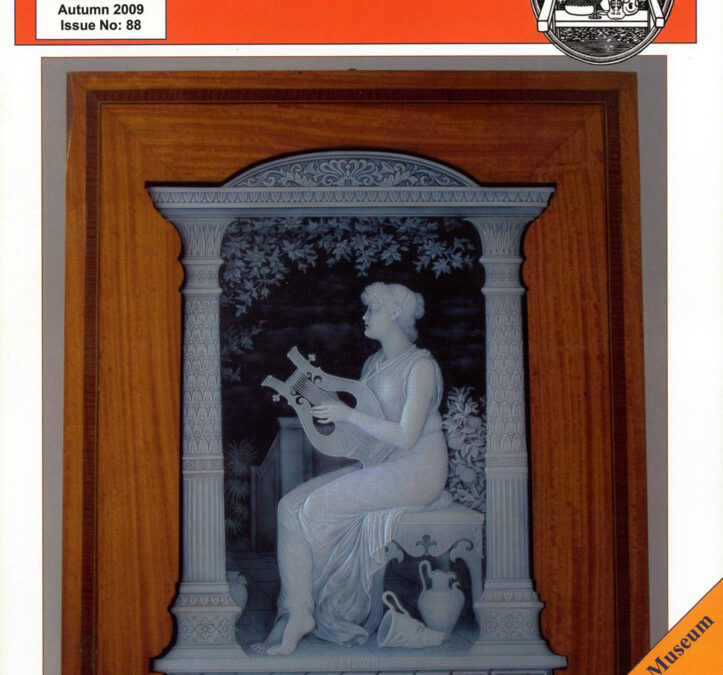
The
Sappho Plaque (illustrated on the front cover)
and
The Race Vase,
both by George and Thomas Woodall, supported by funding bodies
like the Heritage Lottery Fund, The Art Fund and the V&A
Purchase Grant Fund as well as The Friends.
The collection dates from
the 17
th
Century
onwards, although the
mid to late 19
th
and early
20
th
Centuries are the
most comprehensive, this
being the era when the
Stourbridge glass
industry was at its peak.
The major factories
including Thomas Webb,
Richardson, Stevens &
Williams, Webb Corbett
and Stuarts are well-
Fig 6: Ivory bowl with acorn feet, by
Mills, Walker & Co,
registered 23/12/1884.
represented, as well as many
smaller factories and workshops.
Some of the more obscure
companies are represented by
single documentary pieces, such
as Mills, Walker & Co
(Fig.
6)
and Harbridge Crystal Glass
Company.
The Stourbridge glass
industry has had a long and
illustrious history of engraving,
with particular achievements in
cameo glass, rock crystal and
copper-wheel engraving, by
masters such as John
Northwood, the Woodall
brothers, William Fritsche and
other engravers, many of
Bohemian origin
(Fig.
7)
The collection also
focuses on studio glass, from the
1960s up to the present day.
The Museum
Visitors to Broadfield House Glass Museum will find
eight galleries of glass displays as well as the Hot Glass Studio and
gift shop in which to browse and buy. Six of the galleries are
devoted to the Museum’s collection and two are used for temporary
exhibitions.
One of the most popular galleries is the Cameo Gallery
(Fig. 10).
As well as explaining the processes involved in creating
a piece of cameo and the special role that the Stourbridge industry
played in reviving this most challenging technique, the gallery
features a diverse range of cameo glass from the Victorian period to
the modem day. There are several impressive works by the
Woodall brothers, including the aforementioned
Sappho
plaque and
the
Race
vase, and other masterpieces such as
Raising an Altar to
Bacchus
by Alphonse Lechevrel, as well as modem variations on
the cameo technique such as
Drowning of the Innocents
by Peter
Dreiser
(illustrated on p. 22).
Fig.
7:
Fish vase by Thomas
Webb & Sons, engraved by
William Fristche
in the rock
crystal style,
c. 1889, purchased
with the aid of a grant from the
National Heritage Memorial Fund
Many of the Museum’s most
recent acquisitions have been
works by contemporary makers,
including Bob Crooks, Gillies
Jones and Simon Moore, as well
as contemporary engravers such
as Christopher Ainsley
(Fig. 8),
Peter Furlonger and Nancy
Sutcliffe. The newest addition to
the collection is Fertile
Landscape 2, a piece of kiln-
formed glass by Max Jacquard,
acquired in 2009 with grant aid
from The Art Fund (with the
assistance of the Esmee Fairbaim
Foundation), and sponsorship
from Ashwood Nurseries,
Kingswinford
(Fig. 9).
Other highlights to be seen are displays of tableware from
the Georgian, Victorian and Art Deco periods, an atmospheric black
and white film of Royal Brierley Crystal from the 1950s, and a
large and fascinating mystery object quiz to challenge and surprise
visitors—we defy any visitor to identify every one! There is a
gallery entirely devoted to studio glass, following the movement
from its origins in the 1960s up to the present day. Anther gallery
highlights three of the leading Stourbridge factories — Richardson,
Stevens & Williams, and Thomas Webb — and also looks at the
principal decorating techniques used in Stourbridge, such as cutting,
engraving, etching and enamelling.
Fig 8: Tango by Christopher
Ainslie, 2008
The Glass Cone
—
Issue No: 88 Autumn 2009
18
Fig 9: Fertile Landscape 2 by Max Jacquard, 2008
NJ
,
12: Allister Malcolm,
2007
Library & Archives
The Glass Reference Library is one of the most
comprehensive in the country, containing everything from rare 17
th
Century treatises to new publications on contemporary studio glass.
It includes the library and research files of the late Robert
Charleston, former Keeper of Glass at the Victoria & Albert
Museum. The library is stored at Himley Hall and is available to
researchers by appointment with the Glass Museum.
The archives relate mainly to the local Stourbridge glass
industry, particularly from the 19
th
and 20
th
Centuries. The material
ranges from pattern books, designs, catalogues, correspondence,
and legal and financial documents to photographs, slides and
microfiche. The archive collection is particularly strong in material
relating to Richardson, Thomas Webb and Stevens & Williams.
Most of the archives are kept at Dudley Council’s Archives & Local History Centre in Coseley, and are available to view by
contacting the Archives centre. A small amount of archival
material is kept at Himley Hall and the Glass Museum — this can be
viewed by making an appointment with the Glass Museum.
With the growing interest in genealogy, one of the most
frequently used parts of the archive collection is the Brian
Hardyman card index of glassmakers’ names, which was donated in
2004. This contains thousands of cards filed in alphabetical order
by sumame and was compiled by Brian over a period of thirty
years, from visits to record offices and archive centres all over the
country.
The archive collection was strengthened in 2007 with the
purchase of the Jack Haden Collection which was sold at auction.
This contained a vast body of material relating mainly, but not
exclusively, to the Stourbridge glass industry, and ranging from 18
th
Century correspondence and legal documents to modem printed
papers on subjects such as the Glassmakers’ Union. One of the
highlights of this collection is the
‘Register of Students from
Stourbridge Government School of Art 1864 — 1874’ .
Other noteworthy items from the archives collection
include two design books and some loose patterns for cut and
engraved glass by Joseph Keller
(Fig 11),
scrap and sketch-books
by Frederick Kny and Daniel Pearce, a pattern book by
J & J Northwood, original photographs of George Woodall’s cameo
work and the Keith Murray Description Book.
Fig. 11: Title
page & pattern for
A Collection of Patterns for the
use of Glass Engravers by Joseph Keller, c.1880,
purchased with
the aid ofa
grant from the V&A/MGC Purchase Grant Fund
Having a studio on site also allows the Museum to invite
guest glassmakers to demonstrate during special event days, such as
the annual Paperweight Days and Bead Days, as well as the
biennial International Festival of Glass.
Exhibitions
The Museum runs a
programme of temporary exhibitions that
complement the permanent displays and
show the diversity of glass, exploring
subjects beyond the scope of the collection, such as the current
display of glass petrol globes in
Petrol Heads
(Fig 13).
About half
of the temporary exhibitions focus on studio glass as a means of
supporting and promoting contemporary artists as well as giving
visitors a glimpse of glassmaking today.
Hi
Sklo Lo Sklo,
a
fascinating exhibition of Czech glass, runs until 11 October, and is
followed by
Migrate,
the 30
th
anniversary exhibition of the Scottish
Glass Society. This opens on 14 November and features the diverse
work of thirty artists with Scottish connections
(Fig 14)
Past exhibitions have varied from solo shows, such as
Helen Millard’s contemporary cameo in
The Secret Garden,
to
mixed-media shows such as Gill Hobson’s glass
displayed alongside the work of textile group
4plus2 in
Glass Threads.
The
headline exhibition for
2008 was
The Danger of
the Image
featuring
fourteen life-size glass
dresses by Diana
Dias-Lego.
It
The Hot Glass Studio
Since 1981 the Glass Museum has had a glassmaking
studio on site. The reasons for having a hot glass studio are three-
fold — to provide studio facilities for new and established artists, to
keep glassmaking skills alive in the area, and to provide visitors
with the opportunity to see real glassmakers at work.
The first studio occupants, Okra Glass (Richard Golding),
are now an established name in the glass world, specialising in
coloured, art glass. Okra were followed by Osiris Glass, now better
known as Blowzone, based in Shropshire. In 1994 the running of
the studio changed to a scholarship scheme, whereby recent
graduates were awarded the studio for one or two years, rent-free as
a stepping stone to establishing their businesses. Many have
continued to follow their careers in glass including LoCo Glass,
Susan Nixon, Stephen Foster, Sam Sweet and Lynn Baker. In 2007
Allister Malcolm, a former scholarship holder, returned to become
the Museum’s permanent artist in residence
(Fig 12)
Fi
b
II: feather
Carrie Fertig
roin the Ilr
,
rate exhibition
19
The Glass Cone—Issue
No: 88
Autumn 2009
proved to be one of the most popular exhibitions ever staged by the
Museum and won ‘Best Exhibition on a Small Budget’ at the Best
of the West museum awards in March this year
(seep. 24 Ed)
The Tyzack Gallery is used mainly for historic
exhibitions, although it is sometimes necessary to spill over into an
additional room to provide sufficient space. The exhibitions have
included
Ale & Hearty
featuring beer glasses through the ages and
traditional pub games, and
A Glass Menagerie: Pcite de Verre by
Amalric Walter
with its ground-breaking catalogue written by Keith
Cummings. At least one exhibition each year features exhibits from
the Museum’s own collection. More than three-quarters of the
collection is in store and this provides an opportunity for objects to
come out of storage and for staff to spend some quality time on
cataloguing and condition checking.
The next exhibition to feature many items from the
Museum collection is
2(t Century British Glass.
This will open on
17 October and marks the launch of Charles Hajdamach’s much
anticipated book of the same name, which follows the remarkable
changes in the glass industry throughout the 20
th
Century.
Events
The Museum stages events that appeal to a wide audience;
some, such as the annual Paperweight Days and Bead Days, are
aimed at collectors, others, such as the Valuation Days with
Bonhams and Fielding’s, are aimed at local residents.
The Glass Museum also has a large family audience,
thanks to the JAM (Juniors At Museums) Club which it runs in
partnership with the other venues in Dudley Museums Service.
Every school holiday the Museum is inundated with young visitors
eager to take part in the crafty activities and complete the latest trail.
Once a week there are story-telling sessions for pre-school children
and one Saturday a month there are free craft activities. There are
also additional workshops such as hand-casting sessions in the hot
glass studio. One of the most popular events is the annual
Christmas Festival when Father Christmas visits the Museum and
children
can
decorate glass
baubles
(Fig. 15).
These activities
encourage the
budding artists,
collectors, history
enthusiasts and
museum-goers of
the future.
Outreach
The Glass Outreach Service was set up by the Museum
two years ago. Trained members of staff, on casual contracts, visit
groups and schools to give talks and interactive sessions on glass
and local history. This year the Outreach Service has introduced a
series of canal walks, which will hopefully expand into additional
guided walks in following years. Sessions are now being developed
that will be taken out to residential care homes. In this way the
Museum can reach a public that is not able to visit in person.
For groups that can visit, the Museum offers guided tours
in conjunction with the Red House Glass Cone. Many groups take
the opportunity to visit the former factory site and learn about the
working conditions before seeing the range of finished products on
display at Broadfield House Glass Museum. The Museum has also
been a partner in several schools projects, most recently ‘Black
Country Treasures’
(Fig. 16),
a project between four Black Country
museums that enabled school children to discover more about four
local industries, including glassmaking, and to curate a special
touring exhibition of selected exhibits.
The Glass Museum is also making use of technology to
improve access to the Museum collection. A DVD has just been
launched which features a guided tour of the Museum, courtesy of
tour guide Kate Round and Keeper of Glass Roger Dodsworth. The
DVD is available to buy from the gift shop (£6.99 plus postage) and
also plays continuously in the ground-floor rest-room so that
visitors unable to attempt the flights of stairs can sit back and enjoy
a virtual tour.
Work is also underway, behind the scenes, to make parts
of the collection available on-line via the website
www.blackcountryhistory org, which already feature some of the
glass archives. It is hoped the first glass records will be available to
view by the end of this year.
The Future
The Glass Museum strives to keep glass and its heritage
alive, by encouraging understanding and enthusiasm for all aspects
of glass. It does this through its exhibitions, events, and the services
it provides; by working with glassmakers, artists, collectors,
societies and other partners; and by ensuring the collection
represents the makers of the past and the present, and is available
for everyone to enjoy and appreciate for generations to come.
Dudley Council has appointed heritage consultants L&R
to conduct a feasibility study into the proposed move of the glass
collections to the Red House Glass Cone. The outcome of Phase I
of the study will be announced in September 2009.
April 2010 will see the 30
th
anniversary of Broadfield
House Glass Museum. It is hoped that the Glass Museum will be
able to celebrate this landmark anniversary with all of its friends and
supporters. To keep up-to-date with events and exhibitions taking
place at Broadfield House Glass Museum visit the website,
www.glassmuseum.org.uk or call 01384 812745 and ask to join the
Museum’s mailing list.
Kari Moodie
Information
Broadfield House Glass Museum is at Compton Drive,
Kingswinford, West Midlands, DY6 9NS, tel: 01384 812745;
open Tuesday to Sunday, from 12noon to 4pm. Admission is free.
The Museum is located just off the A491
Wolverhampton-Stourbridge main road. Kingswinford is
approximately 10 miles from M5 J4 (Stourbridge) and 8 miles from
M5 J2 (Dudley). The nearest train station is Stourbridge Town and
the buses that run regularly between Wolverhampton and
Stourbridge bus stations pass the entrance to Compton Drive.
All images are copyright of Broadfield House Glass Museum,
Kingswinforcl except where stated otherwise, when permission has been
granted by the copyright holder.
Fig 16:
Black Country
Treasures
project, 2008
(Allister
Malcolm in the
studio in the
background)
The Glass Cone
—
Issue No: 88 Autumn 2009
20
The Woodall Team 1889
Back: Tom Fanner,
Harry Davies, Tom Woodall
Front: William hill, J.T. Fereday, George Woodall
Bromfield House Glass Museum image
The Brierley Hill Glass Collection and
H.W. “Bill” Woodward (1913 — 1999)
Brierley Hill’s Central Library, one of the many built
through the munificence of Andrew Carnegie, occupied part of the
building at the corner of Moor Lane and Bell Street that also housed
the Art and Technical School and the Council Chamber. When
Herbert William (Bill) Woodward took over, the library was not an
inviting place. On the first floor the Reference Room was only
opened by request and kept locked when not in use. In it were
some showcases containing a motley collection of glass, started in
1924 when Stevens and Williams, of Moor Lane, presented 29 fine
specimens of their own manufacture. About the same time
W.W. Skidmore-Westwood, of Stourbridge, the wealthy principal
of Westwood & Wright, Ltd presented 21 handsome pieces of glass
from his large collection of
objets d’art.
This important gift was
supplemented from time to time, and in all 241 items were received
from him. This was the collection for which Bill Woodward was
responsible and eager to expand. But soon the country was at war
and eventually its curator was called up for service in the RAF.
The Second World War and the Post War Legacy
The Brierley Hill and Stourbridge district suffered little
material damage from enemy action during the war. However, with
peace came the realisation that much of the industrial plant was
worn out and had to be replaced so that industry could supply the
peacetime needs of a tired but euphoric populace eager to enjoy the
fruits of victory, as well as supply the export market. During the
war the local glassmakers had to employ their skills producing vast
quantities of plain domestic ware: electric light bulbs, chemical
ware and cathode ray tubes. Suddenly it became essential to switch
the depleted skilled labour
force back to production of
the high quality cut crystal
ware for which the district
was famed. All first class
products were for export; the
home market had to make do
with seconds, of which in
future years the number
increased disproportionally,
severely damaging the
industry’s reputation and
contributing considerably to
its decline.
Concomitantly there
was in certain circles aJ
movement for the
preservation and safeguarding
of the nation’s historic culture
and art. Not only had so
many of the nation’s treasures
been destroyed or lost during the war but economic circumstances
were forcing the dispersal and sale abroad of much that had
survived. It was the heyday of the auctioneer and antiques dealer.
The ‘knocker’ was a familiar figure in the Stourbridge area, calling
and asking austerity-ridden housewives if they had hidden away in
their cupboards any old glass ornaments, especially unfashionable
21
coloured items they no longer wanted.
Notwithstanding the hard time when Brierley Hill Council
had to concentrate on repairing the wear and tear of the district’s
infrastructure, Bill Woodward, with the support of a few like-
minded councillors, set about reviving the library service and
stimulating public interest in local history.
The Brierley Hill Glass Collection that had been kept
safely in store during the war was formally re-opened to public
view in the Reference Room by Thomas Williams, the oldest
member of the Libraries Committee, on 23 July 1947, and John
Northwood II, former manager of Stevens and Williams Ltd., gave
a talk on the history of glassmaking. Subsequently Mr. Northwood
gave a fine collection of cameo glass to the Stourbridge Collection,
much of which was stolen and never recovered.
With a few exceptions the glassmaking fraternity had
been aloof from their industrial history but they began to realise it
could be employed for publicising their businesses which were
expected to make a significant contribution to the county’s export
drive. In 1949 the Libraries and Arts Committee of the Council
published two booklets.
‘The Collections of Glass at the Brierley
Hill Public Library’
was a hand-list of the glass displayed in the
Reference Room, compiled by W.A. Thorpe of the Victoria &
Albert Museum. The second, my
‘Notes on the Stourbridge
Glass Trade,
sparked off a somewhat acrimonious controversy:
leading Brierley Hill councillors took exception to the name
Stourbridge’
being recorded as the centre of the glass trade, and
also to a comment that it was a source of regret that examples of the
work of great craftsmen and artists should not be housed in a place
of honour somewhere in the Stourbridge district.
The Stourbridge versus
Brierley Hill controversy
continued for years and was
one of the issues that
eventually led to Stourbridge
Council forming a municipal
glass collection in 1952, when
the Mayor in that year,
Councillor E.R.R. Tooby,
following on from the success
of the 1951 Festival of Britain
glass exhibition, provided a
showcase in which a
collection of glass could be
displayed in The Council
House, Mary Stevens Park,
Stourbridge.
(Seep. 23 Ed)
The Stourbridge and Brierley
Hill glass collections became
the source of considerable
publicity for the local glass
industry. But neither collection was adequately housed and they
tended to compete for attention. This situation was remedied when
local government reorganisation resulted in the creation of the
Metropolitan Borough of Dudley within a new West Midlands
county. One result of the reorganisation was that in 1972 Bill
Woodward was appointed Keeper of Dudley’s Glass and Fine Art,
The Glass Cone—Issue No: 88 Autumn 2009
“The Cocktail Party”- a
fa
it
: display of tableware from
the Art Deco period
an office from which he
retired in 1974.
It was
appropriate that his redundant
library rooms in Brierley Hill
were developed as a Glass
Centre for training
glassmakers and decorators.
Attached to Dudley College
of Technology and, having
earned a fine reputation for
producing craftsmen, it was
given the title the
International Glass Centre in 1989.
(From the current academic
year the centre has been scaled down dramatically, and the rump
moved to the Mons Hill campus in Dudley, so that there is no
longer a distinct centre of excellence. Ed)
One of the subjects that exercised the minds of the
enlarged Dudley Council was the future of the municipal glass
collections, and where to house them. The problem was solved by
a circuitous route, which led to the solving of another of the
Council’s problems
Broadfield House, Kingswinford, an
attractive early 19
th
Century house with a large coach-house which,
if left vacant, was likely to become the prey of vandals. Opposition
was voiced from Stourbridge, and it was proposed that either the
old Council Chamber in Mary Stevens Park, or a purpose-built
building in Amblecote would be better suited. The £250,000 sum
needed made this latter proposal unsuitable. Bill Woodward was
consulted and suggested that in the circumstances since the
dignified Broadfield House already belonged to Dudley
Corporation and was conveniently sited it would be an ideal venue.
Local glass manufacturers concurred.
The History of Broadfield House
The branch of the Dudley family that had occupied the
house for over 150 years was also connected by marriage with the
Briscoe family who occupied the adjacent Summerhill estate. The
Dudleys claimed descent from the 13th century family of Somery,
Lords of Dudley Castle, and also Dud Dudley, the famous
ironmaster near whose dwelling called Green’s Lodge
“the Glass
Invention with pit coal was first effected’.
Descendants of this
branch of the Dudley family formed connections with prosperous
families in North Worcestershire and South Staffordshire. Robert
Dudley married Eliza Briscoe of Summerhill, and set up as a nail
manufacturer in Bamett Lane, a short distance from Broadfield
House which became the family home until the Second World War.
When the residing Mrs. Dudley found so large a house
unmanageable in wartime conditions, the estate was sold to
Kenneth MacMaster, a businessman who had moved to
Kingswinford. He operated
his firm, Associated Settings
and Chimneys Ltd, engineers
and chimney builders, from
his home, the old St Mary’s
Vicarage in High Street. For
several years Broadfield
House was used as a home for
unmarried mothers. When it
was decided that it was
inconvenient for use as an old
peoples’ home, New Bradley
Hall was erected in the grounds.
Much work had to be done to adapt Broadfield House as a
secure home for the display and studying of glass. Advice was
sought from museums and staff with experience in displaying glass
collections, and in 1979 an Advisory Committee was set-up,
composed of representatives of Dudley Council and local glass
manufacturers, and a few others, including Bill Woodward and
myself.
A vital step in the creation of the museum and its future
development was the appointments of Charles Hajdamach and
Roger Dodsworth as Keepers. There was some controversy as to
the name of the museum but there was an air of general satisfaction
when Princess Michael of Kent formally opened the Broadfield
House Glass Museum 2 April 1980. It excited much interest
among glass enthusiasts and collectors and became an important
tourist attraction. The flow of books, newspaper and magazine
articles about glass increased significantly, and it contributed in no
small way to the founding of the Glass Association at a meeting at
Stourbridge College of Art in November 1983, with Roger
Dodsworth as its first Secretary and Charles Hajdamach as
Editor of its magazine “The Glass Cone”.
H. Jack Haden
June 2000
This is an edited version
of a paper written by
Jack Hayden and
published in
`Cameo, the then
quarterly
publication of the
Friends of
Broadfield House
in the Summer and
Autumn editions,
2000.
The illustrations show
more of the Glass Museum and
its collections, and the story
continues in Charles Hajdamach ‘s
article which follows.
Ed
HYACINTH VASES
Member Julie Berk has started a web site about antique glass
hyacinth vases at
www.hvacinthvases.org.uk.
She hopes to
organise a get-together in September for like-minded collectors
in London. Please contact her if you are interested:
iulie(&hvacinthvases.org.uk.
There will be an article by Julie in the next Cone.
Displays in the
Contemporary
Gallery
Drowning of
the Innocents
by Peter Dreiser
(a cameo protest against the
indiscriminate netting of
dolphins)
•
The Glass Cone
—
Issue No: 88 Autumn 2009
22
Nineteenth Century Origins
“It is a matter of much regret that, unlike Birmingham,
Stourbridge should still be without an art gallery or Museum, in
which might be shown specimens of the beautiful glass made in the
town, and which have given the district a more than European
reputation. Some of the showrooms at the manufactories are in
themselves art museums; but in too many cases the treasures they
contain are only seen by customers of the firms. What is sadly
wanted is a public museum, in which may be exhibited to the public
at large samples of the best qualities of glass which are from time to
time produced at the works of the neighbourhood. Such a collection
could not fail to be of advantage in many ways. It would tend to
foster a love of the beautiful on the part of the residents, and would
give strangers a better idea of the class of work made in the town,
examples of which are too frequently only seen in the leading shops
in London and other cities”.
When that comment appeared in 1892, in the Pottery
Gazette, the idea for a glass museum in the Stourbridge district was
already well established. Sir Philip Cunliffe Owen, the director of
the South Kensington Museum (now the Victoria and Albert
Museum), strongly advocated the setting up of a local museum
when he attended the prize-giving at Stourbridge School of Art in
1885. Other commentators echoed the idea and suggested that the
museum should be closely allied to the School of Art. But it was
only some 50 years later, in the 1930s, that the first public collection
was formed at Brierley Hill.
(Seep. 21 Ed)
The Stourbridge Glass Collection
Almost in opposition to the Brierley Hill Collection, the
Borough of Stourbridge decided to establish its own glass collection
following an exhibition of local glass as part of the Festival of
Britain celebrations in 1951. The collection was based on two
exceptional collections, from Benjamin Richardson III and John
Northwood II, which had been lent for the Festival exhibition and
left as a gift after the exhibition ended. Further donations continued
to emphasise the local aspect which complemented the more
international flavour of the neighbouring collection. Both
collections contained extremely important glasses but were housed
on the first floor of the Brierley Hill library and in the corridor of the
Council House in Stourbridge in Mary Stevens Park, making both
difficult to find and access. The displays were basic with few or no
explanatory labels or panels giving a wider contextual history of
glassmaking in the area. Neither collection had a dedicated museum
curator, the Stourbridge holdings being placed in the hands of the
building’s caretaker Cliff Share. Some monies were available at
Brierley Hill to buy new pieces but Stourbridge relied totally on
gifts from local residents. Security at both venues was equally poor.
The security on the corridor cases at Stourbridge consisted of fine
wires stretched vertically at intervals and any attempted break-in
would only be detected by passing Council staff, as there were no
attendant staff As a result, a group of important items were stolen
including one cameo piece made by John Northwood I. A burglary
at Brierley Hill was only foiled and the stolen items recovered when
the thieves ran out of petrol in their getaway vehicle and were
accidentally apprehended by the police.
23
1974: Local Government Amalgamation
In 1974, following local government re-organisation
throughout the country, things were about to change for the two
collections. After my appointment in September 1974 to take over
after the retirement of Herbert Woodward, there was a period of
taking stock of the collections and by 1976 plans were being
discussed about the possibilities of amalgamating the two
collections. While discussions were on-going, a policy was
implemented to organise regular major exhibitions on glass topics.
A small exhibition of work by the glassmakers at The Glasshouse in
London was held in 1975 at Brierley Hill but the lack of suitable
space for any large exhibitions meant that subsequent exhibitions
were held at Dudley Art Gallery, also part of the Dudley Museums
Service. In 1976 the first glass exhibition held at Dudley was
`English Rock Crystal Glass 1878
–
1925’.
Curated by Ian
Wolfenden, it was the first gathering together of this type of glass
and featured as a special loan, the famous William Fritsche Ewer
from the Coming Museum of Glass. The catalogue for the show
still stands as the main text on the subject. Dudley was also the
venue for the Cinzano Glass Collection before it returned to its
home in Italy. In 1979, the exhibition
‘Glasshouses’
was a
topographical look at the British glass industry through paintings,
watercolours, drawings and photographs borrowed from galleries
and libraries throughout England and Scotland.
By 1979 negotiations to merge the two glass collections
had reached agreement, due mainly to the indefatigable work of the
Conservative Councillor George Griffiths. When a new home was
proposed it seemed ideal, as it stood on neutral territory as it were,
neither in Brierley Hill nor in Stourbridge, thus saving face for both
political factions. At the final Council meeting to decide the issue,
the decision to go-ahead went through by one vote.
The Opening of Broadfield House Glass Museum
Councillor Bill Webb, L Col. Reg Williams Thomas, Charles Hajdamach
and the Duchess of Kent at the Official Opening
With the narrowest of margins to proceed and with
limited funds, the beginnings of the new museum were less than
propitious, but with the news that a member of the Royal family
was to attend the opening ceremony, the restrictions on spending
were dropped and the attitude of most politicians changed to one of
The Glass Cone—Issue No: 88 Autumn 2009
Cloisonne vase by John Moncreiff
Ltd. (Monad), c.1930,
purchased with
the aid of a grant from the V&4/MGC
Purchase Grant Fund
24
support. When Princess Michael of Kent opened Broadfield House
Glass Museum on 2n
d
April 1980, a hundred year dream was
realised. In 1981 the Museum won the award for Best Small
Museum in the country, a fine accolade for a fitting memorial to the
achievements of the generations of glassmakers of the district. The
prize money from the award was used to renovate the barn at the
rear of the main building and open it as a glassmaking studio. Over
the ensuing two decades Broadfield House quickly became an
internationally recognised centre for the study and enjoyment of
local glass, with a vigorous collecting policy, a wide-ranging
exhibition programme and strong links with the wider British glass
industry.
Collections and Collecting Policy
The collecting policy
adopted a tiered approach
with local Stourbridge
and West Midlands glass
as first priority, then
other British and Irish
glass, followed by
Continental
and
European glass to
provide a wider context
to the local glass. As well
as glass, acquisitions
included pattern books
and paper records from
the companies, and
glassmaking equipment.
With regular cuts in
Council finances the
Museum’s purchase fund
was eventually lost, but
with the support of the Friend’s group and private benefactors the
Museum was able to continue to buy major examples and often
save them from export. Graham Knowles and his firm Hulbert of
Dudley for example, donated £10,000 in 1986 to allow Broadfield
to acquire special items from the auction of the Cyril Manley
Collection. Hulbert’s also funded the purchase of thirteen pieces of
glass by Clyne Farquharson from his wife’s collection which
otherwise would have been dispersed and lost as the last link with
the Birmingham designer. In the 1990s, the then leader of the
Council, Fred Hunt, and the Chief Executive, Viv Astling, awarded
Broadfield a one-off sum of £120,000 which allowed the museum
to match large grants from the National Lottery, the Heritage Fund,
the National Art Collections Fund and the Victoria and Albert
Museum, and to buy superb pieces including the very best cameo
pieces by George Woodall. Purchases were made from a variety of
sources including Sotheby’s and Christies, a host of glass dealers
including Jeanette Hayhurst, Nigel Benson, and John Smith at
Mallet and Aspreys, and in the case of studio glass from the artists
themselves or the galleries representing them. The Museum also
saved collections when no one else saw the benefit of doing so.
Following the death of the great industrial glass designer Alexander
Hardie Williamson, his doctor and neighbour Patrick Reade,
contacted the Victoria and Albert Museum to see if they would save
his entire collection. When they refused he contacted Broadfield
who organised three trips to Williamson’s house in Sussex and
saved every piece of glass and all the paperwork which went back
to the 1930s and the Royal College of Art where Williamson had
studied and worked. In the 1990s the Museum was also responsible
The Glass Cone—Issue No: 88 Autumn 2009
for rescuing the remaining structure and foundations of a late 17
th
Century glass furnace from the estate of Sir Charles Wolsely near
Rugeley in Staffordshire. The operation was a first for glass
archaeology as the furnace was lifted intact on a raft of iron girders
and enclosed in a protective cocoon.
Alongside the purchased items the Museum has benefited
over the years from incredibly generous loans and donations from
many, many private individuals, ranging from single items to
collections into the hundreds of pieces. In monetary terms alone
these gifts have boosted the value of the Museum’s holdings
enormously, but few in Dudley appreciate this hidden aspect of the
public’s support for this institution. Worthy of special mention as
major benefactors to the Museum are Graham Knowles and Hulbert
of Dudley for their on-going purchase of major pieces, John
Keatley and The Keatley Trust for 20
t
h Century examples, Jack and
Penny Pacifico who have lent examples of engraved and rock
crystal glass since the late 1970s, Ray Notley and Michel Lerpiniere
with their Carnival glass collection, and Michael and Peggy
Parkington, two of the greatest benefactors the Museum has had the
privilege to know. Michael Parkington’s collecting policy consisted
quite simply of two criteria, the glass had to be rare or unique and in
pristine condition. With a cheque book to match those expensive
requirements, he went on to build up what was almost certainly the
finest private collection of British glass ever put together, from the
earliest lead glass of the 1680s to late 20
t
h Century pieces from the
major producers. At the time of Michael’s death the Museum had
500 of his pieces on display on the first floor, with the tongue-in-
cheek title
‘A Few Nice Pieces of Glass’.
Following Peggy’s death a
few years later she bequeathed those items to Broadfield, an
incredibly generous gift which even the great Coming Museum of
Glass in America would have envied.
The Museum also pursued an active policy of
commissioning artists to create unique pieces for the collection,
often supported financially by the Friends of Broadfield House.
International names who were chosen included Keith Cummings,
David Prytherch, David Peace, Doug Burgess, Max Jacquard, and
the twelve artists involved in the Dudley Millennium Glass
Commissions.
Outstanding Exhibitions
Throughout its 29 year history Broadfield House has
always presented a varied and impressive selection of temporary
exhibitions. Memorable ones include
‘Legends in Glass’,
the cameo
glass of George and
Thomas Woodall;
‘British
Glass Between The Wars’,
a
ground-breaking exhibition
of ’20s and ’30s glass;
`Cameo Glass’
by David
and Chris Smith;
‘American
Brilliant Cut Glass’
from
the collections of the Lone
Star Chapter of the
American Cut Glass
Association in Texas;
`Victorian Engraved
Glass’; `Majesty and
Rebellion’,
Jacobite Glass
from the Drambuie
collection;
‘Innovation and
Diversity’,
75 years of
Swedish Art Glass; and
most recently
‘Danger of the Image’,
the fabulous glass dresses by
Diana Dias-Lean. Many other shows featured solo exhibitions of
British studio glass artists, including the occupants of the
Scholarship Studio, the glassmaking studio transformed by a huge
donation from Hulbert of Dudley, to act as a buffer one or two year
facility for graduating glassblowers before they moved on to set up
their own businesses. All of the teams of glassblowers who have
held the Scholarship Studio are now acknowledged glass artists
throughout Britain, while one was headhunted and is now
established in Holland.
By 1988 Broadfield House organised the first of the
Dudley Glass Festivals which became a focal point in the year for a
celebration of glassmaking not only in Stourbridge but also
throughout Britain. Master glassmakers were invited to demonstrate
their skills throughout the week while an intense programme spread
around all the major glass factories in the area, offered lectures,
walks and tours of historic glass sites and factories, and even an
auction of the studio glass made during the week’s festivities.
Funded on a mere £2000 each year, the Festival was the model for
the more recent and highly successful International Festival of
Glass held every two years since 2004, and unique in the UK.
When Dudley Council purchased Himley Hall and its
parkland in the late 1980s, the search for a use for the Hall led to the
idea of transferring the glass collections from Broadfield to Himley.
At that time other national developments were taking place which
led to the creation of the National Glass Centre in Sunderland and
the World of Glass at St. Helens. The proposed development at
Himley was seen as the third element in this nation-wide promotion
of glass and the staff at Broadfield held regular quarterly meetings
with the other venues to
discuss future working
relationships. A multi-
million pound scheme
was designed by the
British architects Design
Antenna (DADA) of
London, with Brent
Richards as the lead
Director, which would have transformed Himley into a major
international glass attraction. A key element in the strategy for
Himley was the revitalisation of the displays at Broadfield House so
that the existing museum could be used as an advert for Himley and
would show in microcosm what could be achieved there. The most
high profile element in the Broadfield House refurbishment was the
construction of the Glass Pavilion. Opened in August 1994, the
Pavilion not only extended the available space by forming a
dramatic new entrance, reception area and museum shop but it was
at the cutting edge of architectural glass innovation and for a
number of years was the largest glass-only structure of its kind in
the world. When it transpired that the aspirations and targets of the
major national funding agencies had changed, and that less would
be available for the Himley scheme, the Dudley executive suddenly
lost faith in the project, and the vision of developing a new national
glass museum sadly fizzled out.
Links with Red House Cone
The final part of the history of Broadfield House at the
end of the 20
th
Century was its link with the Red House Glass Cone
which was to become part of Dudley Museums Service. Built about
1790, it is one of only four surviving glass cones which were a
common feature of the 18
th
Century British landscape. Since the
end of the 19
th
Century it was the focal point of Stuart and Sons
who leased it to Dudley Council in 1999. Time and weather had
caused severe deterioration to the Cone which now needed
immediate attention. A partnership of Waterford Wedgwood (the
owners of Stuart Crystal who closed the firm in 2001), Dudley
Council, English Heritage, the Heritage Lottery Fund, and
Advantage West Midlands eventually raised £1.7 million to restore
the Cone and the adjacent buildings. After two years of restoration
work the Cone was opened in July 2002 with its unique features of
the reconstructed central furnace, the annealing tunnel and lehr
table, on view for the first time in 70 years. The two sites,
Broadfield as an artistic experience and Red House as the social
working element, became complementary and exciting elements in
the interpretation of the glassmaking history of the entire Dudley
and Stourbridge area.
In the publicity hand-out for the official opening of the
Cone, the final paragraph stated that the Red House Glass Cone
“with nearby Broadfield House Glass Museum, the Glasshouse
Project at Ruskin Mill Further Education Centre, the International
Glass Centre, the Glass Department at the University of
Wolverhampton as well as the various studio makers, free-lance
cutters and engravers, and firms such as Royal Brierley Crystal and
Plowden and Thompson, the area continues
to be a major force in international glass
circles”.
With the proposal to dismantle Broadfield
House in 2010, and the drastic down-sizing
of the International Glass Centre, one
wonders whether the current officers and
executive of Dudley Council are hell-bent
on undoing 120 years of history and
achievement, and return to the days of 1892
when we, like the writer then, will be
clamouring yet again for a worthy museum
to show off those incredible creations which
have “a more than European reputation”.
Charles it Hajdamach
(Charles Hajdamach was Keeper of Glass and
Fine Art from 1974, becoming Principal
Museums Officer with responsibility for the whole of the Dudley Museums
Service until his early retirement in 2003. In 1993 he and two others
founded The Glass Association, the society now numbering about five
hundred members world-wide. In 1991 he published ‘British Glass 1800-
1914′ and his new book 2(1
th
Century British Glass, also extensively
publicising the collections at Broadfield House, will be published in
November 2009. He now concentrates on his work as a lecturer and author,
and plans to write a definitive work on 18
th
Century glass to complete his
trilogy on the British glass industry.)
The Pavilion, opened by the Duke
of Gloucester in 1994, and now the
attractive entrance to the museum
25
The Glass Cone—Issue No: 88 Autumn 2009
Allister Malcolm, who is the current glass maker in the
Broadfield House hot shop, describes the pleasures
and the perils of a major public commission.
When I was based at Himley Hall I was
approached by my neighbour, Steve Field
RBSA, Dudley’s borough artist. Apparently he
had admired the more sculptural work that I
had produced for a number for
years. He had been waiting for
the right project to come along on
which we could collaborate. As
the borough artist Steve is the
first port of call for clients who
wish to conduct amazingly large-
scale projects. Examples of his
commissions may be seen all over Dudley.
A brief outline of the situation was simply that
a
supermarket was being built in Wednesbury town centre. The
client , S R Davis architects, were in association with Morrisons and
Sandwell MBC. Their vision was to transform the Town Square.
Artwork would enhance the site and would be funded through the
`percentage for arts’ scheme. These opportunities don’t come along
very often, and it was a real chance for me to work in a totally
different realm, with the support of Steve’s experience to ensure the
success of the project.
Steve had researched the fact that excavations on site had
uncovered the remains of a medieval ceramic furnace. It was
suggested that a replica model built entirely from glass would have
a great impact on the Town Square. Advising Steve on the
technicalities of glass making I helped to develop a design that
could be manufactured. The dome-shaped kiln would have walls of
about 100mm thick bricks. Inside, vessel forms would represent
products that would have been produced, whilst outside, set into the
floor, disks of glass would represent the fire pits surrounding the
kiln
The arch on a bridge is self-supporting, and the initial idea
was that this structure would work on the same basis. It took
countless calculations to ensure that the curve changed on the
profile of the kiln and that the bricks altered slightly in shape
accordingly, to form the correct curve. I did a quantity survey
to
work out the volume of glass needed and the time to make the glass
including the moulds, and then produced a quote.
There seemed to be a long delay whilst Steve’s concept
had to go through approval from planners and public. This provided
time to research the right materials to produce the work, and
additional labour if the deadline looked like it was going to be tight.
When the commission came through, the deadline was
horrendously tight, and an overrun would incur thousands of
pounds-worth of penalties for each day the commission remained
incomplete. It would hold up the opening of the site scheduled for
the beginning of December. This gave me three and a half months
to produce three tonnes of glass! This whole process seemed to go
against the idea of finely crafting a piece of art. It is of course in
everyone’s interest to get the job done efficiently but not at the cost
of quality. I seriously considered withdrawing from the commission
at this point. After some reflection I chose to go ahead reminding
myself it was a great opportunity. The pressures facing
•
these realities on this level were immense and really
took the joy out of the project from there on.
Inevitably, changes to the design had to be made:
could a form built entirely of
glass with no supporting
steelwork take the weight of two
adults? Health and safety is of
massive concern with every
activity now given that the site is
in the middle of a town square; it
was quite plausible that someone
could actually attempt to climb on
top.
A structural engineer’s
advice had to be called for at this
time. I have to say their solution wasn’t really sympathetic to the
overall look of the project: the type of structure they prescribed was
comparable to that of a bridge—too bulky! However without their
advice at this stage the project would simply have stalled, and I now
believe they were a necessary evil to progress. It meant that I would
have to craft the bricks to fit around the framework.
The frame was amazingly crafted by a local father and son
team, Apollo Fabrications. They were responsible for producing all
the metalwork for the commission and well experienced in these
projects. Whilst the frame was being produced I set to my mind to
work on the cast disks that are set around the outside of the kiln.
Initially about a mile of cane was pulled in various shades of red. I
favour producing my own cane as it comes out quite irregular with
interesting qualities. The density of colour slightly changes as does
the thickness; these subtle details bring the casts to life for me and I
am still pleased with the results. These canes were then set within a
sand mould with granules of glass colour set around to tie it all
together. The clear glass was then poured at a temperature which
left evidence of how the glass poured, with a subtle texture on the
surface which would catch the light. The ovals were produced in a
few sections which would then be simply set on the floor as though
laying large tiles.
Apollo Fabrications
installing the steelwork
At the same time as producing these ovals, formers were
produced to build the columns in the centre and the handles. These
were also sand-cast but here simply produced in clear.
The Glass Cone—Issue No: 88 Autumn 2009
26
Detail of the discs
aN
they were installed
Gluing of bricks”
to fit the,
rame
Gas- fire inside the kiln, to
help wt the bonding agent
Bottle firms within the kiln
Once the framework was delivered and bolted together I
set up to cast the bricks. There were about 1000 of them to produce
and all with slightly different profiles, I had to work it out as I went
along in order to ensure that a staggered brickwork effect was
created.
At this point the site should have been ready for the
installation, but as usual there had been a series of delays which had
the knock-on effect that we would not be able to gain access for as
long on site as once thought. I also found out at this time (autumn,
and a cold one at that) that the glass-assembly compound that I
wanted to use would not work below five degrees centigrade. I
decided quickly that I should join sections of the bricks together,
which would then be simply fixed to the frame on-site in larger pre-
formed panels.
Fortunately for me all of my equipment held together, and
so did everyone who helped throughout the relentless pace of
production, and all the glass was produced on time. I still shake my
head in disbelief at this: I had organised so many back up plans just
in case and I was certain that I would be using a couple at least. The
one thing that had gone against me though was that it was the
coldest November that I could remember, we had already had a bit
of snow, and we were due to go and work on site for a week fitting
the glass together. Not a pleasant thought for a glassmaker who
would normally enjoy this time of year making glass in a nice warm
workshop! Adding to this, Jim, my assistant, who had worked in
glassworks for over 30 years had never before been involved in an
outdoor job, so you can imagine his delight!
I had not had a spare second to consider the lighting
27
aspect of the feature, and Steve used his contacts to work on the
LEDs to flood the form from the inside with light. Although LEDs
are supposed to be maintenance free, the project manager of the site
wanted to be able to access all lights just in case, so the design of
the supporting steelwork had to be adapted to allow for this.
A plinth had been erected on-site for the steel to sit on top.
With some encouragement the metal slotted into place. Text by
local Wednesbury writer Brendan Hawthorne
“Firepit Glory Holes
illuminating darkness with the promise of a new dawn”
surrounded
the plinth. Now everything else was up to me, and so we began
installing the glass. I had to overcome the problem of using glue in
freezing temperatures. The solution was to put a gas fire inside the
kiln, work quickly fixing the panels in place, then wrap the kiln in
masses of bubble wrap leaving a small vent. This enabled me to
work inside, filling gaps with the assembly solution in the warm; a
small space to work, but probably the warmest part of the Town
Square! This resulted in using about a mile of bubble wrap, as each
day we had to peel off and use new stuff for speed, the old bubble
wrap being saved to be recycled later. This process was also used
whilst building the disks in the centre of the kiln Finally, to finish,
we set the disks in around the outside.
The Glass Cone—Issue No: 88 Autumn 2009
Once finished I just felt a massive sense of relief. I look at
the work now and am amazed at how it all came together so well
considering there are so many components. I now look at Public Art
in a totally new light and am in awe at some examples that I see,
appreciating what goes on in the background.
The kiln was unveiled with many good reviews. Locals
liked it, though some really didn’t understand what it was supposed
to represent. Unfortunately, within 30 days it suffered vandalism.
There were broken pieces inside, the metal had been damaged and
glassware chipped. I raced to the site to repair what I could, and
when I stepped away I was pleased in as much as I thought no one
would be able to tell. The implications of such an attack in such a
short space of time meant that it needed protecting against further
harm. Steel grids were installed across the front section to stop
unwanted guests spoiling the detail again. I was deeply saddened; it
was the first project that I had produced where any member of the
public could get to appreciate my work without having to make a
purchase. In other countries these pieces of art become tourist
attractions and national treasures. I had hoped this piece in time
might have the same effect.
Straight after completing the commission I relocated my
studio to Broadfield House Glass Museum. I was exhausted and
was upset that it could take so little time to damage something that
had taken so long to create. After recovering from the commission
and the move, I have to say it has not stopped my thirst for similar
projects though, and I would love to execute more. I have produced
quotes on some but none yet have come to fruition.
Meanwhile the studio collections have gone from strength
to strength. Demand has grown and developed to newer audiences;
this is really what keeps me going as a glass artist. A real
achievement for me was to be selected for the Biennale 2008 and to
run a master-class for the International Festival of Glass.
This year I have participated in a group show in Coming,
New York entitled
‘Same Dfference’ ,
almost selling out on day
one. This came as a total shock, as I thought collectors out there
would be really tough to appeal to, having such a massive amount
to choose from.
13-18 October I am due to participate in the country’s
leading craft fair,
Origin,
at Somerset House, run by the Crafts
Council. I have planned thoroughly for this, with an application for
assistance from the Arts Council. I have developed concepts from
the Biennale and Coming to produce a new body of work. I am
really excited by this project and the potential avenues I may take
next as a result.
Allister Malcolm
www.allistennalcolm.
com
Allister’s recent work on display
at the entrance to the Broadfield
House studio, children’s activities going on in the background
(August 2009)
The Prime Minister has said that we must ‘design our way
out of the recession!’ Easy words, but difficult to implement.
Industry as a whole, but glass in particular both here and in Europe,
are in a dire situation. This is principally due to exorbitant energy
prices, unworkable legislation from Europe and the UK, the
headlong rush to ecotopia and history.
Broadfield may only have 30 years fame, but the
collections, access to 400 years of knowledge and literature, coupled
with the studio, form a lynch pin for the future.
We need the history to avoid making costly errors, to look
to alternative methods of creating beauty and invention without
recourse to time consuming methods, access to objects of desire to
create wonder and to ask the question — ‘how was that possible?’.
The studio has given many the opportunity to develop
glassmaking skills and many visitors the opportunity to observe and
take part in those skills. A truly symbiotic relationship!
The economic future is uncertain, but one thing I do know
is that glass is a wonderful material. This area has a heritage to be
proud of and deserves to have a living museum to keep the heart of
glassmaking alive, form the core of the industry and be part of an
economic regeneration combining tourism, industry and education.
The Friends are from all backgrounds and age groups, part
of a larger support community in glass, who, together with the local
Council, can design a Museum that is truly world class.
Barbara P. Beadman
Chairman of the Friends
Director — Plowden & Thompson Ltd and Tudor Crystal.
The Glass Cone—Issue No: 88 Autumn 2009
28
Here Today and
Gone Tomorrow—
`
‘r Hilton-Robt
Committee
member Francis
Grew showing
mastery of the
engraving drill.
RECENT GLASS ASSOCIATION EVENTS
I
South West Meeting, 25 April
On Saturday 25th April the revival meeting of
the South West Area took place in Clevedon. I was understandably apprehensive as to how it would go, but need not have worried, for
30 members turned up to make a most enjoyable and informative
afternoon. The star of the show was Maurice Wimpory, ably
assisted by his wife Pauline, who presented an illustrated talk on
“Cut Glass from the Middle of the 20
6
Century”.
Maurice
presented over 140 slides showing cut glass in its various forms and
styles from the U.K. and around Europe. Most of the slides were
taken against a backdrop of an opaque glass window in Maurice’s
home which enabled each piece of glass to be shown to great
effect. Many of the pieces covered in the talk were on display for
the audience to examine.
It had been suggested that members brought some items
from their own collection, and to say what they did or did not know
about these items. There was an excellent response to the
suggestion. Following the main talk, Dr. Geoff Lawson spoke
about his interest in Swedish glass and the several pieces that he
brought, as well as giving a brief history of Orrefors and Kosta. (He
also was able to identify an item of Swedish glass which I had
bought in the seventies). Among those who spoke about their glass
was Peter Beebe who was accompanied by his glass working
daughter, Jane Evans, and former Association Chairman, John
Delafaille. Virtually everyone who had brought a piece along had
something to say. The enthusiasm and friendliness of those who
came from as far afield as the Midlands, South coast and Devon,
made for an excellent meeting, the success of which bodes well for
the future. I hope that further and regular meetings will now be
planned.
Valerie Humphries
Roman
Glassmakers & Glass
Engraving, 9 May
We last visited the Roman Glassmakers some years ago
when
they had their experimental wood-burning kiln in a field
adjacent to their workshop and studio. They burnt 4 ‘A tons of
wood in a season, so it is hardly surprising that it was only in use for
the period of the project, but any disappointment we may have had
at sitting around a modern kiln was soon dispelled by the quality of
Mark Taylor’s demonstration – his glass blowing, and his
explanations. Mark, with David Hill, not only showed the highly
efficient ways that the Romans developed to make their glass, he
explained the fascinating little tricks of the trade: how the materials
29
used for
the cores of
vessels
made before glass-blowing
were
pulverised by the process so were easily extracted through the neck,
how they used the flame from an oil-lamp to coat the inside of their
moulds with soot so that the glass did not stick, and much more.
The demonstrations moved forward into the mediaeval and Tudor
periods. They also make (and sign) reproduction 18
th
Century
wine-glasses and Mark impressed us with the ease with which a
skilled glass-maker could produce a twist stem.
We then adjourned to a nearby village hall where a tasty
lunch awaited us, prepared and beautifully laid out by engraver
Patricia Hilton-Robinson and her husband Peter. Patricia started the
afternoon session with an explanation of the various techniques of
engraving, and how it has developed in recent years. She showed
slides of some of the finest examples, starting with Laurence
Whistler and his son Simon. Their works were all on clear glass,
and Patricia explained the stir that there was when engravers started
to use coloured glass. This opened up a whole new world to the
engraver, and took their art to new heights. Patricia supported the
slides with
examples of her own
work, including graal (with a
dramatic example
of how a poor
glassblower can
ruin the hours of
work the engraver
may have spent on
the embryo) and
cameo, the latter
illustrated by a
beautiful
and
poignant vase
“Here Today and
Gone Tomorrow”
depicting the
plight of orang-
utans when their
rain-forest is cut
down for palm-oil
plantations.
The Glass Cone—Issue No: 88 Autumn 2009
Whitefriars Glass
Tazza (detail), 1902
© Manchester
Metropolitan
University Library
Patricia followed the presentation with a demonstration of
“simple” diamond-drill engraving, and she then provided each of us
with a drill, so that we could engrave an initial on a wine-glass or
tumbler. One of the party was particularly adept, but we all were
able to produce quite presentable engravings with Patricia’s patient
guidance.
There is nothing like hands-on experience to give you a
real appreciation of the effortless skill that goes into producing the
finest glass, and our thanks must go to Patricia, and to Mark and
David for giving us such an interesting day (and leaving us with the
thought just how did the Romans produce their cameo masterpiece,
the Portland Vase, all those centuries ago?!)
Bob Wilcock
Mark and David welcome visitors at any time, but recommend a telephone
call or e-mail first (01264 889688; vitrearii(&,romanglassmakers.co.uk).
Reproductions may be purchasedfivm www.romanglassmakers.co.uk.
Patricia’s web-site is www.hilton-robinson.co.uk. She will be attending the
Cambridge Glass Fair on 27 September with her latest work and offers
10% discount to fellow GA members. She very much enjoys working with
clients on personal or corporate commissions, and also runs glass-
engraving courses. She may be contacted on 01264 771447 or by e-mail to
patriciaa,hilton-robinson.co.uk. Details of the courses are at
www.earnley.co.uk
(01243 670392)
Blackwell House, 18 July
Blackwell,
,
onnqUiV/IwffigmMT
with a spectacular overview
of
top-quality domestic glass
produced by the London
company from the 1860s to
the
early 1920s. The exhibition was
complemented by an illuminating talk on ‘
The Minefield of Arts &
Crafts Glass, or, Is it Powell?’
by Nigel Benson, who had loaned
many items to the exhibition. Nigel illustrated many of the
characteristics that identify Powell’s glass and also pointed out the
many pitfalls, giving us new hope that should we ever be lucky
enough to stumble across a piece, we would now be better qualified
to recognise it!
A delicious lunch of soup, sandwiches and lemonade — all
homemade of course — fortified us all and the excellent gift shop
with its selection of books and contemporary crafts relieved many
wallets and purses too. The exhibition closes on 1 November so
there is still time to catch it — beautiful objects, beautifully
displayed, it cannot not fail to impress. The following exhibition is
Catching the Light: Contemporary Glass so it will also of interest to
glass-lovers. Details about Blackwell The Arts & Crafts House can
be found on the website www.blackwell.org.uk or by calling
015394 46139.
Karl A. Moodie
The Garton Collection, 2 & 29 July
Following the presentation by Francis Grew at the 2008
AGM and his article in Cone 86 we knew we were in for a treat on
this visit. Only one or two key pieces from the collection are on
show in the Museum, the vast majority are in the Research Centre
at Mortimer Wheeler House in North London, so these visits were a
rare opportunity to see the collection.
We were asked to choose 3 glasses each that we would
like to see, using the online catalogue at
www.museumoflondon.org/ceramics,
searching under 34.139%,
and naturally a high proportion of those chosen were the rarer and
most interesting pieces. The pleasures were not just in looking at
the pieces, talking about them, and hearing the expert views of
Francis, Alex Werner and Beatrice Behlen from the Museum and
the highly knowledgeable members around the table, but actually
handling them. For one person the thrill was in a priceless engraved
Beilby goblet, for another an exceptionally rare taperstick with an
inverted acorn knop, for us all a hand-painted goblet with
charmingly naive images that made us think of a young lady fed up
with embroidering a tapestry and deciding to paint the designs on
glass; not an outstanding work of art, but an absolute treasure!
The historic glassware safely away, modern glasses were
filled with wine, and we had a brief look into the main store to
round off a truly memorable evening.
Bob
Wilcock
A warm welcome to new members
Edinburgh
W Sussex
Cheshire
London
Essex
Edinburgh
Gloucs
Ingram
Somerset
Suffolk
Suffolk
London
Oxfordshire
Essex
London
Australia
Cheshire
On Saturday 18th July, thirty-six
members and friends of the Glass
Association wound their way to
Bowness-on-Windermere in the
heart of the Lake District which
provides the picturesque
backdrop to Blackwell House.
Designed by Mackay Hugh
Baillie Scott and built in 1898 –
1900, Blackwell House is a
superb example of Arts & Crafts
domestic architecture, which
was
at the forefront of a global revival
of vernacular architecture.
We were given a warm welcome
by Dr Kathy Haslam, curator of
who gave an interesting history of the house and
its
various incarnations as holiday home, school, offices and now
visitor attraction. Blackwell is very special for a number of reasons:
it is the only Baillie Scott house that is open to the public; it was
built as a holiday home and therefore is more whimsical in design;
and it was Baillie Scott’s first
major commission in the UK, Miss
A Dalton
having primarily built up
his M
r 0 Barret James
reputation abroad thanks to Mr &
Mrs R J Stephenson
publications such as The Studio.
Miss R Wallis
Powell & Sons was the glass- Mr & Mrs M Noble
maker of choice for many Arts & Mr
G Neilson
Crafts designers and architects,
Mr J Hobbs
and the exhibition, James Powell Mr
A Fraser & Ms
M
& Sons of Whitefriars: Arts & Mr
R Edmunds
Crafts Glass-makers shows why,
Mrs L & Mr Watts
Ms J Berk
Mr & Mrs M Rooker
Mr R Flory
Mr A Aaronson
Mr W Davis
Dr B & Mrs H Middleton
The Glass Cone—Issue No: 88 Autumn 2009
30
1111,
4,–w4
–
04
P
THE PRESCOT STREET ROMAN MOSAIC GLASS BOWL
Earlier this year the Museum of London announced the
discovery of what has become known as
“The Dish of a Thousand
Flowers”,
made up of hundreds of millefiori petals. The petals are
blue edged with white set in a red ground Unfortunately the red
faded quickly after exposure, but can be seen on the photograph of
some of the fragments before they were re-assembled by
conservator Liz Goodman, a process that took three weeks—the
dish was whole when found but came to pieces when it was lifted
from the soil.
This is an unprecedented discovery, not only for London,
but for the whole of the Western Roman Empire.
Guy Hunt &
John Shepherd from
the Museum give some detail of the discovery
of the bowl and its importance:
Excavations last year at
Prescot Street, on the edge of
the City of London, carried
out by L-P : Archaeology,
were the first large scale
excavations within the
Eastern cemetery since the
early 1990s. Among the
many finds, was an
exceptional late 2n
d
or 3r
d
Century cremation burial
containing a unique shallow
mosaic glass dish. Mosaic
glass is well-known from the
earlier period of glass
production, during the 1 s
t
Century BC and 1s` Century AD, but some researchers have long
suspected that vessels were being made at a later date. Until recently
it would have been necessary to point out that such suspicions “can
only be confirmed by the discovery of other well-dated
specimens…” (Shepherd in
Barber and Bowsher
2000). We now
suspect that one of these has just turned up onto centre stage.
The glass dish was discovered within a cremation burial at
the eastern end of the site, in an area with several other unusual
burial types and structures including a stone mausoleum and a
round or possibly octagonal building foundation. The relationship
between these structures, the rich cremation and the wider cemetery
layout is the subject of ongoing post-excavation work and analysis.
Our grave, however, contained a range of grave goods; these
included 7 ceramic vessels and 3 glass vessels, a coin and of course
the mosaic glass dish itself These have yet to be studied in full but
31
appear to be late 2n
d
or 3′
d
Century in date.
Mosaic glass vessels are generally considered to be an
early type of luxury glass dating to the early to mid 1s` Century. For
example, finds from Camulodunum show that mosaic vessels were
in use there before the town’s destruction by Boudicca and her
supporters.
However, recent work on the glass from Augst in
Switzerland by Beat Rtitti has demonstrated that mosaic glass may
well have continued to be made, though in smaller quantities,
beyond the late first century — perhaps as late as the third century.
This is where the London bowl fits into this exciting new
development. Whilst there is an outside possibility that the bowl
could be a one hundred and fifty or two hundred year old survivor
from the earlier period — though this in itself would be both rare and
fascinating – it is more likely that it is contemporary with it the
associated objects and so is a rare example of a late second or third
century mosaic glass bowl. In terms of Roman glass making
technology, therefore, it is becoming increasingly possible to think
of a resurgence of cast (mosaic) glass in the later Roman period.
Bibliography
•
Barber B and Bowsher D, 2000. The Eastern Cemetery of
Roman London. Museum of London, London.
•
Price J, 2009. Pers. comm. with John Shepherd
•
Whytehead R, 1986. ‘The Excavation of an Area Within a
Roman Cemetery at West Tenter Street, London El
Transactions of LAMAS. Vol. 37.
The dish is currently on display at the
Museum of
London Docklands
at West Ind Docks, London E14, a short walk
from West India Quay station on the Docklands Light Railway. The
Museum is open daily, 10am-6pm.
The Glass Cone—Issue No: 88 Autumn 2009
Late in 1993 a group of glass enthusiasts decided to form a
Friends organisation for the Museum. The first meeting was held at
Dudley Art Gallery in March 1994, and The Friends were delighted
and honoured that Mary Boydell, from Sotheby’s in Ireland, gave the
inaugural lecture. At present there are more than 300 members
throughout the world and 18 corporate members. Members’ interests
range from those interested in the local history to avid glass
collectors and researchers.
The Friends support the work of the Museum through a
range of activities. One of the invaluable methods of support is
through The Friends’ Purchase Fund. The Museum lost its
acquisitions budget a few years ago due to local government cuts
and purchases for the collection are now made thanks to The
Friends, grants from other bodies and donations.
To date the Friends have raised over
£50,000
to help with
acquisitions and match-funding for grant applications.
Other activities organised by The Friends, called the Facets
programme, include an annual series of lectures on glass topics by
guest speakers, visits to glass factories and studios, talks on major
exhibitions at the Museum, providing refreshment facilities at
events, and a Christmas party.
Membership Benefits
•
Cameo newsletter 3 per year, includes reviews of events,
news of forthcoming exhibitions and events, sales and
auctions, appeals, snippets and other articles.
•
Lectures, films and members’ evenings
•
Social events and excursions
•
Opportunities to help at Museum events
•
10%
discount on purchases from Tudor Crystal showroom
•
10% discount on gifts and 5% discount on books purchased
from the Broadfield House Glass Museum or Red House
Glass Cone gift shops (exclusions apply)
Membership Rates
•
Individual £10.00
•
Family £15.00
•
Corporate £25.00
For fuller details and a membership application form write to
Friends of Broadfield House, do Broadfield House Glass Museum,
Compton Drive, Kingswinford, West Midlands, DY6 9NS
or visit wwwfriendsofbroadfieldhouse.co.uk
The Glass Cone—Issue No: 88 Autumn 2009
32
Museum of London
conservator
Liz Goodman
Friends
of
Broadfiel