


Copy Dates:
Spring:
Summer:
Autumn:
Winter:
21 January—publication late March
21 April—publication late June
21 July—publication late September
21 October—publication early January
Articles are welcome at any time, but please bear the above dates
in mind if you have an event you would like to be publicised
Ronald Stennett-Willson
It
is with sadness that we report the death of Ronnie
Stennett-Willson, on 27 November last, at the age of 94. A full
obituary and an appreciation of Ronnie, and the enormous influence
he had on British glass, will appear in the next Cone.
The
Glass Cone
Issue No: 89 — Winter 2009
The Magazine of
The Glass Association
Registered as a Charity No. 326602
Chairman
Dr. Brian Clarke: chairman@glassassociation.org.uk
Hon. Secretary
Alison Hopkins (secretaryaglassassociation.org.uk)
Editorial Board
Bob Wilcock (The Glass Cone), Mark Hill (The Journal),
Yvonne Cocking
Address for Glass Cone correspondence
E-mail to editor@glassassociation.org.uk or mail to
Bob Wilcock, 24 Hamilton Crescent, Brentwood, Essex, CM14 5ES
Address for membership enquiries & backnumbers
Pauline Wimpory, Membership Secretary,
150 Braemar Road, Sutton Coldfield, West Midlands,
B73 6LZ
(membershipa,glassassociation.org.uk)
Committee
Paul Bishop (Vice-Chairman); Julie Berk; Roger Dodsworth;
Jackie Fairburn; Christina Glover; Judith Gower; Francis Grew;
Mark Hill; Valerie Humphries; Gaby Marcon; Janet Sergison;
Maurice Wimpory (Treasurer)
Website:
www.glassassociation.org.uk
E-mail news & events to newsa,glassassociation.org.uk
Printed by
Micropress Printers Ltd: www.micropress.co.uk
Published by
The Glass Association
ISSN No. 0265 9654
© The Glass Association 2009
All rights reserved.
VIIIM111111111F
The Glass Cone—Issue No: 89 Winter 2009
CONTENTS
Australian Indigenous Glass Art
3
Hyacinth Vases
8
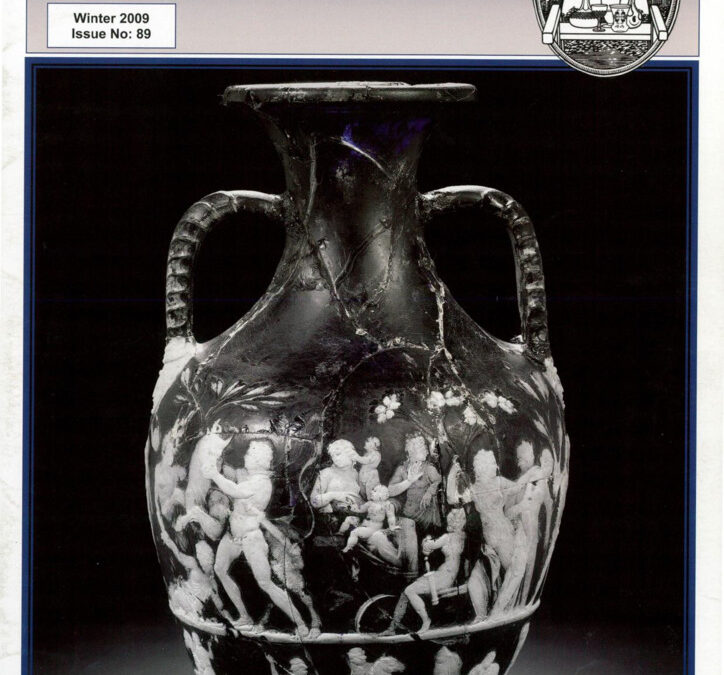
Roman Cameo Vase Discovery
11
Glassmaker’s Corner: Tolly Nason
12
Paperweight Corner
14
Malaga Museum of Glass
16
Goblets Galore
17
The Glass association AGM
19
Hailware—appeal for items
20
`And Then There Was The Glass’.
A visit to Ireland (10th-15th September 2009)
by members of the Glass Association
21
GLASS ASSOCIATION EVENTS
As we go to press, Committee are putting together the programme for 2010
(and looking forward to 2011). Further details, and booking forms for
spring events, will be found amongst the inserts with this Cone.
Saturday 6 March
Chelmsford Museum and the Tunstill Collection
of
18
th
Century glass—a guided visit with
Anne Lutyens-
Humfrey,
Keeper of Art.
It
is hoped to have a supporting visit in the afternoon.
For full details see flyer or contact Janet Sergison-
01732 851663
janetsergison@onetel.com
Saturday 24 April
“Swedish Glass in the 20th Century”
A presentation by Geoffrey Lawson at St. Mary’s
Church Hall, Walton St. Mary, Clevedon, BS21 7BX
2:30 pm to 5 pm; cost £6
For full details see flyer or contact Valerie Humphreys-
01275 877861
valeriehumphreys(&btinternet com
Saturday 19th June
Visit to the exhibition at Frome of the work of the late
Frank Hudson, introduced by Pearl Hudson
Further details will be available in due course (Valerie Humphreys)
-Date to be arranged
“A celebration of cut glass from the middle of the
20
th
Century” – a presentation by Maurice Wimpory
at the National Glass Centre, Sunderland.
30-31 October
Annual General Meeting at Bristol Museum
April 2011
Visit to Veste Coburg in Germany
OTHER SIGNIFICANT EVENTS
Scottish Year of Glass 2010
For further details go to www.scotlandsglass400.co.uk
or phone: Shiona Airlie on 07722 431 987
Biennale & International Festival of Glass
Stourbridge 28-30 August 2010
For an up-to-date list of forthcoming events & exhibitions visit our
web-site
www.mlassassociation.orzuk/news.htm
The opinions expressed in the Glass Cone are those of the
contributors. The aim of the Editorial Board is to cover a
range of interests, ideas and opinions, which are not necessarily
their own. The decision of the Editorial Board is final.
2
Membership & Subscriptions:
Individual: £20
Joint:
£25 Overseas (Ind/Jt): £28
Student:
£10
Institutional: UK £40; Overseas £50
Subscriptions are due on 1 August (for those joining May-July subs
are valid until 31 July of the following year)
ai
Fig. 1
Photo S. Hu
s .Australian Museum Collections
ARAFURA SEA
Toms Stroit
Womb
•
Darwin
GULF
Lan
,
K.
.,
adu.
AR
,
NHEM
Wyndham
•
I
LAND
OF
lealumbore
CARPENTARIA
Y
‘r
k
NORTHERN
Peninsula
KIMBERLEY
trtl,„
TERRITORY
Derby iimroy
Puhlululis (Bungle Bungle
)
Br•nme ,M
11,1alreei
INDIAN OCEAN
Billiluna .
i
hlulan • • US.
I
Willows
..d.^.
mo.loor… .
hlePPeF4
(…..
..
.,,,,,=:173;_ .:t;2,,z….-
Kicolo
ti
..Ponta
*
FAulp
sore
nn
WESTERN
Flinn
,
IAFrr4
RNA).
NRN”…
,
bRNS
CENTRAL
WESTERN
DESERT
VV.ARRURDAN
4.
r
.-
‘E
”””
a
‘
gml
•
• Indulkana
RANGES
LAKE EIRE
AUSTRALIA
SOUTH AUSTRALIA
•
Perth
vat.shan
y
oa
,
araa
SOUTHERN
OCEAN
Sydney •
canberra •
VICTORIA
Melbourne.
Reproclucedfrom Songlines and Dreamings ‘
by the late Patrick Corbally Stourton, with
permission of the publishers
Flinders Island
Hob
, TASMANIA
o
:110
zoo so*
.4,
SOUTH
PACIFIC
OCEAN
QUEENSLAND
Fraser
Island
Brisbane•
NEW SOUTH WALES
AUSTRALIAN INDIGENOUS GLASS ART:
A CONTEMPORARY MEDIUM FOR FLUID TRANSLUCENT DREAMINGS
One of many surprises
on our recent first visit to
Australia was discovering
exquisite art glass along side the
familiar bark panels, desert
paintings, and woodcarvings in
indigenous art galleries. On our
return home I could find only one
reference to modern glass
(Warburton Project) in recent
editions of books on Aboriginal
Art. So I searched the World
Wide Web and conversed with
participants to discover how
artists with such ancient traditions
were exploring a new medium. It
has also provided insight into the
cultural significance of the
imagery, which varies between
regions, tribes and clans.
The Australian art glass scene, as illustrated by the
membership of Ausglass, the National Art Glass Collection, Wagga
Wagga, NSW, and Canberra Glassworks, for example, is
progressive, dynamic and vibrant and benefits from the hybrid
vigour of its immigrants. Its international reputation is being
enhanced by recent contributions from indigenous artists.
History
European settlers introduced glass, along with ceramic
and metal, to the indigenous people of Australia. It contributed little
to the cultural life of societies that consisted primarily of small
groups of semi-nomads, but re-cycled glass rivalled stone for
ceremonial spear-points in the northwest. These beautifully finished
‘Kimberley points ‘
(Fig. 1)
were made by a technique, akin to flint
knapping, called pressure flaking, using a bone tool to fashion the
margins and point of the glass. They became sought after by
aboriginal exchange networks and as souvenirs, and are now highly
collectable.
In the 1960/70s, many modem materials and techniques
became available to indigenous artists, who were living in rural
settlements by then, or in the more urban environment of a multi-
cultural society. These new methods have revolutionised the
presentation of those parts of their heritage they wish to share with
the rest of the world. In particular, the production of permanent and
transportable illustrations of previously transient ceremonial
3
creations has provided cultural
enlightenment and spawned an
avid international collectors’
market, especially for paintings. It
is only in the last decade or so that
various indigenous communities
throughout Australia have
embraced working with glass,
which requires specialist
equipment and expert technical
demonstration, but the activity has
not always been sustainable in
remote locations.
Pictures and castings in
translucent glass have a different
light responsive resonance
compared to paintings and
carvings on the surface of board,
canvas, bark, rock, pottery or
timber. Unique visual effects can
also evolve during the fluid production processes, and both can
expand the creative possibilities available to traditional artists.
Subject matter
The cultural interaction with their environment and the
spiritual history of Australia’s indigenous groups is expressed in
their art through a combination of topographical and cosmic
‘dreamings’, traditional iconography and stylised figurative
representations of nature. Detailed interpretation of these precious
and frequently ceremonial images, which are passed on by the
custodian elders to succeeding generations, appears in the
accompanying bibliography. The modified expression of these
subjects, particularly by younger urban artists, often reflects and
comments on a wider experience of contemporary Australian life,
and indigenous motifs abound in modern Australian design. The
burgeoning, lucrative ‘Aboriginal Art Market’ provides unique
masterpieces, limited editions, and tourist, mass-produced,
somewhat caricatured items, locally termed ‘Airport Art’. It is not
without controversy, especially concerning authenticity, cultural
intrusion and insensitivity, the inclusion of foreign images and
styles, and attempts to rationalise its relationship to Western art
history’s critical values.
Organisation
Some artists work in community-owned art centres, whilst
others are based or work as visiting artists in commercial studios
that may not focus entirely on indigenous glass pieces. The rural
Art Centres usually employ commercially experienced coordinators
from outside the community, as those receiving government
subsidies are expected to produce revenue from their creative
activities. Much of the completed work is exhibited and sold
through a network of galleries and few end purchasers have direct
dealings with the originators. Pieces come with certificates of
authenticity but are usually unsigned. Fusing, slumping, painting
(enamelling), sand blasting and casting are the most frequently used
techniques, whereas glass blowing is in its infancy. Two groups
(Warburton and Wathaurong) make large glass panels and similar
architectural units as well as decorative objects.
The Glass Cone—Issue No: 89 Winter 2009
Fig.
r
2:
\
Two men hunting two goannas. Myra Lawson
I
Community Art Centres
1
Most community based projects have been inspired by
grant funded workshops, led by visiting experts who have
encouraged established painters and carvers to explore glass as a
vehicle for expanding their creative activities, whilst providing an
extra revenue stream to support their community. The experiences
of Kirstin McFarlane’s group with the Warlayirti Artists
Community in the Balgo Hills, WA, and Luna Ryan’s work with
the Tiwi Island artists, illustrate the rewards, practicalities and
complexities of successful intercultural collaboration.
The first community project, making architectural panels
and cast bowls, was started at Warburton, WA, in 1995, and still
flourishes as illustrated in a recent exhibition (2008) at the Mining
Hall of Fame in Kalgoorlie, WA. The Tjulyuru artists, initially
encouraged by Gary Proctor, now tell their stories in large, clear
slumped glass panels using foam cut-outs to create the required
voids during the heating of the glass sheets
(Fig 2).
They also make
coloured bowls and small platters, whilst younger artists are
experimenting with jewellery and computer wire inclusions.
The Melbourne glass artist Kirstin McFarlane was one of
a group of experts who helped to establish a fused-glass studio in
the Warlayirti Artists Community (Wirrimanu), Balgo Hills, WA in
2001. Her magical account of these workshops and the subsequent
ones (2002), which created slumped glass versions of wooden
carrying baskets called coolamons, describes desert community life
850 kms north—west of Alice Springs and the practicalities of
introducing them to technology. Using Bullseye glass powders,
flits, stringers, rods (sliced to produce ‘dots’) and clear and coloured
sheets, the artists translated their famous paintings into fused panels
(Fig
3). Coolamons were made by allowing these panels to slump
Fig. 4: Pukumani Poles: Buffalo Horns
and Fighting Sticks. Jock Puau#imi
Fig. 3: Glass tile: Tjumpo Tjapanangka. Courtesy Belinda Cornish
through a ceramic mould and the subsequent curved glass was cut
into the oval coolamon shape using a diamond saw and the edges
polished. This initiative was supported by a grant from the
philanthropic Myer Foundation until 2006, but has since been
difficult to sustain and, according to Belinda Comish of Gecko
Gallery, Broome, WA, the artists are concentrating on painting. The
limited production of these pieces makes them highly collectable
for their creative vitality as well as their historic significance.
Dutch born Luna Ryan runs a glass practice at Australian
National Capital Artists studios in Canberra, ACT. In 2003 she was
invited to introduce glass casting techniques to the artists of Nguiu
on Bathurst, one of the Tiwi islands north of Darwin, where
Fig. 6: Cup and Vases.
Roseanne and Marie Ellis
Fig. 5: Vision offragile Eden series. Luna Ryan
The Glass Cone—Issue No: 89 Winter 2009
4
Studios
Indigenous artists make
glass objects with aboriginal themes
in urban studios and workshops,
often as joint ventures with the
commercial galleries found in all
major Australian cities and many
provincial towns especially in tourist
g
.
areas.
woodcarving flourished, and pottery techniques and kiln technology
had recently been acquired. The profound effects of this experience
and further visits in 2004 and 2006, as related by Ann Mc Mahon,
were similar to those documented by the Balgo group. It resulted in
friendship with Jock Puautjimi and collaboration on several joint
exhibitions (e.g. Mamana Mamanta 2007; 2009-10). Carved and
painted wooden Pukumani funeral poles are an essential element of
Tiwi culture and are part of Jock’s repertoire along with ceramics,
painting and printmaking. Luna’s guidance in mould making and
casting in glass has allowed him to explore new colours, and to see
into these poles revealing their inner life, with stunning and moving
results
(Fig. 4).
Similarly her contact with him and the Tiwi people
is
reflected in the iconography of her latest work which includes
kiln cast, recycled television screens
(Fig.
5).
Recycled glass was also used by Central Australia’s first
indigenous glass blower Tony Palmer at the Amoonguna Arts
Centre, NT. The painted and etched bowls, cups and vases
(Fig. 6)
decorated by local artists, such as Marie and Roseanne Ellis, who
were being trained in Venetian hot glass techniques, were first
exhibited at ‘Mwerre Alpeme’ (Good Return) Inaugural
Amoonguna Arts Festival, June 2008. This initiative has since
ceased with the departure of the coordinator Chris Simpson.
Wathaurong Glass & Art was formed in North Geelong,
Victoria, in 1998, to express aboriginal art in glass. It is a not-for-
profit commercial factory and not an Art Centre. All the staff are
aboriginal and the Warthaurong community benefits from the
proceeds. Mostly using kiln forming and sand blasting, it specialises
in architectural features such as windows, doors and partitions that
incorporate indigenous motifs, as well as decorative platters and
sculptures
(Fig. 7).
The company’s many prestigious installations
include a TV studio for the 2000 Sydney Olympics and it also
accepts non-ethnic commissions.
s
r
The Glassmob group
set !”
up by Paul Saunders, Sam Juparulia
and Summer Saunders (originally
as
Bonegilla Glass in 2000) based in
a
L
40-acre complex in Albury, NSW, is
a good example. They teach and
mentor local artists, and visiting *
artists such as the desert painter,
Dorothy Napangardi from
Yuendumu NT, and Rachel
Malthouse whose work uses totems
from tropical north Queensland. In
2007, in collaboration with Gecko
Gallery of Broome WA, they held
a
glass workshop for the Kudjina
community at Millijidde Station in
the desert 600kms south east of
Broome to explore the practicalities
of glass manufacture in another
remote location.
In addition to producing small, modest bowls, dishes and
platters, the group have created unique studio pieces such as
enamelled coolamons and shields depicting bush tucker and
traditional Wiradjuri stories by Robert Murray
(Fig. 8),
platters
exploding with colour illustrating bush tucker by Gay Baker, and
plates by Matilda Charles which depict the Bogong Moth and
Mugabereena meeting place
(Fig 9).
Glass poured directly from the
Fig. 8: Birik Water Spirit
Coolamon.
Robert Murray. Glassmob
.
Possum Skin Cloak 1.5m x .8i
•
Fig.
7:
ILathatirong Glass and Art
Fig. 9: Mungabereena plate. Matilda (Josie) Charles. Glassmob
The Glass Cone—Issue No: 89 Winter 2009
•
Fig. 14
Travelling
180 X 370MM
Fig. 13:
Goanna bowl.
Yibi. Studio 8 glass
The Glass Cone—Issue No: 89 Winter 2009
Water
180 X 370MM
Desert Water
180 X 370MM
MS 01 :
Campfires
furnace is manipulated in
its hot state by Rachel
Malthouse to produce the
protection shields
(Fig.
10)
and coolamons of her
Blue Ochre project. The
images are from her
ancestral home in
Atherton Tablelands near
Mareeba, QLD, and were
passed on to her by her
mother, the renowned
indigenous artist and
educator, Jennifer Herd.
The platters, message
sticks, dichroic jewellery
and coolamons/shields
made by the artists
represented by the True
Blue Gallery in
Fremantle, WA, are less
busy than Glassmob’s.
They use simpler, elegant
iconography to illustrate a single event such as campfires, travelling
or water on each piece
(Figs. 11, 12).
The platters can be used as
food trays and are also available with animal motifs.
•
•
. • •
More elaborate, multi-coloured animal images are
depicted on bowls and plates in the ‘Yibi Legends’ series
(Fig. 13)
offered by Studio 8 Glass, QLD. They are created using layered
lead-free, hand cut, coloured sheet and crushed glass, in
collaboration with local indigenous artist Yibi.
The multi-talented
Atictute artist, educator, and
champion of Aboriginal
development, Jenni Kemarre
Martiniello has added glass
objects to her literary, print,
photography and textile
work in recent years
(Kemarre Arts). Her wide
range of traditional subjects,
inspired by her Central
Australian ancestry, are
illustrated, using vitreous enamels, mostly on recycled glass panels,
plates and bowls
(Fig. 14: a candle
–
holder).
Her jewellery includes
Venetian styled glass beads.
Future evolution
Each July, to mark Aborigines’ Day, the National
Aboriginal Islander Day Observance Committee (NAIDOC)
organizes celebrations and public displays. In 2008, this
was
celebrated in Tuggeranong ACT, with an exhibition at the
Tuggeranong Arts Centre entitled
‘Postcards from the Referendum,
IndigiGlass 08’.
It was sub-titled ‘visions for new directions in
glass’. During the first residency of Aboriginal artists at Canberra
Glassworks, Jenni Kemarre Martiniello, Lyndy Delian, Renee
Smith and Belinda McDowell mastered techniques including
blowing, casting, etching and bead making. They used these new
Fig. 10: Mbarba
.
1)
42t1(2,
Shield. Rachel
River
180 X 370MM
•
•
•
MS 02 :
MS 03:
Campsite
Travelling
Hunters
skills to make pieces which reflected their feelings about the 1967
Referendum in which 90% of Australians voted to remove
references in the Australian Constitution which discriminated
against Aboriginal people. 27 of these works were acquired by the
National Museum of Australia to be part of their permanent
Referendum collection. Blown and cold worked glass piti
(coolamons) showcase their new found skills
(Fig. 15).
A
captivating film of this project is available on the Tuggeranong
arts
website. Following this success, 13 other indigenous artists have i
ll
held residencies at Canberra Glassworks . Ten of them exhibited
in
`Old Cultures, New Rituals; IndigiGlass 09′,
at Tuggeranong Arts
in December 2009.
6
River and Waterholes
180 X 370MM
10
11
7
11
:
q1
9
113C1
•
• ” •
River
180 X 370MM
Figs. 11 & 12: Glass Platters & Glass
Message Sticks. Trueblue Gallery
MS 04:
Emu Tracks
Fig 16: Enee, Meanee, Minee, Mo. Yhonnie Scarce. Courtesy of Museum and Art Gallery of the Northern Territory, Darwin
Yhonnie Scarce is a prize winning glass artist and was the
first indigenous glass blower in Australia (now joined by Tony
Palmer and the
IndigiGlass 08
group). She is doing a Masters
degree in Fine Arts by research at Monash University. On receiving
the Qantas Encouragement of Australian Contemporary Art
Award she gave an insight into her artistic objectives: ‘I try to
recreate objects from the traditional environments of Indigenous
people and present them in a way that is creative and pushes the
boundaries of what we consider to be art representative of
Aboriginal people. In my work I try to achieve the perfect balance
between the European artistic medium (blown glass) with
traditional Aboriginal concepts and objects’. This is well illustrated
in her interpretation of the derogatory rhyme
Enee Meanee Minee
Mo’ (Fig. 16).
As more indigenous students and those from multi-
ethnic backgrounds emerge from art education systems the
opportunities for new ways to express their traditions and culture
will appear. Let us hope some of them discover our pleasure in
glass.
Roger Ersser
Special thanks are due to Paul Saunders, Luna Ryan,
Jenni Kemarre Martiniello, and Belinda Cornish for sharing their
knowledge, and to the artists and their representatives, who retain
the copyright to their images.
References
Aboriginal Art (1998):
Howard Morphy
Phaidon Press Ltd. London.
Aboriginal Art (second edition 2003):
Wally Caruana
Thames and Hudson. London. ISBN 0-500-20366-0
Oxford Companion to Aboriginal Art and Culture (2000):
S. Kleinert & M Neale (Eds);
OUP, Melbourne.
ISBN-10:0195506499; ISBN-13:978-0195506495
Songlines and Dreamings, Contemporary Australian Aboriginal
Paintings (1996)
Patrick Corbally Stourton.
Lund Humphries, London. ISBN 0 85331 691 0
McCulloch’s Contemporary Aboriginal Art; The Complete
Guide (2008).
Susan McCulloch and Emily McCulloch Childs
Australian Art Books. PO Box 2482 Fitzroy, VIC 3065,
Australia. ISBN 978 0 98044 942 6
The Australian Association of Glass Artists
www.ausglass.org.au
Balgo Glass: Kirstin McFarlane
www.craftculture.org/world/balgoglass.htm
Tiwi Glass: An Intercultural Collaboration:
Ann McMahon
www.craftculture.org/Review/mcmahon6.htm
Mamana Mamanta — Gradual Friendship.
Luna Ryan/Jock
Puautjimi
www.craflact.org.au/exhibitions/2007EX8G2
From Stone to Glass: Australian Museum Collections
www.amonline.net.au/collections/aboriginaUstone.htm
Art of Glass — Warburton Exhibition at Kalgoorlie 2008.
Rebecca Mclaren
www.abc.net.au/locaUstories/2008/08/12/233085.htm
Links
Amoonguna Arts: www.amoongunaarts.com.au
National Art Glass Collection
www.wagga.nsw.gov.au/html/426
–
national
–
art
–
glass
–
collection.asp
Canberra Glassworks: www.canberraglassworks.com.au
Glassmob: www.glassmob.com.au
Gecko Gallery: www.geckogalley.com.au
Kemarre Arts: www.kemarrearts.com.au
Kirstin Mc Farlane: www.kirstinmcfarlane.com.au
Myer Foundation: www.myerfoundation.org.au
Studio 8 Glass Australia: www.studio8glass.com.au
Tiwi Design: www.tiwiart.com.au
True Blue Gallery: www.truebluegallery.com.au
Tuggeranong Arts Centre: www.tca.asn.au/naidoc
Warburton Arts: www.warburtonarts.com.au
Wathaurong Glass & Art: www.wathaurongglass.com.au
Yhonnie Scarce
•
www.unisa.edu.au/art/undergrad/glass/yhonniescarce.asp
www.monash.edu.au/news/monashmemo/stories/20080625/glass
The Glass Cone—Issue No: 89 Winter 2009
7
Figure 1: Hyacinth vases in all shapes
and sizes, Daphne’s amber vase in the centre
HYACINTH VASES
Discovering hyacinth vases
I absolutely adore hyacinth vases. I first saw them in 1982
when I met my future mother-in-law, Daphne. She had hyacinths in
bloom indoors in February in special vases holding the bulb above
water with the roots growing into the water. I had never seen such a
thing and their scent was intoxicating. Daphne had (what I now
know are) vintage hyacinth vases: amber and cobalt vases in squat
bulbous shapes, also referred to as “Tye” (more below). I was
enchanted. I loved them. I wanted some. I had to have some but
there weren’t any for sale anywhere, new or antique. The early
1980s was a very grim time if you wanted to buy a hyacinth vase,
which are also called hyacinth/bulb/forcing/rooting jars/glasses/
vases. It was rare to see one at an antique shop, but
I
finally saw
vases. I was delighted I could actually buy more examples of the
beautiful cobalt blue vase Daphne had, but I still knew very little
about them and their history. Someone mentioned Tye to me and
said those were most sought after. Well I’d bought a couple of Tye
vases on eBay but the seller never even mentioned it, nor did I
know anything about Tye, such was our naivete. So just what is a
“Tye” hyacinth vase? It’s a moulded, not hand-blown, vase
stamped on the bottom: “G P Tye” in the centre and “Gt Charles St
Birmingham” around the edge, and because most vases are not
marked by a manufacturer this one has become famous. Some are
also stamped “1850”, the date of Tye’s first of two patents, the other
being 1852. A number of manufacturers, producing both moulded
and hand-blown vases, used Tye’s distinctive shape, and it became
some at a “junk” shop on Hayling Island, where Daphne lived,
called Reggie’s: three clear 1950’s vases
(one of them is in Fig. 1,
ringed).
Of course I bought those but it wasn’t until eBay 15 years
later that I found any more vintage vases. In the meantime new
hyacinth vases started to be sold again in the UK. I snapped up all I
could find—plastic, glass, different shapes and sizes—and tried
forcing hyacinths with varying degrees of success (see my tips for
successful forcing below).
Discovering antique
hyacinth vases
When I started using eBay I discovered antique hyacinth
The Glass Cone—Issue No: 89 Winter 2009
very popular, although Tye may have copied an existing shape.
Figure 2
shows a blue Tye vase (note the smaller rim) in the
middle, surrounded by other bulbous vases which were
manufactured from the 1850s until well into the 20
th
century with
slight variations in shape, size and colour, although the colours
shown: cobalt blue, amber, amethyst, green and teal were the most
popular, and are fairly common now on eBay. Tye’s innovation
was to include a metal support that could hold the stem when the
hyacinth flower got large and heavy and prone to fall over. Barr and
Sugden were Tye’s London agent and offered his vases in their
catalogue:
“Tye’s Registered Drawing-Room Hyacinth Glasses and
Supports. It is our duty to caution the public against the
vile imitations of Tye’s Registered Hyacinth Glasses.
Cheaper, certainly, the imitations are; but they are
wanting in that exquisite symmetry of form possessed
in so eminent a degree by those bearing Mr. Tye’s
registered stamp, while the decorations are vulgar in
the extreme.”
(See
Fig. 3
which shows a page from the
Barr and Sugden 1870 catalogue with Tye vases with
bulbs and then extending their use with flowers.)
George P. Tye
George Piercy Tye is famous for his hyacinth vase
designs but very little else is known about him. His
obituary in the Gardeners Chronicle (1 February
8
TYE.S REGISTERED DRAWING-ROOM HYACINTH GLASSES.
This illostniion is
to sh01. emir
and cleanlier Way, and might be more acceptable to the Curious o
the Fair Sex, who must be highly pleased to see a Garden Growing,
and exposing all the Beauties of its Spring Flowers, with the most
delicious Perfumes thereof in their Chambers or Parlours;
a
Diversion worthy the Entertainment of the most Ingenious”.
It
sounds like we have Furber to thank for popularising forcing bulbs
on water.
4a
[Rap, ao.1 Stegvto,,
tri
m
Tyvs
REGISTERED DRAWING-ROOM IIYACINTN GLASSES AND
SUPPORTS.
ThWitt
.„10,7;
77
lircintl6 6n motet.
nett
.
rio. 1.
WIA1 S11,011 /
/.16 16,6
to t3.1
– 3 6
‘
3
ft
3
6
a
66
to
‘
:6
1
o’ ‘n
I
; :
7 ‘d
1
7
‘
o
70
3
‘
.
x 6
Q 6
,
6
4
,
o
„ Alabaster,
/4.
solitr, ulm Afxc foot plow
, Tranaparott, Ma,
pro+,
pAo#7
0,4
.„
o
q 0
o 5
Sopprot6
for
NO.
t. y. par clown, 6r
6
. mob No.
oath
No
3, 3e. too& to. 63. Pot 40=3.
liyaa,11111 Glasse,
.±,t,tiftd it ay.tosetlo,
Hyacinth
wsesps,
yaloOn
,
.r lee t
Oilt 0064
aata 050400.
Itime P,…porot
Transpwren
To
t.
66
‘,
6,
6
,
• •
Plain 016.63,
…dr,
am °pupa,
axe or pyrr,
4.4o,
–
r
–
1879) does not even give his date of birth, nor does his entry in the ,
Dictionary of British Botanists and Horticulturists which describes
him as
“Die-sinker. Devised Improved Registered Hyacinth Glass c.
1852. Secretary Handsworth Floral and Horticultural Society”.
From 1855 to 1876 he is listed in White’s Directory Birmingham as
“Die & Seal Engraver, 107 Great Charles Street’.
He is not listed ,
in 1878, and in 1880 there is no listing for 107 Great Charles St.
However, in 1878 there
is: “Tye, George S. die sinker, press tool
maker and stamper and piercer, 41 Caroline Street’.
George Tye’s
son went into business for himself? Certainly it doesn’t look as if
glass was his main business. (Thanks to Mike Jee at the
Birmingham History Forum for the White’s Directory information).
History of hyacinth vases
Although there are a number of bulb vases in Dutch
museums, there are hardly any in UK museums and a
corresponding lack of information about their history. There may be
one hyacinth vase in one of the room displays in the Geffiye
Museum although I’m not certain. There are no hyacinth vases in
the Broadfield House Glass Museum. The Victoria and Albert
Museum has one hyacinth vase (or at least they think it might be) in
storage but there’s no photograph of it. The Museum of Garden
History has no hyacinth vases. John Smith (in his fantastic article in
a 2004 issue of the Journal about hyacinth vases) mentions a Tye
vase at the Birmingham Museum and Art Gallery which I can’t
wait to go and see. I think part of the problem here seems to be that
hyacinth vases do not fit neatly into a category. They are not the
typical piece of glass in a museum (often drinking glasses). They
are not furniture in a decorative arts museum, although something
of a piece of home furnishing. They are not exactly a garden item
although they are all about growing flowers.
So what do we know about the history of hyacinth vases?
Barr & Sugden’s Illustrated Autumnal Floral Guide from the 1860s
notes:
“The cultivation of the Hyacinth in water came into fashion
in England as far back as the year 1734. Since then its charming
flowers, delightful fragrance, and easy culture, have secured for it
the most favoured place among our domestic plants; its name is a
household word associated with the most early recollections of
childhood; while its period of bloom, marking the retirement of the
dark days of Winter before the cheering influences of Spring,
connects it with the most hopeful and pleasant associations of life.”
So what happened in 1734? I assume they refer to
“A Flower-
Garden for Gentleman and Ladies”
from “The Flower Garden
Display’d” by Robert Furber, published in 1734. He experimented
with forcing flowers in soil very successfully so, he writes,
“I
thereupon, resolved to attempt as early Productions, by the Effects
of Water only, that is without Earth, which would be a much neater
9
It was though almost a hundred years after Furber started
his forcing that dedicated hyacinth vases were produced, in the late
18
th
Century (Furber used cork to hold the bulbs up), the earliest
being the tall chum shape (see
Figure 4)
with shallow cups,
prominent kick-ups and snapped off pontils common of hand-
blown glass of the period. Cobalt blue was the most popular colour
although they were also made in green and amethyst. The cups
started off quite shallow and later became larger and deeper. Since
then there has been an enormous variation in vases with a myriad of
shapes and sizes, the common features being a cup at the top to hold
the bulb above the water and enough room in the vase for the roots
to develop fully (see
Figure
5 for a range of vase shapes, sizes and
colours from Victorian to modem).
Who used the antique hyacinth vases I love?
If the Victorian catalogues are to be believed, everyone!
Forcing was a pastime shared by “the
wealthy and lower
classes”
(Mrs. Loudon’s
“Gardening for Ladies”,
1843).
“The
Hyacinth, from its beauty and ease of culture, has obtained
complete and universal acceptance with all classes. As an in-door
plant it may be grown in many ways, and in vessels of almost any
The Glass Cone—Issue No: 89 Winter 2009
Figure 6
60
HOOPER A P0. SEEDAMEN, •DV7IIT 0..011gN.
ORNAMENTAL SPECIALITIES.
/Oh GROWING RULES AND OTHIR PLOWER/I
HYACINTH GLASSES.
4
0
4
4 6
worts a
Co.
samalaw, covicyr caRtax, tosios,
ETRUSCAN
HYACINTH
VASES.
utd
adapted for growing bulle
og
d.*
in Wats.
No.
Per
6A,
with black trachtE.,
noltut
3 6
Ore Maws, With banters
teloarad
5 0
Fame pattern, Iowa richly de-
costal
6 0
Tslk. Tatters, richly &bonged 0 0
with white
gatm
on black
7 0
Taint? No. 2.
TRIPLETS.
Each—R. d.
.-11
,
11
ground, nirrly
decorated
7 6
Si,. —Rot ground, nicely
decanted
6 0
N.
n.
Noa 1 St 0
6
Per pa
d
ir.
.
Ruby, gilt lines
3 6 3 6
3 6
RabY, gilt decoration
4 0 4 0
Tunis., plain
.
., 0
6
Row.
Tun
lai
mo
n
p
ue. gilt
1
…
0
4 6
2
,
0
,
Eats gilt
s o
mot., lain
0 0
Alabaster, ea
4 6 4 0
Alabarter, painted
7
Dial, painted with Bowels
4 0
TILL(A.1 enamel ground, sea green, yellow, sod ‘Auk, i
4
punted wit/s flowers
1 il
tor ua num puta, bloc, green, and amber, plain
Photograph of a group of patterns may br WO for Inspoetion, returnable within
or If kept, 3s. sack.
TRIPLE STACIE= 01.43110.
Clew colon” as above, is M. each, N. ed. per pair.
HYACINTH IOPP0111.
Per /Shape Na A k pads. j For Shame 1, 3, 3, 4. 64. per doe. For Td
Clang OZANNE,
ad.
rat
pair.
TYNE
mann
(Shape No. 0)
ORNAMENTAL, d Arilai NETS,
&C.
SQUARE SUSPENDER
NEW RUSTIC JARDINET FOR
St.11
t
for Foos, Rolla, to.
BULBS OR FERNS.
.,
or elopnt .
it
64., 9dadt,
Diameter., 12„rwh,
Go.
• ts•e.A.
bd.; 6.anni, 2s. 6d..•
6. oh/
14•ins.A, 8.. 6d.
Other oath les In the same more, sue!,
these Pots, Roaparniers,
ilee hr. •
uarden or Conserrotory Seale, Los/tat/on of Oak Smug., 10… 04. each.
IAREDIRTII
1711710AR WARN. From Rs. sorb.
IARDINITII IN WIDORWOOD. 17.. 6d.
7 0
,
o
The Glass Cone—Issue No: 89 Winter 2009
cheerful by its smiling presence, and fragrant by its sweet
odour. It is not difficult to account for this universal
adoption of the Hyacinth as the queen of indoor flowers.
Its superlative beauty is such as to elicit an epithet of
admiration from the most indifferent; couple this with the
fact that it may be grown by the most inexperienced, and
under almost any circumstances, and it may be easily
understood why it is that the broad acres of Haarlem are
so brilliant with Hyacinths in the month of May, and the
importations of their bulbs into England amount to tens of
thousands annually.”
(Another Hooper catalogue, early
1860s).
How to force hyacinths using hyacinth vases
Sadly my mother-in-law passed away and I inherited her
hyacinth vases, as no one else in the family had the
interest or patience to put them to good use, and you do
have to have patience and be organised to force hyacinths:
1.
buying the bulbs in August,
2.
preparing the vases and putting them in a dark
cool environment in September,
3.
checking them regularly for 3 months and
4.
bringing them out into the warmth and light in
December or January.
But one is rewarded magnificently for the work when
you
have those flowers in bloom in the middle of winter and the house
is filled with their intoxicating scent. The stand of hyacinths had
visitors stopping in their tracks in the Pavilion at Chelsea this
year
when the smell of hundreds of hyacinths in bloom hit them. Sadly
the person on the stand knew nothing of forcing them using vases.
The two keys to success with forcing hyacinths are the
dark, cool environment, and
waiting until the bud is fully
out
of the bulb before
bringing the bulbs into the
heat and light. A friend gave
me an old fridge to put in my
cellar so I can ensure the
temperature is correct for the
cold period. This may be
essential in the future with
climate change as we cannot
rely on cool weather in the
autumn. Further information
Please see my web site for
more information and
images of hyacinth vases:
ww.hyacinthvases.org.uk.
I’d love to hear from anyone
else who collects hyacinth
vases, especially images of
their vases which I could add
t to the site for everyone to
enjoy.
Julie Berk
10
description that are capable of containing mould, sand, moss or
water.”
(Hooper & Co, Seedsmen, Covent Garden, London
Autumn Catalogue, 1874, see
Figure 6
for some of the hyacinth
vases they sold). Much appreciated in urban areas in the 19th
century:
“In the most confined streets of London the Hyacinth may
be seen blooming as magnificent4, as if surrounded by all the
advantages of the open country, and displaying ungrudgingly for
the delight of its city cultivators charms which most other plants,
even though indigenous to our own soil, cannot be induced to
reveal”
(Barr and Sugden’s Guide, as above).
“Of all ‘household
flowers doubtless the Hyacinth is the most important. It is grown
everywhere, and by almost everybody; indeed, so great are its
claims upon the flower-love of the public, that there is scarcely a
house or home which has not, at one time or other, been made
In October last Bonhams specialists announced that they
have identified a magnificent Roman cameo glass vase which may,
they claim, be the most important of its kind in the world. Chantelle
Rountree, head of antiquities at Bonhams, said: “It is of major
international importance. Academically and artistically it is
priceless. Scholars will be evaluating this find for decades.”
The vase dates from between late 1s` Century B.C. to early
1s
t
Century A.D and stands 33.5cm high. Only 15 other Roman
cameo glass vases and plaques are known to exist today. These
very rare vessels were highly artistic, luxury items, produced by the
Roman Empire’s most skilled craftsmen. They are formed from two
layers of glass — cobalt blue with a layer of white on top — which is
cut down after cooling to create the cameo-style decoration.
Items of this kind were produced, it is thought, within a
period of only two generations. They would have been owned by
distinguished Roman families. Until now, the most famous example
has been the Portland vase, held by
the British Museum. This is smaller,
standing at only 24cm high. It
is
also missing its base and has been
restored three times.
The recently identified
vase is also more complex than
others of its kind, being decorated
with around 30 figures and a battle
scene around the lower register. By
comparison, the Portland vase has
just seven figures.
Bonhams experts believe
that this magnificent artefact could
rewrite the history books on cameo vases. Unlike the Portland vase,
it still has its base and lower register and will therefore add
significantly to the archaeological understanding of these vessels.
Bonhams are quoted as saying that “there is no doubt
about its authenticity”, but, in co-operation with the present owner
of the vase, are carrying out detailed research into the historical
background of the vase and its miraculous survival, as well as into
its more recent history and chain of ownership. The research will
include chemical analysis of the glass, and study of the engraving
technique, to see whether the vase came from the same workshop as
the Portland Vase; initial indications are that it was not engraved by
the same skilled craftsman. There will also be study of the
iconography: mistakes or anomalies could indicate a forgery.
The vase was presented publicly for the first time at the
18
th
Congress of the International Association for the History of
Glass in September. The presentation created huge excitement
among delegates, who were drawn from
the world’s leading museums and
cultural institutions.
They, and we, are eagerly awaiting the
results of the research, and the
restoration of the vase (incredibly, some
of the glue used in the current assembly
of the vase has been coloured blue
simply with a felt-tip pen!). If its
authenticity is established, it really will
be
the most important piece of glass in
the
world, and the sky is the limit when
it
comes to auction!
RW
11
The Glass Cone—Issue No: 89 Autumn 2009
GLASSMAKER’S CORNER: TOLLY NASON
Occasionally, an artist emerges who is instantly
recognisable as a major talent. One such is Tolly Nason, a glass
artist and photographer who has been making a name for herself in
the last year.
I first briefly met Tolly Nason around five years ago when
I visited Layne Rowe’s then studio in Knebworth, Hertfordshire.
1
She was experimenting with sandcasting in a bucket, as I recall.
A few years later in 2007, we attended a combined show
by Layne and Tolly which they held at her studio, The Ark’, in
Abington, just south of Cambridge. The exhibition was entitled
`Ray of Light’ and included glass and photography. Tolly, as the
photographer, had taken images of Layne’s work and included them
. , in the exhibition. Visitors could see and hold a piece of Layne’s
°w work and then look at Tolls photographic interpretation of the
same piece. It was at this exhibition we first saw examples of
Tolls pate-de-verre work which has become central to her glass
art.
It was an evening which left a lasting impression on me. I
have long admired Layne Rowe’s work, but here was another glass
artist who was very obviously going to make her mark.
In February 2009, Tolly decided to exhibit her glass at the
Cambridge Glass Fair. I was very pleased to receive her
I
application. Her display was very well received by the public. It
was fresh and different. Throughout most of the day her stand was
surrounded by people both looking at the display and waiting to talk
to her about her work.
Whilst much of her work is free-flowing and
imaginative, she also loves to replicate in glass parts of an extinct
natural world. She has in the last two years made a series of cast
Dodo and Great Auk beaks. All are accurate representations with
the measurements taken from museum exhibits. She has now taken
this side of her work to a new level.
Her work also made an impact on other exhibitors with
its refreshing originality. Adam Aaronson, who was also exhibiting
at the show, took her
‘Whimsicals’
range to Sofa, New York, where
they were snapped up by American collectors.
These fragile pate-de-verre pieces appear too delicate to
touch. They differ in colour, shape and size and are ideal for
collectors to put together their own arrangement.
Tolly’s consuming
interest in the natural
world has heavily _
influenced her art. In the
medium of glass this can
be seen in her
pate-de-verre
‘Whimsicals’
and
‘Ice
Bowls’
that look like
melting ice.
Fig. 2: Ice Bowl
Her combination of
the image of a delicate and fragile coral growing out of the solid
rock on a seabed. In this series she is exploring the relationship of
the living with the non-living and how they become intertwined and
glass in her
‘Living Rock’
range is particularly striking. They evoke
interdependent.
pate-de-verre and cast
The
Glass Cone—Issue No: 89
Winter 2009
Tolly has recently completed her biggest and most
important exhibition yet: ‘Seeing the Light: Finch by Finch’ at the
University Museum of Zoology in Cambridge, as part of the
Darwin 200 year anniversary festival. Tolly had long wanted to
stage an exhibition of finch beaks as part of the 2009 Festival but
only got the go-ahead when the Director of the Zoological Museum
was able to see her work when she exhibited for the first time at the
Cambridge Glass Fair in February.
For this self-funded exhibition she cast the beaks of
fourteen Galapagos finches in striking red glass. They are 20 times
actual size, and were displayed in a line on lit plinths across the
lower-ground floor of the museum. The finches were integral to
Darwin’s Theory of
Evolution, and these cast
finch beaks provide
an
artistic
introduction to
the science of
Charles
Darwin.
Fig. 4.•
Dodo beak
(amber)
12
•
:
5:
Tally working
0/7 a
clay mould
Fig. 6: Rubber mould
The process
Initially Tolly took
photographs, accurate measurements
and used scanning equipment to help
scale the beaks proportionately. She
examined the finches held by the
Zoology Museum, Cambridge, and the
Natural History Museum in Tring,
Hertfordshire. She also had to visit the
Natural History Museum in New York
to study the Mangrove Finch, as we do
not have a specimen in this country.
A clay ‘original’ was made
from all the data collected for each beak.
Once the clay had hardened it
was used as a positive to make a rubber
mould which enables multiple castings.
This involves creating a complex two-
part mould in plaster around the original
and the two halves of rubber are poured
through holes in the plaster.
When both halves were cured, the clay was removed and
the mould cleaned and fitted back together ready for the next stage.
Wax was then poured into the rubber mould. The larger
beaks can take up to forty hours to cure. Some of the moulds were
then so weighty that a small crane was brought in to move them
from one position to another.
The positive wax beak then needed working to perfect. A
plaster/silica mould was poured around the wax with a sprue’
added to the positive to allow enough room to stack the glass. Air
holes were also added to undercuts using wax or clay to make sure
the glass could reach all areas.
The wax positive was then steamed out
and any residue carefully removed.
The amount of glass needed was
calculated and the mould carefully
stacked with glass.
The kiln cycle was calculated and the
mould then put into the kiln for between
four days and five weeks depending on
the size of the cast Most of this time is
spent on ‘annealing’ — cooling the glass
down very slowly to reduce any stress.
The cast was then ‘de-moulded’ and
once it had reached room temperature
could be cold worked. The sprue was
removed using a saw or angle grinder
and the surface meticulously cold
worked. This involved the use of seven
different grades of diamond abrasives in
the form of an air-tool or hand-pads
followed by a final polish where
required. This last process can take
several days per cast to achieve the
desired effect
The project was massively ambitious for a relatively
inexperienced glass maker. Tolly managed, in the four months
allocated, to complete a project for which she really should have
been allowed around a year. When asked in an interview what is her
favourite piece from those she has made, she replied: “It has to be
the Galapagos finch beaks because of the sheer amount of work –
physical labour as well as mental ache! I knew I was being
overambitious, so Pm very pleased it’s worked out”
In the same interview Tolly was asked “If you weren’t a
glass caster, what other medium would you like to try?” Her reply
was: “I don’t know what I don’t try! I’d quite like to try precious
metal casting. If I hadn’t become an artist I would have liked to have
been in wildlife research spending most of my time in a tropical
rainforest somewhere…”
Tolly does not see herself as a glass artist She sees herself
as an artist who is currently working in glass. She has worked and
Fig. 7: ‘Seeing the Light: Finch by Finch’ at the
University Museum of Zoology in Cambridge
13
The Glass Cone—Issue No: 89 Winter 2009
continues to work in film and her degree is in textiles. Her
unconventional training and love of the natural world has allowed
her to create glass art that is refreshing and original.
A question that arises is what happens to art on the scale
of the Galapagos finch beaks when the exhibition is over? In this
case, Tolly informs me that she has sold several of the beaks. The
largest and the smallest have gone to Princeton University, New
Jersey, U.S.A., where they will be displayed in the foyer of the
Biology department. They are to be shown in a specially built
cabinet alongside information about Peter and Rosemary Grant’s
Kyoto Prize for their work on the finches. Peter and Rosemary
Grant, who are the world authorities on the Galapagos finches, saw
Tolly’s exhibition during the Darwin Festival and thought they
were spectacularl
There should be a place for at least one finch in our
Natural History Museum!
Paul Bishop
PAPERWEIGHT CORNER
New Type of Chinese White
Although most paperweight collectors will probably have
a few examples of Chinese weights in their collection, building a
collection of Chinese weights is not something that most would
contemplate. However there is one variety of Chinese weights that
in recent years has become quite sought after and today is quite
difficult to find: I am talking about what collectors call ‘Chinese
Whites’
featuring the 1930s era American style coach with a background of
mountains and a setting sun,
(Figure 2)
and a well-recorded weight
I featuring a clipper ship and Chinese warriors. The sizes of the
weights vary from miniature to magnum. On a recent visit to a
local gift shop that specialises in imported products we spotted
some flat domed weights with designs of birds, butterflies, shells
and a starfish set upon a thin white base. Were these what they first
appeared to be? Closer inspection confirmed that they were made
Thought to date from the 1930s this type of weight
comprises a white glass base on top of which are painted scenes
usually featuring flowers, birds, butterflies and the like painted in
typical Chinese style.
(Figure 1)
The technique involves the use
of heat-resisting paints which are not destroyed when the painted
base is encased in clear glass in the same way as the normal
millefiori or lampwork weights. Closer inspection of the painted
design will often show crizzling of the paint where it has been
affected by the heat of the molten glass of the encasement. There
are some more unusual designs that turn up, like the weight
of glass and the label on the base confirmed that they indeed were
made in China but instead of a painted picture like the earlier
weights these appear to employ the use of a heat resisting transfer
resulting in a much finer design. Like the original weights the base
is still white but this time is a very thin layer and the edge at the
junction of base and dome has been hand ground to remove any
roughness. The butterfly weight
(Figure 3) is
two and a quarter
inches in diameter and the bird weight
(Figure 4)
four inches in
diameter. The technique of using a transfer is nothing new having
been used for some years by the Italian weight makers on the island
The Glass Cone—Issue No: 89 Winter 2009
14
#•1 r; et/
e
Herts
Surrey
Cumbria
Middlesex
Essex
Hertfordshire
Lincs
Sussex
London
W Glamorgan
Somerset
Bucks
Worcs
Suffolk
Mr P Griffiths
Mr&Mrs D Barker
Mr S Cook
Mrs P & Mr S Fisher
Mrs P Holt
Mr W I Millar
Mr A Townshend
Ms C Hood
Mr A Radford
Dr A T & Mrs C P Mc Connell
Mrs J Doughty
Miss A Lutyens-Humfrey
Mrs V Glasser
Mrs G Wing
15
The Glass Cone—Issue No: 89 Winter 2009
come o new mem
ers
of Murano to produce such weights as those featuring the signs of
the zodiac, hot air balloons and pictures of cats, dogs and horses
(Figure 5).
It has been documented that Whitefriars Glass
also experimented with the same technique and a well documented
example features a picture of a ginger cat. My weight
(Figure 6)
is
similar in shape and size and features the usual Whitefriars button
formation on the underside but the subject is a bit different in that it
is a lady clad in Georgian style clothing. Memories of those who
worked at Whitefriars indicate that their manufacture seems to date
from the mid 1970s but how many of these type of weights were
made remains a mystery. From the few that have turned up to date it
is obvious that they were not made in large numbers. For further
information on these and other non-millefiori weights produced by
the company see the article by Dave Webber called
The Other Side
of Whitefriars
published in the PCA
Annual Bulletin
for 1997.
Richard M. Giles
MALAGA MUSEUM OF GLASS:
MUSEO DEL VIDRIO Y CRISTAL DE MALAGA.
The newly-opened
Malaga Museum of Glass is
housed in an 18
th
Century house
just outside the line of the
mediaeval walls of the city, in the
area in which the Arabs built their
pottery ovens. It occupies one side
of the Plazuela Santisimo Cristo
de la Sangre, opposite the church
of San Felipe Neri. Over the years
the fabric had deteriorated to such
an extent that the
municipality was bent on its
demolition, and several
years of negotiation were
needed to save and restore
it. It finally welcomed the
public on 1 September
2009.
The Museum
contains a private collection
of decorative domestic art
Eastern
mostly inherited or collected
Mediterranean
by the partners in the
oinochoe
‘ endeavour, Gonzalo
Fernandez-Prieto, Steven Sprague and myself. Essentially the
furnishing is such as may be found in a Spanish noble house. The
furniture, mostly dating from the 18
th
and 19
th
Centuries, comes
from various parts of Europe, much of it from France and Great
Britain. The walls carry a series of family portraits dating from the
17
th
to the 20
th
Centuries. The general theme in the placing of the
various objects has been to follow developments in domestic
furnishing over the past three centuries.
The Museum’s main collection of glass is placed on the
first floor of the house, as far as possible in its historical context, and
so maintains the appearance of a home as much as that of a
museum. The tour of the main floor starts in the library which is lit
by a pair of Baccarat chandeliers. The earliest pieces in the
collection are also in the library and come from the eastern
Mediterranean — first what is often labelled as Greek, followed by
Roman and then early Islamic glass.
The theme is taken up again by representative pieces of
17
th
Century Facon de Venise, Bohemian and Spanish glass.
However the strength of the collection is in glass from the 18
th
to
the 20
th
Century. First comes a collection of 18
th
Century English
drinking glasses, documenting the development of lead crystal from
simple balusters to engraved and facet-cut glasses, housed in an 18
th
Century Dutch cabinet.
Alongside this is a smaller
collection of the fine
engraved and gilded glass
of La Granja, the royal
palace a short distance to
the north of Madrid. The
dining room of the
Museum centres on
a
Wilkinson dining table
and Wedgwood china of around
1820-30, with complementary
early 19
th
Century glass.
In some contrast, the next room
contains 19
th
Century pressed
glass mostly by Sowerby, and a
collection of decidedly grander
Stourbridge intaglio and cameo
glass. The tour route then passes a
cabinet of late 19
th
and early 20
th
Century Whitefriars glass
designed by Philip Webb, TG
Jackson and, especially, Harry
Powell. The next room has
collections of Galle, Lague and
Val Saint Lambert glass as well as
Monart, Vasart and Strathearn
pieces. The final drawing room
houses a beautiful eighteenth
century La Granja chandelier as
well as — perhaps strange
bedfellows – Whitefriars vases by Hogan, Wilson and Baxter, and
European, mostly Czech, vases. As one leaves the main museum
floor there are further cabinets of post-war Whitefriars glass mostly
by Geoffrey Baxter and a cabinet of Scandinavian vases, with
representative pieces from a selection of the main designers for the
well-known firms including Kosta Boda, Orrefors, Iittala and
Holmegaard.
La
Granja,
Emil Galle, and Stourbridge
The ground floor of the house provides space for
entertainment of various kinds — from string quartets to flamenco
dancing. It also houses our collection of English religious,
institutional and domestic stained glass, with pieces manufactured
by Swaine and Boume, Whitefriars (designed by J Blackford),
AL Moore, and Curtis, Ward and Hughes (designed by George
Parlby) and Shrigley and Hunt (designed by Carl Almquist).
The Museum is currently open from 1 lam to
7 pm from Tuesday to Sunday, and the charge for adults is 3 Euros,
with reductions for children, pensioners and groups, the latter being
advised to book in advance. Up-to-date details are to be found on
our website www.museovidrioycristalmalaga.com, and we are
contactable by telephone 0034 952 221949 or e-mail
museovidriomalagaAgmail.com.
Ian Phillips
Façade and main
entrance o Museum
The Glass Cone
—
Issue No: 89 Winter 2009
16
GOBLETS GALORE
Peter Adamson made that move
from a collector in 18
th
Century glass to well
known dealer a number of years ago, when
early retirement left him the time to indulge in
his first & second loves — his wife Debbie and
his glass. The drinking glasses that “stuck”
with him and became his passion and major
collection were large goblets: English &
Continental, some engraved, others of glorious
design with sparkling grey metal. All a joy to
hold, behold and from which occasionally to
drink.
Peter was persuaded to show his
collection at the recent glass fair in Cambridg
e
what a stunning show the two cabinets of large
goblets made in the entrance! Leaving out the
discussion on whether “Newcastle” style glasses
were really all made in Newcastle and thus English,
there was one cabinet of 18 Continental glasses and
one of 32 English glasses.
When asked which goblets were his favourites,
Peter replied that he always found that very difficult to
answer, as all had “something or other” that made him
decide to add them to the collection, “though there are some,
which for various reasons I can select for special mention”.
From the Continental goblets the first he selected
was no.C2 in the exhibition, a massive ceremonial
goblet c1680, probably from the Netherlands
(Fig. 1).
This thinly blown, low lead content
goblet measures an impressive 121/2 in. without
its lid, and with its lid (which is soda and not original), 161/2 in.
“What I admire most in this piece is the skill that was obviously
17
required to create such a large item with
superb proportions and presence,
notwithstanding the fact, that when full, its
wonderfully spiked and gadrooned bowl has
a capacity of just over 2 litres”. Goblets of
this huge size were probably used at functions
such as marriages and would be passed
around for use in toasts.
His second was no. C16 in the exhibition, ‘A
Lauenstein Erotic Goblet’, c1750
(Fig.
2).
Standing 9 in. tall, this goblet in the English
heavy baluster style is excellently engraved with
a woodland scene, the composition being of a
hunting gentleman and a lady holding his gun!!
The lengthy script in Old German, engraved
around the rim of the bowl loosely translates to,
“We love the fingers under the Oaks and Firs,
cocking (!!) the hunter’s gun.” Peter added, “much
more so than English engraving at the time, the
continentals were very fond of producing ‘naughty
glasses’.” Not of lead glass, the pointed round funnel
bowl over a teared knop, over a teared inverted baluster
knop, with a high domed and folded foot is a typical
example from the Lauenstein Glasshouse.
His last selection from the continental glasses was no. C17
(Fig.
3). Designed to deceive, this glass is a composite,
constructed from 4 different parts, all roughly from the
same date c1680, though from different n
countries: the bowl is Bohemian, the stem
English lead glass, the bottom knop and foot
are also in lead glass but from different
glasses. Peter informs us “I was informed at the time of acquiring
this glass that it was put
together by a prominent
continental dealer for the
purpose of having some
fun with both collectors
and fellow dealers: for the
collectors it was shown as
an example of what you
must watch out for when
collecting those glasses
which look like very
interesting
early
examples, and that every
item must be examined
very carefully before
purchase. It was also on
-4.
display without a price
ticket and to this dealer’s
surprise, many visiting
dealers, in their haste to
get a price without
carefully looking at the
piece were momentarily
led to believe (by
themselves) it was a rare
and interesting item, only
to be slightly embarrassed
The Glass Cone—Issue No: 89 Winter 2009
Fig.
1
on further examination to discover its true
identity as ‘The Glass That Never Was’.”
I also enjoyed the form of no. C1 with its
vibrant fruit & vegetable engraving on a
large
conical bowl over the most wonderfully massive
quatrefoil/propeller knop stem I’ve ever seen
(Fig. 4).
Glasses C5 through to C9, with their multi-knopped
stems, were a tribute to the skill of the glassmaker, whilst
no. C11, a Norwegian glass dated c1770, has a finial to the
cover, reminiscent of the Lismullen Cup, gifted by William
III in 1690 after the Battle of the Boyne, some 80 years
earlier, a glass that some of us had just seen in the Ulster
Museum, on the Glass Association’s recent trip.
Not to show any favouritism, Peter also chose three
glasses from the English cabinet. This was difficult, with such
a variety of glass on display; large Newcastle goblets,
engravings by Sang and Wolff; unusual bowl shapes and
those showing that perfection of 18″ Century design.
First choice was no. E5. A superbly
engraved Friendship goblet and cover, probably of
Newcastle origin, c 1 760
(Fig. 5).
The glass is
engraved by Jacob Sang, possibly Amsterdam’s
finest wheel engraver of the 18
t
h Century. This
superb glass, carrying
exceptionally fine
engraving of clasped
hands emerging from
clouds with a crown above
and with cornucopia on
either side, also includes a
verse from Dirk Smits
poem of c1740 translated
here as: “If you value
it’s a testament to the great skills of the
blowers of the day. It needs no further
embellishment in the way of engraving or the
addition of lumps or other frills. It’s a superb,
simple, but very well made goblet.”
Lastly, Peter chose a glass that he calls “a
classic”
(Fig.
7). “No. El° for me is an example of
the finest quality glass, from the very best period, a
91/4 in. Heavy Baluster Goblet, c1710/15, superb in
every aspect; construction, form and metal all being of
the very best quality, a glass that I think speaks for
itself.” With it’s large round funnel bowl, resting on a
huge triple annulated knop, a short plain stem section over
a basal knop and a folded conical foot, it is presented in a
wonderfully bright fiery metal.
For readers of The Cone, no. El 4 will be familiar,
having appeared in issue 83, summer 2008. Peter is
still trying to discover a definitive meaning for the
inscription ” THIS IS FOR THE SECOND
FAULT’ over the engraving of two
churchwarden pipes, broken in two places.
I could not complete this overview without a
mention of the other Friendship goblet on
display, no. E5a
(Fig. 8),
a
superb example of stipple
engraving by David Wolff;
showing three cherubs on
clouds — quite a rarity. This
goblet, now passed on to
another collector, had been in
the Drambuie collection prior
to Peter’s and Lord
McAlpine’s before that
tender, noble friendship, Then fill me to the brim, Drink
me empty and refill me, And thus hand me to your
friend.”
“Retaining its original cover probably makes
this a unique survivor, as no others engraved by Sang
with this poem, have survived with their lids and only
around 6 or so other glasses, engraved by Sang with
this poem, have been found.”
Secondly, Peter chose a goblet, not in his
possession anymore, but kindly loaned for the
exhibition, no. E6
(Fig. 6). ”
For me, this ‘cup
bowl’ goblet with its wonderful simplicity of
design and superb execution by the maker,
standing 11 in. tall and being a glass of 2 piece
construction, is so successfully produced that
The Glass Cone
—
Issue No: 89 Winter 2009
For admirers of the 18
th
Century baluster goblet, the
colour of the metal and the simplicity of form please the
eye, where the weight of the metal and feel of the glass in
the hand completes the pleasure; for me, no. E7 is all of
that, with its solid based round funnel bowl over a round
knop and short baluster section over a folded conical foot
(Fig. 9).
I
was also delighted to see in this company, a perfect
drawn trumpet goblet over a teared plain stem on a
folded conical foot — E22
(Fig. 10),
a glass so
basic, yet a “must have” in a collection of 18
th
Century glass. Other examples of honeycomb
moulding and engraving were a delight to the
eye.
We thank Peter Adamson for the use of his
18
Fi. 9
Fig. 10
library photographs, all of which were taken by Athelny
Townshend. We also thank the current owners of C4 in the
continental section and E5a, E20 and E29 in the English section an
Mr M Evans for E27 and Ms L-a.Vemon for E6 in the Englis
section, for their permission to show their glasses.
It has not been possible to mention all of the glasses
nor print all of the photos. The complete catalogue of th
collection will be found on The Glass Association’s website:
www.glassassociation.org.uk. This article has been written b
Brian Clarke
in discussion with
Peter Adamson
THE GLASS ASSOCIATION AGM 24 OCTOBER 2009
Given this year’s concerns about the future of Broadfield
House Glass Museum suitably the AGM was held in Stourbridge at
the Bonded Warehouse. There was a very good attendance at
around seventy members, which boded well for the day’s events.
Encompassing the AGM there were three talks, which
were given by Charles Hajdamach, Richard Giles and Stephen
Pollock-Hill, followed by a visit to the exhibition
20
th
Century
British Glass
being held to accompany the launch of the book
under the same title.
The day began with Charles Hajdamach giving an insight
into his newly published book
(which will be reviewed in the next
Cone)
and the thought processes behind it„ whilst discussing who
Charles considers the most important three designers of the period
in question, and in so doing gave an interesting insight into the man.
We discovered that Charles had a lifelong love of poetry,
which dovetailed well with his choice of a piece of Galle glass in
the form of a hand, not unlike the image of the hand taking
Excalibur into the lake, indeed this was one of the analogies that he
chose for the piece. He became particularly interested in Basil
Bunting whilst taking his fine art degree, and wrote his dissertation
on the sculptor Constantin Brancusi whose work pares things down
to the essential form. Charles linked this into folklore and music
which he asserted affects one’s decisions.
Then followed a tour through various designers and
craftsman who exhibited a social conscience, from George Woodall
and
his work
“The Armenian Girt’
through to vessels by Peter
Dreiser, whose work questions what we are doing to the world.
Others included were Dillon Clarke, Peter Layton and Keith
Cummings.
Returning to the beginning of the century, Charles made
the point that Stevens & Williams were a highly important
company contributing to the design of glassware, beginning with
Frederick Carder who, until fairly recent times, had been much
maligned for leaving these shores for the USA. He believes that
Carder’s position within British glass needs to be re-established as
one of the greatest designers.
In common with Harry Powell, Carder travelled
extensively; both visited museums to gain inspiration, culminating
in the production of superb Art Nouveau designs. Later in the
century, Keith Murray was to become the only British designer of
glass to win a Gold Medal. This was in 1933, for his freelance work
for Stevens & Williams, only a year after he had begun what was to
be a seven year association with the company. Like Tapio
Wirkkala, a later recipient of a Biennale Gold Medal, Murray was a
prolific designer in a number of disciplines – ceramics with
Wedgwood, and Silverware for Mappin & Webb.
Murray’s designs in glass pre-empted an experiment in
glass design that culminated in two exhibitions, at Harrods in 1934,
and British Art in Industry in 1935. These were stimulated by what
was seen as a need for the introduction of artists into the design
91
1111
n
The Glass Cone—Issue No: 89 Winter 2009
19
special reference to Broadfield House Glass Museum. The latter
was hinted at with Stephen’s strong initial statement,
“It
is essential
that we record our past and heritage to stimulate and educate the
future.”
Stephen told us that he had known the working sites of all
the major Stourbridge manufacturers, Webb, Webb Corbett, Stuart,
Stevens & Williams, and Tudor Crystal, in addition to knowing
both Geoffrey Baxter and Frank Thrower well. Thus he was in a
unique position to tell us all about the subject under discussion.
A map of British glass manufacturers 1900-2000, past and
present, was highly illuminating and emphasised how few
companies still existed.
After a preamble Stephen then explained that he had
broken down the reasons for the decline and closure of so many
firms into an astonishing 17 reasons. These ranged from the
obvious, ‘traditional attitude towards production and design’,
combined with ‘insularity’, and ‘lack of R&D investment’ through
to a ‘failure to create an Industry Identity’ and the ‘total lack of
understanding by the British government of the importance of a
healthy British industrial base’.
Stephen discussed the relevance and importance of each
point in some detail; the significance toward the current situation of
Broadfield House Glass Museum was inescapable, especially when
Stephen went on to share his thoughts on that subject. The talk
ended on an upbeat note with positive suggestions for funding the
upgrading of the museum for the future, including sources such as
the Olympiad, the EU, Lottery Funding and something that many
had not considered — charities, such as the Leverhulme Trust.
This talk made one think of the possibilities and the
importance of saving this particular part of glass heritage, and
amply illustrated Stephen’s initial statement.
Finishing on a high point left us all in the right frame of
mind to adjourn to Broadfield House to see the new exhibition and
to meet Charles Hajdamach with copies of his new publication.
Thanks are due to all three speakers for their interesting,
illuminating and thought-provoking talks and to members of the
committee who the organised this very successful event on behalf
of the Glass Association.
Nigel Benson
HAILWARE -APPEAL FOR ITEMS
process, in the same way as in Sweden with Simon Gate and
Edward Hald. Stuart & Sons worked with a number of modern
British artists to achieve this, and their work was exhibited at both
exhibitions.
Charles then took us through the effect of these ideas on
post-war glass companies and designers, from Webb Corbett and
Irene Stevens to Thomas Webb and David Hammond; John Luxton
and Stuarts to Geoffrey Baxter and Whitefriars. This dovetailed
nicely into an exploration of the influence of Scandinavia on British
glass, with the work of Frank Thrower for Darlington, Alexander
Hardie-Williamson for Bagley’s and Ravenhead, Domhnall
O’Broin for Caithness and Ronald Stennett-Willson for Lemington
and Kings Lynn Glass.
Finally, engraving was examined, beginning with John
Hutton and his role in creating the screen at Coventry Cathedral.
Charles advised anyone who had not been to prioritise a visit — it
would be well worth while! Touching on the work of David Reekie,
who Charles regards as one of the greatest studio glass makers, and
whose work exemplifies social conscience in the tradition of
Hogarth, he then moved onto Sir Lawrence Whistler emphasising
his links to poetry, notably the goblet
“Leave the door ajar”,
which
was engraved 29 years after the poem was written. Charles’ last
comments included advice to go and see St Nicholas Church in
Morten, Dorset, where all the windows are engraved by Whistler.
Charles was followed by Richard Giles, a GA member
since 1988, who used part of his comprehensive collection of
paperweights, spanning 180 years, to treat us to a tour through their
progression through the 20
th
Century. Richard’s talk will be a major
feature of the next Cone, so we shall move on to lunch, which was
very copious!
We returned for the AGM, at which the minutes of last
year’s meeting and the 2008-9 accounts were accepted. Paul Bishop
was voted in as Vice-Chairman as a result of Mark Hill standing
down through heavy commitments elsewhere, and a new Secretary,
Alison Hopkins, was elected. These were the only changes to what
has become a successful and effective committee.
The next Journal was outlined, along with the intention
that it will be returned to a bi-annual publication. Apart from
discussion about a number of well-attended meetings throughout
2009 there was news about projects that the GA was undertaking
through the committee.
Approaches have been made to the lenders of items to two
exhibitions in order that they may be recorded and placed onto the
GA website. Both co-incidentally cover the work of James Powell
& Sons, the first being the whole of the collection assembled for
Blackwell this summer, and the second from a one day exhibition
held at the Cambridge Glass fair on the Whitefriars.com stand. This
concentrated on the lattice items made in the late 1920’s and 1930’s
and for this exercise will be extended to add in other examples.
There was open discussion concerning a contribution to
the Dan Klein Memorial fund in support of Northlands, and to give
a prize in support of the Biennale being held at Stourbridge in 2010.
Additionally, there was an announcement about the sponsorship of
Daniel Howells to research into gold glass in late antiquity, with the
undertaking that this will provide an article for publication.
After the AGM, the last talk was given by Stephen
Pollock-Hill of Nazeing Glass and was a thought provoking treatise
on
“The Reasons for the Decline in the British Glass Industry”
with
Nigel Benson has been researching the work of the
company
Hailwood & Ackroyd,
who made glass under the names
Hailware, Hailopal
and
Hailcris.
Little is known about their glass
production, other than a few marked items. Since so few pieces are
recorded it would seem a good idea for members to let him know if
they own a piece so that it can be recorded. It would be useful to
know the type of glass ware, its dimensions and the mark(s) used.
Other information also gratefully received! Many thanks.
Please contact Nigel on 07971 859 848 or e-mail
nbenson@,20thcentury-glass.com
The report on the
Bonhams Modern and Contemporary Glass
sale in Cone 88 (Pp. 6-8) was written immediately after the sale.
There was considerable post-sale activity with the result that
virtuali), all of the works from the invited artists were sold, and
many more of the earlier lots. We understand that a further sale is
contemplated in the not-too-distantfinure.
BW
The Glass Cone—Issue No: 89 Winter 2009
20
KiTillawhitmey giving
her presentation
The glass-domed conservatory at Ballywalter House
`AND THEN THERE WAS THE GLASS’.
A VISIT TO IRELAND (10
TH
-15
TH
SEPTEMBER 2009)
BY MEMBERS OF THE GLASS ASSOCIATION.
Introduction
The fine autumn weather, sunlit countryside, stunning
architecture, and welcoming hospitality, enhanced the pleasure of
seeing and handling the best of Irish glass during the Glass
Association’s trip to the Emerald Isle. We should definitely visit our
cousins more often.
Belfast and the north
Our first visit was to the Ulster Museum where
Kim
Mawhimiey,
curator of Applied Arts, gave an enthusiastic,
knowledgeable, and beautifully illustrated presentation on the
collections. Traditional pieces, reflecting Irish glass making history,
include 350 drinking glasses, decanters from numerous Irish
although a tour of the building revealed spectacular display spaces,
the glass was still to be unpacked. A strong food and drink theme (a
familiar component of GA trips!) will feature in initial exhibits.
We also met Dr. Joseph McBrinn of Queen’s University
and accompanied him to the adjacent campus. He discussed 20
th
Century Irish stained glass history, mentioning pivotal figures such
as Wilhelmena Geddes, Harry Clarke, and their disciples, whilst we
viewed the war memorial window by Joseph Nuttgens as a prelude
to other site visits on the following day.
The sun was setting over Strangford Lough as we drove
to Ballywalter Park, Newtownards, whose history and architecture
was explained by Lord Dunleath, during a champagne tour of his
imuncila iu,
A Water’
. Ord
Criital
bowl and an Irish cat-glass candlestick
glassworks, and the monumental Marquis of Bute bowl and stand
(1790). The modem collection has impressive examples of Czech
and other European studio glass together with more recent pieces by
artists such as Keiko Mukaide, Rachel Woodman and Louise Rice.
The major renovation of the Museum was nearing completion and,
magnificently restored family house. Meanwhile, his wife and Kim
opened the well stocked glass cabinets and placed significant 18
t
h
and 19
th
Century Irish pieces on tables for us to examine. Feeling
the weight and edges of the often heavy and deeply cut bowls,
decanters, jugs and glasses, one appreciated the Irish contribution to
the golden ages of ‘British’ lead crystal
glass making. A dinner, of mainly
local produce, including a culinary first
—the Ballywalter duck burger, was
served in the domed conservatory.
This palace of reflective, imperfect
toughened glass panels, shallow pool
and shelves holding an extensive
collection of pelargoniums and
streptocarpus in full flower, almost
eclipsed the glass collection.
The next morning we returned to Co.
Down. We approached
Karl
Harron’s
studio in Loughries down a
country lane, and surprised the artist
who was searching for his errant
cockerel! This pastoral scene did not
prepare us for either his highly
The Glass Cone—Issue No: 89 Winter 2009
A beautiful engraved
Georgian toothpick
holder
Platter by Karl Harron
organised, hi-tech, cutting edge studio, or the breathtaking beauty of
his signature, ‘reactive glass’, slumped bowls and plates. He
described the meticulous selection of glass compositions, inventive
manipulation of the processes and fine control of the kiln and lear
programmes required to create his unique matt, translucent,
porcelain-like masterpieces.
We then made a short trip to St. Mary’s Church at
Comber to meet stained glass maestro
David Esler
and view his
recently completed Cistercian Window. A combination of
traditional and local historical references, the theme of this vibrant
multicoloured piece is unity and light. It came alive as the bright 1
sunlight streamed through it onto the floor of the south transept of
the church. We followed David back through Belfast and out to his
new studio near Antrim. He gave us a presentation of his portfolio
which included restoration and commissions for both public and
private clients. His colourful, personal storytelling interpretation of
his commissions draws the observer into the subject and new
elements are revealed on repeat viewing.
After a hearty lunch we returned to Belfast and were
guided around the
stained glass of St.
Anne’s Cathedral
(1899) by Joseph
McBrinn.
He
explained that the
windows still
required detailed
cataloguing. Several
from the1920s were
provided by Powell
and
Sons
“UN i
La Mon Window by
David Esler
David with his wife
and daughter in
their studio
AL
The Glass Cone—Issue No: 89 Winter 2009
(Whitefriars). Edward Marr’s Sanctuary windows (1976) and the
Ambulatory windows by various artists, were particularly fine.
We moved on to the Castlereagh Civic and
Administrative Offices. The building was opened in 2000 and has
an atrium covered by a multicoloured glass dome, which
incorporates elements of the Council’s Crest, and 2 Memorial
windows in the Council Chamber, created by David Esler. Yet
again, they sparkled in the evening sunshine.
The La Mon
Window
is dedicated to the 12 who died from a terrorist bomb at
the La Mon House Hotel in 1979 and the other window
commemorates all the other innocent victims of terrorism within the
Borough. Both contain elements of lyrical nature, quiet compassion
and healing, characteristic of David’s work.
Our one opportunity to engage with Belfast City was
during an evening walking tour of unique historic pubs, landmark
buildings and the modem shopping centre. The atmosphere of
optimistic regeneration was also present in our chic, recently
opened Fitzwilliam Hotel where we rounded off a typically
crowded GA day, with a relaxing dinner.
Dublin and the south
`When the continuous line at the edge of the road turns
into a broken one, we have crossed the border’ announced Brian,
our driver, as we travelled south past rolling countryside and
through patches of autumnal Celtic mist. Our visit to the giant
Guinness Storehouse was a boisterous introduction to Dublin. Our
reward, for surviving this heaving, noisy, coffee-grinder full of
tourists experiencing how Guinness is produced, came when rising
to the 7th floor Gravity Bar for a complimentary drink and a
panoramic view of the city. A peaceful lunch in the Brewery Bar,
on the floor below, restored our equilibrium and heightened our
desire to see some serious glass.
A short journey across the river to the home of the
Decorative Arts and History section of the Museum of Ireland at
Collins Barracks satisfied that need. There are over 4000 pieces in
the collection of Irish, American, and
European glass dating from the 1 8
th
to
20
th
Century. There is also a modest
collection of Irish and Irish-related
contemporary works. Audrey Whitty,
the curator, directed us towards the
outstanding examples, especially the
stars of the Belfast, Cork, Dublin and
Waterford factories and instigated
probably the most informative
discussions of the whole tour.
Fortunately those not being exhibited
are displayed in the reserve collection
rooms, where choice glass pieces were
displayed together with porcelain,
metalwork etc. in related
groupings.
Our base in Dublin was Buswells Hotel, which is a
Georgian gem of quirky corridors, staircases, half
landings, characterful, irregular bedrooms and ornate
public spaces, close to Trinity College. After a short
rest, we travelled to Beaufield Mews, Stillorgan, for a
browse around the antique shop followed by dinner in
the
adjacent restaurant. Both are owned by Glass
Society of Ireland member Jill Cox.
22
YOV
E
~NFNAMI
®
®
tionffll
Imagimupww
n
mlimuir
tirar411112MMIT
I
N
kffuntwz
i
ggemaa
, Killian Shurmann
in his upper studio
gallery
Chandelier in the
Provost’s House, by
unknown maker
Innorial seal with harp
Sunday’s adventure started with a visit to the stable yard
studio of
Killian Schurmann
in rural Woodtown Park,
Rathfarnam. Since his initial training as a scientific glassblower,
Killian has mastered almost every glassmaking technique during a
long, itinerant and restless international career. He generously
displayed examples of his jewellery, blown bottles and vases, cast
sculptures and recent panels together with experimental pieces and
illustrations of public and private commissions. The ethereal, fluid
colour swathes of his multi-layered, translucent glass panels
reinterpreted the concept of a window. It is hard to think of a
contemporary artist with a more complete and versatile command
of the medium. Leaving before we had exhausted our questions,
and his rich vein of knowledge, was painfully difficult.
Following a visit to Eblana Gallery, which show cases
applied arts including work by glass artists such as Deirdre Rogers,
and a memorable lunch at Dobbins, we went to the National
Botanic Gardens at Glasnevin for a leisurely ramble around the 100
or so exhibits of ‘Sculpture in Context 09’. Nine glass artists had
work either in the exhibition hall or throughout the grounds.
Refreshed, we headed along the coast towards Blackrock
to take tea with members of the Glass Society of Ireland at the
house of one of their members. Her father
was an avid, eclectic collector of all things
Irish and her basement cabinets are
packed with glass items. Others, including
the member’s modern acquisions, are
displayed throughout the house.
Unfortunately, the President of the
Society, Mary Boydell, whose
work on topics such as the Pugh glasshouses and Franz Tieze, may
be familiar to members, was too frail to attend. Our conversations
continued over dinner in a local restaurant.
Next morning, we took a short walk to the Provost’s
House of the University. This architecturally important Georgian
house is still the home of the present Provost, and we were
privileged to be granted a visit. During a tour with Dr. P.
McParland, we viewed a cabinet, containing a regal rummer and a
majestic suite of Waterford crystal from 1830, and which was
specially opened to allow close inspection. He sought our opinion
on the origin of a grand chandelier and Brian Clarke offered to seek
expert advice.
We then travelled south to Kilkenny to meet Una Parsons,
CEO of the Crafts Council of Ireland, who explained the role of the
Council in promoting, supporting and developing craft activities
throughout Ireland and the World. The Council sponsored the
present touring exhibition of work by 20 contemporary stained
glass artists, called
‘The Light Fantastic’,
which was curated by
Audrey Whitty and Mary Boydell. In addition to the perennial
problem of irregular funding, glass topics which prompted lively
and constructive discussion included:- limited local educational
opportunities, a balance between traditional crafts and new applied
art developments, when is a craft an art?, the economics of glass
making in isolated sites, and the shocking demise of Waterford
Crystal. Jill Turnbull noted the similarities in history and
experience of the Scottish and Irish glass making communities. We
visited the exhibition spaces and craft shops housed in the
attractively renovated stables of Kilkenny Castle before moving on
to Jerpoint Glass Studio at Stoneyford.
Thanks to curator and co-founder of Jerpoint, Kathleen
Leadbetter, an exhibition ‘
Visions in Glass — Celebrating 30 years
of Jerpoint Glass’
was extended especially for us. Work by 20
artists, in a range of styles, was a good survey of current activity.
The retail shop was well stocked with handmade glass products and
we saw jugs being blown in the hot shop which is restricted at
present to one furnace. A highlight of the long journey back to
Dublin was the Chairman treating us to a rendition of ‘Molly
Malone’. That evening at dinner, Ruth Wilcock spoke for us all
when she thanked Gaby Marron for organising such a varied and
comprehensive programme of events.
23
A Waterford rummer in the Provost’s House, engraved:
USED . BY . KING . GEORGE . THE .
AT . THE . DINNER . GIVEN . BY
TRINITY . COLLEGE . AUGt . 27th . 1821
THE . REVd . SAMUEL . KYLE . D.D.
BEING . PROVOST
‘111111
n
11•11
n
1111111
The Glass Cone—Issue No: 89 Winter 2009
`Study no 2 for
Miro’ (1985) by
James Scanlon
Features on Harry Clarke and on the newly refurbished Ulster
Museum are planned for subsequent issues of The Cone.
Eblana Gallery www.eblanagallery.ie
Crafts Council of Ireland www.ccoi.ie
Jerpoint Glass Studio www.jerpointglass.com
Karl Harron www.theglasstudioireland.com
David Esler www.leadlines.co.uk
Killian Schurmann www.schurmannglass.com
Roisin de Buitlear rdebuitlea0,yahoo.com
Deirdre Rogers www.deidrerogers.com
24
`Cormorant Drying Its Wings’ by Killian Shurmann
in the exhibition at Jerpoint Glass Studio
Our final morning started with an engaging lecture on
the sources of inspiration for Irish glass makers by
the distinguished artist and educator, Roisin de
Buitlear. It was an excellent tail piece, drawing
together the threads of our previous visits.
Our last organised visit was to the newly
opened (Jan 09) Stained Glass Room at the
Hugh Lane Gallery. This small, dimly lit
room contains backlit examples of
exquisite work of modest scale by,
Wilhelmena Geddes, Evie Hone, Paul
Bony and James Scanlon, which are
almost overpowered by 2 windows
of Harry Clarke’s ‘The Eve of St.
/
Agnes'(1 9 24). Clarke’s
reputation for ‘fantastical’ book
illustration, equal to Beardsley,
Dulac or Rackham, is eclipsed
by this work. Freed from the
limited size of a book page,
he interlinks scenes with
the colour and detail of
the finest illuminated
manuscripts. ‘The
Deposition'(1953) by
the cubist and
abstract painter
Evie Hone, and
‘ Study no 2 for
Miro’ (1985)
by Clarke’s
acknowledged
successor,
James Scanlon,
are
further
examples of
brilliant glass
`paintings’,
whereas
Geddes revived,
and was an
outstanding
exponent of the
traditional
`biblical’ style
of stained glass
windows.
The few horns left before returning home were spent
enjoying the glass and other delights of Dublin’s buildings and
antique shops.
Roger Ersser
Photographs by Brian Clarke &
Bob
Wilcock
Links
Ulster Museum www.nmni.com
Ballywalter Park www.ballywalterpark.com
Belfast Cathedral www.belfastcathedral.org
Castlereagh Council Offices www.castlereagh.gov.uk
National Museum of Ireland www.museum.ie
Dublin City Gallery, The Hugh Lane www.hughlane.ie
National Botanic Gardens, Glasnevin www.botanicgardens.ie
The Glass Cone
—
Issue No: 89 Winter 2009
Striking sculpture in the exhibition at
Jerpoint Glass Studio